Disney WDCC Snow White & the Seven Dwarfs t Set COA limited edition:
Walt Disney Classics CollectionSnow White and the Seven DwarfsOrnament Set 2809 of 5000Certificate of AuthenticityIn original box with all paper work
Condition
good

Disney WDCC Snow White & the Seven Dwarfs t Set COA limited edition:
Walt Disney Classics CollectionSnow White and the Seven DwarfsOrnament Set 2809 of 5000Certificate of AuthenticityIn original box with all paper work
Condition
good

1 Doll Pinn Family Dolls 8:
(Blond) Ty Pinn (Gray) Ty Pinn Hattie Pinn (Blonde) Beauty Pinn (Orange) Beauty Pinn Harry Pinn Bobby Pinn Baby Pinn
Condition
good

Steuben Crystal Vase with a Gold Vermeil Thistle Weed Finial:
Steuben Crystal Vase with a Gold Vermeil Thistle Weed Finial. [4″ H without finial].
Condition
good

Fossilized Saber Cat Skull – Amphimachairodus Giganteus:
Eurasia, Late Miocene, ca. 9.5 to 5.3 million years ago. Meow, wow! This is an incredible fossilized skull from a gigantic prehistoric sabretooth feline fittingly known as Amphimachairodus giganteus! Excellent preservation with the saber teeth on display, overhanging the lower mandible for the ultimate wow factor, and this specimen is likely from a male due to the size and morphology of the teeth. The oversized canines are similar to its famous relative, Smilodon (saber-toothed tiger), and they shared similar hunting habits to modern day lions – using strength and speed to stalk prey and sever their neck arteries with their saber canines. The quality and rarity cannot be stressed enough- the value of these specimens is astronomical from a collector and scientific standpoint! Size (skull): 12.75″ L x 4.75″ W x 6″ H (32.4 cm x 12.1 cm x 15.2 cm); (saber tooth): 3″ L (7.6 cm)
Provenance: private New Jersey, USA collection, acquired from an old collection made prior to 1984
All items legal to buy/sell under U.S. Statute covering cultural patrimony Code 2600, CHAPTER 14, and are guaranteed to be as described or your money back.
A Certificate of Authenticity will accompany all winning bids.
PLEASE NOTE: Due to recent increases of shipments being seized by Australian & German customs (even for items with pre-UNESCO provenance), we will no longer ship most antiquities and ancient Chinese art to Australia & Germany. For categories of items that are acceptable to ship to Australia or Germany, please contact us directly or work with your local customs brokerage firm.
Display stands not described as included/custom in the item description are for photography purposes only and will not be included with the item upon shipping.
#172131
Condition
Professionally prepared. Partial right zygomatic arch. Natural striations and fissures throughout and on teeth.

Huge Nazca Wood Female Fertility Votive, ex-Museum:
This is an oversized piece that may require special shipping. Please inquire for a quote prior to bidding.
Pre-Columbian, South Coast Peru, Nazca culture, ca. 100 BCE to 1000 CE. A truly unique and magnificent hand-carved wooden figure of a woman boasting rich hues of chocolate brown and tan. The minimalistic figure stands with her arms bent at her elbows and her hands resting on her flat stomach, suggesting that she may be a fertility votive. Highly stylized, her elegant visage displays a prominent straight brow over slender eyes, a flat nose, and a serene incised smile. Light lines to ether side of her mouth outline her nasolabial folds. Two conical breasts emerge below her shoulders. The roughly carved surface of her lower half, as well as its difference in color from her upper, indicate that this piece was likely buried in the ground, so she could stand upright. A remarkably well-preserved example from Nazca culture! Size: 11″ W x 57″ H (27.9 cm x 144.8 cm); 59″ H (149.9 cm) on included custom stand.
Provenance: private Hawaii, USA collection; ex-Alt Amerikanisches Museum, Zurich, Switzerland; ex-Hans Koella collection, Zurich, Switzerland, 1950 to 1990
All items legal to buy/sell under U.S. Statute covering cultural patrimony Code 2600, CHAPTER 14, and are guaranteed to be as described or your money back.
A Certificate of Authenticity will accompany all winning bids.
PLEASE NOTE: Due to recent increases of shipments being seized by Australian & German customs (even for items with pre-UNESCO provenance), we will no longer ship most antiquities and ancient Chinese art to Australia & Germany. For categories of items that are acceptable to ship to Australia or Germany, please contact us directly or work with your local customs brokerage firm.
Display stands not described as included/custom in the item description are for photography purposes only and will not be included with the item upon shipping.
#161502
Condition
A few minor fissures. Expected surface wear commensurate with age with nicks/chips and abrasions throughout. Otherwise, excellent.

Rare Dinosaur Nursery w/ 5 Juvenile Psittocosaurs:
This is an oversized piece that may require special shipping. Please inquire for a quote prior to bidding.
Central / Eastern Asia, China, Early Cretaceous, ca. 126 to 101 million years ago. Wow! An incredible find of five juvenile Psittocosaurs, all within a nesting formation, their bodies overlapping but with five skulls clearly visible. Spinal processes, limbs, tails, and rib cages are also well preserved and generally easy to see. A remarkable find demonstrating that juveniles were raised together – a clear sign of the parenting behavior of dinosaurs. Psittacosaurus, a ceratopsian dinosaur who lived in the area that is today Mongolia, Siberia, China, and Thailand, stood on their powerful back legs as adults, with their heads held high. However, when they were young, they were quadrupeds. Their skull resembles that of a parrot – indeed, that is the origin of the name, as parrots are Psittaciformes – with a pronounced beak. Size (fossil bed): 24.25″ W x 31.25″ H (61.6 cm x 79.4 cm); (frame): 5.75″ L x 28.5″ W x 36.5″ H (14.6 cm x 72.4 cm x 92.7 cm)
Recent research has given us a better idea of what these animals would have looked like in life if they had made it to adulthood. A Psittacosaurus found in the Yixian Formation of eastern China had some preserved body covering, revealing that the animal was covered in scales and possibly feathers. Another study from two different fossil finds in 2016 revealed that the animal, which would have lived in dense forest, may have had counter shaded coloring, similar to deer, with stripes and spots that camouflaged it. The tail would have had a series of stiff bristles rising from it. In life, this creature would have had large eyes and an excellent sense of smell, its body evolved to evade predators as it browsed the Cretaceous forests. Instead, this group of juveniles were preserved forever in their creche, presumably the result of a flooding event and/or being buried in mud.
Provenance: private California, USA collection, acquired prior to 2009
All items legal to buy/sell under U.S. Statute covering cultural patrimony Code 2600, CHAPTER 14, and are guaranteed to be as described or your money back.
A Certificate of Authenticity will accompany all winning bids.
PLEASE NOTE: Due to recent increases of shipments being seized by Australian & German customs (even for items with pre-UNESCO provenance), we will no longer ship most antiquities and ancient Chinese art to Australia & Germany. For categories of items that are acceptable to ship to Australia or Germany, please contact us directly or work with your local customs brokerage firm.
Display stands not described as included/custom in the item description are for photography purposes only and will not be included with the item upon shipping.
#145870
Condition
Preserved in their original matrix. This is very fragile with hairline cracks across its surface and small losses from the edges. Much original sedimentation is well preserved on the surface, with the skeletons easy to see and well delineated. The edges are wrapped in adhesive and the matrix has been set into a grout and wood frame for preservation.
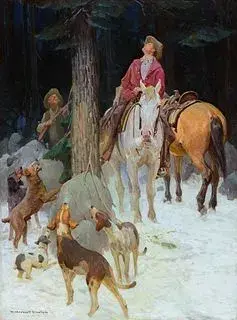
William Herbert Dunton (1878–1936) — Treed (ca. 1915):
William Herbert Dunton (1878–1936)
Treed (ca. 1915)
oil on canvas
40 × 30 inches
signed lower left
Treed will be included in Michael R. Grauer’s forthcoming W. Herbert Dunton Catalogue Raisonné.
“A ‘lone wolf?’ Yes, to the human. But I am far from alone for with me constantly is my art in which I am absorbed and back in the hills with a saddle horse and one to pack and with a hound or two I’m quite content; with the trees and streams and the deer, elk and bear all about me.” – William Herbert Dunton
According to art historian Michael R. Grauer, “Unlike his fellow artists in Taos, New Mexico, and most of his peers in Western art, W. Herbert Dunton was a true outdoorsman. Dunton worked annually in the West as a cowboy and hunter from 1896 to his first summer in Taos in 1912. Because of his work as a ‘puncher’ and hunter from Montana to Mexico, at one time Dunton was one of the most prolific and popular Western and outdoor illustrators in the United States.
“Born near Augusta, Maine, he hunted and fished with his maternal grandfather as a child, and later carried a sketchpad along with his rod or rifle. In 1896 ‘with a … new Winchester’ he traveled to Montana where he became a contract hunter for ranches in Park and Musselshell counties for two years. Back in Boston then New York, he wrote and illustrated articles for outdoor and sporting magazines. He became friends with Philip R. Goodwin, the most popular wildlife and sporting artist in America by the early 1900s.
“After first visiting Taos in 1912, he moved there in 1915. He continued hunting big game in the Sangre de Cristo Mountains, including deer, elk, bear, and mountain lion. Dunton also became Taos Fish and Game Protective Association president in the late ‘teens as his views toward wildlife in New Mexico evolved. While in Kansas City, Missouri, for an exhibition of his work there in 1924, Dunton delivered a radio address titled ‘Hunt But Don’t Kill All,’ lamenting the loss of game in New Mexico and the need to protect what remained.
“During pack-horse trips into the Sangre de Cristo Mountains in the late 1920s and early 1930s, he mainly made ‘dry-hunts,’ ‘taking’ game with a thumb-box of oil paints and small canvas panels. His last major paintings from 1930 to 1936 emphasize big-game animals – elk, deer, and especially bears – in simplified, stylized landscapes characterized by rich color.
“Treed is an excellent example of Dunton’s hunting paintings created while he still maintained his connections to Boston and New York publishers such as Forbes Lithograph Manufacturing Company. The most prominent lithographic house for the firearms and ammunition trade, Forbes printed advertising posters and calendars for firearms makers Hopkins & Allen, Marlin, Remington, Savage-Stevens, and Winchester.
“For about his first ten years in New Mexico, Dunton actively hunted and acted as a hunting guide. One of his frequent hunting partners was Elliott S. Barker (1886-1988), particularly on mountain lion hunts. Barker worked as a professional guide and hunter near Las Vegas, New Mexico, for two years before becoming a forest ranger in the Jemez National Forest in Cuba, New Mexico, and the Pecos National Forest in Pecos, New Mexico, beginning in 1909.
“Treed probably depicts a mountain lion hunt in which Barker may have been the inspiration for the younger hunter in the red coat mounted on the white horse. Barker was often photographed with a white horse. The figure of the older hunter in the background may have been inspired by Dunton’s friend and fellow hunter Bingham E. ‘Bing’ Abbott (1875-1948). The dogs include hounds, an Airedale, and a terrier.
“Writing to a patron in 1926, Dunton discussed the source of his ideas for hunter, hunting, and outdoor paintings: ‘The inspiration for this canvas – as in my others – was my own trips in the hills.… I have depicted no particular place – as I do in few of my canvases – changing the lines of those I see in nature to make a ‘composition.’ That is where the art comes in – taking what one wishes from a place or places and knowing what to discard.’
“As far as composition for these type of figure paintings, Dunton wrote to his friend Texas artist H. D. Bugbee in 1922 advising him about how to construct his paintings: ‘you also have got to arrange them so that they form artistic masses along the lines of which the eye is unconsciously led through and back and fourth [sic] across the canvas – never out of the picture.’ This describes Treed perfectly in that the eye is led into the picture by the right hind leg of the dog, exactly at center (his tail helps guide the eye). The curve of his body up to his head point up to whatever is ‘treed’ and is reinforced by the heads of the other four dogs and the hunter in the background all gazing up. The broken branch leaning against the tree at center forms an arrow pointing up the trunk of the pine tree (that reminds us of one of Goodwin’s signature hemlocks). Then our eye is led back down to the front brim of the younger mounted hunter, around his brim and down his shoulder to the saddle horn, then cantle, then horse’s rump, down its tail to the resting hind foot angled slightly toward the centermost dog’s tail. Then our eye jumps to the tail of the foremost dog and the journey starts all over again: ‘through and back and fourth [sic] across the canvas – never out of the picture.’
“Dunton insisted upon appropriate clothing and accoutrements in his paintings, although he never descended into accuracy for its own sake. In Treed both hunters carry Winchester rifles and the mounted hunter wears Barker’s signature ‘batwing’ chaps and a hat with what appears to be a Stetson Carlsbad crease, favored about this time. The buckskin horse carries a single-rigged open-loop Western stock saddle with Sam Stagg rigging and a cantle with a Cheyenne roll.
“Dunton bathed the foreground in a general light in the forest clearing. He posed both hunters and horses and the snow-covered ground and boulders against a dark forest background. This effect presages the theatricality – even artificiality – that came to characterize his much later canvases such as McMullin, Guide (1934), that aligned his work with the Regionalist movement of Grant Wood, John Steuart Curry, and Thomas Hart Benton. This theatricality is only heightened by the mystery of what has been ‘treed.’ This air of mystery (foreboding) is an undercurrent found in the ‘predicament paintings’ of Dunton’s friends Goodwin and Charles M. Russell.
“W. Herbert Dunton’s Treed is an outstanding example of wildlife and sporting art depicting the American West. This painting would make an exceptional addition to any collection of art of the American West or wildlife and sporting art, or both.”
PROVENANCE
The artist
Forbes Lithograph Manufacturing Company, Boston, Massachusetts
Private collection, Andover, Massachusetts
View more information
ConditionSurface is in good condition. Faint hairline cracks in the trees. Small line of inpainting on the solid-brown dog’s chest. Small spots of inpainting in the snow in the lower-right corner.
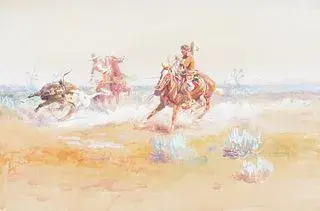
Charles M. Russell (1864–1926) — Mexican Vaqueros Roping a Steer (1925):
Charles M. Russell (1864–1926)
Mexican Vaqueros Roping a Steer (1925)
watercolor on paper
18 × 28 inches
signed and dated lower left
VERSO
Label, Mongerson Wunderlich Galleries, Chicago, Illinois
Mexican Vaqueros Roping a Steer is recorded in the C. M. Russell Catalogue Raisonné as reference number CR.PC.163. A typed letter from Mongerson Wunderlich Galleries detailing the PROVENANCE
of the work will accompany the lot.
Russell historian Ginger K. Renner wrote, “The Great Falls Tribune of Sunday, February 11, 1906, carried a story with a picture of the Cowboy artist, Charles M. Russell, headlined ‘He Is Going To Old Mexico.’ The reporter states that he and Mrs. Russell would visit the interior of Mexico for six weeks or perhaps two months, the purpose being to make a series of studies of ancient and modern types of the Mexican cowpuncher for Outing, the well-known, high-class magazine of sports and out-of-door life, the editor of which, Caspar Whitney, is a personal friend and great admirer of Russell. The story goes on to extol Russell’s art and the success he had been having not only in illustrating for several of the outstanding publications but that he was being recognized as an author, as well, since several of his sketches and stories would be appearing shortly in Outing.
“Apparently, between the time of that story and their departure for Mexico the plans developed further. First, Charley’s father, Charles Silas Russell, was invited to accompany them and probably through the contacts Whitney had, plans were made to present an exhibit of Russell’s art in the Porter Hotel in Mexico City. The Mexico City Daily Record of April 8, 1906, in a two-column story states, ‘The art exhibit at Porter’s Hotel this morning was as refreshing as the dawn itself.… The work of Mr. Russell is difficult to describe. Language faintly describes the exquisite touch of his magic brush and pen, or the marvelous details of his art.’ We have no information on how long the exhibit lasted, but during the Russells’ stay in the Capital they met the owner of the largest ranch in all Mexico. Señor Terrazas cordially invited the Russells to make an extended visit to his giant spread outside the city of Chihuahua, where Charley would have every opportunity to study and sketch the vaqueros and the stock and a different way of ‘cowboying.’ The several weeks the Russells were guests of Señor Terrazas were an eye-opening experience for Montana’s favorite artist and a number of paintings resulted.”
PROVENANCE
Nancy Russell, Pasadena, California
C. R. Smith, Washington, D.C.
George Miller,
George Miller, Jr.
Earl C. Adams, Los Angeles, California
Adams Family Trust, San Marino, California
Mongerson Wunderlich Galleries, Chicago, Illinois
Corporate collection, Chicago, Illinois
EXHIBITED
Art League of Santa Barbara, Santa Barbara, California, 1927
Biltmore Salon, Los Angeles, California, 1927
The West Remembered: Artists and Images, 1837-1973, California Historical Society, San Francisco, California, 1973
LITERATURE
The West Remembered: Artists and Images, 1837-1973, California Historical Society, 1973, p. 64, illustrated
Charles M. Russell: The Artist in His Heyday, Gerald Peters Gallery, 1995, pp. 92-93, illustrated
View more information
ConditionAs viewed through glass. The paper appears to be in good condition.
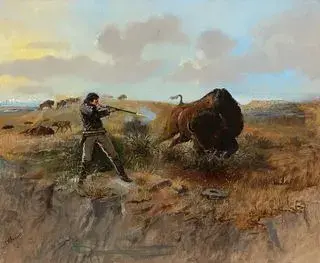
Charles M. Russell (1864–1926) — Shooting the Buffalo (ca. 1892):
Shooting the Buffalo (ca. 1892)
oil on canvas
27 × 33 inches
signed lower left
VERSO
Label, Amon Carter Museum, Fort Worth, Texas
Label, Buffalo Bill Historical Center, Cody, Wyoming
Shooting the Buffalo is recorded in the C. M. Russell Catalogue Raisonné as reference number CR.ACM.133.
According to Russell biographer Dr. Larry Len Peterson, “In the American West, opportunity calls men of courage. Around the time Shooting the Buffalo (ca. 1892) was created, Russell was preparing to leave the cowboy life behind for the uncertain life of a full-time artist. His dream would soon come to fruition, but that didn’t mean he erased from memory his last dozen years on the Montana range. Real life experiences along with bunkhouse banter and bravado would fuel his imagination the rest of his life. His future wife Nancy Russell explained, ‘No man can be a painter without imagination,’ and also courage. Better titled Contest on the Plains, this oil is a nostalgic tribute to Buffalo Bill Cody, the cowboy, and the bison – gratitude in solid form. Studying the bison more extensively than any other artist, Russell immortalized the symbol of ‘The West That Has Passed’ in oil, watercolor, clay, bronze, and nostalgic prose and poetry. The woolly beast inspired him to create his famous buffalo skull cipher and his most desirable art, the buffalo hunt.
“No artist was a better predicament painter than Russell. In this duel it is uncertain which gladiator will come out victorious. While the hunter advances the first blow, if the target isn’t lethal, then his future is in peril. Notice that he is teetering on uneven ground, backed up to the edge of a ravine, and there is no horse in sight to make a quick and safe escape. There were many stories of a raging bull enjoying the last laugh, which was just fine with Russell who was not a hunter. Very likely the popular legend that directly inspired this painting involved his idol, Theodore Roosevelt. The future president arrived in Dakota Territory in September 1883, just as the bison were near extinction. A rancher who made a thousand-mile trek throughout northern Montana reported to Roosevelt that during his entire trip he had never been out of sight of a dead buffalo and never been in sight of a live one. In 1881 with the commercial hunters killing 320,000 bison, the animals almost vanished from the plains, much like the Indian. The killing came to an end in 1883, when the Blackfeet netted their last few animals.
“As a disciple of Charles Darwin – champion of survival of the fittest – Roosevelt was determined to bag one of the last bison. Who was the fittest on the plains? Well, in his mind he was. Undaunted by rain and mud, the wilderness warrior and his hunting guide Joe Ferris confidently crossed into the badlands of eastern Montana, yet experienced no luck for days. Still, on September 20 they were finally rewarded. Exhausted from riding, walking, and crawling, Roosevelt wrote, ‘I put the bullet in behind his shoulder. The wound was an almost immediately fatal one, yet with surprising agility for so large and cumbersome an animal, he bounded up the opposite side of the ravine … and disappeared over the ridge at a gallop.’ In the next gully they found their prize ‘stark dead.’ The victor performed an Indian war dance and handed his guide a hundred-dollar bill. And Russell had the story to inspire him to create this work. Falling in love with the West, in 1884 Roosevelt built his famed Elkhorn cattle ranch, which was thirty-five miles north of the booming cow town of Medora, Dakota Territory. He would go on to pen the wildly popular Hunting Trips of a Ranchman (1885), Ranch Life and the Hunting Trail (1888), and The Winning of the West (1889), among dozens of other books.
“Early works such as Shooting the Buffalo anticipated Russell’s rise over the next thirty years to become the most beloved and famous Western American artist. Russell was an artist savant. He was a one-off. People have tried, but nobody’s come close to approaching his art, folksy appeal, and sheer fame. Western American art has never been bigger, thanks to Charlie, but at the same time, it feels a little smaller without him.”
PROVENANCE
Mrs. Rose Lane, Lewiston, Montana
Amon Carter Museum, Fort Worth, Texas
Coeur d’Alene Art Auction, Coeur d’Alene, Idaho, 1999
Private collection, Bryn Mawr, Pennsylvania
Private collection, Colorado, 2005
EXHIBITED
Bison in Art, Buffalo Bill Historical Center, Cody, Wyoming, 1977
LITERATURE
Don Russell, The Lives and Legends of Buffalo Bill, University of Oklahoma Press, 1960, p. 88, illustrated
Frederic G. Renner, Charles M. Russell: Paintings, Drawings and Sculptures in the Amon Carter Museum, Harry N. Abrams, Inc., 1974, p. 56, illustrated
View more information
ConditionSurface is in excellent condition. Canvas is lined. Faint bar mark in the center, along the top. Specks of inpainting in the sky.
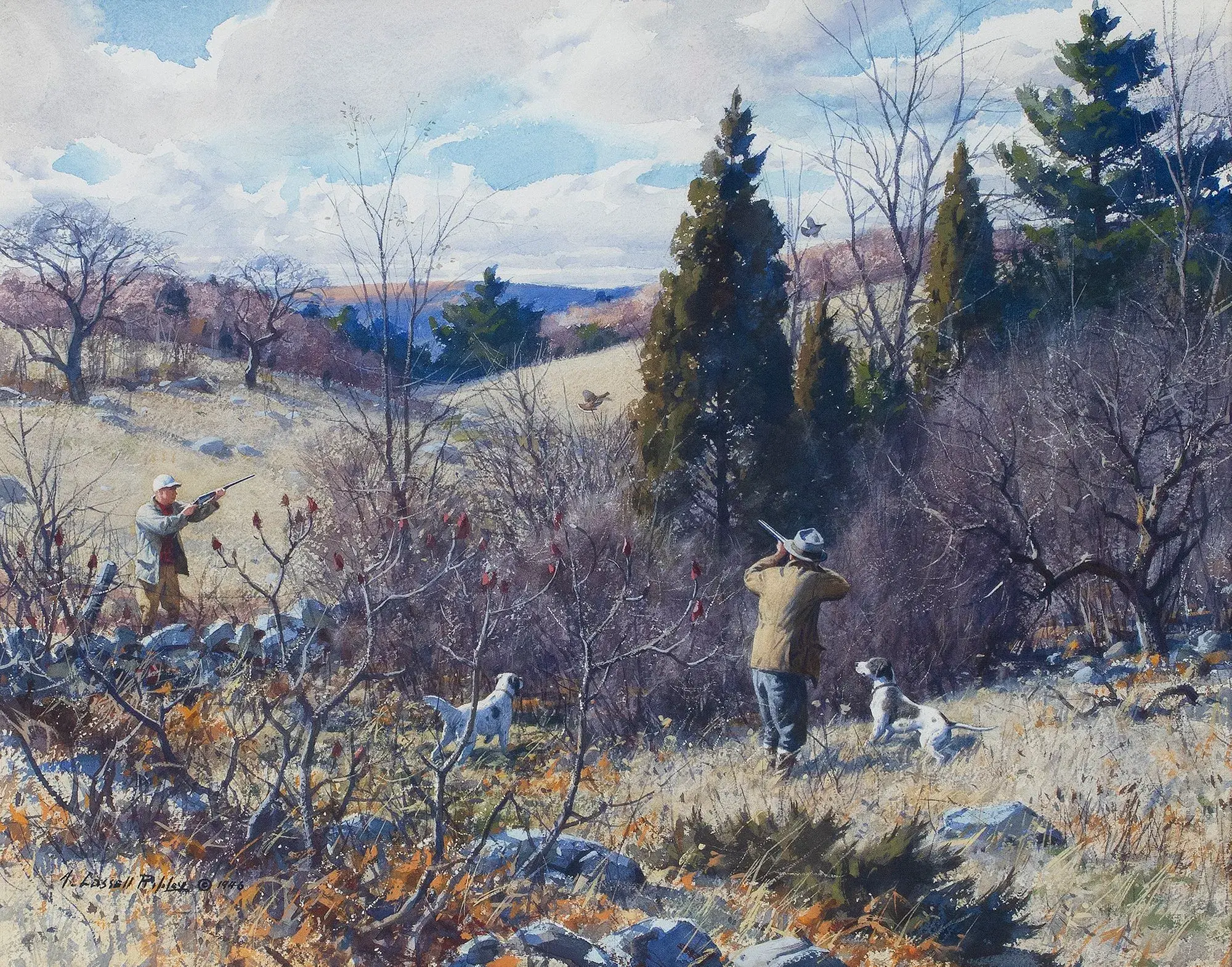
Aiden Lassell Ripley (1896-1969), Grouse Shooting:
Aiden Lassell Ripley (1896-1969)
Grouse Shooting, 1946
signed and dated “A. Lassell Ripley © 1946” lower left
watercolor, 18 by 22 in.
This 1946 watercolor is number four in a print series of six scenes done for “Field & Stream” entitled “Gunning in America.” The gentleman pictured to the right is most likely the artist, with his favorite dog, “Chief,” by his side. It is by many accounts the most important grouse hunting watercolor the artist ever produced.
Born in Wakefield, Massachusetts, Aiden Lassell Ripley was the son of a Boston Symphony Orchestra musician. From an early age he excelled at music, but he soon discovered a deeper interest in painting. By his mid-teens, Ripley was committed to a career in art, commuting into Boston to take classes. After returning from service in World War I, he attended the Boston Museum School where he studied with the country’s top artists, including Philip Leslie Hale (1865-1934) and Frank W. Benson (1862-1951).
Ripley was awarded a Paige Traveling Fellowship to study in Europe. While abroad, he painted watercolors “en plein air” in North Africa, France, and Holland. Upon his return in 1925, he was elected to the prestigious Guild of Boston Artists. His work focused on the New England countryside as well as depictions of city life and railroad commuting scenes. The Great Depression, however, limited the sales potential for these works. Following a successful one-man show of his sporting art in 1930, Ripley decided to change tack and specialize in hunting, fishing, and outdoor scenes as subjects.
Along with his contemporary Ogden Pleissner (1905-1983), Ripley exemplified the life of a successful sporting artist. Collectors of Ripley’s sporting art endorsed his numerous trips to the salmon rivers of New Brunswick and the quail plantations of Georgia, where the artist indulged his passion for hunting and fishing while recording material he would use in his art.
Provenance: Commissioned by Field & Stream, 1946
Private Collection, New Hampshire
Private Collection, Massachusetts
Literature: Stephen B. O’Brien Jr. and Julie Carlson Wildfeuer, “The Art of Aiden Lassell Ripley,” Boston, MA, 2009, pp. 53 and 125, illustrated. Field & Stream, February 1947, p. 35, illustrated. Sporting Classics, November/December 1997, pp. 70-71, illustrated.
Exhibited: New York, New York, Coe Kerr Gallery, December 2–January 8, 1982, no. 16.
Wildlife and Sporting Art: The Masters’ Show in Ligonier, 1987.
Dennis, Massachusetts, “Aiden Lassell Ripley (1896-1969): A Retrospective,” Cape Cod Museum of Art, August 2–October 5, 2008.
ConditionPlease email condition report requests to [email protected]. Any condition statement given is a courtesy to customers, Copley will not be held responsible for any errors or omissions. The absence of a condition statement does not imply that the lot is in perfect condition.