Chinese Export Famille Rose Porcelain Seated Boy

Chinese Export Famille Rose Porcelain Seated Boy

Chinese Export Famille Rose Porcelain Seated Boy:

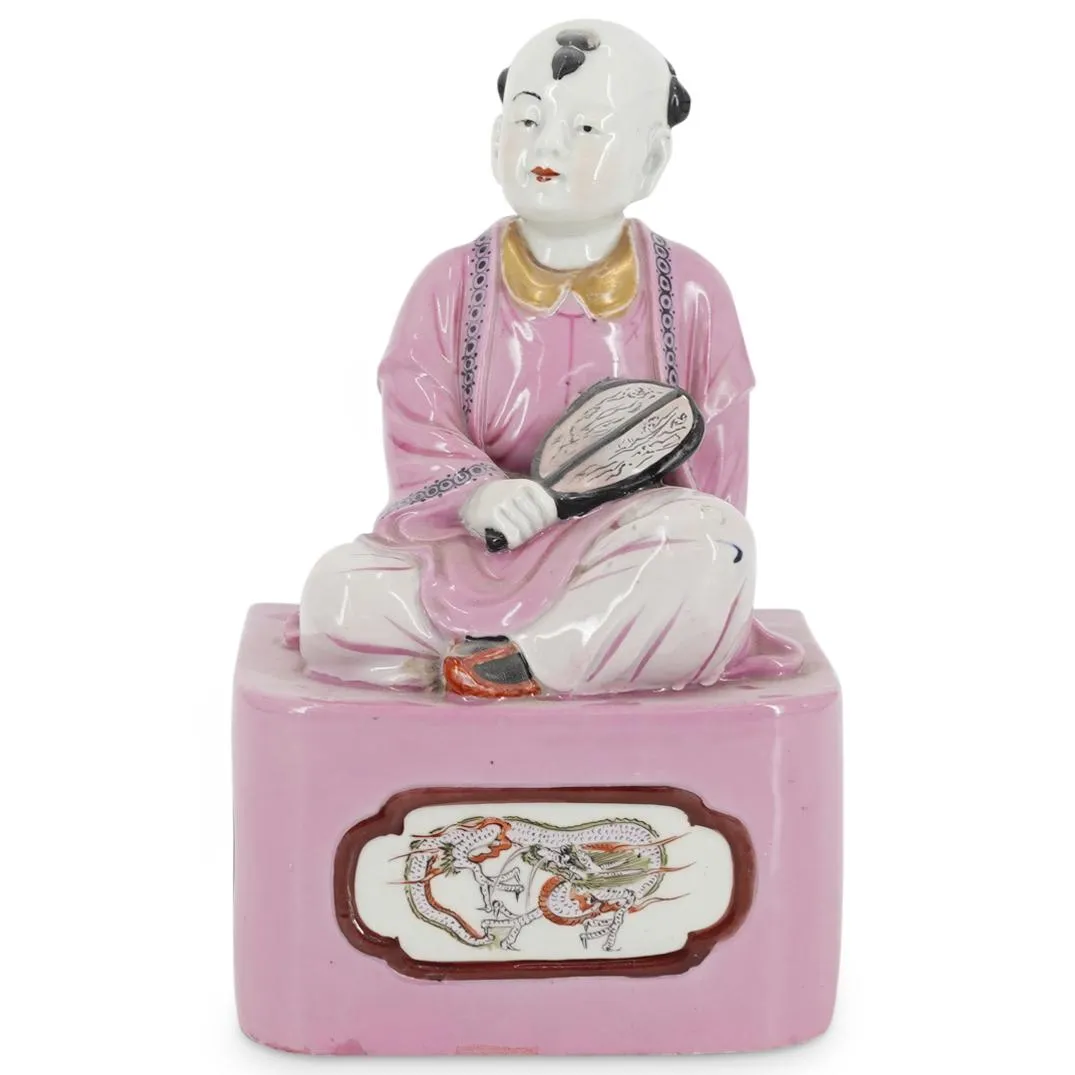
A Chinese export porcelain sculpture depicts a young boy with fan seated atop a raised pedestal. Painted in a famille pink and white ground with dragon accents along the bottom base.
CIRCA: Early 20th Cent.
ORIGIN: China
DIMENSIONS: H: 9″ W: 5.25″ Depth: 4.5″
CONDITION: Great condition. See lot description for details on item condition. More detailed condition requests can be obtained via email ([email protected]) or SMS (305) 333-4134. Any condition statement given, as a courtesy to a client, is only an opinion and should not be treated as a statement of fact. Akiba Antiques shall have no responsibility for any error or omission.

Joan Miro (Spanish 1893-1983) Signed Lithograph On Arches

Joan Miro (Spanish 1893-1983) Signed Lithograph On Arches

Joan Miro (Spanish 1893-1983) Signed Lithograph On Arches:

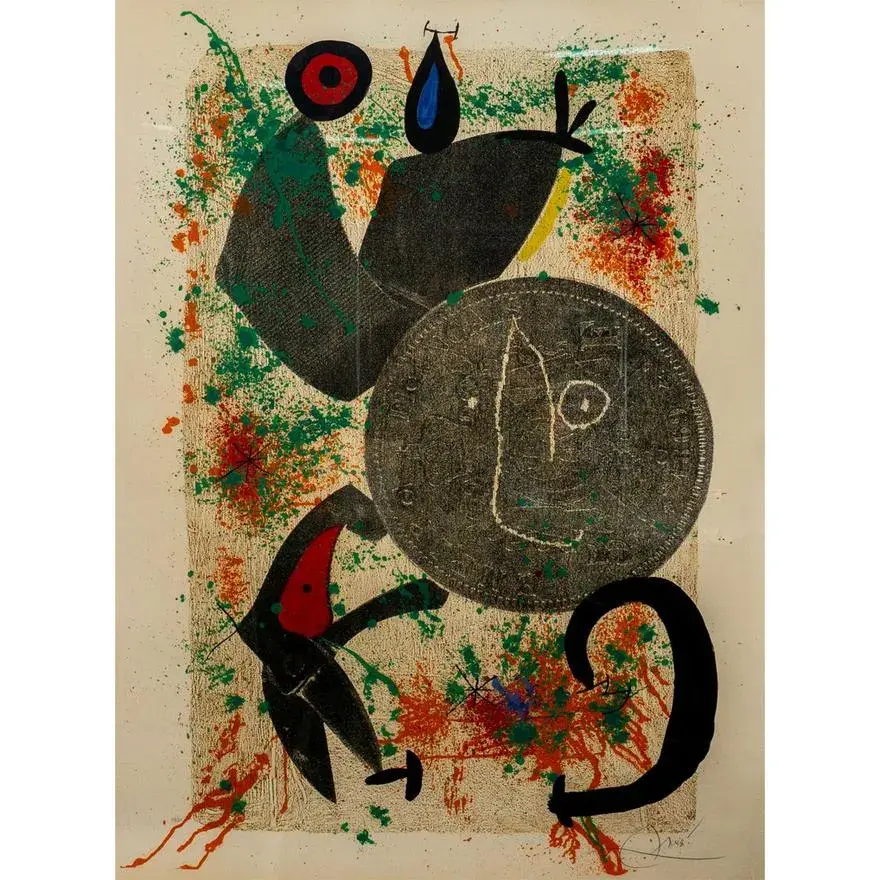
Title: Le Croc a Phynances II. Rare lithograph in color. Signed in pencil on lower right. Numbered on lower left;16/30.
English title: The Crooked Phynancial Phang II. Housed in silver toned metal frame with clear cover. Sight size – 36″W x 49″H. Frame size – 46.5″W x 60″H x 1.5″D. Joan Miro was (1893-1983) a Spanish Catalan artist. He did works in sculpture, painting, and worked as a ceramist. Earning international acclaim, his work has been interpreted as Surrealism but with a personal style, sometimes also veering into Fauvism and Expressionism. #Miro #modernart #Surrealism

Artist: Joan Miro
Issued: 1971
Manufacturer: Maeght-Editeur
Country of Origin: France
Condition
Minor age related wear. Overall good condition.

Chinese Kangxi Blue and White Porcelain Charger

Chinese Kangxi Blue and White Porcelain Charger

Chinese Kangxi Blue and White Porcelain Charger:

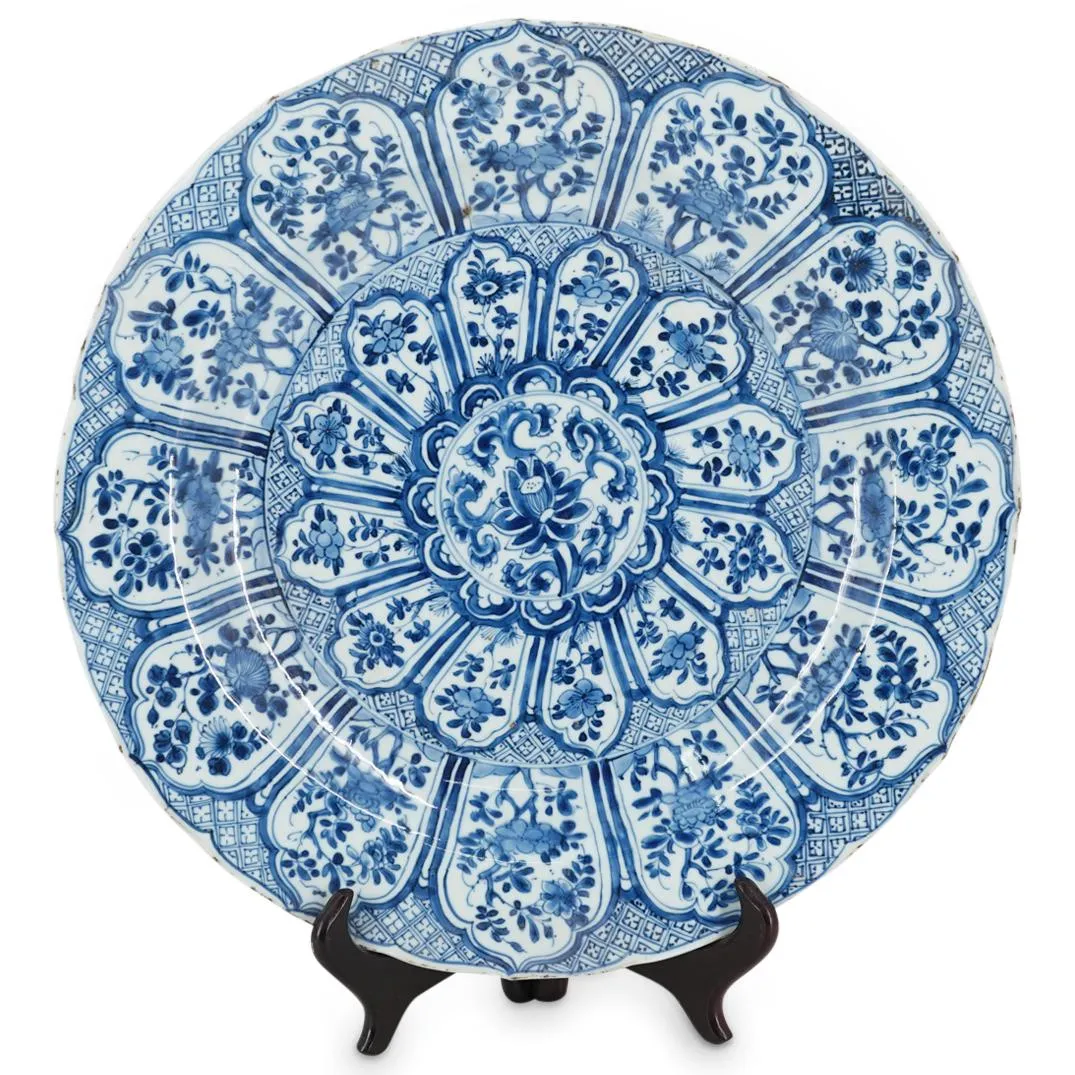
A 17th Cent. Chinese Blue and white porcelain charger centered by a lotus flower, encompassed by repeating floral plum banding, scalloped edge. Completed with a flower mark along the underside.
CIRCA: Late 17th Cent.
ORIGIN: China
DIMENSIONS: Diameter: 15.25″
CONDITION: Minor age flea bites See lot description for details on item condition. More detailed condition requests can be obtained via email ([email protected]) or SMS (305) 333-4134. Any condition statement given, as a courtesy to a client, is only an opinion and should not be treated as a statement of fact. Akiba Antiques shall have no responsibility for any error or omission.

Jerzy Nowosielski (Polish, 1923-2011) “Mirror” Nude Portrait Oil on Canvas

Jerzy Nowosielski (Polish, 1923-2011) "Mirror" Nude Portrait Oil on Canvas

Jerzy Nowosielski (Polish, 1923-2011) “Mirror” Nude Portrait Oil on Canvas:

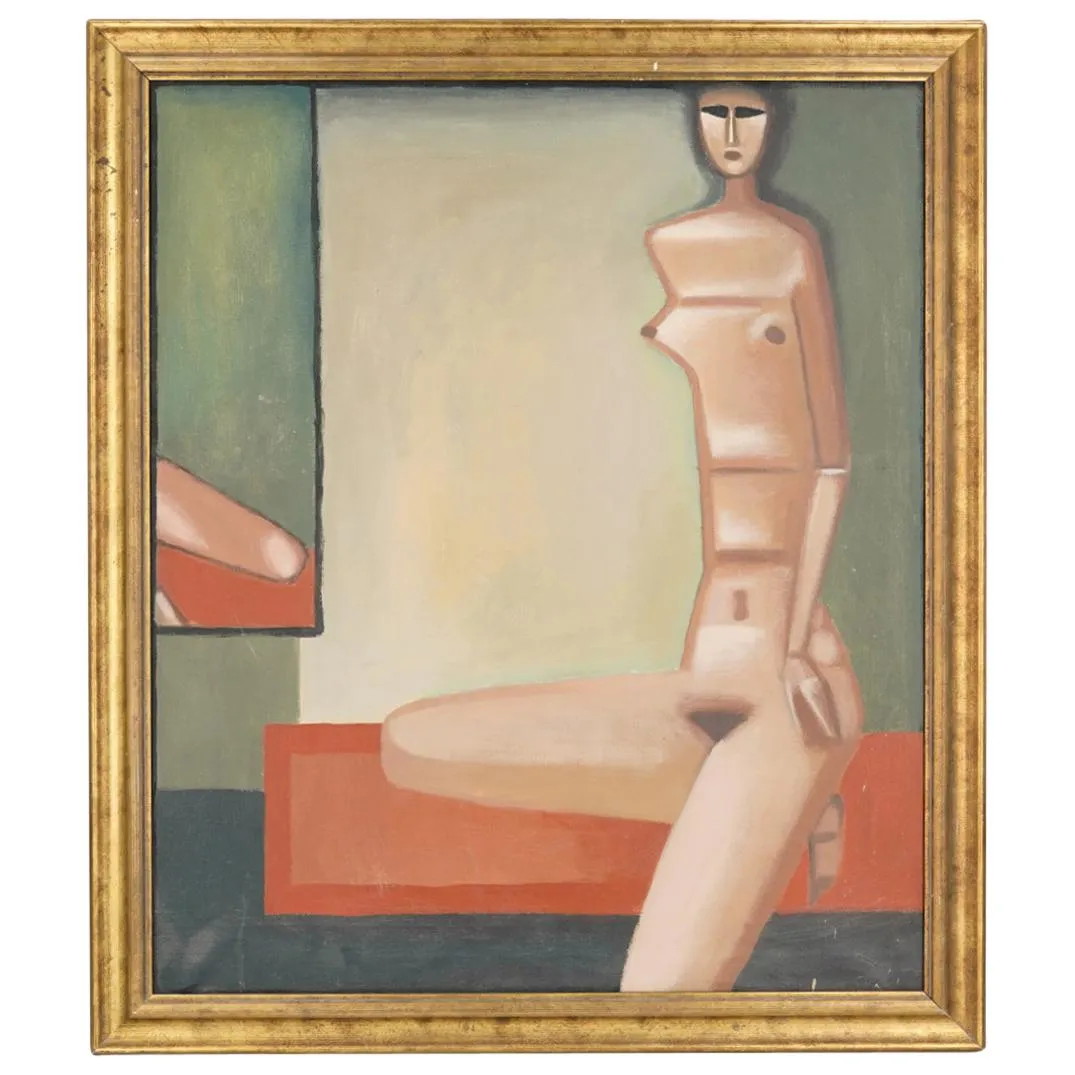
Portrait oil painting on canvas by Polish artist Jerzy Nowosielski (1923-2011) titled “Lustrem” (Mirror); Depicting a nude woman in a minimalist style.
Signed on canvas verso “Jerzy Nowosielski Artz Lustrem 19”. Mounted in gilt beveled wood frame.
CIRCA: 20th Century
ORIGIN: Poland
DIMENSIONS: Image H: 37.12″ X W: 30.75″, & Frame H: 42.5″ X W: 35.87″
CONDITION: Great Condition. See lot description for details on item condition. More detailed condition requests can be obtained via email ([email protected]) or SMS (305) 333-4134. Any condition statement given, as a courtesy to a client, is only an opinion and should not be treated as a statement of fact. Akiba Antiques shall have no responsibility for any error or omission.

Fossilized Ammolite Ammonite in Matrix by Korite

Fossilized Ammolite Ammonite in Matrix by Korite

Fossilized Ammolite Ammonite in Matrix by Korite:

North America, Canada, Alberta, Bearpaw formation, late Cretaceous, ca. 71 million years ago. This is a stunning ammonite in its natural shale matrix, where is has fossilized and rested for millions of years, the shell transforming into ammolite, a brilliant organic gemstone. This ammonite is a rare Placennticeras costatum; less than 10% of ammonites found belong to this species! The entire piece is carefully prepared – the fossil excavated so the surface is slightly raised from the surrounding stone. Even the vibrant colors are unique- amongst the greens, reds, and orange, there are unusual blue and purple hues, which shimmer and contrast starkly against the gray matrix. This is an exciting specimen that can be displayed face up or propped on the side to best see the color play that is hard to truly capture in photos! Size (ammonite fossil): 7″ L x 5.5″ W (17.8 cm x 14 cm); (stone matrix): 18.5″ L x 3″ W x 16″ H (47 cm x 7.6 cm x 40.6 cm)

This fossil was prepared by the company Canada Fossils Ltd, the sister company to Korite, the largest commercial producer of natural ammolite gemstones and jewelry using ethical practices. Together, they provide ammonites and other amazing finds to important institutions, including an ammonite on display in the American Museum of Natural History in New York! This piece comes with a copy of the certificate of authenticity from Korite.

Ammolite is a rare, iridescent, gem-quality material cut from the fossilized shells of extinct sea creatures known as ammonites. Found only in the Bearpaw Formation in Alberta, Canada – along the eastern slopes of the Rocky Mountains – this organic gemstone has a dazzling range of colors and patterns and is highly desired for freeform natural cabochons and assembled jewelry pieces.

According to the International Gem Society (IGS) statement on the difference between Ammolite and Ammonite: “You may find the terms ammolite and ammonite sometimes used interchangeably. However, ammonite, strictly speaking, refers to the fossil shells of ammonites, whether gem-quality or not. Ammolite refers to the gem-quality material made from fossils of particular species of ammonites.” Also, according to IGS, “Ammonites were marine mollusks that became extinct around 65 million years ago. There were many species of ammonites, and their fossils have been found across the globe. The fossils of Placenticeras meeki, Placenticeras intercalare, and Baculites compressus can yield gem-quality ammolite. To date, this material has been found only in Alberta, Canada.”

Provenance: private Berthoud, Colorado, USA collection

All items legal to buy/sell under U.S. Statute covering cultural patrimony Code 2600, CHAPTER 14, and are guaranteed to be as described or your money back.

A Certificate of Authenticity will accompany all winning bids.

PLEASE NOTE: Due to recent increases of shipments being seized by Australian & German customs (even for items with pre-UNESCO provenance), we will no longer ship most antiquities and ancient Chinese art to Australia & Germany. For categories of items that are acceptable to ship to Australia or Germany, please contact us directly or work with your local customs brokerage firm.

Display stands not described as included/custom in the item description are for photography purposes only and will not be included with the item upon shipping.

#170382
Condition
Professionally excavated and prepared. Shale stone matrix is coated in a black protective fixative to prevent losses. A square wooden base is permanently attached to verso for displaying ammonite face up. Ammonite fossil is coated in clear protective coating. Amazing ammolite extra bright grade AA coloration and rare hues.

Roman Palmyrene Limestone Portrait Head – Veiled Woman

Roman Palmyrene Limestone Portrait Head - Veiled Woman

Roman Palmyrene Limestone Portrait Head – Veiled Woman:

Near East, Palmyra, Roman Imperial Period, ca. 1st to 2nd century CE. A gorgeous female portrait head, perhaps intended as a funerary portrait – that is hand-carved from creamy yellow-white limestone and replete with intricately stylized yet almost veristic detailing. The feminine visage presents in high relief with upturned, almond-shaped eyes with drilled pupils beneath sweeping brows, a slender nose with nostrils flanked by asymmetrical nasolabial folds, full lips with a delineated philtrum, and earlobes adorned by elegant earrings. A forehead chain peeks out from beneath a bejeweled diadem and with a coiffure consisting of carefully incised rows of curls, all beneath a delicate veil. Size: 13″ H (33 cm)

Palmyra was a wealthy city that linked the caravan routes from the Parthian Near East with the Roman Mediterranean. The people who lived there during this period largely enjoyed prosperity and were able to adopt eastern and western customs, clothing, and artistic styles, creating a distinctive visual culture unique to the city. We know of this culture today from the large funerary monuments that the Palmyran people built – tower-shaped vaults whose interiors were lined with sculpted limestone reliefs depicting the deceased.

Palmyrene sculpture was made from a stone that is largely nonreflective – usually limestone as we see in this example; however, the ancient Palmyrene sculptors excelled at sharp, angular chisel work that resulted in strong patterns which made for dramatic silhouettes and shadows. Just imagine this piece in its dark, shadowy tomb environment – lit by candlelight so that its intricate surface patterns would come to life as it were, the smooth facial contours contrasting with the darkness surrounding it – quite a vision indeed!

Another Palmyrene limestone portrait head of a woman hammered for 75,600 GBP ($90,727.56) at Sotheby’s, London “Ancient Sculpture and Works of Art Part I” auction (December 7, 2021, lot 27)

Provenance: private New York, New York, USA collection; ex-American philanthropist J.I.K. collection, Florida, USA, acquired 1970s to 1980s

All items legal to buy/sell under U.S. Statute covering cultural patrimony Code 2600, CHAPTER 14, and are guaranteed to be as described or your money back.

A Certificate of Authenticity will accompany all winning bids.

PLEASE NOTE: Due to recent increases of shipments being seized by Australian & German customs (even for items with pre-UNESCO provenance), we will no longer ship most antiquities and ancient Chinese art to Australia & Germany. For categories of items that are acceptable to ship to Australia or Germany, please contact us directly or work with your local customs brokerage firm.

Display stands not described as included/custom in the item description are for photography purposes only and will not be included with the item upon shipping.

#173298
Condition
Loss to proper lower left corner and tip of nose as shown. Chips and abrasions commensurate with age, with minor softening to some finer details, otherwise in excellent condition with great preservation to most detailing.

Signed Qi Baishi Painted Handscroll – Shrimp, Crabs, Frogs

Signed Qi Baishi Painted Handscroll - Shrimp, Crabs, Frogs

Signed Qi Baishi Painted Handscroll – Shrimp, Crabs, Frogs:

Qi Baishi (Chinese, 1864-1957). Shrimp, Crabs, Frogs, and Aquatic Plants Handscroll Painting – ink and colors on paper, n.d. Signed and stamped with two seals (see extended description below for discussion of calligraphic inscription and seals). A magnificent ink and wash painted handscroll by the legendary Chinese literati artist Qi Baishi depicting various sea creatures and aquatic plants in a long and impressive horizontal format. Ocean blue leaves of aquatic plants lead the viewer’s gaze toward the left to view a trio of frogs, a pair of crabs, five shrimps, another crab, another pair of shrimps that crawl toward the left above additional blue-green plantlife, and finally, a sinuous gathering of crabs that swim in a meandering manner toward a single crab that faces them as well as the beginning of the scroll to complete the composition. An outstanding handscroll of a rare format, presenting this lively ensemble of sea creatures and plants with an elegant, flowing quality. Size of painting: 145.25″ L x 10″ W (368.9 cm x 25.4 cm)

The calligraphic inscription reads: Xingtang laowu hou ren Qi Huang hua (Painted by Qi Huang, descendent of the old house in Xingtang)

The small seal reads Qi Da

The larger seal reads Jieshan yin guan zhuzhe, one of Qi Baishi’s many studio names.

The Metropolitan Museum of Art’s curatorial description of Qi Baishi’s “Water Life” (1940), which also features a sea creature theme, captures the magic of this artist’s virtuosity with the following words, “The sweeping tendrils and crusty shell of the shrimp, the structure of the crab, and the moist flesh of the frogs poised to spring are rendered with the greatest economy of means. The paper becomes the pond in which elemental life is stirred by the brush.”

Qi Baishi has been lauded as “the most popular painter in 20th century China, esteemed by the conservative scholarly elite, the common citizens of China’s urban centres, foreign collectors and revolutionaries both artistic and political for his traditional paintings of birds, flowers, small animals and insects. The range of his appeal from the 1920s onwards derived from his character, his lifestyle and his image as a traditional, high-minded scholar–artist who remained aloof from corrupt politics and preserved cultural values during the politically and socially unsettled period after the fall of the Qing dynasty (1644–1911)” (Oxford Art Online).

Born and raised in Hunan province, Qi Baishi was a self-taught artist who lived a modest life working as a craftsman prior to pursuing painting. Baishi’s story is among the most romantic of art history, because he would rise from these humble beginnings to become a master literati artist, creating impressive paintings in addition to calligraphy, seal carving, and poetry. Baishi studied with masters of the Shanghai School of painting and then moved to Beijing where both domestic and international collectors became his patrons. Following the establishment of the People’s Republic in 1949, Baishi’s humble background led devotees to celebrate him as a “people’s artist.” He was named Outstanding Artist of the Chinese People by the Ministry of Culture and was also awarded the World Peace Prize by the World Peace Council in 1955. While Baishi was undoubtedly an heir to the classical tradition of literati painting, his art stood apart for its marriage of traditional culture and modern innovation, employing virtuosic brushwork and scintillating coloration. (Sources: Oxford Art Online, The British Museum website, The Metropolitan Museum of Art website)

Qi Baishi made history in 2017 as the first Chinese artist to surpass the $100 million mark at auction. His “Twelve Landscape Screens” (1925) sold for $140.8 million (931.5 million yuan) – the highest price ever for a Chinese painting – at Poly Beijing.

A Qi Baishi hand-painted scroll entitled “Crabs and Shrimps” that measured 40 1/2 x 13 3/8 inches sold for $254,783 at Sotheby’s Hong Kong on April 2, 2019 – lot 1367.

A Qi Baishi handscroll entitled “Shrimps and Crabs” (1933) that measured 13 x 51 1/6 inches sold for $205,920 at Christie’s Hong Kong on May 31, 2016 – lot 1359.

Provenance: Private Gaithersburg, Maryland, USA collection, inherited from their father who was an art collector and an adjunct professor at the Academy of Arts & Design of Tsinghua University in Beijing, China

All items legal to buy/sell under U.S. Statute covering cultural patrimony Code 2600, CHAPTER 14, and are guaranteed to be as described or your money back.

A Certificate of Authenticity will accompany all winning bids.

PLEASE NOTE: Due to recent increases of shipments being seized by Australian & German customs (even for items with pre-UNESCO provenance), we will no longer ship most antiquities and ancient Chinese art to Australia & Germany. For categories of items that are acceptable to ship to Australia or Germany, please contact us directly or work with your local customs brokerage firm.

Display stands not described as included/custom in the item description are for photography purposes only and will not be included with the item upon shipping.

#172601
Condition
Recently remounted. Staining of paper appears to be consistent with natural aging. Expected creases commensurate with age as well. Imagery, colors, calligraphy and seal stamps are vivid. Custom box is in excellent condition.

Henry Viii D6888 (Double Handled) – Large – Royal Doulton Character Jug

Henry Viii D6888 (Double Handled) - Large - Royal Doulton Character Jug

Henry Viii D6888 (Double Handled) – Large – Royal Doulton Character Jug:

White and black with gold trim.
This is a two-handled jug and, strictly speaking, should be classified as a loving cup. It was issued in 1991 in a limited edition of 1,991 to commemorate the 500th anniversary of the birth of Henry VIII.

Artist: William K. Harper
Issued: 1991
Dimensions: 7″H
Edition Number: 909 of 1991 Manufacturer: Royal Doulton
Country of Origin: England
Condition
Good

Royal Doulton Apothecary Loving Cup

Royal Doulton Apothecary Loving Cup

Royal Doulton Apothecary Loving Cup:

Two colorful textured panels. Limited edition piece.
The supplier of love potions and poisons as well as medicinal drugs, the apothecary played an important role in Elizabethan times. If his potions were held to be particularly powerful he could become a wealthy man; although it was best not to ask what went into them! Romeo, hearing that Juliet is dead, remembers an apothecary from whom he can buy poison for himself: In tattered weeds with overwhelming brows Culling of simples; meagre were his looks; And in his needy shop a tortoise hung An alligator stuf�d and other skins Of ill-shaped fishes. The apothecary depicted on the lovingcup is a successful man. He is seen talking to a richly dressed lady while two dandies wait in an ante-chamber as another customer is admitted by a page. There are pots of ingredients, a pestle and mortar and a large globe. Skeletons adorn the walls and the ghostly faces of lovers are moulded in relief around the rim and on the handles. On the base are the words spoken by Romeo before he takes his poison �0 true apothecary Thy drugs are quick�. Doulton backstamp. #Ceramic #England #Vase #HomeDecor

Issued: 1934
Dimensions: 6″H
Edition Number: 546 of 600 Manufacturer: Royal Doulton
Country of Origin: England
Condition
Good.

Doulton Lambeth Large Stoneware Jug, Admiral Lord Nelson

Doulton Lambeth Large Stoneware Jug, Admiral Lord Nelson

Doulton Lambeth Large Stoneware Jug, Admiral Lord Nelson:

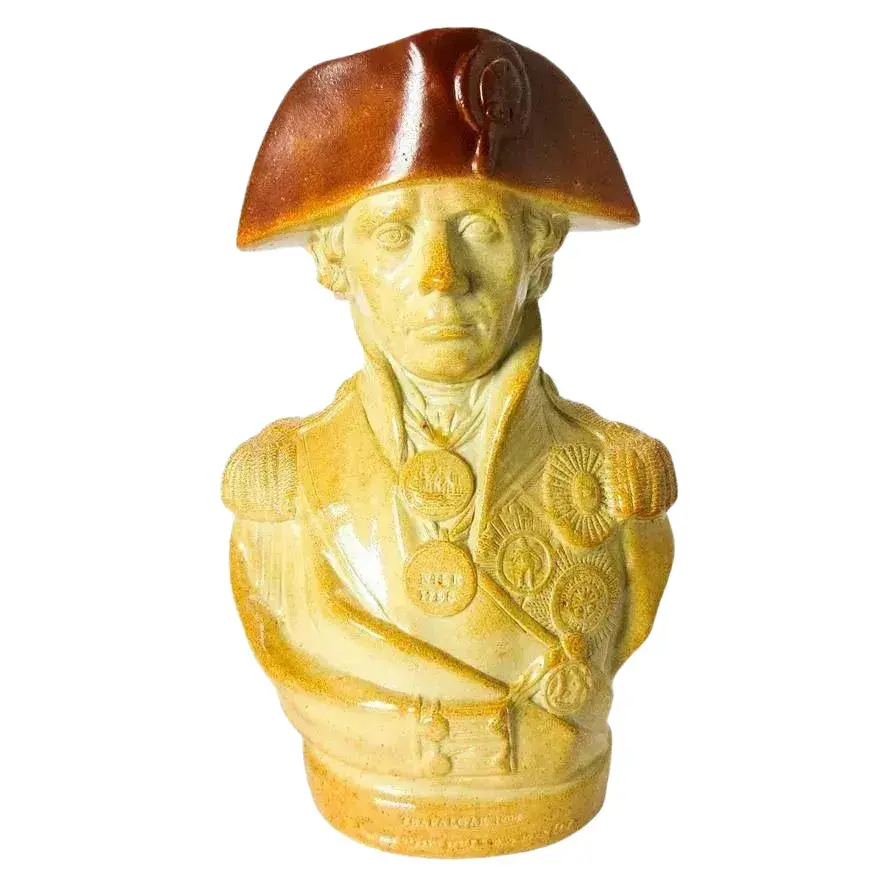
Style Two. Salt-glazed stoneware jug modeled from head to waist. Two-tone tan and brown coloration. Ponytail handle.
Modeled with medals of accomplishments on the chest. The inscription around the base of this jug is Nelson’s famous words spoken before the Battle of Trafalgar, “England expects every man to do his duty.” Base unmarked. #doultonlambeth #doultonwatts #stoneware #lordnelson

Issued: 1845 – 1880
Dimensions: 11″H
Manufacturer: Doulton and Watts
Country of Origin: England
Condition
Good.