Chicken Foot signed guitar:
Frame: 24 x 41 3/4 inches. Depth: 6 inches. NOTE: LARGE ITEM TO SHIP.

Chicken Foot signed guitar:
Frame: 24 x 41 3/4 inches. Depth: 6 inches. NOTE: LARGE ITEM TO SHIP.

Pablo Picasso (Spanish 1881-1973) Trois Femmes:
1960, pencil signed and numbered 24/50, with wide margins, Galerie Louise Leiris, Paris, publisher. Color linocut on Arches.
[Bloch, 926; Baer, 1248]
image: 20 7/8 x 25 1/4 in. (53 x 64.1cm)
sheet: 24 1/4 x 29 3/8 in. (61.6 x 74.6cm)
Condition report:
Time, light and mat staining. The lighter tan color is almost imperceptibly lightened. There is a darker outline around the overmat window area. There is some variation in the light staining, such as a darker area at the lower right near the signature. There is an approx. 1 in. by 1/8 in. moisture stain at the extreme bottom left sheet corner. The darkening of the sheet edge is consistent with contract with an acidic frame. Traces of surface soiling are evident in the margins, with an occasional very pale fox mark, for example at bottom right margin corner. The sheet is trimmed and shows variation in height, indicating it was trimmed unevenly along the top and bottom. For example, the top left corner and bottom right corner show an uneven nature. The width varies by approx. 1/16 in. because of trimming. On verso, old adhesive is apparent at top left, otherwise there is no evidence of prior glue or tape. There is light time and age staining, with a very pale line of faint staining at top right quadrant that does not show through to the front. There is a pinpoint fox mark at left center, approx. 2 in. from left edge. The work is currently framed in a wood frame that does not appear to be archival, and the print makes contact with the frame at all four points. Overall good condition.
Frame: 25 1/2 x 30 1/2 x 1 1/2 in.

Esteban Vicente (American/Spanish, 1903-2001) Untitled:
Signed bottom right, signed again and dated 1980 verso, mixed media and paper collage on canvas.
(48 x 40 in. (121.9 x 101.6 cm))
Provenance
Gruenebaum Gallery, New York, New York.
Private Collection, Bethesda, Maryland.
Footnote:
Note
Esteban Vicente was an important member of the first generation of New York School Abstract Expressionists, which included fellow artists Franz Kline, Jackson Pollock, Barnett Newman, and Willem de Kooning, with whom he shared a floor in his rented studio on East 10th Street. Turning away from representational painting in favor of works that emphasized shape, color, and pigment, Vicente referred to his paintings as “interior landscapes.” The use of collage – paper torn by hand, typically combined with other media such as oil, pastel, graphite, ink, or gouache – is also employed in many of the artist’s works, including the present lot. Initially trained as a sculptor, Vicente would go on to create small-scale wood assemblages called “divertimientos” and to teach painting classes, including at the New York Studio School and the progressive Black Mountain College. The artist had his first solo show at the Kleeman Gallery in New York in 1937, and six decades later the Spanish government opened the eponymous Museo de Arte Contemporáneo Esteban Vicente in Segovia.
Condition report:
The wood of the stretcher is showing through the canvas slightly in two areas at the top edge. These areas are stable and one appears to have been affixed with the glue used for the collage.There are occasional light brown stains in the paper, most likely inherent. The red collaged paper is lifting slightly at the bottom right corner. Overall good original condition.
Frame: 49 3/4 x 41 1/2 x 2 in.

Andy Warhol (American, 1928-1987) Mao:
1972, signed and initialed in black felt-tip marker and dedicated ‘to Janet Solinger,’ signed again in blue ball-point pen and stamp-numbered 236/250 verso (there were also 50 artist’s proofs pencil signed and numbered), the full sheet, Castelli Graphics and Multiples, Inc., New York, co-publishers and with the artist’s copyright inkstamp verso. Color screenprint on Beckett High White paper.
[Feldman & Schellmann, II.99]
(sheet: 36 x 36 in. (91.4 x 91.4cm))
Condition report:
The sheet rippled throughout as is common with works from this series. The paper is somewhat stiff, and exhibits toning/some darkening in the uninked areas and on verso. With a series of approximately 10 shallow vertical cracks in the ink, each measuring between 1/2 to 1 1/2 inches up the center of the sheet mainly through the subject’s neck, face and forehead. Additionally there are two in the turquoise at right near the black squiggle and shoulder/neck, two at lower left, as well as larger (approx. 5-inch) crescent-shaped crack in the turquoise at upper left corner, a few in the green including lower center and an ‘x’ shaped small crack at lower right corner. The sheet edges showing wear and a few short nicks or creases. Hinged/taped to the support in four places at the reverse (showing through slightly); the lower two were cut to allow examination of the sheet verso. Overall, generally in good, original condition.
Frame: 36 1/2 x 36 1/2 x 2 in.

Richard Pousette-Dart (American, 1916-1992) Small Cathedral:
Signed, dated 79 and inscribed #18 verso, titled on stretcher in another hand, acrylic on linen.
(42 x 33 in. (106.7 x 83.8cm))
Provenance
Obelisk Gallery, Inc., Boston, Massachusetts.
Private Collection, Pennsylvania.
Footnote:
Note
One of the founders of Abstract Expressionism, Richard Pousette-Dart was born in Minnesota to two creative parents, his mother a poet and musician and his father a painter, writer, and art director. The family moved east to Valhalla, New York in 1918, and Pousette-Dart attended Bard College in 1936 for just one year. He then decided to pursue his artistic career independently, moving to New York City and working as an artist’s assistant, while experimenting with his own photography, sculpture, drawing, and painting. While living in the city, the artist made frequent trips to the Natural History Museum, as he was particularly fascinated by Native American art in the collection, drawing on the universal quality of the forms and shapes he observed in the works on view for his own experimentation.
Pousette-Dart gained early recognition and had his first solo exhibition at the Artists’ Gallery in New York, in 1941, shortly thereafter beginning to work on a monumental scale, creating some of the first mural-sized Abstract Expressionist canvases. He went on to show at Howard Putzel’s gallery, as well as Peggy Guggenheim’s Art of This Century, before joining the Betty Parsons Gallery in 1948, which represented his fellow New York School artists Mark Rothko, Jackson Pollock, and Clyfford Still, and where Pousette-Dart began a long-standing association. Preferring the solitude of life outside of the city, Pousette-Dart relocated upstate in 1951, where he maintained a residence and studio for the rest of his life.
The artist continued to work and exhibit with the Abstract Expressionst painters even after his move, and in 1950 joined the protest of the Metropolitan Museum of Art’s juried exhibition “American Painting Today,” claiming the museum held contempt for modern painting and had no intention of showing “advanced art” in the exhibition. Pousette-Dart posed for a now-famous photograph titled “The Irascibles,” with Pollock, Still, Rothko, Robert Motherwell, Willem de Kooning, and others, that was published in Life Magazine in 1951, along with a story of the artists’ protest. This publicity helped popularize the term Abstract Expressionist and solidify the group as an important force in modern American art. Later in life, Pousette-Dart held teaching positions at the Art Students League, Columbia University, and Sarah Lawrence College. His work is in museum collections around the world and he has been the subject of several ambitious retrospective exhibitions, at the Indianapolis Museum of Art and the Whitney Museum of American Art.
Pousette-Dart painted in vibrant, pulsating color as often as in a reduced black and white palette, as seen here in Small Cathedral from 1979. The painting incorporates geometric and biomorphic shapes, playing on the universal forms and iconography the artist referred to again and again in his work, brought to life by a thickly applied impasto of acrylic paint. The dance of dots and lines, measured out along the canvas, create a playful surface that carries the eye around and up and down, providing a new experience every time it is engaged. Pousette-Dart once said “I strive to express the spiritual nature of the Universe. Painting for me is a dynamic balance and wholeness of life; it is mysterious and transcending, yet solid and real.” [1] Standing like a black and white stained-glass window, the painting calls to mind other “cathedral” works by the artist, including a ten-by-ten foot bronze panel in the collection of the Indianapolis Museum of Art, from 1990. Created more than ten years after Small Cathedral, the panel engages with similar themes, executed in light and dark bronze surfaces on a grandiose scale. A playful late work by a well-known artist, Small Cathedral encapsulates the painter’s life-long project, bringing an energy and universality to the fundamental experience of abstraction.
[1] Richard Pousette-Dart: Drawings, exh. cat., Chicago: Arts Club of Chicago, 1978.
Condition report:
Frame: 44 1/4 x 34 3/4 x 3 in.

Barbara Hepworth (British, 1903-1975) Torso II (Torcello):
1958, stamped 3/6 bottom center, Susse Frères, Paris foundry. Bronze with cement base.
Dimensions without base:
height: 34 1/4 in. (87cm)
width: 21 in. (53.3cm)
depth: 10 in. (25.4cm)
base: 1 1/2 x 16 x 16 in. (3.8 x 40.6 x 40.6cm)
Provenance
Gimpel Fils, London, United Kingdom.
Private Collection (acquired directly from the above in 1961).
Private Estate (by family descent).
Footnote:
Literature
Bowness, Alan, Barbara Hepworth, London 1961, no. 234 (another cast illustrated).
Hodin, J.P., Barbara Hepworth, London: Lund Humphries , 1961, pp. 22, 169, no. 234 (another cast illustrated).
Hammacher, A. M., et al., Barbara Hepworth, London: Thames & Hudson, 1968, rev. ed. 1987, p. 130, 138, pl. 106 (another cast illustrated).
Jenkins, David Fraser, Barbara Hepworth: A Guide to the Tate Gallery Collection at London and St. Ives, Cornwall, London: Tate, 1982, p. 17, 31 (another cast illustrated).
Tate Gallery Acquisitions 1980-2, London: Tate, 1984, pp. 115-16, (another cast illustrated).
Cork, Richard, “On Growth and Form,” Tate: The Art Magazine, (Winter 1994) no. 4, p. 38 (another cast illustrated).
Festing, Sally, Barbara Hepworth: A Life of Forms, London: Viking, 1995, p. 229.
Gale, Matthew and Chris Stephens, Barbara Hepworth: Works in the Tate Gallery Collection and the Barbara Hepworth Museum St. Ives, London: Tate, 1999, cat. no. 41, p. 169 (another cast illustrated).
Curtis, Penelope, Barbara Hepworth, London: Tate, 1998/2013, p. 52, 53 (another cast illustrated).
Note
The sculpture will be included in the upcoming revised catalogue raisonné of the artist’s work as BH 234, by Dr. Sophie Bowness, Hepworth Estate, London.
Growing up on the West Riding, Yorkshire where her father was a land surveyor, Barbara Hepworth developed early on a keen awareness of the rounded forms of hill and landscape juxtaposed against sweeping coastlines, all shaped by movement of wind and sea. The rounded forms, cavities, textures, crevices and hollows that define her mature work evoke these formative visual memories.
After attending art school in the 1920s at the Leeds Art School (where Henry Moore was a fellow student) and the Royal College of Art, London, Hepworth studied in Paris and Italy, including a period studying the carving of marble from master-carver Giovanni Ardini. Hepworth was married to two artists, first to John Skeaping and later to Ben Nicholson, and spent decades living and working mainly in England and France. Throughout the 1930s and 1940s, Hepworth worked prolifically, and visited and exhibited with artists including Picasso, Braque, Calder and Gabo.
The early 1950s, however, were a period of pain and loss for Barbara Hepworth. Unforgettable memories and images of human suffering, death, and destruction were indelibly stamped upon the collective consciousness of human experience as a result of the Second World War. In addition, Hepworth’s marriage to Ben Nicholson broke up, closely followed by the 1953 death of her son who was flying in the Royal Air Force. Former studio assistant, David Lewis described the artist’s grief during this time as a “physical as well as an emotional cavity which….became real in the hollows and tunnels of her sculptures, a way of expressing – as a woman and a sculptor – an emotional and spiritual inwardness within outer form.”
Executed in 1958, Torso II (Torcello) is the second of three torso variations created in a period when Hepworth had begun working with expanded aluminum as a hollow framework for the application of plaster used to create her sculpture. This technique allowed the artist a certain fluidity and speed with which to create weighty forms with intention and specificity, something she found previously defined, and perhaps limited by the inherent nature of wood or stone. Interestingly, however, with bronze, Hepworth found she could yet manipulate the surface of the medium as she had with stone and wood. “I only learned to love bronze when I found that it was gentle and I could file it and carve it and chisel it” she stated in a letter to Ben Nicholson, from October 2, 1966. Indeed, the surface of Torso II (Torcello) bears intentional texture and crags that reveal the artist’s touch and attention to the entirety of this truncated and abstracted human form. Viewed from one perspective, Torso II (Torcello) is a sold mass which bears such critical voids and curved hollows, textured and slightly mottled yet glowing with the warmth of bronze beneath the cool tones of its weathered surface. Yet, viewed from another angle, the form is slender and appears to list slightly, showing a perhaps more vulnerable perspective of human form.
The subtitles of the three Torsos offer Mediterranean associations which may have been inspired by the artist’s important trip to Greece in 1954. Torcello is the name of an island north of Venice known for its Byzantine Basilica and mosaics. Torso II (Torcello) offers a vulnerable human form shaped and uniquely marked by Hepworth’s hand and grounded in both land and sea. “I remember standing on Patmos and thinking – with that incredible stretch of sea and islands before me – how intensely a figure rising in the distance expressed that perfect elevation of the human spirit which in a way is conveyed by a powerful sculptured form…” [1]
Other examples from the edition reside in the collections of the Tate, The Los Angeles County Museum of Art, and the Auckland Art Gallery.
[1] J.P. Hodin, Barbara Hepworth, London: Lund Humphries , 1961, p. 10.
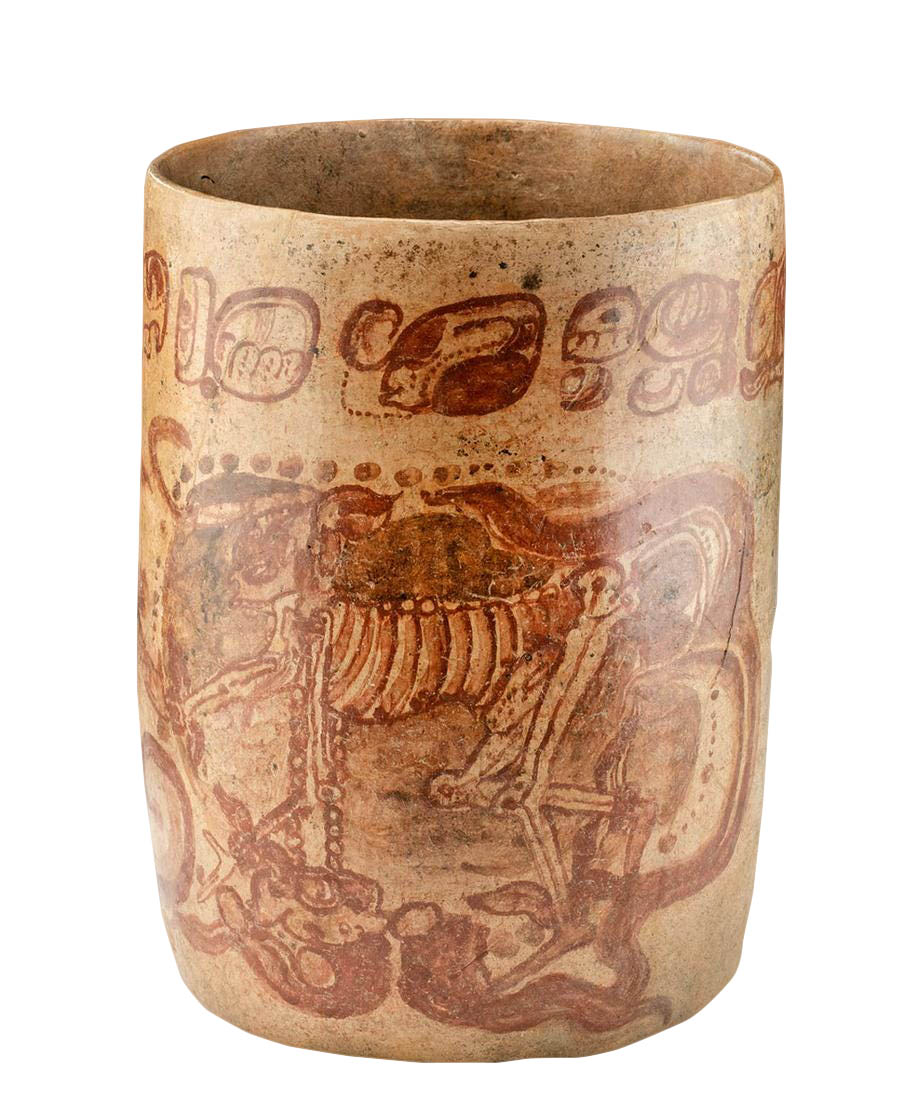
Important Maya Pottery Cylinder Vessel – Kerr Database:
Pre-Columbian, Northern Peten, Guatemala, Maya, Late Classic Period, ca. 550 to 900 CE. Amazing! Presenting macabre and incredibly striking motifs, this is a ceramic cylinder vessel with rich iconography. It was probably given as a gift during a feast and used for drinking cocoa. It is tall, with a wide mouth and an unpronounced rim whose edge is gently curved. It stands on a flat base with gently upturned edges, and the sides taper very slightly to the mouth. One complete side of the exterior body is dominated by a painted profile of a composite skeletal image of God A and Chak (he wears the pendant of Chak) in animal form. He stands on all fours and appears to be inside a darkened cave, possibly the underworld. Glyph bands adorn the top rim and run diagonally up one side. Size: 6.625″ W x 9″ H (16.8 cm x 22.9 cm)
God A is one of the Maya codical death gods, known to us only from early colonial-era documents and from the work of 19th century scholar Paul Schellas, who named the gods for letters from the Roman alphabet because at the time Maya hieroglyphs could not be read. A figure similar to God A is referred to with many different names by modern Maya people – often Kimi or Ah Puch – and is the Lord of the Underworld (known variously as Xibalba or Mitnal depending on the dialect). God A is often painted as he is here, as partially dead, with grey, decaying flesh and skeletal bone structure. He is meant to be both terrifying and grotesquely funny, and this portrayal, with its askew teeth and bulbous nose, embodies both. Modern Maya folklore still considers God A a threat – creeping around the houses of the sick, waiting to take them to Xibalba.
Showing a chiaroscuro technique seldom seen with such naturalistic result. Note the background behind the WHAY figure is delicately shaded to give the effect of depth, possibly indicating a cave opening, portal to XIB’AL’BA. This area has not been altered by modern restoration! The deity’s three-dimensional rib cage, and skeletal arms and legs become even more gruesome with this unique and innovative shading technique used by the scribe.
Published in The Maya Vase Database created by Justin Kerr, Kerr number 9132
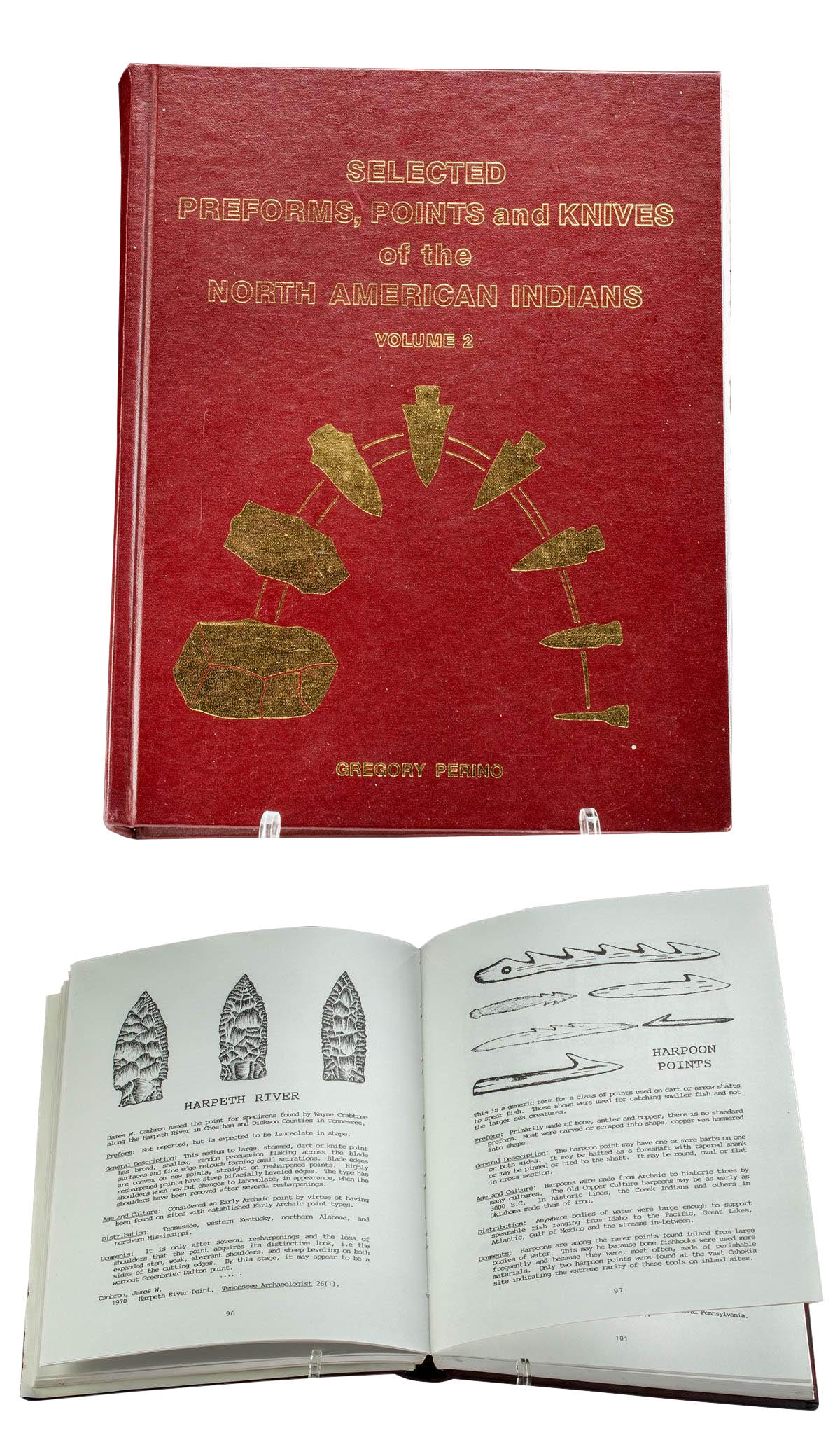
1991 Perino’s Vol 2 Point Book & Meyer Illustrations:
Gregory Perino (American 1914-2005) “Selected Preforms, Points and Knives of the North American Indians. Vol. 2.” Points and Barbs Press 1991 First edition. This is one of the best guides to Native American artifacts, written by a leading expert in the field. Perino’s book was part of the attempt to standardize projectile point typology in the United States. The book contains clear descriptions and illustrations to help identify each point accurately. This is an invaluable reference guide for those interested in projectile point collecting! Included in this lot are approximately 40 separate documents with illustrations by Charles Meyer, the illustrator of the book, including orignal drawings as well as printed copies. Perhaps his first drafts and plans for the book, a few of these pages display drawings that have been cut from a another document and taped in place, some even include white out and written notes – an interesting look into his process! Size of book: 8.75″ L x 1.125″ W x 11.25″ H (22.2 cm x 2.9 cm x 28.6 cm); papers are approximately: 11″ L x 8.5″ W (27.9 cm x 21.6 cm
Gregory Perino was a self-taught archeologist and founding member of the Illinois State Archaeological Society. Perino’s interest in Native American artifacts started when he found an arrowhead as a child. His natural ability to find and meticulously excavate prehistoric sites gained him recognition on a local level in Illinois. He was soon recruited to handle field excavations by the Thomas Gilcrease Institute of American History and Art. Perino’s work in artifact analysis led him to projectile point typology in which he has written and published several books on the topic. By the 1980s, Perino was the most respected authenticator of Native American artifacts.
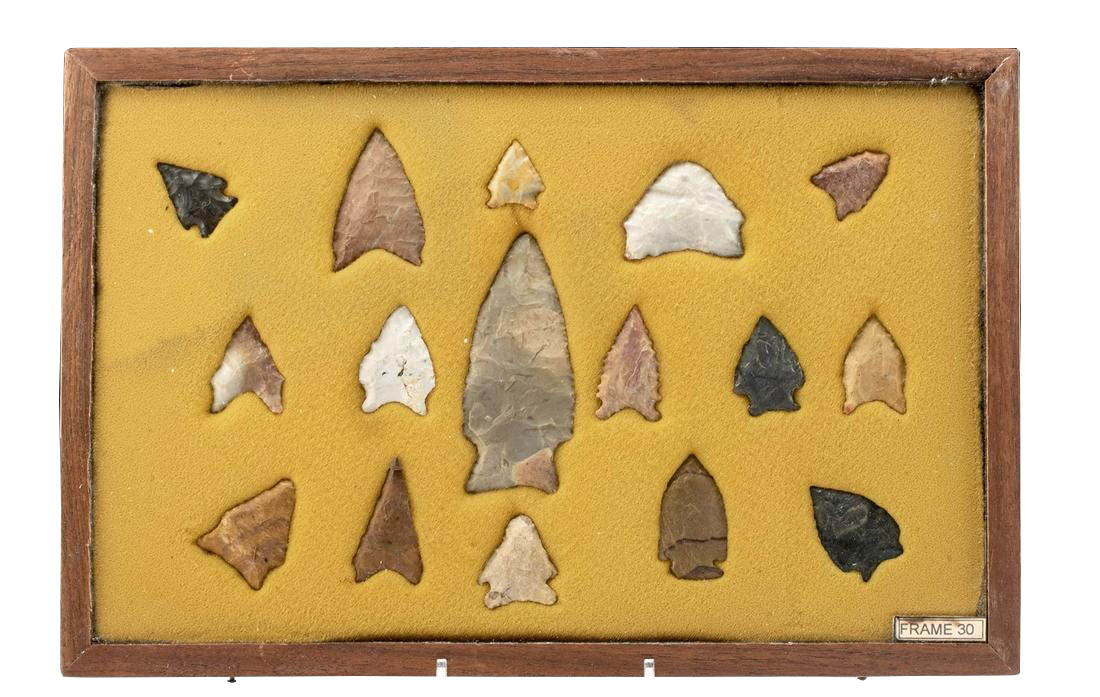
14 Native American San Patrice Stone Arrowheads:
Native American, Arkansas, Oklahoma, Missouri, Mississippi, and Texas, Transitional Paleo Indian to Early Archaic, ca. 8000 to 6000 BCE (10,000 to 8,000 BP). An intriguing collection of 14 hand-knapped stone projectile points featuring a series of diverse forms, such as triangular side notch, auriculate, and triangular auriculate. All presenting variants of the San Patrice type, these arrowheads fall into the classifications of Keithville, St. Johns, Leaf River, Geneill, and Hope and boast tones of russet, sienna, dark grey, butterscotch, cream, black, and white. Size of largest: 3.25″ L x 1.5″ W (8.3 cm x 3.8 cm); Size of frame: 12.125″ W x 8″ H (30.8 cm x 20.3 cm)
San Patrice arrowheads are primarily found in the San Patrice cluster, which is concentrated in the western Gulf Coastal Plains of northeastern Texas, western Louisiana, and southwestern Arkansas, but also spreads throughout eastern Louisiana, southern Mississippi, southern Alabama, northern Texas, and eastern New Mexico.
Knapped lithics, like these examples, are made using percussion, striking them with other stones; the process required to get them the correct shape requires training and skill.
This piece has been searched against the Art Loss Register database and has been cleared. The Art Loss Register maintains the world’s largest database of stolen art, collectibles, and antiques.
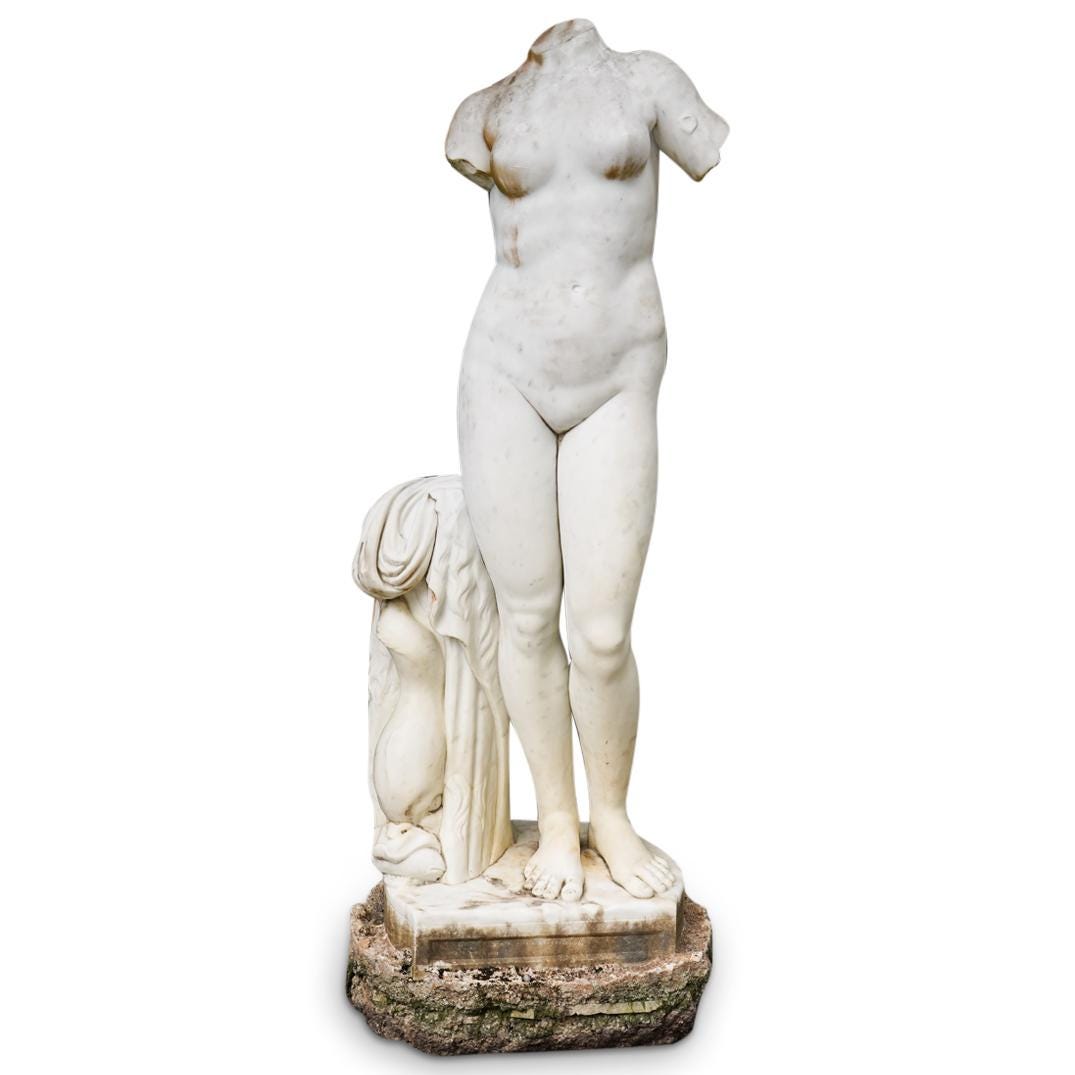
Antonio Frilli (Italian 1860-1920) 19th Cent. Marble:
Antonio Frilli (Italian) 19th Century figural carved statue depicting the nude torso of “Aphrodite” composed of hand carved Carrara marble with naturalistic anatomical female form and detailed creased garb accents. Incised signature: “A. Frilli Firenze” at reverse side of base.
CIRCA: 19th Cent.
ORIGIN: Italy
DIMENSIONS: H: 69″ x D: 24″