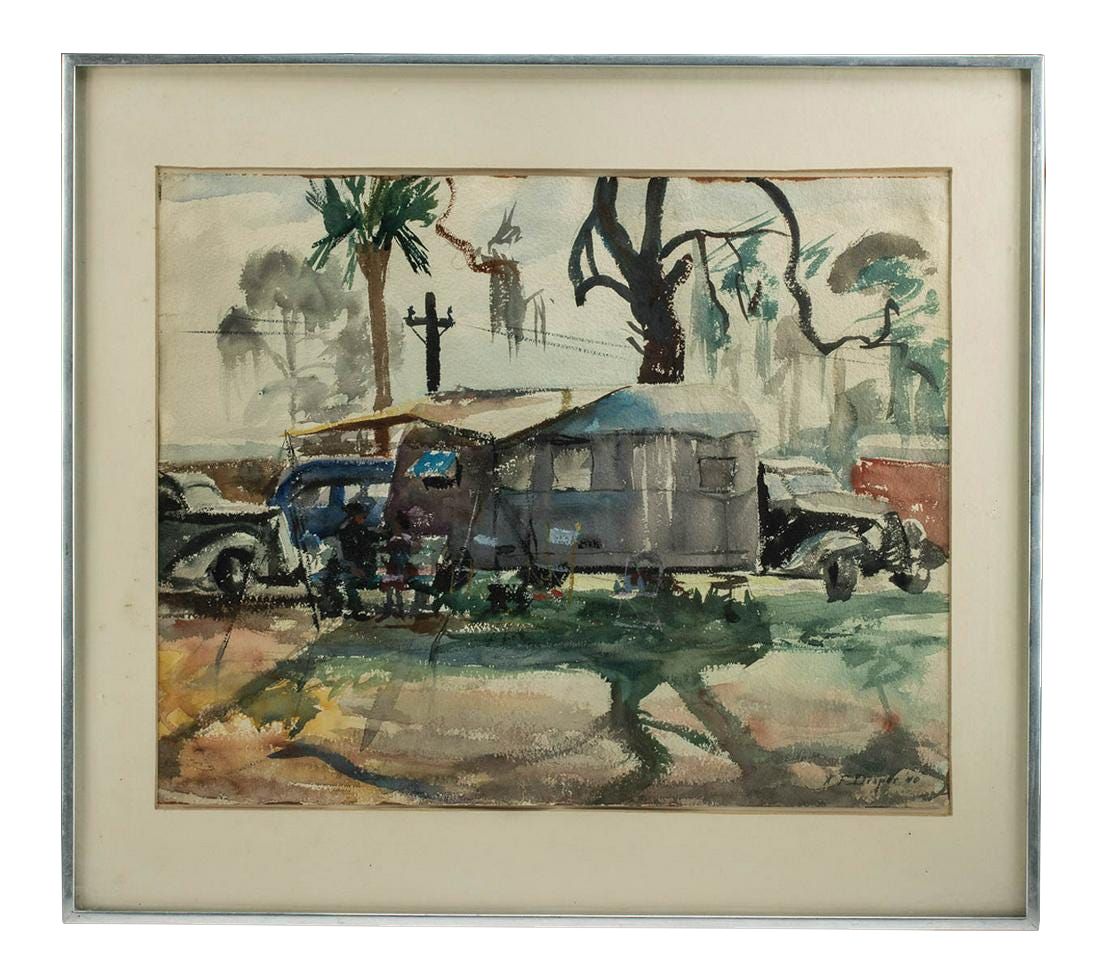
Framed William Draper Watercolor – Campsite, 1940

Framed William Draper Watercolor - Campsite, 1940

Framed William Draper Watercolor – Campsite, 1940:

William Franklin Draper (American, 1912-2003). Campsite – Watercolor, 1940. Signed and dated on lower right corner. A charming watercolor painting of a couple resting at a campsite. The pair sits upon a bench beneath the awning that extends from their camper. The campsite itself takes on a life of its own, with palm trees towering overhead as cars and telephone poles denote humankind’s mark on the natural world. A candid composition capturing one of America’s beloved pastimes, delineated with Draper’s lively, expressive technique. Size of painting: 18.75″ W x 15″ H (47.6 cm x 38.1 cm) Size of frame: 23.125″ W x 20.7″ H (58.7 cm x 52.6 cm)

William Draper’s career spanned seven decades and his subjects included a portrait of John F. Kennedy that hangs in the National Portrait Gallery in Washington D.C. based upon an oil sketch for which the president sat in 1962. Draper was actually the only artist who painted JFK from life. Draper showed at Knoedler, the Graham Gallery, Portraits, Inc., the Far Gallery, The Findlay Galleries (New York, NY) and the Robert C. Vose Galleries (Boston, MA). His work has been included in shows at the National Portrait Gallery and the Corcoran Gallery of Art (Washington, D.C.), The National Academy of Design (New York, NY), The Boston Museum of Fine Arts, (Boston, MA) the Fogg Art Museum, (one of the Harvard Art Museums, Cambridge, MA), the National Gallery, (London), Salon de la Marine (Paris) and in museums in Australia. He also taught at the Art Students League of New York, and received a lifetime achievement award from the Portrait Society of America in 1999.

More on the artist’s background: William Franklin Draper was born in Hopedale, Massachusetts on December 24, 1912. A child prodigy, he studied classical piano at Harvard University. He later changed his focus to fine art and studied with Charles Webster Hawthorne and Henry Hensche in Provincetown, Rhode Island. Draper also attended the National Academy of Design in New York and the Cape Cod School of Art in Massachusetts. Then he traveled to Spain and studied with Harry Zimmerman, moved on to France and attended the Academie de la Grande Chaumiere. In 1937, he moved to Boston to study sculpture with George Demetrius and also studied with Jon Corbino in beautiful Rockport, Massachusetts. In 1942, Draper joined the Navy and served as a combat artist when stationed on the Aleutian Islands and in the South Pacific. He observed and painted battle scenes on Bougainville, Guam, Saipan, and other locations, as well as genre scenes of soldiers who were not engaged in combat but rather at work and at play. National Geographic magazine reproduced 25 of his war images in four issues in 1944. In 1945, the Corcoran Gallery of Art in Washington D.C. organized a group exhibition of works by five official war artists, including Draper. That same year the Metropolitan Museum of Art included Draper in an exhibition entitled, ”The War Against Japan.” Draper was also featured in a PBS television show about combat artists entitled, “They Drew Fire” in May of 2000. After the war, Draper opened a studio on Park Avenue in New York City and continued to not only paint, but also play classical and jazz piano.
19th C. Russian Gilt Silver Enamel Vessel – Grachev

19th C. Russian Gilt Silver Enamel Vessel - Grachev

19th C. Russian Gilt Silver Enamel Vessel – Grachev:

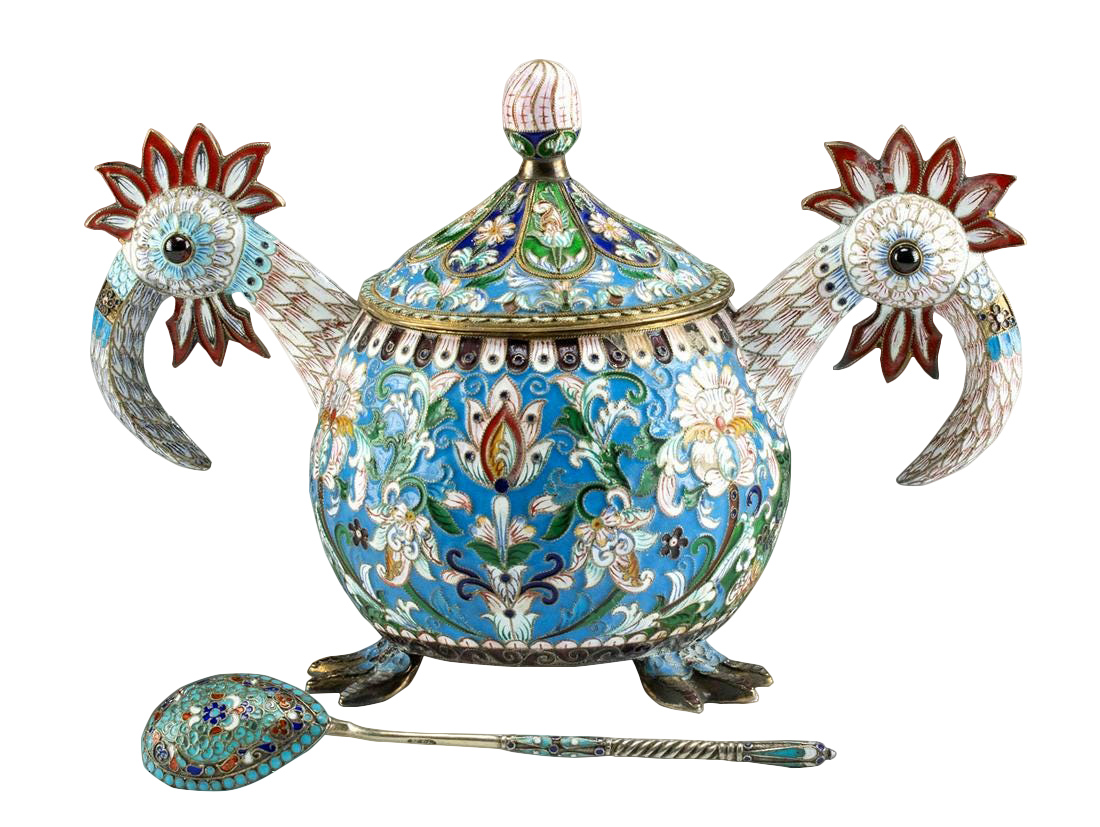
Eastern Europe, Russia, St. Petersburg, The Grachev Brothers, ca. 1896 to 1908 CE. An incredible objet de vertu, a gilt silver filigree cloisonne enamel vessel in the form of a stylized double-headed bird – perhaps meant to represent the double-headed eagle of Imperial Russia. Teapot-shaped and standing on three wide, bird-like feet, the vessel has a steep-sided lid with a knobbed handle projecting from the top. The bird heads project from two sides, back to back, on long necks. Size: 8.5″ L x 4.35″ W x 5.05″ H (21.6 cm x 11 cm x 12.8 cm)

The artistry and detail of this piece are incredible. The bird heads are white and pink, with pale blue details and purple glass “jewel” eyes. There are exposed bands of gilt silver around the upper part of each beak. Each bird has a large red and white crest and wattle. The vessel’s body has a background of deep sky blue with stylized floral motifs in green, pink, white, and yellow; purple and white motifs wrap around the rim (where they look like the top of a circus tent) and above the feet. The three feet also have sky blue and navy blue enamel, also in a stylized floral pattern. The lid, which fits snugly into the vessel’s flanged rim, continues the floral pattern, and offsets the background sky blue with dark, royal blue and emerald green enamel in wide teardrop-shapes flowing down from the handle. The handle is swirling white, red, and pink, matching the birds’ heads. The interior of the vessel is gilded.

Russian silver items have a variety of stamped marks – a maker’s mark, an assay mark, and/or a kokoshnik mark. In 1896, Tsar Nicholas II issued an edict to reform the assay marking system and created the standardized kokoshnik mark, which was also used to indicate the assay of the silver in addition to giving the location of production. This vessel has a St. Petersburg stamp as well as a kokoshnik reading “84” with a woman’s head in profile. Also stamped on it is the maker’s mark, in Cyrillic, for the Grachev brothers.

From the mid-19th century to the early 20th, Russian art of all kinds experienced a renaissance that is known as the Silver Age. Russian artisans were inspired by the Gothic, the Moresque, chinoiserie, the Baroque, the Rococo… all ornate styles, replete with scrolling vines and flourishing arches. They combined this with the bright colors and rich ornament of Old Russian applied art to create a unique style of which silver items like these spoons are some of the most enduring.

Silverware was produced mainly in St. Petersburg (which had more western European influence and therefore a more European style) and Moscow (where a more pure Old Russian-inspired style came from), but other cities like Kiev, Odessa, and even places as far afield as Archangelsk had silversmiths creating beautiful objects of art. The industry grew quickly, aided by art exhibitions held from the mid-1850s onward and the public excitedly snapped up the beautiful objects they produced. An exhibition in London in 1851 showcasing silver made in Moscow introduced the Old Russian style to western Europe and the renown of Russian silversmiths increased, with firms like Ovchinnikov, Kurlyukov, the Grachev Brothers, and Faberge attaining national and international renown.

Signed George Dombek Watercolor – Bicycle, ca. 2004

Signed George Dombek Watercolor - Bicycle, ca. 2004

Signed George Dombek Watercolor – Bicycle, ca. 2004:

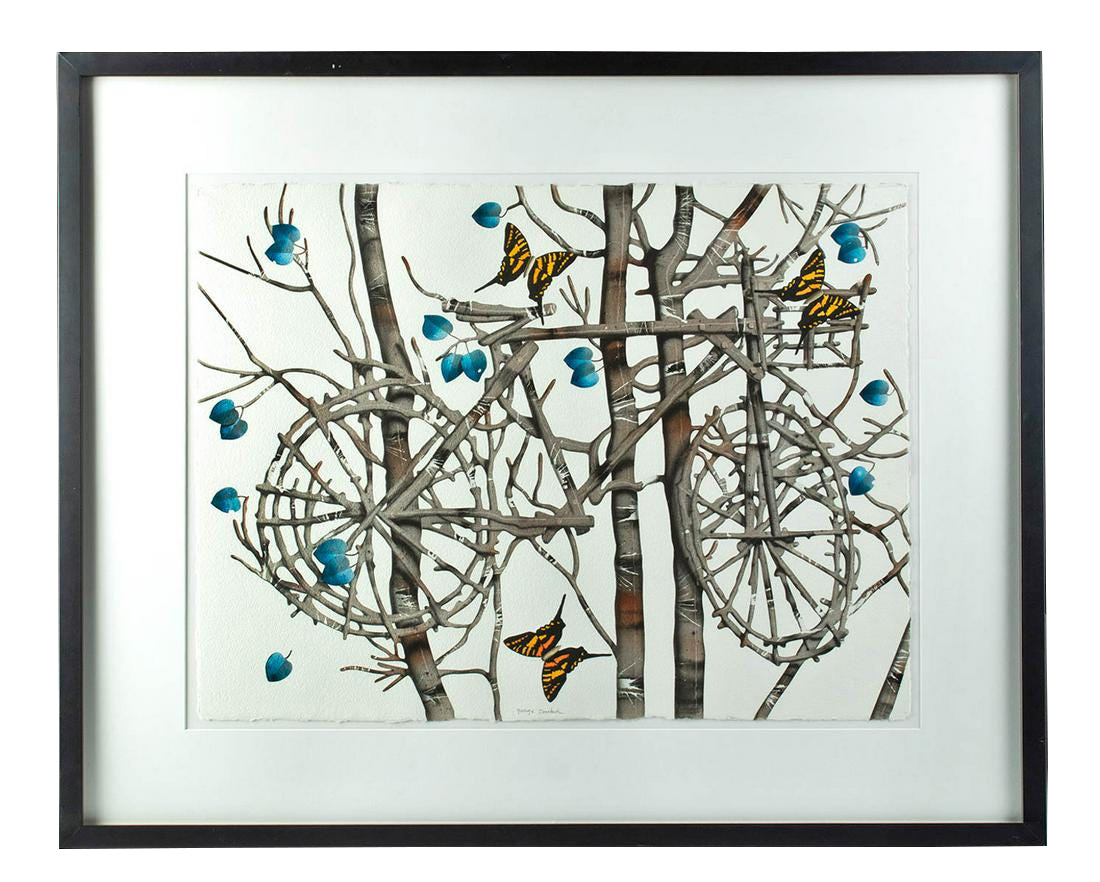
George Dombek (American, b. 1944). untitled watercolor, ca. 2004. Hand signed at lower center. A large-scale, framed, and hand-signed watercolor by Arkansas artist George Dombek. This composition presents a fascinating convergence between a bicycle and nature. Notice that the bicycle itself is rendered from skillfully bent and shaped tree branches and almost merges with the cluster of branches behind it. All is a vision of soft grays punctuated with moments of color – azure blue leaves and golden yellow monarch butterflies. A wonderful example of what Dombek calls constructed realism. See the biographical information below for more about Dombek’s oeuvre and technique. Size: 30″ W x 22.5″ H (76.2 cm x 57.2 cm); 41.5″ W x 33.5″ H (105.4 cm x 85.1 cm)

According to George Dombek’s monograph with commentary by Henry Adams, “Arkansas artist George Dombek has sold his work to over sixty museums and corporate collections, including seven works to the Crystal Bridges Museum of American Art. He has received numerous awards, including the Arkansas Arts Council’s Lifetime Achievement Award.

Dombek was born in Paris, Arkansas, the son of a coal miner. He became fascinated by art at the age of seventeen when he read about the work of Jackson Pollock and Franz Kline in Time magazine. Concerned that he couldn’t earn an adequate living as an artist, he studied architecture but was later drawn back into art and earned a master’s in painting. Throughout his career, he has practiced and taught architecture, while devoting his principal effort to painting, particularly in watercolor.

All of Dombek’s work, in one or another fashion, creates the illusion of reality by following a step-by-step process of construction, similar to the work of an architect or a builder. Dombek has used this method, which he calls constructed realism, to explore a variety of subjects in a way that seems to bridge the usual distinctions between real and abstract. George Dombek: Paintings collects some of the artist’s most notable renderings of the themes he has pursued intensely for years: birds in trees, rocks, discarded cans and metal objects, enormous flowers seen in close-up, sticks bent in unusual ways, bicycles, and more.”

Inuit Serpentinite Stone Sculpture, Native Girl In Parka

Inuit Serpentinite Stone Sculpture, Native Girl In Parka

Inuit Serpentinite Stone Sculpture, Native Girl In Parka:

Hand carved olive stone with dark inclusions. Artist signed.
#Sculpture #InuitArt #NativeArt #NativeCanadians #Soapstone #Serpentine #Serpentinite

Dimensions: 12″H x 5.25″W
Country of Origin: Canada

Lladro Porcelain Figurine, Return To La Mancha

Lladro Porcelain Figurine, Return To La Mancha

Lladro Porcelain Figurine, Return To La Mancha:

Glazed; Beautifully designed cattle and buggy. With original box, base and certificate.
Elite Limited Edition (500). Artist signature on base.

Artist: Salvador Furio
Issued: 1988-2001
Dimensions: 36″L x 9.5″W x 12.75″H
Edition Number: 187 of 500 Manufacturer: Lladro
Country of Origin: Spain

Williams 1992 Pinball Amusement Machine, The Getaway

https://images4-cdn.auctionmobility.com/is3/auctionmobility-static4/mU3B-4-3I8S3//612-1.jpg?width=440&height=440&resizeinbox=true

Williams 1992 Pinball Amusement Machine, The Getaway:

High Speed II; Model no. 50004. 4 players; racing themed collectors quality game.
Back glass depicting a red sports car and the title, The Getaway. The goal of the game is to run the red traffic light, then get away from the armed police pursuit that chases you down the highway. Unlike a traditional plunger, players launch balls using a car gear shift lever. Machine plays, Like A Dream. Designed by Steve Ritchie. Art by Doug Watson and Mark Sprenger.

Artist: Steve Ritchie
Issued: 1992
Dimensions: 80″H x 29″W x 52″D
Manufacturer: Williams Electronics Games
Country of Origin: United States

Large Royal Doulton Prototype Character Jug, Marilyn Monroe

Large Royal Doulton Prototype Character Jug, Marilyn Monroe

Large Royal Doulton Prototype Character Jug, Marilyn Monroe:

Modeled as the American actress with clapperboard, spotlight and film reel handle.
Doulton backstamp. Marked, The Property Of Royal Doulton Tableware Ltd. Not Produced For Sale.

Artist: Amanda Hughes-Lubeck
Issued: 20th c.
Dimensions: 7.5″H
Manufacturer: Royal Doulton
Country of Origin: England

Royal Doulton Lg Character Jug, Clark Gable, Design Sample

Royal Doulton Lg Character Jug, Clark Gable, Design Sample

Royal Doulton Lg Character Jug, Clark Gable, Design Sample:

Prototype. Modeled as an early 20th century American film actor. Handle in form of a movie camera entwined in film.
Design Sample piece. Hand painted handle. Different color. Small number of Clark Gable jugs are known to exist. The jug was issued in the United States prior to approval from the Gable estates and had to be withdrawn when permission was denied. Royal Doulton backstamp. Hand-written, Design Sample 1983, to bottom base.

Artist: Stanley J. Taylor
Issued: 1983
Dimensions: 7″H
Manufacturer: Royal Doulton
Country of Origin: England

Large Royal Doulton Figurine, St. George Hn4371

Large Royal Doulton Figurine, St. George Hn4371

Large Royal Doulton Figurine, St. George Hn4371:

Doulton Classics. Limited edition 19 of 50. Hand made, hand decorated. St. George on horse.
Polychrome figure; glazed finish. Doulton marks on the underside.

Issued: 2001
Dimensions: 16″L x 17″H
Manufacturer: Royal Doulton
Country of Origin: England

American Flyer 1953 K5328 Passenger Set

American Flyer 1953 K5328 Passenger Set

American Flyer 1953 K5328 Passenger Set:

American Flyer New Haven 293 Pacific 4-6-2 Steam Locomotive with coal pusher tender. 951G Baggage Car, 953G Combine, 952G Pullman and 954G Observation. Trucks and couplers are intact. Cars have scratches in paint.