Marklin HO ICE Train 3371, Extra Coach 4171 in original boxes:
Marklin HO ICE Train 3171 and extra Coach 4171 in original packaging. Never used. Shelf wear and tear on boxes.

Marklin HO ICE Train 3371, Extra Coach 4171 in original boxes:
Marklin HO ICE Train 3171 and extra Coach 4171 in original packaging. Never used. Shelf wear and tear on boxes.
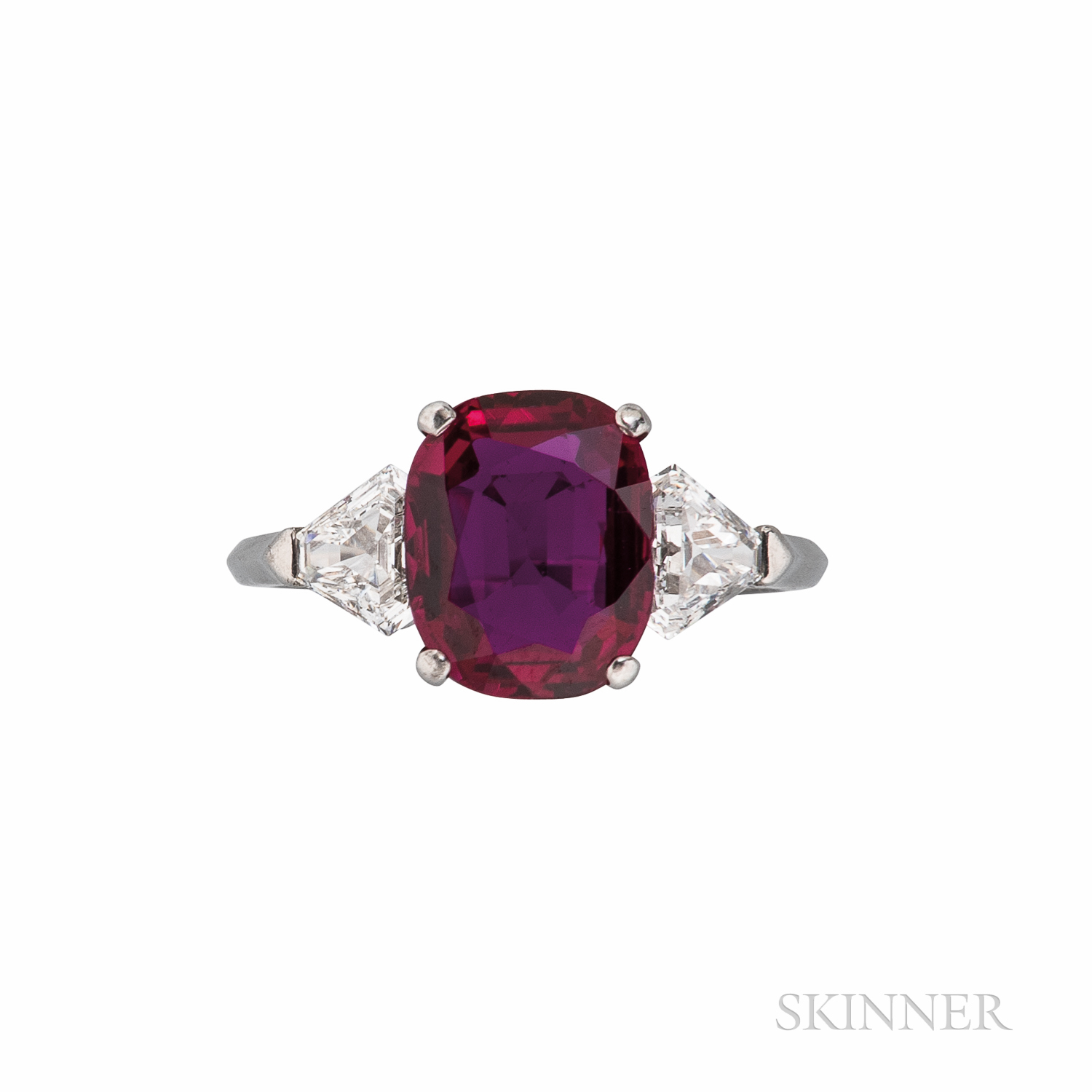
Van Cleef & Arpels Ruby and Diamond Ring, prong-set with a cushion-cut ruby measuring approx. 9.99 x 8.00 x 3.40 mm, and flanked by shield-shape diamonds, mounted in platinum, no. N.Y.22884, size 6 1/2, signed.
Note: Accompanied by AGL document no. 1107790, dated May 15, 2020, stating that the ruby is from Burma, no gemological evidence of heat.

Marklin HO 4998 Digital Dance Car:
Marklin HO Digital Dance Car in original box – unused. Under digital Control the figures in the car “dance†to the music played by the car. Has instructions, warranty card and unused decals.
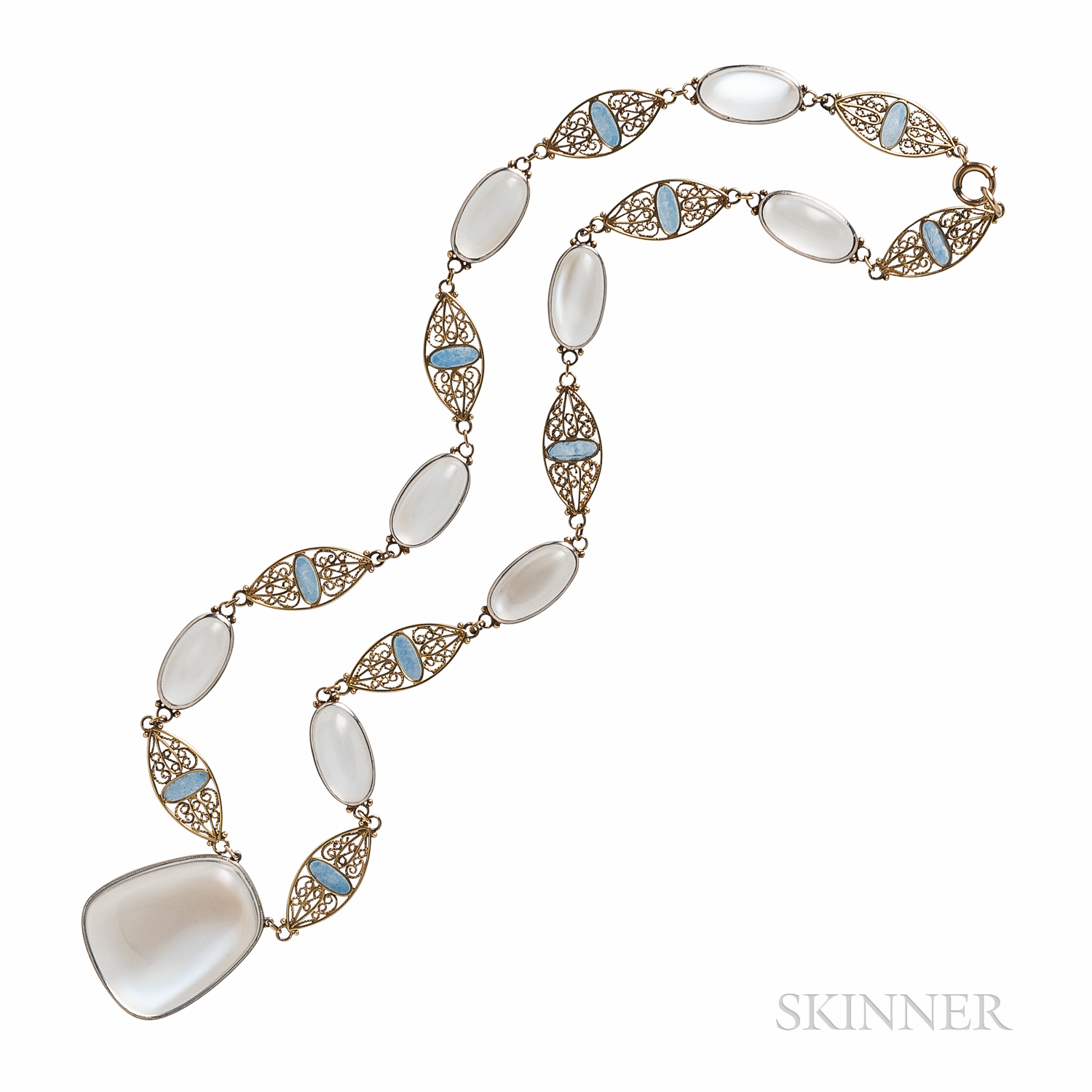
Tiffany & Co. Moonstone and Enamel Necklace, designed by Louis Comfort Tiffany, c. 1910, suspending a fancy-shape cabochon moonstone joined to a necklace of alternating navette-shape filigree links with blue plique-a-jour enamel centers and oval cabochon moonstones, platinum and gold mount, lg. 18 in., signed.
Provenance: Christie’s, Magnificent Jewels, Sale 1890, Lot 173, October 15, 2007.
Literature: Dr. Géza von Habsburg, Fabergé: Imperial Craftsman and His World (Booth-Clibborn Editions, London, 2000), p. 355, no. 970.
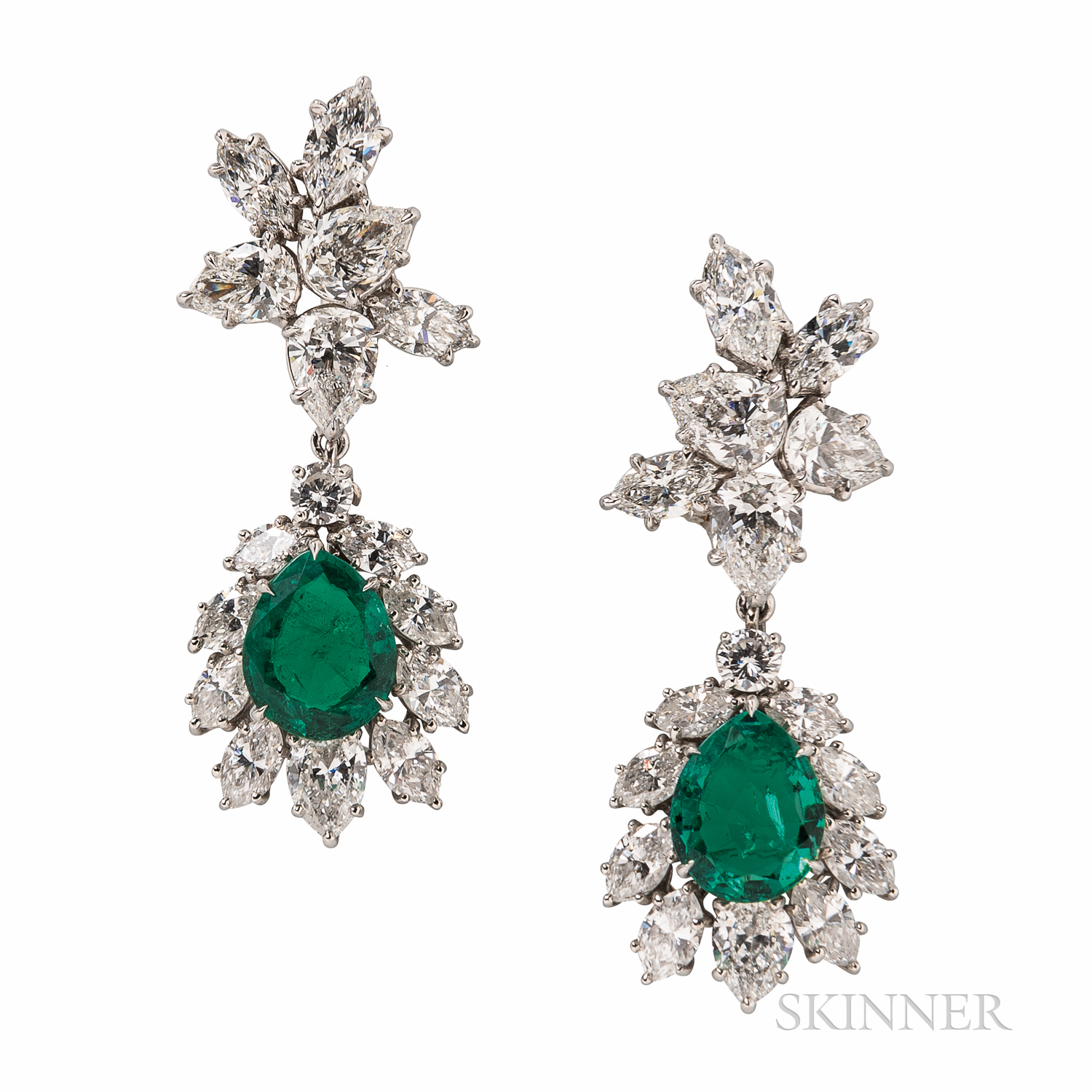
Fine Pair of Jacques Timey for Harry Winston Emerald and Diamond Day/Night Earclips, c. 1960s, set with pear-shape emeralds weighing 2.10 and 2.08 cts., framed by marquise-, pear-, and full-cut diamonds, suspended from pear- and marquise-cut diamond clusters, approx. total diamond wt. 9.25 cts., lg. 1 3/4 in., maker’s mark for Jacques Timey.
Note: Accompanied by AGL document no. 1094602 A and B, dated August 9, 2018, stating that the emeralds are from Colombia, with minor, traditional clarity enhancement.
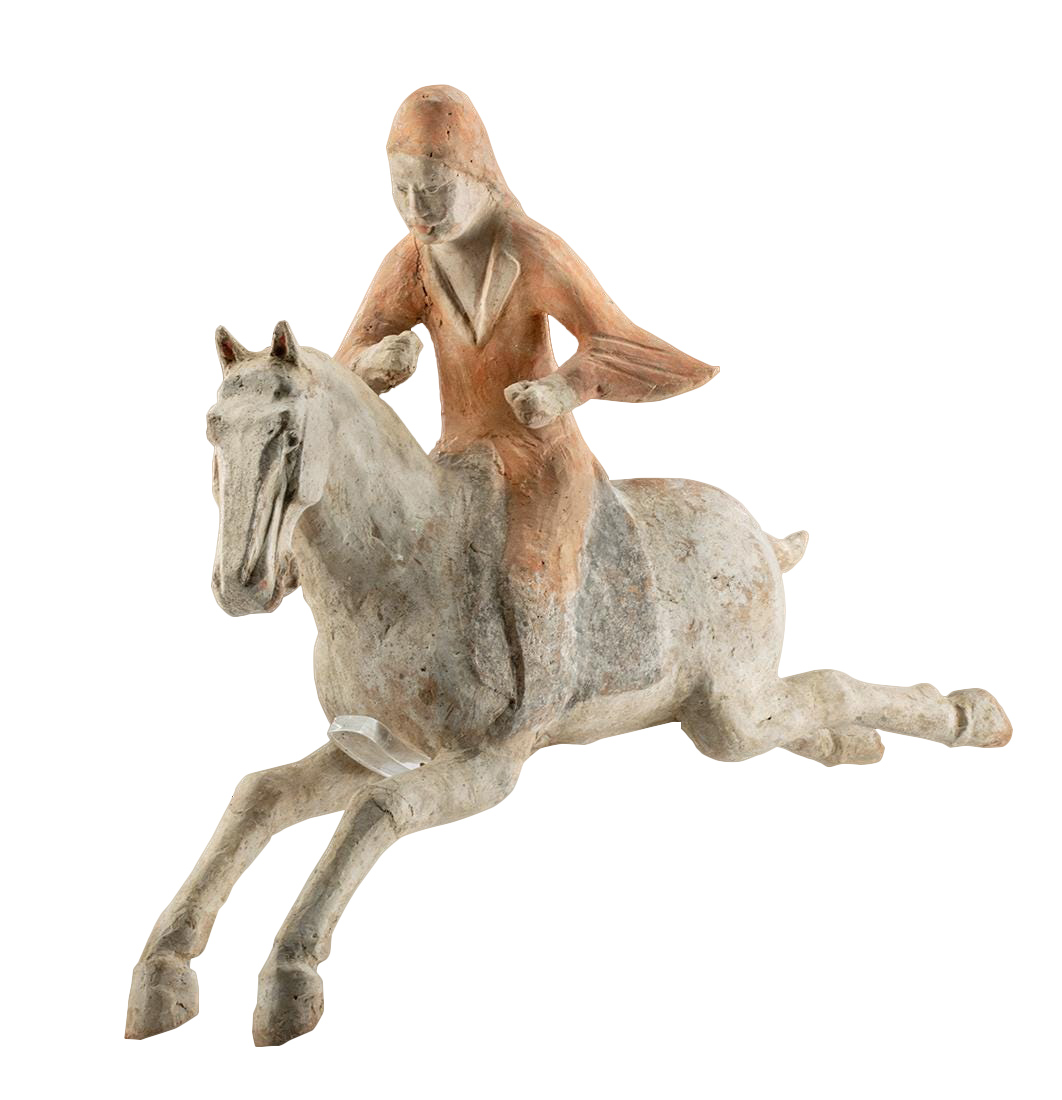
Chinese Tang Dynasty Pottery Polo Player w/ TL Test:
East Asia, China, Tang Dynasty, ca. 618 to 907 CE. An exemplary pottery polo player with a well-modeled figure upon a galloping horse with finely painted details and nice remaining pigments of orange, beige, white, and black. The sculpture emphasizes a powerful sense of movement and athletic balance. Note how the horse’s legs are extended front and back – a pose known as ventre a terre – while the rider leans forward, bending both arms at the elbow with hands clenched in fists, demonstrating intense focus. The player’s bellowing sleeves sway in the wind, giving the impression of quick movement, while a veil caps the head. Size: 12.75″ L x 3.25″ W x 11.125″ H (32.4 cm x 8.3 cm x 28.3 cm); 13.5″ H (34.3 cm) on included custom stand.
While a 3rd century CE poem by the Chinese poet Cao Zhi mentions the act of hitting a ball on horseback, and a mural in the late 6th century tomb of Xu Minxing in Shandong province depicts a man mounting a horse while holding what look like polo sticks, the first very clear written evidence of the game of polo in China dates to the Tang dynasty, when the game was called jiqiu (meaning strike ball). In the present day, the game is usually called maqiu horse ball) or damaqiu (strike horse ball). Both men and women of the Tang court played polo. Two Tang emperors in particular, Taizong (reigned 626-649 CE) and Xuanzong (reigned 712-756 CE) favored the game of polo. They encouraged young men of the court to play it, because the skills involved could be applied to military activities.
Tang dynasty poets were also inspired by polo. The literatus Han Yu wrote a poem entitled Poem to Commander Zhang at the meeting of the Bian and Si Rivers” which describes a polo field that was 1000 steps long, with low walls on three sides, and called the ball used in the game “the divine bead”. The poem describes the game occurring before sunrise on a cold autumn morning; drums making a thunderous sound when the red flags are raised to start the match; as well as the intense competition between the players and the excitement of the spectators. At the end of the poem, Han Yu declares that polo is not a game for mere fun, but is actually one devised for military training. This said, scholars also played polo during the Tang dynasty and successful candidates in the national civil service examinations held a polo tournament to celebrate.
This piece has been tested using thermoluminescence (TL) analysis and has been found to be ancient and of the period stated. A full report will accompany purchase.
This piece has been searched against the Art Loss Register database and has been cleared. The Art Loss Register maintains the world’s largest database of stolen art, collectibles, and antiques.

Fine Harry Winston Emerald and Diamond Ring, set with a cushion-cut emerald measuring approx. 10.40 x 10.26 x 7.39 mm, and weighing 4.579 cts., framed by pear-shape diamonds, approx. total wt. 4.69 cts., platinum mount, size 6, signed.
Note: Accompanied by SSEF Gemstone Report no. 100570, dated June 14, 2018, stating that the Emerald is natural, Colombia origin, no indications of clarity modification in fissures at time of testing, and AGL document no. 1096922, dated December 10, 2018, stating that the emerald is from Colombia, clarity enhancement: none.
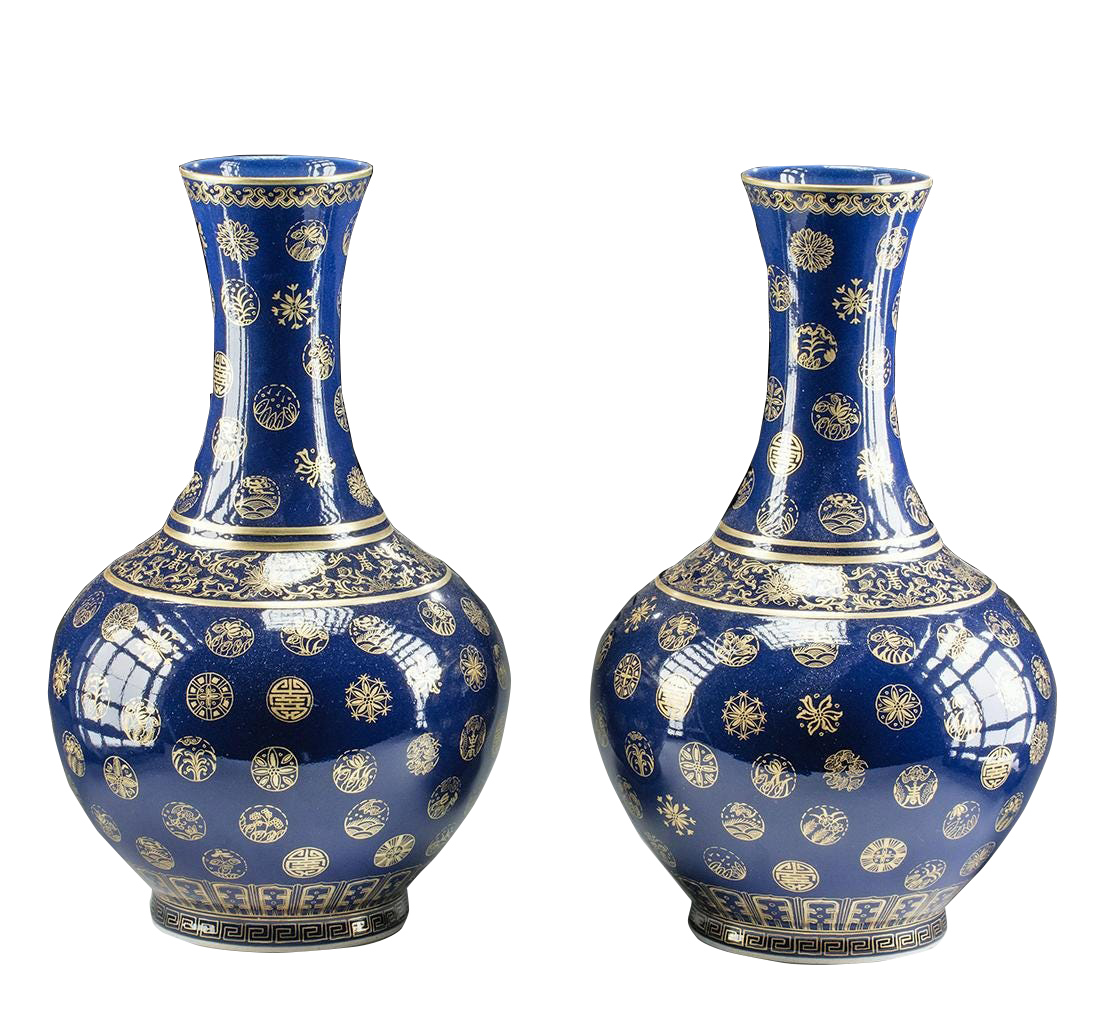
Pair of 19th C. Chinese Guangxu Gilt Porcelain Vases:
East Asia, China, Qing dynasty, Guangxu, ca. 1875 to 1908 CE. An exemplary pair of porcelain vases boasting an intricate gilt design atop a rich hue of navy blue. Adorned with a lustrous burnish, these opulent vessels present identical forms, each with a bulbous body, a graceful, elongated neck, and an annular, flared rim, all sitting upon a concave, circular foot. The body and neck of the vessel are embellished with lovely botanical medallions, all equidistantly scattered, as a thick band of a swirling lotus scroll with “shou” (longevity) characters encircles the shoulder. A meander pattern adorns the foot with a pretty design of petal lappets sitting just above it. The golden rim is additionally decorated by ruyi heads, which are representative of the Chinese god of prosperity, Cai Shen, as well as the act of achieving success in fengshui practice. The base of each vase is marked with 6 Chinese characters in kaishu script, indicating that these elegant examples were made during the rule of Guangxu (1875 to 1908) during the Qing dynasty. Size (both the same): 10.5″ in diameter x 16.125″ H (26.7 cm x 41 cm)
For similar Guangxu-marked bottle vases see “National Museum of History: Major Holdings of the National Museum of History”, Taipei, 1988, p. 72 and “Imperial Porcelain of Late Qing from the Kwan Collection”, Hong Kong, 1983, no. 126.
Most recently, a similar single vase of a slightly smaller scale than these was sold at Christie’s Hong Kong for 350,000 HKD (equivalent to $45,100.48) as lot 367 in The Pavilion Sale Chinese Ceramics and Works of Art (Live Auction 18243) on October 7th, 2020. A nearly identical pair of vases, also of a slightly smaller scale, was sold by Christie’s New York for $68,750 as lot 1268 in Fine Chinese Ceramics and Works of Art (Live Auction 12900) on March 16th, 2017. Additionally, another similar single vase was sold at Christie’s Hong Kong for 400,000 HKD (equivalent to $51,541.40) as lot 3325 in Important Chinese Ceramics and Works of Art (Live Auction 3371) on November 25th, 2014.
This piece has been searched against the Art Loss Register database and has been cleared. The Art Loss Register maintains the world’s largest database of stolen art, collectibles, and antiques.
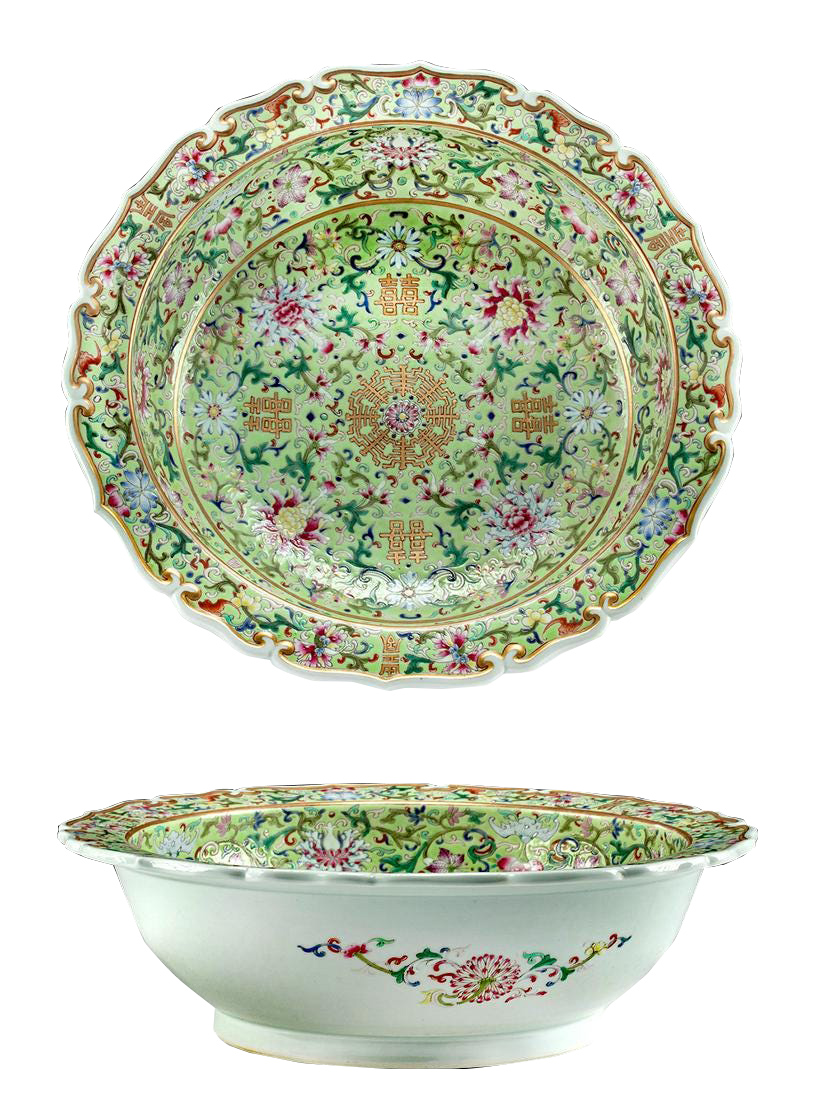
Ornate 19th C. Chinese Qing Porcelain Bowl:
East Asia, China, Qing Dynasty, ca. 19th to early 20th century CE. A well-preserved porcelain bowl with a scalloped rim and lovely painted motifs. The vessel rests on a ring base with a blue stamp seal containing the character for QianLong Reign Period of Great Qing (1735-1796). The exterior sides are painted with a scrolling vine with a lotus, a chrysanthemum, and a peony flower on a white ground. The wide rim and basin interior are decorated with gilt, a pale green ground, and a centralized flower medallion surrounded by gilt characters, as well as four additional characters that symbolize happiness from all directions. The interior walls also contain stylized bats, another symbol of good luck and happiness. This bowl is covered with auspicious symbols and has a lovely array of hues, creating a spectacular composition! Size: 11.25″ Diameter x 3.375″ H (28.6 cm x 8.6 cm)
This piece has been searched against the Art Loss Register database and has been cleared. The Art Loss Register maintains the world’s largest database of stolen art, collectibles, and antiques.
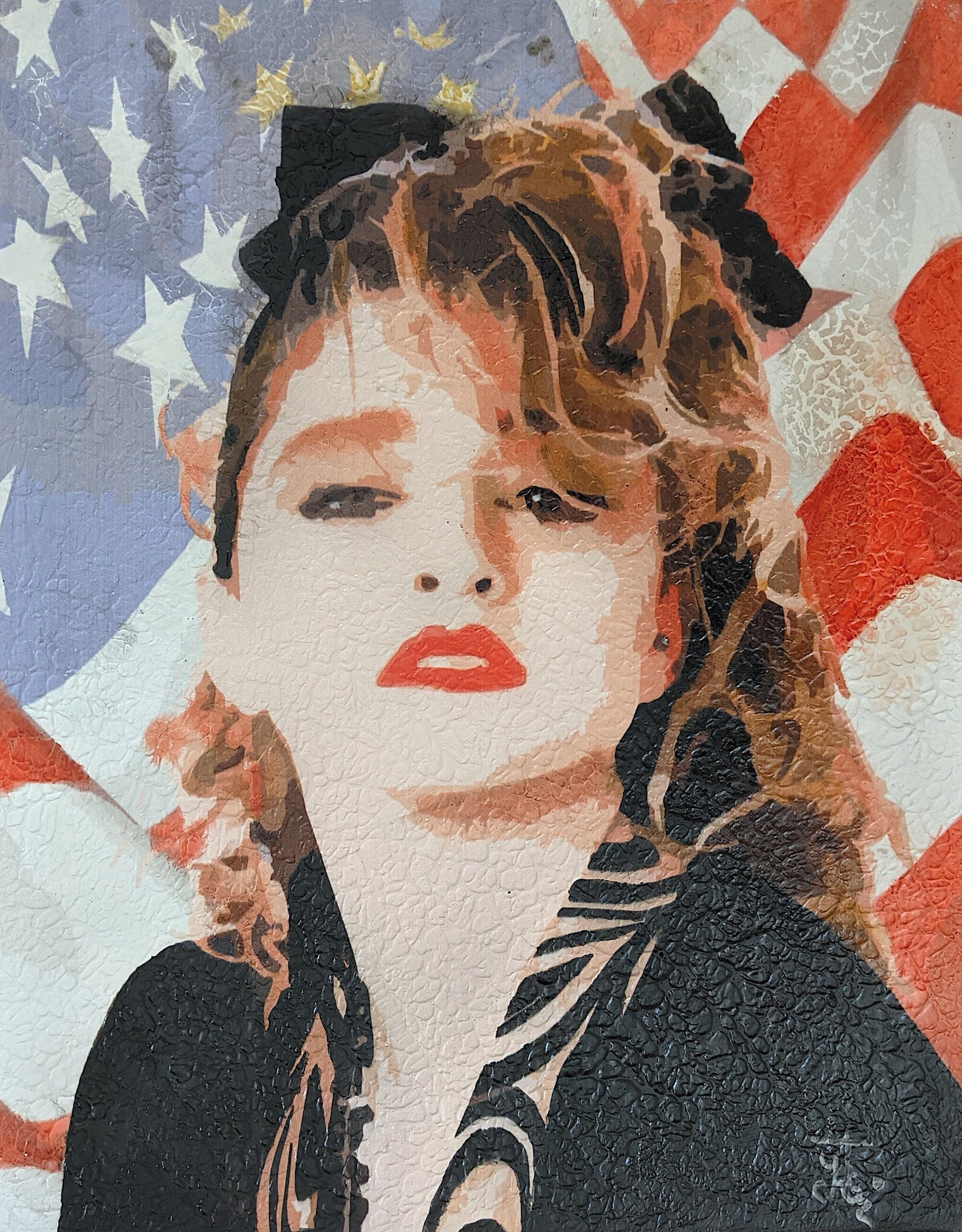
Original Oil Pop Art MADONA By Jorge Torres G:
DIMENSIONS: Original artwork by well listed Colombian artist Jorge Torres. The dimensions are 18.75″ x 14.75″ (48cm x 37cm) (small variances can occur).
ABOUT THE MEDIUM: Mixta Oil on canvas.