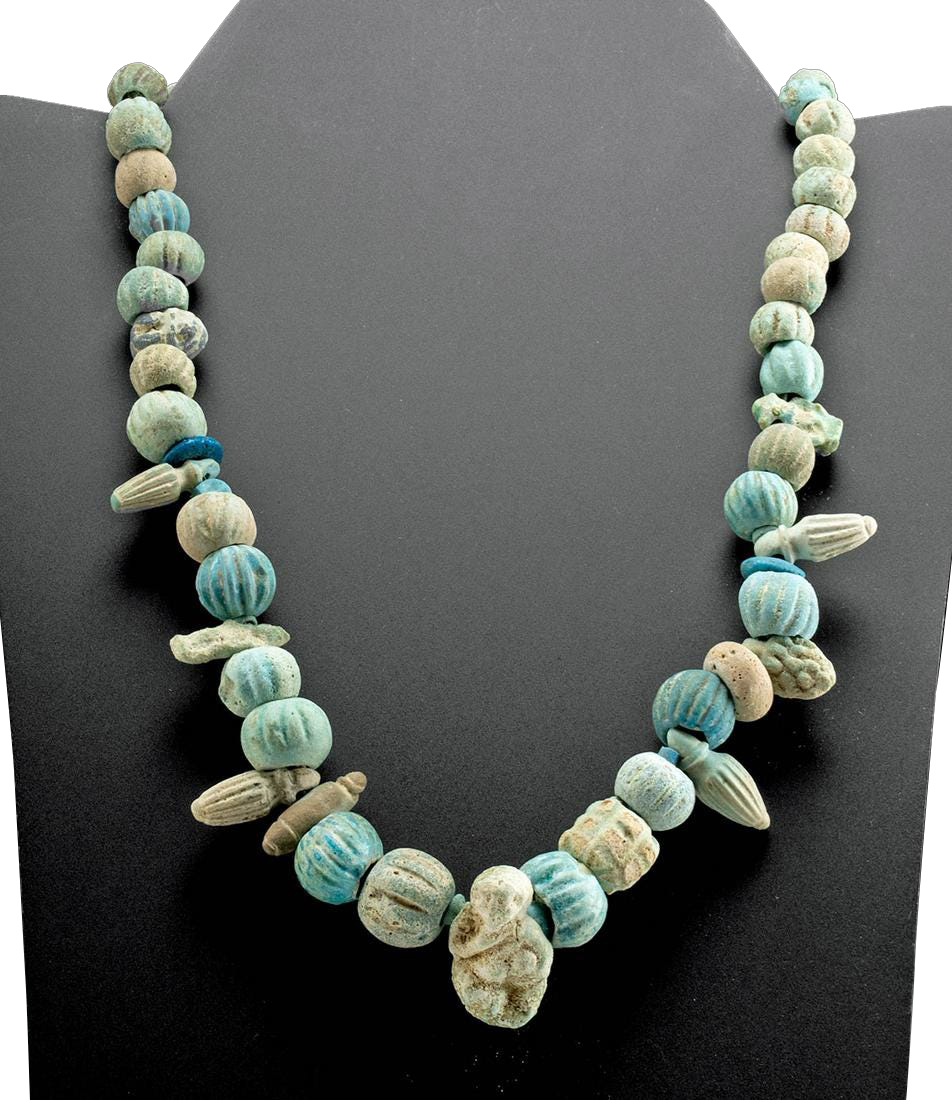
Egyptian Faience Bead Necklace w/ Figural Pendant:
Ancient Egypt, Third Intermediate to Late Dynastic Period, 21st to 31st Dynasty, ca. 1070 to 332 BCE. A stunning set of 65 mold-formed faience beads from Ancient Egypt in rich hues of turquois, teal, sky blue, tan, and grey, all strung on a modern strand to be wearable. The dazzling necklace presents beads of varying forms, including melon beads, gridded barrel beads, cylindrical beads, rounded convex beads, figural beads, beads in the form of bunches of grapes, and cylinder disc beads, which gradually increase in size towards the center. A remarkable combination of ancient art and modern style! Size of chain: 19.5″ L (49.5 cm); Size of largest bead: 19.5″ L x 0.675″ W (49.5 cm x 1.7 cm)
Faience was known to the ancient Egyptians as “tjehnet,” meaning brilliant or dazzling. It was made by grinding quartz or sand crystals together with various elements including copper oxide which gave the material its distinctive blue-green glaze color when fired. During the New Kingdom Period (ca. 1550 to 1070 BCE), new developments in glass production crossed over into faience craftsmanship and enabled a wider array of colors and shapes when forming compositions. Beads like these examples were perhaps buried with mummies or carried by individuals as apotropaic charms and good luck symbols.
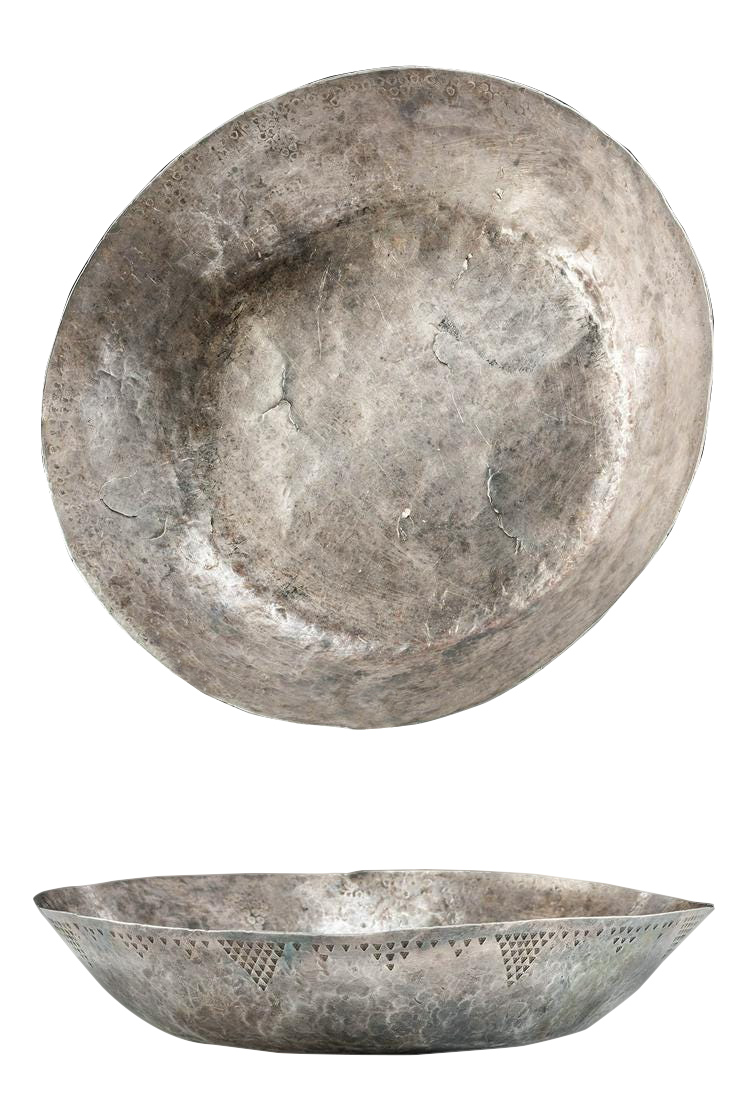
Rare 9th C. Viking Silver Ritual Bowl:
Northern Europe, Scandinavia, Viking or Norse culture, ca. 9th to 10th century CE. A rare and beautiful bowl made from 99.5% to 99.6% silver and likely deposited in a Viking hoard. This is a luxurious piece, with a flat base and steep, slanted sides, hammered into a rounded shape. The exterior of the bowl has a geometric design of small impressed triangles encircling the wall just below the rim. Precious metal items of silver and gold were the ultimate symbol of wealth and status in northern and western Europe at this time. A substantial and quite striking example! Size: 8.75″ Diameter x 1.75″ H (22.2 cm x 4.4 cm); quality of silver 99.5% to 99.6%; total weight: 255 grams
A silver bowl such as this one may have been an object of great religious power in the Viking world. In “Olafs saga helga” (The Saga of St. Olaf), written by Snorri Sturluson ca. 1230 CE, there is a scene between two Vikings who have found a sacred grove where an image of the god Jomali guards a hoard of gold and silver treasure, including a silver bowl full of coins. The Vikings steal the bowl and coins without thought, and are cursed by Jomali for their trouble, with one murdering the other.
A bowl like this was probably deposited in a treasure hoard. One of the most interesting archaeological finds from the Viking period is a hoard of metal objects, often buried in the earth or deposited in bodies of water. Such hoards have been found throughout the British Isles and the Nordic countries. This bowl would have been incredibly valuable to its owners, used as part of the important social ritual of feasting, in religious ceremonies, and, ultimately, to deposit as treasure.
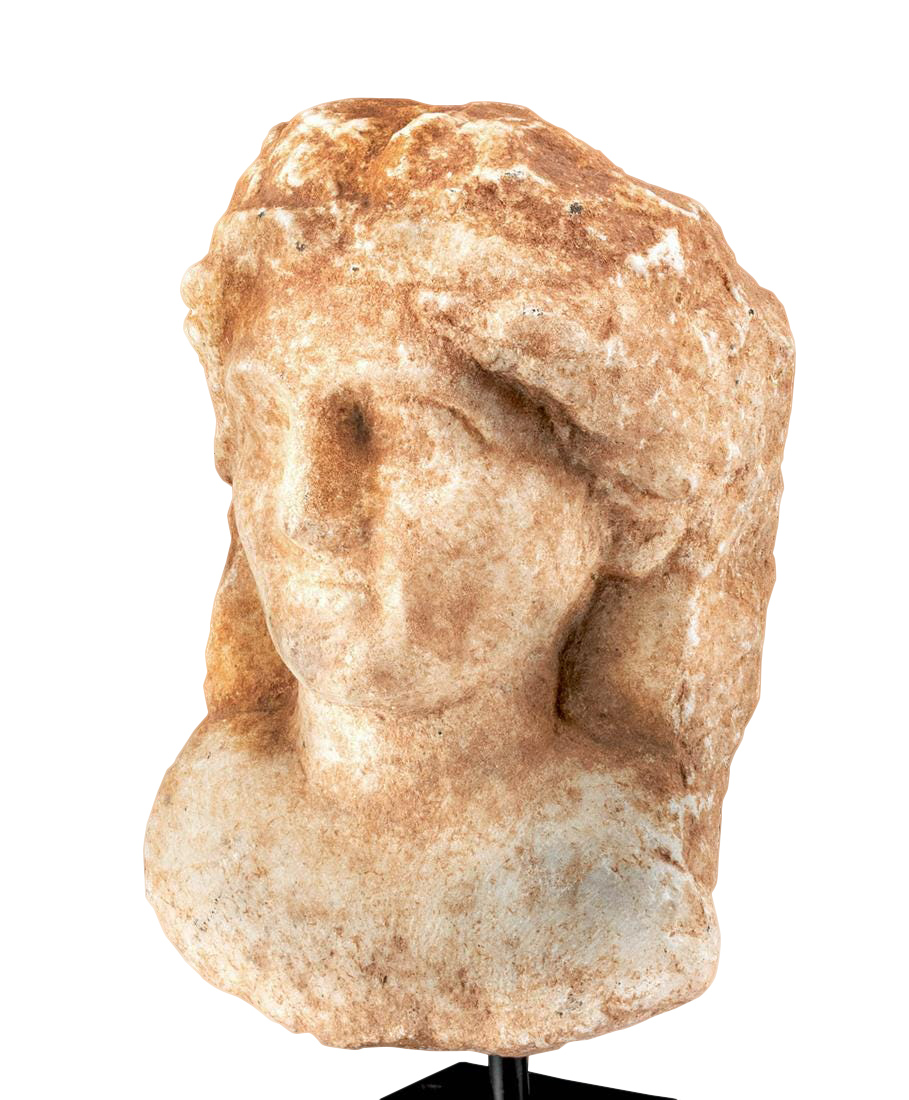
Roman Marble Bust of a Female / Muse:
Roman, Imperial Period, ca. 1st to 3rd century CE. A lovely marble sculpture of a female – perhaps a Muse – bust-length and uncarved on the verso, hence likely created for a niche, depicting a youthful female with nicely defined facial features including deep-set almond-shaped eyes, an aquiline noble nose, closed lips, and gentle contours – all crowned by a wavy coiffure adorned by a diadem. A beautiful bust from ancient Rome. Size: 4.625″ L x 4.75″ W x 7.25″ H (11.7 cm x 12.1 cm x 18.4 cm); 9.875″ H (25.1 cm) on included custom stand.
Sources of inspiration to poets, Muses were goddesses of music, song, and dance. In classical sculpture and vase painting, the Muses (Musai) were depicted as graceful young woman with various attributes such as musical instruments. Muses were also revered as goddesses of knowledge who possessed remarkable memory. In time, the muses were given specific names and assigned particular artistic realms: Kalliope (Calliope) for epic poetry; Kleio (Clio) for history; Ourania (Urania) for astronomy; Thaleia (Thalia) for comedy; Melpomene for tragedy; Polymnia (Polyhymnia) for religious hymns; Erato for erotic poetry; Euterpe for lyric poetry; and Terpsikhore (Terpsichore) for choral song and dance.
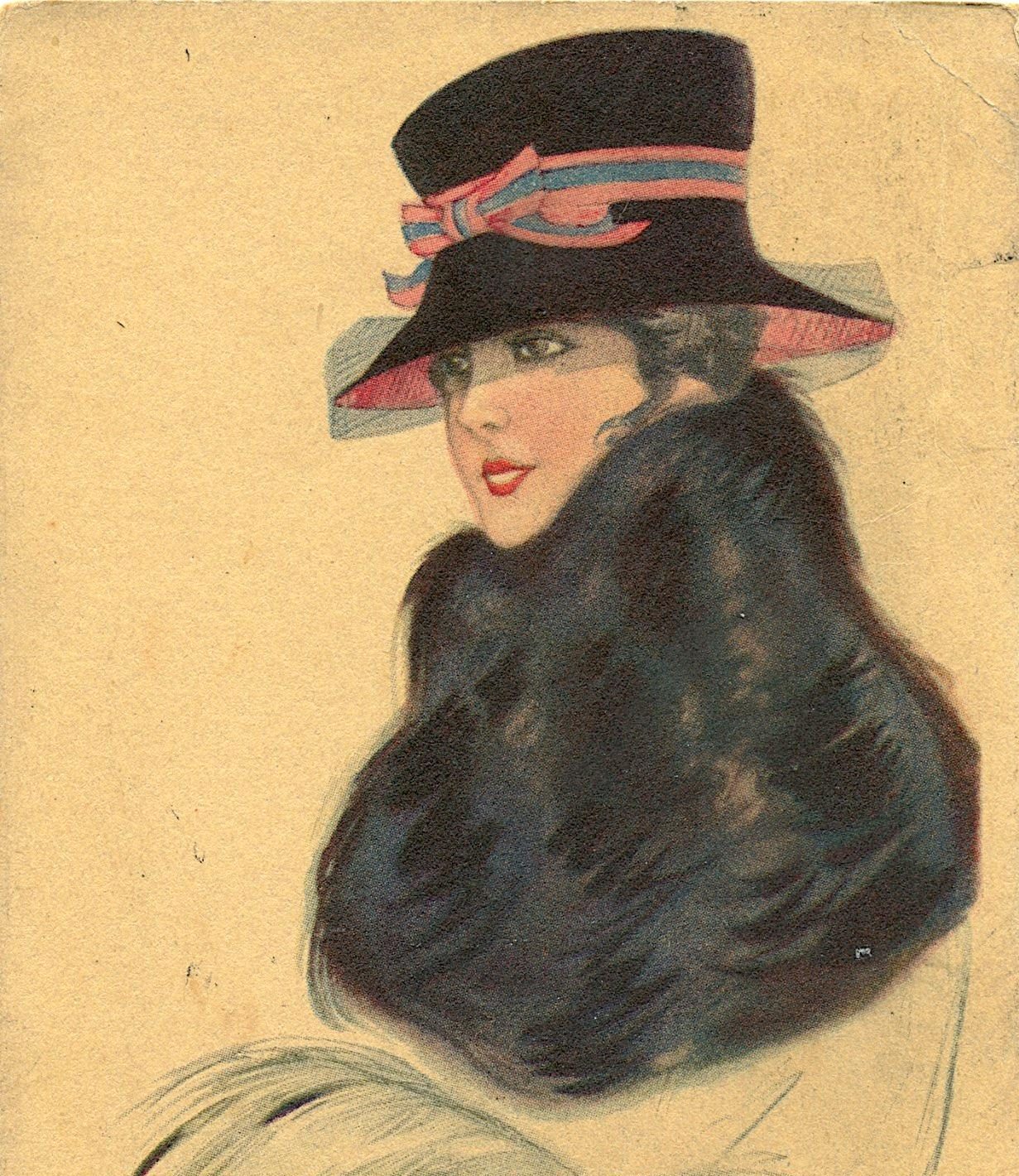
Early Postcard Unusual Rare NANNI:
ABOUT POSTCARDS: The study and collecting of postcards is termed deltiology (from Greek deltion, small writing tablet, and English -logy, the study of).
Rarity. As with all antique items, rarity brings up the value of postcards. If only a few of the cards were printed or only a small number have survived the ages, your card may be very valuable. However, rarity goes hand-in-hand with other characteristics; if only a single card was printed, that makes it rare.
”The rarity, age and desirability of the image, as well as whether it`s an original rather than a reproduction, all play a role in making a postcard collectible”.
Nostalgia is one of the main reasons people collect postcards: pictures and stories on cards are often associated with memories from their own past. Historians actually study old postcards to find out about the people living in a certain town, lifestyle patterns, architectural differences and more.
The design of a postcard often tells you from which era it comes. For example, from 1906 onwards a US postcard had a divided back; before then it was undivided with a lack of room for greeting wishes. Between 1915 and 1930 postcards often were designed with a white border to save ink, while postcards from 1930 until 1950 have a linen look.
Despite many prefer collecting postcards with little to no marks, grease or splotches on the surface and from which the corners have not been bent or torn. Some say say it does not matter as long as the condition of the card and handwriting is good. It surely gives the card a historical value! A stamp on a postcard can add historical information depending on the readability of the date and location.
You also should consider the value and age of the stamps that are included in used postcards. Infact many of the postcards we are offering are coming with early Washington Stamps that were used during the beginning of the 20th century to deliver the postcard.
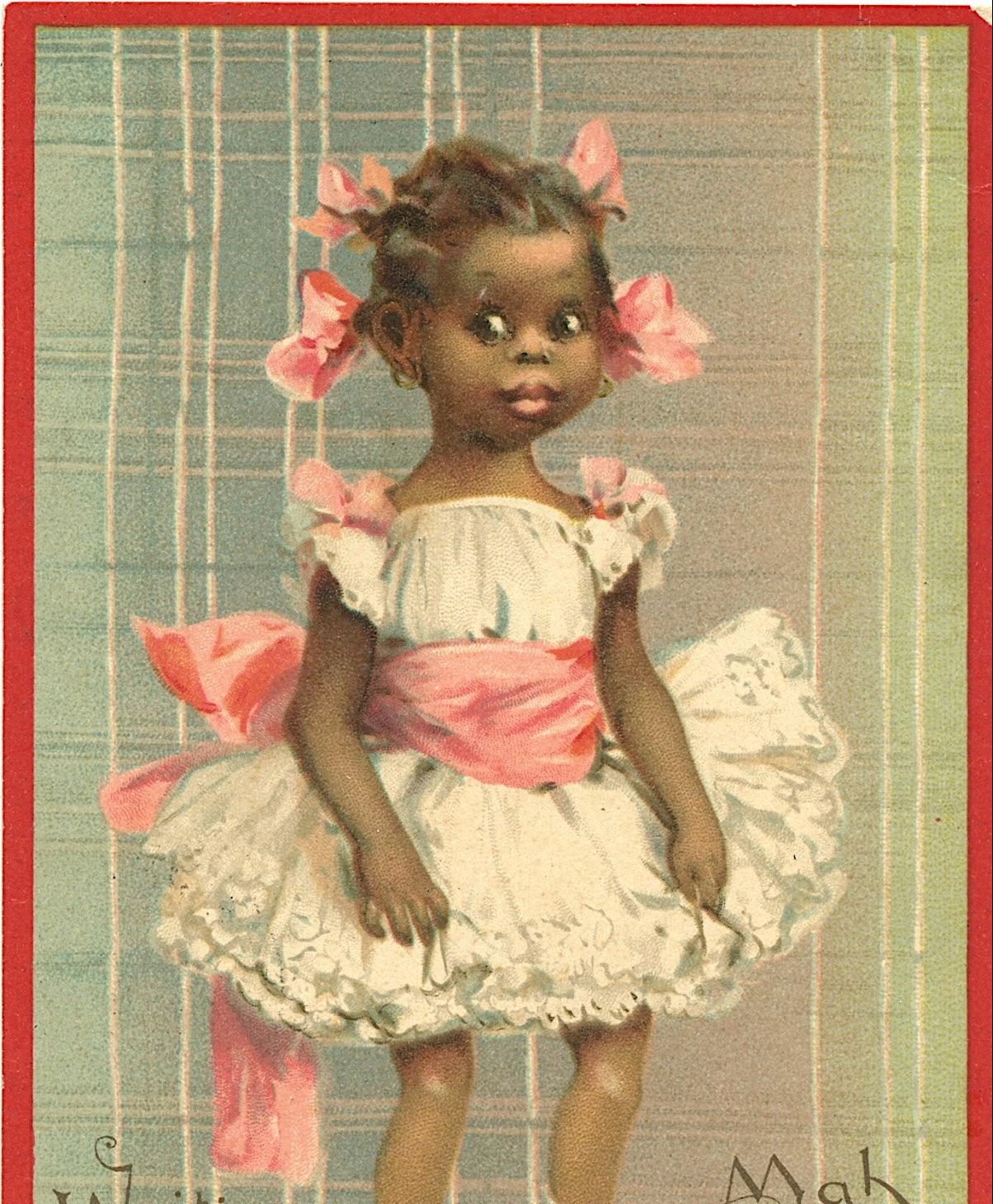
Early Postcard Unusual Rare African Black:
ABOUT POSTCARDS: The study and collecting of postcards is termed deltiology (from Greek deltion, small writing tablet, and English -logy, the study of).
Rarity. As with all antique items, rarity brings up the value of postcards. If only a few of the cards were printed or only a small number have survived the ages, your card may be very valuable. However, rarity goes hand-in-hand with other characteristics; if only a single card was printed, that makes it rare.
”The rarity, age and desirability of the image, as well as whether it`s an original rather than a reproduction, all play a role in making a postcard collectible”.
Nostalgia is one of the main reasons people collect postcards: pictures and stories on cards are often associated with memories from their own past. Historians actually study old postcards to find out about the people living in a certain town, lifestyle patterns, architectural differences and more.
The design of a postcard often tells you from which era it comes. For example, from 1906 onwards a US postcard had a divided back; before then it was undivided with a lack of room for greeting wishes. Between 1915 and 1930 postcards often were designed with a white border to save ink, while postcards from 1930 until 1950 have a linen look.
Despite many prefer collecting postcards with little to no marks, grease or splotches on the surface and from which the corners have not been bent or torn. Some say say it does not matter as long as the condition of the card and handwriting is good. It surely gives the card a historical value! A stamp on a postcard can add historical information depending on the readability of the date and location.
You also should consider the value and age of the stamps that are included in used postcards. Infact many of the postcards we are offering are coming with early Washington Stamps that were used during the beginning of the 20th century to deliver the postcard.
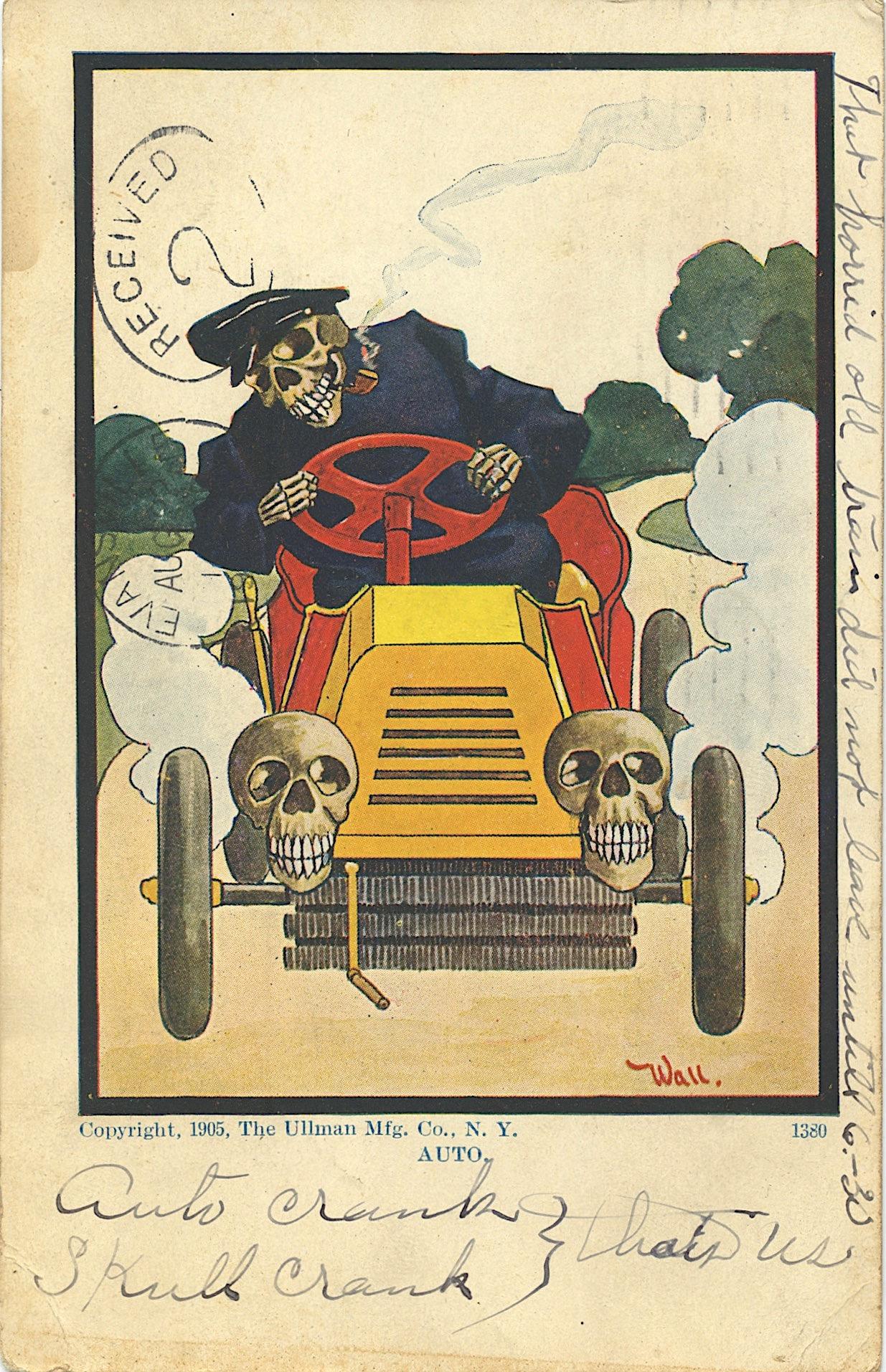
Early Postcard Unusual Rare Skull Halloween Car:
ABOUT POSTCARDS: The study and collecting of postcards is termed deltiology (from Greek deltion, small writing tablet, and English -logy, the study of).
Rarity. As with all antique items, rarity brings up the value of postcards. If only a few of the cards were printed or only a small number have survived the ages, your card may be very valuable. However, rarity goes hand-in-hand with other characteristics; if only a single card was printed, that makes it rare.
”The rarity, age and desirability of the image, as well as whether it`s an original rather than a reproduction, all play a role in making a postcard collectible”.
Nostalgia is one of the main reasons people collect postcards: pictures and stories on cards are often associated with memories from their own past. Historians actually study old postcards to find out about the people living in a certain town, lifestyle patterns, architectural differences and more.
The design of a postcard often tells you from which era it comes. For example, from 1906 onwards a US postcard had a divided back; before then it was undivided with a lack of room for greeting wishes. Between 1915 and 1930 postcards often were designed with a white border to save ink, while postcards from 1930 until 1950 have a linen look.
Despite many prefer collecting postcards with little to no marks, grease or splotches on the surface and from which the corners have not been bent or torn. Some say say it does not matter as long as the condition of the card and handwriting is good. It surely gives the card a historical value! A stamp on a postcard can add historical information depending on the readability of the date and location.
You also should consider the value and age of the stamps that are included in used postcards. Infact many of the postcards we are offering are coming with early Washington Stamps that were used during the beginning of the 20th century to deliver the postcard.
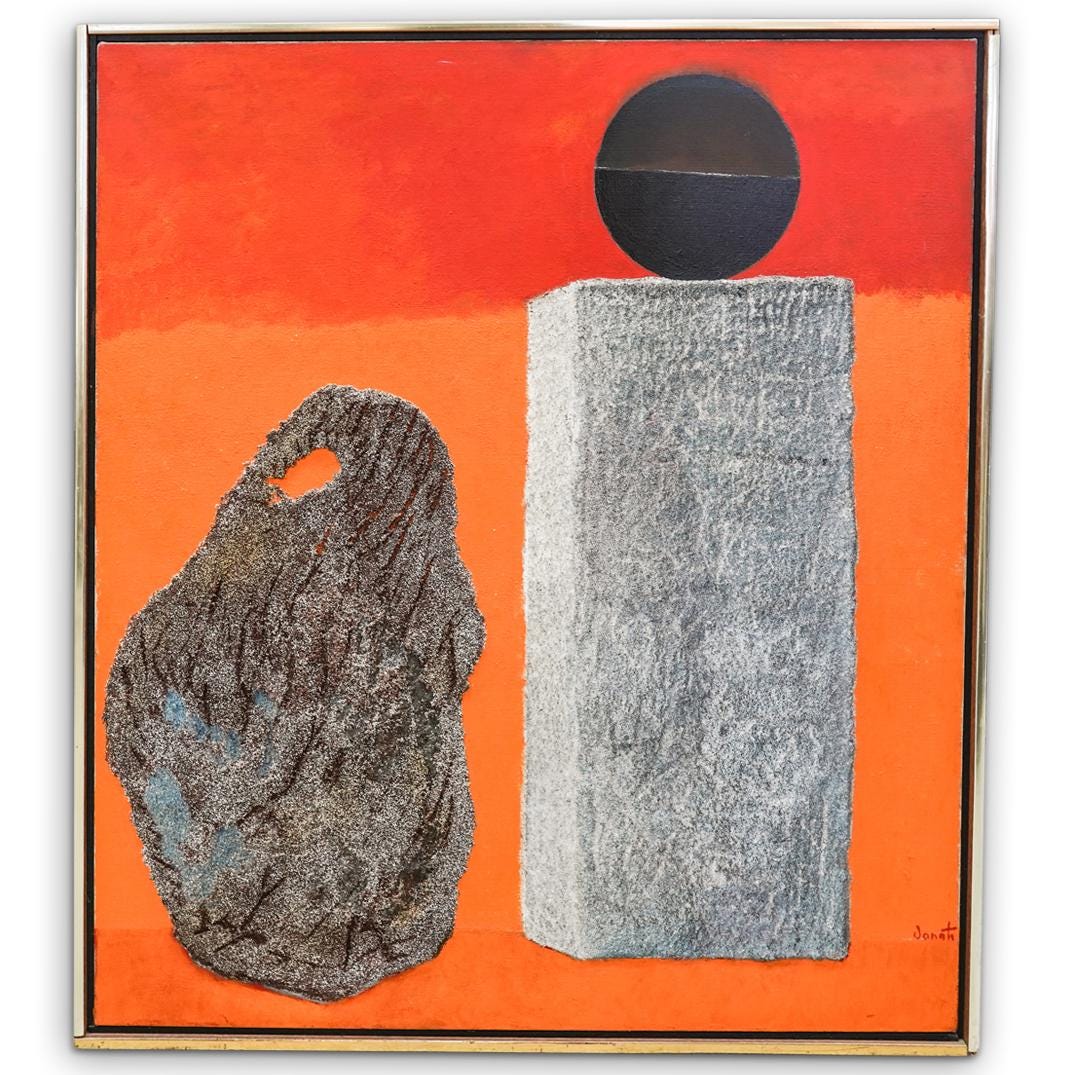
Enrico Donati (Italian-American, 1909-2008) Mixed Media:
Enrico Donati oil and sand relief on canvas painting. Features a surrealist abstract scene with vibrant orange background and sand textured design. Signed lower right “Donati” mounted in a wood frame. Reverse of canvas signed “Enrico Donati” with attached labels “Hommage A Magritte, 1975” and “Staempfli Gallery, Inc New York”
CIRCA: Mid 20th Cent.
ORIGIN: USA
DIMENSIONS: H: 33.5″ x L: 37.5″
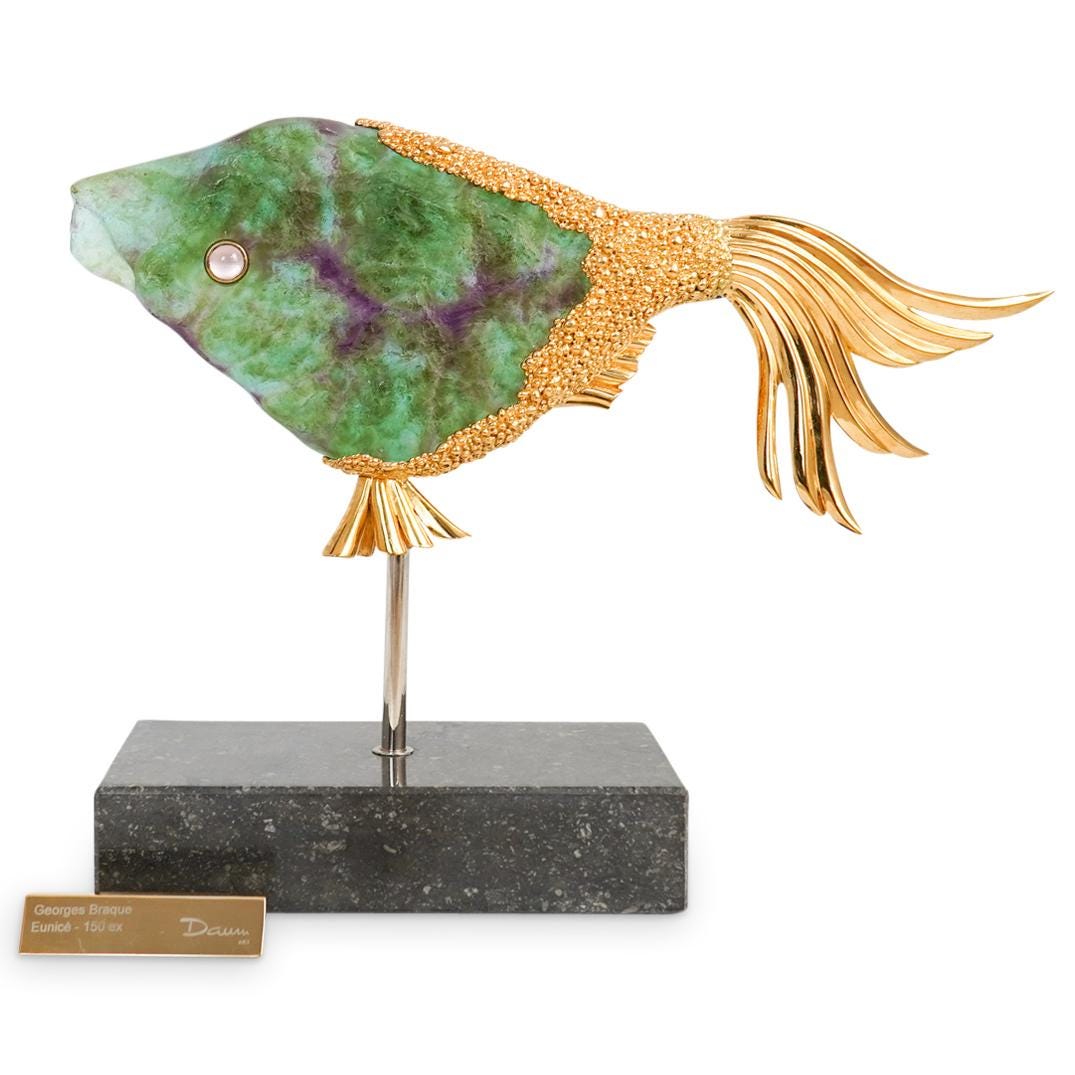
Daum “Eunice” Fish By Georges Braque:
Georges Braque Daum “Eunice” fish sculpture. Features a limited edition signed and numbered sculpture depicting a fish with gilt bronze accents. Incised signature at glass “Daum, France, 062/150” signed “S Braque” at bronze. Finished on a rectangular marble display base with engraved plaque. Includes certificate from Daum, original booklet and box.
CIRCA: 1963
ORIGIN: France
DIMENSIONS: H: 10″ x W: 3.5″ x L: 13″
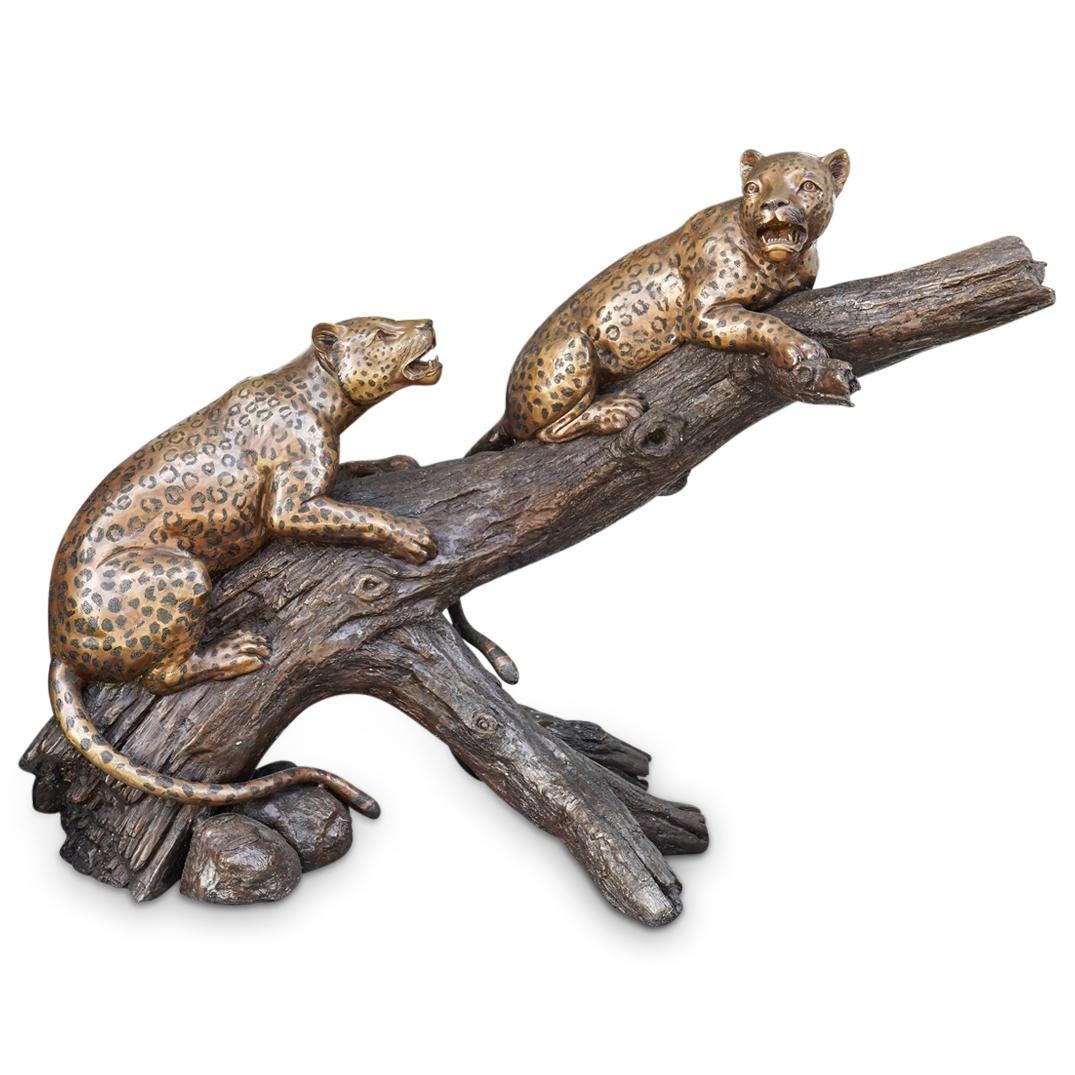
Signed Monumental Leopard Bronze Garden Statue:
A monumental bronze garden statue featuring the deception of two naturalistic cast leopards resting on a tree branch. Cast using the lost wax technique and signed lower right “Hill Brooke”
CIRCA: 20th Cent.
ORIGIN: USA
DIMENSIONS: H: 46″ x W: 32″ x L: 72″
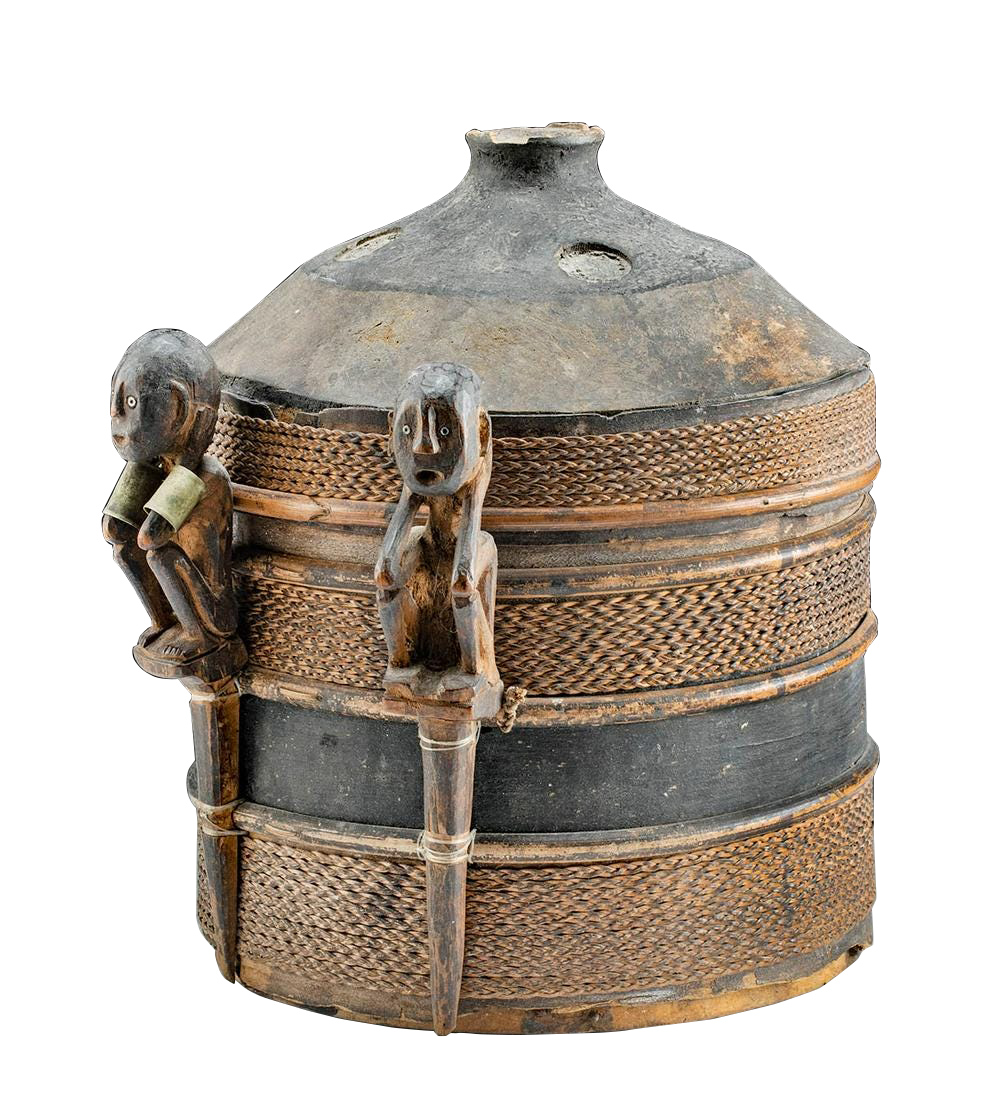
Southeast Asia, Indonesia, Borneo, Dayak, ca. 19th century. A carved-wood shaman box of cylindrical form wrapped in three registers of braided rattan fiber with a pair of hand-carved tutelary figures strapped to its exterior. Sitting upon an annular base, the box displays a circular rim and a broad mouth over a deep basin. The exterior of the box boasts two thick horizontal bands of braided rattan fiber in a hue of golden caramel over a chocolate brown base. A conical lid tops the lovely vessel, adorned with a rattan fiber-wrapped periphery and a raised circle embellishment at its center, which is surrounded by four annular recessed areas. Two carved figures decorate one side of the vessel, sitting atop integral plinths with their elbows resting on their drawn up knees and their hands on the back of their necks. Size: 8.25″ W x 9″ H (21 cm x 22.9 cm)
Intended to represent tutelary spirits and hold apotropaic powers, the fascinating figures showcase slender bodies with attenuated limbs and large, bald heads bearing inlaid, glass bead eyes, flat noses, and incised, open mouths. One of the curious figures is adorned with a pair of petite nickel brass arm bands. Boxes such as this example are known as “Lupong manang” and used by Dayak shamans to hold all the magical instruments they may need for healing, oracles, and predictions.