Vintage Universal Geneve Tri-Compax Chrono Watch

Vintage Universal Geneve Tri-Compax Chrono Watch

Vintage Universal Geneve Tri-Compax Chrono Watch:

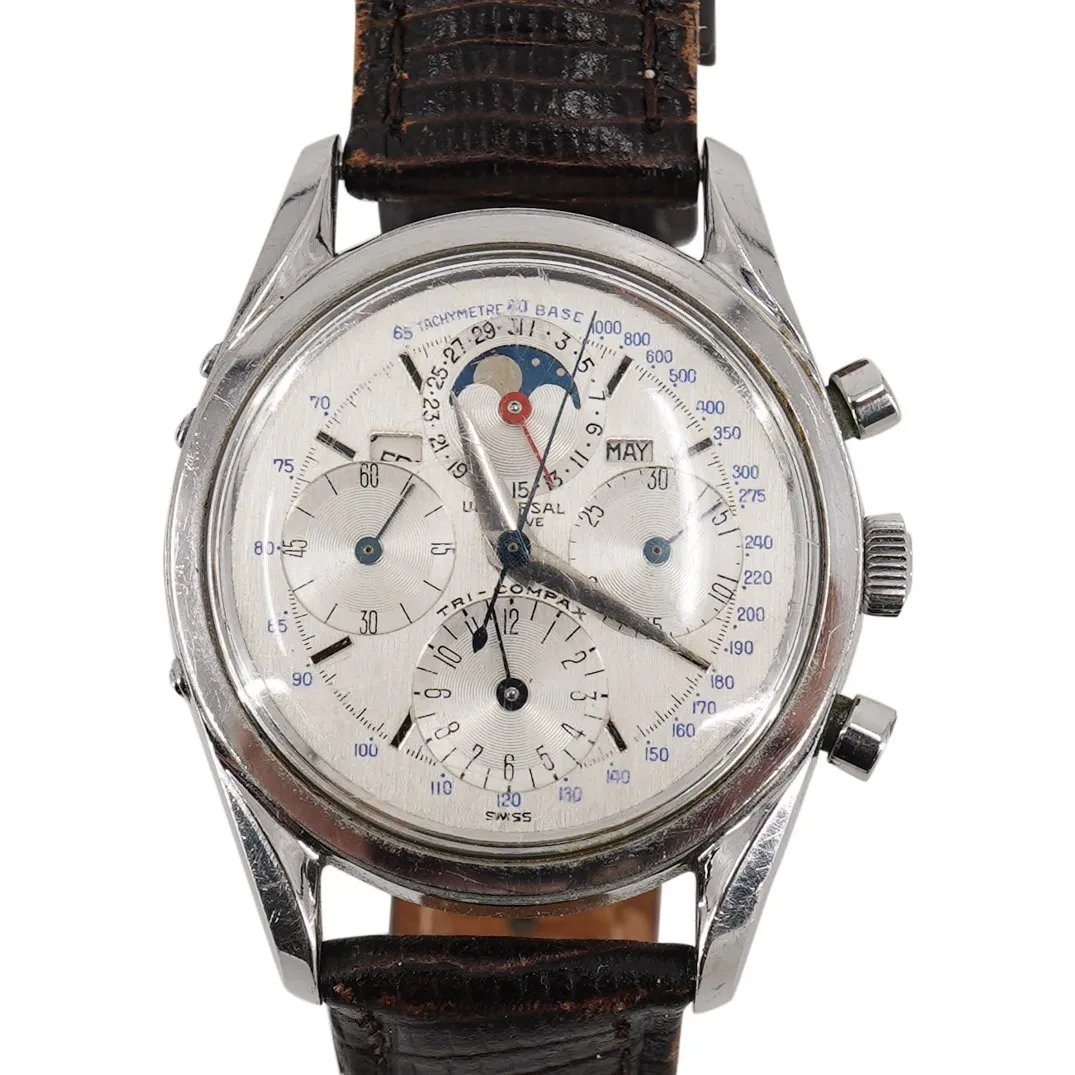
Bombay-style case of 36mm with twisted lugs and screw caseback. Manual winding.
Silver metallic linen face has a vertical brushing, at twelve o’clock the distinctive red sub dial hand, that denotes the date, and moonphase, at 10 o’clock day’s window and at 2 o’clock month’s window. features a triple calendar, chronograph and moonphase. Attached to a crocodile band. S# 222100
CIRCA: 1960s
ORIGIN: Switzerland
DIMENSIONS: 36mm

Have a similar item to sell? Contact: [email protected].

CONDITION: Some scratches on crystal and scuffs on watch. See lot description for details on item condition. More detailed condition requests can be obtained via email ([email protected]) or SMS (305) 333-4134. Any condition statement given, as a courtesy to a client, is only an opinion and should not be treated as a statement of fact. Akiba Antiques shall have no responsibility for any error or omission.

Have a similar item to sell? Contact: [email protected].

Andy Warhol (American, 1928-1987) AP “Leonardo da

Andy Warhol (American, 1928-1987) AP "Leonardo da

Andy Warhol (American, 1928-1987) AP “Leonardo da:

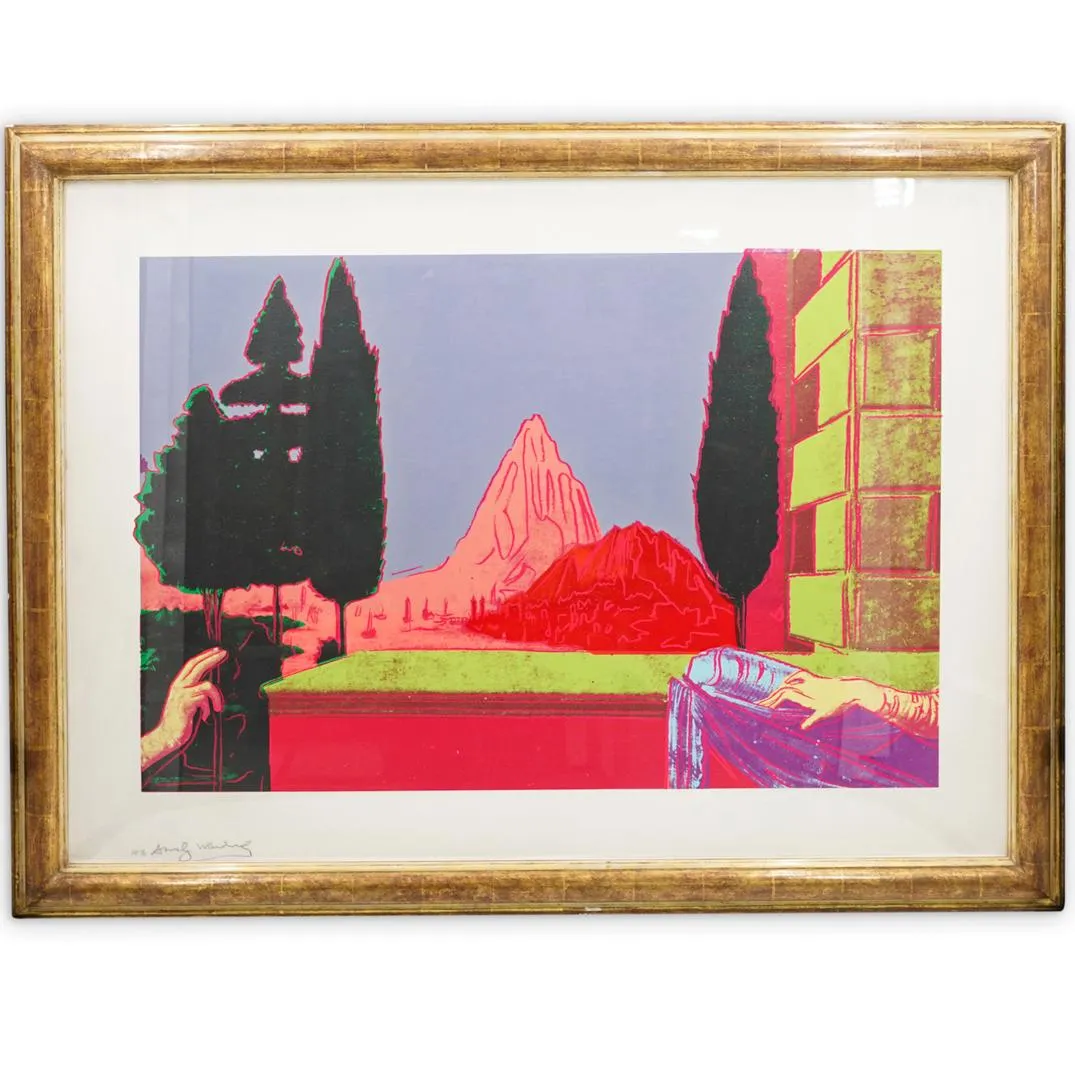
An Andy Warhol Artist Proof Screen Print, hand signed and numbered “AP 10/15”. The Unique screenprint in colors on Arches Aquarelle (Cold Pressed) paper. Faintly stamped along the back “Andy Warhol 1984″.
Provenance: Gifted to Fernadith Gimenez a Friend of Warhol
Ref. II.320
Series: Details from Renaissance Paintings, 1984
CIRCA: 1984
ORIGIN: USA
DIMENSIONS: 32.25 x 44 in (In Frame: 37.5″ x 49″)

Have a similar item to sell? Contact: [email protected].

CONDITION: Great condition. See lot description for details on item condition. More detailed condition requests can be obtained via email ([email protected]) or SMS(305)-332-9274. Any condition statement given, as a courtesy to a client, is only an opinion and should not be treated as a statement of fact. Akiba Antiques shall have no responsibility for any error or omission.”

Maya Stone Kneeling Monkey Figure

Maya Stone Kneeling Monkey Figure

Maya Stone Kneeling Monkey Figure:

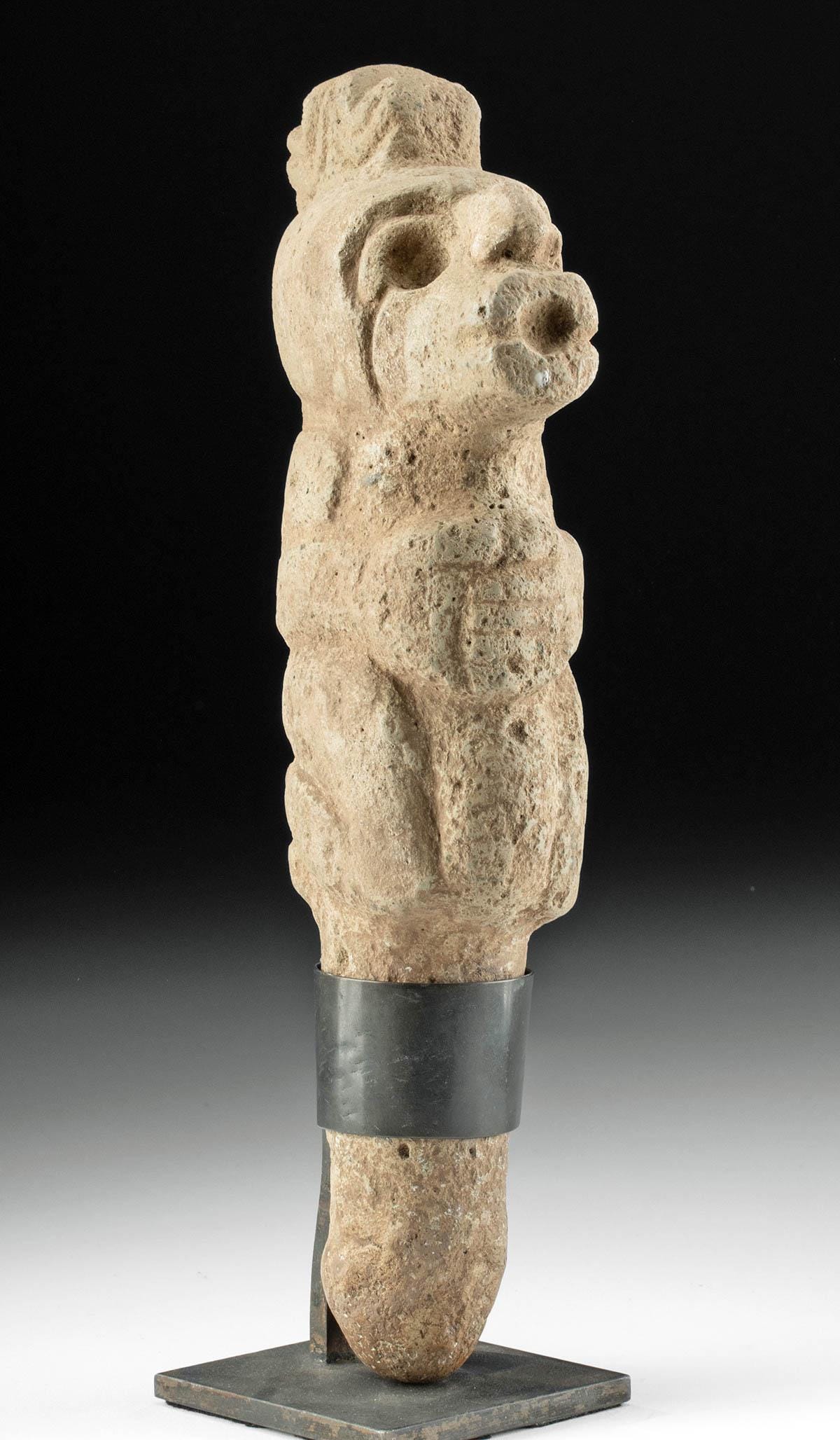
Pre-Columbian, Mayan territories, ca. 500 to 950 CE. An astounding hand-carved stone sculpture of a kneeling zoomorphic figure resembling a monkey. The fascinating figure holds his huge hands together at his chest, as though holding a small object. His body displays thick thighs, arms bent at elbows, and a giant head with a recessed visage. His expressive face is comprised of deep-sunken eyes, a bulbous nose with delineated nostrils and large, projecting lips held open as though singing or chanting. A crest-like headdress adorned with an incised zigzag motif caps his head. He kneels atop a phallic spike that narrows to a round base. Size: 4.375″ L x 2.125″ W x 11.75″ H (11.1 cm x 5.4 cm x 29.8 cm); 12″ H (30.5 cm) on included custom stand.

Monkeys were often depicted on Maya vases engaged in writing and carving human heads. Scholars have suggested that these activities may have represented a metaphor for creation of humankind. According to the Popol Vuh, Hun-Chowen and Hun-Batz ‘One-Howler Monkey’ were both artists and musicians who had a major conflict with their half-brothers, the Maya Hero Twins. It was this conflict that resulted in their transformation into monkeys.

Maya artisans used obsidian chisels, mallets and hammers made of flint and wood, and obsidian knives to create their sculptures. The use of basalt places this carving to the Maya uplands (lowlands carved in limestone); the three-dimensional carving in the round places it to the Postclassic period. The Spaniards wrote of the Aztecs believing that stone quarried to be carved had magical properties and was alive, able to speak and offer prophecies; perhaps the Maya had similar beliefs.

This piece has been searched against the Art Loss Register database and has been cleared. The Art Loss Register maintains the world’s largest database of stolen art, collectibles, and antiques.

Provenance: private New York, USA collection, acquired August 1999

All items legal to buy/sell under U.S. Statute covering cultural patrimony Code 2600, CHAPTER 14, and are guaranteed to be as described or your money back.

A Certificate of Authenticity will accompany all winning bids.

PLEASE NOTE: Due to recent increases of shipments being seized by Australian & German customs (even for items with pre-UNESCO provenance), we will no longer ship most antiquities and ancient Chinese art to Australia & Germany. For categories of items that are acceptable to ship to Australia or Germany, please contact us directly or work with your local customs brokerage firm.

Display stands not described as included/custom in the item description are for photography purposes only and will not be included with the item upon shipping.

#165125
CONDITION
Expected surface wear with nicks, chips, and abrasions throughout, all commensurate with age. Otherwise, very nice with lovely encrustations.

1938 American Folk Art Whirligig of Dust Bowl Era

1938 American Folk Art Whirligig of Dust Bowl Era

1938 American Folk Art Whirligig of Dust Bowl Era:

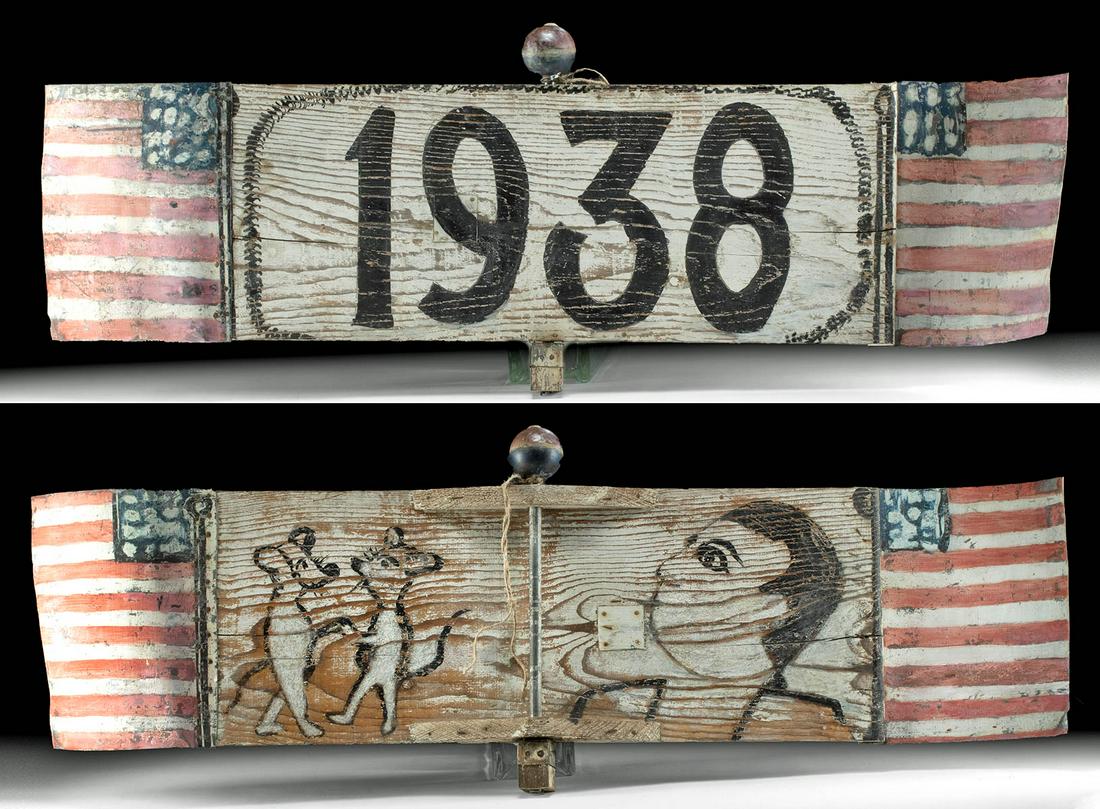
North America, United States, 1938. A fabulous piece of American folk art – a large whirligig/sign comprised of painted wood and metal – likely intended for a barn or farmhouse. On one side, the piece presents the year “1938” boldly delineated in black on white and flanked by a pair of American flags. On the opposite side are two endearing dancing mice along with the profile portrait head of a man, also flanked by two American flags. These metal flags – painted in their red, white, and blue glory – are also curved so as to add to their kinetic quality as the whirligig spins. At the center of the piece is a metal pole, about which the sign would have rotated in the wind, with a spherical finial that is also painted red, white, and blue. Size: 49″ W x 17″ H (124.5 cm x 43.2 cm)

Why was the year 1938 being celebrated? Quite a few major events occurred during 1938; however, given that this piece was likely used to decorate a barn or farmhouse, this grand visual statement of American pride may have been inspired by the passing of the Agricultural Adjustment Act. In February of 1938, the United States Congress passed the Second Agricultural Adjustment Act, replacing the Agricultural Adjustment Act of 1933. As part of President Franklin Delano Roosevelt’s New Deal program, this Act gave price support for wheat, corn, and cotton in order to ensure regular supply during times of low production, as farmers were greatly impacted by The Great Depression and the Dust Bowl. The Second Agricultural Adjustment Act also established the Federal Crop Insurance Corporation and assured support for other crops until 1940.

Provenance: ex-House of Ancestors, Santa Fe, New Mexico, USA

All items legal to buy/sell under U.S. Statute covering cultural patrimony Code 2600, CHAPTER 14, and are guaranteed to be as described or your money back.

A Certificate of Authenticity will accompany all winning bids.

PLEASE NOTE: Due to recent increases of shipments being seized by Australian & German customs (even for items with pre-UNESCO provenance), we will no longer ship most antiquities and ancient Chinese art to Australia & Germany. For categories of items that are acceptable to ship to Australia or Germany, please contact us directly or work with your local customs brokerage firm.

Display stands not described as included/custom in the item description are for photography purposes only and will not be included with the item upon shipping.

#167028
CONDITION
There is an old repair (measuring about 2″ x 2″) in front of the man’s mouth. Some age cracks, wear to pigments, and weathering as expected. Otherwise, the decorative program is still very strong, and the form is remarkably well preserved.

1999 LeRoy Nieman “John Elway” Signed by Elway & Nieman

1999 LeRoy Nieman "John Elway" Signed by Elway & Nieman

1999 LeRoy Nieman “John Elway” Signed by Elway & Nieman:

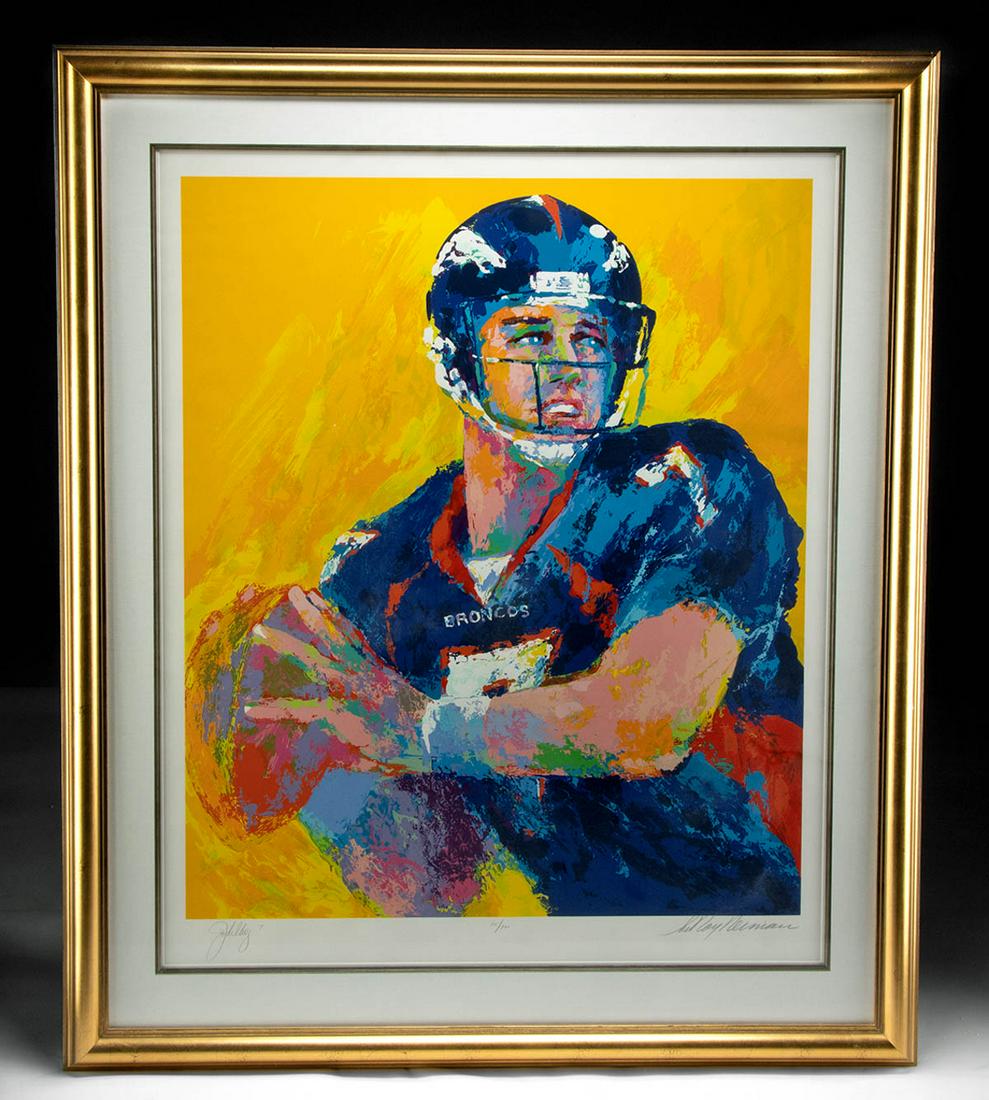
LeRoy Neiman (American, 1921-2012). “John Elway” original color serigraph on Arches paper with private watermark of the artist’s signature – Brand X Editions Limited. Date: August, 1999. Number 115 of 300. Hand signed in the bottom margin by LeRoy Neiman on the right side and John Elway on the left side. Atelier’s chop “X” in lower right corner. Impressive for its grand scale, remarkable rendering, and brilliant color palette, LeRoy Neiman’s “John Elway” depicts one of the all time great Super Bowl heroes and is pencil signed by both Neiman and Elway. Neiman’s talent earned him the title, “Father of Contemporary Sport Art” and in addition to covering the Super Bowl, he created captivating scenes at the World Series, the Kentucky Derby, PGA and The Masters golf tournament, championship boxing matches, and the Tour de France. Size of image: 38″ L x 31.75″ W (96.5 cm x 80.6 cm) Size of sheet: 45″ L x 37.75″ W (114.3 cm x 95.9 cm)

LeRoy Neiman, who studied at the School of the Art Institute of Chicago, is best known for his depictions of sports activities and personalities – frequently working on the sidelines of Super Bowls, boxing matches, gold tournaments, horse races, and other sporting events. Neiman was in fact the official artist at five Olympiads. As stated on the LeRoy Neiman Foundation website, “Millions of people have watched him at work: on ABC TV coverage of the Olympics, as CBS Superbowl computer artist, and at other major competitions, televised on location with his sketchbook and drawing materials, producing split-second records and highly developed images of what he is witnessing.” The passage continued with a quote from Carl J. Weinhardt excerpted from the catalogue of Neiman’s 1972 Olympics sketches hosted that same year by the Indianapolis Museum of Art, “Before the camera, such reportage of history and the passing scene was one of the most important functions of painters and draftsmen of all sorts. Mr. Neiman has revived an almost lost and time-honored art form.” Next, they cited a Christian Science Monitor (May 2, 1972) article in which Nick Seitz exclaimed that Neiman “has the journalistic talent, as well as the artistic ability, to convey the essence of a game or contestant with great impact, from the Kentucky Derby to Wilt Chamberlain, from the America’s Cup to Muhammad Ali, from the Super Bowl to Bobby Hull.”

Accompanied by copy of certificate that includes the edition number, description of signature, method of production, use of master, size of edition, description of multiple, and involvement of the artist with printer – this final excerpt reads as follows, “Each screen is proofed by the atelier, Brand X Editions Limited. Preliminary proof was submitted to the artist for review. The artist corrected proof, making changes to color and form. After changes were implemented, the artist approved final proof. The entire edition was then pulled one color at a time by atelier. After the printing, the artist inspected each print in the edition. Each print was then signed by LeRoy Neiman by hand in pencil in the lower right hand corner, and signed by John Elway by hand in pencil in the lower left hand corner.”

Provenance: private Greenwood Village, Colorado, USA collection, purchased August 26, 1999 from Royce Galleries Ltd., Denver, Colorado, USA

All items legal to buy/sell under U.S. Statute covering cultural patrimony Code 2600, CHAPTER 14, and are guaranteed to be as described or your money back.

A Certificate of Authenticity will accompany all winning bids.

PLEASE NOTE: Due to recent increases of shipments being seized by Australian & German customs (even for items with pre-UNESCO provenance), we will no longer ship most antiquities and ancient Chinese art to Australia & Germany. For categories of items that are acceptable to ship to Australia or Germany, please contact us directly or work with your local customs brokerage firm.

Display stands not described as included/custom in the item description are for photography purposes only and will not be included with the item upon shipping.

#165142
CONDITION
Serigraph has not been examined outside the frame but appears to be in excellent condition. Hand signed in pencil in the bottom margin by LeRoy Neiman on the right side and John Elway on the left side, with edition number 115/300 at center. Atelier’s chop “X” in lower right corner hidden by frame. Set in museum quality frame. Suspension hooks on the verso.

Harry Bertoia (American, 1915-1978) Untitled (Tonal Sound Sculpture)

Harry Bertoia (American, 1915-1978) Untitled (Tonal Sound Sculpture)

Harry Bertoia (American, 1915-1978) Untitled (Tonal Sound Sculpture):

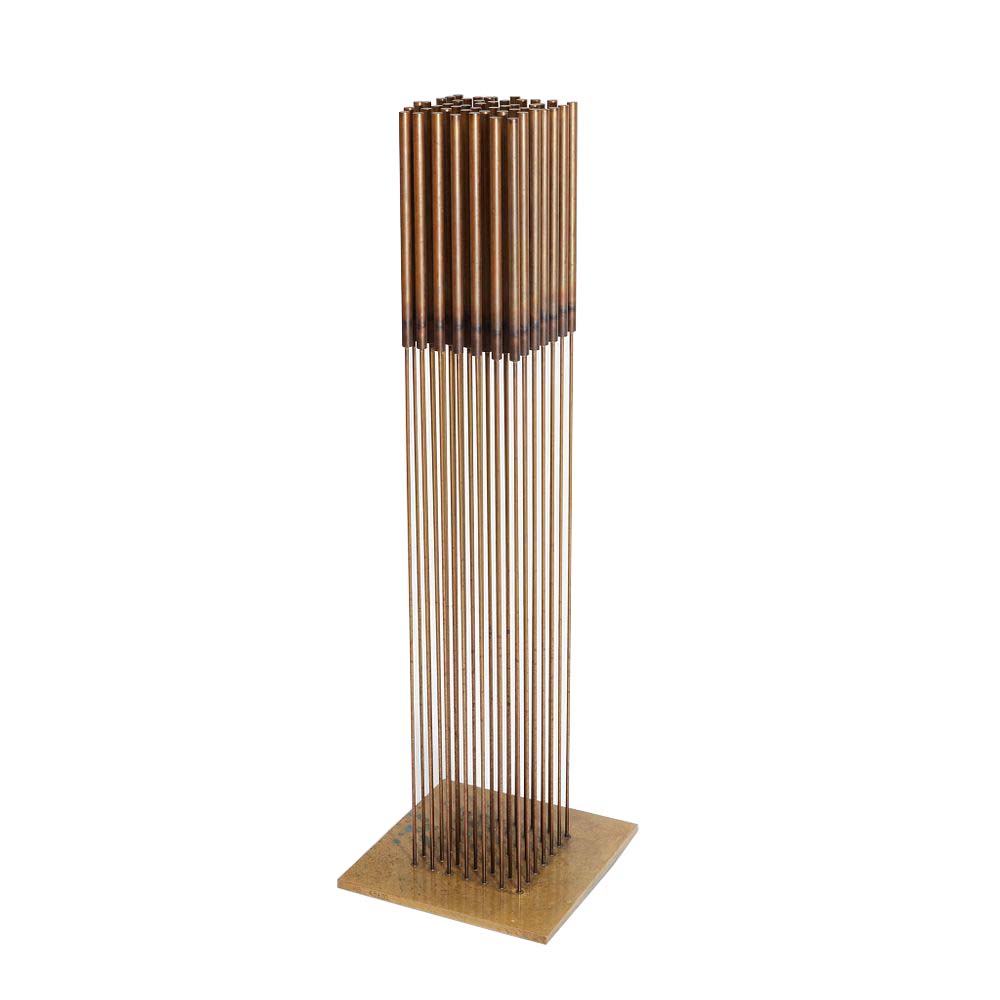
Silicon bronze tops welded to beryllium copper rods silvered to brass base.
Executed in 1978.

height: 39 1/2 in. (100.3cm)
width: 11 3/4 in. (29.8cm)
depth: 11 3/4 in. (29.8cm)

Provenance

Mangel Gallery, Philadelphia, Pennsylvania.
Collection of Bob and Gabriele Lee, Philadelphia, Pennsylvania (acquired directly from the above in 1978).
Property from the Estate of Gabriele Lee.

Footnote:
Note

This lot is accompanied by a certificate of authenticity issued by the Harry Bertoia Foundation, signed by Celia Bertoia, Director, and dated August 4, 2021 and will be included in the upcoming catalogue raisonné of the artist’s work.

Please see lot 37 for more information about this artist and collection.

Condition report:
To receive a complete Condition Report on this Lot, please contact the department at [email protected]

Chaïm Soutine (French/Russian, 1893-1943) Le Viaduc Rouge Près de Vence

Chaïm Soutine (French/Russian, 1893-1943) Le Viaduc Rouge Près de Vence

Chaïm Soutine (French/Russian, 1893-1943) Le Viaduc Rouge Près de Vence:

Oil on canvas.
Executed c. 1919.

(21 1/8 x 14 5/8 in. (53.7 x 37.1cm))

Provenance

Henri Bing, Paris.
Roger Dutilleul, Paris.
Roger Masurel, Roubaix, France.
G. Hyordey, Paris.
“Tableaux Modernes,” Palais Galliera, Paris, June 22, 1962, lot 71 (sold as Le Viaduc Rouge à Céret).
“Impressionist and Modern Paintings and Sculpture (Part II),” Sotheby’s, London, April 1, 1987, lot 219.
Galerie Fabien Boulakia, Paris (acquired directly from the above sale).
“Importants Tableaux Modernes et Impressionistes,” Hôtel Drouot, Paris, June 19, 1988, lot 49.
Galerie Matignon, Paris (acquired directly from the above sale).
Galerie Nichido, Tokyo.
“Impressionist and Modern Paintings, Drawings and Sculpture (Part II),” Christie’s, New York, November 12, 1997, lot 386.
Property from a Private Philadelphia Collection (acquired directly from the above sale).

Footnote:
Exhibition

“Soutine 1894-1943,” Galerie de France, Paris, January-February 1945, no. 3.

Literature

Germain Bazin, Labyrinthe, March 15, 1945, p. 9 (illus.).

Raymond Cogniat, Soutine, Paris: Editions du Chêne, 1945, no. 3 (illus.).

Pierre Courthion, Soutine: Peintre du Déchirant, Lausanne: Edita; Paris: Denoël, 1972, p. 188A (illus.).

Maurice Tuchman, et al. Chaim Soutine (1893-1943): Catalogue Raisonné. Vol. 1. Cologne: Benedikt Taschen Verlag, 1993, p. 151, no. 39. (illus.).

Note

Under the threat of German invasion as World War I progressed, Chaïm Soutine left Paris for Vence in the south of France in 1918 with his friend and fellow painter Amedeo Modigliani. Soutine spent the next three years traveling throughout the sun-soaked region, perhaps his first time away from the city after moving to Paris from his native Smilovitz (in present day Belarus) in 1913. Soutine’s landscape painting developed during the artist’s time in Provence, beginning with his visit to Vence in 1918-1919.

Revered over time by artists and authors like Henri Matisse, Raoul Dufy, Marc Chagall, and D.H. Lawrence, Vence was considered the “heart of Provence” for its charm, seclusion and historic interest. The turbulence of Soutine’s painted landscapes from this time, roughly 1919-1922, suggest more about his own emotional state and personal psychology relating to the aftermath of the war, rather than an account of his direct observation of the Provençal landscape. The trees, bridges, mountains, and houses in his view became a means for his expression, an atmosphere he could deconstruct and exaggerate for his own purposes.

Soutine returned to Paris in 1922 and the following year his dealer Paul Guillaume exhibited over fifty paintings in an exhibition, largely from his time in the south. Philadelphia collector Albert C. Barnes visited the gallery and purchased the entire oeuvre for his collection, transforming the little known and impoverished artist’s life and bestowing new importance upon his work.

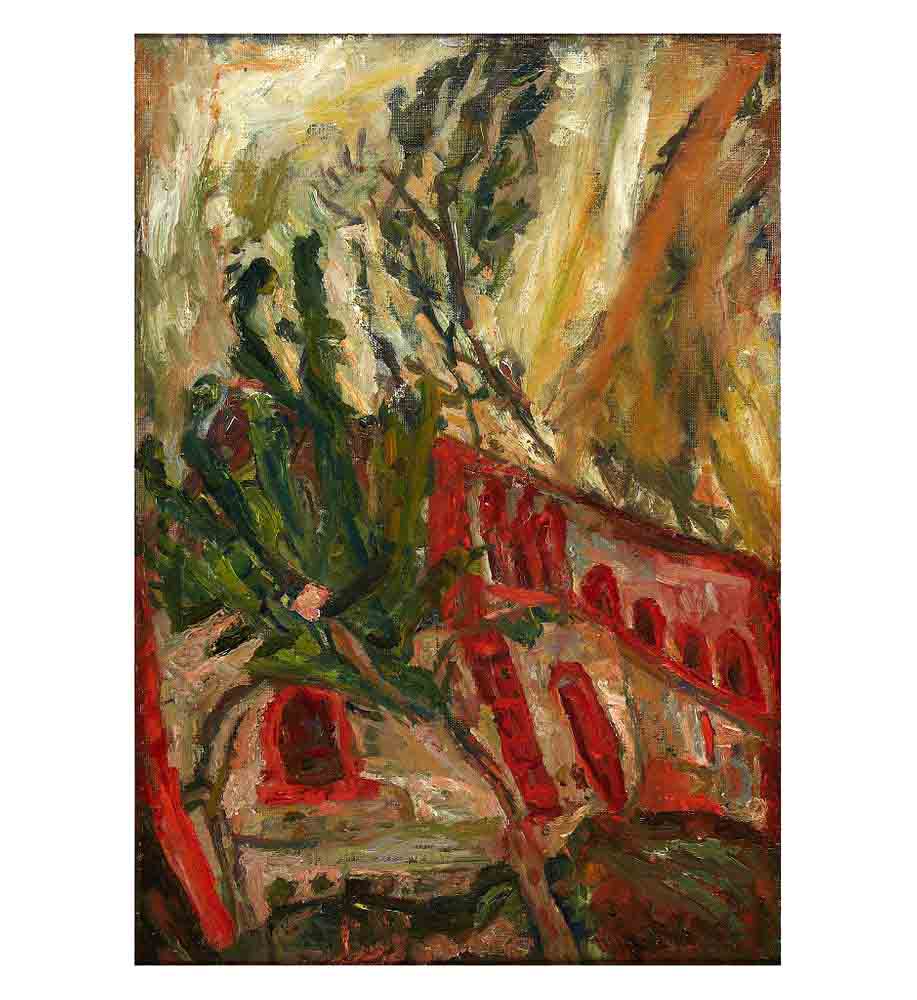
Many of the Barnes paintings, particularly Landscape with Houses (c. 1919), Landscape with House and Tree (c. 1920-21), and Landscape with White Building (c. 1920-21) relate directly to the turbulent Le Viaduc Rouge (c. 1919) on offer here. Painted quickly, with areas of thin and thick application, the disorienting landscapes twist and swirl under Soutine’s hand, with elements of the built environment, whether houses, a church, or a bridge at center, accentuating the undulating nature of Soutine’s line. The numerous bridges and viaducts connecting the Provençal towns Soutine visited, provided endless angles and plays of positive and negative space for his experimentation. In Le Viaduc Rouge, the structure appears to rise up out of the right side of the canvas, culminating in two central trees whose branches stretch up to a bright and turbulent sky.

The Chaïm Soutine Le Viaduc Rouge comes from a prominent Philadelphia estate which also includes paintings by Jules Pascin, Armand Guillaumin, and other artists of the style that was popular in Philadelphia art circles during Barnes’s time. Soutine’s work in particular has garnered special attention recently, as Philadelphia’s Barnes Foundation and Les Musées d’Orsay et de l’Orangerie in Paris organized an exhibition in 2020-21 that emphasized the artist’s unique impact on Abstract Expressionist painter Willem de Kooning and his continuing legacy today. Soutine stands as a pivotal figure in European Modernism and Le Viaduc Rouge provides a vibrant and dynamic example of his work.

Condition report:
To receive a complete Condition Report on this Lot, please contact the department at [email protected]

François-Xavier Lalanne (French, 1927-2008) Two Moutons de Pierre

François-Xavier Lalanne (French, 1927-2008) Two Moutons de Pierre

François-Xavier Lalanne (French, 1927-2008) Two Moutons de Pierre:

Signed FxL and numbered 78/250 under chin; also dated 1988 and signed LALANNE on underside. Epoxy stone and patinated bronze.
Designed in 1979.

height: 34 in. (86.4cm)
width: 15 3/4 in. (40cm)
depth: 36 3/4 in. (93.3cm)

Signed FxL, stamped LALANNE and numbered 79/250 under chin; also dated 1988 and signed LALANNE on the underside. Epoxy stone and patinated bronze.
Designed in 1979.

height: 34 in. (86.4cm)
width: 15 3/4 in. (40cm)
depth: 36 3/4 in. (93.3cm)

Qty: (2)

Provenance

The Artist.
Property from the family of a Prominent Washington, D.C. Real Estate Developer (acquired directly from the above in 1988 through Christian Duvernois, New York, New York).

Footnote:
Literature

Daniel Marchesseau, Les Lalanne, Paris: Flammarion, 1998, pp. 34-36, 146 (other examples illustrated).

Robert Rosenblum, Les Lalanne, Geneva: Skira, 1991, pp. 76, 122, 124, 127 (other examples illustrated).

Daniel Abadie, Lalanne(s), Paris: Flammarion, 2008, pp. 186-187, 190-191, 322, 325-326, 335 (other examples illustrated).

Les Lalanne at Fairchild, exh. cat., New York: Paul Kasmin Gallery; and Coral Gables: Fairchild Tropical Botanic Garden, 2010, n.p. (other examples illustrated).

Adrian Dannatt, et al., Les Lalanne: Fifty Years of Work 1964-2015, exh. cat., New York: Paul Kasmin Gallery, 2015, pp. 77, 88- 89, 106-108 (other examples illustrated).

Paul Kasmin, Claude & François-Xavier Lalanne: Art, Work, Life, New York: Skira Rizzoli, 2012, n.p. (other examples illustrated).

Adrian Dannatt, François-Xavier & Claude Lalanne: In the Domain of Dreams, New York: Rizzoli International Publications, Inc., 2018, pp. 18, 84-89, 181, 192-193 (other examples illustrated).

Note

Throughout his sixty-year long career, François-Xavier Lalanne is best remembered for his unique, amusing, surrealist and undeniably poetic take on the animal kingdom. Among the creatures that inspired him the most, aside from the gorilla, the hippopotamus, and the rhinoceros, are the sheep. The French designer’s fascination with the bovine animal started early. It was not an uncommon trait as before him, many Surrealist artists including Salvador Dalí and Henri Matisse revered the sheep as an important source of inspiration, and in fact channeled the oneiric dimension associated with the animal (“counting sheep to sleep”) to suggest an otherworldly dimension.

François-Xavier Lalanne presented his first sheep creation in 1966 at the Salon de la Jeune Peinture in Paris. Consisting of 24 wooly pieces (some headless, others featuring bronze sheep faces), the flock was described as the most extraordinary show stopper, partly due to their surprising functionality. Indeed, depending on how they were arranged in the space, the sheep could serve as a bed, a sofa or a chair on which the visitor was invited to recline. As Lalanne himself explained: “The sheep in a Parisian apartment: it’s a bit of the ‘countryside in Paris.’ It’s always easier to have a sculpture in an apartment than a real sheep. And it’s even better if we can sit on it.” The idea to present a life size sheep that also functioned as seat was not exclusively for the sake of whimsy. As is often the case with François-Xavier Lalanne, the sculpture relied on a witty and subtle play on words. In French, the word bergère is used to describe a specific, and very comfortable type of chair, which appeared in the 18th century. The same word can also mean “shepherdess,” and therefore refer to the female shepherd who tends sheep. Through his creation, Lalanne used the functionality associated with the first meaning of the word, and paired it with the image associated with the second meaning of the same word; thus combining the two meanings into one image: one materialized idea. Titled Pour Polyphème, the group was conceived as a clear allusion to the Greek mythological story of Odysseus’ escape from the cave of Polyphemus by clinging to the underbelly of a sheep. This literary reference not only proved Lalanne’s deeply rooted training in classical art, but also enabled him to strike an artistic coup. Just like Odysseus, “the man with a thousand tricks,” Lalanne used the sheep to his advantage, as a ruse: instead of hiding underneath the animal’s underbelly to escape from a dangerous place, Lalanne sat on top of the bovine to infiltrate an equally scary place; one which did not welcome him: an exhibition space originally solely devoted to painters. By presenting his flock in a painting show, and making sure every visitor would leave with this striking image in mind, Lalanne boldly blurred the lines between painting and sculpture. Through an ordinary, common animal, he revolutionized the art establishment, in a “gentle” way. As the designer put it himself: “I wanted to do something very intrusive, because if you present a small object, no one sees it (…) This idea of a herd struck me as a peaceful idea (…)”

The 1966 installation proved so successful that Lalanne went on to design another model of his famous sheep in 1979. After moutons de laine (“wooly sheep”), Lalanne created moutons de pierre (“stone sheep”), made of patinated (cast) bronze and epoxy stone – as exemplified by the present five works. Such new material added versatility to the sheep, which could now be alternatively exhibited in a domestic interior or displayed outdoors in a grassy field (as opposed to the wooly sheep, bound to stay inside). Followed by a 1995 and a 2008 edition (the year of François-Xavier Lalanne’s death), the moutons de pierre showcase the same stylized, almost archaic and naïve manner, made of straight, pure lines and minimalist and often times flat shapes – a loose homage to Egyptian and Assyrian sculpture, which inevitably impacted Lalanne during his brief time as a guard at the Louvre Museum in December 1949.

The present flock of five sheep was executed in 1988, in accordance with the stylistic guidelines associated with the 1979 model. From an edition of 250, they were commissioned directly from the artist by their first owner (in the family of whom the sheep descended), through their fine art advisor, and close friend of Claude and François-Xavier Lalanne, Christian Duvernois. Consecutively numbered (#78 through #82), the sculptures guarded the entrance of the philanthropic family’s estate, Merrywood, for nearly thirty years. The Georgian style mansion perched on the banks of the Potomac River near Washington, D.C. was once the house of Jacqueline Kennedy Onassis, at the time Bouvier, and today is known as the Embassy of the Kingdom of Saudi Arabia.

Condition report:
To receive a complete Condition Report on this Lot, please contact Specialist Raphael Chatroux at [email protected]

Important lake trout trade sign, Oscar Peterson, Cadillac, Michigan, 2nd quarter 20th century.

Important lake trout trade sign, Oscar Peterson, Cadillac, Michigan, 2nd quarter 20th century.

Important lake trout trade sign, Oscar Peterson, Cadillac, Michigan, 2nd quarter 20th century.:

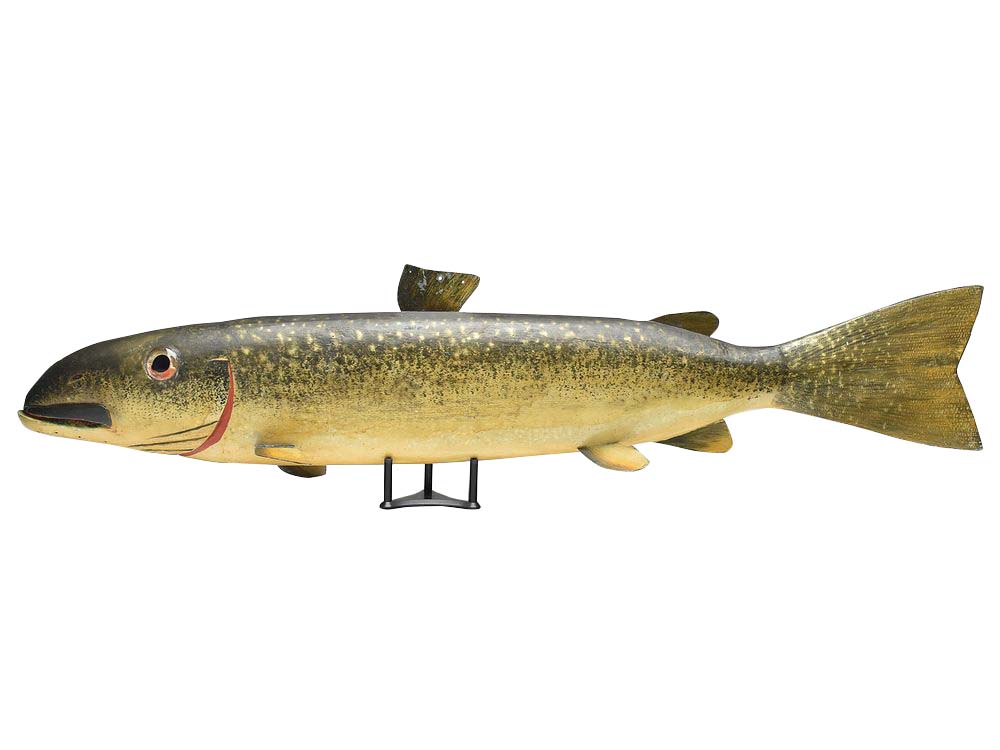
Carved in the round with glass eyes, metal side fins, and carved mouth and gills. Metal strapping along entire tail fin, with copper tag that reads “O. Peterson, Cadillac, Mich.” A layered paint pattern with mix of yellows and greens over side and body. A This sign hung in a fish mongers store in downtown Cadillac, Michigan. After the store closed, the son took it to his home in Montague, Michigan and hung it in his basement until it was purchased by Ron Fritz in the early 1980’s. “Oscar Peterson,” Decoy Magazine, September 2006, p. 24-27, exact carvig pictured.
Condition
Original paint, protected by Peterson’s standard coat of varnish, which has mellowed with time; a few small rubs along underside, one eye and edge of mouth; small paint loss at fins; otherwise very good and original.

Important, and certainly one of the finest Oscar Peterson fish plaques to ever be offered at auction, Cadillac, Michigan, 2nd quarter 20th century.

Important, and certainly one of the finest Oscar Peterson fish plaques to ever be offered at auction, Cadillac, Michigan, 2nd quarter 20th century.

Important, and certainly one of the finest Oscar Peterson fish plaques to ever be offered at auction, Cadillac, Michigan, 2nd quarter 20th century :

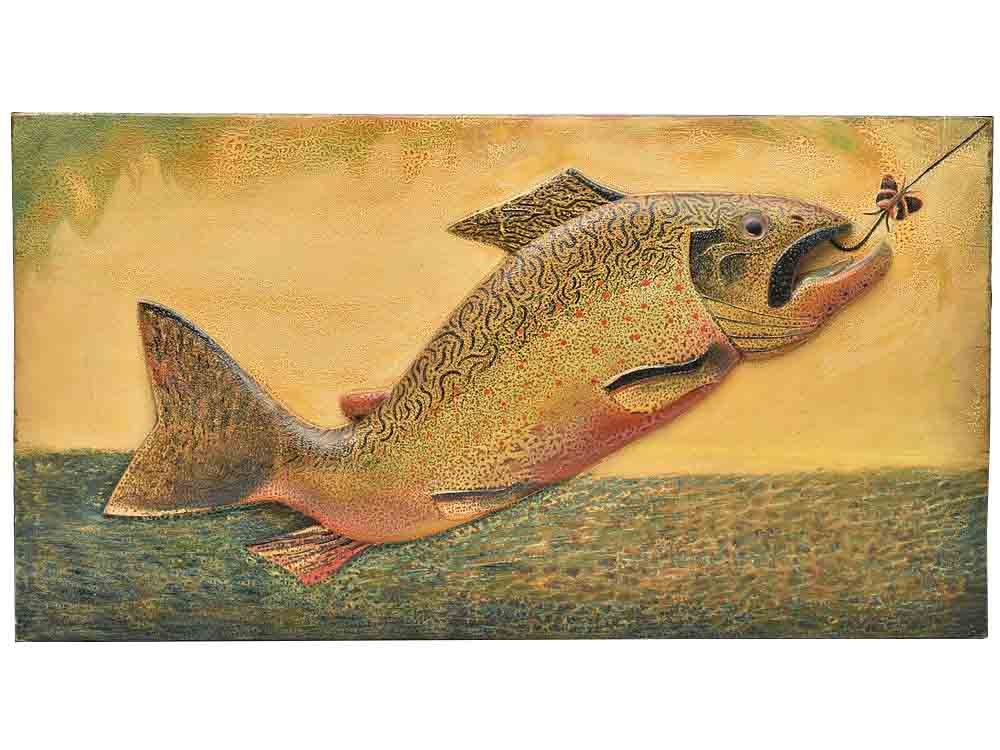
Peterson’s “flip tail” brook trout with large glass eye. Carved detail from the suspended tongue and open mouth. Leaping towards the butterfly pattern lure. Fish is relief carved and rises approximately 1″ above the board, which depicts a background of wa “Oscar Peterson,” Ron Fritz, p. 14. “Oscar Peterson,” Decoy Magazine, September 2006, p. 24-27, exact carvig pictured.
Condition
Excellent original paint that has crazed and created a very appealing surface; three nail holes, across top, which secured the board to the wall were filled; professional restoration to a natural crack in board at right hand side that runs along area betw