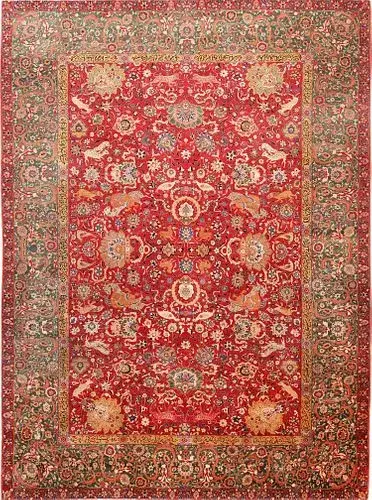
Antique Persian Kerman Mashahir Rug 8 ft 3 in x 5 ft 1 in (2.51 m x 1.54 m)

Antique Persian Kerman Mashahir Rug 8 ft 3 in x 5 ft 1 in (2.51 m x 1.54 m)

Antique Persian Kerman Mashahir Rug 8 ft 3 in x 5 ft 1 in (2.51 m x 1.54 m):

The meaning of the word in Urdu, which is mostly spoken in Pakistan, Mashahir translates into noblemen. In Arabic, the word can be translated to mean famous, a world celebrity, or prince of this world. Mashahir is also the name of a small village in Azerbaijan and a family surname. It is also used to describe something or someone of the noble lines. For example, Mashahir horses are the lines of horses of the noblemen. The word is associated with something of exquisite taste, beauty and wealth.

Mashahir rugs are a special class of Oriental carpets. They feature the faces of noblemen and kings of the Persian Empire. Sometimes, they have the names of the noblemen written on them, and other times they do not. Some of them may be recognizable to modern eyes, awhile others may be lost to antiquity. Some of these faces have been recounted in documents throughout history that provide a glimpse into the world of the noblemen and kings throughout the history of the Empire.
Condition
Request Condition Report
Lot # 5164 is in a very good condition. This is a finely woven piece with 100% wool pile on silk foundation. The pile is full and even with no visible wear signs. There is an old repair ( 1 inch x 1/2 inch ) at the top right corner . The two ends are complete , original and secured. The two sides are original , complete and secured. There is no dryness or cracking in the foundation. There is no moth or water damage visible or detected in this rug. This has always been a wall hanging masterpiece and it is clean and floor ready.. Please contact our rug experts at [email protected] or call us for any questions you may have at 212.545.8029.

Animal Design Antique Persian Tabriz Rug 14 ft 5 in x 10 ft 7 in (4.39 m x 3.23 m)

Animal Design Antique Persian Tabriz Rug 14 ft 5 in x 10 ft 7 in (4.39 m x 3.23 m)

Animal Design Antique Persian Tabriz Rug 14 ft 5 in x 10 ft 7 in (4.39 m x 3.23 m):

Tabriz is an ancient city that has a special place in the history of Persian rug weaving. It is the home of one of the first formal weaving schools of the Safavid Dynasty and was part of a plan to elevate the arts to a level that ushered in what became known as the Golden Age of Persian rugs. During this time, many of the familiar patterns and designs that are familiar to us today were developed. This breathtaking antique animal rug was created around the turn of the 20th century and has many of the elements that made these antique Persian Tabriz rugs some of the most desirable in the world.

This magnificent piece was created during a time of a revival of the ancient weaving traditions that began in the 1880s. During this time, several master weavers decided to try to resurrect the rug weaving traditions that made Persian rugs favorites among wealthier clientele all around the world. They drew their inspiration from classic designs that we still love today. This Persian rug stands out in the precision of the design and the variety of elements that are present.

This Tabriz rug features a delightful garden theme that is full of life and abundance. It has a range of animal life, floral elements, and cloud bands that weave their way through, creating graceful curves. The circle of life is represented in the predators and prey. The symmetry is representative of the divine order of the universe and the place of all the creatures within it. One of the striking characteristics of this piece is the level of detail, indicating a fine knot count and careful attention to precision. This is an antique rug that was created by skilled hands.

Many fine rugs, such as this one, were created on commission for exclusive clientele. It is not known if this piece was created by one of the more famous master Persian weavers of the time, but many clues within the piece would indicate that this piece was not created for the mass market. It would make a gorgeous addition to your home or any collection.
Condition
Request Condition Report
Full condition report on request. Please contact our rug experts at [email protected] or call us for any questions you may have at 212.545.8029.

Pair of Antique Chinese Root Wood Buddhist Lions

Pair of Antique Chinese Root Wood Buddhist Lions

Pair of Antique Chinese Root Wood Buddhist Lions:

A pair antique Chinese Buddhist lions composed of root wood with applied eyes.

Provenance: (Sold at Heritage Auctions: Apr 02, 2017)
CIRCA: 18th Cent.
ORIGIN: China
DIMENSIONS: (H: 11″ x W: 5.5″ x L: 11″) & (H: 12″ x W: 6″ x L: 11″)
CONDITION: Single eye may be a replacement, chipping at rear leg of single lion See lot description for details on item condition. More detailed condition requests can be obtained via email ([email protected]) or SMS (305) 333-4134. Any condition statement given, as a courtesy to a client, is only an opinion and should not be treated as a statement of fact. Akiba Antiques shall have no responsibility for any error or omission.

Nicola Simbari (Italian, 1927-2012) Oil On Canvas Painting

Nicola Simbari (Italian, 1927-2012) Oil On Canvas Painting

Nicola Simbari (Italian, 1927-2012) Oil On Canvas Painting:

Nicola Simbari oil on canvas painting depicting a kneeling girl with basket, signed lower right: “Simbari” Stretcher stamped: “Florence Art Gallery, Florence Italy” mounted in a white wood frame. Includes gallery booklet.
Provenance: (Purchased from the “Wally F Galleries”)

CIRCA: 20th Cent.
DIMENSIONS: (Image) L: 35.5″ x W: 39.5″ (Framed) L: 41.5″ x W: 45.5″
CONDITION: Canvas dented at upper middle. See lot description for details on item condition. More detailed condition requests can be obtained via email ([email protected]) or SMS (305) 333-4134. Any condition statement given, as a courtesy to a client, is only an opinion and should not be treated as a statement of fact. Akiba Antiques shall have no responsibility for any error or omission.

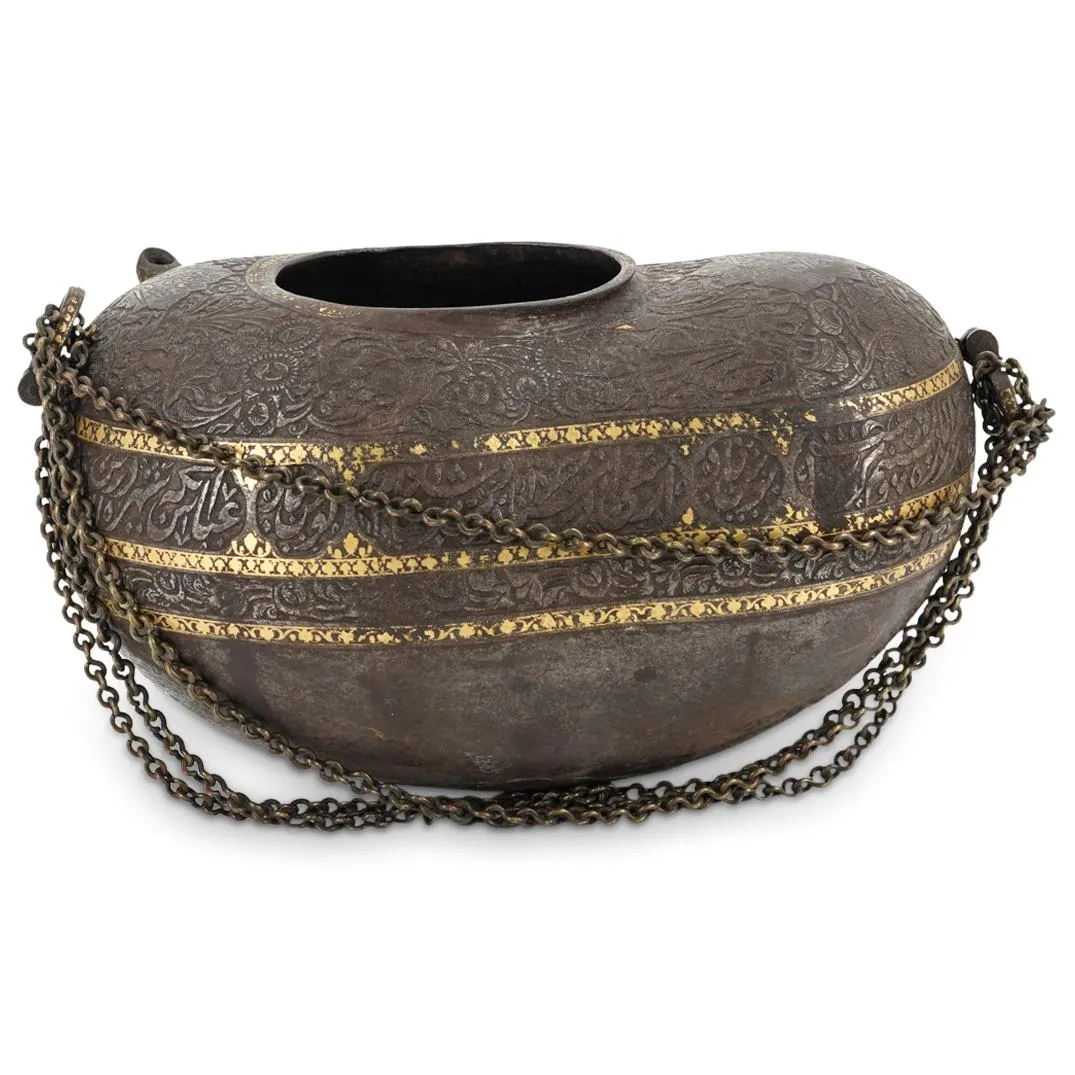
Antique Islamic Gold & Silver Inlaid Steel Kashkul

Antique Islamic Gold & Silver Inlaid Steel Kashkul

Antique Islamic Gold & Silver Inlaid Steel Kashkul:

An antique Islamic Kashkul composed of hand hammered steel with gold inlaid foliate designs with four chain-link mounted straps.
CIRCA: 19th Cent.
ORIGIN: Middle East
DIMENSIONS: H: 6.5″ x D: 11″
CONDITION: Great condition. See lot description for details on item condition. More detailed condition requests can be obtained via email ([email protected]) or SMS (305) 333-4134. Any condition statement given, as a courtesy to a client, is only an opinion and should not be treated as a statement of fact. Akiba Antiques shall have no responsibility for any error or omission.

Exceptional Nazca Ensemble Silver Ornaments for Queen

Exceptional Nazca Ensemble Silver Ornaments for Queen

Exceptional Nazca Ensemble Silver Ornaments for Queen:

Pre-Columbian, South Coast Peru, Nazca, ca. 200 to 400 CE. An astounding collection of silver adornments, including a crown, earspools, and pectoral, with a vibrant feather and fiber fan; all fit for a queen or lady of elite power and wealth! The crown is a comprised of a silver band with openwork motifs of birds with dozens of dangling discs suspended from the top and bottom peripheries. The earspools are large cylindrical plugs with bird finials protruding from the center of the rondels. The pectoral is comprised of ten separate, openwork discs that represent the moon. The blue-and-yellow macaw (Ara ararauna) may have supplied the feathers for the fan; each is attached to the handle by short cords tied to the quills, and woven vegetal and wool fibers form the handle. Colorful feathers were prized materials in Andean cultures and used by the elite for clothing and ornaments. Avian motifs and the use of feathers were symbolic in Andean cultures, for birds were sacred animals that could fly between worlds and were messengers for the gods. All is displayed in a museum quality acrylic case that demonstrates how these beautiful pieces would be worn. Size of fan: 10″ L x 9″ W (25.4 cm x 22.9 cm); pectoral: 9″ L x 2.5″ W (22.9 cm x 6.4 cm); silver quality: 53%; earspools: 2″ L x 1″ Diameter (5.1 cm x 2.5 cm); silver quality: 96% to 97.3%; crown: 2″ W (5.1 cm) silver quality: 89% to 91%; size of case: 15″ L x 13″ W x 31″ H (38.1 cm x 33 cm x 78.7 cm)

This piece has been searched against the Art Loss Register database and has been cleared. The Art Loss Register maintains the world’s largest database of stolen art, collectibles, and antiques.

Provenance: private Hawaii, USA collection; ex-private Hirsch collection, Germany, 1950 to 1960s

All items legal to buy/sell under U.S. Statute covering cultural patrimony Code 2600, CHAPTER 14, and are guaranteed to be as described or your money back.

A Certificate of Authenticity will accompany all winning bids.

PLEASE NOTE: Due to recent increases of shipments being seized by Australian & German customs (even for items with pre-UNESCO provenance), we will no longer ship most antiquities and ancient Chinese art to Australia & Germany. For categories of items that are acceptable to ship to Australia or Germany, please contact us directly or work with your local customs brokerage firm.

Display stands not described as included/custom in the item description are for photography purposes only and will not be included with the item upon shipping.

#164516
Condition
Missing a couple dangling discs on crown. Minor nicks and tearing to peripheries of pectoral. Pectoral discs are not attached together. Earrings have small nicks to peripheries. Age commensurate wear and patina on all silver pieces. Fraying and losses to tips of feathers. One feather is bent and hanging downwards. Displayed in a museum quality case. Cannot be taken out to weigh silver pieces.

Olmec Volcanic Stone Tenon – Cuboid Form w/ Face

Olmec Volcanic Stone Tenon - Cuboid Form w/ Face

Olmec Volcanic Stone Tenon – Cuboid Form w/ Face:

Pre-Columbian, Southern Mexico to Guatemala, Olmec, ca. 900 to 600 BCE. An impressive tenon of sizable form, skillfully hand-carved from porous volcanic stone of any earthy gray hue. The tapered conical body gradually expands to present a cuboid face or maskette on the front. The ancient visage gazes outward from bulbous, almond-shaped eyes beneath arching brows that flank a flat nasal bridge above broad nostrils. His rectangular mouth is held open, exposing a top row of square teeth and an extended tongue that stretches outward to cover his chin. The full, fleshy cheeks give the sculpture the appearance of a child or baby. A flat headdress surrounded by a slender headband caps the fascinating face, held in place by a head strap that ends in a large, relief circle on each side. Size: 11.9″ L x 5.8″ W x 7.1″ H (30.2 cm x 14.7 cm x 18 cm)

We know that the Olmec settled in areas including San Lorenzo Tenochtitlan, La Venta, Tres Zapotes, Laguna de los Cerros, and La Mojarra; however, their influence impacted the entire Mesoamerican region. In 2005, Neutron Activation Analysis and petrography was used to demonstrate this impact via the widespread existence of Olmec ceramic vessels. Scholars suspect that other groups equated the Olmec style with elite status given the exchange and emulation of Olmec artifacts throughout Mesoamerica. It is also believed that the Olmec invented the famous Mesoamerican ballgame prevalent among the later Maya as well as other cultures in the region and may have also invented religious entities such as the feathered serpent and the rain god, which would continue in subsequent cultures.

While difficult to completely understand their belief system given that the Olmec were pre-literate, scholars theorize that their famous monumental stone heads, which can weigh up to forty tons, may have been erected to honor ancestors or rulers. The smaller figures and tenons like this example are thought to represent totems or divinities. The artistry and technique of Olmec sculptural works is remarkable given what little technology that was available to them as well as the dearth of earlier works to reference for inspiration.

Tenons like this example were set into wall mortises with other, similar tenons. Aztec public architecture featured many symbolic and artistic elements, many carved from stone, that reinforced their cosmology and religious rituals.

This piece has been searched against the Art Loss Register database and has been cleared. The Art Loss Register maintains the world’s largest database of stolen art, collectibles, and antiques.

Provenance: ex-Les Margulis, New York, USA, acquired November, 1998; ex-The Lands Beyond Gallery, New York City, New York, USA

All items legal to buy/sell under U.S. Statute covering cultural patrimony Code 2600, CHAPTER 14, and are guaranteed to be as described or your money back.

A Certificate of Authenticity will accompany all winning bids.

PLEASE NOTE: Due to recent increases of shipments being seized by Australian & German customs (even for items with pre-UNESCO provenance), we will no longer ship most antiquities and ancient Chinese art to Australia & Germany. For categories of items that are acceptable to ship to Australia or Germany, please contact us directly or work with your local customs brokerage firm.

Display stands not described as included/custom in the item description are for photography purposes only and will not be included with the item upon shipping.

#167941
Condition
Expected nicks and abrasions, commensurate with age. Otherwise, intact and excellent with light earthen deposits in areas.

Palmyrene / Roman Period Limestone Head of A Female

Palmyrene / Roman Period Limestone Head of A Female

Palmyrene / Roman Period Limestone Head of A Female:

Near East, Palmyra, Roman Imperial Period, ca. 2nd to 3rd century CE. A finely carved Palmyrene limestone head of a youthful female beauty, her quixotic visage comprised of large almond-shaped eyes with generous upper lids, incised irises, and petite depressions for pupils, framed by elegantly arched brow line that merges seamlessly with an aquiline nose, a bow-shaped closed mouth below, apple cheeks, and smooth facial planes – topped by an elaborate coiffure of incised wavy tresses adorned with a ‘beaded’ hair ornament or crown and lovely drop earrings. Size: 7.375″ W x 10.875″ H (18.7 cm x 27.6 cm); 15.875″ H (40.3 cm) on included custom stand.

A distinct regional version of Roman funerary busts emerged in Palmyra. The figures and their elaborate ornamentation exemplified an attractive fusion of Western and Eastern influences. This Palmyrene lady does not show evidence of paint on the surface; however, given the polychromy of the famous “Beauty of Palmyra” (ca. 190 to 210 CE, Ny Carlsberg Glyptotek, Copenhagen) it is possible that she was once considerably less subdued than she appears today. This said, it is also possible that she was not intended to be painted.

Palmyrene sculpture was made from a stone that is largely nonreflective – usually limestone as we see in this example; however, the ancient Palmyrene sculptors excelled at sharp, angular chisel work that resulted in strong patterns which made for dramatic silhouettes and shadows. Just imagine this piece in its dark, shadowy tomb environment – lit by candlelight so that its intricate surface patterns would come to life as it were, the smooth facial contours contrasting with the darkness surrounding it – quite a vision indeed!

A Palmyrene limestone female head sold at Sotheby’s, New York in 2015 for $37,500, and a Palymrene limestone male head sold at Christie’s New York in 2008 for $32,500.

Provenance: private Denver, Colorado, USA collection; ex-Hisperia Gallery, Philadelphia, Pennsylvania, USA; acquired in 1964

All items legal to buy/sell under U.S. Statute covering cultural patrimony Code 2600, CHAPTER 14, and are guaranteed to be as described or your money back.

A Certificate of Authenticity will accompany all winning bids.

PLEASE NOTE: Due to recent increases of shipments being seized by Australian & German customs (even for items with pre-UNESCO provenance), we will no longer ship most antiquities and ancient Chinese art to Australia & Germany. For categories of items that are acceptable to ship to Australia or Germany, please contact us directly or work with your local customs brokerage firm.

Display stands not described as included/custom in the item description are for photography purposes only and will not be included with the item upon shipping.

#129008
Condition
Losses to chin, nose, lips, brow line, neckline, headdress / hairline as shown. Verso shows a chisel pecking marks. Overall, a remarkable example.

Donald Duck Signed Serigraph More Bang For Your Duck

Donald Duck Signed Serigraph More Bang For Your Duck

Donald Duck Signed Serigraph More Bang For Your Duck:

A limited edition serigraph on deckle edged paper, signed and numbered by the artist David Willardson. Disney’s Donald Duck.
Includes certificate of authenticity and original price sticker from Magic Kingdom Main Street USA – Walt Disney. #waltdisney #donaldduck

Artist: David Willardson
Issued: 2002
Dimensions: 30.5″W x 22.5″H
Edition Number: 74 of 395 Country of Origin: USA
Condition
Good

Royal Doulton Jemima Puddle Duck & Foxy Whiskered Gentleman

Royal Doulton Jemima Puddle Duck & Foxy Whiskered Gentleman

Royal Doulton Jemima Puddle Duck & Foxy Whiskered Gentleman:

Beswick / Royal Doulton color variation of Jemima Puddle Duck and Foxy Whiskered Gentleman.
Beatrix Potter figure – Foxy with multi colored jacket, burgundy vest. Jemima with blues and greens on her bonnet and jacket. Marked The Property of Royal Doulton Tableware LTD Not Produced For Sale to base. #beatrixpotter

Issued: 1980s
Dimensions: 5″H
Manufacturer: Royal Doulton
Country of Origin: England
Condition
Good