Meistersinger Metris Bronze Automatic Watch, 38mm, Leather, Blue, ME917BR. Line Metris, Reference ME917BR, Movement automatic, Caliber ETA 2824-2, Jewels 25, Power Reserve 38 hrs, Frequency 28800 A/h, Anti-shock system Incablock. The Bronze Line of watches interprets this traditionally uséd metal in all its diversity: enduring, multi-faceted and, despite all its sturdiness, a reflection of its weares over time.
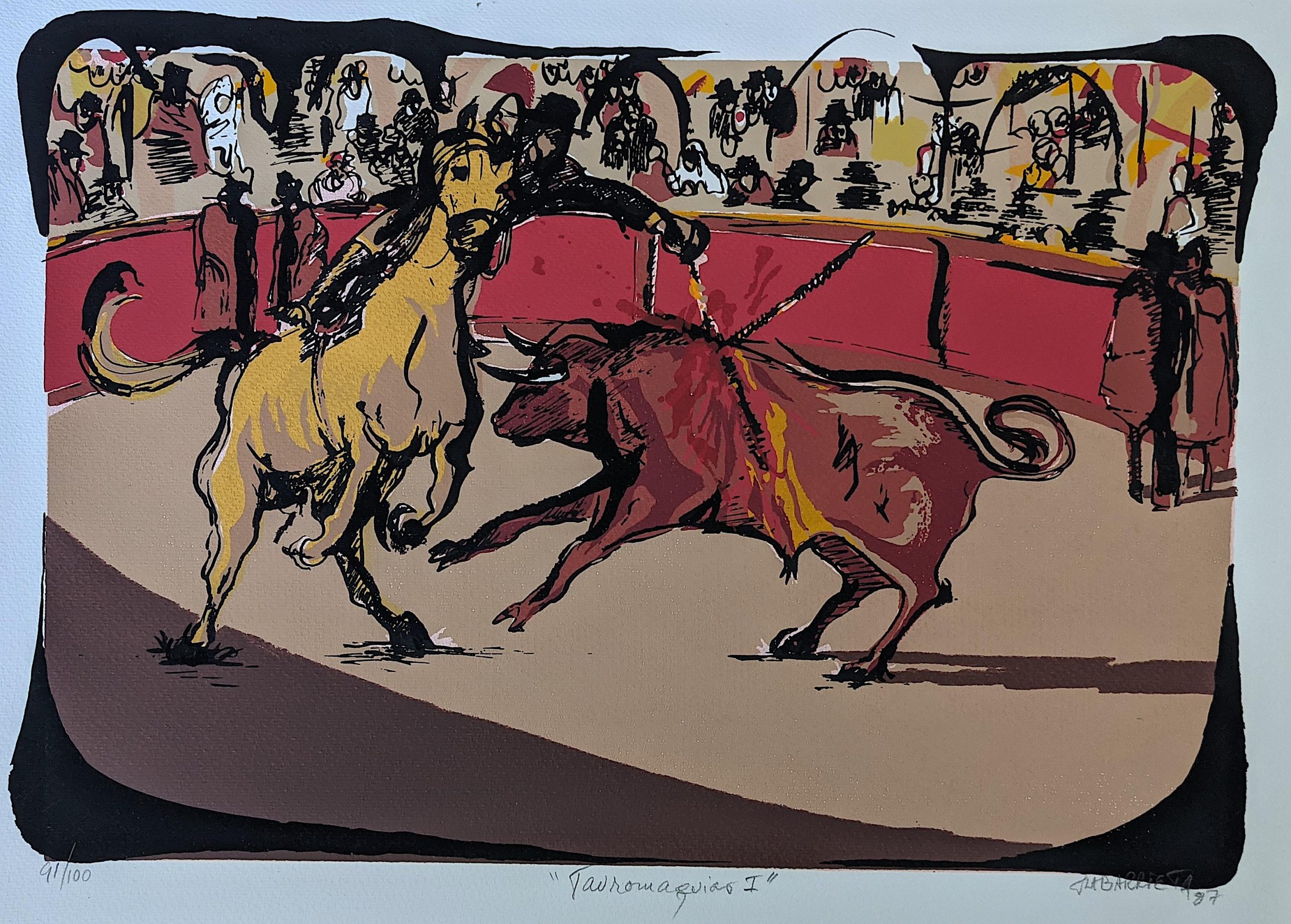
ISMAEL OLABARRIETA Colombia Grabado 27.5″ X 19.75″:
Original grabado L.E. 91/100 by the important Colombian Artist Ismael Olabarrieta. The dimensions of the lithograph are Approx. 27.5″ x 19.75″ (70 cm x 50 cm).
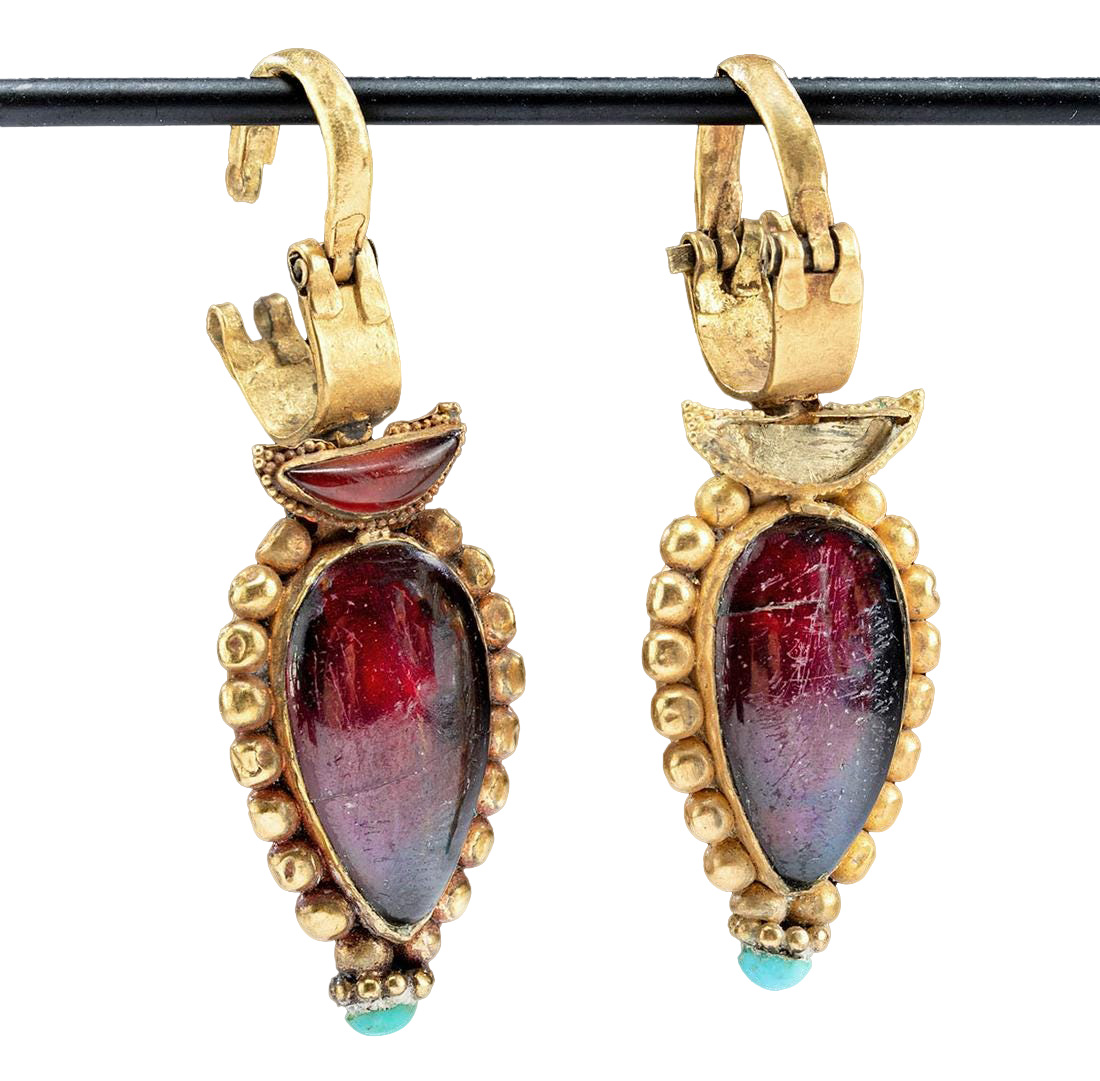
Published Greek Gold Earrings w/ Garnet & Turquoise:
Greece, Hellenistic Period, ca. 2nd to 1st century BCE. A dazzling pair of wearable 77% (equivalent to greater than 18K+) gold earrings with lovely inlays of translucent garnet in a rich hue of dark violet-red and turquoise from ancient Greece. Nearly identical in form, each gorgeous ornament boasts a sizable egg-shaped cabochon garnet with a round face surrounded by a border of golden spheres and topped with a crescent inlay filled with garnet on one and enveloped in even smaller golden orbs. A hemispherical turquoise embellishment encompassed by golden dots is featured at the end of each earring, serving as a type of finial. Both are fit with a gold backing and a thick golden suspension loop with a peg for securing closed. A truly eye-catching combination of ancient art and modern style! Precious metal quality: 77.16% (equivalent to 18K+) gold and 16.29% silver, with 4.27% copper; Size (both the same size): 0.75″” W x 1.875″” H (1.9 cm x 4.8 cm); Weight: 14.3 grams
It is believed that the crescent moon was a symbol of Ishtar, the Near Eastern goddess of love and war.
This style is called polychrome, and it is based on the combination of color of the metal that creates the shape and structure of the item and the colors of stones that fill it. Such design influenced the whole Hellenistic jewelry and continued into the Roman period
This gorgeous pair of earrings was published in “Masterpieces of Ancient Jewelry: Exquisite objects from the Cradle of Civilization” (Philadelphia: Running Press, 2008) by Judith Price on pages 77 through 79.
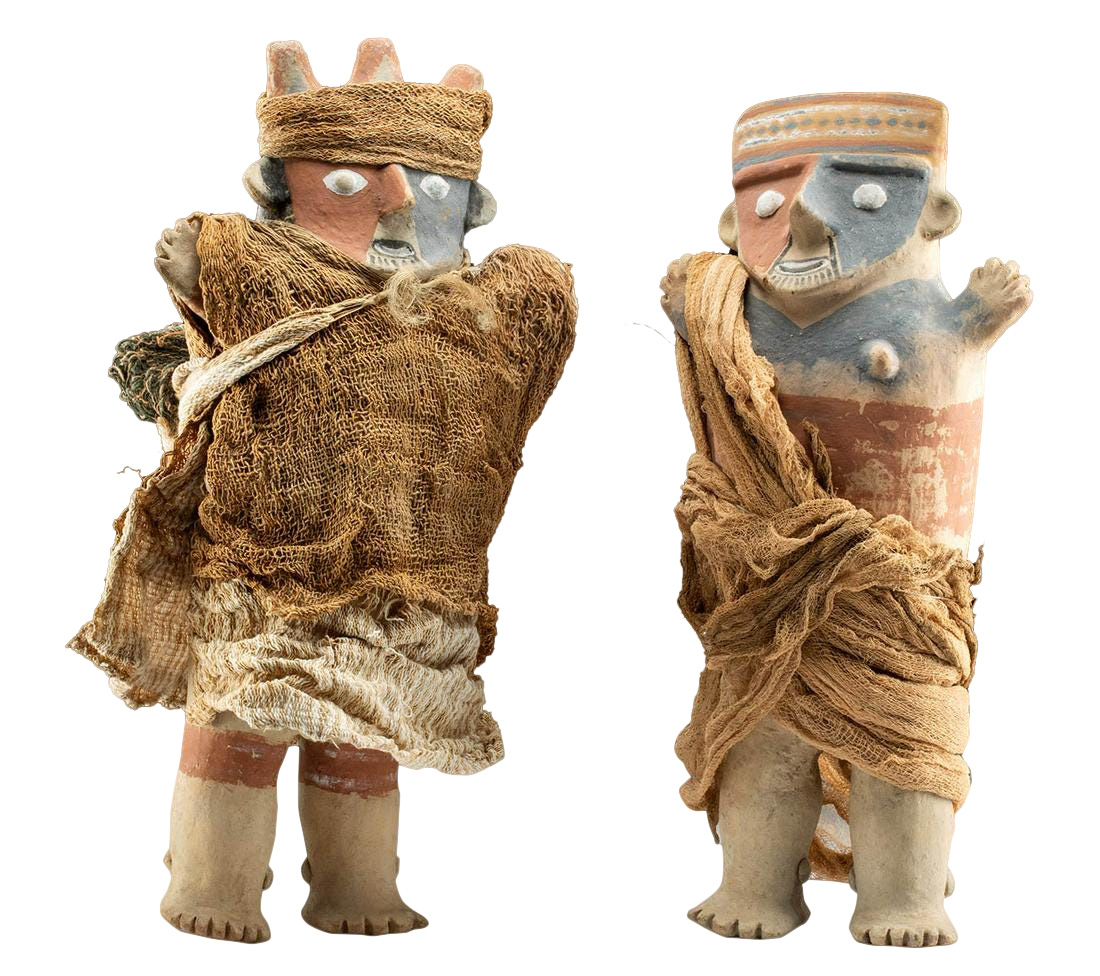
Rare Chancay Polychrome Figures Male, Female TL’d:
Pre-Columbian, North Coast Peru, Chancay, ca. 800 to 1200 CE. An impressive and rare pair of terracotta cuchimilco figures – a male and a female – wrapped in woven textiles of orange, tan, peach, and cream hues. Both figures stand atop delineated legs and feature a welcoming pose with stubby arms outstretched and their heads pointed skyward. Their faces are comprised of almond-shaped eyes, protruding pinched noses, and petite ears. Carrying a satchel containing a dehydrated husk of maize and corn kernels, the male displays an erect phallus which projects from beneath his garments. The female exhibits pointed breasts and incised genitalia surrounded by a triangle that highlights her pubic area. Characteristically left unglazed, pigments of burnt sienna, black, grey, peach, and white decorate the white slip surface of both fascinating figures, emphasizing the whites of their eyes and teeth and also representing face and body paints. An intricately decorated headband of geometric motifs wraps around the flat head of the female figure. The male is embellished with three spikes that cap his head, acting as an elaborate coiffure or headdress, swaddled with a band of cloth. Size: 8.75″ W x 17.5″ H (22.2 cm x 44.4 cm)
The Chancay people were exceptional ceramic and textile artisans, and archaeologists have often found cuchimilcos in the tombs of Chancay nobility. Some scholars believe that their outstretched hands were intended to absorb negative energy. Chancay artisans created ceramics that are quite distinctive in form and decoration – finely painted and molded with specific decorative details carefully added by hand as we see in this example.
Like these two examples, Cuchimilco figures are often found in pairs of male and female, indicating the importance of divine duality. Archeologists posit that these charming pottery figures were intended to ward off bad spirits or energies.
This piece has been tested using thermoluminescence (TL) analysis and has been found to be ancient and of the period stated. A full report will accompany purchase.
This piece has been searched against the Art Loss Register database and has been cleared. The Art Loss Register maintains the world’s largest database of stolen art, collectibles, and antiques.
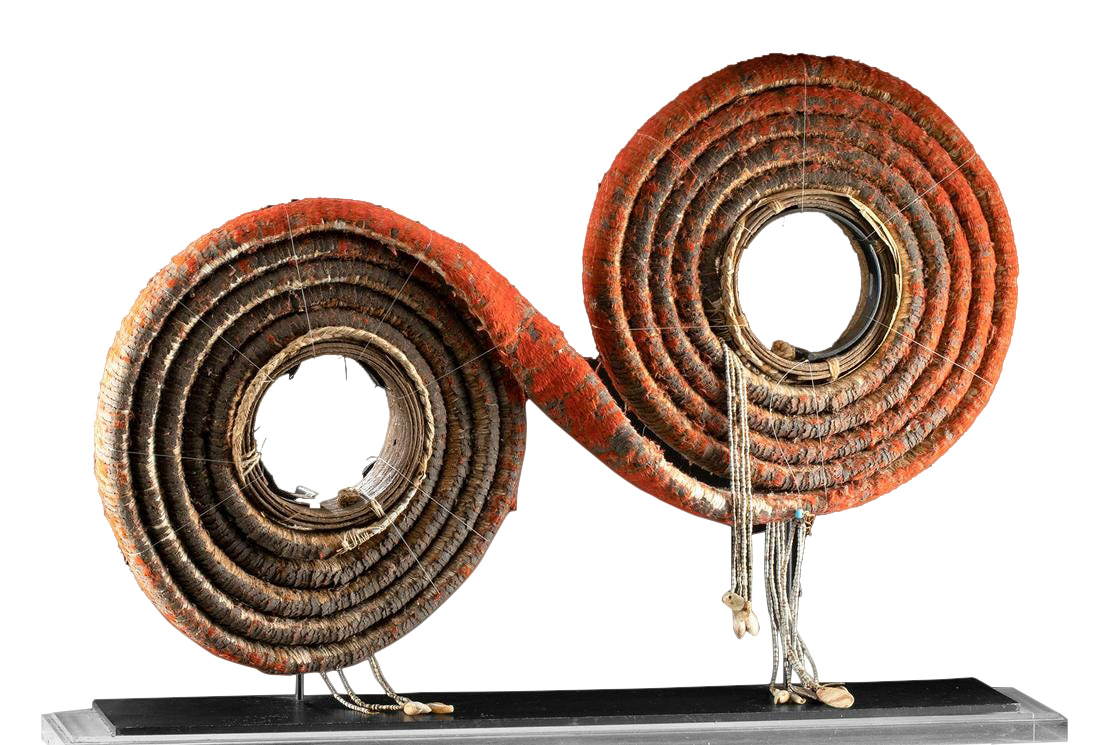
19th C. Solomon Islands Feather Currency, ex-Sotheby’s:
Oceania, Melanesia, Solomon Islands, Temotu Province, Santa Cruz Islands, ca. 19th century CE. A stunning and tightly coiled red feather form of currency known as a tevau that is traditionally used to pay for goods such as root crops, canoes, turtles, and pigs. Tevau have also traditionally served as gifts offered during marriage ceremonies. The spiraled band of fiber is decorated with scarlet feathers from the honey-eater bird. All is wound around two bark coils with strands of shell beads and pendants attached. What is fascinating is that a tevau like this example very likely includes feathers from more than 300 birds, because the artisans only use 4 small red feathers from each honey-eater bird they catch in order to create a tevau. Each feather was carefully attached and the tevau was also decorated with multiple shell-adorned strands. Custom lucite display case included. Size: 29″ L x 2.1″ W x 17.625″ H (73.7 cm x 5.3 cm x 44.8 cm); 20.875″ H (53 cm) on included custom stand; (display case): 31″ L x 5.4″ W x 23.1″ H (78.7 cm x 13.7 cm x 58.7 cm)
According to the Museum of New Zealand, “As well as being a standard currency, the feathered coils are appreciated for their beauty and the work that goes into making them. In 1948, the famous canoe navigator Tevake, from Peleni, exchanged ten turtles for one especially fine tevau. However, the value of the coils declines as the feathers fade.” Note that the feathers decorating this tevau still exhibit vibrant hues.
See a similar example at the Museum of New Zealand (registration number FE012737).
Cf. Sotheby’s New York: May 12, 202, lot 300 for a similar currency roll formerly belonging to the Masco Corporation Collection.
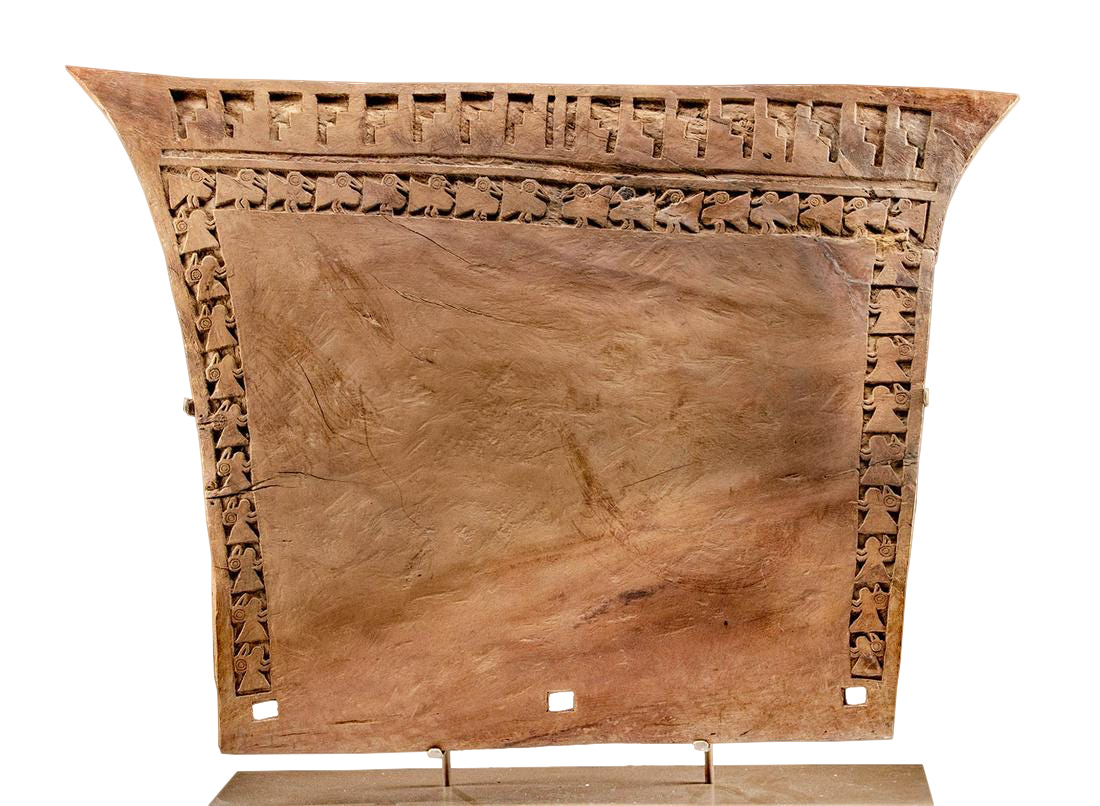
Rare Sican-Lambayeque Wood Litter Backrest w/ Birds:
Pre-Columbian, North Coast Peru, Sican / Lambayeque culture, ca. 10th to 11th century CE. A large hand-carved piece of wood, shaped to a roughly rectangular shape with the top corners flaring outward. This functioned as a backsplash or backrest for a litter, and is reminiscent of the Tumi shape. The front side is adorned with a register of avian forms and geometric stepped motifs above. The birds are shown in profile, with fanned tails, and circular eyes. The stepped motifs represent sacred pyramids. The verso is flat and free of carvings, and the bottom edge has 3 square holes to attach to the rest of the litter. Royalty were carried in ceremonial litters by four attendants lifting each corner. This is a rare item, and also noteworthy as it is carved from a singular piece of wood of this size and age. A massive tree may have been cut down and brought in from afar; quite an undertaking! Size: 46″ L x 1″ W x 33.75″ H (116.8 cm x 2.5 cm x 85.7 cm); 36″ H (91.4 cm) on included custom stand.
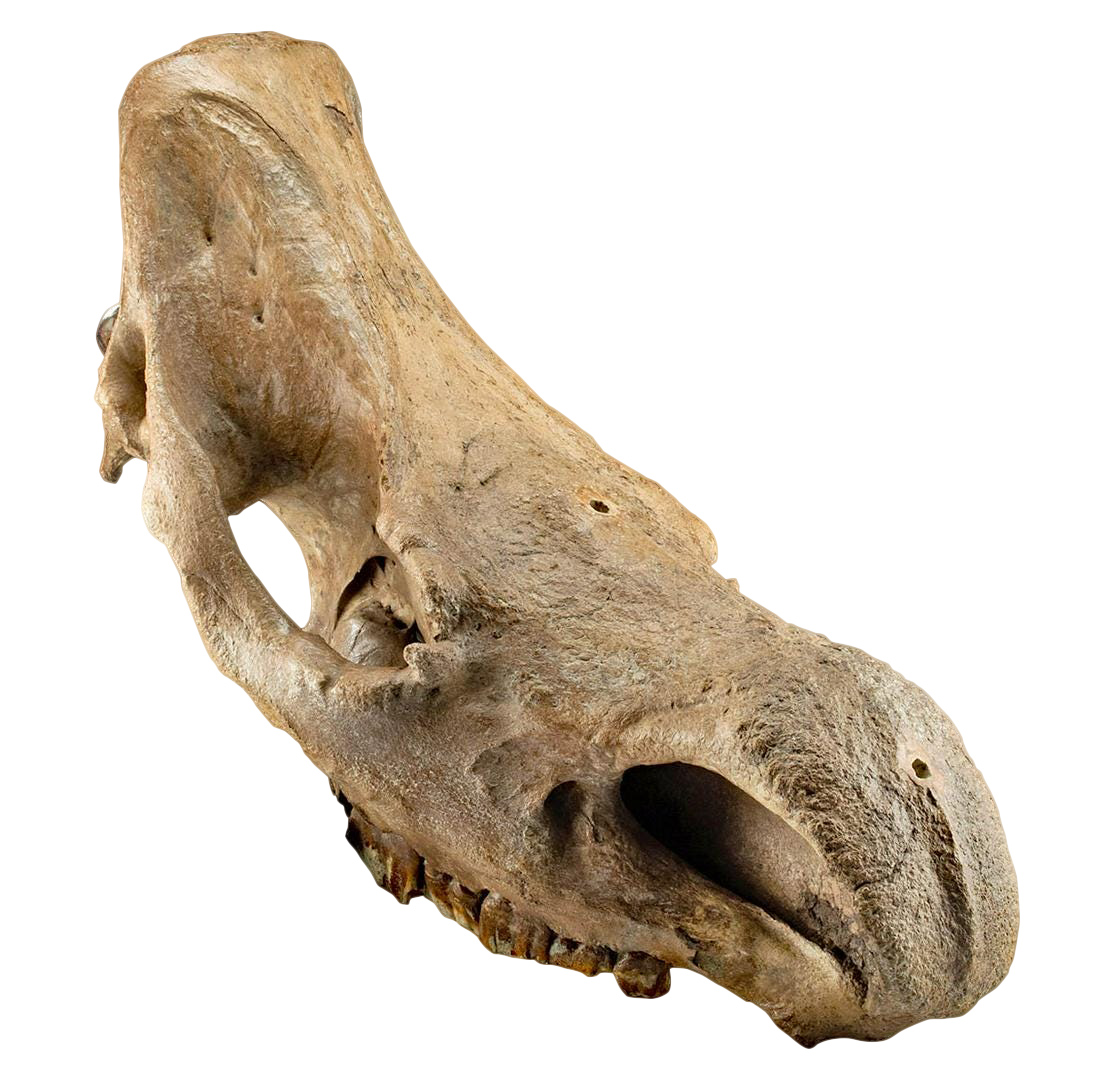
Fossilized Siberian Woolly Rhinoceros Skull:
Central Asia, Siberia, Pleistocene, ca. 2.6 million to 12,000 years ago. A rare and striking skull from one of the most famous beasts of the last Ice Age – the Woolly Rhinoceros (Coelodonta antiquitatis). Now extinct, the head of the ancient beast presents a lengthy, rounded snout, a pair of sizable nostrils, huge, sunken eyes, and twelve teeth, each showing a thick enamel and the swirling structure of the internal cavity. The enormous animal could grow to 12.5 feet (3.8 meters) in length and 4,400 pounds (2,000 kilograms) and featured two giant horns with the longer reaching forwards and the smaller between the eyes, as well as a long fur coat with a thick undercoat. A powerful hump on the creature’s back allowed it to support its heavy horns. Size: 13.625″ W x 27.5″ H (34.6 cm x 69.8 cm)
Regardless of their massive bodies and brutish appearance, woolly rhinoceros primarily fed upon grasses and sedges in the mammoth steppe, hence their downward facing heads, flat teeth, and lack of incisors. This fact is lucky for the paleolithic humans who not only lived beside them, but also drew representations of the ancient rhinos on cave walls in France and built statuettes of beasts in the Czech republic. Interestingly, however, when a fossilized head of the animal was first recovered in 1335 in Austria, it was believed to belong to a dragon, and later in 1590, it became classified as an “ancient griffin”. By the 18th and 19th century, researchers began to recognize the animal as part of the rhinoceros family, yet having the fur of a woolly mammoth, part of the elephant family. So, what did they call this fascinating cross between an elephant and a rhino? Elephino!
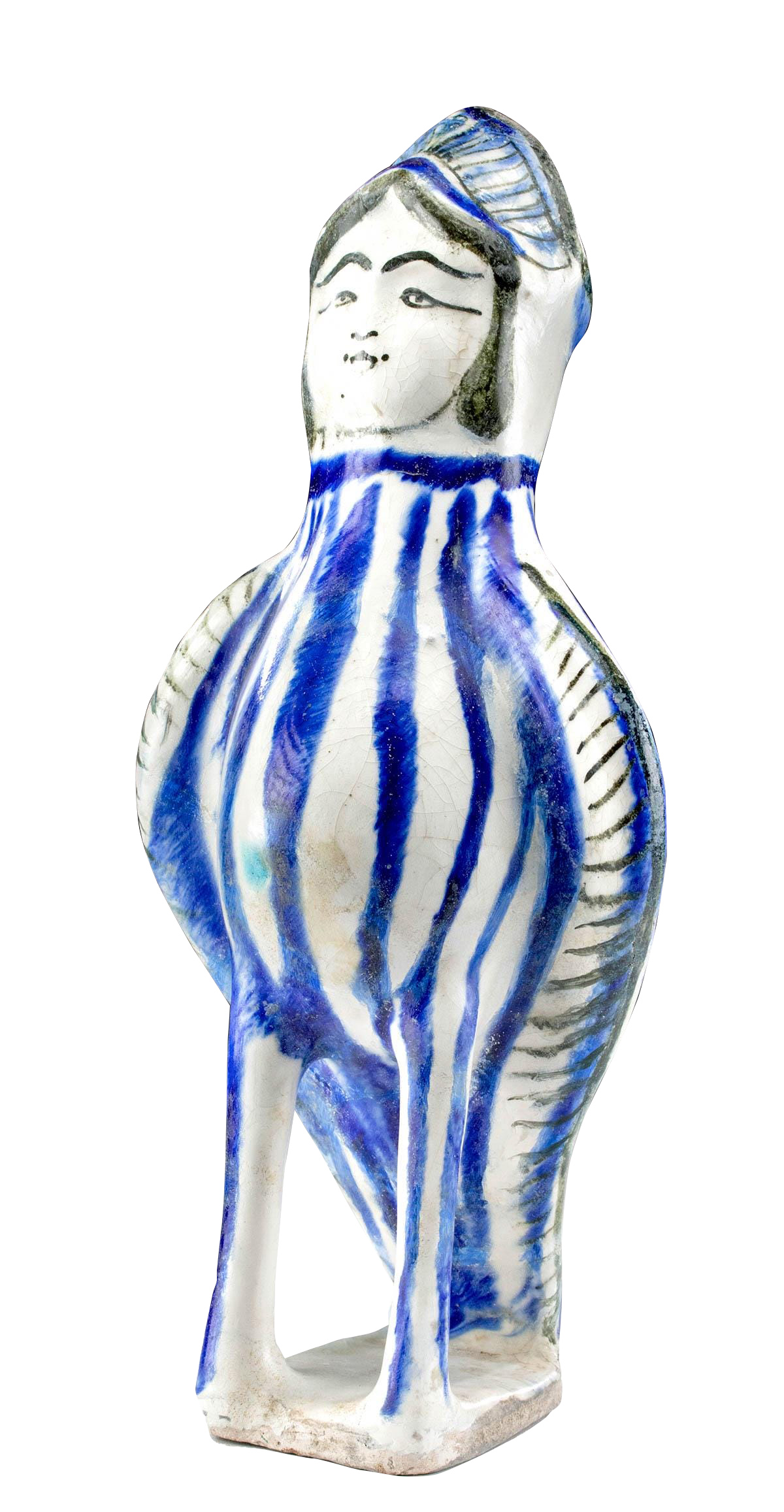
13th C. Persian Seljuk Glazed Pottery Vessel Harpy Form:
Western Asia, Persia/Iran, Seljuq Empire (Seljuk, Saljuq), ca. early 13th century CE. Wow! A fantastic ceramic vessel in the form of a harpy, glazed with the dramatic, bright colors associated with Seljuk ceramics. The neck of the vessel is the creature’s human woman face, complete with diadem atop her head and black hair. The back of her head is the open mouth of the vessel. Her bird-like body forms the rest of the vessel, which stands on two thin legs and the broad tail, atop an integral, thin rectangular base. The body features bright cobalt blue vertical stripes giving the impression of plumage. A fascinating piece of medieval Islamic artistry! Size: 5.45″ W x 12″ H (13.8 cm x 30.5 cm)
According to the Metropolitan Museum of Art’s exhibition, “Court and Cosmos: The Great Age of the Seljuqs” (April 27, 2016–July 24, 2016), “Seljuq art abounds with depictions of real, mythological, and hybrid animals on objects large and small. Animal combat was a favorite theme in Iranian art… Harpies (composite creatures having the body of a bird and the face of a human) and sphinxes (beasts with the body of a lion, face of a human, and occasionally the wings of a bird) appear frequently.”
Rene Lalique “Archers” Glass Vase:
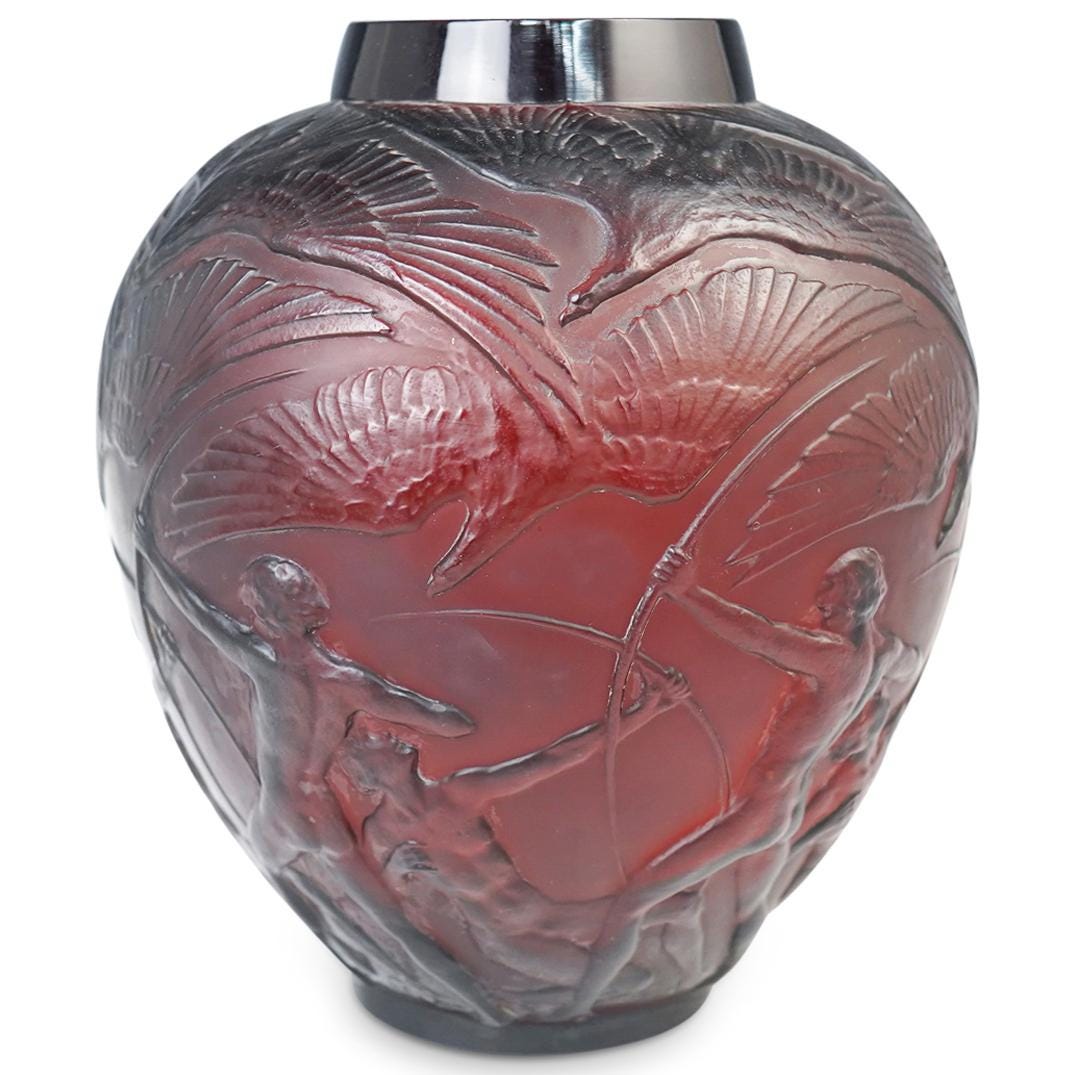
A Rene Lalique “Archers” Vase features in a deep red hue with archer motifs aiming at birds, marked along the underside. M p 415. no 893. Molded R. Lalique.
CIRCA: 1920s
ORIGIN: France
DIMENSIONS: H: 10.75′ W: 9″
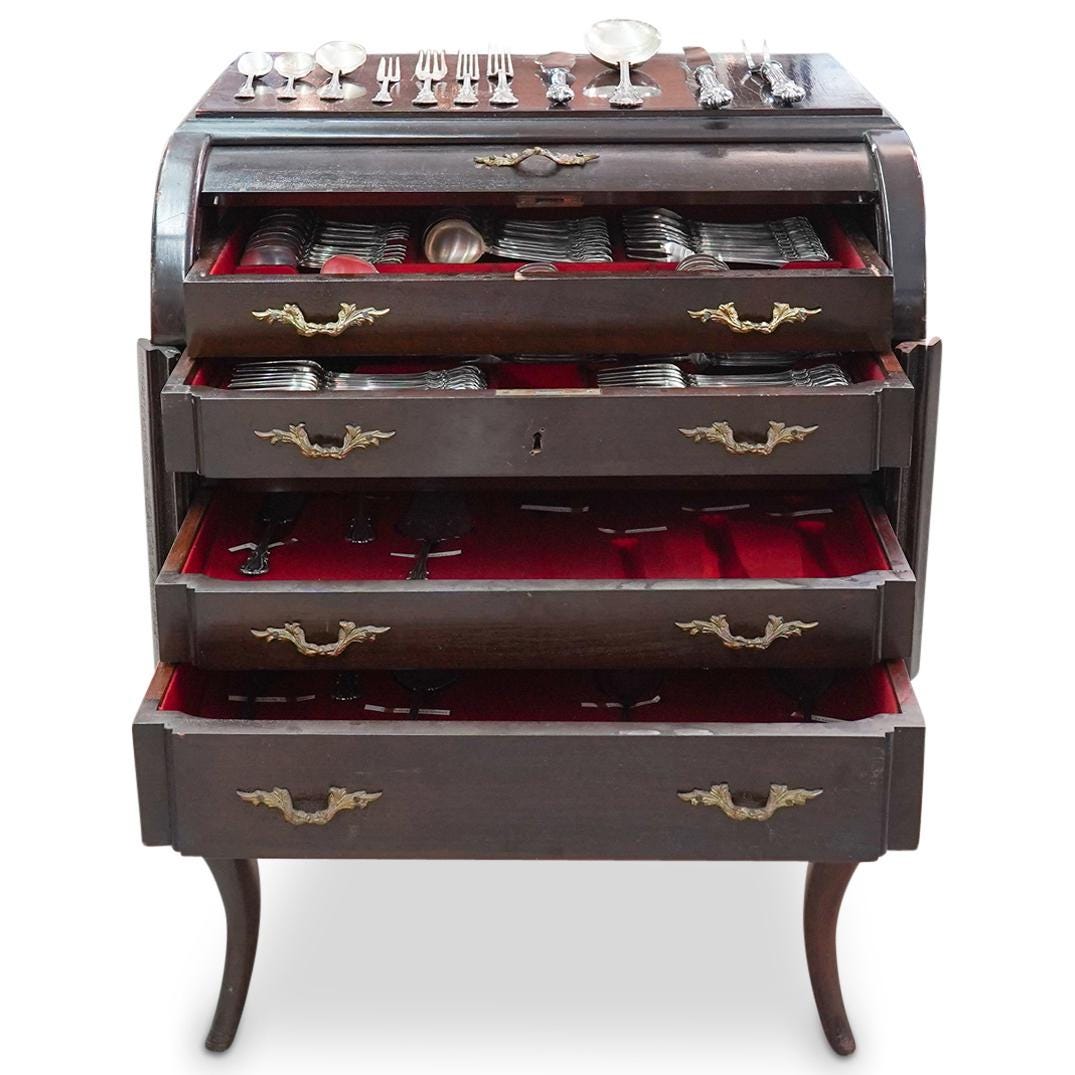
(183 Pcs) Camusso Sterling ” Boston” Flatware Set:
A 183 Piece Camusso sterling “Boston” patterned set individually hallmarked “Sterling 925 Camusso Made in Peru”. Comes with an original custom five drawer mahogany wood display case. Total Weight: 6129 Grams (Knives Not Included)
Composed of the following:
– 11 X Tea Spoons 5.5″
– 12 x Ice Cream Spoons 6.25″
– 12 x Ice Cream Fork 7″
– 12 x Demitasse Spoons 4.5″
– 13 x Tea Spoon 5.5″
– 24 x Dinner Forks 8″
– 12 x Salad Forks 6.75″
– 12 x Small Fish Forks 6″
– 12 x Soup Spoons 6.75″
– 12 x Butter Knives 6″
– 13 x Fish Knife 8.25′
– 24 x Dinner Knives 8.5″
– 1 x Dinner Fish Knife 8.5″
– 1 x Large Fish Server 10.25″
– 1 x Large Fish Server 8.75″
– 1 x Cake Server 10.25″
– 1 x Large Serving Spoon 11″
– 1 x Large Fish Serving Knife 10″
– 1 x Large Meat Serving Knife 12.5″
– 1 x Large Meat Serving Fork 10″
– 1 x Large Serving Fork 10.5″
– 1 x Round Cake Serving Spoon 8.5″
– 1 x Medium Serving Spoon 10.5″
– 1 x Salad Serving Spoon 8.25″
– 1 x Small Ladle 6″
– 1 x Small Serving Spoon 8″
CIRCA: 20th Ct
ORIGIN: Peru
DIMENSIONS: Flatware Set: (See Above), Display Set: H:32″ W:24″ D:20″
CONDITION: Great condition. See lot description for details on item condition. More detailed condition requests can be obtained via email ([email protected]) or SMS (305) 332-9274. Any condition statement given, as a courtesy to a client, is only an opinion and should not be treated as a statement of fact. Akiba Antiques shall have no responsibility for any error or omission.