Wedgwood Flame Fairyland Lustre Malfrey Pot

Wedgwood Flame Fairyland Lustre Malfrey Pot

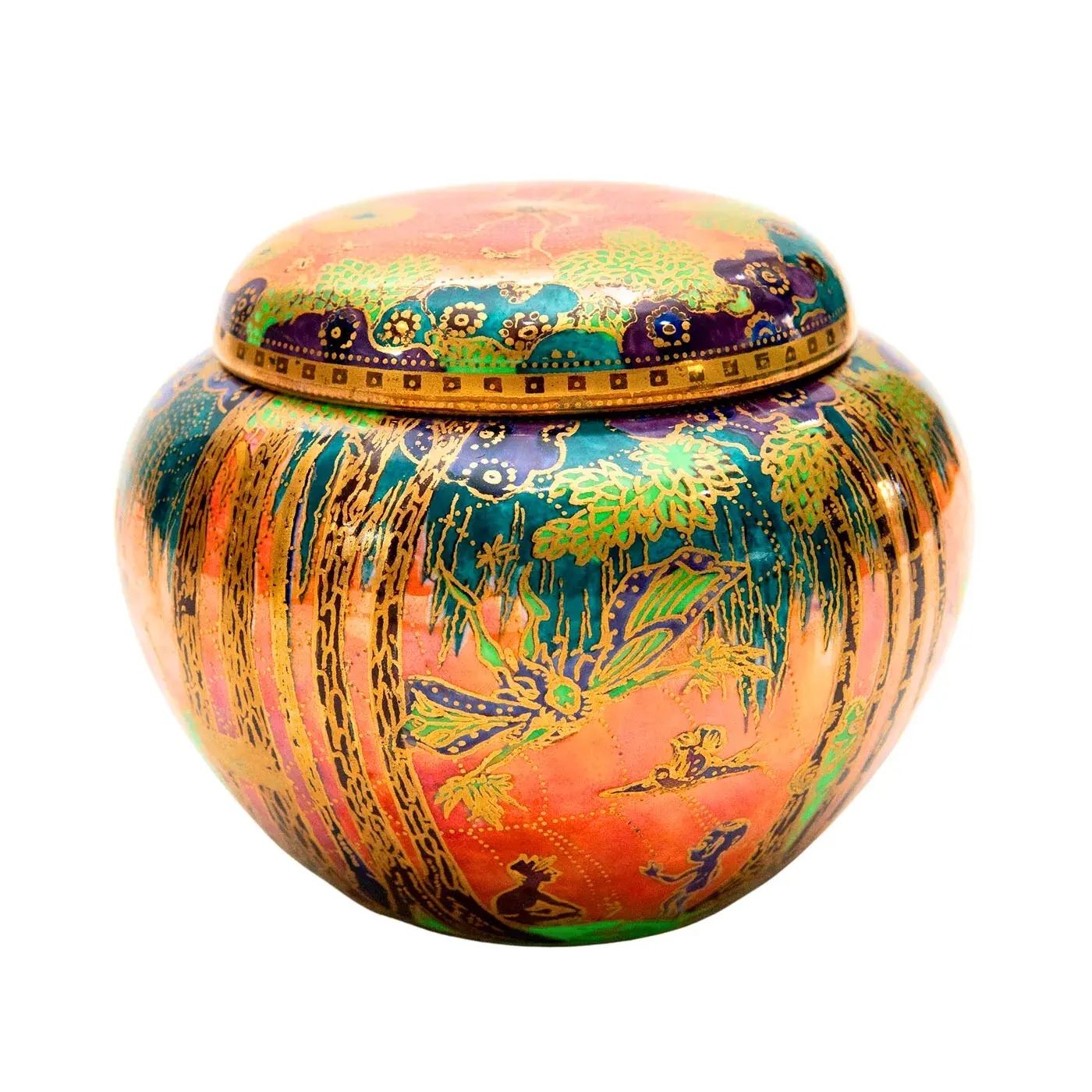
Wedgwood Flame Fairyland Lustre Malfrey Pot:

‘Woodland Elves IV Big Eyes’ flame fairyland lustre exterior. Mother of pearl and green lustre interior.
Porcelain, with gilt outline decoration. Wedgwood gilt Portland vase mark and MADE IN ENGLAND, Z5360 on base. Artist: Daisy Makeig-Jones
Issued: c. 1920
Dimensions: 3.5″H x 4.5″Dia.
Manufacturer: Wedgwood
Country of Origin: England
Condition
Age related wear.

18th c. Wedgwood Black Basalt Canopic Jar Candleholder

18th c. Wedgwood Black Basalt Canopic Jar Candleholder

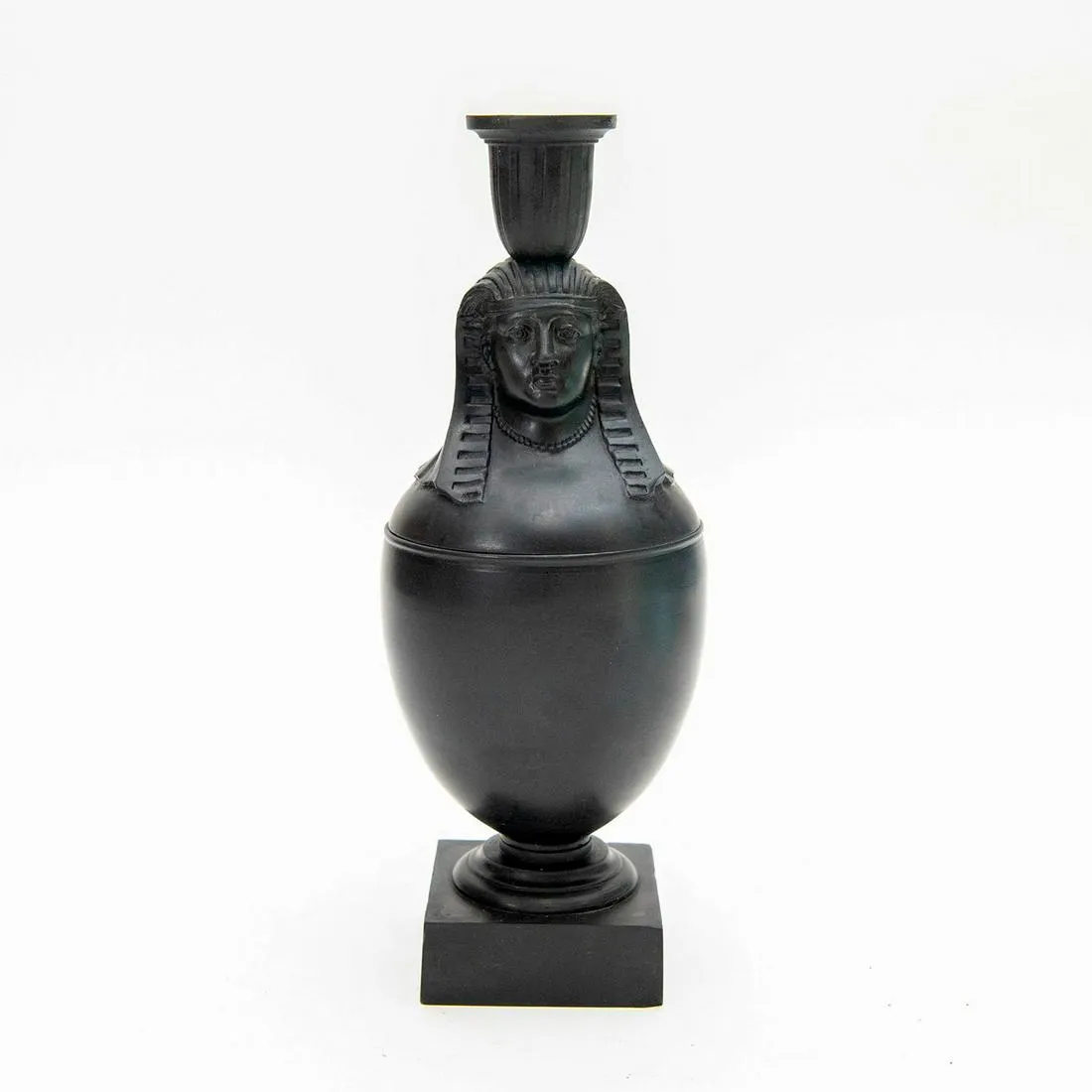
18th c. Wedgwood Black Basalt Canopic Jar Candleholder:

Depicted as ancient Egyptian figural lidded jar set atop a raised square plinth, with candleholder to top of head. Wedgwood & Bentley Etruria impressed backstamp.
Issued: 1769-1780
Dimensions: 10.25″H
Manufacturer: Wedgwood
Country of Origin: England
Condition
Age related wear, with chipped base.

Wedgwood Flame Fairyland Lustre Vase

Wedgwood Flame Fairyland Lustre Vase

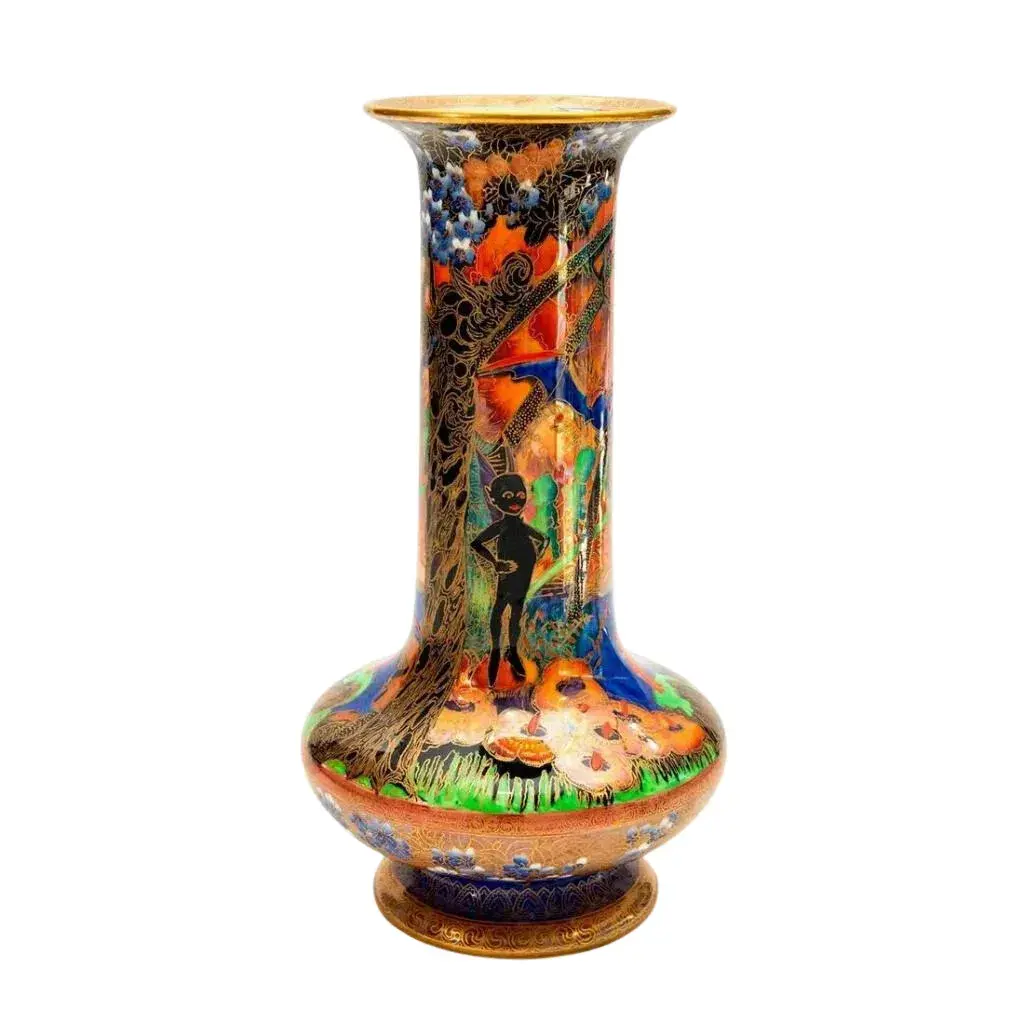
Wedgwood Flame Fairyland Lustre Vase:

‘Imps on a Bridge’ fairyland lustre on a flame ground exterior. ‘Rhages’ bead with stylized clump of leaves borders designed to interior rim.
Porcelain, with gilt outline decoration. Wedgwood gilt Portland vase mark and MADE IN ENGLAND, Z5481 to the bottom base. Artist: Daisy Makeig-Jones
Issued: c. 1920
Dimensions: 11.25″H x 6″Dia.
Manufacturer: Wedgwood
Country of Origin: England
Condition
Age related wear.

ROGER M. UPTON, Northeastern Avalon Bay

ROGER M. UPTON, Northeastern Avalon Bay

ROGER M. UPTON, Northeastern Avalon Bay:

Roger M. Upton
Northeastern Avalon Bay 1956
Oil on canvas
30 in. x 36 in. (37 in. x 43 in. framed)

Roger Upton was born in Massachusetts, and moved with his family to Pasadena, CA. as a baby. He went to Catalina for the first time with his parents in 1902, and was never far away after that, often spending his summers there. From his earliest childhood, Upton was interested in art. In his early twenties he became a sign painter, working for Foster & Kleiser. It was during this time that he met Hanson Puthuff (1875-1972) and Paul Lauritz (1889-1975), both well-established and well-known CA. plein-air painters who would become his lifelong friends.

In 1932, Upton and his wife, moved to Avalon. As was the fate of many artists during those Great Depression years, Upton was unable to make a living exclusively as an easel painter, so he went into the sign business. He also painted murals, created decorations for tour buses, designed menus, and served as the all-around design and artistic consultant for many projects in the area. Upton painted in Avalon longer than any other artist to date.

Through his paintings, he recorded the buildings and landmarks of his time, as well as the landscape, weather, and everyday life of Catalina. Throughout his career, Upton chose to paint in his studio rather than out-of-doors. He used photographs, carefully transferring them to his canvas by laying a graph over both canvas and photo and transcribing one to the other. He also painted from memory. Upton is especially well known for his depiction of Catalina’s eucalyptus trees. Upton bragged that he had never had any formal art training but was largely self-taught. In 1958 Upton and a group of other Catalina artists formed the Catalina Art Association. In that first year, the group started an annual Catalina Festival of Art, which has been held continuously since 1959.

KEVIN MACPHERSON, Little Harbor

KEVIN MACPHERSON, Little Harbor

KEVIN MACPHERSON, Little Harbor:

Kevin Macpherson
Little Harbor n.d.
Oil on canvas
16 in. x 20 in. (24.5 in. x 28 in. framed)

Kevin Macpherson has lived a life beyond his wildest dreams because he followed his muse. Paints in hand, he has globe-trotted to over thirty-five countries and counting. Art is his mistress as he travels in search of inspiration. His colorful, compelling oils cross international borders, speaking with the universal language of color.

Kevin is recognized as one of America’s most accomplished Impressionistic plein air painters. His discipline and dedication have earned him critical success and numerous awards for his artwork. He is a member of many top organizations and has been recognized for his accomplishments and influence, including Master Oil Painters of America, Master American Impressionists Society, Master member California Art Club, member of the Salmagundi Club and Founding member and first president of the Plein Air Painters of America.

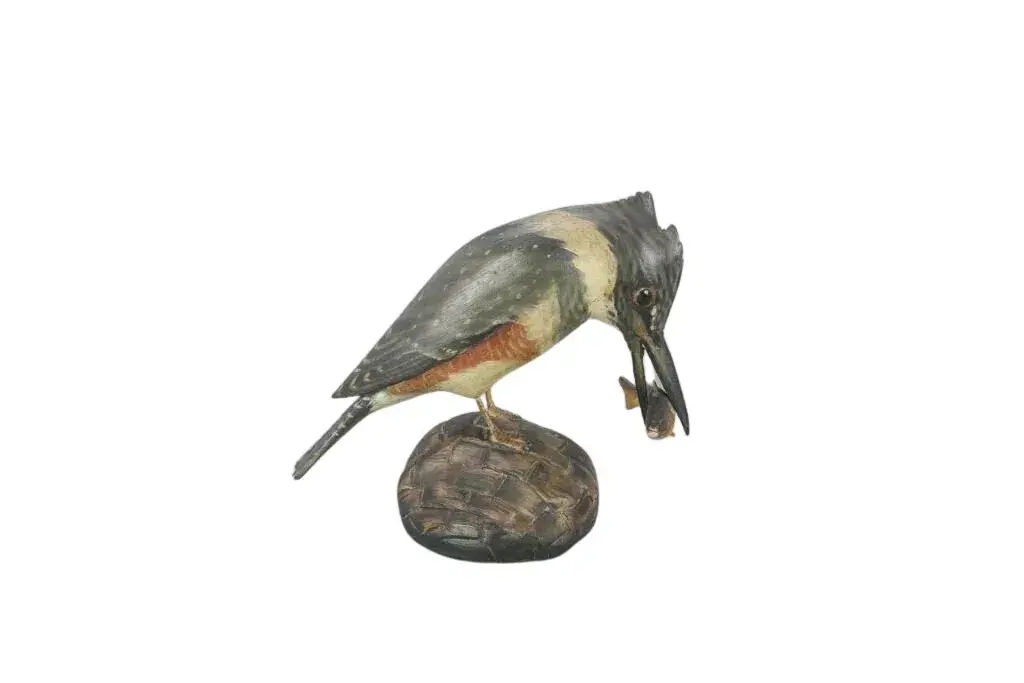
Outstanding Kingfisher with Yellow Perch by A. Elmer Crowell (1862-1952)

Outstanding Kingfisher with Yellow Perch by A. Elmer Crowell (1862-1952)

Outstanding Kingfisher with Yellow Perch by A. Elmer Crowell (1862-1952):

Outstanding Kingfisher with Yellow Perch
A. Elmer Crowell (1862-1952)
East Harwich, MA, 1941
7 1/2 in. long

A rare and exceptional female belted kingfisher mantel carving with its original and notably detailed yellow perch within its bill. The bowed head has a lively saw-tooth crest and the tail has incised feather detail.

The carving is signed, dated, and rectangular-stamped by the maker on the underside of the ornately carved and painted base.
Original paint with light wear. Original fish has some wear on side and has been reset within the open bill.

Provenance: Private Collection, Cape Cod

Literature: Stephen B. O’Brien Jr. and Chelsie W. Olney, “Elmer Crowell: Father of American Bird Carving,” Hingham, MA, 2019, p. 265, related example illustrated.
ConditionPlease email condition report requests to [email protected]. Any condition statement given is a courtesy to customers, Copley will not be held responsible for any errors or omissions. The absence of a condition statement does not imply that the lot is in perfect condition.

CLYDE ASPEVIG, Interior Landscape, Bullrush Canyon, Catalina

CLYDE ASPEVIG, Interior Landscape, Bullrush Canyon, Catalina

CLYDE ASPEVIG, Interior Landscape, Bullrush Canyon, Catalina:

Clyde Aspevig
Interior Landscape, Bullrush Canyon, Catalina 1999
Oil on board
10 in. x 12 in. (17 in. x 19 in. framed)

About the Artist
Inspired by the sagebrush and wide open horizons of Wyoming and Montana, Clyde Aspevig is a landscape painter who sketches on location and finishes the work in his studio. His obvious talent has won him prestigious recognition including the Frederic Remington Award and the Robert M. Lougheed Memorial Award, both from the National Cowboy Hall of Fame. He is a member of the Northwest Rendezvous Group, and is the first Montana artist since Charlie Russell to exhibit at Grand Central Galleries in New York City.

He was born in Rudyard, Montana, and raised on a small working wheat farm near the Canadian border. He currently lives with his wife, artist Carol Guzman, in Loveland, Colorado where he remodeled a historic church for his studio.

Of his feelings about nature, he says: “Paintings are a spiritual communion with nature which results in my celebration of life. Toward this end, I yearn for country that has not been tainted by subdivision, power poles, billboards, and water slides. I choose to paint my pictures as if I, or the viewer, were the first person to set foot upon the landscape”.

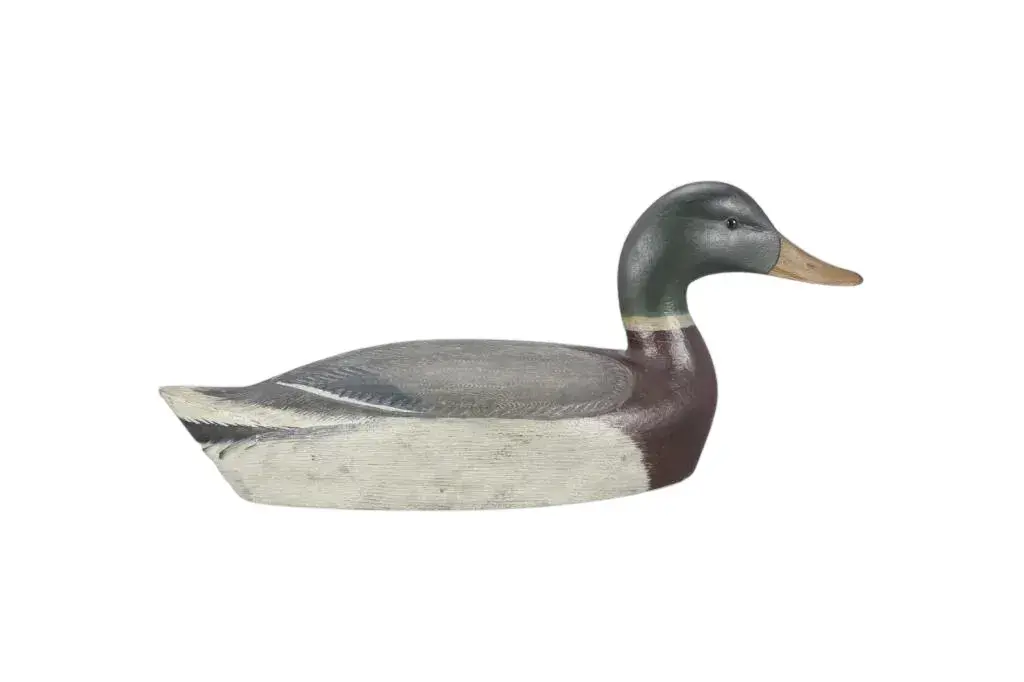
Exceptional Mallard Drake Decoy by Chauncey “Chance” Wheeler (1888-1945)

Exceptional Mallard Drake Decoy by Chauncey "Chance" Wheeler (1888-1945)

Exceptional Mallard Drake Decoy by Chauncey “Chance” Wheeler (1888-1945):

Exceptional Mallard Drake
Chauncey “Chance” Wheeler (1888-1945)
Alexandria Bay, NY, c. 1920
17 3/4 in. long

This highly refined mallard is understood by many to be not only the finest Chauncey Wheeler decoy, but also the best from the entire region. Beyond the region, it stands among the most important mallard drakes by any maker. Like some of A. Elmer Crowell’s best carvings, it was rigged for use as a decoy, yet it shows the refinement and effort the maker exhibited in his best decorative works. The gouged detail is reminiscent of the flourishes seen in the most highly prized works of the Caines Brothers from South Carolina. A view from above this Wheeler carving shows the coveted “Heart Pattern”of the wings and back. The paint is deftly applied with combed, stippled, and wet-on-wet techniques on display.

While the mallard is an ubiquitous species in North America today, wild native mallards, and subsequently their decoys, were scarce in the East during Wheeler’s era. This decoy is the finest of its kind; illustrating its rarity, only one other example is remotely comparable. The other bird is illustrated and discussed in the 2002 monograph on “Chance”in a dedicated chapter titled “New Found Species and Style.”This lot was widely unknown until its public offering in 2012, when it set the record for any Wheeler decoy or decorative. Since then it has been toured and illustrated broadly. The underside retains Kirson Collection markings and a Ward Museum exhibition label.
Original paint with light wear.

Provenance: Robert Billingsly
Private Collection, New York
Donald Kirson Collection

Literature: “The Year in Review 2012,”Decoy Magazine, 2012, front cover, exact decoy illustrated. “48th annual Decoy & Wildlife Art Show,”Decoy Magazine, 2012, July/August 2016, p. 19, exact decoy illustrated. “Decoy Magazine,”March/April 2019, p. 19, exact decoy illustrated.
ConditionPlease email condition report requests to [email protected]. Any condition statement given is a courtesy to customers, Copley will not be held responsible for any errors or omissions. The absence of a condition statement does not imply that the lot is in perfect condition.
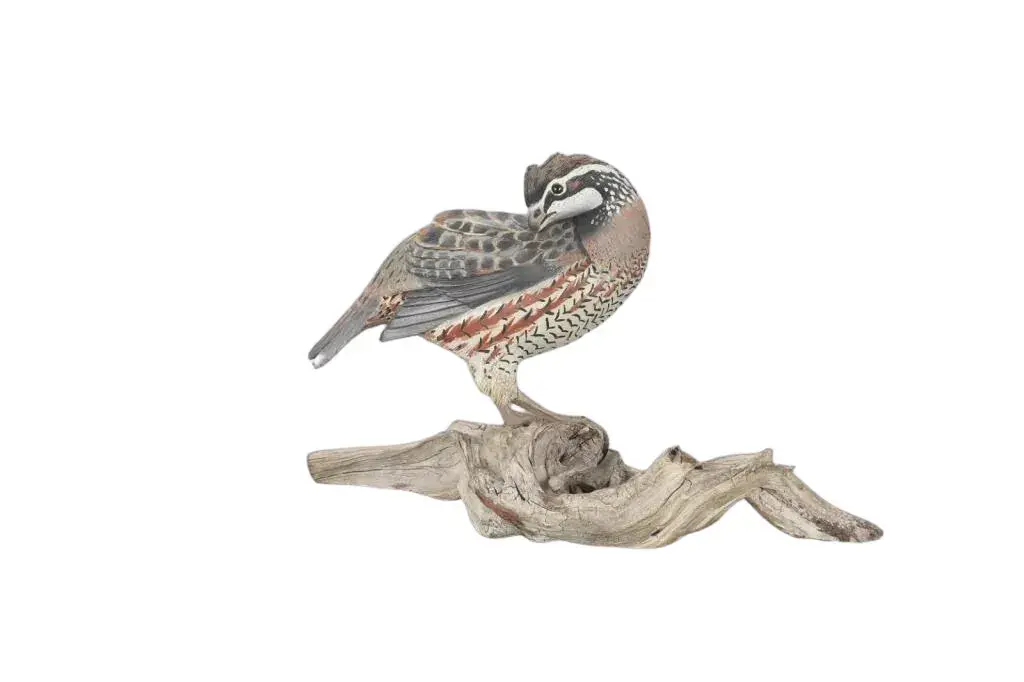
The Ward Bobwhite Quail Carving by Lemuel T. Ward (1896-1984)

The Ward Bobwhite Quail Carving by Lemuel T. Ward (1896-1984)

The Ward Bobwhite Quail Carving by Lemuel T. Ward (1896-1984):

The Ward Bobwhite Quail
Lemuel T. Ward (1896-1984)
Crisfield, MD, 1966
8 1/2 in. tall, 8 in. wide

This carving of a preening bobwhite quail is unique and may be the only standing quail done by the Wards. It is part of his premier decorative “Sunbathing” series of titled birds which includes some of his finest.

The eponymous Ward Museum of Wildfowl Art in Salisbury, Maryland, has one other known quail by Lem. However, that quail is an accessory to one of the greatest and most innovative early American bird of prey carvings ever executed, as it is held limp in the talons of a peregrine falcon.

The rarity of refined early bobwhite carvings by any maker cannot be overstated. Indeed, among the leading decoy makers only Elmer Crowell’s few quail notably preceded this work. They are among the Cape Codder’s most sought-after carvings, yet none of Crowell’s are known to be in a preening position.

The carving is mounted on a fourteen-inch-long driftwood base. The side of the base is signed and titled “Sunbathing L.T. WARD 1966.”
Excellent original paint with light wear.

Provenance: Dr. Morton D. Kramer Collection, acquired from the maker
Private Collection

Literature: Glenn Lawson and Ida Ward Linton, “The Story of Lem Ward,” Exton, PA 1984, p. 44, exact carving illustrated.
ConditionPlease email condition report requests to [email protected]. Any condition statement given is a courtesy to customers, Copley will not be held responsible for any errors or omissions. The absence of a condition statement does not imply that the lot is in perfect condition.
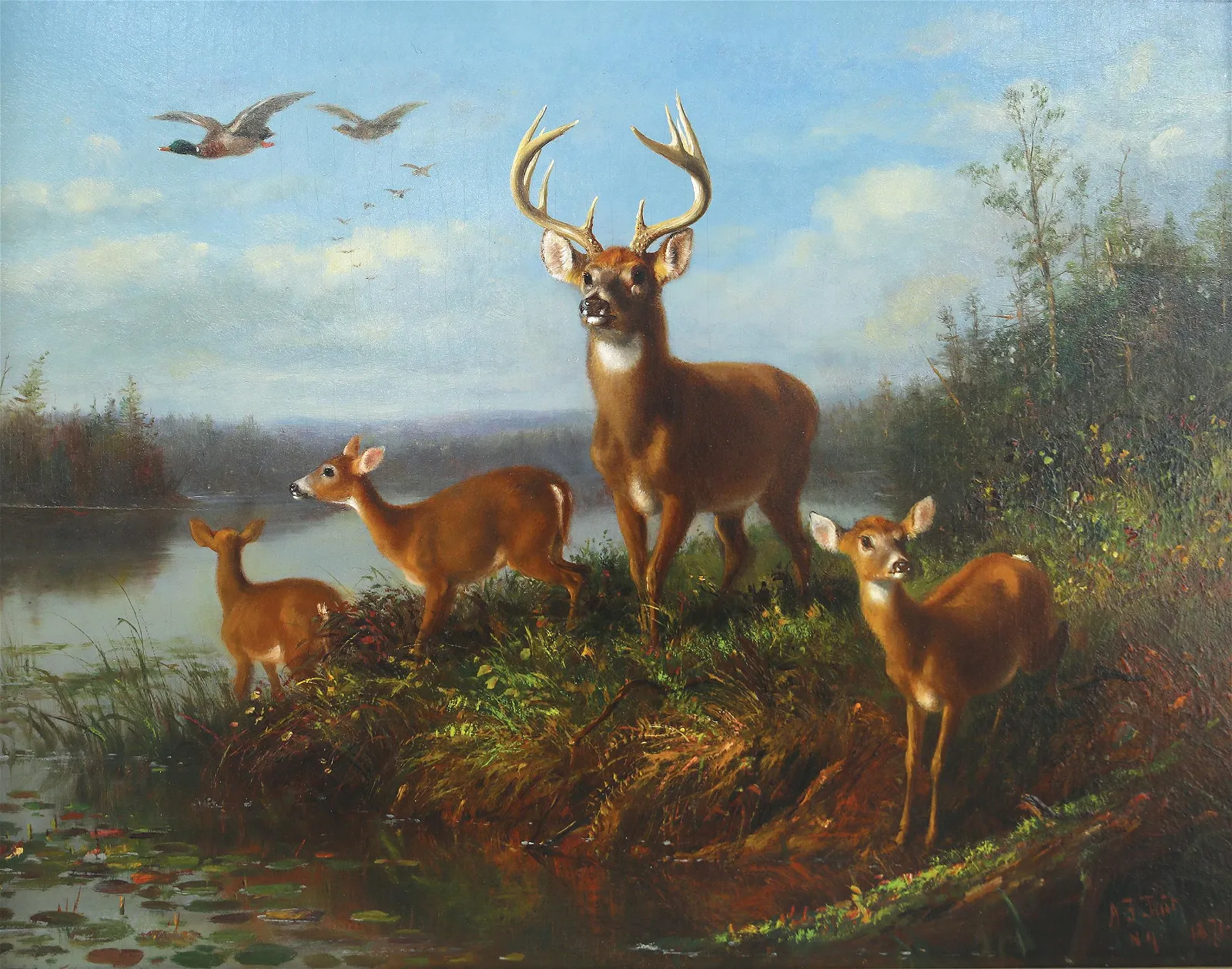
Arthur Fitzwilliam Tait (1819-1905), On the Qui Vive!

Arthur Fitzwilliam Tait (1819-1905), On the Qui Vive!

Arthur Fitzwilliam Tait (1819-1905), On the Qui Vive!:

Arthur Fitzwilliam Tait (1819-1905)
On the Qui Vive!, 1871
signed and dated “A.F. Tait N.Y. 1871” lower right
oil on panel, 12 by 16 in.
numbered, titled, signed, and inscribed on back

“On the Qui Vive” is old slang for “on the alert,” another common title for Tait’s deer paintings. Depicting four deer with flying mallards behind on the shore of Racquette Lake in the Adirondacks, this bright and lively jewel of a painting reveals the artist at the peak of his painting abilities.

This important work is titled and described in Tait’s 1871 register entry as No. 19. It is illustrated in Cadbury and Marsh’s text on the artist: “[No.] 19. Deer. on the qui vive! Buck & 3 Does. 16 x 12. Mr. Dorman, 109 E 27th St. Del’d to him March 17th & paid same time [$125.00] in his own frame by [blank].”

Known as one of America’s earliest sporting artists, Arthur Fitzgerald Tait was born in Liverpool, England, in 1819. From an early age, he was interested in both art and the outdoors. Tait worked for the firm of Thomas Agnew, a famous art dealer and lithographer in Manchester, trained in lithography and drawing, and explored the open land around the city. However, many of the most beautiful vistas and hunting grounds were private and off limits. While in the employ of the art firm, Tait was exposed to the works of Edwin Landseer (1802-1873), Richard Ansdell (1818-1885), and John Frederick Herring (1815-1907), among others.

In Liverpool, beginning in 1843, Tait spent time with fellow artist George Catlin (1796-1872), which may have whetted the young artist’s appetite to explore life in America. Catlin, who was twenty-three years older than Tait, had spent much of the previous decade living in the American West chronicling the lives of Native Americans through his careful drawings and sketches of their clothing, weapons, and ceremonies. There is little doubt that Catlin’s stories would have captivated the young and talented Tait.

In 1850 Tait boarded a boat with his wife and came to America. By 1852 Tait was pursuing his interests in wildlife and hunting, based on the subject matter of his works. He worked from a studio in New York City, but spent a great deal of time on Long Lake in the Adirondacks, where he acquired skills as an angler, hunter, and keen observer of wildlife. These skills were as important for Tait’s art as his fine ability with brush and pigment, since they gave an authenticity to his portrayals of outdoor life which was virtually unrivalled at the time. His relative freedom to paint wherever he wanted in the vast public lands of New York was obviously liberating to the artist, who had felt confined by the strict laws governing trespassing and hunting on private property in England.

With this liberation and experience of the outdoors, Tait’s artistic career flourished. In 1852, only two years after Tait arrived in New York, Nathaniel Currier (1813-1888) and James Merritt Ives (1824-1895) purchased the first of many works from the budding artist. In that same year, Tait was asked to hang a half-dozen works at the National Academy of Design’s annual exhibition. By 1854 he had achieved an associate membership and four years later he became a full member. Editions of Tait’s works for Currier and Ives were reproduced by the thousands and formed some of America’s most iconic images of the Victorian era. The exceptionally popular “American Field Sports” series showcased Tait’s abilities as an upland bird and dog painter and included the four lithographs “A Chance for Both Barrels,” “Flushed,” “On a Point,” and “Retrieving.” These hunting scenes, along with his camping and woodland scenes, resonated with the public as an integral part of the American experience and continue to inform us of our history as a nation. Seminal works by Tait, such as “An Anxious Moment,” “A Tight Fix,” and “Trappers at Fault: Looking for the Trail,” have become embedded as part of our heritage and serve as signposts along our path as a nation.

Today, Tait’s wilderness, frontier, and wildlife scenes hang in some of the most prominent museums and private collections, including the permanent collections of the Addison Gallery of American Art, Andover, Massachusetts; the Adirondack Museum, Blue Mountain Lake, New York; the American Museum of Western Art, Denver, Colorado; the Amon Carter Museum, Fort Worth, Texas; the Brooklyn Museum, New York; the Corcoran Gallery of Art, Washington, DC; the Denver Art Museum, Colorado; the Metropolitan Museum of Art, New York; the National Museum of Racing, Saratoga Springs, New York; the Shelburne Museum, Vermont; the Yale University Art Gallery, New Haven, Connecticut; the Tate Gallery, London; and the Victoria & Albert Museum, London, among others.

Provenance: Dorman Collection
Mrs. J. Augustus Barnard Collection
The Metropolitan Museum of Art, New York, 1979
Private Collection

Literature: Warder H. Cadbury and Henry F. Marsh, “Arthur Fitzwilliam Tait: Artist in the Adirondacks,” Newark, DE, 1986, pp. 215-16, no. 71.10, illustrated.
ConditionPlease email condition report requests to [email protected]. Any condition statement given is a courtesy to customers, Copley will not be held responsible for any errors or omissions. The absence of a condition statement does not imply that the lot is in perfect condition.