Di-Faced Tenner, 10 GBP Note (two works), 2005
Offset lithograph in colors on paper
3 x 5-5/8 inches (7.6 x 14.3 cm) (each)
Banksy X Banksy of England

Di-Faced Tenner, 10 GBP Note (two works), 2005
Offset lithograph in colors on paper
3 x 5-5/8 inches (7.6 x 14.3 cm) (each)

United States,1963
Marvel Comics Tales of Suspense issue 39 from March, 1963. The book featured the origin and first appearance of Iron Man. CGC 4.5 w/ Cream/Off-White Pages
CGC case 12 3/4″ x 8″
Condition
Overall good condition.

A piece presented to the actress for “World Film / Favorite / of / 1959” by the Hollywood Foreign Press Association; small ‘Henrietta’ statuette now broken off the top of the globe.
9 by 3 by 3 inches

This is an impressive extra large sterling silver Georg Jensen Centerpiece bowl, design #250B by Johan Rohde from 1917. A hammered pedestal base, Floral and Scroll work combined with oxidized floral center piece with a hand hammered large sculptural bowl. A monumental and impressive piece. Measures an impressive 13″ in height and has a diameter of 14 1/4″ (32cm, 36cm). Vintage Georg Jensen hallmark from 1945-1977.
Condition
Condition: Very good
One of the tried and true facets of the auction-house world is that when an item performs spectacularly well, somebody with another one will often step forward and say, “Well heck, if it’s worth that much, then I’ll sell mine.” It’s a win-win-win situation; the new consignor gets to sell while the market’s hot, collectors get a rare second chance at an amazing piece, and of course the auction house in between makes its fees and keeps rolling along.
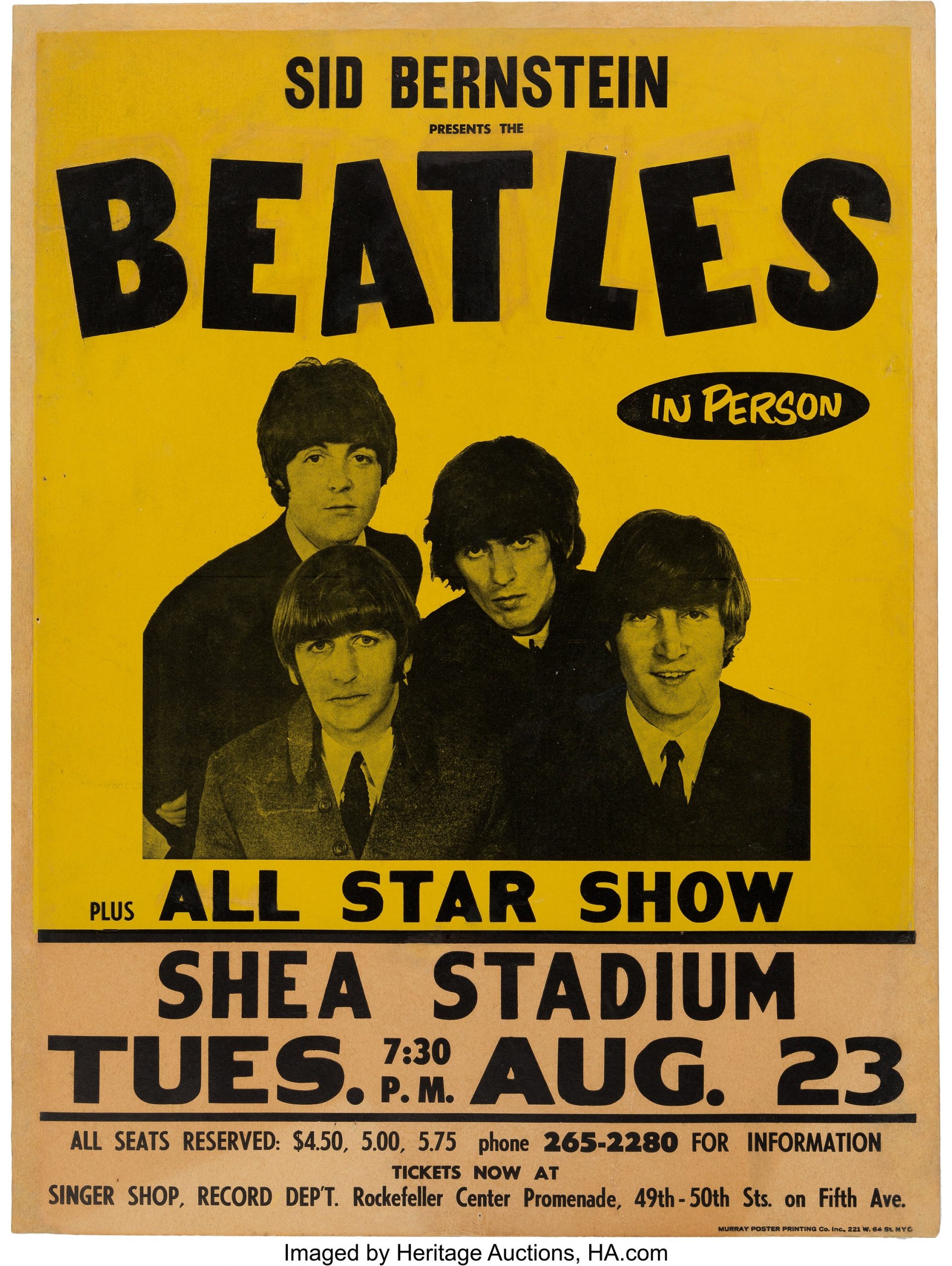
Delightfully, such is the case with our offering on April 4 of another super-rare gem of a concert poster, the highly coveted Beatles at Shea Stadium 1966 advertising window card. Simply put, a doctor outside of Boston saw our results last November ($125,000), his sister had recently passed away and the time was right for him to sell. Once again, like last fall’s copy, this is not a dealer or collector consigning the poster; it’s the original owner (within the family) who simply took it down out of fandom and has possessed it for all 54 years since, with no other posters in their house. It’s the best kind of consignor anyone can ask for.
We told you the whole story behind this remarkable poster in our last auction, but we’re not going to short you one word of it this time around. For after all… this could be the last one to get publicly auctioned for a long, long time. Just because we lucked into this poster in two consecutive auctions doesn’t mean a third one will be coming around anytime soon. Ten more years would not be a surprise at all.
So what we have is a truly authentic cardboard advertising poster for the Fab Four’s summer 1966 personal appearance at Shea Stadium in Queens, New York. It’s been bootlegged a million times, but this is the real deal, pulled down by our consignor’s sister (see the accompanying Letter of Provenance, included of course in the sale).
“The Beatles” and “Shea Stadium” are two sets of couplets that go together in pop culture like Fred Astaire and Ginger Rogers up through Jay-Z and Beyonce. Not only world-changing music, but entertainment history was made there by the Fabs in 1965 and ’66, and it’s easy to see why: by stepping on stage at Shea, the Beatles faced an audience that probably exceeded the size of all of their 279 appearances at Liverpool’s Cavern Club combined – all in one night.
For their first appearance there in 1965, no advertising materials were needed; word of mouth alone was enough to sell the place out 10 times over. Once New York radio DJs started mentioning it on the air, promoter Sid Bernstein just sat back and watched the ticket money roll in. Who needed to spend money on advertising? Concert posters were, after all, just an advertising expense, despite collectors’ love for them today. They weren’t created frivolously in the 1960’s; they were produced only if needed.
Bernstein did, however, take advantage of the situation in ’65 by creating a small B&W ‘marquee-style’ poster and handbill – with no pictures or images – that touted several other concerts he had coming up, along with the Beatles. We have one of those posters in this sale as well.
But in 1966, Bernstein had to pull out all the stops.
The world had grown weary of Beatlemania, the band had experienced a rough time of it overseas, everyone was getting tired of the fans’ screaming, and worst of all, John Lennon’s “We’re more popular than Jesus now” remark had exploded in the media in July, directly impacting ticket sales for this August concert. Although the Beatles were still creating fantastic music – many fans & reviewers now consider their summer 1966 album Revolver their greatest ever, even better than Sgt. Pepper – ticket sales were not robust at many stops on this tour, which would end up being their last. The upcoming hippie ethos, which would completely dominate pop culture for the next few years, had started to seep its way in. So… Shea ’66 was anything but a sellout.
So what’s a promoter to do? Market and advertise, of course. So promoter Bernstein went to the Murray Poster Printing Company there in New York and had an advertising poster (aka window card) designed, printed up and distributed, to try to goose sales.
While relatively simple and straightforward in presentation, at the same time the poster is a masterwork of charisma, color, type fonts, our heroes’ faces and, above all, rarity. How many did Sid have printed up? Nobody knows. A couple hundred is a good guess, with a range ultimately of anywhere from 50 to 500. We just have to remember that in the 1960’s, nobody saved anything. The world was having too much fun to bother stopping and documenting it all. Why would they want to save this piece of cardboard? The poster didn’t have a unique photo of John, Paul, George and Ringo… just their current standard publicity shot. So what’s the big deal? Besides, they were certainly returning again in 1967, and then 1968, and then 1969…
Not.
That’s right; another thing nobody knew is that this was the Beatles’ last hurrah, live-performance wise. Within a week of this concert, it would be impossible to ever see the Beatles live in concert again (rooftop frivolity aside). It would all end in San Francisco six nights later, and a page would then be turned that nobody on earth except the four men from Liverpool wanted to see turned.
But first, there was the Big Apple and getting butts into those 55,000 seats. We don’t know what promoter Bernstein did with radio and newspaper ads, but we sure know about this poster. It was likely stapled to telephone poles, fences, record-store walls and anyplace around Manhattan that would gather the most eyeballs. Young eyeballs. Pop music was still a young person’s game at this point. Parents were relegated to dropping their kids off at the stadium and patting them on the head for wanting to see the “yeah, yeah, yeah” quartet. Only later would everyone realize that the Fabs were making revolutionary rock-music history that would have tremendous influence well into the next century – and presumably beyond.
But the ‘burn rate’ for concert posters back then is often calculated at 99 percent… as in, 99 out of 100 of these window cards would be thrown away after the event. Sometimes the ones that were saved were saved accidentally. In the wonderful case of this auction’s consignor and his prized poster we’re offering, it was pulled down by his sis who, although not a collector, cherished it framed on her wall for decades.
It wasn’t too long before promoter Bernstein realized how iconic, and marketable, his concert-poster image was. Thus began the trickle, which turned to a flow, which eventually turned to a tidal wave, of limited-edition lithographs, reproductions, signed editions (by Sid, not the untouchable Beatles of course), bootlegs, pirates, knock-off’s… just pick your term. The sheer scope and variety of “Beatles Shea 1966” concert posters out there in eBay-land is staggering, and sometimes humorous. I like the one with a Dezo Hoffman shot of the Fabs from 1963… really? They had just put out an album with “Tomorrow Never Knows,” and the pirates couldn’t do any better than a photo from the picture sleeve for “I Want to Hold Your Hand”?
I’ve been a serious poster collector for 25 years, so between that and Heritage’s enormous reach, naturally I get lots of phone calls from strangers. Honest to goodness: When somebody starts to say, “I’ve got this old Beatles concert poster, and…”, I get bored. Immediately. My eyes roll and my goal switches to finishing the call as quickly and politely as I can. I’d much rather they have said “this old Otis Redding poster” or something. Why? Because with Beatles concert posters, they’re always fake. ALWAYS! They’re always contacting me about one of the million boots out there. I usually say, “Does it have the year on there?” And then when they say, “Yes, sure, of course!” and give me ’65 or ’66, I’ll respond with something like, “So what do you think of the Yankees’ chances this year?”
None of these posters needed the year on there… they were created to have an entire lifespan of six or eight weeks. When you’re standing in Times Square in the middle of summer looking at a poster, you know what year it is. All you needed to know was that the event was on Tuesday, August 23. (However, it should be pointed out that even to this day, probably about 5% of genuine concert posters do have the year on there, for whatever reason. And there are also many Beatles Shea boots out there now without the year, trying to mimic the original.)
So from the perspective of a serious collector, any poster printed after the last Beatle said to the crowd, “Thank you, goodnight!” is worthless garbage. Any poster printed before they stepped foot on that stage is the main goal. The former is nothing but a merchandising poster, created in huge numbers to be sold for money; the latter is an advertising poster, created in tiny quantities to be thrown away the moment it couldn’t be used to sell tickets anymore. Collectors ignore the former and go bananas for the latter.
Getting down to the nitty-gritty details, the poster measures 18 x 24″ and grades to Very Good Plus. We had the poster professionally repaired, because it had black electrical tape covering the white margins on the top, left and right. (Luckily not the bottom margin, which would have harmed the Murray Poster Printing Co. credit.).
Obviously, that tape had to be meticulously removed. That process revealed a couple of small missing pieces of cardboard in the top white margin and lower left corner. So we turned to our world-class paper conservation expert / concert poster specialist to make those repairs. A few original staple and thumbtack holes remain present: two in the “B” in Bernstein, two just above the “L” in Beatles, one below “Person” in the little black oval, two on the yellow edge to the left of Paul’s face and one to the left of his shoulder, one in the black bar under “Show,” two above “$4.50” in the ticket prices, and one below “Center” in the bottom margin.
Also, the large “Beatles” letters are a little ghosted by something the consignor’s sister may have done back in the day; each letter appears to have a light shadow behind it. We decided to leave that alone. The poster also has general toning throughout, and its measurements, “18X24,” written in pen on the verso. The poster-collecting hobby now recommends extremely light restoration if it’s needed at all. That’s exactly how we approached this Holy Grail of a concert poster, which is why we left the toning, the tiny staple holes, etc. all intact. But we’re sure you’ll agree, that black electrical tape had to come off.
So I’ve been lucky enough to have thousands of rare posters pass through my hands over the last quarter-century, and I had several of my own 1961-62 original Beatles Liverpool concert posters on display at the Rock and Roll Hall of Fame and Museum in Cleveland, Ohio for the first decade they were open (1995-2005). But up until last fall when our first Beatles Shea ’66 arrived at Heritage’s offices in Dallas, I had never, ever seen or held one in person before. That is just silly. And the world’s biggest private dealer of vintage concert posters told us that it’s the only big poster he can think of that has never passed through his hands, ever. And that he’s never even been offered one, at any price. It is truly the rarest of the rare. Thank goodness Mr. Sommer of Auburndale, Massachusetts spoke up about his.
It’s still as rare as hen’s teeth, no question about it. How rare? I’m going to say only five or six of them are now known to exist, and the owners are clinging to them for dear life. No wonder that in 2004, the last time one was auctioned before Heritage, it sold for $132,736. And no wonder we fetched $125,000 for ours last fall. It’s as popular, reliable, solid and spectacular as any concert poster, or dare I say any music collectible period, could possibly be.

James Edward Buttersworth (New Jersey/New York, 1817-1894)
Packet Ship Kennebec in New York Harbor
Signed “J.E. Buttersworth” l.r., titled on a presentation plaque.
Oil on canvas, 20 1/4 x 26 1/8 in., in a gilt molded frame.
Condition: Canvas laid down, spots of retouch associated with abrasions through the center of the canvas.
Provenance: Christie’s, November 14, 2007, Lot 5.
Estimate $60,000-80,000
Items may have wear and tear, imperfections, or the effects of aging. Any condition statement given, as a courtesy to a client, is only an opinion and should not be treated as a statement of fact. Skinner shall have no responsibility for any error or omission.

Cartier Panthere de Cartier Diamond, Enamel and 18 Karat Yellow Gold Bracelet Watch with Quartz Movement, Sapphire Crystal. Case measures 22mm x 22mm. Signed, stamped 18K, hallmarks. Approx. weight: 63.3 grams. Condition: Very good condition. Please note the gallery does not warranty the running condition of watches. Estimate: $30000.00 – $40000.00 Domestic Shipping: $32.00
Condition
Very good condition. Please note the gallery does not warranty the running condition of watches.

Parker Bros. VH grade SxS 16ga shotgun circa 1910-11, serial no. 154432; box lock, extractor, stamped: I and VH on barrel flat; barrel 28″ and overall L44″ **Firearm Laws Apply**
Provenance: South Carolina collection
1944
Mural-sized gelatin silver print, printed 1967, flush-mounted.
39 x 63 1/4 in. (99.1 x 160.7 cm)
Signed, titled and annotated in ink on a label accompanying the work. Additionally accompanied by a typed letter signed by Adams to the present owner, 1969.
Estimate

Inverted crescent pendant on a squash-blossom necklace called the Naja by the Navajo. Native American style, sterling silver w. 17 turquoise stones.
Solid sterling silver beads, with 17 inset green turquoise cabochons surrounded by fine silverwork pendants. Total weight is approximately 141.3g.
Issued: 20th c.
Dimensions: 24″L
Country of Origin: United States
Provenance: David Farin Collection