The Only Known Mangels Rowdy LightThe Only Known Mangels Rowdy Light-Up Gallery Target-Up Gallery Target

As with the Mangels’s ‘Clown’ target (lot 111 in this auction), this ‘Rowdy’ target by Mangels is the only example found to date. The monumental size and complexity are that of a centerpiece target anchoring a shooting gallery display. While conveyors may have had multiples of the same figure, there would only be one large light-up target like this, thus the rarity. The fixed iron mechanical box with cover would contain light bulbs in porcelain sockets and is fronted by the thick iron silhouette of Rowdy, a burglar-like figure with thick iron spectacles, cap and collar attached. As originally constructed, light bulbs would blink when a sensor was activated. This and the companion Clown target by Mangels are important in terms of their size, complexity and visual presence. pictured on the title page and page 13 (Figure 1.3) of Sellers’ book, this truly unique example is also pictured in multiple Mangels catalogs with the similar Clown model as its companion on same gallery.
Displayed on a custom iron stand.
Measures 24 x 17.25 inches, excluding stand.
We happily provide seamless in-house packing and shipping services on nearly everything we sell.
Greek Italic Bronze Statue of Herakles

*Originally Listed At $7000**
Magna Graecia, ca. 4th to 3rd century BCE. A solid cast bronze figure depicting Herakles / Hercules wearing a hood and cloak made from the Nemean lion (note the incised furry coat and the finely delineated head/visage of the wild beast), standing in a contrapposto pose, with his left hand held outward with a clenched fist, and his right arm raised with a clenched fist. The iconography of this bronze references the legendary hero’s first labor when King Eurystheus asked Hercules to bring him the skin of a fierce lion that terrorized the hillside around Nemea – a seemingly impossible task. Despite the fact that initially Hercules’ arrows were utterly useless against this threatening beast, our hero ultimately succeeded, clutching the lion in his muscular arms all the while strategically avoiding its claws, finally choking it to death. A marvelous rendering of Hercules displaying the ancient artist’s strong interest in delineating physiognomy and movement of Hercules’ heroic yet human form. Gorgeous patina. Lucite stand. Size: 5.75″ H (14.6 cm); 6.5″ H (16.5 cm) on stand
FRED STONEHOUSE, The Sound of Night

Fred Stonehouse’s unmistakable style reflects disparate influences. His pinched figures recall innovations in artistic naturalism during the Northern Renaissance in Europe. The bravado strangeness is sanctioned by outsider art. His probing analysis into the nooks and crannies of the human psyche is the bequest of Surrealism. Featuring a human-animal hybrid and a mysterious phrase, The Sound of Night is classic Stonehouse.
Since his first solo show in 1983, Stonehouse has exhibited across the United States, as well as in Mexico, the Netherlands, Italy, the United Kingdom, France, and Germany. He received a Lifetime Achievement Award from Wisconsin Visual Artists in 2007, and grants from the National Endowment for the Arts and Arts Midwest among others. Stonehouse’s work appears in collections across the country, including the private collections of Madonna and Sheryl Crow.
Etruscan Bucchero Amphora w/ Animals, ex-Christie’s

Northern Italy, Etruscan, late 7th century BCE. An outstanding Etruscan bucchero amphora with an extensive and very refined graffiti decorative program comprised of six feather-like motifs around the upper section of the neck, six open fan motifs at the lower end of the neck, just above the shoulder; four bands that each contain three upright feather-like motifs separated and bordered by incised double lines on the handles; a register of incised vertical frets surrounded by bas relief borders with incised diagonal marks; a wide register displaying a parade of four animals including two antlered bucks alternating with two wild felines as well as a centaur. The overall shape of the vessel suggests a funerary context. Similar examples were found at Cerveteri. This particular vessel is among the finest Etruscuan Bucchero amphoras we have had the honor of handling. Size: 7.375″ in diameter at widest point x 9.125″ H (18.7 cm x 23.2 cm)
See a similar black Bucchero Etruscan amphora at the British Museum collection (accession number 1984.1023.2) – https://www.britishmuseum.org/research/collection_online/collection_object_details.aspx?objectId=466606&partId=1
This piece has been tested using thermoluminescence (TL) analysis and has been found to be ancient and of the period stated. A full report will accompany purchase.
Provenance: private East Coast, USA collection; ex-private Texas, USA collection, acquired in the early 2000s; ex-Christie’s, New York Antiquities auction (sale 1446, December 10, 2004, lot 520)
All items legal to buy/sell under U.S. Statute covering cultural patrimony Code 2600, CHAPTER 14, and are guaranteed to be as described or your money back.
A Certificate of Authenticity will accompany all winning bids.
We ship worldwide and handle all shipping in-house for your convenience.
A Blue And White Porcelain Jar With Three Worthies Playing Weiqi
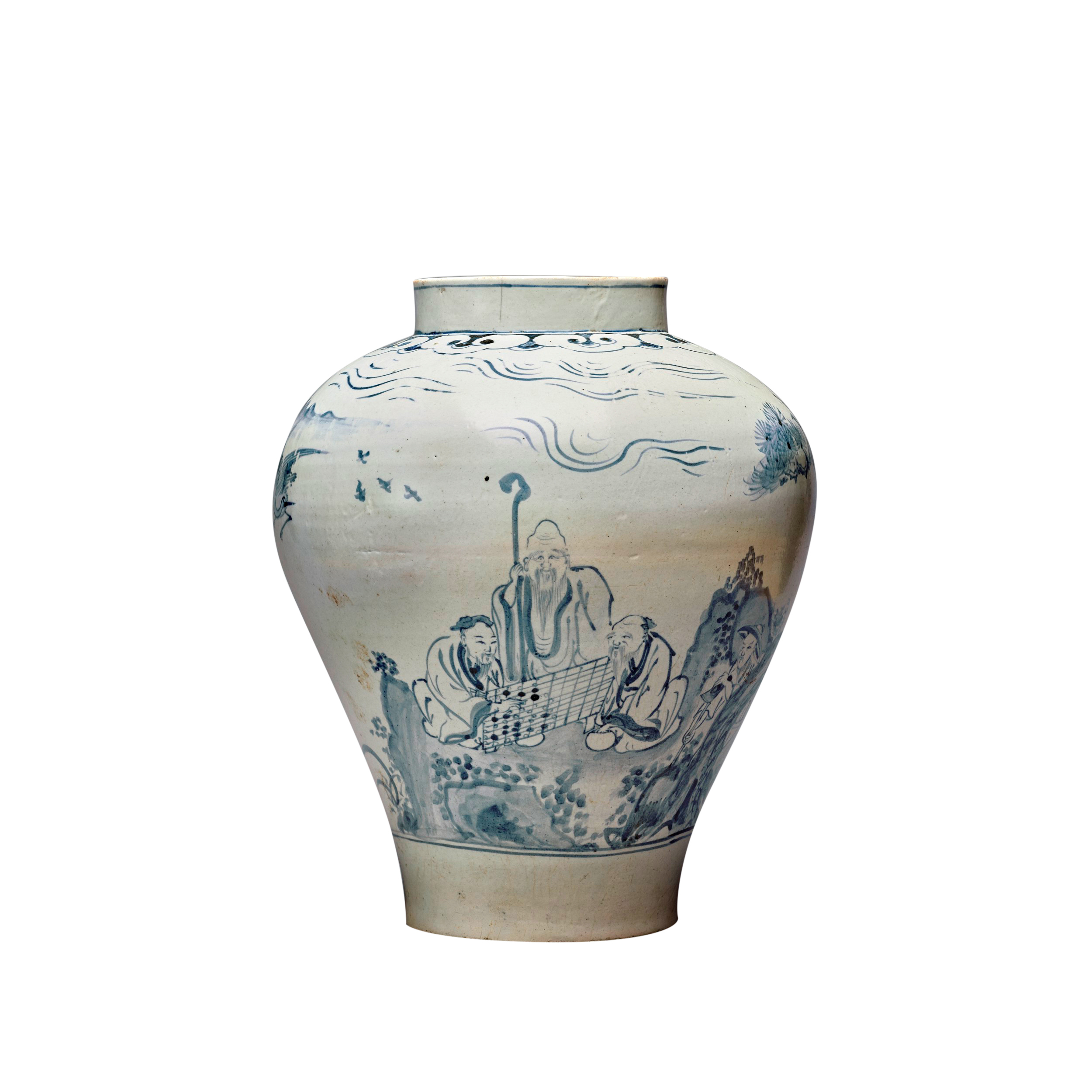
A BLUE AND WHITE PORCELAIN JAR WITH THREE WORTHIES PLAYING WEIQI
JOSEON DYNASTY (18TH CENTURY)
The ovoid form, vividly painted in underglaze-blue with Three Worthies in a Landscape Playing Weiqi, the neck with auspicious fungus-head-shaped cloud collar, the body applied with a lustrous transparent overglaze
16 ¾ in. (42.5 cm.)
Mochica Spondylus Shell Pendant Necklace

Pre-Columbian, North Coast Peru, Moche, ca. 100 to 500 CE. A magnificent ensemble of hand-carved spondylus shell beads – 28 depicting various species of flora and fauna comprising the lower strand and 18 ridged beads (the ridged surfaces representing those of spondylus shells) comprising the upper stand – the ensemble presenting a variety of hues – plum, tangerine, cream, and white. Arranged in an attractive design on a museum-quality stand which is included. Size: 25″ L (63.5 cm); 11.875″ H (30.2 cm) on included custom stand. Largest beads measure ~ 1.75″ L (4.4 cm)
Spondylus shells, also known as spiny or thorny oysters for obvious reasons, have been revered by Andean peoples since the Pre-Columbian era. In addition to being featured in their artwork and used as currency, Spondylus pieces served as sacred offerings to Pachamama, the earth/time mother, a version of Mother Nature. The Spondylus shell carries numerous symbolic meanings. A symbol of fertility and elite social status, it was also believed to be an omen of rain, warning the indigenous of El Nino. In fact, the Spondylus shell only appears when the water becomes warmer during December – the time of the El Nino current – immediately before the rainy season.
Provenance: private Hawaii, USA collection; ex-private Hans Juergen Westermann collection, Germany, collected from 1950s to 1960s
All items legal to buy/sell under U.S. Statute covering cultural patrimony Code 2600, CHAPTER 14, and are guaranteed to be as described or your money back.
A Certificate of Authenticity will accompany all winning bids.
We ship worldwide and handle all shipping in-house for your convenience.
Karl Lagerfeld Inscribed Book To Nolan Miller
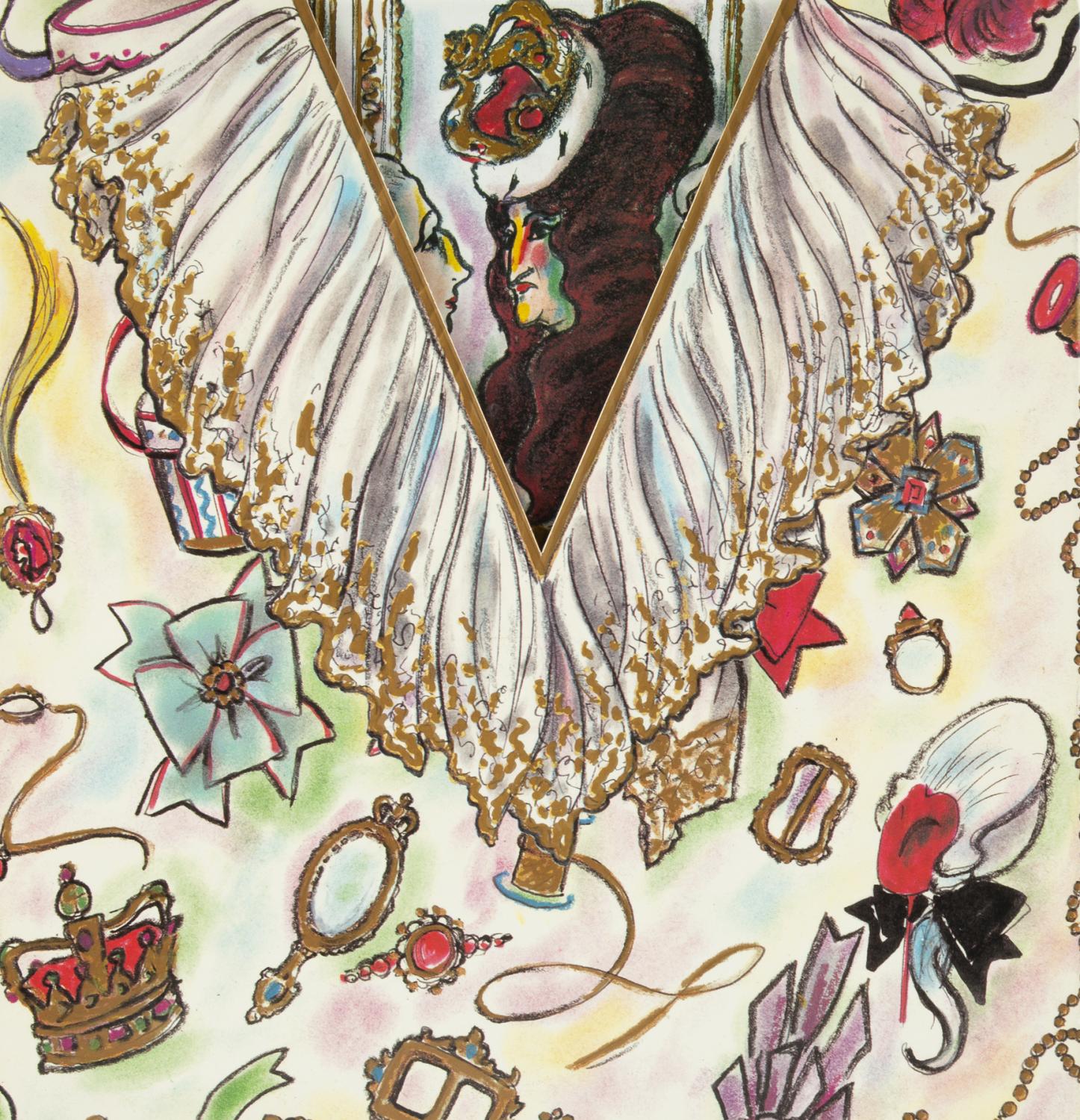
A copy of Hans Christian Andersen’s The Emperor’s New Clothes (New York: The Atlantic Monthly Press, 1992) illustrated by Karl Lagerfeld. The book is inscribed “To Nolan Karl Lagerfeld.”
11 by 11 inches
PROVENANCE From the Estate of Nolan Miller
George Segal, Three Nudes

c. 1959
oil and charcoal on canvas
67.75 h × 96 w in (172 × 244 cm)
Signed to lower right ‘G. Segal’.
After Andy Warhol (1928-1987): John Richardson

Giclée on canvas.
40 x 40 in., 48 x 48 in. (frame).
Note: Andy Warhol painted John Richardson in 1973. The composition is based on a polaroid that Andy took of him wearing this cap. Richardson gifted the painting to the Tate in 2017.
Literature: John Richardson at Home, ill. page 183.
John Richardson: A Scholar Collects