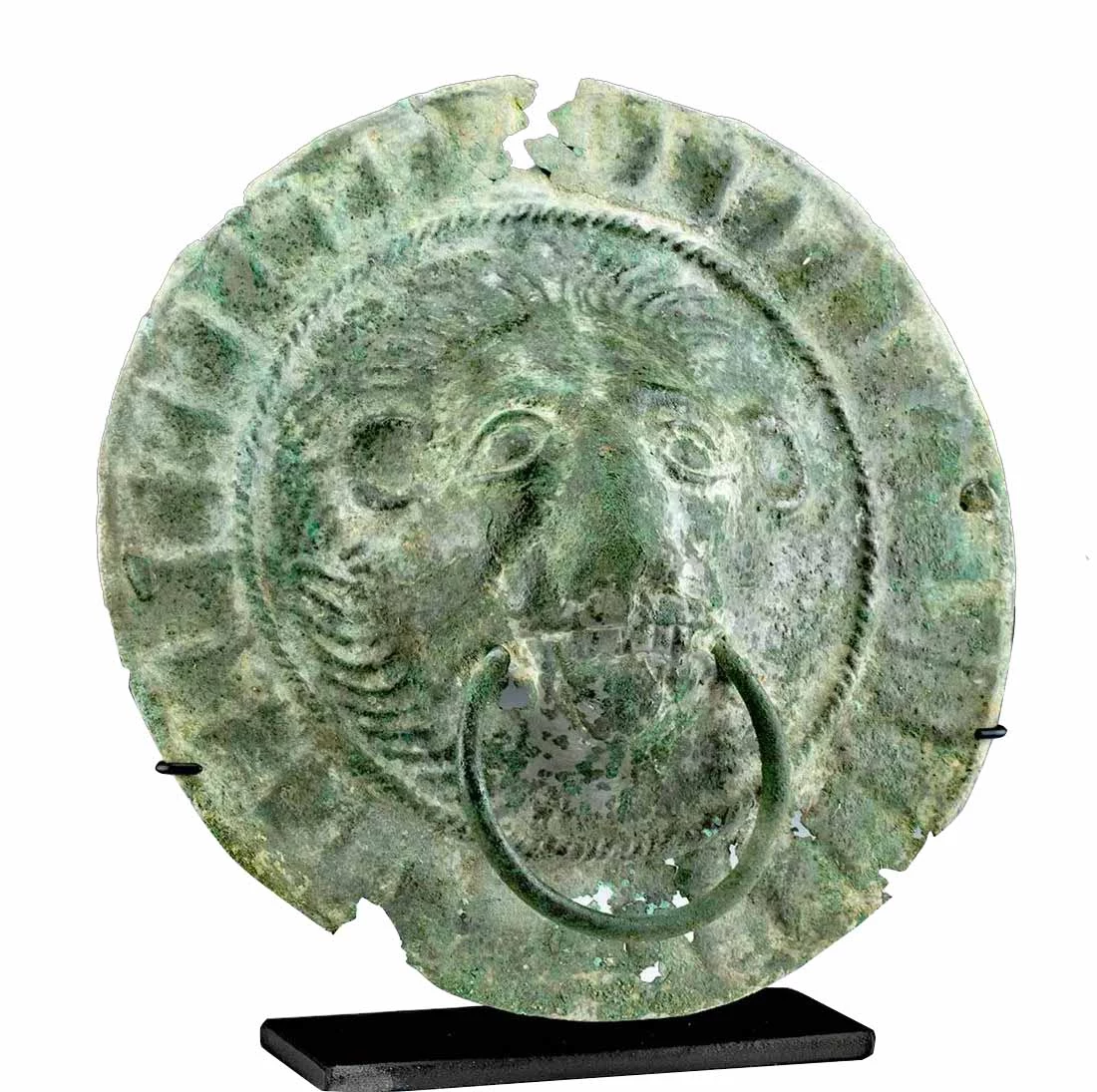
Rare Etruscan Bronze Boss Lion w/ Ring in Mouth
**Originally Listed At $5000**
Northern Italy, Etruscan, ca. 6th to 5th century BCE. Finely cast via the lost wax (cire perdue) technique, a leaded bronze boss adorned with a leonine visage in repousse with a ring in its mouth. The lion presents with large, almond-shaped eyes, a prominent nose, cup-shaped ears, a mouth that is delineated with revealed teeth, fangs, and tongue, a separately cast ring fitted through either side of the lion’s mouth, and a finely delineated wavy mane. Framing the wild feline is a raised rope-patterned border followed by a register of equidistantly placed ribs in bas relief, and finally, a rounded edge. A stupendous example with well-preserved details. Size: 8.125″ W x 8″ H (20.6 cm x 20.3 cm); 8.125″ H (20.6 cm) on included custom stand.
This piece was collected by Paul Suttman, acquired by Suttman in the 1960’s when he lived in Italy as a fellow of the American Academy of Rome. A three time recipient of the prestigious Prix de Rome, Paul Suttman (1933-1993) was an internationally known American sculptor who produced many impressionistic figurative works in bronze. Mr. Suttman’s work is represented in the Museum of Modern Art, the Morgan Library, the University of Michigan Museum of Art, and the Hirschhorn Museum and Sculpture Garden in Washington D.C. More information on Suttman can be found in his New York Times obituary.
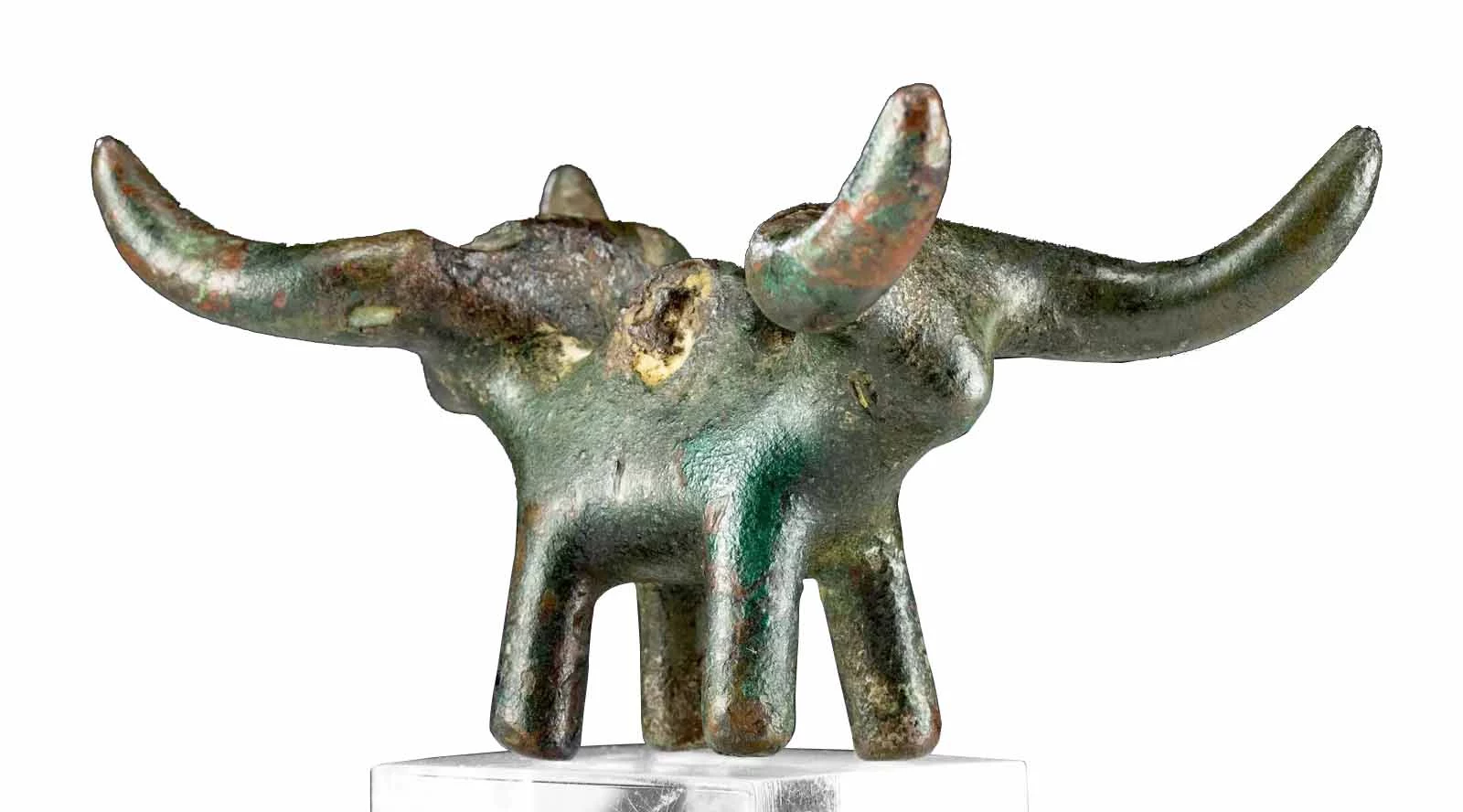
Rare / Published Greek Geometric Bronze Bull
**Originally Listed At $5000**
Italic or Greek, Geometric period, ca. 8th to 7th century BCE. An incredibly rare, double-headed, leaded bronze bull, finely cast via the lost wax (cire perdue) process. Notice a suspension loop, now filled with deposits; this suggests that this piece may have been used as a weight as well as a votive. Animals were very popular motifs in the Geometric period, and small bronze figures were given as votive offerings at temples, and bull figures were oftentimes given as offerings at the Temple of Zeus of Olympia. Size: 3.25″ W x 1.75″ H (8.3 cm x 4.4 cm)
Interestingly, a few centuries after this piece was created, the Apadana palace in Persepolis (ca. 520 to 465 BCE) featured column capitals with animals in the form of twin-headed bulls as well as eagles and lions. All of these animals symbolized power, virility, and by extension royal authority.
We look to the Geometric period (ca. 900 to 700 BCE) for the roots of Classical Greek civilization as well as the mythos that much of Western culture is built upon. This was when Homer composed the Iliad and the Odyssey, and when graves full of rich and rare metal objects alongside the monumental kraters that served as grave markers told the story of warriors riding into battle in chariots for heroic (or sometimes villainous) rulers. Beyond the world of warfare and kings, the common people engaged in a difficult agricultural cycle whose vagaries led people to worship with cults dedicated to gods. Artistic figures like this one show a strong command of form and shape, and the ability of artists at this time to create instantly recognizable representations with relatively minimalist forms. The existence of votive figures demonstrates that farmers placed their trust in and prayed to the gods for help.
An unusual large Chinese blue and white porcelain archaistic vase 倣古风格青花瓷瓶 Qianlong six-character seal mark 乾隆六字款
The body decorated with two stylized pairs of strong kuilong gripping stylized peony scrolls, all among elaborated scrollwork and lotus blossoms; the lower registers and neck decorated with archaistic scrollwork and stylized cicada lappets, composite border below the lip; underside with broad bi-shaped footring, centered by a Qianlong six-character seal mark.
LGB21832New Old Stock:
LGB21832New Old Stock in custom wood cabinetWhite Pass & Yukon 2-8-2 Mikado Limited edition Number 142 of 600.
LGB72700New Old Stock:
LGB72700New Old Stock in custom wood display cabinetLocomotive and two passenger cars in custom wood display cabinet with casters and plexiglas front with 51070 control and (12) 16000 curve track in hidden storage in base. Protective film still on plexiglass
LGB20821New Old Stock:
LGB20821New Old Stock in custom wood cabinetWestside Lumber Company # 12 Shay. Limited Edition Number 328/500
LGB20922New Old Stock:
LGB20922New Old Stock in custom wood cabinetNGG-13 Beyer-Garrett Locomotive Limited Edition Number 051
A Partial Card Of Division 1 Assorted Political Buttons:
9 S/M 19th century assorted political buttons.
This lot includes a scarce Rough & Ready button representing Zachary Taylor in 1848, a brass “Whig” party campaign button for 1834 showing a liberty cap, A Harrison campaign button for 1840 of a log cabin, a brass head of Abraham Linoln for his campaign of 1864, a fabric button for Grant, ‘an 1846 campaign button in black molded horn for Harrison and a couple of others. THis is a fantastic group so dont pass it up.
Issued: DIVISION 1=PRE 1918 AND DIVISION 3 IS AFTER 1918
Dimensions: SM=Less than 3/4″, Medium=3/4″ to 1 1/4″. Large=1 1/4″ and above, extra large=1 3/4″ and above
Condition
Unless otherwise noted we find no significant condition concerns except for normal age related wear for the age of these items.
One Of The Two Rarest 18th C. Buttons In The Auction:
1 RARE Large English Battersea enamel button from the 18th C
A set of these buttons can be found on Plate 288 in the BBB by Hughes and Lester. They are said to be from South Staffordshire although others have called them in the Battersea style. This incredibly rare enamel pictorial shows a Horse and Rider with several hunting dogs on a Fox hunt. The enamel is done in the monochromatic style and as the BBB says it is a transfer on enamel. The enamel is set in an 18th century metal mounting with a tin back. These are indeed very rare and certainly very desirable among collectors.
Issued: DIVISION 1=PRE 1918 AND DIVISION 3 IS AFTER 1918
Dimensions: SM=Less than 3/4″, Medium=3/4″ to 1 1/4″. Large=1 1/4″ and above, extra large=1 3/4″ and above
Condition
Unless otherwise noted we find no significant condition concerns except for normal age related wear for the age of these items.
1 Of The Two Rarest Buttons In The Auction An 18th C.:
1 Large extremely rare 18th century under glass figural button.
This 18th century button is incredible. I’m not sure how else to explain it. The figures under glass are hand crafted of plaster and bordered by an enameled reverse painted blue border with fine wire work overlaid under the glass. The background is a light sage green Mica which sets off the white plaster. Copper rim and tin back and a fabulous example of 18th century craftsmanship.
Issued: DIVISION 1=PRE 1918 AND DIVISION 3 IS AFTER 1918
Dimensions: SM=Less than 3/4″, Medium=3/4″ to 1 1/4″. Large=1 1/4″ and above, extra large=1 3/4″ and above
Condition
Unless otherwise noted we find no significant condition concerns except for normal age related wear for the age of these items.