A Sensory Landscape Painted by Josef Sima: The Milan Plain

Making its auction debut, The Milan Plain is a late oil by the Franco-Czech painter, whose mental landscapes, born of sensory experiences, hark back to the early days of Surrealism and Le Grand Jeu review.
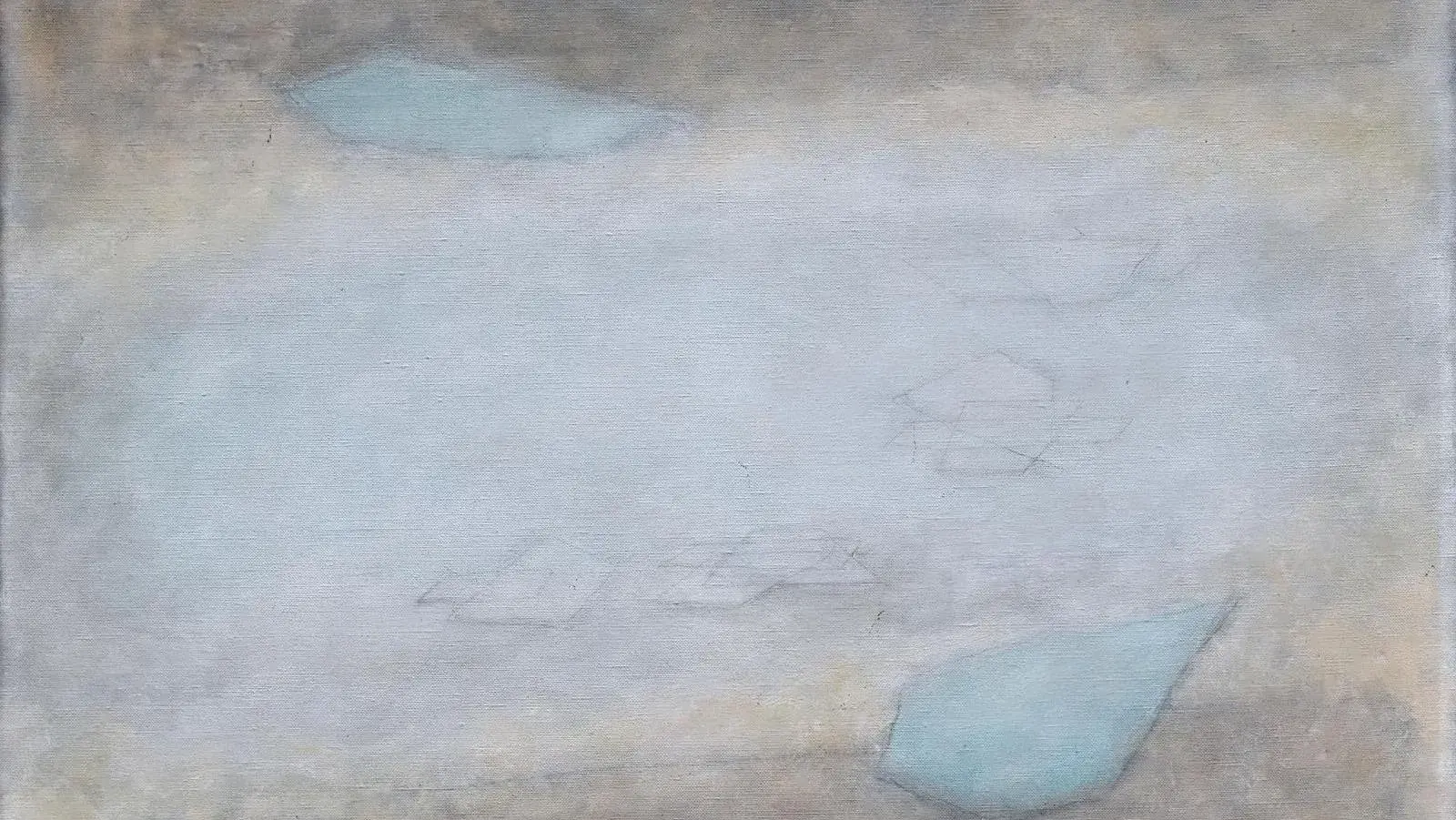
Joseph Sima (1891-1971), The Milan Plain, 1962, oil on canvas, 60 x 73 cm/23.6 x 28.7 in.
Estimate: €100,000/150,000
Joseph Sima (1891-1971), The Milan Plain, 1962, oil on canvas, 60 x 73 cm/23.6 x 28.7 in.
Estimate: €100,000/150,000

The canvas soon coming up for sale in Boulogne-Billancourt is a work from Sima’s last decade, a period when he was at his peak, marked by profound pictorial developments, with paintings composed of linear and geometric signs and transformed light-matter. Close to Surrealism in its early stages, Sima’s art evolved into imaginary landscapes, which between 1960 and 1965 explored variations of form in the same chromatic range, where light dissolved matter to reign alone on the surface. His work did away with all external references and no longer conveyed any message. The experience is solely poetic. Its expression was akin to Rothko‘s contemplative explorations: Sima’s paintings became mental landscapes, the result of an inner vision, where the contemplation of nature and the state of mind become one. When he arrived in Paris in 1921, the painter embraced the ideas of the review L’Esprit nouveau, directed by Le Corbusier and Amédée Ozenfant. Their purist aesthetic inspired him to simplify his forms, without moving into abstraction. In the 1920s, his landscapes began to shift towards somewhat muted shades and synthetic representations where light played an increasingly important role. In The Milan Plain, he reduced forms to their most elementary geometry, suggesting an immaterial representation of the earth. Jean-Louis Chantreau (1908-1991), a printer in Nantes, bought the oil painting from the Argos Gallery in Nantes on the advice of his brother-in-law Jean Le Guillou (1909-1985), a shrewd connoisseur and collector. It has remained in his family to this day, and has never before gone to auction. From 1950 onwards, Sima further developed the work on light he had begun in the 1920s. This 1962 work features floating horizontal formations and levitating cloud-like quadrilaterals.

“I think that for painters, lightning, fire and light are elements they must never lose.”

The painting could illustrate his experience of lightning during a storm on a summer’s night between 1924 and 1925, when he was staying with Pierre Jean Jouve in Carona, near Lugano. He referred to it again much later, in a letter dated September 10, 1959 to his friend, the artist Jií Kolár (1914-2002): “I think that for painters, lightning, fire and light are elements they must never lose. […] the subject of my painting is light and the unity of all things. And the unity of all things is the unity of matter, of which light is the most subtle expression—light not as a mysterious fluid illuminating objects, but as a force constituting the existence of objects.” The central part of The Milan Plain could be this lightning, this white with its shifting, thick, translucent duality, which strikes when you least expect it. Sima never engaged in a spiritual quest for light, but in the sensory experiences lying at the root of all his work. Abandoning dark colors, he used lighter shades of ocher and sky blue, which enabled him to reveal the essence of light as a transcendental journey. After the war, he returned to the philosophy of Le Grand Jeu which held that 20 centuries of rationalism and science had killed innocence. He then turned his attention to the unconscious, archetypes, myths, Eastern philosophy and pre-Socratic ideas.

Sima’s Interpretation of Magic Realism
Sima came to a new understanding of the phenomenon of light, distancing himself from any reference to external concerns in a monistic conception of the world. Seeking new directions in his work, he materialized light, making it solid and crystalline: “I saw light as matter, and this confirmed my early intuitions. At first I painted landscapes lit up by this electrical storm, then, much later, light itself became the substance of my paintings.” Sima was one of the few Czech painters whose work significantly contributed to the history of art outside their own country. Born in 1891 in Jaromer, 100 km north of Prague, he was raised by a father who taught drawing and was highly involved in local cultural life. Josef spent a year at the capital’s Academy of Fine Arts. Here he was profoundly influenced by his teacher, Jan Preisler (1872-1918), founder in 1896 of the review Volné smëry (“Free Directions”), who was fascinated by Gauguin, and close to Mucha and the Symbolists. Sima played an active role in the Prague art scene, mingling with the avant-gardes and helping to found the Devtsil group on October 5, 1920, which among other things took up the magic realism theories of German art critic Franz Roh (1890-1965). The artist’s work during the interwar period provides a glimpse into his creative process. He processed the sensory perceptions arising from his poetic imagery and reflection, moving indefatigably from descriptive drawing to the purification of form. He transformed his inner world, childhood memories, dreams and experiences into a unique language at the meeting point of Surrealism and poetry. He succeeded in making the suprasensible world visible through the four guiding principles of symbolism, dissolution, geometrization and light. Light, identified as an absolute principle, became the sine qua non for any expression of the suprasensible.

ANTIQUE AND MODERN PAINTINGS, FURNITURE, ASIAN AND EUROPEAN OBJETS D’ART

Thursday 19 December 2024 – 14:00 (CET) – Live

23 bis, rue des Longs-Prés – 92100 Boulogne-Billancourt

Jonquet

Info and sales conditions

Catalogue

Pop Culture-Inspired Art to Sell at Robinhood Auctions

Iconography from American pop culture has long inspired visual artists, from the brands and celebrities that adorned Andy Warhol’s screenprints to the references that characterize contemporary street art. The upcoming Contemporary Horizons sale at Robinhood Auctions will showcase a selection of artworks that embrace pop culture. The sale will begin on December 19, 2024. Check out some of the top lots before the bidding begins. 

Invader, Invaded Cube (NVDR1-1). Image courtesy of Robinhood Auctions.
Invader, Invaded Cube (NVDR1-1). Image courtesy of Robinhood Auctions. 

Invader Cube

French street artist Invader is known for his pixelated artworks that reference pop culture from the 1970s and 80s. An urban artist who moves comfortably between mediums, Invader creates mosaics on city walls in addition to wall hangings and video art. His work references video games such as Space Invaders, Pac-Man, and others. American cartoons such as Hong Kong Phooey and Popeye also make appearances in Invader’s public art. The artist has notably engaged with Rubik’s Cubes as well, riffing on the colors and structure of the iconic puzzle toy that was popularized in the United States and internationally during the 1980s. 

One such Rubik’s Cube-inspired artwork by Invader will be offered in this upcoming sale from Robinhood Auctions (lot #355; estimate: USD 6,400 – $8,000). Measuring 40 inches square, this wall hanging is composed of Diasec-mounted Giclee on an aluminum composite panel. Depicting a three-by-three grid of colored squares, the piece is anchored by Invader’s logo in the center box. 

Kenny Scharf, Kalorzi, limited edition silkscreen. Image courtesy of Robinhood Auctions.
Kenny Scharf, Kalorzi, limited edition silkscreen. Image courtesy of Robinhood Auctions. 

Kenny Scharf Silkscreen 

Other works inspired by American pop culture include Kenny Scharf’s Kalorzi, a 2020 screenprint that is numbered and hand-signed by the artist (lot #852; estimate: $5,556 – $6,945). This limited edition piece depicts a grinning, rainbow-colored smiley face, complete with sparkling teeth and three bulging eyes. 

An American artist, Kenny Scharf began his career in the 1980s. He painted alongside Keith Haring (with whom he shared an apartment) and Jean-Michel Basquiat in New York’s East Village, creating graffiti rooted in satirical commercialism. Cartoons are referenced often in his work, as well as a unique cast of characters imagined by Scharf himself. He describes his art as “Pop Surrealism,” a nod to its roots and otherworldly charm. The offered screenprint appears to reference the smiley face ideogram. Scharf elaborates on the classic image by adding the garish, toothy smile and extra eye.

Craig Alan, Populus: How About a Magic Trick, giclee on canvas. Image courtesy of Robinhood Auctions.
Craig Alan, Populus: How About a Magic Trick, giclee on canvas. Image courtesy of Robinhood Auctions. 

Craig Alan Painting 

Other aspects of American pop culture that have filtered into the fine art world include comic books. Both the style and characters from this classic medium have entered the popular lexicon. While some artists continue to create new comic books and superheroes, others embrace the existing canon by leaning into nostalgia or offering a fresh perspective.  

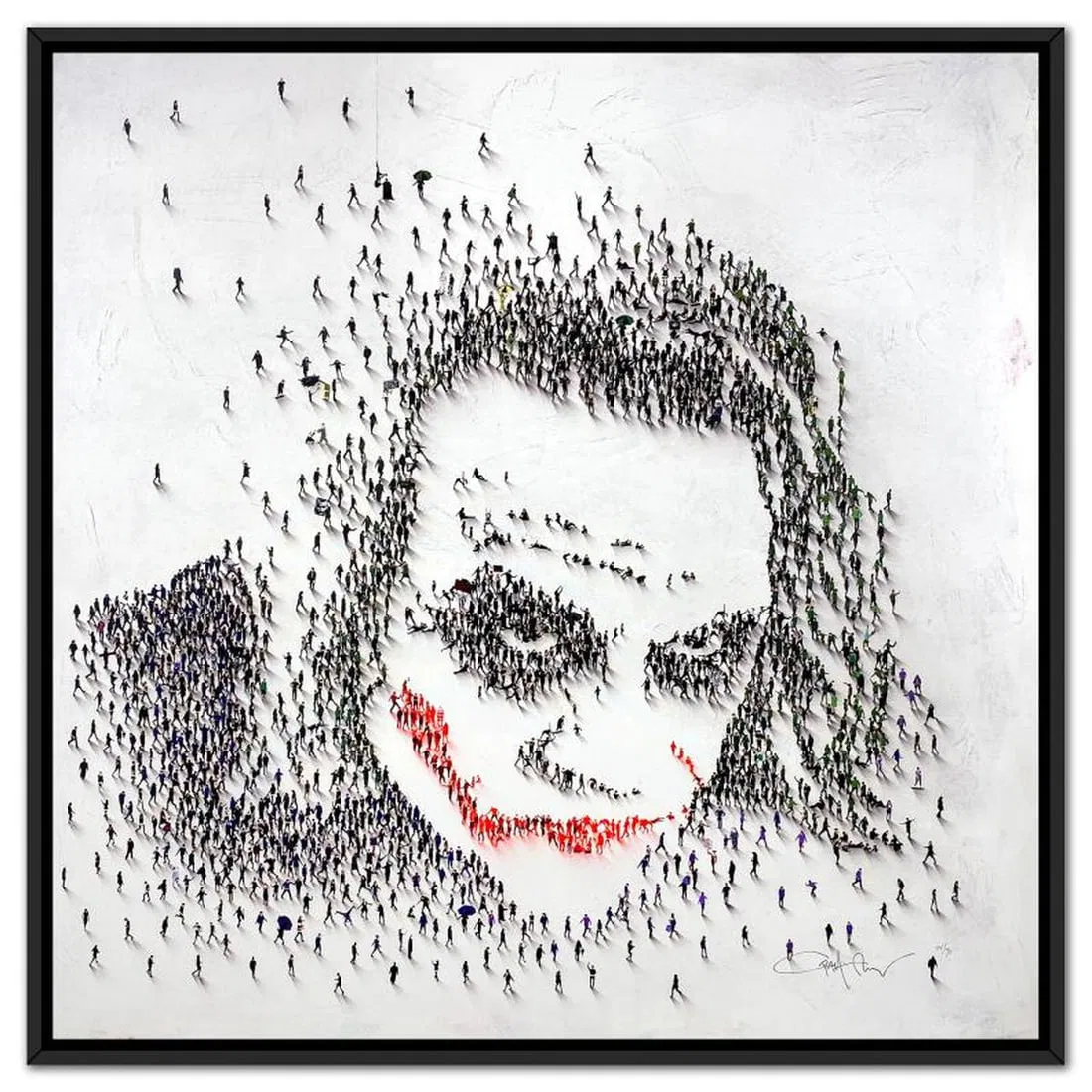
Contemporary artist Craig Alan is among those who have worked in this genre. He is best known for his Populus series, which views groups of human figures from the air as they form an image. The style winks at Pointillism, with its emphasis on acknowledging the whole picture rather than individual marks (or people). Pieces from this series have recreated works by Robert Indiana and Roy Lichtenstein, as well as real celebrities and fictional comic book characters. Belonging to the latter group is Alan’s Populus: How About a Magic Trick, a framed Giclee on canvas signed by the artist (lot #772; estimate: $4,176 – $5,220). Using Alan’s signature aerial technique, the piece depicts Heath Ledger as the Joker in the 2008 film The Dark Knight. Outlined in black, the character’s mouth is a slash of red. 

Each of these items will be available in Robinhood Auctions’ Contemporary Horizons sale. Bidding will begin at 1:00 PM EST on December 19, 2024. To browse the complete catalog and register to bid, visit Bidsquare

Find more auction world news and sale previews on Auction Daily

Milestone’s Jan. 4 auction of Dr. Jim Reynolds’ Buddy ‘L’ collection features samples, prototypes from storied toy factory ‘morgue’

450-lot auction lineup features one of the most complete assemblages of early Buddy ‘L’ trucks ever to come to market, led by one-off Insurance Patrol truck sample and extremely rare Red Baby trucks

Buddy L Prototype Insurance Patrol W/ Box

WILLOUGHBY, Ohio – On Saturday, January 4, 2025, Milestone Auctions in suburban Cleveland will offer collectors the opportunity to bid on treasures from the renowned pressed-steel toy collection of the late Dr James R Reynolds (1943-2020). An esteemed heart surgeon, hobby farmer, philanthropist and South Dakota Hall of Fame inductee, Dr Reynolds lived life to the fullest, with a long and varied list of interests that included hunting, fishing, sailing, NASCAR, spending time in the field with his dogs, and traveling the world. But a visit to his spacious country home left no doubt as to which hobby consumed the majority of his free time. He loved acquiring and displaying vintage pressed-steel toys, especially Buddy ‘L’s, and had an extensive network of dealers and fellow collectors from whom he purchased rare, immaculate examples. 

The decades Dr Reynolds spent in pursuit of toys took him to groundbreaking toy shows and auctions during the late 1980s and ‘90s, and later, to the most famous of all pressed-steel specialty events: the March 2001 Buddy ‘L’ Morgue Auction of factory prototypes and samples. Dr Reynolds’ prized purchases from that sale and many other sources are included in the 450 lots to be sold on January 4. 

The Reynolds trove is anchored by one of the most complete assemblages of early Buddy ‘L’ trucks ever to come to market, including doored trucks, Buddy ‘L’ Jrs, flivvers, ride-on trucks, and wood prototypes that the famed Illinois toymaker produced during the World War II era when metal was scarce. 

Leading the selection is the only known example of a Buddy ‘L’ Insurance Patrol fitted with headlights and a bumper, complete with factory prototype tag reading 205C 1928 9LBS. All original with its original pullcord and NM paint and decals, this model never saw production. The 27-inch-long truck comes with its original box and distinctive Buddy ‘L’ blue-and-white striped wrapping paper. It was the top-selling toy at the March 9-11, 2001 Buddy ‘L’ Morgue auction, which exclusively featured the collection of former Buddy ‘L’ owner/president Richard Keats (1927-2024). At that event, Dr Reynolds paid $40,700 to take home the now-legendary one-off toy. Its estimate in the January 4 auction is $10,000-$20,000.

Another coveted ‘Morgue’ toy is an outstanding all-original 1938 Buddy ‘L’ International Shell Truck with its original pull handle and factory box. It is one of the very best examples known and will be offered with a $3,000-$5,000 estimate.

A rare version of a Buddy ‘L’ Red Baby truck has a round floor decal and Buddy ‘L’ decal on its radiator, but no International Harvester decals. This point is significant because it confirms the auction example to be one of the earliest Red Baby trucks, produced before such toys were retailed at International Harvester dealerships with added IH-logo decals. Measuring 24 inches long, this hefty production could command a winning bid of $4,000-$6,000. 

The collection also contains the only known original Buddy ‘L’ Open Cab Red Baby. With very nice original paint and displaying correct International Harvester McCormick Deering decals, its extreme rarity is confirmed by Milestone’s cast iron experts who say it is the only toy of its type that they have seen in 40 years of active involvement in their area of specialty. Graded Excellent, it is estimated at $4,000-$6,000.

A rare Buddy ‘L’ Baggage Truck with opening doors, dual rubber tires, headlights and bumper sports attractive paint and decals. Measuring 27 inches in length, it was part of the Harold Williams collection prior to acquisition by Dr Reynolds. Estimate: $3,000-$4,000. Very hard to find in any condition, a 26-inch-long Buddy ‘L’ Tank Line Street Sprinkler Truck with rubber tires, headlights and bumper still has its original pumper mechanism. In Excellent condition, it will cross the auction block with a $2,500-$3,500 estimate.

A wonderful all-original Buddy ‘L’ International Sit-N-Ride Stake Truck with NM paint and decals retains its original pull handle and seat, and is accompanied by its original box. More than 2ft long, this desirable toy was purchased by Dr Reynolds at the Buddy ‘L’ Morgue auction. Estimate: $1,500-$2,500

Likely to be a bidder favorite on auction day, an all-original 23-inch-long wood Buddy ‘L’ #484 “Big Show Circus Wagon with Animals” shows off bright colors and has all of its original animal figures. It is emblazoned The Big Top on Wheels on its sides, is in excellent condition and comes with its original box. Estimate: $1,000-$2,000

Three more toys in all-original condition are worthy of special note: an exceptionally fine 28-inch American National Packard Fire Chief Car with its original convertible top, outstanding paint and decals, $4,000-$5,000; a scarce and super-clean 26-inch Kelmet “Big Boy” Tank Truck with excellent paint and decals, $1,500-$2,000; and a seldom-encountered 26-inch Sturditoy US Mail Truck, also with excellent paint and decals, and with both back doors intact, estimate: $1,500-$2,500.

A special highlight within the is the 481-lot offering is a subcollection of 40-50 large-scale sculptural vehicles created by Brian Cowdery of Cowdery Toy Works, Hot Springs, Arkansas. Very highly regarded by toy collectors, Cowdery’s pricey pressed-steel designs were initially offered in limited editions and are no longer in production. One of Dr Reynolds’ favorites, a Flivver House Car (1920s-‘30s terminology for “motorhome”), was a one-of-a-kind special-commission piece and is marked Prototype Reynolds. The boat affixed to the House Car’s roof is custom-marked Sioux Falls, South Dakota, reflecting Reynolds’ city of residence. Near-mint and 23 inches long, it is estimated at $1,000-$2,000.

The auction of the Dr. James R. Reynolds collection of pressed-steel toys with prototypes and samples from the Buddy ‘L’ factory morgue will be held at Milestone’s gallery located at 38198 Willoughby Pkwy., Willoughby, OH 44094. Start time: 10am ET. Ample free parking. In addition to live bidding at the gallery, Milestone welcomes all other forms of remote bidding: absentee, phone or live online through Milestone Live, LiveAuctioneers or Invaluable. Worldwide shipping available. For additional information about any toy in the auction, to reserve a phone line for bidding, or to discuss consigning to a future Milestone auction, call Miles King at 440-527-8060 or email [email protected]. Online: www.milestoneauctions.com

Apollo’s Dec. 15 Fine Ancient Art & Antiquities Auction delivers holiday selection of extraordinary treasures dating as early as the 50th century BC

Many prized artifacts have provenance from acclaimed collections of Alison Barker, Nahum Goldmann, Shlomo Moussaieff, Dr Guido Goldman, W. Benson Harer, Drexel Institute, and others

Egyptian Wooden Boat Model

LONDON – Apollo Art Auctions takes utmost pleasure in announcing highlights of their December 15 Fine Ancient Art & Antiquities live gallery auction, which will start at 3pm GMT/10am US Eastern time, following a red-carpet morning session devoted exclusively to The Prince Collection. The afternoon event offers collectors a stellar selection of Ancient Egyptian, Roman, Greek, Viking, Medieval, Western Asiatic and other top-tier antiquities dating from the 50th century BC to 15th century AD. Absentee and Internet live bidding will be available to remote participants through Apollo Live or LiveAuctioneers.

Peerless provenance is the rule and not the exception throughout the 405 lots expertly curated for this sale. Many of the prized artifacts were formerly in such internationally acclaimed collections as those of London barrister Alison Barker (1951-2021), Mrs B Ellison, W Benson Harer, Drexel Institute, the Minneapolis Institute of Art, Nahum Goldmann (1894-1982), Shlomo Moussaieff (1923-2015), and Dr Guido Goldman (1937-2020). 

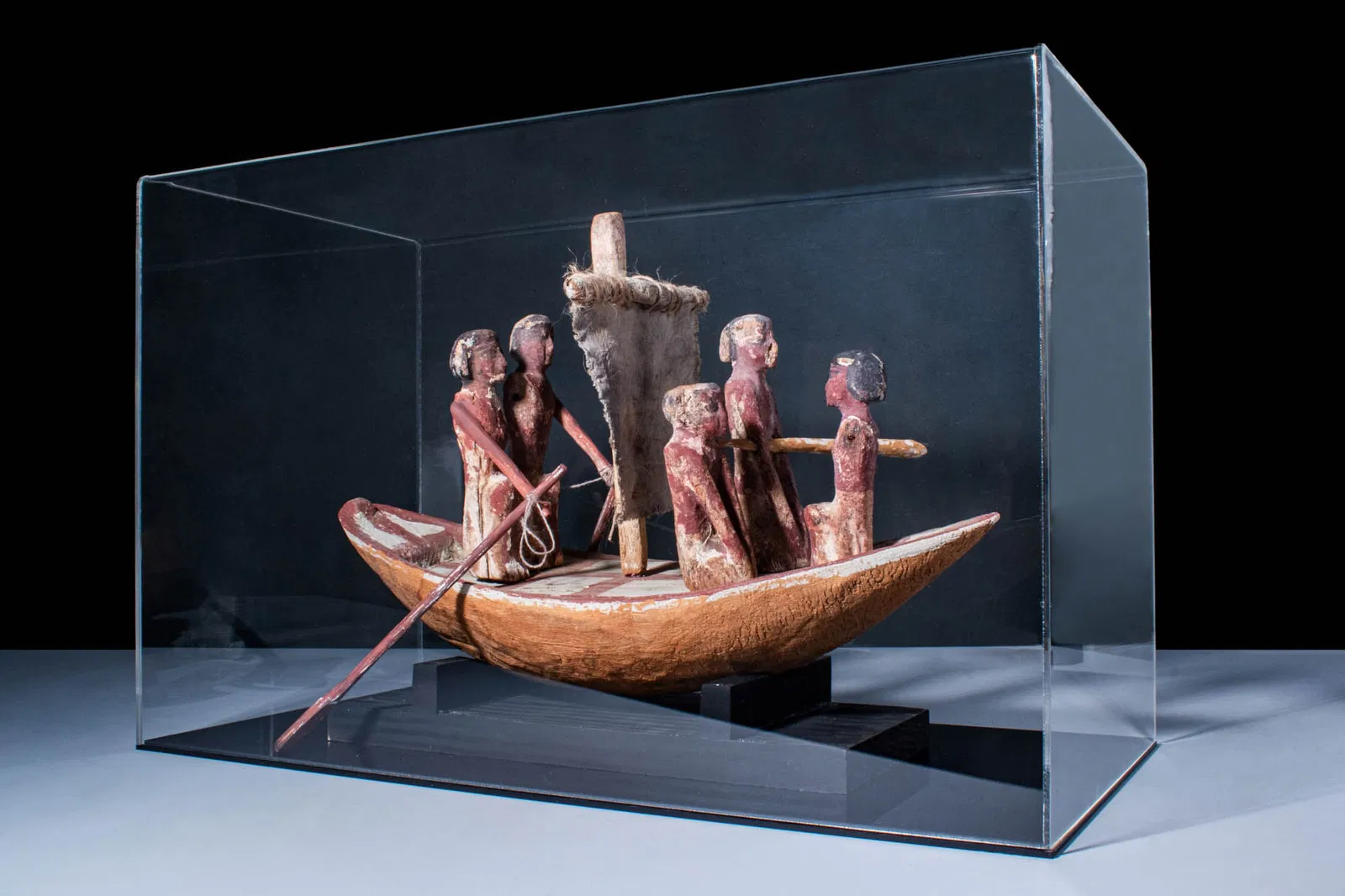
A fabulous assemblage of Ancient Egyptian art and relics will launch the sale, and in the case of Lot 2, in quite a literal sense, as it is an iconic and well-preserved Egyptian boat model. Dating to the Middle Kingdom period, circa 2055-1790 BC, it was meticulously carved from sycamore wood and symbolizes the journey of a deceased person’s soul into the Afterlife. It is a realistic depiction of a marine craft, with details faithful to those of a real boat of its period, including rowers, a helmsman, oars, sails and original painted decorations. The piece has been reviewed by Simone Musso, consultant curator for Egyptian antiquities at the Stibbert Museum, Florence, Italy, and member of the Nuri Archaeological Expedition. Measuring 370mm x 200mm/15.6in x 8in, its previous ownership was with a London art gallery and, before that, a French collection where it had resided since the 1970s. Its opening bid at auction is £5,000/$6,370.

An outstanding example of Ancient Greek pottery, a circa 510-500 BC Attic red-figure kylix is a possible Pioneer Group production. Its lines are elegantly simple, with matching handles and a primarily black colorway to draw attention to the compelling central red figure of a nude ithyphallic satyr. Its size is 375mm x 295mm/14.6in x 11.61in and its weight is 1.16kg/2lbs 9oz. An impressive line of provenance starts with a London art gallery, which acquired the kylix on the German art market. Its previous owner in Germany acquired it in 2002, and before that, it appeared in a 1983 Sotheby’s Antiquities auction in London. It also published in Galerie Günter Puhze, Freiburg im Breisgau Catalogue Art of Antiquity, Number 26 in 2012; and was listed in the Beazley Archive Pottery Database 8647. This lot will convey with a historical report from Alessandro Neri, an international cultural heritage expert based in Florence, Italy. Opening bid: £3,000/$3,820

Today’s glass artisans sometimes look to the Ancient Romans for inspiration, but it would take exceptional skill to replicate a circa 300-500 AD (late Roman period) polychrome glass rhyton, or ceremonial drinking horn. Displaying aqua blue-green hues and embellished with an applied yellow zig-zag pattern – possibly coming from Western workshops – this piece is similar to examples in the MET Museum and British Museum collections. Most recently it was part of a London private collection, with prior acquisition on the European art market pre-2000. The rhyton will pass to its new owner with a historical report from Alessandro Neri. Opening bid: £10,000/$12,740

It is the gift-giving season, and as we all know, good things come in small packages. Imagine the delight that would come from opening a wee but beautifully-wrapped box and finding an ancient gold ring inside. Many wonderful options to fit that scenario may be found in the Saturday afternoon sale, both for men and women. For example, there’s a circa 450-300 BC Greek gold ring whose oval bezel is engraved with the scene of a griffon with outstretched wings, hunting a running horse with a long mane and slender body. This ring is similar to an example seen in Bagot’s El legado de Hefesto: A Memorial to a Private Collection of Ancient Rings and Glyptics. Weighing 8.19 grams, the ring’s provenance includes a private UK collection and prior acquisition in the 1990s on the German art market, Munich. It is accompanied by an authentication report by ancient jewellery specialist Sami Fortune and will open for bidding at £3,000/$3,820.

A mythological theme is also seen in a circa 100-300 AC Roman gold ring whose round bezel secures a carnelian intaglio carved with winged centaurus. Weighing 22.51 grams, this ring is a statement piece with provenance from a UK private collection and an old British collection formed in the 1990s. Opening bid: £2,000/$2,550

Paramount provenance backs a circa AD 900-1200 AD Byzantine gold finger ring that was once in the celebrated collection of London barrister Alison Barker. Displaying an unusual design, the ring to be auctioned has a D-section round hoop adorned on the shoulders with two heads of lions connected to a round bezel and depicting a haloed saint holding a processional cross in a frontal position. Ms Barker acquired the 5.55-gram treasure sometime between the early 1960s and 1990s. Subsequently, it became the property of a European collector. Opening bid: £2,200/$2,805

The medieval period’s association with chivalry and courtly love may have been exaggerated over the centuries that followed, but there’s no denying the romance of one particular English “posy” ring entered in Apollo’s Sunday auction. A circa-1600 AD creation, the slender gold band is inscribed on its inner surface with a short, poetic line, hency the name “posy.” The interior inscription, Vertu – haffeth – riches, is in a handwritten script and was meant to be hidden against the wearer’s skin, adding an intimate and personal touch. A similar ring is held in the collection of the British Museum, while the auction example was formerly in a London private collection. Prior to that, it was acquired on the UK art market, sometime in the 1970s. Opening bid: £1,000/$1,275

Apollo Art Auctions’ Sunday afternoon, December 15, 2024 Fine Ancient Art & Antiquities Auction will be a live gallery event with online bidding also available through Apollo Live or LiveAuctioneers. Start time: 3pm GMT/10am US Eastern Time. Goods may be previewed at the gallery by appointment only, now through December 13, from 10am-5pm daily. Address: 63-64 Margaret Street, London W1W 8SW. Apollo accepts payments in GBP, USD and EUR; and ships worldwide. No import charges are assessed on most antiquities sent to the United States. All packing is handled in-house by white-gloved specialists who are skilled at preparing precious goods for shipment. Questions: Please call +44 7424 994167 or email [email protected]. Visit Apollo Art Auctions online at www.apolloauctions.com 

For the Discerning Collector on Your Holiday List, Asian Art Treasures Abound from the Galleries of Asia Week New York

Shoun (1870 - 1965)
Snow Peony, 1906
Woodblock Print
15.25 x 10.25 in (38.74 x 26.04 cm)
Credit: The Art of Japan
Shoun (1870 – 1965)
Snow Peony, 1906
Woodblock Print
15.25 x 10.25 in (38.74 x 26.04 cm)
Credit: The Art of Japan

New York: As the holiday season approaches, finding the perfect gift becomes a pursuit of meaning and beauty. For those seeking to offer more than just an object—something with cultural resonance, historical significance, and artistic excellence—Asia Week New York presents an inspiring selection of treasures for the discerning eye. From Japanese woodblock prints to intricate bamboo baskets to centuries-old ceramic vessels, the participating galleries of Asia Week New York are an excellent resource for Asian art that transcends time and geography. With prices ranging from $380 to $5,000, these artworks represent thoughtful and sophisticated choices for holiday giving.

China and Vietnam

From Alisan Fine Arts, contemporary art lovers will appreciate Recluse Studio No. 33 by Kelly Wang (b. 1992). This evocative work, created in 2021, combines ink, xuan paper, pigment, and resin on aluminum. At $2,000 it makes for a striking, modern addition to any collection.

At Fu Qiumeng Fine Art, The Gift by Zhang Xiaoli offers a thoughtful and affordable option. This signed and numbered digital print on is part of an edition of 99. Priced at $500, it is an elegant yet accessible piece perfect for new and seasoned collectors alike.

At Kaikodo LLC, collectors will appreciate a Bronze Incense Burner in the form of “Du Fu Riding a Donkey.” Dating to the Ming-Qing dynasty (16th–17th century), this rare and whimsical piece is priced at $5,000 and offers a glimpse into the charm and sophistication of Chinese bronze artistry.

To the Western eye, Chinese robes and dress, down to their shoes were an exotic curiosity- particularly women’s bound feet.  Small decorative objects like this pair of His and Her Chinese Sancai Glazed Porcelain Shoes, at Ralph. M. Chait Galleries, Inc. have become collectible curios in the West, appreciated for their fineness of manufacture and fascination for all things porcelain. $4,800.

A true gem awaits at Zetterquist Galleries. This 15th-16th century Vietnamese Eggplant Jar from the Le-So Dynasties, (under $5,000) showcases the delicate craftsmanship and rich cultural history of early Vietnamese ceramics. Eric Zetterquist notes, “This jar is a perfect blend of form and function, a timeless object that speaks to a refined appreciation for Asian ceramics.”

Japan and Korea

For those captivated by the beauty of traditional Japanese prints, The Art of Japan offers Snow Peony by Shoun (1870–1965). Created in 1906, this exquisite woodblock print is available for $3,600. Its delicate rendering of the snow peony speaks to a timeless appreciation for the natural world in Japanese art.

Dai Ichi Arts, Ltd. features No. 15 “Calyx” sake cup by Shingu Sayaka (b. 1979), a 2024 creation made from mixed clay with glaze slip. Accompanied by a signed wood box, this elegant cup is listed at $380, making it a delightful gift for lovers of both fine art and functional design.

A charming, glazed stoneware Zodiac sculpture of a Monkey (Saru), priced under $5,000, is available for purchase at Joan B Mirviss LTD.

Senshudo, a stunning urushi lacquer and gold charger plate with a beautiful Chrysanthemum motif–from the Wajima Lacquer Company–is $3,000 at the

Onishi Gallery.

From Scholten Japanese Art comes Winter Vista, by Ansei Uchima (1921-2000). Priced at $2,600, this is an original print, which the artist himself drew, carved and printed himself (as opposed to the publisher method of production whereby the artist would make the design and have others carve and print the blocks). Called sosaku-hanga, it’s a specific and more modern style in Japanese art.

Nature enthusiasts will be drawn to Cocoon, a striking Nemagari bamboo and rattan basket by Honma Hideaki, available at Tai Modern for $2,500. The artist’s ability to transform humble materials into a stunning work of art reflects the elegance and innovation inherent in Japanese bamboo artistry.

For animal lovers, the Meiji period bronze “Puppy” by Tsunemitsu, at Hiroshi Yanagi Oriental Art, is a heartwarming option. Priced at $2,500, this charming sculpture captures the playful spirit of a young pup, making it an ideal gift for someone who treasures both art and animals

HK Art & Antiques LLC presents Mountain by the Korean artist Cho Yong-ik, a serene and evocative watercolor on paper. Offered at $3,000, this artwork captures the beauty of nature in an understated yet deeply expressive manner.

India

Typically made from cotton or silk, carpet weights were used on a terrace or veranda to hold light-weight summer carpets in place at the corners in case there was a breeze.  Priced at $2,500, this  Carlton Rochell Asian Art  .

These treasures—and many more—await discovery across Asia Week New York’s participating galleries. Each piece tells a story, offering not just a gift but a connection to the rich heritage and artistic traditions of Asia. For more information  visit www.asiaweekny.com.

About Asia Week New York 

Asia Week New York is a nine-day celebration, bringing together top-tier international Asian art galleries, the seven major auction houses, and numerous museums and Asian cultural institutions. It features simultaneous gallery open houses, Asian art auctions, museum exhibitions, lectures, and special events. Participants from Great Britain, Japan and the United States unveil an extraordinary array of museum-quality treasures from China, India, the Himalayas, Southeast Asia, Tibet, Nepal, Japan, and Korea. Asia Week New York Association, Inc. is a 501(c)(6) non-profit trade membership organization registered with the state of New York. 

About Songtsam, Presenting Sponsor

Songtsam (“Paradise”) is an award-winning luxury collection of seventeen hotels, resorts, and tours located in Tibet and Yunnan Provinces, China. Founded in 2000 by Mr. Baima Duoji, a former Tibetan documentary filmmaker, Songtsam is the only collection of luxury Tibetan-style retreats within the wellness space focusing on the concept of Tibetan meditation by combining physical and spiritual healing together. The unique and sustainable properties offer guests authenticity, within the context of refined design, modern amenities, and unobtrusive service in places of untouched natural beauty and cultural interest. One of the Songtsam Properties is a Virtuoso Preferred Partner and four of the Songtsam Properties are Serandipians Hotel Partners. Songstam welcomes all travelers including families with children, travelers with disabilities and is LGBTQ+ friendly.

Morphy’s unveils elegant holiday selection for Dec. 17-19 Fine & Decorative Arts Auction

Featured: 195 art-glass lamps, including very rare Tiffany ‘Venetian’ with Macklowe Gallery provenance; platinum & diamond jewelry, gold watches, art pottery & glass, Black Forest clock

Rare Tiffany Studios Venetian Leaded Glass Table Lamp

DENVER, Pa. – Morphy’s most-loved sale from its always-busy calendar of events, the annual pre-Christmas Fine & Decorative Arts Auction, consistently delivers luxury, rarity and peerless quality to discerning collectors and holiday gift-givers. This year’s edition, which will be held on December 17-19, is brimming with superior jewels and watches, art pottery, silver, coins and dazzling Tiffany Studios lamps. 

“In our Fine & Decorative sales, we always make an extra effort to include lamps that are genuinely exceptional,” said Dan Morphy, founder and president of Morphy Auctions. “In the December sale, there are more than 40 Tiffany productions, as well as designs by Handel, Duffner & Kimberley, Pairpoint, Wilkinson and many other sought-after brands.”

No one has ever understood how to fuse color and light quite like Louis Comfort Tiffany, and today, more than 140 years after the introduction of his first Tiffany Studios lamp, collectors remain mesmerized by his designs. Unquestionably, one of the most desirable Tiffany masterworks is the “Venetian” lamp, an example of which will be auctioned on December 18. 

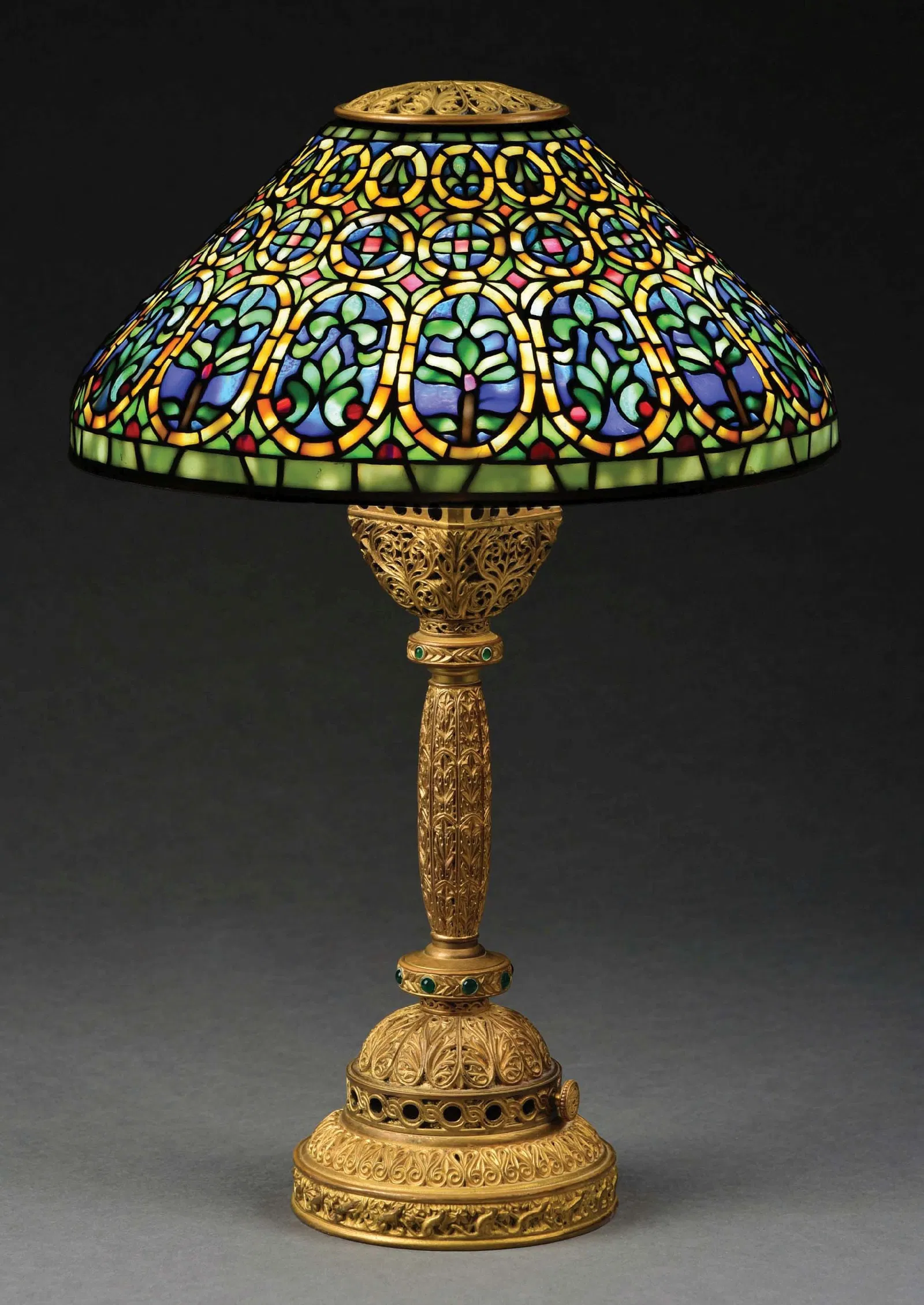
A rare and extraordinarily beautiful Venetian table lamp is diminutive (19 inches tall) by comparison to other Tiffany lighting, yet it was one of the New York firm’s most expensive lamps in the early 20th century. This was due to the time and painstaking effort it took to create the breathtaking Venetian pattern from a profusion of small, very delicate pieces of glass. Both the shade, which retains its attractive original gold “heat cap,” and its correct filigreed and jeweled “gold” base are signed. The lamp is in excellent condition, and its provenance includes a 2003 purchase from the famed Macklowe Gallery. Estimate: $60,000-$80,000

At Morphy’s pre-Christmas auction, good things have always come in small packages. This year’s ultimate stocking stuffer is a ladies’ platinum and diamond line necklace consisting of 66 natural, near-colorless emerald-cut diamonds with a total weight of 21.50cts. The gems are graded H color, VS clarity, and the gross weight of the 16-inch necklace is 56.0 grams. The piece I marked MIR-PLT under the clasp on the safety lock. New and in unworn condition, it is estimated at $25,000-$40,000.

Another jewelry highlight that won’t go unnoticed is an 18K gold Rolex Daytona Ref 116528 wristwatch. Made in Switzerland circa 2011-2013, it has a white MOP dial with diamonds. Accompanied by its original Rolex box and papers, it is offered with an $18,000-$28,000 estimate.

A Reed & Barton (American) 7-piece tea and coffee service retailed by Cartier is the embodiment of gracious living. Comprised of a water kettle on stand, coffee pot, teapot, cream jug, covered sugar bowl, and waste bowl, the set has a distinctive design. Each component has an octagonal baluster body, with a matching handled tray. The approximate total weight is 288ozt, and the lot carries an estimate of $10,000-$25,000.

Highland Park, Michigan, was a village of barely 4,000 residents in 1910, but with the rise of the automobile industry and establishment of Chrysler Corporation locally, the Detroit suburb’s population grew tenfold in less than two decades. Along with that growth came many lovely mansions with attractive exterior appointments, like the pair of massive bronze exterior lanterns entered in Morphy’s December sale. Each measuring 6ft high with an unusual fantasy motif, these fixtures would have made quite an architectural statement in their day, as they would now. In excellent condition, they will cross the auction block with a $10,000-$30,000 estimate.

European highlights include a monumental circa-1925 Hans Winterhalder (Neustadt, Germany) Black Forest two-panel tall-case clock masterfully carved with three bears and grape vines. The interior of the 78½-inch-tall clock is fitted with mirrors, with the movement striking on eight rods. In excellent condition, this impressive timekeeper is estimated at $10,000-$30,000.

The best of Continental artistry is seen in a monumental Villeroy & Boch “Mettlach” jardiniere created circa 1885. Etched and glazed in relief, the stoneware vessel is adorned with handles formed as two nymphs. One side of the jardiniere depicts a former 10th-century Benedictine Abbey in Mettlach, while the other side displays a Saar River scene. It is sized 12 inches by 12 inches by 16 inches and is impressed Villeroy & Boch, Patent, and Mettlach, along with the numbers 1128 and 8. It is like an example held in the collection of the American Museum of Ceramic Art. Estimate: $6,000-$8,000

Morphy’s December 17-19, 2024 Fine & Decorative Arts Auction will be held at the company’s Denver, Pennsylvania gallery, starting each day at 9 a.m. Eastern Time. All forms of bidding will be available, including live via the Internet through Morphy Live. For questions about any item in the auction, please call 877-968-8880 or email [email protected]. Online: www.morphyauctions.com.

Royal provenance crowns Apollo Art Auctions’ Dec. 15 Fine Ancient Art & Jewellery Auction exclusively featuring The Prince Collection

Egyptian treasures include rare granite head of pharaoh, large vessel with painted image of Nile scene; Amarna Period sandstone relief of pharoah worshipping the god Aton; Greek & Roman jewellery

Rare Egyptian Granite Head Of Pharaoh

LONDON – On Sunday morning, December 15, 2024, Apollo Art Auctions will roll out the red carpet for a very special Fine Ancient Art & Jewellery Auction exclusively featuring The Prince Collection, one of the largest royal-provenance collections ever presented by the Central London firm. The 280-lot selection includes breathtaking antiquities of Egyptian, Phoenician, Greek, Roman, Byzantine and Asian origin, with a timeline that spans the 40th century BC to 16th century AD. The live gallery auction, with absentee and Internet live bidding available through Apollo Live or LiveAuctioneers, will begin at 10:30am GMT (5:30am US Eastern Time).

Prior to acquisition for The Prince Collection, many of the premier holdings were the property of esteemed collectors and institutions, including Jean-Paul Barbier Mueller (1930-2016), Robert Hatfield Ellsworth (1929-2014), Edith Bader Koller, W Arnold Meijer, Kurt Flimm, A Obrecht, Jacques H Carre, Jean-Marie Talleux (1930-1995), the Khawam brothers, and the Thalassic Collection.

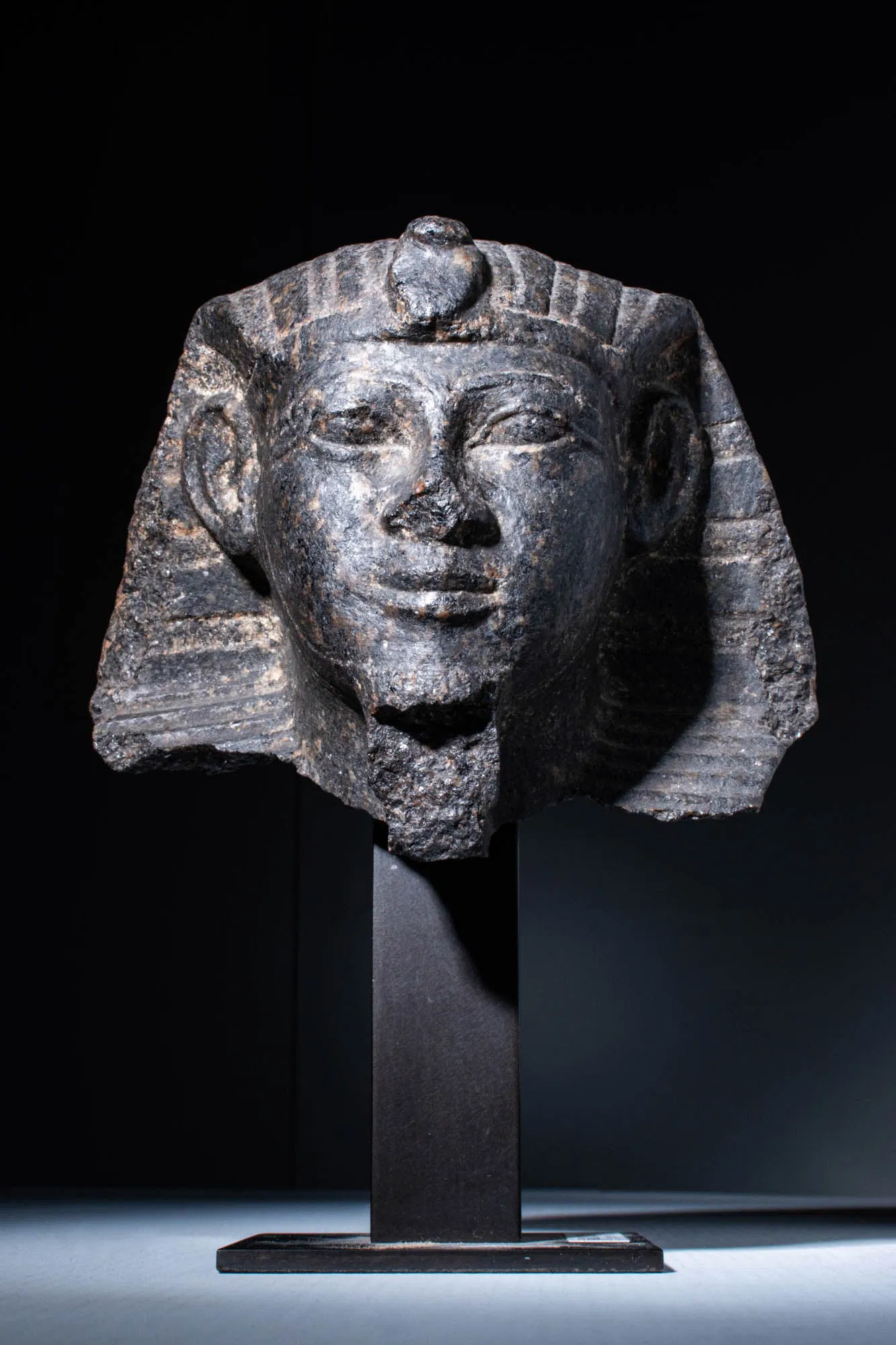
Perhaps the top prize of the day will be the handsome Egyptian black granite sphynx head of a pharaoh of the XXVth Dynasty (747-653 BC), probably Taharqa (690-971 BC). The pharaoh’s face has defined and elegant facial features, almond-shape eyes, full lips, a prominent nose, and a contemplative expression. His nemes headdress is adorned with a frontal uraeus cobra. Measuring 130mm x 120mm (5.1in x 4.7in) and weighing 2.25kg (4lbs 15oz), this rare item was reviewed by Simone Musso, consultant curator for Egyptian antiquities at Stibbert Museum, Florence, Italy, and member of the Nuri Archaeological Expedition. Prior to acquisition for The Prince Collection, 1990s-2014; it was held in the private collection of Jack Josephson. Opening bid: £20,000/$25,485

The sale opens with two notable Egyptian sandstone reliefs to be offered as consecutive lots. Lot #1 is a panel depicting the Egyptian Pharaoh Akhenaten worshipping the ancient god Aton. This artifact is particularly significant because Akhenaten was the first to introduce monotheism in Ancient Egypt – a controversial move that led to the posthumous destruction of his monuments in an attempt to erase his religious reforms. A fortunate survivor, this relief will open for bidding at £10,000/$12,740. Lot #2, a depiction of two male figures in relief, has appeared at Sotheby’s twice in the past 26 years prior to joining The Prince Collection, and will open at £5,000/$6,370.

A stunning example of Egyptian artistry, a highly decorative alabaster jar from the reign of Pharaoh Ramses II is elaborately painted with papyrus flowers and a scene of the Nile River. It has defied the tests of time over the past 3,200 years to emerge in its fine, original state and is a wonder to behold. Opening bid: £8,000/$10,195

A rare steatite head of the goddess Hathor, or a worshipper of Hathor, dates to Egypt’s Late Period, 664-332 BC. With well-defined facial characteristics and gold-inlaid eyes, the head is adorned with a large, intricately-detailed wig that cascades around the subject’s face and frames her distinctive ears. It is similar to an example seen in Il Museo Palatino, le Collezioni (Electa, 2014, #26). Reviewed by Simone Musso, this captivating relic was part of Eric Strobel’s private collection prior to accession by The Prince Collection. Opening bid: £5,000/$6,370

Also, a very rare and exceptionally well-preserved steatite head of a youthful Pharaoh Amenhotep III (reigned 1388-1353 BC) wearing a short, curly wig is one of few examples of its type known to exist outside of museum collections. This piece comes with distinguished provenance, having been part of the Jacques and Henriette Schumann collection, following its acquisition at Christie’s in 2003. Opening bid: £3,000/$3,820

From Egypt’s Middle Kingdom, circa 2055-1790 BC, comes a carved black stone ritual mortar or relatively cylindric form with high walls and a deep basin could have accommodated food or medicinal ingredients. Its external surface is decorated in high relief with images of two standing figures – probably priests – one wearing a long skirt and the other shown naked and wearing a long wig alternating to vertical lines of hieroglyphic inscription. A similar example may be seen in Change and Innovation in Middle Kingdom Art Proceedings produced for the MeKeTRE Study Day at Kunsthistorisches Museum, Vienna, on May 3, 2013; and in Middle Kingdom Studies 4, London, 2016, Figures 45-49. Standing 240mm (9.4in) tall, it weighs 18.29kg (40lbs 5oz). Prior to its acquisition for The Prince Collection, it sold at Nagel Auktionen on May 17, 2008. Opening bid: £8,000/$10,195

A superb Egyptian hand-built blue faience shabti of Nesytanebetisheru, Third Intermediate Period, 21st Dynasty, dates to circa 1075-945 BC. The mummiform figure stands in a dignified pose with fused legs and feet, his arms crossed atop his chest, and is enrobed in layers of incredibly lustrous, bright blue glaze. Painted black picks (tools) appear in his hands, and a seed bag is draped from both shoulders down to the middle of his back. The protruding visage exhibits gently-modeled features, including almond-shape eyes outlined heavily with black pigment, a flush nose, a slender mouth with indented corners, and tall ears, all framed within the striated lappets of his tripartite wig. This 150mm (5.9in) figure has a line of provenance that includes the Thalassic collection; a June 4, 1999 auction at Christie’s; and The Prince Collection from the 1990s to 2014. Opening bid: £2,000/$2,550

The sale also features an exquisite array of Romano-Egyptian mosaic beads and inlays that were once part of elaborate vessels, jewellery and votive objects. A set of 18 mosaic glass inlays of various sizes and shapes, primarily polychrome, span the period 30 BC-200 AD. These inlays originated from architectural tiles and, as a group, form a visually compelling display. In a private collection prior to joining The Prince Collection, 1990s-2014; this grouping will open for bidding at £900/$1,145. 

An excellent example of ancient glass jewellery, a circa 600-100 BC Phoenician glass-eye bead necklace is entered as Lot 110. The Phoenicians wore “glass eyes” as jewellery or clothing to ward off evil, and the blue bead, in particular, was believed to deflect the “evil eye curse,” making it both a talisman and cultural icon. This attractive necklace of primarily blue beads will open for bidding at £500/$637.

Apollo Art Auctions’ Sunday, December 15, 2024 Fine Ancient Art & Jewellery Auction exclusively featuring The Prince Collection will be a live gallery event with online bidding also available through Apollo’s bidding platform or LiveAuctioneers. Start time: 10:30am GMT/5:30am US Eastern Time. Goods may be previewed at the gallery by appointment only, now through December 13, from 10am-5pm daily. Address: 63-64 Margaret Street, London W1W 8SW. Apollo accepts payments in GBP, USD and EUR; and ships worldwide. No import charges are assessed on most antiquities sent to the United States. All packing is handled in-house by white-gloved specialists who are skilled at preparing precious goods for shipment. Questions: Please call +44 7424 994167 or email [email protected]. Visit Apollo Art Auctions online at www.apolloauctions.com 

The Galerie Subra Woolworth: Women Jewelers For Three Generations

Passed down from mother to daughter for three generations, for over 50 years this offbeat spot has attracted people who love antique and artists’ jewelry. We met the founder’s granddaughter, Lou Woolworth, who took up the torch in 2018.

Lou Woolworth in her gallery, leaning on the staircase designed by Marc Held.
© Delphine Jouandeau
Lou Woolworth in her gallery, leaning on the staircase designed by Marc Held.
© Delphine Jouandeau

From now on it will be called the Subra Woolworth and not the Isabelle Subra Woolworth Gallery. “It’s stronger and more institutional without the first name,” says Lou Woolworth, head of the gallery specializing in antique and artist’s jewelry. “It lets us broaden our horizons and emphasize the family history. Everything began in the 1960s with my grandmother Jacqueline Subra, and with a little luck it will continue after I’m gone.” Located at 51 rue de Seine in Paris in architect and designer Marc Held’s former offices, as his superb spiral staircase attests, the boutique is only 35 square meters (376+sq ft) but bursting with treasures. An ingenious system of pivoting display windows means they can even be admired from the inside, like a cabinet of curiosities. This autumn’s brilliantly designed display features a 1920s Art Deco pearl bracelet made for the Dutch royal family, a late 19th-century 22ct gold Indian cuff bracelet, a gold crocodile ring by young artist Chloé Valorso, a bronze necklace by Claude Lalanne, a ring set with two aquamarines by Lara Koulajian, Nisa Chevènement’s silver “Bark” bracelet, a gold necklace set with four 19th-century naturalized beetles, a 1970s lion’s head bracelet by Zolotas and an unlikely secret ring from the 1860s using René Dagron’s photo-microscopic process to include a picture of a woman from the period. In addition to this enticingly eclectic selection, one display case permanently exhibits pieces by designer Line Vautrin, whose bronze and talosel jewelry inlaid with colored glass draw a lot of interest. “The mix of periods, styles and prices is quite deliberate,” says Ms. Woolworth, who promotes her favorite contemporary designers while honoring the past.

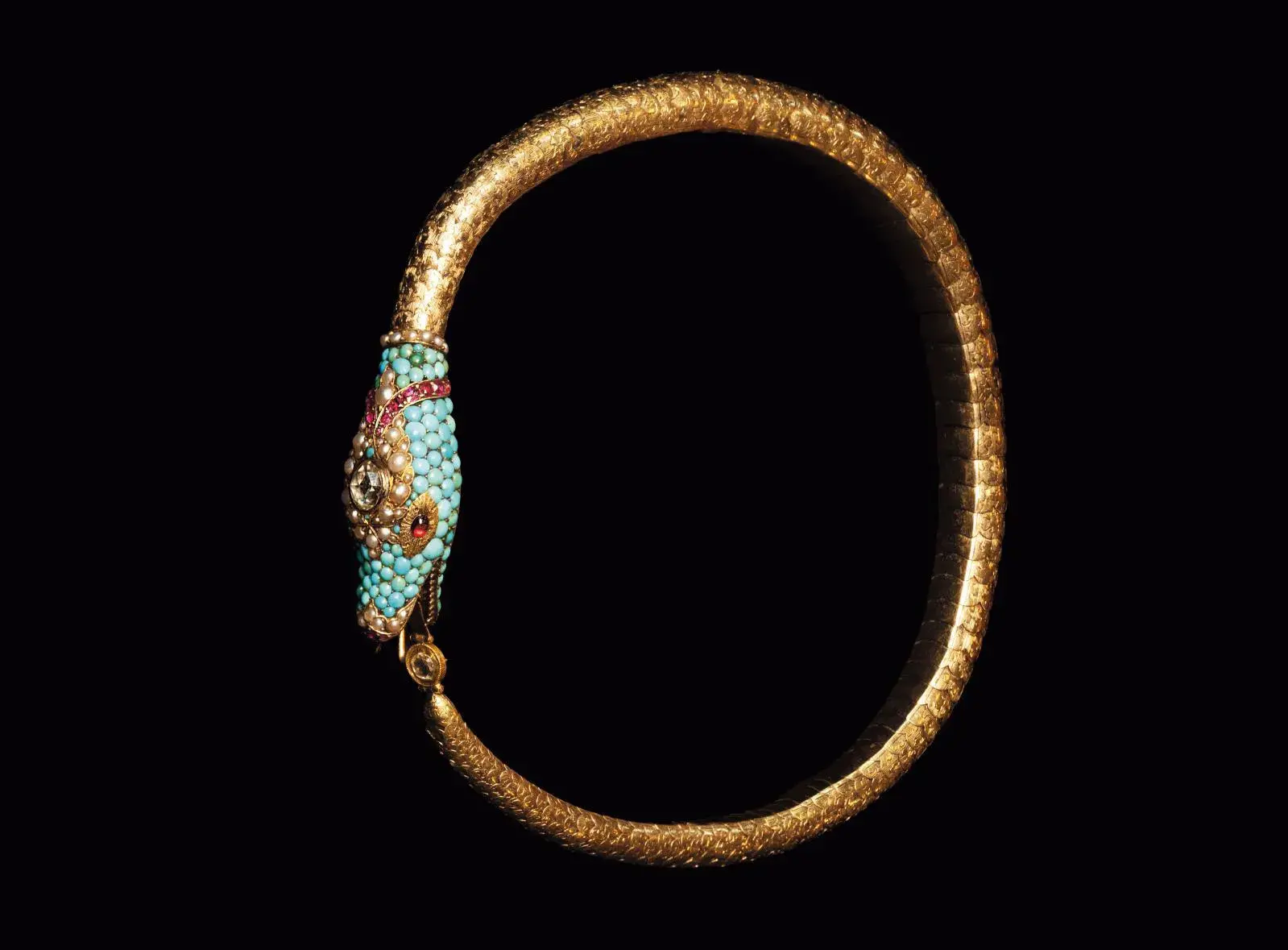
Jointed gold snake necklace from the 1860s. The head is set with turquoise, rubies, garnets, pearls and a diamond in the center.
© Delphine Jouandeau
Jointed gold snake necklace from the 1860s. The head is set with turquoise, rubies, garnets, pearls and a diamond in the center.
© Delphine Jouandeau

Jacqueline Subra’s Instant Success

The story began in Montparnasse in 1963. On a whim, Jacqueline Subra, a 30-year-old married mother of two young teens, opened a store selling antiques and odd objects. The law school graduate knew nothing about the business but trusted her unusual taste. Breaking with her conservative Catholic background, she created a gallery on rue Littré and, in 1965, boulevard du Montparnasse, that was unique at the time, offering second-hand furniture, accessories and curios, including a huge merry-go-round elephant in her window. Right from the start, the store stood out and attracted artists as customers, Andy Warhol and Marcel Duchamp being among the first. The young woman also bought unsold stock and added hats and dresses by Paul Poiret and antique jewelry, which she loved. She quickly began specializing in jewelry, with a clear preference for 19th-century and Art Nouveau and Art Deco pieces by the likes of René Lalique, Jean Desprès, Georges Fouquet and talented unknown designers. In the early 1970s, Ms. Subra, who was becoming well known, was joined by her eldest daughter, Isabelle. Learning on the job, the 17-year-old became interested in contemporary artists and gradually made her mark. “She took a sharper, less conventional look at jewelry,” says Ms. Woolworth. “She began working with Line Vautrin, whom my grandmother wasn’t too keen on at first.” Their collaboration proved decisive for both the artist and the gallery, which over a period of nearly 15 years built up a collection that was sold at Christie’s New York in 2006. Under Isabelle’s influence, other contemporary artists were gradually brought into the fold, including Jean Vendome, Goudji, Catherine Noll and Jacques Gautier. “We even have exceptional jewelry by Salvador Dalí,” recalls Ms. Woolworth. Meanwhile, the boutique continued to track down antique pieces and became one of the few, if not the only, places to find dangling earrings and gold Indian jewelry. Positioned as a reference on a niche market, it attracted the Parisian elite, from Yves Saint Laurent to Karl Lagerfeld, Catherine Deneuve, Alain Delon, Jean-Pierre Marielle and even Coluche, who loved antique jewelry and was a loyal customer. With strong and complementary personalities, mother and daughter worked together for nearly 30 years and passed their passion on to the next generation.

Line Vautrin’s gilded bronze “Counting Sheep” necklace
© Delphine Jouandeau
Line Vautrin’s gilded bronze “Counting Sheep” necklace
© Delphine Jouandeau

Contemporary Jewelry and Living Artists

“I was still in diapers when I began coming to the gallery,” says Ms. Woolworth, an elegant woman in her thirties born to Isabelle and her second husband, art book printer and publisher Michael Woolworth. “As a child, I already had a sense of just how unique this world is and I loved being in it.” Located on rue de Seine since 1984, the place bears her mother’s imprint: “An aesthete down to her fingertips, she always had a knack for making her environment more beautiful—a natural gift, perhaps strengthened by her first husband, painter and theater and opera set designer Jean-Paul Chambas.” Young Lou enjoyed going to flea markets with her mother and grandmother on the weekends: “We always brought back treasures, jewelry or small utilitarian objects.” Nevertheless, after graduating from university she did not join the family gallery, preferring to become a fashion designer instead. It was not until 2018, when she sensed that her mother wanted to retire, that she decided to take up the torch, an “unplanned choice” that she does not regret. “I love everything about the business, from buying to selling and restoring damaged pieces,” she says. “I like the idea of a chain that brings an object back to life, especially since France has a network of small workshops with incredible expertise in stringing fine pearls, cutting glass and enameling.” The open-minded young gallery owner enjoys spotting talent and sourcing unique pieces from professional dealers as well as sometimes-unexpected connoisseurs, including a security guard and a nurse. “Like her mother, she’s interested in jewelry with a soul,” observes designer Lara Koulajian. In this spirit, Ms. Woolworth focuses even more on contemporary artists. “Especially living artists who have a definite taste for design with architectural overtones,” says sculptor Nisa Chevènement, who first met her when they complimented each other on their jewelry while waiting on line for a movie. With more of a nose for business than her forerunners, Ms. Woolworth fosters relationships with prestigious customers from the worlds of cinema, theater, fashion and royalty as well as beginners, delighted to introduce them to her world. “I have a magnificent place and want to make it more widely known,” she says, especially by hosting events like last June’s exhibition of animal-shaped jewelry.
 

The Gallery 
In 5 Dates

1963
Established at 19, rue Littré

1965
First Move to 79, boulevard du Montparnasse

1972
Arrival of Isabelle Subra

1984
Second Move to 51, rue de Seine

2018
Arrival of Lou Woolworth 

Apollo Art Auctions traverses Asia’s Silk Road with exciting Dec. 14 sale of Fine Islamic, Indian & Chinese Art

Islamic highlights include important 7th-8th century Sodgian silver elephant incense burner and early-14th-century molded pottery tile wall panel with stunning turquoise and cobalt blue palette

Silver Incense Burner In The Shape Of An Elephant With A Rider

LONDON – On December 14, Apollo Art Auctions will explore the ascendancy and incomparable beauty of fine Islamic and Asian art through a 348-lot sale of historically-important, expertly-vetted pieces. The live gallery auction, with optional online bidding, is a virtual museum-level showcase for exceptional Islamic, Indian and Chinese artworks as well as Korean and Tibetan pieces, with a timeline starting around 3000 BC and continuing to the 19th century AD. The Saturday auction session will commence at 1pm GMT (8am US Eastern time).

Prestigious provenance accompanies literally every piece on the auction roster, including Islamic and Indian objects whose former owners included Henri René d’Allemagne and the Marquis de Ganay. The Southeast Asian portion of the sale features an impressive array of Chinese artworks from the collections of Phillip Allen and the estate of Roslyn Willett.

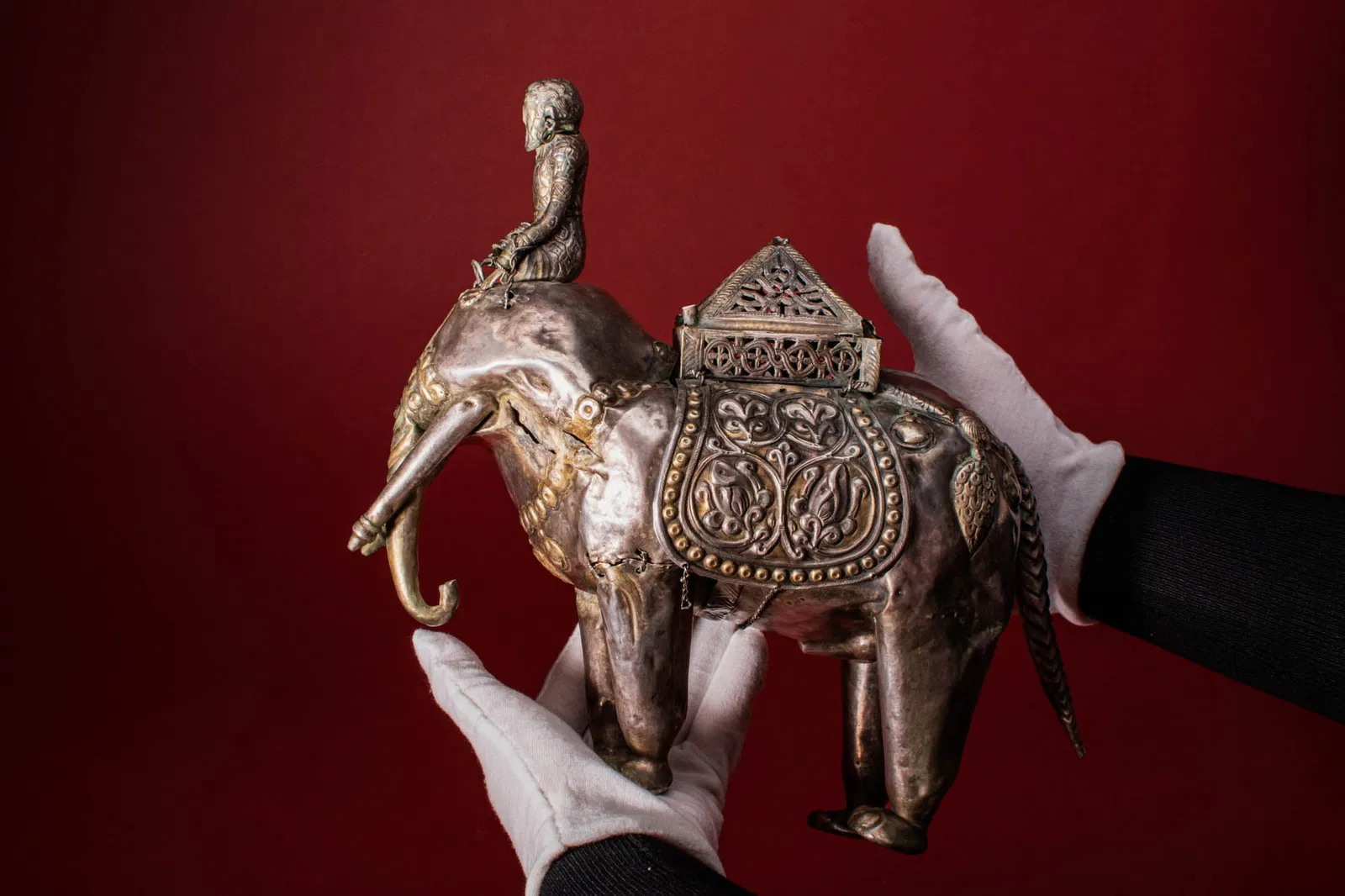
The list of highlights is led by a rare and extraordinary Sogdian (7th-8th century A.D.) silver incense burner sculpted as an elephant transporting an ornately-dressed rider. It bears the Arabic signature of “Fazil” or “Faisal,” the master artisan who created it. An advanced standard of artistry is evident in its adornments, which include intricate floral motifs and a stunning openwork structure atop the pachyderm’s back. This remarkable treasure, with its motif reflective of elephant depictions in Asian palace art of its period, has immense significance. It measures 260mm x 900mm wide (10.2in x 35in) and weighs 563 grams. Formerly, it was the property of a European collector; and prior to that, Mr Nathan Axtel. It was sold to the latter gentleman in 1979 by Mr Andrew Bannister, London. It will convey to the winning bidder with a full historical report. Further information regarding the piece may be obtained prior to the auction by contacting Apollo’s director, Dr Ivan Bonchev (PhD, University of Oxford). Bidding will open at £400,000/$510,282.

From the early 14th century AD, a molded pottery tile wall panel executed in turquoise and cobalt blue features floral relief detailing with six central stellar cobalt-blue glazed sections for each formed square. It is a large and hefty piece, measuring 1223mm x 870mm/48.15in x 34.3in and weighing 40.03kg/88lbs. 4oz. It is similar in design to an example referenced in the book Ceramic Tiles in Islamic Architecture by Oney Gonul. Previously the property of a UK Islamic art professional, it will open for bidding at £20,000/$25,520.

Originating in Kashmir, North India, a circa-18th-century illuminated Qur’an is an Arabic manuscript on paper, with each folio written in black thuluth script and with five flyleaves. The opening bifolio has fine and elaborate gold and polychrome illumination, while the subsequent folio is headed with gold and polychrome illumination and text within cloud bands reserved against gold, in gold and black rules. Other exceptionally beautiful detail work enhances this Qur’an, which has an opening bid of £8,000/$10,210. 

In its time, a circa-1300 to 1400 AD Mamluk bronze inlaid candlestick might have been found in mosques, shrines or religious schools, as the artistry of such objects was very highly regarded. The candlestick is intricately detailed and bears Kufic script. It is similar to example depicted in L’eredita dell’Islam, published in 1993. Formerly the property of an Oxfordshire art professional, it can be traced to an old Canadian collection that was formed in the 1980s. Opening bid: £5,000/$6,380

Moving into the Tibetan and Indian cultures, Lot 156 is a Nepalese Licchavi Period (9th-10th century A.D.) gilded bronze seated bodhisattva from a period that was crucial to the development of Himalayan Buddhist art. The crowned figure is adorned with beautifully-crafted necklaces, armlets and earrings. With provenance from a private UK collection, it was previously purchased in 2024 from a Kensington Church Street (London) gentleman who acquired the piece on the Asian art market in the early 1990s. Opening bid: £20,000/$25,520

A large Tang Dynasty (circa 618-907 A.D.) terracotta camel depicts the desert beast with its head thrown back playfully as though braying, while a lively monkey comes along for the ride in a cushioned, multi-layered saddle. The camel’s anatomy is realistically interpreted, and its mane is nicely detailed. Standing 640mm (25.2in) tall, this striking artwork would enhance any collection of Chinese figural pottery and has been successfully TL tested. Most recently, it was part of a UK private collection and, prior to that, was acquired in the 1990s in Hong Kong. Opening bid: £3,000/3,830

The Ming and Qing dynasties are prominently represented in this sale, especially through their distinctive decorative ceramics, like Lot 235, a pair of vibrant circa-19th-century Chinese porcelain glazed vases. Notable for their impressive size (570mm x 240mm/22.4in x 9.4in), vessels such as this duo were highly prized in the European marketplace for their gorgeous cherry-red flambé glaze with lavender and blue striations. Opening bid: £1,000/$1,275

A Chinese Ming Dynasty (circa 1426-1435 AD) blue and white jar is an elegant example with its gently tapered globular form enhanced by floral designs. Under its base it reveals a six-character Xuande Mark and of the period. Its size is 290mm x 260mm/11.4in x 10.2in, and it compares to an example in The Palace Museum, 新00109501. Prior to coming to auction, the jar was part of a Hong Kong private collection, which it joined in 1990s. Opening bid: £3,000/$3,830

Apollo Art Auctions’ Saturday, December 14, 2024 Fine Islamic, Indian & Chinese Art Auction will be a live gallery event with online bidding also available through Apollo’s bidding platform or LiveAuctioneers. Start time: 8am US Eastern Time/1pm GMT. Goods may be previewed at the gallery by appointment only December 9-13 from 10am till 5pm daily. Address: 63-64 Margaret Street, London W1W 8SW. Apollo accepts payments in GBP, USD and EUR; and ships worldwide. No import charges are assessed on most antiquities sent to the United States. All packing is handled in-house by white-gloved specialists who carefully prepare goods for shipment. Questions: Please call +44 7424 994167 or email [email protected]. Visit Apollo Art Auctions online at www.apolloauctions.com 

Salome and the Head of St. John the Baptist, a Biblical Work by George Frederic Watts in Homage to Titian

The Victorian painter’s canvas conveys a moralizing message, while paying homage to his teacher Titian.

George Frederic Watts (1817-1904), The Daughter of Herodias, oil on canvas, 120 x 76.5 cm/47.24 x 30.11 in.
Estimate: €150,000/200,000
George Frederic Watts (1817-1904), The Daughter of Herodias, oil on canvas, 120 x 76.5 cm/47.24 x 30.11 in.
Estimate: €150,000/200,000

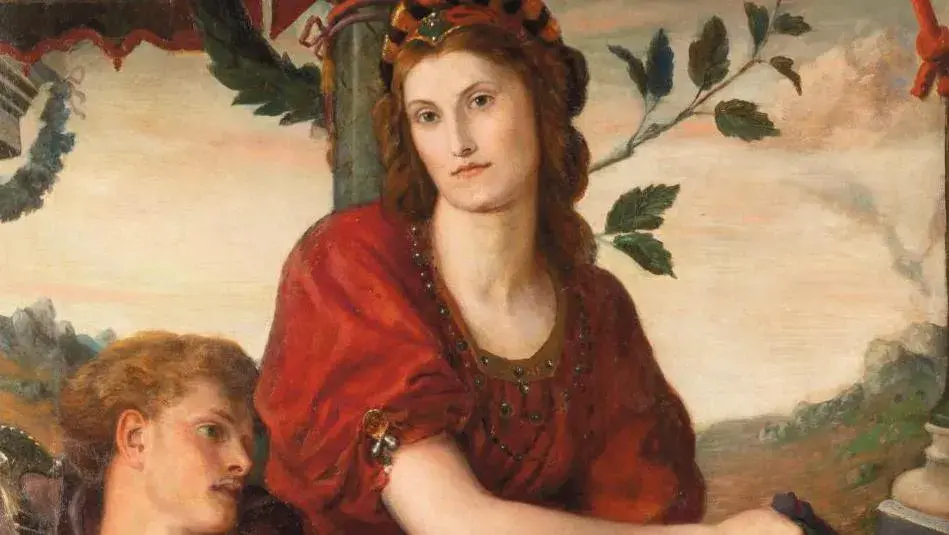
There is no overt provocation in Salomé’s demeanor. Seated, a vague air of defiance in her frontal gaze, she lifts a piece of cloth concealing a rich gold dish in which the head of John the Baptist is visible. Behind her, a young soldier cleans the bloody blade of the sword used for the sinister task, while at her feet, a wolf licks its paws contentedly. This is not the dancing, seductive Salome — as portrayed by Gustave Moreau, among others — but a woman proud of her accomplished task, yet depicted with a hint of density. The composition is meticulous, large-scale and unmistakably the work of a master. But which one? The only drawback is that it is neither signed nor dated. Looking at the work, one is irresistibly reminded of the Pre-Raphaelites, and its recent discovery in Italy — a kind of art-historical wink — makes this hypothesis seductive. However, if it was indeed painted by an English artist, Mark Bills, former Chief Curator of Paintings and Drawings at the Museum of London from 2001 to 2006, and Curator of the Watts Gallery in Guildford from 2006 to 2013, attributed it to George Frederic Watts. The Victorian art specialist puts forward several arguments in support of this hypothesis, not least the influence of Titian. Watts was fascinated by the Venetian master, whom he discovered on his second trip to Italy in 1853, the presumed date of the painting’s conception. The work’s composition and color effects — particularly that of Salome’s red dress — compares with Titian’s 1515 painting of the same subject, now in the Galleria Doria Pamphilj in Rome. The face of Herodias’ daughter, with its powerful symmetry and prominent jawline, is characteristic of Watts’ aesthetic, and can be found in several of the artist’s female portraits. The closest is Lady Ashburton (1857, location unknown), whose features are almost identical. But the most decisive element is the head of St. John the Baptist, for which it is arguably a self-portrait of Watts. A photograph taken by James Soame in 1854 shows him with the same full beard and similar elongated face. Finally, the idea that Titian might have done the same with his Salome of Rome (accepted by a number of art historians, including Erwin Panofsky) may have made this idea attractive to Watts.

More about
Gustave Moreau (1826-1898)

The Moralizing Work of an Austere Painter

The Victorian era was not exactly a carefree time. A certain puritanism was de rigueur, conveyed by the powerful Church of England. Although he was not an active member, Watts often painted biblical subjects, by virtue of his belief in improving the character of those who looked at his work. This idea, widespread in 19th-century Britain, explains why the majority of Watts’ works carry a moral and ethical message. The image of Salome, repeatedly used by painters since the 16th century, is a case in point. For good measure, Watts added a wolf to the young woman’s foot, an animal symbolizing the thirst for power as well as a form of lust. It was a fitting subject for an artist with a mystical bent and a well-established reputation. In 1892, the Pall Mall Gazette wrote of him that “Watts was serious, lacked a sense of humor and was politically radical – twice refusing the title of baronet”. Quite a character! It wasn’t all doom and gloom, however, as the same newspaper pointed out: “He was very sensitive to the appalling living conditions of the urban poor. Watts considered the fact that the country’s upper classes were taking huge sums of money they hadn’t earned to be a great evil.” He thus devoted four paintings to social tragedies in London and Ireland. Watts’ love life was rather tumultuous, as the Pall Mall Gazette points out: “In middle age, this serious and already elderly painter made a short-lived and totally disastrous marriage with the great actress Ellen Terry, then in her teens.” Although the union lasted only a year, Watts used the young girl as the model for his portrait Choosing (National Portrait Gallery). His second marriage in 1886 to Mary Fraser Tylter, thirty years his junior, was a happy and artistically fruitful one. An excellent portraitist, Watts was a celebrity during his lifetime, being the only artist to be among the first twelve recipients of the Order of Merit, newly instituted in 1902. A complex artist, whose works touched the heartstrings of his time.


Salomé, a Woman Misunderstood

“Whatever you ask of me, I will give you, even if it’s half my kingdom”. So says the tetrarch Herod Antipas — according to the Gospel of Saint Mark — to Salome, daughter of Herodias. She had just performed a dance that pleased her great-uncle — or uncle and/or father-in-law, depending on tradition. The price of this dance is well known: the head of the holy preacher, requested by… Herodias. In the Scriptures, Salome is referred to by the Greek word korasion, a diminutive of korè (young girl), as she was no more than 11 or 12 years old at the time. It was not until three centuries later that she metamorphosed into an erotic figure in a sermon by Saint Augustine, an image that would endure through time, and conveyed by artists. Watts is no exception to the rule, highly inspired by figures of powerful women. He returned with another version of the same subject in an 1885 painting (private collection). The vision is very different: Salomé is triumphant, looking straight at the viewer and brandishing Herod’s ring, thus exonerating herself of all guilt. Seductive and bewitching, Salomé epitomized the castrating femme fatale of the late 19th century. Although her popularity subsequently waned, she has yet to be redeemed.

Paintings – Furniture and objets d’art

Wednesday 18 December 2024 – 14:00 (CET) – Live

Salle 16 – Hôtel Drouot – 75009 Paris

Paris Enchères – Collin du Bocage

Info and sales conditions

Catalogue