Morphy’s ‘lured’ collectors of antique fishing baits to $900K+ sale of Wayne Edens collection, Part I

Extremely rare lures, many of them boxed, included one of eight legendary frogs hand-carved in 1898 by James Heddon and displayed at Heddon factory, plus many other seldom-seen examples
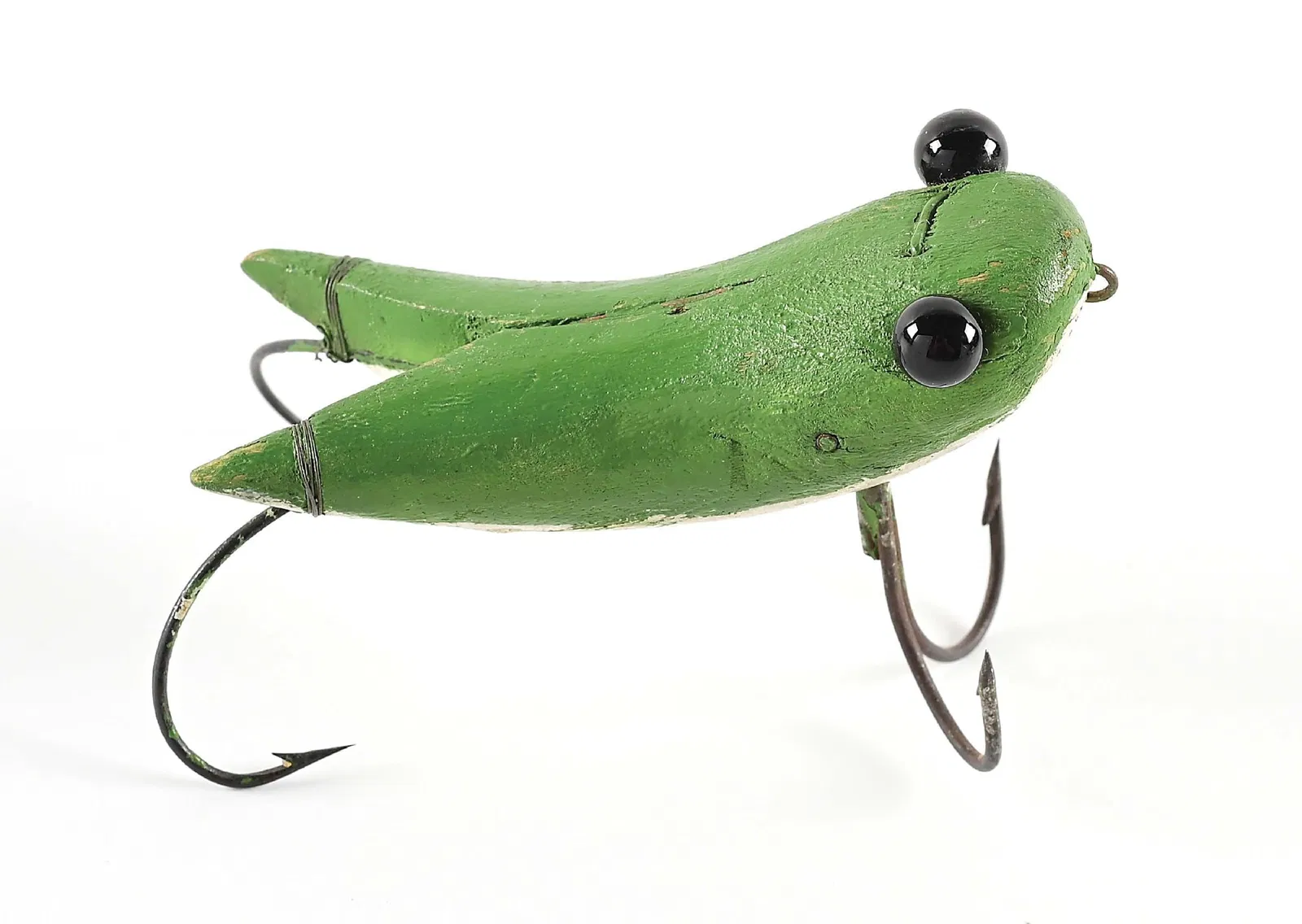
One Of The 8 James Heddon Hand-carved Frogs

DENVER, Pa. – The water was fine and the bidders were biting at Morphy’s December 9 auction of the Wayne Edens collection of antique and vintage fishing lures, Part I, which tallied more than $900,000. The 622-lot sale was singularly focused on treasures from the Edens collection, the largest, most comprehensive and historically-important collection of its type ever to come to the public marketplace.

As predicted, the top lot of the day was an all-original Heddon frog lure (or “bait”) personally crafted by James Heddon, founder of the Heddon Company. One of eight created and subsequently exhibited on a display board at the Heddon plant in Dowagiac, Michigan, the frog was formerly the property of Dudley Murphy (1940-2022), co-founder of the National Fishing Lure Collectors Club. Murphy had obtained the lure directly from the Heddon factory. In addition to its unbroken line of provenance, Edens’ frog lure was definitively photo-matched to one of the original eight “board” examples. It made its first-ever auction appearance on December 9 at Morphy’s and sold within estimate for $30,750.

An extremely rare Heddon special order 1309 Black Sucker in a five-hook configuration dazzled with its spectacular white saltwater color, glitter finish and solid amber-glass eyes. Graded Excellent Minus to Excellent, it reeled in a winning bid of $22,200.

A Heddon 707 Dowagiac Musky Minnow bait with a sienna crackleback finish was of a type first marketed in 1909. Sturdy and sizable at 5-3/8 inches long, it was one of the finest of those few known to have survived. On top of that, it was accompanied by its oversize introductory box. It landed within its pre-sale estimate range at $20,910.

Among other exotic Heddon lures that met with success on auction day was an 8-inch 7602 Musky Vamp produced around 1925. With red eyes and tail, a shiny finish and perfect glass eyes, it was graded Excellent and came with its Excellent original box. It sold for $9,840 against an estimate of $4,500-$6,500. An Introductory 3-bellyweight 150 Dowagiac Minnow in early olive-green Fancy Back crackle-paint finish, with egg-yolk glass eyes, represented the earliest of all Heddon Underwater Minnows from the 1904 season. It correctly matched its thicker Type II intro wood box with a slider top, and glided to $7,680 against an estimate of $2,000-$4,000. Also, a Heddon 309V Dowagiac Surface Minnow in the desirable special-order motif of glossy orange paint with black spots, L-rigged on its belly with marked pointed props and perfect glass eyes, surpassed its high estimate to realize $5,280.

Beautiful and sought after, a Shakespeare No. 64 five-hook Red Musky (Muscallonge) Trolling Minnow bait exhibited deep crimson coloration and a high forehead design that definitively dated it to circa 1906-7. Oversize baits of its type are rarely encountered, and with the bonus inclusion of an elusive circa-1908 pictorial box, it was one of the auction’s most desirable entries. Attracting 15 bids, it sold near the mid-point of its estimate range, for $27,600.

Another fabulous lure was a Shakespeare No. 1611 Wooden Minnow with five hooks, a red back and white belly; thin, hand-painted gills, and perfect glass eyes. Dating to circa 1907-09, the irresistible fish-enticer came to auction with its correct and equally-rare white-label pictorial box, making it an incomparable duo for any serious collector. Against an estimate of $10,000-$15,000, it leaped to a winning bid of $19,680. 

Made by one of the most collected of miscellaneous makers, A.F. Bingenheimer, Milwaukee (established 1904-05), a gold-painted Bing’s Nemahbin Minnow was graded VG Plus to Excellent Minus. It retained its incredibly rare pictorial box adorned with an image of the bait, its name, and the description “A NEW BAIT.” One of the box ends was correctly marked “GOLD WEEDLESS.” Cataloged with a $5,000-$15,000 estimate, it swam to even friendlier waters, settling at $18,000.

A Jan Cummings Fairform Bait Works set consisting of four diminutive handmade Savage Shrimp, each displaying a different, exceptionally beautiful color, was a popular entry. Each bait was new in its individual paper-labeled box, along with a larger dealer case to accommodate the quartet. Against a $3,000-$6,000 estimate, the appealing little fly rod baits drew 22 bids before closing at $14,145.

Also noteworthy, a desirable “Missouri Barberpole” made by Charmer Minnow Company and known as “The Charmer Minnow” certainly lived up to the claim imprinted on its included original orange box: “The Most Attractive Fish Lure Any Angler Ever Cast.” Additionally, the box label indicated a retail price of $1 and the words “THE CHARMER” and “Patent Applied For.” It rose to $7,200 against a pre-sale estimate of $2,000-$4,000.

Parts II and III of the Wayne & Lori Edens fishing lure collection will be auctioned at Morphy’s in 2025, with dates to be announced soon on the Pennsylvania company’s website. Each of the sales will offer 600-700 lots and feature many special-order and one-of-a-kind lures, some in their original picture boxes. To discuss consigning antique or vintage fishing or sports-related antiques of any type to a future auction conducted by Morphy’s, please call Dan Morphy at 877-968-8880 or email [email protected]. Visit Morphy’s online at https://www.morphyauctions.com. All enquiries are kept strictly confidential and there is never an obligation to consign.
Takis: A Magnetic Sculptor Back in the Limelight

The White Cube gallery is devoting its first exhibition in France for ten years to the Greek artist, who died in 2019. A chance to rediscover a pioneering corpus at the intersection of science and metaphysics.

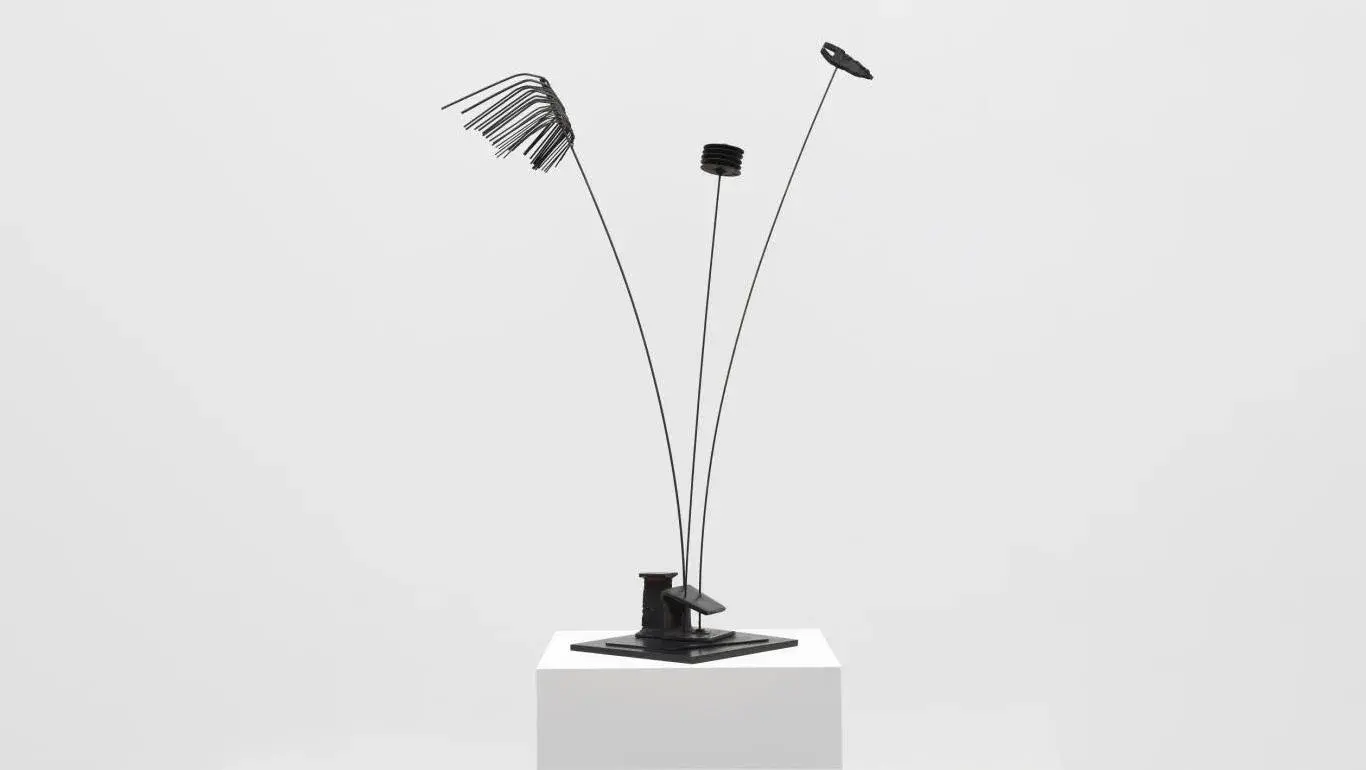
Takis (1925-2019), Signal, 1954, painted iron, Plexiglas and bronze, 103.5 x 29.7 x 25.3 cm/40.6 x 11.4 x 9.8 in. One of the works featured in the exhibition at the White Cube gallery, Paris.
© TAKIS FOUNDATION / ADAGP, PARIS AND DACS, LONDON, 2024
PHOTO © WHITE CUBE (THEO CHRISTELIS)
Takis (1925-2019), Signal, 1954, painted iron, Plexiglas and bronze, 103.5 x 29.7 x 25.3 cm/40.6 x 11.4 x 9.8 in. One of the works featured in the exhibition at the White Cube gallery, Paris.
© TAKIS FOUNDATION / ADAGP, PARIS AND DACS, LONDON, 2024
PHOTO © WHITE CUBE (THEO CHRISTELIS)

Duchamp dubbed him “the happy ploughman of magnetic fields”. It was an apt sobriquet for Panayótis Vassilákis, aka Takis, who not only broke down the boundaries between art and science, but also sought to reveal invisible forces he likened to the “fourth dimension”. His last exhibition in France was in 2015, when the Palais de Tokyo hosted a retrospective overseen by Alfred Pacquement, former director of the Musée National d’Art Moderne. The White Cube’s exhibition focuses on the sculptor’s relationship with Paris, and features 20-odd works conceived or created in the capital between 1950 and 1980. This is where Takis really established himself during these four decades, even if he also spent time in London and New York. But like many artists of his time, he was drawn to the dazzling City of Light. And “he aspired to a better life,” says Ikenna Malbert, Associate Director of Artist Relations at the White Cube Gallery. With good reason. Born in 1925 on the outskirts of Athens, the sixth of seven siblings, Takis spent his early years in poverty, in the context of the Nazi occupation and civil war. Against his parents’ wishes he took up art, teaching himself. His first works were plaster busts and wrought-iron silhouettes inspired by Cycladic art and Giacometti’s work, which he discovered through books. He arrived in Paris in January 1954, joined Brancusi‘s studio and soon became part of the avant-garde milieu, where he met Klein, Calder, Tinguely and Giacometti.

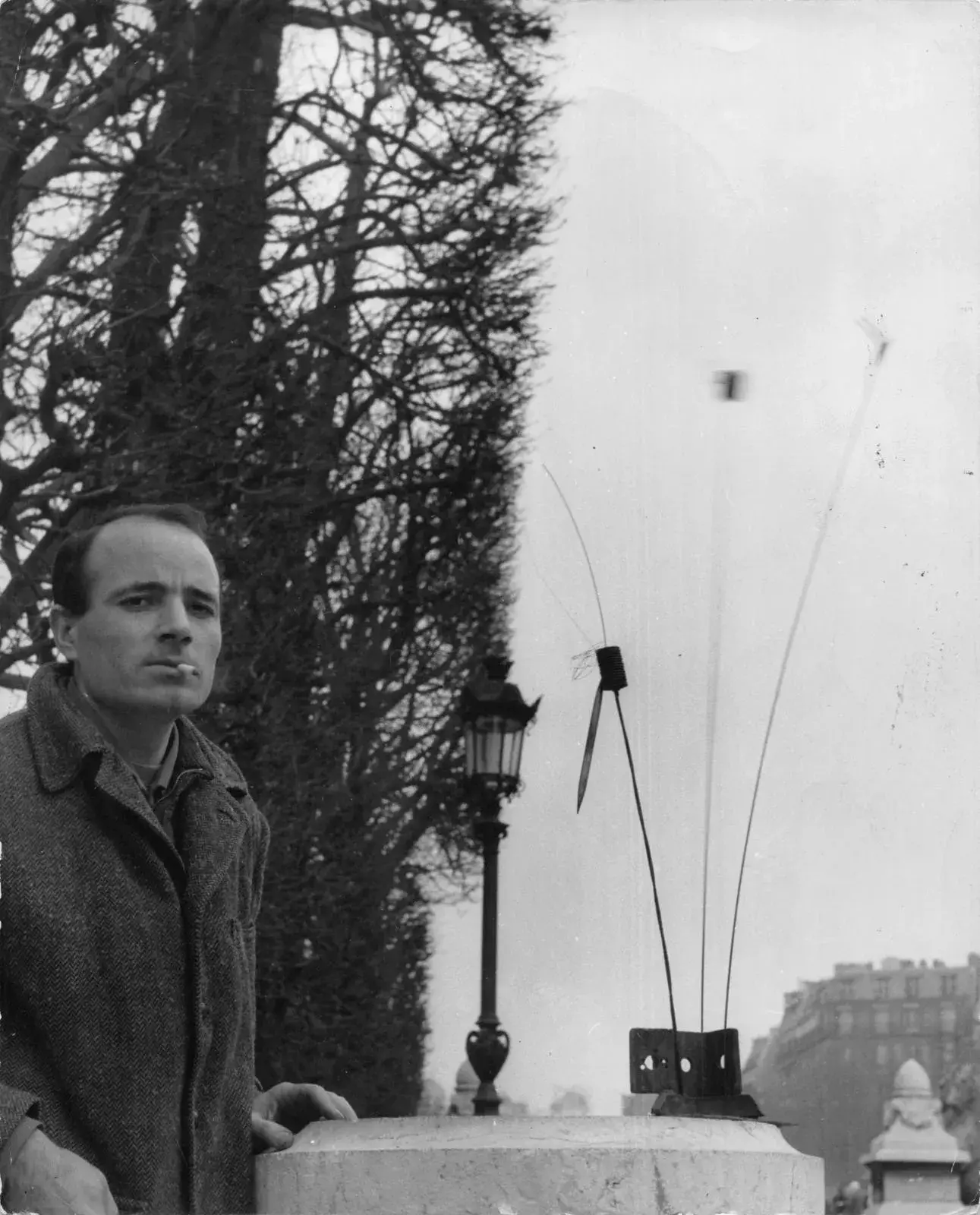
Takis in the Luxembourg Gardens in 1955, next to a Signal.
© PHOTO COURTESY OF MARTHA ROCHER ARCHIVE, ROME. ALL RIGHTS RESERVED
Takis in the Luxembourg Gardens in 1955, next to a Signal.
© PHOTO COURTESY OF MARTHA ROCHER ARCHIVE, ROME. ALL RIGHTS RESERVED

Signals and Telesculptures: Welcome to the Fourth Dimension!
It was during this period that he experienced “his two most important artistic epiphanies”, says Ikenna Malbert. In 1954, while waiting for a train at the station in Calais, he was fascinated by the signals and signs. This “iron jungle” illustrating the industrial world inspired him to create the “Signals” that accompanied him throughout his life. These works resembled rigid or flexible metal totems, topped with salvaged objects or flashing lights. Near Paris, on the esplanade of La Défense, around 50 of these have been swinging above a pond since the late 1980s. “His second ‘Eureka’ moment, to quote critic Alain Jouffroy, came in 1959, when Takis began experimenting with the powers of magnetism,” continues Ikenna Malbert. An “intuitive scientist”, as he described himself, he invented “telesculptures”, in which metal elements remain suspended through the power of magnets. In November 1960, at Iris Clert’s gallery, for a few moments he even levitated his friend the poet Sinclair Beiles, who was wearing a metal belt held in place by ceiling-mounted magnets. Takis was thus “the first to send a man into space”, six months before Yuri Gagarin’s flight! This led to the “magnetic walls”: paintings or panels on which metal elements floated, activated by magnets concealed on the back. He also introduced movement, making him one of the founders of kineticism, and developed “telelights” featuring large light bulbs, and “musical telesculptures”. In this case, electromagnets triggered strange random sounds, which he described as the “music of the universe”. “The cosmos was central to his explorations,” says Alfred Pacquement. One thing was certain: his pioneering approach intrigued a lot of people. In 1968, he was invited to lecture at the prestigious MIT (Massachusetts Institute of Technology). Naturally, a string of international exhibitions followed, and it was in the middle of his retrospective at London’s Tate Modern that Takis died in August 2019 at the age of 93, like an artist taking his farewell bow on stage.

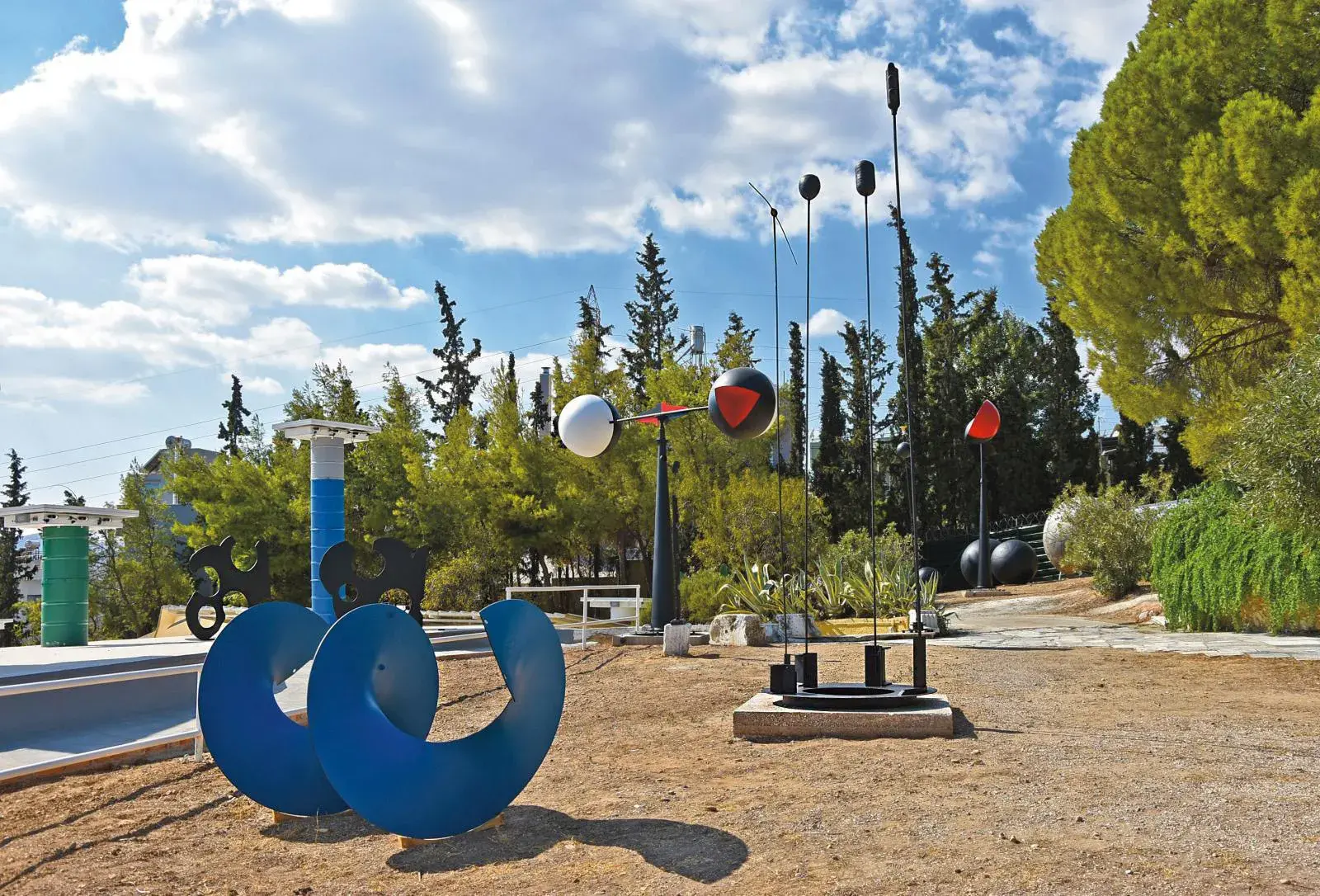
The garden of the Takis Foundation on Gerovouno Hill, near Athens.
© PHOTO: FAY ZERVOS
The garden of the Takis Foundation on Gerovouno Hill, near Athens.
© PHOTO: FAY ZERVOS

Takis: A Price Index to be Consolidated
Although he lived outside Greece, he was always very attached to it. In 1964, he built a studio and a summer home on Gerovouno Hll, some 15 km (9.3 miles) from Athens. This choice was no accident. Since antiquity, Gerovouno (Greek for “holy mountain”) had been said to contain minerals with magnetic powers, whose benefits Takis asserted he could feel. Over the years, he terraced the arid slope, planting pine, olive and fig trees, and adding other white concrete buildings. In 1986, with the support of Melina Mercouri, then Greek Minister of Culture, he transformed the site into a research center for Art and Science, better known today as the Takis Foundation. But it was only inaugurated in 1993, after the artist had decided to return to his homeland. “Currently, the foundation has one of the most comprehensive collections, ranging from his 1940s works to the most recent, and we’re always trying to add to it,” says Penelope Sideri, vice-president of the foundation’s board of directors. “Since 2018, it has been very active. Until then, visits were by appointment, because Takis lived and worked there. Now it is open to the public, and offers a very broad program.” Guided tours, lectures, recitals and performances are organized, as are artist residencies and events for institutions and patrons. “We intend to intensify projects and collaborations to honor the memory of this artist who thought so differently about sculpture and space, with the idea of passing on his legacy to future generations,” she adds. The peace and quiet of this hillside is all-pervasive. You can see the master’s studio, his library, the dining room for which he designed the furniture, and the living room with its piano. And everywhere, works of art enchant the eye or pique the curiosity. Here you find plaster idols, there weightless spheres, brightly colored telepaintings or a gigantic gong vibrating with an eerie sound. And from the park with its myriad wind-powered signals and mobiles, there is a spectacular view of the Hellenic capital and the Acropolis. Pursuing its development policy, the foundation entrusted White Cube with the sculptor’s estate in 2020. “The presentation of Takis’s work in its spaces, notably at solo shows in London and Hong Kong, has had a major impact on the market,” says Penelope Sideri. This assessment is corroborated by Artprice, though it only includes auction results: “Sales rose a lot after the artist’s death,” says Jean Minguet, head of the Economics department. Annual turnover figures, mainly recorded in France, have followed an upward curve even if they fluctuate. In 2022, sales totaled €1.7 M, with 86 lots sold (mainly sculptures). Since January 2024, sales have topped the million mark, with 65 transactions. “These results are still relatively low, given the artist’s reputation,” says Jean Minguet. “But his price index could rise.” A sale at Piasa on October 30, 2024, points in this direction. A four-meter-high (13+ ft) “Signal” from the 1980s fetched €253,000, beating the previous record of €187,000 set by a 1970 “Double Signal” at Christie’s Paris in December 2021. A new dimension undoubtedly awaits Takis’s work.

Worth Seeing
“Takis, The Void”, White Cube Paris, Paris 75008.
Until January 11, 2025
whitecube.com

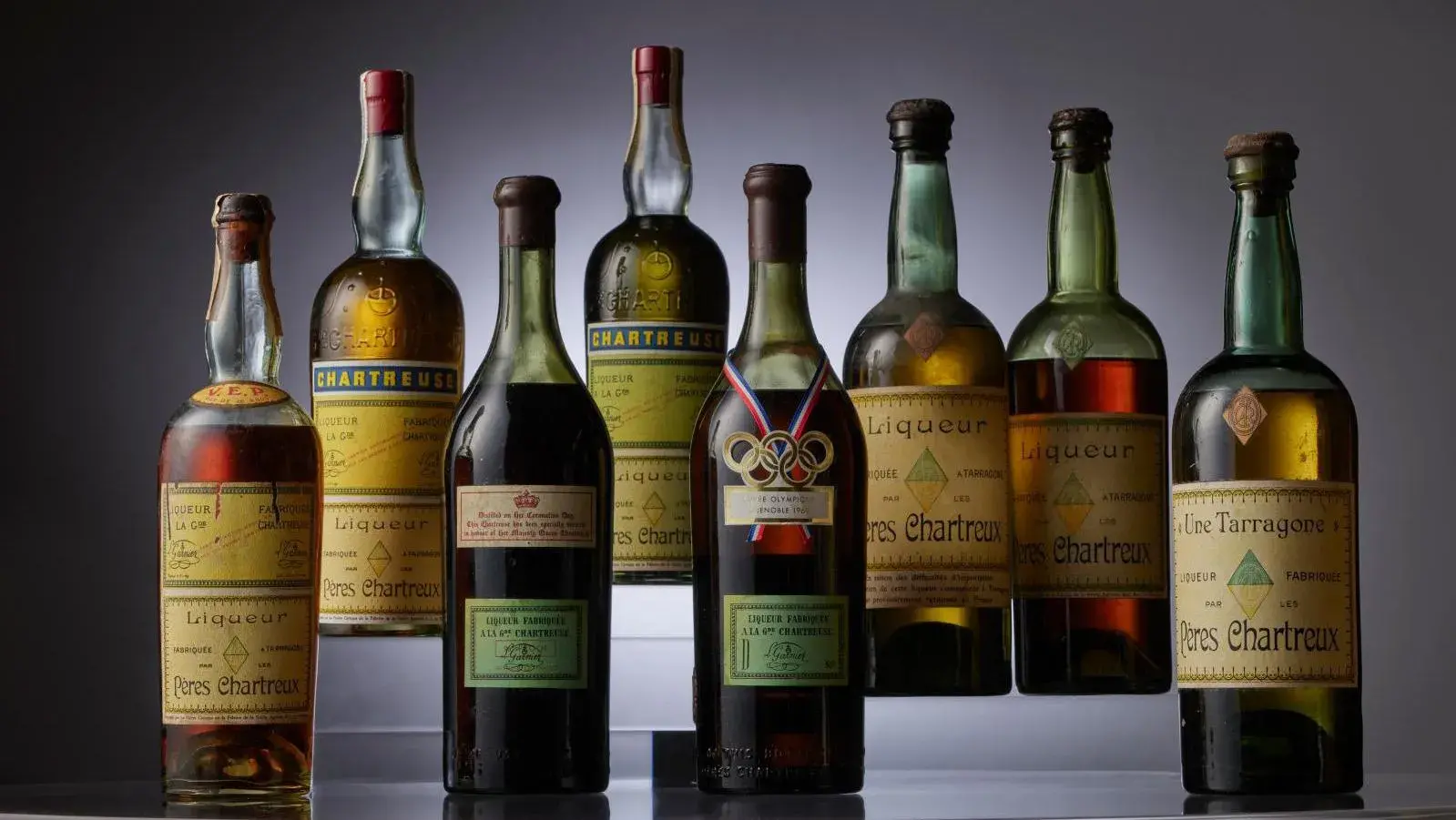
Chartreuse, “The Best Liqueur in the World”, in the Spotlight at Auction in Cannes

The sale of a collection dedicated to the liqueur distilled by the Carthusian fathers will be one of the highlights of the “Chartreuses, Grands Vins & Alcools” sale, organized by Besch. A consecration for an alcohol whose recipe has remained a secret for centuries.

The Chartreuse, as we know it, first appeared around 1789, the same year the French Revolution started. Today, it too is undergoing a minor revolution. Interest in this liqueur distilled by the community of Carthusian fathers, whose recipe is jealously guarded, has grown “exponentially since the covid”, indicated Philippe Rochez, Sales Director of Chartreuse Diffusion, on France 3 in 2023. However, for ecological reasons, the monks decided to reduce their production two years ago. International demand has literally exploded, particularly in Anglo-Saxon countries such as the United States, which in 2012 named it the “world’s best liqueur”, and Australia, where the famous Croft Institute bar in Melbourne’s Chinatown district holds the 2015 record for bottles consumed, with an order for over 1,000 bottles! Against this backdrop, the dispersal of a collection initiated over twenty years ago by a French enthusiast can only be a major event on the spirits market.

Among the finest pieces in this collection is a commemorative 70cl “Marseille” bottle, produced in 760 examples.

“This collector, explains auction expert Pascal Kuzniewski, got hooked when he started giving his father bottles of the liqueur he loved for the holidays. An enthusiastic member of the “Club des Fous de Chartreuse”, he was able to acquire virtually all the production periods of the 20th and 21st centuries, and even had a custom-built, armored cellar dedicated exclusively to the liqueur.” Among the finest pieces in this collection is a commemorative 70cl “Marseille” bottle, produced in 760 examples with a personal certificate (€5,500/7,000), and a 100cl bottle of VEP green Chartreuse, for Extended Exceptional Ageing, distilled in 1952 to mark the coronation of the Queen of England the following year (1,000 bottles, €8,000/10,000).

An Alcohol Popularized by Quentin Tarantino

The Carthusian fathers have also paid particular attention to the packaging of their famous spirit. A short film contained in a USB key was slipped into the wooden case of a bottle soberly named Une Chartreuse (€2,500/3,000). It shows glassblowers making some of the 120 bottles in the 2018 vintage collection. “This collector preferred to sell his entire collection, concludes the expert. For him, all the bottles had a special history. It was impossible to make a selection”. A decision that will delight those who, like Warren, the bartender at Güero’s Taco Bar played by Quentin Tarantino in his film Death Proof, believe that chartreuse is a “liqueur so good that it gave its name to a color”.

Chartreuses, Fine Wines & Spirits

Friday 27 December 2024 – 10:30 (CET) – Live

73, boulevard de La Croisette – 06400 Cannes

Besch Cannes Auction

Info and sales conditions

Catalogue

New Year’s Eve Sale Offers Rare American Coins and International Currency

Gold Standards Auctions will close out 2024 with a robust sale of rare American coins and international currency. The Dec. 31st Seattle Sage Coin Auction will begin at 11:00 AM EST on December 31, 2024. It features 450 lots. Collectors will find early coinage from the first years of the American union alongside modern variations and unusual examples from abroad. 

Here are some of the top coins on offer in this New Year’s Eve event.

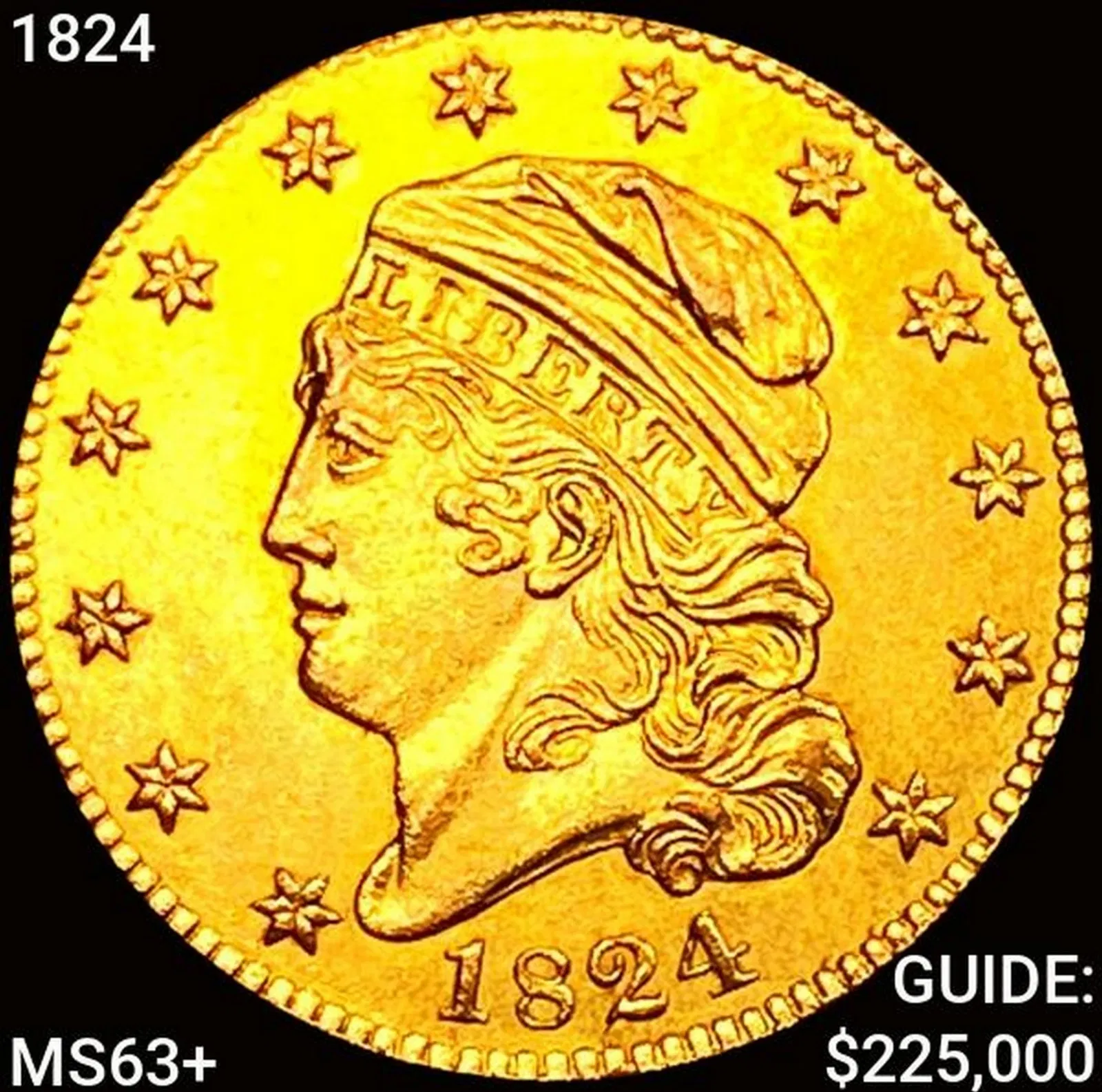
An 1824 $5 gold half eagle. Image courtesy of Gold Standard Auctions.

1824 $5 Gold Half Eagle 

Among the top rare American coins in this event is an 1824 $5 gold half eagle (lot #316682; estimate: USD 20,005 – $30,000). The obverse depicts Liberty’s head in profile, wearing a cap. Thirteen stars encircle her. On the reverse is an eagle bearing a shield, arrows, and an olive branch. This “Capped Head” design was introduced in 1813 and was produced through 1829. For several years, this half eagle was the only American gold coin in circulation. Challenges around access to gold and the metal’s high value abroad led to many of these half eagles being melted down. Surviving half eagle coins in this design are considered particularly rare. 

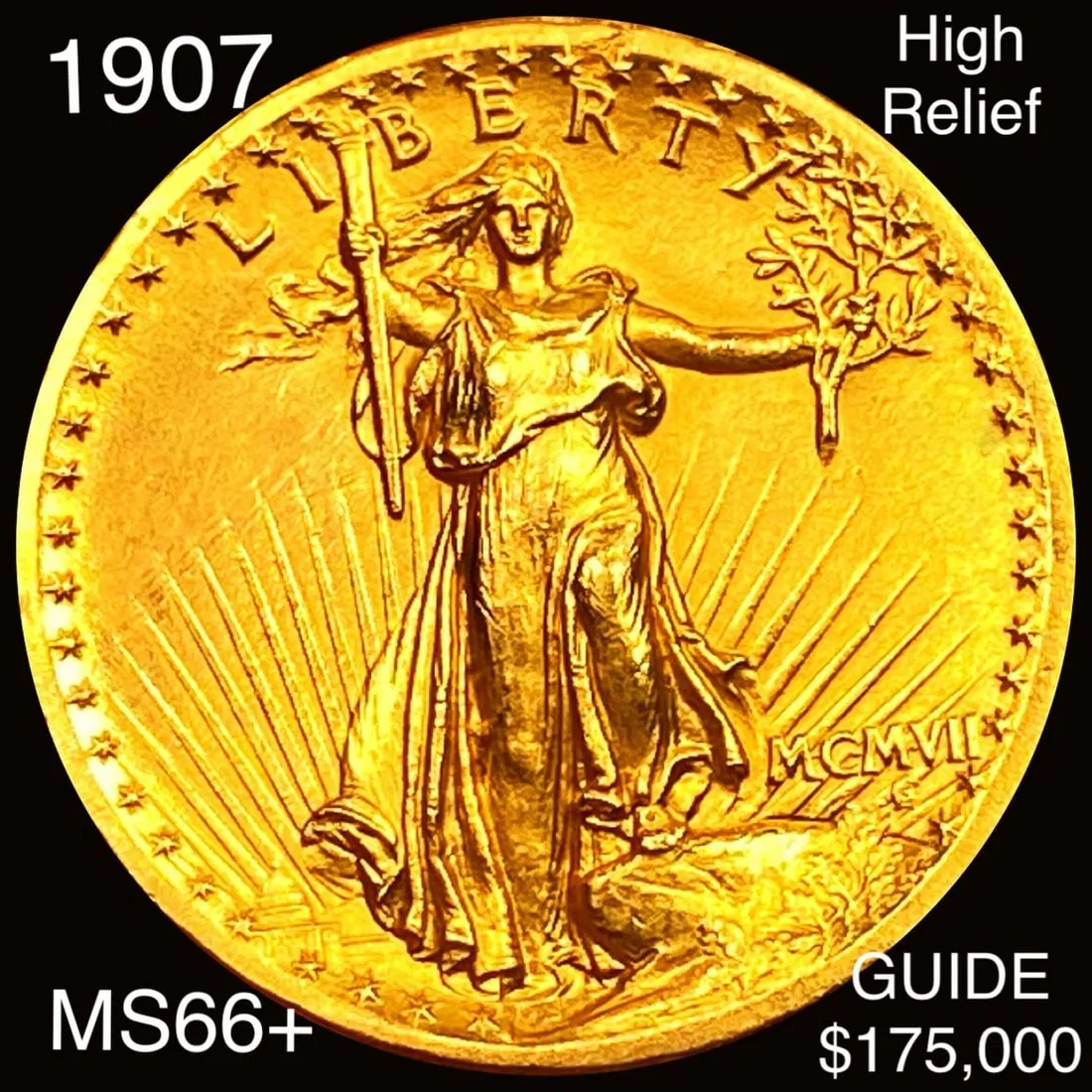
A 1907 high relief $20 gold double eagle. Image courtesy of Gold Standard Auctions.
A 1907 high relief $20 gold double eagle. Image courtesy of Gold Standard Auctions. 

1907 High Relief $20 Gold Double Eagle 

Another rare American coin available in this auction is a 1907 $20 gold double eagle (lot #316696; estimate: $9,505 – $20,000). This coin was designed by sculptor Augustus Saint-Gaudens as part of President Theodore Roosevelt’s project to improve the beauty and artistry of American coinage. The result of Saint-Gaudens’ efforts was a high-relief design showing Liberty stepping forward with a flaming torch on the obverse. The Sun radiates in the background as Liberty’s skirts swirl in the breeze. Saint-Gaudens intended the image to evoke progress in the 20th century. 

The coin’s reverse shows a flying eagle from the side, also backgrounded by the Sun’s rays. This angle was a departure from previous designs, which tended to favor a frontal view of the bird. Unusually, Saint-Gaudens double eagles feature the minting date in Roman numerals, lending the design an antique aspect. 

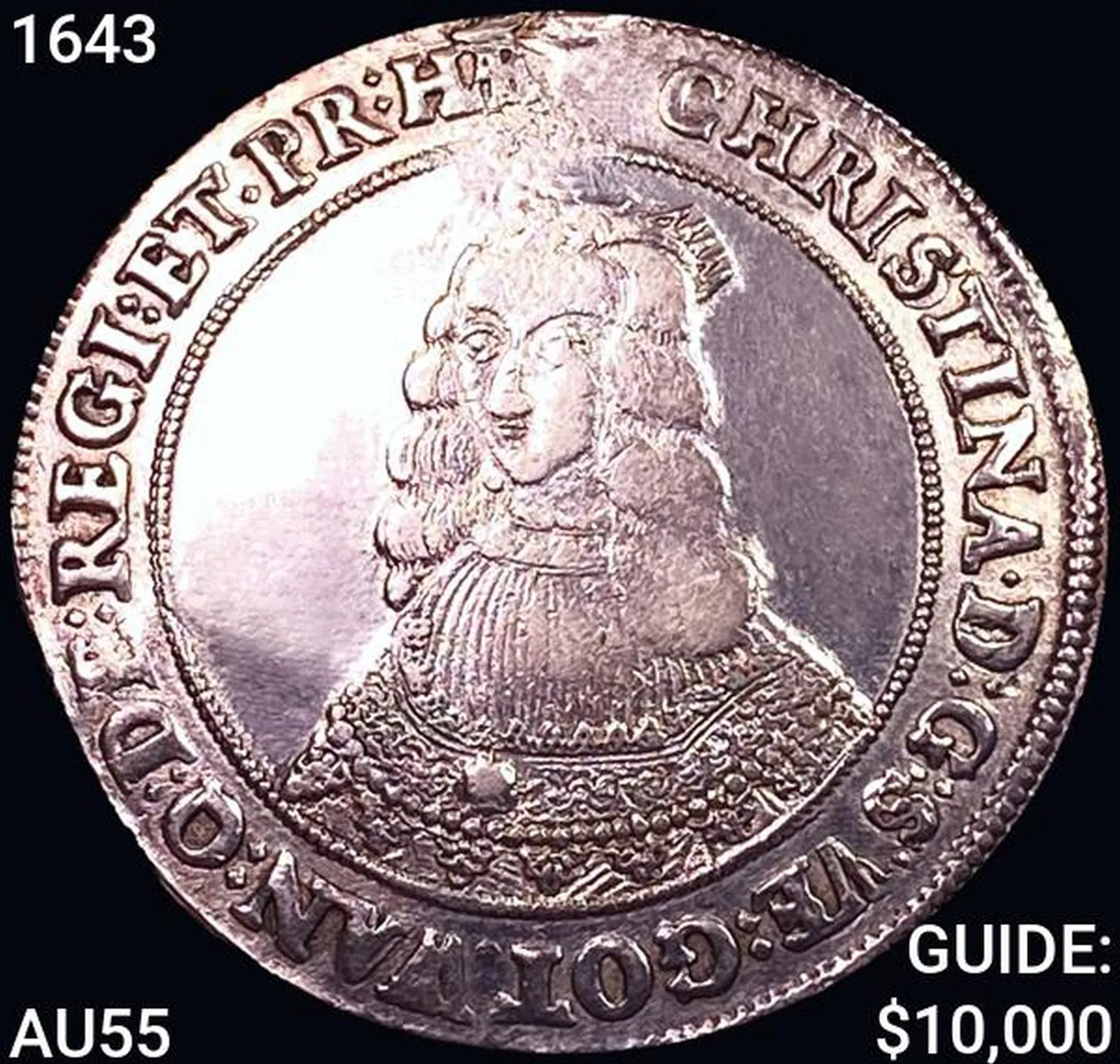
A 1643 silver Sweden 1 RD DAV-4525. Image courtesy of Gold Standard Auctions.
A 1643 silver Sweden 1 RD DAV-4525. Image courtesy of Gold Standard Auctions. 

1643 Silver Sweden Riksdaler

Among foreign currency in the catalog, a 1643 silver Swedish riksdaler coin is particularly notable (lot #316685; estimate: $855 – $11,000). The Swedish svenka riksdaler was first minted in 1604 and remained in circulation until the 1870s, when it was replaced by the contemporary krona. The available riksdaler depicts Queen Christina of Sweden on the obverse. She ruled from 1632 to 1654 and was known for her refusal to marry, unconventional lifestyle, and robust support for the arts. Her likeness appeared on many coins during her rule. This particular example– with Christina appearing on the obverse and the risen Christ on the reverse– was produced for just five years. This coin includes the minted date in Roman rather than Arabic numerals. 

A 1936 Albany half dollar. Image courtesy of Gold Standard Auctions.
A 1936 Albany half dollar. Image courtesy of Gold Standard Auctions. 

1936 Albany Half Dollar 

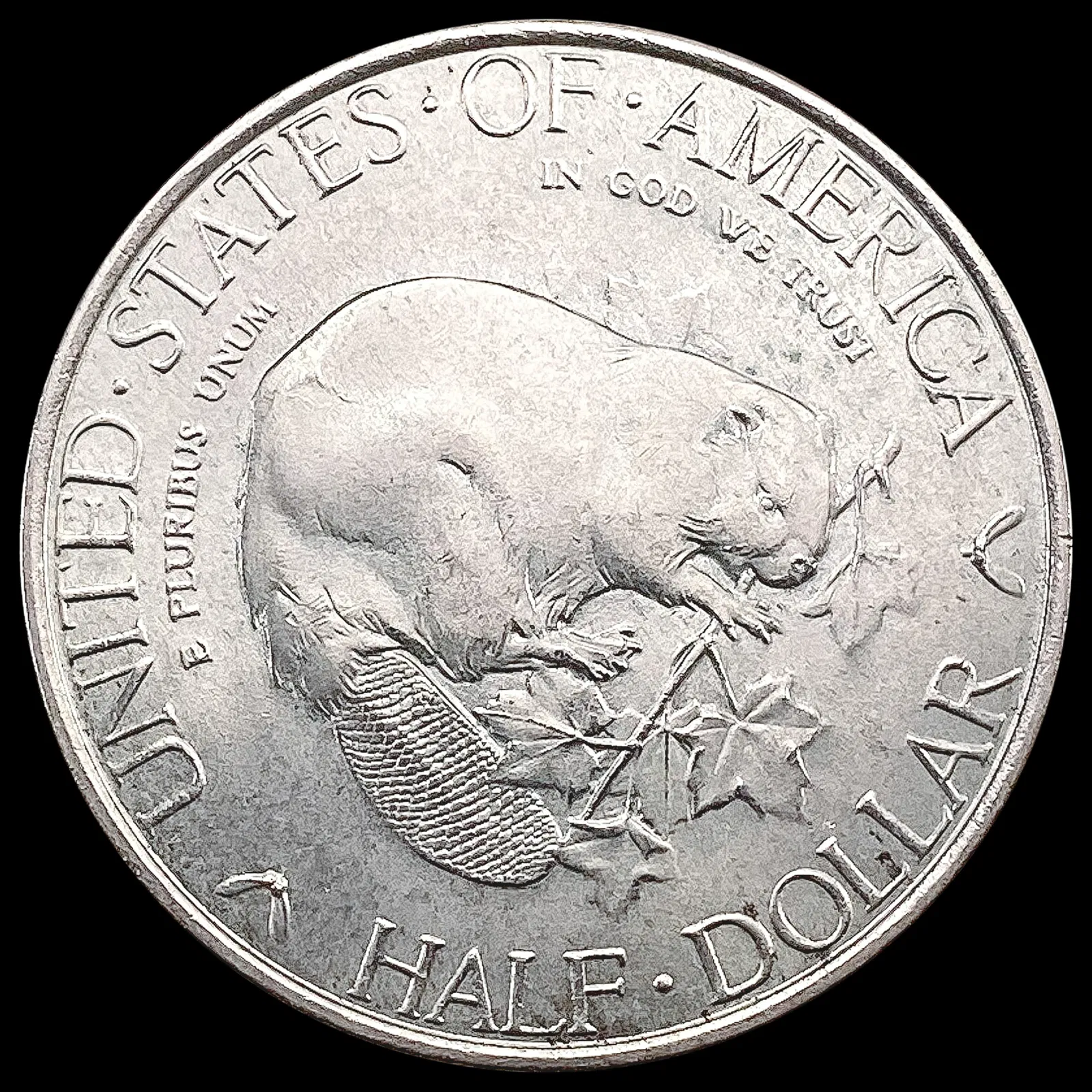
Other unusual coins in the sale include commemorative coins that celebrate notable events in history. This section of the catalog includes a 1936 Albany half dollar (lot #34584; estimate: $165 – $10,000). Sculptor Gertrude K. Lathrop designed this commemorative coin to celebrate the 250th anniversary of Albany’s municipal charter. Lathrop sought to emphasize the local traditions and symbolism of Albany on this coin. The obverse shows a beaver gnawing a maple branch, referencing the city’s early history of fur traders as well as New York’s state tree. Tiny maple keys separate the words “United States of America” and “Half Dollar” around the coin’s edge. On the reverse is a scene from history: New York Governor Thomas Dongan hands a municipal charter to future Albany mayor Pieter Schuyler and Robert Livingston. Lathrop intentionally included many historical details on the coin, studying 17th-century fashion, portraits of the featured founders, the Albany charter document, and a live beaver. The resulting design remains popular among numismatic collectors. 

Other rare coins in the catalog include an 1883 Kingdom of Hawaii quarter depicting King Kalākaua (lot #34569; estimate: $115 – $10,000), a 1921 Missouri half dollar commemorating the state’s centennial (lot #34595; estimate: $175 – $10,000), and a 1915 Panama-Pacific Exposition commemorative half dollar (lot #34454; estimate: $195 – $10,000). 

Gold Standard Auctions’ Seattle Sage Coin Auction will begin at 11:00 AM EST on December 31, 2024. Online bidding and the full catalog is available on Bidsquare

Find Perfect Holiday Gifts at SJ Auctioneers’ Jewelry, Silverware, Toys & Décor Auction on Dec. 29

The auction, starting at 6 pm Eastern time, is loaded with over 200
lots in a wide range of categories. It showcases items by famous names and designers and makers. Bidding is via LiveAuctioneers.com.

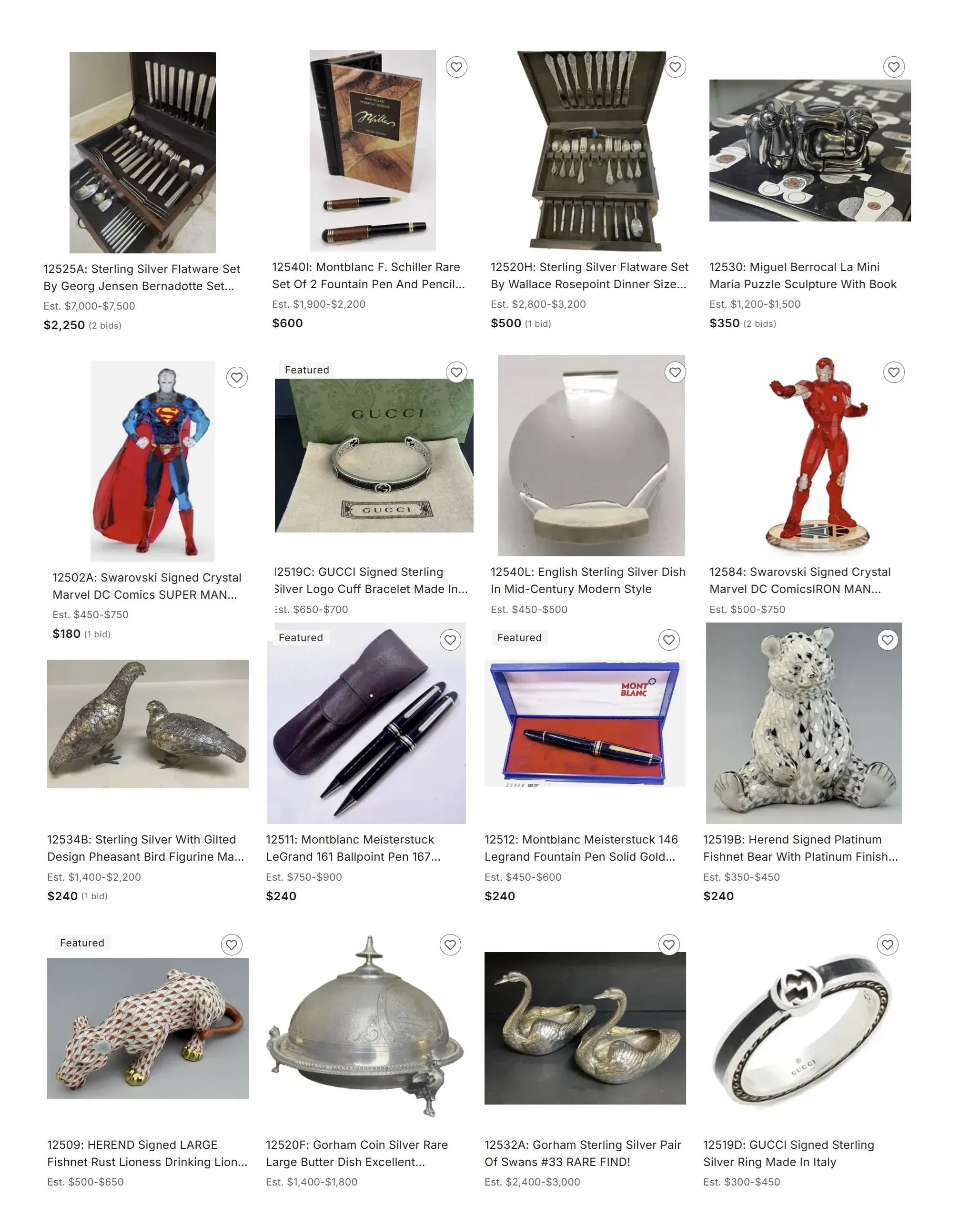
BROOKLYN, N.Y. – Anyone looking for that perfect holiday gift need look no further than SJ Auctioneer’s online-only Jewelry, Silverware, Toys & Co, Buccellati, Bvlgari, Georg Jensen, Louis Marx, Orrefors, Meissen, Versace, Swarovski, Herend, Gucci, Baccarat, Yonezawa, Ichiko, Montblanc. Bidding is available online now, at LiveAuctioneers.com. Pre-bidding is also available, meaning for those who are unable to attend the online auction, they can still leave their bids now. This auction uses Autopay by LiveAuctioneers.com. A link to the catalog is here:

https://www.liveauctioneers.com/catalog/353477_toys-collectibles-jewelry-decor-silverware

Gold Standard Auctions’ December Sale Features Currency, Foreign Coinage, and More

The upcoming Dec 31st Seattle Sage Coin Auction from Gold Standard Auctions features 450 pieces of currency, foreign coinage, and a collection of US coins. It will take place live on December 31, 2024. Online bidding options are available through Bidsquare.

1861 White Metal $5 Clark Gruber K-10 CHOICE PROOF

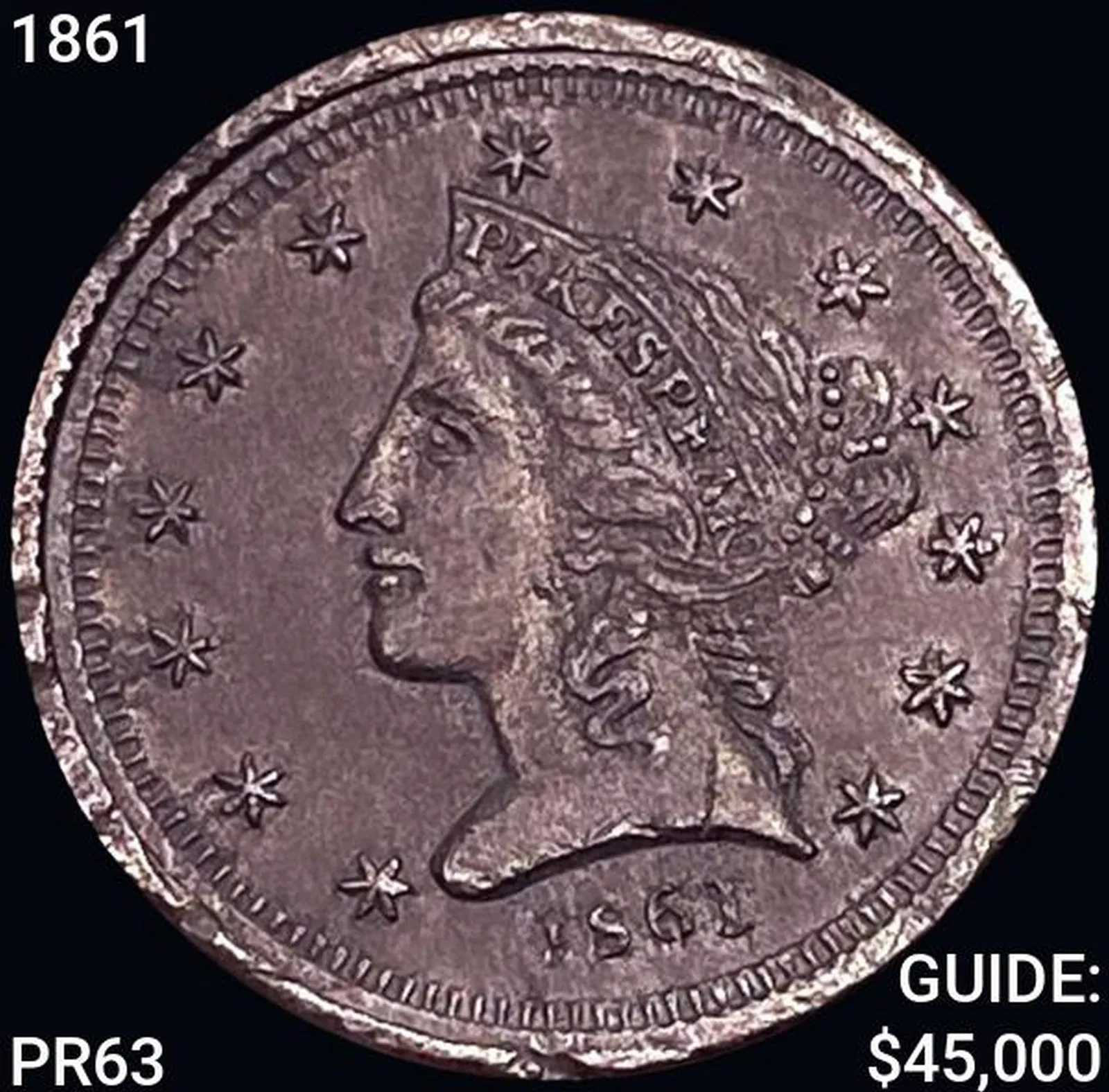
Leading the sale is a Clark Gruber K-10 $5 white metal coin from 1861 (lot #316709; estimate: USD 3,005 – $13,000). By the Kagin reference, this piece represents a K-10, featuring a plain edge with white metal striking of double thickness. A Liberty Head appears with “Pikes Peak” on the diadem. The date (1861) is depicted on the obverse, surrounded by 13 stars. The reverse features a federal eagle, encircled by the words “Clark Gruber & Co. Denver. Five D.” This private company transformed raw gold dust into coinage during the Colorado Gold Rush.

1889-CC Morgan Silver Dollar UNCIRCULATED

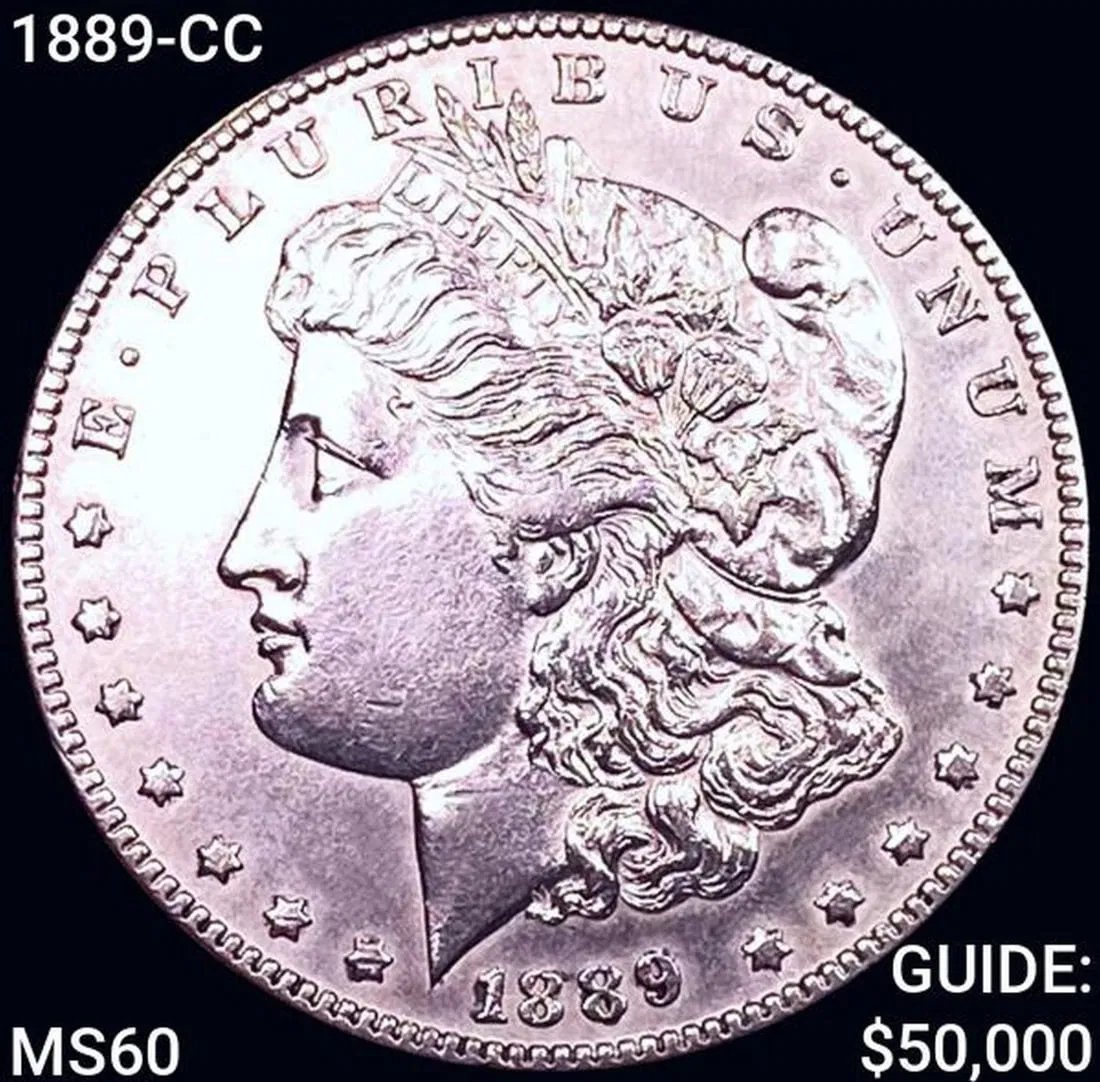
Another notable lot in the catalog is an 1889-CC Morgan silver dollar (lot #316707; estimate: $4,255 – $14,000). Morgan silver dollar coins, such as the 1889-CC dollar, were struck in Carson City as Business (MS) strikes. Despite the low mintage of all Carson City Morgan dollars, 1889-CC silver dollars are by far the rarest. The obverse features Lady Liberty wearing a Phrygian cap, surrounded by stars and the words “E Pluribus Unum.” At the bottom is the date. On the reverse, an eagle is depicted holding an olive branch and arrows, surrounded by olive leaves. The CC mint mark below the wreath indicates Carson City mint. 

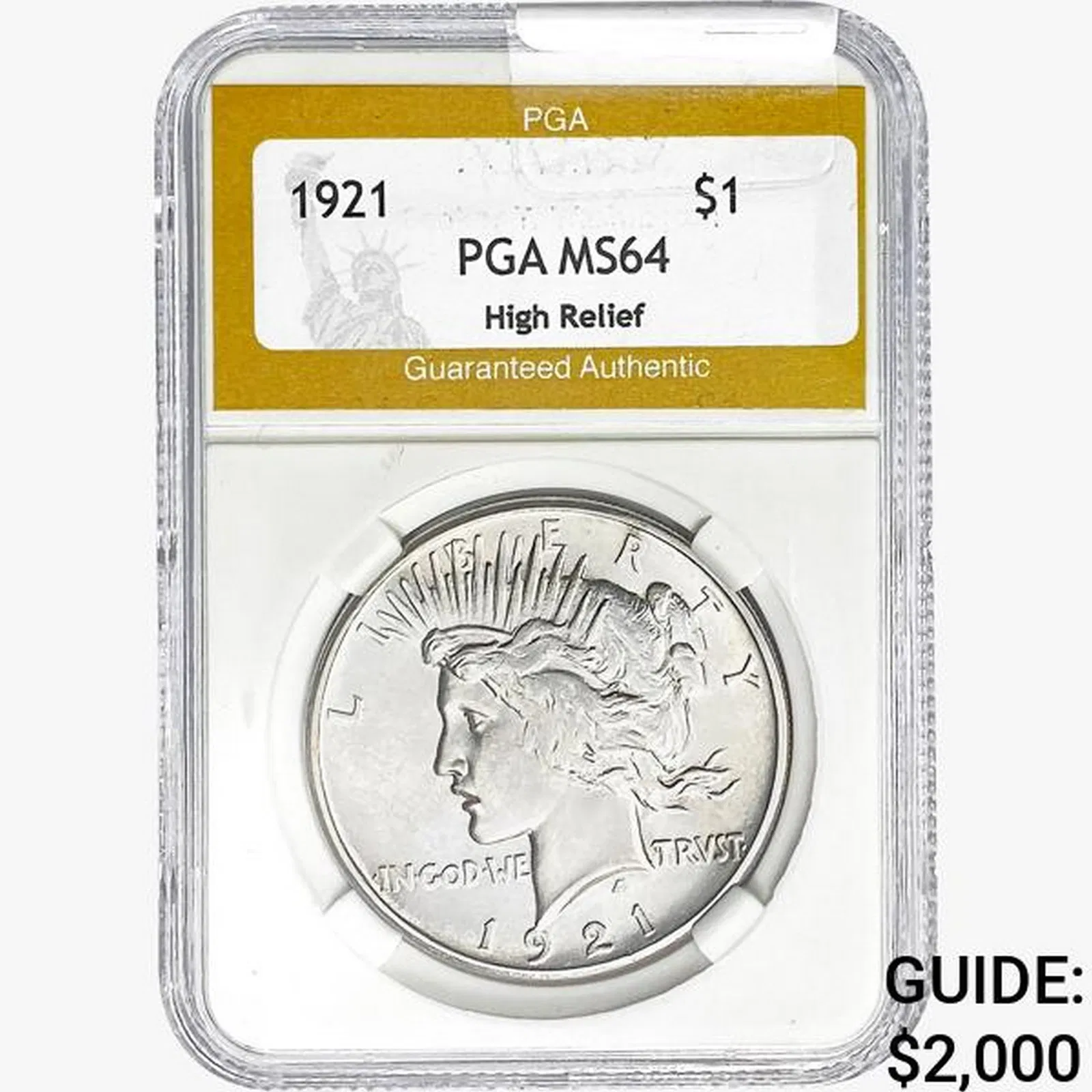
1921 Silver Peace Dollar PGA MS64 HR

A 1921 silver Peace dollar will also be offered (lot #34401d; estimate: $305 – $10,000). The 1921 Peace dollar commemorated peace following World War I. In comparison with later dollars, this one was struck at the Philadelphia Mint in higher relief on both sides. The silver Peace dollar was designed by sculptor Anthony de Francisci and was minted from 1921 to 1928, as well as from 1934 to 1935. A crowned Liberty is featured on the obverse of the coin, with “Liberty; In God We Trust; 1921” inscribed around her. On the reverse is an eagle perched on a rock.

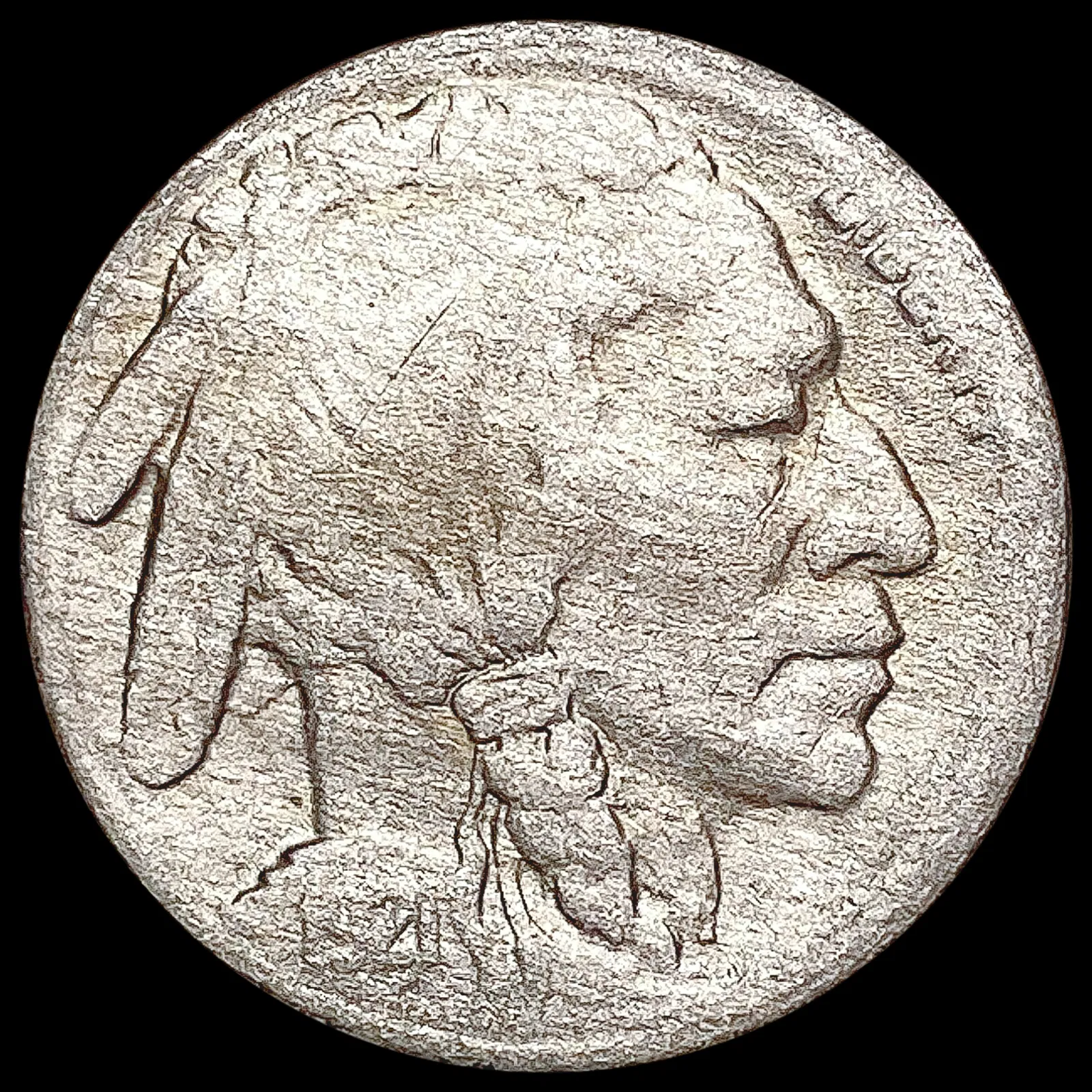
1921-S Buffalo Nickel LIGHTLY CIRCULATED

Also available in the sale is a 1921-S buffalo nickel (lot #34408; estimate: $35 – $10,000). This coin was minted by the San Francisco Mint and designed by James E. Fraser. An image of a Native American is depicted on the obverse. An American buffalo is shown on the reverse of the coin. 

Additional lots of interest include:

  • A lightly circulated Seated Liberty half dollar from 1859 (lot #34405; estimate: $55 – $10,000) 
  • A closely uncirculated 1927 Standing Liberty quarter (lot #34410; estimate: $35 – $10,000)
  • A DWM MS64 Toned 1886-P Morgan silver dollar (lot #34511d; estimate: $$70 – $10,000)
  • A 1936 PGA MS68 York half dollar (lot #34412d; estimate: $155 – $10,000)
  • A set of nine 1956 United States Mint coins (lot #34405s; estimate: $25 – $10,000)

Gold Standard Auctions is an online auction house specializing in rare coins, precious metals, and collectibles. It provides collectors with access to hard-to-find items through reliable and transparent auction practices, while educating the public about monetary history. New technology and exceptional customer service allow Gold Standard Auctions to provide collectors from around the world with quick and convenient sales solutions. The auction house’s mission is to offer collectors everywhere the opportunity to build a collection of the world’s most sought-after collectibles at competitive prices. 

The Dec 31st Seattle Sage Coin Auction from Gold Standard Auctions will begin at 11:00 AM EST on December 31, 2024. To view the complete catalog and register to bid, visit Bidsquare

Auction Review: Special Auction Services’ Teddy Bears of Witney Sale

Antique Teddy bears, especially those with fantastic provenance or rarity, continue to bring top dollar at auction. On December 3, 2024, Special Auction Services of Newbury in the United Kingdom presented its Teddy Bears of Witney Sale. This event featured an impressive collection of cubs and bear-related materials from the personal collection of Ian Pout, the founder of the legendary store Teddy Bears of Witney. This mecca opened its doors in 1985 and was the first retailer in the U.K. to specialize in antique to new Teddy bears. Pout’s inventory included celebrity bears as well as ephemera and materials related to some of the best-known Teddy bear fictional characters of the 20th century. 

Here are some highlights from this anything-but-bear-market sale. All prices noted include the seller’s premium.

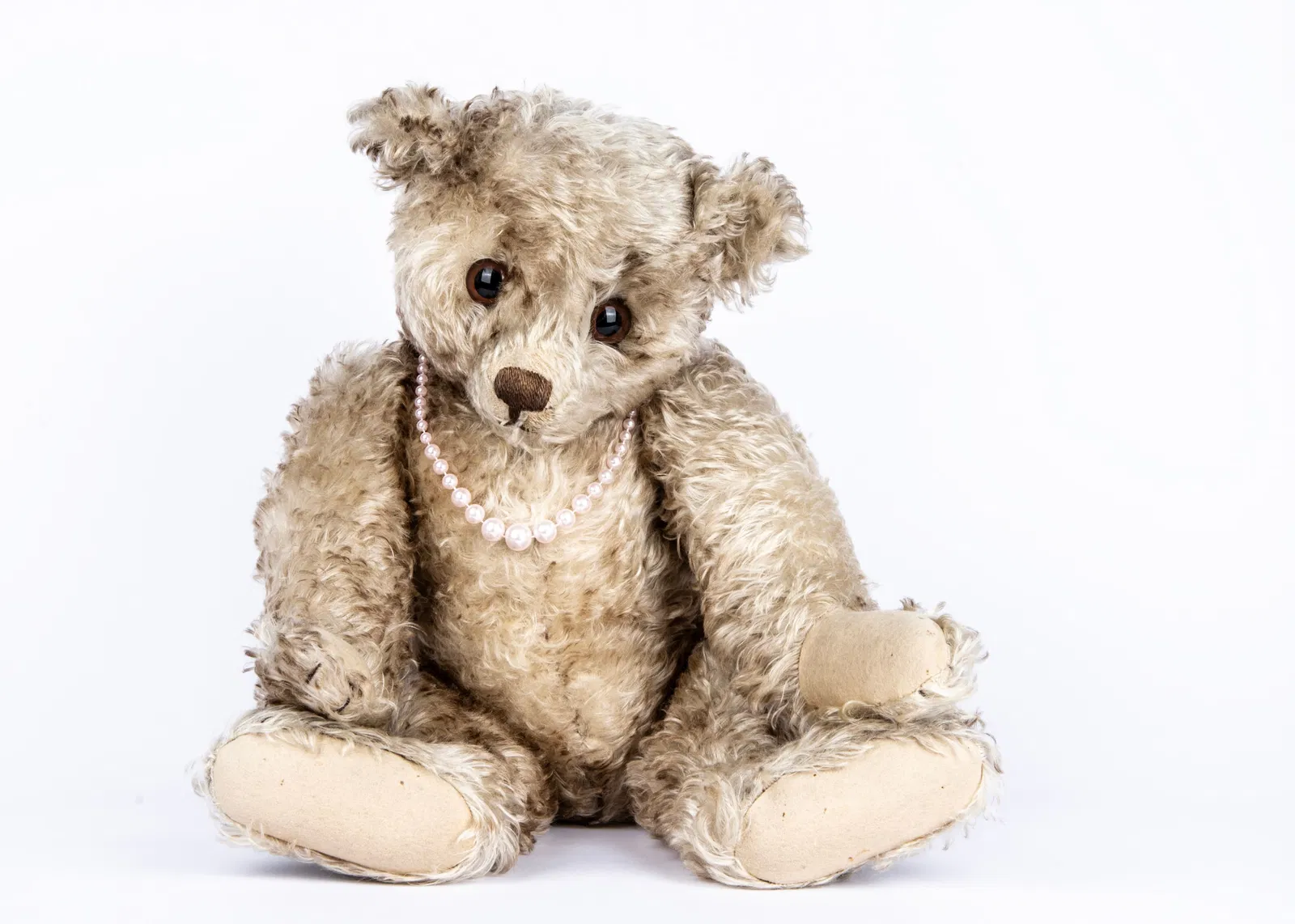
Lot #155, Happy, a brown-tipped mohair Steiff Teddy bear, was estimated at GBP 20,000 to £30,000 and sold for £56,250. Image courtesy of Special Auction Services.
Lot #155, Happy, a brown-tipped mohair Steiff Teddy bear, was estimated at GBP 20,000 to £30,000 and sold for £56,250. Image courtesy of Special Auction Services. 

The top lot in this sale was #155, a brown-tipped mohair Steiff Teddy bear named Happy. She was estimated at GBP 20,000 to £30,000. She sold for £56,250 and generated 19 bids. This fully-jointed 61 cm tall bear from 1926 featured many design details typical to her period of production, including oversized glass pupil eyes, long and soft mohair, a prominent and fuzzy muzzle, long limbs, and hand-embroidered claws and facial features. She retained her long trailing “f” style Steiff button-in-ear as her ID and was sold with a signed copy of the book The Happy-est Bear – A Biography. This book was written and self-published by Rosemary and Paul Volpp– the bear’s previous owners.

It is no surprise that this bear once again made international headlines. In 1989, she was sold at Sotheby’s in London for a new world record price of £55,000. The Volpps worked with a proxy to submit their bids; it is suspected that the underbidder was the British Royal Family. Paul bought Happy for Rosemary as an anniversary gift, which led to her name Happy, as in Happy Anniversary. Happy traveled the world with the Volpps as a goodwill ambassador and fundraiser for charities through 2000.

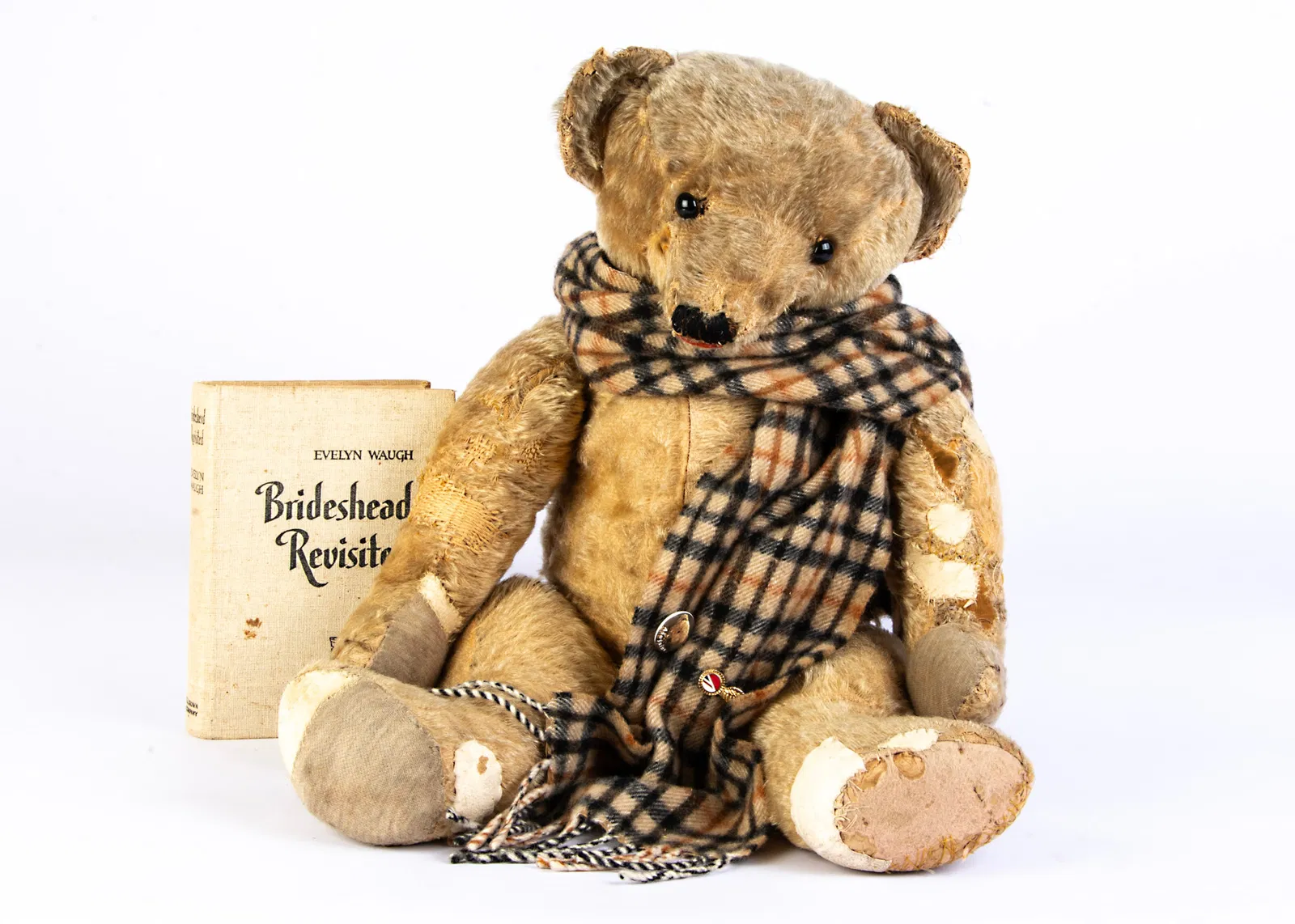
Lot #45, Aloysius, was estimated at £20,000 to £30,000 and sold for £32,500. Image courtesy of Special Auction Services. 

Bears with ties to popular culture also broke through at this important sale. Lot #45, Aloysius, was estimated at £20,000 to £30,000, sold for £32,500, and generated 12 bids. This 64 cm, fully-jointed golden blonde mohair bear was made in America around 1907. He was detailed with simple black glass eyes and felt paw pads and accessorized with a perfectly scaled Daks of London scarf and several decorative pins. Aloysius was sold with a collection of ephemera and related items to his role in the 1981 British TV series Brideshead Revisited, where he was featured as Lord Sebastian Flyte’s Teddy bear. This now legacy series was based on the novel by Evelyn Waugh and is credited in part with catalyzing the spike in Teddy bear collecting throughout the 1980s and 1990s.

Aloysius belonged to British actor and author Peter Bull (1912 – 1984), who also had an impressive collection of Teddy bears. Aloysius was gifted to Bull by Euphemia Ladd from Maine. She mailed the bear to Bull across the pond, noting the bear’s prominent back hump which had developed as he sat on the shelf of her dry goods and grocery store for over four decades. Upon receipt, Bull renamed him Delicatessen in honor of his past. The producer of Brideshead Revisited selected Delicatessen from Bull’s collection to play the role of Aloysius, immediately catapulting him forever into the hearts and minds of bear lovers worldwide.

Lot #248, a letter and drawing from Ernest Shepard, was estimated at £8,000 to £12,000 and sold for £17,500. Image courtesy of Special Auction Services.
Lot #248, a letter and drawing from Ernest Shepard, was estimated at £8,000 to £12,000 and sold for £17,500. Image courtesy of Special Auction Services. 

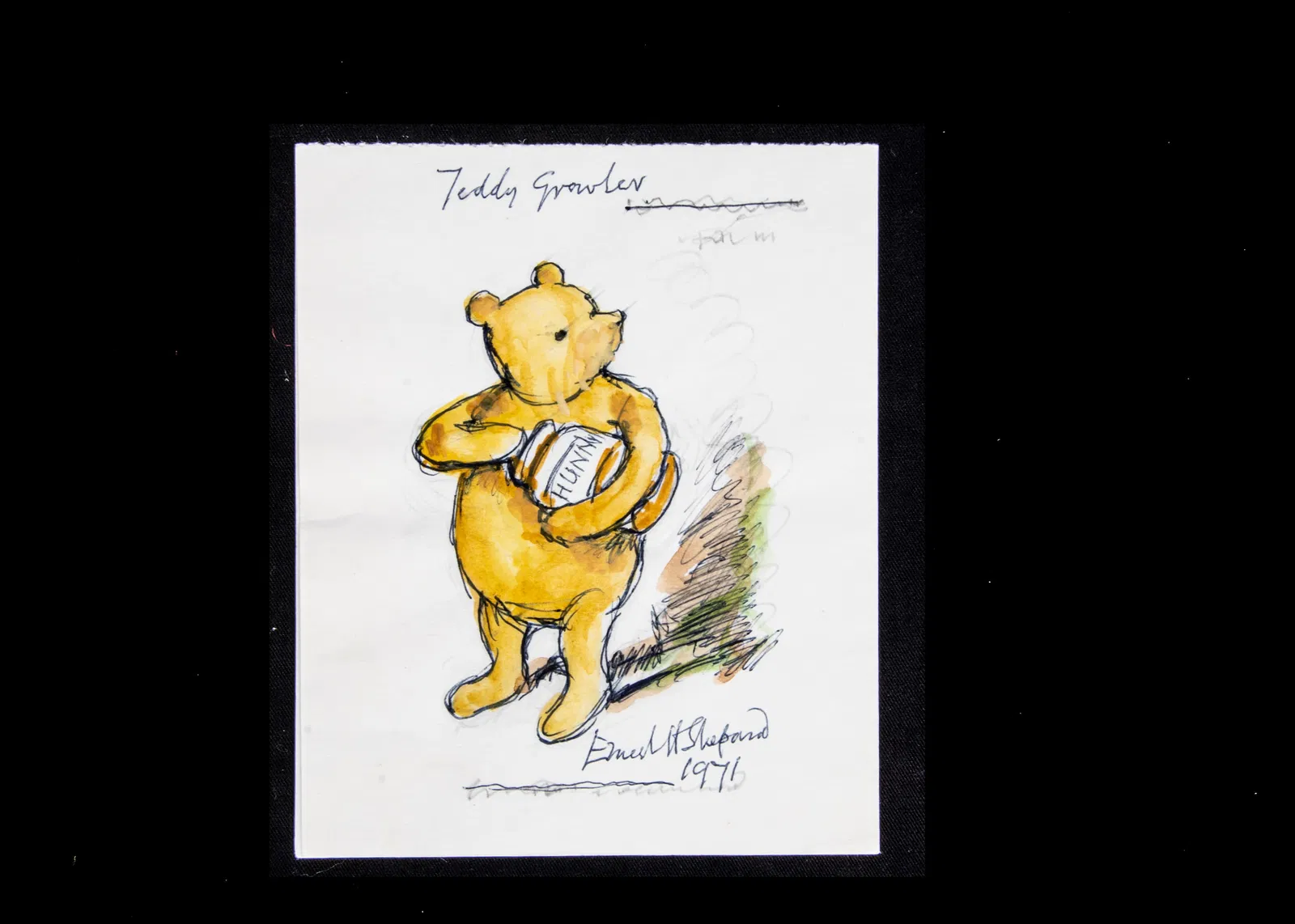
This Special Auction Services event featured a number of important pieces of ephemera related to Teddy bears. Lot #248, a letter and drawing from English artist and book illustrator Ernest Shepard (1879 – 1976), was estimated at £8,000 to £12,000 and sold for £17,500. These materials were from 1971 and included a two-sided handwritten letter, an addressed envelope, and an ink, pencil, and watercolor illustration of a standing bear holding a honey pot.

Ernest Shepard was best known for bringing to life the characters from the Winnie the Pooh series as well as the classic children’s tale The Wind in the Willows. He based his design for Pooh on a Teddy bear named Growler from his own collection. This bear was called Growler because he had a very loud embedded noisemaker in his belly. The letter and illustration were sent to Miss Karena Elphinstone, who had reached out to Shepard by mail to tell him about the history of her Teddy bear named Emma. He responded to her note, penning this letter which gave a full accounting of the history of his Growler and how he became the basis for his interpretation of Winnie the Pooh.

Lot #147, a Schuco Teddy Bear roller toy, was estimated at £600 to £800 and sold for £4,500. Image courtesy of Special Auction Services.

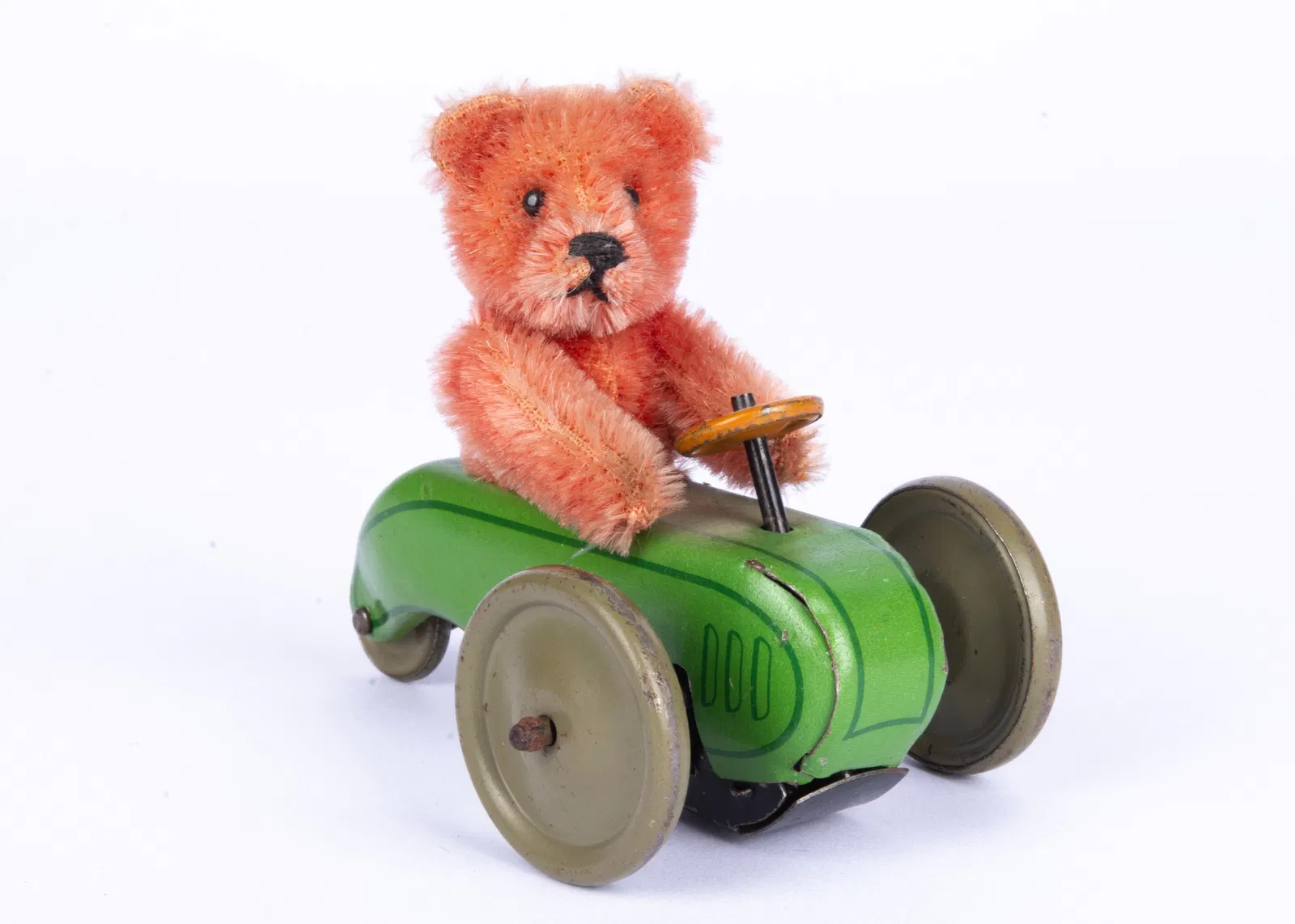
Antique toy novelties featuring Teddy bears in all forms caught the eyes of arctophiles. Lot #148, a Schuco Teddy Bear roller toy, was estimated at £600 to £800 and traded hands at £4,500. This 1920s toy was comprised of a fully-jointed rose pink mohair Teddy bear behind the wheel of a green lithographed tinplate tricycle with a steering wheel. The toy featured a friction drive mechanism and was activated by moving the wheels along a flat surface. This exact example was featured in Pout’s 1996 book, Some of Our Favourite Bears.

Schuco began making toys in the early 1900s and is especially known today for its early prewar clockwork cars, trucks, and other playthings, such as this tricycle. Schuco also produced petitely scaled Teddy bear novelties, including perfume vials, tape measures, compacts, and snuff bottles, often in jewel-toned mohair. These bears had metal heads, limbs, and torsos and were covered in plush, making them extremely durable. This delightfully hued roller toy– the best of the Teddy bear and vehicle worlds– called to Teddy bear, tin toy, novelty, and Schuco collectors, which might help to explain its impressive final price and why it generated 35 bids.

Lot #286, an original pen, ink, and watercolor illustration of Paddington bear by Fred Banbery, was estimated at £400 to £600 and sold for £5,000. Image courtesy of Special Auction Services.
Lot #286, an original pen, ink, and watercolor illustration of Paddington bear by Fred Banbery, was estimated at £400 to £600 and sold for £5,000. Image courtesy of Special Auction Services. 

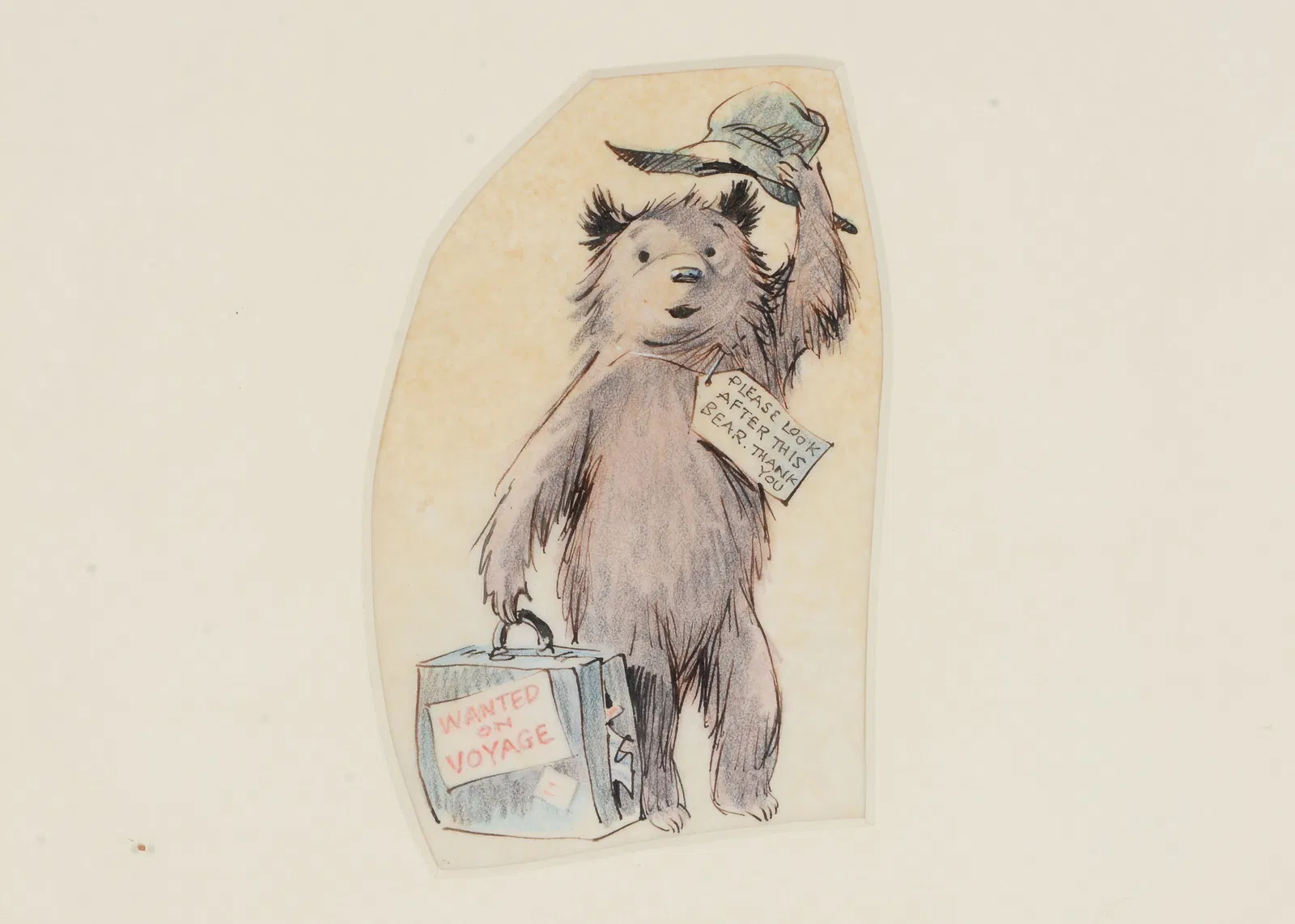
This sale rounded out with fine vintage to antique bears made by companies including Steiff, Chiltern, Dean’s Rag Book, Farnell, Bing, Ideal, Terrys, and Cramer, as well as first edition books, photographs, Teddy Bears of Witney store materials, and other Teddy treats related to famous fictional cubs. Lot #286, an original pen, ink, and watercolor illustration of Paddington bear by British artist Fred Banbery (1913 – 1999) was estimated at £400 to £600 and sold for £5,000. This example from 1975 was titled Please Look After This Bear; a version of this illustration was used on the back cover of Michael Bond’s beloved Paddington Bear, which was published in London by Collins in 1975.

For more information on Special Auction Services’ December 3, 2024 Teddy Bears of Witney Auction, visit LiveAuctioneers

Looking for more Teddy bear auction news? Check out Auction Daily’s recent coverage of the Japan Teddy Bear Association’s 34th Japan Teddy Bear With Friends Convention Charity Auction. 

Morphy’s chalks up $3.7M at Las Vegas auction of coin-ops and antique advertising featuring Rich and Sharon Penn collection

Dec. 5-7 event was led by circa-1905 Ray-O-Lite rifle game, $319,800; Anheuser-Busch Bevo boat auto, $172,200; 1927 Ahrens-Fox fire engine, $129,150; and drug store mortar & pestle sign, $51,550

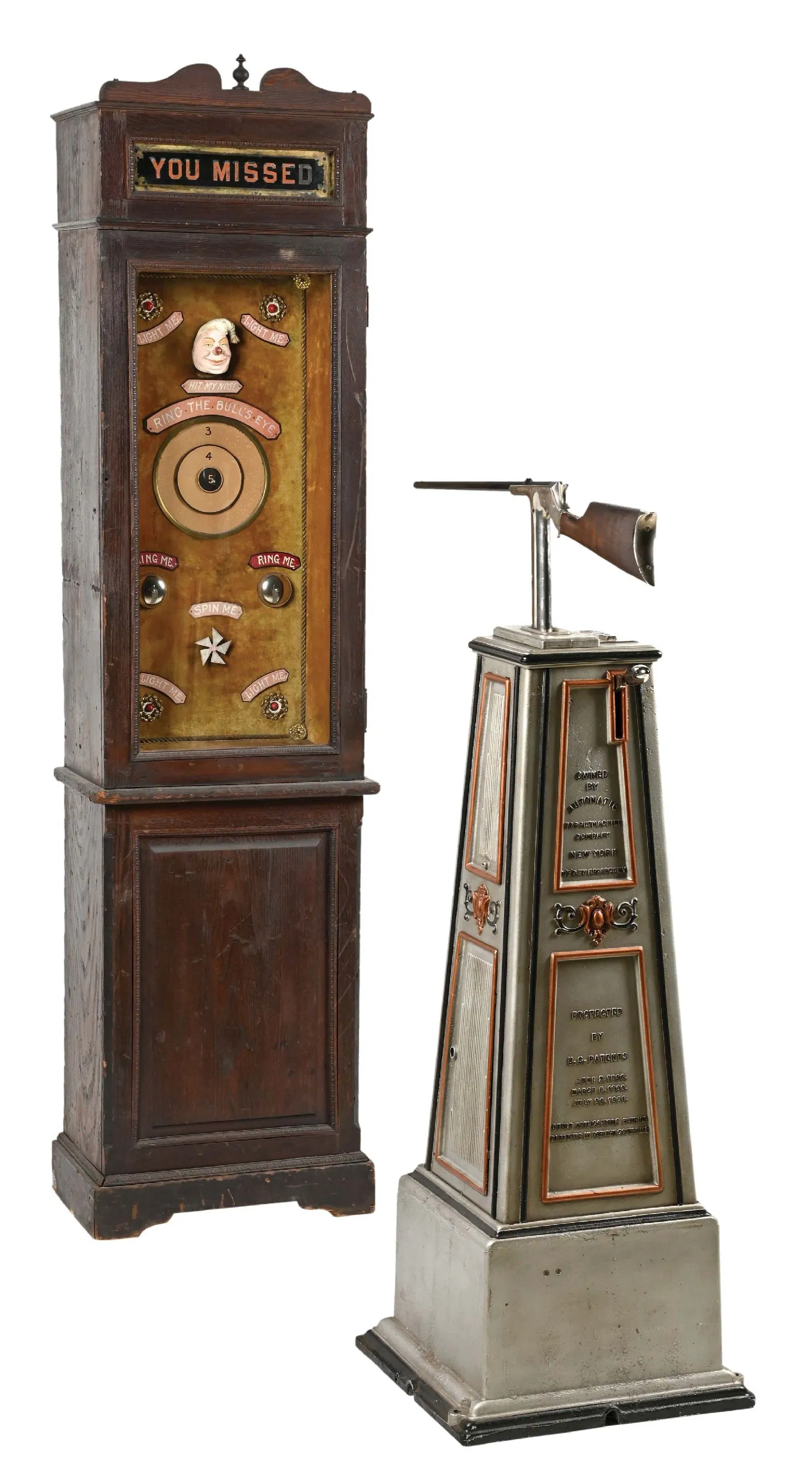
Rare Automatic Target Machine Co. "Ray-o-lite" Rifle Arcade Game
Rare Automatic Target Machine Co. “Ray-o-lite” Rifle Arcade Game

LAS VEGAS, Nev. – Part I of a fabulous personal collection of antique advertising and coin-operated machines amassed over several decades by Rich and Sharon Penn was the special highlight of Morphy December 5-7, 2024 auction in Las Vegas, which grossed $3.7 million. Acknowledged experts within the collecting world, the Penns founded Rich Penn Auctions, an Iowa business that forged a partnership with Morphy’s in May when Rich assumed a key role there as Market Development Officer. 

The Penns’ private collection was described by Morphy Auctions’ founder, president and principal auctioneer Dan Morphy as “unquestionably one of the finest of its type. Every item Rich and Sharon acquired was handpicked with an emphasis on high condition, rarity and eye appeal. Based on what we heard after the debut auction this month, there’s a lot of excitement and speculation about what might be offered in the next installment of antiques from their collection.”

The December event included music, arcade and gambling machines, as well as rare antique and vintage signs promoting a wealth of products from the late-19th and early 20th centuries. Both floor and phone bidders were particularly active during the sale.

The 3-day series was led by a prized holding from the Penn collection: a circa-1905 battery-operated Ray-O-Lite rifle game made by Automatic Target Machine Co. It was an early, especially-rare version powered by a dry-cell battery. Later revamps introduced by William Gent in the 1920s were AC-powered. The auction example had nine unique target features, was in all original condition and retained its additional cord extension. Against an estimate of $100,000-$200,000, it shot to a final price of $319,800. 

Two offbeat transportation lots rolled to six-figure prices at the sale. A 1930 Cadillac “Bevo Boat” manufactured for Anheuser-Busch for promotional purposes and named for its non-alcoholic beverage called “Bevo” is believed to be the only survivor of eight that were in the original fleet. Designed as an inboard-style cruiser on an automobile chassis and boasting luxurious interior appointments, the vehicle’s illustrious line of provenance began with Anheuser-Busch brewery division sales manager Jimmy Carroll Jr. Estimated at $50,000-$150,000, the Bevo Boat cruised to $172,200.

A circa-1927 Ahrens-Fox (Cincinnati, Ohio) Model MX-4 triple-combination pumping fire engine, Serial No. 1314, had undergone a first-class restoration and retained all the gear and appointments that were built with the engine. Painted and labeled for the Bristol Fire Department and ready for action, it blazed to $129,150 against a $50,000-$150,000 estimate.

Well-heeled former hippies were invited to relive the Hendrix concert of their choice in a circa-1960 Volkswagen Westfalia camper, a conversion of the Volkswagen Type 1 sold from the early 1950s to 2003. Restored and roadworthy with a 4-cylinder standard transmission and odometer reading of only 6,598 miles, it was fitted with standard birch plywood interior panels, laminated plywood cabinetry for storage, an icebox or cold-box; a sink, water storage and a pump; electrical hookups, and seating that folds out for sleeping. Estimated at $20,000-$60,000, it took a trip across the auction block to finish at $49,200.

A witness to everyday life in the thriving city of St Louis, Missouri a century ago, an original wood horse-drawn, spoke-wheeled delivery cart for Pevely Dairy Co., Grand & Chouteau (street address), displayed its original yellow paint and attractive applied lettering. Remarkably, it still had its original interior seat, bench and fittings. Against an estimate of $1,000-$5,000, it sold for $19,200.

Two neon signs, in particular, lured advertising collectors during the second session. A circa-1930s single-sided porcelain with original neon-skin sign advertising “Rifle Range” was hard to miss with its good-looking crossed long gun graphic and impressive width of 10ft 8 inches. Estimated at a modest $2,000-$4,000, it was chased by multiple bidders who pushed it to a final price of $27,060 – almost eight times its high estimate. 

An atmospheric Ozark Court double-sided neon sign from the office of a “tourist court” (precursor to a motel) was maker-marked “West Gate Neon” and emblazoned with the image of a leaping deer and conifer tree. Measuring a full 8ft by 6ft, it bounded to $20,400 against an estimate of $500-$2,000.

It is said that Andy Warhol invented the selfie. Another of his innovations, photo-strip art, is said to have been created in an Auto-Photo Model 14 coin-operated photo booth just like the one entered in Morphy’s Vegas sale. Made to accept quarters, the Model 14 booth was designed in Los Angeles in 1958 and manufactured until 1974. Only a few dozen examples of its type are currently believed to be publicly available. Presenting in all-original condition, including its original signage and advertising, the auction lot sold for $28,905 against an estimate of $2,000-$4,000.

Three of the top-finishing signs from the Penn collection kept bidding cards airborne during the sale’s closing session. A circa-1910s “Corner Drug Store” leaded-glass light formed as a mortar and pestle, with a multicolored “jeweled” center and bearing the words “Cigars” and “Prescriptions,” achieved $51,660 against an estimate of $15,000-$30,000. 

Next in the trio was a stunningly beautiful circa 1910s-1920s reverse-glass corner sign, backlit and advertising “Round Oak Stoves, Ranges and Furnaces,” with a Native American graphic within an oak-leaf cartouche. It sold for $26,445 against an estimate of $8,000-$16,000. 

And finally, all eyes were fixed on an outstanding circa-1910s light-up figural optometrist sign with the message “Dr. Blakey / Eyes Examined / Glasses Fitted.” Visually compelling with its reverse-painted eyeglass lenses encircling images of lidded, lash-bordered eyes, the 64-inch by 36-inch piece more than tripled its high estimate, reaching $19,680.

Other notable lots included a circa-1910 Mills Novelty Co., Dewey upright 5-cent slot machine with original music, $20,910 against an estimate of $12,000-$24,000; and a circa-1902 Caille Bros., 5-cent “Search Light” cast-iron counterwheel trade stimulator in the original operator’s woodgrain paint. With its original reel, back door and rotating base, it sold for $19,200 against an estimate of $5,000-$10,000.

To discuss consigning coin-op or gambling machines; antique advertising or general store antiques to a future auction conducted by Morphy’s, please call 877-968-8880 or email [email protected]. Visit Morphy’s online at https://www.morphyauctions.com. All enquiries are kept strictly confidential and there is never an obligation to consign.
Robinhood Auctions Presents Artworks by Marc Chagall, Salvador Dali, Victor Vasarely, and More

Over 1,000 lots of posters, prints, multiples, and other fine artworks will soon come to auction with Robinhood Auctions in the Contemporary Horizons sale. Scheduled for December 19, 2024, the sale includes work by legendary artists, including Pablo Picasso, Salvador Dalí, and Mr. Brainwash, as well as visionary masters like Marc Chagall, Peter Max, and Patricia Govezensky. 

Marc Chagall (1887-1985), "Dan" Framed Limited Edition Serigraph with Certificate of Authenticity
Marc Chagall (1887-1985), “Dan” Framed Limited Edition Serigraph with Certificate of Authenticity

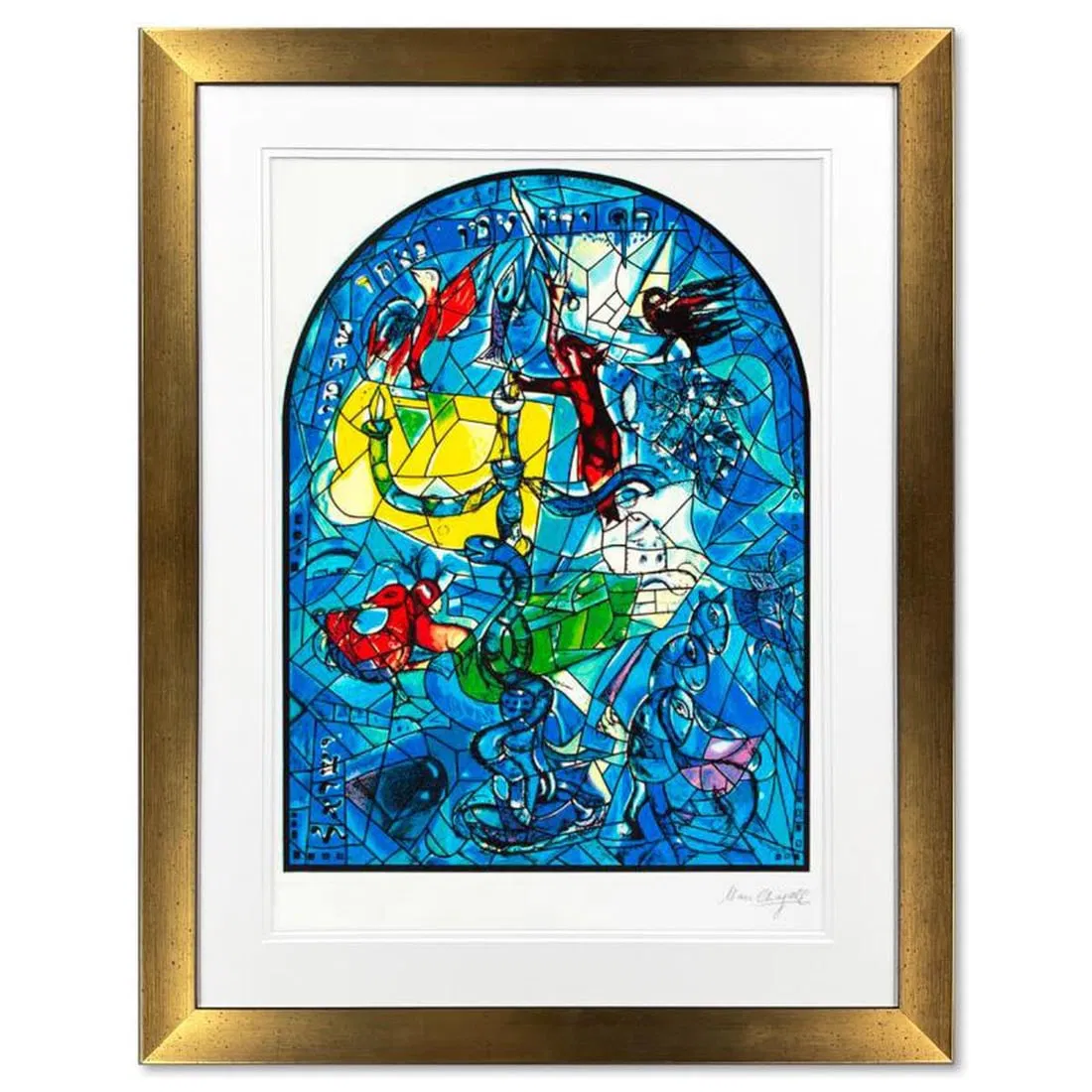
Leading this auction is Marc Chagall’s Dan, a limited edition framed serigraph on paper work (lot #359; estimate: USD 1,776 – $2,220). Chagall derived inspiration from Jewish life, biblical stories, and Russian folklore. Chagall designed this image in 1964 following his work on the Jerusalem synagogue’s stained glass windows. Dark blue dominates this composition centered around a three-branched candelabrum. A diffused yellow area is created by its flaming lights in between red animals, balanced by the green space beneath. There is a horned viper entwined around the candelabrum, striking suddenly, frightening horses. Among the candelabrum’s branches stands a vermilion lion cub. In his right hand, symbolizing justice, he carries the sword of war that acts as a scale beam.

Salvador Dali- Original Color Woodcut on B.F.K. Rives Paper "Paradise 14"
Salvador Dali- Original Color Woodcut on B.F.K. Rives Paper “Paradise 14”

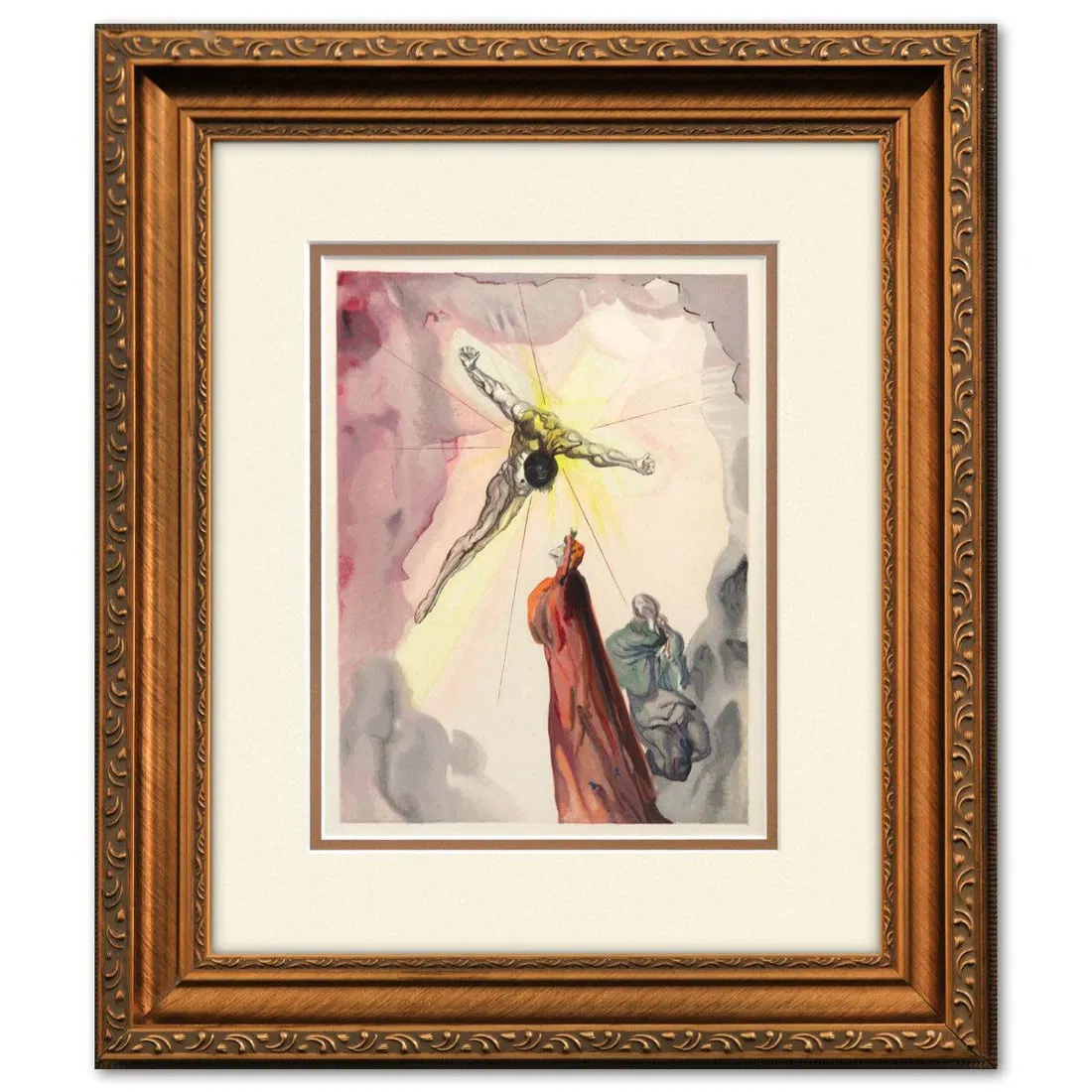
Another notable work in the catalog is an original color woodcut of Salvador Dalí’s Paradise 14. (lot #72; estimate: $1,485 – $1,856.25). An important figure in the early 20th-century Surrealist movement, Dali pushed the boundaries of creativity and challenged accepted ideas. His work is characterized by a sense of mystifying symbolism and meticulous detail. Paradise 14 depicts the Apparition of Christ, part of a series of 100 engravings depicting Dante Alighieri’s Divine Comedy. It was published by Les Heures Claires, Paris.

Victor Vasarely- 3D Wall Sculpture/object "Cinetiques"
Victor Vasarely- 3D Wall Sculpture/object “Cinetiques”

Beyond fine art, this sale will feature a three-dimensional wall sculpture of Victor Vasarely’s Cinetiques from circa 1973 (lot #122; estimate: $780 – $975). A sculptor and painter recognized as the father of Op Art, Victor Vasarely’s contemporary works are often characterized by geometric shapes and bright colors that create a sense of depth. From the portfolio Vasarely Cinetiques, the offered piece was published by Edition Du Griffon Neuchatel and printed in Switzerland. Also available is a 1975 heliogravure print from Vasarely with a signed letter of authenticity from the artist (lot #75; estimate: $264 – $330).

Additional lots of interest in this sale include:  

  • Nachum Gutman’s Small Carriage, an original lithograph, numbered and signed by the artist (lot #5; estimate: $180 – $225)
  • Andy Warhol’s Queen Elizabeth II of the United Kingdom 335 from Sunday B Morning, a silkscreen on museum board, accompanied by a certificate of authenticity (lot #9; estimate: $2,400 – $3,000) 
  • Poppies Vase, a David Gerstein free-standing sculpture (lot #59; estimate: $336 – $420) 
  • A limited edition silk screen print on paper of Mr. Brainwash’s Love Above All (lot #111; estimate: $3,492 – $4,365) 
  • SHOPPERS IN MAMILA A, a mixed-media aluminum cutout (lot #48; estimate: $11,200 – $14,000) 

Based in Las Vegas, Robinhood Auctions is an online auction house that offers fine art, collectibles, and jewelry sales. A wide range of items is available through Robinhood Auctions, including sculptures, paintings, limited editions, and collectibles. Many well-known artists are represented in the company’s inventory, such as Salvador Dalí, Pablo Picasso, and Marc Chagall. Approximately two weeks before an auction, a listing is posted for bidders to investigate and ask questions. Buying items through Robinhood Auctions is easy through either the website or the app. Live bids or advance bids are both available. Bidding requires registration by clicking “Register to Bid” next to the item or catalog. The items sold at Robinhood Auctions come with a money-back guarantee. Clients are also provided with information to aid in decision-making.The Contemporary Horizons sale at Robinhood Auctions will begin at 1:00 PM EST on December 19, 2024. To view the complete catalog and register to bid, visit Bidsquare. Find more auction previews on Auction Daily. 

George Loudon Exhibits His Cabinet of Curiosities in Venice

This London-based collector is particularly fascinated by the objects, illustrations and educational aids used to teach the natural sciences in the 19th century. Part of this collection of 300 pieces is to be exhibited in Venice.

How did your collection come about?
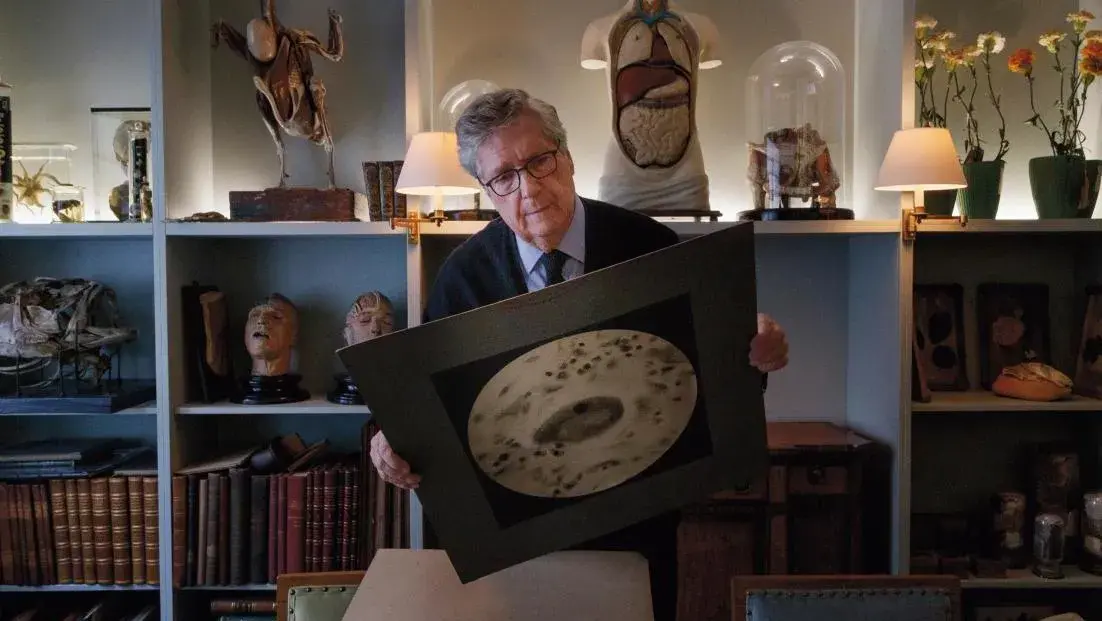
I’ve always been a collector, but I never consciously chose a particular field: I just began collecting. As a child, my love of woodwork led me to collect objects connected with this art. At university, my interest turned to the caricatures of James Gillray and Thomas Rowlandson. When I lived in Indonesia from 1969 to 1971, I became fascinated by Ming Chinese ceramics. I began collecting seriously in the late 1970s, while working in the banking sector. With help from a Dutch artist friend, I decided to focus on young contemporary artists, which fuelled my need for something visible and concrete I wasn’t finding in my work.

How did you move into the world of cabinet of curiosities?
I used to describe my collection as a leisurely trip down a river, looking to left and right at what was happening on either bank, selecting an artist here and there and accepting that I might miss an important one hidden among the others. I’d say it was like “taking the outer curve of the river, looking for deep water”, trying to acquire difficult works often lying around unsold in a gallery’s storeroom. I wasn’t really looking for a new area of collecting. It just happened. I confess I gradually lost my enthusiasm for contemporary art when I felt I really wanted to know more about science. So I read a lot of books by and about Darwin, Wallace, Cuvier, Lamarck, Bates, Haeckel and so on. And I was struck by some of the visual elements, illustrations and models these 19th-century scientists used for presenting their discoveries. I was dazzled by the beauty of some of them, and I began to search for this kind of thing in museum and university storerooms. Over the years, I must have visited around 50 in different countries: all fascinating places. I focused on what was produced in the 19th century for teaching — educational material on the life sciences — and on pieces I found aesthetically pleasing or that had a particularly interesting history.

What are your outstanding pieces, and your favorites?
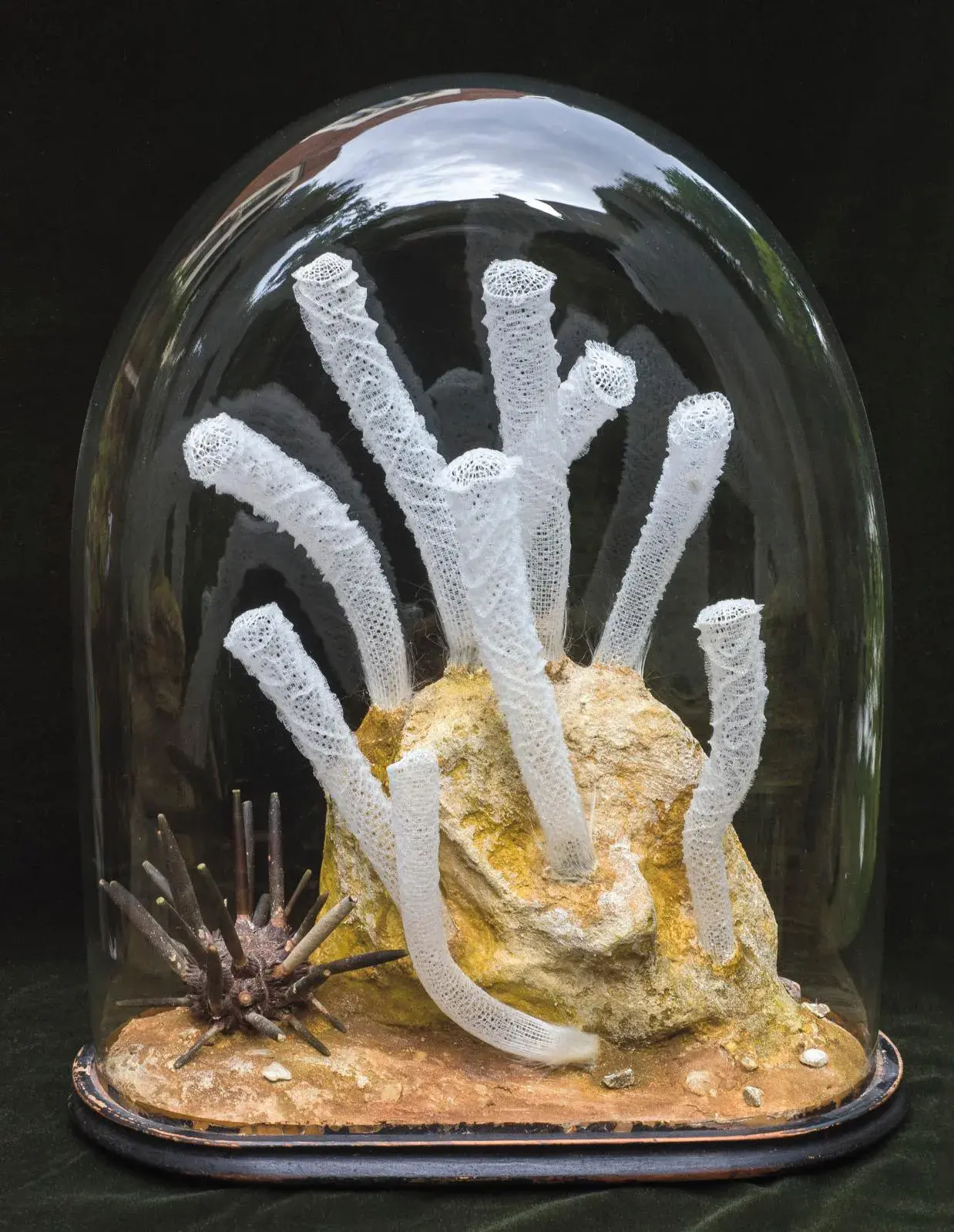
My first purchase was a set of display stands for teaching children in French primary schools. Entitled “Leçons de choses” (“Object Lessons”), it was designed by one Mr. Pitoiset, and this became the title of my book, published in 2015. My pride and joy are my two glass Blaschka pieces: the man o’war jellyfish and the Serpulidae model. Leopold Blaschka and his son Rudolf were German glassworkers famous for their glass representations of invertebrates (species that are difficult to preserve because they lose their color) and flowers for the Harvard Museum of Natural History. I also love Robert Brendel’s botanical models, various globes from Japan, some wax models of plants and fruit from Northern Italy and a set of Japanese fish paintings. We know relatively little about the creators of these objects. It’s rare for the illustrator of a 19th-century publication to be mentioned when people talk about a life science book or teaching material. I love the way designers grappled with different and sometimes new techniques and materials, from wax casting to cyanotypes.

How is the cabinet of curiosities market faring?
It’s not easy to find these objects. There are very few dealers specializing in this field. Any schools and universities that used them in the 19th century no longer do so. They are usually not allowed to sell them, anyway. I spent a lot of time visiting the storerooms of schools, universities and museums, to get an idea of what was made in the 19th century and what I should be looking for. But finding material is largely a matter of luck, and the people you know. Getting the opportunity to buy an object is a rare event, crowning a long and arduous quest. Art dealers who manage to obtain them have a limited stock, which they can only replenish with difficulty. Pieces appear by chance in medium-sized auction houses, as the larger ones have moved upmarket. So it’s a niche market, with little information circulating about it. This can be an advantage for collectors.

Your collection will soon be on show at the Palazzo Grimani in Venice: how will it be displayed?
The Palazzo Grimani provides an ideal setting, because of its historical link with Giovanni Grimani, a famous collector who had an encyclopedic interest in art and science. I gave the curator, Thierry Morel, carte blanche to work on my collection. He was assisted by Flemming Fallesen in designing the circuit. This aims to create a bridge between past and present, and a sensory experience that is both evocative and surprising, offering visitors a unique pathway to connect with history, nature and art. The public will start by entering a 17th-century princely cabinet, as it existed in the Palazzo when the Grimani family lived there. When they look at the ceiling decorations, they will immediately realize that my interests echo those of the Grimani family over four centuries ago.

Part of the exhibition is devoted to reconstructions of two Wunderkammer. What does the concept of “cabinet of curiosities” mean to you?
A “cabinet of curiosities” literally embodies the ideals of collecting in the Renaissance and Baroque periods: a time when art, science and the natural world were seen as interconnected. Voyages of discovery had brought astonishing, unfamiliar objects back to Europe. These cabinets were not only collections, but also mirrors of the collector’s mind. They ran counter to our modern tendency for specialization, with the idea that everything in the world is interconnected and can interact. Essentially, a cabinet was a material representation of a collector’s mind, aspirations and dreams. It was a truly personal space, where each object resonated with their inner world.

What would a 21st-century Wunderkammer look like?
It would be difficult to create one because, in theory, there would be nothing unknown, no real surprises regarding the precious objects on display. Perhaps objects from outer space? Or from the depths of the ocean? The real wonder would certainly come from the way the objects were presented: a job for curators like Thierry Morel.

Worth Seeing
“A Cabinet of Curiosities. A Celebration of Art and Nature.
The George Loudon Collection”
Museo di Palazzo Grimani, Venice
December 15, 2024 to May 11, 2025
museiveneto.cultura.gov.it