János Vaszary, Biography & Art

János Vaszary, education & influences

János Vaszary was active during the 1880’s to 1930’s. He was known for using wide a wide variety of color, combining technique and imagination to create outstanding artworks that during their time, were considered on the forefront of modernism. His style was constantly changing, evolving, and experimenting, ranging from Art Nouveau, Fauvism & Post-Impressionism. He dedicated his life to his art, studies, and teaching.

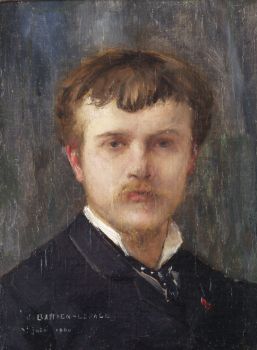
Vaszary began his formation at the Hungarian University of Fine Arts, studying under János Greguss. Later, he was taken under the wing of the great Hungarian painter, Bertalan Székely, spending several years studying his techniques. In 1887, like many other Hungarian painters of this period, he went to further his training in Munich. Inspired after seeing an exhibition of Jules Bastien-Lepage’s paintings, he moved to Paris in 1899, ending his official studies at the renowned Julian Academy of Paris.

In his art, one can see that Vaszary was primarily influenced by his French masters, Bastien-Lepage and Puvis de Chavannes. However, the artistic colony of Nagybánya also played a role in the evolvement of his works. This was a group of artists led by Károly Ferenczy, who is considered the “father of Hungarian impressionism and post-impressionism” and the “founder of modern Hungarian painting,” also one of the many artists who had studied in Munich roughly around the same time as Vaszary.

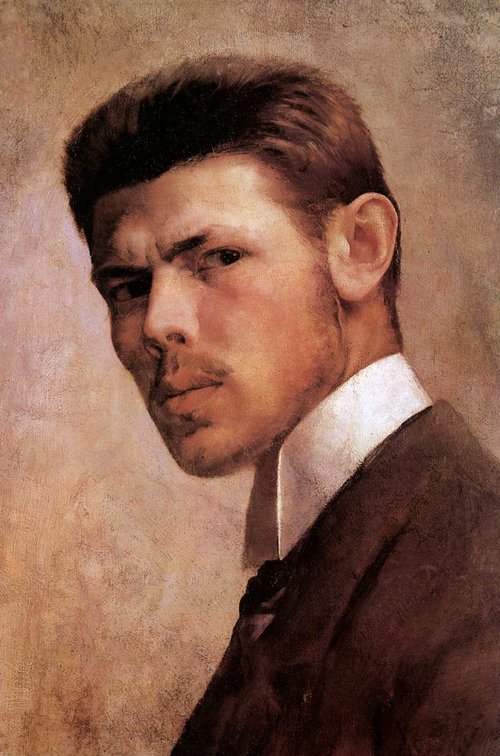
Vaszary, Self Portrait & Self Portraits from His Masters
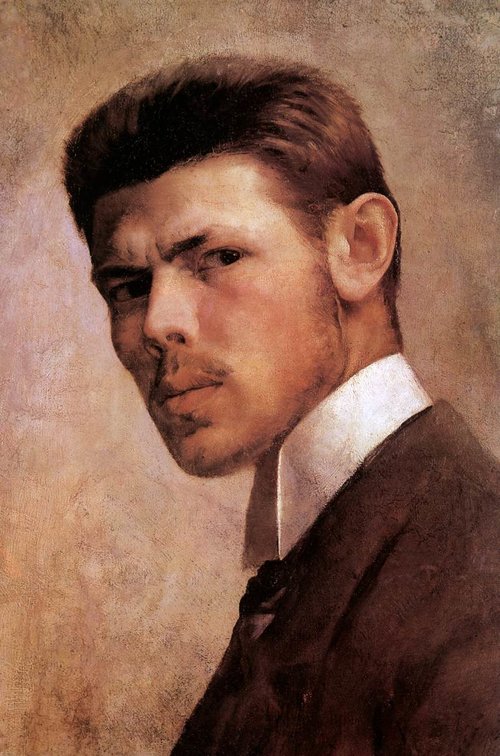
János Vaszary, Self Portrait
Bastien-Lepage Self Portrait
Puvis de Chavannes, Self Portrait
Károly Ferenczy, Self Portrait

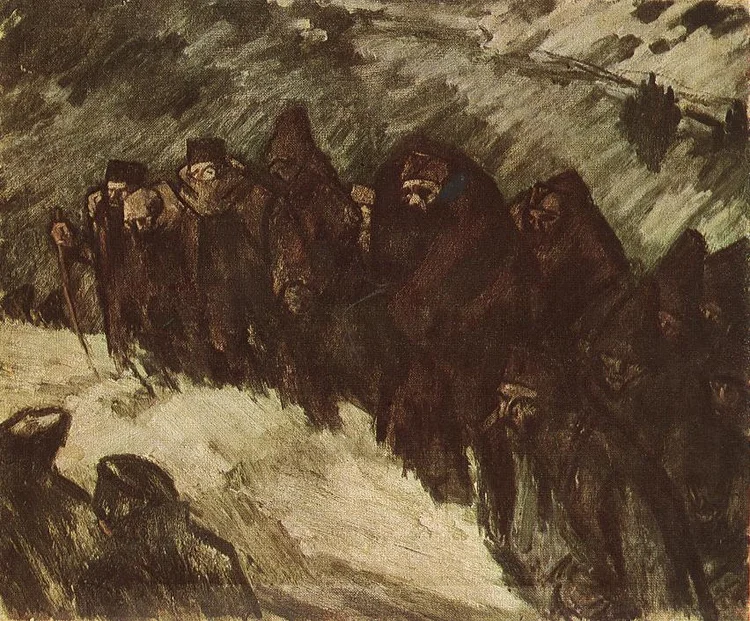
Although Vaszary studied under these notable masters, he became a master himself – his mesmerizing styles evolving over time. The most drastic change is noted when he was called to the Serbian front during WWI, serving as a correspondent. During this period, his paintings reflected the horrors he had experienced firsthand. His techniques became more tense and striking, depicting life (or death) on the Carpathian frontline. In his 1915 painting entitled Russian Prisoners in the Barracks, officers and privates of the Tsar’s army linger in captivity lethargically. There is more intensity to Soldiers in the Snow, a work Vaszary painted just one year later, which uses the arsenal of German expressionism to depict man as he is laid bare to war and vicious natural elements.

Vaszary during WWI
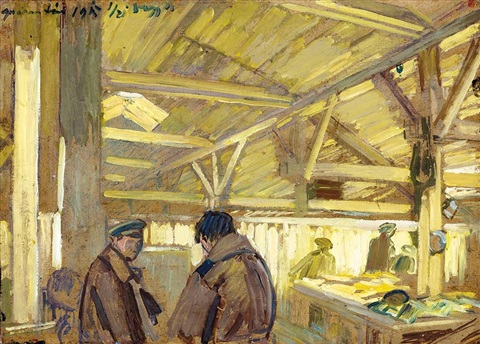
János Vaszary, Russian Prisoners in the Barracks
János Vaszary, Soldiers in the Snow

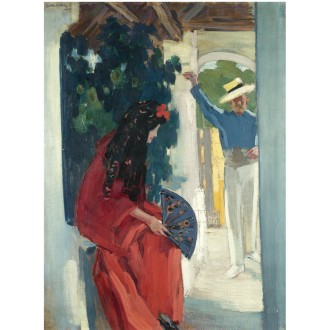
Upon the end of the war, he returned to Paris, where his tendencies returned to a more Impressionistic approach. Vaszary also spent some time touring Italy and Spain, as noted in some of his works (Couple From Seville featured below.) As Vaszary’s recognition increased, it was boosted furthermore after Emperor Franz Joseph I, The Emperor of Austria, King of Hungary, King of Bohemia, and monarch of many other states of the Austro-Hungarian Empire, purchased a painting of Vaszary’s, titled “The Sharecropper.”

Notable Vaszary Works
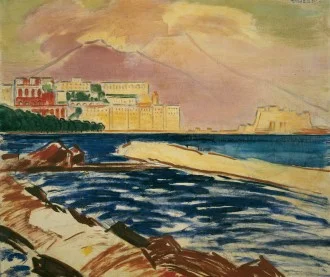
János Vaszary, Naples Harbour, Sold for $54,000
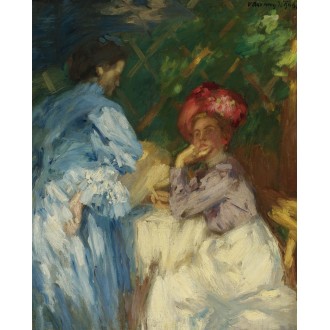
János Vaszary, Women in the Park, Sold for $65,000
János Vaszary, Mid-Day Rest (Couple from Seville), Sold for $115,000
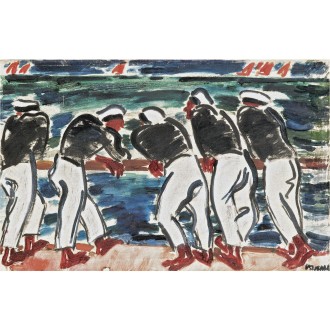
János Vaszary, Sailors by the Sea, Sold for $49,000

In 1920, Vaszary began serving as a Professor at his alma mater, the University of Fine Arts, until 1932. In 1924, he was one of the founders of the “Képzőművészek Új Társasága (New Society of Artists, whose acronym “KÚT” means “fountain” in Hungarian). In 1926, he was commissioned to paint murals at the Biological Institute in Tihany.

Vaszary painted until his death in 1939, after retiring to the small town of Tata, Hungary.

Vaszary Works Available at Upcoming Auction

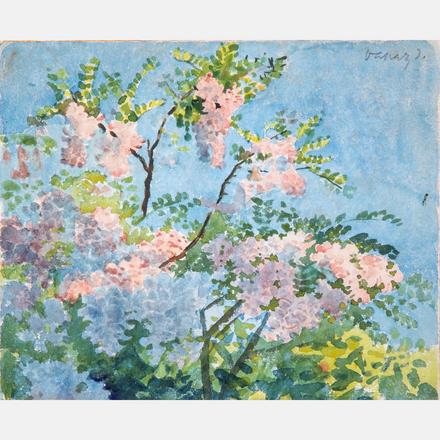
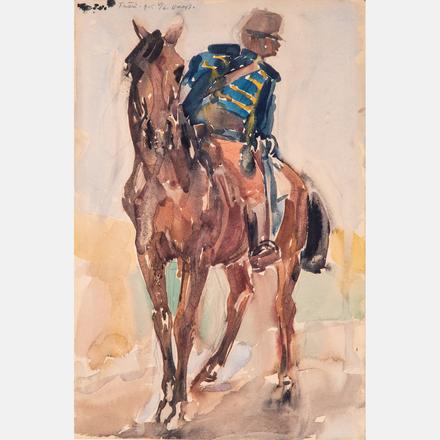
Our upcoming June 26th auction features three pieces of Vaszary’s. The first, a portrait of his wife, Maria Vaszary, also known as “Mimi.” This painting was given to the current owner’s grandfather who is Maria Vaszary’s nephew. The second is titled “Hussar”, and the third, “Floral Scene.” All three of the artworks have never been exhibited and have been in the family for over 90 years.
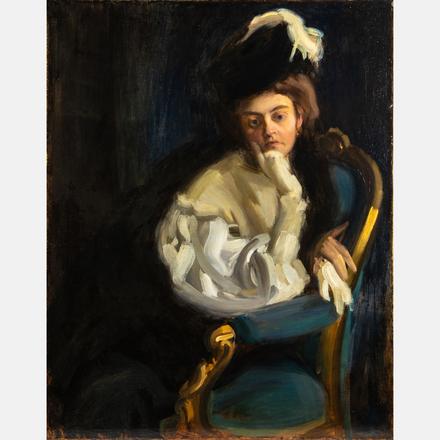
János Vaszary, Maria “Mimi” Vaszary, Estimate: $150,000 - $250,000.  View Lot >
János Vaszary, Maria “Mimi” Vaszary, Estimate: $150,000 – $250,000.
János Vaszary, Hussar, Estimate: $10,000 - $20,000.  View Lot >
János Vaszary, Hussar, Estimate: $10,000 – $20,000.
János Vaszary, Floral Scene, Estimate: $10,000 - $20,000.  View Lot >
János Vaszary, Floral Scene, Estimate: $10,000 – $20,000. 

A Third Thursday Discovery Feature: Colorful Fruit Labels from The Golden State

A Third Thursday Discovery Feature: Colorful Fruit Labels from The Golden State

The first time I ever lived, worked, and bought groceries on my own I was living Louisiana. At least once a week I would walk just over a mile and a half to a small, local grocery store in New Orleans called Langenstein’s to buy food and whatever else I might need for the days ahead. Something that struck me every grocery run, whether it was standing in the aisle of the store or unpacking groceries in front of the fridge in my apartment, was that nearly all the of fruit, most certainly all of the berries, I bought in New Orleans came from the California. I like to imagine every strawberry I ate in the South making a voyage from the West Coast to Louisiana — a journey that mirrored my own movement from Sacramento to New Orleans.

For the month of June our Third Thursday Auction features fruit labels, more specifically California fruit labels from the late 19th and early 20th centuries. Fruit labels are the colorful prints originally affixed to the outside of the wooden crates that were used to transport fruit from California to destinations all over the United States. Witherell’s received this wonderful and unique collection from Donna Holmes, who discovered these well-preserved, stunningly vibrant fruit labels in a suitcase high on a closet shelf in her parents’ home over 20 years ago.

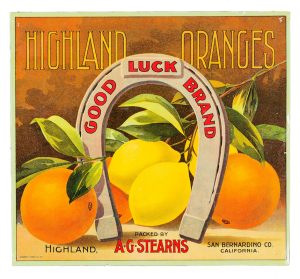
When Ms. Holmes stumbled upon the fruit labels, she was also uncovering a bit of family history about her grandmother and her great aunt. Christine and Rebecca Suhr, born two years apart in the late 1870s, were orphaned at a young age and became the wards of Charles R. Gray, a lawyer who ended up mismanaging much of the girls’ family money. After Rebecca (Ms. Holmes’ grandmother) graduated from San Bernardino High School she was accepted at Stanford University and Christine, in order to help support her younger sister and put her through college, began working for A.G. Stearns Packers and Shippers of Highland Oranges and Lemons. She worked for the company from 1900 until 1920, first as a bookkeeper and eventually as an office manager. The collection of fruit labels Ms. Holmes discovered inside the suitcase had belonged to her great-aunt Christine. The collection includes labels made for A.G. Stearns as well as other well-known fruit packers, shippers, and wholesalers, including the Earl Fruit Company, West Highlands Citrus Association, and Ruddock, Trench & Company. These hidden art pieces are not only a testament to Ms. Holmes’ family story, they are also a window into the past, providing a small glimpse of California’s unique agricultural history.

Several factors serendipitously came together in the latter half of the 19th century, setting the stage for the development and popularization of fruit labels. America’s economy was expanding from local retailers to national sellers and mass merchandizers (think, Sears); in 1869 the railroad officially connected the East Coast to the West Coast; and by the end of the 19th century, with the increase in literacy and the subsequent proliferation of print media, color lithography became more affordable than ever before. All kinds of goods were being produced, packaged, and shipped from different areas to buyers all over the country and these goods included fresh California produce. Advancements in technology like new refrigerated rail cars, agricultural developments including the introduction of pesticides and fertilizers, as well as the growing population in the West also played a significant role in encouraging the growth of a national produce industry in the West.

A nearly perfect moderate climate along with fertile soil and vast, diverse resources make California one of the best places in the world to grow produce. All kinds of different fruits and vegetables thrive and are farmed here, but there are a few fruits that California is known for. Many of the fruit labels in our auction were specifically designed to advertise “California Oranges.” Farmers in California’s valleys grew the produce while large corporations that specialized in canning and packing, as well as marketing and shipping, would put the goods into circulation. These companies were responsible for properly presenting and packaging the produce, contracting with railroads and transportation companies, and actually selling to retailers and other clients across the country. It was these companies who would essentially create the brand — physically pack the fruit into small wooden crates — and whose name typically appeared on the iconic packing labels.

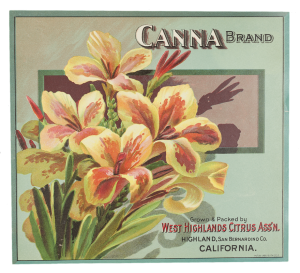
The peak or so-called “Golden Age” of fruit crate labels is considered to be from about 1890 to 1940. In the late 19th century many family farms shipped their own products and used their own labels. But, as the industry grew, smaller family-run farms began looking to fruit exchange corporations, member-owned cooperatives, and/or packing and shipping companies to more efficiently process and effectively package their goods. Some larger companies like the West Highlands Citrus Association did both the growing and the packaging, making sure to state this on their packing label (see above). Even though these labels are intentionally artistic and were clearly painstakingly designed, in general these works are not attributable to any particular person or individual creator, simply identified as the product of the design department of a lithography company.

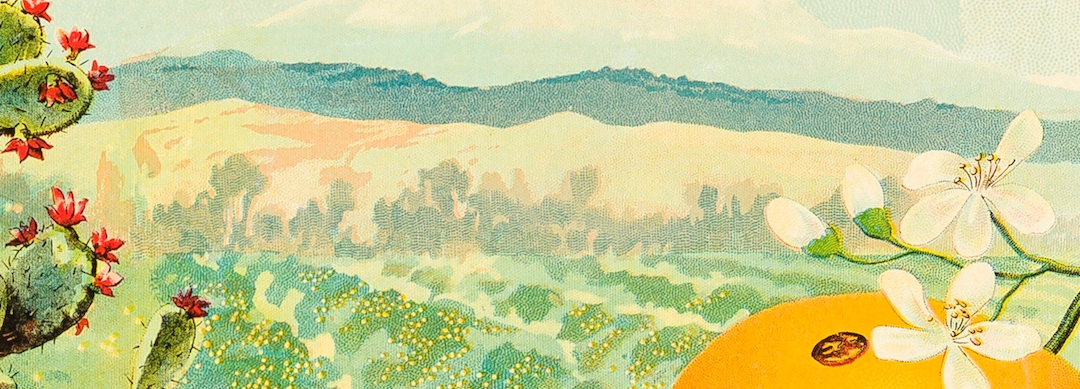
The labels helped to identify the fruit in the wood crates – who packed it, shipped it, and where it came from – but they were also created by artists with the intent of appealing to the customer. One of the primary ways this was done with California fruit labels was to illustrate the beautiful landscape where the delicious fruit was grown. Consumers would see the rolling hills with orchards and know that the fruit coming from such a sunny paradise must taste just as wonderful as it looks. Images of fruit were often featured alongside flowers (floral themed brands were very popular: “White Rose Brand,” “Camellia Brand,” “Azalea Brand,” “Germanium Brand”), serving to visually emphasize the fertility of the land and to evoke the beautiful and distinct floral scent of fresh fruit. Some labels featured images that potential customers would associate with the West including depictions of particular landscape scenes (“Yosemite Brand”), Native Americans (“Minnehaha Brand”), and certain animals (“Bison Brand” and “Antler Brand”).

Most of what we buy today, particularly what we purchase in the supermarket, is packaged and labeled. The label’s job is basically two-fold: to entice and to inform. The product’s packaging is what makes the initial appeal for purchasing while the information on the label is often what seals the deal, so to speak. Like the baseball cards and comic books we have previously auctioned, the fruit labels are strikingly graphic. They blur the lines between what is a simple object from the past, cultural material, and what is art.

While fruit labels are not what many would consider “high art,” that doesn’t mean that there isn’t beauty or sophistication in the creation. Art is unique because it is not (usually) inherently valuable; we ascribe value and often assign a particular meaning to all of the different types of artwork we encounter. And because these fruit labels belong to history, cherishing them and collecting them, or even just looking at them and appreciating the story they tell, is a way of preserving the past.

Redware @ The Glebe House

Redware @ The Glebe House

Lecture on the history of colorful pottery

Redware @ The Glebe House

The Glebe House Museum & Gertrude Jekyll Garden will host a Decorative Arts lecture about Redware, Tuesday, June 5 at 7:00 pm at the Glebe House located at 49 Hollow Road, Woodbury, CT.

Samuel Herrup, redware expert and owner of Samuel Herrup Antiques in Sheffield, Massachusetts will speak about the newly acquired Redware Collection at the Glebe House. The 31 piece collection was donated by a private collector in December 2017 and is now on display in the Library – Gallery at the Glebe House Museum.

Tickets for the lecture are $5 for members of the Museum and $10 for non-members and may be purchased in advance by calling the Museum Director at 203-263-2855. Reservations recommended. Seating is limited.

The Glebe House Museum & Gertrude Jekyll Garden located at 49 Hollow Road in Woodbury is celebrating its 93rd anniversary as a historic house & garden this year. It is open Wednesday through Sunday from 1:00-4:00 p.m. and for special group tours upon request. For more information about this program or other programs or events call the Museum or visit the website: www.glebehousemuseum.org” class=”redactor-linkify-object”>http://www.glebehousemuseum.or…

Auction Services Market: 2019 Global Industry Trends, Growth, Share, Size and 2025 Forecast Research Report

Auction Services Industry 2019 Global Market research report presents you analysis of market size, share, and growth, trends, and cost structure, statistical and comprehensive data of the global market.

Global Auction Services Market 2019 Industry Research Report is a professional and in-depth study on the current state of the Global Auction Services industry. This report studies Global Auction Services in Global market, especially in North America, China, Europe, Southeast Asia, Japan and India with production, revenue, consumption, import and export in these regions, from 2014 to 2019, and forecast to 2025. In 2018, the global Auction Services market size was xx million US$ and it is expected to reach xx million US$ by the end of 2025, with a CAGR of xx% during 2019-2025.

Get Sample Copy of this Report – https://www.researchreportsworld.com/enquiry/request-sample/14240181

The Global Auction Services market 2019 research provides a basic overview of the industry including definitions, classifications, applications and industry chain structure. The Global Auction Services market analysis is provided for the international markets including development trends, competitive landscape analysis, and key regions development status. Development policies and plans are discussed as well as manufacturing processes and cost structures are also analyzed. This report also states import/export consumption, supply and demand Figures, cost, price, revenue and gross margins.

Global Auction Services Industry 2019 Market Research Report is spread across 97 pages and provides exclusive vital statistics, data, information, trends and competitive landscape details in this niche sector.

Inquire more or share questions if any before the purchase on this Report – https://www.researchreportsworld.com/enquiry/pre-order-enquiry/14240181

Global Auction Services market competition by top manufacturers, with production, price, and revenue (value) and market share for each manufacturer; the top players including

Sotheby’s

Property Auction Services

KAR Auction Services

Christie’s

Nagel

Zhongzheng Auction

PHILLIPS

Poly Auction

……

The report also focuses on global major leading industry players of Global Auction Services market providing information such as company profiles, product picture and specification, capacity, production, price, cost, revenue and contact information. Upstream raw materials and equipment and downstream demand analysis is also carried out. The Global Auction Services market development trends and marketing channels are analyzed. Finally, the feasibility of new investment projects is assessed and overall research conclusions offered.

With tables and figures helping analyze worldwide Global Auction Services market, this research provides key statistics on the state of the industry and is a valuable source of guidance and direction for companies and individuals interested in the market.

Order a copy of Global Auction Services Market Report – https://www.researchreportsworld.com/purchase/14240181

Market segment by Type, the product can be split into

Small Business

Medium Business

Large Business

Market segment by Application, split into

Absolute Auction

Minimum Bid Auction

Reserve Auction

Major Points from Table of Contents:

1 Report Overview
1.1 Study Scope
1.2 Key Market Segments
1.3 Players Covered
1.4 Market Analysis by Type
1.4.1 Global Auction Services Market Size Growth Rate by Type (2014-2025)
1.4.2 Small Business
1.4.3 Medium Business
1.4.4 Large Business
1.5 Market by Application
1.5.1 Global Auction Services Market Share by Application (2014-2025)
1.5.2 Absolute Auction
1.5.3 Minimum Bid Auction
1.5.4 Reserve Auction
1.6 Study Objectives
1.7 Years Considered

2 Global Growth Trends
2.1 Auction Services Market Size
2.2 Auction Services Growth Trends by Regions
2.2.1 Auction Services Market Size by Regions (2014-2025)
2.2.2 Auction Services Market Share by Regions (2014-2019)
2.3 Industry Trends
2.3.1 Market Top Trends
2.3.2 Market Drivers
2.3.3 Market Opportunities

3 Market Share by Key Players
3.1 Auction Services Market Size by Manufacturers
3.1.1 Global Auction Services Revenue by Manufacturers (2014-2019)
3.1.2 Global Auction Services Revenue Market Share by Manufacturers (2014-2019)
3.1.3 Global Auction Services Market Concentration Ratio (CR5 and HHI)
3.2 Auction Services Key Players Head office and Area Served
3.3 Key Players Auction Services Product/Solution/Service
3.4 Date of Enter into Auction Services Market
3.5 Mergers and Acquisitions, Expansion Plans

4 Breakdown Data by Type and Application
4.1 Global Auction Services Market Size by Type (2014-2019)
4.2 Global Auction Services Market Size by Application (2014-2019)

5 United States
5.1 United States Auction Services Market Size (2014-2019)
5.2 Auction Services Key Players in United States
5.3 United States Auction Services Market Size by Type
5.4 United States Auction Services Market Size by Application

6 Europe
6.1 Europe Auction Services Market Size (2014-2019)
6.2 Auction Services Key Players in Europe
6.3 Europe Auction Services Market Size by Type
6.4 Europe Auction Services Market Size by Application

7 China
7.1 China Auction Services Market Size (2014-2019)
7.2 Auction Services Key Players in China
7.3 China Auction Services Market Size by Type
7.4 China Auction Services Market Size by Application

To Continued……

About Us:

Research Reports Worldis the credible source for gaining the market reports that will provide you with the lead your business needs. At Research Reports World, our objective is providing a platform for many top-notch market research firms worldwide to publish their research reports, as well as helping the decision makers in finding most suitable market research solutions under one roof. Our aim is to provide the best solution that matches the exact customer requirements. This drives us to provide you with custom or syndicated research reports.

Bidders Battle Over Collectible Militaria

 U.S. Military circa 1860 Cavalry saber with scabbard

On May 18, our country celebrated Armed Forces Day – this is a day we come together and thank our military for their patriotic services. Under the leadership of President Harry S. Truman, the holiday was first celebrated in May 1950 to unify all the armed forces under one agency – the Department of Defense. May is also Military Appreciation Month, and of course, our country will celebrate Memorial Day on Monday, May 27.

The heroic and horrific stories of past wars continue to be told through the relics, artifacts, documents, firearms, equipment and other militaria that have survived through time. Some serious collectors will pay top dollar for rare items, as evidenced by the sale of a U.S. flag that sold at auction in 2016 for $514,000. The flag flew from a control boat on D-Day and sold at Heritage Auctions in Dallas for five times the pre-auction estimate.

We see militaria from many different countries come through our auction house, and collectors will often battle in bidding frenzies to win a coveted piece of history. Earlier this month, we had a specialty auction on a Friday night that focused on militaria, western and Native American collectibles. The collection belonged to one man who was a big fan of General Custer and he took great care of his collectibles, which included Civil War uniforms, swords, a circa 1880 U.S. Cavalry dress helmet and more.

Bidding for the military collectibles was strong both live at the auction house and online. The star of the auction was a Plains Indian beaded deer hide war shirt, which hammered at $1,800. While a Native American collectible, it was worn by a warrior, and appealed to militaria collectors as well.

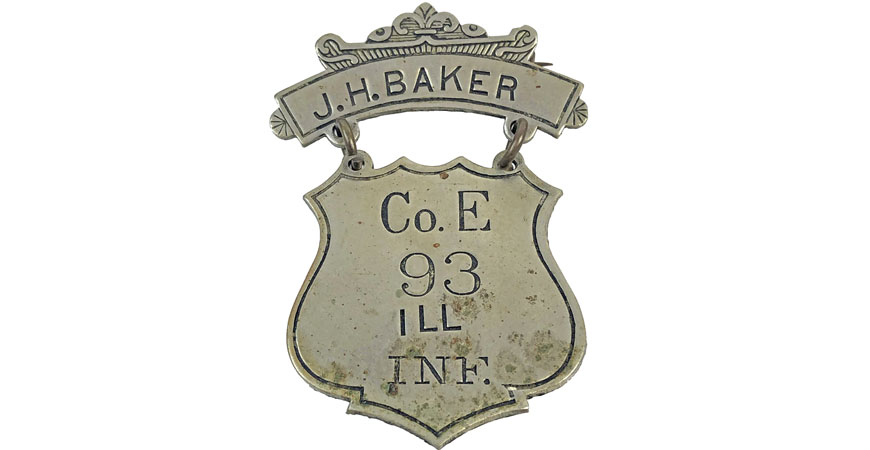
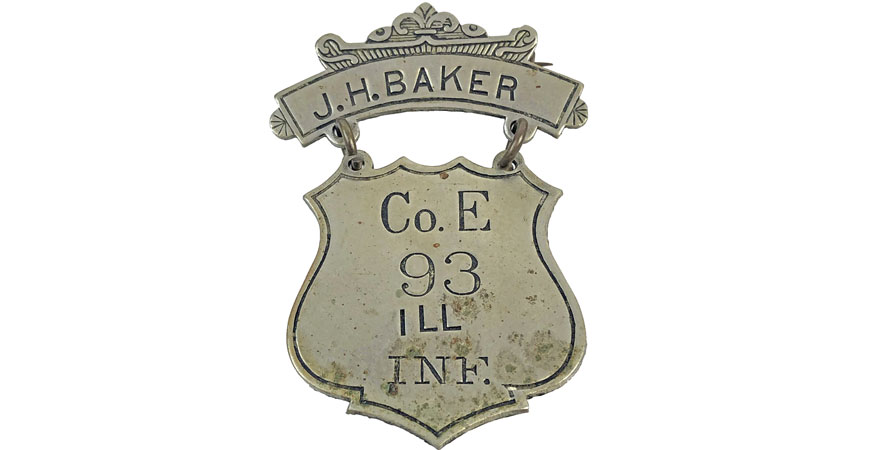
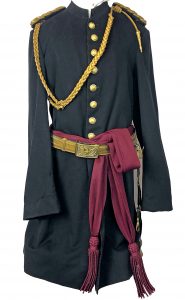
Other items that did well included a Civil War Union nine-button frock coat that realized $750, a U.S. Military circa 1860 Cavalry saber with scabbard that realized $550, a 1917 World War I U.S. American Cutlery Co. trench knife that sold for $475, and a Civil War Illinois Infantry ladder badge that sold for $250.

When it comes to assessing value of militaria, rarity, condition and provenance play an important role. As with any collectible, do your research to make sure you are not purchasing a fake or reproduction. There are many reproductions made for re-enactment groups that look authentic. But a closer look may reveal differences in materials, stitching, insignias, and other flaws that rule the item out as being original.

If you’re fortunate enough to collect direct from a veteran, ask him or her to share their story and then search through national archives and history books to learn about the battles they participated in. If an item is referred to as a “vet pickup,” it usually means the item was taken away from the original owner – in most cases from the enemy. Militaria from past enemies, such Germany and Japan, are in strong demand as well.

While some collectibles lose value over time or are cyclical, I believe there will always be a strong interest in collecting militaria. Not only is the history fascinating, there’s tremendous respect for the men and women who served their countries with courage and honor.

Ceramics From Manises: History Of The Most Summery Material

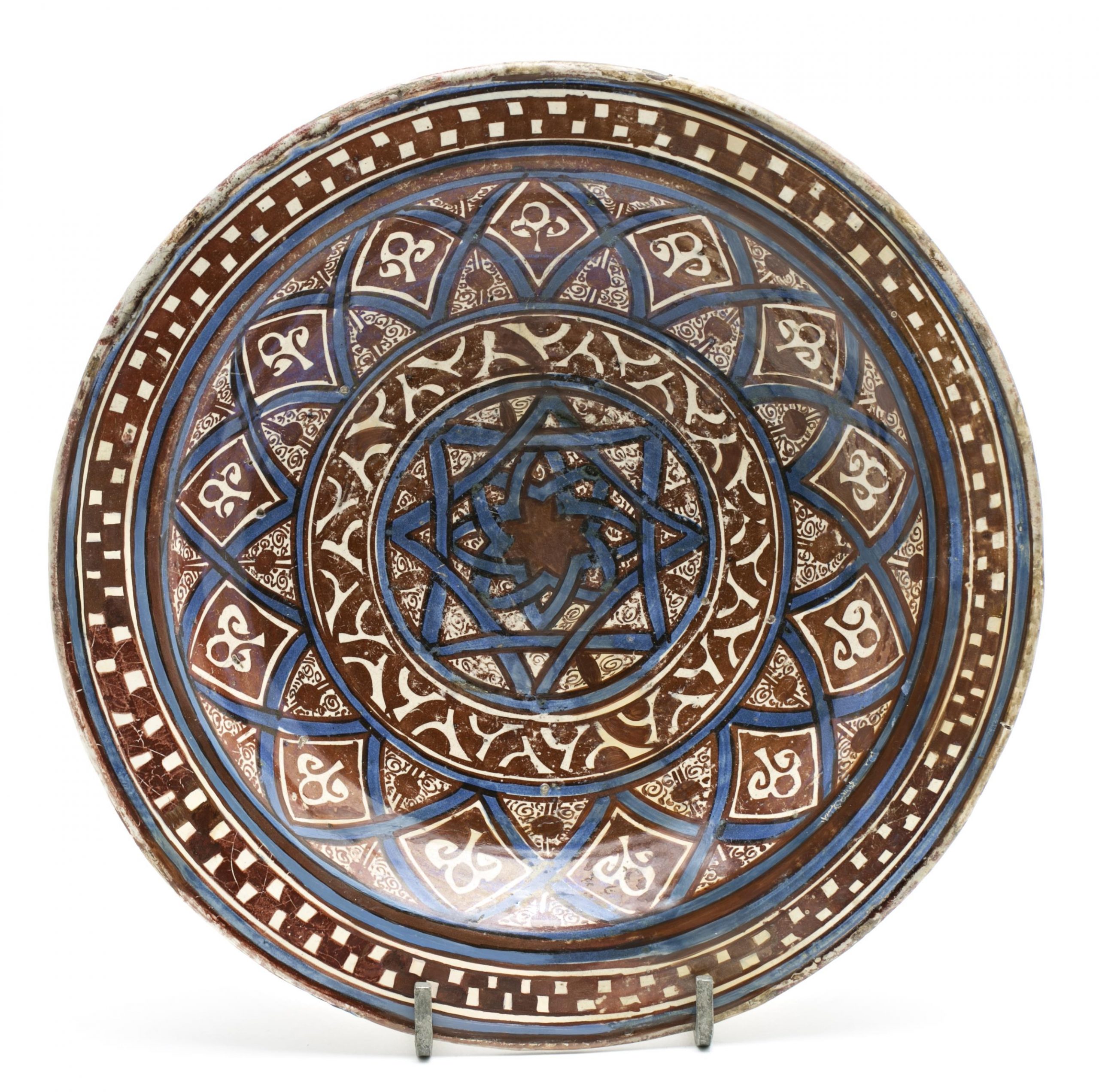
Pottery from Manises (in Valencia, Spain) has its origin in metallic reflection ceramics from the Muslim era. After the conquest of the Iberian Peninsula by the Muslims (711 A.D.), decorative arts were influenced by the eastern region; so ivory, textiles and ceramics became all famous for their great quality.

Before that conquest, metallic reflection ceramic had already been used in other places, such as Persia or Mesopotamia, and in the Iberian Peninsula it had been very important at the time of the Caliphate and later, during the Nasrid dynasty. The city of Málaga became its main production centre and, in the 14th Century, it spread to Manises, Paterna (Valencia), and subsequently to Reus, Muel and Barcelona.

1. History of Manises ceramics

The development of eastern-Spanish ceramics began around 1304, during the reign of James II, when the Lordships of Manises and Paterna were bought by D. Pedro Boil, ambassador of John I in the court of Granada. He established there metallic reflection ceramics imported by the Muslims and moved many Nasrid ceramists to his lands, until Manises became the most important producer of ceramics in the Middle Ages.

There, potters had been in Moorish hands for a long time, and they used to make cobalt blue earthenware pieces over a tin bath, or in green and manganese, but they were mainly used for local consumption. However, after the settlement of the new ceramist centre, the most requested production was the one we now know as Manises, and especially the gilt earthenware, which was even exported.

Ceramics reached its peak in the 15th and 16th centuries, at the same time as the trade boom in Valencia, which became the main port in the Mediterranean. That is how a great amount of ceramic works arrived to the great Italian families from Naples, Florence, Siena or Venice, replacing gold and silver crockeries. Also popes Alexander VI and Callixtus III often requested earthenware and tiles from eastern Spain to be used in Vatican halls.

To a lesser extent, pieces were also exported to the Netherlands, where they were often depicted by Flemish painters, as in the central panel of the Portinari Triptych, by Hugo van der Goes, which can be found in Uffizi Gallery in Florence, as well as in some other works by Jan van Eyck.

2. Classic series (15th Century)

The gilt reflection technique’s formula was one of the best kept secrets. It was based on three firings; the last one used a mixture of silver, copper and vinegar solution and was put into an oven with a reducing atmosphere, which was what gave it that characteristic gilt reflection. Shades could vary from yellow to coppery, depending on the materials and firing time in the oven. Afterwards, pieces were decorated by hand. Such items are very popular within antique ceramics auctions held at Balclis.

Regarding production methods, the most outstanding were large dishes, called “del xapelet”, bowls with ears, honey jars, pharmacy jars, basil jars and balloon-shaped jugs with a cylindrical neck.

In terms of production stages, we can identify three different periods:

The 15th Century, known as “classic series”, stood out for that mixture of Christian and Muslim decorations, but especially for their plant decorations such as:

  • “Parsley leaves”.
  • Flowers like split oranges.
  • Thistle leaves and the “Gothic rose”, especially in years 1420 – 1500.
  • Fern leaves (1425 – 1450).
  • The “ivy leaves” series (1450 – 1475).

Heraldic decoration was also very common in Manises’ production. In fact, in the production of the ivy leaf series, some pieces included coats of arms of Spanish lineages, and among them, the most usual were those of the Kingdom of Aragon, Castile, Valencia, Sicily, and even the Medicis. Likewise, symbols of different guilds were also very common.

3. Moorish series (16th Century)

During the 16th Century, the so-called “Moorish series” (1475 – 1609), started to show changes in production’s quality; walls became thicker, backgrounds began to show a creamier enamel, and there was a small decline in the glaze’s metallic quality. In addition, the potter’s wheel was no longer used to create those pieces, and the mould began to be used, resulting in a central nipple in dishes, gallons and overlaps.

With regard to decoration, gilding was still present, and it was only at the end of the century that blue reappeared to highlight embossed decorations, which were made by pressing, such as leaves or zoomorphic figures. The most important pieces used to differ from the rest because their backs were decorated with archaic patterns, such as stylised ferns, pineapples and alafias, although it was also common that the same decoration was repeated on the front of the dish.

On the other hand, there was a final distancing from the Islamic world in representations, which were replaced by smaller ones. The most common ones were:

  • “Musical notation” motifs. They were a kind of degeneration between an ivy leaf and a holm oak, very similar to a musical note.
  • “Nails” motifs. They were always placed in the centre of the composition, forming a single scene, with a figure larger than it, and surrounded by filled leaves and stems.
  • “Lace” motifs. They consisted of a net with rings at the vertices, very similar to the lacework of Irish fabrics, and very frequently used in other pottery centres of that time.

4. The most popular series

Finally, in 17th and 18th Century Manises’ pottery manufacturing suffered a major decline, to the point of evolving to much more popular series, so that objects were reduced in size, adapting themselves towards functional shapes and seeking greater resistance, which resulted in thicker pieces.

With regard to decoration, gilding evolved to reddish tones, and the most frequent decorative motifs were those known as kidney-shaped and serrated leaves, which used to completely cover the piece. As in previous centuries, ornamentation with overlaps or scales, as well as carnation leaves, was repeated tirelessly.

On the other hand, figurative representation was limited to isolated animals such as roosters, eagles, sparrows or Saint John birds, drawn with wide open eyes, which almost filled the entire item’s surface.

In the 19th Century, Manises kept on producing classic pottery, although of lower quality, and began to produce popular pieces, such as the well-known “demandá” dishes.

Getting to Know the Artist Joseph J. Greenberg, Jr: An Interview with his Son Dan Greenberg

Figural forms, stone carvings of animals and abstract shapes make up the diverse catalogue of work by the prolific artist Joseph J. Greenberg, Jr. Born in 1915 in Philadelphia, PA. The artist started his education by studying engineering at MIT for a year before transferring to Tyler School of Art of Temple University. It was here that he majored in sculpture and his lifelong love of creating was cultivated. He then went on to travel to Italy in 1949 to further broaden his artistic horizon. While abroad he had a solo show in Rome and exhibited in the XXVI Venice Biennale. In 1951 the artist was awarded a $1,000.00 prize for winning the Metropolitan Museum of Art National Sculpture Exhibition. In 1953 he returned to Philadelphia. It was in this city that he prospered and worked until his death in 1991.

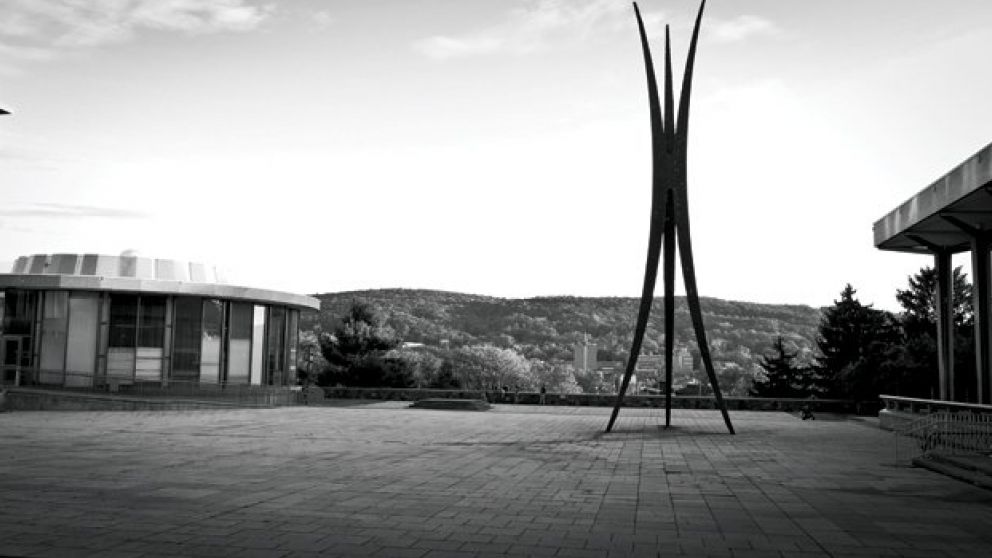
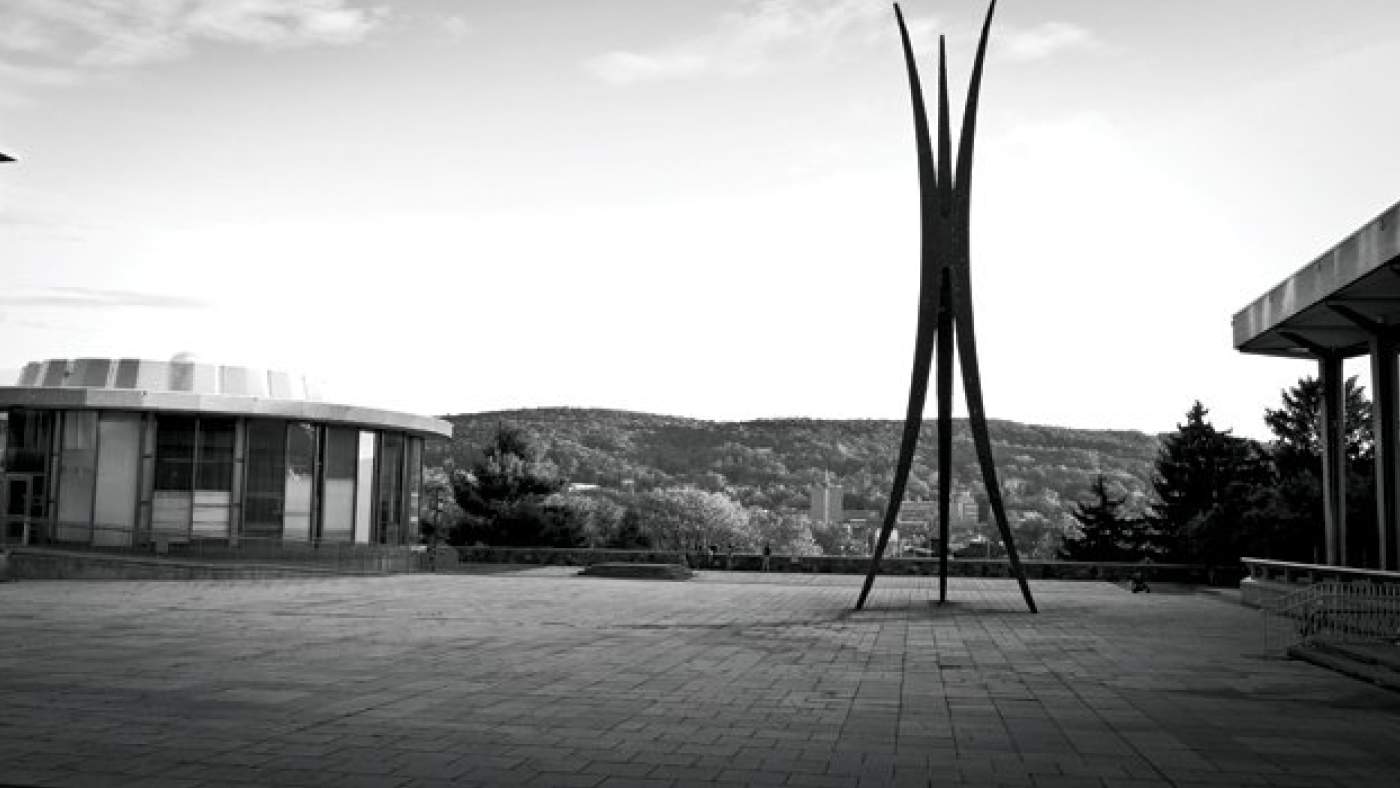
Among his many creations were commissioned public art projects made from a variety of materials. These pieces made up a major part of Greenberg’s career and legacy. His black granite Mother Bear and Cub is a well-known fixture at the Philadelphia Zoo. Perhaps one of his best known pieces is his largest, the sixty foot tall Symbol of Progress located in the heart of Bethlehem, PA by the entrance of the Bethlehem Area Public Library. The piece was created by Greenberg in 1967. It weighs 11,000 pounds and had to be helicoptered in to its home space. Take a look below to see images of this process taken at the time, including a photo of the artist accompanied by his wife. This piece is meant to stand as a symbol of various ethnic groups on which the city is based, moving upward to show the integration of the people of Bethlehem, then progressing skyward as they are strengthened by their diverse beginnings and their subsequent meeting.

The Symbol of Progress being air lifted in
The Symbol of Progress being set in place
Mr. and Mrs. Greenberg at The Symbol of Progress ceremony

(photos courtesy of Bethlehem Area Public Library website)

Greenberg created many none public works of art from a variety of media throughout his career, including life size sculptures of Adam and Eve made from fiberglass and epoxy. These are among the many sculptures in our Fine and Decorative Arts Auction catalog. The artist also taught sculpture in New Hope, PA, at the Philadelphia Museum of Art and Fleisher Memorial. In order to get a better understanding of the artist, we turned to his son, Dan Greenberg, for answers to a few questions of interest.

adam and eve sculpture
(Photograph: Adam and Eve)

AA: Did your father ever share his creative process with you? What did that look & feel like?

DG: His process was synthetic, informed by issues of the day and classical mythology. His career followed a series of approaches (traditional representational studies, simplified stylizations, active expressionist pieces, then a series of semi-abstract shapes, representational pieces purposely distorted for his own amusement and Mythological Figures), and he took great pride in mastery of the traditional skills of sculptural media, as well as being a pioneer in new materials (fiberglass/organically catalyzed polyester/later epoxy). He loved working in wood above all, but enjoyed being able to model, cast, carve, forge, weld and construct. His only regret was never learning to work in molten glass.

Beyond that, his process was internal, whatever piqued his curiosity. He freely shared craft and technique, starting me off with plasticine on an armature of wooden doweling (I made a dinosaur), we then made a rubber mold, plaster outer mold and thence a plaster cast replicating the original.

AA: What impact did your father being an artist have on you?

DG: Early access to the arts at all levels, personal tutoring in modeling, and a sense that being an artist was a viable occupation. During the 70’s and 80’s I and my friends often had the opportunity to help with installations and other “heavy lifting” duties.

AA: Which piece of your father’s is your favorite? Why?

DG: This is a tough one! There are so many! Of the public works some are long gone and only photos remain. The Family obelisk at Cheltenham Mall, the fountains at Temple University are both gone.  The Symbol of Progress at Bethlehem Library is still there as are the Mother Bear and Cub at the Philadelphia Zoo. I think the bronze Eve perfectly captures his early approach, the bronze Hand series (done at the time of commissions for large fiberglass and wood sculptures for the Jefferson Hand Clinic), The Fox (Purpleheart), are all works I’m partial to.

AA: Your father has been quoted as saying that the Bethlehem sculpture was his favorite work, is that true & what are your thoughts on the piece?

DG: I think the full quote is “among” his favorites, which The Symbol of Progress certainly was. He enjoyed the commission process (as opposed to the Bell Telephone project Man and Universe in 1963-4), and was proud be first to utilize the new non-oxidizing steel of which it was made. I think the piece is wonderful! It represents the dynamic of diversity and integration and in my humble opinion holds its place against all other large public sculpture in the region.

He also was very proud of the bronze Eve sculpture which won 4th Prize at The Metropolitan Museum of Art exhibition: American Sculpture 1951. Other favorites would include: The King (Oliver King, jazz trumpeter), 1955, Mahogany, at the Pennsylvania Academy of Fine Arts, Black Granite Mother Bear and Cub at the Philadelphia Zoo, his portraiture (Sidney Bechet, plaster and fiberglass, Baronessa Lina Celesia di Vegliasco, plaster), as well as the whimsical Artist and Muse painted fiberglass/epoxy and are all in the auction.

AA: What would you say was your father’s greatest accomplishment artistically or otherwise?

DG: Hard to pin down, he had so many. Mastery of traditional and new media, being in the collections of Pennsylvania Academy of Fine Arts, Addison Gallery of American Art, Temple University, and Carnegie Endowment for International Peace. His involvement with the Philadelphia Art Alliance; as a vice-president for Art ’77-79, and on the board of directors ’57-58 and again ’77-82. He helped frame the 1% for Art Ordinance in Philadelphia.

It was a pleasure receiving the opportunity to speak with Dan Greenberg and receive answers to our questions in regards to his renowned father. Having insight into the artist makes the pieces that much more powerful and personal to take in as a viewer. Take a look at the images of the works of Joseph J. Greenberg, Jr. we have featured in our upcoming Fine and Decorative Arts Auction taking place on Thursday, June 6th beginning at 10:00 AM, by clicking the following link to our catalog.

Fine and Decorative Arts Catalog

(Photograph: Eve)

Bernard & S. Dean Levy Is Moving

Bernard & S. Dean Levy Inc

In six months Bernard & S. Dean Levy will move from 24 East 84th Street in New York City to the third floor of 227 West 17th Street in Chelsea, trading a five-story townhouse for a 5200-square-foot loft.

“The furniture will be displayed on one floor in an open setting with especially designed lighting in a neighborhood with modern furniture galleries, Williams Sonoma, Brooks Brothers, Le Pain Quotidien, and Barneys,” said Frank Levy on the phone the day after he sold the firm’s 84th Street townhouse and made arrangements to stay until the new premises are designed and built. “The offices of Google and Facebook are around the corner, and Twitter is two doors away, and the old Bell Atlantic building has been turned into expensive condos. I hope that all the people who work and live there will become our customers,” Levy said as he continued extolling the advantages of the vibrant neighborhood. “The Chelsea Market is a block away, the Metropolitan Pavilion is a block north and block east. There are museums, the Rubin and the Whitney, at the end of the High Line not far away,” he continued.

 He said 25 years ago he would not have considered such a move, but it is a different world today. “We don’t get much walk-in traffic anymore, and I realized when I started to exhibit at antique shows that my stuff looked so much better when you are not on top of it in our narrow building where it is hard to maneuver. After my father had a stroke six years ago, he lives three blocks away and could not manage the steps in a wheelchair.”

“When a developer made us a generous offer we began looking for loft space and found it on the third floor of a building with a freight elevator where we can install proper lighting, design open displays, hold special exhibitions, have a library, and where I can have a beautifully appointed office furnished with some of my favorite antiques and with a window. My office is now in the basement,” said Levy, who is impatient to move. “And now my father can come here. It will be ADA compliant,” he added. Moreover, Frank Levy said he will not miss being a building manager. “The superintendent deals with the inspections for the boilers and the elevators and all the city rules.”

He said that Ginsburg & Levy was founded in 1901 by his great-grandfather Isaac and Isaac’s brother-in-law, John Ginsburg, on Grand Street on the Lower East Side. As their sons, Benjamin Ginsburg and Bernard Levy, took over they kept moving uptown to the 50s and finally to 815 Madison. After Benjamin Ginsburg and Bernard Levy dissolved the firm in 1976, Bernard and his son S. Dean Levy moved to 77th Street in the Carlyle Hotel and then to 84th Street. “Now we are doing a 180-degree reverse move downtown to the West Side of New York, echoing the changes in the city.” Frank Levy, the fourth generation, observed, “I hope the move will expose a whole new group of people to American antiques, those who rarely travel above 42nd Street. The other day I was thinking that the late Martin Wunsch, who lived in Gramercy Park and came to the gallery often, would have found our new address more convenient.”

Rockefeller: Items from the single-owner collection of Peggy and David Rockefeller to be auctioned by Nadeau’s

 Items from the single-owner collection of Peggy and David Rockefeller – members of one of the most important and wealthiest families in American history – will be sold at public auction on Saturday, June 2nd, by Nadeau’s Auction Gallery, online and at Nadeau’s showroom located at 25 Meadow Road in Windsor, beginning promptly at 11 am Eastern time.

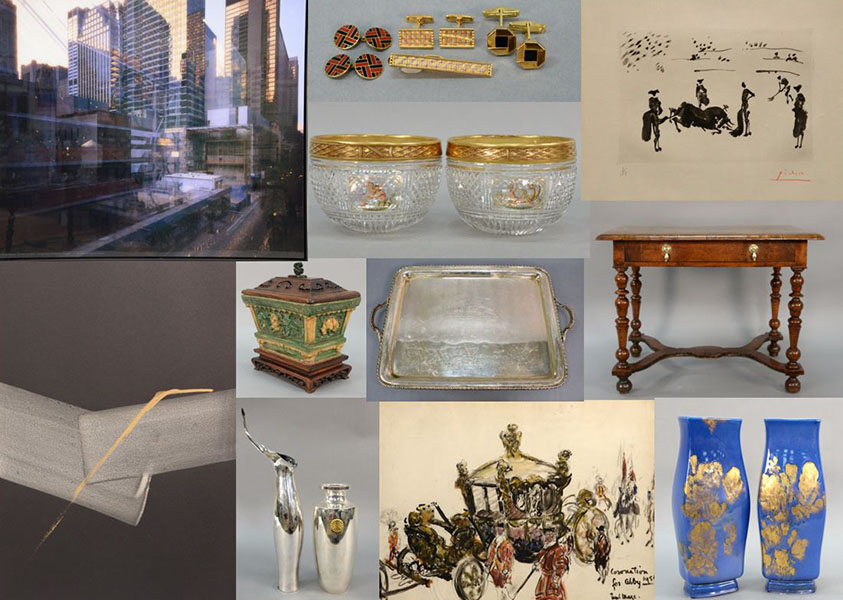
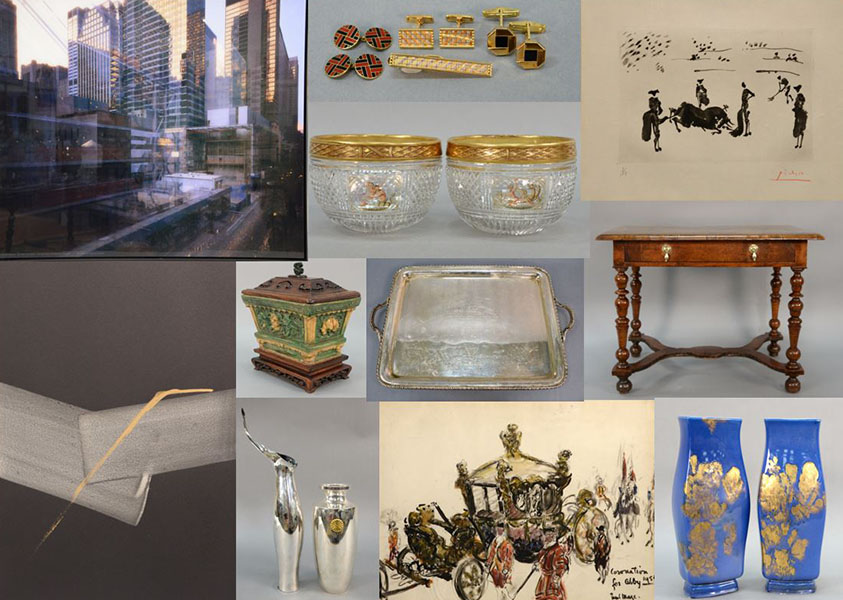
Around 635 lots will come up for bid, to include artworks by Pablo Picasso and Michael Wesely, Chinese and Japanese antiques and objects, many personally inscribed items (such as jewelry, crystal, silver, bronzes, paintings, lithographs and engravings) and furnishings, including French, Georgian and contemporary. About 100 items are monogrammed or inscribed for Rockefeller.

“This is a great opportunity for everyone to take part in, and potentially own, a piece from one of America’s most prominent families,” said Ed Nadeau of Nadeau’s Auction Gallery. “Many of the Rockefellers’ higher-end pieces were recently sold at a series of auctions through Christie’s in New York, but in this sale a variety of items will be selling for between $50 and $20,000.”

For those unable to attend in person, online bidding will be provided by LiveAuctioneers.com, Invaluable.com and Bidsquare.com. Phone and absentee bids will also be accepted. A special wine and cheese preview will be held on Thursday, May 31st, at Nadeau’s gallery, from 4-6:30 pm Eastern. Previews will be held Wednesday-thru-Saturday, May 30-June 2, or by appointment.

David Rockefeller was an American banker who was chairman and chief executive of Chase Manhattan Corporation. He was the oldest living member of the Rockefeller family and family patriarch from August 2004 until his death in March 2017. He and his wife Peggy (who died in 1996) were philanthropists and lifelong patrons of the arts. This is reflected in their collection.

Pablo Picasso and Michael Wesely are the auction’s headliners. Several aquatints by Picasso – rare examples from an original set of twelve copies (#3 of 12) of La Tauromaquia: Muerte del Toro, hand-signed and numbered by the Spanish-born master himself, are expected to attract bidder interest. They still have the original “Collection of David Rockefeller” inventory label.

Michael Wesely (b. 1963) is a German art photographer, known for his photos taken using a special, ultra-long exposure technique. Several lots of his work are in the sale, all color print photos in steel frames, titled “The Museum of Modern Art MOMA in New York City Under Construction” written by Wesely across the bottom. They’re big: one is 55 inches by 40 inches.

Other artworks in the auction will include, but aren’t limited to, the following:

  • A drypoint etching with collage and opaque white by Francis Alys (b. 1959), titled The Modern Procession, showing one figure holding a Museum of Modern Art Queen’s ticket and another holding a MOMA sign; numbered 25/60, signed lower left, 11 ¾” by 17 ¼”.
  • A pair of watercolor paintings by Brion Gysin (1916-1986), one a Moroccan scene titled Just Waiting (6 ½” by 10” sight), the other a landscape titled Blenching Beaches (6 ½” by 9 ¾” sight), both having the “Collection of David Rockefeller inventory label on verso.
  • A watercolor painting by Paul Lucien Maze (1887-1979), titled Coronation for Abby 1953, acquired by the Rockefellers as a gift directly from the artist in 1957, with “Abby” being the nickname for Abigail Aldrich Rockefeller, measuring 24 ½” by 33” sight.

Gorgeous decorative accessories will be offered in abundance. These include a pair of Sevres Mahieddine Boutaleb powder blue and gilt porcelain vases, both 14 ½ inches tall, having blue ground with gold painted decoration; a pair of Murano art glass ducks, each one 11 ½ inches tall; and six box lots of crystal and glass stem wine glasses, water goblets and other lovely examples.

Also up for bid will be a set of twelve early 19th century crystal cylindrical finger bowls, having a heavy gilt and painted laurel pattern rim over a diamond cut body, as well as a rectangle panel decorated with polychrome enamels showing classical vignettes of water gods, goddesses and sea creatures. The circa 1820 bowls have a height of 3 ½ inches and a diameter of 5 ¾ inches.

The Asian portion of the sale’s catalog includes a silver plated copper vase by the Korean artist Chunghi Choo (1938-1985), #3 from an edition of 35, 20 ½ inches tall; and a large Chinese Fahua rectangular censer, boldly decorated with large lotus blossoms against foliate ground, having a hardwood carved rectangular cover, on a pierce carved hardwood base, 12 inches tall.

Also from the Orient is a handsome Chinese hardwood altar top stand with a reticulated carved gallery, 7 inches tall by 13 ½ inches in width; and an untitled mixed media on paper by Toko Shinoda (b. 1913), artist signed lower right with a total sheet size of 25 inches by 17 ¾ inches.

The furniture category will be highlighted by a Queen Anne walnut veneered dressing table with inlaid top and an overall height of 28 ½ inches. Also made of wood (but not a piece of furniture) is a large, turned bowl, or vase, made from ash leaf maple by Philip Moulthrop (b. 1947), 6 ½ inches in height, artist signed, with “David Rockefeller, June 12, 2005” written on the bottom.

Rounding out just a couple more of the sale’s expected top lots is a three-piece Mitsubishi 18kt jewelry set consisting of two cufflinks and a tie clip with multicolor surfaces, monogrammed “DR” (for David Rockefeller), weighing a total of 18.2 grams; and a sterling tray with handles monogrammed with “A. David Rockefeller Presidente Council for Latin America”, with five lines in Spanish, signed by the President of Mexico, dated April 1969, and having 24 signatures.

The Lost Jewels Of The Spanish Crown

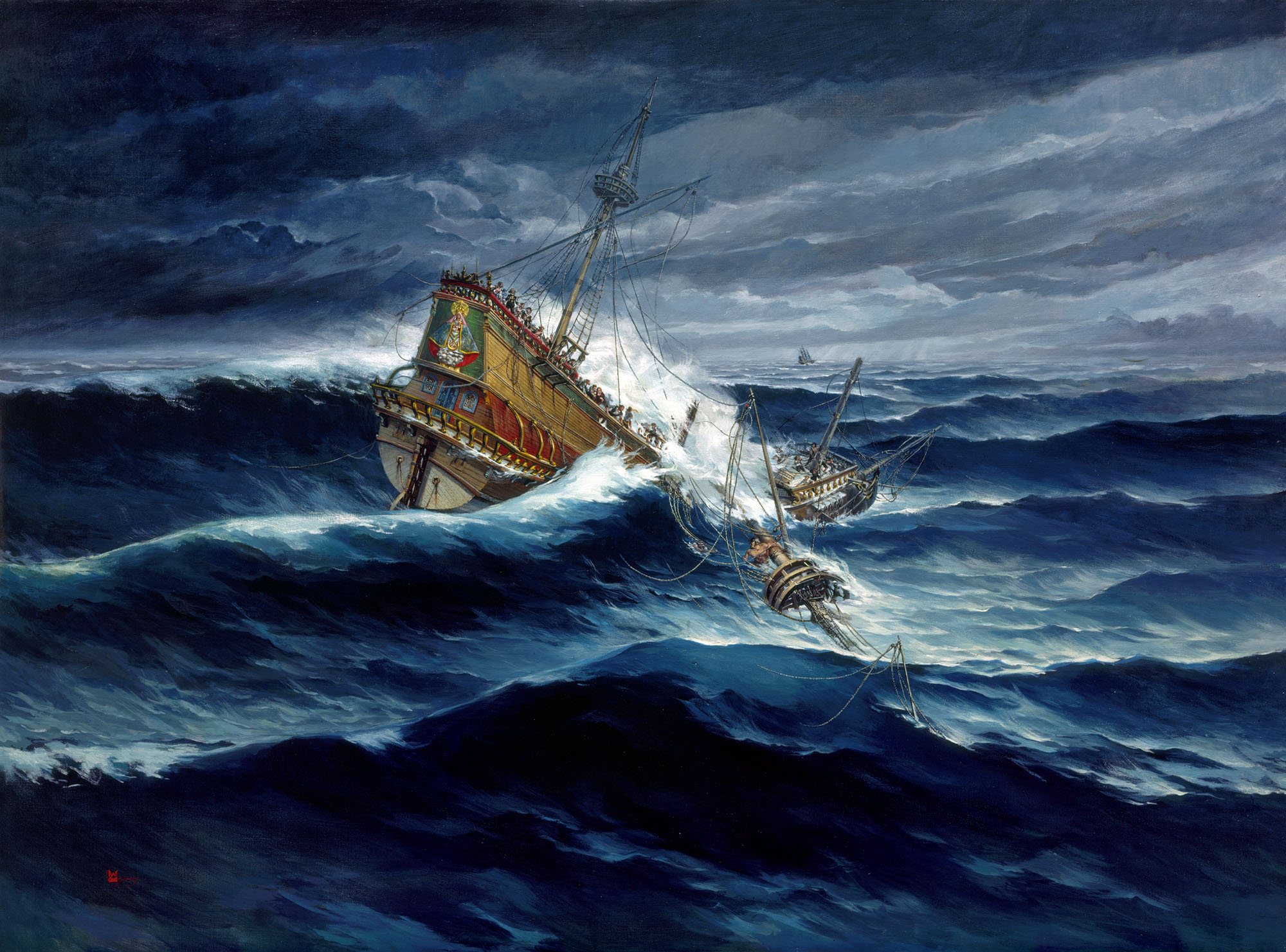
Summer 1622. A large Spanish fleet was returning to Spain from Havana, full of great riches from Orient and the Indies. It was protected by the guard galleons, which had cellars full of the most valuable treasures.

Every year it made the same route, but on that occasion, during the cyclone season, the navy was delayed, so that on its way to the Bahamas Channel it was caught up in a terrible storm with catastrophic consequences: eight sunken ships, among them the Santa Margarita and the Nuestra Señora de Atocha, which were sailing together; more than 185,000 pesos in silver coins; 23 tons of gold and silver ingots; more than 500 tons of copper, and an invaluable amount of jewels were lost in the depths of the ocean along with the lives of hundreds of people.

Over the following decades, Spain carried out several rescue operations to recover what had been lost, but the galleon Nuestra Señora de Atocha was never found. That treasure fleet was forgotten as the years went by. Today, on our jewellery blog, we are going to tell you the full story.

Indies Archive in Seville

In pursuit of the lost ship of jewels

In the late 1960s, a Californian diving instructor, Mel Fisher, was able to find the track where Spanish ships could be found, on the basis of a series of documents from the Indies Archive in Seville.

From that moment, Fisher, who had already participated in other successful explorations of Spanish fleets, didn’t think it twice, and he decided to pursue this other equally tempting goal by undertaking the adventure. To do so, he set up a wreckage company, called Treasure Salvors, in which he involved his entire family and a large number of divers, archaeologists, and investors, and provided himself with the latest state-of-the-art exploration technology of that time.

The research began in 1971 and, after several scattered finds, it was not until four years later that they found the ultimate evidence of the presence of the Atocha: two groups of bronze cannons whose inscriptions corresponded to the registration numbers of the galleon’s goods. However, everything indicated that the ship had lost its cargo before sinking, as there was no trace of the treasure and hopes started to be given up. It was only when he was desperate to achieve his goal that he attempted a final exploration of the deep waters in the Hawk Channel.

On July 20, 1985, the Treasure Salvors offices received an announcement from the Dauntless ship’s radio, in which its euphoric captain, Kane Fisher, said: “Close the maps! We found it!”

The Indies Treasure

The retrieved cargo consisted of more than a hundred thousand silver coins, 125 gold ingots, more than a thousand silver ingots that were destined to the Spanish coffers, and a large amount of personal objects, belonging both to the crew and to the richest passengers, valued at over 500 million dollars of that time.

Among the most outstanding pieces, it was found a solid gold belt with rubies —very similar to the one worn by Princess Isabella Clara Eugenia, daughter of Philip II, in one of her portraits—; richly decorated gold goblets and plates, especially a goblet containing a bezoar; a complete collection of medical tools; a stone used as an antidote against poisons; carved ivory boxes from Ceylon, and many other things.

The wonderful collection of goldsmith’s and religious and secular jewellery was also very significant; it included a gold chalice designed to prevent those who used it from being poisoned; a magnificent gold and emerald cross, a gift from King Philip V of Spain to Elizabeth Farnese, Duchess of Palma; an important collection of crosses and rosaries and a very valuable collection of jewellery, which included a heavy gold chain of more than three kgs (which Mel Fisher himself brought during the interview he was given in ‘The Johnny Carson Show’); several smuggled emeralds, among them an impressive uncut hexagonal crystal of 77.76K, which experts determined it came from the Muzo mine in Colombia; and several rings, bracelets, pendants… set with rubies, topazes, pearls and other precious stones.

Today, as a token of appreciation for his work, a large portion of that sunken treasure can be seen in the Mel Fisher Maritime Heritage Society Museum, a museum owned by the Fisher family in Key West, Florida.