It took forty-eight days crossing from Le Havre to Philadelphia, yet only few days spent with this important historic figure in Mount Vernon, Virginia… the result Jean-Antoine Houdon (1741-1828) became the most important sculptor in the history of the Founding Fathers of the United States.
In Jean-Antoine Houdon’s obituary, his son-in-law Raoul-Rochette emphasized one of the most glorious episodes in his father-in-law’s career: “The reputation he enjoyed in Europe, barely 36 years old, spread to the new world. […] It seems that his trip to the United States had left a lasting impression on his discerning mind. The sight of a free, wise and happy people, and the pleasure of being near Washington, the greatest of men in the eyes of the philosopher, had left him with memories that he often enjoyed recalling in his later years, when so many other recollections had faded from his memory.” In November 1784, the two most famous Americans present in Paris, future president Thomas Jefferson and scientist and statesman Benjamin Franklin, were commissioned by the Virginia legislature to choose the most worthy sculptor to create the statue of George Washington. Jefferson’s response was unambiguous, given, as he put it, Houdon’s unrivalled reputation in Europe. Since the Salon of 1779, where his bust of Franklin had received unanimous acclaim, the Freemason had frequented a host of Americans with whom he was highly esteemed and with whom he shared intellectual and philosophical affinities. When Charles Willson Peale’s Portrait of George Washington was sent to Paris, Houdon was not satisfied, so he offered to visit the eminent man, accompanied by two assistants. During the negotiations recounted in Jefferson’s correspondence, discussions centered on both his remuneration and the sum that would be paid to the Houdon family should he die during his trip. He arrived in the New World with Franklin on September 14, 1785, and happily left on his own two feet less than three months later.
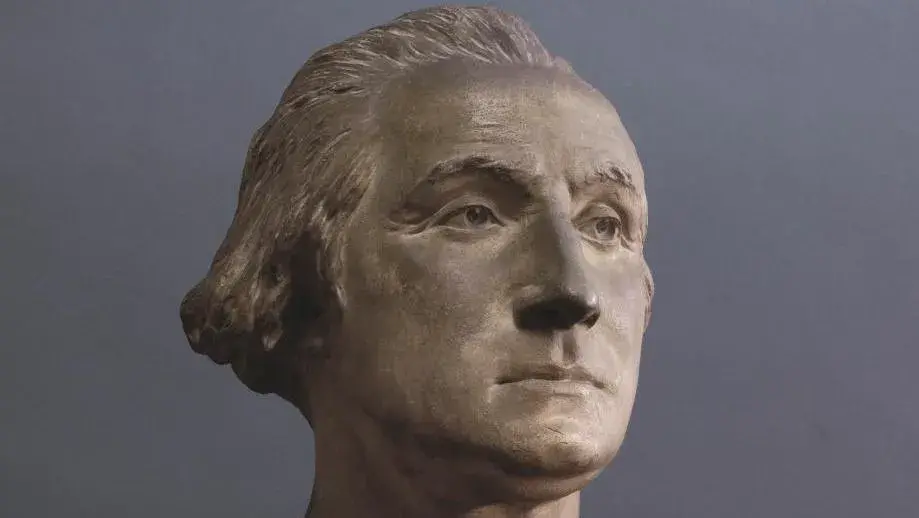
Jean-Antoine Houdon (1741-1828) and his workshop, George Washington (1732-1799), bust in terracotta patinated plaster, signed, original model created in 1785, h. 65 cm/25.5 in including pedestal in Breche marble, h. 14 cm/5.5 in. Estimate: €20,000/30,000
Washington, alive and well, was no Voltaire, and it was unthinkable to depict him in a robe! Or naked!
A Question of Dress
How to represent one of the Founding Fathers of a new nation, military hero of the American Revolutionary War and future first President of the United States? On both sides of the Atlantic, the idea of an equestrian statue was put forward, but discarded, much to the sculptor’s regret. The parties debated both the inscription that should appear on the pedestal and the most appropriate choice of clothing for a full-length statue. Washington, alive and well, was no Voltaire, and it was unthinkable to depict him in a robe! Or naked! According to an often quoted account, Houdon conceived a sculpture of Washington dressed in the garb of a country gentleman, wearing sandals and with his head covered by a Liberty cap, standing next to a plow. This bucolic bias was also rejected. The full-length statue of Washington, now visible in the rotunda of the Virginia State Capitol, dated 1788, but delivered in 1796, finally presents him dressed as general. In addition to the commission from the Virginia legislature, Houdon created three versions of the bust of George Washington. The best known today are those in which the model appears in tunic and toga, or in shirt and scarf.
The nude, ‘antique’ version is much rarer. We know that during Houdon’s stay at Mount Vernon, he produced a live mask and a terracotta bust (Mount Vernon, George Washington’s Estate, Museum & Gardens), from which he made a first plaster cast offered to Benjamin Franklin, now lost. When his assistants returned to France, further plaster casts were produced from the bust molds. One of these proofs, acquired by Jefferson in Paris in 1789, is preserved at the Athenaeum in Boston, but the terracotta-like patina has been stripped. Another was published for Houdon’s centenary exhibition at Versailles in 1928. The proof rediscovered by Cabinet Lacroix – Jeannest could be confused with the one in Louis-Léopold Boilly‘s famous Atelier de Houdon, painted in the early 1800s (Paris, Musée des Arts Décoratifs), where the same beige marble pedestal can be found. Houdon’s technique here was certainly easy, but the quality of the rendering in terracotta-patinated plaster is also a plus. For Élodie Jeannest de Gyvès, “the bust oozes intelligence and says it all about Houdon’s journey to meet and see Washington. The man’s dazzling intelligence shines. It is remarkable to observe the rendering of the skin made possible by this patina. Washington is resurrected, a bit like Mérimée’s “Venus d’Ille”!”
The rarity of this version is also a magnificent example of the evolution of the history of taste: It’s hardly surprising that during Washington’s lifetime, and even in the 19th century, the toga version with which we are so familiar thanks to the terracotta in the Louvre, or the version in modern costume in the Versailles marble, were preferred. They were very successful, as the countless copies prove. Seeing him naked, on the other hand, must have been confusing. Beyond the American hero, we are here confronted with the man. Washington’s personality is more important here than his status, and that’s precisely what we’re looking for in the 21st century: soul rather than function.”
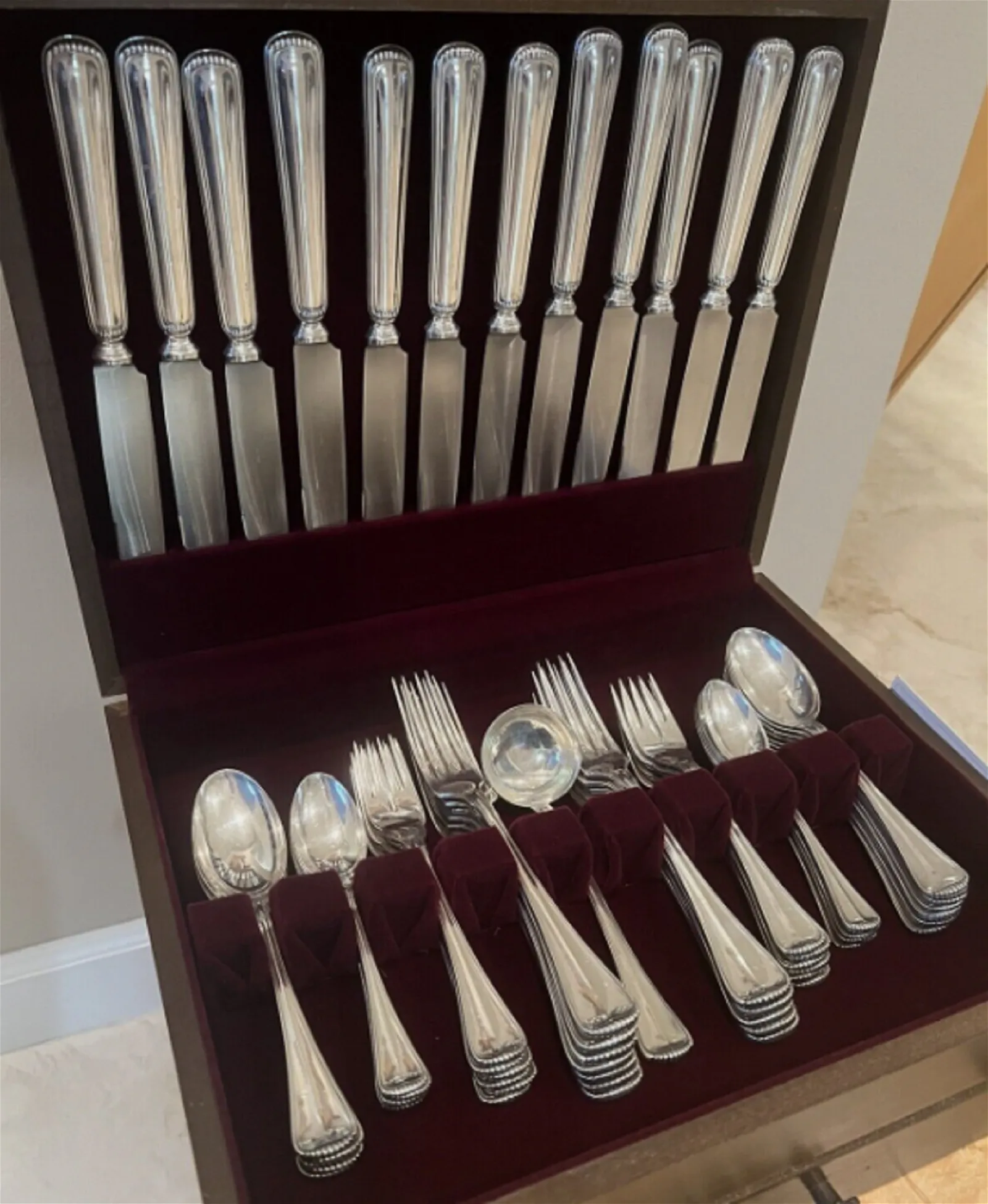
Buccellati Sterling Silver Milano Flatware Service For 12 Excellent Condition
The sale will include names such as Tiffany & Co., David Yurman, Buccellati, Gorham, Georg Jensen, Wallace, Whiting, Cartier, Kirk, Daum, Van Cleef & Arpels.
BROOKLYN, NY, UNITED STATES, May 24, 2024
An online-only Father’s Day auction featuring 150 lots of décor items, vintage trains and toys, sterling silver, fine estate jewelry and more is planned for Sunday, June 16th, by SJ Auctioneers, starting at 6 pm Eastern time. Internet bidding via LiveAuctioneers.com.
The artists, designers, silversmiths and manufacturers will include names such as Tiffany & Co., David Yurman, Buccellati, Gorham, Georg Jensen, Wallace, Whiting, Cartier, Kirk, Daum, Van Cleef & Arpels, Swarovski, Lalique, Herend, Maitland-Smith, Baccarat, Steuben, Armani, Hasbro, Marx, Ingersoll, Matchbox, Structo, Tootsietoy, Lionel, Tippco, Nintendo and others.
Wonderful sterling silver is offered at nearly every SJ Auctioneers sale, and this one is no exception. An example is the Buccellati sterling silver and parcel-gilt Millennium Globe, 9 inches tall, with original box and paperwork. The globe is numbered (005/500) and comes with an affidavit of authenticity signed by Gianmaria Buccellati. It has an estimate of $3,600-$4,000.
Sterling flatware sets are expected to sit atop the final list of top achieving lots, led by a 61-piece Buccellati sterling silver flatware service for twelve in the Milano pattern, in excellent condition (est. $7,500-$9,000); and a 50-piece Tiffany & Company large dinner service for seven in the Hampton pattern, no monogram, in superb condition, in a two-tiered chest (est. $5,500-$8,000).
A gorgeous five-piece Tiffany & Company sterling silver tea and coffee set in pattern number 3884 from 1875, in good condition and in the Aesthetic style, consisting of a coffee pot, a teapot, a covered sugar bowl, a creamer and a waste bowl, weighing a total 108.5 troy ounces, with hallmarks and the monogram shown, is expected to find a new home for $5,000-$5,800.
A Gorham coin silver butter dish in excellent condition and totaling over 17 ounces of troy silver, 5 inches tall by 7 inches in diameter, should finish at $1,200-$1,800; while a set of three ladles from the Georg Jensen United States store in New York City, all three in different sizes, complete with the original box featuring the company logo, carries an estimate of $250-$350.
The jewelry category will be led by two Tiffany & Company pieces: a 1940s late Art Deco 14kt yellow gold men’s (or unisex) bracelet, handmade and solid and weighing a hefty 52 grams, 8 inches long (est. $4,000-$5,500); and a mid-century retro-style 14kt yellow gold diamond and ruby convertible pendant, nicely centered by a ruby and diamond cluster (est. $3,000-$4,500).
Other jewelry offerings will include a David Yurman 18kt yellow gold necklace pendant enhancer charm Albion turquoise with diamonds, the turquoise alone 14mm (est. $2,500-$3,500); and four stingray cuffs and matching necklaces (black, charcoal, green and pink), the cuffs 10mm wide and the chokers 3mm wide, being offered as single lots (each est. $350-$500).
Vintage mid-century toys will be plentiful and will include the following examples:
• A circa 1964-1969 Hasbro GI Joe action sailor figure with the original box, the figure and box in very good condition considering their age, plus a plastic case (est. $450-$750). • A Marx tin litho wind-up train that goes around a track playing music, in pastel colors of yellow, pink and green, featuring children playing, in working order (est. $180-$250). • A Structo pressed steel auto haul loader with 2 vehicles, 21 inches long (est. $150-$200).
On to decorative items, where a Herend signed bunny rabbit figurine with no chips or cracks, 12 inches tall and 7 inches long, is expected to realize $750-$2,500; and a vintage, 1990s Lalique crystal shark figurine from a limited edition created exclusively for the Nassau Bottle, 2 ¾ inches tall, magnificently sculpted in satin-finished crystal, carries a pre-sale estimate of $500-$750.
Swarovski figures, so popular with collectors, will feature a crystal DC Comics Thor figure with box, in a collectible deign that features 523 facets and a mix of metal accents (est. $600-$850); and an Idyllia Gouldian large and colorful finch bird designed by Martin Zendron, executed with a vibrant kaleidoscope of colors, featuring 376 facets and lacquered metal feet (est. $280-$350).
A Maitland-Smith apple décor figure in tessellated marble with a brass stem, measuring about 8 inches, is expected to change hands for $350-$500. Also, a vintage pair of sterling silver Japanese red crested Tsuru crane birds, hallmarked Gin-Sei (the Japanese sterling silver mark), mounted on a velvet-lined wooden stand and with a covered glass case, should hit $250-$500.
Rounding out this short list of expected top achievers is a pre-1905 Bartholomay (Rochester, N.Y.) winged wheel small metal coaster or tip tray (“Beers, Ales & Porter, in Kegs & Bottles”), with a diameter of about 4 ½ inches, lithographed by Chas. K. Shonk, Chicago (est. $300-$500).
Bidding is available online now. Pre-bidding is also available; for those who are unable to attend the online auction, they can still leave their bids now. This auction uses Autopay by LiveAuctioneers.com. SJ Auctioneers prides itself on offering its customers great service and fast shipping, unlike some other auction houses where people need to arrange their own shipping.
SJ Auctioneers is always seeking quality items for future auctions. To inquire about consigning an item, an estate or a collection, you may call 646-450-7553; or, you can send an email to [email protected]. To learn more about SJ Auctioneers and the online-only Father’s Day auction slated for Sunday, June 16th, visit www.sjauctioneers.com.
Roland NY of Glen Cove, NY is presenting the Rosalind P. Walter Collection of Silk Scarves sale on June 8, 2024. This single-owner collection features 272 lots of premier scarves and other accessories owned by Rosalind P. Walter. A philanthropist, Walter (American, 1924 – 2020) was best known for her support for the humanities, environment, public television programming, and educational opportunities. During World War II, at the age of 19, she worked in an aircraft factory in Bridgeport, CT and was the inspiration behind the 1942 song, Rosie the Riveter. Here are some highlights from this upcoming event that caught the attention of the AuctionDaily team.
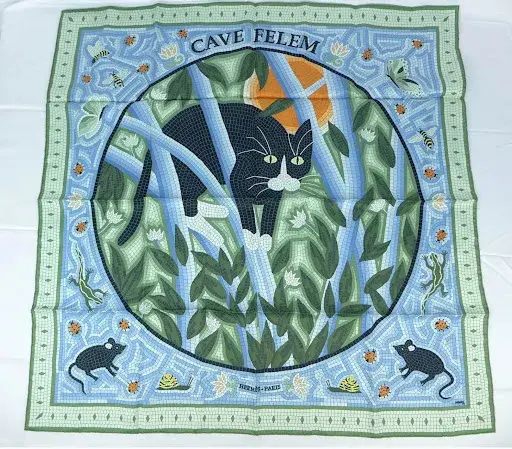
Lot #68, Hermès’ Cave Felem, is estimated at $200 to $300. Image courtesy of Roland NY.
Stunning silk scarves by the French brand Hermès take center stage at this colorful sale, with over 200 lots on offer. All eyes are certain to be on lot #68, the company’s Cave Felem, which is estimated at USD 200 to $300. It measures 90 cm square and was made in the late 20th century. It is decorated with a black and white tuxedo cat, flowers, greenery, bugs, mice, and other field and forest animals in a tiled, mosaic style. The image was designed by Christine Henry and debuted in 1998. The scarf is sold with its original box and packing papers.
Hermès began producing scarves as an extension of their fashion production in 1937. The first one was designed by Robert Dumas, the son-in-law of Emile Hermès, who was the grandson of the company founder Thierry Hermès. Each Hermès scarf design takes about 1.5 years to go from concept to production, and the company has traditionally released about a dozen new patterns per year. Universally beloved for their quality, integrity, and remarkable coloration, enthusiasts have included Queen Elizabeth, Grace Kelly, Jackie Onassis, and Madonna.
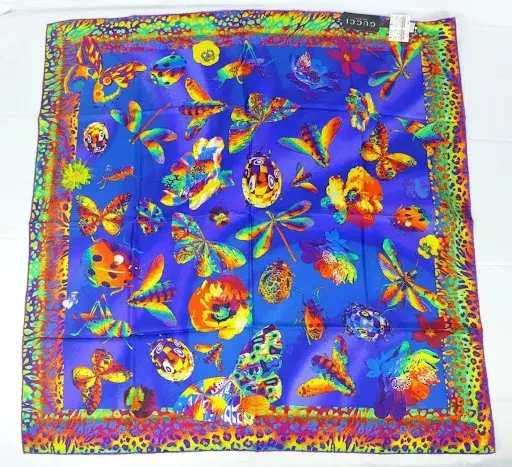
Lot #222, Gucci’s Insects, is estimated at $200 to $300. Image courtesy of Roland NY.
Scarves by the Italian brand Gucci also feature prominently in this sale, with 54 examples on offer. Lot #222, Gucci’s Insects from the 1990s to early 2000s period, is estimated at $200 to $300. This as-new scarf measures approximately 34 inches square and includes its original box, papers, and tags. It is decorated with iridescently colored garden bugs including butterflies, dragonflies, ladybugs, and grasshoppers, as well as a sprinkle of pansies, daisies, and other blooms.
Flora and fauna have featured prominently in Gucci’s scarf history. In 1966, Gucci created a scarf especially for Princess Grace because the company felt nothing was outstanding enough in the existing line for the royal. It was designed by Vittorio Accornero and simply named Flora. This pattern was printed in 37 different colors, themed to the four seasons, and was decorated with a collection of insects and flowers. This now iconic design would go on to influence the creative direction of the firm’s clothing, handbag, and jewelry lines for the next half-century.
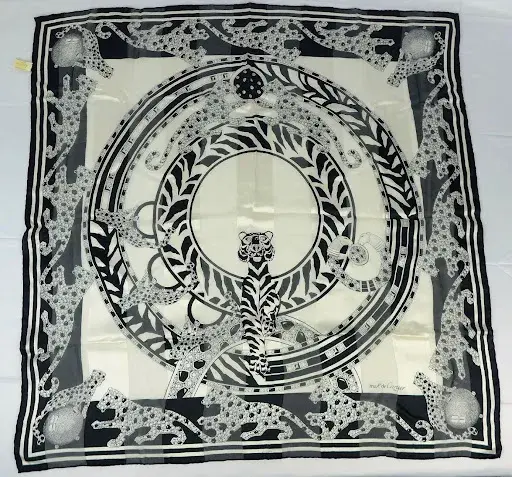
Lot #266, Must de Cartier Paris’ Panthère Jewels, is estimated at $200 to $300. Image courtesy of Roland NY.
Eye-catching scarves by the French brand Cartier are another important category in this event, with eight lots available. Lot #266, Must de Cartier Paris’ Panthère Jewels, is estimated at $200 to $300. This predominately black, white, and gray example is decorated with concentric circles, a standing panther, and diamond-embellished Art Deco-inspired jungle gems. It dates from the 1990s to early 2000s and is in fine condition. It is being sold with its box and papers and measures about 34 inches square.
The panther has been synonymous with Cartier for more than a century. Jeanne Toussaint joined Cartier’s design team in 1913. She loved panthers and felt they would be a good theme for Cartier, given their elegance, sophistication, and strength. By 1914, a panther appeared as part of a print ad for the company. They quickly became part of the luxury firm’s branding, and to this day, panthers appear as integral design elements in the company’s fine jewelry, watches, handbags, and other accessories.
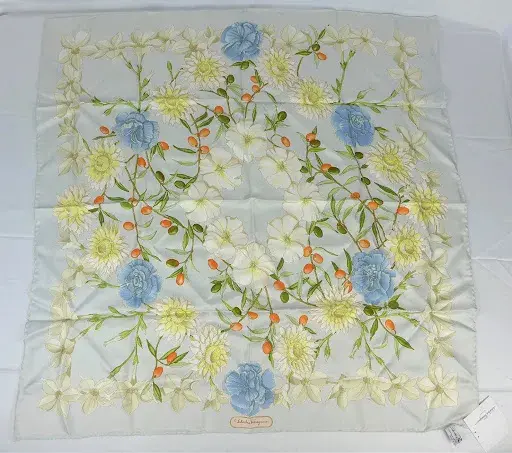
Lot #258, Ferragamo’s Flowers, is estimated at $200 to $300. Image courtesy of Roland NY.
The Italian firm Ferragamo is known for its exquisitely designed accessories, including silk scarves. Lot #258, the company’s Flowers from the 1990s to early 2000s, is estimated at $200 to $300. It is decorated with greenery, orange buds, and white, cream, and blue flowers on a gray background. This as-new scarf is being sold with its original box, papers, and tags and measures about 34 inches square.
Ferragamo’s silk scarf line debuted in the 1970s and was championed by Fulvia Ferragamo, Salvatore’s daughter. The first examples were decorated with animals made from flowers– meaning they came to life through leaves, petals, buds, and other plant materials blended together as a mosaic. Soon after, versions just spotlighting flowers or jungle animals were introduced. According to the company, it takes a month and dozens of sketches to develop the final version of any scarf produced today.
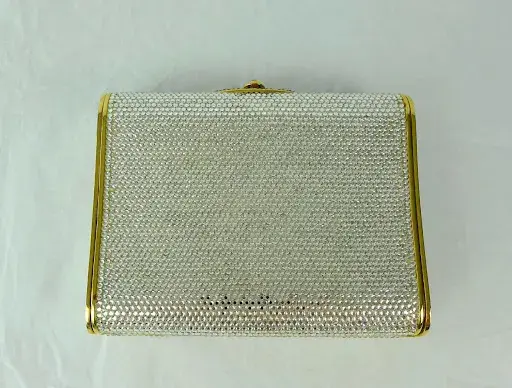
Lot #272, Judith Leiber’s crystal hard shell clutch, is estimated at $200 to $300. Image courtesy of Roland NY.
Accessories by other world-renowned designers and firms including Tiffany and Judith Leiber round out this exciting sale. Lot #272, a stunning vintage Judith Leiber Austrian crystal hard shell clutch with its original chain strap and push lock, is estimated at $200 to $300. This bejeweled example is in like new condition and measures about 6.5 inches tall.
For more information on Roland NY’s Rosalind P. Walter Collection of Silk Scarves sale on June 8, 2024 and to register to bid, visit LiveAuctioneers.
Find more auction world news on Auction Daily’s news channel.
Featured: Unusual Egyptian ceramic funerary mask, monumental bronze of Venus, white marble head of Dionysus, Roman gold jewelry & glass; carved marble statue of Bodhisattva, medieval swords
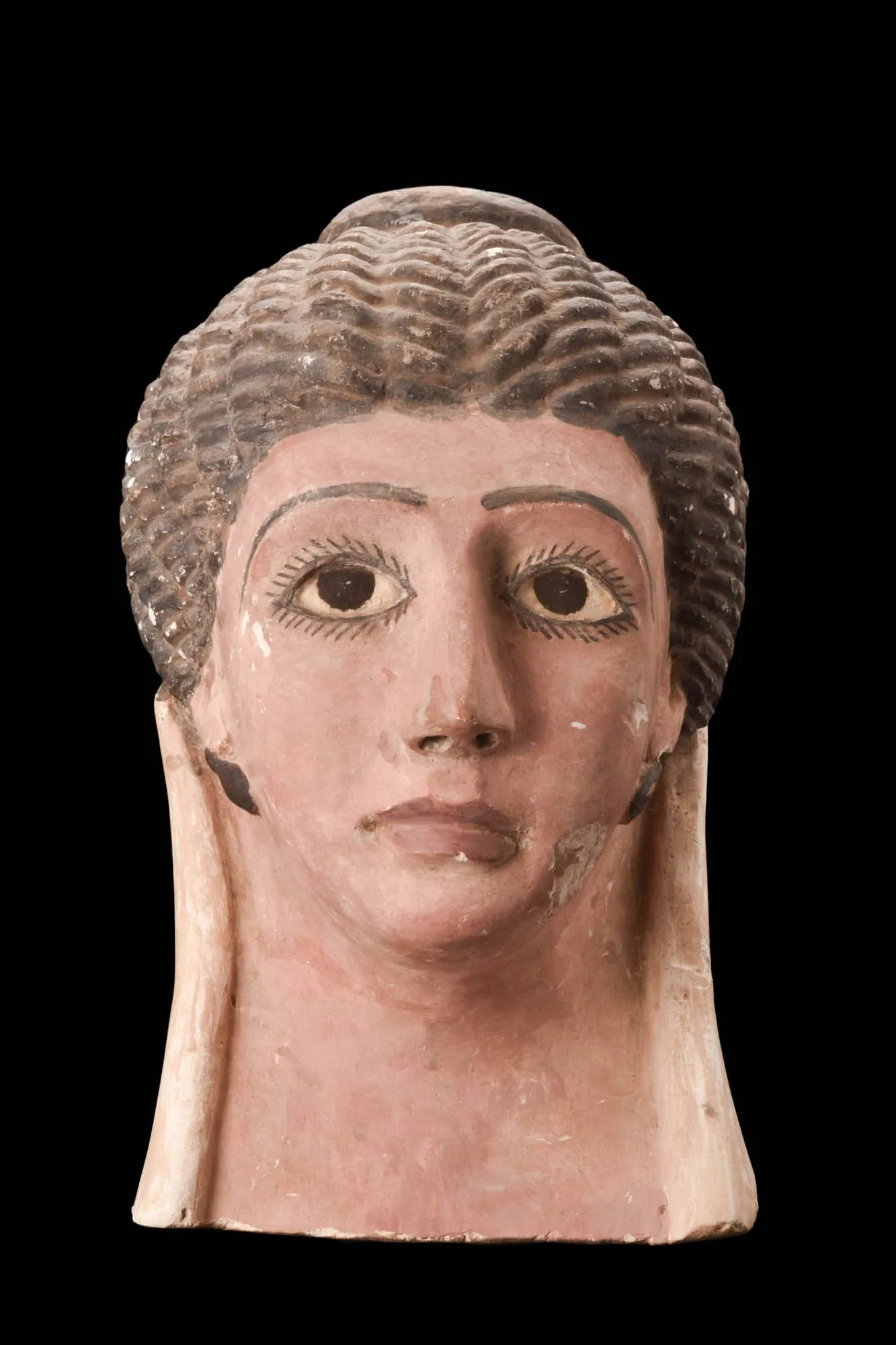
Circa 30 BC-323 AD Egyptian polychrome ceramic funerary mask of youthful female with braided hair and painted eyebrows, hair, lips, earrings and eyes, which have inset glass panels. Size: 275mm x 160mm (10.83in x 6.3in) Weight: 2.16kg (4lbs 12oz). Provenance: Property of an Israeli gentleman; acquired from Aaron Gallery, Berkeley Square, London W1 in 2011; formerly in the Issa collection, early 1980s. Opening bid: £5,000 ($6,400)
LONDON – Collectors of ancient art and antiquities who never miss an Apollo Art Auctions live gallery sale won’t have to wait till the next big in-person event (slated for July) to acquire rare and fascinating treasures for their collections. On June 11, the London-based firm will host a special 495-lot online-only sale of well-provenanced and carefully authenticated artifacts from Classical Europe, Egypt and the Near East, with additional art and relics from ancient India and China. Each item entered in this bonus auction has been rigorously vetted by a top specialist from Apollo’s team of experts.
The auction’s timeline begins in one of the earliest and most influential centers of human progress: Egypt. Known as the “cradle of civilization,” Egypt’s society was advanced beyond measure in science, mathematics and art, yet their overriding focus – some say obsession – was with the afterlife, which they viewed as a continuation of one’s eternal journey. Deceased individuals were bedecked with amulets, jewels and funerary masks for their send-off to the next world. A particularly fine example of this sort of adornment is the auction’s opening lot: a circa 30 BC-323 AD Egyptian polychrome ceramic funerary mask of youthful female. She is shown with braided hair and painted eyebrows, hair, lips, earrings and eyes, which have inset glass panels. The mask was previously the property of an Israeli gentleman and was acquired from Aaron Gallery, Berkeley Square, London, in 2011. Before that, it was part of the Issa collection (early 1980s). The starting bid is £5,000 ($6,400).
Along with embalming and mummification, Egyptian funerary rituals included entombing their dead with objects and representations of people, animals and other things that would be useful in the afterlife. A perfect example is the carved and painted wooden model of a boat with six boatmen, which dates to circa 2030-1640 BC. All of the figures are depicted in the classic Egyptian manner, with large, dark-outlined eyes, a cropped black wig, and white loincloth. In the afterlife, they were destined to be servants, ready to row the deceased upon the eternal Nile. Similar to an example in the Met Museum, this model is accompanied by a historical report from Alessandro Neri and can be traced back to an old French collection from the 1970s. Opening bid: £3,000 ($3,830)
Masterfully executed, a Roman white marble head depicting Dionysus, the god of wine and pleasure, is carved in archaic style with idealized fixed features and dates to circa 200 AD. Its most striking detail is the curly hair that encircles the subject’s forehead and connects to a long polygonal beard and moustache. A similar example is seen in Borghese e l’antico, Skira editore, 2011. Described in Apollo Art Auctions’ catalog as having been part of a “herm” (squared stone pillar topped by a carved head and used in ancient times as a boundary marker or signpost), this substantial sculpture measures 470mm by 300mm (18.5in by 12in) and weighs 50+ kg (110+ lbs). Most recently the property of a London gentleman, this stunning sculpture was previously in a Paris collection and, prior to that, on display at a Parisian gallery from 1970 to 1990. Bidding will open at £22,000 ($28,085).
A monumental Roman bronze statue of Venus, circa 1st-3rd century AD, depicts the goddess in a graceful pose standing on a wooden plinth. Similar to examples in The Walters Art Museum, The British Museum, and Christie’s December 7, 2006 auction, the 340mm/13.4-inch-tall artwork was formerly the property of a London gentleman, with earlier owners going back to 1970 in Paris. Accompanied by an Art Loss Register letter and professional historical report from Ancient Report Specialists, the statue will open at £15,000 ($19,160).
Ancient Romans established the tradition of art glass in the Mediterranean region, and it is a specialty that has gained a devoted following at Apollo Art Auctions. The June 11 selection includes a huge and very attractive Roman plate of greenish-blue glass with an outward-folded rim, hemispherical bowl, applied ring foot and two dolphin-shape handles. Dating to circa 50-300 AD, it passed down through the family of a London collector who was active in the 1970s and ’80s. The plate will be offered with an opening bid of £3,000 ($3,830).
One of many Chinese highlights is a circa 700 AD Sui to Tang Dynasty white marble figure of Bodhisattva. It is an especially well-carved depiction of a standing Buddha with elaborately “jeweled” and decorated hair and robes. Presented on a plinth, it measures 450mm by 110mm (17.7in x 4.3in) and weighs 3.75kg (8lbs 4oz). Its line of provenance includes a London private collection, and Sir Roger Moss, who acquired it in the 1980s in Hong Kong. Its opening bid is £5,000 ($6,385).
Nothing can match the gorgeous luster of old gold as exemplified in a circa 400 BC-300 AD Hellenistic filigreed gold pendant and glass-bead necklace. The round pendant is set with a central oval garnet and four smaller round garnets, and is similar to an example sold at Christie’s Ancient Jewelry Auction #1445. XRF analysis confirmed its metallurgical content, suggesting ancient origin with no modern trace elements. Its line of provenance includes a central London art gallery following acquisition on the art market in Monaco; and an English private collection that was formed between 1996 and 2017. It will convey with an Art Loss Register letter and authentication report by ancient jewelry specialist Sami Fortune. Opening bid: £3,000 ($3,830)
Apollo’s gilt-edged auction jewelry box also contains a Ptolemaic gold finger ring, Henig Type I, that dates to circa 300-100 BC. Its elongated bezel setting encloses a richly-hued carnelian intaglio engraved with the image of a full-bodied crocodile. From its carefully etched scales to its casually curved tail, the well-formed reptile is a most unusual and amusing character to see on jewelry of its age and origin. The ring was most recently part of a Central London private collection, and prior to that, was in a collection formed on UK/European art market prior to 2000. It has been cleared against the Art Loss Register database and is accompanied by an authentication report prepared by ancient jewelry specialist Sami Fortune. The opening bid is set at £3,000 ($3,830).
Understatedly elegant and eminently wearable, a medieval finger ring of 21K gold features a beautiful green emerald cabochon set in a square bezel. It dates to circa 1300-1500 AD and has undergone XRF analysis, which confirmed its metallurgical content and showed it was consistent with ancient origin with no modern trace elements. Formerly in a London private collection, this extremely attractive bauble is accompanied by an Art Loss Register letter and has an opening bid of £3,600 ($4,595).
Apollo Art Auctions’ Tuesday, June 11, 2024 Ancient Art & Antiquities Auction, an online-only event with bidding through LiveAuctioneers, will commence at 8am US Eastern time/1pm GMT. In-gallery viewings can be arranged upon request. Apollo Art Auctions accepts payments in GBP, USD and EUR; and ships worldwide. All packing is handled in-house by white-glove professionals. Questions: call +44 7424 994167 or email [email protected]. Visit Apollo Art Auctions online at www.apolloauctions.com
International bidding was strong, with buoyant prices paid for early Lionel auto sets, Tonka pressed-steel vehicles, postwar Japanese and European toys
Large and wildly futuristic Yonezawa (Japan) tin friction #58 Atom Jet racer with driver inside clockwork. Beautiful colors, graphics and details. Both friction and motor sound are functional. Length: 26in. Sold for $25,740 against an estimate of $10,000-$15,000
WILLOUGHBY, Ohio – Ever since Milestone Auctions’ October 2023 debut offering of toys from the legendary Elmer’s Toy Museum collection, the question many vintage toy fans have been asking is, “When will we see Part II?” Their long wait ended on May 11 when the suburban Cleveland auction house rolled out 774 lots of tin windups, battery-operated toys, pressed-steel trucks, Japanese tin cars, Dooling gas racers, and both automotive and character toys from Germany’s pre-war era.
The single-consignor event closed the books at $460,000, a figure that was comfortably within Milestone’s range of expectations and a full $100,000 above the overall low estimate. “Across all categories, better things brought better prices. Some of the numbers were insane, like on the Atom Jet Racer and the small Lionel autos,” said Miles King, co-owner of Milestone Auctions. “European toys were shipped everywhere, and the number of bidders for postwar Japanese toys was way up – collector interest just keeps on growing for that particular category.”
Made by Yonezawa, the wildly futuristic tin friction #58 Atom Jet Racer finished at the top of prices realized. With its distinctive midcentury colors, a toothy chrome grille, and cool 1950s/’60s graphics, the oversize toy measured an impressive 26 inches long and had all its bells and whistles. Sought after by collectors of race cars as well as postwar Japanese toy aficionados, Atom Jet always creates a stir on those rare occasions when an example appears at auction. At Milestone’s sale, it stormed across the finish line to claim $25,740 against an estimate of $10,000-$15,000.
Lionel is a revered American toy train company, but over the years they’ve produced a number of interesting sidelines. An unusual Lionel production from the Elmer’s Toy Museum collection was a rare 1912 #80 Automobile Outfit containing an orange race car, both original drivers, and a metal track. The set appeared never to have been played with and even retained its original cardboard box with Lionel company advertising on the exterior. It sold for $10,238, more than five times the high estimate. Immediately following its production of #80, Lionel produced the same set with a red car, also with two original driver figures. Set #81, also in beautiful, untouched condition and with its original Lionel cardboard box, also commanded more than five times the high estimate, retiring at $10,530.
The sale featured two prized “Gordon Bennet” tin windup racers, named for an early 20th-century New York playboy and sportsman who made headlines with his foolhardy adventures in yachting, hot air ballooning, aviation and motor racing. The racer made by Issmayer (Germany), measuring 7½ inches long, presented in excellent condition with a functional clockwork mechanism and both of its original passenger figures. It charged past its pre-sale estimate of $4,000-$6,000 to settle at $10,148.
Another German toy that boasted high condition was a Lehmann (Germany) 7-inch tin windup Taxi Cab lithographed in a mustard color with black roof and running boards. It was 100% complete and original, even retaining its liveried driver and Lehmann-logo’d fabric flag on the hood. Estimated at $400-$600, it gliding to a final price of $3,198.
Rough-tough pressed steel toys of the postwar era are special favorites to collectors who remember playing with them as children. A premier brand of that time was Tonka, whose construction toys were built to last. Unfortunately for collectors, few have survived in spotless, boxed condition simply because they were so tempting to play with. The late Elmer Duellman’s collection contained several beautiful examples, including hard-to-find boxed sets. A 1955 Tonka #775-5 Road Builder Set consisting of a semi with lowboy trailer, steam shovel, road grader and dump truck was complete in its original, correctly partitioned box. The pre-sale estimate was set at $1,500-$2,000, but it paved its way to a winning bid of $5,850. Yet another Tonka treasure that set the room ablaze was a 1959 B-12 Fire Department set 1959 Tonka B-212 Fire Department set. In very fine, unplayed-with-condition, it included a good-looking 30-inch fire ladder truck, a fire pumper truck and a set box that Tonka had cleverly lithographed to resemble a burning apartment building. It sold for $3,960 against an estimate of $800-$1,200.
Showing off its sleek lines and Art Deco styling, a Steelcraft New York/San Francisco streamline bus was another pressed-steel highlight. In all-original condition with excellent paint, the 21-inch-long transport vehicle sold well above its high estimate, for $2,640.
A crowd-charmer that captured Disney fans’ attention was a coveted Dean’s Rag Mickey Mouse soft doll on a metal scooter. All original and in very nice condition, the 8-inch rarity whizzed pasts its $800-$1,000 estimate to apply the brakes at $5,658.
After the sale, Miles King expressed his delight with the continued global interest in Elmer Duellman’s toys. “From start to finish, an overwhelming percentage of bids came in either through the Internet and by phone. We were very happy to see how many of those bids were from other countries. Our overseas customer list just keeps on growing, and we think that’s because collectors like what we offer and, no matter where they are located, appreciate the way they are treated – before, during and after the sale.”
To discuss consigning a collection or just a single vintage toy to a future auction at Milestone, call 440-527-8060 or email [email protected]. All enquiries are kept strictly confidential. Online: www.milestoneauctions.com
____________________________
All prices shown in this report are inclusive of buyer’s premium as stated on Milestone’s website.
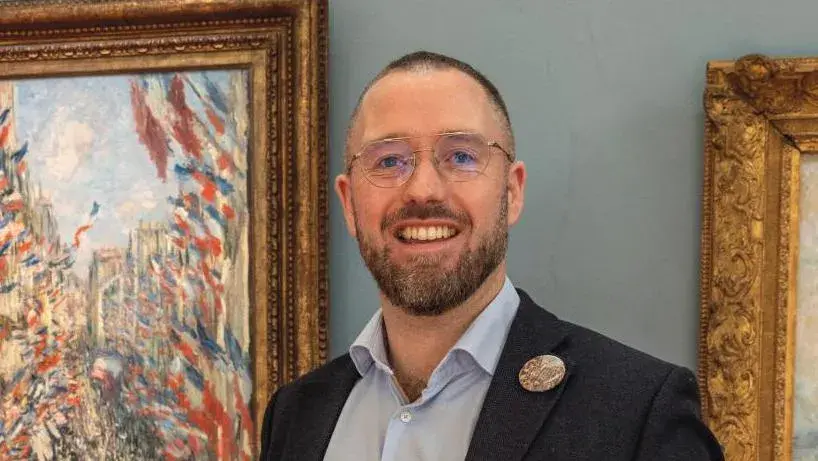
The Director of the Douai museum—who was previously head gardener at the Louvre and then head of the French presidential parks and gardens—looks back on an atypical career and takes stock of the development and restoration of the permanent collections.
Pierre Bonnaure, in front of Monet’s Rue Montorgueil, Paris. Fête du 30 juin 1878 (Rue Montorgueil, Paris. National Holiday, June 30, 1878), on loan from the Musée d’Orsay for the “Monet-Duhem: Impressionism in Douai” exhibition. City of Douai
How did you get into gardening? After two years at the École du Louvre and six months at an architecture school, I attended a general meeting of the Friends of Versailles, of which I was a member. Afterwards, I spoke with Joël Cottin, the Palace’s head gardener, who offered me some short-term work. This turned into an apprenticeship after a few months. One thing led to another, and I decided to do a postgraduate diploma in the “History of Gardens, Heritage and Landscape” at Paris I-Panthéon-Sorbonne university.
Would you describe yourself more as a researcher or a hands-on person? I started a doctoral thesis on “Ink and sap. The art of André Le Nôtre’s gardens”. I dropped it when I was appointed head gardener of the Tuileries and Palais-Royal at 29, after passing the competitive examination. But I never lost that connection to Le Nôtre.
What was the most important lesson you learned from Le Nôtre at Versailles and during your ten years at the Louvre? Perhaps the most poetic aspect was the way he constructed perspective, just as a museographer would use it as a way to direct visitors today. It provides an instinctive guideline for people walking around. In Le Nôtre’s time, Versailles had a magnificent line of chestnut trees—considered highly exotic—, which transformed the Tuileries into a gigantic bouquet of flowers in April.
What was your finest project at the Louvre? Definitely the renovation of the gardens at the Musée Delacroix. It was a very ambitious challenge launched by the museum’s then director Christophe Leribault, as we had no archaeological traces or iconographic documents on this garden, which faces due south—an astonishing detail. The project, which drew on some accounting elements from Delacroix’s diary and a few comments on his still lifes, owes a great deal to the sharp eye of Henri Loyrette, who made the right choice in terms of design.
Nicolas Guy Brenet, Portrait of Charlotte Herts, 1770, oil on canvas, 78.5 x 67 cm/30.7 x 26.4 in., acquired by pre-emption at Drouot on October 12, 2023, Delon-Hoebanx auction house. Douai, Musée de la Chartreuse, 2023.
In 2017, you were appointed to the Élysée Palace. Isn’t its garden the very antithesis of Le Nôtre’s style? The Élysée garden is deceptively simple! It’s very subtle, because the sunken lawn has retained some artificial gradients, a legacy of the French-style garden of the Hôtel d’Évreux, “customized” when it was transformed into an English garden at the end of the Revolution.
Incidentally, was there ever a question of reviving a French-style garden? Valéry Giscard d’Estaing certainly wanted to, had he been re-elected in 1981. Box hedge embroidery, a small grove and a line of trees had already been planted.
What was your role after taking up your post? My mission was to restore the 12 hectares (approximately 30 acres) of the presidential residences. As well as the Élysée Palace garden, the five-gardener team was in charge of the gardens at the former Hôtel de l’Impératrice Eugénie on the Rue de l’Élysée, the Hôtel de Marigny, the Palais de l’Alma and the Pavillon de la Lanterne. While leaving the garden intact, as the President and his wife wished, I essentially played with shades. Too many colors kill color, as in a late Renoir painting! To enjoy beautiful seasonal blooms, it’s essential to introduce gradations in the heights and shapes, and diversify the botanical elements—for instance with grays and downy foliage, which provide marvelous graphics.
What is your philosophy when it comes to gardens? I champion natural gardens; I even welcome weeds! For me, a garden that is silent in summer is a failure. It should be a microcosm given over to insects and birds. Apparently, the “natural garden” originated in England at the end of the 19th century as a reaction to the French and English styles. Yet the latter, where the principle was to reproduce in nature the sort of Italian rural landscape composed on canvas by Poussin, is as unnatural as a garden by Le Nôtre. It would be like judging Ingres through the prism of Monet. Le Nôtre, instead of imposing a conception of nature and constraining his plants, skillfully chose species whose potential he could exploit to the full, like yew, with its highly flexible wood allowing for quirky, extravagant shapes.
But now you’ve left the din of the Elysée Palace for the silence of the Chartreuse de Douai, your home town… When I was younger, I did an internship there. It’s a museum with a real soul. What’s more, it contains the only Giambologna marble in France’s public collections! As well as the finest 17th-century Dutch earthenware in the world. There is an outstanding pair of huge lidded vases, which entered the museum in the 19th century, though we don’t know their provenance. The Chinese decorative art is not simply a copy of Chinese “blue and white” porcelain: it includes purely Western details. These pieces are the work of the brilliant potter Rochus Hoppesteyn, who died ruined because of his endless experiments. They can be dated to between 1680 and 1686, making them the first to combine grand feu blue and green with muffle-fired red and gold. We were lucky enough to acquire a third vase featuring the same decoration.
Southern Flanders, Ange de Masny, anonymous sculptor, c. 1260-1280, carved oak with polychrome, 57 x 19 x 10 cm/22.4 x 7.5 x 3.9 in. Douai, Musée de la Chartreuse, on deposit from the City of Masny. City of Douai
What was your most exciting discovery in the reserves, some of which you’ve already moved? In 2021, I had the amazing chance to spot an oak statuette covered in thick dust and pigeon droppings, which had been deposited with the museum in 1969 by the municipality of Masny. It was described as a 17th-century Saint John. But I recognized it as a 13th-century altar angel, similar to the ones by Saudemont and Humbert in Arras: an identification that has since been confirmed by Pierre-Yves Le Pogam, Head Curator of Sculpture at the Louvre.
You have also just launched a project regarding the Italian collections. Marquis Pierre-Amédée Foucques de Wagnonville spent the last two decades of his life in Florence, where he was a skilled collector. In 1877, this collection was bequeathed to his native Douai and to Florence. He left us some beautiful majolica pieces, various sculptures by Pierino da Vinci, Tiziano Aspetti, Giambologna and Félicie de Fauveau, a very fine large Deposition by Giorgio Vasari, the world’s oldest listed desco da parto (birth salver) and a whole collection of Italian Seicento paintings, which we will soon be studying, restoring, and bringing out of storage, with help from specialists Françoise Baligand, Christophe Brouard, Philippe Costamagna, and Matteo Gianeselli.
Last October, the Chartreuse preempted a portrait by Nicolas Guy Brenet a few days after the publication of Marie Fournier’s monograph. During the presentation of her book at Artcurial, Marie Fournier talked about this portrait of a Douai woman, making its debut at auction. It was an obvious decision for us, as well as for the friends of the museum and an anonymous Douai patron who enabled us to buy it. I really admire Marie Fournier’s work, which is extremely sound. I’ve asked her to curate the painter’s retrospective, and this will help us to rediscover his works in the collegiate church, as well as in the Parliament of Flanders. This decor has survived and remained in situ since it was built, but is now inaccessible, as it is an integral part of the courthouse.
It seems you have a particular passion for Second Empire and Belle Époque jewelry… It’s an area that fascinates me. I’m very interested in the quality of the settings and the sheer inventiveness of the subcontractors who worked for leading 19th-century companies or now-forgotten manufacturers.
WORTH SEEING UntilJune 24, 2024, “Monet-Duhem: Impressionism in Douai”.
From September 20, 2024, to January 6, 2025, “Nicolas Guy Brenet, un peintre du roi à Douai au siècle des Lumières” (“Nicolas Guy Brenet: A Painter to the King in Douai during the Enlightenment.”)
Alex Katz, Reflection 2, 2021
Archival pigment ink on Innova Etching Cotton Rag 315 gsm fine art paper, 47 x 39.5 in.
Signed and numbered in pencil, edition of 100
NEW YORK, NY – The American Friends of Museums in Israel raises funds for eight outstanding museums whose dynamic, diverse range of exhibitions, tours, art education, public programs, and learning resources offer a myriad of engaging opportunities for discovery and dialogue.
Auction Info
Featuring over 50 works including paintings, sculptures, photographs, and works on paper by celebrated artists, the American Friends’ Fine Art Online Benefit Auction hosted by Artsy is now live through June 5, 2024, with lots beginning to close that day at 12pm EDT. To bid online, visit Artsy.
Participating Auction Artists
Ai Weiwei, Alex Katz, David Hockney, Donald Sultan, Ed Ruscha, Ellsworth Kelly, Gregory Crewdson, Harland Miller, John Baldessari, Katherine Bernhardt, Kenny Scharf, Nan Goldin, Richard Misrach, Robert Motherwell, Robert Rauschenberg, and Yue Minjun, among many others.
Partner Museums
Design Museum Holon, Haifa City Museum, Haifa Museum of Art, Hermann Struck Museum, Mané-Katz Museum, National Maritime Museum, Tikotin Museum of Japanese Art, and Tower of David Jerusalem Museum.
Select Museum News and Exhibitions Highlights
Tower of David Jerusalem Museum is a leading international heritage site featuring significant archaeological finds dating back 3,000 years. The Museum serves all socio-economic groups and populations as well as those with special needs. Its new Angelina Drahi Entrance Pavilion (opened March 2024) houses changing exhibitions that examine the points of connection between the city’s heralded past and its contemporary art and culture.
Design Museum Holon, housed in an iconic building by acclaimed architect Ron Arad, is Israel’s only museum dedicated to design. Its newest exhibition, Game Changer, examines design’s potential to foster a more inclusive society. Exhibition-related initiatives transforming the Museum’s Design Laboratory into experiential space for children and families include interactive programming promoting equality, social diversity, cooperation, and acceptance of difference.
Tikotin Museum of Japanese Art in Haifa holds one of the largest and most important collections of Japanese art outside Japan. Currently on view, Duos explores points of connection between 18th- and 19th-Japanese woodblock print masters and contemporary Japanese and Israeli artists. Pairings include Utagawa Hiroshige with video artist Tabaimo, and Katsushika Hokusai with multimedia artist Yael Balaban.
About American Friends of Museums in Israel
The American Friends of Museums in Israel recognizes, promotes, and honors its outstanding partner museums in Israel by providing exhibition, program, project, and financial support through the generosity of its donors. In addition, the non-profit organization provides heightened visibility for its partner museums through special events held in New York, virtual programming, and promotional materials.
For more information about the American Friends, call (917) 970-8846.
Red on red, Paris is a buzz for the 7th edition of Printemps asiatique—a lucky number, of course. Learn more here!
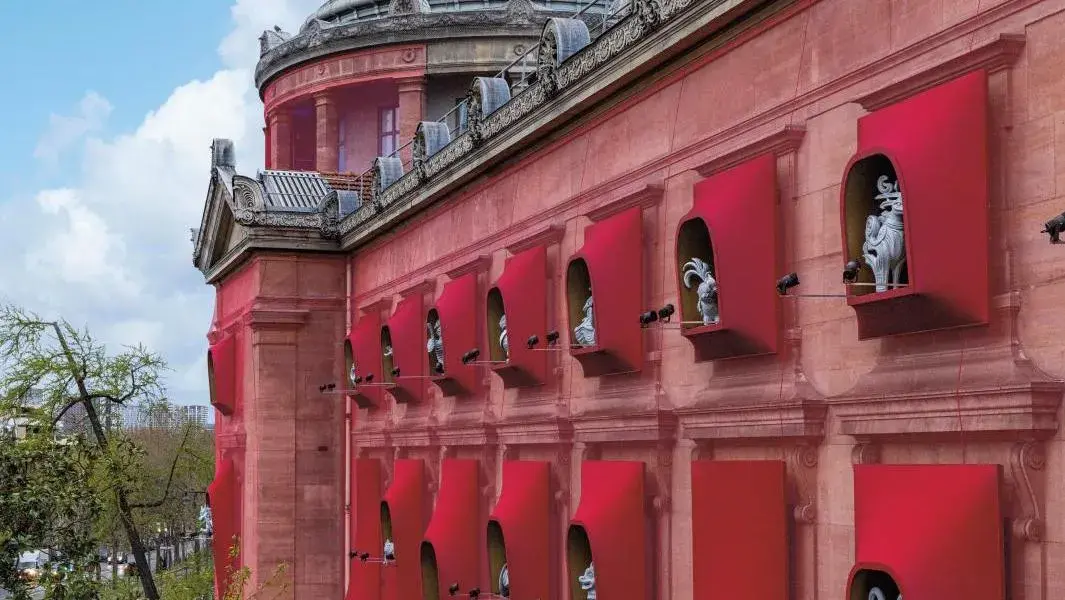
Façade du musée Guimet, decorated by artist Jiang Qong Er. PHOTO Frédéric Berthet
From the top of the Eiffel Tower, Paris unfolds in all its beauty and diversity. This year, the eye is drawn towards a new red accent that may seem incongruous. In fact, with the carte blanche given to Franco-Chinese artist and designer Jiang Qiong Er, the Musée Guimet, which usually blends into the mass of surrounding Haussmann architecture, stands out. For the first time in its history, to celebrate the 60th anniversary of the re-establishment of diplomatic relations between France and China, the building’s facade is transformed: it is entirely covered in a veil of red tulle and reborn under the contemporary guise—reinterpreted—of Chinese caves inhabited by twelve mythical creatures, the Guardians of Time, born of the fertile imagination of the dynamic visual artist. What better way to dress the capital in the colors of China, as Printemps asiatique (Asian Spring) returns for its 7th edition?
La Pagode, The Beating Heart This incandescent red echoes that of La Pagode, an emblematic site for Asian art and its Parisian market since the dealer Ching Tsai Loo, better known as C. T. Loo, transformed the two-story Napoleon III-style townhouse into the headquarters of his gallery and the showcase for his collections. It was the 1920s and his business was flourishing. This ingenious idea propelled the businessman onto the international scene, with subsequent openings in London, Shanghai and New York. The perfect tribute. In fact, once again this year, major foreign dealers—seven to be exact, including Gregg Baker, Carlo Cristi, Marcel Nies, Carlton Rochell and Tenzing—are invited to present their finest pieces in this unique venue, alongside their Parisian counterparts—thirty in all, as the exhibition space has been doubled. Since Christophe Hioco took over the presidency (see below), this is a much more international event. As he emphatically affirms: “Printemps asiatique is a highlight of the Asian art market. All the conditions are in place to make Paris shine and attract collectors and connoisseurs from all over the world. Greg Baker Asian Art and Kiyama Gallery, the Paris branch of Kyoto’s Yumekoubou Gallery, will be exhibiting top-quality traditional and contemporary Japanese art. It’s one of the aims of the event’s organisers: a dialog with the past will be established, and contemporary creations will have a special place here and in the participating galleries in the French capital.
Former region of Gandhara, 12th-13th century, Buddha sculpture, gray schist, h. 80 cm/31.4 in. Hôtel Drouot, June 14, Ader OVV. Estimate: €20,000/30,000
The Beautiful Music of Auctions Over the past few years, the position of Paris in the Asian art market has strengthened, and the French capital is now ahead of London and New York. Auction houses are turning up the deep, crystalline sound of theHuang zhong ritual bell, dating from the reign of the great Kiangxi (1662-1722), which will be offered on June 12 at Drouot, by Tessier & Sarrou et Associés. This imperial object, is estimated at €150,000/200,000. The Hôtel Drouot, once again a partner of Printemps asiatique, will host eleven specialized sales during the event. “This event, which has become a must-attend, brings together all the major players in this sector, all at the service of Asian art, whether professionals, institutions or collectors. Its growing success demonstrates that the French capital offers major assets capable of establishing Paris as a leading place on the international scene”, insists Alexandre Giquello. The sale of jewelry and textiles from the Tchen Gi-Vane Collection by Aponem (June 10), also includes traditional Chinese headdresses from the early 20th century, remarkable for the diversity of its decoration, combining red coral and kingfisher feathers for example (between €1,500 and €2,000 each). Xu Beihong’s ink and colors on paper is expected to fetch between €300,000 and €400,000 at De Baecque et Associés on June 14, it depicts a proud horse in the middle of a mountain landscape. The first part of the Pescheteau-Badin sale on June 13 will pay tribute to lawyer Maurice Garçon’s former collection of traditional Japanese objects, before China takes center stage with a famille rose enameled porcelain vase from the Qianlong period (€60,000/80,000), and a spinach-green jade wedding cup, carved in its center with peonies, lingzhi immortality mushrooms and nandina bamboo (€15,000/20,000). The combination of these elements born of nature is synonymous with a desire for longevity.
Vietnam and the 100th anniversary of the l’École des beaux-arts de l’Indochine will be at the heart of the round table organized at Hôtel Drouot on June 12. The remarkable institution of the École des Beaux-Arts d’Hanoi, will be on display at Ader on Friday 14th with a screen by N’Guyen Van Ty from 1942. In it, sampans navigate the tumultuous waters of the Cho Bo black river in Upper Tonkin (€100,000/120,000). The polychrome and gold-lacquered wooden box from Pham Hau’s workshop (€15,000/20,000) is more peaceful: at the foot of majestic century-old trees, deer and hinds graze freely. The same auction house will be showing the serenity of a gray schist Buddha, testimony to Gandhara art of the 2nd-3rd century. This sculpture is estimated at between €20,000 and €30,000. As you can see, the collections are at the heart of the program.
Asia in Paris Elsewhere in the capital, the sights and sounds of the Far East will be in the spotlight at Christie’s on June 13, with a blue-white porcelain bowl with yellow ground, decorated with pomegranate blossoms from the Zhende reign (1506-1521)—estimated at €150,000 to €200,000—, as well as at Bonhams Cornette de Saint Cyr, which will be dispersing the Jules Speelman Collection on June 11. This group of 28 Tibetan, Nepalese and Chinese Buddhist statuettes and objects made between the 11th and 18th centuries can be described as exceptional as well as personal. This is particularly true of a 17th-century statuette in partially gilded silver and gilded copper alloy, representing the eight-armed goddess Ushnishavijaya, a symbol of long life and merit. While waiting to attain reincarnation, his spiritual path is expected to materialize at between €600,000 and €800,000. This high estimate is repeated on three other occasions for statuettes featuring Vajrapani, Vajradhara and Shri Devi. These are museum-quality pieces of the highest quality, not frequently seen under the Parisian auctioneer hammers.
China, 18th-19th century. Green jade wedding bowl, h. 34 cm/13.38 in. Thursday June 13, Room 11 – Hôtel Drouot. Pescheteau-Badin OVV. Estimate: €15,000/20,000
Printemps asiatique is also supported by cultural institutions. The Louvre once again joins traditional partners such as the Guimet and Cernuschi museums, the MAD and the Château de Fontainebleau, among others. The Musée Guimet, which will open the exhibition “Au cœur de la couleur”, presenting Richard Kan’s porcelain collection, promises a wide-ranging cultural and scientific program, including a symposium on June 8, chaired by Yannick Lintz, to consider the future of Asian art museums in the 21st century. International dealers, auction houses and museums are all working together in harmonious convergence. The planets are aligned to make this new edition a renewed success. Isn’t 2024 the Year of the Dragon, a guarantee of prosperity and success?
Lee Hyun Joung (née 1972), Symphonie en trois mouvements, 2023, muk et Korean pigments on hanji paper, 162 x 292 cm/63.77 x 114.96 in. Galerie Louis & Sack. COURTESY Louis & Sack.
You’ve presided over the event for three editions now. What are the highlights and new features? My aim has always been to make Printemps asiatique one of the world’s leading events for Asian art, on a par with London and New York. The 7th edition promises to be more international than ever. Leading galleries, exceptional auctions and museum exhibitions will open the dialog between ancient and contemporary art. It will also be a grand celebration of the richness of Asian arts, as France and China seal sixty years of cultural relations between the two countries. The participation of internationally renowned Asian art galleries is confirmation of this.
You asserted this international ambition as soon as you arrived. How do you intend to go even further? My answer will be very short. I believe we’ll have reached our goal when we feel that our event has become the must-attend event for collectors from all over the world. A must!
Can you tell us more about your partnership with the museums and your guest of honor, John Guy? Our cultural program, initiated three years ago, will be even richer this year. Firstly, with the Musée National des Arts Asiatiques-Guimet, which is organizing two colloquia open to the public. I’d also like to mention two conferences at the Musée des Arts Décoratifs, led by Béatrice Quette, curator in charge of Asian and non-Western collections. And let’s not forget the program of galleries and auction houses. As for John Guy, I’m delighted to welcome him to Paris, as he is the iconic curator of Asian art at the Metropolitan Museum in New York. It will be very interesting for John to come and talk to us about his collections, and to take part in the colloquium on the future of museums organized on Saturday June 8 by Yannick Lintz, President of Guimet.
SALES CALENDAR AND EVENTS AT THE HÔTEL DROUOT
Friday June 7 Daguerre: Asian art, China, Japan, Southeast Asia Orne Enchères: Asian Art
Monday June 10 Aponem: feminine beauty in the Qing period
Tuesday June 11 Giquello: Jacques Barrère collection
Wednesday June 12 Tessier & Sarrou et Associés: Asian art
Thursday June 13 Pescheteau-Badin: Asian Art
Wednesday June 12 and Friday June 14 Delon-Hoebanx: Asian Art
Friday June 14 Ader: Far Eastern Art De Baecque et Associés: Far Eastern art Thierry de Maigret: Asian Art
Friday June 21 Auction Art Rémy Le Fur: Asian Art
Thursday June 6 to Tuesday June 11 Preview exhibition of 50 tsubas from a collection, prior to its sale September 20 by Tessier & Sarrou et Associés.
Saturday June 8 at 10 am and 3 pm, and Monday June 10 at 10 am Appraisal workshops led by Alice Jossaume, expert from Portier et Associés.
Wednesday June 12 at 7 pm Round-table discussion on the centenary of the l’École des beaux-arts de l’Indochine.
WORTH KNOWING Printemps asiatique, 7th edition, June 6 to 13, 2024.
Online Auction Features Over 140 Men’s Wristwatches and Carriage Clocks
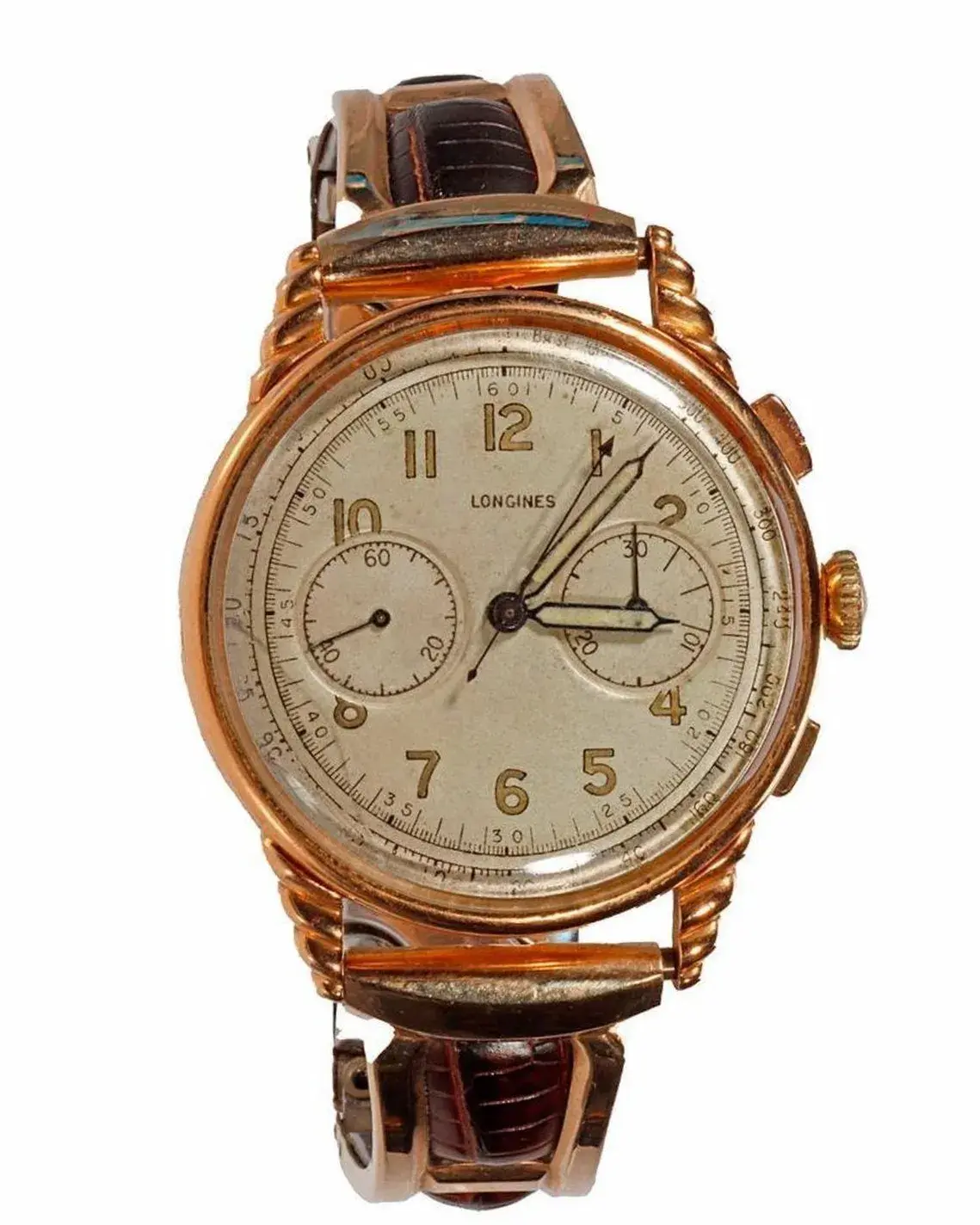
SOUTH SAN FRANCISCO, CA, May 28, 2024 – Turner Auctions + Appraisals is pleased to present Vintage Watches, Part 2: One Man’s Collection on Saturday, June 8, 2024. The sale features over 140 timepieces from a private collection in Northern California – mostly men’s wristwatches and carriage clocks from the late-19th/early-20th centuries, plus several ladies’ watches. Almost all wristwatches date from the mid-20th century, from the 1940s to the 1970s. The sale features noted American and European brands. The 25+ manufacturers include Rolex, Bulova, Hamilton, Longines, Lord Elgin, Omega, LeCoultre, Dreyfuss & Co., Zodiac, Frédérique Constant, Pulsar, and many more. Highlights include several Bulova Accutron Spaceview selections, a 1950s Longines 13zn Flyback Chronograph watch, a 1950s LeCoultre Powermatic Indicator watch, and a 1968 Rolex Perpetual watch.
Turner Auctions + Appraisals begins its online auction on Saturday, June 8, 2024, at 10:30 am PST; sale items are available for preview and bidding now. The online auction will be featured live on multiple platforms: LiveAuctioneers, Invaluable, Bidsquare, and Turner Auctions + Appraisals’ free mobile app, which can be downloaded from the App Store or Google Apps (“Turner Auctions”). All are easily accessed through ‘Upcoming Auctions’ at the company’s website: www.turnerauctionsonline.com/upcoming-auctions.
Here below are some highlights of the upcoming online sale (please see auction information and lot details in the online catalog). PLEASE NOTE: All timepieces are sold as-is regardless of functionality. Bidders should examine the provided photos to evaluate each piece. Because all timepieces in the sale have been in storage since 2015, Turner Auctions suggests an overhaul at buyer’s expense.
Lot 97: Vintage LeCoultre Watch. Estimate $150-$250.
Lot 113: Frédérique Constant Open Heart Automatic Watch. Estimate $200-$400.
Lot 108: Vintage Hamilton Two-Tone Asymmetrical Dial Watch. Estimate $300-$500.
###
ABOUT TURNER AUCTIONS + APPRAISALS
Based in South San Francisco, Turner Auctions + Appraisals was founded by Stephen Turner to expand and complement the capabilities of Stephen G. Turner Associates,an auction and appraisal consulting firm founded in 2004.Turner Auctions + Appraisals presents online auctions in diverse categories of personal property (www.turnerauctionsonline.com). Among them are Fine Arts, Decorative Arts, Asian Arts, Toys, Jewelry, Militaria, Ethnic Arts, and others. The company offers a range of auction and appraisal services for buyers, sellers, and collectors. Online auctions are held several times a month. Working with leading live and online auction houses on the West Coast since 1991, Turner is a professional appraiser of personal property and seasoned auctioneer. His areas of expertise include fine art, decorative arts, antiques & residential contents. The company welcomes consignments and appraisals.
For more information about the company, please contact:
Stephen Turner, President, Turner Auctions + Appraisals, 461 Littlefield Avenue, South San Francisco, CA 94080
Collectibles for dad and all will be auctioned at SJ Auctioneers on Sunday June 16th.
Rare tin Japanese windups in its pristine condition. A huge variety of Georg Jenses sterling silverware and dazzling designer jewels. Lalique, Steuben and of course Disney are always part of the SJ Auctioneers family.