The palatial residence dreamed up by a Languedoc aesthete is open to visitors, taking them on a fantastic journey through space and time from Pharaonic Egypt to the Gilded Age.
© David Maugendre
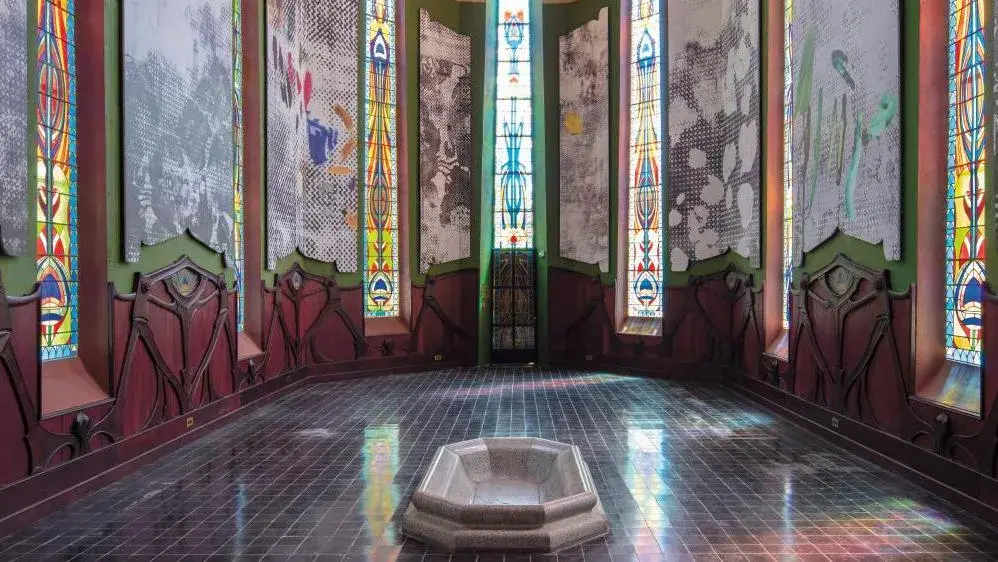
Generations of Agde residents, in southern France, have contemplated this spectacular house on the banks of the Hérault opposite the old town, with its light volumes and terraced roofs, halfway between an Egyptian temple and a Greco-Roman mausoleum. Erected between 1898 and 1901, Château Laurens is named after the man who had it built, Emmanuel Laurens (1873-1959). Money was no object for the millionaire dandy, who gave shape to his dreams nurtured by travels to distant places. The aesthete lived and hosted lavish parties in the extravagant palace, whose decorative scheme brilliantly combines Art Nouveau and ancient Egypt, until the late 1930s. After Laurens died in 1959, the château, already sold as a viager, remained uninhabited. While forgotten by its new owners, this sleeping beauty fortunately was not subject to alterations, but suffered decades of neglect, damage and theft. This long, critical period ended in 1994, when the town of Agde bought the property, which was listed as a historic monument two years later. In 2024, after a 16-year, €15 million renovation funded mainly by the Agglomération Hérault Méditerranée (35%) and DRAC Occitanie (30%), visitors can finally enjoy this timeless place, the product of its original owner’s whimsical imagination.

© David Maugendre
Rich and Free
Laurens inherited unimaginable amounts of money that allowed him to make his wildest dreams come true. Born into an upper-middle-class family in Agde, he began studying medicine at the University of Montpellier but never became a doctor. In 1897, he came into two inheritances: the first from his mother’s cousin, Baron Eugène de Fontenay, the other from his father, Saint-Étienne Laurens. Altogether, they amounted to the colossal sum of 320 million gold francs. From that point on, he began traveling, starting with a journey that took him from Austria to Russia and Uzbekistan. Then he sailed the Mediterranean, on his two yachts, to Barcelona, Seville and Malaga. In 1903, during his first long cruise, he explored Egypt, Madagascar, India and Ceylon. In 1898, his trips inspired him to build an enormous house on the Belle-Isle estate, a plot of land between the Hérault and the canal du Midi that would become the setting for his travel souvenirs. Laurens asked the most innovative local artists to work on the project, starting with Montpellier architect Jacques Février, who designed a four-story palace with a 700-m2 (7,534.7 ft2) footprint divided into reception areas and private quarters. The long, neoclassical façade features a black marble colonnade with Egyptian lines, particularly notable in the glass ceiling of the rooftop terrace. The walls of the spacious foyer are painted in Pompeian red, confirming the spectacular syncretism of Greco-Roman and Egyptian antiquity already evident on the exterior. While the distribution of the reception rooms is inspired by a great Roman domus, laid out around an atrium flanked by four columns of Algerian pink onyx, the frescoes are worthy of a palace on the banks of the Nile. Lotus flowers and bouquets dangle from long stems, framed by Hathoric pillars.
Laurens asked his friend, Marseilles painter Eugène Dufour, to make his pharaonic dream come true. Using template patterns and stencils, Dufour reinterpreted his frescoes’ Egyptian themes in an Art Nouveau light by introducing modern lines and colors. The apotheosis of this opulent decor, and the only depiction of a human in the house, is an enthroned Cleopatra worshipping the Sun Disk of Ra, facing the sun streaming in through a triple bay window in the staircase. Some rooms in the reception area break with the iconographic scheme to evoke other worlds. For example, a Moorish sitting room in a large alcove in the atrium recreates an Eastern world in the style of Pierre Loti. But the highlight of the festive decor is the music room: resembling a chapel with its 18-meter-high (59.05 ft) nave, it leaves one speechless. Winged women stand out against the Byzantine gilded vault lit by sconces shaped like elephant tusks. The bays’ parabolic arcs reveal the influence of Antoni Gaudí, whose architecture Laurens admired on his frequent trips to Barcelona.
Memorable Costume Parties
Gaudí’s Catalan modernist influence peaks in the “laboratory”, an astonishing room with a counter and ceiling covered by the ochre scales of an antediluvian monster. Like Des Esseintes, the decadent hero in Huysmans’ novel Against Nature, Laurens, as a fin-de-siècle dandy, seemed to live in a strange theater set on which he stage directed his wife, the singer Louise Blot, and his guests, dressed up in ‘Oriental’ costumes for memorable parties. Resonating with this singular scenography, eclectic furniture, which was auctioned when the château was sold in 1994, livened up the reception areas, mixed with memories of far-off worlds. Period photographs show Vietnamese ceramic elephants, large Satsuma vases, Arab-Andalusian ewers, Chinese perfume burners and suzani tapestries. These pieces are gradually being reintroduced as similar models are purchased. In the huge atrium, they were alongside cabinetmaker Carlo Bugatti’s finest wood, ivory and parchment creations, including his famous curule armchairs and the iconic, now lost “minaret” desk.

© David Maugendre
The patient work of refurnishing the rooms has led to rediscovering the remarkable work of Montpellier sculptor, painter and cabinetmaker Léon Cauvy, a virtuoso disciple of Art Nouveau.
Poetic Inspiration
Art Nouveau features mainly in the private apartments, both on the walls, decorated with sinuous silk friezes, and in the furniture specially commissioned by Laurens. The most spectacular room is his master study, lit by a monumental stained-glass window depicting a mermaid amidst Japanese-inspired waves. Entitled La Mer (The Sea), it was designed by Parisian artist Eugène Martial Simas and takes up almost the entire wall. L’Aurore (Dawn), also known as Apollon sur son char (Apollo on His Chariot), a sketch on marouflé paper by painter Louis Anquetin, graces the ceiling. The original furniture, which was dispersed by its former owners before the 1994 sale but bought back in the art market, adds to the impression of life radiating from the large study. The patient work of refurnishing the rooms, including a desk, armchairs and a bookcase in carved and painted wood decorated with pyrography leather female figures like Alfons Mucha and Eugène Grasset’s flower-women, has led to rediscovering the remarkable work of Montpellier sculptor, painter and cabinetmaker Léon Cauvy, a virtuoso disciple of Art Nouveau. Most of the pieces in this incomparable group were acquired from Ader-Tajan at the Hôtel Drouot on December 6, 1994, when the most beautiful piece, a monumental corner sofa, fetched 32,000 francs, or €7,755. The same poetic inspiration can be found in the dandy’s bedroom-boudoir, which, unsurprisingly, features a nocturnal theme: Cauvy’s carved walnut bed is adorned with a sleeping woman, owls and a moonrise. The adjacent bathroom has one last surprise: extraordinary floor-to-ceiling floral decoration. Ceramic tiles from the Sarreguemines factory, designed by Félix Auber and Alexandre Charpentier with motifs of aquatic arums and bathers in relief, mingle with flowery mosaics by Italian mosaicist Giandomenico Facchina on the floor and the sunken bathtub. In June 1899, far from the banks of the Hérault, Studio magazine, the bible of English design, published an article on this emblematic room, consecrating the splendor of Château Laurens.

© Jean-François Peiré–DRAC Occitanie

© Jean-François Peiré–DRAC Occitanie
LÉON CAUVY, PAINTER AND CABINETMAKER
While less famous than their counterparts in Paris and Lorraine, a number of craftsmen in southern France were brilliant Art Nouveau cabinetmakers. Among the most noteworthy is Léon Cauvy (1874-1933), who created in a variety of media, including native and precious woods combined with polychrome and gilded leather pyrographed with female profiles and plant motifs. After finishing art school, the Montpellier native taught painting, drawing and decorative arts in the Languedoc city while taking part in Paris shows and competitions organized by the main decoration magazines. His entries won 12 awards, including one from Art et Décoration in 1905 for a dining room set in competition with Gustave Serrurier-Bovy. With his partner Paul Arnavielhe, another Montpellier designer, Cauvy presented his creations in Paris, Liège, London, San Francisco and, in 1907, Algiers. Arnavielhe fell in love with the white city, where he became the director of the École des Beaux-Arts and an Orientalist painter.
WORTH SEEING
Château Laurens, the Belle-Isle estate, Agde, France
www.chateaulaurens-agde.fr