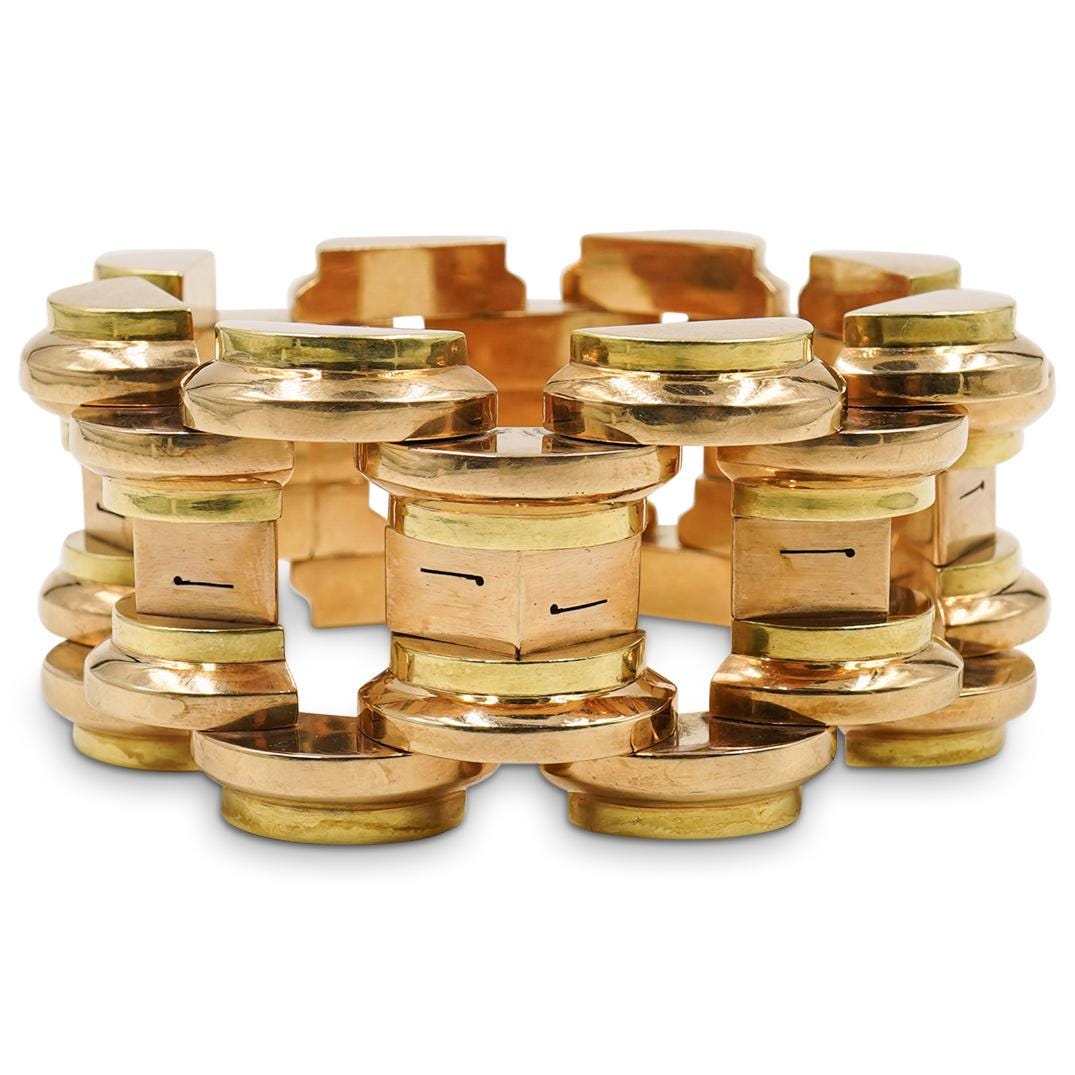
16K Yellow and Rose Gold Mechanical Bracelet:
16K Yellow and Rose Gold Mechanical Bracelet features a two tone design with round and square intertwined chain pattern. Unsigned. Tested 16 karat. Finished with a push clasp. Weight: 81 DWT
CIRCA:1980’s
ORIGIN:
DIMENSIONS:L:8.25″ W:1.5″
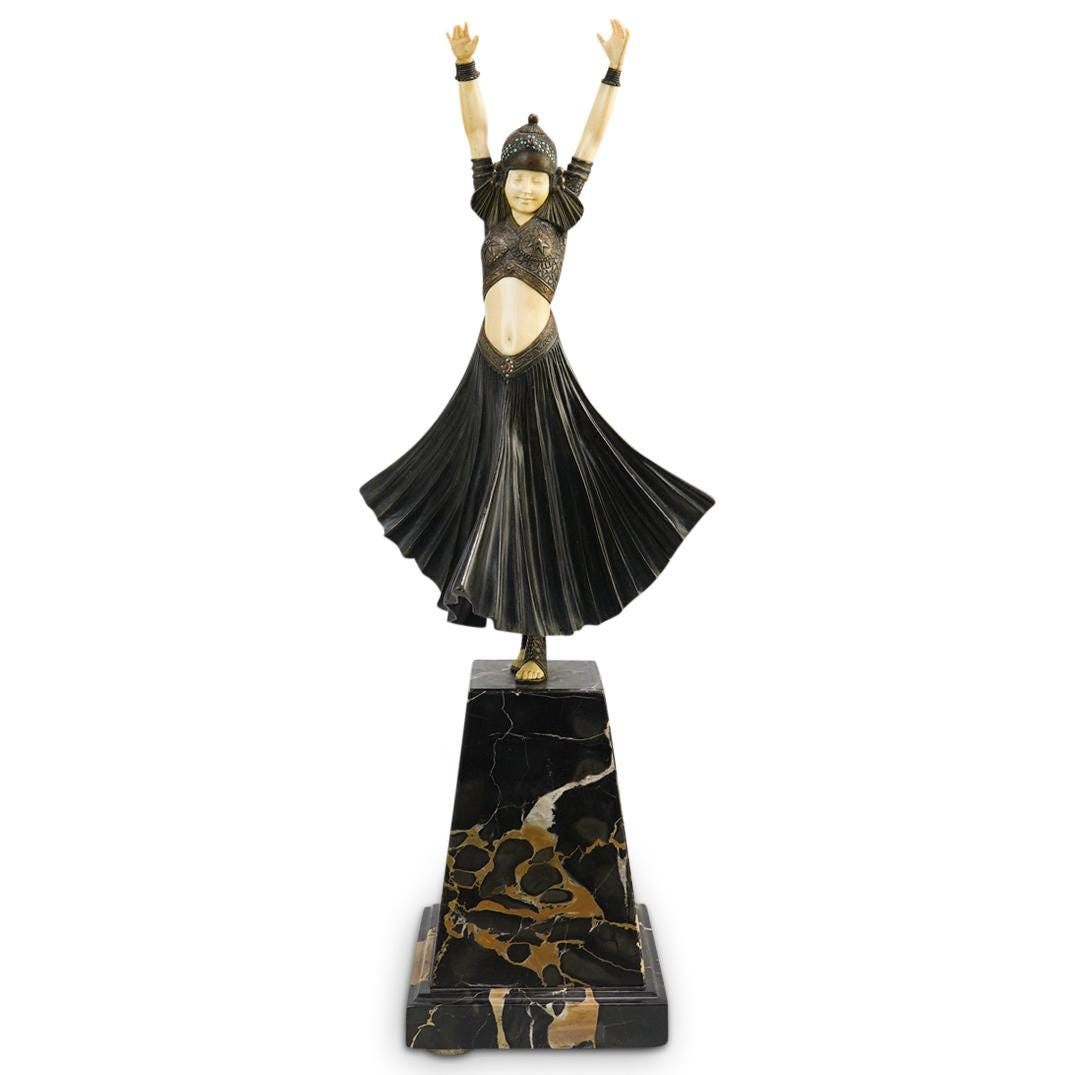
Demetre Chiparus (Romanian,1886-1947) “Hindu Dancer”:
A Chiparus bronze sculpture titled: “Hindu Dancer” depicting a dancer with an ornate flared dress and posed with arms raised upward. Further embellished with cold painted details and fitted atop a portero marble base. Incised signature at top of base “D. H. Chiparus”
CIRCA: Early-Mid 20th Cent.
ORIGIN: France
DIMENSIONS: H: 22.5″ x W: 6″ x L: 8.25″
After Auguste Rodin (French, 1840-1917) Title: The Thinker (Le Penseur) Medium: Bronze with green patina Signed: Inscribed ‘A Rodin F. Barbedienne. Found’ on the back of the base Size: 30 x 14 x 13 1/2 in. Condition: In good condition. Scattered abrasions and surface soiling. Note: Large and heavy for shipping.
Pierre Auguste Renoir (French, 1841-1919) Title: Woman with Tambourine III (La Danseuse au Tambourin) Medium: Bas relief bronze sculpture, posthumously cast from the original terra-cotta Inscribed: Renoir lower right Edition: 149 of 220 Size: 29 3/4 x 17 1/2 in. x 2 1/2 in. Frame: 36 1/4 x 24 3/4 in. Provenance: Sale, Parker & Parker, New York, June 1984 Condition: In excellent condition. No apparent problems to note. Note: Woman with Tambourine III is the last of seventeen total sculptures that Renoir created in his career. It has been authenticated by Claude Renoir, the sculptor’s grandson as well as experts from Sotheby’s, Christie’s and the Metropolitan Museum of Art in New York. A certificate of authenticity, signed by Claude Renoir and stamped by S.P.A.D.E.M., the organization that protects the rights of the artist, accompanies this lot.
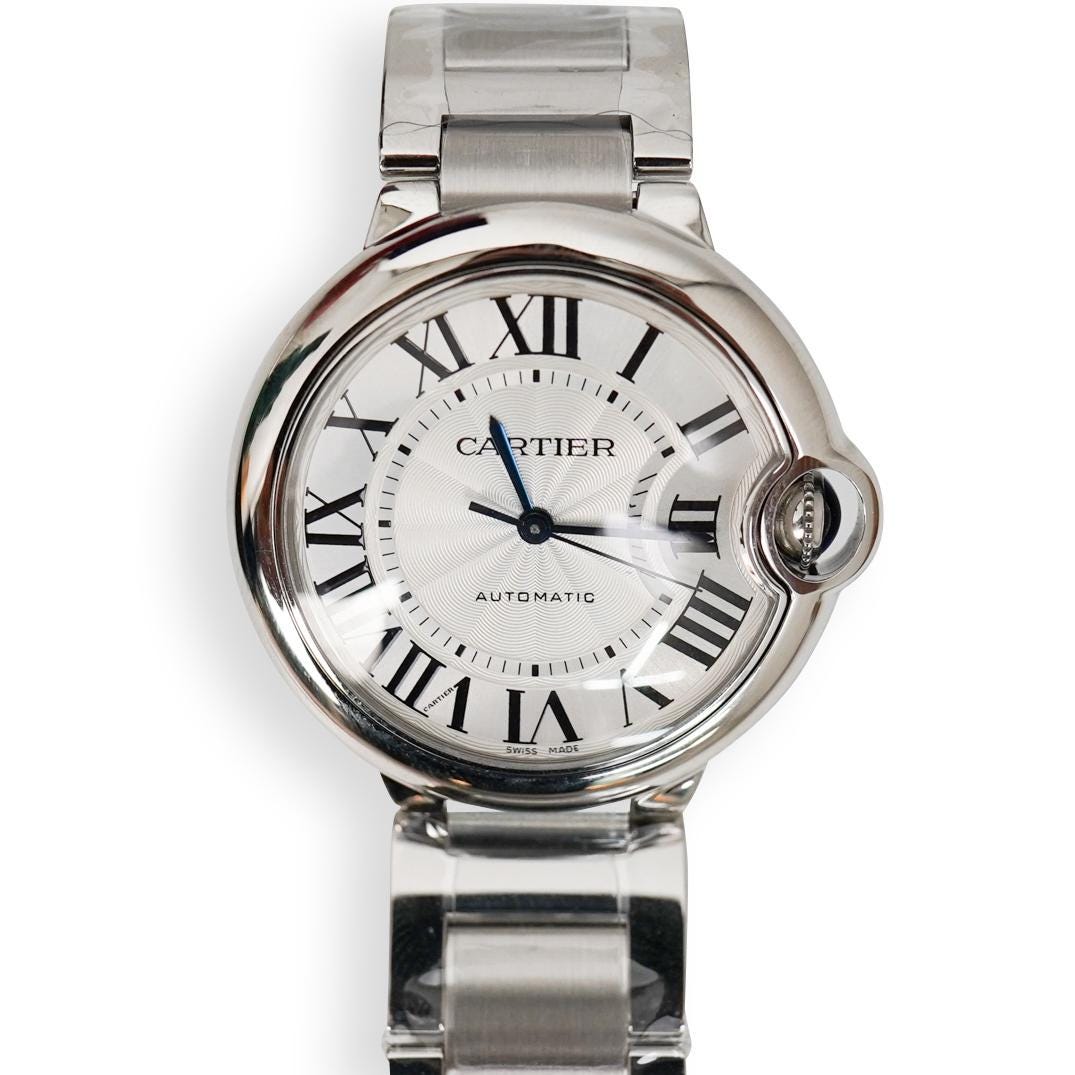
Cartier “Ballon Bleu” Stainless Watch:
A Cartier Ballon Bleu Unisex Swiss made, automatic, stainless steel, wristwatch still wrapped in original packaging with tag attached. Original case, box and papers included. REF.: W2BB0012
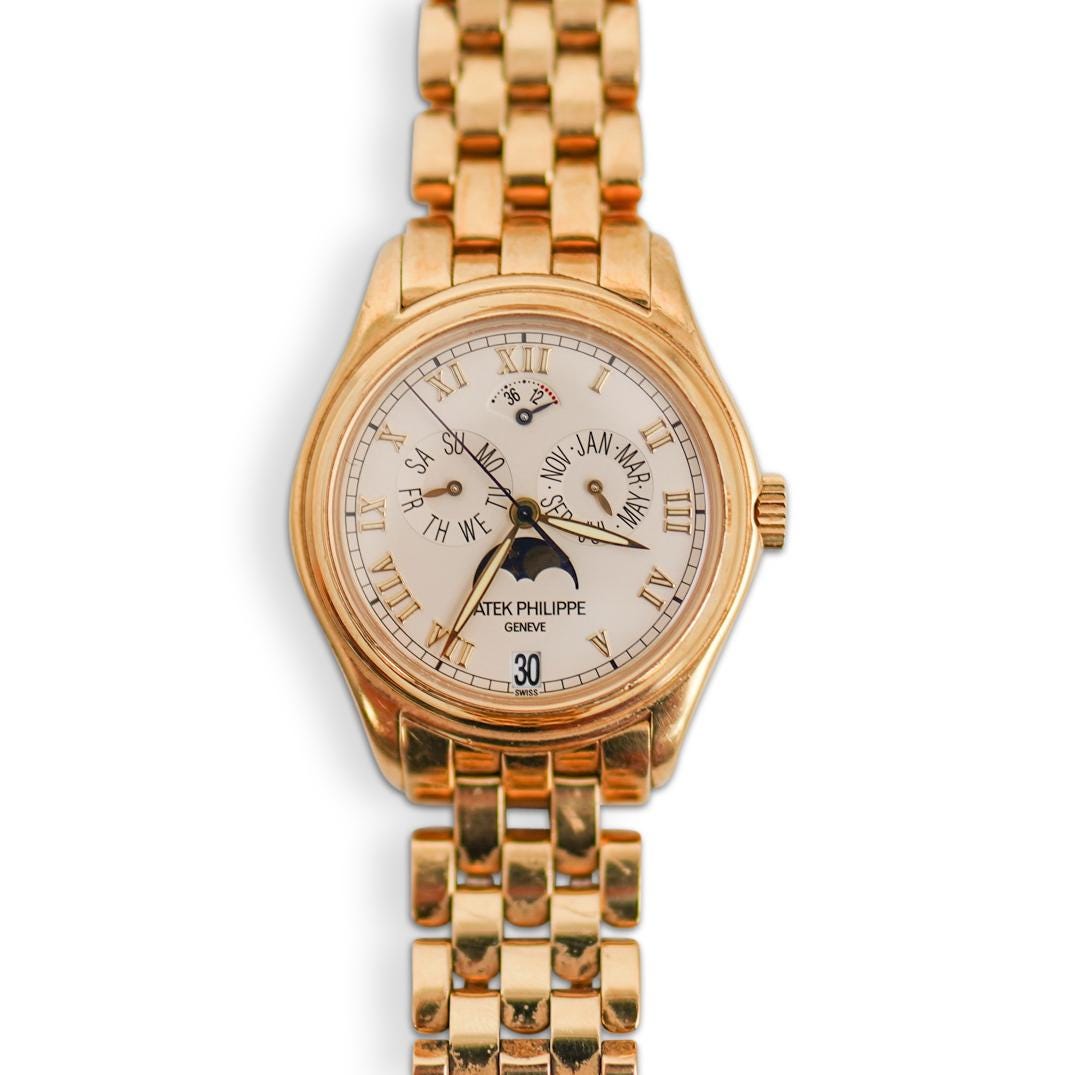
Patek Philippe 5036/1J Annual Calendar 18k Gold Watch:
The 18k Yellow Gold Annual Calendar Moonphase Wristwatch, features a roman numerals with luminous hands, month sub-dial between 2 and 3 0’clock, moonphase and date displayed at 6 0’clock, weekday sub-dial between 9 and 10 0’clock, power reserve indicator at 12 0’clock, a fixed 18k yellow gold polished bezel, an original 18k yellow gold polished bracelet with a concealed 18k white gold double deployant clasp, sapphire glass, exhibition back, automatic movement, in excellent working condition.Reference number: 5036/1J. Case diameter is 37 mm. 37 Jewel movement. Comes with Original box and papers.
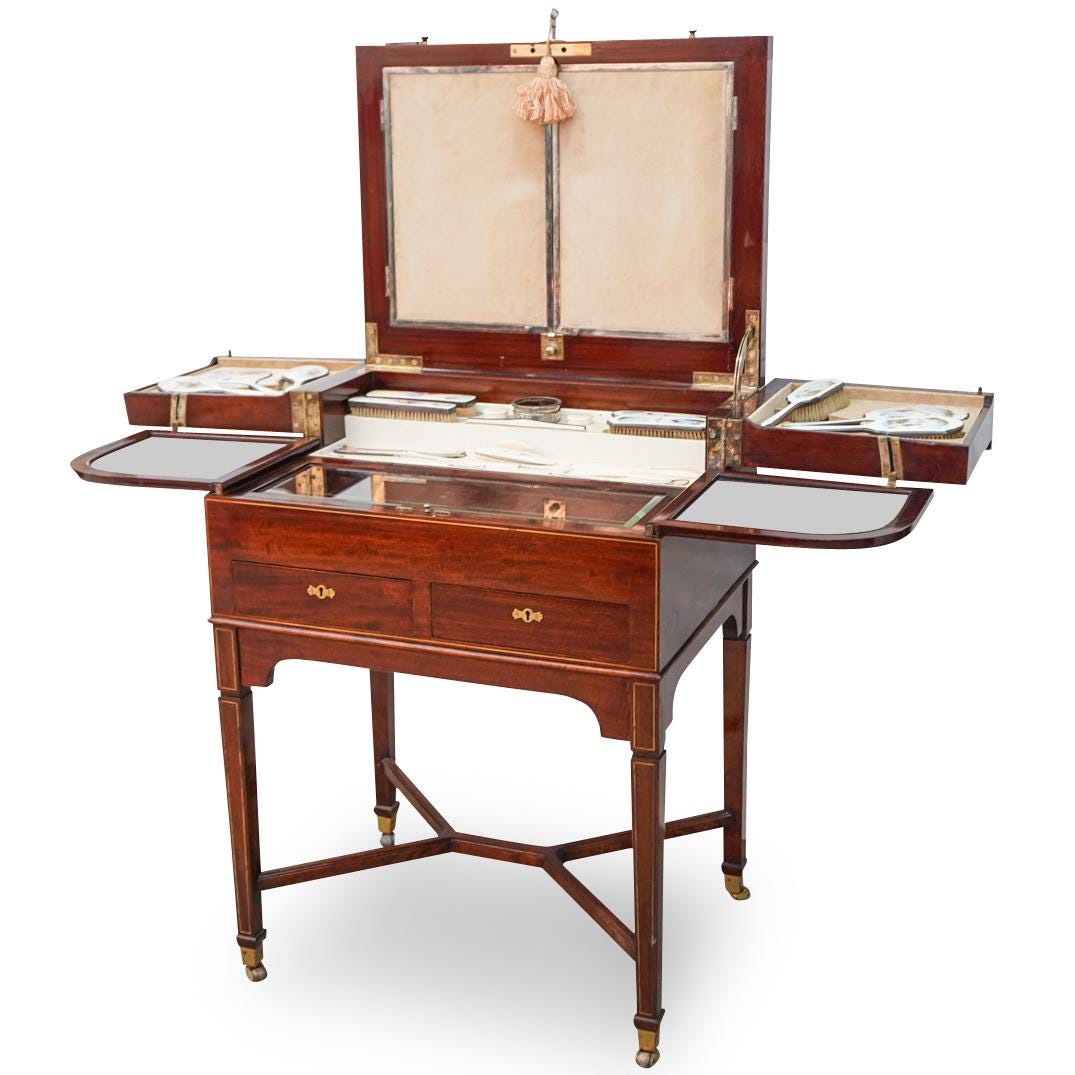
George Betjemann & Sons Dressing Table:
George Betjemann & Sons Edwardian Mahogany Enclosed Dressing Table. Constructed in a finely grained mahogany, with line inlays of metamorphic form, rising from brass castor shod tapering legs. The rectangular hinged top opens to reveal four out lifting sides to a compartmented interior with a central adjustable beveled glass triptych mirror with a silver frame. The two hinged compartments flanked by two glass slides, contain fitted interior comprising of four silver and Guilloche brushes, and two handheld mirrors. The front has two pull out slides and the whole table stands on square legs joined by a lower stretcher-shelf. The fitted interior comprising of five silver brushes of various sizes, 1 silver topped crystal bottle and a full manicure set. Comes with one key. The beautiful guilloche enamel vanity and manicure sets are hallmarked “F.B.R” “925” dated to the early 20th Century.

Historical Early YALE Stuffed Mascot Bulldog, 1900s:
HANDSOME DAN EARLY HISTORY: (The following from Wikipedia) Handsome Dan I 1889–1897 (retired to England).
Handsome Dan was selected based on his ability to tolerate bands and children, negative reaction to the color crimson and to tigers (the symbols of rival schools Harvard and Princeton respectively), bought by Yale student Andrew Barbey Graves, who cleaned up the dog and named him “Handsome Dan.” Soon, Dan followed Graves everywhere around campus, including sporting events. The students quickly adopted Dan as the Yale mascot. After Graves graduated and returned to England, Dan stayed on campus with his master’s brother, William Leon Graves. Before football and baseball games would begin, Handsome Dan founded a tradition and a dynasty by being led across the field. One newspaper reported: “He was a big white bulldog, with one of the greatest faces a dog of that breed (English) ever carried”. This was not an exaggeration, as Handsome Dan was one of the finest specimens of his breed in America, and went on to win first prize at the Westminster Dog Show and at least thirty other first prize ribbons in the United States and Canada. According to the Hartford Courant, “In personal appearance, he seemed like a cross between an alligator and a horned frog, and he was called handsome by the metaphysicians under the law of compensation. The title came to him, he never sought it. He was always taken to games on a leash, and the Harvard football team for years owed its continued existence to the fact that the rope held.” The Philadelphia Press reported that “a favorite trick was to tell him to ‘Speak to Harvard.’ He would bark ferociously and work himself into physical contortions of rage never before dreamed of by a dog. Dan was peculiar to himself in one thing – he would never associate with anyone but students. Dan implanted himself more firmly in the hearts of Yale students than any mascot had ever done before.” Handsome Dan crossed the Atlantic to join his old master in 1897 and died in 1898. Graves had Dan stuffed and returned him to be displayed at Yale in the old gymnasium. When it was torn down, Dan I was sent to the Peabody Museum for reconstruction. Handsome Dan I now is in a sealed glass case in one of the trophy rooms of Yale’s Payne Whitney Gymnasium, where, according to Stanton Ford, “he is the perpetual guardian of the treasures which attest to generations of Yale athletic glory.” Andrew Graves died of tuberculosis on February 18, 1948, in Westbury, Long Island.
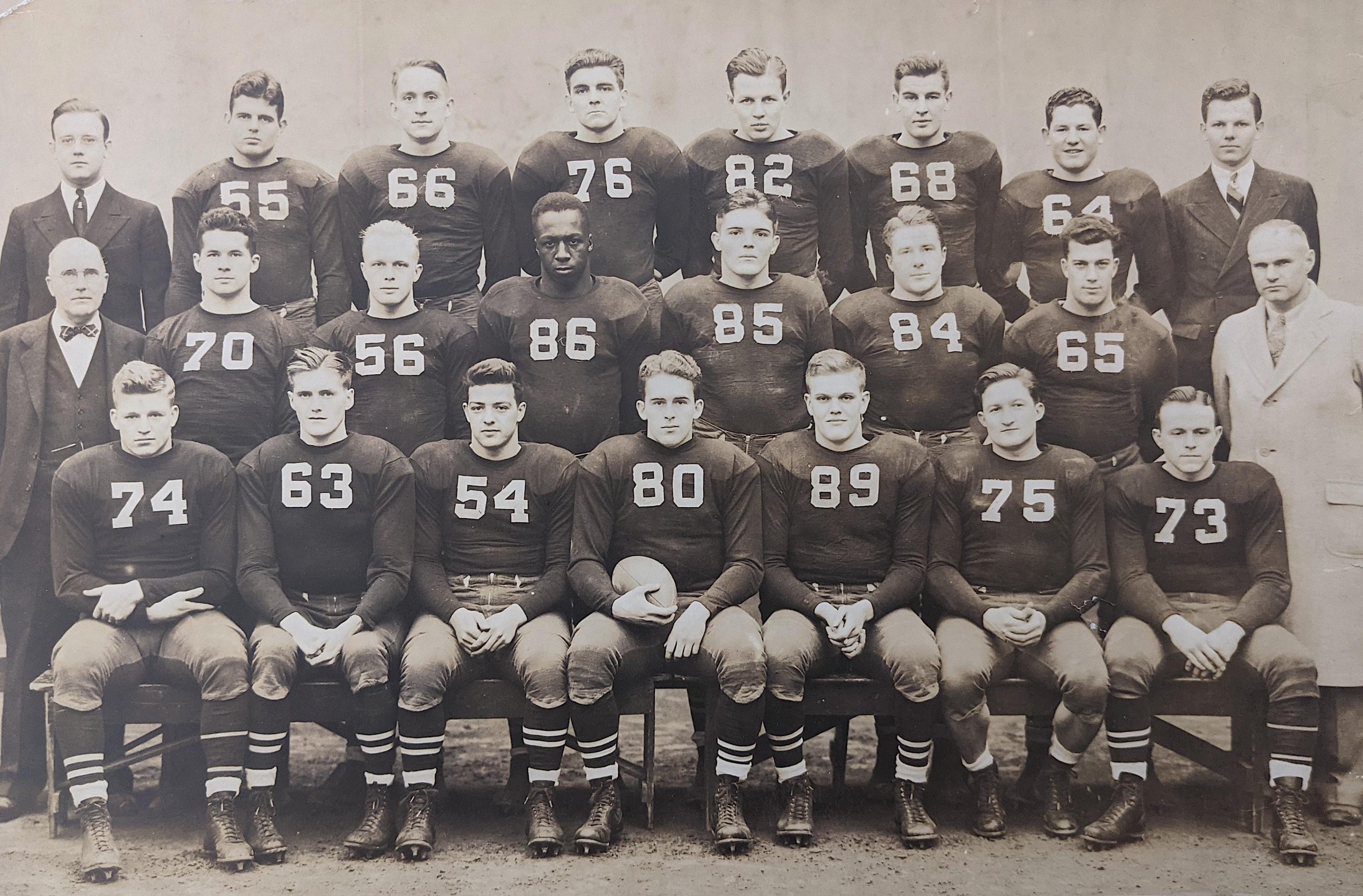
Historical Photo Football Team Cornell Jerome Holland:
ABOUT JEROME HEARTWELL “BRUD” HOLLAND (1916 – 1985) (From Wikipedia): Jerome Heartwell “Brud” Holland (January 9, 1916 – January 13, 1985), one of 13 children, was an American university president and diplomat. He was the first African American to play football at Cornell University, and was chosen as an All American in 1937 and 1938. He was also the first African American to chair the American Red Cross Board of Governors, which named its Laboratory for the Biomedical Sciences in his honor. He was the first African-American to sit on the board of the New York Stock Exchange (1972), and the first appointed to Massachusetts Institute of Technology’s governing body, “The Corporation”.
AMERICAN HEROES DURING 1920s – 1930s: College football fully came of age in the 1920s, when it became widely recognized as America’s greatest sporting spectacle. As college football thrived, professional football struggled for respectability. The NFL was formed in the year 1920 with 11 teams. Today American Football is the most popular sport to watch in the United States.