Probably Victor Paillard Dore Bronze Bronze Ewers

Probably Victor Paillard Dore Bronze Bronze Ewers

Probably Victor Paillard Dore Bronze Bronze Ewers:

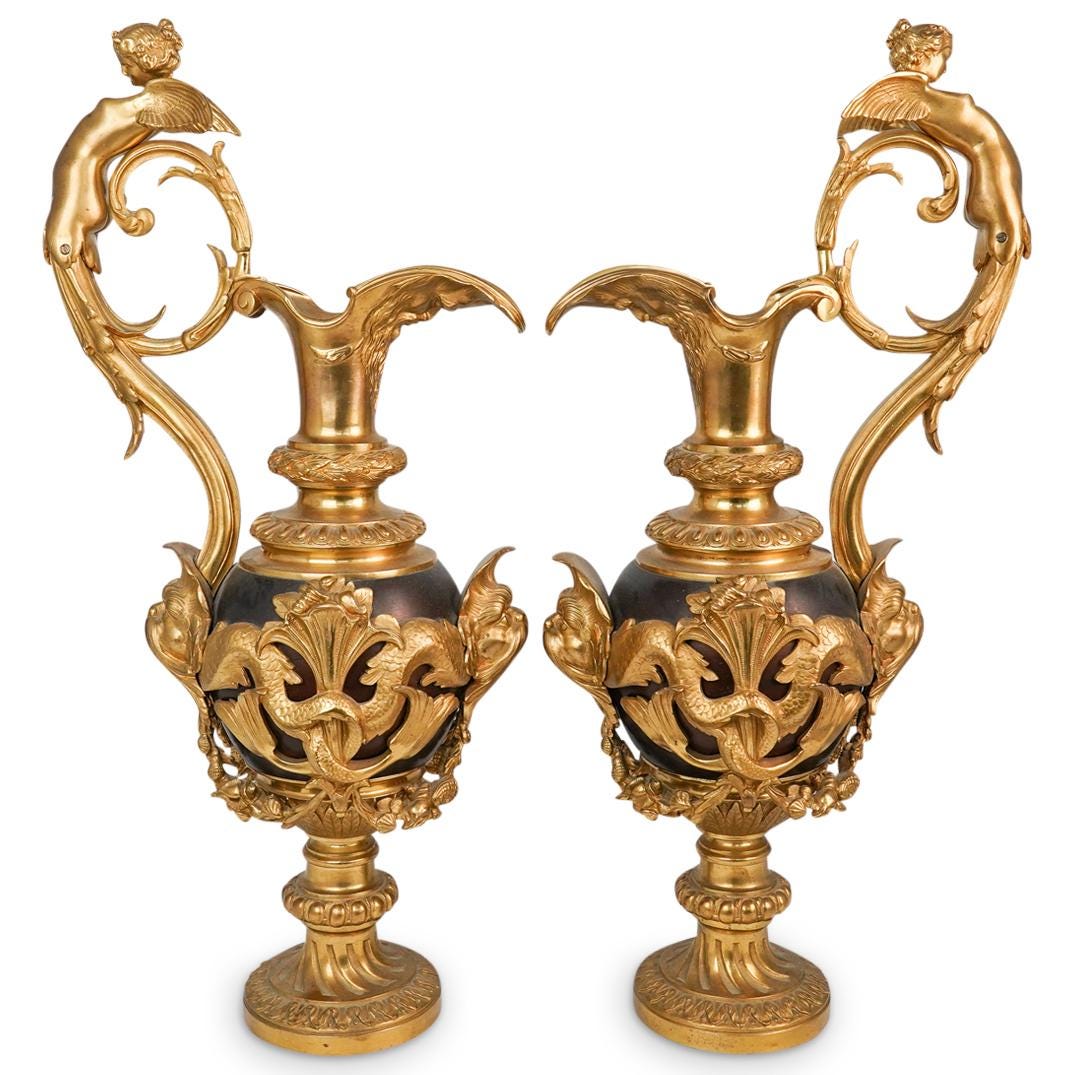
A Pair of French Victor Paillard (probably) dore bronze figural bronze ewers. Each of baluster form with winged nude female figural scroll handles. The center is decorated with reliefs of stylised dolphins with bearded faces and garlands formed of shells. Finished with beaded mask spout.
CIRCA: Late 19th Ct
ORIGIN: France
DIMENSIONS:H:26″ W:13″ D:8″
CONDITION: Great condition. See lot description for details on item condition. More detailed condition requests can be obtained via email ([email protected]) or SMS 305-332-9274. Any condition statement given, as a courtesy to a client, is only an opinion and should not be treated as a statement of fact. Akiba Antiques shall have no responsibility for any error or omission.

Russian Enamel Silver Desk Set

Russian Enamel Silver Desk Set

Russian Enamel Silver Desk Set:

An early 20th-century Russian Enamel Silver Seven Piece Desk Set covered with floral patterns. Russian Hallmarks. Size: Ink stand with pen holders (Largest example) 6″ x  13.5″ x 8.25″ Overall condition good.

Lalique “Heliconia” Crystal Wall Sconces

Lalique "Heliconia" Crystal Wall Sconces

Lalique “Heliconia” Crystal Wall Sconces:

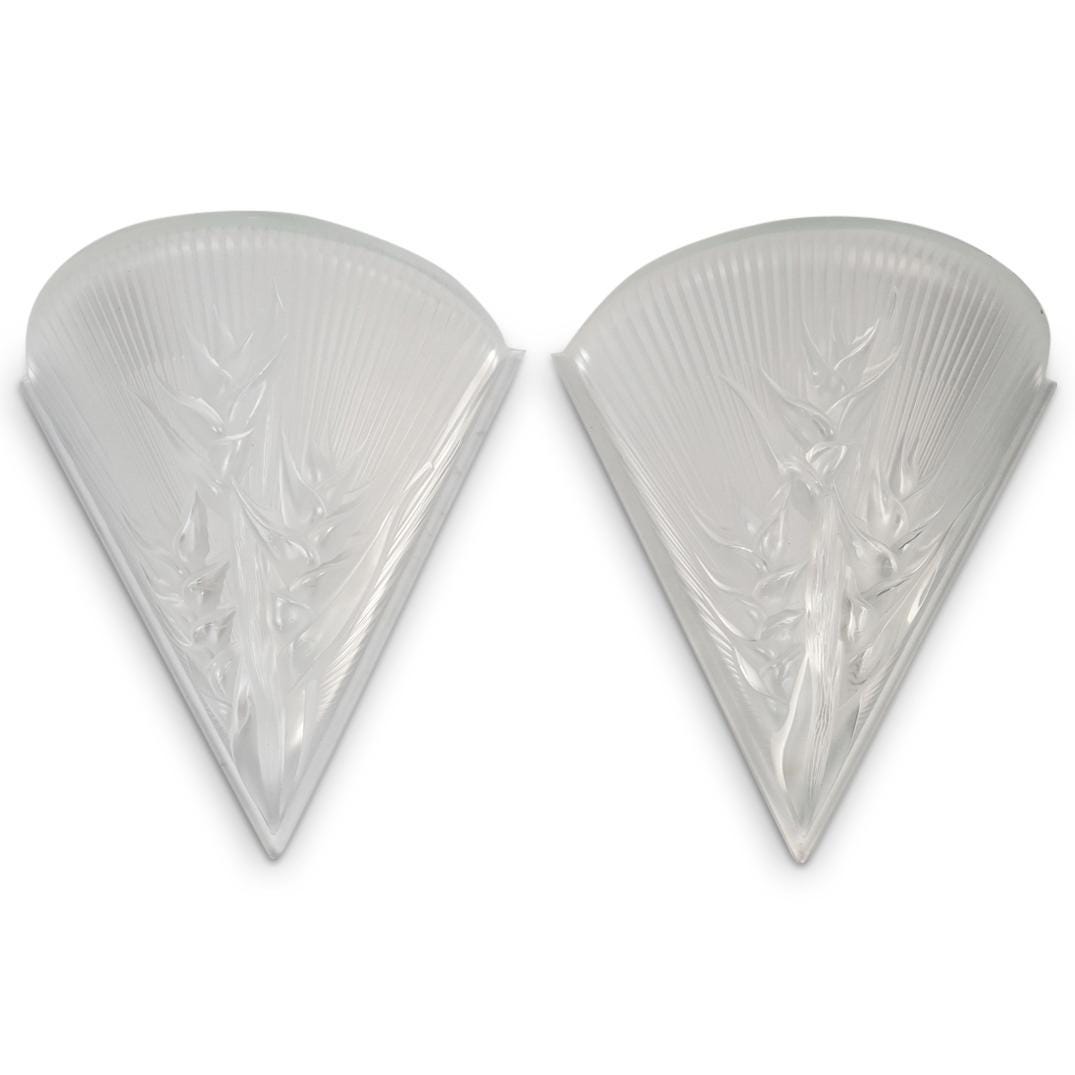
Pair of Lalique Heliconia wall sconces. Features a convex, triangular shape with embossed heliconia tropical floral motif. Finished with silvered outlining. Marked:”Lalique France” Designed by Marie-Claude Lalique.
CIRCA: 20th Ct
ORIGIN: France
DIMENSIONS::H 17.09″ x W 15.55″ x d 6.50″
CONDITION: Great condition. See lot description for details on item condition. More detailed condition requests can be obtained via email ([email protected]) or SMS 305-332-9274. Any condition statement given, as a courtesy to a client, is only an opinion and should not be treated as a statement of fact. Akiba Antiques shall have no responsibility for any error or omission.

Russian Enamel Silver Egg

Russian Enamel Silver Egg

Russian Enamel Silver Egg:

An early 20th-century Russian Enamel Silver Egg covered with floral patterns. The egg is gilded inside. Russian Hallmarks. Size: 5 in. Overall condition good

[Literature] Eliot, T.S., The Waste Land

[Literature] Eliot, T.S., The Waste Land

[Literature] Eliot, T.S., The Waste Land:

New York: Boni and Liveright, 1922. First edition, second issue (with 2 mm rubber stamp on colophon, “water” spelled correctly on p. 22, “mountain” spelled without “a” on p. 41 line 339), #738/1,000 copies. Original stiff black cloth, stamped in gilt; all edges untrimmed; ownership signature on front paste-down; newspaper clippings mounted on front paste-down, verso of front free endpaper, and rear endpaper, offsetting from same on front free endpaper, half-title, and rear paste-down; offsetting on copyright page and second half-title; underlining in pencil on pp. 29-32; in original first state salmon dust-jacket (with periods after both sentences in the boxed announcement on front panel), lettered in black, worn, lower spine panel lacking, front panel hinge reinforced, soiling and three open tears at head of front panel, chip at bottom rear panel, inscription in ink at top of same, creasing to front flap edge. Gallup A6a.

[Americana] [Champlain, Samuel de], Les voyages du sieur de Champlain…

[Americana] [Champlain, Samuel de], Les voyages du sieur de Champlain...

[Americana] [Champlain, Samuel de], Les voyages du sieur de Champlain…:

Les voyages du sieur de Champlain xaintongeois, capitaine ordinaire pour le Roy, en la marine. Divisez en deux livres. ou, journal tres-fidele des observations faites es descouuertures de la nouuelle France…

Paris: Jean Berjon, 1613. First edition. Two parts in one. 4to (217 x 165 mm). (xx), 325, (5); 52 pp. Illustrated with three engraved folding plates, 8 engraved folding maps, 13 in-text engravings, and one woodcut diagram; large folding map “Carte Geographique de la Nouelle Franse Faictte…” in facsimile, linen backed, and bound facing p. 1; double-page map “Malle Barre” in facsimile, bound between pp. 88 and 89; folding map “Isle de sainte Croix” bound facing p. 134; map “Carte geographique de la Nouelle franse en sonaray meridien”, second state (1613), linen backed and bound facing pp. 161; map “port fortune” repaired at bottom center; map on p. 9 corrected. Full red levant, stamped in gilt, expertly rebacked; all edges gilt; gilt dentelles; marbled endpapers; by W. Pratt for H. Stevens & Son 1889; bottom corner p. (vii/viii) repaired; two repairs in fore-edge p. 11/12; repairs at bottom p. 29/30; repair at bottom corner p. 109/110; repair top corner pp. 117/118; wormhole repairs bottom corner pp. 129-48; repair at bottom of map facing p. 176; scattered marginalia; scattered minor spotting. Church 360; Burden 160, 161, 166-81; Sabin 11835.

“The second printed volume of Champlain’s voyages, and contains the journals, maps, etc., of its author’s four voyages to America, in 1604, 1610, 1611, and 1613…The volume deals very fully with the natural history of the country, its soil, and products, and is especially minute in its description of the manners, customs, and habits of the Indians.” (Church 360). Rare

Rare Fossilized Sabertooth Hoplophoneus Skull

Rare Fossilized Sabertooth Hoplophoneus Skull

Rare Fossilized Sabertooth Hoplophoneus Skull:

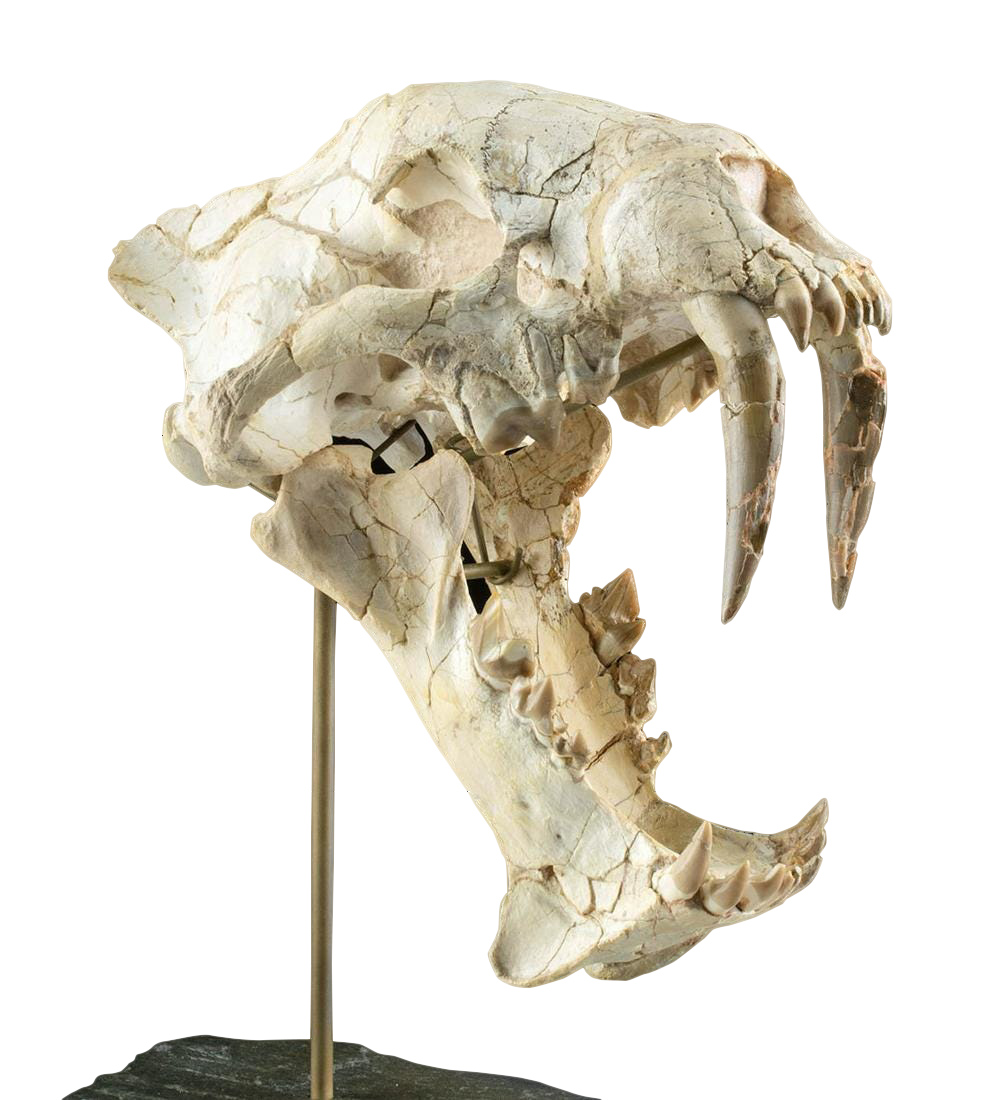
North America, Custer County, South Dakota, Late Eocene to Early Oligocene Period, ca. 35 million to 29 million years ago. A fossilized skull from the long-legged Hoplophoneus, a false saber-tooth cat, in the Nimravid family. This skull beautifully displays the large and once-razor sharp saber teeth. Most of the lower jaw is original, which is a rare find! This species is the second earliest saber-tooth mammal that roamed prehistoric North America. These animals had a lot of physical characteristics similar to the famous Smilodon (saber-toothed tiger) including large saber canine; however, Hoplophoneus was not a true cat! These animals were 2 feet tall (0.6 meters), about the size of a large bobcat, and likely hunted in packs with close knit families as evidenced by some remains found together in death. They hunted grazing ungulates, including camelids and prehistoric oreodonts. Using their highly developed saber-teeth they would likely sever the blood supply in the neck of their prey in the initial attack, much like large cats of today! A stunning and rare fossil! Size: 7″ L x 4.5″ W (17.8 cm x 11.4 cm); 9.75″ H (24.8 cm) on included custom stand.

Exhibited & Published Roman Fresco Panel w/ Portrait

Exhibited & Published Roman Fresco Panel w/ Portrait

Exhibited & Published Roman Fresco Panel w/ Portrait:

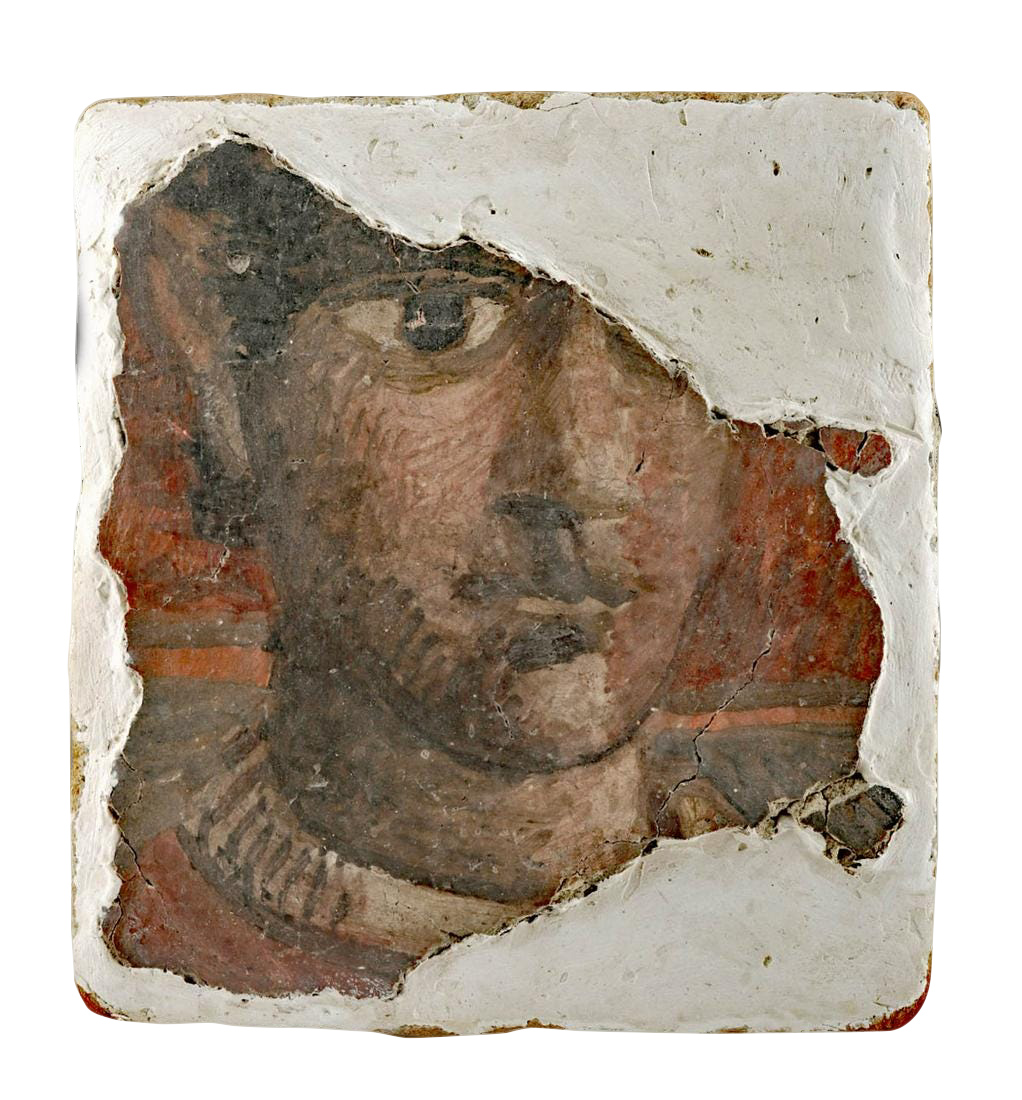
Roman, Imperial Period, ca. 1st century CE. An ancient Roman fresco fragment depicting the head of a figure, with a large eye that is nicely delineated with generous lids, a black-brown iris, and a white sclera, an aquiline nose, pursed lips with a well-delineated philtrum above the upper lip, a naturalistic ear, well-modeled facial planes, a rounded chin, and a thick torc (also torq and torque) around the neck that suggests this subject may be a Gaul or possibly a soldier. Interestingly, the Roman Titus Manlius challenged a Gaul to combat in 361 BCE, and when he defeated and killed the Gaul, he took his torque and wore it forever more, thus earning the nickname Torquatus (one who wears a torque). After this momentous event, the Romans adopted the torque to decorate distinguished soldiers during the Republican period. Size: 8.25″ L x 7.75″ W (21 cm x 19.7 cm); mount 9″ L x 8.25″ W (22.9 cm x 21 cm)

The ancient fresco technique involved applying saturated pigments into wet lime-rich plaster, and only the wealthiest, most elite Romans adorned their houses with these elaborate wall paintings which required immense skill to create. Art historians have identified four styles of wall painting. This example aligns closest with the Second Pompeiian Style – also known as the architectural style – which was popular during the 1st century BCE. This style was characterized by illusionism whereby the walls were painted with architectural elements framing compositions that fooled the eye into believing they were real via a trompe l’oeil effects. While we cannot see architectural elements given the size of this fragment, the artist of this piece successfully achieved naturalism in the visual imagery via subtle tonal changes, modeling the figure with color and shading, and suggesting depth with foreshortening.

Another aspect of Roman wall painting to appreciate are the brilliant colors which contrast with the white hues of surviving ancient marble sculpture. Scholars have demonstrated that classical sculptures were actually originally brightly painted; however, the pigments have worn away over the ages. Thankfully, ancient wall paintings demonstrate the bold coloration that embellished ancient visual culture. What’s more, while some of the most impressive artists of the Classical world were painters, sadly, many of their creations were painted on wood panels and have disappeared due to the perishable nature of this material. Thankfully, other forms of Classical art such as vase paintings, mosaics, and even a few fresco fragments like this example – many surviving from Pompeii and Herculaneum buried under the ash of a volcanic eruption in the year 79 CE – have survived the tests of time and can provide a means of understanding ancient painting techniques.

Exhibited: La Biennale, Grand Palais, Paris, 11-17 September 2019; PAD London, Berkeley Square, London, 30, September 6 – October 2019

Tall Egyptian Bronze Osiris, Pre-1960 Provenance

Tall Egyptian Bronze Osiris, Pre-1960 Provenance

Tall Egyptian Bronze Osiris, Pre-1960 Provenance:

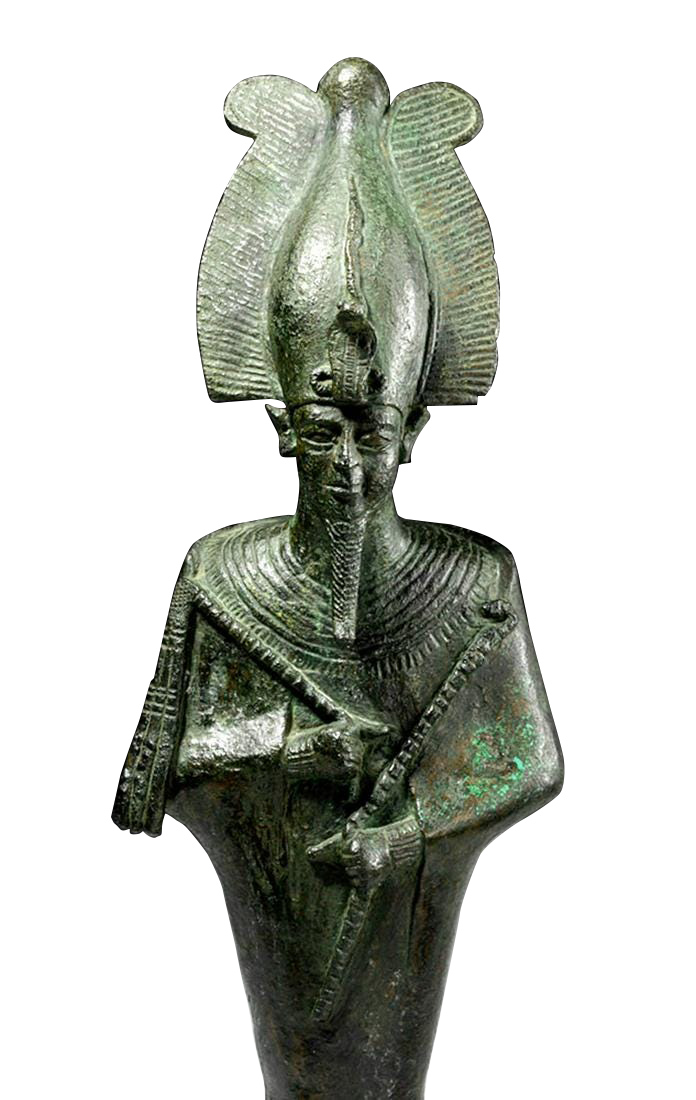
Egypt, Third Intermediate Period to Late Dynastic Period, ca. 1070 to 332 BCE. A heavy and detailed cast bronze figure of the mummiform god of the Underworld, Osiris. This would have been a votive figure, perhaps made to be kept in a (very!) wealthy home and prayed to, deposited in a temple as an offering, or, most likely, kept for ritual with other metallic objects by priests. Comes with custom wood stand. Size: 3.25″ W x 10.2″ H (8.3 cm x 25.9 cm); height on stand: 11.55″ (29.3 cm).

He wears a tight shroud and Atef crown, with two lateral plumes flanking a uraeus. In his hands, which he holds close together at his chest, he has a flagellum and a short-handled heka scepter (perhaps indicating that this piece is from Thebes) – both are Egyptian symbols of authority and kingship, showing Osiris’s close connection with the pharaoh and his role as Ruler of the Dead. He has a round face, with almond-shaped eyes, large ears, and thick lips below a straight nose. He also has the classic Egyptian false beard, incised to look like it is braided. Incised decoration gives further detail to his tools, his crown, and a pectoral underneath his shroud. One wonderful detail is found on his otherwise unornamented back – incised lines create a tie to hold his crown in place, with its strings hanging down his back.

Antiquities from the collection of Albert J. Zaloom were assembled from the 1970 to 1990s. Mr. Zaloom was of Middle Eastern descent and grew up in Brooklyn. He was owner of Zaloom Brothers, a firm dealing in pistachios. He served as the 37th President of the prestigious New York Numismatic Club, from 1992-1993, and subsequently on its Board. He was an enthusiastic collector of ancient coins, medals and antiquities.

Purportedly published in “Egyptian, Greek, and Roman Antiquities Property of Mrs. Charles E. Crawley,” Parke-Bernet Galleries Inc. 1957, but we have been unable to confirm.