Antique Speech Admission of California To The Union, 1850

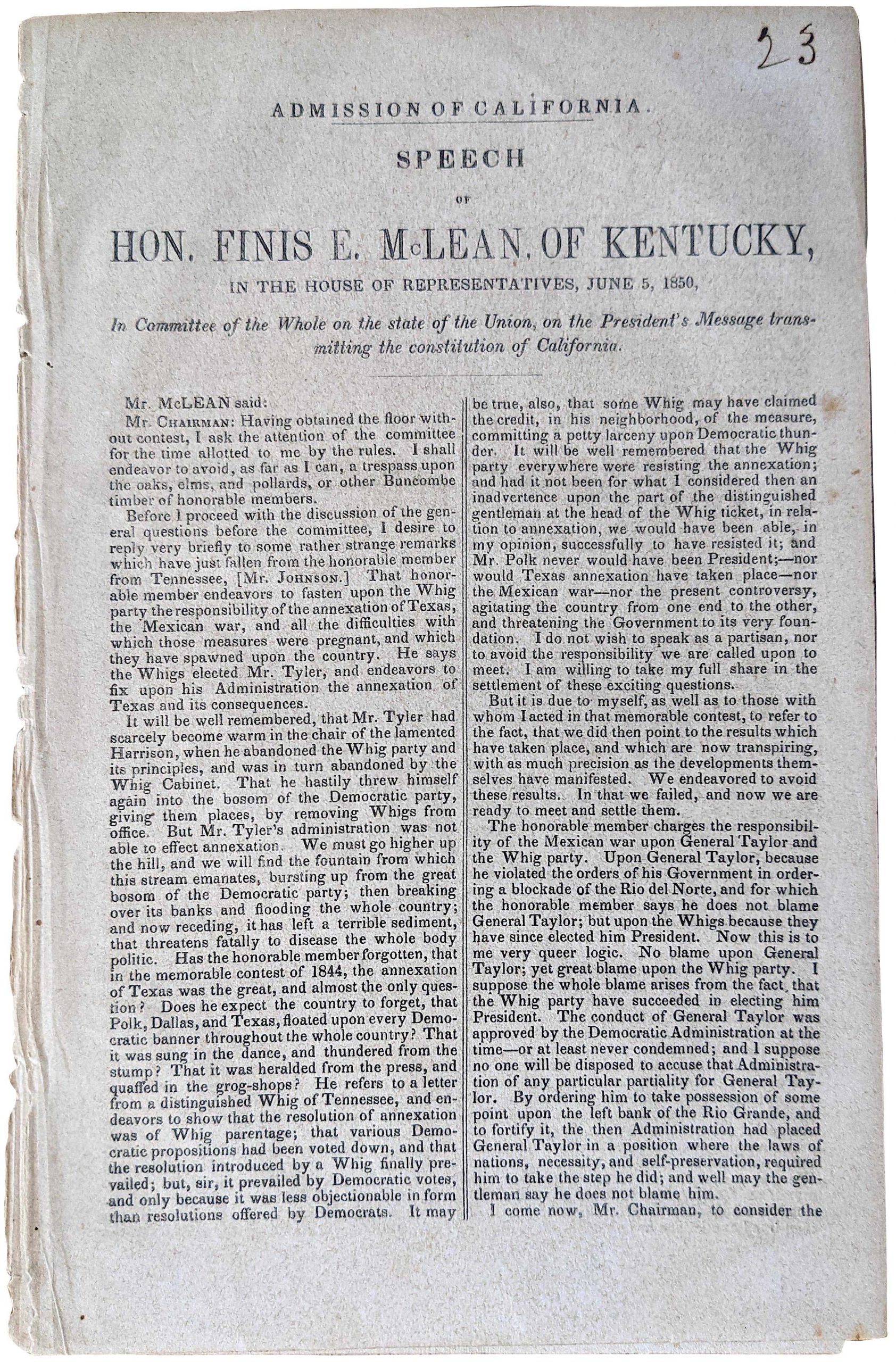
Antique Speech Admission of California To The Union, 1850

Antique Speech Admission of California To The Union, 1850:

The paper dimensions are Approx. 9″ x 6″ (small variances can occur). The provenance of this lot is from a collector in Palm Beach.This collector is a MSc in History (Emph. American History).

This lot is located in Boca Raton, Fl. The shipping by Artelisted will be via USPS – First Class or Priority (tracking # will be provided via Stamps.com). If you wish to use the “media” mail (books only) via USPS, please send us an email and we will update the corresponding shipping cost. Sometimes Artelisted can decide to coordinate shipping with a third party (between buyer and contractor). Shipping insurance is the responsibility of the buyer. Ask us if you want to add insurance cost. Note that if there is loss or damage due to bad handling by the transporter, this loss will be assumed only by the buyer. Enquires are welcome, do not hesitate to contact us at your convenience, we are looking to providing you with an excellent service.

Bactrian Stone & Shell Bead Necklace, ex-Christie’s

Bactrian Stone & Shell Bead Necklace, ex-Christie's

Bactrian Stone & Shell Bead Necklace, ex-Christie’s:

**Originally Listed At $6000**

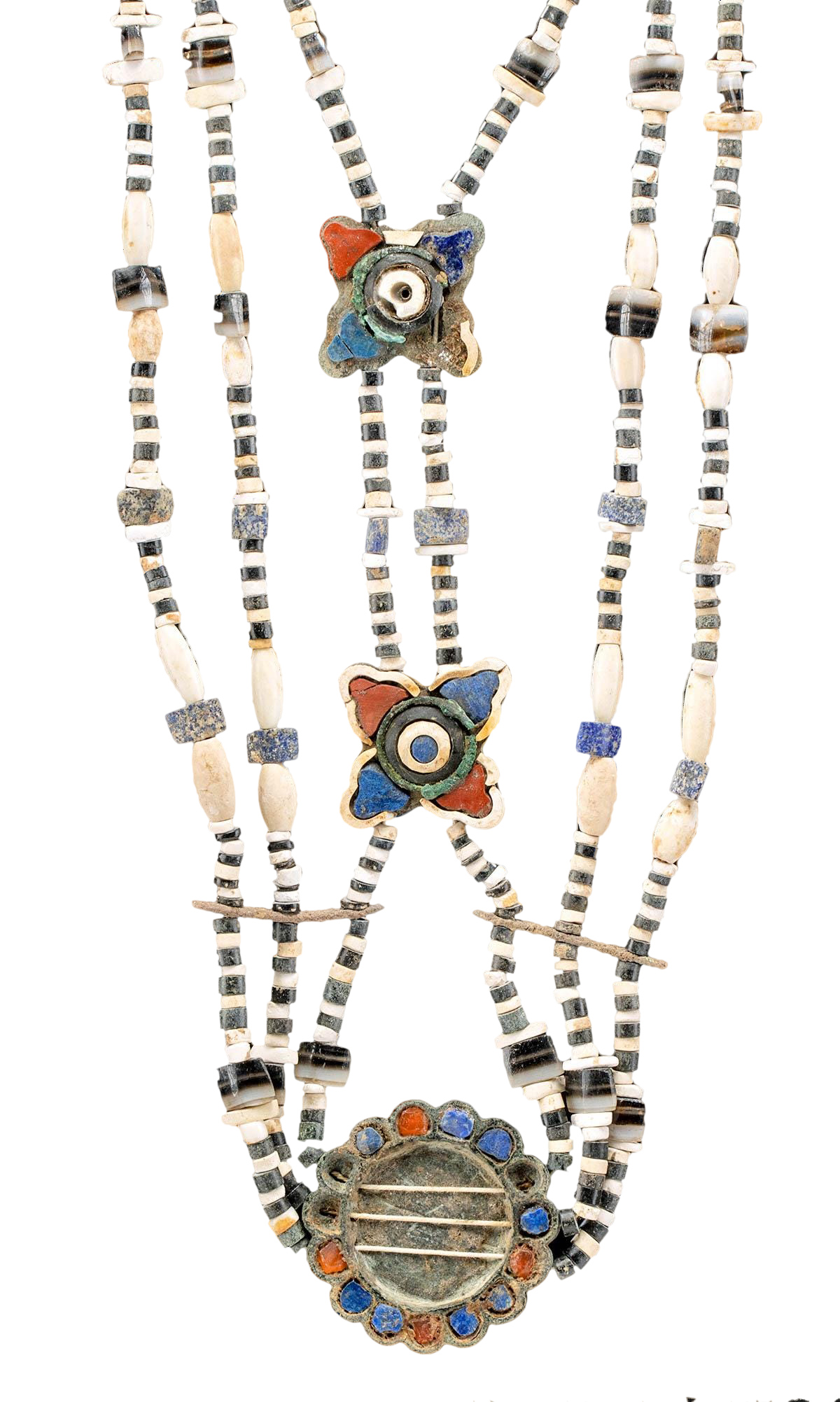
Central Asia, Bactria, ca. late 3rd millennium BCE. An incredible necklace made of ancient beads restrung in modern times to restore its ancient glory. Strung in three strands, it centers on a chlorite compartmental rosette bead, inlaid with lapis lazuli and carnelian. Above that, the strands are arranged with alternating black and white spacers, interspersed with banded agate and lapis lazuli tabloids, and shell barrels, joined by triple strand 80% silver spacers. The center features two quatrefoil compartmental chlorite pendants inlaid with lapis lazuli, calcite, carnelian, and copper. At the upper end of the necklace, the three strands join together at a pair of triangular shell terminals. Length of strand: 35″ L (88.9 cm); size of rosette: 1.45″ W (3.7 cm)

Extremely Rare Phrenology Booklet, 1838

Extremely Rare Phrenology Booklet, 1838

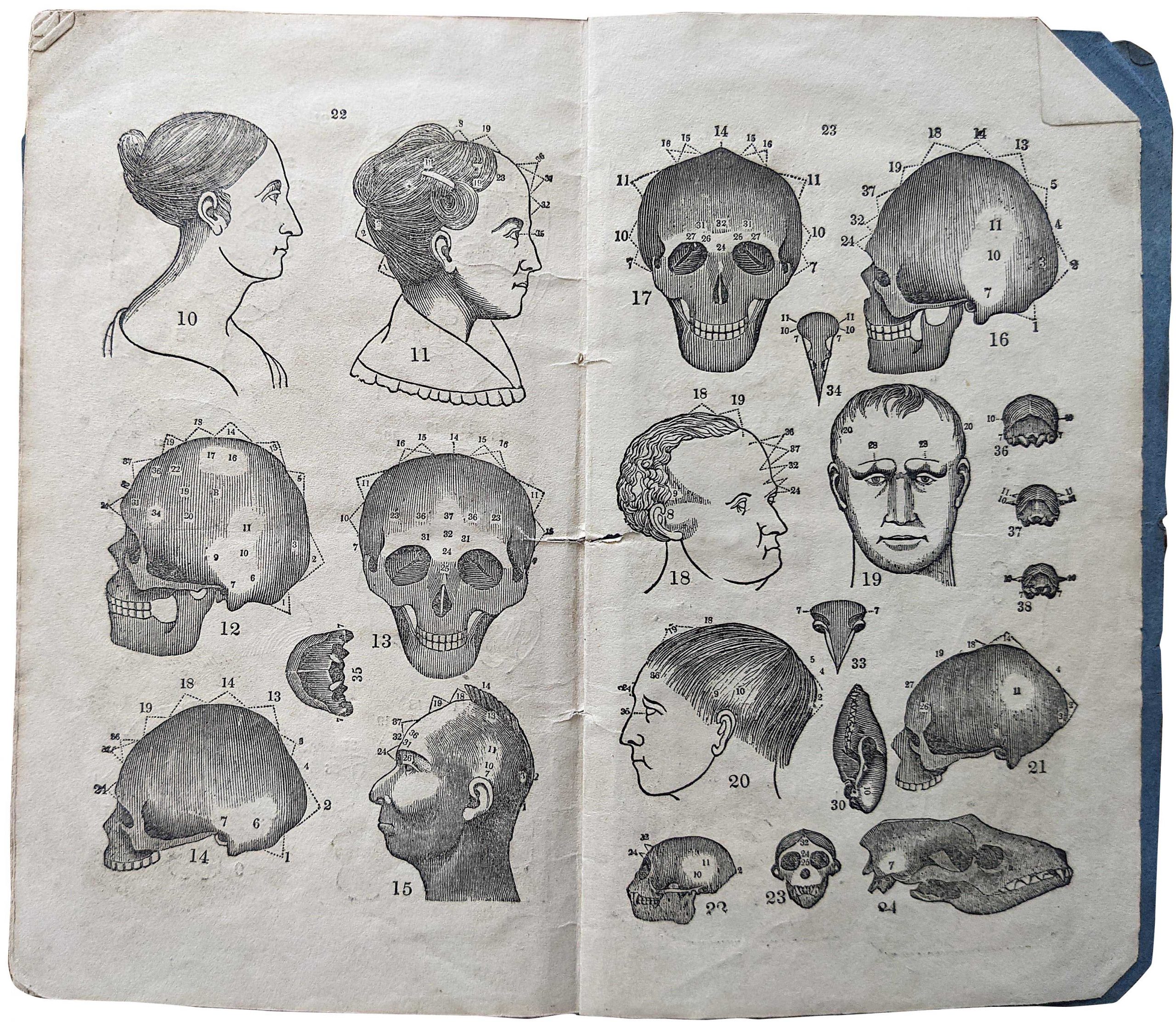
Extremely Rare Phrenology Booklet, 1838:

The paper dimensions are Approx. 9″ x 6″ (small variances can occur). The provenance of this lot is from a collector in Palm Beach.This collector is a MSc in History (Emph. American History).

This lot is located in Boca Raton, Fl. The shipping by Artelisted will be via USPS – First Class or Priority (tracking # will be provided via Stamps.com). If you wish to use the “media” mail (books only) via USPS, please send us an email and we will update the corresponding shipping cost. Sometimes Artelisted can decide to coordinate shipping with a third party (between buyer and contractor). Shipping insurance is the responsibility of the buyer. Ask us if you want to add insurance cost. Note that if there is loss or damage due to bad handling by the transporter, this loss will be assumed only by the buyer. Enquires are welcome, do not hesitate to contact us at your convenience, we are looking to providing you with an excellent service.

Lifesize 18th C. Spanish Colonial Painted Wood Crucifix

Lifesize 18th C. Spanish Colonial Painted Wood Crucifix

Lifesize 18th C. Spanish Colonial Painted Wood Crucifix:

**Originally Listed At $9000**

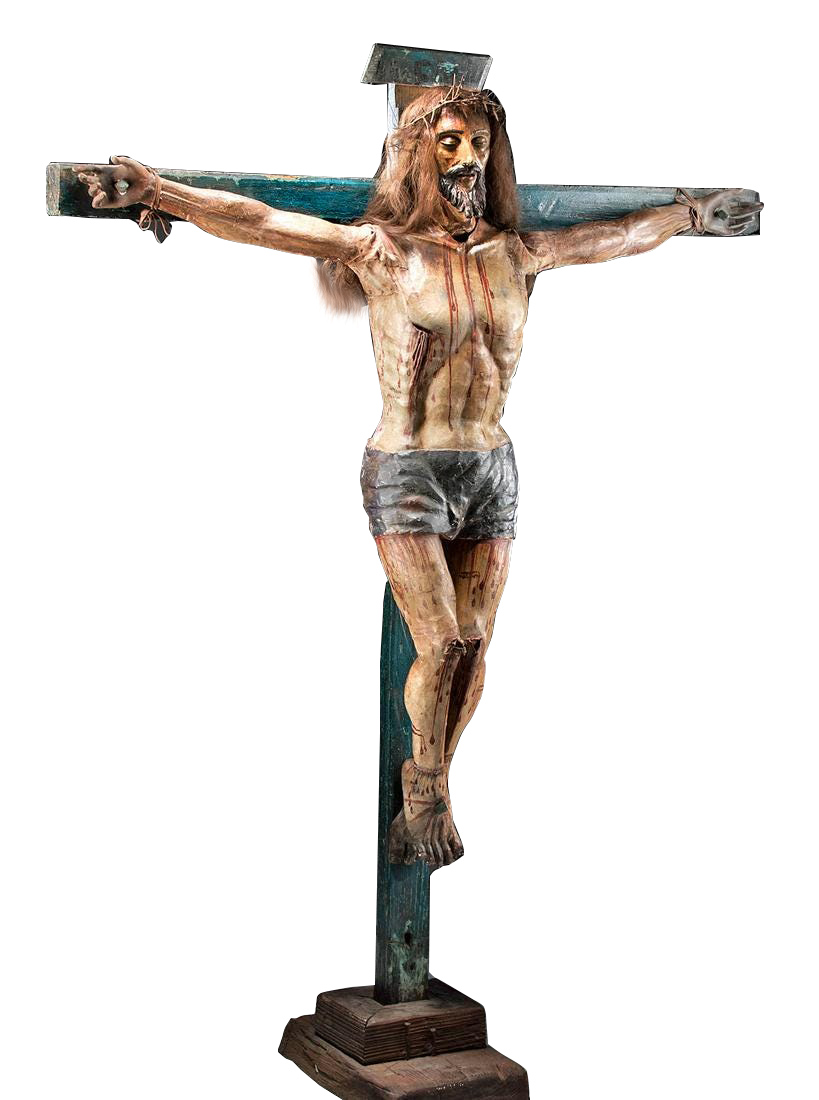
North America, northern Mexico, Spanish Colonial period, ca. 1790s CE. A stunning, lifesize piece of devotional artwork, this is a crucifix with the cross itself made from wood and the figure of Christ made from plaster with leather at the joints to allow the arms and neck to be articulated. Horse hair creates a flowing coiffure, while the crown of thorns and nails through the feet and palms are all made of wood. The body is realistically painted with wounds, including a long mark on the rib from a Roman soldier’s spear. The face is lifelike, carved in the manner of a santo, with sensitive eyes, a strong browline, and a carved beard. The neck is articulated so that the head can move forward and back, with the chin resting on the chest in its resting state. Size: 20.25″ L x 58.75″ W x 79″ H (51.4 cm x 149.2 cm x 200.7 cm)

The figure of crucified Christ has been central to Christianity, and especially Catholicism, for centuries, representing his humanity through his suffering and death. In “The Crucified God: A Death in Pictures” (Los Angeles Review of Books, 2017), religious scholar Ed Simon writes, “A crucifix is holy because it does not look holy. A crucifix is holy because it tells a truth. A crucifix is holy because it does not sanitize, clean, erase, obscure, or deny the trauma – or the majesty – of being a human, even if that human happens to be God.” In 18th century Mexico, under colonial Spanish rule, May 3 was the feast day of the Invention of the Holy Cross, a celebration so important that when in 1960 the Church ordered the removal of the holiday from the liturgical calendar, Mexican bishops intervened to save it in their country. Cavalry processions, using crucifixes like this one, were then and remain now a major part of this feast.

Figures like this one follow on from the medieval tradition, practiced until the present day in Spain and its colonies, of using lifelike puppet and/or articulated figures to act out a theatre of key moments from the Bible. Many of these figures – like this one – have leather over exposed areas or at joints to simulate flesh and make them as lifelike as possible. Some were even given cogs, spindles, and straps to move their heads independently (interestingly, these figures are sometimes considered the earliest European “robots”)! They became a folk art tradition in the Spanish New World, from modern day Guatemala to as far north as New Mexico and Colorado. Many of them were lovingly cared for over the years, with repairs and paint added as they aged, and played an active part for a long time in the religious life of their communities. This crucifix would have been displayed in a church, and also could have been carried by members of the community during processions on important religious holidays.

Massive Inca Stone Star-Shaped Mortar

Massive Inca Stone Star-Shaped Mortar

Massive Inca Stone Star-Shaped Mortar:

**Originally Listed At $15000**

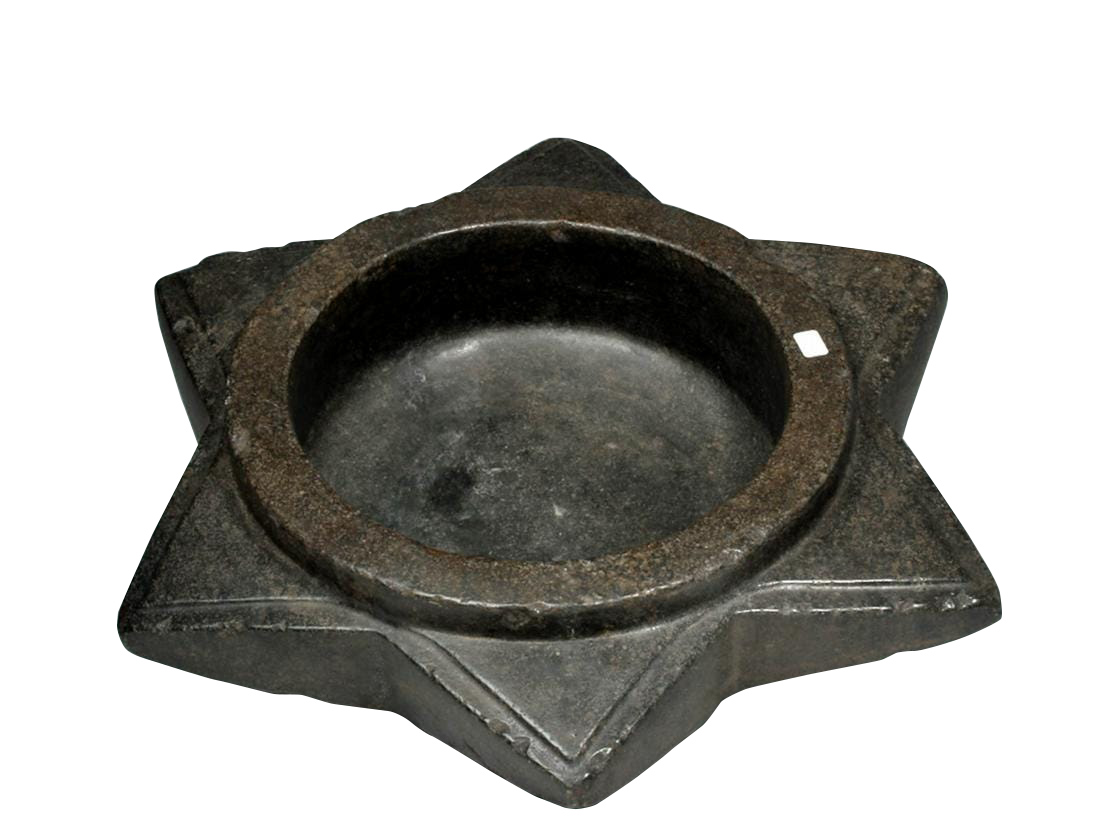
Pre-Columbian, Ecuador to Chile, ca. 1400 to 1500 CE. Very large deep brown hard stone mortar carved in the form of a six-sided star with deep circular well surrounded by raised ring. Each star point with slight raised edge. You can see how this was created using an exhaustive pecking process and then smoothed using stone burnishing. Bottom is smooth and slightly convex. Entire surface is enhanced with an almost thick patina from years of use and subsequent burial. A gorgeous example of a rarely found object! Size: 19″ W x 4.375″ H (48.3 cm x 11.1 cm)

PANERAI Luminor Automatic Stainless Steel Men’s Sports Watch PAM00250 BF517435

PANERAI Luminor Automatic Stainless Steel Men's Sports Watch PAM00250 BF517435

Lot Description
General
Brand – PANERAI
Line – Luminor
Model – PAM00250
MPN – PAM00250
Design
Type – Sports watch
Gender – Men
Material (Case) – Stainless steel
Material (Band) – Leather
Color (Dial) – Black
Movement
Movement – Self Winding (Automatic)
Functions
Functions – Chronograph, Date
Size
Case Diameter – 44mm / 1.73”
Inventory
SKU – BF517435
Serial Number – PB0601***
Included Items
Accessories – None
Condition
Condition – Used (very good)
Ranking Rank A Used – A few traces of usage, some scratches / dirt can be seen but overall in very good condition
Glass Scratches None
Dial Scratches/Deterioration – None
Hand Scratches/Deterioration – None
Case Scratches – Insignificant
Bezel Scratches – Insignificant
Crown Scratches – None
Case Back Scratches – Insignificant
Band Stains/Dirt – Slight
Maintenance – Polished
Shipping
Total Weight – 160g / 5.64oz.

Ed Mell, “Western Landscape”, Oil On Canvas

Ed Mell, "Western Landscape", Oil On Canvas

Ed Mell, “Western Landscape”, Oil On Canvas:

Ed Mell (American/Arizona, born 1942). “Western Landscape”, oil on canvas. Signed lower right, giltwood frame. Provenance: From the Estate of Ms. Franca Oreffice of Atlanta, Georgia. Approx. 41″x 53″ (frame), 36″ x 48″ (canvas).

George Nakashima Walnut Minguren Coffee Table

George Nakashima Walnut Minguren Coffee Table

George Nakashima Walnut Minguren Coffee Table:

George Nakashima (American), 1966. Walnut Minguren coffee table with rosewood butterfly, several free / raw edges and a natural reticulation. Marked to underside with original owners name. Provenance: By descent, from the Estate of Dr. Alberta C. Johnson, Tucson, AZ; acquired directly from George Nakashima in 1967. Accompanied by original receipt, original handwritten purchase order, original printed finishing instructions, original correspondence card regarding delayed delivery signed by Kathy Mezger, and May 7, 1966 original graphite sketch/plans by George Nakashima. Approx. h. 18.25″, w. 69.5″, d. 28.5″.

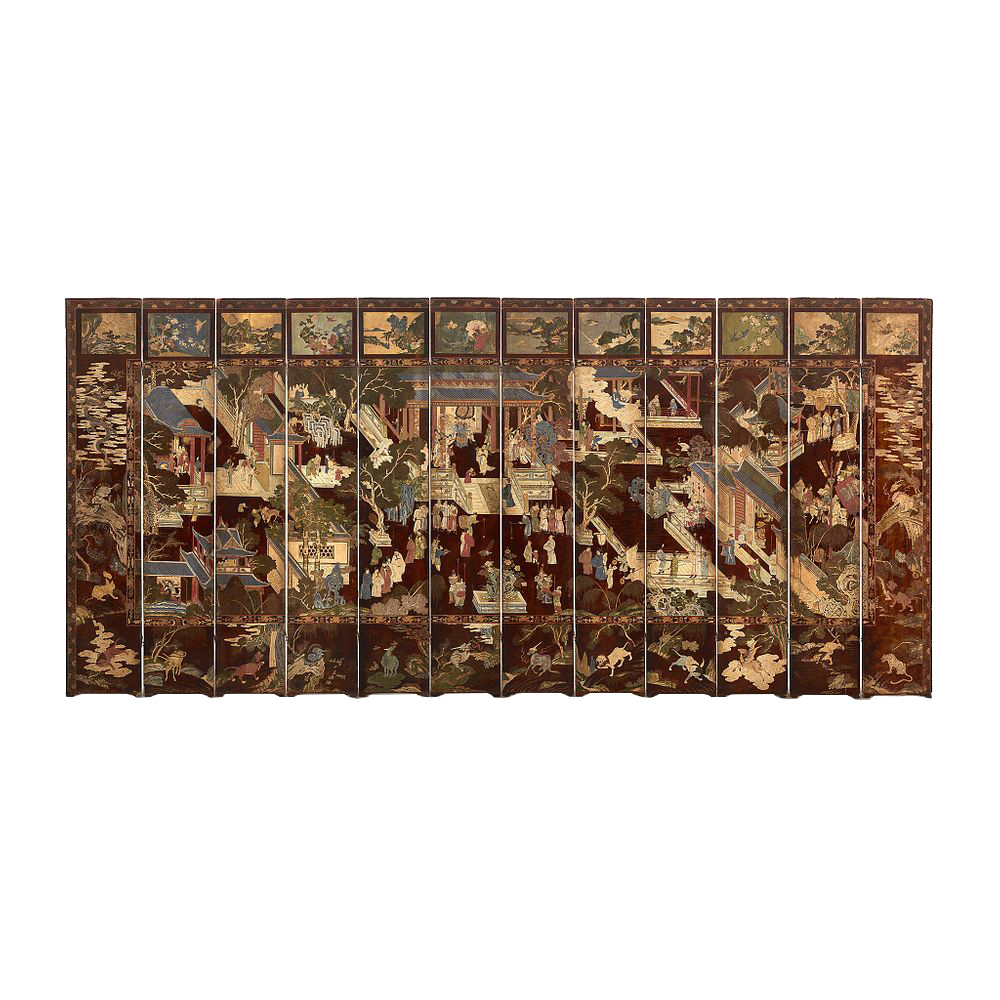
A Chinese carved twelve-panel “Coromandel” folding screen 17th/18th Century

A Chinese carved twelve-panel "Coromandel" folding screen 17th/18th Century

A Chinese carved twelve-panel “Coromandel” folding screen 17th/18th Century:

Finely carved and colored with numerous figures and immortals arriving to celebrate before an Emperor, among pavilions, gates, rockwork and lush vegetation, the upper panels depicting landscapes and bird and flowers, lower panels with animals, mythical and mundane, the side panels with additional auspicious beasts below sinuous dragons descending though scrolling clouds; the reverse with a lengthy calligraphic inscription with a transcription of Shengzhu de Xianchen song, which may be translated as “Ode to the Lord Who Has a Virtuous Minister/Subject,” composed by Wang Bao of the Western Han dynasty. Further inscribed “Written by Marquis Gao Shinian in the first month of summer in the wu chen year (possibly equivalent to 1688). Two seals of the calligrapher Gao Shinian(?), and Si Yi(?); all bordered by reserves of flowers and antiques. (Dimensions: H: 103 1/2, W: 18 1/2 in. (each panel))

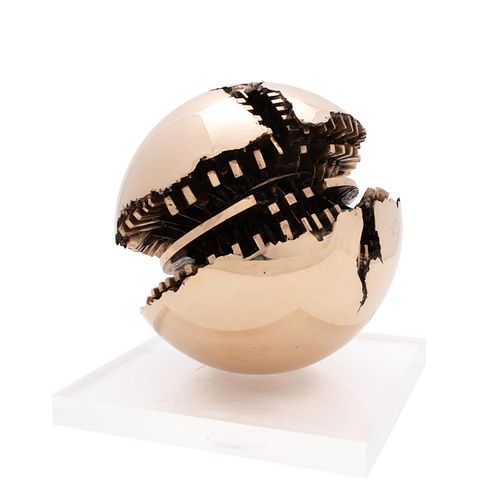
Arnaldo Pomodoro, “SFERA”, Bronze On Lucite Base

Arnaldo Pomodoro, "SFERA", Bronze On Lucite Base

Arnaldo Pomodoro, “SFERA”, Bronze On Lucite Base:

1976, polished bronze on unattached Lucite base. Signed, titled and numbered 2 of 6 on base (from an edition of 6 plus one artist proof). Note: This sculpture is archived in the online catalogue raisonne of the artist as number 590. Provenance: From the private collection of Ms. Nedra Byers of Gainesville, Georgia; acquired from Ann Jacob Gallery, Atlanta. Approx. h. 12.25″ (overall), h. 11″ (sculpture only), base 11.75″ square.