Maxime Maufra: A Painter and The Sea


Fascinated by nature and the fractured coasts created by a rough sea, Maxime Maufra (1861-1918) makes outdoor painting a true religion. A tireless traveler he set his easel down throughout Brittany in search of its vibrant lights.
Estimation : €20,000/30,000
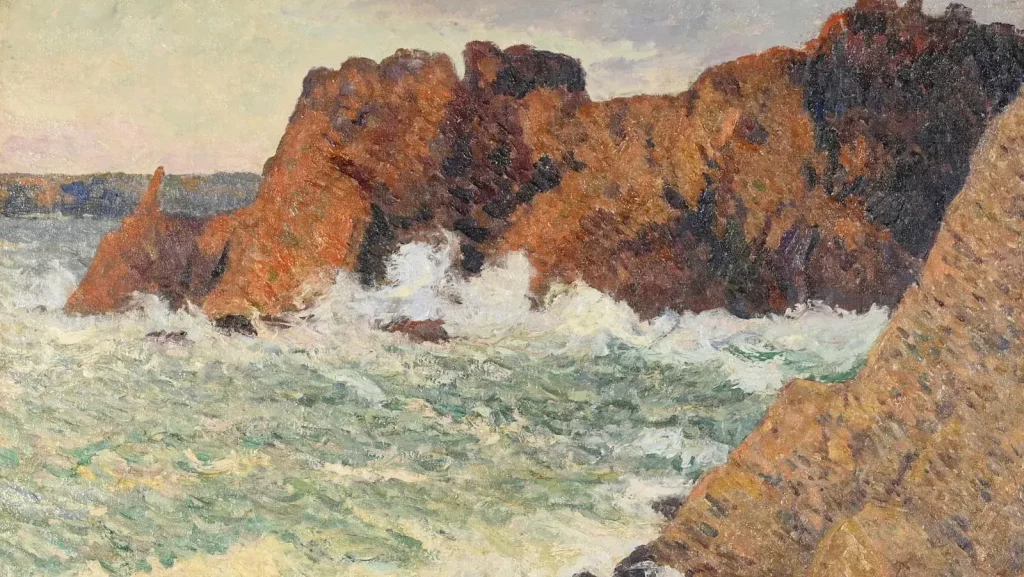
This image of the rocky coast of the Morgat Cove, in the Bay of Douarnenez, just south of the Crozon Peninsula, is first and foremost a clash of a turbulent sea breaking down into a steaming whirlpool against the rocks. Behind the water, which has become foam under the violence of the impact, we can make out the intensity of the wind, the raging of the sea and the deafening sound of its waves. The verticality of the rock face is matched by the horizontality of the water surface; the cold tones of the sea are matched by the warm tones of the stone. The sea with its foam is the central theme of the painting, filling two thirds of the composition. Maxime Maufra was fascinated by the nature, the Breton and Normand landscapes, their coasts and the waves that crash into them. Initially attracted by the Nabi aesthetic, he quickly gave into the Postimpressionist aura, seduced by the vibrations of light on landscape. The brushstrokes proudly placed on the canvas prevails over drawing, forming the whirl of luminous and pearly whites of the foam in contrast to the green—deep blue and yellow—of the water.
Yet the impact of the Nabis’ remains in the idealization of nature and the order and construction of planes. His love for painting outdoors, which he studied beside two local painters, Alfred Leduc and Charles Le Roux, took him to Pont-Aven. In the small Breton village, he made friends with the passionate painter, Paul Gauguin. Maufra writes in his journal that one afternoon in November 1893, Gauguin knocked on his door: “I was very surprised to see the great devil Paul Gauguin appear on my doorstep. Wearing an astrakhan cap, he seemed to have returned from the North Pole rather than the Tropics […].” Gauguin exclaimed: “I understand that you’re defending my art, Maufra, but although we’re following a different path, yours is a good one, so carry on with it.” These words served to comfort Maufra, who was never destined to become an artist. On the path to a career in business, it was during a trip to Liverpool in 1881 that the young Maufra discovered art and, especially the work of William Turner (1775-1851). In 1889 he definitively gave up on the world of business and traveled alone along then coast in a quest of landscapes similar to those that captivated the British master. From the work of Turner, Maufra learned to compose from nature and not copying from it, as he liked to say. He tirelessly painted the sea and the Loire river. It was along the banks of the river where Maufra died, in May 1918, like he lived, with a paintbrush in his hand.
TABLEAUX MODERNES, ECOLES BRETONNES : SECOND PART
Saturday 22 July 2023 – 14:00 (CEST) – Live
26, rue du Château – 29200 Brest
Thierry – Lannon & Associés