July 14, 2018 Auction Results Press Release

Banner Day at Case’s New Gallery

Art and Historical Items Fly High

KNOXVILLE, Tenn.— The July 14 auction at Case Antiques Inc. Auctions & Appraisals was all about history – in more ways than one. It was Case’s first auction in its new, flagship Knoxville gallery, representing a milestone for the twelve-year old firm. And, while there were noteworthy highlights in the categories of European and Western Art, Chinese antiques and Southern Decorative Arts, the smashing success of flags, maps, political and Civil War items made clear that Case is becoming a destination firm for historical artifacts and ephemera.

The presence of many longtime customers from across the South lent a kind of housewarming feel to the event, with about 200 people attending over the course of the day-long event. More than 4,200 others, from Silicon Valley to Shanghai, registered to bid via phone, internet, and absent bid. The auction featured the estates and collections of Mr. and Mrs. H.R. Slaymaker of Nashville, Larry Casey of Jackson, Wilma and Jack Murray of Knoxville, Johnny Maddox of Gallatin, and Charles Boyd Coleman of Chattanooga, along with multiple other consignors from across the South. The open layout and enhanced lighting design of the new building allowed their items to be showcased to greater advantage in room-like vignettes, while Ipads were made available at locations across the floor to assist customers in locating item descriptions in the paperless catalogs.

“When you relocate after ten years in one spot, even when it’s just a couple of miles away as in this case, you kind of wonder if your customers will make the move with you,” said company president John Case. “But it was rewarding to experience such a robust turnout, especially on a day when so many of our regional competitors were also having auctions. I think it’s a testament not just to our marketing but also to the loyalty of our customers. We saw a lot of return bidders, and experienced strength across multiple categories.”

The day’s highest grossing lot was a pointillist oil on canvas of a man working at a vineyard press by French Neo-Impressionist painter Henri-Jean Guillaume Martin (1860-1943), a study for a mural in Cahors, France, celebrating winemaking. Case successfully pursued having the painting added to the Martin catalog raisonné, which likely helped it surpass its $18,000-22,000; it harvested $33,600 from a European bidder on the telephone (all prices in this report include the buyer’s premium).

Also garnering international attention was a re-discovered work by William Shakespeare Burton (United Kingdom, 1830-1916), titled “King of Sorrows,” depicting Jesus Christ prior to the crucifixion, with crown of thorns and rope-bound hands. The 53” x 43” oil on canvas was exhibited at the Royal Academy in London in 1897 and then, seemingly, disappeared; a National Portrait Gallery website article referencing the painting listed it as “untraced” until it surfaced at Case as part of the estate of Tennessee businessman Larry Casey. It realized $14,080.

American art, particularly paintings from the Slaymaker estate/collection, packed the walls of the gallery and found ready buyers. A Charles Woodbury painting of figures on a sunny beach in Ogunquit, Maine, soaked up $11,400 (est. $4,000-4500), while a Van-Gogh influenced view of Boston by Hayley Lever met expectations at $9,000 (est. $6800-7,800) and Lever’s “Low Tide Cornwall” came in at $5,120. Both were small, under 12” x 16”. Circa 1900 oil views of the Smoky Mountains by Charles Krutch, known as the “Corot of the South,” brought $8,400 and $4,560. A mid 19th century miniature portrait of Charles Thompson of Nashville by the New York/Nashville portraitist John Wood Dodge achieved the biggest price of the day for any portrait, hammering at $4,560. The McClung Museum was the winning bidder for an oil on board study for “The Weeping Magdalene” by Tennessee painter Lloyd Branson at $1,680, and a moody Louisiana landscape by Alexander Drysdale sold for $3,600. Folk art by Outsider and Southern female artists was in demand. A scene of little girls leaving Sunday School by Clementine Hunter climbed to $6,144 (est. $2,400-3,000), while memory paintings by Helen LaFrance of Kentucky ranged from $1,100-$2,100 with the top dollar going for a scene of quilts hanging on a line outside a cabin. A 13” x 9” Thornton Dial watercolor of a nude figure made $2,280, a 20” carved riverstone plaque by Raymond Coins realized $1,408, and a small Mary T. Smith portrait of a woman, rendered in house paint on found wood, brought $640. And, there was a happy ending for a late 19th century oil on canvas view of Eastside Farm in Wisconsin by an unknown artist, picturing the farm’s long-lost barn. A descendant of the farm’s original owner fought off competitors in the room and online to win it for $5,520; she plans to give it to the non-profit society which now operates the site as a historic house museum. An Old Master painting depicting the Crowning of Aphrodite doubled its estimate at $2,760, as did a 17th century oil portrait of a woman, possibly Nell Gwynn, attributed to a follower of Sir Peter Lely, which sold for $2,176, and a portrait of a woman after Jean Perreal, $2,304.

Western paintings, most from the Casey estate, also fared well. An oil of a Native American scout on horseback by Arnold Friberg rode to $19,200, while two watercolor Western forest landscapes by Gunnar Widforss competed to $10,800 and $7,800. A Steven Juharos oil depicting the Grand Canyon after a storm ascended to $5,376, and a 19th century atmospheric Western landscape with waterfall by Lucien Powell realized $4,608.

Kurt Vonnegut was best known as a writer, but he also created visual art. A circa 1980 Vonnegut aluminum sculpture titled “Wasp Waist” was the auction’s top-selling sculpture at $5,040. Other strong sellers from the contemporary art category included an ethereal glass Frederick Elliot Hart sculpture, “Spirita,” at $3,000 and a Roy Lichtenstein signed poster from the Whitney Museum’s 1978 “Art about Art” exhibit, $3,600 (est, $350-450). A George Cress abstract oil featuring glowing warm colors tinged with blue doubled its estimate to hit $2,640, and a lot containing two Suzanne Caporeal abstract etchings tripled its estimate at $3,456. Other 20th century works on paper included an Alfonse Mucha “Four Seasons” lithograph signed and inscribed by the author, $4,320; and two Andrew Wyeth signed prints (Snow Hill, a collotype, and Jupiter, a lithograph), each earning $2,560.

In the historical category, a Georgia collection of Civil War artifacts provided many of the highlights. Tops was a Confederate shell jacket said to have been worn by Col. Tomlinson Fort of the 1st Ga. Infantry on his return home to Milledgeville, Georgia, along with his shoulder straps and a post-war albumen print depicting him and his brothers. Estimated at $8,000-$10,000, the lot rallied to $28,800, hammering down to a couple bidding in the room. A lot of four Confederate officer staff brass buttons, including one Tennessee button, charged to $12,000, while two other CSA button groupings brought $5,760 and $4,800. A small (5 x 10 inch) Confederate first national parade flag with nine applied paper stars soared to $8,960, while a circa 1864 Army of Georgia “Soldiers Wanted” banner recruited a top bid of $4,800. A square “Southern Cross” reunion flag trampled its $400-450 estimate to reach $7,680, and two large CSA reunion flag/banners achieved $4,864 – nearly ten times the estimate. CSA reunion ribbons, lotted in groups of two to nine, ranged from $660-$3,480, also well over estimate.

It wasn’t only Civil War flags flying high: a 38-star American flag with stars arranged in an unusual floral pattern rocketed to $10,240 (est. $3,800-4,200) while a rare 42-star Cavalry Guidon flag, officially used for only two years (1889-1891) flew at $5,888. A 15-star hand sewn flag commemorating Kentucky statehood earned $2,048.

A lot comprised of a US Navy Bicorn hat, dress epaulets, and officer insignias sailed to $4,352; all belonged Captain Hugh Purviance (1799-1882), whose colorful Navy career included commanding the St. Lawrence during the blockade of Charleston and engaging with the Merrimac in 1862. A Colt 1851 Navy London model revolver owned by James Nelson III, a Kentucky soldier who fought with Morgan’s Raiders, shot to $5,280 (est. $3,000-3,500), and a group of Chickamauga battlefield relics, including a tree stump with cannonball lodged inside, yielded $2,048. And in what may have been the most surprising finish of the day, a remnant of timber from the White House, scorched during fire started by the British in the war of 1812 and removed during renovations in the 1950s, sizzled to $8,960 (est. $300-350). The relic came from the estate of Capt. Gordon Wells, a member of the Secret Service/White House Police from 1943-1967. (A golf ball from Wells’ estate, personally used by Dwight Eisenhower, landed at $608).

Maps and documents have become an increasingly successful category at Case. A rare 1673 “Map of the English Plantations in America” by Robert Morden and William Berry, considered the first general map of the American colonies, hammered for $13,200. An early English edition of the “Nova Virginiae Tabula” map by Hondius, based on the 1612 map of Virginia by John Smith, earned $2,560. A scarce 1855 map of the plan of the city of Knoxville sparked fierce competition from floor bidders, but ultimately hammered to an East Coast buyer on the phone for $5,760.

This auction included part two of the estate of Charles Boyd Coleman, a Chattanooga attorney and descendant of John Marshall of Virginia. Marshall was a U.S. Chief Justice, friend and biographer to George Washington, and Secretary of State under John Adams. A member of Coleman’s family also married President Adams’ youngest son, Thomas Boylston Adams, and several Adams related lots were featured in the auction, drawing interest from collectors as well as institutions. An archive with autograph album containing a John Adams inscription with signature dated 1823, three years before his death brought $3,328 (est. $1,200-1400). It read: “Remember thy Creator in the days of thy growth and in the extreme stage of thine old age.” A John Adams free-franked signed envelope with framed lithographed portrait of Adams, after the portrait by Albert Newsam, delivered $3,200. A lot containing two John Quincy Adams free-franked envelopes and a hand drawn map of Okefenokee (the Cherokee Nation lands in Georgia) sold for $6,000, while a circa 1825 album containing a sonnet penned by John Quincy Adams, titled “A Theory of Comets, to the Comet Seen at Quincy 6 October 1825,” streaked to $2,040. A lot containing three cut book pages with one George Washington signature and two John Marshall signatures earned $7,040, and a group of four books from John Marshall’s library brought $2,420 (titles were “The History of the Rebellion and Civil Wars in England,” published 1705, and “Letters of Philip Stanhope,” 1775; three were signed by Marshall). A Bible belonging to General Henry Dearborn’s family closed at $1,536.

Furniture from the Coleman estate also attracted interest, particularly a Chippendale side chair with oral history of descent at Mount Vernon, which competed to $6,144. It bore a strong resemblance to a chair in the Mount Vernon collection, and was believed to have been given by George Washington to John Marshall for his help in settling the estate of his nephew, Augustine, (who lived at Mt. Vernon but died in his 30s without issue). The day’s top furniture lot was a rare Cumberland-action dining table attributed to the Seymour school of Massachusetts; it entertained a host of bidders who drove it to $11,400. Another Seymour-attributed piece from the Coleman estate, an inlaid game table, scored $3,840, while a less ornate serpentine front card table, pictured in a 1913 brochure on the James Marshall home, hammered to an anonymous phone bidder for $3,000. A Mid-Atlantic Chippendale carved side chair and tiger maple Chippendale side chair, offered together, brought $7,200, while a tiger maple chest on chest with New Hampshire provenance earned $4,800, and an American Federal carved mahogany square back sofa, similar to examples from the shop of Duncan Phyfe, rested at $4,080. A Kentucky “bandy leg” chest featuring four graduated drawers on short, cabriole legs danced to $6,600 despite multiple leg restorations, and an East Tennessee late classical mahogany sideboard, signed by maker Joseph Harmon, served up $5,040.

A single owner collection of Liverpool jugs and Historical Staffordshire, all with American Patriotic themes, was a notable addition to the Ceramics category. Top seller was a pearlware jug with polychrome decoration of “The Arms of the United States”, formerly from the Robert Teitelman collection and pictured in the book “Success to America: Creamware for the American Market.” Despite some restoration, it achieved $4,320 (est. $2,000-2,500). A Liverpool “Boston Frigate” jug cruised to $2,880, and a jug with “Immortal Washington” on one side and American Ship on the other, having restoration to its spout, realized $2,640 (est. $1,800-2,200). A massive Sevres style cobalt and floral decorated porcelain jardinière quadrupled its estimate at $5,040, and a Pablo Picasso Madoura terra cotta visage plate smiled at $2,994 despite some condition issues. A handpainted Haviland game plate in the pattern designed by Theodore Davis for President Rutherford B Hayes, dished up $2,048, and a 5 ¾-inch Newcomb College scenic landscape vase hit $3,120.

The ceramics category featured the Larry Casey collection of late 20th century Southwestern and Native American pottery. Best seller in the group was a large Hopi pottery bowl with intricate geometric decoration by Rondina Huma at $3,200. A Heard Museum Guild Award-winning jar by Polly Rose Folwell, commemorating the events of Sept. 11, 2001 with motifs including the Stature of Liberty, skyscrapers, and airplanes, realized $1,664. A Randy Miller Cherokee turquoise mosaic pottery jar sold for $2,688, and a large Hopi polychrome jar by JoFern Puffer earned $1,560. A Stephen Lucas Hopi pottery jar brought $1,280, the same as a large polychrome jar by Lucy Leuppe McKelvey. A finely woven Panamint (Timbisha Shoshone) coiled basket, measuring under 4 ½ inches tall and estimated at $500-600, surprised at $2,880.

Topping the glass and lighting category was a late 19th century French or English crystal chandelier, deaccessioned from the Tennessee Room of the Museum of the Daughters of the American Revolution in Washington, DC. Measuring 47” high x 35” diam., the chandelier was an accessible size and attracted lots of attention, finishing at its high estimate, $6,144. A Tiffany Studios desk lamp with “turtleback” shades reached $8,320. A ruby glass biscuit jar or humidor with Whiting sterling overlay achieved $3,120, a pair of Bohemian enameled glass decanters made $2,640, and a Lalique crystal swan sailed to $1,664. Four green glass goblets from an early Nashville family, said to have been used during the Marquis de Lafayette’s visit to Nashville in 1825, changed hands at $1,320.

Chinese bidders proved to be active buyers as usual. The top Asian piece was a white jade dragon buckle with metal mounts, which clipped to $7,680. A pair of celadon jade buckles with knot, scroll and bat motifs brought $2,176, and a small white jade carved boulder, paired with a spinach jade snuff bottle, climbed to $6,400. A Chinese archaic bronze wine vessel, possibly Shang Dynasty, sold for $4,096, and a blanc-de-chine Guanyin figure rose to $3,712, while a carved early 20th century hardwood games table closed at $1,920.

Silver and jewelry performed consistently. Notable lots included a diamond and sapphire ring in custom 18K figural setting, $5,632; a Cartier 18K and garnet bracelet, $2,040; an 18K Rolex Submariner with blue face, $4,800, and a Cartier Santos 18K ladies watch, $4,096. A Kurt Matzdorf sterling Kiddush cup tripled its estimate to finish at $3,072; a Gebelein sterling tea kettle on stand served up $1,800; a circa 1914 Irish sterling dish ring made $1,408; and a Continental silver wager or marriage cup attracted $1,560. A Winterthur “Paul Revere” reproduction sterling tankard topped out at $1,536 (est. $350-400). There were multiple sterling flatware services; top seller was a 128-piece set in Whiting’s Lily pattern, $3,840.

Oriental rugs from the Slaymaker collection dominated the textile category. A Talish Caucasian area rug brought $3,200, a Shirvan prayer rug, $2,040, and an antique Bidjov, $2,160. An East Tennessee pieced and appliqued quilt in a variant of the North Carolina Lily pattern blossomed to $2,640, while another East Tennessee quilt in a variant of the New York Beauty pattern peaked at $2,160. A Kentucky house sampler dated 1865 sold for $2,688, and a Navajo “Crystal Storm” blanket rose to $2,520.

Other lots of note included a pair of Black Forest carved deer heads, $3,840; first editions of “Life on the Mississippi” and “Around the World in 80 Days” from the Maddox collection $1,680 and $1,536; a refurbished Western Union Ticker Tape Machine, model 3A, $4,096; a 1775 New Hampshire Colonial Sixpence Note, $1,088; and a 1796 United States “Draped Bust” silver dollar, $9,600.

Case is based in Knoxville with offices in Nashville and the Tri-Cities (Kingsport and Johnson City, TN, and Bristol, VA). The company conducts quarterly auctions of investment quality art, antiques, jewelry and historical objects. For more information or to inquire about consigning objects for the upcoming Oct. 6 and January 26, 2019 auctions, see our selling page here
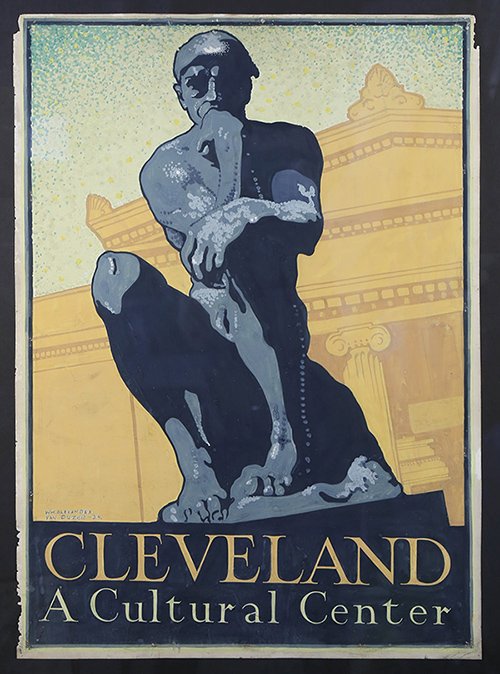
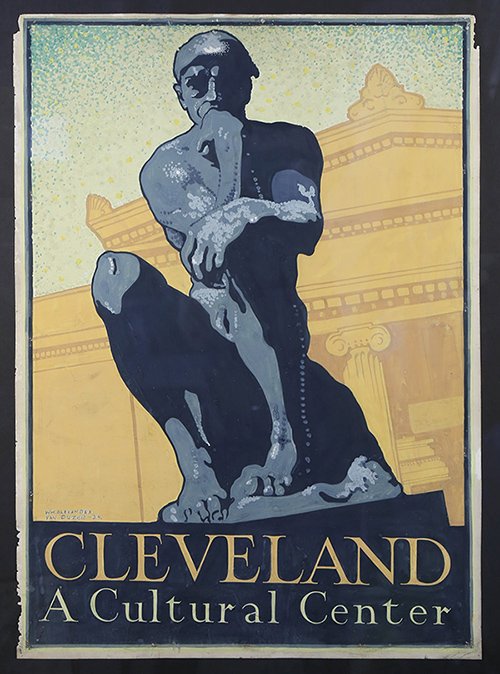
Cleveland: A Cultural Center

WOLFS,Cleveland: A Cultural Center

Join us as we celebrate the community of makers known as the Cleveland School, whose artistic contributions made an important impact on the American cultural landscape throughout much of the 20th century. This stunning display of over 150 works of art and design was conceived as a celebration of the Cleveland School and their important role within our city’s longstanding tradition of artistic excellence. As a not-for-profit exhibition, Cleveland: A Cultural Center is the first of its kind for WOLFS. The vast majority of exhibited works have been loaned from private collections.

Curated by Henry Adams, Ph.D.

STUNNING EXHIBITION FLAUNTS CLEVELAND CULTURE

WOLFS is pleased to present Cleveland: A Cultural Center, an exhibition of over 150 works originating from the Cleveland School, a community of exceptionally talented artists which began to take shape in Northeast Ohio during the early 1900s. The men and women of the Cleveland School would go on to contribute a staggering number of beautiful and important works of art and design throughout much of the 20th century.

By many accounts, this exhibition is long overdue. The Cleveland School’s collective body of work has been aggressively pursued by collectors for over a century; as a result, much of the Cleveland School’s greatest work has existed within private collections,

rarely having been exhibited publicly. Not since The Cleveland Museum of Art’s 1996 exhibition, Transformations in Cleveland Art, has such a comprehensive survey of the Cleveland School’s remarkable legacy been available for public viewing.

Curated by Henry Adams, Professor of Art History at Case Western Reserve University and noted authority on the Cleveland School, Cleveland: A Cultural Center is a celebration of both the Cleveland School’s enormous impact on the region’s cultural landscape, and its importance within the larger narrative of American art history.

This loan exhibition is drawn almost entirely from private Cleveland School collections throughout the country. In fact, a great many of the works included in the exhibition were acquired from WOLFS over the course of the last four decades. By assembling the finest examples of work by the Cleveland School’s most talented artists, a vibrant visual chemistry results in a compelling chronicle of 20th century American Art.

Cleveland: A Cultural Center will be on view at WOLFS through August 31st, 2018. 

2018, Press Feature, Decorating the Gentleman Cave, Wall Street Journal

Wall Street Journal
“The Gentleman Cave: How to Create a Tastefully Macho Room”
By Tim Gavan
June 1, 2018

The weekend Real Estate/Design section of the Wall Street Journal featured Australian interior designer Greg Natale’s take on designing a gentleman’s “man cave.” Inspired by a 1970s collaboration between Spanish designer Paco Muñoz (1925-2009) and English designer David Hicks, Natale offers his suggestions on where to shop for similar items.

Nadeau’s Auction Gallery to Present the Peggy and David Rockefeller Collection

Nadeau’s Auction Gallery, one of the largest and fastest growing auction houses in New England, is excited to announce this important, single owner sales event, featuring artwork and personal items from The Peggy and David Rockefeller Collection – including over 100 monogrammed or inscribed selections! This auction, which will finalize the recent, record breaking New York sale of Rockefeller family materials, will be held on Saturday, June 2, 2018 beginning promptly at 11am EST.  All items from the sale are on display in Nadeau’s gallery in Windsor and are available for preview Wednesday, May 30th from noon-4:00pm; Thursday, May 31st from noon-6:30pm; Friday, June 1st from 10:00-5:00pm; and Saturday, June 2nd from 9:00am-11:00am. A special wine and cheese preview will be held on Thursday, May 31 from 4:00pm-6:30pm.

Members of the Rockefeller family have always been known for their extraordinary eye for fine art, and the transformational effects it has on people and spaces.  This sale offers collectors the opportunity to purchase world-class paintings, sculptures, and other visually stunning works of art – most with their original Rockefeller inventory labels –  that until recently graced the family’s private home walls, mantles, and other focal points.  Lot #100, a watercolor signed and dated by Paul Lucien Maze (1887-1979), depicts a regal coach, uniformed guards, and men on horseback.  Entitled Coronation for Abby 1953, this painting was acquired as a gift from the artist in 1957 and has its original Collection of David Rockefeller label on verso. It is estimated at $1,000-2,000.  “Abby” is the nickname for Abigail Aldrich Rockefeller. Things are twice as nice with lot #433, a pair of signed Brion Gysin (1916-1986) gold-gilt framed watercolors estimated at $ $2,000-4,000.  These complementary, peaceful, and earth-toned landscapes include Just Waiting and Blenching Beaches; both retain their original Collection of David Rockefeller labels on verso.  Lot #250, an untitled, mixed media on paper by Japanese artist Toko Shinoda (b. 1913) is estimated at $3,000-6,000.  It features its original Collection of David Rockefeller label on verso. Shinoda, who at 105 is still actively creating art, is best known for her work merging traditional calligraphy and expressionistic themes.  And lot #300, a signed and dated drypoint etching by Francis Alys (b. 1959) with collage and opaque white highlights, is estimated at $2,000-4,000. Entitled The Modern Procession, this work features one figure holding a Museum of Modern Art Queen’s ticket and another holding a MoMA sign. It is numbered 25/60 and is marked on the verso, indicating it is from the estate of Peggy and David Rockefeller.

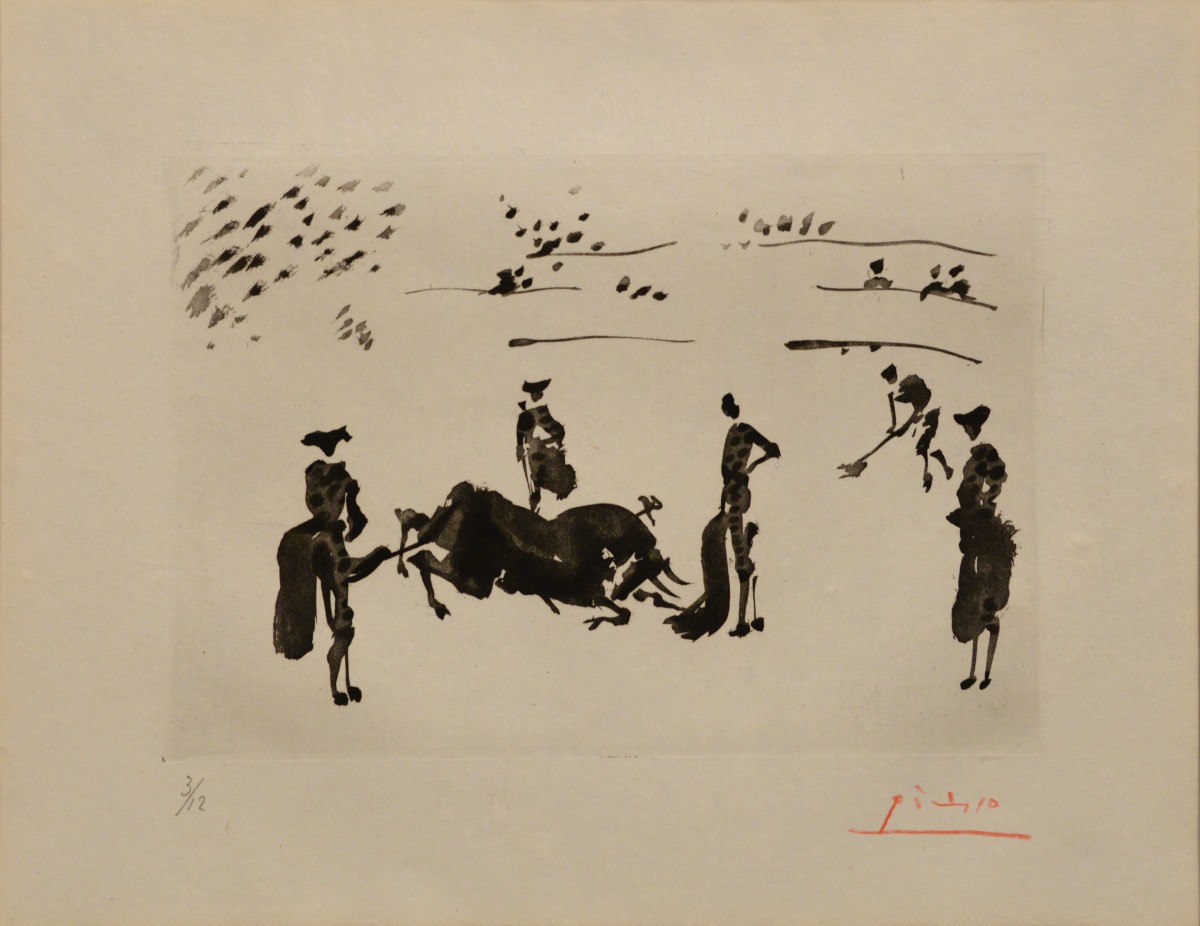
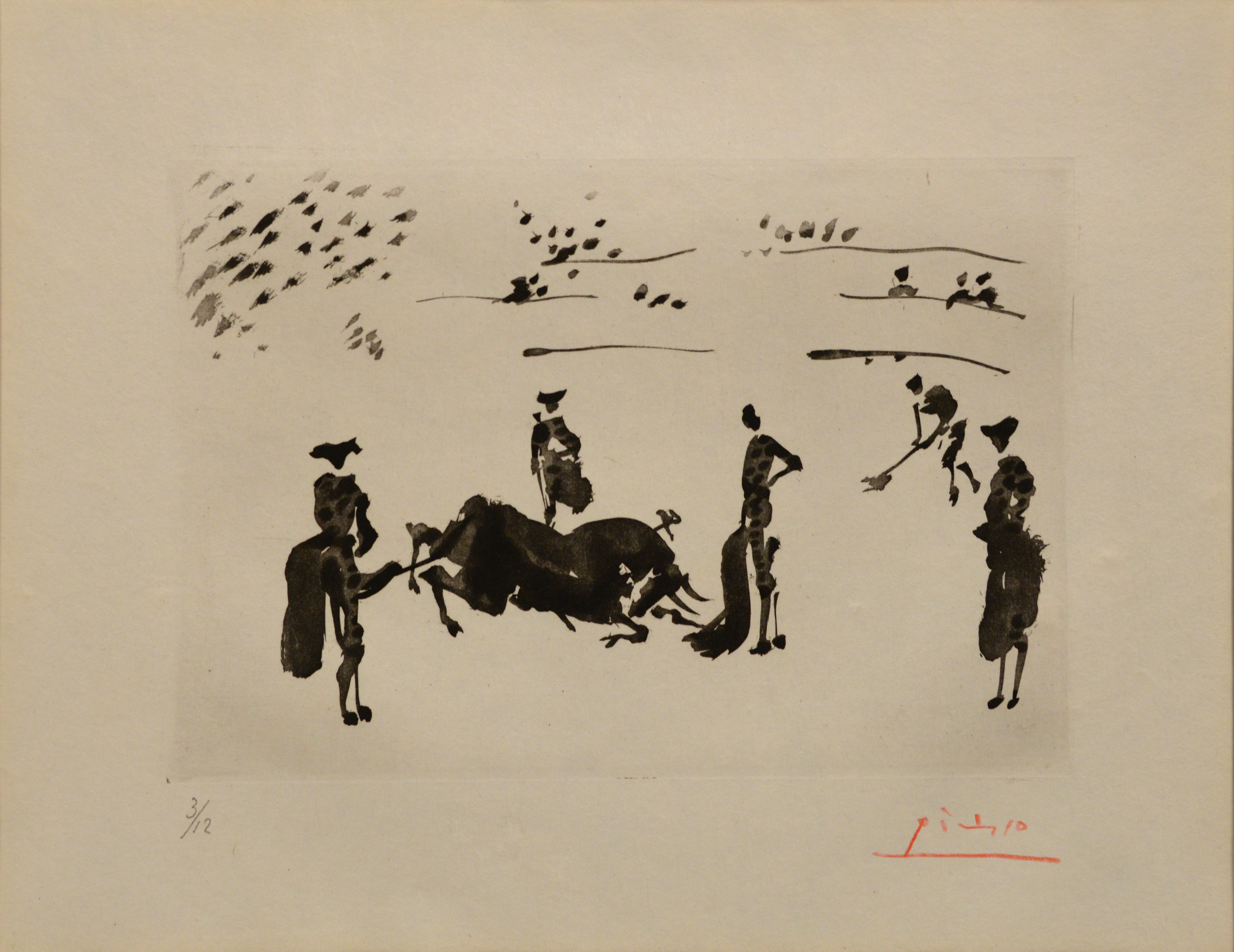
The $115,000,000 sale of Pablo Picasso’s (1881-1973) Fillette à la Corbeille Fleurie as part of Christie’s May 8, 2018 “The Collection of Peggy and David Rockefeller: 19th and 20th Century Art, Evening Sale” in New York City has again focused the world’s attention on one of the 20th century’s most important and influential artists. Nadeau’s auction also features a number of more accessible Picasso works, including a trio of hand signed bullfighting themed aquatints.  Each is estimated at $5,000-10,000.  The first, lot #350, is titled Muerte Del Toro (Death of the Bull).  The second, lot #351, is titled El Matador Brinda La Muerte Del Toro (The Matador Brings The Death Of The Bull). And the third is lot #352, titled El Torero Sale En Hombros de los Aficionados (Bullfighter Exits On Amateur Shoulders.)  Each aquatint is part of an original set of twelve copies, is #3 of 12, and has its original Collection of Nelson A. Rockefeller and Collection of David Rockefeller labels on verso.

The Rockefellers were instrumental in launching the world-famous Museum of Modern Art (MoMA) in New York City in 1929.  Today MoMA is considered to have one of the finest and most comprehensive art collections on the planet, and members of the Rockefeller family remain active as trustees within the organization.  A quartet of large c-print photographs by Michael Wesely (b. 1963) on offer through this sale capture the early-2000 era construction related to MoMA’s expansion and renovation.  These include lots #301, #302, #303, and #304.  Each of these distinctly urban steel framed photographs are signed and dated by the artist, dedicated to David and Peggy Rockefeller, and are estimated at $4,000-8,000.

Collectors looking to feather their nests with functional and decorative art rarities from the Rockefeller family collections need look no further than this sale.  Outstanding porcelain, glass, and silver selections are available in a full spectrum of price points.  For starters, let’s point out lot #374, a c. 1820 set of 12 crystal diamond cut finger bowls estimated at $1,000-2,000.  They are decorated with a gilt and painted laurel pattern rim and polychrome enamels of classical vignettes of water gods, goddesses, and sea creatures. Lot #508, a signed, silver-plated copper vase from Korean artist Chunghi Choo (1938-1985) is estimated at $500-1,000.  This vase is number 3 of an edition size of 35; this identical example was exhibited at the Museum of Fine Arts, Houston.  Lot #576, a large signed Philip Moulthrop (b. 1947), tan and orange finished ash leaf maple turned bowl/vase is certain to be a bidder’s favorite, given its good looks and $500-1,000 estimate. Meriting a double take is lot #325, a pair of fully marked Sevres Mahieddine Boutaleb powder blue and gilt porcelain vases, estimated at $ $2,000-4,000.  And lot #500, a large, 153 troy ounce sterling silver tray with handles, is certain to be a heavy metal favorite in this grouping.  Estimated at $ $2,000-3,000, it is monogrammed A. David Rockefeller Presidente Council for Latin America, has five lines in Spanish, is signed Bruno Pagliai Presidente Mexico, April 1969, and includes twenty-four additional signatures.

Asian art selections from the Peggy and David Rockefeller collection add a touch of foreign intrigue to the fantastic array of fine international items on offer through this sale.  Lot #25, a Chinese hardwood altar table top stand with a reticulated carved gallery is estimated at $300-500.  And things are certain to heat up over lot #400, a large Chinese Fahua rectangular censer.  This impressive vessel is boldly decorated with large lotus blossoms against a foliate ground, has a hardwood carved rectangular cover and base, and a dramatic finial. It is estimated at $1,000-2,000.

This comprehensive sale rounds out with amazing, interesting, and sometimes quirky selections of furniture, household goods, awards and gifts, sculpture, lighting, and accessories – among other diverse categories.  A crown jewel here is lot #32, a Queen Anne walnut veneered dressing table with an inlaid top and decorative metal handles, estimated at $300-500. And lot #3, a “DR” monogrammed Mitsubishi tri-colored 18K cuff links and tie clip set is the perfect highlight to button up this discussion. Decorated overall with a concentric square design, this handsome and beautifully handcrafted trio is estimated at $400-600.

Q&A: Taylor Thistlethwaite

At 32, Taylor Thistlethwaite is one of the youngest antiques dealers on the circuit. The Kentucky native radiates a Southern charm that runs as deep as his appreciation for the material that hails from below the Mason-Dixon line. We caught up with him at the Philadelphia Antiques and Art Show to get his take on what it’s like to be young in the business nowadays, his thoughts on the market and how he manages to fit all of his inventory into his townhouse.

How did you get started?

When I was a little kid, my parents were passionate collectors. Most people would consider me tortured because my parents never took me to Disney World, but I knew every antiques shop up and down the Shenandoah Valley. I used to get thrown into attics and they’d yell, “Taylor, you see anything up there?!”

Exhibition | ‘The Squash,’ Anthea Hamilton Explores Imagery’s Physical Knowledge

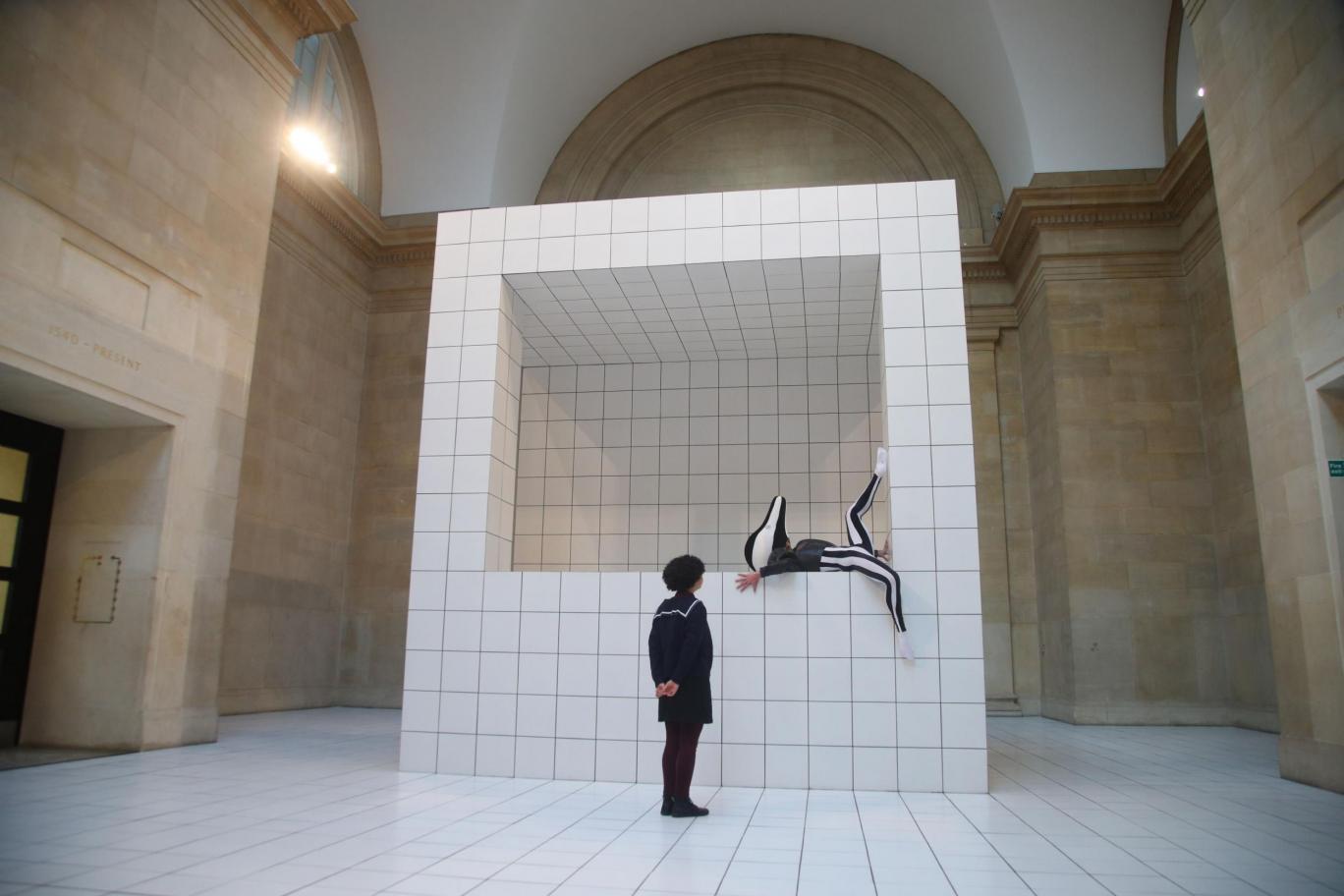
LONDON––Tate Britain presents The Squash (March 22 – October 7, 2018), an immersive, tile-covered installation combining performance and sculpture by 2016 Turner Prize nominee Anthea Hamilton. The exhibition is part of Sotheby’s annual Tate Britain Commission, which invites contemporary British artists to create innovative new sculptural artwork in the setting of England’s first public gallery designed specifically for such displays––the Duveen Galleries.

For her installation, Tate Britian writes, Hamilton transformed the space into an elaborate arena for a continuous 6-month performance by a delightfully dressed squash inhabitant. Setting the stage are more than 7,000 white floor tiles, which traverse the vast length of, and juxtapose, the neoclassical galleries. They also make up a varied series of large structures, which not only serve as staging areas for Hamilton’s squash character, but also as plinths for a number of artworks from Tate’s collection, chosen by the artist for their organic forms and colors.


“Anthea Hamilton has made a unique contribution to British and International Art with her visually playful works that both provoke and delight. This compelling commission demonstrates her ability to seamlessly weave together captivating images and narratives, creating rich new environments in which to encounter works of art.” ––Alex Farquharson, Director, Tate Britain.

Influenced by early 20th century French writer and dramatist Antonin Artaud and his call for the ‘physical knowledge of images’, it is this bodily response to an idea or an image which Hamilton strives to examine in The Squash. Each element of the work has evolved from Hamilton’s interest in a found photograph, for which the original source has since been lost. Thus, the viewer is invited to imagine its history and intention, through the artist’s employment of tile, structure, sculptures and costume.

Hamilton designed seven costumes in collaboration with LOEWE Creative Director Jonathan Anderson which draw from the colors and shapes of varieties of squash or pumpkin. Performers will select a costume each day, informing and reflecting their individual interpretation of the character as they inhabit the space.


Anthea Hamilton

Anthea Hamilton is renowned for her bold, often humorous works which incorporate references from the worlds of art, design, fashion and popular culture. She has exhibited widely with recent large-scale, site-specific installations including her Turner Prize nominated exhibition Lichen! Libido! Chastity! at the SculptureCenter in New York, re-staged at Tate Britain in 2016, and Anthea Hamilton Reimagines Kettle’s Yard at The Hepworth Wakefield.

Tate Britain Commission 2018: Anthea Hamilton is curated by Linsey Young, Curator of Contemporary British Art, Tate, with Sofia Karamani, Assistant Curator of Contemporary British Art, Tate.

LA WEEKLY NEWS / APRIL 25, 2018

Robert Berman’s Santa Monica Auctions has been in business for decades, a twice-yearly weekend event offering rare fine art and ephemera gems with an above-average rate of interesting provenances. But even by his standards, Lot 110 at the Sunday, May 6, auction takes the cake. And the cats. And dogs. And clown suits. It’s everything.

Lot 110 is a painting by the legendary Margaret Keane, of Big Eyesfame. At almost 4 x 6 feet, it is her largest canvas, and something of a crown jewel in her career. Commissioned by Jerry Lewis in 1961 as a portrait of the comedian and his family with his first wife, Patti Lewis, it originally features their five children (plus three cats and four dogs). Two years later, the couple had a sixth child, a son, and Keane came back and added him to the painting. You can see him as the small child on Patti’s lap, in the white onesie with the blue collar.

Keane herself wrote of the experience, “Until such an unlikely time as I paint the Ride of the Valkyries, this shall remain my most gymnastic work. I had to use hitherto unsuspected muscles to tether this herd. There are 14 subjects and guess which one was the most difficult to keep in focus.” And she also addressed the situation with the Harlequin costumes. “Here the clownish part of him is seen only in the motley he wears. The rest is Jerry Lewis, the intense creative personality, devoted family man….”

Devoted or not, the Lewises divorced, but Patti had the painting and it was willed to the estate when she died. One of their sons, who was managing the family estate, sold the painting to a buyer who was a friend of the family, for an undisclosed sum, with the stipulation that he could not sell the painting for at least five years. In fact, that buyer held on to it until Jerry Lewis died in 2017. Since then, this trusted but unnamed person inquired with a private dealer as to its sale. And that brings us to May 6. Not only will the sale proceed as perhaps the biggest draw to this year’s event but its display at Bergamot Station (currently on view through auction day) marks the first time it has been exhibited in public at all.

With a minimum estimate of $100,000, none of us are going to be bringing it home, so this may also be the only time it’s seen in public. Good thing it’s free to look.

This 1962 Jerry Lewis Family Portrait by Margaret Keane Exists. You’re Welcome.

Robert Berman’s Santa Monica Auctions has been in business for decades, a twice-yearly weekend event offering rare fine art and ephemera gems with an above-average rate of interesting provenances. But even by his standards, Lot 110 at the Sunday, May 6, auction takes the cake. And the cats. And dogs. And clown suits. It’s everything.

Lot 110 is a painting by the legendary Margaret Keane, of Big Eyesfame. At almost 4 x 6 feet, it is her largest canvas, and something of a crown jewel in her career. Commissioned by Jerry Lewis in 1961 as a portrait of the comedian and his family with his first wife, Patti Lewis, it originally features their five children (plus three cats and four dogs). Two years later, the couple had a sixth child, a son, and Keane came back and added him to the painting. You can see him as the small child on Patti’s lap, in the white onesie with the blue collar.

Keane herself wrote of the experience, “Until such an unlikely time as I paint the Ride of the Valkyries, this shall remain my most gymnastic work. I had to use hitherto unsuspected muscles to tether this herd. There are 14 subjects and guess which one was the most difficult to keep in focus.” And she also addressed the situation with the Harlequin costumes. “Here the clownish part of him is seen only in the motley he wears. The rest is Jerry Lewis, the intense creative personality, devoted family man….”

Devoted or not, the Lewises divorced, but Patti had the painting and it was willed to the estate when she died. One of their sons, who was managing the family estate, sold the painting to a buyer who was a friend of the family, for an undisclosed sum, with the stipulation that he could not sell the painting for at least five years. In fact, that buyer held on to it until Jerry Lewis died in 2017. Since then, this trusted but unnamed person inquired with a private dealer as to its sale. And that brings us to May 6. Not only will the sale proceed as perhaps the biggest draw to this year’s event but its display at Bergamot Station (currently on view through auction day) marks the first time it has been exhibited in public at all.

With a minimum estimate of $100,000, none of us are going to be bringing it home, so this may also be the only time it’s seen in public. Good thing it’s free to look.

2018, Exhibition, New York on Ice: Skating in the City, Museum of City of New York

2018, Exhibition, New York on Ice: Skating in the City, Museum of City of New York
Print from George Glazer Gallery in the exhibition 'New York on Ice: Skating in the City'
Print from George Glazer Gallery in the exhibition ‘New York on Ice: Skating in the City’

Museum of the City of New York
“New York on Ice: Skating in the City”
December 20, 2017 – April 15, 2018

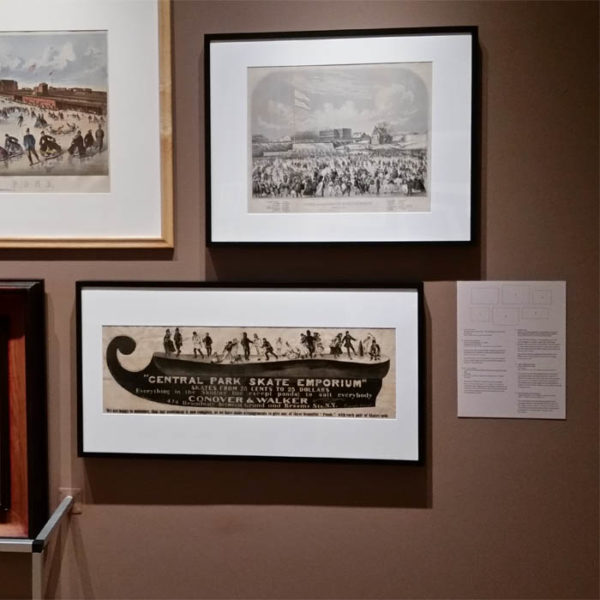
A rare 19th-century broadside advertisement from the George Glazer Gallery is part of an exhibition at the Museum of the City of New York about the history of ice skating in the city and how the pastime has “left its mark on New York’s urban landscape,” including Central Park. Drawn and engraved by Edward Bookhout around 1860, the broadside advertises skates sold at Conover & Walker, a hardware and sporting goods store, with a whimsical illustration of an assortment of men, women, and children skating on top of a giant blade and the slogan “Everything in the skating line (except ponds) to suit everybody.” View the broadside on our site.

Gallery Younghye (New York) Showed Work By Sosan Kim At Scope Miami Beach 2018

Gallery Younghye (New York) showed work by Sosan Kimat Scope Miami Beach 2018.

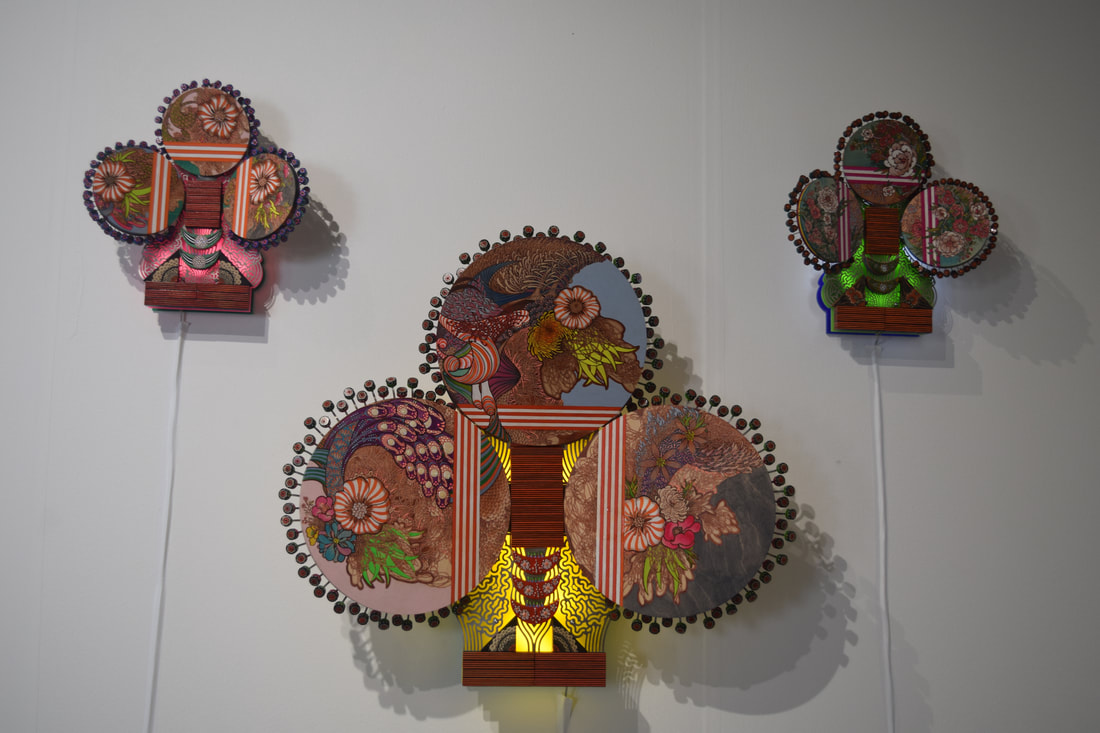
The work by Kim is hard to capture via photograph because the sometimes move. The colorful clockwork like pieces are mesmerizing. She has been part of various exhibitions going back three or four years. You are likely to see more from her.  Follow her on Instagram HERE (this may be the first Mapanare link to an Instagram account!)

 Younghye Hwang‘s blog on the website linked above is an interesting read as well.