The November 9 and 10 Arts of the American West auction at Leslie Hindman Auctioneers was conducted to a standing room only crowd in the Denver saleroom. The sell-through rate and a number of high prices realized led to a sale total over $1.3M, marking the highest grossing auction in firm history for the Denver office.
“The energy of the saleroom was palpable,” said Maron Hindman, VP West and Southwest. “We were happy to see a crowd gather to bid at the auction in-person, contributing to a record sale for the department.”
The top selling lot of the sale was Frederic Remington’s The Rattlesnake, which realized $225,000, surpassing its presale estimate of $100,000 – $200,000. The iconic bronze sculpture, portraying a cowboy and his startled horse, was initially competitive due to a number of aggressive absentee bids that kicked-off bidding. Phone bidders excelerated the bidding, eventually selling over the phone to a gallery in New York. The Rattlesnake #69 holds particular significance because it was the first of Remington’s bronzes to be cast at his favorite foundry, Roman Bronze Works. Additionally, the piece depicts a variation of the same subject matter as Remington’s most popular sculpture, The Bronco Buster.
Property from the estate of Steve and Peggy Fossett, from both their Beaver Creek and Carmel, California homes, drew interest through the entirety of the auction. Steve Fossett was most well-known as a ground-breaking adventurer who set records in aeronautics, air ballooning and cross-country skiing. The highest selling lot from the estate, a Navajo Second Phase Variant chief’s blanket, realized $57,500. A Lakota Sioux Buckskin war shirt once owned by venerable collector George Gustave Heyes sold for $52,500. Also, exceeding expectations was a Tlingit Chilkat dance blanket that sold for $50,000 against a presale estimate of $8,000 – $12,000 and a Navajo child’s wearing blanket that sold for $30,000 against a presale estimate of $20,000 – $25,000.
“The caliber of property included in the auction was spectacular,” said Hindman. “We were privileged to handle important collections from across the country and see it all culminate in good company.”
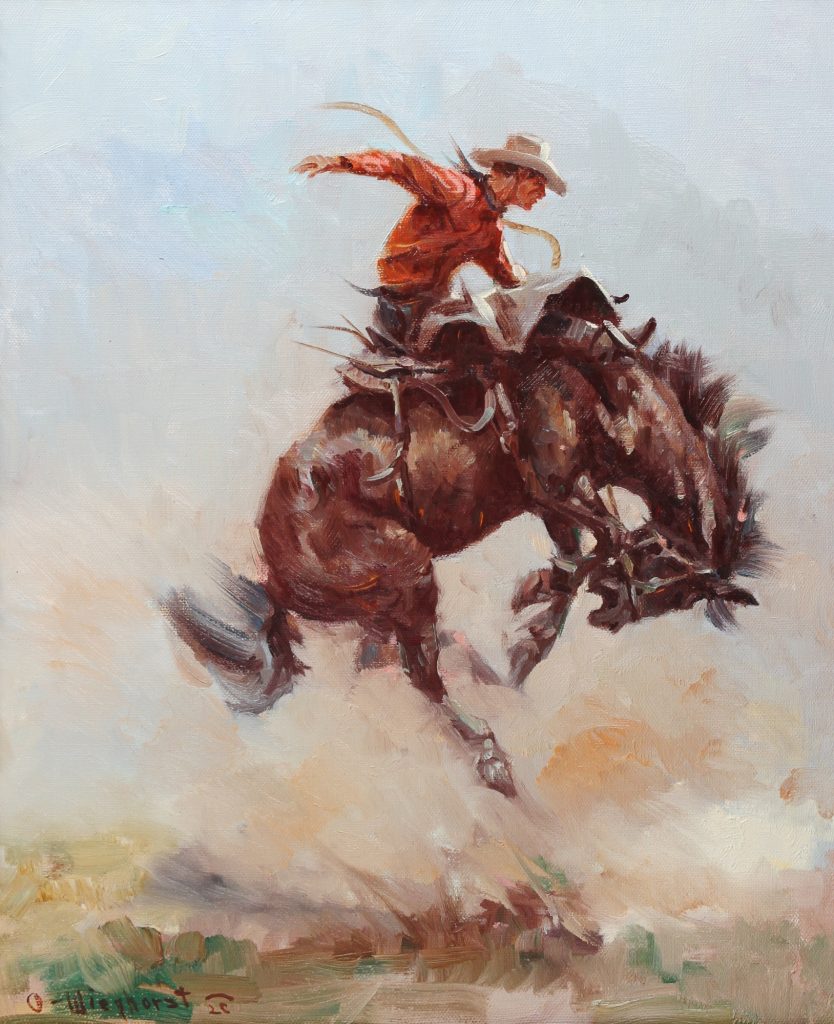
Additional highlights from the auction include Olaf Wieghorst’s Buckin’ for Bucks from the collection of M. Anthony Greene of Jackson, Wyoming. Realizing $68,750 and exceeding its presale estimate of $30,000 – $50,000, the painting tied as the second highest selling lot in the sale. The other, which also realized $68,750, was a Thomas C. Molesworth club chair and ottoman, which surpassed a presale estimate of $15,000 – 25,000.
Leslie Hindman Auctioneers’ bi-annual Arts of the American West auction will be conducted on November 9 and 10 at the firm’s Denver saleroom. The sale will feature over 700 lots of historic and contemporary Western paintings, bronzes, furniture and decorative objects, Native American arts and artifacts, Pueblo pottery, Navajo textiles and Southwestern jewelry. The sale will include property from the estates of Anthony M. Greene and Steve and Peggy Fossett.
Featured in the auction is a collection of important Native American beadwork from the Beaver Creek, Colorado home of the late Steve and Peggy Fossett. Steve Fossett was a record-setting adventurer and explorer, who is known for his speed and distance as an aviator, sailor and cross-country skier. Mr. Fossett, a part-time Beaver Creek resident, set an Aspen to Vail cross-country skiing record in 1998. Fossett was the first person to complete a solo circumnavigation of the Earth in a hot air balloon and flew the Virgin GlobalFlyer for the longest uninterrupted and unrefueled aircraft flight in history, covering 25,766 miles. He participated in races across many disciplines, including the Iditarod, Ironman and Paris to Dakar Rally. He also swam the English Channel and climbed some of the highest mountains on Earth. Fossett was a fellow of the Royal Geographical Society and a member of the Explorers Club.
Examples from the Fossett collection include a late 19th century Lakota Sioux Buckskin War Shirt. The shirt was once owned by George Gustave Heye, whose collection was the foundation for what became the Museum of the American Indian (MAI) in New York City. In 1989, the MAI collection was transferred to the Smithsonian Institution for the creation of the National Museum of the American Indian. The Lakota Sioux war shirt carries a presale estimate of $40,000 – 60,000.
Other highlights from the Fossett collection include a late 19th century Tlingit Chilkat dance blanket and a rare Shoshone painted hide robe, attributed to Cadzi Cody, with respective presale estimates of $8,000 – 12,000 and $20,000 – 40,000. Both were formerly from The Andy Warhol Collection sold in 1988. Also of note is a Navajo Second Phase Variant chief’s blanket with a presale estimate of $40,000 – 60,000 and a Navajo child’s wearing blanket estimated at $20,000 – 25,000, each circa 1865-1870.
“The collection of Steve and Peggy Fossett is undeniably reflective of their interest in travel and culture. They built a worldly collection that also matched the landscapes of their homes in Chicago, Carmel and Beaver Creek,” said Maron Hindman, VP West and Southwest at Leslie Hindman Auctioneers. “It’s always thrilling to work with a collection that contains items with such fascinating histories.”
Another highlight of the sale is The Rattlesnake, #69 by Frederick Remington, depicting a cowboy and his spooked horse. It carries a presale estimate of $100,000 – 200,000. Remington explored the subject matter, a single mounted cowboy in motion, ten years earlier with his first sculpture, The Bronco Buster. Remington created a new, larger version of The Rattlesnake around 1908, which has become, after The Bronco Buster, his most popular sculpture.
“In 1918, when this specific bronze was cast, Roman Bronze Works, Remington’s favorite foundry, was incorporated for the first time,” said Michael E. Shapiro, Senior Advisor, Museums and Private Collections at Leslie Hindman Auctioneers. “The foundry marking on this specific cast echoes that important and particular moment in time.”
The November auction will also feature property from the estate of Anthony M. Greene of Atlanta, Georgia and Jackson, Wyoming. Anthony Greene served on the boards of the High Museum of Art in Atlanta and the National Museum of Wildlife Art in Jackson, Wyoming. He had homes and collections of Wildlife and Western art in both cities.
Among the wildlife and Western paintings from the Greene collection are two works by Ken Carlson, Autumn Rivalry and Grizzly Crossing a River, each estimated at $20,000 – 40,000, Buckin’ for Bucks, c. 1954, oil on canvas, by Olaf Wieghorst estimated at $30,000 – 50,000, and Clyde Aspevig’s Along the Rim estimated at $20,000 – 30,000.
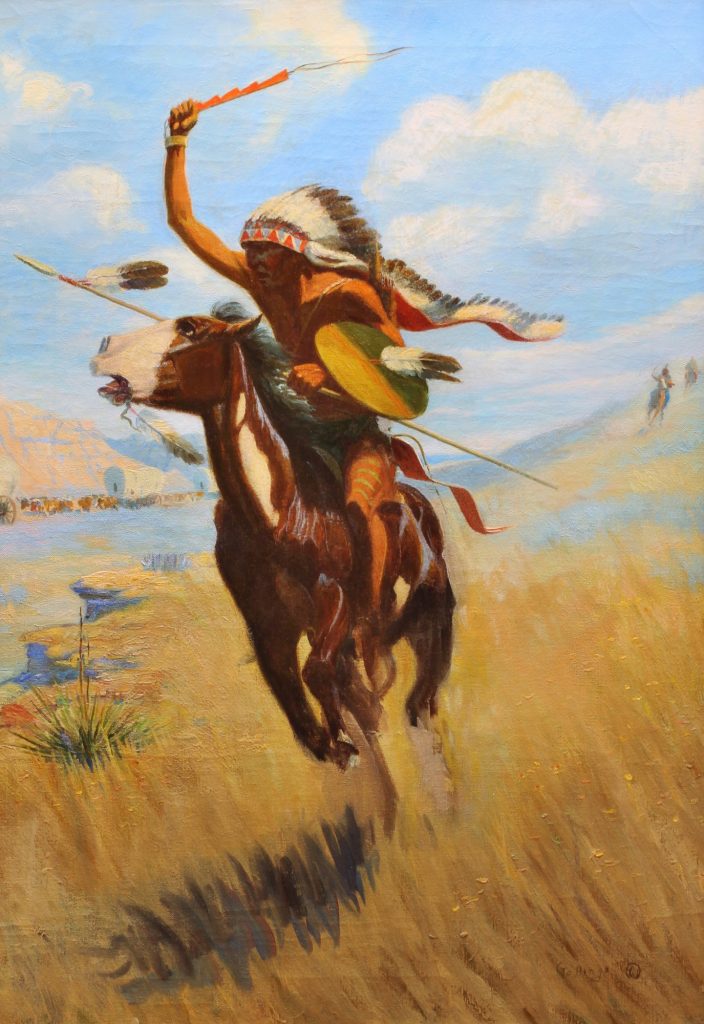
Other paintings included in the sale are Herald of Trouble by E. William Gollings, which holds an estimate of $70,000 – 90,000, Harmonious Sounds by William Acheff ($15,000 – 25,000) and Night Visitors, Taos by Oscar Berninghaus ($12,000 – 18,000).
The sale will be conducted live in the Denver saleroom at 1024 Cherokee Street, Suite 200. The exhibition will be open to the public November 3 – 9. The catalogue is currently available online at lesliehindman.com. For additional information, please contact Rachel Enright at [email protected] or (303) 825-1855.
Leslie Hindman Auctioneers’ October 31 sale of The Adventure & Exploration Library of Steve Fossett, Part I, featuring works from the fields of aeronautics, exploration, circumnavigation and mountaineering, realized over $664,000. With strong bidding across all channels, the sale put the Fine Books and Manuscripts department on track for a record-setting year.
The Steve Fossett library collection achieved several milestones for the Fine Books and Manuscripts department at Leslie Hindman Auctioneers. The auction was not only the first single-owner sale for the department but also its highest grossing sale in firm history. Exceeding expectations, the collection had a nearly 90% sell-through rate.
Highlights from the Steve Fossett library collection include a signed copy of a rare variant of Ernest Shackleton’s Aurora Australis, the first book printed in Antarctica, which brought $87,500 against a presale estimate of $60,000-80,000. A first collected edition of Sir Francis Drake’s voyages, Sir Francis Drake Revived surpassed expectations realizing $20,000 against a presale estimate of $10,000-$15,000.
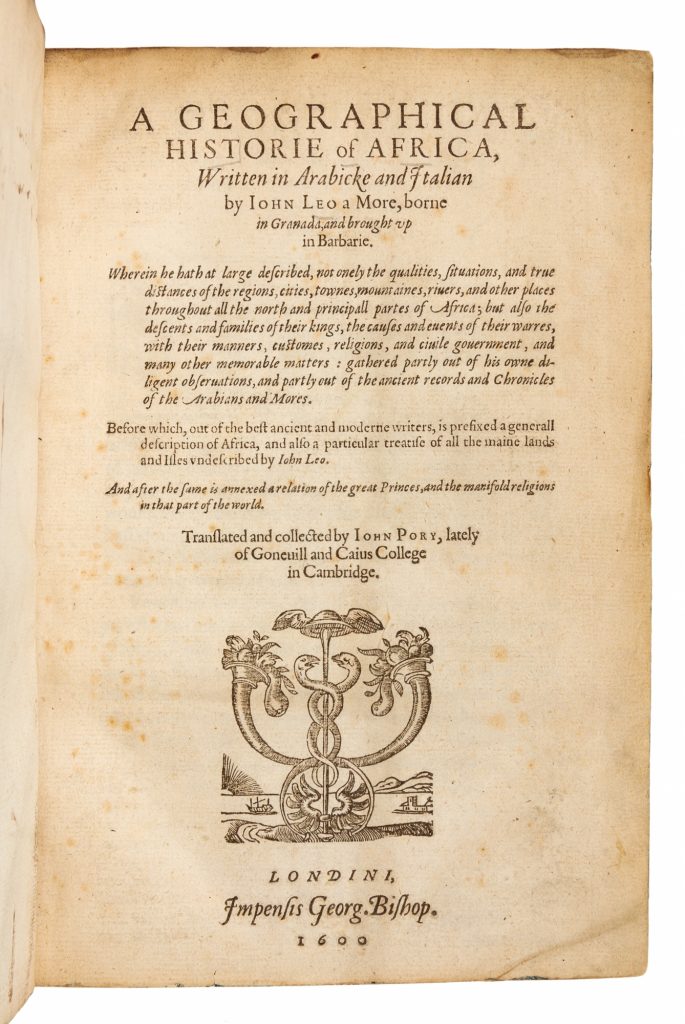
Offered at auction for the first time and also exceeding presale estimates, The Forthcoming Antarctic Expedition, Robert Falcon Scott’s rare exposition of his plans for the Terra Nova Expedition, which was unknown to bibliographers, sold for $5,500. Other highlights from the sale include a rare variant with text printed on vellum of the first edition of Humboldt and Bonpland’s Vues des Cordillères, et monumens des peuples indigènes de l’Amérique, which realized $37,500, and a copy of the first edition of Leo Africanus’ A Geographical Historie of Africa, which realized $8,750 against an estimate of $4,000-6,000.
Gretchen Hause, Director of Fine Books and Manuscripts, comments: “We are honored to have been entrusted with the sale of Steve Fossett’s remarkable adventure and exploration library. This important collection includes fine copies of the most important works in the field, which closely relate to his own record-setting pursuits as an adventurer. We look forward to offering the second part of this collection at auction next spring.” The sale of The Adventure & Exploration Library of Steve Fossett, Part II will be conducted on Friday, March 15 at 10am in the Chicago saleroom.
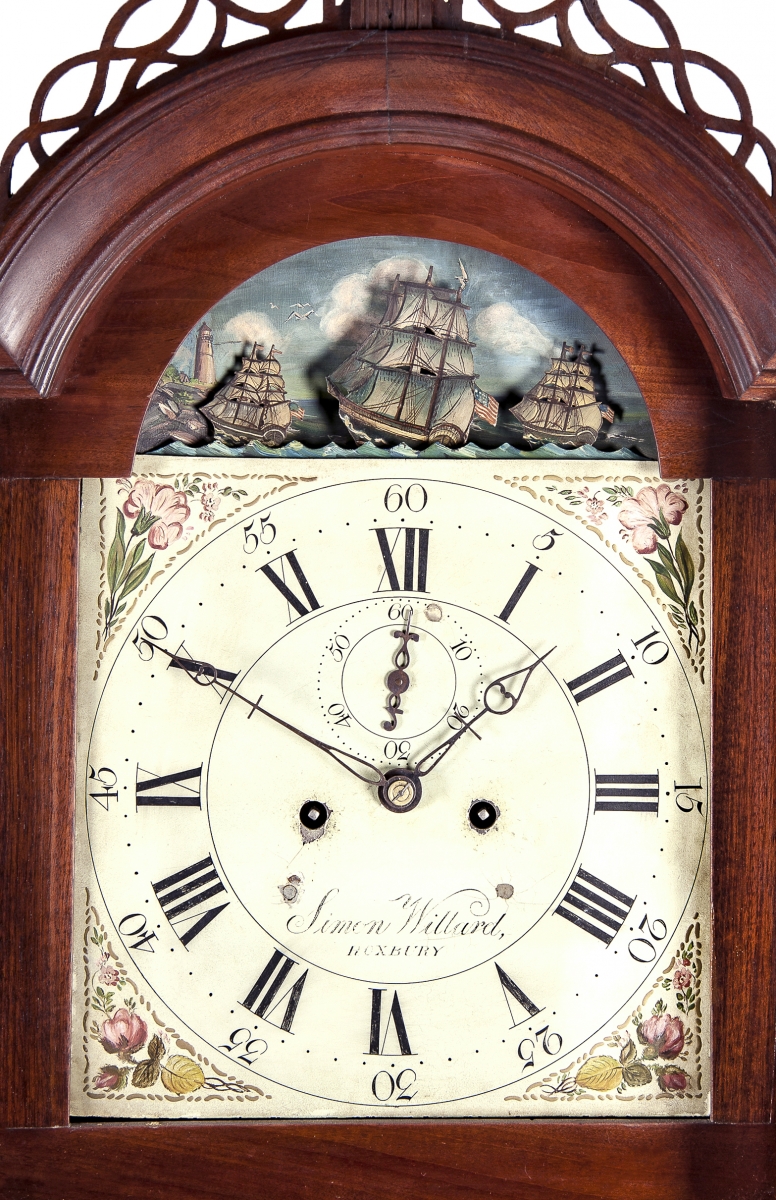
Three ships are tossed on choppy waves, the American flags rippling out from each one’s prow in the fierce easterly wind. Behind them, a lighthouse stands as the marker between safety and adventure, a nod to the Massachusetts landscape that master clockmaker Simon Willard called home.
The ships, perpetually heading out to sea, decorate the arch of a tall case clock by Willard that Cordier Auctions will be selling in its Fall Fine and Decorative Arts auction. The painted automaton increases the rarity of this clock, itself one of only 1,200 manufactured by Willard during the late 1700’s. Cordier expects that the clock will bring between $8,000 and $12,000 in the auction, which will be held November 10th and 11th.
Along with the clock, other pieces of American history will be crossing the block, including a very early Pennsylvania Windsor settee, likely made in Harrisburg during the early days of the 18th century. A 19th century needlepoint sampler, a 1900 Koken oak and leather barber chair, and a mid-18th century Queen Anne tiger maple highboy will also highlight this category.
Over the course of two days, the auction will span categories from antique furniture to fine jewelry and sterling. Among the latter categories, stand out lots include a wristwatch by renowned Swiss manufacturer Patek Philippe, as well as an 18K brooch by mid-century jewelry artisan Ed Wiener. Wiener started his career in silver, but his later gold pieces were considered by critics as a move “from craft into art,” as his New York Times obituary puts it.
The popular jewelry and sterling category will also include a truly striking Towle sterling flatware set in the Lady Mary pattern, containing nearly 250 pieces of sterling and sterling-handled utensils and serving pieces in a massive storage case.
Woven throughout the auction are threads of fantasy and wonder inspired by artists like Mathurin Moreau, whose mythology-derived works grace numerous noble courtyards in France. A bronze sculpture after his work, depicting a woman and a fairy, lends an air of otherworldliness to this auction, which also includes a French gilt and marble mantle clock topped by a sculpture of a fairy, as well as a beautifully patinated Tiffany & Co desk clock with a pattern influenced by the rhythm and storytelling of Native American tribes.
Hundreds of other lots of interest will be offered throughout the sale, including a collection of pieces by Walt Huber and Alden Turner, a miniature redware spittoon by John Bell of Waynesboro, an anthropologic collection of early shark tooth tools, and mid-century modern furniture by makers like Paul Evans, George Nelson, and Paul McCobb. Bidders will have the opportunity to participate both live and online, with the complete catalog available at www.CordierAuction.com. A live preview will be held at Cordier’s Harrisburg, PA auction house on Friday, November 9th from 12-4 PM.
In our next Mexican Art Auction, we celebrate the diversity of the art of this country, that is, of the art created in national territory, either by Mexican or foreignartists , to which Mexico likewise fell in love with its unique color and diversity. We invite you to this brief tour guided by some of the greatest artistic exponents that will be present at auction.
The Mexican muralists is one of the most representative national art movements of the twentieth century, which seeks to break with European standards and show the Mexican essence addressing social and political issues, committed to the new ideology of post porfirista thought.Soon, muralism gained strength and expanded throughout Latin America. David Alfaro Siqueiros, considered one of the three great Mexican muralists who, thanks to his interdisciplinary interest, took architectural, pictorial and cinematographic aspects, creating works in which he would include new techniques that would later be used by artists of the new vanguards such as Jackson Pollock.
Another important character, who is also the cover of our catalog is Adolfo Best Maugard, nationalist artist, choreographer, film director and part of the group of intellectuals who wanted to educate Mexico through art, accompanies us with a diptych in which we find to one of his emblematic characters with a penetrating gaze.
Of the second generation of muralists , Jorge González Camarena , artist who made murals and easel painting. His work is exhibited in Mexico and around the world. One of the main themes in her work was the feminine beauty that shows in her famous painting “La Patria” that illustrates the free textbooks of the SEP, that is why to continue surrounded by her muses that were strong and free women, We will have at auction the portrait of the famous French actress and singer Brigitte Bardot.
At the same time that the Mexican School of Painting had in the muralists its main exponents, a movement was brewing that sought to break with nationalist and political art: The Rupture, this movement brought to Mexico a more abstract and free art. On this occasion we have two participants of the movement: Juan Soriano who was a key piece to provide ideas and knowledge about the European avant-garde and Rafael Coronel that will delight us with an acrylic where a cerulean blue background that highlights one of its iconic characters.
Finally, in a more contemporary context, the presence of Sergio Hernández and Dr. Lakra enhance our auction showing the richness of Mexican art, reflected in its colors, textures, cultures and unique cosmogonies.
Through more than three hundred lots in the first session of the Auction of Mexican Art and Photography , we will review these and other important artists who gave their name to the modern era of art in Mexico.
Mexican Art and Photography Auction, first session, Thursday, October 11, 2018, 6:00 pm Monte Athos 179
Candy for a Cause: Donations Distributed to Deployed Troops and Local Heroes
GARNET VALLEY/PENNSYLVANIA. October 4, 2018 – Taking candy from children is usually frowned upon, but teaching them the value of giving back by donating their excess Halloween candy in support of Operation Gratitude’s Care Package Programs for U.S. Troops, Veterans and First Responders is a win-win for kids, parents, and dentists.
This Halloween, local trick-or-treaters will join kids across the country when they donate their extra Halloween candy to Operation Gratitude at local collection site: The Briggs Auction Showroom. The sweet treats will be included along with handwritten thank you letters in Care Packages sent to U.S. Service Members deployed overseas, Veterans, and to First Responders serving in their local communities.
Americans spend an estimated $2.5 billion dollars on a whopping 600 million pounds of Halloween candy each year. In 2017, more than 400,000 pounds of candy was donated to Operation Gratitude and distributed to America’s Heroes through its care package programs.
“Operation Gratitude’s mission is to thank all who serve, bridging the divide between grateful Americans and the Heroes who serve and protect them,” said Kevin Schmiegel, Lieutenant Colonel, USMC (Ret.) and CEO of Operation Gratitude. “The Halloween Candy Give-Back Program provides every American child the opportunity to learn about service, sacrifice and generosity.”
About Operation Gratitude
Operation Gratitude, a 501(c)(3), volunteer-based organization, annually sends 250,000+ care packages to Veterans, New Recruit Graduates, First Responders, Wounded Heroes, Caregivers, and to individually named U.S. Service Members deployed overseas and their families waiting at home. Each package is filled with food, entertainment, hygiene and hand-made items, as well as personal letters of support. Operation Gratitude’s mission is to lift the spirits and meet the evolving needs of the Military and First Responder communities, and provide volunteer opportunities for civilians anywhere in America to express their appreciation to all who serve our nation. Each package contains donated product valued between $50 and $100 and costs the organization $15 to assemble and ship. Since its inception in 2003, Operation Gratitude volunteers have shipped more than 2.1 Million Care Packages.
Fine art, a traditionally opaque and fragmented market, is now more transparent and democratic than ever before. As fine art sales soar, buyers and sellers are also becoming more familiar and comfortable with art sales’ slow but steady digital migration. Join us for more than 700 lots of fine art featuring many different artists.
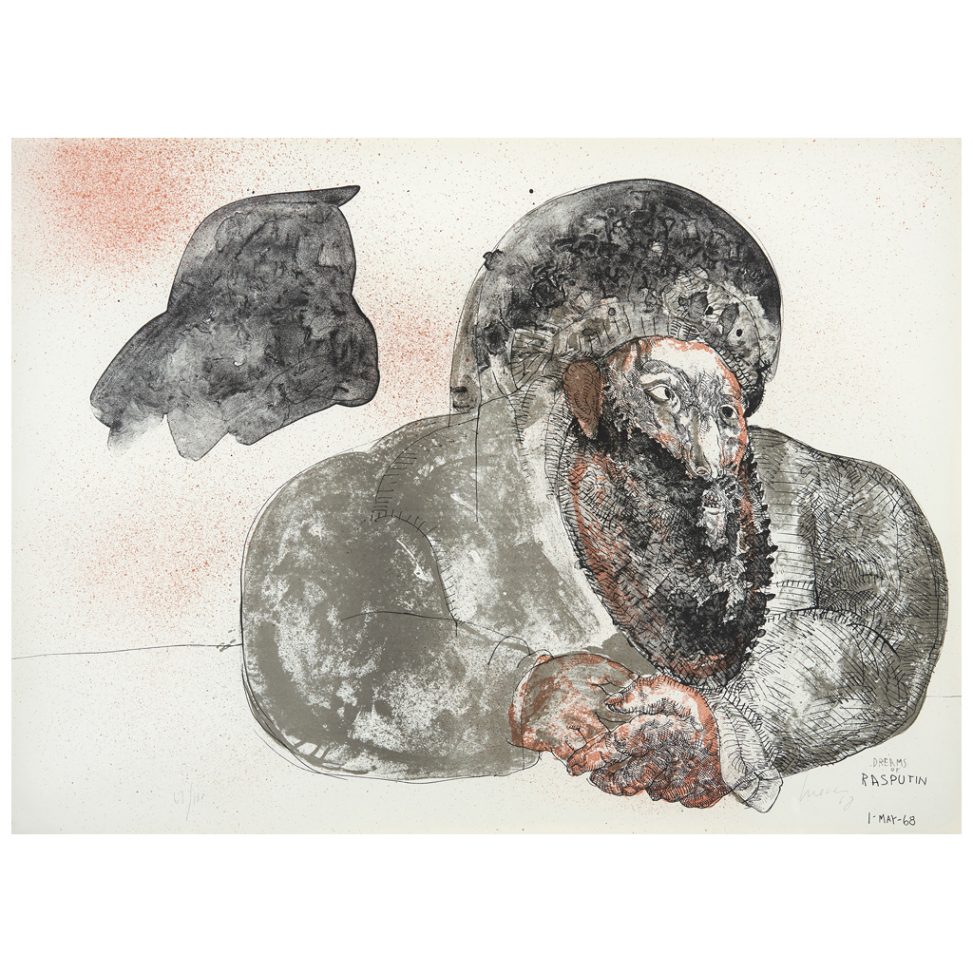
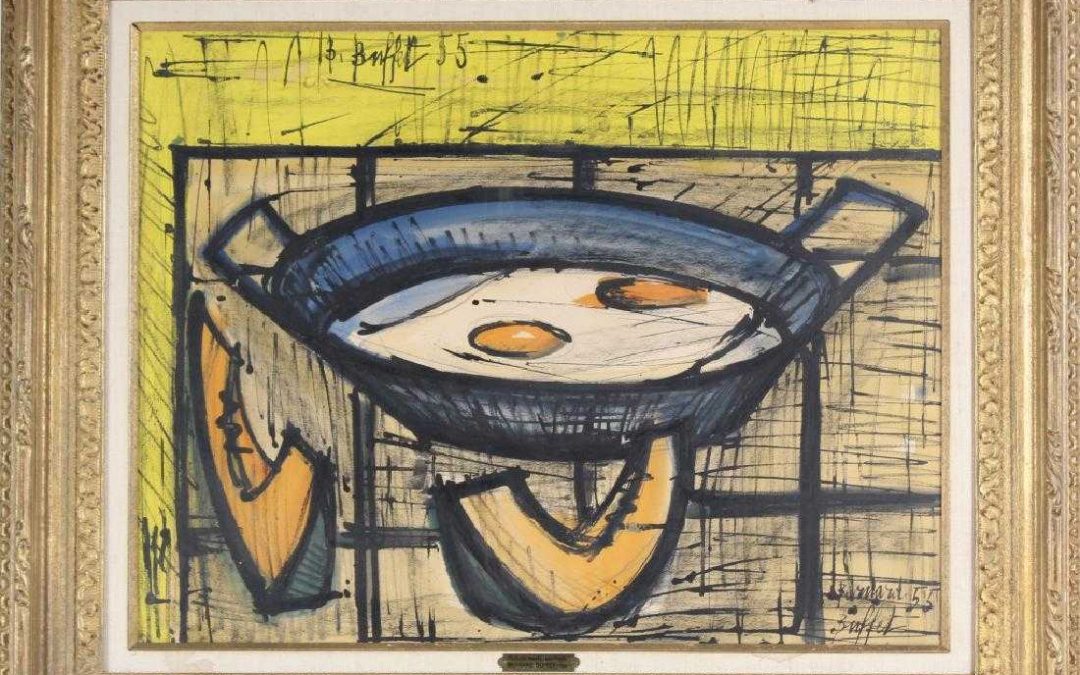
Bernard Buffet, one of the many artists featured in this auction, was born in 1928, France. He was an exceptional French Modernist painter. Lot #1 estimated at $15,000-$25,000 is an original watercolor on paper titled “Nature Morte Aux Oeufs Sur Le Plat”. Frank Stella, an American fine pop artist was exclusively commissioned to create the featured icon image for The New York Metropolitan Museum of Art Centennial Celebration from 1969 to 1971. This monumental installation piece is Lot #2, titled M11, estimated at $2000 to $5000.
Another listed artist featured in this auction is Donald Roller Wilson, an American surrealist who paints wild, comical, and often mystical eccentricities. Lot #254 is a beautiful oil painting of a female ape in a white dress and a flower crown that exhibits Wilson’s imaginative mind estimated to sell between $15,000-$25,000. Heather Nevay, another talented surrealist artist, uses symbolism to express ideas of heroism, weakness, fear and the shifting balance of human relationships. Lot #251 depicts three colorful portrait images with a mystical creature, titled “A Fork in the Road”, estimated between $1,800-2,200.
Antique 19th century painter Mauritz Frederik Hendrick De Haas, 1832-1895, was one of the most famous marine and landscape artists of his era. Lot #164 is the perfect example of Haas’s exquisite ability to portray lifelike seascapes transcending the viewer into another reality. Estimated to sell between $2,000-5,000.
Not only does Fine Art for the Beholder feature different styles of paintings, it also includes sculpted and blown glass.
Paul Stankard is an American master glass sculptor, Lot #114 “Bouquet Cube D7” is arguably one of Stankard’s most beautiful masterpieces. This amazing piece depicts stunning technical work with an amazing floral bouquet center, estimated between $2,000-$5,000. Lot #122 sculpted by Czech Republican Michael Pavlik, born 1941 is a stunning work of contemporary glass titled “Three Triangles Inside the Spiral with Yellow and Red”, estimated between $3,000-$6,000. This piece was originally purchased Habatat Galleries. Dale Chihuly was born in 1941 and is one of the most famous American glass blowers to date. Lot #123 is a wonderful example of this extraordinary series, a radiant orange persian set with Supreme blue lip wraps, each piece hand blown and outlined in blue. Estimated $6,000-$9,000.
Hand painted studio art pottery is another facet of fine art that is explored in this auction. Jean Cocteau, 1889-1963, was a French Modernist. Lot #147 is a art pottery charger plate decorated with three eyes and two faces, appropriately titled “Les Trois Yeux” (The Three Eyes), estimated between $1,000-$3,000.
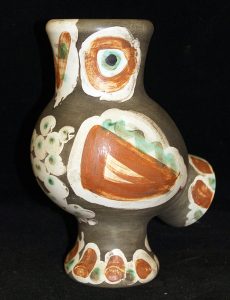
Briggs Auction, Inc. is pleased to announce its Friday, September 14th auction featuring a curated collection of fine furnishings and decorative arts, including a Pablo Picasso Madoura “Wood Owl” vase, circa 1968.
The vase is made of glazed earthenware clay with a wood owl decoration on a light black patina ground. It is numbered 57/500 and marked “Edition Picasso 57/500 R-146 Madoura”, “Edition Picasso”, and “Madoura Plein Feu”.
Picasso’s association with Suzanne and Georges Ramié would span over 25 years but first began with a trip to the Madoura pottery workshop in 1946. Located in Vallauris, France, the Ramiés allowed Picasso full use of the studio where he used the opportunity to work with clay as a break from painting. The Ramiés went on to produce Picasso’s ceramic works for years to come.
“The entire catalog is strong and well-comprised, but it’s been an absolute pleasure to catalog the wood owl,” says Stephen Turner, Director of Business Development.
Purchased during a trip to Europe, the wood owl vase comes from a private Philadelphia collection. It is estimated to bring $10,000 – $15,000 USD.
Briggs Auction Inc. is a four-generation family-owned and operated auction house offering comprehensive estate management and downsizing solutions, including weekly estate variety auctions, periodic cataloged fine estate auctions, estate appraisals, real estate auction sales, and cleanout services. They are based in Garnet Valley, Pennsylvania. They hold frequent, public estate variety auctions on Fridays and feature a wide array of antique, modern decorator, and quality reproduction furnishings; fine and decorative arts; country antiques and primitives; fine and vintage costume jewelry; silver; fine porcelains, china, glassware, and pottery; collectibles; coins; toys; books; electronics; and discovery lots.The upcoming September 14th auction will begin at 1 p.m. Bidding is available online through Live Auctioneers and Invaluable. Live bidding will also be available in the showroom. For extensive photos, details, and exhibition times, please visit www.BriggsAuction.com.
The North Texas Chapter of the International Society of Appraisers (NTISA) will host an exciting event at Dallas Auction Gallery on September 15th – PAPER: Seminar on Fine Prints and Rare Works on Paper. This seminar is open to appraisers, as well as anyone interested in the world of fine works on paper. A full program schedule can be found below, as well as a link to register for the event through NTISA.
*This will serve as 7 Personal Development credits for ISA members.
THE NTISA PAPER SEMINAR
When: Saturday, September 15, 2018
8:30 AM – 5:15 PM
Where: Hosted by Dallas Auction Gallery
2235 Monitor St, Dallas 75207
Join NTISA for a day of lectures, hands-on demonstrations, and learning about the world of fine prints, maps, ephemera, letters, works on paper, and historical documents. Appraisers, have you found yourself in a collection, faced with a work on paper behind glass, and you are stumped about how to define the object? Is it a copy print? Photograph? Etching or engraving? Have you found a truly rare map or a framed map from the glove box? Join us for an interactive and in-depth day of education and hands-on examinations of fine prints, maps, documents, and much more.
Program Schedule:
8:30 AM
Doors and Registration Open
8:30 – 9:00 AM Coffee
9:00 – 11:00 AM
Brenda Simonson-Mohle, ISA CAPP, Owner of Signet Art
Getting to Know Works on Paper: the Basics of Paper History, Printmaking and Identification of Works on Paper
This 2 hour introductory lecture will start the day and cover basics of identifying prints from a decorative arts perspective. Graphite Drawings v. Prints, numbering, labeling systems, and much more. Please bring a loupe for viewing.
Brenda established Signet Art in 1987 after her years as a gallery sales consultant. Brenda has served as the National Chair and on the Designation and Review Committee of ISA, she has administered the peer reviews for appraisers seeking certification. She has served on the nominating committee for ISA and as the National Chair as the Eithics Committee. She has spoken at Whitehall Antiques Summer Seminar on printmaking. She has been published in the Journal of Advanced Appraisal. She spoke at the 2004 Annual conference on Appraising prints.
11:00 – 11:15 AM – Break
11:15 AM – 12:15 PM
Matt Balgey, Master Printmaker, Owner of Iron Frog Press
Relief and Intaglio Prints
An in depth and look at relief and intaglio printing. Matt will start with a hands on demonstration by creating a relief print with his signature Print Frog. Matt will also cover topics diving deep into the process behind titling, numbering, archival terms and production. Matt will also discuss the issues with today’s reproductions and “copy” prints flooding the market.
12:15 – 1:00 PM
Lunch. Lunch provided with the cost of the seminar.
1:00 – 2:00 PM
Kyle Hobratschk, Artist, Printmaker, Furniture Maker, and Founder of 100 West Corsicana
Etching, Intaglio Prints – A contemporary Perspective
Kyle’s print focus is in etching, a form he is passionate about, particularly velvety results that other print forms cannot render. Kyle will talk on the different etching and engraving techniques. He will bring etching tools and examples of contemporary prints along with earlier examples of prints.
Kyle Hobratschk is an artist and furniture maker living and working in both Dallas and Corsicana, Texas. Kyle received his BFA in Painting from SMU’s Meadows School of the Arts, before locating to Oak Cliff to establish an intaglio printmaking studio where he leads workshops and practices the medium in architecturally based commissions. In 2012 Kyle founded 100 West Corsicana, an international studio residency for artists and writers in a decommissioned 1890s Odd Fellows Lodge. The past six years have been devoted to restoration and furniture projects to repurpose this historic building as semi-communal live-work studio space, and is hosted by a small collective of artists and writers.
2:00 – 3:00 PM
Eric Smylie, Historian, author, and antiquarian.
Manuscripts, Documents, Letters, and Ephemera
Eric will discuss the identification, analysis, and handling of historical and collectable ephemera. In addition to manuscripts, documents, and letters, topics will include pulp magazines, comic books, posters, and early photographic images.
Historian, author, and antiquarian. Active in the antique trade for over forty years, Eric received his doctorate in history from the University of North Texas and has authored several books on Texas, Canadian and military history.
3:00 – 3:15 PM
Break
3:15 – 4:15 PM
Royd Riddell, Owner of Riddell Rare Maps and Fine Prints, Dallas, TX
Early and Historical Rare Maps and Fine Prints
Royd has owned and operated Riddell Rare Maps and Fine Prints for over 20 year. Royd will discuss rare and early maps and techniques. He will also discuss the different types of fine prints, including the world of Audubon prints and beyond.
4:15 – 5:15 PM
Greg Dow, Owner of Dow Art Galleries, Fort Worth, TX
The Largest Collection of Abraham Lincoln Ephemera, The building and selling of an American Collection
Greg Dow will discuss his late father’s collection of Abraham Lincoln ephemera. For a half a century Dow passionately collected and amassed the largest, most conclusive collection of Abraham Lincoln ephemera. The collection was eventually sold. Dow will discuss how his father built the collection, with an eye and understanding of authenticity through various avenues. After his passing, the decision to sell the collection was made. The over three and a half years, efforts to place the items that ended in auction sale. This is a story of passionate collecting, and today’s challenges and the marketplace for selling irreplaceable American history.
Rammellzee, From Living Letters to Living Sculpture
The universe of the graffiti master turned astrofunk storyteller in a bracing show reveals his lifelong battle against the limitations of form.
Rammellzee assembled his “Letter Racer” sculptures (1988-1991) from found objects, corrugated plastic and skateboards. These repurposed objects of beauty, in warrior shapes, are in a survey of his work at Red Bull Arts New York. Credit: Vincent Tullo for The New York Times
The graffiti writer, rapper, sculptor, quasi-outsider artist and unorthodox philosopher of language known as Rammellzee was given to enigmatic dissertations, and near the front of the bracing survey of his work, “Rammellzee: Racing for Thunder,” there is a media station with a telling page from one of them.
On it, he sketches the evolution of graffiti’s engagement with individual letters. Up top is Bomberism, which in his rendering is soft, almost cuddly. Beneath that is Wild Stylism, in which the letter is denatured and recast as a futurist puzzle. For many, that was graffiti’s great formal shift, the thing that elevated tagging to speculative art.
Rammellzee in 1987. The graffiti artist and rapper moved to mixed-media work, repurposing detritus he found on the streets into beauty. Credit: Peter Gramberg/Red Bull Arts New York
But at the bottom of that page is Rammellzee’s own invention — Ikonoklast Panzerism, in which the letter had been distended further, shaded and reconstructed into something gleaming and weapon-like. What started as a simple E became a narrative character — prepared for a fight, ready to peel off the page and start shooting.
Ever since he was a teenager in Far Rockaway, Queens, a precocious kid with an artistic bent and a propensity for tinkering, Rammellzee wanted to make letters into weapons. He saw language as a system of domination, and understood that whoever controlled the letters controlled much more than that.
From Rammellzee’s Garbage Gods series, “Vain,” 1994-2001. The outfits are part Kabuki, part horror film, part techno-dystopic craft fair. Credit: Vincent Tullo for The New York Times
And so for much of his career, from making graffiti in the 1970s to building vivid character figures in the 1990s, sending letters off to war was his animating force.
“Rammellzee: Racing for Thunder,” at Red Bull Arts New York through Aug. 26, includes more than 150 of his pieces spanning four decades. It is the first survey of his work on this scale, through his graffiti and gallery days and concluding with his outsider art of the 1990s and beyond. Where he once sought to give letters a life of their own, by his death in 2010, he had more or less become his art, thanks to a self-contained universe of wearable and inhabitable work that intruded onto, shaped and recontextualized his day-to-day life.
From Rammellzee’s Garbage Gods series, “Vocal Well’s God (chimer),” 1994. Credit Vincent Tullo for The New York Times
Graffiti was never intended to be archivable, so there are only a handful of examples of Rammellzee’s earliest work here. They are largely startling, though. “Maestro 2 Hyte Risk” (1976-79) is a robust riot of animate letters, and “Evolution of the World” (1979) turns graffiti grammar into longitudinal astro-funk storytelling.
What’s clear throughout this phase is his emerging battle against the limitations of form. Like much of hip-hop in its protean era, Rammellzee conceptualized his work in terms of resistance — against the world at large, but also, in his case, against the frameworks that were fast beginning to congeal on the trains as well as in the galleries newly flirting with street art. Jean-Michel Basquiat was a contemporary, a friend, a competitor and an occasional antagonist of Rammellzee’s. Basquiat produced Rammellzee’s best known song, “Beat Bop,” and immortalized him in the painting “Hollywood Africans” (1983).
“Beat Bop” by Rammellzee + K-Rob Credit: Video by E
Miniature figures of Garbage Gods from the Rammellzee show at Red Bull Arts New York. Credit: Vincent Tullo for The New York Times
Rammellzee — the child of an African-American mother and Italian father, and a model in his teenage years — also pushed back against his corporeal self, in what would become a recurring theme. He legally changed his name to Rammellzee, and he frequently referred to himself as an “equation.” (“Ramm’s name was a construction site,” the artist Lee Quinones says in one of the exhibition’s audio packages.) There is even, among the ephemera included in this exhibition, a business card advertising the services of Rammellzee, the Equation.
By the beginning of the mid-1980s, Rammellzee was becoming a favorite of progressive European gallerists, and his work was moving onto more formal canvases. But these pieces, when he was transitioning from fantastical 2-D representations into three dimensions, and nodding weakly in the direction of abstraction, are the least purposeful and challenging here — showing an artist constrained, not liberated, by success.
“Maestro 2 Hyte Risk” (1976-1979), pen and marker on cardboard, is a robust riot of animate letters. Credit: Vincent Tullo for The New York Times
In his graffiti, Rammellzee was precise and imaginative — a virtuoso of detail. (In one of the audio stations, his brother recalled him putting together car models as a child and then cutting them apart with an X-Acto knife.) By the late 1980s, he’d returned to that approach, but in mixed-media work. In resin and epoxy, Rammellzee found freedom. It made unusual juxtapositions and unconventional shapes possible. It allowed him to repurpose the detritus he found on the streets into beauty, a stroke of resistance all its own.
And most crucially, it brought the letters to life. Two of his inventive, fascinating Letter Racer sets, from 1988 to 1991, are included here — small wheeled sculptures composed of found items collaged into forceful warrior shapes and arranged in the gallery in triangular battle formations. (There is also a brief video showing off each letter’s corresponding Racer in detail.) Finally, he’d liberated the letters from the train wall and made them the superheroes he’d always proposed that they were.
Some of the 19 Garbage Gods by Rammellzee at his survey at Red Bull Arts New York. Credit: Vincent Tullo for The New York Times
Considering that these micro battlebots are made of industrial effluvia, they are remarkably coherent and pointed. They also reflect the vision of an artist not content to make art for the purpose of observation or transaction, but rather used it as a tool to bring philosophy to life. And he was moving toward creating a full-scale lived-in environment that ignored art as object and replaced it with art as oxygen.
Every part of Rammellzee’s life was oriented this way. This show — curated by Max Wolf with the critic Carlo McCormick — includes a set of his watches, encrusted beyond conventional functionality. It spotlights manifestoes he wrote that laid out the arguments for his worldview, and includes videos of him in galleries lecturing people about his philosophy, looking to spread his ideas.
“RAMMELLZEE: It’s Not Who But What” Credit: Video by Red Bull Music & CultureImage Rammellzee’s business cards on display at his show at Red Bull Arts New York. Credit: Vincent Tullo for The New York Times
And over time, he built himself into his art. His Laight Street apartment was called the Battle Station, and almost everyone who describes visiting him there noted, with retroactive concern, the intensity of the chemical smell. He lived among his resins and the creations they made possible — his art had become his life. (Rammellzee died at the age of 49 of heart disease.)
Unlike the main floor of the show, which is well lit, the basement is dark (thanks in part to black light) and is filled with the fantastical creations of these later years. Right away, you are met by the Gasholeer (The RAMM: ELL: ZEE), from 1987 to 1998, an epic, spare-parts statue with a keyboard gun, serving here as a kind of sentry guarding the ecosystem Rammellzee built for himself.
Alpha’s Bet, a short video for gothicfuturism.com, made in collaboration with Celia Bullwinkel, 2002. Courtesy of Celia Bullwinkel. Credit: Video by Celia Bullwinkel
On the rest of the floor are the 19 Garbage Gods, made from 1994 to 2001. They are overwhelming and awe-inspiring, in proto-Afrofuturist outfits that are part Kabuki, part horror film, part techno-dystopic craft fair. Here, too, the devotion to detail is warming. He treated them like royalty, giving each a specific back story. (Grab a poster at the entrance, which has the details.) In pods near the rear of the room, there are tiny versions of similar characters. Between these and the Letter Racers, had Rammellzee arrived a decade later, he might have birthed a toy empire.
But by this stage of his life, Rammellzee wasn’t interacting much with the traditional art world. He stayed mostly in the Battle Station until he was forced out in the early 2000s. The work he made was for himself to inhabit, a personal mythology given physical form.
On the one hand, the Garbage Gods were costumes, yes — he sometimes wore them in public — but they were also the logical continuation of his earliest experiments with graffiti. He started out trying to bring his drawings and sculptures to life. But by the end, he himself had become the sculpture.