Fine green crackled celadon glaze to pear form body, with ribbon handle and a long curved spout. Cover to top. Yuan to Ming dynasty. H. 25cm (10 in.) Condition report available upon request.
Chinese Longquan Celadon Pear Ewer

Fine green crackled celadon glaze to pear form body, with ribbon handle and a long curved spout. Cover to top. Yuan to Ming dynasty. H. 25cm (10 in.) Condition report available upon request.

Folded sheet. Diagram of Descendance. First Edition. Seal of the Library Collection of Mr. Lorenzo Zambrano.
Original binding by “Edmonds and Remnants” (spine variant A). Covers and spine are slightly worn; hardcover bound in cloth; in case, “V.R. Stoakley Cambridge”.
Garrison – Morton: 22.; Grolier/Horblit: 23b. Norman: 593. Printing and the Mind of Man: 344b.
“This, without a doubt, is the most important Biology book ever written.” Seen in: Morse Peckham’s Variorum Edition”, 1959.
Charles Darwin began writing this book on July 20th, 1858, while on holiday in Sandown, on the Isle of Wight. Darwin originally planned it as a 30-page project in order to publish it in the “Journal of the Linnean Society”. However, by winter it was evident that 30 pages wouldn’t be enough, and they’d have to be published in book form.
Darwin presented it to John Murray, who accepted it in April 1859 after reviewing the first three chapters. By September, it was completely corrected with the exception of the index. In early November, Darwin received a copy, after which, courtesy copies were sent out both locally and internationally. Only 23 courtesy copies were registered, and possibly there are more in existence than the 12 known ones. All were written by employees of John Murray, none by Darwin himself.
“On the Origin of the Species” was published for the first time on November 24th, 1859, with a limited printing of only 1250 copies, all of which sold out that same day. Darwin’s book is considered to be one of the most important books written in history; both science and religion were directly influenced by Darwin’s theories, even creating new vocabulary terms such as “Darwinism”.
Source: “The Works of Charles Darwin: An Annotated Bibliographical Handlist. Segunda edición revisada y aumentada. Freeman, Richard Broke. Dawson: Archon Books. 1977.
b) Letter Adressed to Dr. William Ogle.
“Dear Dr. Ogle many thanks for your translation of Kerner which arrived while I was away from Down for a day or two. I shall be very glad to read it again in a Christian language, I have not yet had time to look at it as Frank was using it…”.
Written by Emma Darwin and signed by Charles Darwin. Dated “Dec 2 / 78″ written in pencil on the upper left-hand side, slightly erased. 7.2 x 4.4″ (18.3 x 11.3 cm).
– Includes: Envelope, 2.9 x 5.2” (7.6 x 13.3 cm). Addressed to Dr. Ogle. Signed by Charles Darwin on the lower left-hand side.
Pieces: 2.
Total Number of Pieces: 3.
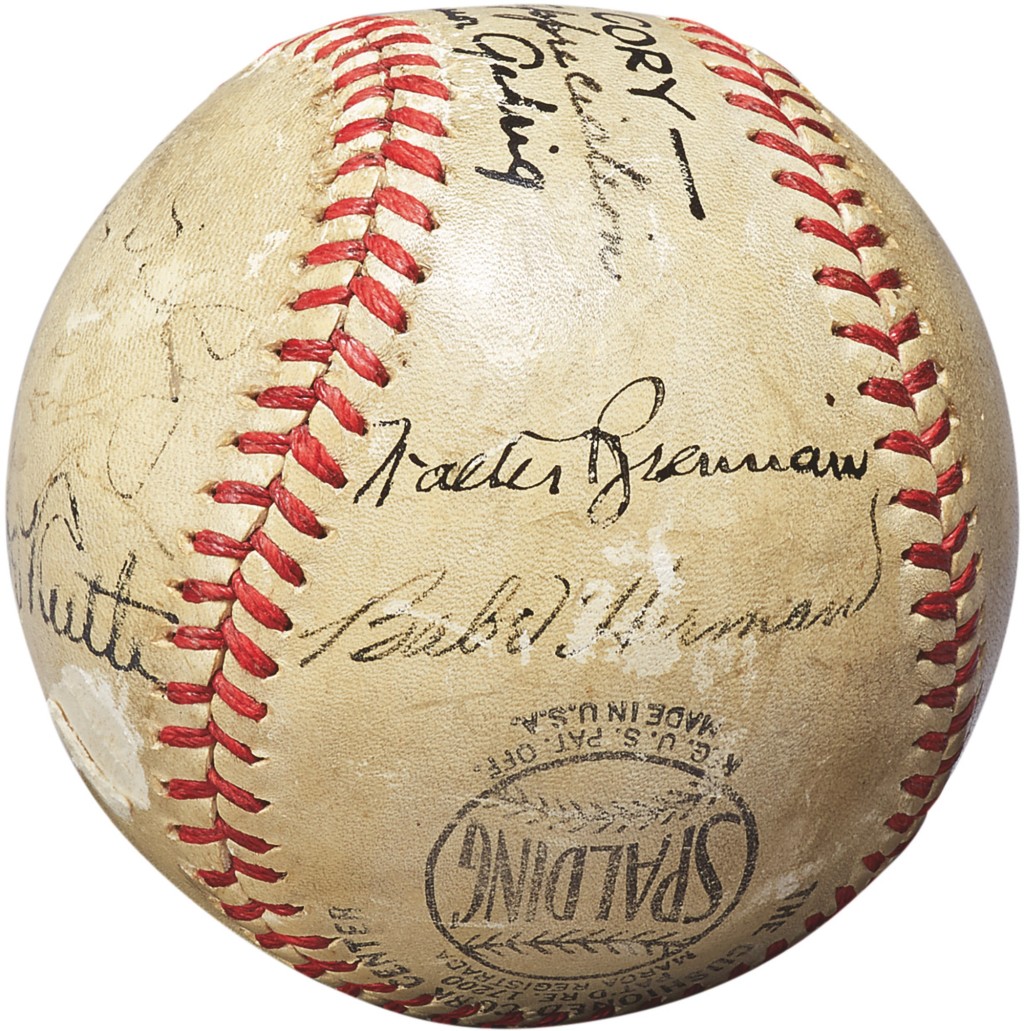
Spalding National League baseball signed by a number of people involved with the film The Pride of the Yankees; lightly soiled overall, some signatures rubbed and faded, a couple of scuffs, including one below Ruth’s signature. Mounted on an ink blotter marked The Pride of the Yankees | Compliments of Christy Walsh.”
Frank Cory was a Hollywood studio guard in the 1920s to 1940s who became friendly with Gary Cooper. Cooper starred as Lou Gehrig in the 1942 film The Pride of the Yankees, and arranged for others involved in the film to join him in signing this ball for Cory. Gehrig’s widow inscribed the ball “with appreciation Eleanor Gehrig.” It is also signed by Babe Ruth and Bill Dickey, two of Gehrig’s teammates who played themselves in the movie; Babe Herman, a left-handed major-leaguer who doubled in some scenes for the right-handed Cooper; co-star Walter Brennan; director Sam Wood; and producer Sam Goldwyn. Christy Walsh was babe Ruth’s agent.
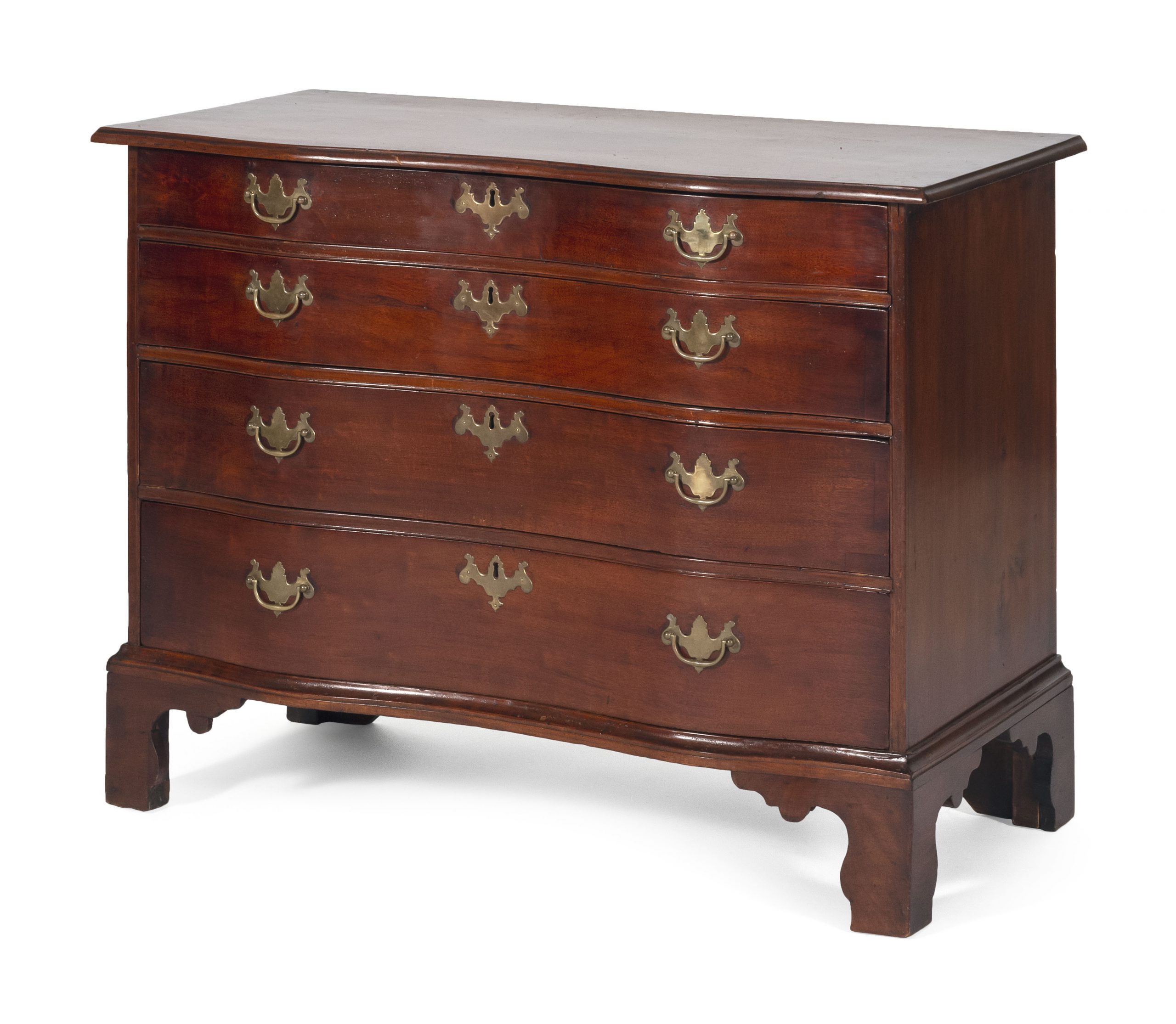
In Santo Domingo mahogany under what is possibly the original finish. Molded-edge top. Four graduated full-width drawers with cock-bead moldings. Shaped bracket base. Height 31″. Width 37″. Depth 20″.
Condition: Overall wear consistent with age.
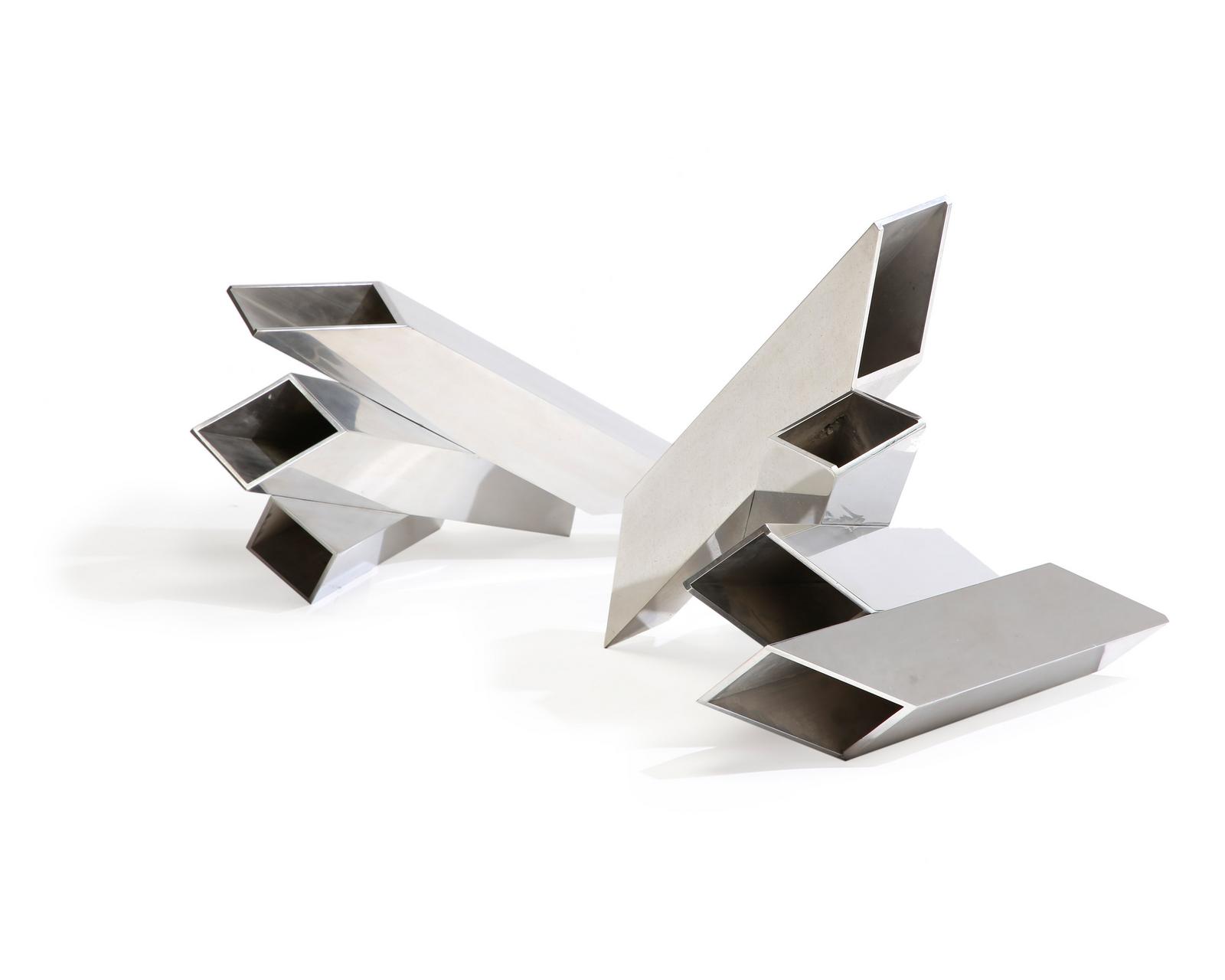
“Conceptual Evolution,” 2 pieces
Chromed steel
Titled to plaque affixed to base
Larger: 16″ H x 30″ W x 26″ D
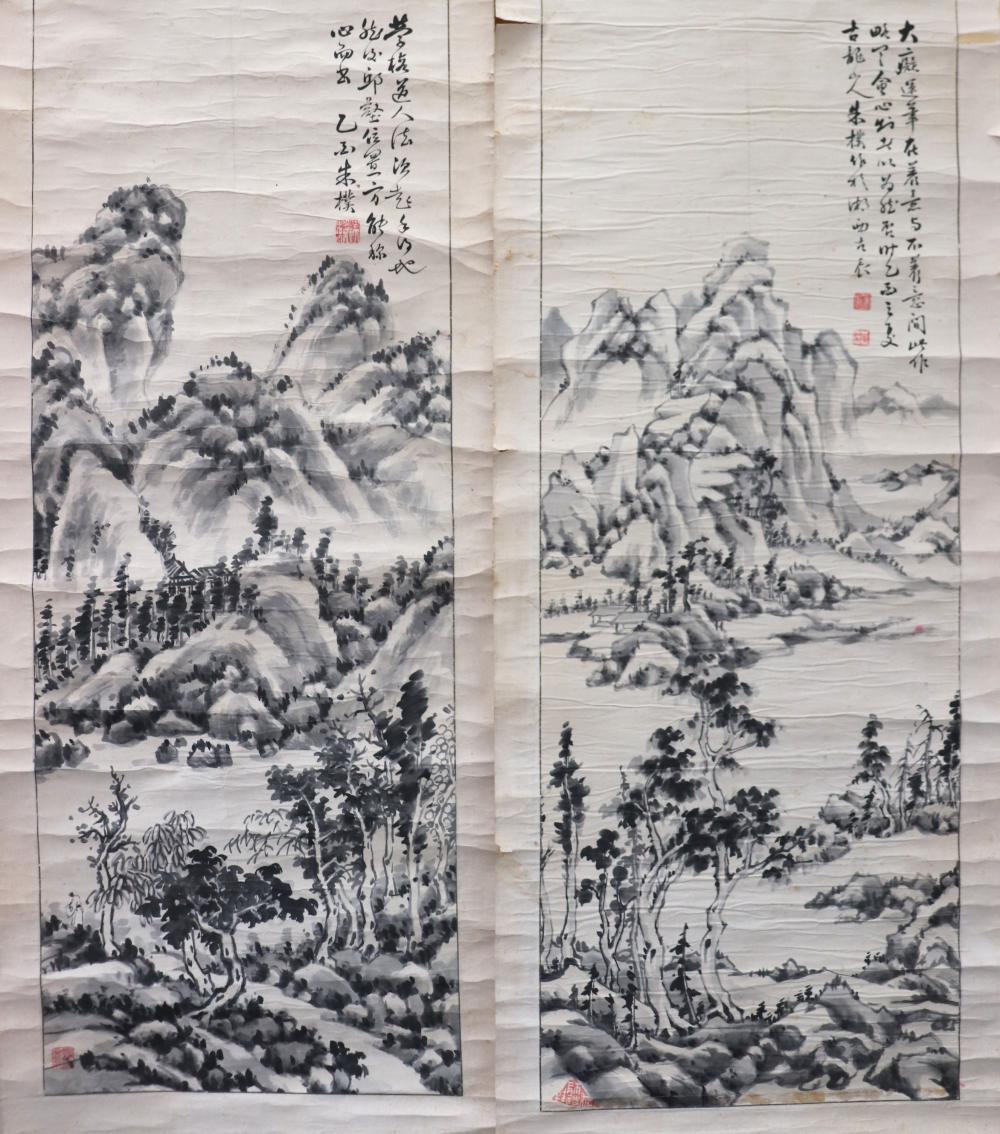
each with 2 red seals; mounted with paper as hanging scrolls; with wood storage box. Age related wear to paper, light staining, small tears to borders, handling wear. Height of art 41 1/2 inches (105.5 cm.) X width of art 15 3/4 inches (40 cm.). PROVENANCE: From the collection of Mr & Mrs Charles Guilkey, 151 West Boston Avenue, Youngstown, Ohio. NOTE: Any condition statement is given as a courtesy to a client, is only an opinion and should not be treated as a statement of fact. Eddie’s Auction shall have no responsibility for any error or omission. The absence of a condition statement does not imply that the lot is in perfect condition or completely free from wear and tear, imperfections, or the effects of aging. We do not carry out in-depth research of the sort carried out by professional historians and scholars, and any statements made by us orally or in writing about any lot concerning attribution to an artist, provenance, period, materials, origin, history, or dates represent an opinion of Eddie’s Auction and are not to be relied on as a statement of fact. Such opinions serve for informative purposes only and do not constitute historic or academic scholarship on the works and do not aim to substitute or contradict any such scholarship.

a fine Queen Anne needlework picture worked in a tent stitch with French and Colonial knots in polychrome wool yarns and silk threads on a linen ground depicting a rider on horse back with three dogs on hilly ground chasing a leaping stag, the group surrounded by flowers, strawberries, blossoming trees, geese and other fanciful birds, with a brick dwelling in the background; the reverse with old paper backing indistinctly inscribed in graphite Stodra, and what appears to be its original stretcher.
16 ⅞ by 20 ⅛ in.

ICY BLUE UNHEATED BURMESE SAPPHIRE AND DIAMOND RING An unusual icy sapphire conjures frosty dreams in this stunning diamond ring. Sapphire is Burmese & UN-Heated with GRS Certificate. Item: # 03399 Setting: 18K W Lab: GRS Color Weight: 9.01 ct. of Sapphire Diamond Weight: 1.38 ct. of Diamonds

inscribed with motto Esto Perpetua (May You Endure Forever); together with a silhouette of Samuel Trask dated April 15, 1811 on verso, 4 by 3 inches. (3 pieces)
Height 20 in. by Diameter 8 in. (top)
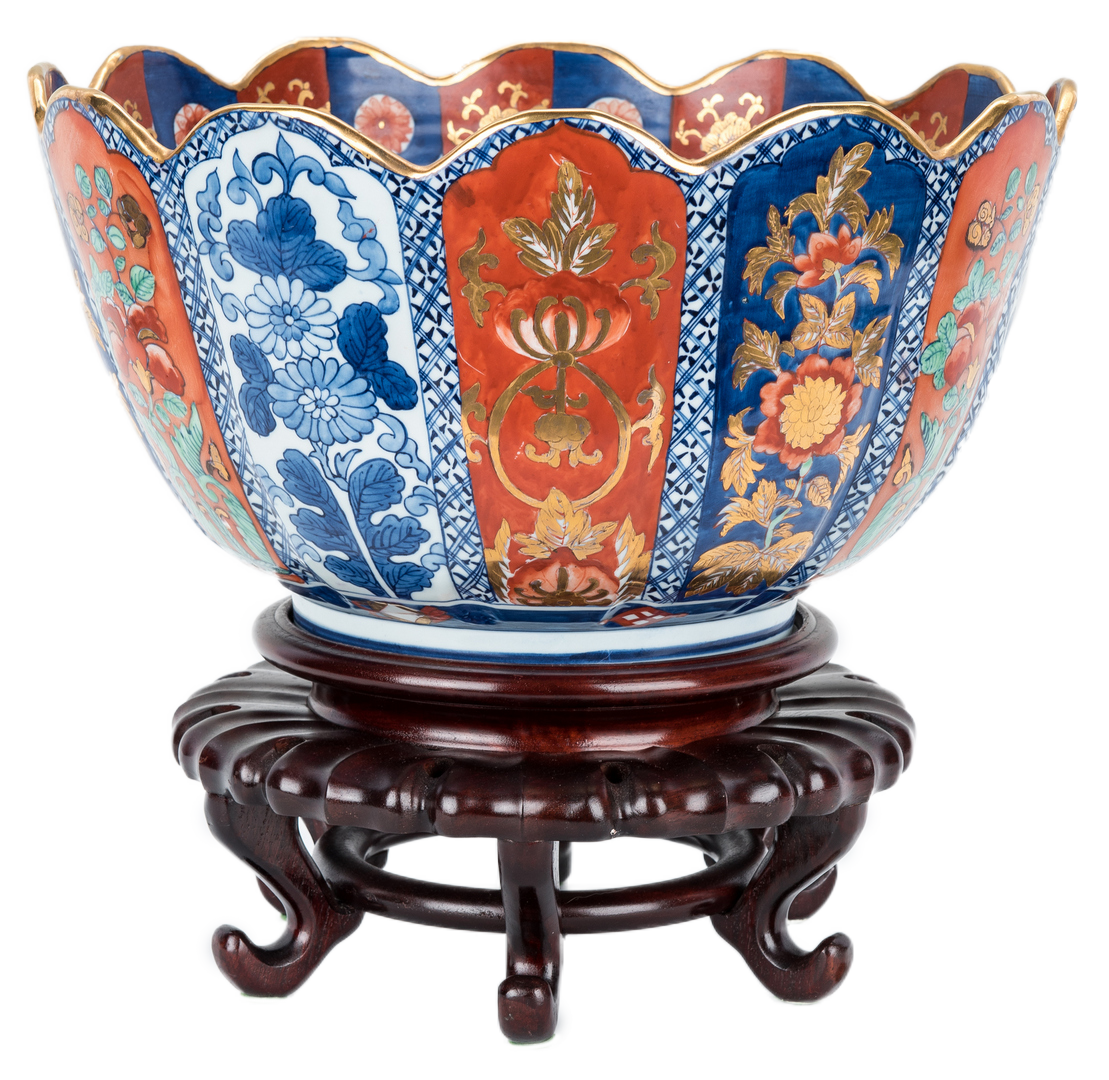
Large Japanese Imari porcelain footed punch bowl with scalloped rim and gilt highlights, the center interior with flowering potted plant motif and additional floral and tassel to the interior, the exterior body with alternating bands of floral decoration on various backgrounds. Fitted with a carved footed hardwood stand. Bowl measures: 7 3/4″ H x 13 3/4″ dia. Stand measures: 4 3/4″ H x 10 1/4″ dia. Late 19th/early 20th century. Provenance: Living Estate of Joseph & Bette Bacon, Knoxville, TN.