Donald Roller Wilson
(American, b. 1938)
Shirley’s Friend’s Head and Chest Were His Primary Attractions…, 1984
oil on canvas
signed Donald Roller Wilson and dated (upper edge)
8 1/4 x 8 1/4 inches.
Provenance:
Moody Gallery, Houston, Texas
Acquired from the above by the present owner in 1984
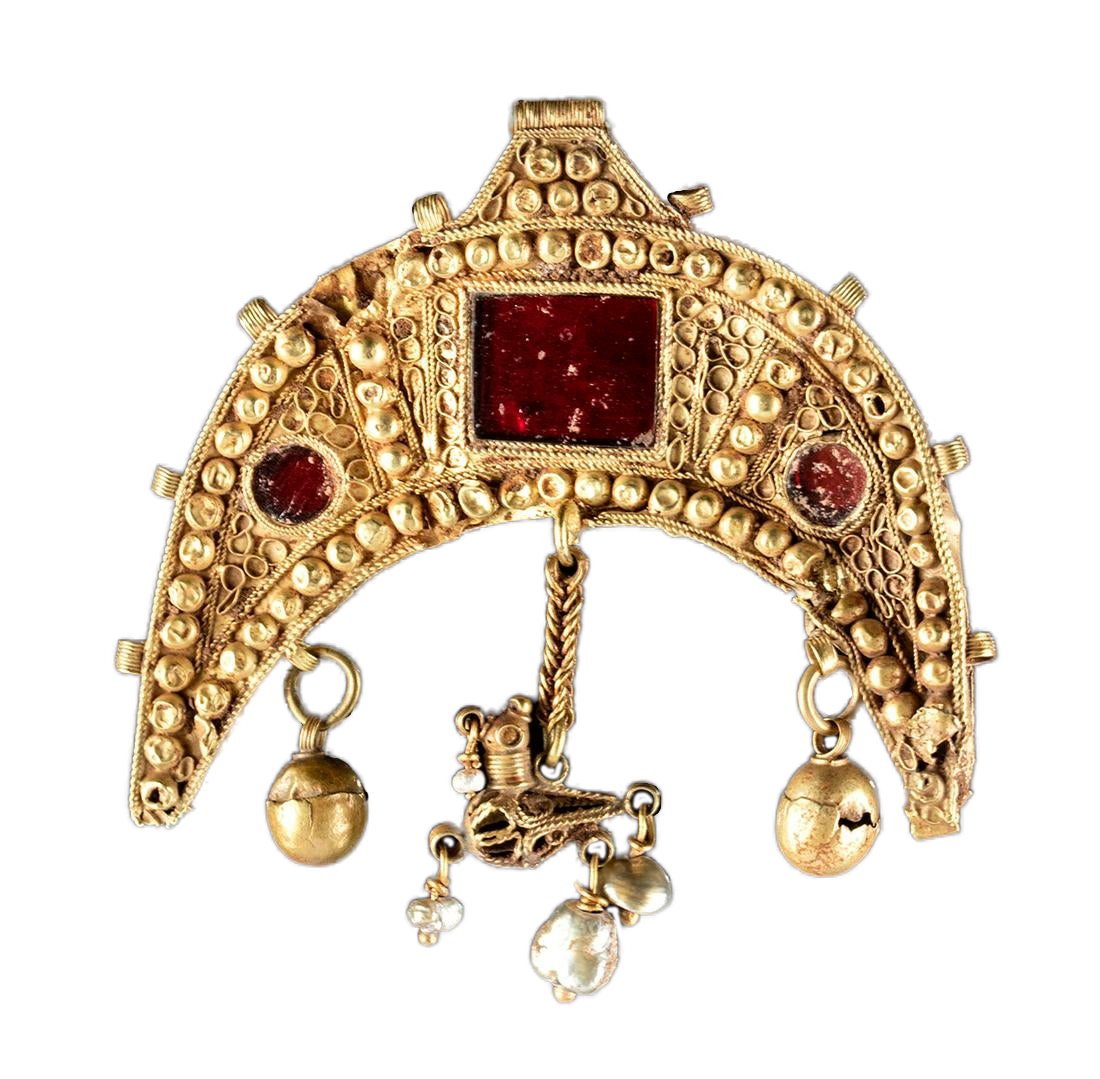
Near East / Holy Land, Byzantine Empire, ca. 6th to 9th century CE. A lovely 75% gold (equivalent to 18K) crescent-shaped pendant featuring a large square inlay of deep, wine red glass and two smaller round glass circular inlays, giving its face an appearance of stained glass. Dangling gold baubles hang on either side of the crescent’s interior while the center features a magnificent openwork bird made of thin gold wire, with four pearls hanging from it on gold posts. Granulations outline the crescent while its interior is decorated with fine gold filigree. A thick, triangular loop at the top of the crescent – also decorated with filigree – serves as a beautiful suspension point. Size: 2.2″ W x 2.15″ H (5.6 cm x 5.5 cm); 75% gold (equivalent to 18K); total weight is 11 grams
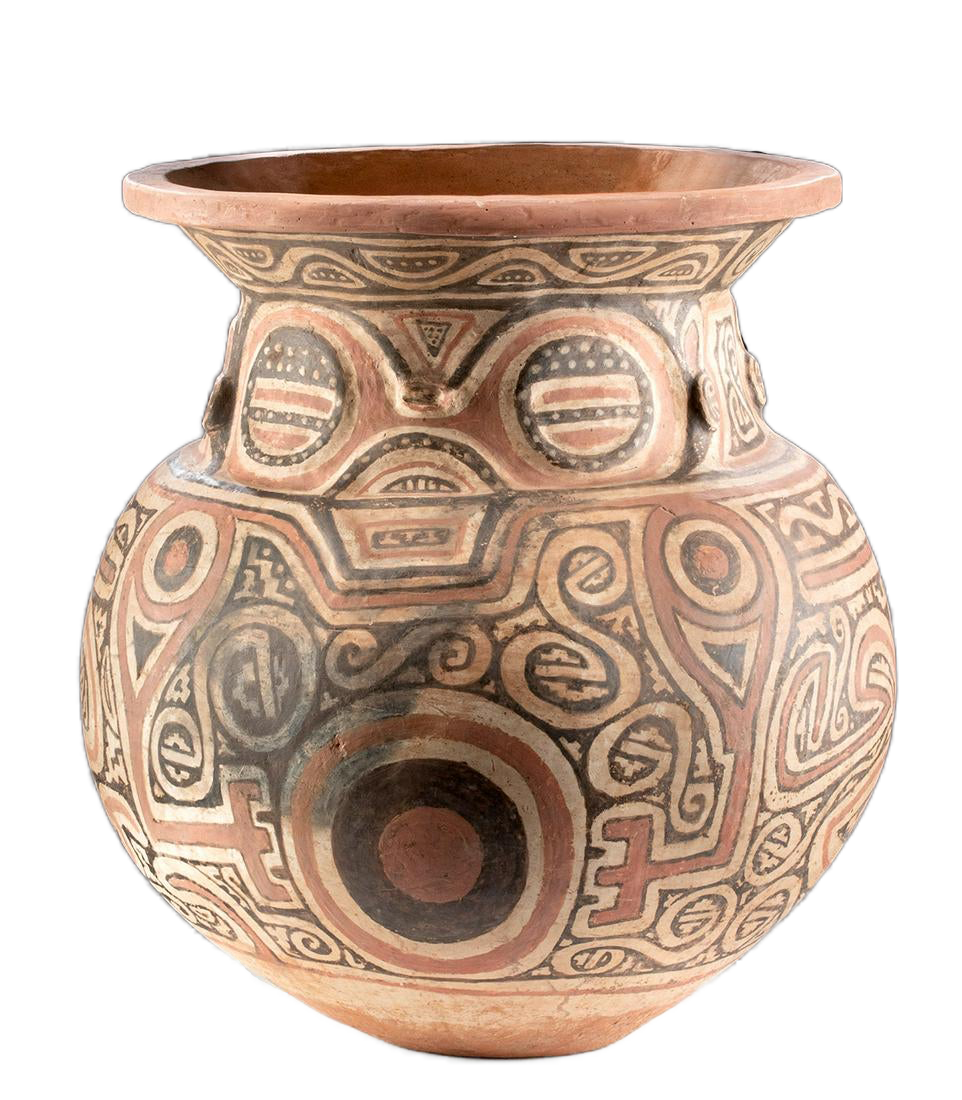
Pre-Columbian, Brazil, Marajoara culture, ca. 800 to 1400 CE. A huge ceramic funerary urn. This represents much of the neck of the vessel, with a two highly abstract, identical, anthropomorphic faces and upper bodies painted on opposing sides. This face seems to be that of a woman whose hands – painted on the sides – touch the sides of her pregnant belly. Her eyes are huge and round, her mouth smaller, with teeth visible like she is grimacing – perhaps preparing to give birth. Her nose and earrings are applied but the rest of her form is composed of incredible interlocking, swirling and labyrinthine geometric motifs, painted in red and black on the buff pale brown background. This creates an ornate surface and suggests ritual tattoos or scarification. Urns of this size are rarely if ever found in a complete and intact state. Size: 14.5″ W x 17.75″ H (36.8 cm x 45.1 cm)
The Marajoara – also known as the Marajo – flourished on Marajo Island, in the mouth of the Amazon River. They built impressive mounds and lived subsistence lifestyles while producing stylistically-unique, beautiful pottery like this. This was a large-scale civilization, contrary to what many European researchers believed of the Amazon before their discovery – the mounds ranged from 3 to 10 meters in height, and some sites cover more than 10 square kilometers and contain 20 to 30 individual mounds. Their figural pottery was mainly of females, representing roughly 70-90% of all known ceramic sculptures from the Marajoara and their neighbors the Santarem, which researchers believe indicates that chiefly descent came from a mythical female ancestor, while both male and female figures are shown as shamans. Urns were buried in the many large cemeteries known from the region.
1963
oil on canvas
69.5 h × 35.5 w in (177 × 90 cm)
Signed and dated to lower right ‘Philip Evergood LXIII’.
Provenance: Mr. and Mrs. J. James Akston | Private Collection
Exhibited: 1963 Annual Exhibition of Painting, 11 December 1963 – 2 February 1964, Museum of American Art, New York | Philip Evergood: A Retrospective, 1967, The Gallery of Modern Art, New York | Philip Evergood: A Retrospective, 10 January – 7 March 1976, Norton Gallery & School of Art, West Palm Beach, Florida I Philip Evergood : A Selection of Major Works, Terry Dintenfass Gallery, New York
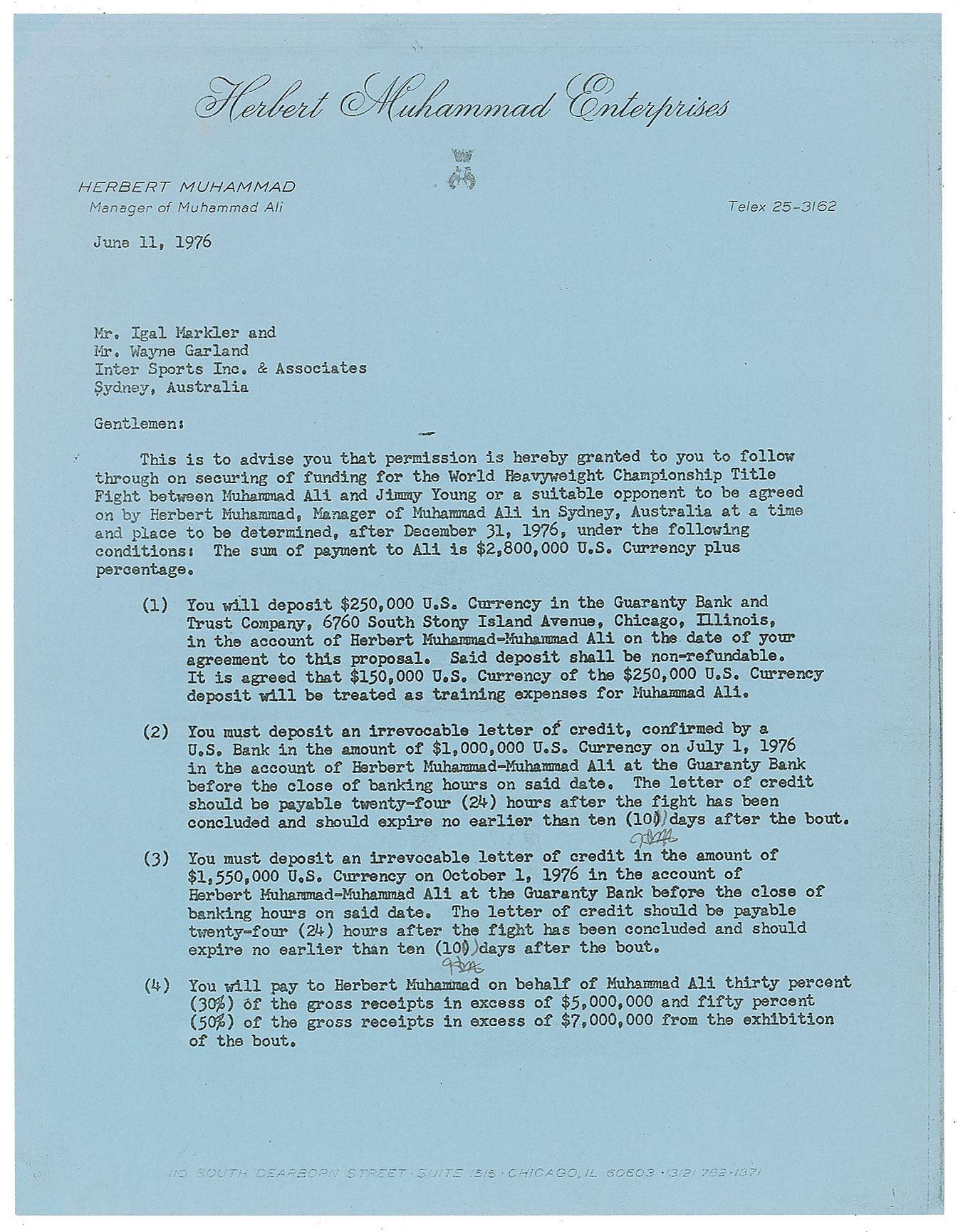
DS, two pages, 8.5 x 11, on Herbert Muhammad Enterprises letterhead, June 11, 1976. An agreement between Ali and Inter Sports Inc. of Sydney, Australia, regarding a proposed match with heavyweight contender Jimmy Young, signed at the conclusion by both Ali and Herbert Muhammad. Besides depositing a non-refundable proposal payment of $250,000 and two irrevocable letters of credit in the amounts of $1,000,000 and $1,550,000 in Ali’s Chicago account, Inter Sport’s agents agree to pay the fighter “30% of the gross receipts in excess of $5,000,000 and 50% of the gross receipts in excess of $7,000,000 from the exhibition of the bout.” In addition, Inter Sports must make its “own contract with Jimmy Young or a suitable opponent to be mutually agreed upon,” and arrange for “One Hundred tickets, ringside, and Two Hundred second rate tickets,” “Fifty first class airline unrestricted tickets round trip…first class hotel and accommodations including meals and lodging…for fifty people” and “three limousines…with chauffeurs at the fight site for duration of final training. Three friendly security guards for duration of stay in Australia.” In fine condition, with a small tear to the upper edge of page one and a few mild wrinkles.
Two months before signing this agreement, Ali and Young squared off in Landover, Maryland for the world heavyweight title. Young, a generally passive pugilist, outlanded and outworked Ali throughout the night, with ‘the Greatest’ unable to connect with more than a few solid blows. Many thought Young might be crowned the heavyweight champion of the world that night, but the judges awarded Ali a unanimous decision After that fight, most believed Young deserved another shot at the title—and as this contract suggests, that fight was going to be a reality. Before that, however, in September 1976 in New York City, Ali defended his title—this time against Ken Norton—winning a close but unanimous 15-round decision. Young would face other former and future heavyweights, including Norton and George Foreman, but this planned rematch with Ali would never happen. Desirable ‘phantom fight’ contract
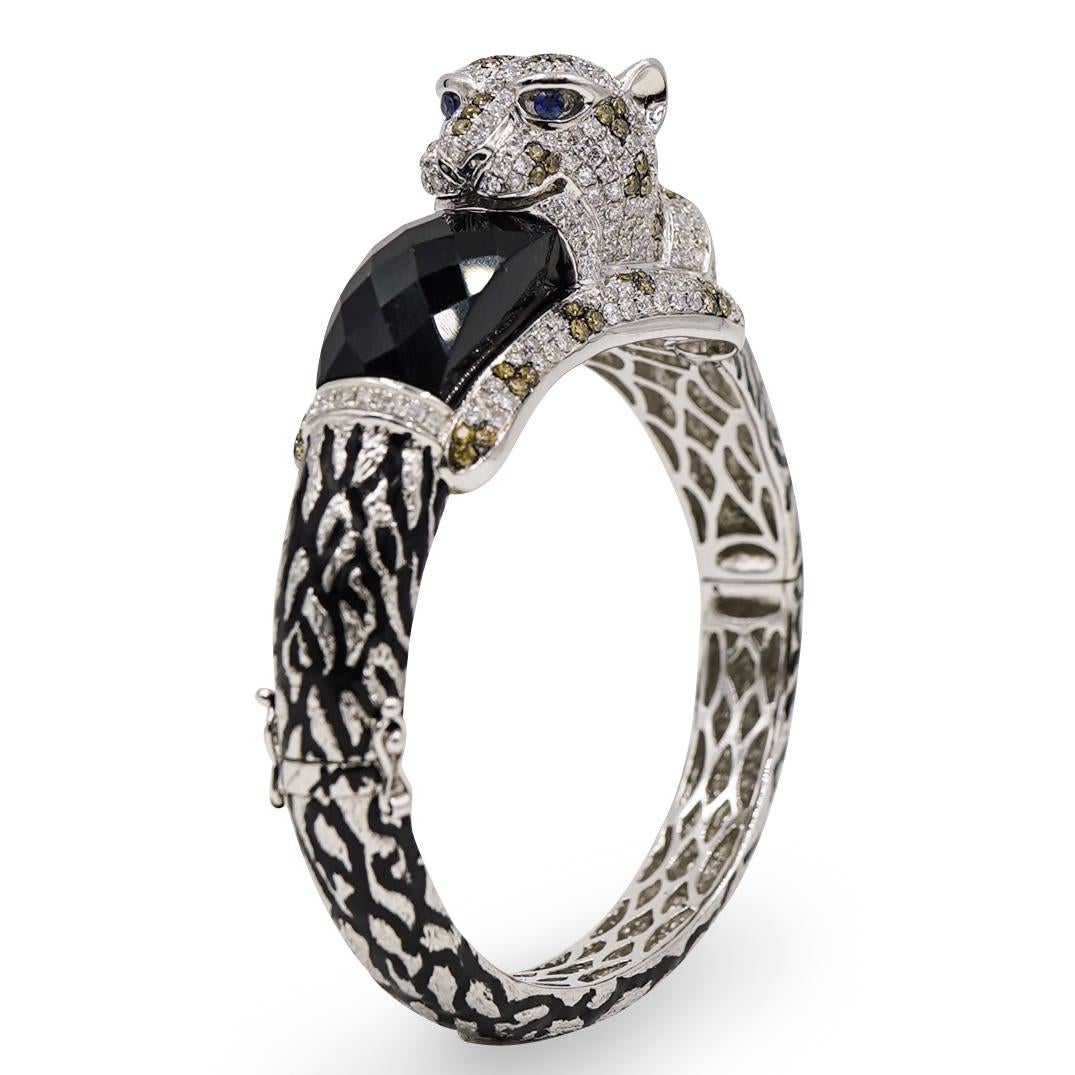
A Cartier Panthere cuff bracelet, designed in the form of a panther head with curving tail. The head is set with pavé round brilliant-cut White VS diamonds, further accented with multiple patterned clusters of yellow diamonds, and finished at the eyes with Sapphires. Flanked to the side of the Panther head is a multifaceted cut Black Onyx cabochon, The bracelet frame is elegantly designed with black enamel alternating with the spotted white gold foundation. Marked along the interior band “18k Cartier” with # 36825. Comes with Box, Total Weight: 48 dwt
CIRCA: 20th Cent.
ORIGIN: France
DIMENSIONS: Wrist Size: 6.5″
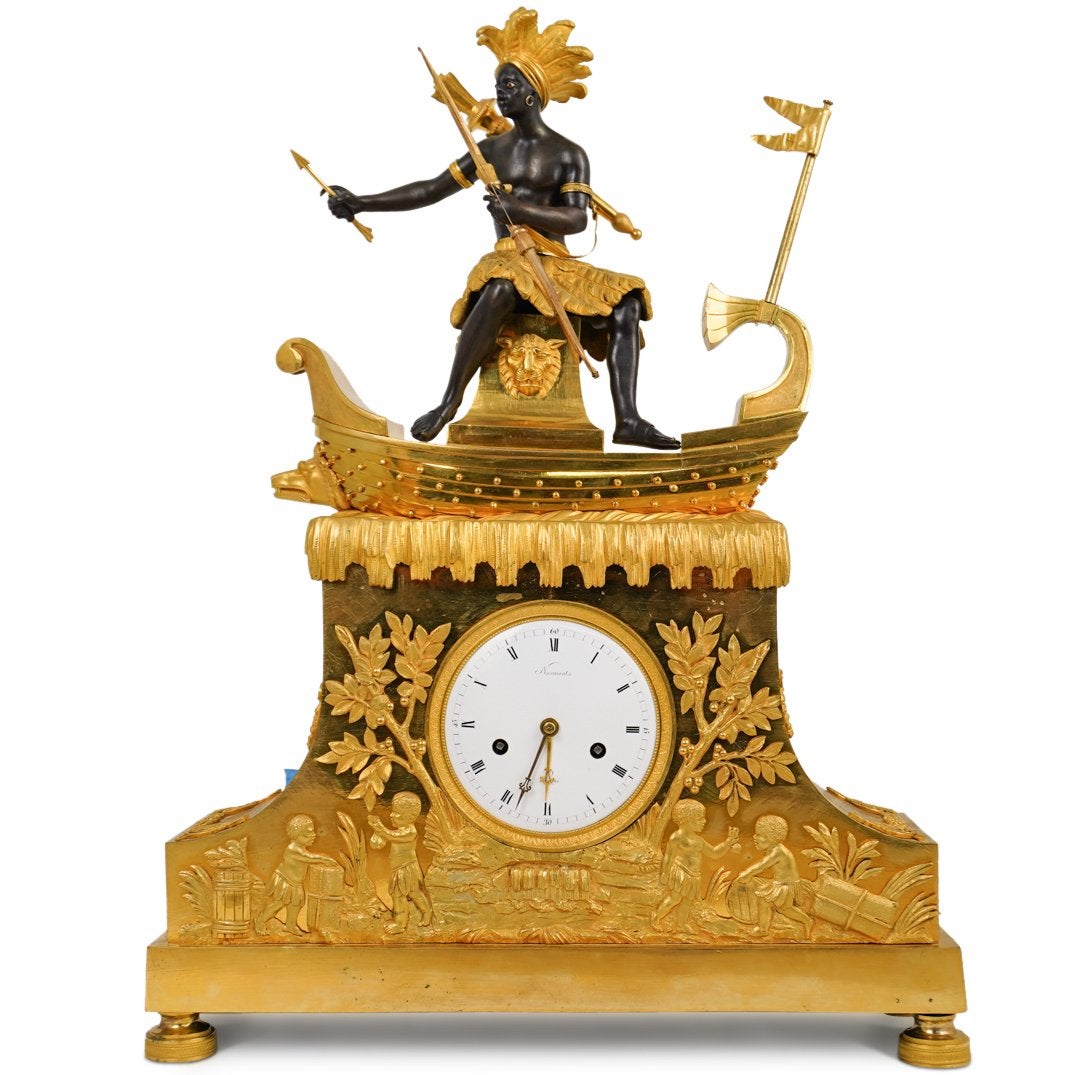
This figural 19th Cent. clock features a round enamel dial, signed Normant, indicates the Roman numeral hours and the Arabic fifteen-minute intervals by means of two bronze hands. The clock is positioned within a gilt bronze casing mounted along the top with a Amerindian Hunter decorated with a feather headdress and a feather loincloth who is holding a bow in his left hand and an arrow in his right hand, with a quiver of arrows slung across his chest. Further decorated along the top with a tetes de lion, and decorated on the base with children playing near a garden setting. Has original Pendulum and key.
CIRCA: 1800s
ORIGIN: France
DIMENSIONS: H: 22″ W: 16″ D:5″
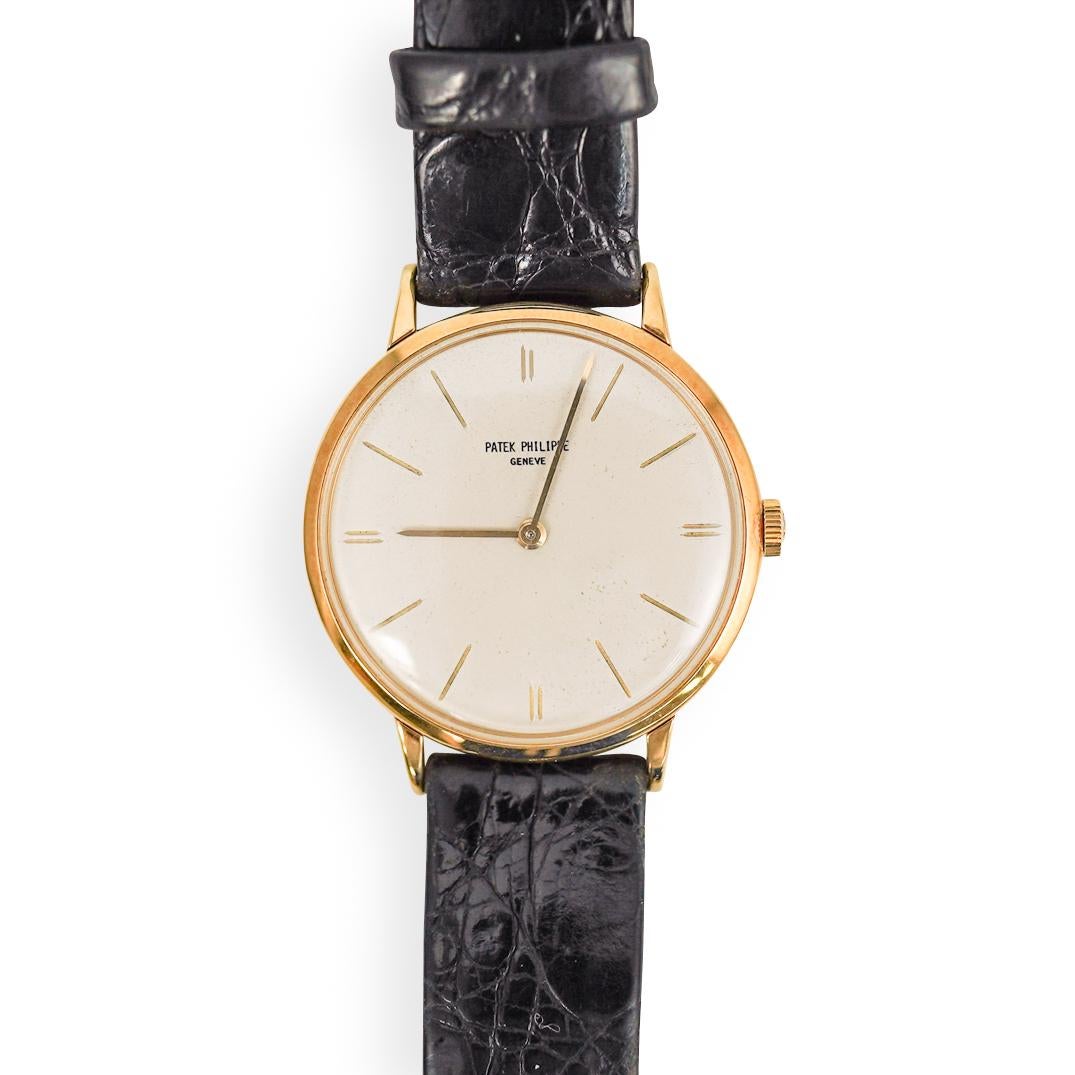
an 18k yellow gold Patek Philippe Calatrava watch features a manual winding movement, 18 jewel, silver dial, gold markers and hand. Attached to a Leather band, and has Service sticker from Patek Philippe along the back. Ref# 2573. Case Weight: 25 Grams
CIRCA: 1950s
DIMENSIONS: 33mm (Adjustable leather strap)
center square old mine cut diamond estimated weight 2.30cts., light brownish yellow, VS, square old mine cut diamond estimated weight 0.50ct., M-O, SI, approx. 100 old European and rose cut diamonds estimated total weight 3.0cts., H-J, VS to SI, tested 18kt. yellow gold and sterling silver, 2 x 2 in., 16.1 gramsProvenance: Private Collection, Asheville, North Carolina
Condition
one diamond out of mounting but with lot, tarnish, appears to have once also had attachment to make brooch, wear and scratches consistent with use, with sterling silver chain

The Nike “Air Jordan” is one of the most iconic designs in the history of both streetwear and basketball, and is a key part of the origin of the Air Jordan brand for Nike. Designed by Peter Moore, Michael Jordan wore Air Jordan 1s in 1984 and 1985, as well as modified versions in 1986 (after a broken foot Michael endured). These specific shoes are the iconic ‘Chicago’ colorway, and perhaps the most recognizable for Michael, as well as the Nike brand.
In 1984, Nike gave Michael Jordan his own signature line of shoes and clothes, which was pivotal in Michael agreeing to sign with Nike. It was the first time the brand did anything like this, and it paved the way for many of the player collaborations we now see. The term “Air Jordan” was coined by Michael Jordan’s agent David Falk. David apparently came up with name because Nike shoes had air in the soles and because, of course, Michael Jordan played basketball in the air.
In terms of the shoe itself, the original Air Jordan 1s were so popular and successful that Nike continued to make new signature Air Jordans each season. This tradition continued beyond Michael’s retirement, and Nike is currently on the Air Jordan 34. From the day it launched, Air Jordans have always represented the pinnacle of sneaker design. The shoes are unmatched when it comes to quality, craftsmanship, materials, innovation, performance, and of course style.
The coding on the inside of the shoes states “850204 TYPS.” 850204 refers to the date of production. These shoes were made in 1985 between the months of February (02) and April (04). TYPS stands for “Tong Yang Player Sample” and means that the shoes are ‘Player Samples,’ produced from the ‘Tong Yang’ factory.
These shoes are accompanied with an LOA from PSA/DNA, and a Letter of Opinion from MEARS Authentication, LLC, with an “Authentic” Final Grade.