The puffed body applied with patterned red, blue & green enamel, with one round cabochon sapphire eye, framed by 17 round diamonds ap. 1.00 ct., with scalloped ribbed fins, ap. 21 dwts.
Gold, Enamel and Diamond Fish Clip-Brooch
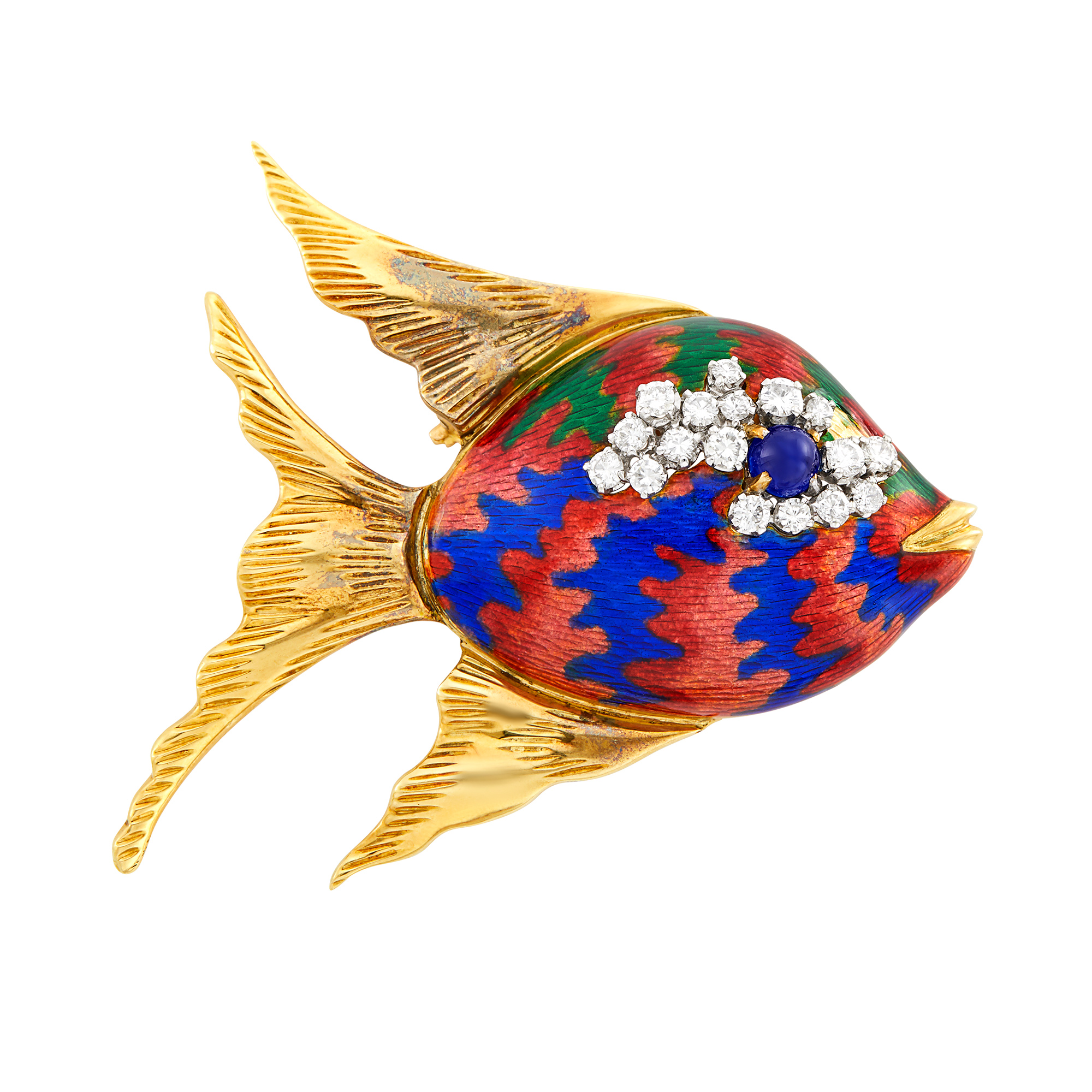
The puffed body applied with patterned red, blue & green enamel, with one round cabochon sapphire eye, framed by 17 round diamonds ap. 1.00 ct., with scalloped ribbed fins, ap. 21 dwts.
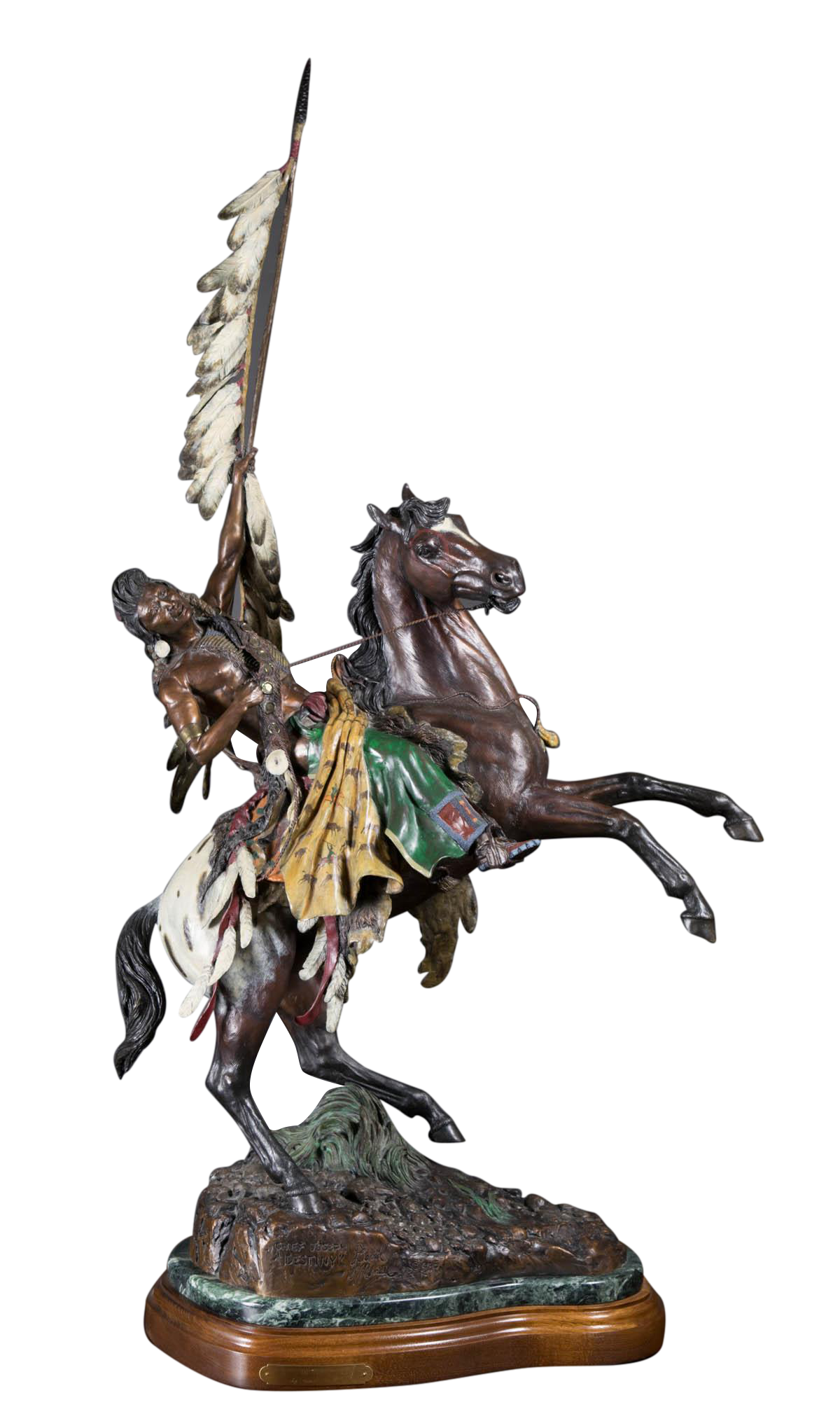
DAVID MANUEL (Oregon, born 1940) bronze sculpture, “Destiny,” a young Chief Joseph on a rearing Appaloosa. Signed, titled, dated 1995, edition 7/50. Includes certificate of authenticity. The bronze measures 38″ x 21″ x 9″. Mounted to a marble and wood plinth; 40.5″ high overall.

ROBERTO MATTA (Chilean 1911-2002) A PAINTING, “Chat-Chat-Chat,” 1997, pastel and oil on red paper watermarked “Canson Mi-Tientes,” signed L/R, verso paper gallery labels, and dated. 29 1/2″ x 29 1/2″ Note: By verbal provenance: A portrait of the artist and his wife Germana Ferrari. A show titled Matta: Selected Paintings presented by Riva Yares Gallery, Santa Fe, May 1–31, 1998 is recorded in Pace Gallery’s, “Selected One-Artist Exhibitions.” Provenance: Riva Yares Gallery, Santa Fe, New Mexico

An Early 20th Century Zsolnay Eosin Glazed Pottery Vase. Baluster vase of substantial size is covered with a deep purple/red iridescent glaze overall with golden leaf, blue medallion, and blue Peacock motifs overall. Zsolany Pecs raised mark in red glaze at the underside. Some surface scratches and some very small nicks to the glaze. 10 x 12 3/4″ high. ESTIMATE $4,000-6,000 Purchased from the Lillian Nassau Gallery, New York.

Signed ‘PAXTON’ bottom right, oil on canvas
32 x 38 in. (81.3 x 96.5cm)
In a Frederick Harer frame.
provenance:
James C. Howe, Boston, Massachusetts.
Shaw Gallery, Boston, Massachusetts.
Collection of Victor D. Spark, New York, New York, 1966
Joan Michelman, Ltd., New York, New York, 1978.
The Regis Corporation, Minneapolis, Minnesota, 1978.
Private Collection, Wyoming.

Tête de Femme (Dora Maar), c. 1943
Aquatint in colors on laid paper, signed in pencil, numbered 41/50, and inscribed ‘Gravé et imprimé par R. Lacourière Paris ’43’, printed by Lacourière, Paris, with wide margins, framed.
16 1/4 x 12 1/4in (41.2 x 31.1cm)
sheet 19 1/4 x 14 3/4in (48.8 x 37.4cm)

Egypt, Late Dynastic Period, 26th to 31st Dynasty, ca. 664 to 332 BCE. An incredible exterior coffin lid carved from hardwood and depicting a serene countenance atop an elaborately decorated body. Painted gesso atop the lid is decorated to show the red-orange face with almond-shaped eyes and elongated canthi, a protruding nose above pouty lips, and a black chinstrap with a net-patterned false beard. Each wig lappet has vertical stripes of alternating hues with serrated tips, and a wadjet peers out on each shoulder. The huge wesekh collar is replete with checkerboards, blue and red triangles, rosettes, and drop-form patterns. The leg panels show the deceased laying atop a lion-headed table beneath the head of Anubis, flanked by the mourning goddesses Isis and Nephthys, with a sun disc, a winged scarab, and two wadjet eyes in the panel above, and two representations of the god Khnum to its sides. The lower legs display several standing funerary deities flanking three columns of hieroglyphs that perhaps identify the deceased. Size: 74″ L x 18″ W (188 cm x 45.7 cm)
Anthropoid coffins like this example first appeared by the Middle Kingdom – skillfully carved so as to outline the mummy’s body and decorated with the visage and wig of the deceased individual. Such coffins not only served to copy the mummy’s form kept within, but also served as actual substitutes for the bodies if that the mummy’s body was lost or destroyed. As time progressed, these coffins were decorated with more extensive iconographic programs, presenting a greater number of inscriptions.
This sarcophagus and others like it were traditionally carved from cedar, though cedar was only used by those wealthy families who could afford the exotic hardwood. Interestingly, cedar wood was not native to Egypt. Egypt did not have verdant forests filled with tall trees, and unfortunately most of its native lumber was of relatively poor quality. Thus, they relied on importing to acquire hardwoods – ebony imported from Africa, cedar and pine from Lebanon. One fabulous obelisk inscription by Thutmose III attests to the luxury of treasured hardwoods. It reads as follows, “They brought to me the choicest products . . . consisting of cedar, juniper and of meru wood . . . all the good sweet woods of God’s Land.” The rarity of cedar meant that coffins like this one were reserved for those who could afford them.
The iconography of Anubis’ disembodied, jackal-form head is symbolically significant due to his direct association with the dead, the process of embalming, and the trial known as the ‘weighing of the heart.’ Anubis, based on the real animal called the African golden jackal, is usually depicted as either a canine or a man with a canine head. Like many Egyptian deities, the role of Anubis changed over time. During the First Dynasty (ca. 3150 to 2890 BCE), he was a protector of graves, a member of the embalming entourage, and the de facto ruler of the underworld. In the Middle Kingdom period (ca. 2050 to 1550 BCE), Osiris claimed Anubis’ role as lord of the underworld. Anubis was still a preeminent presence during the ‘weighing of the heart’ ceremony where the weight of the heart of the deceased would be measured against that of a feather of Ma’at (or feather of truth) to observe if the deceased had been virtuous and forthright during their stay in the realm of the living. Should the heart weigh less than the feather, the deceased would be permitted to enjoy to resplendency of the Fields of Osiris in the afterlife. Should the heart weigh even a gram more than the feather, both the heart and soul of the deceased were cast into the maw of Ammit, a horrifying chimeric beast indentured with punishing evil souls for the rest of eternity.
For a similar example of a coffin lid from the Thirtieth Dynasty with a lower portion beneath, please see Ikram, Salima and Aidan Dodson. “The Mummy in Ancient Egypt: Equipping the Dead for Eternity.” Thames and Hudson, London, 1998, p. 241, fig. 324.
For another example of a coffin lid with dense decorations from the 26th Dynasty, please see The Metropolitan Museum of Art, accession number 30.3.44a,b.
For an example of a coffin lid showing the deceased praying to each of the funerary deities, please see The British Museum, museum number EA6693.
Provenance: private Hawaii, USA collection; ex-private Ezeldeen Taha Eldarir collection, New York, USA, purchased in December, 1946 and imported from Egypt in November, 1948; ex-Salahaddin Sirmali collection, Egypt; appraised by Mr. Hossen Rashed, head of the Egyptian antiquities house

Jesse Monongya
(HOPI / DINE, B. 1952)
Gold and Cobblestone Inlay Cuff Bracelet
marked JMONONGYA
cuff width 3/4 inch, interior circumference 5 1/4 inches x gap length 1 1/4 inches, weight 57.6 dwt.

Roman, Imperial Period, ca. late 3rd to 4th century CE. A very large silver plate of a concave circular form with a relief medallion symbolizing triumph adorning the tondo. The relief features two winged Victory/Nike figures crowning a Roman eagle with a laurel wreath to indicate victory. Beneath the eagle is a Greek inscription “AYR/ EYKARPOC,” probably the name of the owner, Aur(elius) Eukarpos, but possibly the artist as it is not always easy to determine whether the names on silver plates designate the owner or the arti155506 st. Interestingly, the name Aurelius Eukarpos is attested on 3rd century inscriptions found from Thrace to Lycia in Turkey. The scene is surrounded by a beaded and incised decorative cymation type border consisting of swags with drop-shaped pendants containing various punches, half-moon shapes above and ribbons between them. Quite large and impressive! Size: 10.75″ in diameter (27.3 cm); weight: 907 grams (2 pounds)
The eagle stands right on a palm branch with its head turned back to the left. The Nikes don high-belted sleeveless chitons with long overfolds and hold palm branches in their left hands as well as the laurel wreath in their right hands. The plate itself has a carinated edge with incised grooves and sits upon a raised ring base that surrounds a makers mark comprised of concentric circles.
This piece was exhibited and published in catalogue for “Dressed to Kill in Love and War: Splendor in the Ancient World” (February 1 – March 31, 2019 – Academy Museum, Easton, Maryland, USA, fig. 14, p. 9). According to curator Sara E. Cox, “The plate is typical of Roman silver production in the third century AD, in that dishes meant for practical, domestic use at the time were often decorated with a low relief medallion in the center.” Dr. Cox also writes, “Following the conquests of Alexander the Great, new sources of wealth were opened to the Greek world, and by the second to first centuries BC, there were several centers devoted to making fine silver items, including Athens, Pergamon, Ephesus, Antioch, Alexandria, and Tarentum in South Italy.”
See a plate from the Chaourse treasure, now in the British Museum (inv. 1890.0923.1), that is comparable in style and size. See Donald E. Strong, “Greek and Roman Gold and Silver Plate (Ithaca, NY, 1966), pl. 48b; and Tresors d’orfevrerie gallo-romains (Paris, 1989), cat. No. 77, pp. 38-40, 130-131.
For inscriptions with the name Aurelius Eukarpos, see Benjamin D. Meritt, “Greek Inscriptions,” Hesperia 23.4 (1954), pp. 233-283, cat. No. 117, pp. 272-273; Gunter Dunst, Zeitschrift fur vergleichende Sprachforschung auf dem Bebiete der Indogermanischen, Sprachen 78, 1/2 (1963), pp. 147-153, pp. 150-151; and N.P. Milnor, “Notes and inscriptions on the Cult of Apollo at Oinoanda,” Anatolian Studies 50 (2000), pp. 139-149, p. 143.
The border around the central medallion is very similar to one on a large cup with Athena in Hildesheim treasure, now in Berlin, inv. 3779.1; also upon a large octagonal plate with Achilles discovered on Skyros in Kaiseraugst Treasure, now Augst, inv. 62.1. See Lucia Pirzio Biroli Stefanelli, L’Argento dei Romani (Rome, 1991), cat. No. 91, fig. 167, pp. 176 & 271 and cat. 163, figs. 234 & 236, pp. 224-225 & 295-296. There was a lamp workshop of Eukarpos active in Athens in second half of 4th into 5th century CE. See Judith Perlzweig, Lamps of the Roman Period: First to Seventh Century after Christ (Athenian Agora 7) (Princeton, 1961), pp. 25, 33-34. For a Nike with a wreath and an eagle in an apotheosis of Claudius, see sardonyx cameo in BNF, Cab. Med., Babylon 265.
Provenance: private East Coast, USA collection; Exhibited and published in catalogue for “Dressed to Kill in Love and War: Splendor in the Ancient World” (February 1 – March 31, 2019 – Academy Museum, Easton, Maryland, USA, fig. 14, p. 9); ex-Frances Artuner collection, Belgium, acquired in the 1960s

William Franklin Draper (American, 1912-2003). Portrait of John F. Kennedy, oil on canvas, 1962. Signed and dated on lower right. President John Fitzgerald Kennedy sat for William Draper a year before his assassination, and the National Portrait Gallery in Washington D.C. commissioned Draper to paint a portrait from the 1962 life sketch in 1966 (object number NPG.66.35). Draper was the only artist for whom JFK posed during his lifetime. This portrait presents President Kennedy sitting in a rocking chair, dressed in a charcoal grey suit, white dress shirt, and red and gold striped tie, gazing out at the viewer. It is set in a beautiful gilt frame befitting of this most admired President. Size: 24.5″ W x 29.6″ H (62.2 cm x 75.2 cm); 31.75″ W x 36.7″ H (80.6 cm x 93.2 cm) framed
JFK was elected the 35th president of the United States in 1960. At age 43, JFK was not only the youngest man but also the first Roman Catholic to hold the office. During his time in office, Kennedy faced threatening Cold War tensions in Cuba, Vietnam, and more. Famously stating, “Ask not what your country can do for you, ask what you can do for your country,” Kennedy also spearheaded a campaign for public service, and provided federal support for the Civil Rights movement. His tragic assassination on November 22, 1963 shocked the world. To this day, JFK continues to be revered as one of the most admired and beloved presidents of American history.
Peter Rathbone, Director Emeritus of the Boston Museum of Fine Arts, whose portrait Draper also painted stated, “Nature endowed William F. Draper with enough talents to require him to choose among them before embarking on a professional career. Yet to those who know him, it is hard to imagine that any natural bent could rival his personal endowment as a painter of portraits … Draper’s painting belongs to the tradition of Sargent. Like Sargent’s, his style is fluid with virtuoso brushwork as the identifying characteristic. Like Sargent, the preparation of the painting by Draper is all in the artist’s eye. Unlike Sargent’s detachment, Draper’s understanding and love of people and his appreciations of physical subtleties are happily projected into his work. These traits are the source of the warmth and vitality of his portraiture. They are also the reasons why his portraits are fine likenesses. And it is not too much to say that something of his own vibrant personality is reflected in everything he paints.” (“Portraits Period” by Portrait Brokers of America, 1990, p. 46)
William Draper’s career spanned seven decades and his subjects included a portrait of John F. Kennedy that hangs in the National Portrait Gallery in Washington D.C. based upon an oil sketch for which the president sat in 1962. Draper was actually the only artist who painted JFK from life. Draper showed at Knoedler, the Graham Gallery, Portraits, Inc., the Far Gallery, The Findlay Galleries (New York, NY) and the Robert C. Vose Galleries (Boston, MA). His work has been included in shows at the National Portrait Gallery and the Corcoran Gallery of Art (Washington, D.C.), The National Academy of Design (New York, NY), The Boston Museum of Fine Arts, (Boston, MA) the Fogg Art Museum, (one of the Harvard Art Museums, Cambridge, MA), the National Gallery, (London), Salon de la Marine (Paris) and in museums in Australia. He also taught at the Art Students League of New York, and received a lifetime achievement award from the Portrait Society of America in 1999.
More on the artist’s background: William Franklin Draper was born in Hopedale, Massachusetts on December 24, 1912. A child prodigy, he studied classical piano at Harvard University. He later changed his focus to fine art and studied with Charles Webster Hawthorne and Henry Hensche in Provincetown, Rhode Island. Draper also attended the National Academy of Design in New York and the Cape Cod School of Art in Massachusetts. Then he traveled to Spain and studied with Harry Zimmerman, moved on to France and attended the Academie de la Grande Chaumiere. In 1937, he moved to Boston to study sculpture with George Demetrius and also studied with Jon Corbino in beautiful Rockport, Massachusetts. In 1942, Draper joined the Navy and served as a combat artist when stationed on the Aleutian Islands and in the South Pacific. He observed and painted battle scenes on Bougainville, Guam, Saipan, and other locations, as well as genre scenes of soldiers who were not engaged in combat but rather at work and at play. National Geographic magazine reproduced 25 of his war images in four issues in 1944. In 1945, the Corcoran Gallery of Art in Washington D.C. organized a group exhibition of works by five official war artists, including Draper. That same year the Metropolitan Museum of Art included Draper in an exhibition entitled, ”The War Against Japan.” Draper was also featured in a PBS television show about combat artists entitled, “They Drew Fire” in May of 2000. After the war, Draper opened a studio on Park Avenue in New York City and continued to not only paint, but also play classical and jazz piano.
Twenty four years ago, another Kennedy portrait by William Draper (of similar composition and size but unframed) sold at Sotheby’s New York for $82,250 (22 May 1996, lot 158) – illustrated on page 207 of the catalogue.
Provenance: The William F. Draper Collection, New York City, USA, acquired via descent from the late William Franklin Draper (1912-2003), an accomplished American artist whose career spanned seven decades. Known as the “Dean of American Portraiture,” William Draper was the only artist to paint President John F. Kennedy from life, and his oeuvre includes marvelous landscapes from his world travels, military paintings as he was one of only seventeen Combat Artists in WWII, and portraits of illustrious individuals.