Tiffany & Co.: Diamond And Emerald Turtle Pin

Tiffany & Co.: Diamond And Emerald Turtle Pin

TIFFANY & CO.: DIAMOND AND EMERALD TURTLE PIN
designed with a body and movable limbs set with round diamonds weighing approximately 0.55ct and emerald eyes, mounted in 18k gold and platinum, measures 1 x 3/4 x 1/2in., signed Tiffany & Co., with signed box

Four Royal Doulton plate

Four Royal Doulton plate

Four Royal Doulton plates with wall mounts, The Doctor, The Falconer, The Squire, The Jester. Dia.- 10 1/2″ Condition: Good

19th Cent. French Empire Gilt Bronze Mantel Clock

19th Cent. French Empire Gilt Bronze Mantel Clock

A 19th Cent. Silk suspension French mantle clock composed of gilt bronze, decorated along the front base with three ribbon and instrument motif medallions, mounted by Greco Roman scene. Stamped along the back movement “EP”. Comes with pendulum and key. CIRCA: 1800s-1820s ORIGIN: France DIMENSIONS: H: 19.75″. L: 15.75″ Depth: 5.25″Â CONDITION: Great condition. See lot description for details on item condition. More detailed condition requests can be obtained via email ([email protected]) or SMS (305) 333-4134. Any condition statement given, as a courtesy to a client, is only an opinion and should not be treated as a statement of fact. Akiba Antiques shall have no responsibility for any error or omission.

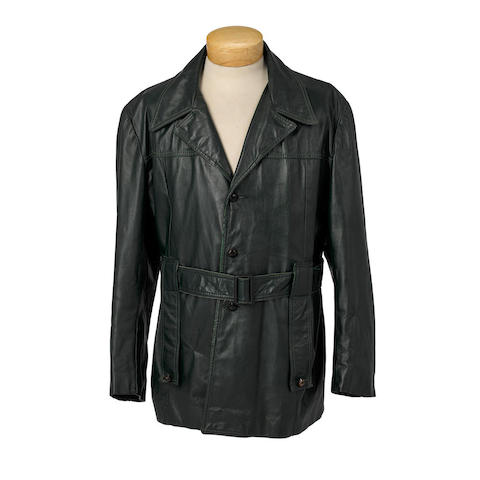
A Kurt Cobain Owned And Worn Dark Green Leather Jacket The Early 1990s

A Kurt Cobain Owned And Worn Dark Green Leather Jacket The Early 1990s

early 1990s
a classic single-breasted leather jacket, with belted waist, lined but label appears to have been removed, accompanied by a letter of provenance.

Provenance: Gifted to the vendor by Kurt Cobain at The Colourbox Night Club in Seattle, WA, where the vendor worked as a bartender 1991-1995. One evening, Cobain accompanied by Krist Novoselic and Courtney Love came into the bar. Cobain was wearing this leather jacket, and soon noticed some custom printed ‘Pearl Jovi’ t-shirts that the vendor had printed by Jeff Ross (JR productions) behind the bar. Cobain traded this leather jacket for one of the t-shirts.

Although the clothes worn by Seattle bands such as Nirvana, Soundgarden and Pearl Jam were more anti-fashion than fashion statement, they quickly took root until grunge fashion seemed to dominate the 1990s. Kurt Cobain was probably the highest profile figure to don thrift store clothes and he had a resounding impact. Leather jackets from the ’60s and ’70s such as this quickly disappeared from thrift stores and found their way into the shops of high-end resellers. Cobain had been pictured in a few jackets of this variety.

Published Roman Bronze Serapis-Zeus-Ammon-Herakles

Published Roman Bronze Serapis-Zeus-Ammon-Herakles

Roman, Imperial Period, ca. 3rd to 4th century CE. A finely cast bronze statue of a bearded deity wearing a chiton and himation, with ram’s horns on his head surmounted by a headdress (possibly of Osiris), and holding a club of Herakles. Given this iconography, the identity of this god remains up to debate. His bearded proud state suggests Zeus or possibly Serapis; the club he holds in his hand suggests that this could be the ultimate hero Herakles; and the headdress with ram’s horns is associated with Ammon. Size: 1.4″ W x 3.5″ H (3.6 cm x 8.9 cm); 4.5″ H (11.4 cm) on included custom stand.

Serapis was a Graeco-Egyptian god who first appeared around the time of Alexander the Great. Serapis was a god created by the fusion of Egyptian and Greek culture and later adopted into Roman religion. He possesses a combination of the attributes of the Egyptian god Osorapis (himself a composite of Osiris and Apis) with the attributes of a number of Greek gods including Zeus, Hades, Helios, and Dionysus. The god Ammon is usually shown with the horns of a ram, and was first worshipped by Libyan desert tribes. Scholars belive that he was possibly related to Ba’al Hammon, a god of Semitic peoples such as the Phoenicians and Carthaginians. However, this has not been proven. The cult was eventually taken over by the Egyptians, who associated Ammon with their supreme god Amun.

Published: J. Eisnenberg. Art of the Ancient World, volume IV (1985), no. 289. Also, on loan to Ball State University Art Museum; George Mason University; Fitchburg Art Museum, 1997-2016.

Provenance: ex-G.T. Collection, Pontiac, Michigan, USA, acquired from Royal Athena in 1985; K.D. Collection, Michigan, USA, Royal Athena, June 1997; On loan to Ball State University Art Museum; George Mason University; Fitchburg Art Museum, 1997-2016.

All items legal to buy/sell under U.S. Statute covering cultural patrimony Code 2600, CHAPTER 14, and are guaranteed to be as described or your money back.

A Certificate of Authenticity will accompany all winning bids.

We ship worldwide and handle all shipping in-house for your convenience.

#156488

Condition

Upraised hand is missing. Otherwise in fine condition with slight smoothing to features and rich green patina.

Samuel F B Morse (USA 1791-1872) “The Goldfish Bowl”

SAMUEL F B MORSE (USA 1791-1872) "GOLDFISH BOWL"

Samuel Finley Breese Morse (AMERICAN,1791-1872) oil painting on canvas titled “The Goldfish Bowl” depicting Mrs. Richard Carey Morse and her two children; Elizabeth and Charlotte. Absolutely a rare piece of American history with museum grade provenance. This is the original painting with amazing provenance was gifted by Samuel F.B. Morse himself to his niece. Samuel F.B. Morse is the inventor of the single wire telegraph and creator of the “ Morse code” which would become the primary language of telegraphy in the world. This painting was on exhibit at the Guggenheim Museum, Spain recently till now. This Painting is also accompanied by handwritten documents by the artist as well. Our Colleagues at Sotheby’s relayed to Elite Auctioneers regarding this painting stating that this painting appears to be slightly more developed than the other version at the Smithsonian. This piece comes with a full detailed condition report by Munson-Williams – Proctor Arts Institute (see photos). Mounted in wooden frame. Canvas on stretcher measure approx. Canvas on stretcher measures approx. Measures approx. es 29 3/4 x 27 7/8 in. (75.5 x 63 cm.). Measures approx. 39 1/2″ height x 34 3/4″ width (75.6cm x 9.5cm) overall including frame. PROVENANCE: Mrs. Richard Carey Morse, New York Mrs. Lottie Morse Hodge, Hartford Mr. Robert C. Hodge Mr. Robert C. Hodge, Jr. Gilbert Colgate Mrs. J. Wright Rumbough LITERATURE H. B. Wehle, Samuel F. B. Morse, American Painter, Occasioned By An Exhibition Of His Paintings, February 16 through March 27, 1932, Metropolitan Museum of Art, New York, 1932, no. 58, illus. RELATED LITERATURE P. J. Staiti and G. A. Reynolds, Samuel F. B. Morse, New York, 1982, pp. 78-80, fig. 84, illus. In 1832, Richard and Sidney Morse, brothers of the artist, founded the New York Observer, a religious newspaper. During S. F. B. Morse’s career, Richard gave him moral and financial support. H. B. Wehle, in his Study of Morse, says that in 1832 when Morse returned from Europe with the principles of the telegraph completed, “His brothers Sidney and Richard met him at the foot of Rector Street… and, finding his pockets empty of funds and his head full of invention, they supplied him with a place to sleep. During these years after his return, he lived from hand to mouth, fiddling with his invention, with the Academy, and with finishing his European paintings. He took a few pupils and probably painted a few portraits.” It was during this time that the portrait of Richard’s wife and daughters was probably painted, possibly out of gratitude for his brother’s assistance. Two versions of the portrait are known, as the artist is believed to have made one for each of his two nieces. Lottie Morse, who was five years old when the painting was executed, was later given this version of it by her mother. The other version went to Lottie’s sister. The second version of this painting entitled The Goldfish Bowl, is in the collection of the National Museum of American Art in Washington, D.C.

Girard-perregaux Tourbillon. 18k Yellow Gold

Girard-perregaux Tourbillon. 18k Yellow Gold

Movement: automatic.
Caliber: G.P.9610C
Serial: 1 O.F.
18K yellow gold squared case of 32 x 32 mm. Crystal.
White dial with Arabic numerals and Tourbillon display window.
Pulse: black leather strap with 18K yellow gold deployant clasp.

Egyptian Faience Ushabti for Prince Khaemwaset TL’d

Egyptian Faience Ushabti for Prince Khaemwaset TL'd

Ancient Egypt, New Kingdom, 19th Dynasty, reign of Rameses II, ca. 1213 BCE. A stunning faience “overseer” ushabti enveloped in turquoise-hued glaze for Prince Khaemwaset (also Khamweset or Setne Khamwas, literally “he who rises in Thebes”), the fourth son of Ramesses II. The mummiform prince stands erect against an integral back panel while holding a black-painted pick and hoe in crossed arms, with a layered and beaded wesekh pectoral collar painted across the smooth chest, and has a side lock of hair similar to that on depictions of the infant Horus. Sizable almond eyes with elongated canthi peer outwards beneath thick brows and above a slender nose, and a rounded right cheek creates a slight smirk on his face. A column of black hieroglyphs reads, “The Illuminate, the Osiris, Sem Priest of Ptah, Son of the King, (Prince) Khaemwaset” with two back columns reading, “The Illuminate, the Osiris, Sem Priest of Ptah, Son of the King, (Prince) Khaemwaset, he says: O these ushabti, if I am summoned or reckoned to do any work…” Size: 1.625″ W x 5.6″ H (4.1 cm x 14.2 cm)

Overseers are much more rare than your standard “worker” ushabti as only one overseer would be made for every 10 workers – and would act as a foreman doing labor in the afterlife.

This piece has been tested using thermoluminescence (TL) analysis and has been found to be ancient and of the period stated. A full report will accompany purchase.

Provenance: private East Coast, USA collection

All items legal to buy/sell under U.S. Statute covering cultural patrimony Code 2600, CHAPTER 14, and are guaranteed to be as described or your money back.

A Certificate of Authenticity will accompany all winning bids.

We ship worldwide and handle all shipping in-house for your convenience.

#136209

Condition

Minor abrasions to body, head, and back panel, with light pitting and a few fissures to glaze commensurate with the kilning process, and light fading to glaze pigment, otherwise intact and excellent. Great remains of pigment and hieroglyphs throughout. TL drill holes atop head and beneath base.

A Pair Of Louis Xv Style Gilt Bronze Mounted Japanese Lacquered Commodes By Paul Sormani

A Pair Of Louis Xv Style Gilt Bronze Mounted Japanese Lacquered Commodes By Paul Sormani

by Paul Sormani, Paris, third quarter 19th century
Each breche d’alep marble top of serpentine outline, above a conforming case lacquered to depict figures or birds in landscapes and fitted with two long drawers mounted sans traverse with scrolling foliate encadrements, the sides similarly mounted, above a seated putto bearing a flowering branch, raised on cabriole legs with oaken chutes continuing to scrolled sabots; each signed P. SORMANI PARIS on the upper section of the chute. height 34in (86.5cm); width 60in (152cm); depth 66 1/4in (66.5cm)