The Large-Scale Paintings of Notre-Dame de Paris: An Exemplary Restoration

Laurent de La Hyre (1606-1656), The Conversion of Saint Paul, 1637. © DRAC Île-de-France

Spared by the fire, the cathedral’s paintings and tapestries, now restored, are reunited in the Gobelins gallery in Paris, where they reveal their mysteries at eye level before returning to their original home at the end of the year.
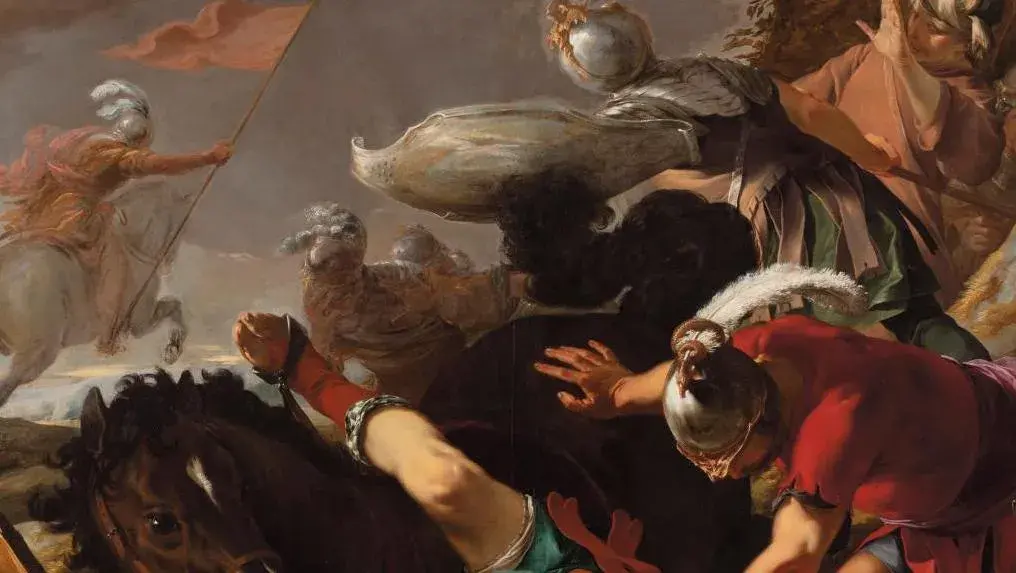
Laurent de La Hyre (1606-1656), The Conversion of Saint Paul, 1637.
© DRAC Île-de-France
Laurent de La Hyre (1606-1656), The Conversion of Saint Paul, 1637.
© DRAC Île-de-France

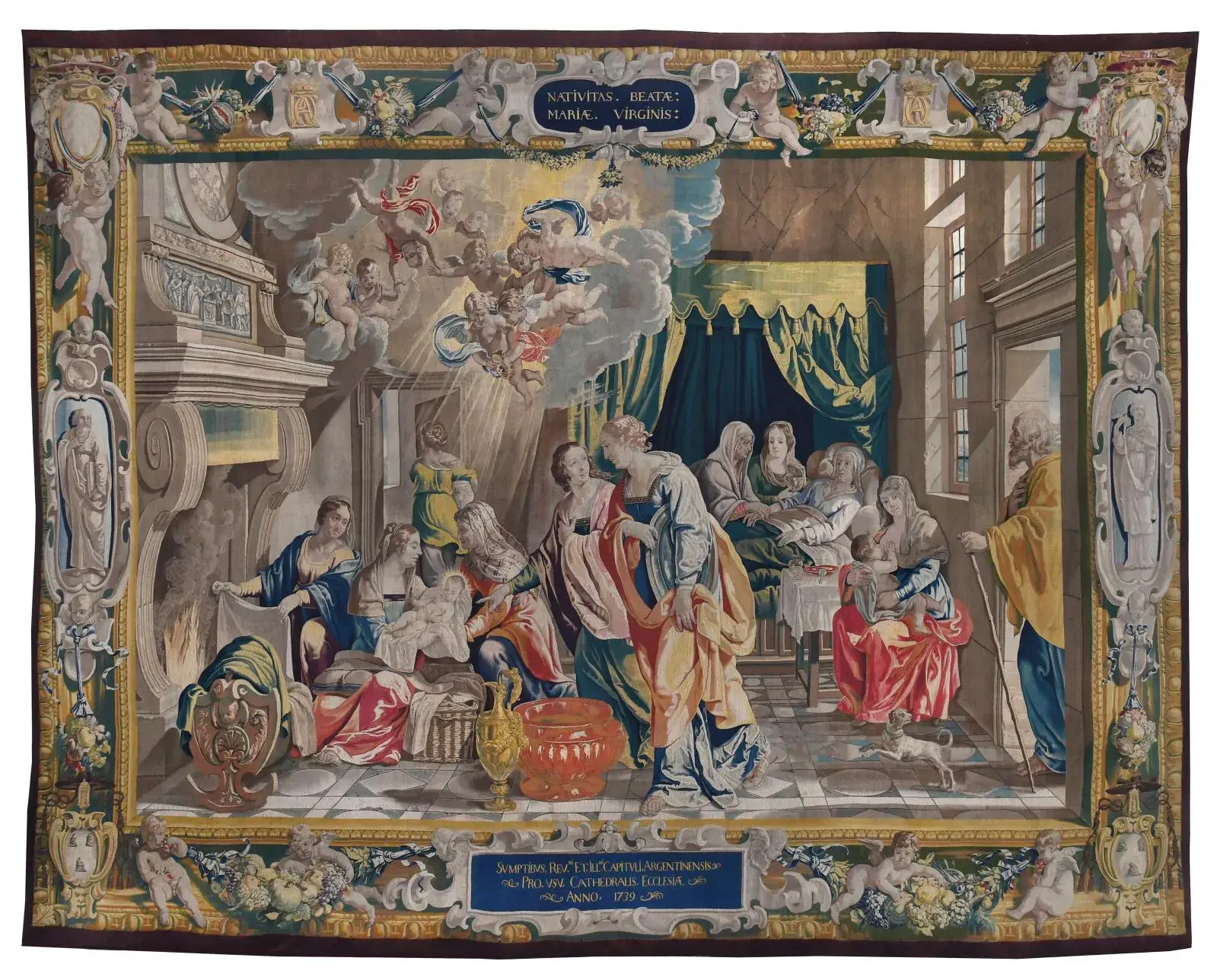
The Mobilier National is providing a rare chance to admire a magnificent series of paintings belonging to Notre-Dame de Paris—the famous “Mays”—at eye level before they return to the cathedral. The exhibition is also an occasion to see the hanging entitled “The Life of the Virgin”, on show every Christmas at Notre-Dame de Strasbourg—its permanent home—and the choir carpet commissioned by Charles X, which is not often displayed. On view as well are models of the new liturgical furnishings in patinated bronze and stone, designed by Guillaume Bardet and cast by Barthélemy Art in Crest (Drôme), and the solid oak chairs designed by Ionna Vautrin, currently being produced by Bosc in Hagetmau (Landes). And it revives memories of the great shock caused by the spectacular fire of April 15, 2019. During the ten days that followed, the masterpieces of Notre-Dame’s interior décor were evacuated in an operation overseen by the state heritage body DRAC Ile-de-France. All the paintings—including the famous Mays—escaped the flames, while the two parts of the choir carpet, rolled up in their cases, were saved by the water poured over the building, then dried out in the Mobilier National premises.
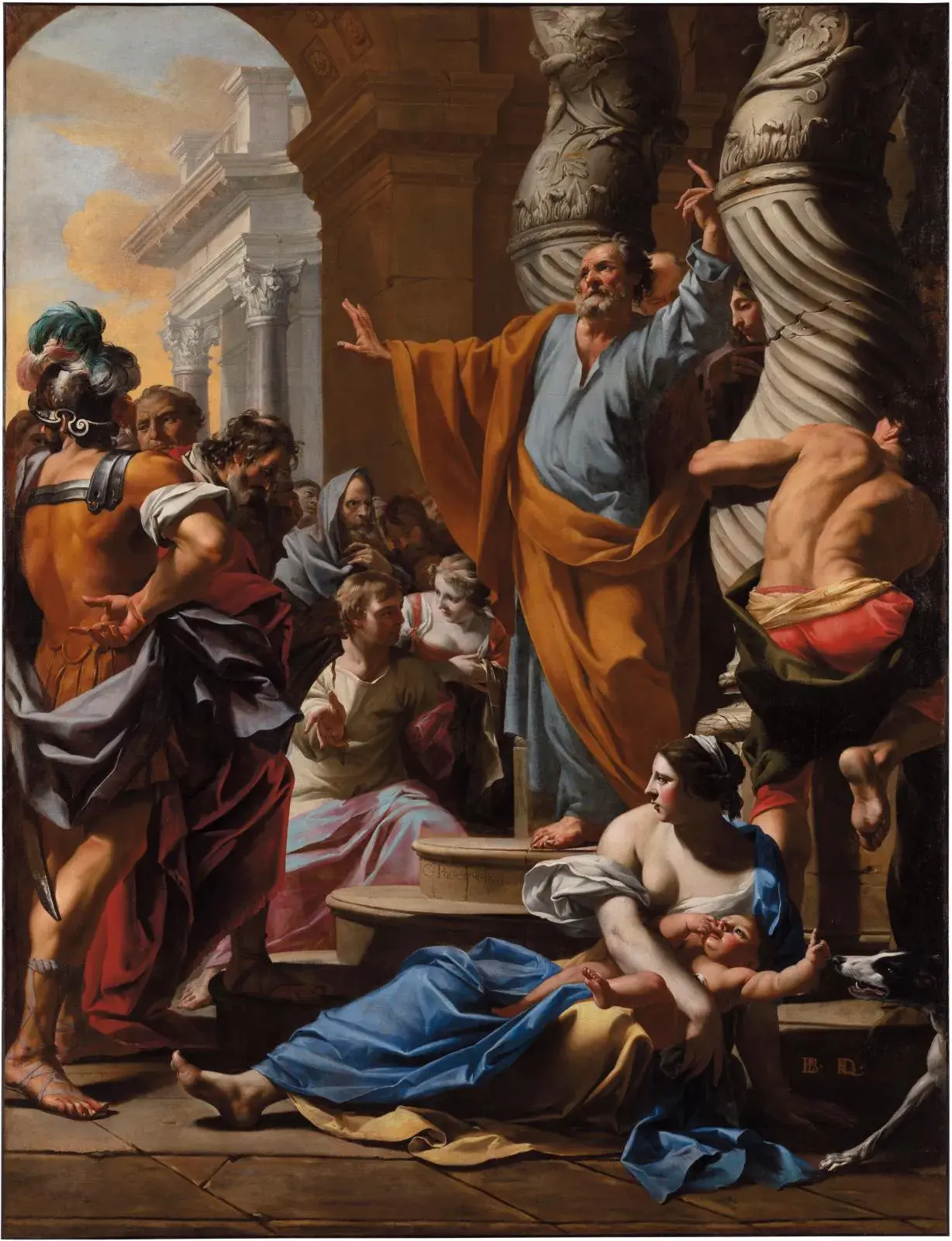
Charles Poërson, St Peter Preaches in Jerusalem, 1642.
© DRAC Île-de-France
Charles PoërsonSt Peter Preaches in Jerusalem, 1642.
© DRAC Île-de-France

The First Mays: An Italian Influence

The story of the Mays goes back to a pagan tradition (planting a tree on May 1 to celebrate the fertility of spring) that was eventually appropriated by the Church. In 1449, a group of Parisian goldsmiths (the “May Companions”) decided to make an annual gift to the cathedral, known as a “May”—probably a green tree placed on the parvis. Over the years, this gift took the form of a wooden tabernacle with niches decorated with silk paintings, hung above the statue of the Virgin in the choir screen throughout the month. One of these is now in the Musée Carnavalet-Histoire de Paris. The early 17th century saw a large number of commissions designed to embellish churches and educate the faithful. Louis XIII and Anne of Austria were particularly devoted to the Virgin Mary, and in 1628, the Queen commissioned the architect François Mansart to build an altar to her in the cathedral. Two years later, the goldsmiths’ guild, with the agreement of the Chapter of Canons, decided to donate a large May each year: a painting measuring around 340 x 275 cm/134 x 108.2 in. In September, the two most recently elected masters of the guild would choose a painter, who was to be paid 400 livres to produce the work. The painter would present a sketch, execute a reduced replica for each patron, and deliver the painting the following April. With two interruptions in 1684 and 1694, the cycle came to an end in 1708, when the guild was dissolved due to financial difficulties. The Mays were gradually hung high up on the pillars of the cathedral. Their compositions were fairly similar, with the lively central scenes, in more vivid colors, placed in the lower section. The first paintings revealed the influence of Italian masters. For example, in The Descent of the Holy Spirit (the oldest of the Mays housed in Notre-Dame, painted by Jacques Blanchard in 1634), the faces turned towards the Holy Spirit are reminiscent of Titian’s style. The following year, Laurent de La Hyre painted Saint Peter Healing the Sick With his Shadow, followed by The Conversion of Saint Paul in 1637. “Now that the yellowed varnish and overpainting have been removed, we can appreciate the full force of the composition in this masterpiece,” says Emmanuel Pénicaut, Director of Collections at the Mobilier National and co-curator of the exhibition. “The painter’s virtuosity really shines in the rendering of the plumes on the helmets of Saint Paul and his companion.” From 1648 onwards, the artists were systematically selected from members of the Académie Royale de Peinture et de Sculpture. After a period in Rome, Charles Le Brun made a name for himself in Paris with his Martyrdom of Saint Andrew, delivered in 1647 when he was 28, followed by the Martyrdom of Saint Stephen in 1651—a painting in which the movements, the light on the tortured body and the expressive faces conveying the protagonists’ violent emotions were much admired.
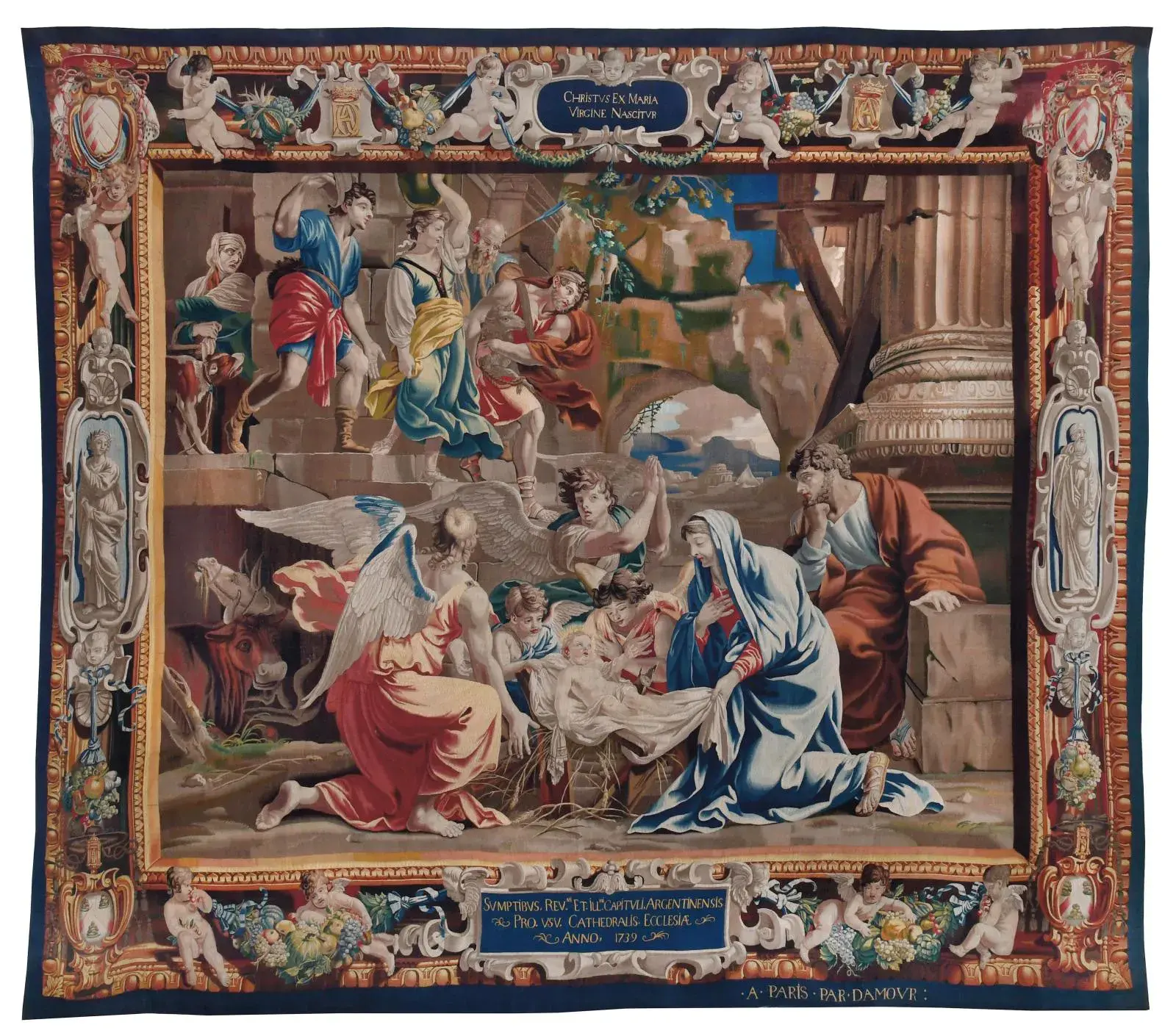
Pierre Damour’s studio, based on a work by Charles Poërson (1609-1667), The Nativity, 1652-1654.
© Mobilier National/Isabelle Bideau
Pierre Damour’s studio, based on a work by Charles Poërson (1609-1667), The Nativity, 1652-1654.
© Mobilier National/Isabelle Bideau
Paris workshop, based on a work by Philippe de Champaigne (1602-1674), The Birth of the Virgin, 1640.
© Mobilier National/Isabelle Bideau
Paris workshop, based on a work by Philippe de Champaigne (1602-1674), The Birth of the Virgin, 1640. © Mobilier National/Isabelle Bideau

Multiple Decorative Works

Throughout the 17th century, various works were created for the cathedral interior. Stained glass windows in grisaille and whitewashed walls now reflected the light from outside. In 1638, Louis XIII vowed to consecrate France to the Virgin Mary and ordered the choir to be refurbished. The same year, Michel Le Masle, Richelieu’s intendant (administrative official) and canon of Notre-Dame, launched a project for four wool and silk tapestries illustrating the Life of the Virgin, wreathed with cherubs. The project finally included 14 tapestries, which took 20 years to produce. The cartoons by Jacques Stella were woven in Brussels, while those by Philippe de Champaigne and Charles Poërson were assigned to various Parisian workshops, including that of Pierre Damour. After the choir was refurbished at the beginning of the 18th century, the tapestries were placed in storage and finally sold to Strasbourg Cathedral in 1739. Between 1645 and 1655, Lubin Baugin painted 19 pictures for Notre-Dame, including for the chapels, five of which have been identified. Two of them returned to the cathedral in the 1960s: The Virgin of Pity and The Martyrdom of Saint Bartholomew. But the most moving painting is undoubtedly The Nativity of the Virgin by the Le Nain brothers, dated around 1642. “They combined deep spirituality with narrative details like a cradle, or a child holding a cloth up to dry. Its restoration has revealed the incredible interplay of whites in the linen and in the bodice of the woman nursing the Virgin,” says Caroline Piel, Inspector General of Heritage and co-curator of the event. In the 18th century, the hang of the Mays was changed, as some of them had probably been dispersed to other churches in Paris. Between 1708 and 1723, Robert de Cotte, First Architect to Louis XIV, gave the cathedral choir its current form. The decor partly consisted of paintings by masters of the time, including Jean Jouvenet, Charles de La Fosse, Louis de Boullogne and Antoine Coypel, later joined by Carle Van Loo and Joseph-Marie Vien. During the French Revolution, Notre-Dame was stripped of its decorative works. The Mays were moved to the Musée des Monuments Français (housed in the former Augustinian convent from 1795 to 1816) and the Muséum Central des Arts, which opened in the Louvre in 1793. In 1802, when religious worship was re-established, some of them returned to the building. To disguise the dilapidated state of the walls, five paintings seized during the Italian campaign were hung on them, including Guido Reni’s Triumph of Job, later joined by an Adoration of the Shepherds painted by Jérôme Francken the Elder in 1585 for the Cordeliers convent. However, the reorganization overseen by Eugène Viollet-le-Duc from 1845 onwards excluded most of these paintings, and it was not until the second half of the 20th century that some of them were reinstated. From the 1940s until his death, Pierre-Marie Auzas (1914-1992), Inspector General of Les Monuments Historiques, expressed a deep interest in the paintings of Notre-Dame. 52 Mays have now been located, including eight in the Louvre and 14 in the Musée des Beaux-Arts in Arras, in addition to the 13 newly restored. The others are scattered around private collections, churches and other museums. Although they escaped the fire unscathed, 22 paintings, including the 13 Mays housed in the cathedral, underwent an exemplary restoration work in 2022 and 2023, carried out by the DRAC and the Centre de Recherche et de Restauration des Musées de France (C2RMF). “The Mays are monumental paintings, but there is sometimes a small animal that goes unnoticed, a secret smile on an angel’s face—little signs left by the artist so that we can really connect with the work,” says Emmanuel Pénicaut.
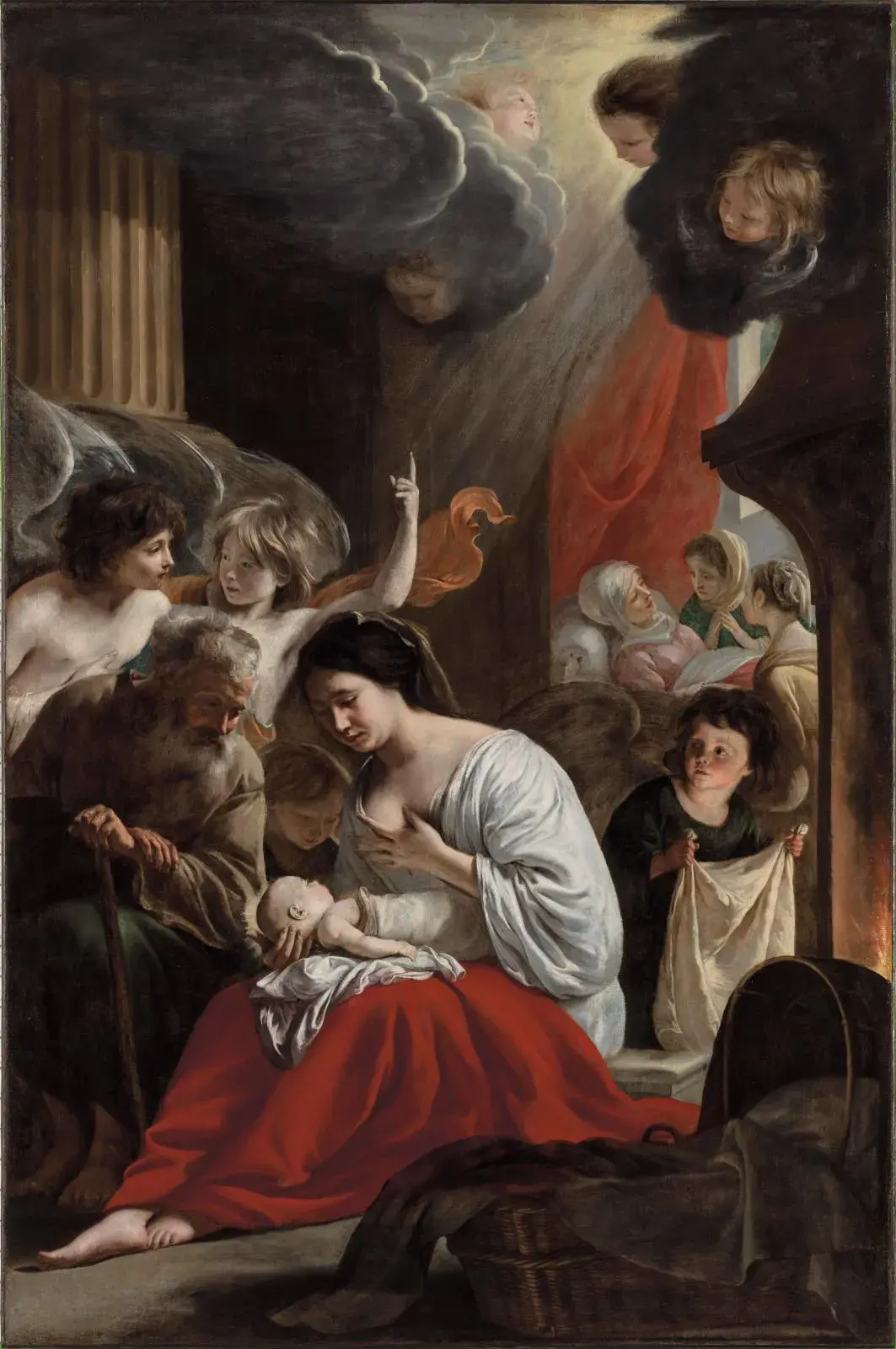
Louis (c. 1593-1648) and Matthieu Le Nain (1607-1677), The Nativity of the Virgin, 1640.
© DRAC Île-de-France
Louis (c. 1593-1648) and Matthieu Le Nain (1607-1677), The Nativity of the Virgin, 1640.
© DRAC Île-de-France

Successive Restorations

For two years, 50 restorers worked in turn on the paintings in an undisclosed location. With help from the C2RMF, each piece was given a scientific imaging file. Ultraviolet light was used to identify overpainting from previous restorations. Infrared light, sometimes combined with reflectography, revealed changes in the composition, reworkings, and even the preparatory drawing. In the case of Aubin Vouet’s The Centurion Cornelius at St Peter’s Feet (1639), the imaging revealed an underlying composition, suggesting that Simon Vouet’s brother had re-used a previously painted canvas. In Francken’s painting, reflectography revealed three bodies beneath the layer of paint—probably angels—with Italian-style modeling. Oriane Lavit, curator at the C2RMF, was thus able to add to the historical dossier on the works, compiled on the basis of Delphine Bastet’s thesis published in 2021: “We knew that the Mays had been restored in the early 1960s. But we were surprised to discover that work had been carried out from 1731 onwards. When we repaired the relinings, we found a piece of paper used as a support, which we dated to 1779. There were also restorations in 1844. So our process is just continuing the long material history of the works.” Studied, scrutinized and restored, these large-scale paintings will return to their rightful place on December 8, 2024, in a cathedral as radiant as it was in the 17th century.
 

WORTH SEEING
“Grands décors restaurés de Notre-Dame” (Notre-Dame’s Large Paintings Restored”),
Galerie des Gobelins, Paris 18.
Until July 21, 2024.
www.mobiliernational.culture.gouv.fr

WORTH READING
Under the direction of Caroline Piel and Emmanuel PénicautGrands décors restaurés de Notre-Dame de Paris, Silvana Editoriale, 112 pages, €15.
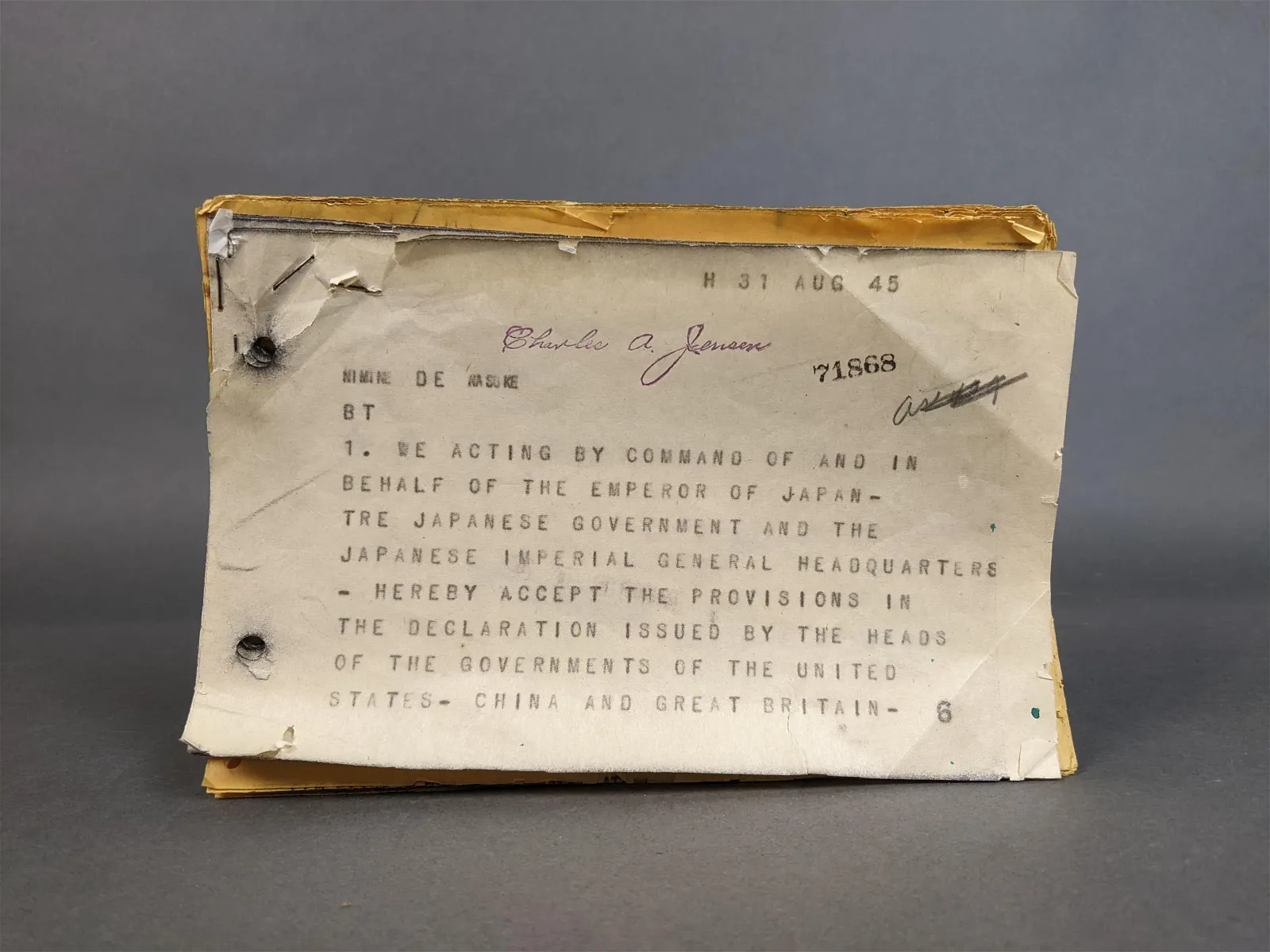
1945 draft of Japanese ‘Instrument of Surrender’ comprising WWII communications cables and auxiliary documents leads Quinn’s July 16 Rare Book Auction

Japanese Instrument of Surrender

Also featured: 1803 first edition ‘Reflections on the Cession of Louisiana to the United States,’ extolling benefits of Louisiana Purchase and suggesting the new territory be used as a colony for freed slaves

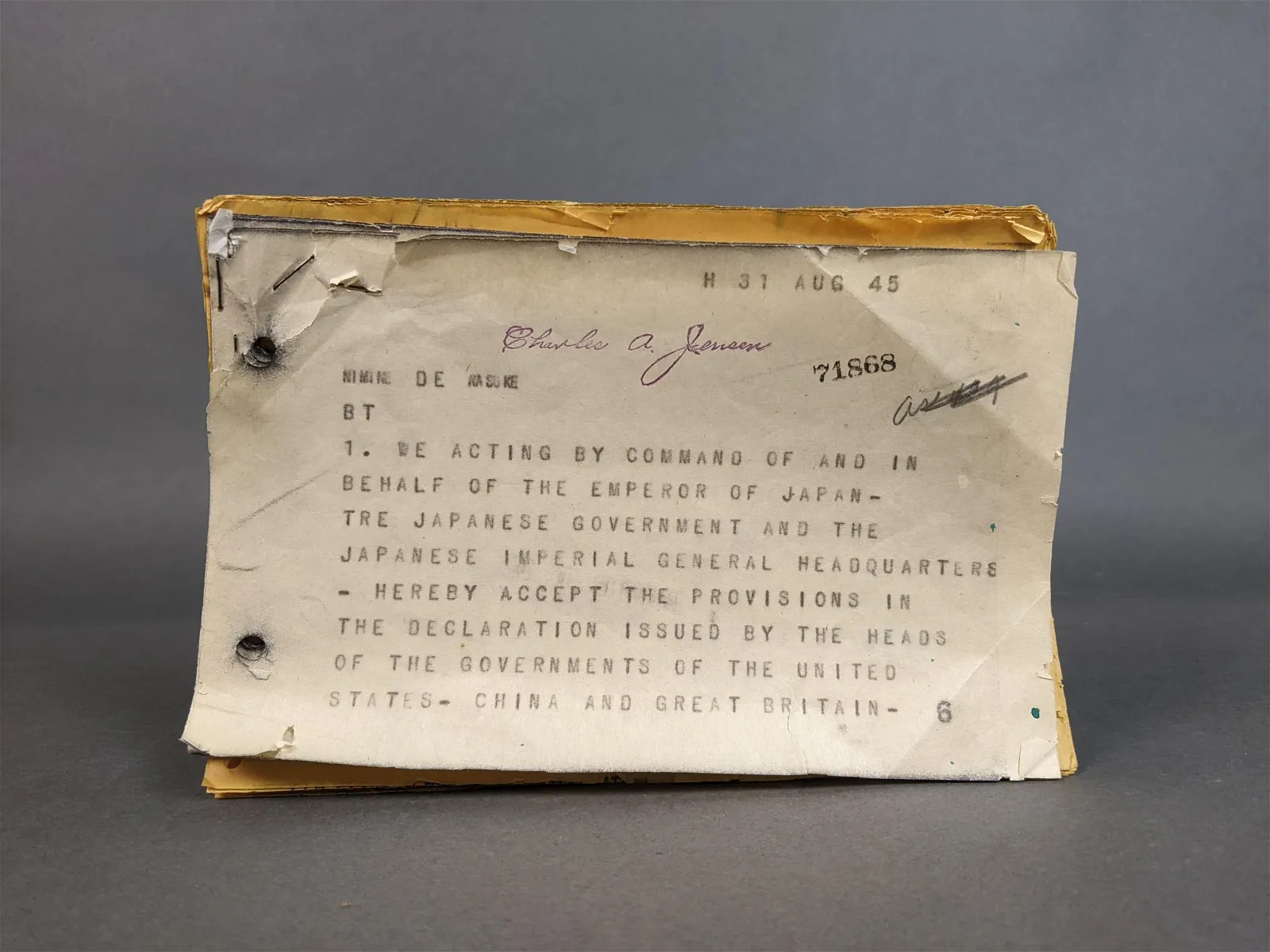
First extant draft copy of the Japanese ‘Instrument of Surrender’ in English, dated ‘Aug. 31, 1945’ and stamped ‘1945 AUG 31 1 20,’ prior to the official surrender ceremony aboard the ‘USS Missouri’ in Tokyo Bay, Japan, on Sept. 2, 1945. Approximately 85% compatible with the document actually signed at the surrender summit. Draft’s 23 pages are raw cables from messages transmitted from the Pacific Front to the Communications Intelligence Organization. No examples of an early draft of the Japanese ‘Instrument of Surrender’ are held either in institutional collections or the National Archives. Provenance: Descendants of Charles A. Jensen, (1916-2007), who served during World War II in the US Navy in Communications Intelligence, receiving incoming encrypted Japanese messages; and whose name is stamped on each leaf of the auction document. Estimate: $2,000-$4,000

FALLS CHURCH, Va. – On July 16, Quinn’s Auction Galleries of northern Virginia will present 226 high-quality lots at their Summer Rare Book Auction with a selection that includes signed books, first editions, American manuscripts, fine bindings and much more. The top historical highlight is an August 31, 1945 dated draft of the Japanese Instrument of Surrender, whose final iteration was signed aboard the USS Missouri in Tokyo Bay on September 2, 1945. 

The draft is essentially a collection of 23 raw cables, including several Japanese communiques, dated “Aug. 31, 1945” and stamped “1945 AUG 31 1 20.” The cumulative verbiage is approximately 85% compatible with the final surrender document that was signed by General Douglas MacArthur, Admiral Chester Nimitz, British Admiral Bruce Fraser, General Philippe LeClerc of France, and other Allies; as well as Japanese Foreign Minister Maoru Shigemisu and General Yoshijiro Umezu. 

The cables were transmitted from the Pacific Front to the Communications Intelligence Organization and, upon receipt, were stamped in purple with the name of Charles A Jensen (1916-2007). A US Navy cryptographer who worked in Communications Intelligence during World War II, Jensen was tasked with receiving and working on incoming wires. 

Along with the cables, the draft includes additional documents that detail the progression of the surrender and the MacArthur delegation’s arrival preparations. One document, dated August 24, 1945, advises that the impending Tropical Storm Grace (noted as “Typhoon” in the communique) might delay the Supreme Command of the Allied Powers’ arrival to Tokyo from Manila. Another document, received and partially transposed from code, shows the agreement of the Government of Japan, using their delegates in Manila, to hand over information about POW camps.

After the war ended, Ensign Charles A Jensen (later promoted to lieutenant) rescued and retained the draft, which very likely would have been discarded and lost forever, had he not recognized its historical importance and taken the initiative to save it. No other examples of an early draft of the Japanese Instrument of Surrender are known to exist, either in institutional collections or the National Archives. The draft comes to auction at Quinn’s with provenance from Jensen’s descendants and is offered with a pre-sale estimate of $2,000-$4,000.

Another significant auction highlight is a first edition, first series octavo publication by Sylvestris (nom de plume of noted abolitionist St. George Tucker) titled Reflections on the Cession of Louisiana to the United States. Published in 1803 by Samuel Harrison Smith, Washington City, the 27-page pamphlet is dated “August 20, 1803” on its final text page. The essay extolls the benefits of the Louisiana Purchase, sympathetically suggesting the land be used as a colony for emancipated slaves, as the climate would be “favorable for the African constitution.” He goes on to caution that emigration to the new territory should be restricted, so as not to compromise the existing population of the eastern seaboard. The author also recommends, rather prophetically, that Congress acquire from Spain a portion of West Florida for settlement by Native Americans. Retaining its original wraps, Reflections on the Cession of Louisiana to the United States is expected to make $3,000-$5,000 at auction. 

One of the earliest natural history publications to incorporate hand-colored lithographic illustrations is William Swainson’s Zoological Illustrations or Original Figures and Descriptions of New, Rare, or Interesting Animals, Selected Chiefly from the classes of Ornithology, Entomoloby, and Conchology, and Arranged on the Principles of Cuvier and Other Modern Zoologists. Quinn’s is pleased to offer a first edition, first series octavo edition of the title, published 1820-23 by Baldwin, Cradock and Joy in London. Swainson, who embraced the then-revolutionary art of lithography at the suggestion of his friend William Leach, Head of Zoology at The British Museum, would eventually earn acclaim as one of the finest natural history artists of his time. The estimate for this lot is $400-$600

Two other first editions of special note are Walter Scott’s Waverley; or ’Tis Sixty Years Since, the “archetype of the historical novel” published in 1814 by Archibald Constable and Co., London; and E.E. Cummings’ W [Viva: Seventy New Poems], which is No. 46 of 95 copies and signed and inscribed to a theater critic by the author. It was published in 1931 by Horace Liveright, New York, has its original publisher’s boards and comes in its original slipcase. An individual estimate of $400-$600 applies to both the Scott and Cummings lots.

The nicely varied auction also includes a complete bound set of the 1853-54 Pacific Railroad Survey ($800-$1,200), an exceptional copy of Adventures of Huckleberry Finn in an early state ($2,000-$3,000), several Persian and Islamic illuminated leaves, several Civil War letters, and other ephemera of interest to Americana collectors. There are also several signed books (a cased trilogy by John Dos Passos, $300-$500; three titles by Robert Frost, and two copies of The Spirit of St. Louis by Charles Lindbergh, $400-$600 and $300-$500, respectively). Presidential signatures include a Herbert Hoover-signed 1934 first edition of The Challenge to Liberty, $100-$200; and three documents signed by Woodrow Wilson ($300-$500 each).
Quinn’s Friday, July 16, 2024 Summer Rare Book Auction will start at 12 noon EDT. Preview July 2-3 and 8-15 from 10:30-5pm. No appointment is needed. All bidding will be remote, either by phone, absentee online through Quinn’s website www.quinnsauction.com, or live via the Internet through LiveAuctioneers or Invaluable. For additional information about any item in the auction or to discuss a future consignment, call Andrew Shifler at Quinn’s, 703-532-5632 ext. 576; or email [email protected]. Visit Quinn’s online at www.quinnsauction.com.

AuctionDaily has the latest news from across the industry. Visit our news channel for more.

Motorheads: Get your kicks at Morphy’s high-octane July 11 Automobilia & Petroliana Auction

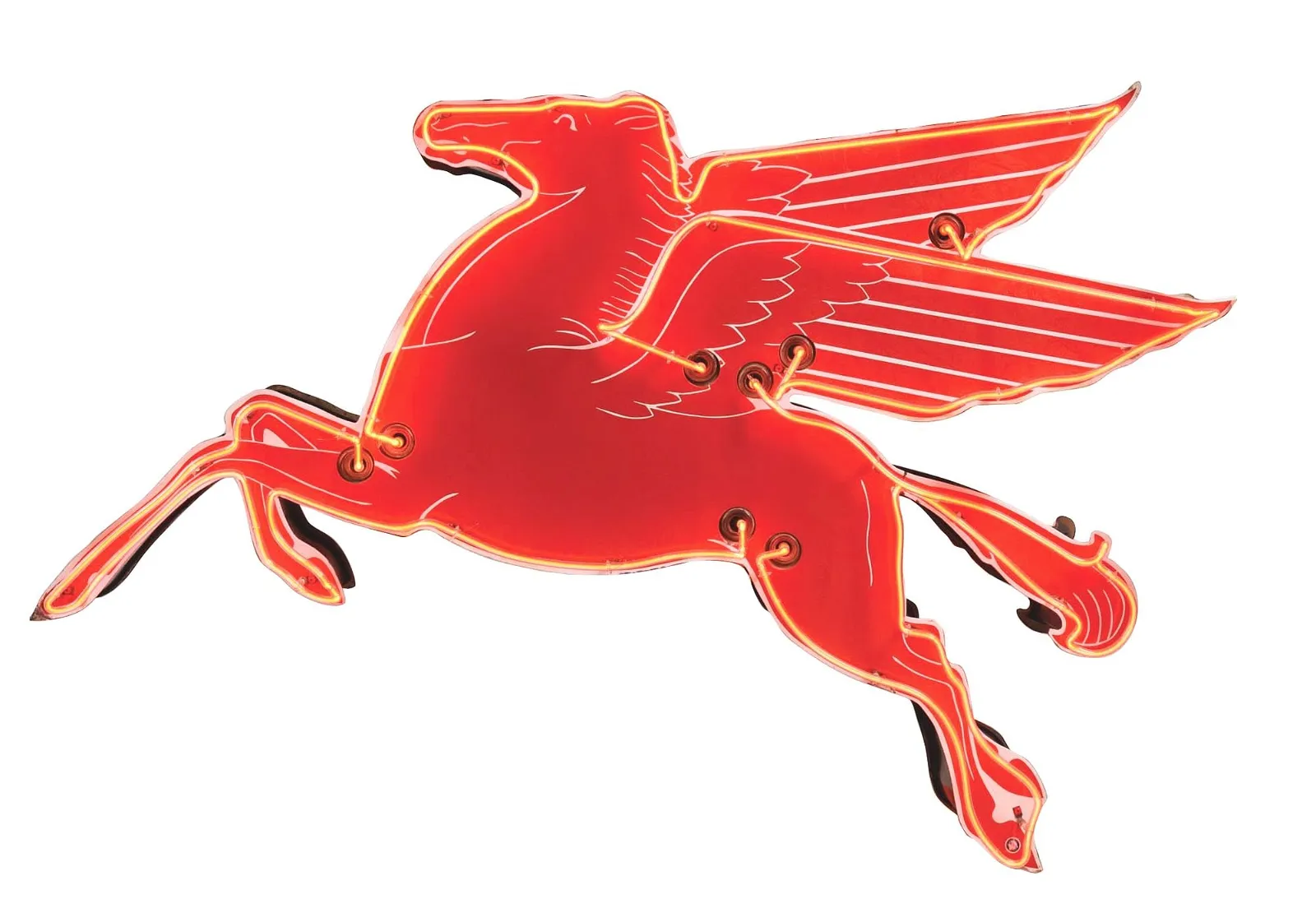
Outstanding Mobil Pegasus rotator neon sign comprised of two single-sided figural porcelain neon signs. Lights up beautifully around the entire perimeter of the sign and on the iconic flying horse’s wings. AGS-certified and graded 83/84. Size: 72in x 15½in x 85in. Estimate: $50,000-$100,000

Featured: Mobil Pegasus porcelain neon sign, Musgo, Aerio 70, Sunset De Luxe and Gilmore ‘Lion’ gas pump globes; service station rarities, plus soda pop signs and vending machines 

Outstanding Mobil Pegasus rotator neon sign comprised of two single-sided figural porcelain neon signs. Lights up beautifully around the entire perimeter of the sign and on the iconic flying horse’s wings. AGS-certified and graded 83/84. Size: 72in x 15½in x 85in. Estimate: $50,000-$100,000

DENVER, Pa. – America is a land of cars, and from coast to coast there are diehard motorheads – collectors of auto, gasoline and oil-related advertising – who consider Morphy’s exciting Automobilia & Petroliana auctions to be their own personal Disneyland. They’re already checking out the Pennsylvania company’s next tempting array of motoring-related collectibles, which will roll across the auction block on Thursday, July 11. The 650-lot selection features choice advertising signs, rare gas pumps and globes; oil cans, and eye-catching display pieces. The sale also includes the types of colorful soda pop signs and wall clocks that would have adorned roadside diners back when Route 66 was the way westward-bound drivers “got their kicks.” 

The star of the show is an absolutely outstanding Mobil Pegasus porcelain rotator neon sign sized 72 by 85 inches, and 15½ inches deep. Comprised of two single-sided figural porcelain neon signs, it lights up beautifully around its entire perimeter as well as on the mythological flying horse’s wings. Everyone knows the Mobil Pegasus, and this ready-to-hang sign shows the popular brand mascot at its very best. Importantly, it is AGS-certified and graded 83/84 (per side). Strong competition and a winning bid of $50,000-$100,000 are expected on auction day. 

Ask any petroliana collector which rare sign they would most love to acquire and there’s a high likelihood they would say the circa-1940s Harbor Petroleum Products sign with the appealing seaplane-on-water graphic. Morphy’s is pleased to offer an exceptional example of the single-sided porcelain sign in 8.75 condition. Its unbeatable color palette combines Pacific blue, orange and yellow, with the seaplane presented in an oval cartouche as though it were a fine painting. Exhibiting high gloss, this sign is described in Morphy’s catalog as “exceptional” and “hard to upgrade.” The pre-sale estimate is set at $40,000-$80,000.

No collection of gas pump globes, no matter how advanced, would be considered complete without a classic Musgo Gasoline (Muskegon Oil Co., Muskegon, Michigan) “Michigans Mile Maker” globe. A beautiful specimen of this gas-station treasure will be offered on July 11 at Morphy’s. Measuring 16 inches high, the one-piece baked globe is distinguished by its orange, sky blue and red bust-portrait of a Native American chief in profile. It has a “September 10th, 1929” date stamp at the interior and a “Made In USA” stamp on its collar. AGS-certified and graded 93, it is one of the highest-graded examples of its type ever to be offered for public sale. Estimate: $20,000-$30,000

Another tempting lot is the rare and complete 13.5-inch gas pump globe for Aerio 70 Gasoline (Gregory Independent Oil Co., Gregory, South Dakota). It even retains its original graphic shipping box – marked “Aerio” – from Cincinnati Advertising Products. Each of the lenses above the original wide milk-glass body is marked “Aerio 70” and displays a wonderful red, blue and green airplane graphic. In very clean, original condition, its sides are scored 96 and 94, respectively. Estimate: $15,000-$25,000 

As visuals go, a circa-1920s single-sided 15-inch gas pump globe lens for “Gilmore Blu-Green Gasoline” (Gilmore Oil Co., Los Angeles, California) is unbeatable. It presents as the work of an accomplished artist with its highly-detailed six-color graphic of a roaring lion. Very clean throughout, its condition-score is 95. This highly sought-after sign is hard to fault and carries a pre-sale estimate of $12,000-$20,000.

According to Morphy’s Automobilia & Petroliana Department Head John Mihovetz, a circa-1930s gas pump globe lens for Sunset De Luxe Gasoline (Sunset Oil Co., Los Angeles, California) has not appeared at a public sale for more than a decade. Morphy’s will end the drought on July 11 with an example that boasts outstanding condition, colors and gloss. Likewise, its lettering and graphic of an orange sun setting over the ocean are clean and attractive. Measuring 15 inches in diameter and condition-scored 91, it is entered with a $10,000-$20,000 estimate.

Another California rarity is a Signal Products (Signal Oil Co., Los Angeles) single-sided 15-inch (diameter) gas pump globe lens with a pop-art graphic of a street light that says “GO.” Extremely clean with brilliant color and gloss, it is condition-scored 95, with an auction catalog notation stating it would be “tough to upgrade.” Estimate: $10,000-$20,000

A flurry of motoring activity is depicted on a huge single-sided cloth banner that advertises “MICHELIN Tires and Tubes.” Maker-marked “Sweeney Litho, Belleville, New Jersey,” it portrays a mountainside road with bumper-to-bumper auto traffic, high above a cityscape. Along the entire bottom width of the sign are 12 Bibendum (Michelin’s mascot) figures, each rolling a tire and posed slightly different to the rest. At the crest of the road on each side are advertising signs that read “MICHELIN Ring Shaped Tubes – LAST LONGER” and “MICHELIN Comfort Balloons,” respectively. In excellent condition overall, it is described by John Mihovetz as “the rarest of the rare.” With a framed size of 120 inches by 40.75 inches, it is AGS-certified “Authentic” and estimated at $10,000-$20,000.

A second cloth service station banner that is worthy of special mention is a 1920s advertisement for “Red Hat Motor Oil,” with the patriotic Red Hat “Approved” graphic and the slogan “Uniform – Dependable.” AGS-certified “Authentic,” the striking red, white and blue banner has a framed size of 62.5 inches by 27.5 inches. Estimate: $6,000-$12,000

Possibly the only known example of its type, a Warrior Petroleum single-sided circular two-piece plywood sign is magnificently hand-painted with the image of a Native American wearing a full feather bonnet and beaded necklace. Its red trim and hand-lettered words “WARRIOR PETROLEUM” also attest to a high standard of artistry. In excellent original condition with a nice patina, this 90-inch (diameter) sign has been AGS-certified “Authentic.” Its pre-sale estimate is $7,500-$15,000.

The Thursday, July 11, 2024 Automobilia & Petroliana Auction, with additional transportation antiques, soda pop signage and vending machines, will be held live at Morphy’s gallery, 2000 N. Reading Rd., Denver, PA 17517, starting at 9 a.m. Eastern Time. All forms of bidding will be available, including absentee, by phone and live via the Internet through Morphy Live. For questions pertaining to any item in the auction, to reserve a phone line or to discuss consigning to a future Automobilia & Petroliana auction at Morphy’s, call 877-968-8880, email [email protected]. Visit Morphy’s online at www.morphyauctions.com.

For more information about upcoming events, checkout AuctionDaily’s auction previews.

Premier treasures of European royalty crown the luxe selection awaiting collectors at Apollo’s July 13-14 Fine Ancient Art, Antiquities & Militaria Auction

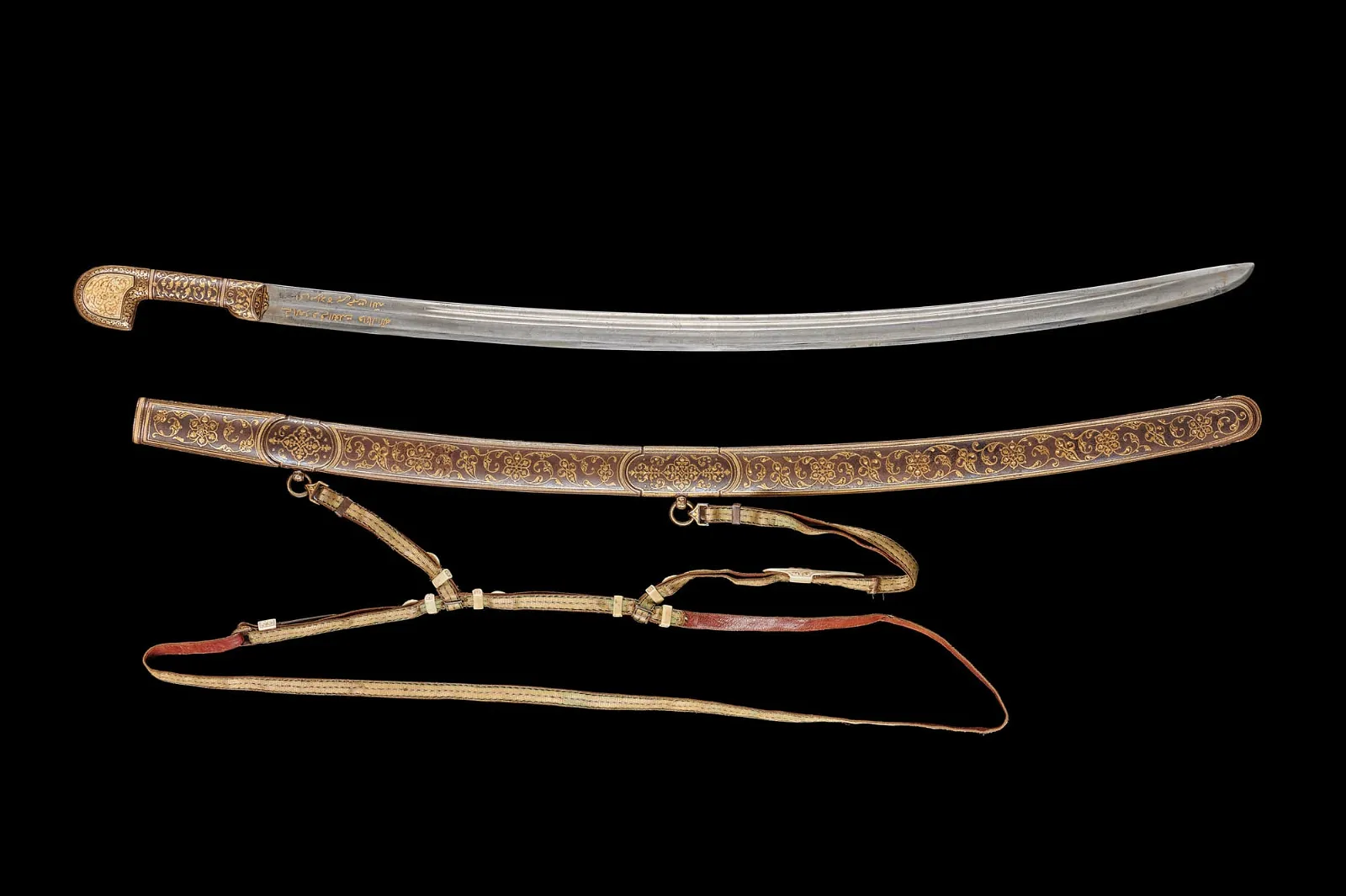
Extremely fine-quality Caucasian shashka that belonged to Nicholas II, Tsar of Russia, given to him when he was Tsesarevich (heir apparent). Research suggests it was presented to Nicholas during a tour of the Caucasus with his father Tsar Alexander III, in 1888. Arabic inscription in gold on blade near hilt: ‘(M)ay the dominance of the owner of this sword grow, and his life, and his greatness, and may Allah bless his family, and he will achieve his goal.’ Monogrammed with the letters ‘N’ and ‘A’ (for Nicholas Alexandrovich), which are surrounded by a golden laurel and surmounted by the Imperial Russian crown. Wonderfully decorated scabbard with calligraphic Arabic inscription that translates to ‘Abdullah worked,’ the equivalent of a European maker’s mark. Only royal sword ever offered for public sale. Provenance: Property of a European collector; ex Eugene Mollo collection, Switzerland. Opening bid: £1,200,000 ($1,516,300)

Featured: Inscribed and gilded Caucasian shashka of Tsar Nicholas II of Russia, the only royal sword every offered for sale; circa-1509 suit of armor by Pompeo Della Cesa, armorer to Philip II of Spain

Extremely fine-quality Caucasian shashka that belonged to Nicholas II, Tsar of Russia, given to him when he was Tsesarevich (heir apparent). Research suggests it was presented to Nicholas during a tour of the Caucasus with his father Tsar Alexander III, in 1888. Arabic inscription in gold on blade near hilt: ‘(M)ay the dominance of the owner of this sword grow, and his life, and his greatness, and may Allah bless his family, and he will achieve his goal.’ Monogrammed with the letters ‘N’ and ‘A’ (for Nicholas Alexandrovich), which are surrounded by a golden laurel and surmounted by the Imperial Russian crown. Wonderfully decorated scabbard with calligraphic Arabic inscription that translates to ‘Abdullah worked,’ the equivalent of a European maker’s mark. Only royal sword ever offered for public sale. Provenance: Property of a European collector; ex Eugene Mollo collection, Switzerland. Opening bid: £1,200,000 ($1,516,300)

LONDON – Central London’s vibrant Fitzrovia neighborhood – an urban village with a bohemian history – is home to many celebrities and art-centric businesses, including Apollo Art Auctions. Antiquities aficionados and militaria buffs flock to Apollo’s sales of ancient art and material culture to view, bid on and hopefully acquire some of history’s most fascinating artifacts. Apollo’s next fully-curated, no-reserve event, an Ancient Art, Antiquities and Militaria Auction, will take place on Saturday and Sunday, July 13-14 and features a wealth of exquisite and well-provenanced works that chronicle the world’s most influential civilizations. In addition to in-house bidding, Apollo welcomes absentee, phone and Internet live bidding through LiveAuctioneers.

“We’re delighted that our next auction includes antiquities from so many well-established collections, such as The Prince Collection,” said Apollo Art Auctions’ director and principal auctioneer, Dr Ivan Bonchev (PhD, University of Oxford). “A very high standard was set for this sale. Each art object and ancient military or cultural relic was scrupulously curated and researched during the cataloging process to ensure they were described with as much background information as possible. We always keep in mind that our catalogs are essentially the next link in the ongoing historical record of every item we handle.” 

In addition to The Prince Collection, there are pieces from esteemed members of the Egyptian Exploration Society (EES), which was founded in 1882 by Amelia Edwards and Reginald Stuart Poole; and Jean-Paul Barbier Mueller (1930-2016), a Swiss collector who was known for his extensive museum collection of primitive arts. Also, the auction showcases an extensive glass collection spanning the Greek to Byzantine periods, with such notable provenances as the Constable-Maxwell collection of Roman glass. And last but certainly not least, Apollo Art Auctions is honored to offer selected antiques and antiquities from the Wittelsbach family collection, which represents centuries of Bavarian history and influence. 

Two absolutely unique productions lead the ancient and antique armor category. First, there is an extremely fine-quality Caucasian shashka given to Nicholas II, Tsar of Russia, when he was Tsesarevich (heir apparent). Research suggests the saber was presented to Nicholas during a tour of the Caucasus with his father Tsar Alexander III, in 1888. An Arabic inscription in gold on the blade translates to: (M)ay the dominance of the owner of this sword grow, and his life, and his greatness, and may Allah bless his family, and he will achieve his goal. It is also monogrammed with the letters “N” and “A” (for Nicholas Alexandrovich), surrounded by a golden laurel and surmounted by the Imperial Russian crown. Its wonderfully-decorated scabbard bears a calligraphic Arabic inscription that would be the equivalent of a European maker’s mark. Translated, it says “Abdullah worked.” Held in consecutive European private collections, including the Eugene Mollo collection (Switzerland), it is the first royal sword ever to be offered for public sale. It requires an opening bid of £1,200,000 ($1,516,300).

The second armor highlight is a breathtaking circa-1590 AD Italian etched and gilded half-suit of armor created by Pompeo Della Cesa, armorer to Philip II of Spain and many European dukes. The central boss on its breastplate features an image of Infant Christ in the arms of the Virgin Mary, under which appears “POMP,” the celebrated Milanese armorer’s signature. Weighing 14.4kg (31lbs 12oz), this suit would have been made for an infantryman. The illustrious line of provenance most recently includes The Prince Collection and the 2009 Galerie Fischer (Lucerne, Switzerland) auction of the Schulthess family collection. Its prior ownership can be traced back as far as the “Duc de Dino Collection,” which was cataloged by the Baron de Cosson in 1901 and acquired by the Metropolitan Museum of Art in 1904. The opening bid is £500,000 ($631,792).

Traveling back through the millennia, the auction includes spectacular Egyptian antiquities, including an anthropomorphic wooden sarcophagus lid from the Late Period, 26th Dynasty, circa 664-525 BC. Hand-carved from cedar and covered in layers of bitumen, its reverse side is hollow to fit the form of the deceased, and has rosette ornamentation. Its provenance includes a private UK collection, acquisition on the Dutch art market; and the collection of Walter Vanhaerents, who obtained it at a 1986 auction at Nouveau Drouot. A catalog from that sale accompanies the lot, which will open at £10,000 ($12,636)

Egyptian sandstone reliefs proved extremely popular with collectors in Apollo’s April 27-28 auction. This time around, there could be a similar level of interest in an Egyptian limestone relief, New Kingdom, 18th Dynasty, circa 1539-1292 BC, bearing cartouches of Akhenaten and Aten. It is similar to an example in the collection of the Metropolitan Museum of Art. Most recently held in The Prince Collection, it comes to auction with an opening bid of £3,000 ($3,791).

Next in the timeline is a huge Attic red-figure krater depicting satyrs and maenads. It dates to circa 500-400 BC, with a possible attribution to the Onesimos painter, an Athenian artist known for his realistically-rendered, active figures; scenes from mythology, and tableaux drawn from daily life. Sized 480mm by 445mm (18.9in by 17.52in), the vessel comes from successive UK private collections going back to the 1980s. Opening bid: £5,000 ($6,318)

Ancient Roman glass enjoys the attention of a legion of followers at Apollo’s auctions. It’s not likely that many would overlook a circa 100 BC-100 AD cobalt-blue ribbed glass bowl entered in the July sale, owing to its vibrant silvery and rainbow-colored iridescence on both the interior and exterior surfaces. It has a shallow phiale-like form with attractive radiating ribs rising from the base and terminating just below the bowl’s smooth rim. A truly beautiful production, it will open with an £8,000 ($10,109) bid. 

Another fine example of Roman decorative art is a Sidonian pyxis – a toilette box for cosmetics, trinkets or jewelry. Its octagonal sides display pronounced moldings that depict altars and various other embellishments. Such containers drew influence from similar Greek productions, which sometimes were used to hold incense or medicines dispensed by physicians. With provenance from The Prince Collection, the pyxis in Apollo’s auction is accompanied by a historical report from Alessandro Neri, an international cultural heritage expert based in Florence, Italy. Opening bid: £8,000 ($10,109)

A substantial Hellenistic gold necklace, circa 300-100 BC, weighs 84g (2.96oz) and is formed of four gold wires braided into a “rope” pattern and twisted in a helical manner. Very finely executed, it has Intricately decorated terminals and retains its original gold clasp. Its provenance includes the private collection of Mr. R. Unger; a London gallery; and acquisition in the 1980s on the UK art market. The necklace comes with an authentication report by ancient jewelry specialist Sami Fortune. Opening bid: £5,000 ($6,328)

A Byzantine solid gold cameo ring, circa 500-800 AD, has a banded oval loop and shoulders adorned with a geometric motif. Its gold bezel secures a square banded agate cameo that depicts the Byzantine symbol of the “CHI-RO” inside a round laurel crown. Formerly the property of a London gallery, it was acquired on the Monaco art market and was part of a French collection in the 1970s. Opening bid: £4,000 ($5,054)

To please the many collectors of ancient Chinese figural pottery, Apollo has rounded up a veritable menagerie of Tang and Han Dynasty animals for its July auction. Among the top choices is a circa 618-907 AD Tang terracotta horse, molded in a naturalistic manner and painted with red pigments. The handsome equine measures 660mm by 620mm (26in by 24.4in) and is depicted with a saddle cloth and seat on its back. The figure has been precisely dated via TL testing performed by Ralf Kotalla and will convey with the testing report as well as a historical report from Alessandro Neri. Opening bid: £2,000 ($2,527)
Apollo Art Auctions’ Saturday/Sunday, July 13-14, 2024 no-reserve sale will be held live at the company’s saleroom located at 63/64 Margaret St., London W1W. The auction will start at 8 a.m. US Eastern Time/1 p.m. GMT. All remote forms of bidding will be available, including absentee or live via the Internet through LiveAuctioneers. The company accepts payments in GBP, USD and EUR; and ships worldwide. All packing is handled by white-glove specialists in-house. Questions: Please call +44 7424 994167 or email [email protected]. Visit Apollo Art Auctions online at www.apolloauctions.com

Looking for more press releases? Visit Auction Daily for the latest updates.

Turquin Teams Up With Stéphane Pinta and The de Bayser Family

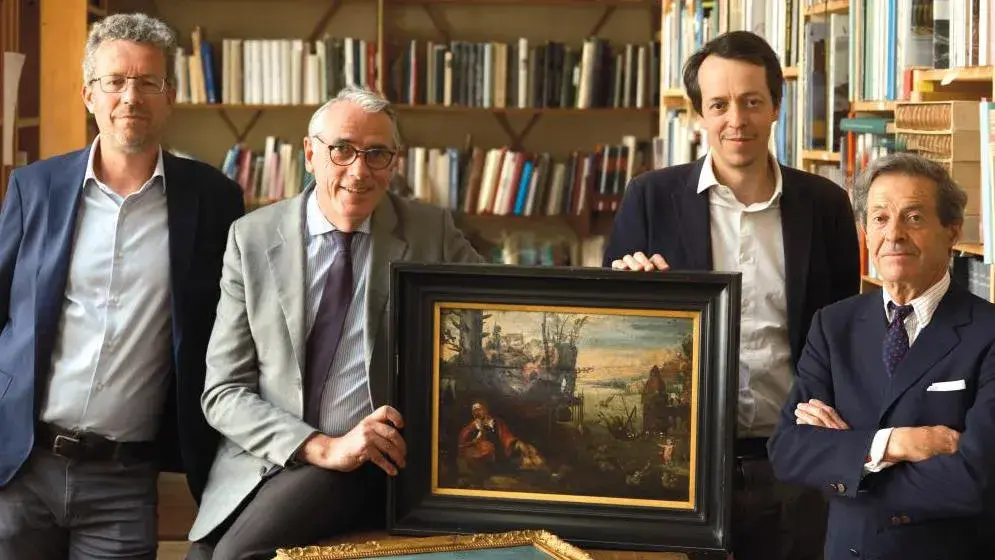
Left to right Matthieu de Bayser, Stéphane Pinta, Augustin de Bayser and Éric Turquin PHOTO Henri du Cray

Eighteen-year Turquin veteran Stéphane Pinta and Patrick, Louis, Matthieu and Augustin de Bayser have bought stakes in the expertise firm to ensure its long-term future. Éric Turquin answered our questions.

Left to right Matthieu de Bayser, Stéphane Pinta, Augustin de Bayser and Éric Turquin
PHOTO Henri du Cray
Left to right: Matthieu de Bayser, Stéphane Pinta, Augustin de Bayser and Éric Turquin
PHOTO Henri du Cray

Why did you sell stakes in the company to Stéphane Pinta and the de Bayser family?
There’s an old saying: “If you want to walk fast, walk alone. But if you want to walk far, walk together.” I’ve always needed others. When Stéphane or Philippine Motais in Narbonne find a painting in Toulouse, it gives me more pleasure than if I had found it myself. Just like when Jérôme Montcouquiol makes an attribution. It increases the possibilities.

So you’re not leaving the business?
Quite the contrary, but it would be inconceivable to jeopardize over 350 auctioneers’ studies if anything happened to me. If I died today, none of our clients would feel the consequences, and it’s essential to keep our partners’ trust. I owe everything to the auctioneers, especially that. I’ve always introduced Stéphane as my partner. After 18 years with me, when he pitched in to modernize our working tools while making a name for himself in the field of expertise with his major discoveries, it seemed natural for him to play a key role in our future by becoming associate director. As for the de Baysers, their youth, the proximity of our offices, the sharing of our documentation and the long friendship that binds me to their history through Bruno de Bayser were essential to our discussions with Stéphane, which quite naturally led us to become closer. It was indispensable to preserve our independence, a prerequisite for our business, and we need young people as a matter of renewal. Together we’ve designed a balanced model where none of us holds a majority stake.

Who are Turquin’s future experts?
I’ve had five new trainees every three months for 20 years. I can assure you I won’t run out. I’ll have all the intellectual resources I need.

Expertise and responsibility are the be-all and the end-all.
You have to differentiate between the noun and the adjective. You can have expertise in one field, but being an expert for customs or auctions is an extremely serious matter. In front of a judge, either you’re an expert or you’re not. France has three experts’ organizations. I belong to the largest, the Syndicat français des experts professionnels en œuvres d’art et objets de collection (French association of professional experts in works of art and collectors’ pieces), which brings together 46 specialties and over 142 professionals. We’ve signed a good conduct charter on the basis of which we negotiate an insurance contract for our expertise with a broker. One expert may not carry much weight, but 120 contracts do.


Do you think the profession is under threat?

Yes, because our role as middlemen is relatively expensive. It accounts for 6% of the sales price, so auction houses are tempted to bypass us. Unlike Christie’s and Sotheby’s, which are cutting back their expertise departments at great cost and to the detriment of their image, if La Mer de Glace in Chamonix decides to do without our services from one day to the next it doesn’t owe us any severance pay. It can freely change experts without incurring any costs. However, in return for that 6%, the Mer de Glace auction house can count on the work of 15 specialists dedicated to researching the paintings, attributing them, documenting their history, putting a value on them, exhibiting them before the sale and finding buyers. That’s what allowed Mr. Le Coent de Beaulieu in Senlis, Mr. Cortot in Dijon and Mr. Rouillac in Vendôme to sell paintings worth several million euros based on our research and reputation. Our services enabled them to give Christie’s and Sotheby’s a run for their money.

Why wouldn’t an auctioneer come to you?
I see two trends unfolding. The first, which you might call traditional, involves going straight to a specialist, if there is one, to obtain a certificate and sell the painting without using our services. This is a common practice in modern and contemporary art, where the expert’s role is often less crucial. Recent works, which are usually signed and well documented, pose fewer restoration and authenticity problems. The second trend on the horizon is somewhat related and involves the use of AI, which in the long term could allow auction houses themselves to conduct the expertise, for example on 17th-centuryDutch seascapes, with the risks that entails.

What would you say to the auction houses?
This form of “self-medication” has advantages like speed and lower cost, but also significant risks. To use a metaphor, when a masterpiece, which by definition defies categorization, eludes us it’s like a doctor missing a serious illness. Increasingly often, the trust of a buyer who hasn’t seen the object sets the final price. A work’s value is based not just on its authenticity, but also on the buyer’s ability to place it in a historical or personal context where its full meaning, power and beauty are revealed. I put a lot of emphasis on our profession’s technical aspect, which is necessary but not sufficient. I’m convinced that, for now, AI can neither create nor fully appreciate a work’s beauty, because beauty is a profoundly human criterion and that’s the way it must stay. We don’t just work on oils, panels and copper, but on beauty.

What’s your main weapon in the fight against fakes made by AI?
An in-person examination of a painting is an emotional experience that photography cannot match. AI might be able to compete with the mechanical aspect of the expert’s memory, but the crucial element of our expertise remains our sensitivity enhanced by direct experience, comparisons and the continuous quest for new impressions of art works. Our keen sensitivity is our best asset and our most effective response to the advances of AI and the inevitable increase in counterfeiting it will bring about.

It sounds like Turquin has a bright future ahead of it.
I sincerely think so. More and more European auction houses request our services. Stéphane and I have forged strong partnerships with auction houses in Sweden, Belgium, Spain, the Netherlands, Switzerland, etc. and we’re developing ties with others in Italy. We also work with the Hôtel des Encans in Montreal, although Europe is still our main area of activity. Our goal is to offer our services, including 600,000 photographs and 20,000 books, to auction houses that can’t afford an in-house expert. An expert without adequate documentation is like a surgeon operating without x-rays. I often think of something I heard during my internship at Hôtel Drouot: “It will fetch the right price.” But sometimes a work of art doesn’t fetch the right price when it’s sold, which is unfortunate for the seller, the auctioneer, the expert and France. That’s exactly why I decided to open my business in Paris. We’re here to defend sellers the way lawyers defend their clients.

The outlook seems bright today.
I’ve never been a fan of big maneuvers. I think success in business, expertise and sales is based on agility and mobility. French auctioneers have demonstrated a terrific ability to innovate by developing cutting-edge tools like Drouot Live and Interencheres to adapt to the Internet age. The lockdowns and the transition to all-digital have allowed them to leap five or 10 years forward. The possibility for an owner in Dijon to sell within his legal framework, in his local area, with a trusted auctioneer who’ll achieve the same result as in New York, is a revolution. When a legal problem arises in Dijon, it costs about €1,000 to consult a lawyer. When you have to take legal action in New York, as I have, you’ve got to shell out $50,000 right off the bat. Since the law of December 31, 1992 limiting the number of national treasures to just eight to 10 a year, all specialties combined, came into effect, the State no longer relies on the 1941 law to despoil owners. It took 25 or 30 years to smooth over relations with sellers, but today trust has been fully restored. Bruno Le Maire has perfectly understood the art market’s strategic importance for France’s influence by making a 120-degree turn. The Ministry of the Economy recently sent a strong signal by lowering the VAT to 5.5%, the lowest rate in the European Union, which will turn Paris into a magnet. Once, a shrewd buyer would ship a work found in the provinces or at the Hôtel Drouot to London or New York. Today, it’s the opposite. Every week, I see paintings acquired abroad arriving in Paris for sale here at home. The city is on the right track to once again become the art market capital of the world, a title it already holds on the continent.

Do you still dream of becoming an auctioneer?
I learned everything I know at Drouot, and if I didn’t become an auctioneer it was because I couldn’t afford an auction house. I’m deprived of the pleasure of picking up a painting from an elderly customer, convincing a young woman who visits the gallery that it’s for her, getting her bid and selling it to her. But I still think like an auctioneer.

Richard Kan, Collector of Chinese Monochrome Porcelain

© Richard Kan / COURTESY of Richard Kan

The Chinese monochrome porcelain collection owned by this Hong Kong patron and collector is one of the finest in the world. Part of this remarkable collection is now on show at the Musée National des Arts Asiatiques-Guimet.

© Richard Kan / COURTESY of Richard Kan

The name of your collection is Zhuyuetang. What does it refer to?
I come from a family of tobacco entrepreneurs, established in 1907, when the Qing dynasty was still in power. This poetic name, freely inspired by the composition of the Chinese character “kan”, like my surname, means “Pavilion of Bamboo and the Moon.” It’s a tribute to my forebears.

What was your first purchase?
Although I studied engineering at university, I’ve been fascinated by history and objets d’art since I was a teenager. In 1979, when I was 29, I fell for a Yixing teapot from the Ming dynasty [1368-1644—Ed.] made by potter Chen Chongmei. I still own it. Its unglazed, unadorned aesthetic appealed to me, as I have a liking for simple decoration and form. I paid €2,500 for it—quite a sum at the time.

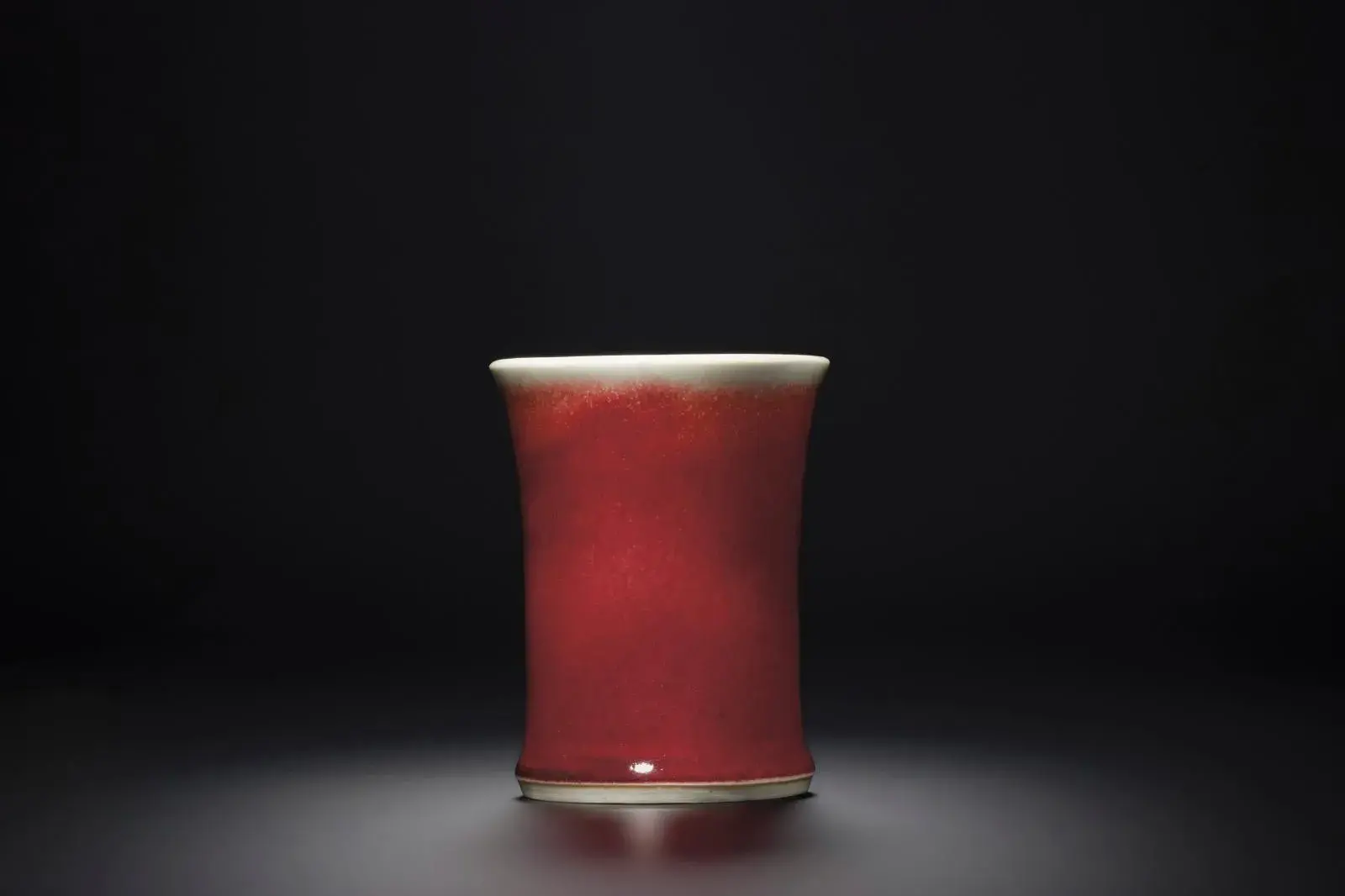
Brush pot, porcelain, oxblood glaze, Jingdezhen kilns, Qing dynasty, Kangxi (1662-1722), h. 12.6 cm/4.7 in, diam 9.8 cm/3.5 in, Zhuyuetang collection.
Richard W.C. Kan's Zhuyuetang Collection/photo: Barry Lui
Brush pot, porcelain, oxblood glaze, Jingdezhen kilns, Qing dynasty, Kangxi (1662-1722), h. 12.6 cm/4.7 in, diam 9.8 cm/3.5 in, Zhuyuetang collection.
Richard W.C. Kan’s Zhuyuetang Collection/photo: Barry Lui

What does your collection include?
It contains around 400 to 500 porcelains in a wide variety of forms: meiping and yuchun vases, ewers, pitongs, and narcissus bowls, to name but a few of these types, in a range of around 50 of the 57 colors formulated by the painter Tang Ying [1682-1756—Ed.], the director of the Jingdezhen Imperial Factory. I bought my finest pieces, including monochromes from the early and middle Ming and early Qing dynasties, between the 1990s and the beginning of the 21st century. I’m particularly fond of “tianbai” (soft white) and “sacrificial red” glazes.

Where do you usually buy your pieces?
At auction, or very occasionally from dealers. In the 1980s, I bought ceramics from the collection of Chinese art dealer and patron Edward T. Chow [1910-1980], and then others—including a large oxblood bowl and a pair of clair-de-lune plates from the Qing dynasty [1644-1911]—belonging to the collection of Hong Kong entrepreneur T. Y. Chao. Over the next decade, I bought several pieces from my good friend Dr. T. T. Tsui, without going through an intermediary. At that time, this collector and philanthropist also donated a great many porcelains to museums in Hong Kong and Europe. Today, I’ve slowed down a bit. About ten years ago, I bought a dozen very fine pieces. In 2023, a bowl from the Song dynasty [960-1279] entered my collection; I bought that at the sale of the American art dealer James J. Lally, in New York. But nothing since then. I’m not a compulsive buyer; I take time to consider.

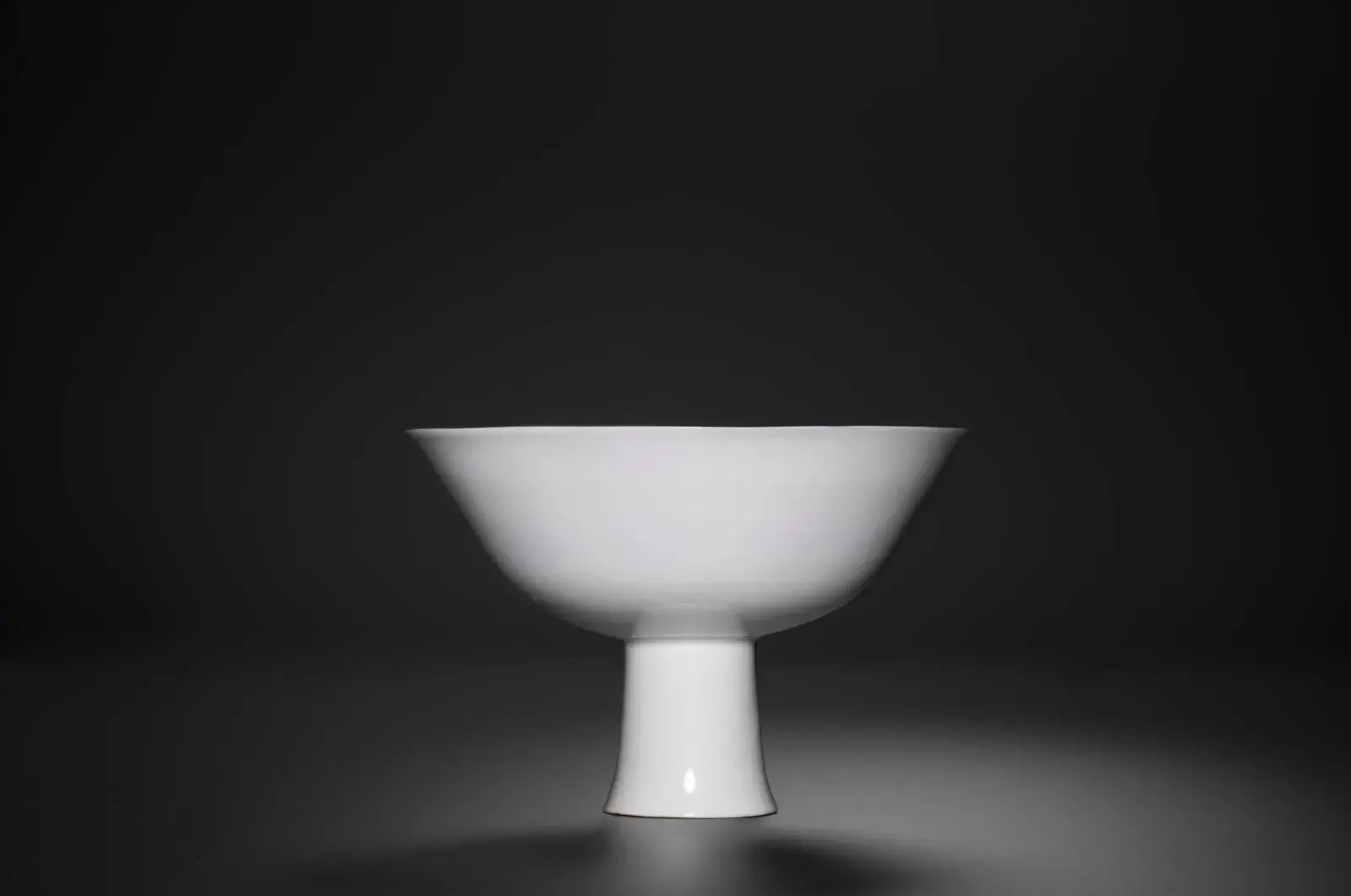
Bowl with foot, porcelain, incised dragon decoration under transparent glaze, Jingdezhen kilns, Ming dynasty, Yongle (1403-1424), h. 9.8 cm/3.5 in, diam. 14.7 cm/5.5 in, Zhuyuetang collection.
Richard W.C. Kan's Zhuyuetang Collection/photo: Barry Lui
Bowl with foot, porcelain, incised dragon decoration under transparent glaze, Jingdezhen kilns, Ming dynasty, Yongle (1403-1424), h. 9.8 cm/3.5 in, diam. 14.7 cm/5.5 in, Zhuyuetang collection.
Richard W.C. Kan’s Zhuyuetang Collection/photo: Barry Lui

Is provenance a decisive factor in your choices?
Even though some of my pieces come from major collections, I mainly rely on my own expertise and experience. In 2012, for example, a porcelain from the J. M. Hu [1911-1995] Collection went for €6 M in Hong Kong. A year later, another of comparable quality, not part of this collection, fetched only €1.5 M. If you have a sufficiently practiced eye, there’s no need to pay more for a similar object. On the other hand, elegance, simplicity, purity of form, and authenticity are crucial criteria for me, that’s for sure.

Do you ever seek expert advice?
Yes: when it comes to more complex pieces, I consult specialists like Professor Peter Y. K. Lam. By “complex”, I mean porcelains made between 1436 and 1464—a period that is less well documented, when not only porcelains with blue-and-white decoration were produced but also extremely rare monochromes. Others, made in Ru kiln in Ruzhou, made their appearance during the Song dynasty, but have only begun attracting scholarly interest in the last decade or so.

What collections could compete with yours?
That’s a difficult question to answer. Every collector has their special favorites: some prefer polychrome porcelain, others blue-and-white, and others monochrome. In terms of quantity, T. T. Tsui’s collection was larger, but it did not only include monochrome porcelains. Perhaps the Tianminlou Collection belonging to Ko Shih Chao [1911-1992], a discerning and generous man, president of the Min Chiu Society in Hong Kong—a group of collectors I have belonged to since 1995. His collection is now managed by his son, and includes monochrome porcelains, but is predominantly blue-and-white. In fact, I think I’m the only one who’s really attracted by monochrome porcelain alone!

How do you see its market?
It’s a peculiar market that is really influenced by the trends of the moment. During the same sale, some pieces can go for very high and others for very low prices. Some extremely rare porcelains, like those from the Song dynasty, can fetch between €10 and €20 M, while more “ordinary” pieces can sell for between €10,000 and €100,000. Imperial pieces from the Kangxi [1661-1772], Yongzheng [1723-1735] and Qianlong [1735-1796] periods are also the most sought-after. Very wealthy buyers, attracted by the rarity of the pieces, are influenced by the glowing assessments of reputable auction houses and art dealers. If it weren’t for them, prices would be lower…

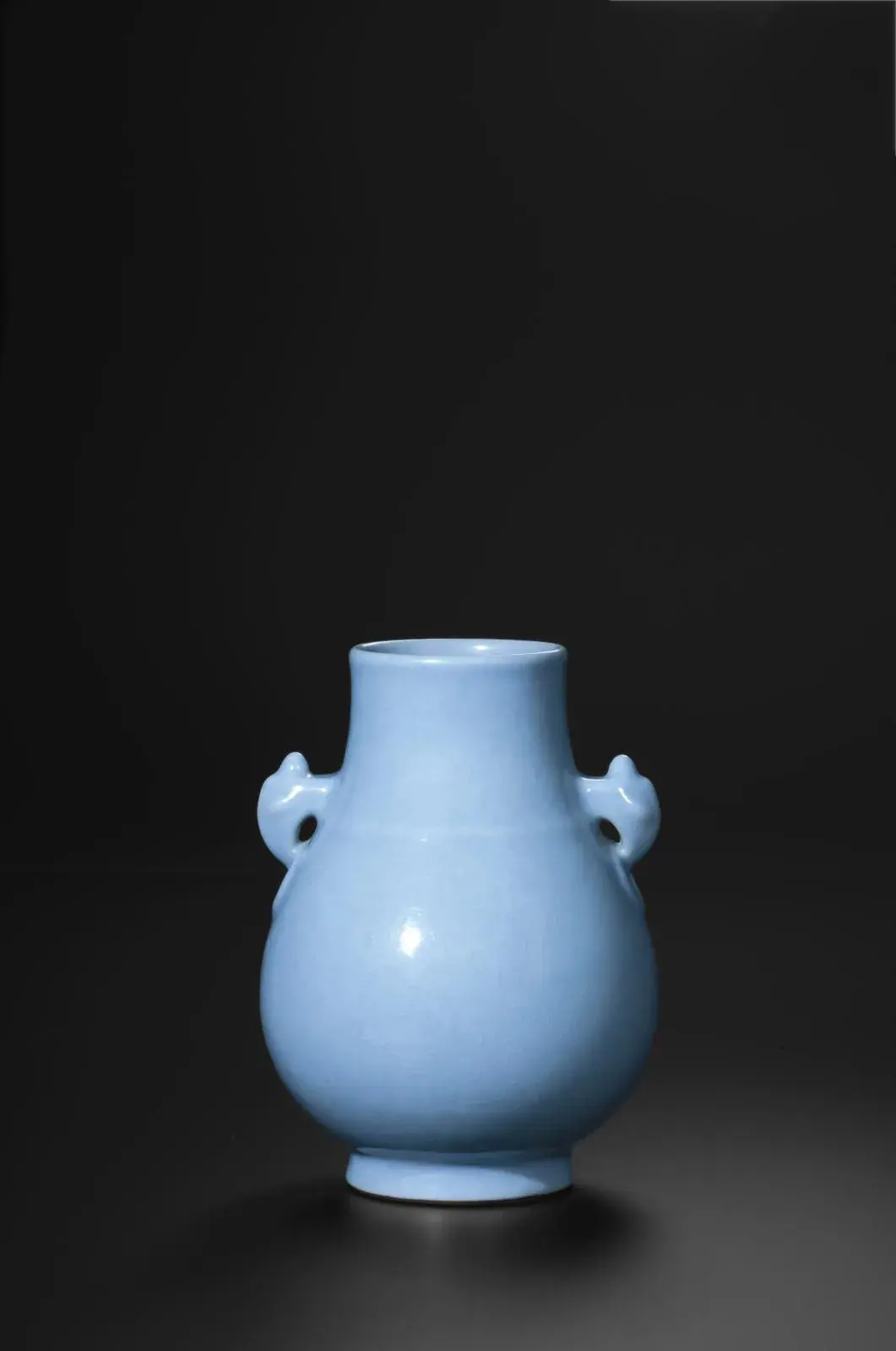
Vase with two handles with monster faces, porcelain, lavender-blue glaze, Jingdezhen kilns, Qing dynasty, Qianlong (1736-1795), h. 16.8 cm/6.3 in, diam. opening 6.7 cm/2.4 in, Zhuyuetang Collection.
Richard W.C. Kan's Zhuyuetang collection/photo: Barry Lui
Vase with two handles with monster faces, porcelain, lavender-blue glaze, Jingdezhen kilns, Qing dynasty, Qianlong (1736-1795), h. 16.8 cm/6.3 in, diam. opening 6.7 cm/2.4 in, Zhuyuetang Collection.
Richard W.C. Kan’s Zhuyuetang collection/photo: Barry Lui

Part of your collection is now on show at the Musée Guimet in Paris. Why is it important to share your collection?
In 2018-2019, I loaned 150 pieces to the Fondation Baur in Geneva for the exhibition “A Thousand Years of Monochromes. Sacred and Profane Tableware of the Emperors”. Now around 250 pieces can be seen at the Musée National des Arts Asiatiques-Guimet, which is an honor for me. Museums like these are valuable platforms for sharing my passion with aficionados from all over the world, and an opportunity to exchange knowledge and expertise.

What is chiefly at stake with a collection like this?
When I came of age, I dreamed of doing something useful and worthwhile in my lifetime. I’m merely the custodian of my pieces. It’s vital to help people understand the importance of monochrome porcelain, through specialized exhibitions and books written by well-informed historians, curators and experts. After the Paris exhibition, I think I’ll have partially achieved my goal.

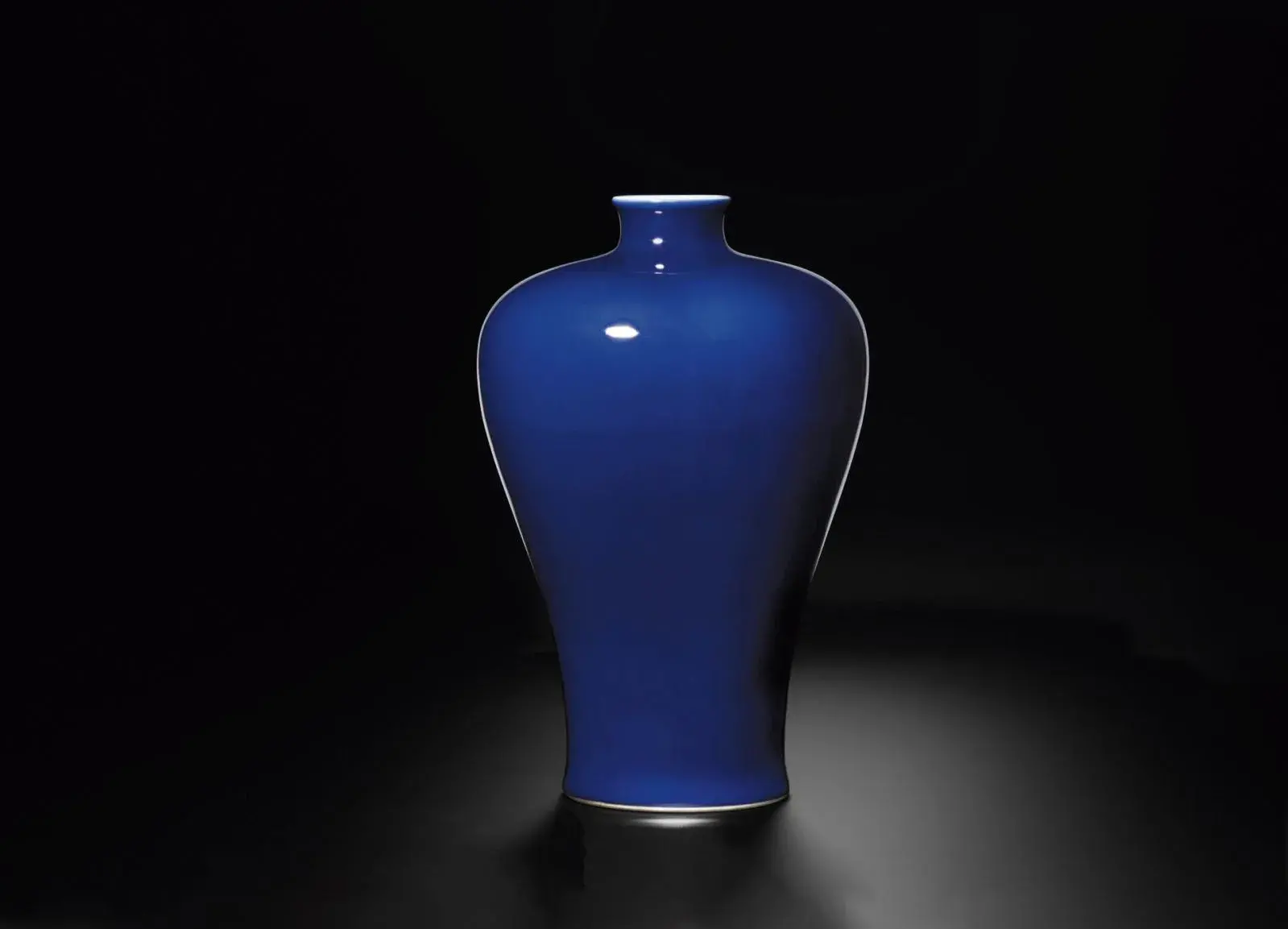
Meiping vase, porcelain, sacrificial blue glaze, Jingdezhen kilns, Qing dynasty, Qianlong, h. 35 cm/13.8 in, diam of base 13.4 cm/5.1 in, Zhuyuetang Collection.
Richard W.C. Kan's Zhuyuetang collection/photo: Barry Lui
Meiping vase, porcelain, sacrificial blue glaze, Jingdezhen kilns, Qing dynasty, Qianlong, h. 35 cm/13.8 in, diam of base 13.4 cm/5.1 in, Zhuyuetang Collection.
Richard W.C. Kan’s Zhuyuetang collection/photo: Barry Lui

In 2022, the “Richard Kan” vase entered the Musée Guimet collections. Why did you support this acquisition?
This porcelain meiping, created during the Yuan dynasty between 1320 and 1350, is the most beautiful blue-and-white piece I’ve ever seen, without a doubt. Its decoration of two phoenixes, a male and a female, is extremely rare. It’s true that the British Museum has a pair of David vases, considered some of the most important blue-and-white porcelains in the world. However, the Guimet vase, undated, is of equally fine quality. I donated this piece, which arrived in France in 1882, after careful consideration. If a billionaire had bought it and decided to take it out of France, it would never have been seen again, and that would have been a disservice to humanity. Support for the acquisition of this masterpiece means that everyone can enjoy it. Works of art should be accessible to everybody; people shouldn’t be selfish.

What do you wish for the future?
That people come to the exhibitions, read the catalogs and learn from them. I also hope that my daughter Isabelle and my granddaughter Jada will be able to tell the story of my collection in turn, when I’m gone.

Hake’s announces January 2025 auction to launch series of sales featuring Jeff Jacob action figure collection, one of the world’s largest and finest of its type

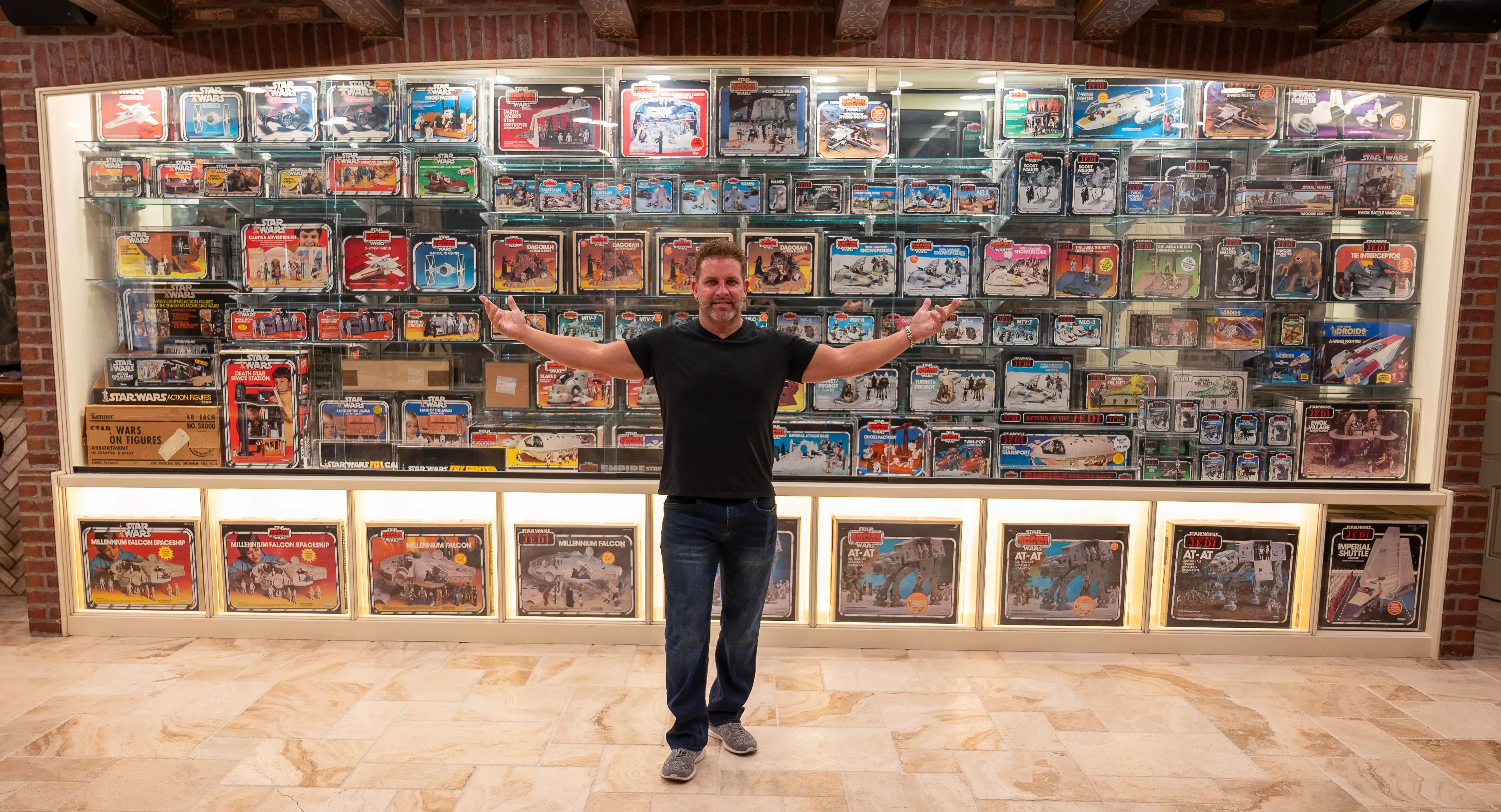
Super-collector Jeff Jacob bids farewell to his spectacular collection of 3,000+ AFA-graded action figures, which Hake’s will present in an auction series that starts in January 2025. Hake’s Auctions image

Holdings include immaculate Star Wars, Transformers, Teenage Mutant Ninja Turtles, GI Joes and Masters of the Universe figures, most AFA-graded, some the highest-graded in the global census 

Super-collector Jeff Jacob bids farewell to his spectacular collection of 3,000+ AFA-graded action figures, which Hake’s will present in an auction series that starts in January 2025. Hake’s Auctions image

YORK, Pa. – Veteran collectors of action figures may think they’ve seen it all, but the team at Hake’s Auctions says wait – there’s more. Much more! Starting in January 2025, the Pennsylvania-based company, which holds numerous world records in pop culture categories, will auction the internationally renowned Jeff Jacob action figure collection. 

Jacob’s 30+ year assemblage comprising more than 3,000 pieces cuts a wide but highly selective swath across the action-figure universe, starting with 1970s Star Wars characters and progressing into the 1980s with premier G.I. Joes, Transformers, Teenage Mutant Ninja Turtles, Masters of the Universe and other productions. Nearly all figures, playsets, vehicles and other related items in the collection are AFA-graded. Most are high grade, and some are the highest-graded examples of their type in the entire AFA Population Report. 

“It is by far the largest and most extensive action figure collection ever to come to auction. Many of the figures have never appeared at auction before; they’ve always been privately owned. As for the collection’s value? It’s in the multimillions,” said Alex Winter, president of Hake’s Auctions.

The fully-illustrated auction catalog exclusively featuring the Jeff Jacob Collection Part I is expected to mail out shortly after New Year’s Day. Simultaneously, a digital version of the catalog will post online. Visit Hake’s website and follow them on social media for auction highlights and updates throughout 2024 and beyond. 

To contact Hake’s, call +1 866-404-9800 (toll-free) or +1 717-434-1600; or email  

 www.hakes.com. Online: https://www.hakes.com/ 

Find more auction world news on AuctionDaily‘s news channel.

Forward, march! Bidders ignored estimates at Quinn’s estate auction of Marine Corps Commandant and Four-Star General Alfred M. Gray Jr’s career mementos

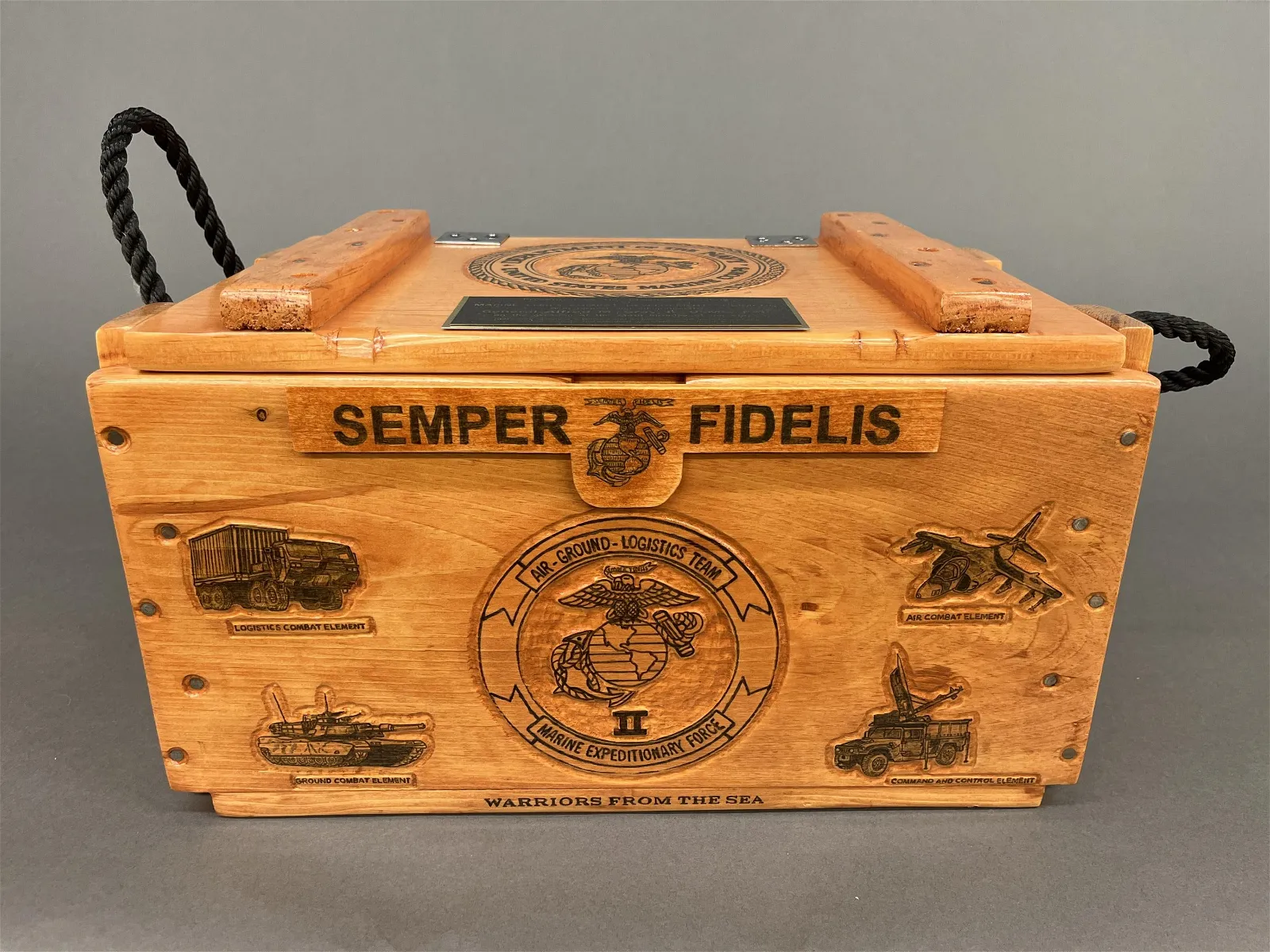
Wood ammunition crate with presentation plaque from ‘Marines & Sailors, Marine Corps Combat Development Command’ to ‘General Alfred M. Gray Jr., USMC Ret’ to commemorate Marine Corps’ 234th birthday. Marine Corps imagery, emblems and the motto ‘SEMPER FIDELIS.’ Provenance: Estate of 29th US Marine Corps Commandant Four-Star General Alfred M. Gray Jr. (1928-2024). Sold for $9,525 against an estimate of $100-$150

Top lots included general’s US Marines ammunition chest, awards, USMC jewelry and watches; campaign desk, mounted bow and arrow gifted by Gray’s Korean counterpart

Wood ammunition crate with presentation plaque from ‘Marines & Sailors, Marine Corps Combat Development Command’ to ‘General Alfred M. Gray Jr., USMC Ret’ to commemorate Marine Corps’ 234th birthday. Marine Corps imagery, emblems and the motto ‘SEMPER FIDELIS.’ Provenance: Estate of 29th US Marine Corps Commandant Four-Star General Alfred M. Gray Jr. (1928-2024). Sold for $9,525 against an estimate of $100-$150
Wood ammunition crate with presentation plaque from ‘Marines & Sailors, Marine Corps Combat Development Command’ to ‘General Alfred M. Gray Jr., USMC Ret’ to commemorate Marine Corps’ 234th birthday. Marine Corps imagery, emblems and the motto ‘SEMPER FIDELIS.’ Provenance: Estate of 29th US Marine Corps Commandant Four-Star General Alfred M. Gray Jr. (1928-2024). Sold for $9,525 against an estimate of $100-$150

FALLS CHURCH, Va. – If anyone exemplified the highest standards of the US Marine Corps, it was the late Alfred M Gray Jr (1928-2024). A highly-decorated four-star general and 29th Commandant of the Corps, Gray forged a distinguished 41-year military career that included courageous wartime duty in both Korea and Vietnam. On June 14, under instruction from the Gray estate, Quinn’s of northern Virginia auctioned the general’s treasured career mementos, awards and art objects in a boutique online sale that totaled $218,948.

The unique contents of the 200-lot event generated tremendous presale buzz and attracted winning bids that consistently exceeded their high estimates. Matthew Quinn, executive vice president of Quinn’s Auctions, remarked: “Because of the number of potential bidders who contacted us prior to the auction, we anticipated many of the lots were going fly. There were constant enquiries about General Gray’s USMC KA-BAR knives and the Henredon Chesterfield chaise lounge from his office. Like everything else in the sale, they went for far more than their pre-sale expectations.”

As aesthetically appealing as it was rugged, a wood ammunition crate decorated with Marine Corps images, emblems and the motto “SEMPER FIDELIS,” displayed an inscribed plaque on its lid that said Presented by the Marines & Sailors of Marine Corps Combat Development Command with respect and admiration to General Alfred M. Gray Jr USMC on the occasion of the 234th birthday of our Corps. Against an estimate of $100-$150, it stormed its way to $9,525.

Although not designed for modern warfare, a bow and arrow – possibly an antique – was also of great interest to bidders. Attractively mounted and framed, the duo had been presented to General Gray by his Korean counterpart, Lieutenant General Choi Kap-Jin, Commandant of the Republic of Korea Marine Corps, and was labeled as such. The lot flew up the ranks to $3,810 against a modest estimate of $20-$40.

USMC jewelry was another popular auction category. The general’s personal timekeeper was an 18K yellow gold Baume & Mercier automatic strap watch with a 40.0mm case and antique white dial with gilt markers, numerals and hands. It was back-stamped CLIFTON, BAUME & MERCIER, GENEVE 1830, 65719 SWISS 50M, BMG Au750 on its skeleton case and Swiss 25 Jewels, BM11300 on its automatic movement. An embossed Marine Corps Standard could be seen at the 9 o’clock position. With pre-sale expectations of reaching $800-$1,000, it ticked quite precisely to a winning bid of $4,127. A 17-jewel 14K yellow gold Hamilton manual-wind watch with an inscription commemorating Gray’s receipt of the “JOHN PAUL JONES AWARD FOR INSPIRATIONAL LEADERSHIP,” was not far behind, earning $3,625. Also, General Gray’s 10K yellow gold US Marine Corps ring, set with an oval cabochon faux-ruby, was pursued to $4,127 against an estimate of $100-$150.

An oak campaign desk with a removable lift-up top bore a metal plaque engraved with three silver stars above the phrase “A.M. GRAY JR / WARRIOR, USMC.” It closed at $4,127, more than 20 times its high estimate. The aforementioned Henredon Chesterfield chaise lounge of button-tufted black leather with a mahogany wood frame and two side drawers added an elegant touch to the general’s study. The stylish 1980s production more than doubled its high estimate at $1,750.

The collection also included a group of three commemorative boating paddles presented to General Gray from “The Men of the Marine Combatant Diving Course,” in 1991; the “U.S.M.C. Recruiting Station Harrisburg, PA (at the) Birthday Ball 2002;” and the “U.S.M.C. Force Reconnaissance,” in 1991. Estimated at $60-$80, the artfully-decorated trio sold for $3,556.

After the auction, Matthew Quinn commented: “It was a great honor for Quinn’s to have been chosen to auction General Gray’s personal property, career memorabilia and awards. General Gray will always be a legendary figure. He earned his reputation as a ‘Marine’s Marine’ in battle, volunteering to serve in the Korean War and, later, receiving a Purple Heart and many other high honors, including a Silver Star for Heroism in Vietnam. It is a tribute to the general that so many people were interested in his career mementos and chose to bid in our auction.”

To discuss consigning to a future auction at Quinn’s, call Corrie Brady at 703-532-5632, ext 572; or email [email protected]. All enquiries are kept strictly confidential and there is never an obligation to consign. Visit Quinn’s online at www.quinnsauction.com.

Check out AuctionDaily’s auction calendar for more upcoming events.

Studebaker neon sign lit up the top 10 at Milestone’s vintage advertising, toys and coin-ops auction

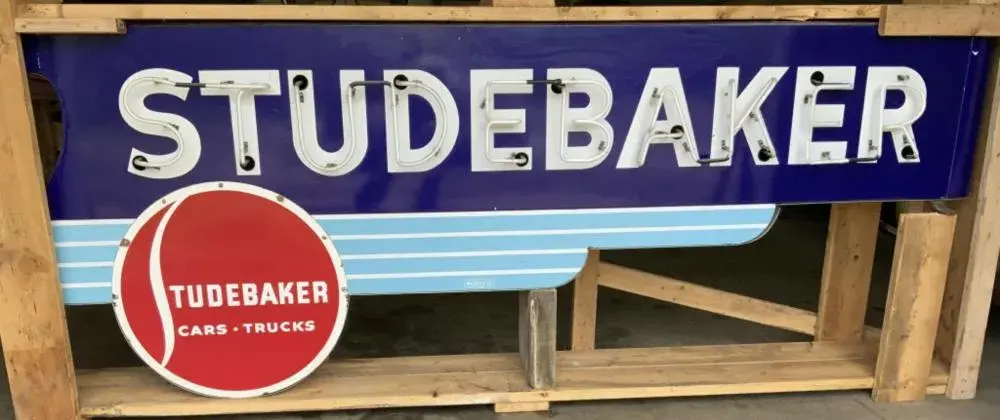
All-original Studebaker Art Deco bull-nose porcelain neon sign, double sided, sharp colors, fantastic condition. Size: 10ft 6in long x 47in tall at round and 2ft at other end; 12in thick. Made by Walker & Co. From an advanced private collection. Sold for $21,000 against an estimate of $15,000-$25,000

794-lot selection was led by fresh-to-market California collection of high-quality gas and oil signs; unexpected star lot: a vintage Louis Vuitton automobile travel trunk that sold for $19,305

All-original Studebaker Art Deco bull-nose porcelain neon sign, double sided, sharp colors, fantastic condition. Size 10ft 6in long x 47in tall at round and 2ft at other end; 12in thick. Made by Walker & Co. From an advanced private collection. Sold for $21,000 against an estimate of $15,000-$25,000
All-original Studebaker Art Deco bull-nose porcelain neon sign, double sided, sharp colors, fantastic condition. Size: 10ft 6in long x 47in tall at round and 2ft at other end; 12in thick. Made by Walker & Co. From an advanced private collection. Sold for $21,000 against an estimate of $15,000-$25,000

WILLOUGHBY, Ohio – Condition was the keyword throughout Milestone’s June 15 auction of vintage advertising, toys, coin-ops and old coins. The 814-lot sale, which totaled a robust $650,000, was chock-full of gasoline, oil and travel-related signs, including a high-quality, fresh-to-the-market collection from California. Many other popular collecting categories were woven throughout the sale, such as advertising clocks and thermometers; watches and jewelry; old radios, pocket knives and ships’ bells. 

An all-original Studebaker Art Deco porcelain neon bullnose sign, with size, originality and great eye appeal in its favor, finished at the top of prices realized. The double-sided sign with a sharp-looking cobalt blue, red and white motif measured 10 feet 6 inches long, 47 inches tall from the top to the Studebaker red dot, and 2 feet tall at the other end. It was made by the noted sign manufacturer Walker & Co., and came to Milestone from an advanced private collection. Many dozens of enthusiasts were watching the near-flawless sign prior to the sale, where it achieved $21,000 against expectations of $15,000-$25,000.

“Even if a neon sign isn’t working perfectly, it will still attract bidders as long as it’s in great condition and the flaw is fixable,” said Milestone Auctions co-owner and principal auctioneer Miles King.” His comment was made specifically with regard to a single-sided, three-dimensional porcelain and neon “Chevron Dealer” sign. Formed in the petroleum company’s distinctive chevron shape and red, white and blue colors, its neon flickered, but did not light up. “Neon sign collectors would know where to go to get that remedied,” King noted. The 32- by 23-inch sign sold for $12,000 against an estimate of $2,000-$4,000.

Like the Chevron sign, a double-sided round porcelain sign for Cadillac Authorized Service was another example of how effective primary colors can be in conveying a message. Described by Milestone’s expert cataloger as being in “equally fine condition on both sides” and marked Walker & Co. Detroit, this appealing sign emblazoned with the distinctive Cadillac brand’s crown-and-shield French coat of arms easily glided past its $5,000-$7,000 estimate to settle at $11,700.

Right alongside the Cadillac sign, both price-wise and condition-wise, a “Night Lubrication” double-sided porcelain sign produced for Shell Gasoline & Oils Co., boasted a bright palette of colors dominated by sunset orange and crimson. With its included stand, it raced past its $4,000-$5,000 estimate to close at $11,700.

Bold and colorful, a double-sided porcelain sign for Pontiac Authorized Service measured 42 inches in diameter and bore the immediately identifiable silhouette of Chief Pontiac, the Odawa chief after whom the city of Pontiac, Michigan, was named. It is also the city where General Motors produced its Pontiac automobiles. In excellent condition, the sign sold for $10,762 against an estimate of $3,000-$5,000.

A large, double-sided red, white and blue porcelain Standard Oil service station sign with a classical torch image measured 59 inches by 42 inches and displayed beautifully, but as is almost always the case when these desirable signs turn up, it was missing its “flame.” Regardless, it realized $5,904 against an estimate of $2,500-$3,500.

Also landing well above high estimate was a single-sided porcelain sign advertising both Veedol 10-20 Motor Oil and Flying A Ethyl Gasoline with the message “Made to go together for Highest Octane Performance.” In excellent condition, the 50- by 18-inch sign finished at $4,674 against an estimate of $1,000-$2,000. 

Some lucky collector will now be able to motor away in high style with their summer vacation wardrobe safely secured in a vintage Louis Vuitton automobile travel trunk. Complete with its two correct interior suitcases, the unit was in 100% original condition with a black leather finish, nickel hardware and “LV” monograms. It even retained its original Louis Vuitton red-and-white label bearing the firm’s 70 Champs Elysees (Paris) address and branch addresses in London, Nice and Lille. Miles King explained that the trunk had come from a local (Cleveland-area) estate. It caught the attention of vintage car buffs and Louis Vuitton aficionados both Stateside and abroad, opening at its high estimate of $5,000. Five phone bidders were in the fray, competing against the floor and Internet, King said. Ultimately, it sold to a US buyer for $19,305. 

A fine selection of signs advertising various products of a century ago included a double-sided porcelain flange sign for Cressman’s Counsellor 5¢ Cigar, $4,059 against an estimate of $300-$500; and a single-sided porcelain sign advertising Lorillard’s Beech-Nut Chewing Tobacco. Displaying rich red, white and blue colors and the trademark image of a Beech-Nut tobacco packet, it more than doubled its high estimate, selling for $3,159.

Early American toys have been on a winning streak lately, and that includes at Milestone’s June sale. An unusual 62-inch-long child’s “Hook and Ladder No 1” wagon presented in all-original condition, even retaining its original side-riding ladders. Finished in red, green and yellow with stenciled lettering and yellow metal wheels and steering handle, it rolled to $4,212 against an estimate of $600-$800.

Soda pop fans lined up for Pepsi-Cola – not a frosty bottle of the popular beverage, but a circa-1955 VMC Model 81D Pepsi 10¢ bottle-vending machine. It had been professionally restored in its correct royal blue with red and white accents and looked absolutely beautiful. It surpassed its high estimate to claim a winning bid of $6,457.

After the 11-hour auction over which he presided, King observed: “There was a lot of action on the phones, but you never know where the winning bids are going to come from. This time most of the big-ticket items sold to the floor, to local buyers. The strongest category was gas and oil, but every category came through for us. In the end, the lots were 99.9% sold. Any auctioneer will tell you that’s a very good day.”

To discuss consigning a collection or a single item to a future petroliana, antique advertising, toy, firearm or coin-op and coins auction at Milestone, call Miles King at 440-527-8060 or email [email protected]. All enquiries are kept strictly confidential and there is no obligation to consign. Online: www.milestoneauctions.com.

Find more auction world news on AuctionDaily news channel.

Glittering designer jewels, Tiffany lamps and a thrilling Wurlitzer Pianorchestra were crowd-pleasers at Morphy’s Fine & Decorative Arts sale

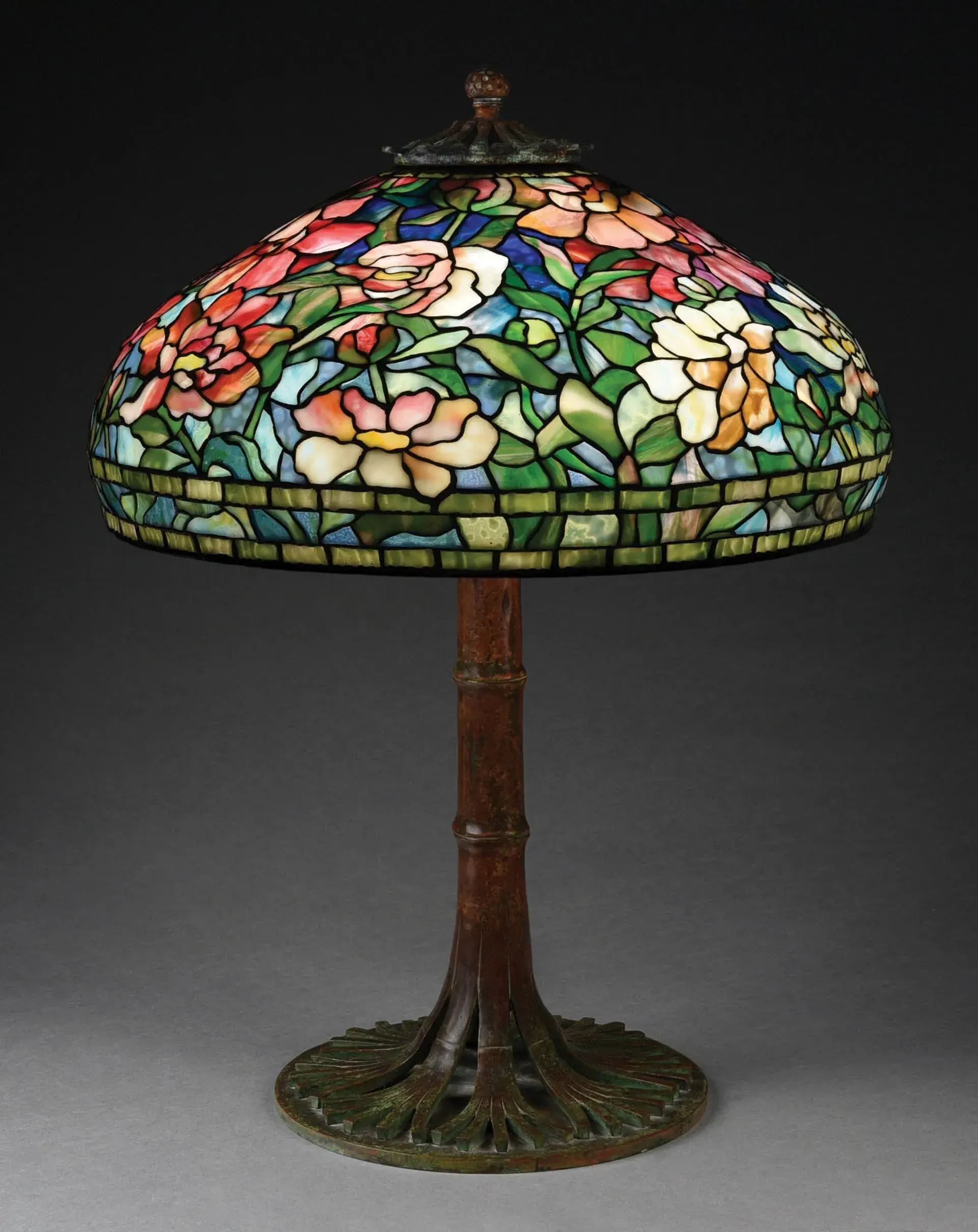
Tiffany Studios ‘Peony’ leaded-glass lamp with multicolored background of mottled cobalt blues and streaked sky blues. Extensive multicolored confetti glass with wonderful transparency. Blossoms comprising numerous types of Tiffany glass, including granite-backed reds and highly mottled opalescent whites. Shade and base are signed by Tiffany. Provenance: shade formerly in Minna Rosenblatt collection; base previously sold at Sotheby’s. Sold within estimate range for $110,700

Above-estimate prices paid for book examples of decorative art, including circa-1906 Paul Dachsel ‘experimental’ Amphora vase and circa-1900 Zsolnay iridescent vase designed by Lajos Mack

Tiffany Studios ‘Peony’ leaded-glass lamp with multicolored background of mottled cobalt blues and streaked sky blues. Extensive multicolored confetti glass with wonderful transparency. Blossoms comprising numerous types of Tiffany glass, including granite-backed reds and highly mottled opalescent whites. Shade and base are signed by Tiffany. Provenance: shade formerly in Minna Rosenblatt collection; base previously sold at Sotheby’s. Sold within estimate range for $110,700

DENVER, Pa. – Stunning jewels, art-glass lamps, a Wurlitzer Pianorchestra and a 1906 Amphora vase whose design foretold the future were among the highlights of Morphy’s June 11-12 Fine & Decorative Arts Auction. The $1.53 million sale offered bidders a widely varied choice with prized examples from many of today’s most popular collecting categories.

Twenty-five lamps by Tiffany Studios led the colorful parade of antique lighting. In addition to the coveted Tiffanys, there were scores of beautiful leaded and reverse-painted lamps by Handel, Duffner & Kimberly, and Pairpoint. The 72-lot group was crowned by a Tiffany “Peony” table lamp whose shade featured a medley of multicolored confetti glass, blossoms crafted from numerous types of Tiffany glass – including granite-backed reds and highly mottled opalescent whites – against a multicolored background of mottled cobalt and streaked sky-blue glass. Both the Peony shade and base were signed by Tiffany. The shade boasted illustrious provenance, having once been in the collection of Minna Rosenblatt (1944-2008); while the lamp’s base was previously acquired at a Sotheby’s auction. Ms Rosenblatt owned a premier Madison Avenue (NYC) antiques gallery for 35 years and was one of the influential dealers who fostered the 1950s revival of Tiffany lamps and other Art Nouveau glass. The stellar Peony lamp presented by Morphy’s sold within estimate for $110,700.

Peonies also featured prominently in a monumental Duffner & Kimberly leaded-glass table lamp. Mounted on a 32-inch-tall Duffner & Kimberly base, the shade was ablaze with color. Its lush, deep-red peonies against a warm yellow ground with multi-hued green leaves, was further beautified by the addition of draper glass, which continued the images of several blossoms. The lamp finished within estimate for $24,600.

A Handel “River Bed” reverse-painted art glass lamp was adorned with a tranquil woodland scene featuring a river flowing over rocks. The artist’s choice of a lavender sky was the perfect backdrop for the palette of lovely autumn colors. The Handel base with a mermaid motif completed the look. Against an estimate of $20,000-$25,000, the lamp went on to secure a winning bid of $33,825.

Moving from table to desk, a classic Tiffany Studios “turtleback” lamp with two large iridescent green turtleback tiles was signed Tiffany Studios New York 268 beneath its base, along with an impressed Tiffany logo. It sold for an above-estimate $14,145.

Pottery collectors couldn’t help but marvel at Paul Dachsel’s circa-1906 Amphora “Cactus” vase, which embodies one of the artist’s most innovative designs. The monumental vessel with undulating reticulated handles and a form that could easily be mistaken as “Moderne” was finished in an iridized matte green glaze. In mint condition, with a “PD” mark and the impressed number “1048,” it was the very example illustrated in Richard L Scott’s reference Ceramics from the House of Amphora. It was chased to $34,440 against a pre-sale estimate of $18,000-$24,000.

Two Fenton glass vases in the “Hanging Hearts” #3024 motif brought identical money, each selling for $8,610. One was a 13-inch double-handled vessel of hand-blown glass in aqua and purple; the other, a 12-inch example in iridescent red glass. Each came with provenance from the collection of Constance Henderson Hoblitzell of Williamstown, West Virginia, and had been entered in the sale with a $1,000-$3,000 estimate.

A European porcelain highlight, a Zsolnay (Hungarian) Art Nouveau “Symbolist” vase was designed around 1900 by Lajos Mack. Exhibiting a green eosin iridized glaze with reddish-purple highlights, this exquisite piece in mint condition can be seen in the Zsolnay book written by Eva Csenkey. It swept past its $1,800-$2,400 estimate to claim $7,380.

Designer jewelry and luxury watches added sparkle and brand cachet to the sale, with two signed pieces by Oscar Friedman at the forefront. An ultra-chic 18K yellow gold, emerald and diamond bracelet featuring 10 octagonal step-cut diamonds and 154 round brilliant-cut diamonds was accompanied by its original CGA Appraisal Report and sold for $23,370 against an estimate of $10,000-$15,000. Also, an 18K white gold necklace with nine graduated emerald-cut emeralds and 640 brilliant-cut diamonds (gross weight: 57.5g) conveyed to its new owner together with its GemAssure Gemological Appraisals Report. It settled within its estimate range for $22,140.

Just in time for Father’s Day, a men’s 40mm stainless steel Rolex Submariner “Kermit” Anniversary watch, Ref. #16610V, came to auction with its paperwork and desirable Rolex inner and outer boxes. The handsome timekeeper left the gallery for $13,530. 

For many years, Morphy’s has been acknowledged as a leading auction source for antique occupational shaving mugs. The selection entered in the June 11-12 sale gave collectors exactly what they wanted: rare designs depicting unusual professions. A mug with a well-detailed image of a diner/soda fountain, with two seated customers and white-coated clerks behind the counter, was embellished in gilt lettering with the name of the mug’s original owner, Joseph Reifler. Against a comparatively modest estimate of $100-$300, it served up a winning bid of $6,150.

Sharing top-lot honors with the Tiffany “Peony” lamp, a fantastic circa-1909 Wurlitzer mandolin Pianorchestra, Style 33A, was manufactured by JD Phillips Co, Frankfurt, Germany, and imported by Rudolph Wurlitzer Co, New York. Within a single case, the self-playing antique music-maker combines the same instruments one would see in a full orchestra, with additional musical accents provided by two delightful mechanical birds in a gilded cage. In excellent condition, it even retained its auto-roll-changer and came with 56 playable Wurlitzer rolls. The multitalented entertainer of yesteryear took a bow at the midpoint of its estimate range, selling for $110,700.

After the hammer fell on the final lot, Morphy Auctions’ president and principal auctioneer Dan Morphy commented: “It was an excellent sale of very high-quality goods, which is what today’s buyers want. The top-estimated Tiffany lamp – the Peony – sold comfortably within its estimate range, as did the Wurlitzer Pianorchestra. On top of that, our fine jewelry selection did extremely well. There seemed to be buyers for everything, even in niche categories like occupational shaving mugs, whose prices only continue to rise in the marketplace.”

To discuss consigning a collection or single item to a future Fine & Decorative Arts Auction at Morphy’s, please call 877-968-8880 or email [email protected]. All enquiries are kept strictly confidential, and there is never an obligation to consign. Visit Morphy’s online at www.morphyauctions.com.