A very rare Chinese carved celadon-glazed porcelain “萬”-Mouthed Vase 珍罕粉青釉萬字口大瓶 Qianlong six-character seal mark in low relief and of the period 乾隆六字款

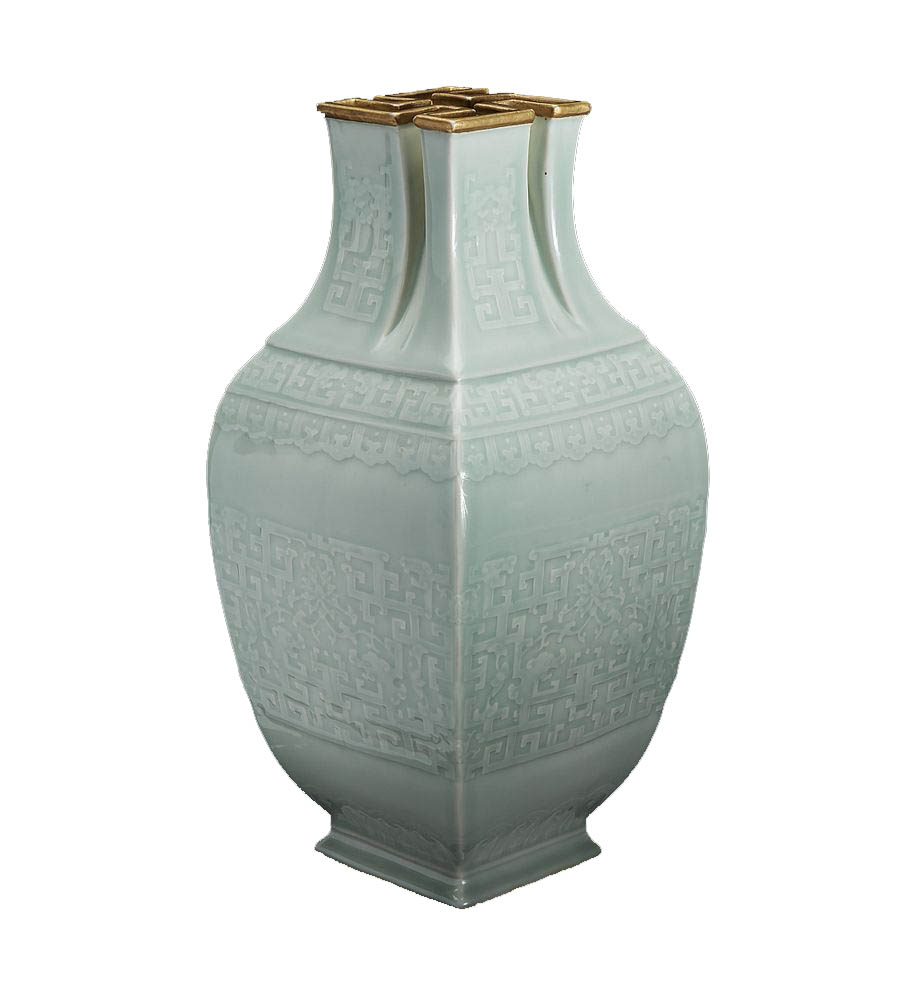
A very rare Chinese carved celadon-glazed porcelain “萬”-Mouthed Vase 珍罕粉青釉萬字口大瓶 Qianlong six-character seal mark in low relief and of the period 乾隆六字款

A very rare Chinese carved celadon-glazed porcelain “萬”-Mouthed Vase 珍罕粉青釉萬字口大瓶 Qianlong six-character seal mark in low relief and of the period 乾隆六字款:

***PLEASE NOTE, THIS IS A PREMIUM LOT. A DEPOSIT IS REQUIRED TO PARTICIPATE IN BIDDING ON THIS LOT. PLEASE CONTACT CLIENT SERVICES FOR FURTHER DETAILS.*

***请注意,本件为高价拍品,需缴付押金方可竞投。请联系客服以获取更多信息。*

Of square section, with swelling body over slightly flared foot, slightly indented sloped shoulder, transitioning into the shaped, slightly waisted neck with slightly everted lip, the lip of swastika or “萬” (wan form), the body with a main band carved in low relief with archaistic scrolls incorporating kui-dragon heads and lotus scrolls, above a stylized lapet band at the foot, the shoulder with similar shorter lappet-band border below a kui-dragon scroll border, each side of the neck with a panel of mirrored kui-dragon scrolls, covered overall with a soft, pale blue-green glaze pooling to a darker tone, the lip gilt, underside with six-character seal mark in low relief within an indented square.

(H: 16 1/4 in.)

Qty: (1)

Acquired in Europe in the 1970s by the grandfather of the present owner, said to have come from the collection of Robert de Stryker
Thence by descent

Footnote:
The present vase appears to relate to a select group of Imperial celadon-glazed wares, often associated with production in the Imperial kilns under the supervision of Tang Ying (1682-1756). These wares are notable for their high quality and variety of creative form and decoration. This particular subgroup of celadon-glazed wares, with decoration carved or molded in low relief, exhibit this variety of form and decoration. These often appear to be inspired by archaic wares, particularly ancient bronzes, but also the wares of the early Ming dynasty. This is evident not only in terms of form, but also in the use of decoration such as archaistic kui-dragon scrolls (angular or more organically foliate in nature), or dense lotus scrolls and lappets, in addition to the incorporation of later auspicious motifs such as Buddhist or Daoist symbols or homophonic symbols such as bats or ruyi scepters.

To date, another example of this technically difficult form has not been located. Other Qianlong mark and period celadon-glazed vases decorated with carved or molded archaistic kui-dragon scrolls are known, but none with this highly unusual “萬” (wan)-shaped or swastika-form mouth. “萬” translates as “10,000”, signifying unlimited abundance or longevity, an auspicious motif, particularly suitable for a birthday celebration or similar important event. For an elaborate celadon-glazed vase with swastika-ornamented ribbons at the shoulders, with Qianlong seal mark in relief, see “Qing Imperial Monochromes the Zande Lou Collection”, Shenzhen, 2005, pp. 120-121, no 43.

For a pair of Qianlong mark and period celadon-glazed vases with lip in the form of an “Endless Knot” in the Collection of the National Palace Museum, Taipei, see “Catalogue of the Special Exhibition of K’ang-hsi, Yung-Cheng and Ch’ien-lung Porcelain ware from the Ch’ing Dynasty in the National Palace Museum”, Taipei, 1993, p. 128, no 101 (one illustrated).

The decoration of these graceful lobed vases, incorporating bats and ruyi-heads is of the more curvilinear stylized manner, is similar to that found on the Qianlong mark and period vase sold at Sotheby’s, Hong Kong, April 8, 2007, lot 708. For other examples incorporating angular kui-dragon scrolls, see the archaistic flask-form vase sold at Christie’s, New York, March 28, 2006, lot 116, decorated with elaborate mirrored bands of kui-dragon scrolls to the neck, body and foot. For other examples of celadon-glazed vases with angular kui-dragon scrollwork in low relief, see the vases sold at Christie’s, New York, March 20, 2014, lot 2181; Sotheby’s, Hong Kong, April 8, 2009, lot 1652, and two similar bottle vases, sold Christie’s, Hong Kong, April 8, 2011, lot 3018 and Christie’s, New York, March 22, 2018, lot 771.

是件大瓶应出自清宫御用定烧粉青釉瓷器中的一件,该批御用瓷器常被认为是由唐英(1682-1756)督造监制,以其极致的烧造质量和奇巧的造型设计闻名于世。该批粉青釉瓷器通常以雕刻或模印表现千变万化的浅浮雕花纹。其题材则多汲取灵感于高古陶瓷,三代青铜器,以及明早期瓷器。敏而好古的设计不仅体现于造型,更见于其器表图案装饰如穿花夔龙纹(方型变型于自然界植物花卉藤蔓),以及繁茂的莲花与衫衾,更伴有佛教与道教题材吉祥图案,如蝙蝠和如意。
是件技艺冠绝的大瓶为首次公诸于世,尚未发现相同例子。与其同时代烧造的乾隆款识粉青釉瓷器,则常装饰有雕刻或模印倣古夔龙纹,然而装饰为万字纹“卐”瓶口设计的大瓶则绝无仅有。“卐”在中文亦意为万,是以表达富足长寿的吉祥标志,尤其多见于寿辰庆典等重要活动。此类装饰可见一例肩部饰有万字纹锦带,以及带有浅凸起乾隆款的粉青釉大瓶出版于“暂得楼清代官窑单色釉瓷器”深圳,2005,第120和121页,编号43.
另见一对乾隆款粉青釉“盘长”口瓶子,现藏于台北国立故宫博物院,出版于“清康雍乾名瓷 国立故宫博物院印行”,台北,1990,第128页,编号101(图示仅其中一件)。此类造型优雅别致,并装饰有蝙蝠和如意云头纹的乾隆款及本朝的瓷器瓶子,另见一例于2007年4月8日经香港苏富比售出,拍品编号708.而带有方型夔龙纹装饰及对称夔龙耳的一例瓶子则于2006年3月28日经纽约佳士得售出,拍品编号116。另见一例方型夔龙纹浅浮雕装饰贯耳瓶于2014年3月20日经纽约佳士得售出,拍品编号2181;另见一例于2009年4月8日经香港苏富比售出,拍品编号1652,以及两件同类装饰的相似瓶子分别释出于2011年4月8日香港佳士得,拍品编号3018,以及2018年3月22日纽约佳士得,拍品编号771。

Condition report:
Generally overall good condition, small glaze pit on edge of one flange to neck, a small iron brown spot under lip above pit, another small glaze pit under the lip, two small faint greyish patches to glaze below shoulder on one side, scattered minor scratches and moderate surface wear, yellowish residue to the interior of footring, minor wear to the gilding, particularly at the extremities, soiling to interior of vase, slight glaze irregularity to interior of neck, felt glued to the underside of footring, slight abrasions to the edge of glaze at footring with very minor discoloration, scattered minor glaze pits edge of foot, nearly invisible.

Fine Roman Marble Torso Youthful Bacchus

Fine Roman Marble Torso Youthful Bacchus

Fine Roman Marble Torso Youthful Bacchus:

Roman, Imperial Period, ca. 1st to 2nd century CE. Finely carved in the round from white marble, a youthful Bacchus (Greek Dionysos, also Dionysus) – god of wine, theater, ecstasy, and rapturous ritual madness – holding a large bunch of grapes. Bacchus is rendered in the nude save the nebris (fawn skin) draped across his body and falling behind his back; his naturalistic navel, buttocks, and genitalia are revealed. A stunning rendering of Bacchus which though fragmentary presents an outstanding form with well-preserved details and musculature. Size: 6.75″ L x 12.125″ W x 15.625″ H (17.1 cm x 30.8 cm x 39.7 cm); 19.875″ H (50.5 cm) on included custom stand.

Though a fragment, one can see that the left leg is slightly advanced which suggests that Bacchus was rendered standing in contrapposto with his weight shifted to his right leg. One can also detect the beginnings of an s-curve and the gentle torque of the torso. Given this, the sculptor of this statue was likely familiar with classical Greek renderings of Dionysos, such as the work of Praxiteles. Clearly the sculptor subscribed to the Roman’s desire to render the body with naturalism. Imagery of the young Bacchus (Dionysos) was very popular under Hadrian’s reign (117 to 138 CE). Perhaps this piece was created during this period or earlier.

Provenance: ex-Barakat Gallery, Beverly Hills, California, USA, acquired prior to 2000

All items legal to buy/sell under U.S. Statute covering cultural patrimony Code 2600, CHAPTER 14, and are guaranteed to be as described or your money back.

A Certificate of Authenticity will accompany all winning bids.

PLEASE NOTE: Due to recent increases of shipments being seized by Australian & German customs (even for items with pre-UNESCO provenance), we will no longer ship most antiquities and ancient Chinese art to Australia & Germany. For categories of items that are acceptable to ship to Australia or Germany, please contact us directly or work with your local customs brokerage firm.

Display stands not described as included/custom in the item description are for photography purposes only and will not be included with the item upon shipping.

#162596
Condition
A fragment of a larger statue missing head and limbs as shown. Expected surface weathering with some abraded areas. Overall, an exquisite sculpture exhibiting fine technique and a strong form.

Giant Permian Orthacanthus Shark Fossil – Teeth Exposed

Giant Permian Orthacanthus Shark Fossil - Teeth Exposed

Giant Permian Orthacanthus Shark Fossil – Teeth Exposed:

Western Europe, Germany, Rheinland-Pfalz, Permian, ca. 260 million years ago. This extremely rare and large Orthacanthus shark fossil skeleton is a fortuitous opportunity for the ultimate collector looking for the best specimen for their own private museum or to loan on public exhibitions! This is a unique fossil, and points to highlight are its rare straight pose, large, gaping mouth, and a full, dislocated array of all original teeth showing three-dimensional preservation of the unusual forked crowns that these sharks are known for. The white color of the skeleton is natural, every fin is present with complete preservation! This is a male shark and is identified by left and right claspers seen on the ventral region just anterior to the anal fins; prepared in very high relief. On rare occasions, you may see one side of the claspers present but, on this specimen, both are shown because the orientation of the belly in this region is slightly turned for an underside view! Size of shark fossil: 63″ L (160 cm); matrix: 80.5″ L x 31.5″ W (204.5 cm x 80 cm)

From a period in time before the dinosaurs even walked the earth, the bizarre Orthacanthus thrived in prehistoric swamps and bayous in Europe and North America. The Orthacanthus was an ancient freshwater shark that is no longer in existence. It had a very long spine protruding from the back of the head followed by a long ribbon-like dorsal fin that gave it the appearance of an eel. The double forked teeth were another unique characteristic. A full grown Orthacanthus is believed to have grown to 10 feet in length and was THE most dangerous apex predator that terrorized all creatures that lived in its environment.

SPECIAL NOTE: The current laws in this state of Germany have forbid the collection of these remarkable fossils since 1986. This legislation has permanently ended the supply of such magnificent specimens such as this one being offered here. This rare example was originally collected years prior to the ban.

This piece has been searched against the Art Loss Register database and has been cleared. The Art Loss Register maintains the world’s largest database of stolen art, collectibles, and antiques.

Provenance: ex-private German collection

All items legal to buy/sell under U.S. Statute covering cultural patrimony Code 2600, CHAPTER 14, and are guaranteed to be as described or your money back.

A Certificate of Authenticity will accompany all winning bids.

PLEASE NOTE: Due to recent increases of shipments being seized by Australian & German customs (even for items with pre-UNESCO provenance), we will no longer ship most antiquities and ancient Chinese art to Australia & Germany. For categories of items that are acceptable to ship to Australia or Germany, please contact us directly or work with your local customs brokerage firm.

Display stands not described as included/custom in the item description are for photography purposes only and will not be included with the item upon shipping.

#167883
Dimension
Condition
This is a 100% original shark fossil with no compositing of pieces from another shark. Professionally prepared and repairs with only 1% fabrication of gaps and cracks filled. Sealer applied to stone slab. White skeletal color is natural with rare instance of all teeth exposed. A supreme example with meticulous 3D preparation!

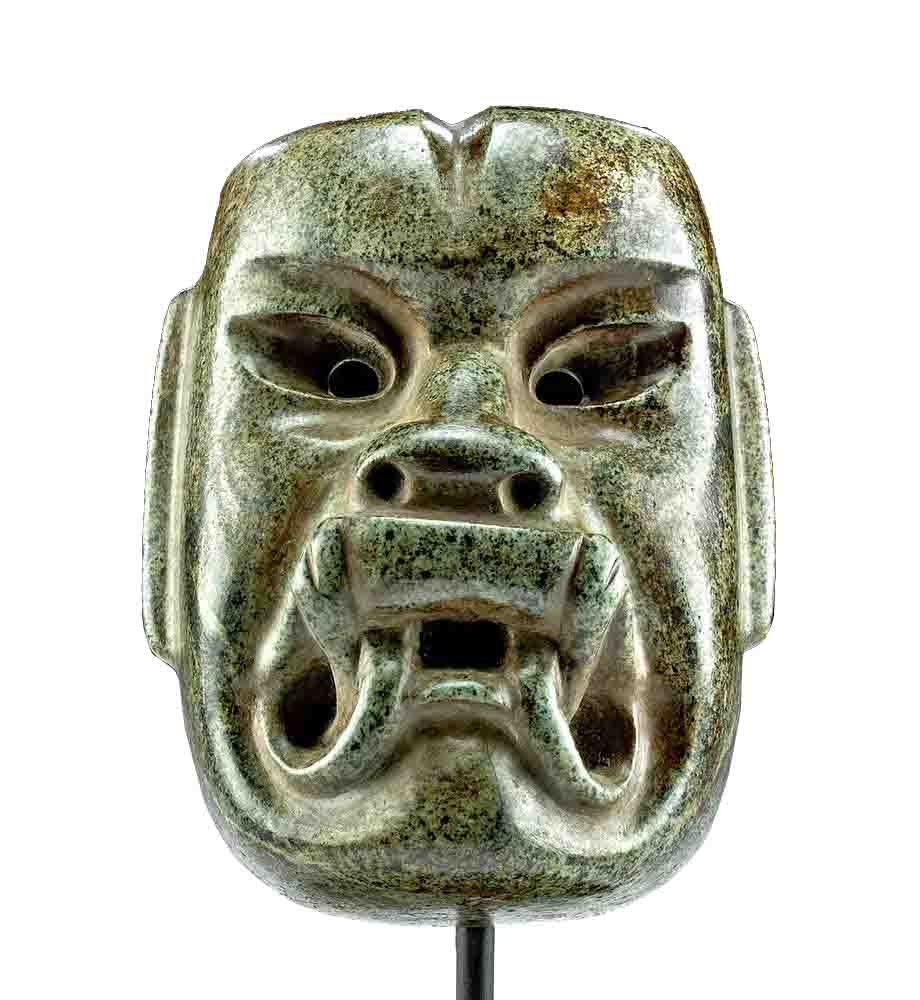
Stunning Olmec Jade Maskette Were-Jaguar Transforming

Stunning Olmec Jade Maskette Were-Jaguar Transforming

Stunning Olmec Jade Maskette Were-Jaguar Transforming:

Pre-Columbian, Mexico to Guatemala, Olmec, ca. 900 to 600 BCE. In a word, wow! Finely carved and string-cut from dark green omphacite jade, an incredibly expressive depiction of a were-jaguar transformation mask with a square jaw, feline eyes, flat nose with broad nostrils, trapezoidal mouth with flared upper lip and drooping corners, making for a feline mouth. The usual headband is not present, perhaps to allow room on the stone’s surface for that incredibly dramatic expression, which even surpasses the most theatrical Olmec visages we have encountered. The eyes are almost bean-shaped with drilled pupils and up-turned outer canthi beneath a narrowed brow, and the mouth is enveloped by prominent nasolabial folds that act as a parenthesis emphasizing the dramatically curved fangs that protrude from the flared lips of the beast. Lengthy ear flaps flank the zoomorphic visage, while an impressed striation vertically adorns the top of the head. Additional perforations at the peripheries were created presumably for attachment. A truly exceptional full maskette! Size: 4.1″ W x 5.3″ H (10.4 cm x 13.5 cm); 7.3″ H (18.5 cm) on included custom stand.

The attention to detail on this piece is quite impressive. Note the expressive lips and cleft palette of the jaguar mouth, the full nose with pierced nostrils, the stylized elliptical-shaped eyes, and the partially drilled circular motifs at the corners of the mouth. To the Olmecs, masks and maskettes like this example carried many meanings, not all of which are obvious to us today; however, scholars surmise that the color green was associated with vibrant growth, renewal, and given the cyclical conception of life and death, rejuvenation after death. Additionally, jaguar imagery symbolized power and might throughout the Pre-Columbian world; hence, warriors, rulers, hunters, and shamans alike associated themselves with this king of beasts, the largest and most powerful feline in the New World.

Research in the late 1990s and early 2000s pinpointed the source of what is colloquially referred to as “Olmec blue” jade in the lowland Motagua River near the modern-day border of Guatemala and Honduras; stone from this source was carved and traded widely throughout early Mesoamerica. The value of jade for ancient people lay in its symbolic power: perhaps its color was associated with water and vegetation; later, the Maya would place jade beads in the mouths of the dead. Many scholars have argued that the demand for jade contributed to the rise of long-distance trading networks and to the rise of urban centers in ancient Mesoamerica. This jade celt would have been regarded as an exceedingly valuable and rare piece of ceremonial art.

A similar example can be found in Dumbarton Oaks in Washington DC under accession number PC.B.020. Additionally, another example depicting a slightly earlier period in the transformational process can be found at The Metropolitan Museum of Art under accession number 1977.187.33

A somewhat larger Olmec jade mask was sold by Sotheby’s New York for $481,000 during their “African, Oceanic And Pre-Columbian Art” auction on May 16th, 2008 (sale number N08444, lot 14).

Accompanied by a hardbound CIRAM Scientific Analysts report attesting to its authenticity and Ruffner Art Advisory Fair Market Value report.

This piece has been searched against the Art Loss Register database and has been cleared. The Art Loss Register maintains the world’s largest database of stolen art, collectibles, and antiques.

Provenance: private Orange City, Florida, USA collection; ex-L. Smyth collection, Orange City, Florida, USA, acquired in the 1970s to 1980s from father; ex-William C. Peverly private collection, Syracuse, New York, USA, obtained between the 1970s and 1980s

All items legal to buy/sell under U.S. Statute covering cultural patrimony Code 2600, CHAPTER 14, and are guaranteed to be as described or your money back.

A Certificate of Authenticity will accompany all winning bids.

PLEASE NOTE: Due to recent increases of shipments being seized by Australian & German customs (even for items with pre-UNESCO provenance), we will no longer ship most antiquities and ancient Chinese art to Australia & Germany. For categories of items that are acceptable to ship to Australia or Germany, please contact us directly or work with your local customs brokerage firm.

Display stands not described as included/custom in the item description are for photography purposes only and will not be included with the item upon shipping.

#167677
Condition
Very light abrasions to some surfaces, otherwise intact and choice. Impressive preservation of detail. Stunningly smooth surfaces, and fantastic stone coloration visible.

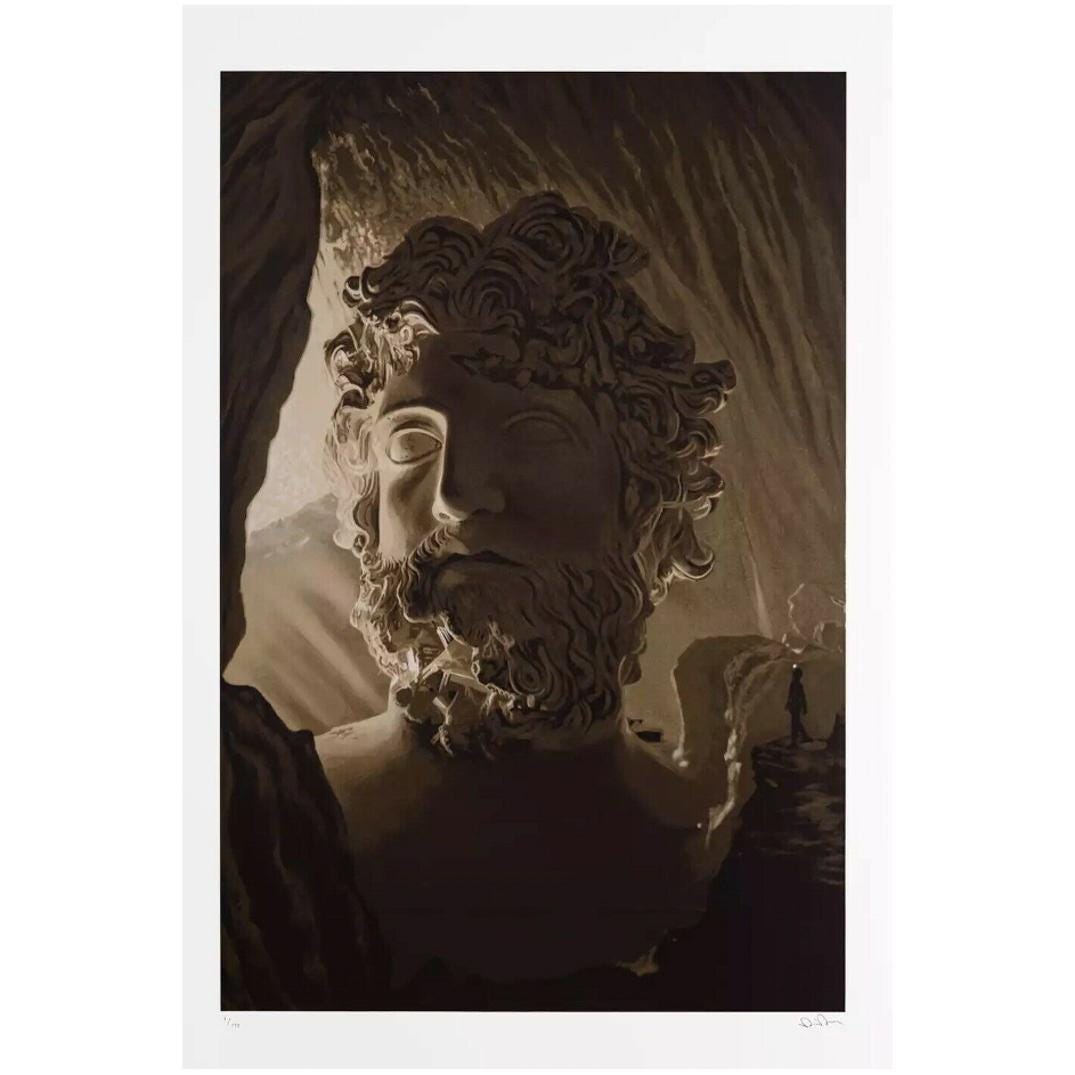
Daniel Arsham (American B. 1980) Tropical Zeus Cave

Daniel Arsham (American B. 1980) Tropical Zeus Cave

Daniel Arsham (American B. 1980) Tropical Zeus Cave:

A Daniel Arsharm lithograph using Sepia chiaroscuro technique over 28 individual silkscreens on 100% archival cotton paper. Hand signed and editioned of 199. Comes with Holographic certificate of authenticity and paper roll. Completed in white frame.
CIRCA: 21st Cent.
ORIGIN: USA
DIMENSIONS: Overall: (lithograph: 56 7/10 × 47 3/5 in)
CONDITION: Great condition. See lot description for details on item condition. More detailed condition requests can be obtained via email ([email protected]) or SMS 305-332-9274. Any condition statement given, as a courtesy to a client, is only an opinion and should not be treated as a statement of fact. Akiba Antiques shall have no responsibility for any error or omission.

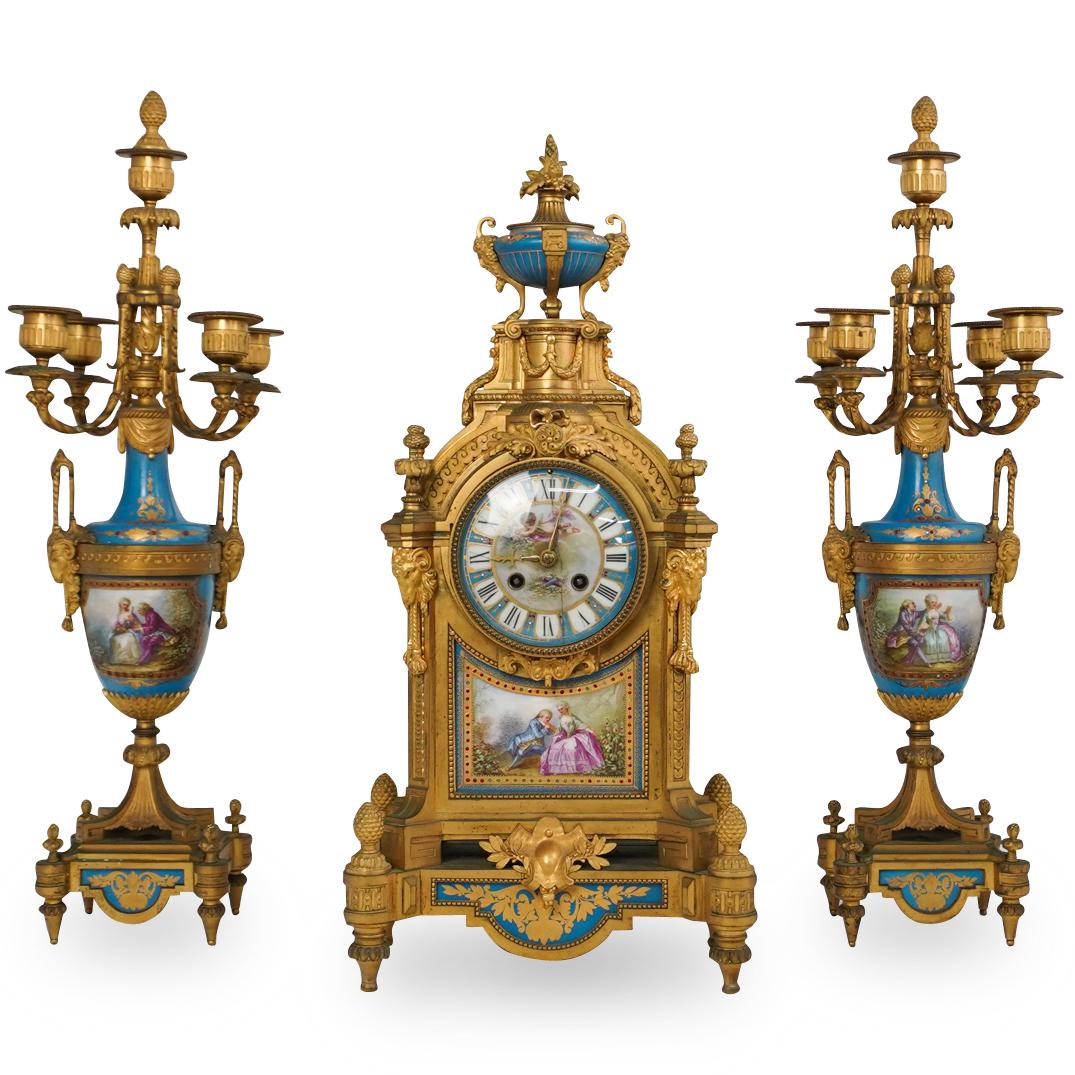
(3 Pc) Antique French Sevres Clock Set

(3 Pc) Antique French Sevres Clock Set

(3 Pc) Antique French Sevres Clock Set:

A 3-piece French garniture set in gilded bronze, together with two candelabras, hand painted porcelain dial, painted Sevres panel of a courting couple in landscape surrounded by a light blue border. Stamped on movement: “A. LeMaire Paris, R.V. Dutemple 121, 2241”. With Pendulum
CIRCA: 19th Century
ORIGIN: France
DIMENSIONS: Clock H. 21″ x W. 9.5″ x D. 5.5″, Candelabra H. 22″ x W. 7.5″ x D. 4.5″
CONDITION: Great condition. See lot description for details on item condition. More detailed condition requests can be obtained via email ([email protected]) or SMS 305-332-9274. Any condition statement given, as a courtesy to a client, is only an opinion and should not be treated as a statement of fact. Akiba Antiques shall have no responsibility for any error or omission.

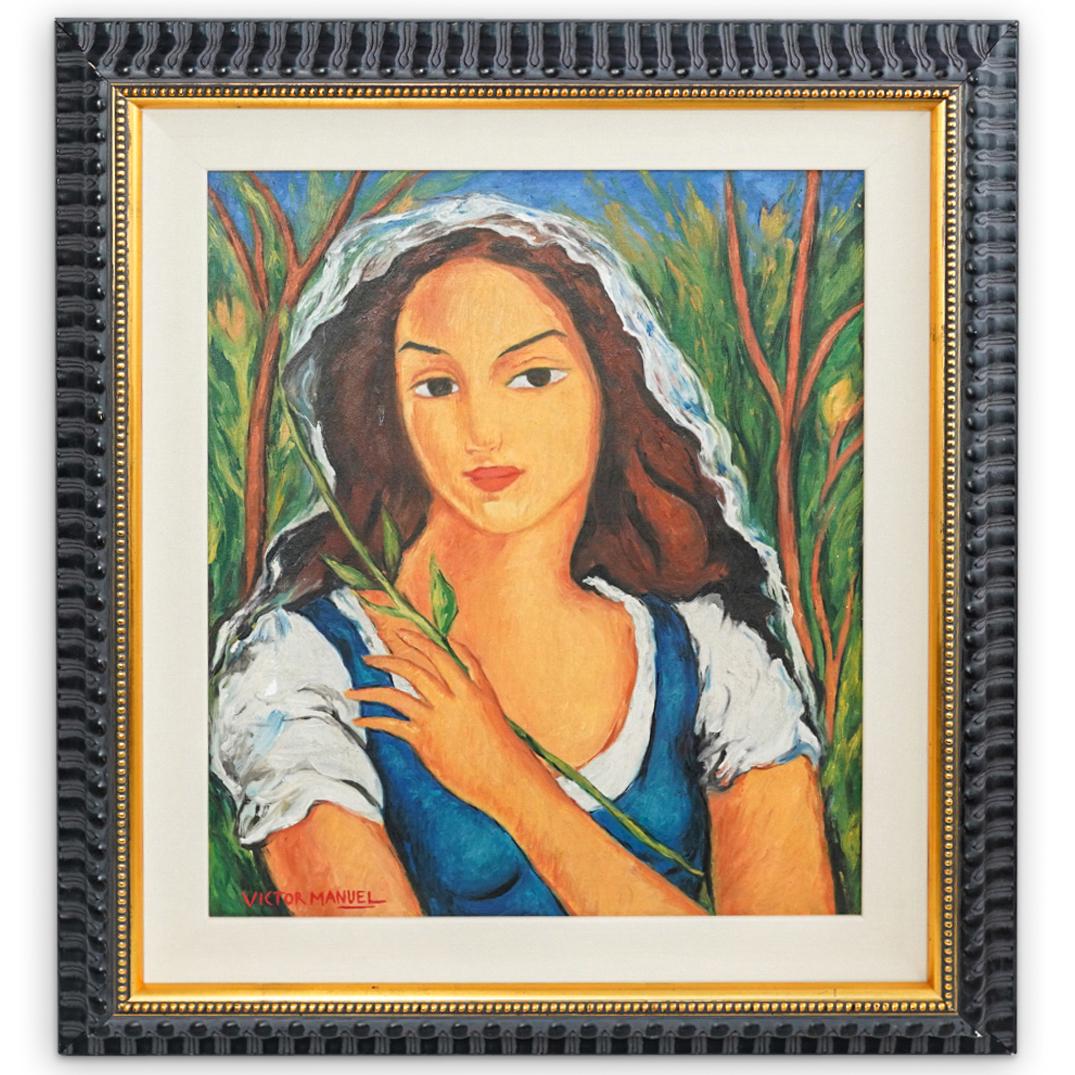
Victor Manuel (Cuban, 1912) Oil Painting

Victor Manuel (Cuban, 1912) Oil Painting

Victor Manuel (Cuban, 1912) Oil Painting:

A signed Victor Manuel (Cuban, 1912-1986) Oil painting on canvas panel depicting the frontal portrait of a female figure holding a flower stem, over a green lavish forest background. Signed “Victor Manuel” in red color in the lower left corner. With COA.
CIRCA: 20th Century.
ORIGIN: Cuba.
DIMENSIONS: W: 26 1/4″ H: 29 1/2″.

Have a similar item to sell? Contact: [email protected].

CONDITION: Good condition. See lot description for details on item condition. More detailed condition requests can be obtained via email ([email protected]) or SMS(305)-332-9274. Any condition statement given, as a courtesy to a client, is only an opinion and should not be treated as a statement of fact. Akiba Antiques shall have no responsibility for any error or omission.”

Malvina Hoffman bronze fountain

Malvina Hoffman bronze fountain

Malvina Hoffman bronze fountain:

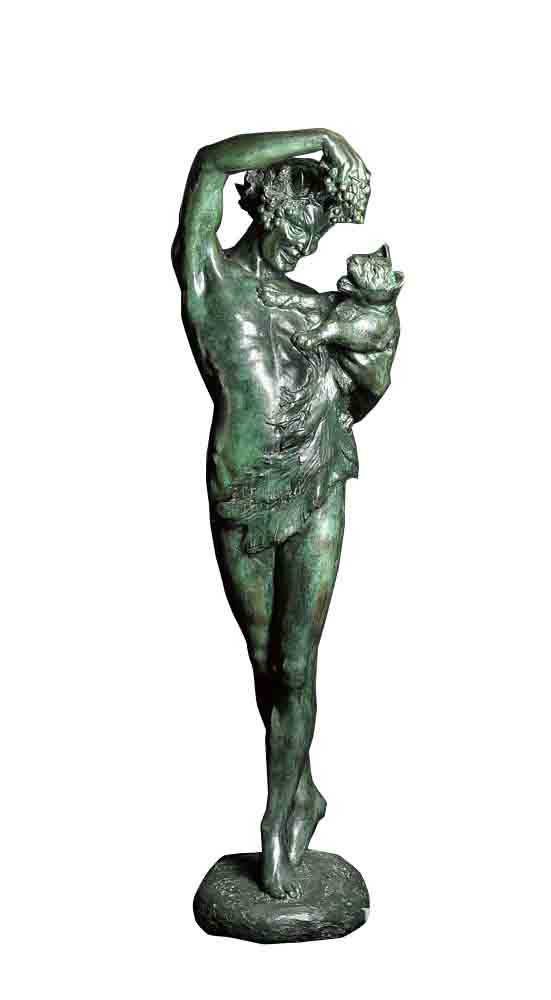
Malvina Hoffman (American 1885-1966), bronze fountain Boy with Panther Cub, ca. 1915, signed and inscribed Roman Bronze Works N.Y., an edition of 4 casts, 67 1/2″ h. Provenance: James Graham & Sons 1999; Estate of Robert Burbridge, Oklahoma City, Oklahoma.

Condition
Good condition. No apparent damages or repairs.

Elie Nadelman bronze Man’s Head

Elie Nadelman bronze Man's Head

Elie Nadelman bronze Man’s Head:

Elie Nadelman (American 1882-1946), bronze Man’s Head, ca.1906-1907, stamped F. Costenoble Fondeur Paris, 15 1/2″ h. Exhibited Whitney Museum of American Art September 23 – November 30, 1975. Exhibition catalog fig 5. Provenance: Estate of the artist; Salander-O’Reilly Galleries 2002.

Condition
Green marble base – 5″ h., 7″ w., 7″ d. Sculpture only – approx. 15 3/4″ h., 8 1/2″ w., 10 1/2″ d. Good condition. No apparent damages or repairs.

Andy Warhol Mickey Mouse screenprint

Andy Warhol Mickey Mouse screenprint

Andy Warhol Mickey Mouse screenprint:

Andy Warhol (American 1928-1987), Mickey Mouse (from Myths) screenprint in colors with diamond dust, signed lower left and numbered 147/200, 38″ x 38″.

Condition
Excellent condition. Sealed in plexiglass frame. Mounted on paper on canvas backing.