While his portraits have gone down in history, Fantin-Latour’s still lifes played a very special role in his career. The painter elevated this ‘minor’ genre to a high level of excellence.
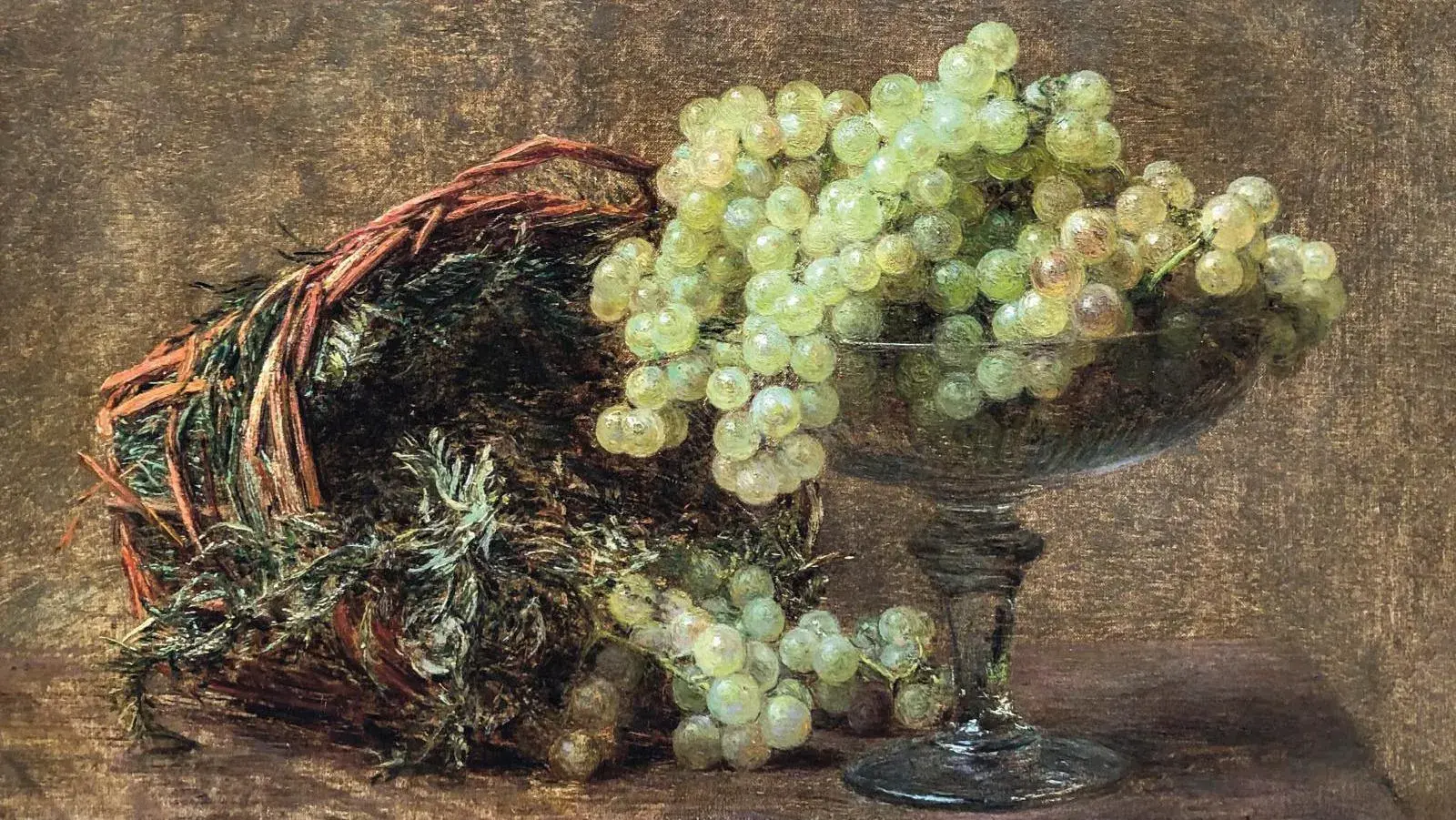
Henri Fantin-Latour (1836-1904), Nature morte au raisin dans une coupe de verre et panier d’herbes, (Still Life with Grapes in a Glass Bowl and Basket of Herbs), 1882, oil on canvas, signed and dated, 37 x 53 cm/14.56 x 20.86 in. Estimate: €100,000/120,00
“The simplest things, the most banal in appearance, have an interesting character; they must be rendered”, declared Henri Fantin-Latour. The painter has put this into practice with this canvas from 1882. For this sober composition, he chose modest herbs, perhaps a branch of hawthorn, placed in a wicker basket to accompany a glass bowl garnished with white grapes. As typically found in his still lifes, the artist is interested in the contrasting textures of the elements and their ability to reflect light. He makes do with a neutral background, so that nothing stands in the way of this poetic vision. Although Fantin-Latour was influenced by the realist movement, he detached himself from it whenever he could to offer the viewer a dreamy contemplation of the miracle of the living world. Romanticism and a form of modernity, which can be found in his ability to render a fragile, ephemeral nature, are also present in his work. Yet he remained a studio painter, composing his reality with what he found around him, whether in his Paris studio at 8, rue des Beaux-arts, or in the family home of his wife Victoria Dubourg—also a painter of flowers—in Buré, Orne. Although his first arrangements were somewhat opulent, from the mid-1870s onwards Fantin-Latour focused on simpler compositions, combining more diverse but always perfectly chosen elements. This led Zacharie Astruc to say at the 1870 Salon that Fantin-Latour painted “still lifes worthy of Chardin”. A fine and just compliment at a time when this genre was still considered minor in comparison with history painting. A member of the bourgeoisie, the artist felt right at home in the hushed, delicate world of his canvases, as did English high society, which first fell in love with his work. Henri Fantin-Latour regularly traveled to the other side of the Channel, accompanied by his friends the painter Whistler and the art patron-dealer Edwin Edwards, who acted as intermediaries for his loyal and welcome clientel.
The sale doubled its total estimate and drew the highest number of registrations for a Bonhams U.S. Sale
Dianne Feinstein. Credit: AP Photo
Los Angeles – Bonhams presented the late Senator Dianne Feinstein’s personal collection on October 8 in Los Angeles. Immense interest fuelled the sale which lasted nearly 12 hrs, with a majority of lots selling well above estimate, and overall doubling the all-in estimate of the sale to achieve $1.85 million. The auction set new records for Bonhams, boasting the highest number of registrations for a U.S. sale ever and for a global sale in the past 15 years.
The majority of the interest came from the United States with Californian buyers accounting for 70% of the hammer price. The auction also attracted a significant number of new buyers, who made up 40% of the hammer price.
Commenting on the sale, Victoria R. Gray, Bonhams Deputy Chairman, North America, said: “This turnout is a testament to the profound influence Senator Feinstein had in her home state of California. We’re proud to have hosted this auction to celebrate the life and career of a remarkable stateswoman and give a unique opportunity for collectors and admirers to own a piece of Senator Feinstein’s enduring legacy.”
The auction offered furniture and design objects from her three homes as well as a stunning collection of American art. Additionally, memorabilia from her illustrious political career was offered as well as an extensive jewelry collection befitting an American dignitary who represented her country with elegance and grace.
Overall, Legacy of a Stateswoman: The Personal Collection of Senator Dianne Feinstein presented 278 lots and totalled $1,850,000 with a 99% sell through rate.
Senator Feinstein’s jewelry collection, often worn to high-profile events, sparked significant interest. The collection sold for 3.5 times its estimated value, achieving a total of over half a million dollars. Stealing the show was Feinstein’s Platinum and Diamond ring selling for $108,450 – 2.4x the estimate of $45,000-65,000. Another significant piece was a 14k bi-color gold and diamond ‘California State Flower’ Brooch,which sold for $19,200 – 27x its estimate of $600-800. Additional highlights include:
A platinum and gem-set bow brooch. Sold for $13,200 – 26x its estimate of $400-500.
An 18k gold rose petal set, 1979, attributed to Angela Cummings for Tiffany & Co. Sold for $10,880 – 4x its estimate of $2,000-3,000.
An18k gold ‘Tank Louis’ Cartier wristwatch. Sold for $8,960 – 11x its estimate of $800-1,200.
The auction also generated overwhelming interest for Senator Feinstein’s political memorabilia, reaching nearly 5 times the estimated value. Highlights include:
Dianne Feinstein’s Mayoral Desk Plaque. Sold for $3,840 – 25x the estimate of $200-300.
A Jimmy Carter letter sent to Dianne Feinstein, sending comforting words after the 1990 election. Sold for $4,864 – 6x the estimate of $800-1,000.
A piece of the Berlin Wall.Sold $3,584 –36x the estimate of $100-200.
Three significant Senatorial Roll Call Votes. Sold for $6,400 – 6x the estimate of $1,000-2,000.
A Jimmy Carter signed program from the 2002 Nobel Peace Prize award ceremony in 2002. Sold for $3,840 – 26x the estimate $150-250.
A Hillary Clinton 2008 campaign poster inscribed to Dianne Feinstein in 2008. Sold for $5,120 – 17x the estimate of $300-500.
A pair of photographs of the Golden Gate bridge, 1937 and 1987. Sold for $5,120 –17x the estimate of $300-500.
Senator Feinstein had an impressive collection of paintings by American artists and Chinese art. The highlight of the section was William Alexander Coulter’s (1849-1936) Ships Sailing in the San Francisco Bay with Fort Point in the Distance, 1907 which sold for $229,100 – 3x its estimate of $70,000-100,000. Selling for over 43x their estimate was four Chinese Doucai ‘shou and peach tree’ dishes, which sold for $108,450, against an estimate of $2,500-3,500. Additional highlights include:
Frank Henry Shapleigh (1842-1906), The Hetch Hetchy Valley, 1887. Sold for $95,750 – 4.8x over an estimate of $20,000-40,000.
A rare pair of Chinese blue and white ‘dragon’ ogee-form bowls Jiaqing seal marks and of the period. Sold for $38,400 – 5x the estimate of $8,000-12,000.
A Dianne Feinstein Drawing. “Orchids 2001.” Sold for $4,864 – 12x its estimate of $400-600
Two more online sales of Senator Feinstein’s collection will follow with Jewelry from the Personal Collection of Senator Dianne Feinstein running until October 15 and further works of art from Senator Feinstein and her late husband, Richard Blum’s Indian, Himalayan and Southeast Asian Art Collection from October 14-24.
Featured: Mark Kuster’s 35-year toy collection spanning the Popeye universe; and a single-owner trove of fan club rarities and autographed material pertaining to “The King”
Very Rare Linemar Battery-operated Popeye Oliveoyl Tank
DENVER, Pa. – Morphy’s last major toy sale of the year will take place on November 6-7, three weeks before Thanksgiving, but there isn’t a single “turkey” in the lineup. In fact, there’s so much quality and variety, it will feel like one of those great toy events of the pre-Internet era that collectors used to love.
The auction is anchored by two major collections: a fantastic array of Popeye toys amassed over 35+ years by retired professor and Popeye reference-book author Mark Kuster, and a North Carolina collection of Elvis Presley memorabilia that will leave bidders all shook up.
Kuster’s collection of approximately 72 Popeye toys includes some of the finest of all known examples, with 39 of the comic-character rarities retaining their original boxes. There are many seldom-seen color variations in the specialty grouping comprised of Popeye with Parrot Cages toys, whose differences include striped or solid-colored legs, caped or without cape, etc.
The top picks in Kuster’s toy trove are a battery-operated Popeye and Olive Oyl Tank (with repro box), followed by a very rare Hoge tin speedboat, which is one of fewer than a dozen known to exist. Also in the circle of honor are a boxed Chein Popeye Heavy Hitter and a Linemar Popeye Aeroplane, which is small but beautiful and very difficult to find in excellent to near-mint working condition. Another of Kuster’s personal favorites is a classic Hubley cast-iron Popeye Motorcycle.
The Elvis collection comes from a diehard fan who always bought but never sold, meaning the goodies are fresh to the market. Many pieces were autographed by “The King” himself, including 20 rare sets of Elvis Presley cards that span the years 1956-1978 and have a total estimated value of $10,000-$20,000. Additionally, there are cards from a series produced in the late 1970s after Presley’s passing (in 1977). Many of the cards are graded. Additionally, there are Graceland mementos, bracelets, earrings, military-style dog tags, scarves, photos, magazines and, of course, records.
“The majority of the collection consists of fan club items you could order, or which you would receive, if you were a member of the Elvis Presley Fan Club,” said Tommy Sage Jr, Head of Morphy’s Toys & Trains Department. In all, there are no fewer than 200 pieces dating from 1956 through the 1970s, which will be apportioned into 75 group lots.
Sports card collectors are expected to step up to the plate for a selection that includes sealed sports cards, wax packs, cellos, rack packs and boxes. Two 1914 Cracker Jack cards are amongst the top lots – a PSA-graded Ty Cobb card could sell for more than $20,000, while a Honus Wagner card carries a $3,000-$5,000 estimate. Other exciting picks include an excellent 1973 Topps cello pack with a rookie card for Philadelphia Phillies third baseman Mike Schmidt visible on top, and a Nolan Ryan card visible on the bottom. This sealed pack is estimated at $2,000-$4,000. In addition to baseball, other major league sports represented in the collector-card category include hockey, football and basketball.
For the “pennywise” collector, more than 100 cast-iron mechanical banks will be offered, many of them in extremely nice condition. They include such “must-haves” as a Boy Scout Camp, Professor Pug Frog, Darktown Battery, Punch and Judy, Bad Accident, Trick Pony, Eagle and Eaglets, and a Shepard Hardware rare-variant Santa Claus and Chimney bank depicting the holiday gift-giver in a dark blue coat. Tommy Sage noted that he has never seen that particular color variation before.
Pressed-steel trucks by all of the most coveted brands will be ready to roll across the auction block. In addition to Buddy ‘L’ trucks, several Buddy ‘L’ trains will join the railroad assortment alongside pre- and postwar trains, both standard and O gauge. Highlights include an exceptionally fine Carlisle train and a Lionel standard-gauge Blue Comet.
From a consignment of old store stock, there are numerous Marklin HO trains and German autos, including approximately 50 mint/boxed Schuco cars that were never sold to the public. “Most are from the 1950s and were purchased right out of a store in Germany in the 1950s and ’60s,” Sage explained.
Additionally, there are German and French (including Citroen) tin-litho cars manufactured both before and after World War II. Collectors of earlier cars aren’t likely to overlook an attractive green Carette auto that is included in this group. From the American side of the Atlantic comes a large collection of Wyandotte pressed-steel and lithographed tin vehicles. In all, there are 200+ cars, buses and airplanes.
From a California collection, a remarkable German-made coin-op depicts heavyweight boxing champion Joe Louis (1914-1981). The 4ft-tall composition figure stands on a wooden base and twists back and forth on springs. For the price of 10 German schillings, the customer could don the extra pair of boxing gloves – which are included and original to the unit – and spar with the legendary “Brown Bomber.” Sage assessed the period of manufacture as “probably the 1930s – the figure looks a lot like Louis did during the Max Schmeling years.”
The Bat-Signal will be guiding superhero collectors toward an extremely rare Ideal Batman Utility Belt in beautiful, all-original condition in its original box. “I’ve never had one, and I’ve collected Batman toys all my life,” said Sage. “The last one I saw was in the $15,000-$20,000 range, and we expect the one in our auction will probably sell for around the same price.”
The broad panorama of toys also incorporates hand-painted German toys, dolls, comic books, 1950s-1970s robots and space toys; pre- and postwar Erector sets in their original wood or metal boxes, and 50 cast-iron doorstops led by a coveted Judd Co., “West Wind Girl.”
An outstanding salesman’s sample represents a road grader/thresher manufactured around 1900 by National Drill. Sage noted that some years ago a sample of the same type sold at auction for around $10,000.
The Wednesday/Thursday Nov. 6-7, 2024 Toys & General Collectibles Auction will be held live at Morphy’s gallery, 2000 N. Reading Rd., Denver, PA 17517, starting at 9 a.m. Eastern Time. All forms of bidding will be available, including absentee, by phone, and live via the Internet through Morphy Live. Enquiries: call 877-968-8880, email [email protected]. Visit Morphy’s online at www.morphyauctions.com.
Netsuke are tiny, carved toggles designed to secure an individual’s sagemono– or traditional purse– to their kimono’s obi (belt sash). These small-scale works of art have been part of Japanese culture since the 17th century. Regardless of age, materials, or form, netsuke by definition have two holes artfully integrated into their design to hold the cords joining these two accessories together. The earliest netsuke were purely functional and were made from found materials, including wood and roots. Starting in the Edo era (1615 – 1868), they became more sophisticated in design, themes, and materials. Over time, netsuke have been produced from animal products, including ivory, bone, tusk, horn, and shells; clay and porcelain; metals including gold, copper, and silver; and even semi-precious and precious stones. Traditional forms have included people, animals, plants, fruits, vegetables, gods and spirits, household items, and even erotica.
Eldred’s, of East Dennis, MA, is offering its 268-lot netsuke sale on October 10, 2024. The sale includes a spectrum of antique to modern examples across material and subject categories. Here are some eye-catching highlights of this netsuke sale.
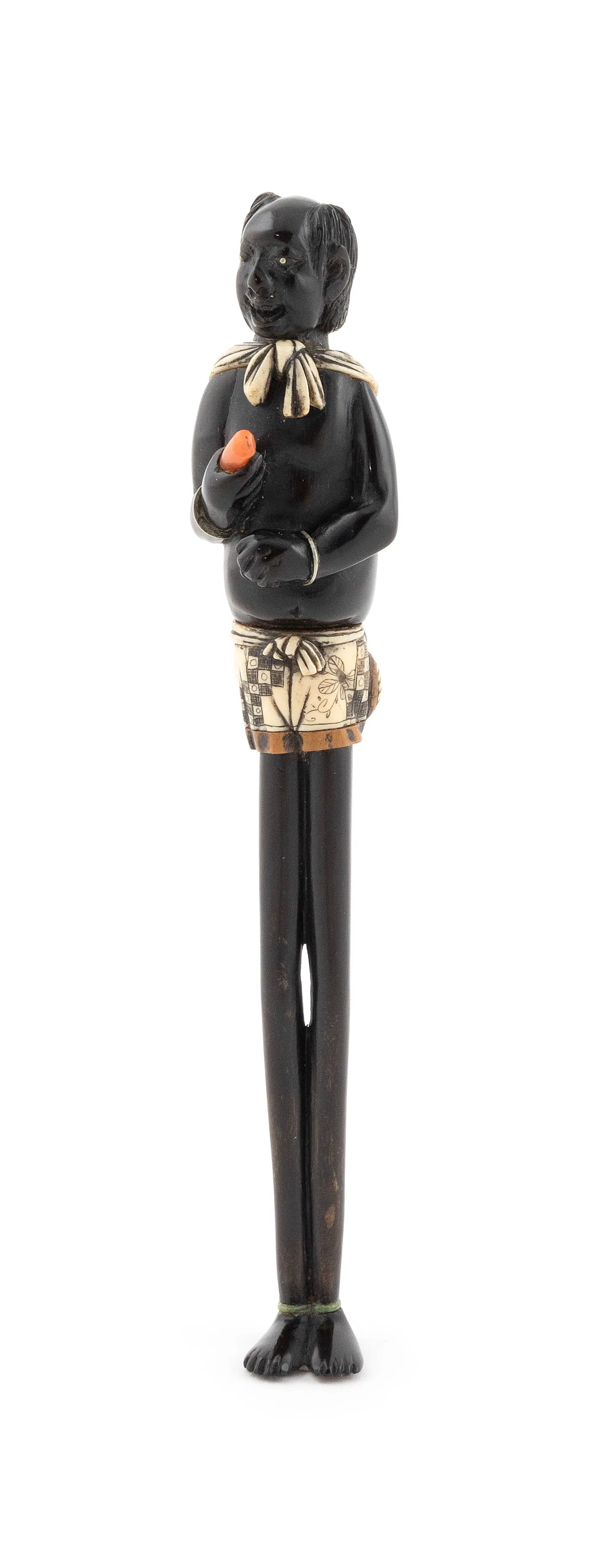
Lot #0638, a wood and ivory netsuke attributed to Kyokusei, is estimated at $12,000 to $15,000. Image courtesy of Eldred’s.
Carved Wood and Ivory Netsuke
The top lot in this netsuke sale is #0638, a carved wood and ivory netsuke attributed to Kyokusei. This unsigned example is estimated at USD 12,000 to $15,000. It is 6.75 inches tall and in the form of a tall, thin South Seas islander. He has well-rendered, oversized feet and toes which allow him to stand on his own. He comes to life with inlaid eyes, full hair above his shoulders, and a pleasant, open smile. His outfit consists of a well-carved ivory neckerchief and matching shorts, and his accessories include metal arm bracelets and green anklets. He holds a long, narrow piece of coral in his right hand.
The Japanese artist Kyokusei, who was active in the late 19th century, was especially known for his quirky, playful interpretation of native islanders. His work often included dark ebony wood and a variety of other natural materials– including ivory, coral, gemstones, and metal– to add authenticity and color contrast to his creations. In 2022, Galerie Zacke in Vienna, Austria sold a late 19th century inlaid ebony wood netsuke of a coral diver signed by Kyokusei for EUR 4,803.
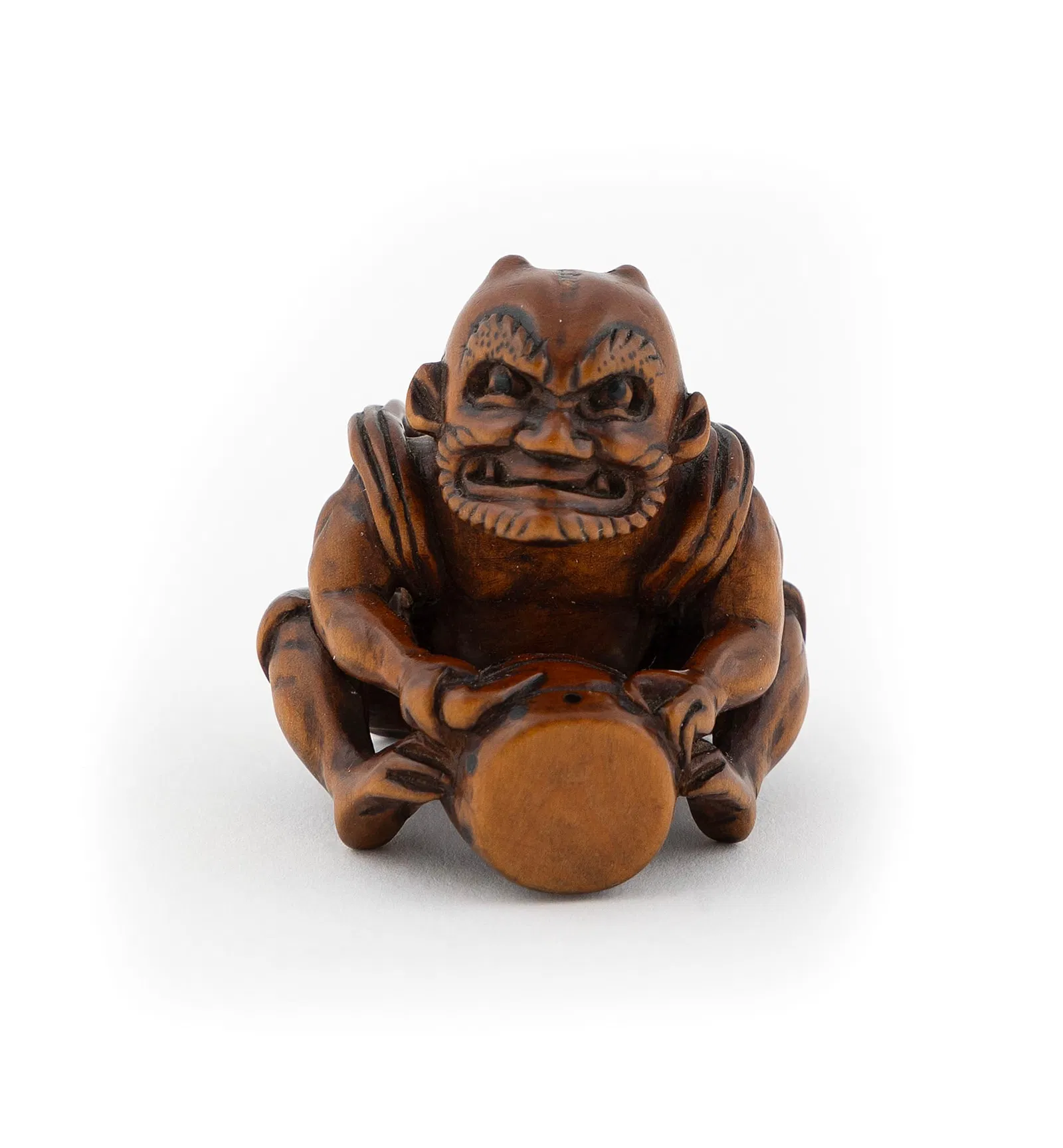
Lot #0631, a carved wood netsuke by Ikkosai, is estimated at $10,000 to $12,000. Image courtesy of Eldred’s.
Carved Wood Netsuke by Ikkosai
This netsuke sale features strong selections of antique, signed wooden netsuke by legacy artists. Lot #0631, a Japanese Osaka School carved wood netsuke by Ikkosai, is estimated at $10,000 to $12,000. This rarity measures 1.75 inches tall and depicts Raijin, the god of thunder, sitting on the ground and playing his drum. It is magnificently designed and executed, with remarkable undercutting details throughout. The netsuke features darker inlaid eyes and as well as decorative studs along both sides of the instrument.
Japanese artist Ikkosai Toun (1804 – 1876) was active in the mid to late 19th century. He specialized in smaller scaled, finely crafted figures and animals. His Sambaso Dancer is featured in the permanent collection of The Walters Art Museum in Baltimore, MD. In 2023, Bonhams sold his small mother-of-pearl netsuke of a rabbit pounding mochi for nearly $4,000.
Lot #0727, a carved boxwood netsuke by Susan Wraight, is estimated at $2,000 to $4,000. Image courtesy of Eldred’s.
Carved Boxwood Netsuke by Susan Wraight
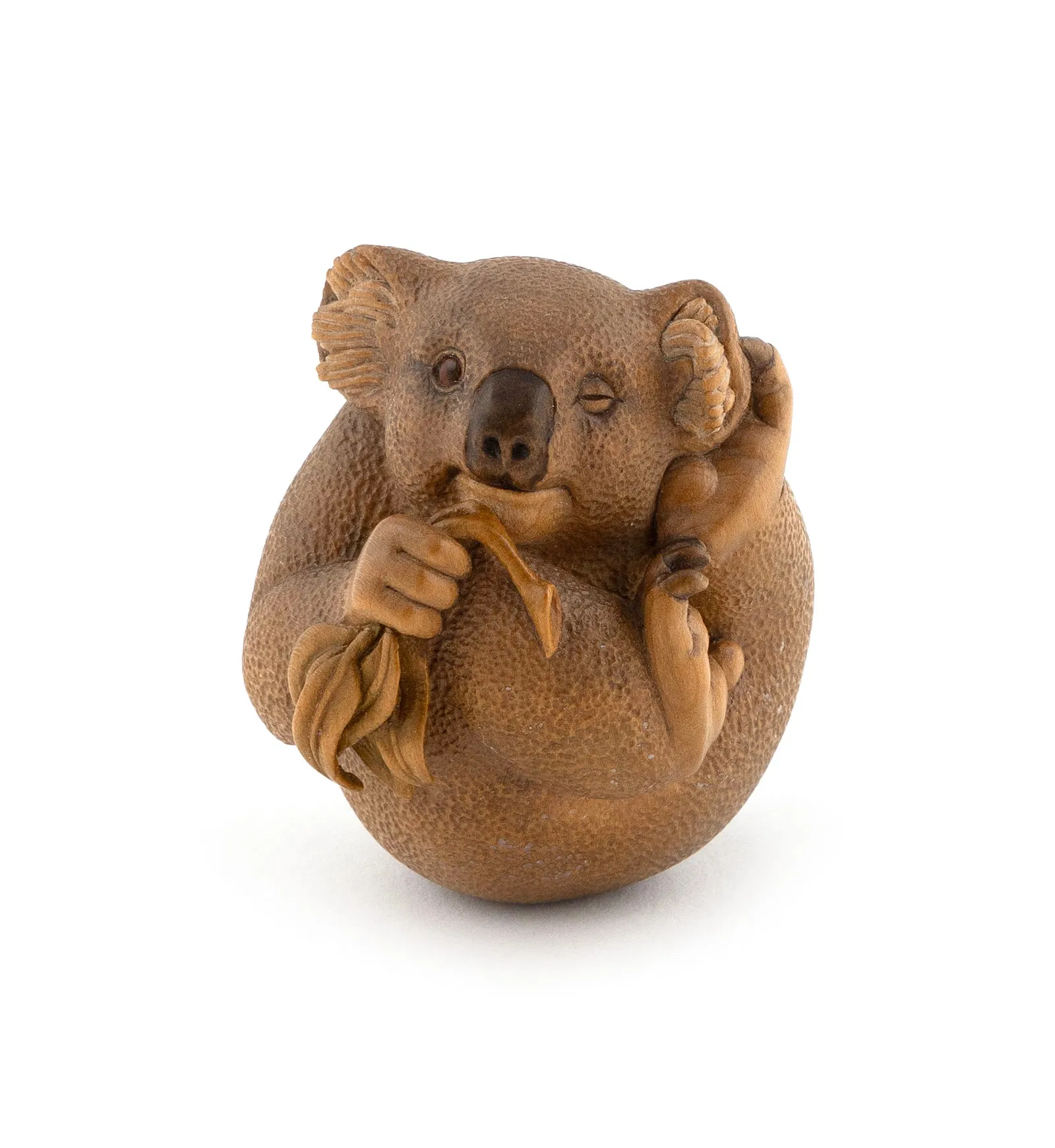
Also of note in this sale is a fine offering of modern netsuke reflecting unconventional themes or subjects. Lot #0727, a carved and stained boxwood netsuke by Australian artist Susan Wraight, is estimated at $2,000 to $4,000. This contemporary, nearly ball-shaped example is 1.5 inches tall and embodies a koala bear scratching an itch behind his ear with one of his feet. The marsupial holds a meal of eucalyptus leaves in one of his hands. One of his eyes is inlaid; the other is closed. The artist signed this netsuke on an 18-karat gold plaque located on the bottom of the piece.
Susan Wraight was formally trained at the Royal College of Art in London in jewelry making. She has been creating netsuke for more than four decades, primarily in wood. She is a leading member of the contemporary netsuke movement, which is pivoting netsuke from being primarily Japanese in theme and audience to a global art category with collectors and carvers on every continent. She was profiled as an important netsuke artist in the Fall, 2006 issue of the International Netsuke Journal and has given netsuke-making courses through the Victorian Woodworkers Association of Melbourne, Australia.
Lot #0677, an ivory netsuke by Masatoshi, is estimated at $6,000 to $7,000. Image courtesy of Eldred’s.
Ivory Netsuke by Masatoshi
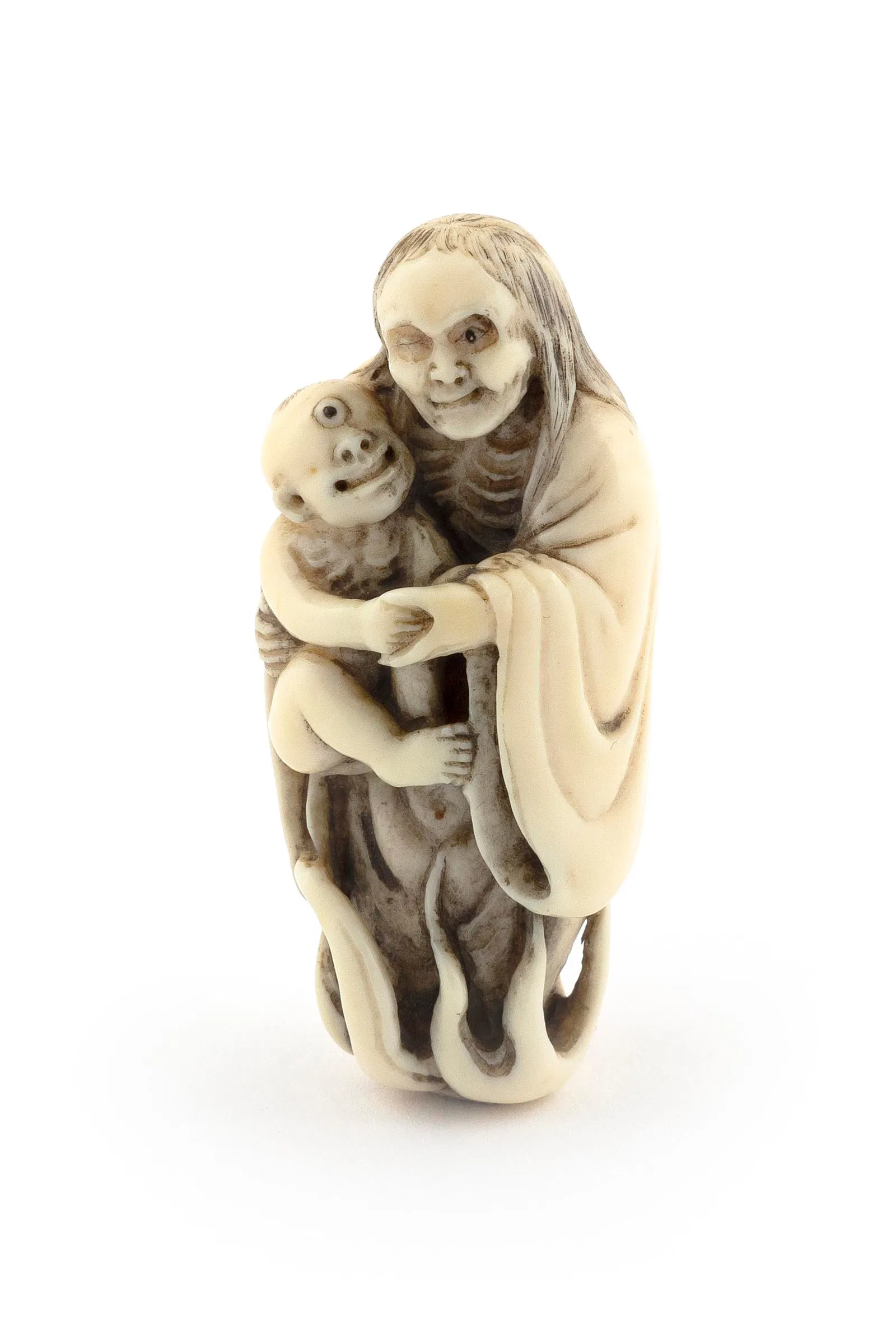
Netsuke made from animal materials including ivory, tusk, and antlers is another premier category in this early autumn event. Lot #0677, an ivory netsuke by Masatoshi, is estimated at $6,000 to $7,000. This carving is 2.25 inches tall and includes two figures. One is an older, emaciated female ghost; she wears a flowing robe, has very long hair, and is emerging from flames. The other is a one-eyed infant with a large, dimensional nose and mouth. It is signed by the artist on its bottom.
Masatoshi (Japanese, b. Nakamura Tokisada,1915 – 2001) is considered the last of the traditional netsuke artists. His work is famous for outstanding sculptural integrity and fine attention to detail. In 1981, he partnered with Raymond Bushell to write the book The Art of Netsuke Carving by Masatoshi as told to Raymond Bushell. This reference tome is considered one of the finest of the netsuke category. In it, Masatoshi explained netsuke production in detail, including his approach to his work, his chosen themes and materials, his tools, and his processes, along with a history of the craft.
Lot #0623, a 19th-century Japanese mother-of-pearl netsuke carved as a bat, is estimated at $1,000 to $1,500. Image courtesy of Eldred’s.
Modern Netsuke
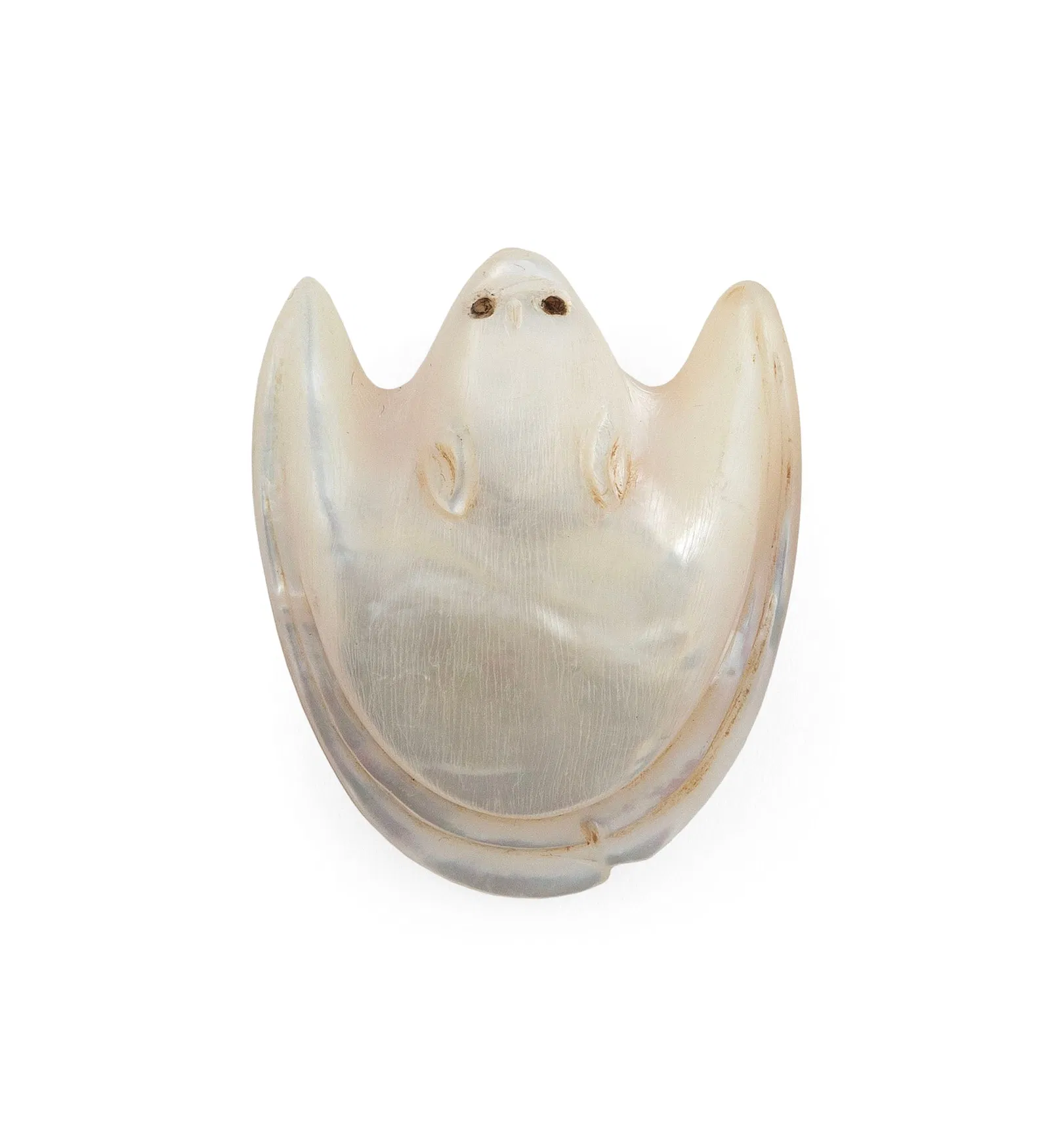
Antique to modern-era netsuke and related accessories made from and/or decorated with ebony, mother of pearl, cloth, and other organic materials round out this important event. Lot #0623, a 19th-century Japanese mother-of-pearl netsuke carved as a bat, is estimated at $1,000 to $1,500. This unsigned example measures 1.5 inches long, is simply but elegantly carved, and features inlaid eyes.
For more information on Eldred’s Netsuke sale on October 10, 2024 and to register to bid, visit LiveAuctioneers. Find more auctions and news on Auction Daily.
“The most important book on art history since Janson’s “History of Art,” says John Buxton, a leading expert in ethnographic art, founder of ArtTrak.com and long-time appraiser on PBS’s popular series Antiques Roadshow.
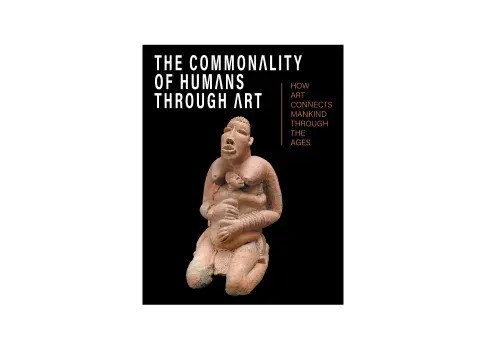
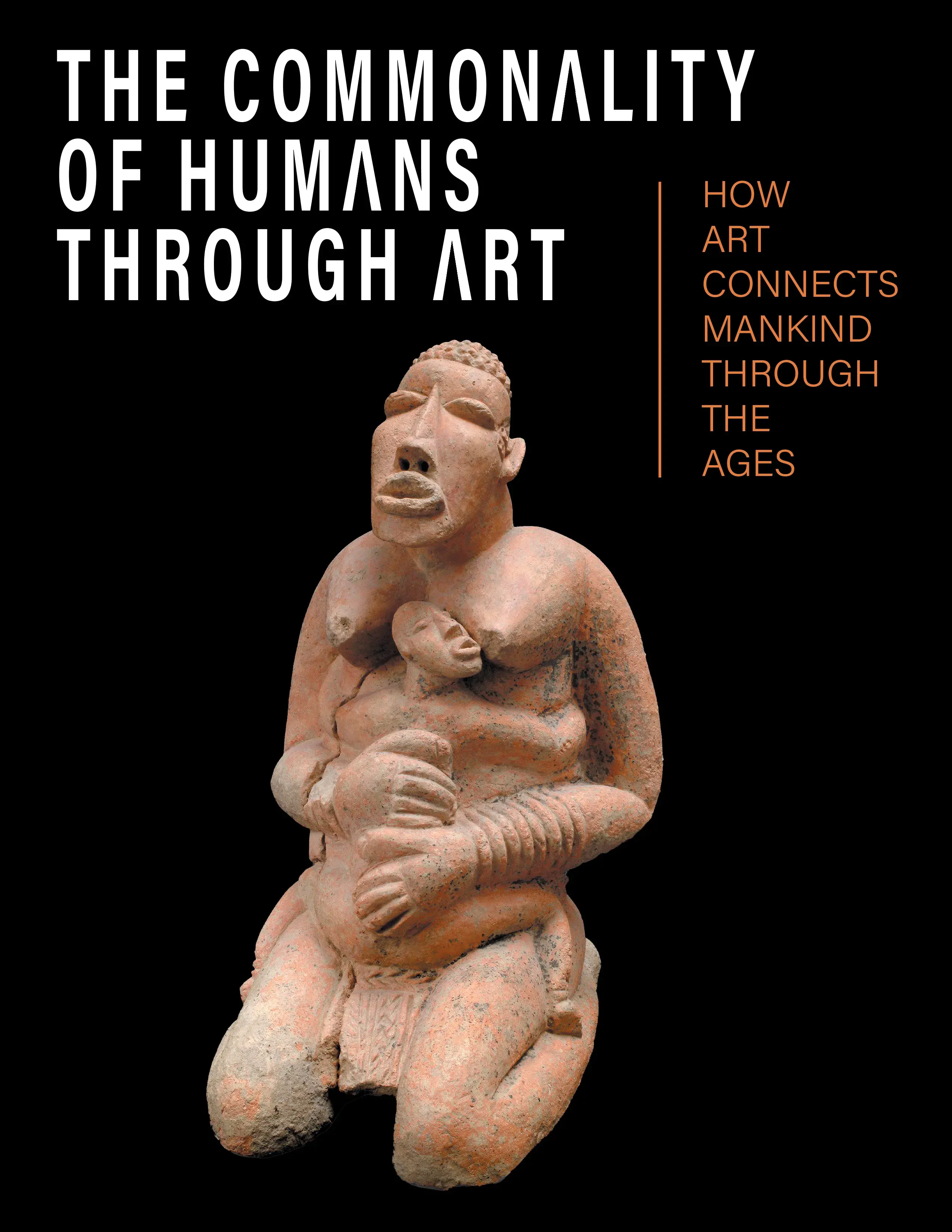
The Commonality of Humans Through Art: How Art Connects Mankind Through the Ages, by Stuart Handler (Paul Holberton Publishing, 576 pages, $78)
(CHICAGO, IL, October 1, 2024) — The Commonality of Humans Through Art, created and edited by Stuart Handler (Paul Holberton Publishing, London, October, $78.00), is a trailblazing volume that delves into the captivating intersection of art and human behavior, revealing how tribal and ancient art has shaped and reflected our existence across millennia. This extraordinary book–now available on amazon.com–brings together ten esteemed scholars to explore the impact of art on human life from birth to death, offering a fresh perspective on art history and cultural anthropology.
In a departure from traditional approaches, this book eschews geographical and chronological constraints in favor of thematic exploration. It presents an innovative framework where art is examined through the lens of universal human experiences—family, motherhood, conflict, sickness, healing, religion, and death. Each thematic chapter, penned by a leading expert, illuminates the profound ways in which art captures and influences our social experiences across diverse cultures and epochs.
With 400 vibrant color photographs of tribal and ancient art objects sourced from world-renowned museums, The Commonality of Humans Through Art serves as a centralized exhibition of humanity’s artistic legacy. This stunning collection not only provides a feast for the eyes but also offers deep, thought-provoking insights into the interconnectedness of art and human behavior.
Says Stuart Handler–a prominent Chicago industrialist and an ancient art collector in his own right, “I’ve had the privilege of seeing thousands of photos of art that mankind has made throughout their existence. Selecting 400 images which represent the human experience was a sobering and astounding experience to see what the human brain has created to make sense out of life.”
This book features expansive essays by a distinguished lineup of contributors:
Dr. Dahlia W. Zaidel, Brain Research Institute Member and Adjunct Professor of Behavioral Neuroscience, UCLA — “The Brain and Art”
Wilfried van Damme, Art Historian and Anthropologist — “Aesthetics and Human Cultures”
Barbara C. Sproul, Former Chair of the Department of Religion, Hunter College, CUNY — “Creation Myths”
Herbert M. Cole, Professor Emeritus of Art History, University of California, Santa Barbara — “Motherhood and the Family”
Lark E. Mason, Former Senior VP at Sotheby’s Chinese Works of Art Department — “The World Around Us”
David H. Dye, Professor of Archaeology, University of Memphis — “Conflict and Warfare”
John F. Scott, Professor Emeritus of Art History, University of Florida — “Portraying Ourselves and Others”
Todd J. Pesek, MD, Holistic Physician and Founding Director of the Center of Healing Across Cultures — “Sickness and Healing”
Alex W. Barker, Former President of the American Anthropological Association — “Religion and Rituals”
Robert B. Pickering, Professor Emeritus of Anthropology and Founding Director of the Museum Science and Management Program, University of Tulsa — “Death”
“Instead of following the standard geographical or historical arrangement, this book [The Commonality of Humans Through Art] groups work thematically in terms of human life events. Each essay teases out how the language of art captures and forms social experience across cultures and history,” praises anthropologist Nigel Barley, who reviewed the book for World of Interiors.
The Commonality of Humans Through Art is more than just an academic reference book. It’s a visually stunning coffee table book that will captivate art enthusiasts and scholars alike. This remarkable volume is a testament to the enduring power of art to shape and mirror the human experience.
An exceptional, astonishing collection traces the history of a family that gave France some of its finest marble treasures.
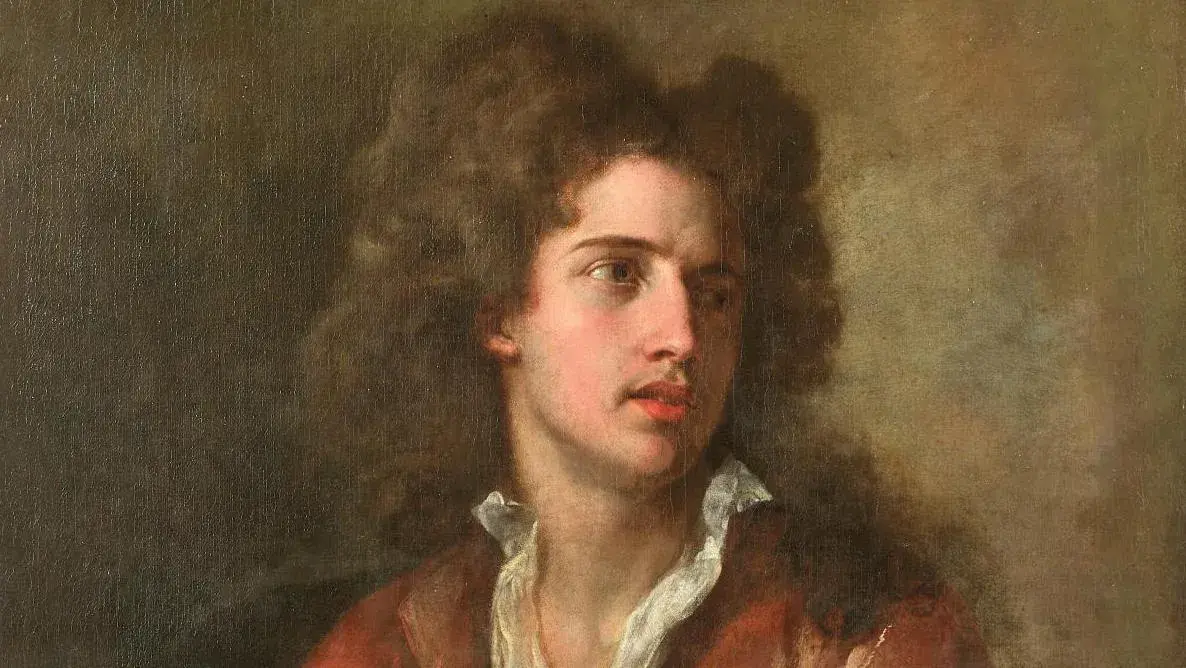
Attributed to Jean Baptiste Santerre (1651-1717), Portrait of Nicolas Coustou (1658-1733), oil on canvas, 97 x 74 cm/38.18 x 29.13 in. Estimate: €12,000/15,000
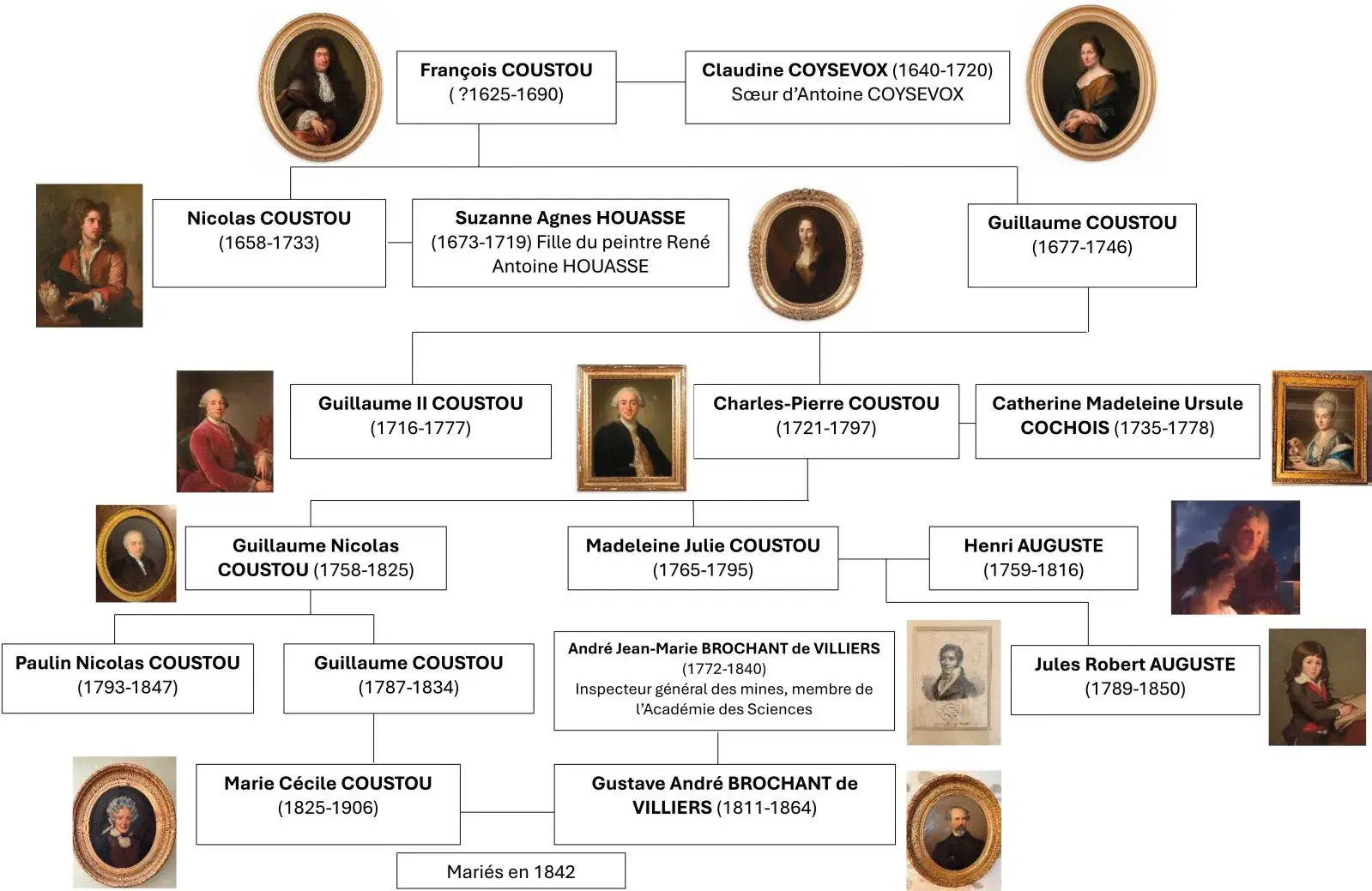
Surprisingly, the collection has just a few sculptures, and they are painted. The name Coustou evokes Louis XIV and Louis XV’s great royal commissions gracing the Louvre’s Marly Courtyard by Nicolas (1658-1733) and Guillaume (1677-1746), the illustrious nephews of Antoine Coysevox (1640-1720). The artistic dynasty they founded passed down 17 intimate portraits from one generation to the next.
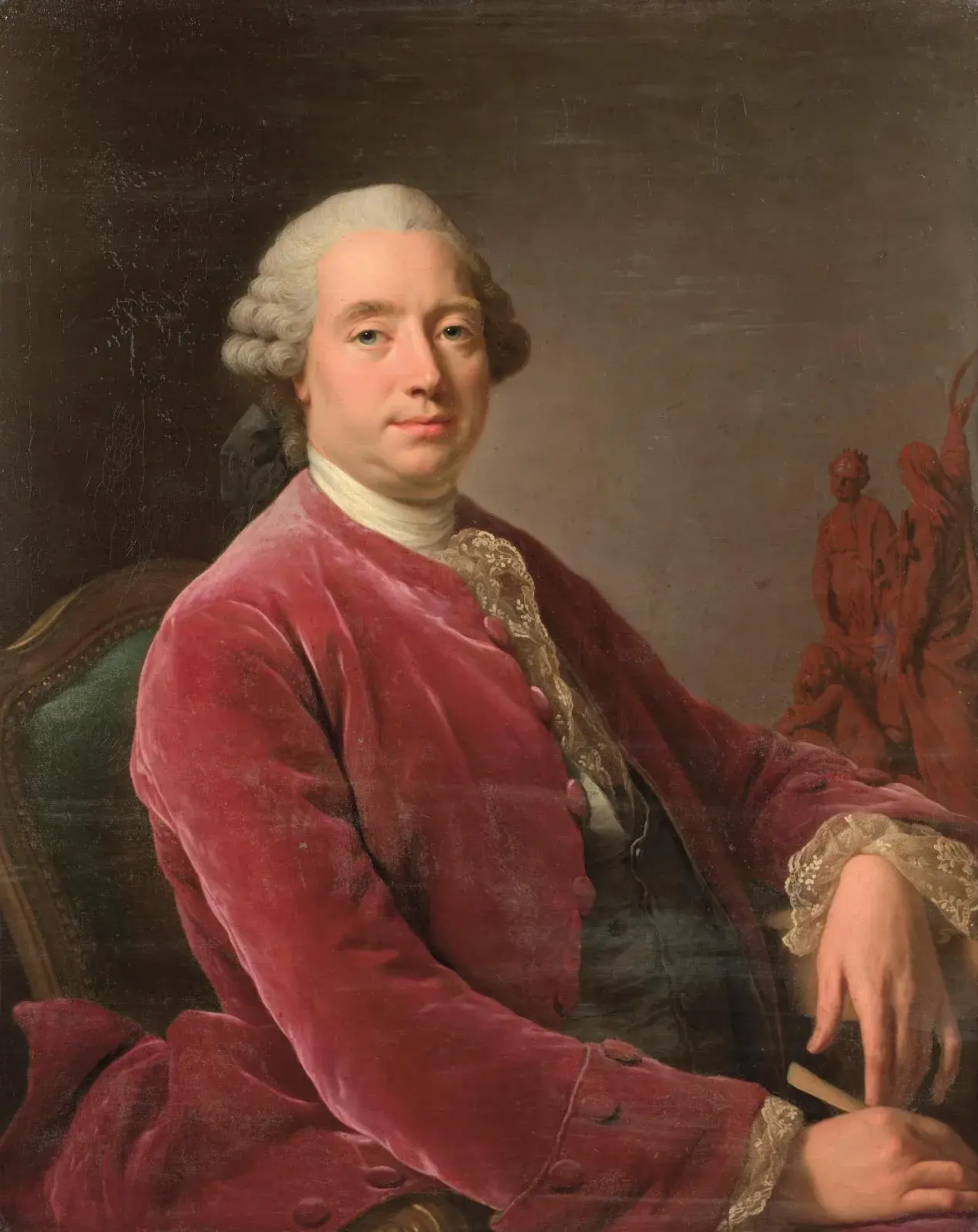
Alexandre Roslin (1718-1793), Portrait of Guillaume II Coustou (1716-1777), oil on canvas, 92 x 71 cm/36.22 x 27.95 in. Estimate: €40,000/60,000
The Origins of the Coustou Story When Notre Dame Cathedral in Paris reopens to the public on December 8, visitors will again be able to see Nicolas Coustou’s most famous work, Pietà, opposite his brother Guillaume’s Louis XIII and Antoine Coysevox’s Louis XIV. Our view of the altarpiece, and of all the other works miraculously rescued from the fire, undoubtedly will have changed. In the meantime, those who cannot wait can see Cardinal Forbin-Janson’s elegant funerary monument (by Nicolas) at Beauvais Cathedral, The Allegory of the Saône (by Nicolas and Guillaume) at the Musée des Beaux-Arts de Lyon or the host of works in the Louvre. But the delicate portrait of Nicolas Coustou in Cannes attributed to Jean Baptiste Santerre is also thrilling (€12,000/15,000). The figure of Coustou twirls, like a sculpture in the round, responding to the small copy of the Belvedere Torso so precious, so essential to the imagination and intrinsic to the identity of the artist, who here says everything he owes to his three-year stay at the French Academy in Rome from 1683 to 1686. Pianists should perhaps more than anyone seize the vibrations of each finger on Nicolas Coustou’s right hand. His official portrait, by Jean Le Gros, in the Chateau of Versailles, shows a prince of the arts whose father-in-law, René-Antoine Houasse, headed the French Academy in Rome. The portrait that has remained in the family of his brother’s descendants is one of an impetuous young man who embraced his destiny as a sculptor. Portraits of his parents, the Lyon master joiner and wood sculptor François Coustou and Claudine Coysevox, will also be presented. When Claudine’s brother, Antoine Coysevox, lodged his nephews in Paris, he began a veritable artistic dialogue with them, from the great waterfall of Marly to the famous equestrian figures, now in the Louvre. Like Antoine, Nicolas died childless, but Guillaume passed his artistic streak on to his two sons, sculptor Guillaume II Coustou (1716-1777) and lawyer and architect Charles-Pierre Coustou (1721-1797). The portrait of Guillaume II Coustou made two years after his death by his friend Roslin (€40,000/60,000) closed a parenthesis in the history of royal sculpture and the family’s devotion to its kings. Before succumbing to tuberculosis on July 13, 1777, Guillaume II finished the most prestigious work of his career: the dauphin and the dauphine’s funerary monument for Sens Cathedral, which Roslin evokes here with a preparatory terracotta model.
Artcento
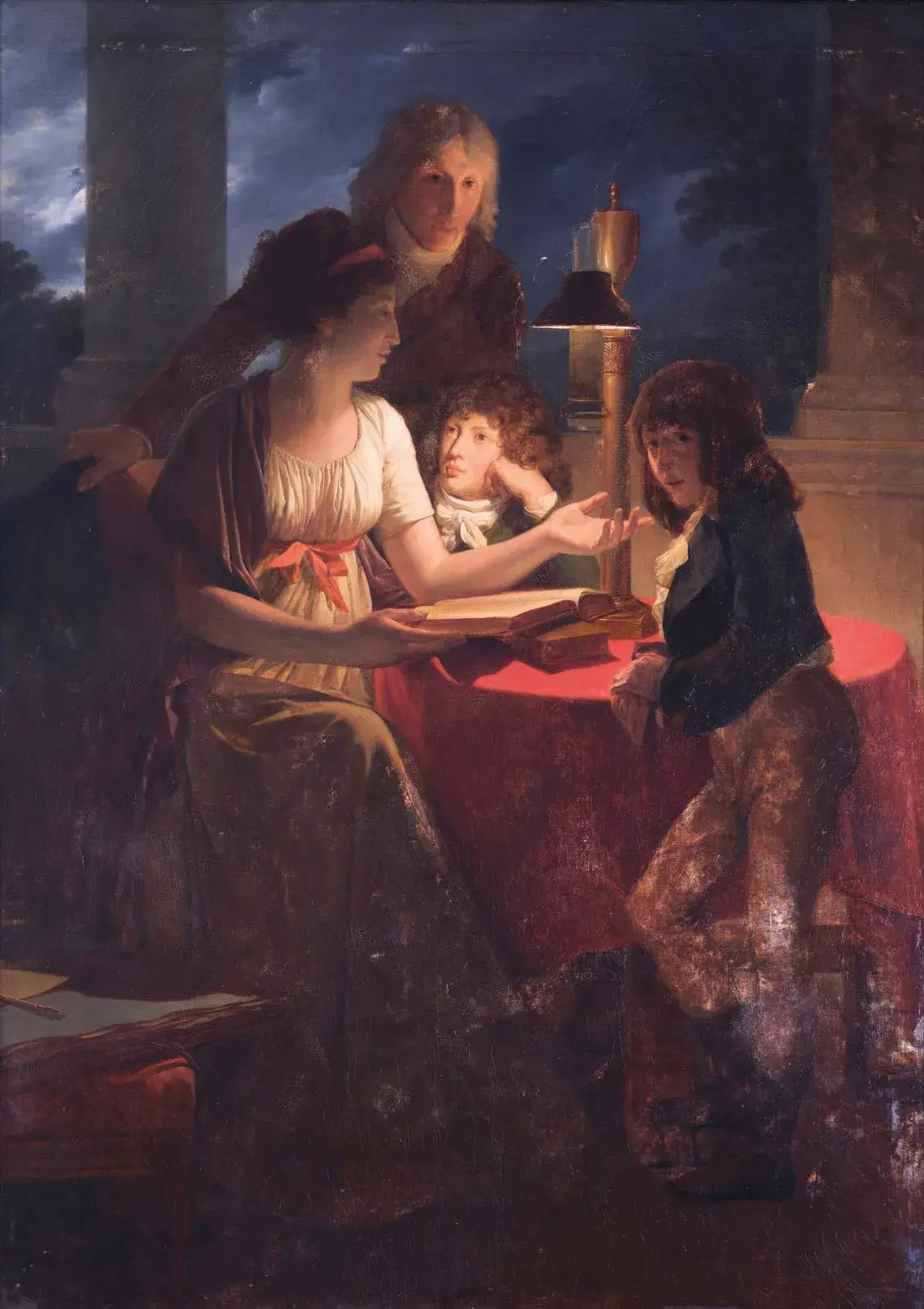
The End of a “Holy Family” The history of this family portrait gallery took a different turn when Charles-Pierre Coustou married architect Jacques-Germain Soufflot’s great-niece. With her he had a son from whom the sellers of all the paintings presented descended, especially a daughter, Madeleine Julie (1765-1795), who married the goldsmith Henri Auguste. Like her uncle, Guillaume II, she was painted posthumously. François Gérard’s famous Portrait du C*** et de sa famille (Portrait of the C*** and Her Family), renamed Portrait de l’orfèvre Henri Auguste (1759-1816) et de sa famille (Portrait of the Goldsmith Henri Auguste [1759-1816] and His Family), exhibited at the 1798 Salon, has never been on the market before (€80,000/120,000). Thanks to the ricordo held in the Chateau of Versailles collections, it already had a choice place in studies of the revolutionary period, particularly by the late Tony Halliday (1946-2006): “A pastiche of a Renaissance altarpiece, Gérard’s Auguste family is a painted translation of the doctrines and rites of theophilanthropy. Borrowing the symbols of a fallen cult, he lends dignity and grandeur to the banalities of his successor. In this work, the ‘Holy Family’ of the future is embodied not by a carpenter in a stable, but a fashionable goldsmith in a Parisian mansion—a Jean-Baptiste Say-like vision, perhaps, of the universal benefits expected from the free market. This work raises bourgeois domesticity to the rank of heroism.” In his review of the 1798 Salon for La Décade philosophique, theophilanthropist Pierre Chaussard praised Gérard’s “great boldness of conception”, writing, “In the painting of Psyche [editor’s note: Paris, Musée du Louvre], Gérard imitated Raphael. Here, he rivals Rembrandt and surpasses Caravaggio.” The same connections with the two 17th-century masters also seemed obvious to the critic at Mercure de France: “The light of the moon contrasts with that of the lamp, which, fitted with its shade, only directly illuminates the items on the table and some of the figures. Its light is perhaps too golden for a Quinquet lamp, reflecting off the other objects and mingling with the silver rays of the moon. Caravaggio would have chosen this double lighting effect and treated it no better. Rembrandt would surely have done it darker.” The critic in La Vérité en riant, ou Les Tableaux traités comme ils le méritent, en vaudevilles, called the painting Lamp Effect and wrote this acclamation: “Gérard again! Always him! … What more praise could we give a painting whose effect is admirable? Yes, Gérard, from the bosom of the arts, you fly to glory/Your great genius opens the way/And history prepares its chisel to inscribe your name in the Temple of Memory.”
François Gérard, called Baron Gérard (1770-1837), Portrait of the Goldsmith Henri Auguste and His Family, oil on canvas, 184 x 132 cm/72.44 x 51.96 in. Estimate: €80,000/120,000
“Gérard again! Always him! … What more praise could we give a painting whose effect is admirable?” La Vérité en riant, 1798
“A Caravaggesque Icon” As Adélaïde Labille-Guiard had done before him by exhibiting the posthumous portrait of Madame Infante at the 1789 Salon (Versailles, musée national des châteaux de Versailles et de Trianon) under the title Une femme et un enfant à un balcon (Woman and Child on a Balcony), Gérard did not mention his model’s death. The backlighting and “Rembrantesque” or “Caravaggesque” play of candlelight on his face were a clever and delicate way to subtly evoke his absence. Portrait of the Goldsmith Henri Auguste and His Family is an edifying scene for the public and a pious memento for the family. Géricault and Delacroix spent countless evenings in front of this “icon” (dixit Tony Halliday), which is mentioned in the will of Jules Robert Auguste, Henri and Madeleine Julie’s second son (see page 16), who left the painting to his cousins so that it could enter the family portrait gallery. History does not say which heir had the clumsy restoration of the drapery in the lower part of Gérard’s monumental composition carried out. Whoever buys the painting on October 22 may see fit to repair the botched job.
Monsieur Auguste a “Shy and Mysterious Man”
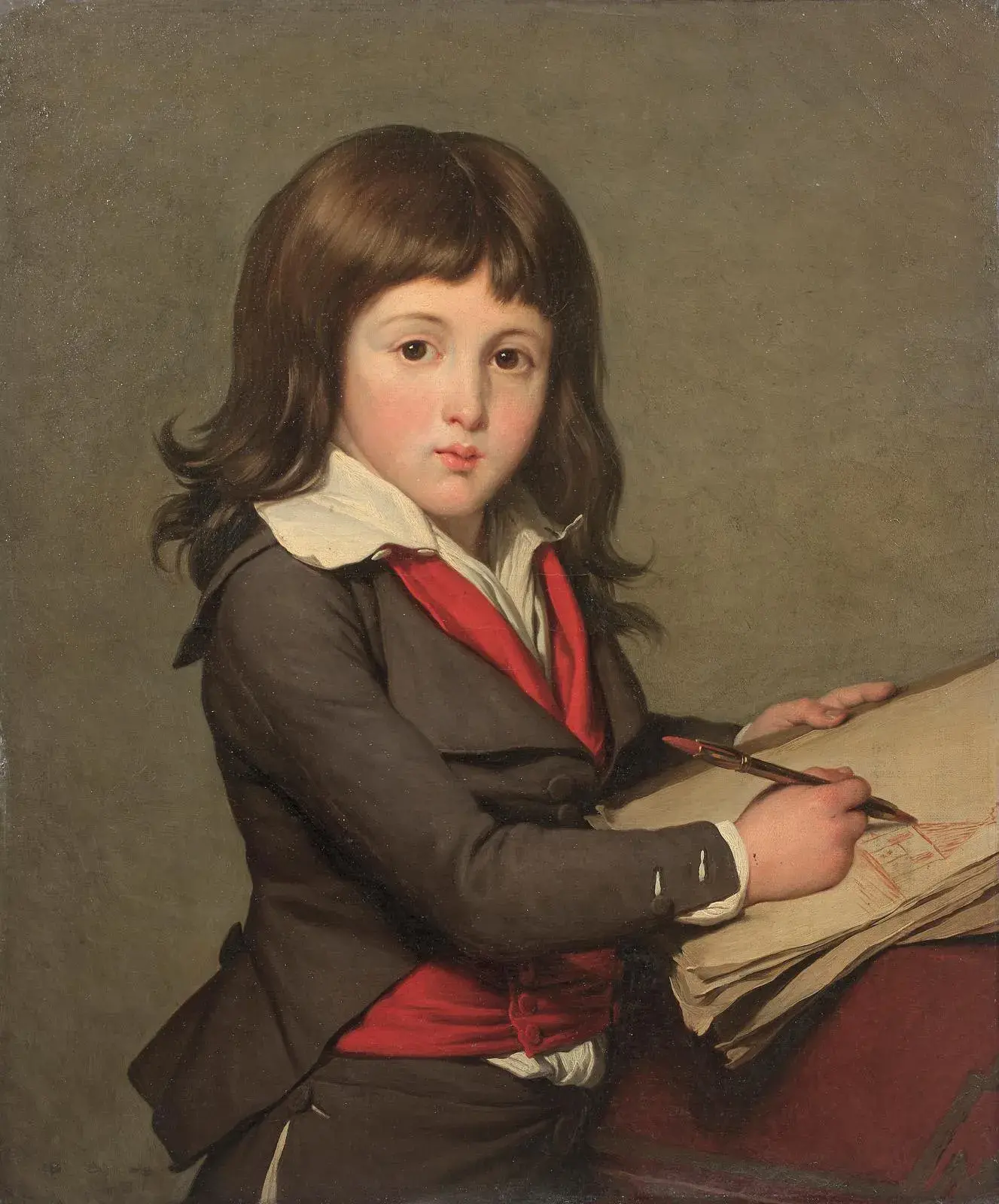
François André Vincent (1746-1816), Portrait of Jules Robert Auguste (1789-1850), oil on canvas, 64.5 x 54.5 cm/25.39 x 21.45 in. Estimate: €80,000/120,000
In the Coustou family, I ask for the great-great-grandson, Jules Robert Auguste (1789-1850). Horace Vernet, Géricault, David d’Angers and Delacroix were apparently greatly inspired by the figure studies this pioneer of Orientalist painting brought back from his travels in Greece, Egypt and Morocco. While the extensive collection held by the Musée des Beaux-Arts d’Orléans provides a good understanding of his paintings and drawings, a fine essay published in 1910 by Charles Saunier, Un artiste romantique oublié. Monsieur Auguste, made him a legend, as Paul Signac explained at the time. “I already liked this Monsieur Auguste, even though he is a little shy and mysterious,” Signac wrote. “But thanks to you, I have gotten to know and like him better.” As a child, the dandy of rue des Martyrs, in Paris, had the privilege of stirring the emotions of two great painters who exhibited his portrait at the Salon. Henri Auguste and Madeleine Julie’s youngest son posed for François André Vincent the year his mother died. In his monograph on the artist, Jean-Pierre Cuzin surmised from Pierre Chaussard’s review of the 1795 Salon that the “two children’s portraits” were of “Mr. Auguste’s sons”, without, however, being able to identify the family with certainty. The work, full of truth and emotion, shows the future resident and architect of the French Academy in Rome drawing a house. At the 1798 Salon, Gérard exhibited Portrait of the Goldsmith Henri Auguste (1759-1816) and His Family, a more enigmatic image of the elegantly dressed and already dashing nine-year-old child, while his older brother religiously listens to their mother. François André Vincent’s portrait of the older brother remains to be found.
Vera Molnár, who died in 2023, received recognition late in life. A pioneer of generative art, she never stopped experimenting, as demonstrated by the approximately fifty works offered up for sale.
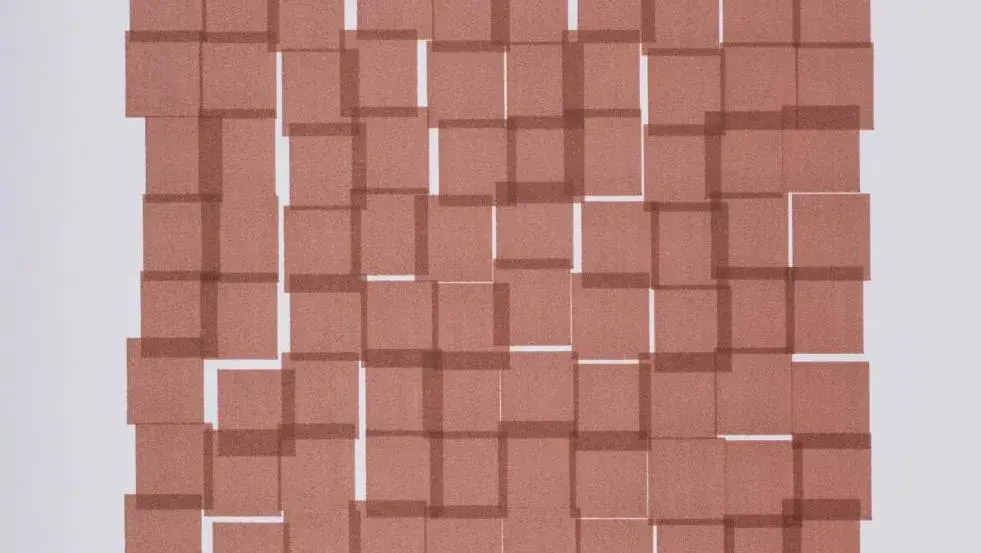
Vera Molnár (1924-2023), Interstices, 1987, computer printout on heavy paper, monogramed and dated lower right, signed, titled and dated on the back, 42 x 29.5 cm. Estimate: €2,000/3,000
At the age of almost 100, Vera Molnár was still giving interviews and continuing to innovate. A woman who could not go a day without drawing a line, she tirelessly pursued her research without worrying about the museumization of her work. As part of the “Elles font l’abstraction” exhibition at the Centre Pompidou in 2021 and at the Venice Biennale in 2022, she was labeled a pioneer for the experimental nature of her approach and her early integration of computer technology into her artistic process. While participating in a number of monographic exhibition projects and cultivating her loyalty to the Musée des Beaux-Arts in Rennes and the Espace de l’Art Concret in Mouans-Sartoux, she developed new collaborations with a young artist such as Paul Mouginot and embarked on NFTs. While the Museum of Digital Art in Zurich revisited the major contribution of her research to several generations of creators, this year’s “Parler à l’œil” exhibition at the Centre Pompidou offered a more individual vision of her work, highlighting the long-term process through the Journaux intimes (Diaries) (1976-2020) donated by the artist to the museum. Several donations to French public institutions, such as the INHA (The French National Institute of Art History), should soon fuel new research on Vera Molnár. The colloquium co-organized by Vincent Baby in June testified to a genuine ambition for transmission, to which this sale contributes in its own way. Bringing together some fifty original works on paper, by hand or by computer, including gouaches, collages and canvases from the artist’s estate, the catalog offers a representative selection of her work since the 1970s, when her practice began to develop with computers. In this respect, the sale shows not so much a break as continuities. Even before discovering IBM machines that allow us to visualize calculations in real time, Vera Molnár was using “imaginary machines”. In the confined space of a sheet of paper, she imposed constraints and protocols on herself. It’s already programming, a work that’s certainly rigorous but close to play. At the same time, the members of Oulipo, many of whom were mathematicians, were applying these same attempts to exhaust possibilities and explore combinatorics to literature.
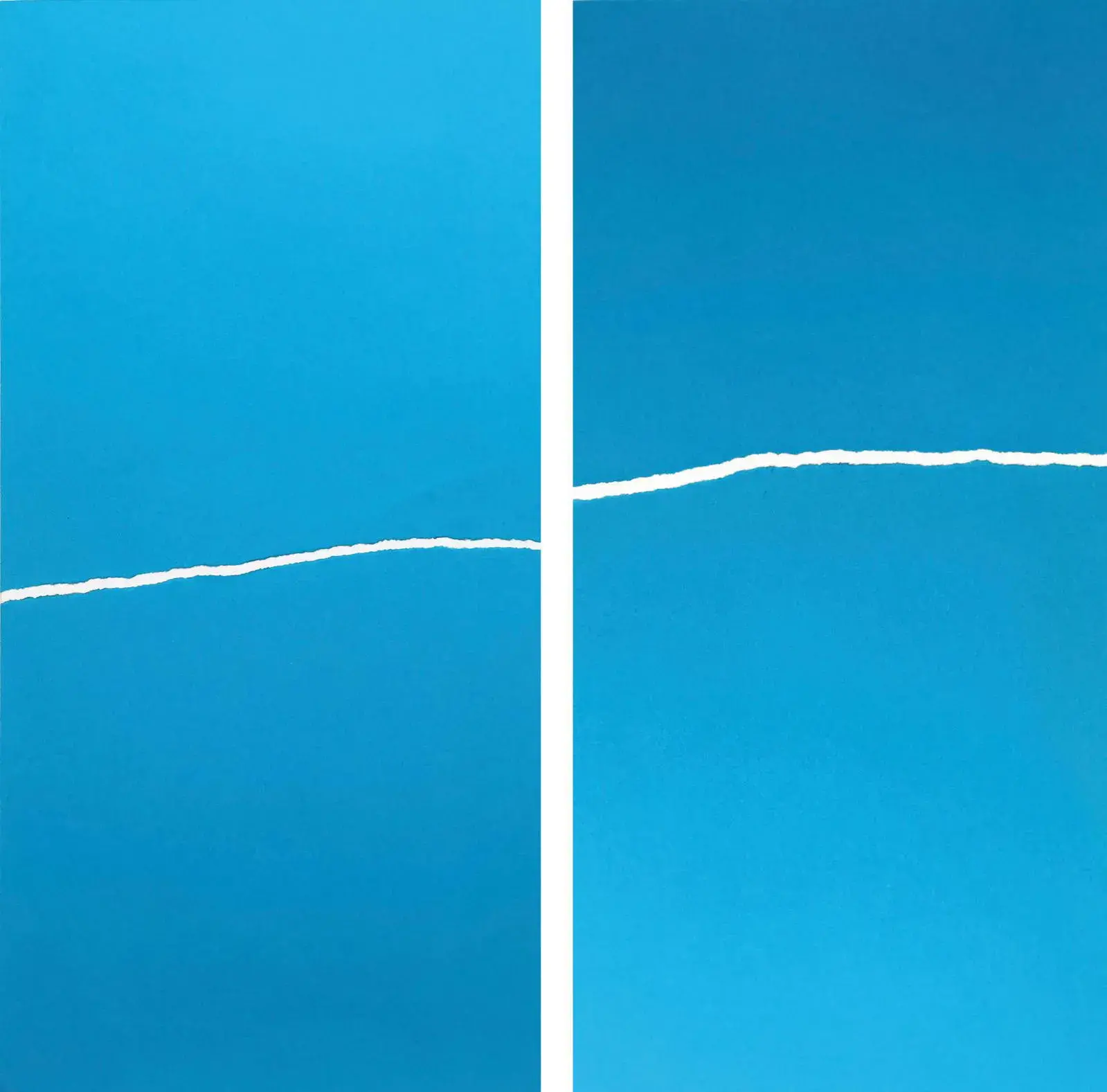
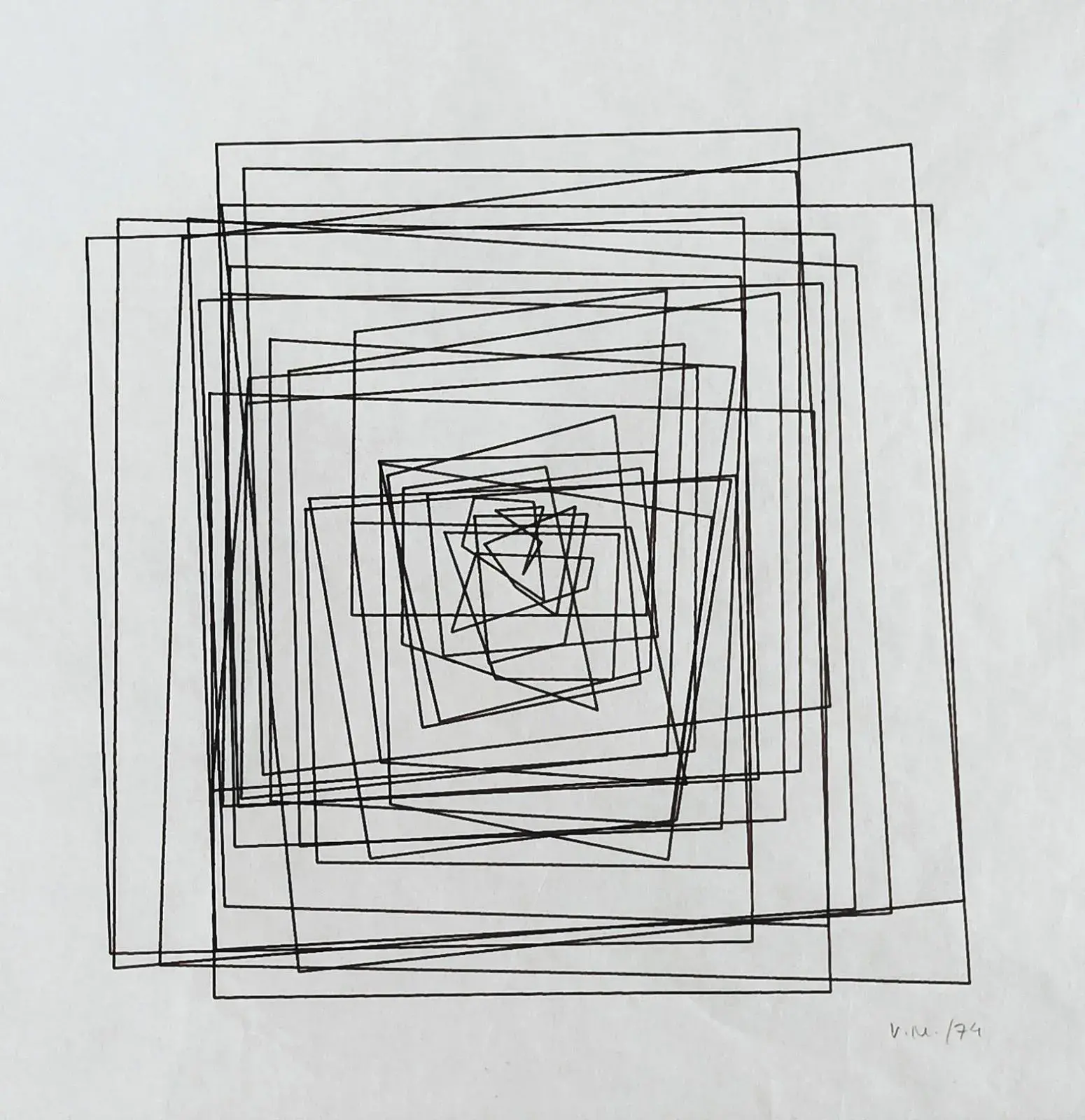
Vera Molnár, Ligne blanche sur fond bleu (White Line on Blue Background), 1995, torn paper and collage on cardboard, signed, titled and dated, 50 x 25 cm each. Estimate: €2,000/3,000Vera Molnár, Hypertransformation, 1974, computer plotter drawing, ink on Benson paper, monogrammed and dated lower right, from the series «Job from Molnar», 50 x 36 cm. Estimate: €3,000/4,000
The GRAV Experiment
Geometry is everything human,” declares Vera Molnár, reminding us that there are no circles, squares or even lines other than those drawn by human beings and which serve as tools for grasping the world. Born in Hungary in 1924, she attributes the beginning of her artistic vocation to the discovery of Albrecht Dürer. Trained as a musician from an early age, she went on to study painting at the Beaux-Arts in Budapest, where she was confronted with the single horizon of figuration. The pleasure of theme and variation would soon reveal itself, notably through the engraving of the Mélancolia, a lasting reference, which she interprets through the figures of the magic square. Various artists discovered during her formative years became discreet references throughout her career, including Cézanne and Monet. After leaving for Paris in 1947 with her Beaux-Arts classmate François — whom she married in 1948 — ,they discovered the French contemporary art scene, which included Auguste Herbin, Michel Seuphor and Sonia Delaunay, who encouraged her. The 1973 hand-drawn Haie is interesting in that it seems to be a return to those Parisian years that ended her figurative period and opened the way to abstraction, which she would never abandon. It recalls the motif of the “Trees and Geometric Hills” drawings in the collection of the Musée National d’Art Moderne, in Paris. Was there an unexplored avenue in this motif? The artist, who had already simplified her forms, took full advantage of the line. She developed a geometry that gradually freed itself from any attempt to represent reality. When she met François Morellet and Jesús-Rafael Soto in the 1950s, she went back to the sources of geometric abstraction, those of the Bauhaus and the Russian Constructivists, and began to emulate them. With François Molnár, she was invited to Zurich in 1960 by the critic Max Bill for the landmark exhibition “Konkrete Kunst: 50 Jahre Entwicklung”. Recognized by her peers, she took part in the creation of the Centre de Recherche d’Art Visuel (CRAV): this commitment testifies to a roped-off approach in which the notion of authority is debated as a potential brake on experimentation; she left the group (which became GRAV) partly for this reason.
Drawing freehand, the artist joyfully pushes her lines beyond the confines of classical representation.
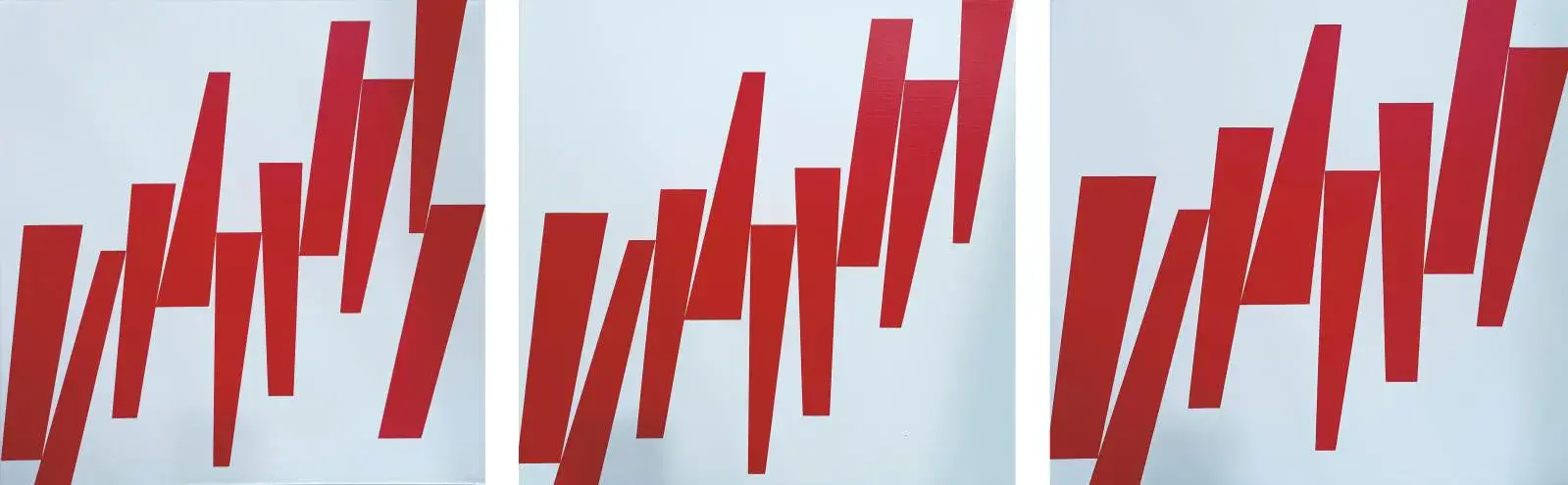
Vera Molnár, Trapèzes penchés à droite, B1, B2, B3 (Right-Leaning Trapezoids), 1987-2018, triptych, acrylic on canvas, signed, titled and dated on the back, 40 x 120 cm ; 40 x 40 cm/15.7 x 47.24 ; 15.7 x 15.7 in each. Estimate: €4,000/6,000
Computer Drawings
In 1980, Vera Molnár co-founded the Centre de recherche expérimentale et informatique des arts visuels at the University of Paris-I, where she was also a lecturer. Long an outsider on the art market, Vera Molnár developed a personal body of work, but she is far from isolated, as demonstrated by the American exhibitions “Code: Arts Enters the Computer Age”, at LACMA in 2023, and “Thinking Machines: Art and Design in the Computer Age, 1959-1989”, at MoMA in 2017. The sale includes Interstices, a computer plotter drawing from this period (1987), which shows the circulation and transformation of forms. In this composition of squares, the degree of disorganization is minimal, but allows us to see one of the cursors with which the artist works. Disorder is part of the program. An earlier drawing from 1974, computer-generated on Benson paper and part of the historic “Job From Molnár” series, shows a dizzying potential for transformation through a series of concentric squares. Vera Molnár addresses the eye first and foremost, as evidenced by several texts and even the title of her latest exhibition. The vibrations that the eye perceives beyond preconceived forms have something of a liberating quality. With her free hand, the artist would jubilate lines outside the framework of classical representation. With time and the evolution of technology, her playground expanded. Following the death of her husband in 1993, she began to be more present on the market, and a succession of collaborations enabled her to experiment with larger formats and new media such as ceramics, glass (stained glass) and textiles (carpets and tapestries). Open from an early age to the idea of art going beyond its own confines, no doubt because she herself stands on the edge of other fields, she conceives of installations that enable new spaces to be approached. The 2018 triptych entitled Trapèzes penchés à droite (Right-Leaning Trapezoids) uses three frames to reproduce the motif of an installation created in 1987-1988 by collaging red adhesive tape at the Museum of Concrete Art in Ingolstadt. With the original materials themselves, the construction game is assumed, reminding us of the extent to which her work was nourished by everyday experience, where the weave of a fabric or the lines of a clothesline could become a colorful pretext, a motif for disorder. Vera Molnár’s work is shaped by obsessions, including Cézanne and his Sainte-Victoire. The first image of France for the artist, this mountain was a summit to be repeated over and over again. Sometimes materialized as a diagram, sometimes as a tear, the horizon line — which can be sensed, for example, in the diptych Ligne blanche sur fond bleu — became an opening for her.
Featured: Hupfeld Phonoliszt-Violina Model A music machine, $250K-$500K, 1904 Caille Bros. 5¢ floor-model Roulette slot machine, $150K-$300K, fortune tellers, arcade machines, 825 advertising signs
Hupfeld Phonoliszt-Violina Piano-Violin Model “A”
LAS VEGAS – There will be no shortage of accomplished entertainers at Morphy’s Oct. 17-19 Coin-Op & Antique Advertising Auction in Las Vegas. A world-class lineup of European antique music machines is waiting in the wings to thrill auction guests with bravo-worthy performances rivaling famed orchestras and musicians of a century ago. Those who cannot attend the event in person are invited to bid absentee, by phone or live online through Morphy’s bidding platform.
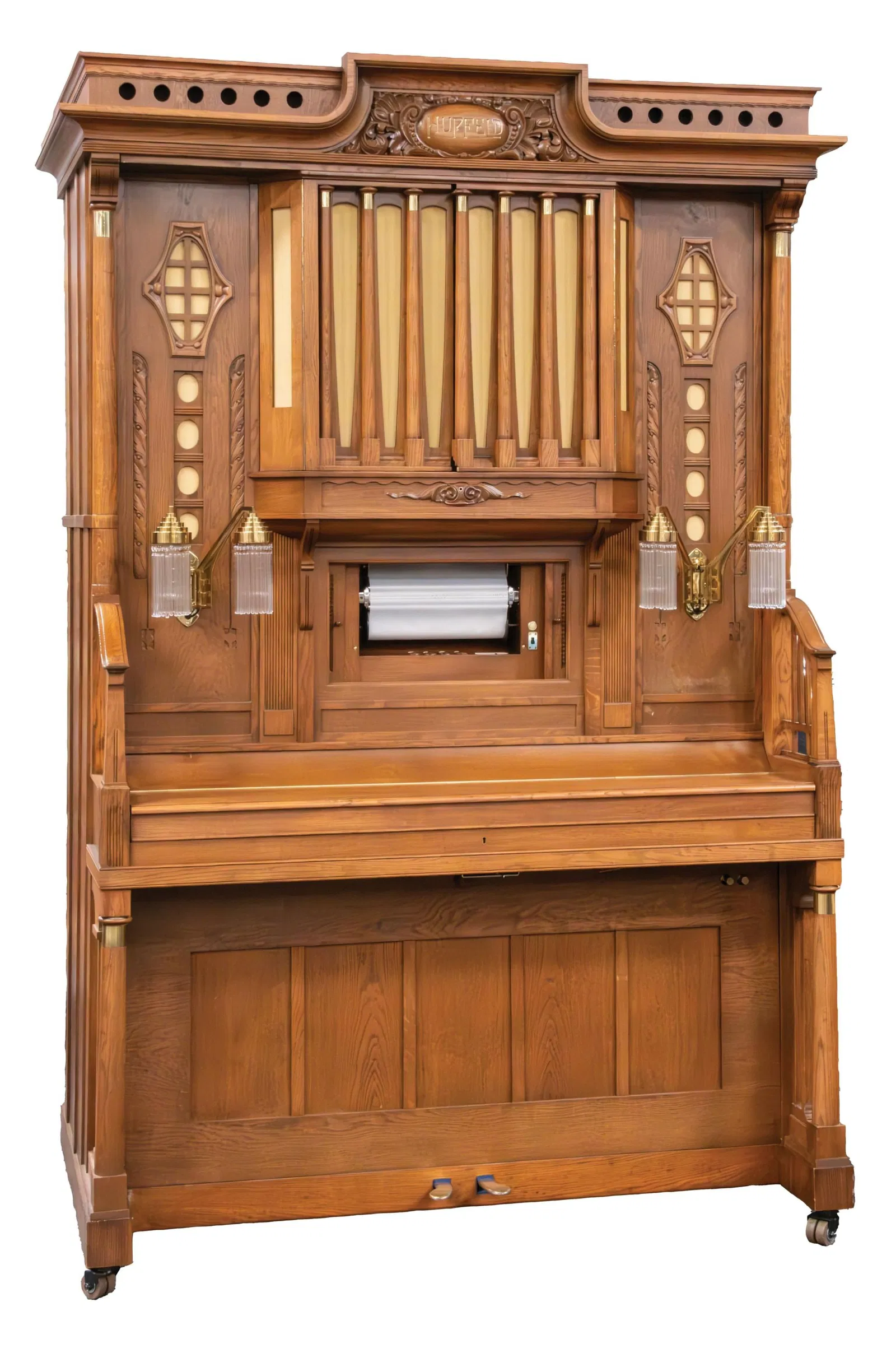
Leading the A-list lineup is a circa-1912 Hupfeld Phonoliszt-Violina Model “A,” which is regarded as the most successful automatic violin and piano-playing machine ever made and one of the most spectacular of all music machines. Its complex mechanisms reproduce violin expression, bowing, vibrato, staccato, etc., as well as piano expression, replicating the technique of highly accomplished pianists. Restored in 1986 and again in 2014, it was acquired in 2012 by its present owner from Sanfilippo Place de la Musique in historic Barrington, Illinois. Jasper Sanfilippo obtained the unit in 1983 from a restaurant in France. Its auction estimate is $250,000-$500,000.
Another musical wonder, a Coinola Model SO Super Orchestrion is one of approximately 50 manufactured circa 1920 by the Operators Piano Company of Chicago. Its “orchestra” includes an 88-note piano (78 notes play automatically), a mandolin, violin and flute pipes; drums, a cymbal and other smaller percussion instruments. It is designed to plays 10-tune “O” rolls. Marketed at the start of the Prohibition Era, its original owner is reputed to have been a Chicago mobster. Restored twice, in 1986 and again in 2015, it is ready to grace a new collection and is estimated at $100,000-$200,000.
Also ready to step into the spotlight is a circa-1920 Mills Deluxe Violano-Virtuoso comprised of two violins that play elegantly and simultaneously. Housed in a Brazilian mahogany cabinet, this unit underwent a scrupulous 36-month restoration in which no small detail was spared. The U S Government designated the Violano-Virtuoso as “one of the greatest scientific inventions of the age,” and this fine example is a functional testament to that distinction. Estimate: $40,000-$70,000
Extremely rare and sought after, a circa-1895 Symphonion No. 38B Eroica 3-disc music box with clock was made by Symphonion Musikwerke of Leipzig, Germany. Housed in a Lenzkirch oak hall-clock case, it plays 14-inch discs in sets of three across six individual combs. Estimate: $40,000-$70,000
A circa-1890 French musical automaton picture clock with music box is as artful as it is scientifically precise. It depicts what appears to be the Crystal Palace, which was built in 1851 in London’s Hyde Park to house the “Great Exhibition.” Its three-dimensional diorama painting shows die-cut horses and jockeys in the foreground, and the Revel clock with a near-perfect porcelain dial is adorned by flowering vines. In excellent condition, this stunning piece is estimated at $12,000-$30,000.
Front and center amongst the 145 rare slot machines is a circa-1904 Caille Bros. Roulette 5¢ floor-model slot with a 7-way roulette wheel payout. Housed in a rare Honduran mahogany cabinet with ornate copper-flashed and plated iron castings, this desirable machine has been fully restored and is one of the finest examples Morphy’s antique coin-op experts have ever seen. Since the 1990s, it has been held in a private collection. It now comes to auction with a $150,000-$300,000 estimate.
A 1912 Caille Bros “Tourist” cast-iron slot machine shows off intricate castings and has its original “country” reel and back door. The unit is fun to play. The user deposits a nickel, pulls the handle, and if the “winning country” comes up, the machine pays out. In remarkable untouched condition with a great patina, it even retains its proper key. Estimate: $40,000-$60,000
Bidders wondering if it will be their lucky day at the auction might want to consult a circa-1891 Roover Bros. Donkey Wonder floor-model fortune teller machine. One of only three or four original machines of its type known to exist, the auction example retains its original “lady” equine fortune teller, who moves her head from side to side, scans the audience and flips her baton to spin the wheel of fortune. It operates by clockwork and is electrified only for the specific purpose of illuminating the cabinet section. The auction estimate is $40,000-$70,000.
Another clairvoyant who will be on hand to predict the future is Princess Doraldina, who holds court behind the glass of a circa-1918 5¢ fortune-telling machine. Manufactured in Rochester, NY, it is one of few surviving examples. The wax figure of the mystical princess moves its head and arm, selects a fortune and dispenses it on a card. An older restoration, this machine is in excellent working order and comes with a supply of both original and reproduction fortune cards. Estimate: $30,000-$50,000
Both baseball fans and collectors of arcade machine are expected to step up to the plate for a circa-1948 “Bat A Score” arcade machine with great-looking baseball graphics. Made by H.C. Evans, Chicago, the unit has been beautifully restored, inside and out. Animated manikin figures of a pitcher and batter, plus a stationary catcher, are on the interior field. When a nickel is dropped into the slot, a player gets 10 pitches, with the goal being to hit the steel ball into one of the five rear levels. In perfect order and retaining its keys, this American classic is expected to drive home a $20,000-$40,000 winning bid.
When it’s snack time at the auction, bidders can imagine what it might have been like to enjoy a freshly popped treat from a circa-1905 Cretors (Chicago) Model D horse-drawn popcorn wagon. Extensively restored to a very high standard, its beveled, cobalt blue flash-cut and chipped-glass signage says HOT BUTTERED POPCORN and IT’S SOOOO GOOD. The spotless interior is just as nice as the exterior, and is finished in red with oak trim, and fitted with metal drawers, counter, etc. Measuring 12½ feet in length, the Cretors wagon will roll across the auction block with an estimate of $15,000-$30,000.
Another lot that serves up tasty turn-of-the-century nostalgia is a Royal #5 coffee roaster made around 1910 by A J Deer Co of Hornell, New York. Complete with its load hopper and cooling pan on the original cast-nickel-trimmed base, this roaster has been restored in a Planters Peanut roaster motif. A sizable 88 inches long by 65 inches high, it could inspire a winning bid of $20,000-$40,000.
An attractive circa-1880 carved and painted Native American cigar store figure attributed to Samuel Robb stands 50 inches high (70 inclusive of stand). Its original polychrome palette shows no signs of touch-up paint or restoration. Originally, the figure would have held a spear in the right hand and a bunch of tobacco in the left hand. Its auction estimate is $20,000-$40,000.
As any collector will attest, antiques know no national boundaries as they pass from one pair of hands to the next over decades or centuries of ownership. One can only speculate about the journey one particular sign in the October auction might have taken before now. It is a massive 17ft by 4ft reverse-painted half-moon glass sign that advertises DEANE & ADAMS / PURVEYOR OF MILITARY ANTIQUITIES / WAR DEPARTMENTS & RULERS OF INDIA / ALL THE PRINCIPAL COLONIES SUPPLIED. It displays the British Royal Arms, the motto of the British Monarch – Dieu et mon droit (God and my right) – and the royal warrant (endorsement) tagline: GUN MAKER TO THE ROYAL HOUSEHOLD. Whether it remains in the United States, returns to its country of origin (England) or ends up in some other distant locale remains a question mark until auction day, when it will be offered with a $16,000-$25,000 estimate.
The Oct. 17-19, 2024 auction will be held live at Morphy’s satellite gallery located at 4520 Arville St., #1, Las Vegas, Nevada 89103. Start time is 9am Pacific time (12 noon Eastern time). Preview Monday through Wednesday, Oct. 14-16 from 9am-4pm local time; or on auction days from 8-9am. All forms of remote bidding will be available, including absentee, by phone (please reserve line in advance), or live via the Internet through Morphy Live. For condition reports or other questions, call tollfree 877-968-8880 or email [email protected]. Online: https://www.morphyauctions.com.
Battle royale for top-lot honors pits magnificent Tsar Nicholas II shashka – only royal sword ever offered for public sale – against circa-1509 gilded suit of armor by Della Cesa, ‘armorer to kings’
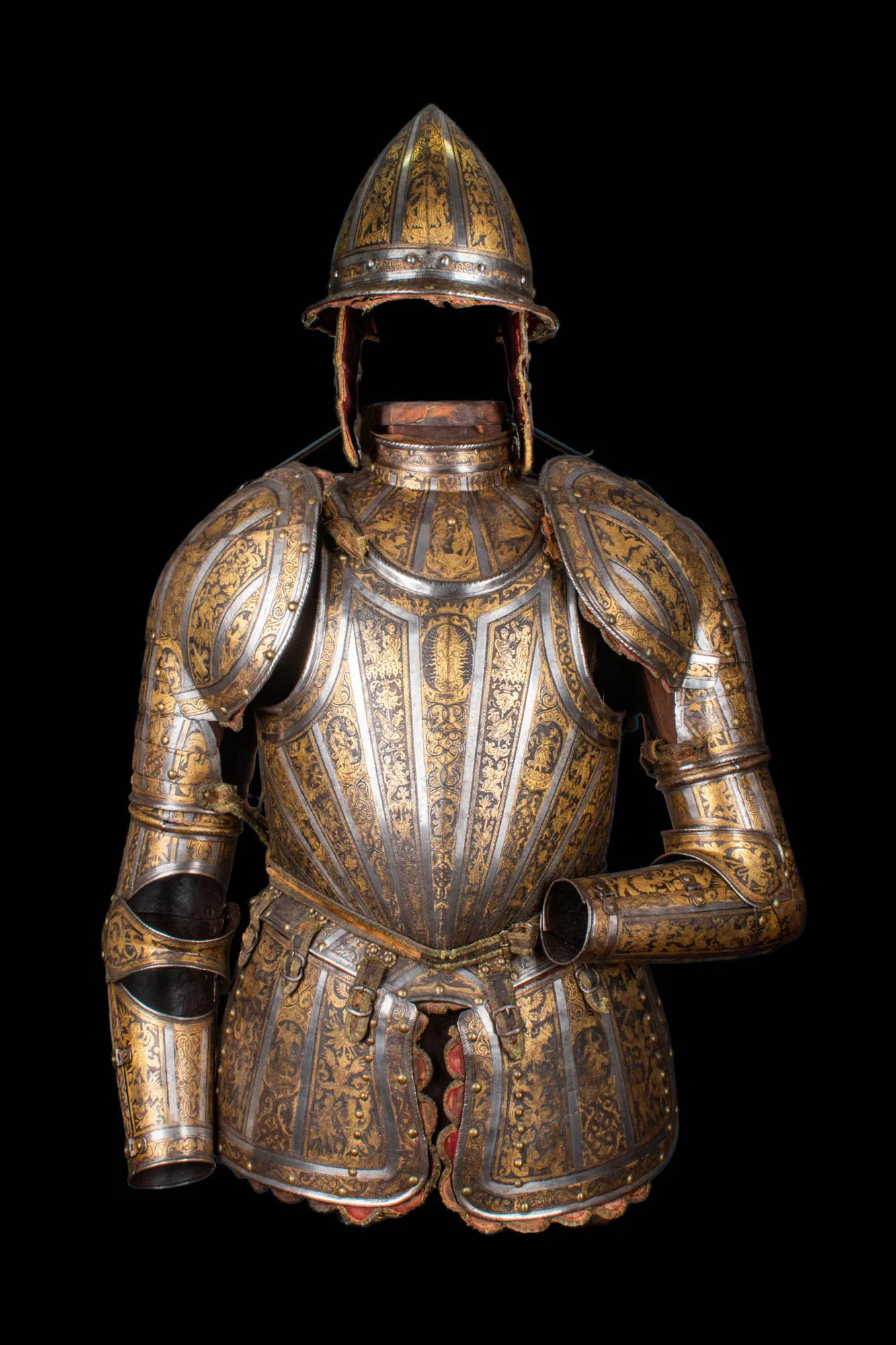
Superb Italian Etched And Gilt Armour By Pompeo Della Cesa
LONDON – Apollo Art Auctions’ October 12-13 Fine Ancient Art & Antiquities sale offers the company’s flourishing audience of bidders a chance to acquire pieces of unrivaled excellence and integrity, each one supported by venerable provenance. The 905-lot auction includes important rarities sourced from the Imperial Russian Romanov Collection, the Prince Collection, the Stephen Joel Albert Collection, the Spencer Joshua Alwyne Compton (Second Marquess of Northampton) Collection, the Alison Barker Collection, the Mrs B Ellison (of the Egyptian Exploration Society) Collection, the Duc de Dino Collection, and the Nicholas Wright Collection.
As the fully-illustrated auction catalog attests, the sale comprises a broad range of desirable items, including wearable jewellery vetted by ancient jewelry specialist Sami Fortune, fascinating military relics, and seals studied by renowned archaeology expert Professor Wilfrid George Lambert FBA (1926-2011). Egyptian decorative pieces come with historical reports from Simone Musso, consultant curator for Egyptian antiquities at the Stibbert Museum in Florence and a member of the Nuri Archaeological Expedition. Expertly-vetted Roman, Greek and Asian artifacts come with historical reports from Alessandro Neri, an international cultural heritage expert based in Florence, Italy. Also, bidders have the assurance of knowing all auction items have been cleared through the Art Loss Register database.
Two absolutely unique productions lead the ancient and antique armor category. First, there is an extremely fine-quality Caucasian shashka gifted to Nicholas II, Tsar of Russia, when he was Tsesarevich (heir apparent). Research suggests the saber was presented to Nicholas during a tour of the Caucasus with his father Tsar Alexander III, in 1888. An Arabic inscription in gold on the blade translates to: (M)ay the dominance of the owner of this sword grow, and his life, and his greatness, and may Allah bless his family, and he will achieve his goal. It is also monogrammed with the letters “N” and “A” (for Nicholas Alexandrovich), surrounded by a golden laurel and surmounted by the Imperial Russian crown. Its wonderfully-decorated scabbard bears a calligraphic Arabic inscription that would be the equivalent of a European maker’s mark. Translated, it says “Abdullah worked.” Held in consecutive European private collections, including the Eugene Mollo collection (Switzerland), it is the first royal sword ever to be offered for public sale. It requires an opening bid of £900,000 ($1,203,370).
The second armor highlight is a breathtaking circa-1590 AD Italian etched and gilded half-suit of armor created by Pompeo Della Cesa, armorer to Philip II of Spain and many European dukes. The central boss on its breastplate features an image of Infant Christ in the arms of the Virgin Mary, under which appears “POMP,” the celebrated Milanese armorer’s signature. Weighing 14.4kg (31lbs 12oz), this suit would have been made for an infantryman. The illustrious line of provenance most recently includes the Prince Collection and the 2009 Galerie Fischer (Lucerne, Switzerland) auction of the Schulthess family collection. Its prior ownership can be traced back as far as the Duc de Dino Collection, which was cataloged by the Baron de Cosson in 1901 and acquired by the Metropolitan Museum of Art in 1904. The opening bid is £450,000 ($602,000).
Another noteworthy armor lot is a circa 600-575 BC Corinthian helmet of hammered bronze with large almond-shape eyeholes with beveled perimeter, a slender nose guard with raised edges, and gracefully-sloping cheek guards. Similar to an example in the MET Museum, it has been XRF-tested to confirm no modern trace elements. Its well-documented lineage includes a European collector; the K Deppert collection (Frankfurt, Germany) following a 1973 purchase; and S Tarab (Geneva, Switzerland). The opening bid on this wonderful-looking opalescent-green helmet is set at £40,000 ($53,560).
Of a later but no-less-captivating era, a circa 900-1100 AD Viking or Norman conical helmet is ruggedly constructed of a single sheet of hammered iron with a T-shape nasal guard attached by five rivets. Both the brow and nose guard are artfully inlaid with dragon motifs. Its line of provenance includes an English art gallery, with acquisition in the 2010s; a private southern Germany collection formed in 1980s-2000s; and the Kenneth John Hewett collection (London), formed from the 1960s-1980s. Strong competition could ensue on auction day when this helmet opens for bidding at £6,000 ($8,035).
The array of “precious metals” continues with a very rare medieval (circa early 13th century AD) bronze lion-form aquamanile of a type that would have been used for ceremonial hand-washing before religious services or dining, especially at banquets. Its ingenious design incorporates a movable tail that serves as a pump to send water coursing through the lion’s body and out its mouth via a spout. A handsome artwork displaying a superb natural patina, its line of ownership includes a 1990s European collection and subsequent acquisition on the British art market in the 2010s. It is similar to an example in the Cleveland Museum of Art’s collection. Bidding will start at £80,000 ($107,100).
An awe-inspiring Egyptian Eighteenth Dynasty (reign of Amenhotep IV-Akhenaten, circa 1353-1336 BC) limestone relief stele fragment features carved images of a queen of the Amarna Kingdom, King Akhenaten, and a child, most likely the young Princess Meritaten. Of vertical form with hieroglyphic inscriptions, this historically significant piece actually appears in A Wiese’s 2001 book about ancient Egyptian holdings in the Basel Museum of Antiquities. Its provenance includes the Prince Collection, 1990s-2014; and before that, the Hans Humbel Collection (Zurich). Opening bid: £20,000 ($26,740)
A leading entry from the popular category of ancient Mediterranean pottery is an ornate Apulian red-figure volute krater, circa 400-350 BC, with handles depicting Medusa. Scenes on its body include female figures, naiskos and symbolic offerings. It stands 650mm (25.6in) tall and is similar to an example at the Civic Archaeological Museum, Milan, Italy. Provenance includes a Central London gallery; a southern England estate collection since its 1990s acquisition from Andre de Munter, Brussels, Belgium; and prior to that, an old European collection. Opening bid: £5,000 ($6,695)
Only an upper-class stable could have produced the type of high-quality equine that inspired the Chinese Tang Dynasty (circa 618-906 AD) terracotta horse sculpture to be sold on Day 1 of the auction. In a resting pose with a gracefully arched neck, low head, finely drafted features and well-detailed musculature, it wears an elaborate harness with dangling tassels, a bridle, blanket and saddle. It has been TL-tested by Ralf Kotalla (report conveys to buyer), and its provenance includes a UK private collection following acquisition in the early 1990s in Hong Kong. Bidding will open at £2,000 ($2,680).
A sizable selection of ancient jewelry includes every imaginable type of adornment. A rare and very fine pair of circa 1100-1200 AD Byzantine enameled gold earrings is designed with lunar-shape bodies engraved and enameled with a central cross and two doves. The pair is similar to earrings seen in the book The Glory of Byzantium, Art and Culture of the Middle Byzantine Era. From a London private collection, elegant adornments come to auction with an opening bid of £8,000 ($10,720).
An attractive gold ring is set with an oval amethyst cameo dating to the Late Roman period (circa 300-350 AD) which depicts Constantine the Great, who reigned from 306-337 AD and was the first emperor to convert to Christianity. Its line of provenance includes a London ancient art collector; the Mayfair private collection of Mr P S; and earlier acquisition (1970s) on the UK art market. The opening bid is £2,000 ($2,680).
Apollo Art Auctions’ Saturday/Sunday, Oct. 12-13, 2024 Fine Ancient Art and Antiquities Auction will be a live gallery event with online bidding also available through Apollo’s bidding platform or LiveAuctioneers. Start time: 7am US Eastern Time/12 noon GMT on Day 1; and 6am US Eastern Time/11am GMT on Day 2. Goods may be previewed at the gallery October 7-11 from 10am-5pm daily. Address: 63-64 Margaret Street, London W1W 8SW. Apollo accepts payments in GBP, USD and EUR; and ships worldwide. No import charges are assessed on most antiquities sent to the United States. All packing is handled in-house by white-gloved specialists. Questions: Please call +44 7424 994167 or email [email protected]. Visit Apollo Art Auctions online at www.apolloauctions.com
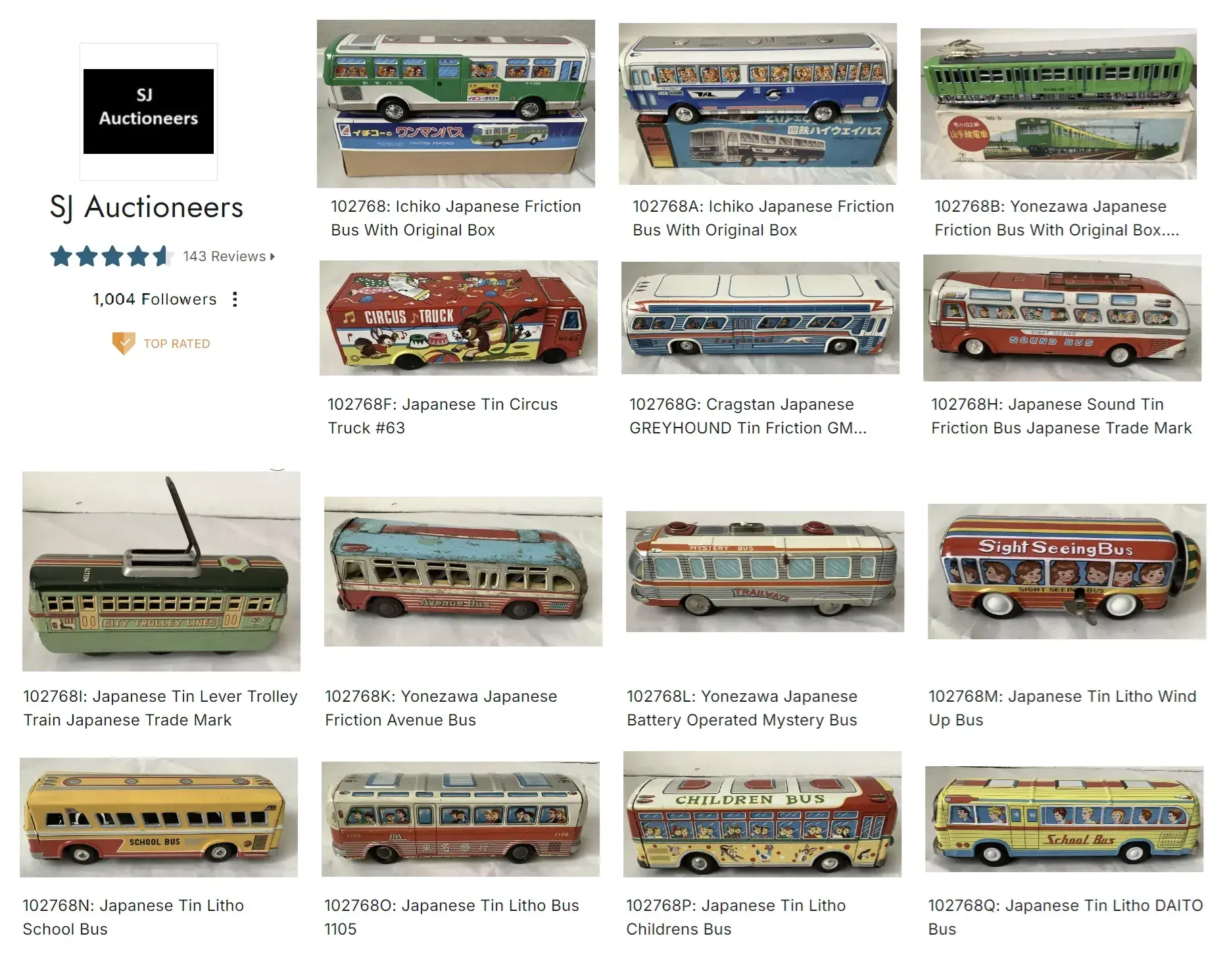
A rare collection of Japanese Tin litho buses will be up for auction at SJ Auctioneers October 27th Online Auction “Estate Silverware,Toys, Decor, Glass Art,”
A rare japanes tin litho bus collection from a private estate collector includes brands such as Yonezawa, Ichiko, Red China, Distler,Cragstan,Marx. The consist of friction and windup models
The auction also features outstanding sterling silver flatware sets and Estate Silverware, Toys, Décor, Glass Art and Toys; more auction lots include items by famous name designers and makers, including Georg Jensen, Cardeilhac, Paul Storr, Wallace, Tiffany &; Co., Cartier, Buccellati, Gucci, Montegrappa, Baccarat, Judith Leiber, Louis Marx, Hasbro, Lionel,
Tootsie Toy, Agglo, Steuben, Lalique, Herend, Swarovski, Louis Vuitton, Gorham and others.
Bidding is available online now, at LiveAuctioneers.com.
Pre-bidding is also available, meaning for those who are unable to attend the online auction, they can still leave their bids now. A link to the catalog is here: