Historically important camera was used by Volz to document Christo + Jeanne-Claude installations worldwide, becoming a tangible part of their ephemeral art and, later, a wrapped work of art itself
Christo (Bulgarian, 1935–2020), ‘Wrapped Leica,’ Leica M4 camera belonging to photographer and longtime Christo + Jeanne-Claude.
WETZLAR, Germany – Every artist, whether famous or obscure, adds something to the collective consciousness of art. But every once in a great while, a true innovator emerges to take the art world down an entirely new path. That certainly applied to the late duo known as Christo + Jeanne-Claude, whose jointly-conceived, grand-scale installations of environmental art captivated the world for several decades. Since the early 1960s, their collaborative projects – whether involving a monument such as the Arc de Triomphe or 11 islands in Miami’s Biscayne Bay – were headline-makers with one thing in common. All featured unexpected physical subjects imaginatively hand-wrapped in some sort of material. After Jeanne-Claude passed away in in 2009, Christo carried on with the genre he and his wife had invented, orchestrating sensational site-specific installations that attracted millions of visitors.
Christo + Jeanne-Claude believed that art was fleeting, therefore their work should be ephemeral as well. After an installation had spent its preallotted time in the public eye, it disappeared. In Rita Gilbert’s Living with Art book series, Christo said of their creations: “They all go away when they’re finished. Only the preparatory drawings and collages are left, giving my works an almost legendary character. I think it takes much greater courage to create things to be gone than to create things that will remain.”
Indeed, Christo’s design sketches for the couple’s wrappings, as well as his earlier Wrapped Objects, Wrapped Books and editions, are widely regarded as their only surviving works. Each is a sought-after rarity on the art market. But now something very special has emerged – something unique, personally associated with Christo + Jeanne-Claude, and of course, wrapped. It is a Leica M4 camera belonging to the famed photographic artist and Christo + Jeanne-Claude collaborator Wolfgang Volz (German, b. 1942-).
Volz officially accompanied the Christo + Jeanne Claude projects over a period of nearly 50 years, photographically documenting each of their finished projects. Because of the temporary nature of those installations, Volz’s photographs are all that remain in a tangible form from those experiences. Therefore, one may conclude that the camera creating those images became, by extension, a contributory part of the actual works of art.
On the occasion of Wolfgang Volz’s birthday on January 17, 1994, the photographer’s Leica M4 camera joined the Christo oeuvre of wrapped objects when it was returned in its newly-enhanced state as a unique gift from the artist.
Some time prior to its wrapping by Christo, Wolfgang Volz had redesigned the originally silver chrome-plated Leica M4 with a Summicron 35mm lens in a red-and-blue motif. Volz explained that this was done specifically for a job he had been commissioned to do in New York’s Bronx borough for the German news magazine Der Spiegel. Volz wanted to take his photos as unobtrusively as possible and was concerned that the eye-catching silver chrome-plated camera might attract attention.
Through the cord-wrapped foil – which was personally signed by Christo with the inscription “For Wolfgang / Jan. 17, 1994 / Christo” – one can see the Leica M4’s red and blue colors. The historically important camera, which has never before been seen in the marketplace, will be offered as Lot No. 80 in Wetzlar Camera Auctions’ October 12, 2024 sale.
The 248-lot live auction will take place at the Hotel Bürgerhof, Konrad-Adenauer-Promenade 20, 35578 Wetzlar, Germany. Bidders worldwide may participate absentee, by phone, or live via the Internet through LiveAuctioneers. For questions or to obtain additional information, call Wetzlar Camera Auctions at +49 6441 9822322 or email [email protected]. View the fully illustrated catalog and sign up to bid either absentee or live online through LiveAuctioneers at https://www.liveauctioneers.com/catalog/340352_auction-6/. Wetzlar website: https://www.wetzlarcameraauctions.com/en-gb/home
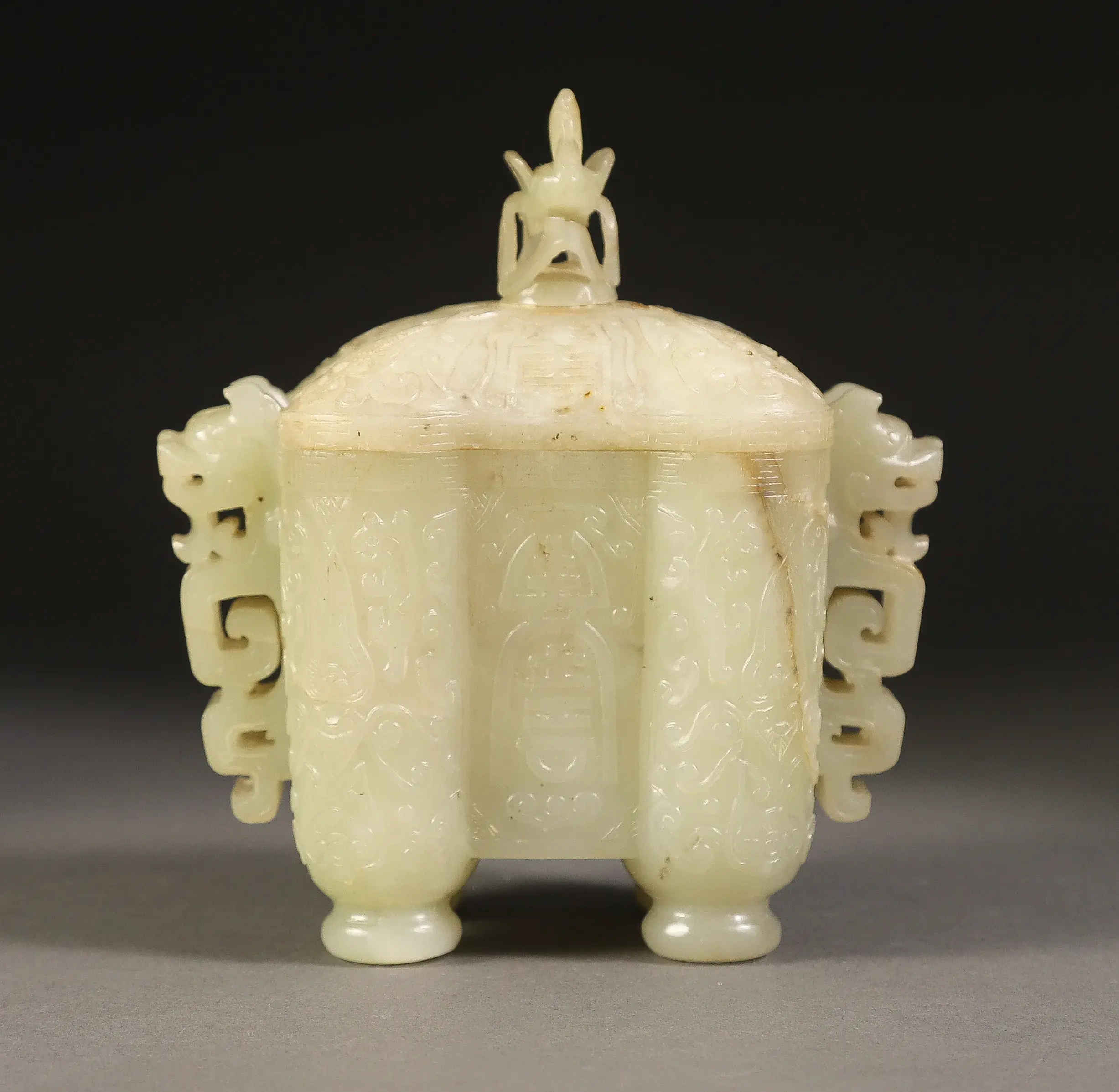
A Chinese Carved Pale celadon Jade Archaistic Covered Vessel, Tulu, Qing Dynasty (Estimate: $4,000-6,000)
New York NY: Lark Mason Associates is delighted to announce that over 300 lots of Chinese and other works of Asian art treasures will open for bidding from October 1st through October 15th on iGavelAuctions.com
Among the highlights are a set of Eight Korean Painted Panels, late Joseon Dynasty (Estimate: $20,000-30,000), a Chinese Carved Pale celadon Jade Archaistic Covered Vessel, Tulu, Qing Dynasty (Estimate: $4,000-6,000), a Chinese Formal Court Robe, Chaofu, Qing Dynasty (Estimate: $10,000-15,000), a Chinese Gilt Lacquer Seated Lohan, Qing Dynasty (Estimate: $5,000-8,000), an 18th century Chinese Blue and White Dragon Dish, (Estimate: $5,000-8,000), and a set of Five Chinese Blue and White and Café-au-Lait Triple Gourd Form Vases, Kangxi Period (Estimate: $5,000-8,000).
Other treasures include an Eight-Panel Japanese Flower Screen, Rimpa School, 17th / 18th century (Estimate: $12,000-18,000), a Chinese Gilt Bronze Figure of Guanyin, Ming Dyansty (Estimate: $4,000-6,000), and a Chinese Underglaze Blue Painted Porcelain Landscape Bowl, 17th/18th century (Estimate: $3,000-5,000).
Says Lark Mason: “This is a solid, highly appealing sale which offers a wide range of significant Asian works that span centuries and traditions at reasonable estimates. It’s a great opportunity for collectors, and we look forward to connecting Asian art enthusiasts with these extraordinary objects.”
“We are Here.” With this title, urban art asserts its claim to territory, just as a mountaineer would plant his flag on a newly conquered peak. The XXL bomb-sculpture by D*Face, which greets the visitor, sets the scene. Long branded as vandals, street artists are now taking their revenge by officially investing the Musée des Beaux-Arts de la Ville de Paris, at the Petit Palais with Mehdi Ben Cheikh, Director of the Galerie Itinerrance, as its conductor. Known for his ambitious projects such as “Tour Paris 13” (2013), “Earth Crisis” under the Eiffel Tower (2015) and “Boulevard Paris 13” (since 2014), the free exhibition set within the museum’s permanent collections is sure to impress. The exhibition’s manifesto is both an ode to the movement and to the French capital. “Paris, cradle of the avant-garde, reaffirms its central role in contemporary creation. Once the epicenter of artistic movements from Montmartre to Montparnasse, the City of Light now embodies a worldwide movement: street art. Between impertinence, humor and admiration, the artists weave links with works that, in the 19th century, were presented at the Salons. We move from the monumental creations of Swoon, Inti and Cleon Peterson to the iconic works of Obey and Invader, with a detour to discover Seth’s immersive installation, La Tour de Babel, depicting a child sitting on a pile of books, his face immersed in a rainbow. Whether in dialogue or rupture, juxtapositions work better for paintings in the large-format gallery than for 3D works in the sculpture gallery. The highlight of the show is the Concorde Room, featuring paintings by sixty artists in a symbolic nod to the hangings at the Salon. Does this legitimization mean that street art is now an official art form?
“We are Here” Petit Palais – Musée des Beaux-Arts de la Ville de Paris, Paris 75008. Until January 19, 2025 www.petitpalais.paris.fr
Featured: 1920s ‘Pig Sandwich’ neon sign from America’s first drive-in restaurant, 1930s Texas Pacific ‘tepee’ sign, Sinclair ‘Dino’ and Husky Oil dog-mascot signs; rare gas pump globes, ’34 Ford Tudor
1920s die-cut porcelain neon sign from Pig Stand drive-in restaurant (Dallas, Texas)
DENVER, Pa. – Few collecting categories can rival gas and oil advertising signs for color, imaginative graphics or the level of bidder enthusiasm they generate at auction. That has been proven time and again at Morphy’s blockbuster Automobilia & Petroliana sales, which, over the years have featured some of the hobby’s most revered collections, including those of Bobby Knudsen Jr, and the late Kyle Moore. The Pennsylvania company’s next stellar selection of motoring-related signage and service station items will cross the auction block on October 6, with all forms of remote bidding available in addition to live participation at the gallery.
The 651-lot auction features 425 signs, 64 gas pumps, 134 gas globes and lenses, 25 motor oil and other product cans, display items, and other uncommon service station accessories. A number of pieces have been certified and graded by AGS, the premier authentication and grading service for antique advertising.
The auction’s headliner is a 1920s die-cut porcelain neon sign from the Pig Stand drive-in restaurant in Dallas, Texas. Measuring an impressive 73 by 41 inches, the sign advertises “Pig Sandwich,” which, according to Texas Monthly magazine, was the Pig Stand’s lead menu item. The famed barbeque restaurant, which went on to become a chain operation with locations in six states, is entrenched in motoring history. The original Dallas Pig Stand held the title of first-ever drive-in restaurant in America and was established in 1921 on the premise that many patrons – including travelers – would rather dine in their cars than go inside. Accordingly, they came up with yet another innovation: carhops to deliver meals to their parked customers. The Pig Sandwich sign entered in Morphy’s auction would be an astonishing rarity in any condition, but luckily for collectors, it displays phenomenal color and gloss throughout. Its neon illuminates through the lettering in green, as well as in red along the outer border. It has a well-made metal can with new electricals throughout and tabs on its top edge to make the sign easy to hang. This lot has been AGS certified and graded 91, and its pre-sale estimate is $35,000-$75,000.
Also from the Lone Star State, a rare circa-1930s double-sided porcelain sign advertises Texas Pacific Gasoline & Motor Oil Products, which were manufactured by Texas Pacific Coal & Oil Co., of Fort Worth. At its center is an appealing red tepee graphic, overlaid by the letters “TP” and encircled decoratively in a motif suggestive of Native American art. Bright and glossy, its sides are graded 84 and 82, respectively. This visually-compelling 42-inch-diameter sign would be hard to improve upon. Estimate: $30,000-$60,000
Popular petroleum mascots will be crossing the auction block, including the lively Arctic dog who represented Husky Oil Co., of Cody, Wyoming. The excellent double-sided porcelain sign offered by Morphy’s is formed as a shield with the phrase “Husky Service” and the iconic Husky dog leaping playfully against a rising sun as its central graphic. It measures 42 by 48 inches and has been AGS certified with sides graded 89 and 87, respectively. Estimate: $20,000-$40,000
Another endearing mascot is Sinclair’s “Dino” the dinosaur. A highly sought-after circa-1930s double-sided porcelain curb sign advertising Sinclair Pennsylvania Motor Oil is dominated by a well-detailed profile graphic of Dino with the slogan “Mellowed 100 Million Years.” Measuring 24 inches in diameter, the red, white and black sign is AGS certified, with sides graded 90 and 93, respectively. Described in Morphy’s catalog as “an exceptionally clean example,” it comes to auction with a $10,000-$20,000 estimate.
Among the dozens of desirable gas globes and lenses, is the classic every collector wants: a one-piece baked-porcelain globe for Musgo Gasoline (Muskegon, Mich.) with the companies iconic Native American graphic and the slogan “Michigans Mile Marker.” The globe is dated Sept. 17, 1929, and ink-stamped “Made In USA” along the outer collar. An excellent example graded a strong 92, it is expected to sell in the vicinity of $20,000-$30,000.
Also not to be missed is an outstanding 15in-diameter Gilmore Blu-Green Gasoline globe lens with a fantastic, well-detailed six-color graphic of a roaring lion that commands attention. The lens is very clean throughout and is set on a high-profile metal body that has been skillfully repainted. Graded 95, it carries a $10,000-$20,000 estimate.
Nicely-restored, an Air Scale service station air meter has an especially nice look with its one-piece baked-porcelain globe marked “AIR.” It boasts brilliant color and gloss throughout and has hand-painted lettering that advises patron their tire is filled when the whistle stops. Made by Air Scale Co., Toledo, Ohio, for Brunner Mfg. Co., Utica, NY, this esoteric gas station accessory would enhance even the most advanced petroliana collection. Estimate: $5,000-$10,000
Speaking of “sideshow” items, many gas and oil advertising fans enjoy displaying a specialty collection of oil and other petroleum-product cans. A rarity to be offered on October 6 is an outstanding 1-lb. grease can for Rainbow Lubricant, which was manufactured by True’s Oil Co., Spokane, Washington. Standing 4¼ inches high, it is a fine example with its original lid and a brightly-hued logo that depicts a gas pump and service station attendant filling a car’s tank as the customer looks on. AGS certified and graded 95, its pre-sale estimate is $3,000-$5,000.
An exciting way to carry home one’s purchases from the October 6 auction would be in a 1934 Ford Tudor Sedan, a hotrodder’s delight with an odometer reading of a mere 8,817 miles. Retaining its original sheet metal, it is described as having a 302 H.O. C-4 engine, a 4-inch dropped axle, and disc brakes. It was purchased in 1965 for $50, and its restoration was completed in 1994. The car’s black paint with red and white accents is VG overall, and it has an aftermarket, steering wheel, gas pedal and seating. Mechanically sound, it starts up and runs nicely. Estimate: $10,000-$40,000
The Sunday, Oct. 6, 2024 Automobilia & Petroliana Auction will be held live at Morphy’s gallery, 2000 N. Reading Rd., Denver, PA 17517, starting at 9am Eastern Time. All forms of bidding will be available, including absentee, by phone and live via the Internet through Morphy Live. For questions pertaining to any item in the auction, to reserve a phone line, or to discuss consigning to a future Automobilia & Petroliana auction at Morphy’s, call 877-968-8880, email [email protected]. Visit Morphy’s online at www.morphyauctions.com.
Featured: Bust by Augusta Savage, first person to open African-American art gallery in USA; European & American paintings, including by Chaim Goldberg, Qing Dynasty etagere, exotic Persian rug
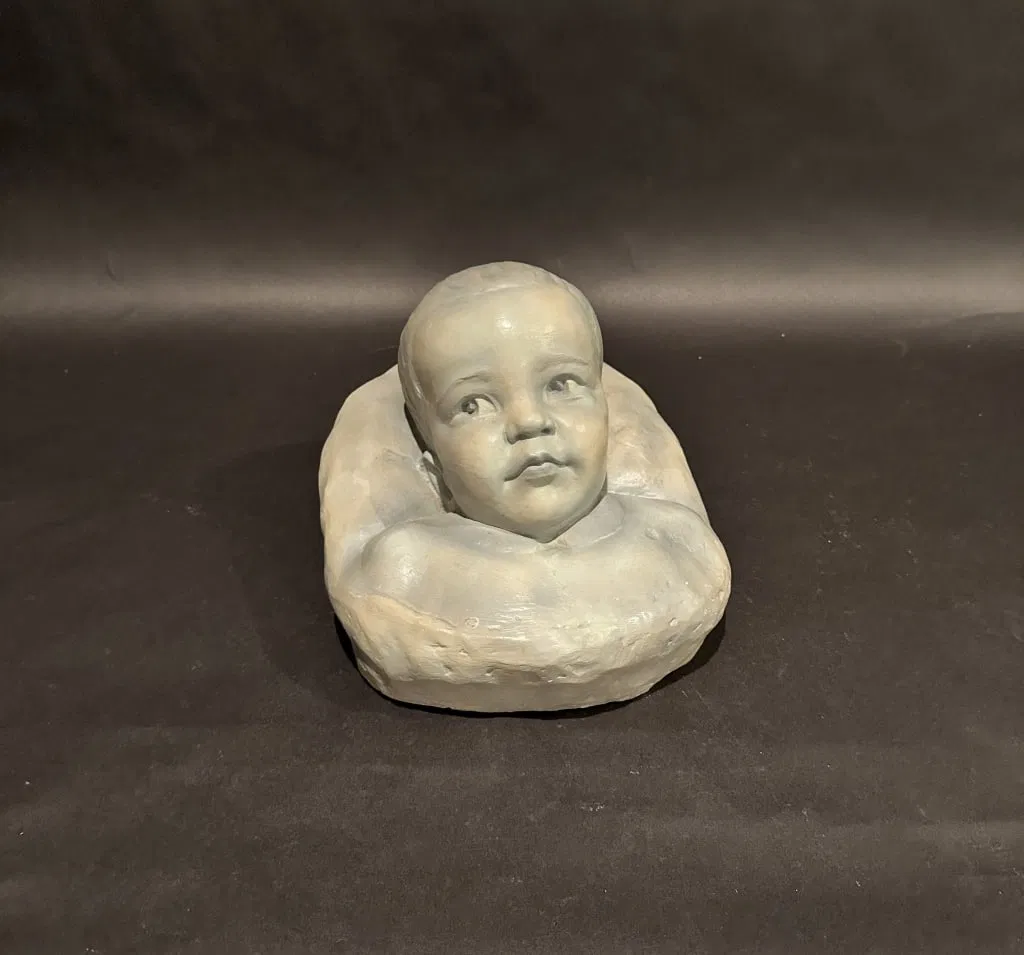
Augusta Christine Fells (Moore) Savage (African-American, 1892-1962), painted red clay/terracotta relief bust of an infant. Signed and dated 1942. Extensive biography of the artist appears in Regenia A. Perry’s 1992 book ‘Free Within Ourselves: African-American Artists in the Collection of the National Museum of American Art (Washington, D.C.).’ While in NYC at the peak of the Harlem Renaissance, Savage created busts of W.E.B. DuBois and Marcus Garvey. She was the first person in the U.S. to open a gallery dedicated to African American Art, and two of her works were exhibited at the Grand Palais in Paris. Size: 9in x 12in x 10in. Estimate: $4,000-$6,000
NORWOOD, N.J. – Whatever might be found inside a tastefully-decorated New Jersey residence is also likely to appear eventually at an auction produced by Sterling Associates. Owned and operated by Stephen D’Atri, Sterling’s roots go back to a family business established seven decades ago. Over the years, the focus on estates and collections has never wavered, as reflected most recently in the discoveries chosen for the company’s October 2 Fine Estates Auction. The 202-lot sale crosses a broad spectrum of periods and styles, with one of the top highlights associated with a luminary of the Harlem Renaissance.
Until earlier this year, many art collectors might not have known the name Augusta Christine Fells Savage (1892-1962), but a February episode of PBS Television’s American Masters changed all that. Titled “Searching for Augusta Savage,” the biographical documentary revealed the largely unheralded Florida-born sculptor and educator to be one of the most important – and talented – of all Harlem Renaissance artists. Additionally, she was one of the first female Black activists to fight for the inclusion of African-American artists in the mainstream canon. In spite of her undeniable gifts, Savage’s own career was plagued by racism and sexism. Even some of her male counterparts in the famed Harlem Black art movement failed to offer support.
More than half of the 160 artworks Savage created in her lifetime are missing or have been destroyed, and none of her extraordinary monumental sculptures has survived, including the 16ft foot sculpture she created for the 1939 World’s Fair. When Savage could not raise the funds to transport or store her depiction of a choir of 12 Black children singing, the sculpture was destroyed. Yet she remained undeterred. At the peak of the Harlem Renaissance, Savage sculpted busts of prominent individuals, including W E B Du Bois and Marcus Garvey, and opened the first US gallery devoted exclusively to African American Art. Over time, her significance could no long be suppressed, even abroad. Two of her works were accepted for exhibition at the Salon d’Automne and exhibited at the Grand Palais in Paris. She was also appointed the first director of the Harlem Community Art Center.
“There is so much more to the Augusta Savage story,” said Sterling Associates’ owner Stephen D’Atri, “Her legacy and influence can only increase. Because her work is so rare, it is especially meaningful that we’ve been entrusted to auction one of her sculptures in our October 2nd sale.” The artwork is a painted, red clay/terracotta relief bust of an infant, signed and dated 1942. Sensitively modeled, the work measures 9 inches by 12 inches by 10 inches and is conservatively estimated at $4,000-$6,000.
Around two dozen artworks by Chaim Goldberg (Polish/Israeli, 1917-2004) passed by descent through the artist’s family. With scores of exhibitions documenting his oeuvre since 1931, Goldberg remains one of the foremost chroniclers of Jewish storytelling through visual art. A framed copper engraving titled Shtetl is a signed artist’s proof that measures 20 by 30¼ inches, while a pencil-signed etching that depicts a Purim celebration, number 52 of an edition of 200, has a framed size of 19 by 13 inches. A diversion in style is seen in Goldberg’s attractive oil-on-canvas waterside scene, 33 by 25 inches, signed in Hebrew and dated 1962. Each of the works is estimated at $100-$200.
In his short life, self-taught painter Bradford Boobis (American, 1927-1972) used art as an outlet to explore the theme of societal woes and personal loss. He was known for his dystopian realist imagery and dreamlike depictions of subjects in turmoil, but his talent and imagination did not stop there. For example, his portrait of actor Richard Boone of Have Gun Will Travel fame appeared on the cover of a 1963 issue of TV Guide, an assignment that might have pursued by many professional artists of greater renown. He also scratched the surface of founding a cult, with the idea of building temples for the display of art, including his own. In 2022, the 50th anniversary of his passing, Boobis’ work was featured in an exhibition at the respected Louis K Meisel Gallery in New York. Three Boobis paintings from a lifelong art collector in New Jersey are entered in the auction, including an oil-on-canvas painting of John F Kennedy. Signed and dated 1968, it has a framed size of 34 by 44 inches and is estimated at $800-$1,200.
Also worthy of mention is a Roy Sanner oil-on-canvas painting based on an iconic photo taken amid the devastation following the World Trade Center terrorist attack on 9/11/2001. Titled Out of the Rubble, its subjects include Mayor Rudy Giuliani, Governor George Pataki, President George W Bush, Senator Chuck Schumer and NYFD Commissioner Thomas von Essen. Signed and dated 8/02 on the stretcher, the 51½- by 39½-inch painting is expected to make $600-$800.
Fine silver is led by a 74-piece Tiffany & Co., sterling silver flatware set in the Chrysanthemum pattern. In typical Tiffany style, no luxurious detail was spared in the creation of this set, even down to the vermeil (gold over sterling silver) enhancements to the oyster forks. With an approximate weight of 131ozt, this extravagant service will be presented to bidders with a $3,000-$5,000 estimate.
The grand aesthetic seen in 19th-century French decorative art is captured in Jean Didier Debut’s (1824-1893) gilt and silvered figural group titled Venus Rising From The Sea. In this piece, whose height is 31 inches, Venus is surrounded by cherubs and stands atop a seashell supported by dolphin fish. Estimate: $4,000-$6,000
Furniture highlights include both Asian and Chinese examples. An antique Chinese Qing Dynasty zitan etagere/display cabinet with multiple levels, door and drawer is carved with bamboo galleries and friezes throughout. Standing 88 inches tall on talon-form feet, it is estimated at $1,000-$2,000. A pair of circa-1820 Regency period brass-inlaid rosewood game tables has provenance that includes a 1994 purchase from Agostino Antiques Ltd. Estimate: $2,000-$3,000
Opulence can be seen from floor to ceiling in Sterling’s October 2nd sale, starting with an 18th/19th-century Persian rug of extraordinarily fine quality. Richly patterned with detailed scenes of mythological figures, men, women (one seminude) and animals, it has a central motif of a tree with serpent, birds and bird nest. Measuring 91 by 54¾ inches, it would add high style to any residence. Estimate: $4,000-$6,000
Overhead, the auction features eight stunning antique chandeliers. They run the gamut from ornate Empire-style brass and crystal designs to a monumental 19th-century Continental bronze, tole and papier-mache chandelier of Gothic style with dragon adornments. A massive 73- by 52-inch fixture, it lights up the category with a $2,000-$3,000 estimate.
Pop culture plays a big role in the sale with a collection of Air Jordan sneakers amassed over the past 20 years by a New Jersey sports fan. Most are mint in their original boxes and all are accompanied by eBay Certificates of Authenticity. Among the 30 sneaker lots in the sale, a pair of Jordan 7 OGs, size 9½, are white with black detailing and have a cardinal-red interior. Their release date was 1992. This mint/boxed pair should fly to a top bid of $200-$300.
Sterling Associates’ Wednesday, October 2, 2024 online-only auction will follow the same innovative blueprint which owner Stephen D’Atri has employed since first opening the doors to his brick-and-mortar business. The auction will begin at 3pm ET and will be conducted online via LiveAuctioneers and Invaluable exactly like a gallery auction, but without a live audience in attendance. All items may be previewed through the online catalog or in person at Sterling Associates’ gallery by appointment only. Winning bidders have the option of picking up their auction purchases at Sterling Associates’ premises at 537 Broadway, Norwood, NJ 07648. Alternatively, goods can be shipped anywhere in the world via third-party shippers.
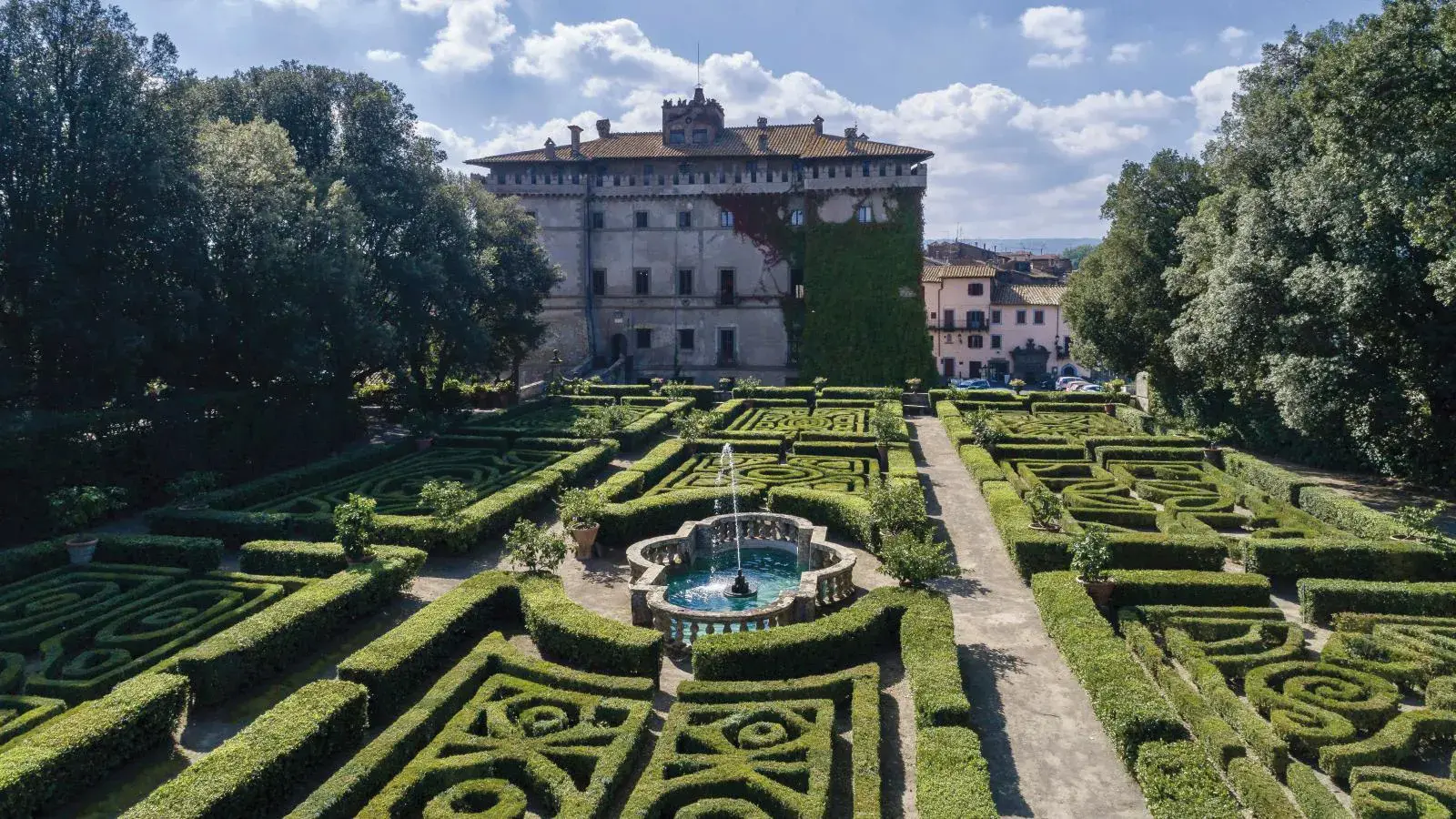
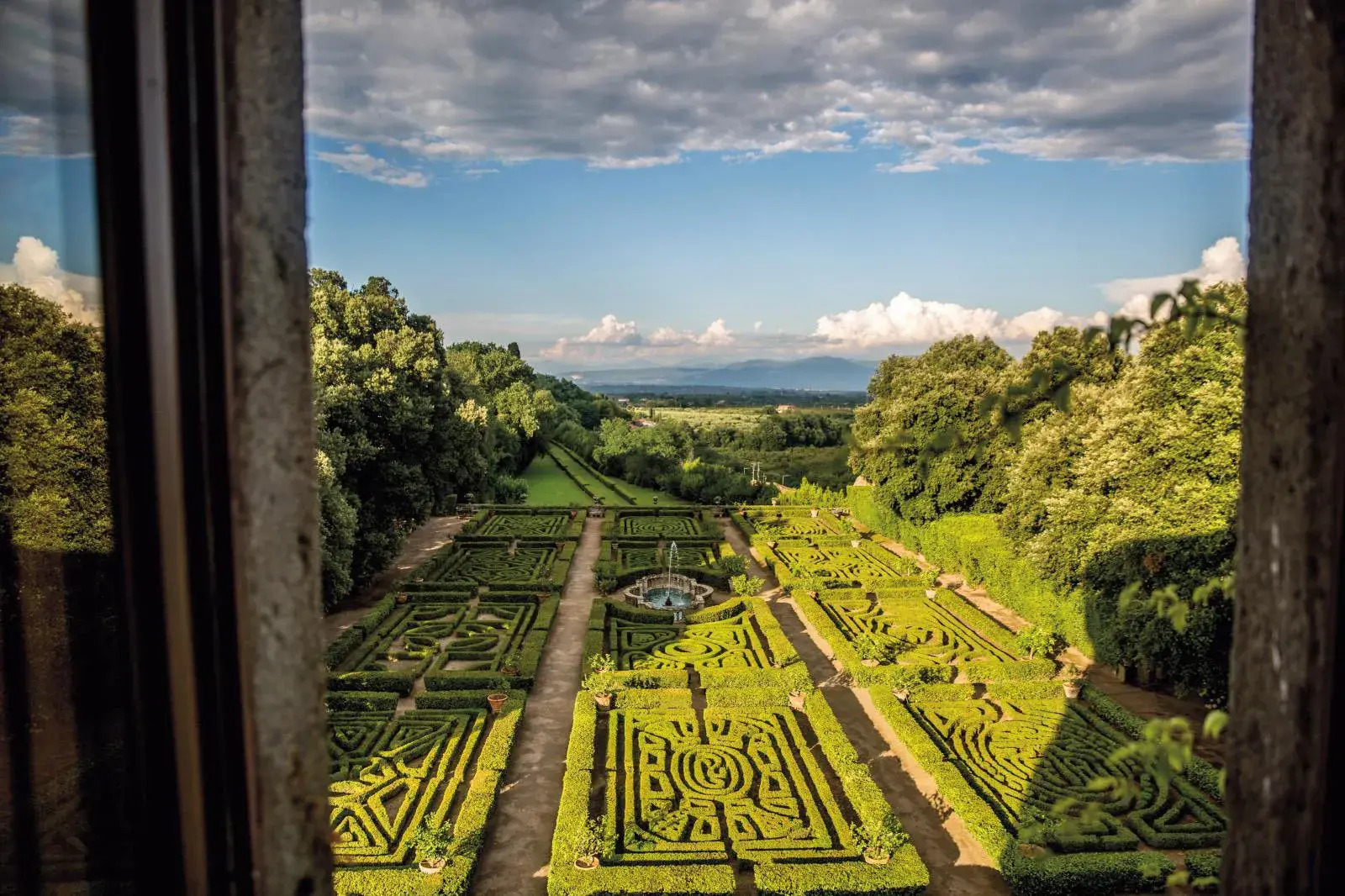
The medieval Ruspoli fortress in the Roman campagna, which was converted into a princely residence in the 16th century, boasts one of Europe’s best-preserved Renaissance gardens. It has remained intact since the 18th century.
At first glance, the four imposing corner towers and deep moat recall the original purpose of the Castello Ruspoli, 70 kilometers north of Rome. It was built as a medieval fortress to protect Tuscia, a part of central Italy that includes some of the areas once under Etruscan influence. The earliest records of a castle on this site date back to 847, before it became a Benedictine convent around the year 1000. The Church and the powerful Aldobrandini, Orsini and Borgia families fought over the region until the 16th century. In 1531, Pope Clement VII gave the stronghold and the fief of Vignanello to Beatrice Farnese Baglioni. Three years later, his successor, the Farnese Pope Paul III, confirmed the decision and raised the fief to the rank of county. Then, Beatrice’s daughter, Ortensia, married an advisor to the pontiff, Ercole Sforza Marescotti, one of whose distant ancestors from Scotland had fought alongside Charlemagne. In the 18th century, the Ruspoli, an old Florentine family on the verge of dying out, acquired the domain through marriage. A family tree painted on a wall next to the chapel traces the dynasty’s ancestral lineage. The name Ortensia Farnese, a three-time widow said to have killed one of her husbands with a fireplace poker, stands out amidst its foliage. She is the one who had the grim fortress turned into a pleasure palace, although the drawbridge was kept. Architect Antonio da Sangallo the Younger rebuilt the interior, while Jacopo Barozzi da Vignola designed the grounds. Coffered ceilings graced the huge reception rooms, whose walls were covered with damascened leather tapestries, while vaults were decorated with frescoes by Francesco Corallo.
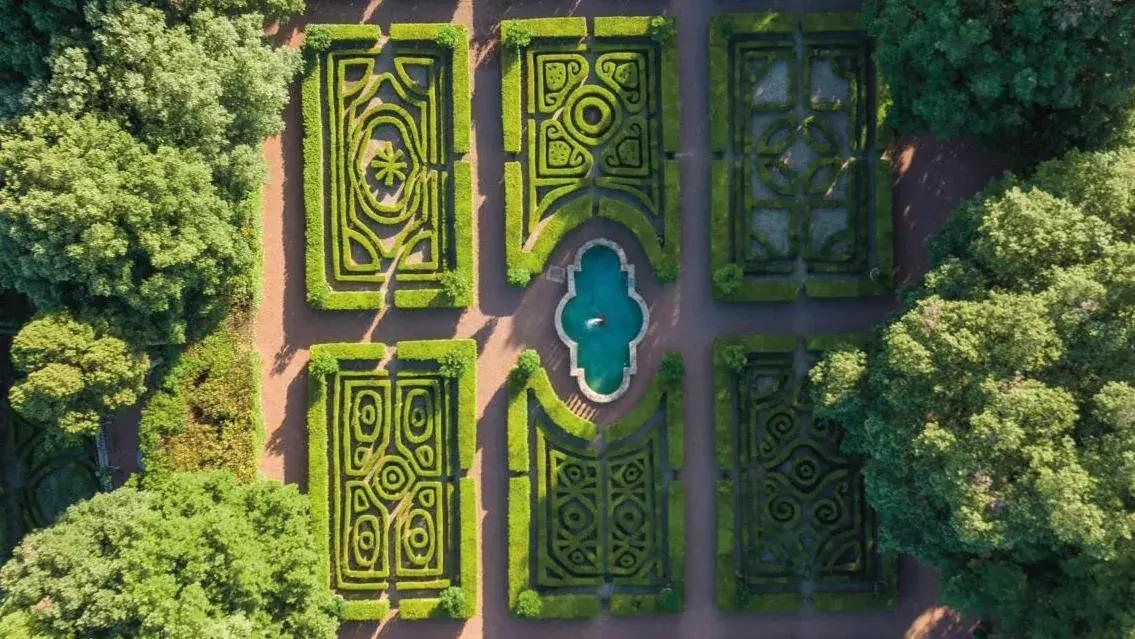
The rich carpet of greenery created for the pleasure of one of Italy’s oldest and most distinguished noble families can be taken in with a single glance from the upper windows. Deemed one of the Renaissance era’s most beautiful hanging gardens, it was designed in 1611 at the request of Ottavia Orsini, daughter of Prince Pier Francesco Orsini, who also created the extravagant gardens of Bomarzo. A stone’s throw from Vignanello, they are dotted with architectural follies and sculptures whose meaning remains shrouded in mystery. In Vignanello, on the other hand, elegant sobriety is on display. No statue is lost in the lush natural vegetation; no water features grace the grounds. The owners’ initials carved out in the boxwood beds are the only concession to fantasy. The Castello Ruspoli boasts one of the Renaissance period’s most representative gardens. Architect Jacopo Barozzi da Vignola (1507-1573), a theorist who left a mark on his field with the Treatise on the Five Orders of Architecture, designed the original project. His work, carved into the stone of villas and the boxwood in the pleasure gardens that surround them, also ensured that he would be remembered. Fulfilling a desire for simple lines and a perfect sense of balance and harmony, the garden at Castello Ruspoli is a veritable manifesto of topiary art, which was enthusiastically embraced by Europe’s royal and aristocratic families. Divided into four lanes and 12 boxwood parterres laid out around a fountain designed by Vignola, it features perfectly rigorous geometric proportions. There are no flowers or changes in elevation to distract strollers from their thoughts. Unlike those of neighboring villas, this hanging garden is on flat ground. It is perfectly aligned with the castle to offer contemplative views of the surrounding valley’s harmonious curves. At the end, a smaller garden behind a high wall, accessible by a small staircase, overlooks the town below. This, the more natural part, symbolizes emotions and instincts, in contrast with the more formal section, embodying rationality.
Unchanged since the 18th century, this dreamlike setting then passed into the hands of Francesco Maria Marescotti Ruspoli (1672-1731), whose wish to boost the family’s glory came true in 1709 when Pope Clement VII elevated his newly-created marquisate of Cerveteri to the rank of principality. The title was obtained thanks to the wise counsel of an uncle who advised him to raise a regiment for the armies of the Papal States in their war against Austria. But Francesco was more interested in art than war. In 1690, he was a founder of Rome’s Arcadia Academy, which brought together poets who had been close to Queen Christina of Sweden. However, he preferred notes to verses, in particular those of Italian baroque singer and cellist Antonio Caldara, French flutist Jacques-Martin Hotteterre and especially his friend George Fredric Handel. The young German composer, who arrived in Italy at the age of 20, became Prince Ruspoli’s concert master. At the castle, he enjoyed not only his generous patron’s hospitality, but also the quiet of the Lazio countryside. The peace he found during his frequent stays there inspired about 50 of his works—mostly cantatas but also the famous Resurrection oratorio. Francesco’s descendants, who still spend much of the year in Vignanello, honor that memory by hosting a music festival every year. Their illustrious ancestor carried out the last major refurbishment and decoration works at the castle, as well as its first restoration. In 1721, one of his distant relatives, Pietro Francesco Orsini, better known as Pope Benedict XIII, granted the Marescotti Ruspoli the hereditary title of Roman princes, making them full members of the “black nobility” in the service of the papacy. Four years later, he came to Vignanello to consecrate the collegiate church of Santa Maria, built between 1710 and 1723 on the foundations of an ancient Roman temple. To host him in the best possible conditions, Francesco called on the services of Benedict’s gardener and spared no effort in the transformation and beautification of his palace. In 1713, the family had moved into an opulent 16th-century Roman palace to display all the pomp befitting their rank. The Vignanello castle, especially its garden, has remained their refuge ever since, away from the bustle of Rome.
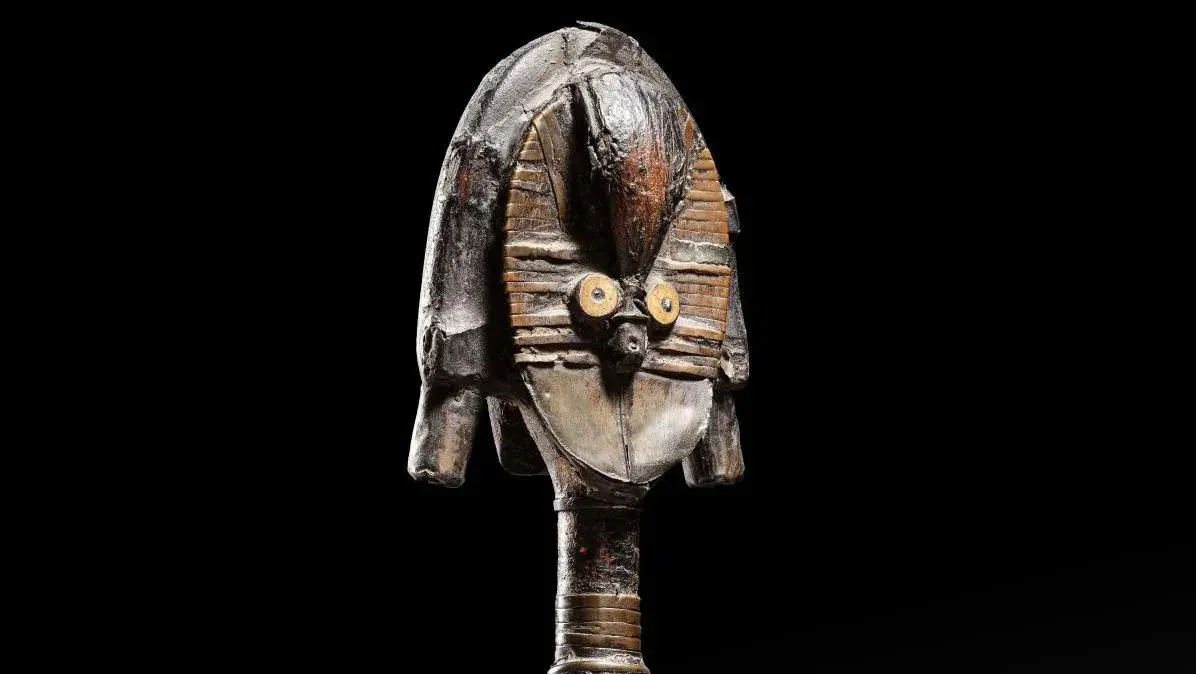
This sacred artifact is one of the finest known mbulu ngulu figures from the Kota culture.
Kota-Shamaye reliquary figure, Gabon, wooden core covered with copper and brass plates, h. 37.5 cm/14.76 in. Estimate: €100,000/150,000
The contemporary archaeology auction, an ideal counterpoint to the 2024 edition of Parcours des Mondes, will feature beautiful items from the private collection of activist and patron of the arts Claire Durand-Ruel. Some of them she bought with her father, a physician and major collector of Non-Western art. The sale spans fields as varied as Non-Western, Asian and contemporary art and archaeology, part of an innovative cultural project that will be the subject of an article in La Gazette on September 20. For now, let’s focus on the Kota-Shamaye reliquary figure from Gabon presented here, an outstanding example of African art (37.5 cm/14.76 in high). The reliquaries, made of a wooden core covered with copper and brass plates, are common to all the Bantu-speaking ethnic groups, including the Obamba, Mahongwe, Shamaye, Sangu and Ndasa peoples classed together under the name Kota since the colonial period in the 19th century. This very large community, which occupies the whole of eastern Gabon all the way to the Sibiti region in Congo, is well-known for the iconic reliquary figures, mbulu ngulu, that inspired Cubism. They stood atop sacred chests to guard the bones of ancestors inside before being removed and sold separately to western collectors.
Expert Bernard Dulon calls our example “a major piece in a very small body of Shamaye works: Only about 10 are known to date.”
A Balanced Composition Within this constellation of related forms, Shamaye figures are among the most sought-after because of their harmonious geometric shapes. Expert Bernard Dulon calls our example “a major piece in a very small body of Shamaye works: Only about 10 are known to date.” Its rarity justifies its high estimate. The figure is emblematic of a style defined for the first time by French ethnologist Louis Perrois (born 1942): an expressive face, penetrating eyes, a curved forehead and a central plait running down the back of the head pierced by holes to hold a feathered headdress. This fascinating head is itself the center of a balanced composition comprising synthesized volumes ending in an indispensable and elegant handle. A worn patina and a good state of conservation add to the appeal of this reliquary, which has come down to us intact through time.
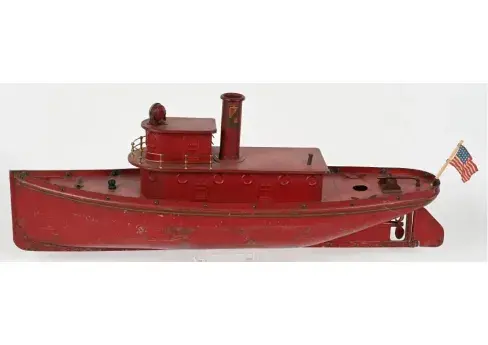
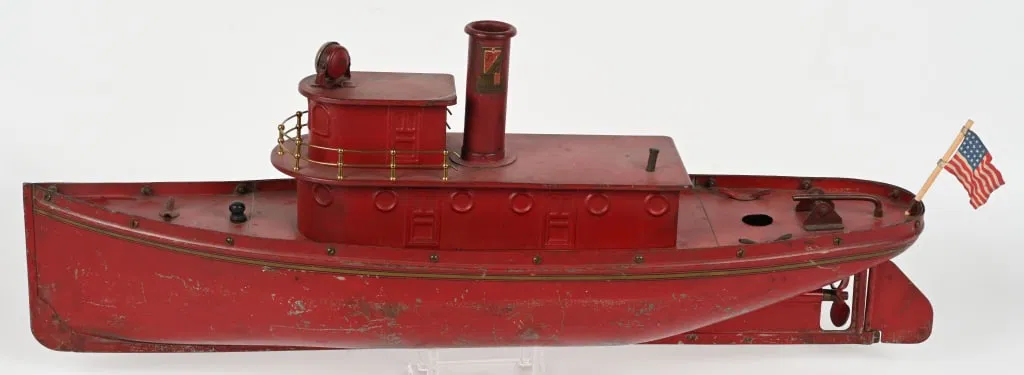
Featured: 28in Buddy ‘L’ red Tugboat, American National Packard Roadster pedal car, super-rare Yonezawa Mechanical Commander Robot, Distler Directional Policeman Car, bevy of motorcycles
Very rare Buddy ‘L’ pressed-steel red Tugboat. All original with vibrant paint and decals. Non-motorized version believed to have been intentionally produced that way at the company’s East Moline, Illinois factory. Length: 28in. Provenance: Fred Castan collection. Estimate: $15,000-$20,000
WILLOUGHBY, Ohio – College football, newly-harvested crops, and the announcement of Milestone’s Premier Vintage Toy Auction are all sure signs that autumn has arrived. This year, Milestone’s bounteous fall event is slated for October 5 at the company’s suburban-Cleveland gallery, with all forms of remote bidding available, including live online through a choice of Internet platforms. The auction lineup is packed with 715 high-quality lots representing the most-sought after categories of antique and collectible toys sourced from across the United States and beyond.
In anticipation of this sale, Milestone’s co-owner Miles King and his team of road warriors have crisscrossed the country, picking up automotive, nautical and character toys; early motorcycles, pressed-steel trucks, banks, and Japanese tin and battery-op productions, including coveted robots and space toys. In addition, the selection includes early European hand-painted and windup toys – some with rare factory boxes – by Lehmann, Martin, Gunthermann and many other sought-after German, French and British brands.
American pressed steel is a strong category in the October 5 sale, with several rarities deserving special attention. First, there’s an elusive Buddy ‘L’ pressed-steel Tugboat, all original with vibrant red paint and intact decals. It’s a non-motorized version believed to have been intentionally produced that way at the fabled Buddy ‘L’ factory in East Moline, Illinois. A sizable 28 inches long and with provenance from the Fred Castan collection, it comes to auction with a $15,000-$20,000 estimate.
Another cast-iron rarity is an all-original 27-inch-long Gendron Sampson pressed-steel stake truck with good-looking orange-and-black paint, and decals. It’s the only original example of this truck Milestone’s team of toy experts has ever encountered. Auction estimate: $6,000-$8,000. Following closely behind is another all-original pressed-steel toy, a Turner Lincoln nicely finished in a two-tone brown color scheme. In excellent condition, the 26-inch auto displays quite attractively and will be offered with a $4,000-$5,000 estimate.
The ultimate in pressed-steel luxury is a rare American National Packard Roadster pedal car in all-original condition with rich red paint. It is the only known example that has electric headlights, leading to speculation that it might have been produced to show at the New York Toy Fair, where exhibitors typically exhibit their most tricked-out variations. The battery holder has been replaced, but for completeness, the lot includes the original, in addition to a dry cell battery. To ride this beauty out the auction gallery door, a high bid of $10,000-$15,000 might be in order.
Even the most advanced robot collections might be lacking a super-rare Yonezawa tin Mechanical Commander Robot. “This particular type of robot just never comes to market,” Miles King observed. The October 5 auction will end the drought for collectors with an extremely nice example of a Commander Robot in its bright and appealing orange, red and white color scheme. The auction catalog notes some minor paint enhancements, but the robot’s assessment overall is “very original” with a working windup mechanism and a “great look.” The primitive looking 10½-inch ’bot, with primitive wheels and gauges lithographed on its chest, also comes with an excellent pictorial repro box. The pre-sale estimate is $15,000-$20,000.
A classic ASC (Aoshin Shoten, Japan) tin windup Tremendous Mike Robot will also cross the auction block. All original and complete, including its important antenna, this super-clean 10-inch toy looks as though it was never played with. Its windup mechanism and other functions worked fine when tested, and it will convey with its original pictorial box. Estimate: $8,000-$10,000
For the space-toy completist, there’s a fantastic Garton “Space Cruiser” pedal car in eye-catching red and white factory paint. All original and complete, its sleek Space Age design sets it apart as something very special. Miles King assesses it as: “possibly the nicest all-original example known.” Estimate: $5,000-$7,000
For those who like their playsets ultra-mint – and who doesn’t – Milestone suggests a complete and exceptional Marx #5422 Trucking Terminal outfit. This beautifully lithographed, fully-boxed playset is new/old stock. The crisp, profusely-illustrated set-box houses mint/boxed tin friction examples of an Allied Van Lines truck, North American Van Lines hauler, and a pickup truck; as well as a never-assembled tin terminal building. On top of that, the set retains its original figures and accessories, which are still in Marx bags. Near-mint and one of the finest Marx playsets or truck sets Milestone has ever offered, it could command a winning bid in the $3,000-$5,000 range.
One of the craziest yet most ingenious German toy designs is seen in Distler’s tin windup Directional Policeman Car, with its comical bug-eyed driver and a figural policeman figure affixed to the front of the vehicle. In its October 5 sale, Milestone will auction an excellent example of this toy, with bright colors and profuse lithography overall. Its medley of graphics includes motorcycles, autos, people, dogs, a double-decker bus, gas pump, buildings, street lights and more. When activated, the policeman points his arms in the direction in which the car is turning. This museum-quality toy in excellent condition is the only one of its type that Milestone’s team has ever seen. Estimate: $10,000-$15,000
More than five dozen European and Japanese motorcycles will be lined up and ready to race toward the finish line. The variety is dazzling, with military, police and civilian riders; couples, clowns and comic characters in tow. Among them are many early German productions by Tipp, Kico, Fischer, Gunthermann, Gely, Lehmann and more. A scarce 8½-inch M&K (Muller & Kededer, Germany) tin flywheel motorcycle with a well-dressed rider has a high-quality, early-20th-century look, with sophisticated colors and intricately lithographed engine details. Obviously, this antique bike has been well cared for, as its flywheel is in fine working order. The pre-sale estimate is set at $2,000-$4,000.
Milestone’s October 5, 2024 Premier Fall Vintage Toy Auction will be held live at Milestone’s gallery located at 38198 Willoughby Parkway, Willoughby (suburban Cleveland), OH 44094. Start time: 10 a.m. ET. All forms of remote bidding will also be available, including absentee, phone and live via the Internet through Milestone’s own bidding platform, LiveAuctioneers or Invaluable. For additional information on any item in the auction or to reserve a phone line for auction-day bidding, call
Associated Estate & Appraisal of Cranston, Rhode Island will soon present its Summer Premier Fine Jewelry & Timepiece Auction. This 206-lot event offers a broad selection of contemporary and vintage jewelry, featuring antique styles and designer lots. Here are some key items in the catalog.
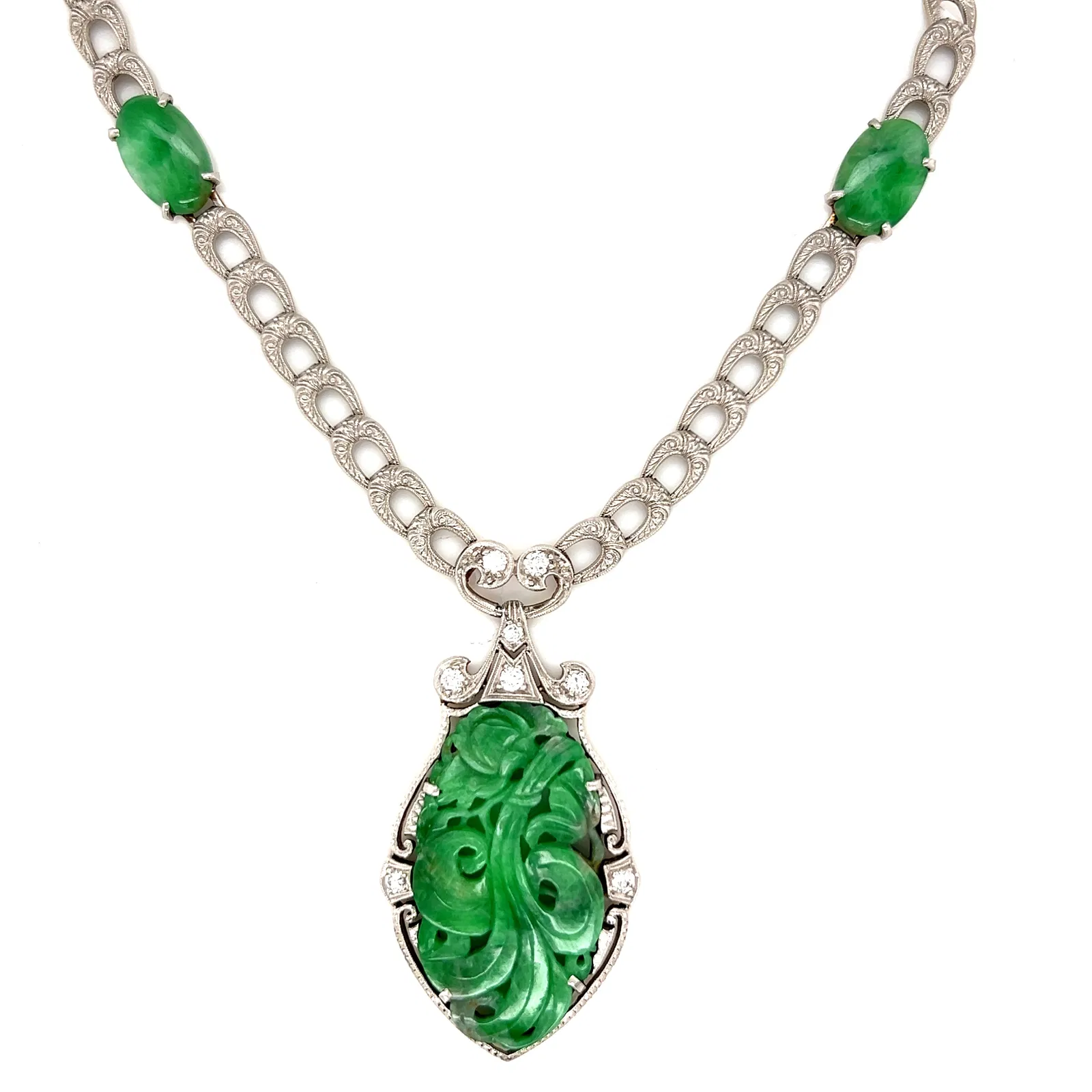
Allsopp & Allsopp Art Deco platinum, jade, and diamond necklace. Image courtesy of Associated Estate & Appraisal.
Allsopp & Allsopp Art Deco Necklace
Leading this sale is an Art Deco necklace by Allsopp & Allsopp (lot #140; estimate: USD 2,000 – $4,000). This fine specimen includes carved jade and diamonds in a platinum and 14-karat yellow gold setting. The center pierced jade pendant features a swirling design; oval-cut jades set around a horseshoe link chain accent the piece.
Allsopp & Allsopp, or Allsopp Brothers Jewelry, was a brand built by two English-American immigrant brothers in the 1880s. They both specialized in jewelry and helped to popularize finger and birthstone rings. The brothers manufactured and sold their creations in Newark, New Jersey through the early 20th century, selling under a variety of business names. Like other designers of the era, the Allsopp Brothers embraced the bold modernism of the Art Deco era. Their work reflects a preference for bright gems and innovative designs.
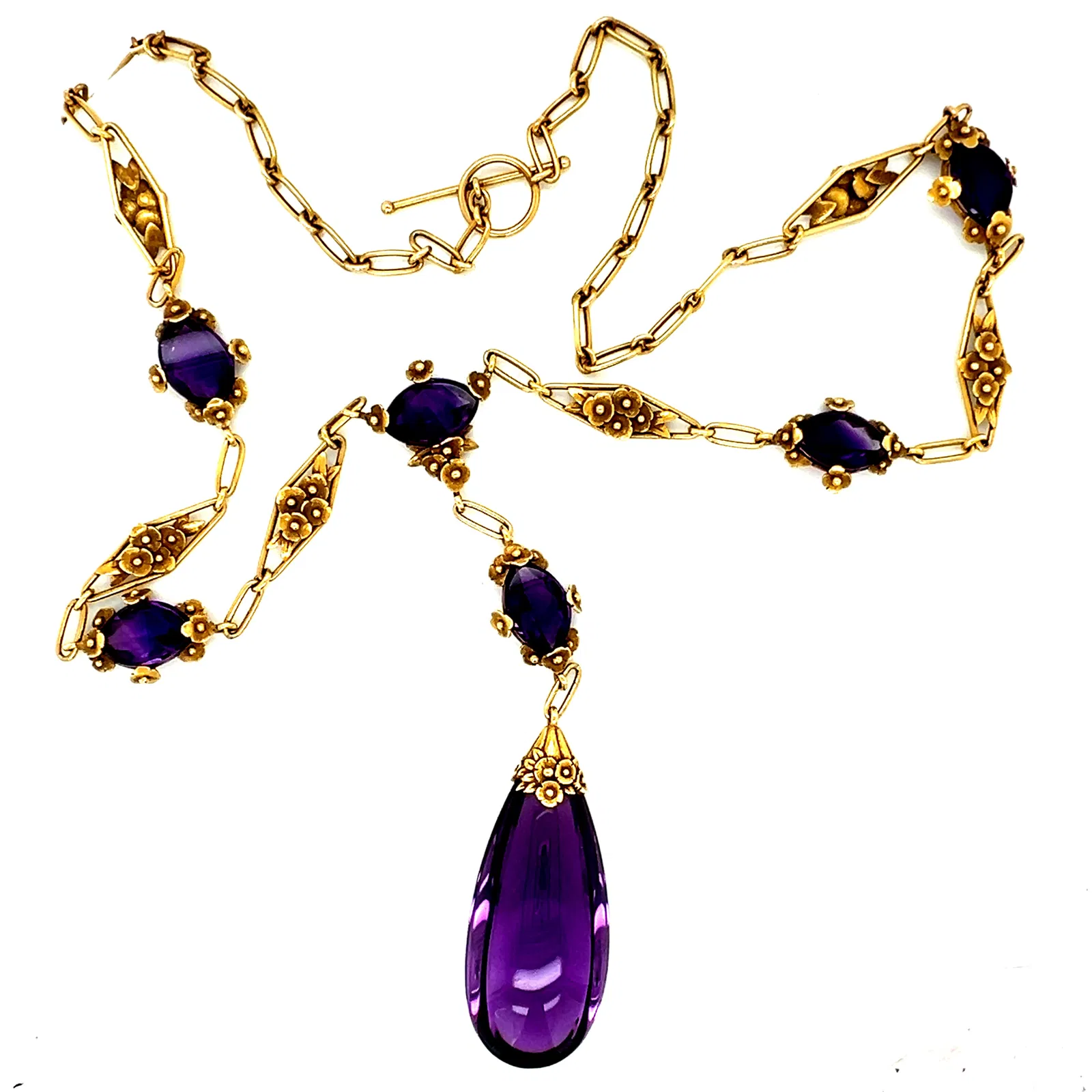
Victorian 14-karat gold and amethyst necklace. Image courtesy of Associated Estate & Appraisal.
Victorian Gold and Amethyst Necklace
Also notable in this sale is an intricate Victorian gold and amethyst necklace (lot #134; estimate: $2,000 – $2,500). The deep purple stones are set in 14-karat gold crafted in flower-dotted links. The piece centers on a teardrop-shaped amethyst pendant and measures over 20 inches in length.
Defined by the reign of Queen Victoria of England, the Victorian era encompasses the middle to end of the 19th century. The period is known for its strict moral code, modest fashion, and established gender roles. Clothes and accessories communicated wealth and social status in Victorian society. The Industrial Revolution brought new manufacturing techniques and made jewelry affordable to more people in society. Early Victorian-era jewelry embraced Romanticism and elaborate details. Later, Victorian styles shifted to include mourning jewelry and purely aesthetic craftsmanship.
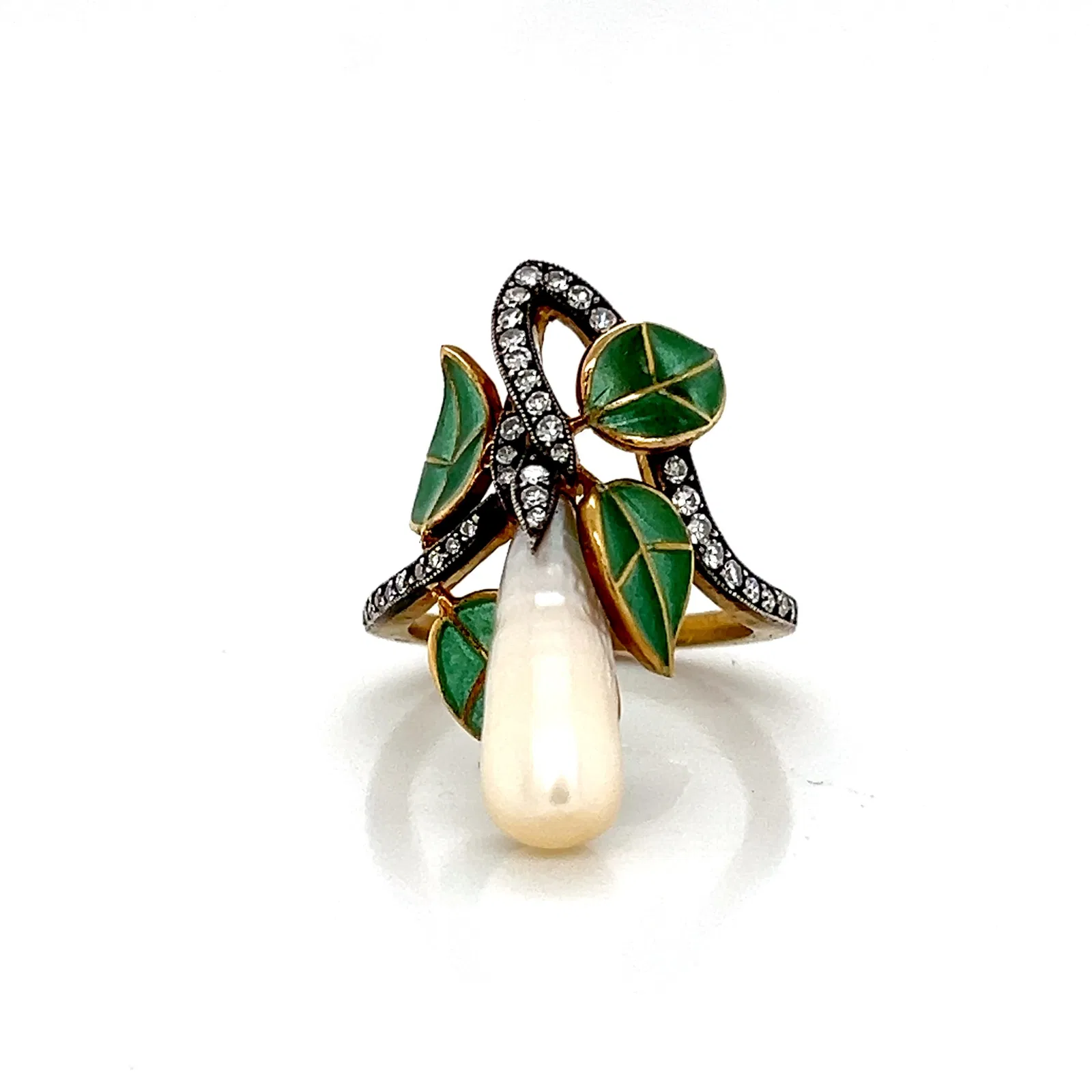
Art Nouveau 18-karat gold, diamond, and pearl plique-à-jour enamel ring. Image courtesy of Associated Estate & Appraisal.
Art Nouveau Plique-à-Jour Enamel Ring
From the Art Nouveau period comes a plique-à-jour enamel, 18-karat gold, diamond, and pearl ring (lot #151; estimate: $1,500 – $2,000). Shaped like a twisting branch with leaves, this piece is studded with diamonds around the band. Dropping from the center of the ring is a lustrous, elongated baroque pearl.
The plique-à-jour enameling technique has existed for centuries and was first developed by Italian and French artisans. However, it rose to particular prominence after being rediscovered in the early 20th century. With careful soldering, a plique-à-jour jeweler can create translucent enamel that evokes the beauty of stained glass windows. Plique-à-jour enamel jewelry was especially popular during the Art Nouveau era, with its preference for natural themes, flowing lines, and mystical elements. The technique brought light to myriad brooches, pendants, and rings.
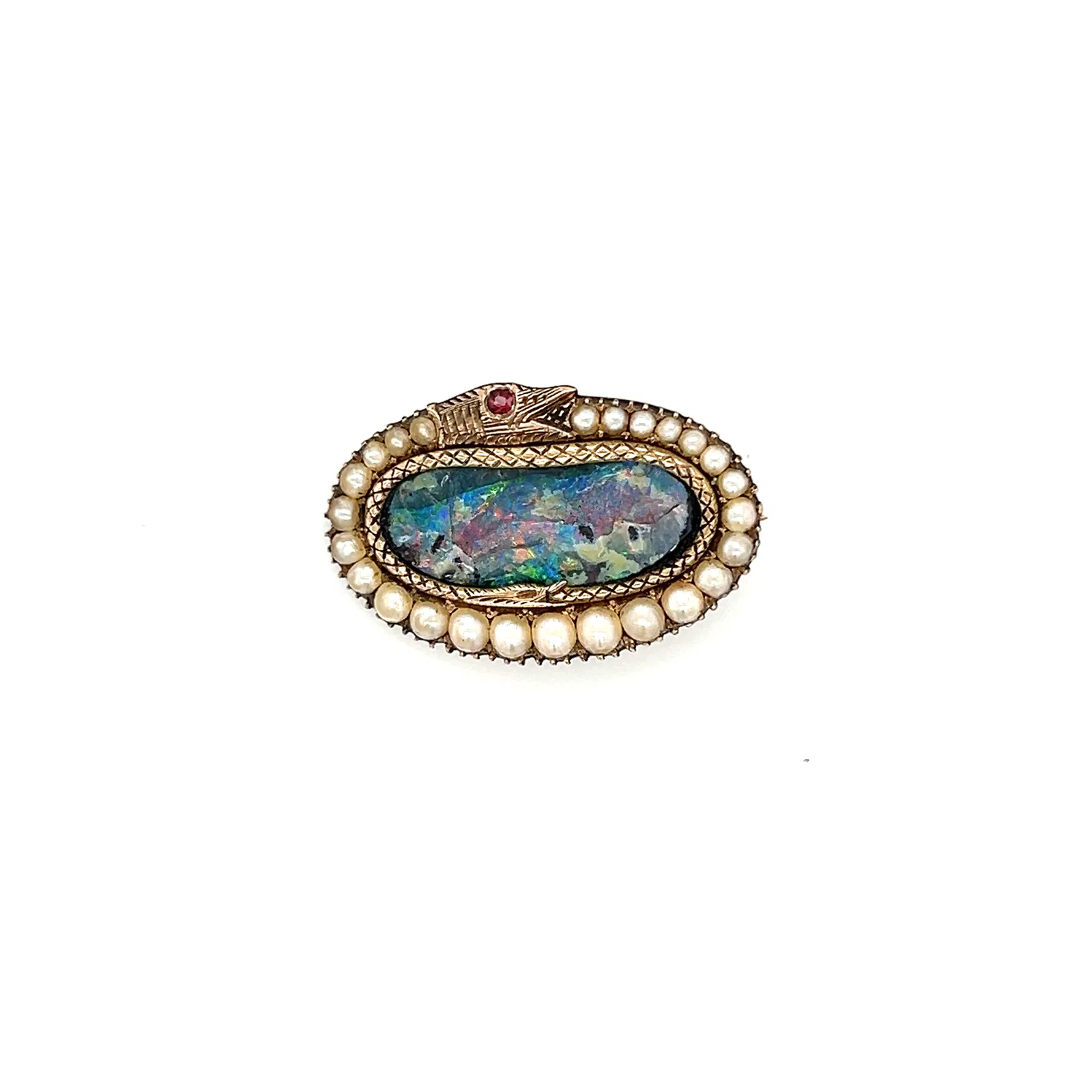
Georgian 9-karat gold ouroboros double snake brooch. Image courtesy of Associated Estate & Appraisal.
Georgian Ouroboros Brooch
Another key lot predates the Victorian era. This Georgian ouroboros brooch is composed of 9-karat gold and features two ouroboros snakes encircling an oval opal (lot #124; estimate: $600 – $800). The outermost snake has a body of graduated pearls with a ruby eye, while the inner serpent is formed of cross-hatched gold.
The ouroboros symbol has emerged in multiple societies across history and contains various meanings, including rebirth and the cycle of life. It was popular in Georgian jewelry and appears in many rings, brooches, and other items. Spanning just over a century, the Georgian era was an important period for jewelry. Craftspeople made each piece by hand and placed particular emphasis on symbolic details. This occurred in a society that was gradually shifting from tradition and mystical beliefs to a preference for science and reason during the Enlightenment. Many Georgian jewelry items reflect this growing tension of the period.
Associated Estate & Appraisal’s Summer Premier Fine Jewelry & Timepiece Auction will begin at 11:00 AM EDT on September 28, 2024. Visit Bidsquare to browse the full catalog or register to place a bid. Find additional coverage of this event on Auction Daily.
First developed in antiquity, this decorative technique spread throughout the Christian and Eastern worlds over the centuries. Since the beginning of the 20th century, the technique has enjoyed a revival.
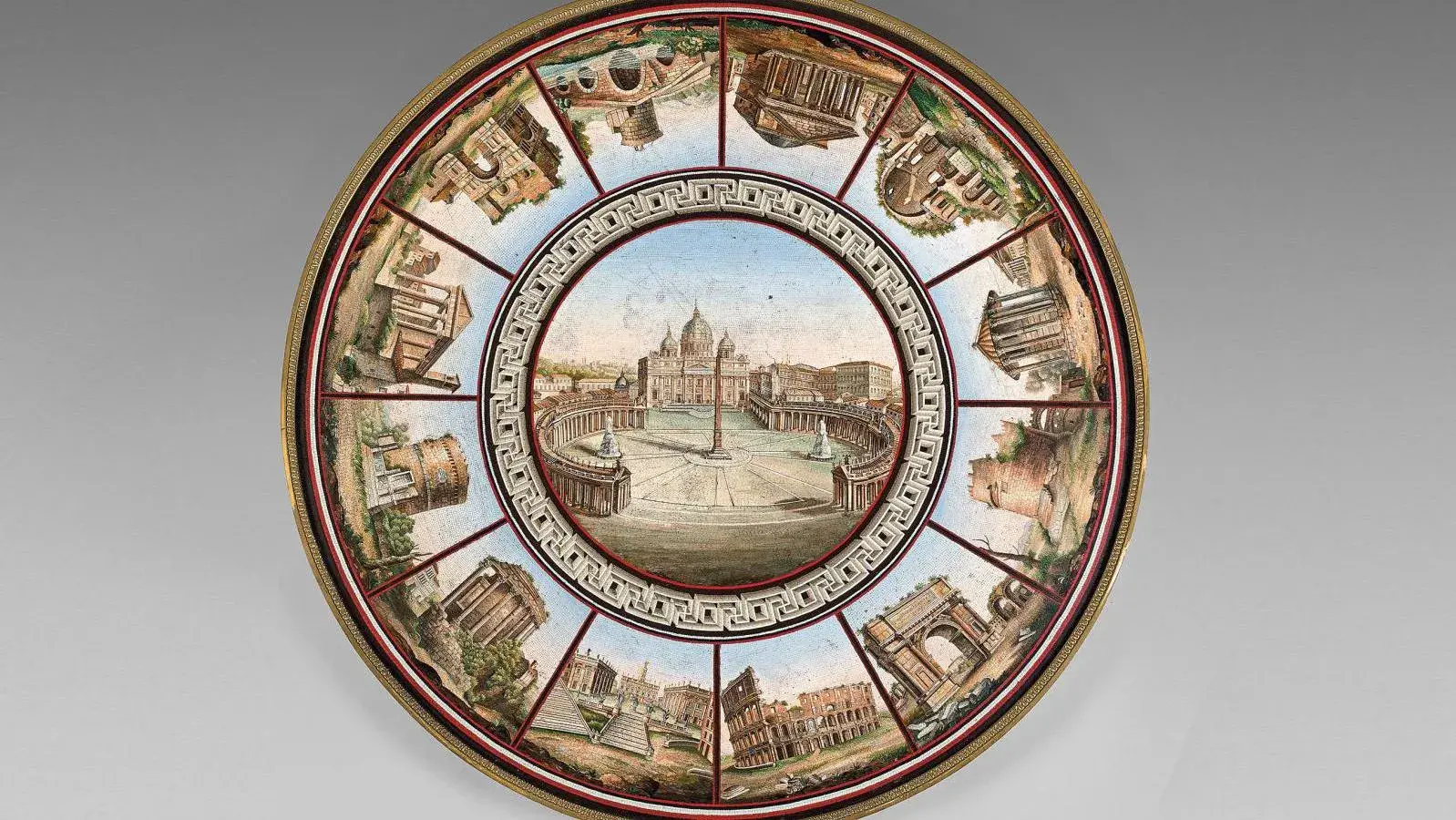
Almost every era has succumbed to the mosaic’s palette of materials and colors, and taken advantage of its great versatility. The range of elements used to form its primary components abound. More than the material itself, it is the small size and irregularity of the elements that make up a mosaic that best distinguishes this technique from other forms of cladding: pebbles, terracotta pieces or small elements called tesserae, cut or broken from slabs of limestone, marble or ceramic.These tesserae can also be cut from colored glass rods or mother-of-pearl pieces. Mosaics therefore lack the perfect regularity of cut stone pavements, like hardstone marquetry. These various elements are fixed with mortar or glue, following a preparatory design traced on the floor or walls, and form a solid, waterproof surface whose utilitarian character was appreciated in antiquity. The mosaicist then arranges the tesserae to imitate a more or less complex tapestry or mural. A monochrome or bichrome geometric mosaic is undoubtedly the simplest of creations, it’s far more difficult to form canevas, compositions assembling different scenes illustrated in fine mosaic, called emblemata. The complexity is overcome by creating these mosaics in the workshop, which are first fixed on a removable support—travertine, terracotta, wood—then installed in the building, usually on the floor, sometimes on the wall, and linked together by opus tessellatum frames, using thicker tesserae. Capturing the possibilities offered by the variety of materials and the multitude of possible technical combinations characterizes the talent and tastes of different eras and cultures.
Multiple Techniques
Among the most common, opus tessellatum, with tesserae ranging from 4 to 20 millimeters on each side, is the most versatile type of tile and can be used for all kinds of designs. Opus vermiculatum tesserae are no larger than 4 mm on each side, while opus figlinum tesserae are arranged edgewise and vary in orientation to imitate the weave of a basket. As for opus signinum and musivum, the tesserae are scattered randomly on the floor in the case of the former, and on the walls of caves dedicated to the muses in the case of the latter; the latter has the particularity of mixing shells, glass and pumice with the tesserae. Attested since the third millennium BCE in Mesopotamia, mosaics entered their golden age during the Greek classical period (507-323 BCE). Initially, pebbles were used, playing with their colors in geometric or figurative, bichrome or polychrome motifs. The virtuoso mosaics of Olynth are the finest expression of this tradition. A privilege of the elite, mosaics maintained a close relationship with painting, a relationship that became even more pronounced with the development of tesserae in the Hellenistic period (323 BCE – 31 CE). While most mosaicists remain anonymous, Sôsos of Pergamon (c. 133 BCE) remains famous for his “poorly swept floor”, asarotos oikos, a polychrome mosaic scattering the remains of a meal in an admirable trompe-l’oeil effect. The work gives an idea of the finest Greek creations, sometimes portable in the form of ‘easel’ mosaics. This format would endure in Byzantine art, whose creations were much coveted during the Renaissance. The Hellenistic style continued into the early Roman Empire, but black-and-white mosaics gradually took over in Italy, as found in numerous Pompeian floors. While polychromy enjoyed a certain success in Gaul and held its own in North Africa, it was poised to change in scope. The rise of Christianity immersed sacred architecture in golden mosaics covering columns, walls and domes. In the upper parts, tesserae made of agglomerated glass, into the thickness of which gold or silver leaf has been inserted, are slightly inclined in the mortar, allowing light to play on their surface. Umayyad mosaics adopted the same technique, achieving a perfect mastery of glass and its coloring: those in the Cordoba mosque are a magnificent example. This art continued to flourish for some time in the Christian world, notably in the Norman kingdom of Sicily in the 12th century, before declining. It was revived in the 15th and 16th centuries, when Titian, Tintoretto, Salviati and Veronese signed cartoons for St. Mark’s Basilica in Venice. At the end of the 16th century, the Vatican’s new mosaic workshop decorated the domes of St. Peter’s Basilica. Its constant experimentation gave rise to almost thirty thousand shades of enamel—pastes of glass colored in the mass—and, in 1775, to tesserae measuring less than a millimeter. From then on, micromosaics adorned the precious souvenirs of the Grand Tour and the diplomatic gifts of the popes.
In Recent Years
In the 19th and 20th centuries, mosaics made a comeback in architecture with Eugène Grasset, Antonio Gaudí and Fernand Léger, but shone brightest in Mexico. Pre-Columbian mosaics of turquoise, jade and obsidian, glued with resin onto all kinds of supports, were already fascinating for their vibrant colors. A few centuries later, artists such as Diego Rivera and Juan O’Gorman would prove worthy heirs to this artistic past, creating monumental, typically Mexican mosaics. Let’s hope the 21st century doesn’t leave the tesserae in the dust.
Worth Seeing Mosaics of antiquity at the Louvre, Fernand Léger’s mosaics at the church of Notre-Dame-de-Toute-Grâce in Passy (Haute-Savoie) and Odorico’s mosaics in Rennes (Ille-et-Vilaine).