VICTOR VASARELY Cube Sculpture:
Signed and numbered 138/300; 8″ H x 6″ W on the stand; Please contact Rivich Auction for more information
Condition
Very good condition; some surface scratches to lucite
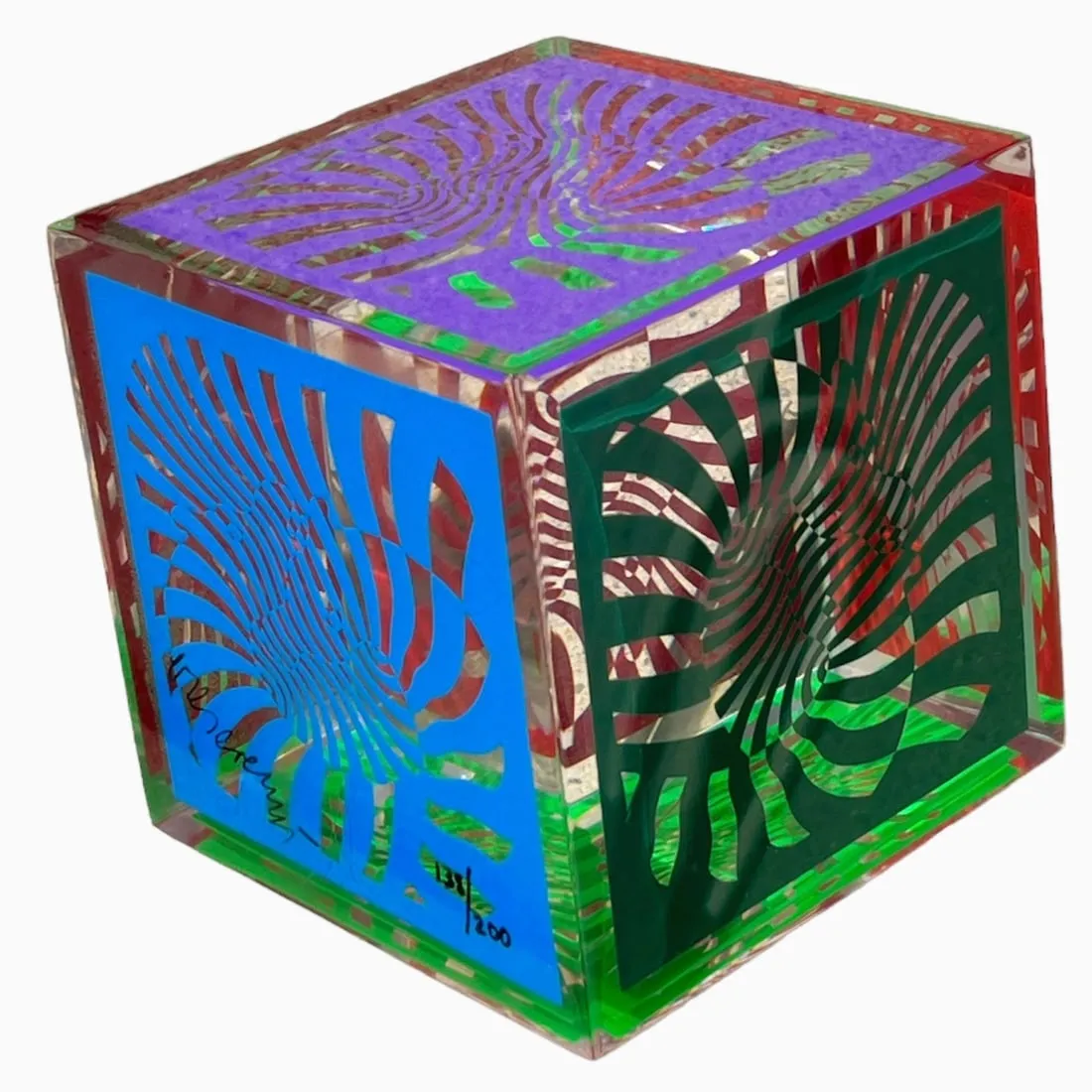
VICTOR VASARELY Cube Sculpture:
Signed and numbered 138/300; 8″ H x 6″ W on the stand; Please contact Rivich Auction for more information
Condition
Very good condition; some surface scratches to lucite

Vintage BIANCHI Luna Carbon Fiber frame Racing Bicycle:
Mavic Ksyrium sl wheelset-Vittoria Diamonte Tires-Bianchi Italia selle seat. 21″ frame size. Mavic rims. Wheel to wheel bike measures in at 64″ L. Handlebars are 16″
Condition
All bikes have only been used one or two times; Bikes have specialized parts with some vintage, new, used, and individualized parts; If you have specific questions regarding any part of one or more bikes and their condition please reach out with questions
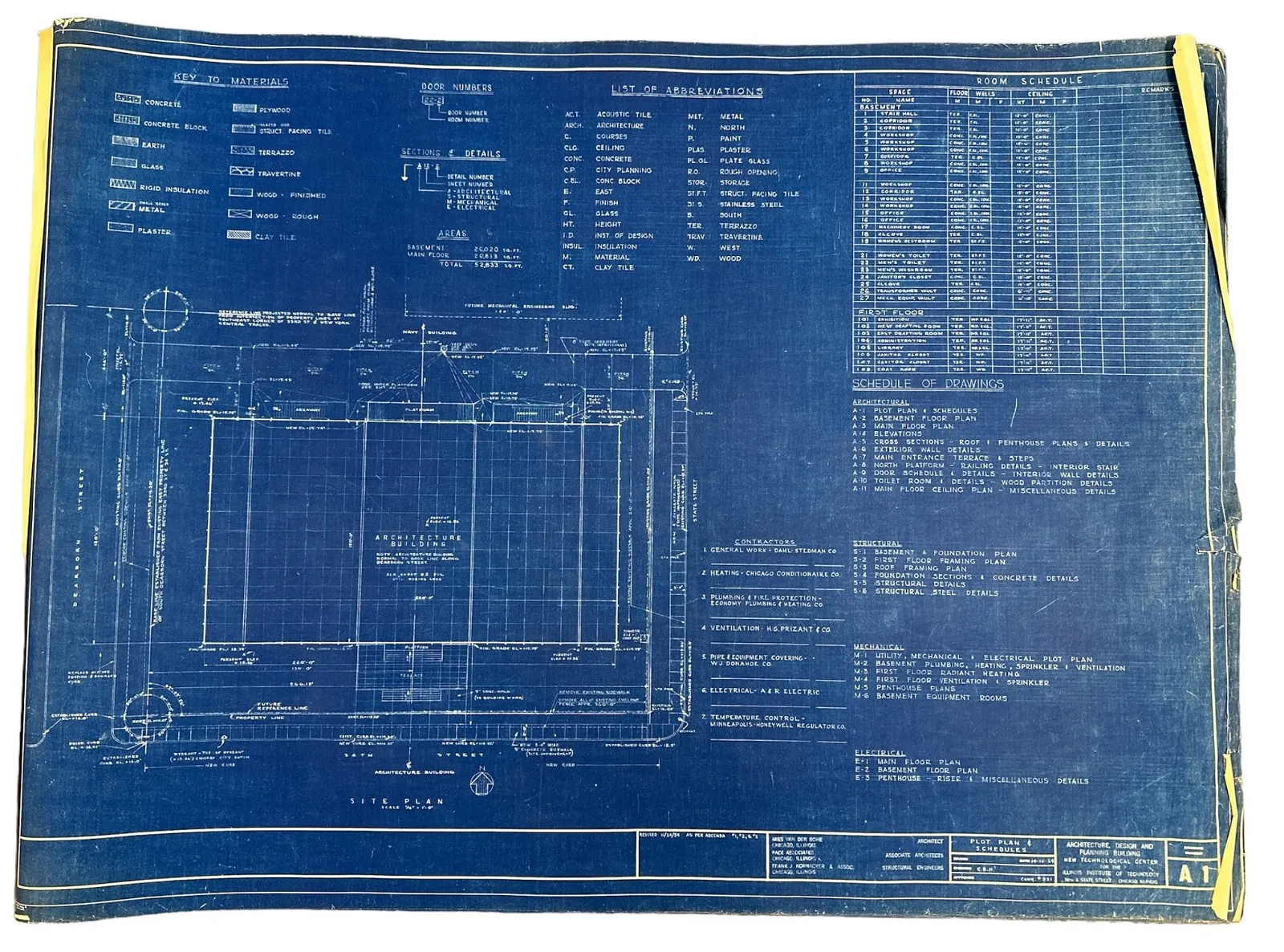
MIES VAN DER ROHE Blueprint For S.R. Crown Hall IIT College of Architecture:
From the Estate of Mid Century Architects Who Worked Closely Under Mies Van Der Rohe and on Incredible Historical Chicago Projects including The Time- Life Building, Lake Point Tower, O’Hare International Airport, and IIT’s S.R. Crown Hall College of Architecture Building. 27 page bound blueprint for Illinois Institute of Technology’s S.R. Crown Hall Architecture Building 30″ H x 42.25″ W Please contact Rivich Auction for more information
Condition
Very nice, original condition with age appropriate wear

Original ALBERTO MASI Frame Custom Racing Bicycle:
This incredible bicycle frame was crafted in the Velodromo Vigorelli in Italy by Alberto Masi and is signed by Alberto Masi; Bontrager Carbon Fiber Handlebars, HED. Hand rest, Stem is Syntace; John Cobb Designed for Oval Concepts A900 Jetstream TT Carbon Fiber Front Fork; Front rim is FiR Carbon; Back Rim is Mavic Comete; Carbon Fiber Chainring, Rear Derailleur is Tune and Pedals are Look Cx6 Ti Carbon, SELLE ITALIA SLR Carbonio Saddle; Seat Post Selcof 2000 Carbon; Wheel to Wheel measures 64.5″ W; Frame size is approx. 55cm; Handlebars are 17.5″ outside to outside and 15.5″ L extending in front; Rims are approx 24.5″ DIA Please contact Rivich Auction for more information.
Condition
All bikes have only been used one or two times; Bikes have specialized parts with some vintage, new, used, and individualized parts; If you have specific questions regarding any part of one or more bikes and their condition please reach out with questions
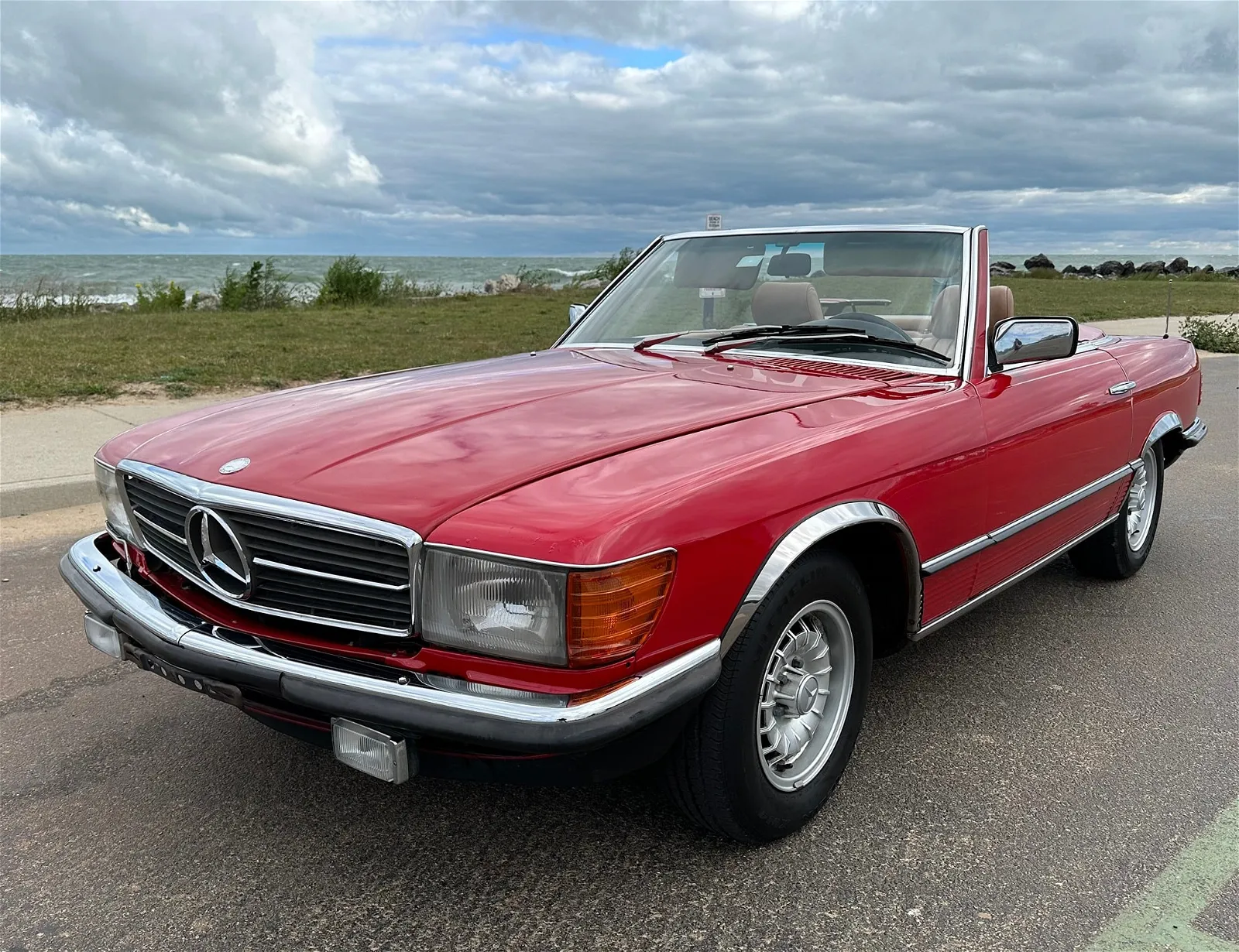
1984 Mercedes-benz 280SL:
1984 MERCEDES-BENZ 280SL 6 Cylinder 5-speed manual drive; Please contact Rivich Auction for more information
Condition
Original one owner vehicle purchased in Germany in 1984 and imported to the United States. Very well maintained and garage kept it’s entire life. Comes with mostly all of its original paperwork and service records. Rusty Jones rust protection was applied to the car. Car drives very smooth, shifts properly, does not appear to have any mechanical issues. A new battery has been installed as well as an oil change. Hard top comes off as it should to reveal the convertible soft top. Everything operates very smoothly on this car. It has one key and comes with a CLEAN TITLE. Power windows, radio, horn, locks, electric antenna, interior lights, all work. Odometer reads 109691 but does not turn, dash lights do not work. Looks to be mostly all original parts, and has never been in any accidents. Please contact RIVICH AUCTION for any questions or to schedule an inspection.
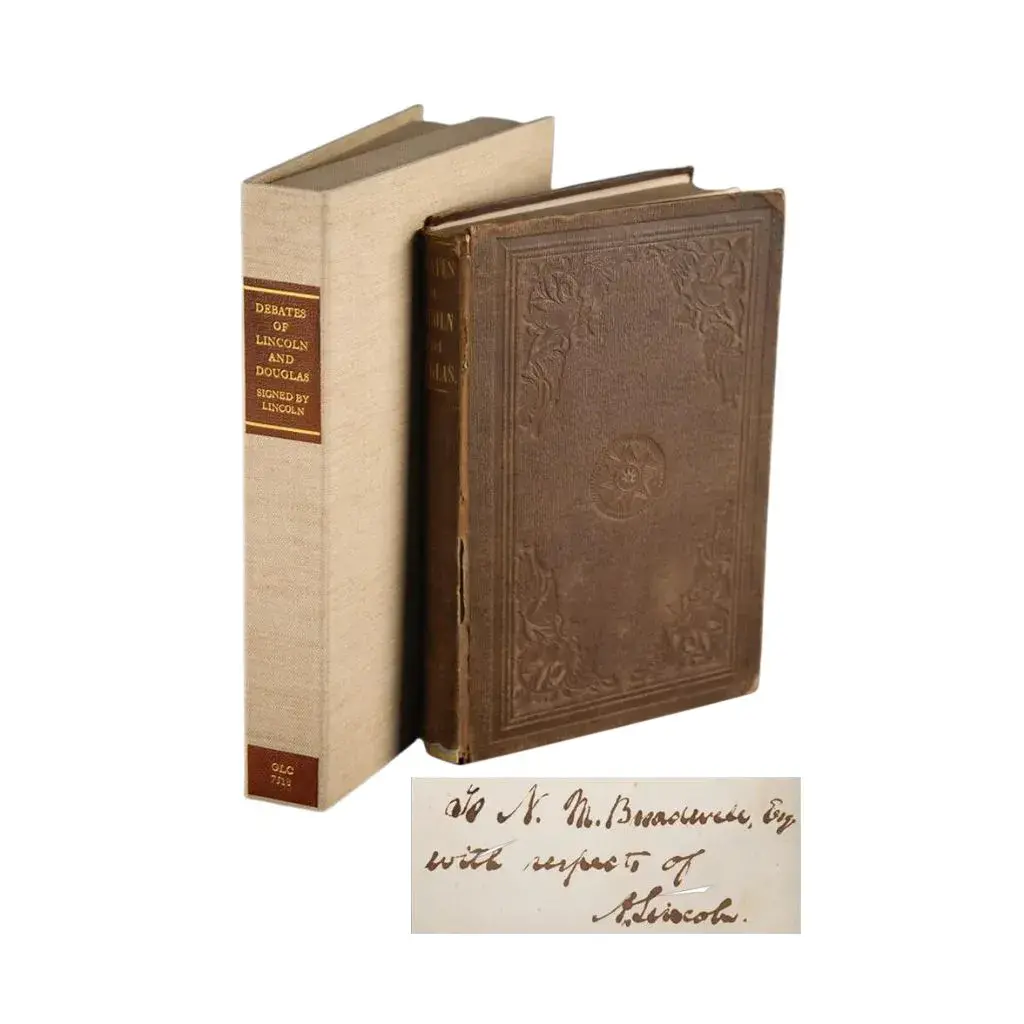
Abraham Lincoln Signed First Edition of the Lincoln-Douglas Debates (One of Four Known Signed in Ink, to Former Law Apprentice N. M. Broadwell):
Incredibly rare signed book: Political Debates between Hon. Abraham Lincoln and Hon. Stephen A. Douglas, In the Celebrated Campaign of 1858, in Illinois. First edition, first issue (with the signature mark “2” at the bottom of page 17). Columbus, OH: Follett, Foster and Company, 1860. Hardcover bound in publisher’s embossed brown decorative cloth with gilt title on spine, 6.25 x 9.5, 268 pages. Boldly signed on the first free end page in ink to a Springfield attorney who studied law under Lincoln, “To N. M. Broadwell, Esq., with respects of A. Lincoln.” Autographic condition: fine, with light ink spreading to the signature and inscription. Book condition: VG-/None, with slightly loose front joint, wear to bumped corners, splits to spine cloth and losses to headcaps, and some minor foxing to textblock. Accompanied by a custom-made clamshell case.
The Lincoln-Douglas debates, a series of seven debates between Abraham Lincoln and Stephen A. Douglas during the 1858 Illinois senatorial campaign, stand among the most celebrated dialogues in the history of American politics. The debates focused on the issue of slavery, particularly on the hotly contested question of the expansion of the institution into newly acquired territories. Douglas promoted the solution of popular sovereignty—that is, allowing settlers of those territories to decide on the question—while Lincoln argued against the expansion of slavery, though was not yet advocating for its abolition in whole. Although the incumbent Douglas was re-elected as senator by the Illinois General Assembly, the debates attracted widespread media attention and vaulted Lincoln into the forefront of national politics. This newfound publicity helped to lay the groundwork of Lincoln’s successful 1860 presidential campaign.
The text of this first edition was set in type from Lincoln’s personal scrapbook, into which he had pasted transcripts of the debates as they were printed in local newspapers. It was published in April, a few months before Lincoln’s nomination as the Republican candidate for president. The book rapidly became a bestseller—in a matter of months, over 30,000 copies were printed and sold. Abraham Lincoln personally received 100 copies to distribute to friends and supporters, as documented in a pioneering study by Harry E. Pratt, “Lincoln Autographed Debates,” in Manuscripts, 6:4 (Summer 1954). Pratt’s census located 18 of these, though a handful of others (including this example) have since come to market. Interestingly, of those known examples, only three others are also signed in ink—the remainder are inscribed in pencil. Evidently, Lincoln noticed the tendency of the ink to ‘feather’ on the inexpensive paper, blurring his name, and opted to sign most copies in pencil. Thus, this ink-signed example is likely one of the earliest that Lincoln signed. An updated census, compiled by David H. Leroy and published in ‘Mr. Lincoln’s Book’ in 2009, documents 42 known signed copies of the book, including Broadwell’s: still, only four of those are known to be signed in ink.
The recipient of this copy, Norman M. Broadwell (1825-1893), studied law as a preceptor with Lincoln in the Lincoln & Herndon offices in Springfield, Illinois, beginning in 1852. Ironically, in his first case, he found the opposing counsel to be his former teacher, Abraham Lincoln; and, in the final case that Lincoln argued in Springfield, Broadwell served as his assistant. Later Broadwell had several law partners including Shelby M. Cullom and John A. McClernand. He became active in Democratic politics, served as Sangamon County judge in 1862, and as mayor of Springfield in 1867. Though on different sides of the political aisle, Lincoln clearly held Broadwell and his call to civic duty in high esteem—evinced by this remarkable presentation copy of the Lincoln-Douglas debates.

Thomas Jefferson: First Edition of Notes on the State of Virginia (Edmund Randolph's Copy, Signed and Annotated):
Rare book authored by Thomas Jefferson, owned and signed by fellow Virginian founding father Edmund Randolph: Notes on the State of Virginia: written in the year 1781, somewhat corrected and enlarged in the winter of 1782, for the use of a Foreigner of distinction, in answer to certain queries proposed by him. Rare, privately printed first edition. [Paris: Philippe-Denis Pierres for the author,] 1782 [i.e., 1785]. Hardcover bound in brown calf, 5.25 x 8, 391 pages, bound with 32 pages of supplementary pamphlets (“Draught of a Fundamental Constitution for the Commonwealth of Virginia,” “Notes on the Establishment of a Money Unit, and of a Coinage for the United States,” and “An Act for establishing Religious Freedom, passed in the assembly of Virginia in the beginning of the year 1786”). Signed at the head of “Query I” by founding father Edmund Randolph, “Edm: Randolph,” who attended the Constitutional Convention as a delegate from Virginia and later served in George Washington’s cabinet. Randolph also adds his personal handwritten table of contents before the title page (including citations to “Slaves,” “Slavery,” “Indians,” and “Negroes”) and annotations in various places (mostly glosses; only one note is substantive, adding the “Osprey” to Jefferson’s list of birds).
On the rear flyleaf is an interesting, indignant Civil War-dated handwritten note by Randolph’s grand-niece, in full: “In 1864 Edmonia Preston, grand-daughter of the owner of this book, (Edmund Randolph the first Attorney-General and the second Secretary of State of the United States) being ‘Kindly permitted’ to purchase supplies for her destitute family, rode into Fredericsburg, clothed in a single garment made of an old quilt, because the soldiers of the United States had robbed her and her children of their clothing. K. P. Wormeley, great niece of Edmund Randolph.” Autographic condition: fine. Book condition: VG-/None, with professional mending to hinges and some pages, minor staining to textblock, rebacked spine and selectively consolidated leather, and the small bookplate of Thomas W. Streeter affixed to front pastedown. Accompanied by a custom-made clamshell case.
Notes on the State of Virginia emanated from Thomas Jefferson’s responses to questions about Virginia posed by François Barbé-Marbois, the secretary of the French delegation in Philadelphia. Jefferson divided his response into 23 “queries,” each discussing a different aspect of Virginia—offering a wide-ranging survey of the state, covering everything from its geography and climate to its commerce and manners. He first had the work printed anonymously in Paris in 1785, in a limited edition of just two hundred copies—this being one.
In a letter to James Madison of May 11, 1785, Jefferson wrote of the volume’s publication: ‘I had 200 copies printed, but do not put them out of my own hands, except two or three copies here, and two which I shall send to America, to yourself and Colo. Monroe.’ He asks for their opinions in confidence, fearing that some of the commentary ‘might be displeasing to the country.’ If Madison finds them offensive, Jefferson promises to ‘only send over a very few copies to particular friends in confidence and burn the rest.’ Randolph—a second cousin of Jefferson, and later his successor as United States Secretary of State—was evidently one of the later recipients of the volume.
In the influential work—the only full-length book that Jefferson published during his lifetime—the founding father expresses his beliefs in the separation of church and state, constitutional government, checks and balances, individual liberties, and the institution of slavery. The first edition of Notes on the State of Virginia is immensely desirable in its own right; that this example derives from the personal library of Edmund Randolph, and was sold in the famed ‘Streeter sale’ of the 1960s, heightens its rank amongst surviving copies.
Provenance: ex. Thomas W. Streeter, the foremost collector of Americana in the 20th century, whose collection was dispersed by Parke-Bernet Galleries (1967).

Rene Descartes Excessively Rare Autograph Letter Signed on Theorem of Circles and Quarrel of Utrecht:
Excessively rare and mathematically significant ALS in French, signed “Descartes,” one page, 8.5 x 12.25, October 21, 1643. Handwritten letter to his friend Alphonse de Pollot, alluding to one of his mathematical theories, the Theorem of Circles (a premise to what is known today as Descartes’ Theorem), and sending thanks for his support in the Quarrel of Utrecht. Descartes vilifies his Protestant enemy at Utrecht, Gisbertus Voetius, and notes that he had recently proposed the ‘Problem of Apollonius’—a famous mathematical problem involving the construction of a circle within a plane—to Princess Elisabeth of Bohemia, but fears it may be too difficult for her to solve.
Descartes opens the letter by offering thanks for Pollot’s support in the Quarrel of Utrecht (translated): “I have no words to express the resentment that I have of the obligations that I have to you, but I assure you that it is extreme, and that I will keep them all my life.” After staying there sporadically, Descartes settled permanently in Holland in the spring of 1629. It was in these Batavian lands that the philosopher published his most famous texts: Méditations métaphysiques (1641), Principes de la Philosophie (1644 ) and the famous Discours de la Méthode, published in Leyden in 1637. Descartes’ philosophy, opposed to the scholastic principles, did not fail to annoy the Protestant authorities, the first of which was Gisbertus Voetius, who launched a cabal against Descartes and his friend Henricus Regius, professor at the University of Utrecht. Accusing Descartes of atheism, Voetius instigated the publication of a brutal pamphlet, ‘Admiranda methodus,’ written by his pupil Martin Schook, in which Descartes is described as ‘a lying mouth’ and ‘a bastard of Christianity.’ This ‘Quarrel of Utrecht’ grew so tense that the philosopher called on the ambassador of France to defend him.
Descartes was condemned by the University of Utrecht on March 17, 1642, prohibiting the discussion of his works and making him subject to criminal charges, thereby forcing him to flee to The Hague. Thanks to his influential friends, Descartes was never put on trial, though he felt his reputation had been damaged. According to this letter’s postscript, the matter had been settled for eight days: “I have been informed from Utrecht that there is no more fear for me, and that the name of His Highness, in Mr. de Ryusmond’s letters, has calmed the whole storm. It was the chief joy I felt, to see that name revered, if not as it should, at least enough to prevent injustice in a town prone to mutiny and where the rebellious spirit of Voetius dominates.” It would take 363 years for Descartes to be officially vindicated by the University of Utrecht—on March 23rd, 2005, the prestigious university finally lifted its condemnation of the teaching of the works of Descartes.
Additionally, Descartes makes mention of his famous correspondence with Princess Elisabeth of Bohemia, a well-educated royal who became his student in philosophy and morals. Here, he writes of sending her a geometrical problem of three circles, also known as Apollonius’ problem. In part (translated): “I regret having proposed the question of the three circles to the Princess of Bohemia, since it is so difficult, that it seems to me that even an angel who had no other instruction in algebra than that which St[ampioen] had given her couldn’t solve it without a miracle.” In solving the problem, René Descartes gave a formula relating the radii of the solution circles and the given circles, now known as Descartes’ theorem. In spite of Descartes’ fears of its great difficulty, Princess Elisabeth also pioneered an alternate algebraic solution to Apollonius’ problem. Descartes so admired the intellect of Elisabeth that in 1644, he dedicated his Principia philosophiae to the princess.
Addressed on the integral leaf in Descartes’ hand to “Monsieur Alphonse de Pollot, Gentilhomme de la Chambre de son Altesse à la Haye.” Housed in a custom-made slipcase. The letter is in fine condition, with intersecting folds and several small holes affecting the blank margin and address panel. Accompanied by full transcript in French, and an official French brochure published by the Imprimerie Nationale Exécutive du Louvre containing the decrees of the National Convention of October 2nd and 4th, 1793, granting “René Descartes the honors due to great men, & order to transfer to the Panthéon François his body, & his statue made by the famous Pajou.”
This important letter is referenced in ‘Princess Elizabeth of Bohemia and Descartes’ letters’ by Erik-Jan Bos, published in Historia Mathematica in 2010. Bos writes: ‘On 21 October 1643 Descartes wrote to his friend Alphonse Pollot that he had recently proposed a mathematical problem to Elizabeth, but now feared it was too difficult. The problem in question was the problem of three circles, also known as Apollonius’ problem: given three circles in a plane, find a fourth circle that touches each of them. Descartes furthermore assumed that the required circle is located in the space between the three circles. Barely a month later, on 17 November, Descartes sent Pollot a letter for Elizabeth that contained his solution to the problem. On 21 November, Elizabeth sent her own solution to Descartes with a covering letter. Although Elizabeth’s solution is lost, Henk Bos has reconstructed it from Descartes’ reply of 29 November‰Û_According to Bos, Elizabeth’s solution is especially interesting, because, in the light of her efforts to solve the problem, Descartes changed or at least adjusted his opinions on the best way to approach geometrical problems.’
Provenance :
– Marquis de Queux de Saint-Hilaire’s collection (the letter was published for the first time by Victor Egger in the Annales de la faculté des Lettres de Bordeaux).
– Auction in Paris, Drouot – December 1981.
– Private collection.
Bibliography :
– Lettres inédites de Descartes. E. de Budé. Durand & Pedone-Lauriel (1868, pp. 12-16)
– Annales de la faculté des Lettres de Bordeaux. Victor Egger (1881, pp. 190-191)
– Adam et Tannery, Œuvres de René Descartes, IV : Correspondance, lettre nº CCCXX.
– Descartes : œuvres/lettres, Pléiade, Gallimard, 1999, Paris, p.1108
– Vie de Monsieur Descartes, Adrien Baillet, Éditions Table Ronde, Paris, 1992, II.
– Descartes, Correspondance, Tome IV, Librairie philosophique J. Vrin.
– “Princess Elizabeth of Bohemia and Descartes’ letters (1650-1665)” by Erik-Jan Bos, Historia Mathematica (Volume 37, Issue 3, August 2010).
– “What Someone May Have Whispered in Elisabeth’s Ear” by Vlad Alexandrescu, Oxford Studies in Modern Philosophy, 2012.

The First Emoticons NFT: The Smiley 🙂 and Frowny 🙁 by Professor Scott E. Fahlman:
The First Emoticons NFT: The Smiley 🙂 and Frowny 🙁 by Professor Scott E. Fahlman
NFT, Non-fungible token (MP4)
3000 x 2000 pixels
Ed. 1/1
Minted on 9/1/2021
First proposed on ARPANET, Carnegie Mellon University, September 19, 1982
Smart Contract Address: 0x495f947276749ce646f68ac8c248420045cb7b5e
There is a ten percent (10%) future royalties requirement on secondary sales enforced by smart contract for this property.
This work is a unique digital artifact and is sold as a non-fungible token. The Emoticons NFT is accompanied by two essays written by their creator, Professor Scott E. Fahlman, about their creation: one written upon their 20th anniversary in 2002, and another composed specifically for the original NFT auction, hosted by Heritage in September 2021, reflecting on their creation. Also includes a framed certificate signed by Scott E. Fahlman, four Davos World Communication Forum emoticon paddles (one signed by Fahlman), a t-shirt honoring the creation of the emoticon signed by Fahlman, and some related ephemera.
The strictly textual nature of the internet in its earliest iterations—local electronic mail and online bulletin-board systems, or ‘bboards,’ often hosted on university intranets—brought about a problem that continues today: the absence of tone or body language in the written word. On September 19, 1982, Carnegie Mellon University computer science professor Scott E. Fahlman offered a solution: “I propose that the following character sequence for joke markers: 🙂 Read it sideways. Actually, it is probably more economical to mark things that are NOT jokes, given current trends. For this, use :-(”
These, the first emoticons—sideways symbols for a smiley face and frowny face—soon came to signify the human emotions of ‘happy’ and ‘sad’ within the digital realm. In an early example of ‘viral’ and ‘meme’ internet culture, the use of 🙂 and 🙁 spread as the internet users spread from research institutions to university networks to public libraries and private homes. Professor Fahlman comments on the universality of the emoticons in his essay that accompanies the digital artifact: “The 🙂 emoticon is the distilled, abstract essence of a smile. It has no gender, no race, no age, no religion, no politics‰Û_ It’s just a smile. This is a big advantage over the emoji versions. With 🙂 we don’t have to argue about how many different versions we have to create for different groups. It looks like all of us.” Today, the emoticons and their evolutionary successors—including more sophisticated ASCII symbols and emojis—are estimated to be used billions of times on a daily basis.
The first emoticons represent humankind’s ever-advancing technological progress, yet recall the earliest of human texts: the pictograms, ideograms, and hieroglyphics used to communicate ideas in prehistoric and ancient times. Like some of the latter tangible artifacts, these digital artifacts were the subject of an ‘archeological dig’ through Carnegie Mellon’s backup tapes, led by Mike Jones and Jeff Baird. Fahlman’s original message proposing the emoticons, and the discussion it was a part of, were successfully retrieved on September 10, 2002, after being ‘lost’ for two decades.
Just as the internet redefined communication around the globe, NFTs are revolutionizing the traditional collecting space with proof-of-ownership and authenticity for digital artifacts. The emoticons stand among the most significant digital artifacts of the early internet, having become ubiquitous as a universal means of expression
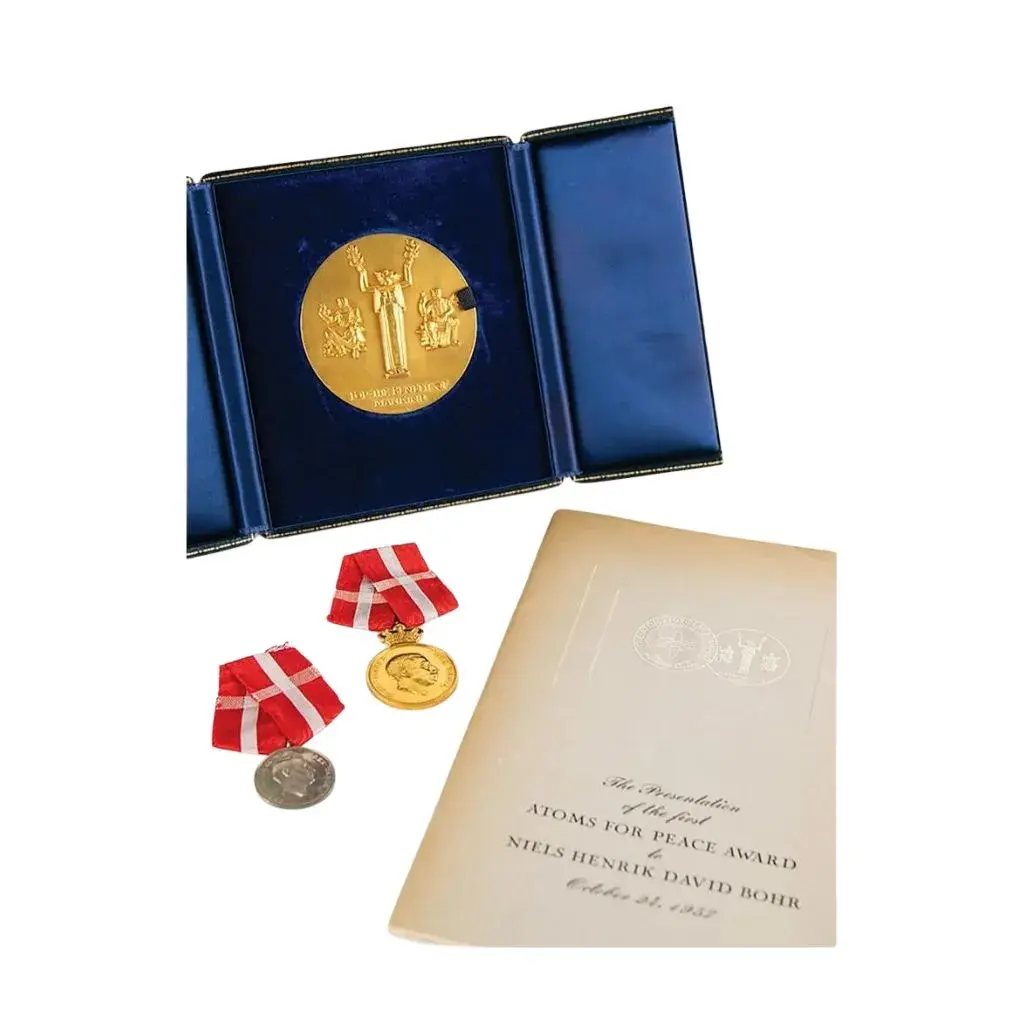
Niels Bohr's Gold 1957 'Atoms for Peace' Award and (2) Danish Medals:
Extraordinary collection of medals awarded to Dr. Niels Bohr, who made fundamental contributions to the understanding of atomic structure and quantum theory, for which he received the Nobel Prize in Physics in 1922—a medal that he auctioned off himself in 1940 to benefit the Finnish Relief Fund, which now resides in the Danish Historical Museum in Fredriksborg. A philosopher of science and promoter of scientific research, he went on to become a premier advocate for peaceful international cooperation on nuclear energy. This collection features three of Bohr’s significant medals: his historic gold Atoms for Peace Award, his Danish Golden Medal of Merit with Crown, and his Danish Galathea Medal in Silver.
The highlight of the collection is the Atoms for Peace Award presented to Bohr in 1957 by President Dwight D. Eisenhower. Gold (marked “18K” on edge), 79 mm, 346 gm, by the Medallic Art Co., New York. The front features allegorical figures representing peace and science, over the legend: “For the benefit of mankind”; the reverse features a symbol representing an atom, with text above: “The Atoms for Peace Award, A Memorial to Henry Ford and Edsel Ford.” The top edge is engraved, “Niels Henrik David Bohr – 1957,” and the bottom edge is stamped with the maker’s mark and fineness. Housed in its original navy blue leather presentation case. Includes an original program from the presentation of the award.
In his ‘Atoms for Peace’ speech before the United Nations on December 8, 1953, President Dwight D. Eisenhower called for efforts in nuclear technology research to re-focus on its capacity for making progress for humankind, rather than on the development of weapons of war. In response to that goal, Henry Ford II, Benson Ford, and Henry Clay Ford proposed that the Ford Motor Company Fund authorize an appropriation of one million dollars—to be granted at a rate of $100,000 annually for ten years—to recognize outstanding contributions to the peaceful application of nuclear energy. A board of trustees was named to identify and select the individual who had made the greatest contribution to the development of peaceful uses of atomic energy, awarding them with a cash honorarium accompanied by a commemorative gold medal. If the board failed to discover a candidate meriting recognition, the award would be held over to the following year.
Niels Bohr became the first to be recognized as an Atoms for Peace Award recipient, and was personally presented with the medal by President Eisenhower on October 24, 1957. In his remarks, Eisenhower praised Bohr’s lifelong dedication to scientific inquiry: ‘In honoring Dr. Bohr, we pay tribute to a great man, one whose mind has explored the mysteries of the inner structure of the atom, and whose spirit has reached into the very hearts of men‰Û_.By disclosing the secrets of nature and in particular those of the atom, science makes possible new technologies by which these secrets are applied. The world now has a choice between the technology of abundance and the technology of destruction—between the use of power for constructive purposes or for war and desolation‰Û_Our country has sought to encourage the application of atomic energy in the arts of peace—toward the end of happiness and well-being for all men and women. So, in saluting and honoring Dr. Bohr in the presentation of the first Atoms for Peace Award, which the Ford family has so thoughtfully provided, we give recognition to a scientist and a great human being who exemplifies principles the world sorely needs—the spirit of friendly scientific inquiry, and the peaceful use of the atom for the satisfaction of human needs.’
The other medals are:
A Danish Medal of Merit in Gold with Crown, 37 mm, 59 gm, engraved “Niels Henrik David Bohr” on the bottom edge, suspended from its original red-and-white ribbon. The front features the portrait of King Christian X of Denmark, and the reverse features a wreath with “Fortient” at center. This medal is an extreme rarity, as it was awarded just four times during the long reign of Christian X.
A Danish Galathea Medal in Silver, 30 mm, 17 gm, suspended from its original red-and-white ribbon. Established by King Frederik IX, this medal was awarded to recognize individuals who assisted in creating, and participated, in the Scientific Danish Deep Sea Expedition between September 1, 1950 and July 17, 1952; Niels Bohr was a member of this executive committee.
This remarkable collection symbolizes Niels Bohr’s foundational contributions to the modern understanding of the atom, as well as his advocacy for peaceful nuclear research. The hopes and hazards of nuclear technology remain at the forefront of scientific inquiry today: scientists continue to seek new, cleaner ways to power modern life, and the world has been reminded of the importance of non-proliferation given Russia’s suspension of its last nuclear arms treaty with the United States and invasion of Ukraine.