A Rare Alexander Calder “Baby-Mobile” From 1974


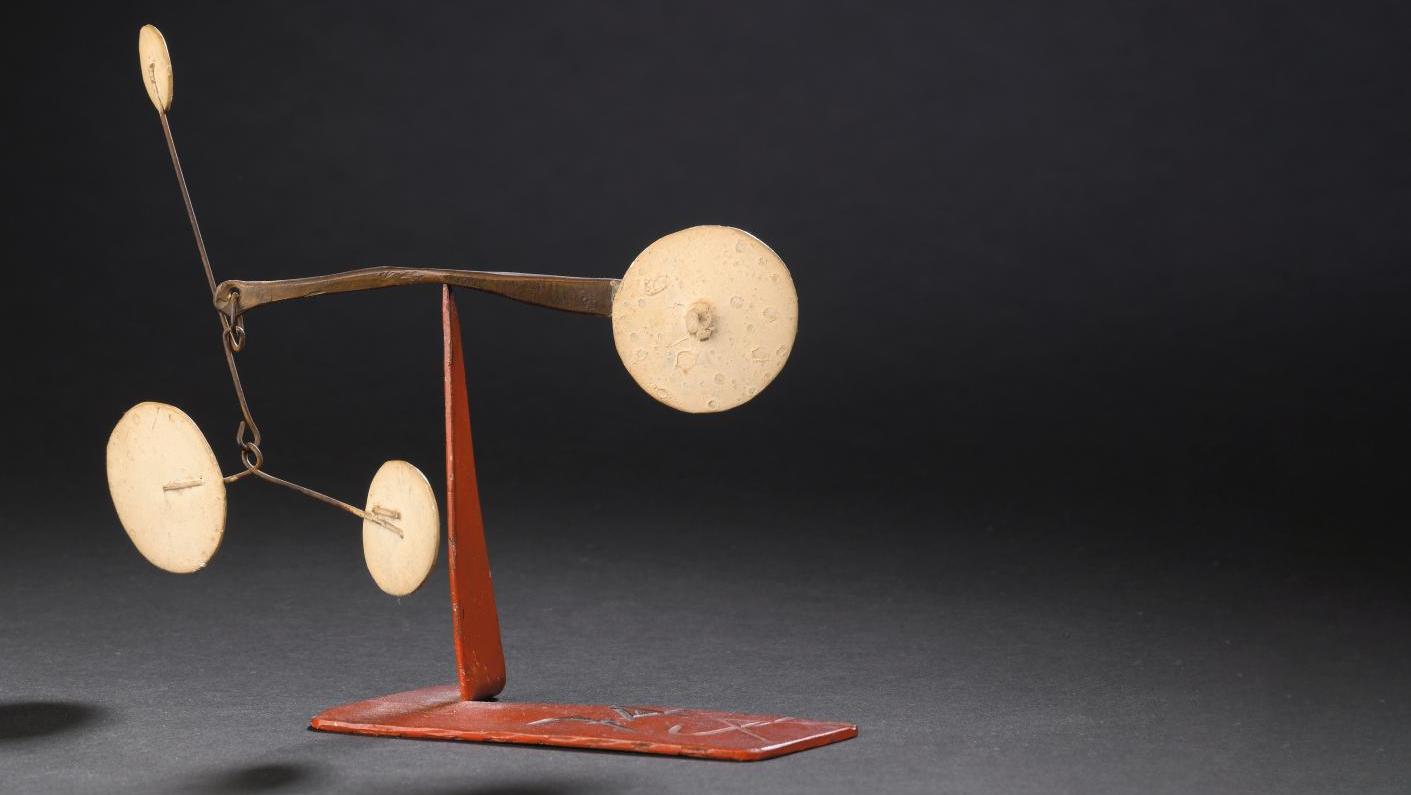
Presented by Alexander Calder in 1974 to Madame R. in his Saché studio, this ‘stabile-mobile’ is one of the few made during the artist’s lifetime. It also stands out for its size, which makes it a “baby mobile”.
© 2026 Calder Foundation, New York / ADAGP, Paris
Alexander Calder (1898–1976), stabile-mobile, sheet metal and wire, composed of white-lacquered discs on a red-lacquered base, monogrammed and dated 74 on the base by engraving, height: 14 cm/5.5 in, maximum width: 16 cm/6.29 in. Estimate: €80,000–120,000
© 2026 Calder Foundation, New York / ADAGP, Paris
A retrospective dedicated to Alexander Calder, “Rêver en équilibre”, is currently on show at the Fondation Louis Vuitton until August 16, marks the 50th anniversary of the artist’s death. This sale of a previously unseen stabile-mobile at auction is yet another way of celebrating the life of the artist. This sculpture, dated 1974 and listed in the archives of the Calder Foundation, was a gift from the artist to Madame R., on the occasion of a visit to his studio in Saché, Indre-et-Loire. Mrs. R. had met Calder in the course of her work at the Musée National d’Art Moderne in Paris, where, as archivist and assistant to the chief curator, she was responsible for organizing some fifty exhibitions between 1961 and 1970, including the one dedicated to the American artist in 1965, in partnership with the Guggenheim Museum in New York. She kept in touch with him well into the last years of his life.
Baby Mobiles, Just Ten Centimetres Long
While the stabile-mobile created in 1958 for the UNESCO offices in Paris was 10m (32.8 ft) high, this one measures just 14 cm (5.5 in), which also makes it a rare piece in the “baby mobiles” series. Created just two years before its creator’s death, it represents the culmination of Alexander Calder’s unique artistic research, which began in the early 1930s and led him towards abstraction. The small wire figures of his Cirque Calder were transformed into geometric elements, which could be operated by motors or simply by touch or air movement. In 1931, during a visit to his studio at 14, rue de la Colonie, Marcel Duchamp suggested they be called “mobiles”. Calder adopted this name, as did the term “stabile” coined by Jean Arp to designate the artist’s static works.
Beyond an apparent formal simplicity and economy of means, leading to universality, Calder implements an intuitive system of equilibrium, based on the principles of physics. Not surprising for someone born into a family of renowned sculptors, who began creating in childhood. The colors are bold, to accentuate spatial legibility and visual dynamics, here the white of the disks contrasting with the red of the base. Alexander Calder gave a new dimension to the kinetic art that was emerging at the time. He embraced the concept of an experimental approach to art, appealing not only to the viewer’s mind, but also to his or her senses.