Our first auction will be held on March 30th at 6:00 PM with a preview night March 29th from 5:00-9:00 PM. It will largely consist of items from the collection of a world traveler and connoisseur of the weird, wonderful, and rare. For privacy purposes we will refer to this individual as the “Collector” in this post.
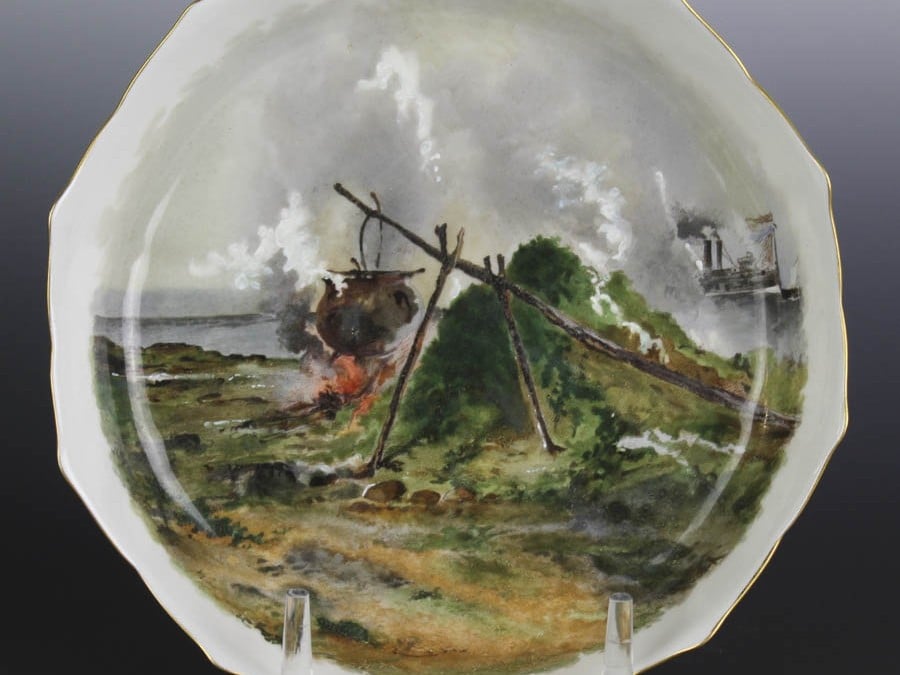
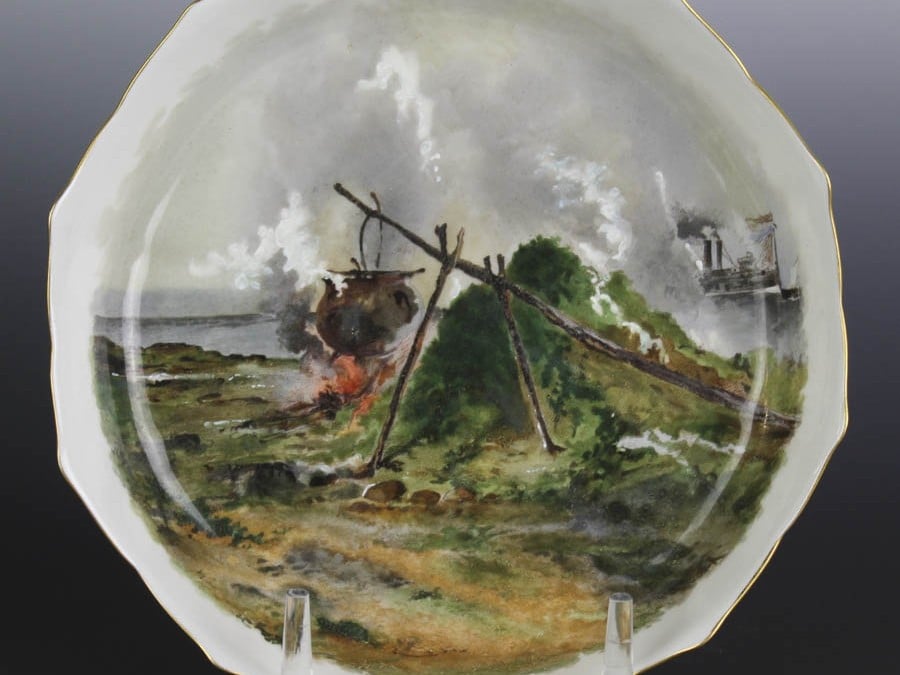
his inaugural auction features many items with intriguing stories and priceless histories. As a global traveler the Collector spent a lifetime seeking out unusual and uncommon treasures often with great histories. Take for example lot’s #24 and #25. These two intricately detailed Limoges bowls feature scenes from nature as well as life on the Mississippi River. If that wasn’t enough these two extraordinary bowls were part of the Official State Dinner Service for America’s 19th President Rutherford B. Hayes. The Collector even had a keen eye for minerals, of all things, as showcased in lot #275, which consists of a huge amber specimen peppered with various pre-historic insects.
Many of these items are rarely seen and have great investment potential. We welcome bidders from around the globe to start their own collections, or add to their existing collections with pieces from this fantastic offering.
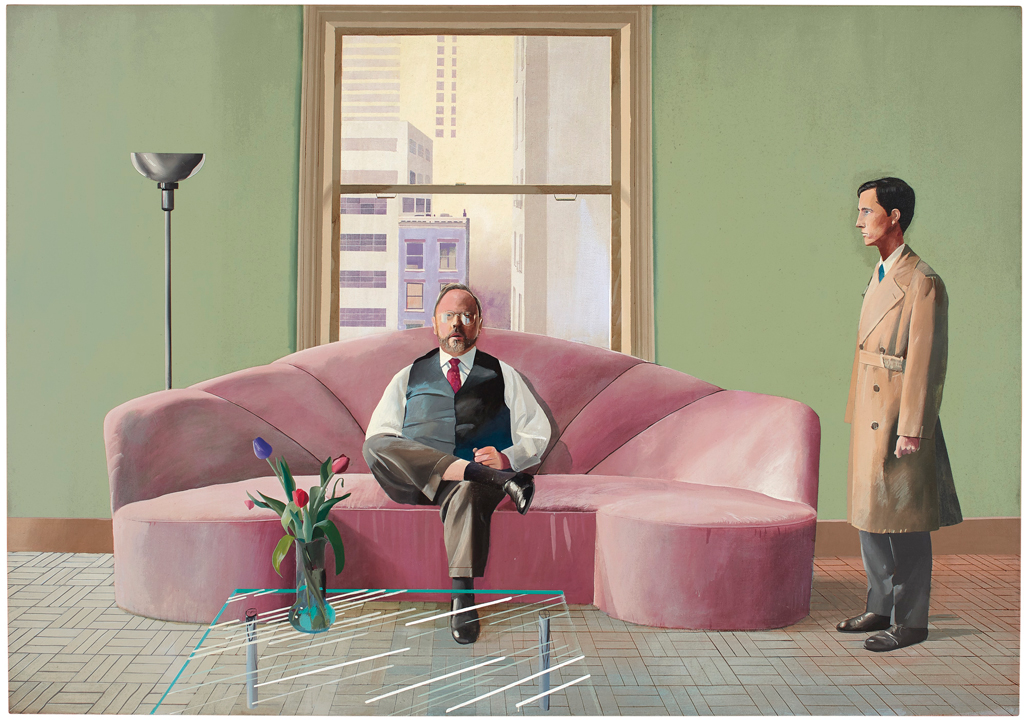
David Hockney, Henry Geldzahler and Christopher Scott, 1969, sold for $49.5 million. CHRISTIE’S IMAGES LTD. 2019
After a strong night at Sotheby’s on Tuesday, the London contemporary sales continued this week with a £79.3 million ($104.6 million) evening sale at Christie’s that saw 38 of 41 lots sell, for a taut sell-through rate of about 93 percent.
The most anticipated lot of the sale was David Hockney’s Henry Geldzahler and Christopher Scott (1969), picturing the famed Metropolitan Museum of Art curator seated on a pink sofa, by which his then boyfriend stands in a trench coat, which made £37.6 million ($49.5 million) with buyer’s premium.
Gerhard Richter, A B, Tower, 1987, sold for $4.12 million.
Bidding began at £27 million and steadily rose by £1 million increments as a handful of bidders competed for the piece. It hammered without too much drama at £33 million, and earned some light applause from the room.
The work had carried an on-request estimate that was said to be above £30 million (about $39.5 million). The seller was the estate of the late collector Barney A. Ebsworth, whose formidable collection, predominantly of American modernism, has been handled by Christie’s over the past few months. (Last November, it hosted a special evening sale that saw a new $91.9 million record for Edward Hopper, in addition to 12 other artist records.)
Ebsworth acquired the Hockney in 1997 from New York dealership Mitchell-Innes & Nash, according to the sale’s catalogue. In 1992, the work sold at Sotheby’s New York for just $1.1 million with premium, to megacollector David Geffen. A climb of more than $48 million over about a quarter-century: not too bad.
The Hockney result comes just months after one of the artist’s key works, Portrait of an Artist (Pool with Two Figures), 1972, sold for $90.3 million at Christie’s New York, making the 81-year-old Brit the record holder for the most expensive work of art by a living artist ever sold at auction.
(Unless noted, all prices include buyer’s premium, which is 25 percent of the hammer price up to and including £225,000, about $254,500; 20 percent on the next increment up to and including £3 million, or $3.95 million; and 13.5 percent on everything above that figure.)
Cecily Brown, Night Passage, 1999, sold for $4.12 million.
Another figurative painting failed to find such success. Peter Doig’s Haus der Bilder (House of Pictures), 2001, estimated at £3 million to £5 million ($3.95 million–$6.58 million), went unsold, the biggest-ticket pass of the night. The owner had acquired it the year it was painted from Milan’s Galleria Monica de Cardenas.
The other two passes were a 1992 Anselm Kiefer estimated at £500,000 to £700,000 ($658,700–$922,200) and a 1965 David Hockney being sold by artist Frank Stella with a £1.5 million-to-£2 million estimate ($1.98 million–$2.63 million).
On the abstract end of things, Gerhard Richter’s A B, Tower (1987), a roughly 55-by-39-inch squeegeed number, in green, silver, and red-orange, also estimated at £3 million to £5 million ($3.95 million–$6.58 million), sold for just above that low estimate, with the help of premium, going for £3.13 million ($4.12 million). The work last appeared on the block less than a year and a half ago, when it went for $3.84 million at Sotheby’s New York.
A 1961 Joan Mitchell, Blue Michigan, also went just above its low estimate, aided by premium as it sold for £2.89 million ($3.81 million) on an estimate of £2.8 million to £3.5 million ($3.68 million to $4.60 million). And Cecily Brown’s Night Passage (1999), measuring about 100 by 110 inches went for a bit more, £3.13 million ($4.12 million), just above its £2.5 million ($3.29 million) high estimate.
The big contemporary evening sales in London conclude tomorrow with 29 lots at Phillips.
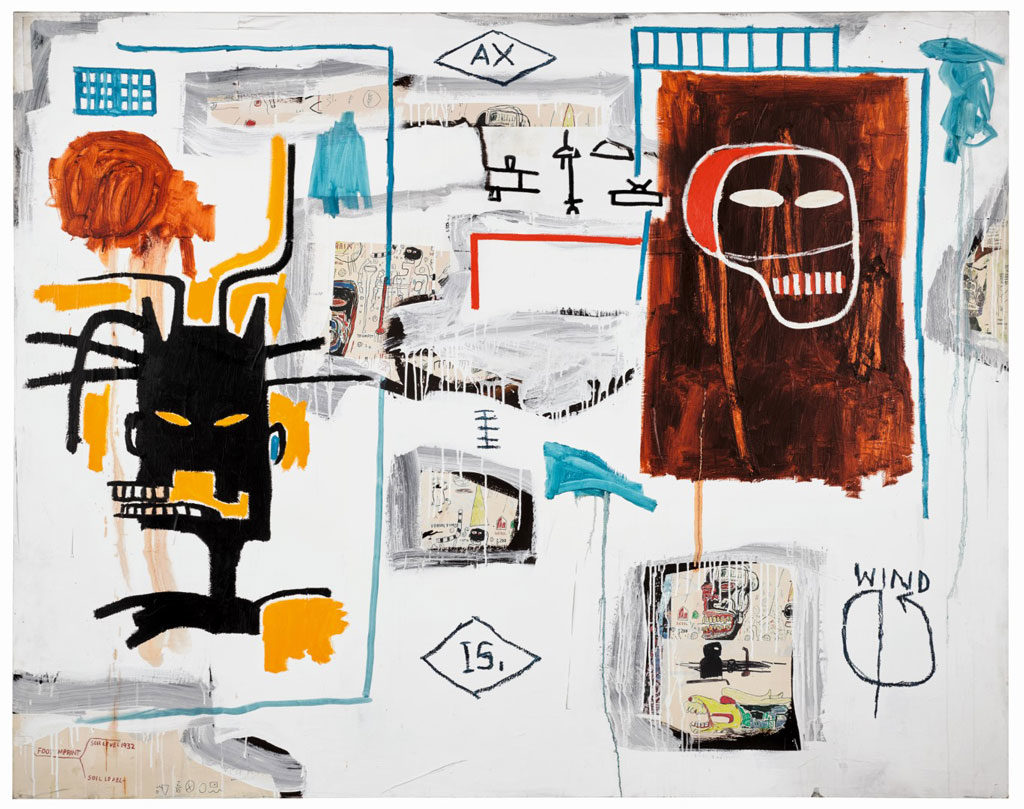
Jean-Michel Basquiat’s Apex, 1986, sold for about $10.8 million.
Tonight, at Sotheby’s London, the auction house sold £93.3 million (about $122.9 million) worth of contemporary art in an auction that saw 60 of 66 lots sell, yielding a robust 91 percent sell-through rate. Three auction records were set, for artists Rebecca Warren, Adam Pendleton, and Toyin Ojih Odutola.
The priciest work of the night was Jean-Michel Basquiat’s Apex (1986), which hammered to a phone bidder at £7.5 million after about four minutes of competition. With premium, its price was £8.23 million ($10.8 million). The work had been guaranteed to sell, with the auction house obtaining a so-called irrevocable bid from an interested buyer for the work, and it had carried an on-request estimate said to be around £5 million to £7 million ($6.56 million–$9.18 million).
Gerhard Richter’s Abstraktes Bild, 2009, sold for $9.12 million.
All sales prices include buyer’s premium, except where noted: 25 percent of the hammer price up to and including £300,000 ($394,000); 20 percent for the segment running up to and including £3 million ($3.94 million); and 13.9 percent for any sum above £3 million.
The Basquiat was being offered by a collector who acquired it in 1995 from dealer Gian Enzo Sperone in Rome, according to its listing in the auction catalogue. Earlier in its journey through various collections, the piece had sold for £16,000 at hammer ($28,190) at Christie’s London in June 1988, a little more than a month before the artist’s death at the age of 27.
It’s a big moment for Basquiat right now, with a blockbuster survey inaugurating the Brant Foundation’s new location in Manhattan’s East Village and another exhibition on deck at the Guggenheim Museum in New York later this year.
The solid auction performance came days after Sotheby’s posted a profit for the fourth quarter of 2018 that was up 12 percent over its 2017 results during the same period. The auction house also reported that its overall sales were up 16 percent in 2018 versus the year prior.
Jenny Saville’s Juncture, 1994, sold for $7.17 million.
Other top lots included Gerhard Richter’s yellow and red Abstraktes Bild (2009), measuring about 70 inches square, which sold for £6.92 million ($9.12 million) on an estimate of £6 million to £8 million ($7.87 million–$10.5 million).
And a 12-foot-tall Jenny Saville portrait of a woman seen from behind, titled Juncture (1994), went for £5.44 million ($7.17 million) on a £5 million–to-£7 million estimate ($6.56 million–$9.18 million). That, too, carried an irrevocable bid. That result was quite an increase over the £457,250 (about $656,000 at the time) it earned back in 2009 at Christie’s London.
Last October, another Saville went for $12.4 million in the same salesroom used for tonight’s auction—a result that made her the most expensive living female artist at auction.
An editioned porcelain enamel on steel piece from 1964 by Roy Lichtenstein also performed nicely. Number four from an edition of eight, the work went for £5.84 million ($7.7 million) against a £5 million-to-£7 million estimate ($6.56 million–$9.18 million). The piece last sold at Sotheby’s in New York only a little more than three years ago, in November 2015, for $7.19 million.
Among the passes were a David Hockney drawing, a Rudolf Stingel painting, and a Mark Bradford mixed-media work in black and silver, which had been estimated to go for £2.3 million to £3.5 million ($3.03 million–$4.61 million).
The auction action continues in the British capital tomorrow, with Christie’s holding a postwar and contemporary evening sale.
The top lot in the sale a Judaea, Bar Kokhba Revolt, AR Sela, undated issue of year 3, obverse depicting the Jerusalem Temple and the holy ark, the verso with a lulav and etrog, approx. XF, 14.57 grams, sold for $8,610 versus a $4,000-6,000 estimate. Department specialist, Kyle Johnson commented that “Hand-hammered coins from the ancient world can be inconsistent and examples without real circulation or wear adds to the success of their sale – many sold in mid-high end of estimates as a result.”
Judaea, Bar Kokhba Revolt, AR Sela, sold for $8,610
A Group of Confederate and Southern States Currency and a Framed 1928 $10 Gold Certificate, sold exceptionally well. Manuscript signatures acknowledging interest payments garnered interest for the historically interesting personalities such as Captain T.A. Roberts and San Antonio, TX issues which tend less commonplace that the southern states and of interest. Sold for $3,444.
Group of Confederate and Southern States Currency and a Framed 1928 $10 Gold Certificate, sold for $3,444
A Group of Confederate and Southern States Currency and a Framed 1928 $10 Gold Certificate, sold exceptionally well. Manuscript signatures acknowledging interest payments garnered interest for the historically interesting personalities such as Captain T.A. Roberts and San Antonio, TX issues which tend less commonplace that the southern states and of interest. Sold for $3,444.
1955 Doubled Die Obverse Lincoln Cent, PCGS AU58., sold for $1,476
The “king” of the error coins, a 1955 Doubled Die Obverse Lincoln Cent, PCGS AU58 sold for $1,476. Errors in the engraving in the die for the lettering and date on the obverse have a doubling effect making it seem like the viewers eyes are crossed. One of the most desirable in the Lincoln cent series.
1928 $20 St. Gaudens Double Eagle Gold Coin, sold for $1,599
Gold coins are always sought after by collectors. Designed by the important American sculptor, Augusts Saint-Gaudens, the 1928 $20 St. Gaudens Double Eagle Gold Coin depicts imagry of a Bald Eagle in flight in front of a sun. This coins sold for 1,599.
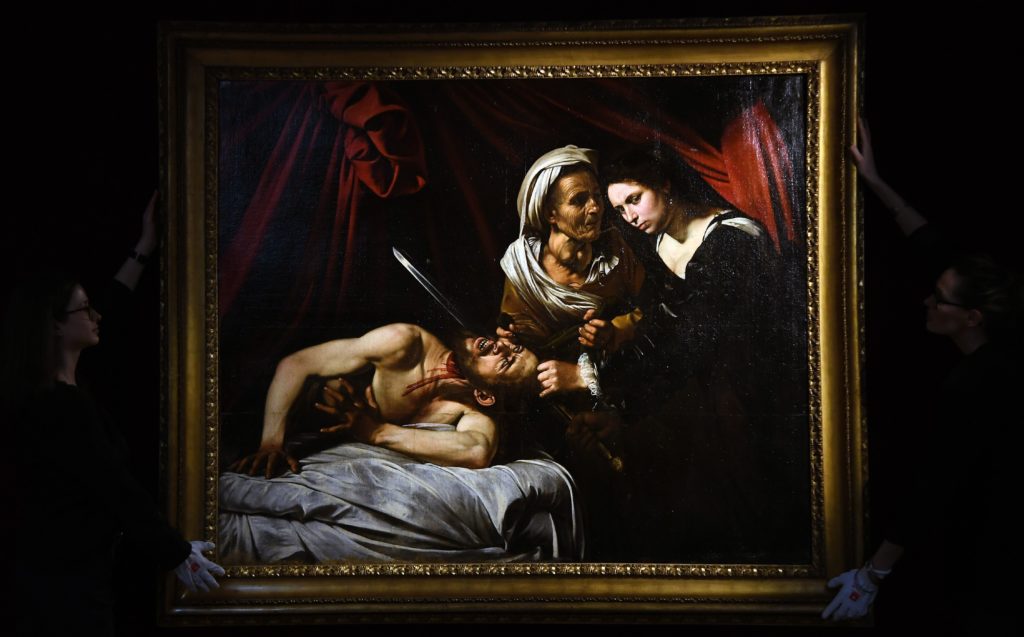
Caravaggio’s Judith and Holofernes (1607) being revealed at a press conference in London. ANDY RAIN/EPA-EFE/REX/SHUTTERSTOCK
At a press conference on Thursday held at London’s Colnaghi gallery, French dealer Marc Labarbe said he will auction off the recently rediscovered painting Judith and Holofernes (ca. 1607). CNN, which first reported the news, said that the canvas has been given a €150 million (about $171 million) estimate. According to Labarbe, the artist who made the work is the Italian painter Caravaggio, though some experts have cast doubt on the attribution.
If the painting sells for anything close to its estimate at the sale, which is scheduled for June 27 at Labarbe’s auction gallery in Toulouse, France, it will blow past Caravaggio’s auction record of $145,000, which was set at a Sotheby’s New York sale in 1998. Caravaggio’s painting Boy Peeling a Fruit, which some have said may have been the artist’s first canvas, was originally expected to shatter that record in 2015, when it was given a $5 million estimate at Christie’s Old Masters auction, but it failed to find a buyer.
Judith and Holofernes was rediscovered in 2014, in an attic in the Toulouse home of one of Labarbe’s friends. Some have said the work is the second version of one of Caravaggio’s masterpieces, a scene showing the Biblical tale of Judith decapitating the Assyrian general Holofernes, which is now owned by the Galleria Nazionale d’Arte Antica in Rome.
A few historians have regarded the work’s attribution with suspicion. In 2016 the French culture ministry said the work was “a very important Caravaggio marker, whose history and attribution are to be fully investigated.” The country’s government decided not to acquire the work and lifted a ban that allowed it to travel beyond France in 2016. That same year, two experts told the New York Times that it was possible the painting was a copy by Louis Finson, a Flemish artist who was known as a Caravaggisti because his art took its cues from the Italian painter.
In a statement, Eric Turquin, a consultant who works with Marc Labarbe, said, “Forgotten in the loft of a house in the Toulouse area, probably for more than 150 years, the painting is in an exceptional state of preservation,” adding that the work is “a very important milestone of Caravaggism.”
“THE STREAM”: This painting by Daniel Garber is one of more than 130 works of art to be featured in the Gratz Gallery and Conservation Studio Modern Art and Fine American Paintings online auction on March 17. A special preview day is Saturday, March 16, from 12 to 5 p.m. at the gallery in Doylestown, Pa.
On March 17, at 11 a.m., Gratz Gallery and Conservation Studio is again partnering with Invaluable.com for its second Modern Art and Fine American Paintings Auction.
The online auction will include more than 130 lots of works by American and international artists. Included are a selection of fine American paintings and an array of impressionist, realist, modern art, abstract and surreal, and decorative art as well as small, unknown treasures and gems. The online catalog is available for viewing at gratzgallery.com, where there is also a direct link to the live auction site at Invaluable.com.
Works included in the auction reflect a selection from a wide spectrum of art genres, from the 19th to 21st century. The gallery offers a varied selection of paintings, etchings, drawings, sculptures, and frames.
Featured are American artists such as Walter Emerson Baum, Paulette Van Roekens, John Pierce Barnes, Henry Snell, Frederick Harer, Emile Gruppe, Arthur Meltzer, Harry Bertoia, and Clarence Carter, as well international artists such as Peter Howell, Thomas Sherwood LaFontaine, and Raymond Douillet-Chevoleau.
It is an online exclusive auction, held in cooperation with the auction platform Invaluable.com. Interested bidders must register and place bids with their online auction collaborators. Invaluable.com allows for both absentee and live real-time online bidding. Gratz Gallery is able to extend a low buyer’s premium to its clients, offering very competitive estimates on this inventory of fine American and modern paintings.
A special preview day is Saturday, March 16, from 12 to 5 p.m. at Gratz Gallery and Conservation Studio, 5230 Silo Hill Road, Doylestown.
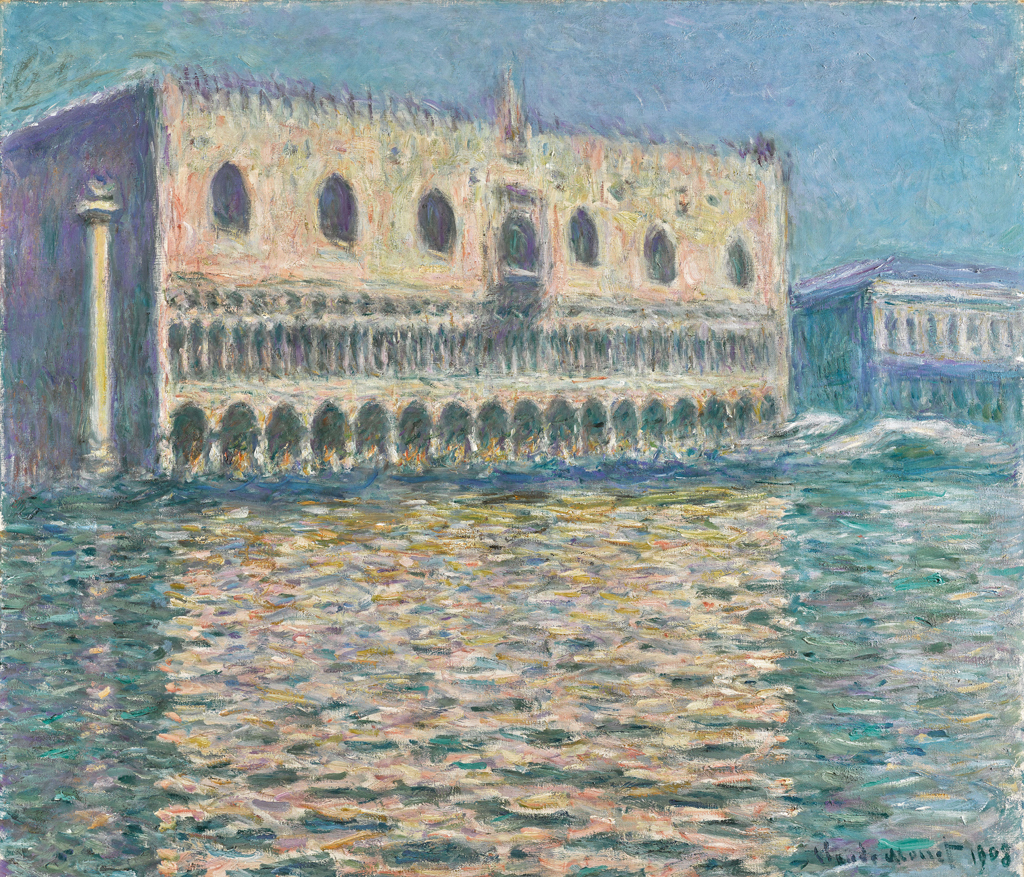
Claude Monet, Le Palais Ducal, 1908, sold for $36.4 million. COURTESY SOTHEBY’S
At its salesroom on Tuesday evening in London, Sotheby’s sold £87.7 million (about $116.3 million) worth of art in a doubleheader: an Impressionist-modern sale that flowed into one of Surrealism. The auctions offered the first major chance to assess the state of the art market in 2019, and the results were generally positive, with 32 of 39 lots selling, for a healthy sell-through rate of about 82 percent by lot.
The top-performing lot of the evening (and also the top-estimated) was Claude Monet’s Le Palais Ducal(1908), which sold for £27.5 million ($36.4 million), solidly within its estimate of £20 million to £30 million ($26.5 million to $39.8 million) with buyer’s premium. The work—a radiant view of the Palazzo Ducale from the water in Venice—had carried an irrevocable bid, so it was guaranteed to sell. Following the sale, Sotheby’s trumpeted the result as the most ever paid at auction for a Venetian scene by the artist: the more you know.
(Unless noted, all sales prices include buyer’s premium, which is 25 percent of the hammer price up to and including £300,000, which is about $398,000; then 20 percent for the next segment up to and including £3 million, about $3.98 million; and 13.9 percent for everything above £3 million.)
Also finishing strong was an Egon Schiele sea scene, Triestiner Fischerboot (Trieste Fishing Boat), 1912, which went for £10.7 million ($14.2 million), over a top estimate of £8 million ($10.6 million). That work, too, carried an irrevocable bid.
Ernst Ludwig Kirchner, Mädchen auf dem Diwan (Girl on a Divan), 1906, sold for $5.08 million.
Also notable in the sale: a brushy, brightly colored picture by Ernst Ludwig Kirchner that was deaccessioned by the Museum of Modern Art in New York, which made £3.84 million ($5.08 million), just edging out its high estimate of £3.8 million ($5.04 million) once premium was added. In keeping with industry practice, MoMA will use proceeds from the sale to fund new acquisitions.
The two passes in the Imp-mod portion of the evening were a 1911 Schiele gouache and pencil on paper, which had been estimated at £1 million to £1.5 million ($1.33 million–$1.99 million) and a 1907 Alexej von Jawlensky that failed to find a buyer on an £800,000-to-£1.2 million estimate ($1.06 million–$1.59 million). The Jawlensky’s seller had acquired the work at Christie’s London for £512,800 back in 2007.
René Magritte, L’étoile du matin, 1938, sold for $7.05 million.
In the Surrealist section of the evening, the top lot was René Magritte’s L’Etoile du matin (The Morning Star), 1938, which pulled in £5.32 million ($7.05 million), above a high estimate of £4.5 million ($5.96 million). Showing the profile of the artist’s wife Janus-style with that of a Native American man (it’s quite a vision), the work had been in the seller’s family for 80 years.
Demand in the Surrealist portion proved to be considerably softer, with 5 of the 17 works passing—two by Miró and one each by Ernst, Arp, and Duchamp.
The auction action continues in the British capital on Wednesday, with an evening sale of Impressionist and modern art at Christie’s and a day sale in that same collecting area at Sotheby’s.
Cfile.Daily’s vault contains over 3,000 articles, reviews, surveys, exhibition catalogs and online books. From time to time Cfile republishes some gems from the past. You can also use our search bar to find and explore the artists or subjects that interest you.
Drawing on her volatile personal history as a child growing up in China, Echo Morgan, whose real name Xie Rong, creates devastatingly emotional performance art. One piece titled Be the Inside of the Vase performed in 2012 at The Royal College of Art in London was based on a conflicting childhood memory. Her mother would tell her “Don’t be a vase, pretty but empty inside, be the inside, be the quality!” while her father would say, “Women should be like vase, smooth, decorative and empty inside!” Beginning with this memory, Morgan pulls the audience deep into her personal history and psyche.
Featured Image: Echo Morgan, Be the Inside of the Vase (Performance Still), Part 2: Break the Vase, 2012, clay, Chinese tissue paper, willow sculpture, water balloons, aluminum, Photographs: Jamie Baker
Be the Inside of the Vase was divided into two parts and begins with the background of her difficult upbringing. Morgan explains, “The first story [Million Dollar Baby] began with my father’s attempt to commit suicide. He owed everyone money. The performance revealed my uneasy childhood and difficult relationship with my father.” In the performance, Morgan stood motionless, painted like a blue and white song dynasty vase, while a recording of her voice was projected into the room telling her heartbreaking story.
Million Dollar Baby begins with a description of her father, neglecting their family, falling into debt and attempting suicide, all a result of his pursuit of his beloved Song Dynasty vase collection. After Morgan’s mother and father divorced in 2011 he promised to make up for his poor fathering and sell his vase collection to pay for Morgan’s college education. He got a loan from her mother to send the vases to auction, where they were promptly confiscated for being stolen goods.
The story continues, revealing equally outrageous stories including her mother’s nearly fatal car accident and her parent’s marriage on what was expected to be her mother’s death bed. She also reveals her father’s dark fantastical life involving losing his virginity at age 13 to a 27-year-old, being a famous local gangster, street performer, stolen car salesmen, brothel owner, casino owner, cocktail bar owner, drunk driving killer and more. He had a life of radical ups and downs, financially and psychologically, which made Morgan’s childhood emotionally abusive, confusing, and at times, terrifying.
“In the second performance [Break the Vase] the story moved towards my relationship with my mother. Through my rather brutal personal history I addressed sexually political statements such as: from my father: “Women should be like vase, smooth, decorative and empty inside!” From my mother: “Don’t be a vase, pretty but empty inside, be the inside, be the quality!” From myself: “This is my voice, my story, my childhood, I am not a vase!”
Break the Vase is an interactive portion of the performance, which begins with Morgan standing inside of a vase form made of wood frames and a paper surface. Just her head is exposed, barely fitting through the opening and poking out the top. In front of her was a pile of colorful water balloons that the audience was asked to throw at her. What at first appeared to be a fun activity for the audience quickly became emotionally dark. In the documentation of the performance, you can watch the audience walk in with a smile, throw the balloons, strike the vase, and then react in various ways to the experience. They had been tricked into an act of abuse, as literal as it was symbolic.
“I often invite viewers to participate, drawing strength from the audiences’ emotional vulnerability, and feelings of uneasiness, to complete the performance as a whole,” Morgan explains in her artist statement. “Here, my emotions become entwined with the audiences,’ creating a symbiotic relationship based on control and power.”
As the 150 balloons struck the paper vase the audience undressed Morgan’s vulnerable nude body, exposed through the ripped paper surface. In the video, her narration describes the experience as “150 balloons hit me like raindrops,” but the video shows a more violent nature to the event with balloons often striking the vase with enough force to shift it or sometimes smacking her in the face and then breaking on the floor. This incongruence of the idealism in the narration versus the violent reality of the performance parallels the audience’s delusion of fun disguised as brutality.
The performance is intended to elicit deviance from the audience seen in the fun colored balloons she provides, the drinks in their hand (although probably provided by the venue), and her slow participant-induced undressing. This dark eroticism is present in Morgan’s relationship with her father, at one point even stating “I used to believe that one day…that one day, he would come back, that one day he would rape me.” The audience’s encouragement to undress her at their will is similar to Yoko Ono’s 1965 performance Cut Piece in which Ono placed a pair of scissors in front of her and asked the audience to come forward one-at-a-time to cut off pieces of her clothing. Near the end of the performance a man gets overzealous and begins to cut off large chunks, exposing her nearly-naked body and clearly making Ono unsettled. Both pieces bring the natural deviance within humans to the surface forcing them to address their typically interior feelings in a very public context.
Break the Vase begins as a piece about Morgan’s mother and her advice to be “like the inside,” but as the performance is executed it becomes clear that her father is an inescapable character in the narrative. The audience is a metaphor for his persistent abuse towards both Morgan and her mother, but Morgan herself, in the vase, may also be a symbol of him. Morgan’s head sticks out the top of the vase just enough to be struck by the onslaught of balloons, an event that appears to be a strange beheading ritual. From the perspective of the father being both the abuser and the abused, Morgan has cleverly placed him in a fantasy hell of self-inflicted torture.
Stills from Father’s Vase by Echo Morgan.
Justin Crowe is Writer-at-Large for CFile.
Echo Morgan, Be the Inside of the Vase (Performance Stills), Part 2: Break the Vase, 2012, clay, Chinese tissue paper, willow sculpture, water balloons, aluminum, Photographs: Jamie Baker
BOSTON, MA, February 12, 2019 – Skinner will present a live auction of Americana in our Boston Gallery on March 2nd. The auction features 465 lots representing a broad offering of American Furniture, Folk Art, and Decorative Arts from collections across the country.
Presidential Portraits and George Washington
Jane Stuart (Rhode Island/Massachusetts, 1812-1888) Portrait of George Washington After Gilbert Stuart (Lot 49, Estimate: $15,000-25,000)
A compelling group of material relating to George Washington, from various consignors, speaks to Washington’s widespread popularity and influence before his death in 1799, and the decades of reverence for his memory after it. The most iconic image is the portrait of George Washington (Lot 49, Estimate $15,000-25,000) signed and inscribed by Jane Stuart, daughter of Gilbert Stuart, author of Washington’s best-known likeness. This example is one of several dozens that Jane painted as a copy of the famously unfinished “Athenaeum Portrait.”
Charles Balthazar Julien Fevret de Saint-Memin (New York, Philadelphia, France, 1770-1852) Miniature Portrait of General George Washington (Lot 47, Estimate: $15,000-25,000)
A portrait miniature in watercolor and gouache on paper, (Lot 47, $15,000-25,000) is executed, signed, and dated 1798 by Charles Balthazar Julien Fevret de St. Memin. The artist and the first president crossed paths in Philadelphia in 1798, and this profile portrait of General Washington is almost undoubtedly a product of that meeting. Interestingly, St. Memin is generally credited with completing the last portrait of Washington from life – a work whose whereabouts are reported as unknown. This miniature has descended quietly in the family of Revolutionary War officer Jacob Morgan.
Society of the Cincinnati Tea Bowl and Saucer Made for and Owned by General Benjamin Lincoln, China, c. 1790 (Lot 45, Estimate: $10,000-15,000)
Other items include a teacup and saucer (Lot 45, Estimate: $10,000-15,000) made in China circa 1790 as part of an extensive service for export to Benjamin Lincoln, a founding member of the Society of the Cincinnati (the society’s crest appears centrally located on both), and a Major General involved in three significant British surrenders, including as George Washington’s second in command at Yorktown. A French sulfide profile portrait bust (Lot 48, Estimate: $4,000-6,000), a copy of a well-known engraved and printed Memorial work (Lot 50, Estimate: $300-500) dated 1801, a Liverpool jug (Lot 174, Estimate: $800-1,200) including Washington’s portrait and a late 19th century profile portrait bust cast in bronze round-out the offerings.
Folk Portraiture & Sculpture
Sheldon Peck (Illinois/Vermont, 1797-1868), Portrait of John Newcomb (Lot 116, Estimate: $10,000-15,000)
Sheldon Peck’s portrait of John Newcomb Knapp of Victory, New York, in 1838, depicted as a boy of about twelve (Lot 116, Estimate $10,000-15,000). Shown three-quarter length, John holds an apple in one hand and stands confidently with the other hand tucked behind his back. John was born into a family of accomplished individuals, and continued that tradition – he held various legal and financial posts and government appointments in a career that spanned five decades, mostly in the state of New York. Also included in the sale is a landscape painting by the New York artist George Clough (lot 117, Estimate $6,000-8,000) showing the Knapp homestead “Springside” overlooking Owasco Lake near Auburn, New York. Both paintings have descended in the family of John Newcomb Knapp. Other folk portraits include an unusually large double portrait of two childrenby watercolorist Jane A. Davis (Lot 318, estimate $3,000-5,000), and several works by artists in the Prior/Hamblen School.
American Flag and Arm and Hammer Weathervane, America, third quarter 19th century (Lot 66, Estimate: $20,000-30,000 )
Large Carved and Inlaid Walnut Spice or Valuables Cabinet (Lot 67, Estimate: $10,000-15,000)
Notable among the several dozen pieces of 18th and early 19th century American furniture is a dramatically figured maple bureau made in Southeastern New Hampshire (possibly Hampstead) and dated 1817 (lot 256, estimate $3,000-5,000). An oversized Carved and Inlaid Walnut Spice or Valuables Cabinet made in Pennsylvania (lot 67, Estimate $10,000-15,000) highlights the furniture from that region, which also includes a pair of shell-carved dining chairs (lot 68, Estimate: $2,500-3,500) , two dressing tables (Lots 71and 72), and tilt-top tables (lots 73 and 74). Furniture from Boston, New York, Rhode Island, Connecticut, and Baltimore rounds out the group.
A masterpiece Shaker Basket (lot 109, Estimate: $15,000-25,000), possibly made by Sister Harriet Goodwin of the Alfred, Maine, community survives in remarkable condition including its silk ribbon enclosure tie. The basket is followed in the sale by a rare yellow spit box (Lot 110, Estimate: $1,200-1,800). Colorfully painted boxes, pails, buckets and other early woodenware, and a good variety of game boards and advertising items from several collections form the core of the “smalls” is this category.
Country furniture with old painted surfaces and colorful design include a 24-drawer apothecary cupboard (Lot 399, Estimate: $3,000-5,000), a New York State tall case clock with painted decoration related to the work of well-studies decorative painter Rufus Cole (Lot 423, Estimate: $1,500-2,500) and a selection of work tables, stands, and chairs.
Nautical & Maritime Arts
Nautical antiques and Maritime paintings include a group of items relating to the 18th and 19th century China Trade: porcelain (the Society of Cincinnati tea bowl and saucer mentioned above, and others); a Portrait of the Clipper Ship Eclipse (Lot 157, Estimate: $1,500-2,500), depicts the white-hulled vessel approaching land. Other items are a small Exotic hardwood and bone-inlaid cabinet(Lot 182, Estimate: $3,000-5,000) which descended in a military family, and a variety of ship portraits by well-recognized artists.
Previews, Catalogs & Events
Previews for the auction will be held on February 27, from 12PM – 5PM, February 28, 12PM – 5PM, and March 1, 12PM-8PM. Free and open to the public, specialists will be on hand to answer questions.
The McPherson Griffin Collection represents three generations of astute collectors having an avid appreciation for the English, American, and Southern fine and decorative art. Of particular note in this collection are miniatures. This collection reflects their superb eye and collecting success