Dated 1856- A heavily veined gold quartz atop, side panels are engraved “H. Cohn to A. Gump San Francisco June 21, 1856″, the Gump family was and still is one of the most prestigious families in California,”The Gump & Cohn families were businessmen in the 1850s Gold Rush era in San Francisco. The Gump family founded Gump’s Store which was famous all over California. Both families were active in the Jewish community and are featured in the San Francisco Jewish Museum.” thick cherry shaft and a metal ferrule. H.- 1 3/4″ x 2 1/2″ O.L.- 35″

Raoul François Larche (1860-1912): This is the original period vintage casting and one of the most famous and iconic Expressions of the Art Nouveau style. This sculpture/lamp was selected to be the cover of the Museum Of Modern Art Book which was published for their exposition of Art Nouveau works. The sculpture/lamp depicts dancer Loïe Fuller, modeled with flowing robes to form a Lamp. Gilt bronze, signed ‘Raoul Larche’ and with the Siot-Decauville foundry stamp. François-Raoul Larche was a French Art Nouveau sculptor. Best known for his depictions of figures both nude and draped, as well as for his functional objects such as lamps, goblets, and ashtrays, Larche’s sculptures are characterized by fluid lines and swirling forms. Many of his best-known works were inspired by the dancer Loïe Fuller, a popular entertainer in Paris who performed while wearing elaborate, flowing dresses to enhance her twirling dance techniques—and who was also similarly immortalized by the painter Henri de Toulouse-Lautrec. Born in 1860 in Saint-André-de-Cubzac, France, Larche went on to study at the École Nationale des Beaux-Arts in Paris. The sculptor’s work can now be found in the permanent collections of The Museum of Modern Art in New York, the Art Institute of Chicago, and the St. Louis Museum of Art, among others. Larche died in 1912 in Paris, France. 18 in. high.
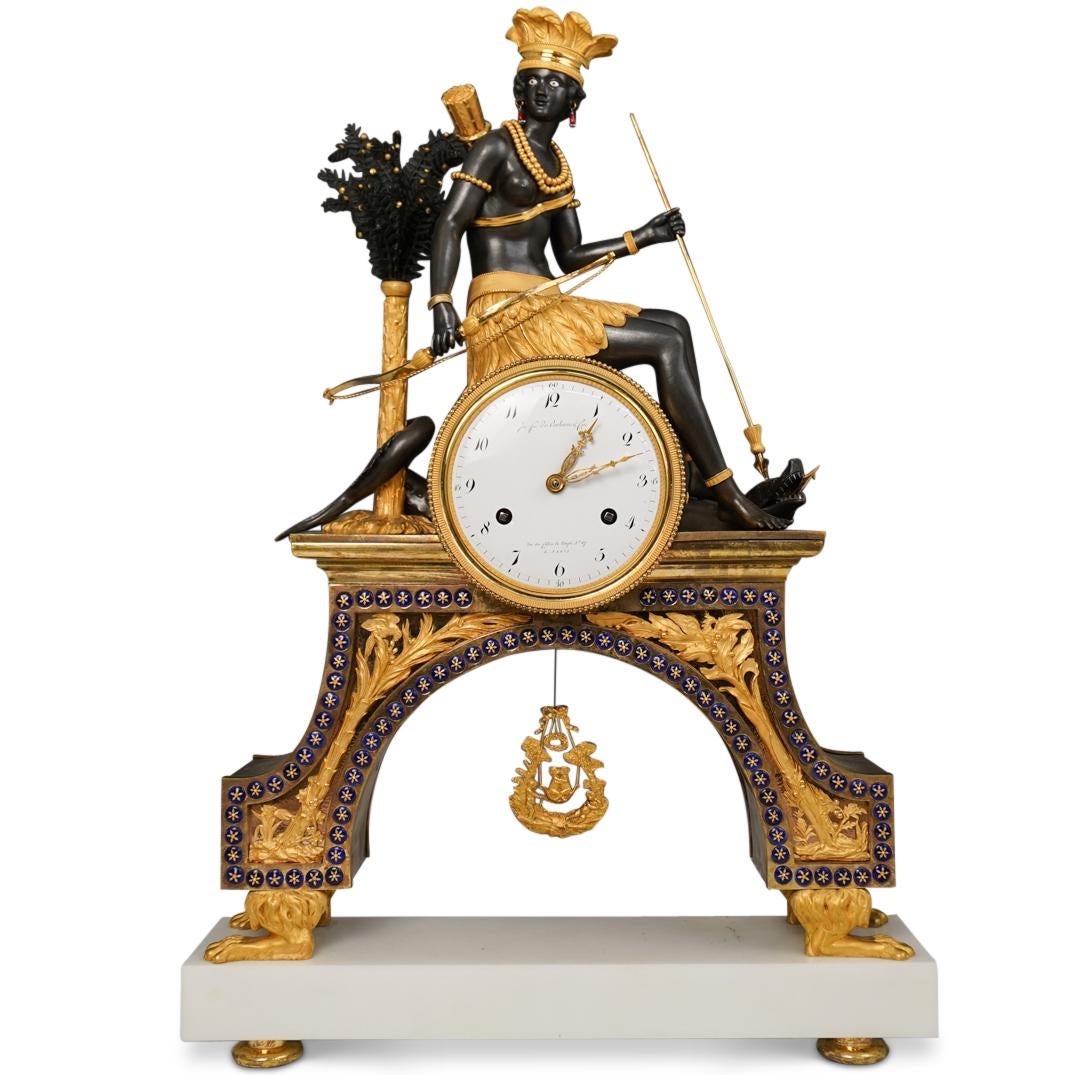
Rare 19th Cent French Empire Gilt Bronze Mantel Clock. The rare gilt and patinated clock is titled ” The American Indian”. The case is attributed to Jean-Simon Deverberie (1764-1824), who is one of the most important Parisian bronziers of the late 18th century and the first two decades of the following century.
The round enamel dial, signed “Inv. Fec. de Verberie & Cie/rue des fosses du Temple n 47/AParis” indicates in Arabic numerals the hours and fifteen-minute intervals by means of two pierced gilt bronze hands. The clock is surmounted by a very fine female figure depicting a seated huntress wearing a feather loincloth with a quiver containing feathered arrows slung across her chest. She holds a bow in her right hand and a lance in her left hand. Her left foot rests on the head of a patinated bronze snake whose tail is wrapped around a highly detailed gilded palm tree. The figures are placed on an arch that is decorated with leaf motifs and blue enamel pastilles. The pastilles are further embellished with star shaped gold pavilions. The arch rests upon four lions paw feet and is supported by a white marble base.
Purchase from La Pendulerie in Paris
CIRCA:Early 19th Cent
ORIGIN: France
DIMENSIONS: H:24″ W:16″ D:4″
CONDITION: Great condition. See lot description for details on item condition. More detailed condition requests can be obtained via email ([email protected]) or SMS (305) 333-4134. Any condition statement given, as a courtesy to a client, is only an opinion and should not be treated as a statement of fact. Akiba Antiques shall have no responsibility for any error or omission.
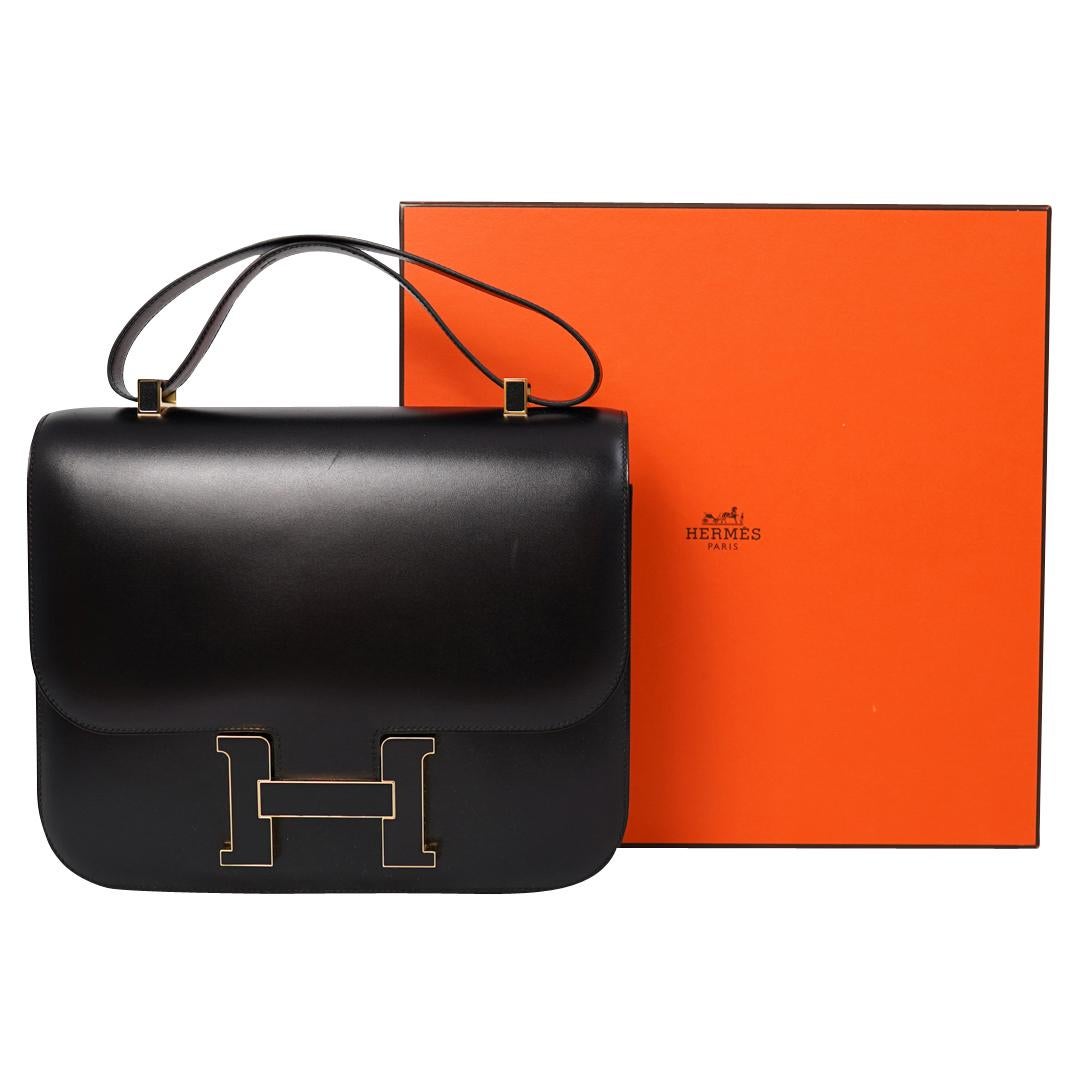
Hermes 29cm box black leather “constance” tote with gold hardware around the large H clasp, has a back pocket, 2 pockets inside (one zipper). Comes with original box and cloth cover. Never used. Excellent condition.
CIRCA: Early 2000s
ORIGIN: France
DIMENSIONS: 11″ high by 11″ long
CONDITION: Great condition. See lot description for details on item condition. More detailed condition requests can be obtained via email ([email protected]) or SMS (305) 333-4134. Any condition statement given, as a courtesy to a client, is only an opinion and should not be treated as a statement of fact. Akiba Antiques shall have no responsibility for any error or omission.
Chinese Kangxi Period (1662-1722) blue and white porcelain baluster vase with landscape and figural decoration, six character mark underside. 28.5″ H x 10.5″ diameter.
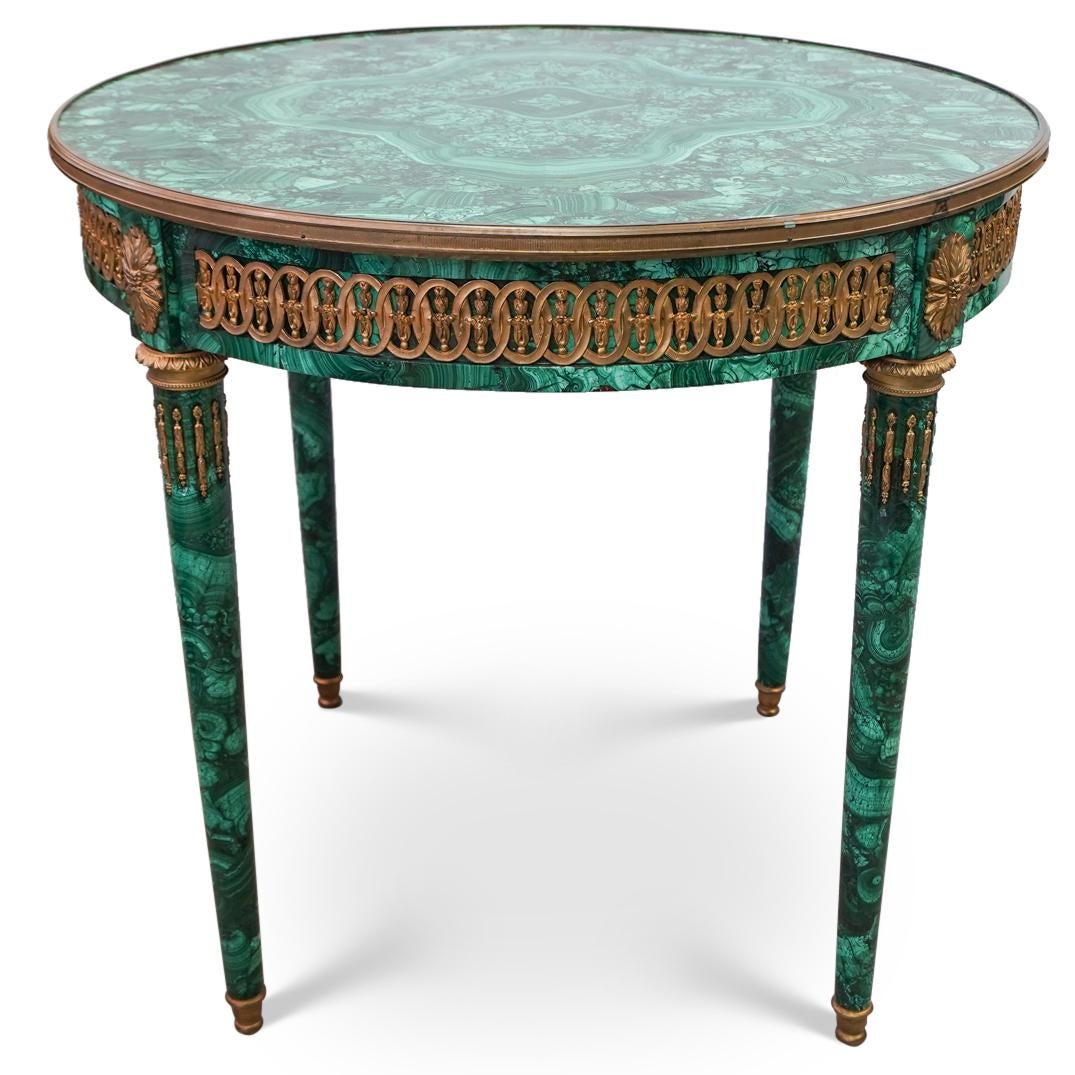
Malachite Table. A foyer round table featuring a wooden foundation overlaid with malachite design along the legs and base of the table. Fitted With a solid Malachite table top enveloped with dore bronze rosettes, overlapping rings and bronze border. The table features Greco-Roman column motif legs. Each leg is embellished with floral wreaths and Neo Classical reefs. Fitted with one pull out drawer.
CIRCA: 19th/20th Ct
ORIGIN: Russia
DIMENSIONS: H:30″ Diameter:33″
CONDITION: Great condition. See lot description for details on item condition. More detailed condition requests can be obtained via email ([email protected]) or SMS (305) 333-4134. Any condition statement given, as a courtesy to a client, is only an opinion and should not be treated as a statement of fact. Akiba Antiques shall have no responsibility for any error or omission.
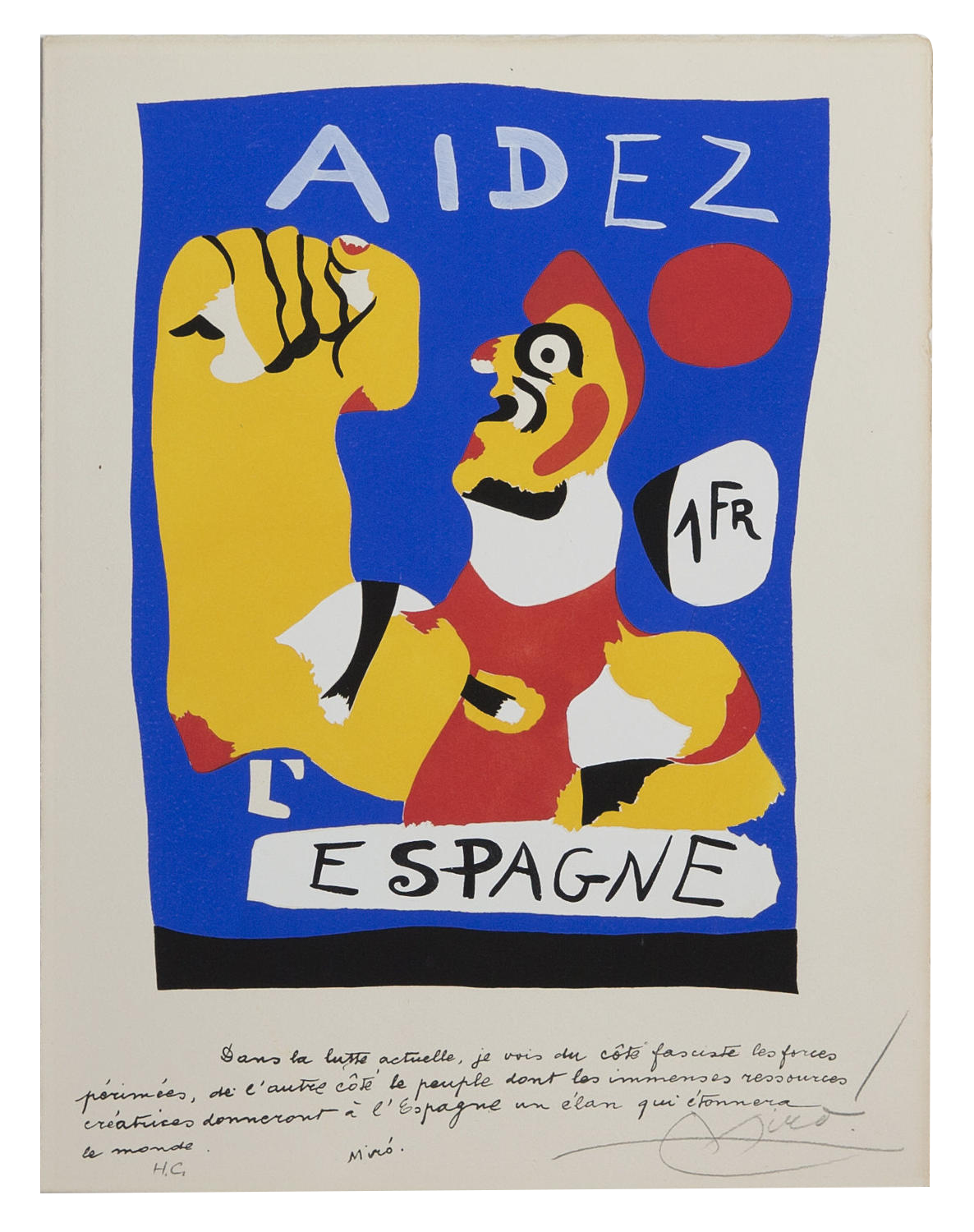
Aidez L’Espagne (Help Spain).
Pochoir in colors; 1937. Cramer books IV, Fundació Joan Miró, Barcelona. Signed in pencil lower left: Miró and annotated H.C. (hors commerce). One of the extremely rare signed impressions of this pochoir published in Cahiers d’art 1937. Miró gave these signed impressions to friends and the staff of Cahiers d’art. This issue was published in aid of the Republic of Spain, then engaged in a horrific civil war.
The so-called Nationalist forces, nominally led by Francisco Franco but powerfully aided by the Italian fascist government and Germany, were relentlessly driving the Republicans back on all fronts, even though the Soviet Union had sent some materiel to the Republic. The rest of the world was divided in its sympathies. The Civil War was seen as a struggle between fascism and socialism. The Spanish Republican government was supported by Spanish socialists and anarchists while Franco appealed to the Spanish political right and indeed later made no attempt to dissociate himself from the Germans or the Italian or Spanish fascists.
The Spanish Civil War divided the sympathies of people in Europe and the United States in cruel ways. Even those who did not support the fascist governments of Europe were wary of supporting the Republican cause, aided as it was by the Soviet Union.
Miró believed passionately in the cause of the Republic, a position he never retreated from even after the defeat of the Republicans and the formation of an avowedly fascist government by Franco in 1939. Our pochoir marks the beginning of a very important turning point in the artist’s career. From this point through the 1930s and 1940s Miró never abandoned his political stance.
Artistically one can see here the first elements of the biomorphic abstraction that he developed in the 1940s and which became a central compositional and formal element of his art. It is fair to say that the graphic arts were an essential means of expression for Miró; he continued to work in this media until the last years of his long life.
318 x 247 mm 12 9/16 x 9 ¾ inches
Four Mesa/Boogie brand Road Ready cabinets (two 118 model cabinets with one 18-inch speaker each and two 1516 model cabinets with one 15-inch, one 10-inch, and two 6-inch speakers each) together with two Mesa/Boogie brand 400 model bass heads (serial numbers B1107 and B1108) and two Mesa/Boogie brand Strategy 400 model stereo slave heads (serial number S1390 and S13920) both rack mounted in a pair of Mesa/Boogie brand SUS-3 model super shock mount cases. This custom bass amplifier system was used live on-stage by Bill Wyman during The Rolling Stones Steel Wheels / Urban Jungle World Tour (1989-1990).
Ruth Bernhard (American, 1905-2006). Classic Torso, 1951. Gelatin silver, printed later. 13-1/4 x 10…
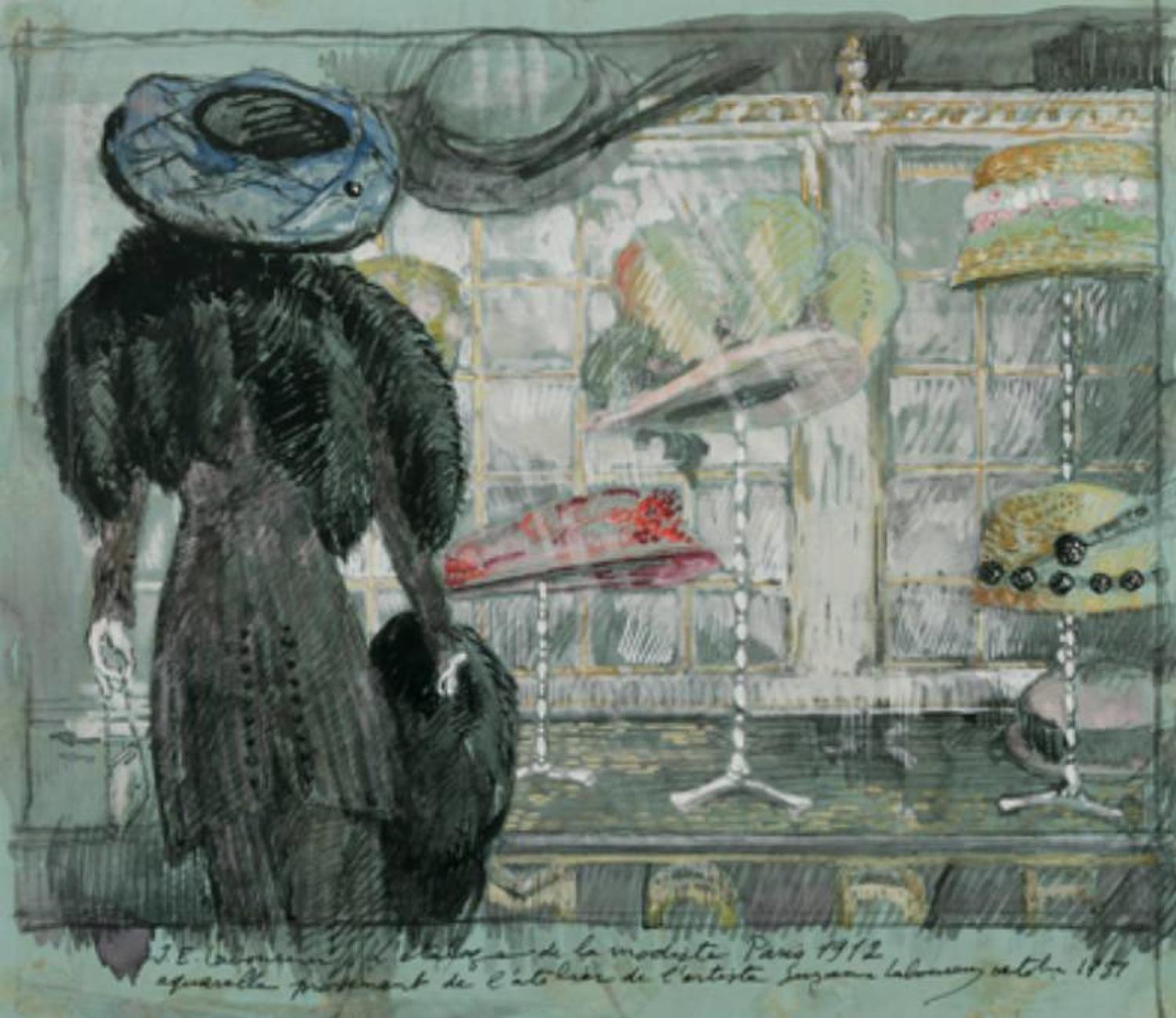
A Woman in a Hat Shop (Devanture de modiste).
Watercolor, heightened with gouache, ink, gray wash on green paper; 1912. Annotated:
J.E. Laboureur, l étalage de la modiste Paris 1912//aquarelle provenant de l atelier de l artiste Suzanne Laboureur octobre 1987.
Exhibited: Nantes, December 1966 – January 1967; Nantes, July – October 1977.
Published: Sylvain Laboureur, Catalogue complet de l oeuvre de Jean-Emile Laboureur, Neuchâtel, Ides & Calendes, 1991, vol. III-IV, page 207, no. 282, illustrated.
Laboureur was a painter, printmaker and draftsman whose images of daily life in France from the beginning of the 20th century until World War II defined the grace and elegance of French culture. At the core of his art lies a sense of wit in the use of line itself.
Laboureur began to exhibit in Paris in 1896, at the relatively young age of 19. He had studied with the painter and printmaker Auguste Lepère who was himself a considerable force in the revival of the woodcut in France.