Augusta Auctions of Bellows Falls, VT– an auctioneer specializing in nonprofit institutional deaccessioning as well as vintage couture– is presenting its End of Summer Elegance sale on September 25, 2024. This auction offers 250 sartorial temptations, ranging from 18th-century outfits to late 20th-century formalwear by some of the world’s most respected designers. Of note is a collection of antique day, evening, and party dresses previously owned by the Valentine Museum of Richmond, VA. Here are some stunning highlights from this timelessly fashionable event.
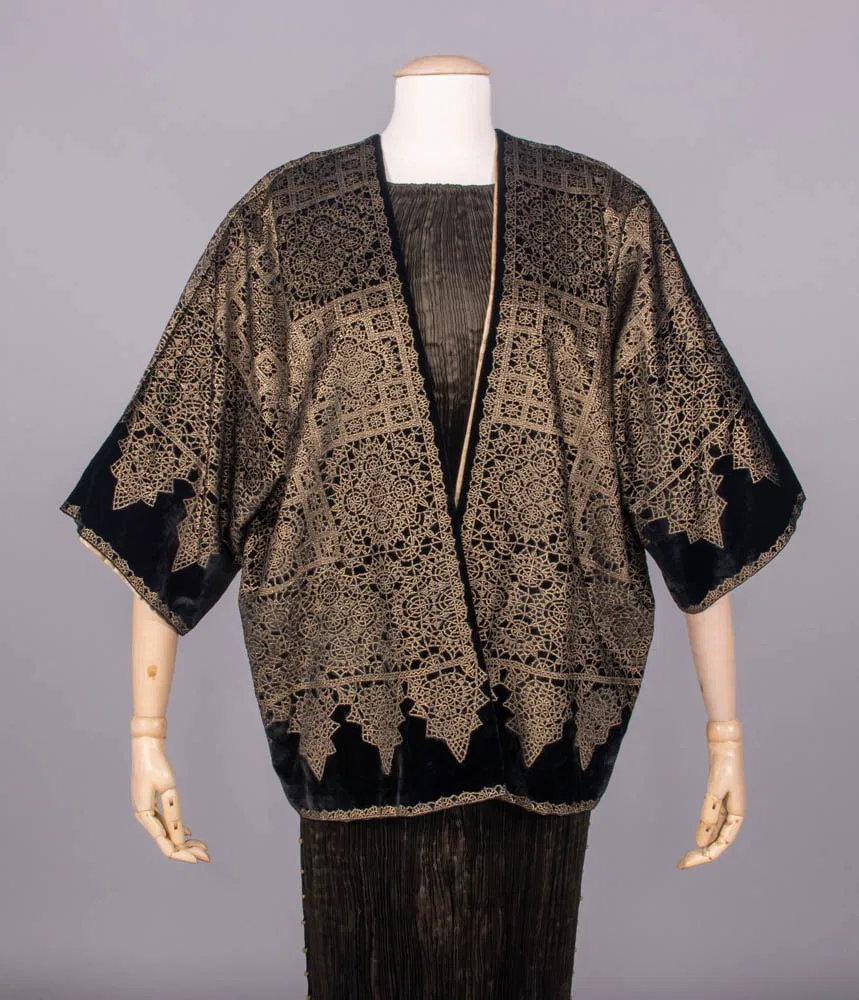
Lot #249, a Fortuny stenciled velvet evening jacket, is estimated at $5,000 to $8,000. Image courtesy of Augusta Auctions.
Two 1930s-era garments from the Italian brand Fortuny share top lot status in this September sale. Both have USD 5,000 to $8,000 presale estimates.
The first, lot #249, is a stunning stenciled velvet evening jacket. This draping, belted black silk top is decorated with a gold stenciled reticella lace pattern. It is lined in champagne silk satin and measures 50 inches by 28 inches overall. This elegant example retains its original labels, which read “Mariano Fortuny, Venise” and “Made in Italy, Fortuny Depose.”
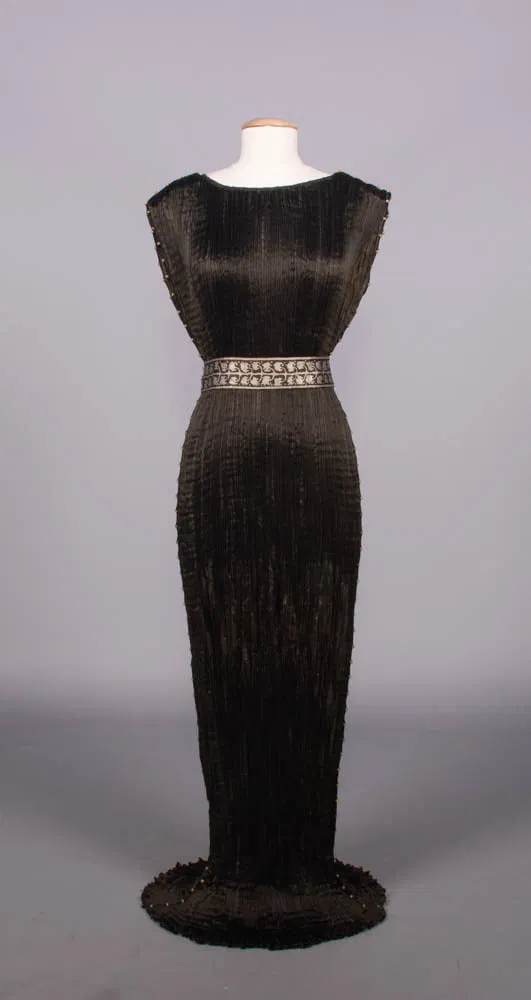
The second, lot #250, is a Delphos gown with two belts. This 58-inch long, dark green pleated silk dress features rows of brown Murano glass beads which are decorated with blue and red stripes. The stenciled black silk belts are based on Medieval stylized foliage patterns. The dress is tagged “Fortuny Deposee, Made in Italy.”
Lot #250, a Fortuny Delphos gown with two belts, is estimated at $5,000 to $8,000. Image courtesy of Augusta Auctions.
Fortuny, which is still in business today and is headquartered in Venice and New York, was founded by Mariano Fortuny y Madrazo (Spanish, 1871 – 1949). Fortuny was an artist at heart and had a passion for textiles since childhood. In 1907, he and his wife created the signature Delphos gown, famous for its pleating and glass beading. It was designed to be worn without underwear and based loosely on an ancient Greek aesthetic. Celebrities including Eleonora Duse, Isadora Duncan, Ellen Terry, and Oona Chaplin were pictured in this legacy dress design. Fortuny also invented a unique way to print on velvet and silk fabric using a wooden block press. Today, his production is still very much in demand and noted for its amazing quality and artistic properties.
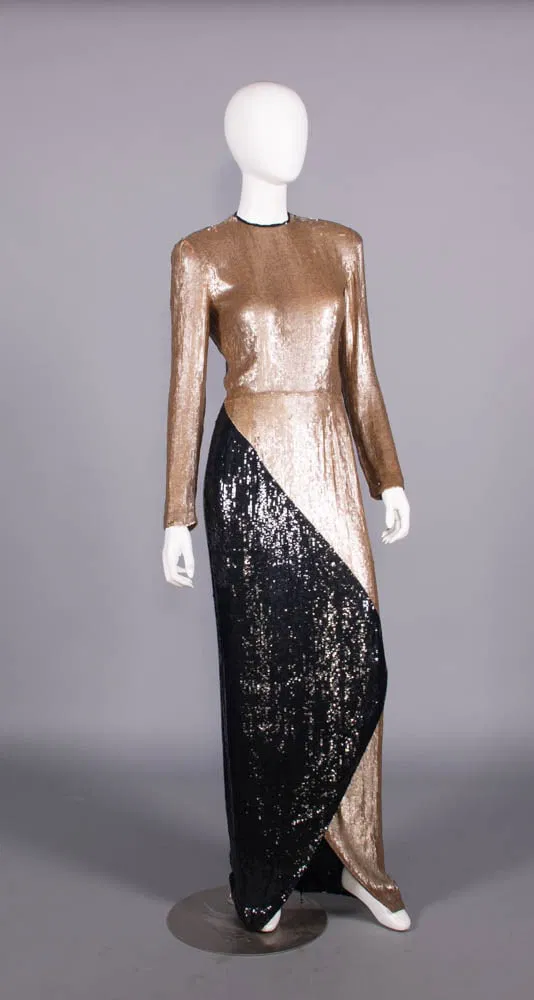
Lot #128, a silk organza Geoffrey Beene evening gown, is estimated at $800 to $1,200. Image courtesy of Augusta Auctions.
This sale features a fine collection of century-spanning women’s formal dresses. Lot #128, a long-sleeved, silk organza Geoffrey Beene evening gown, is estimated at $800 to $1,200. This champagne and black sequin-decorated example is from the designer’s 1985 fall collection. The label reads, “Geoffrey Beene, New York” and is inked “1904.” This exact dress was sold in 2019 as lot #194 as part of a three-piece lot of Beene dresses through Hindman’s Property from the Geoffrey Beene Archive sale.
Award-winning designer Geoffrey Beene (1924 – 2004) was born into a family of doctors and was expected to become one as well. He attended medical school for three years, but he then dropped out and moved to California to follow his dream of fashion design. Beene opened his own boutique in New York City in 1963. His career took off in the 1970s when he designed various clothing lines and held licensing agreements for household items, accessories, and toiletries. His clients included Lady Bird Johnson, Pat Nixon, Nancy Reagan, Faye Dunaway, and Glen Close, among many other high-profile individuals.
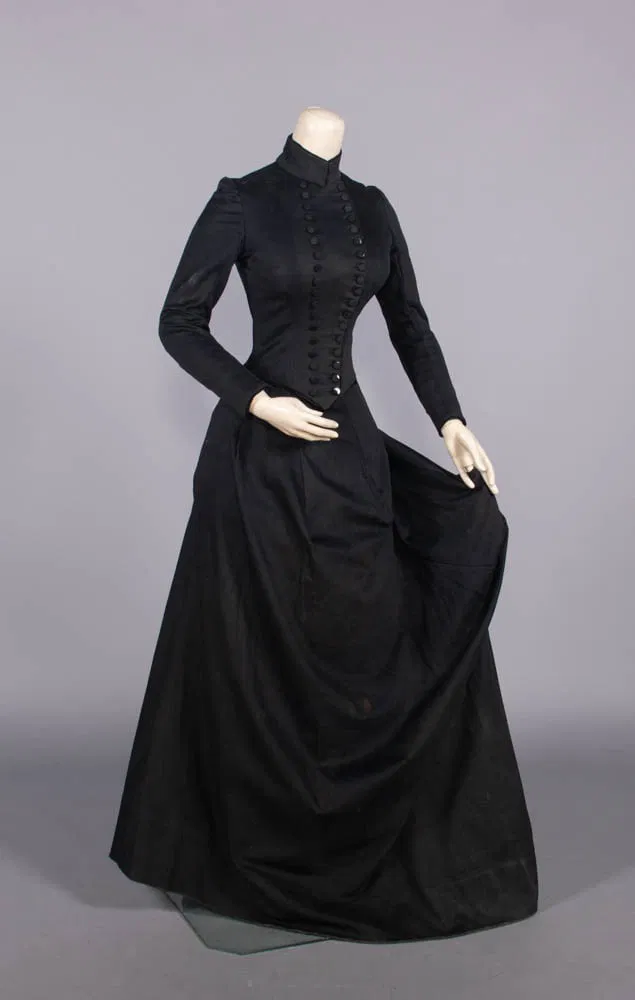
Lot #234, a two-piece black wool riding habit from 1885, is estimated at $1,200 to $1,500. Image courtesy of Augusta Auctions.
Antique outfits for horseback riding are also well-represented in this sale. Lot #234, a two-piece black wool riding habit from 1885, is estimated at $1,200 to $1,500. This broadcloth duo includes a tailored, double-breasted bodice and riding skirt. The shapely top is decorated with large black buttons and a stand-up collar. The skirt is pleated for riding comfort. It is tagged “Mme. Wilson Robes, 42 E. 19th St, New York.”
Historically, women’s clothing items designed for sidesaddle horseback riding were called riding habits. These debuted around the middle of the 17th century and traditionally included a fitted jacket and blouse, a long flowing skirt, and accessories like flat boots, gloves, a top hat, and a necktie or bow. For the most part, these outfits were distinctly masculine, dark in color, and based on menswear trends of the era. This particular outfit was produced at 42 E. 19th Street in New York. This nine-story building is located in the city’s popular Flatiron District, was built in 1905, and today is a mixed-use structure of ground-level retail shops and 15 apartment residences above.
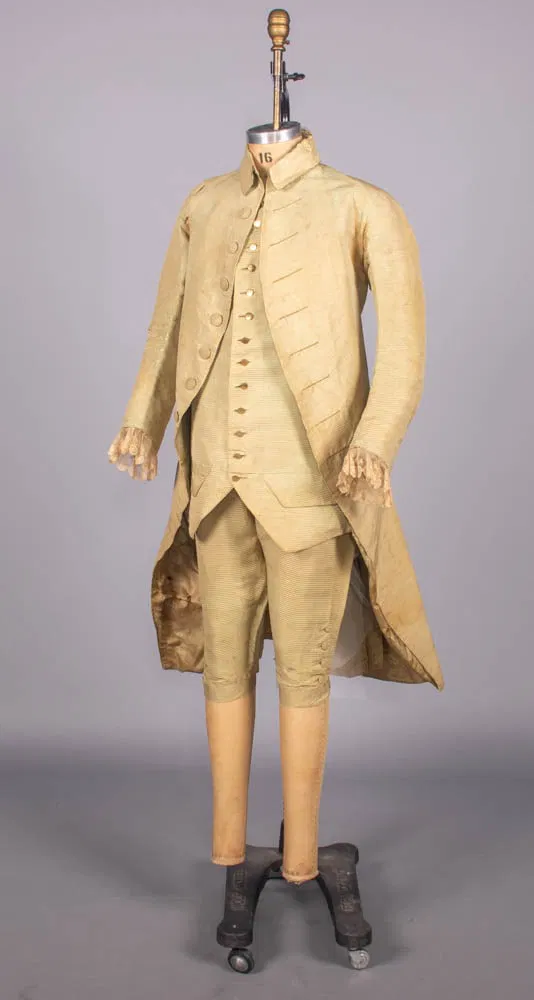
Lot #239, a gentleman’s circa 1785 to 1790 three-piece silk suit, is estimated at $2,000 to $3,000. Image courtesy of Augusta Auctions.
Wedding dresses, tea gowns, afternoon or day dresses, swimsuits, and vintage to antique men’s clothing round out this sale. Lot #239, a gentleman’s three-piece ribbed silk suit, is estimated at $2,000 to $3,000. It dates from circa 1785 to 1790 and is made from celadon-colored fabric. It includes a frock coat with a standing attached collar, a waistcoat with tabbed pockets and buttons, and a pair of breeches featuring a watch pocket.
For more information on Augusta Auctions’ End of Summer Elegance event on September 25, 2024, please visit Bidsquare. Find more auction world news and previews of upcoming events on Auction Daily.
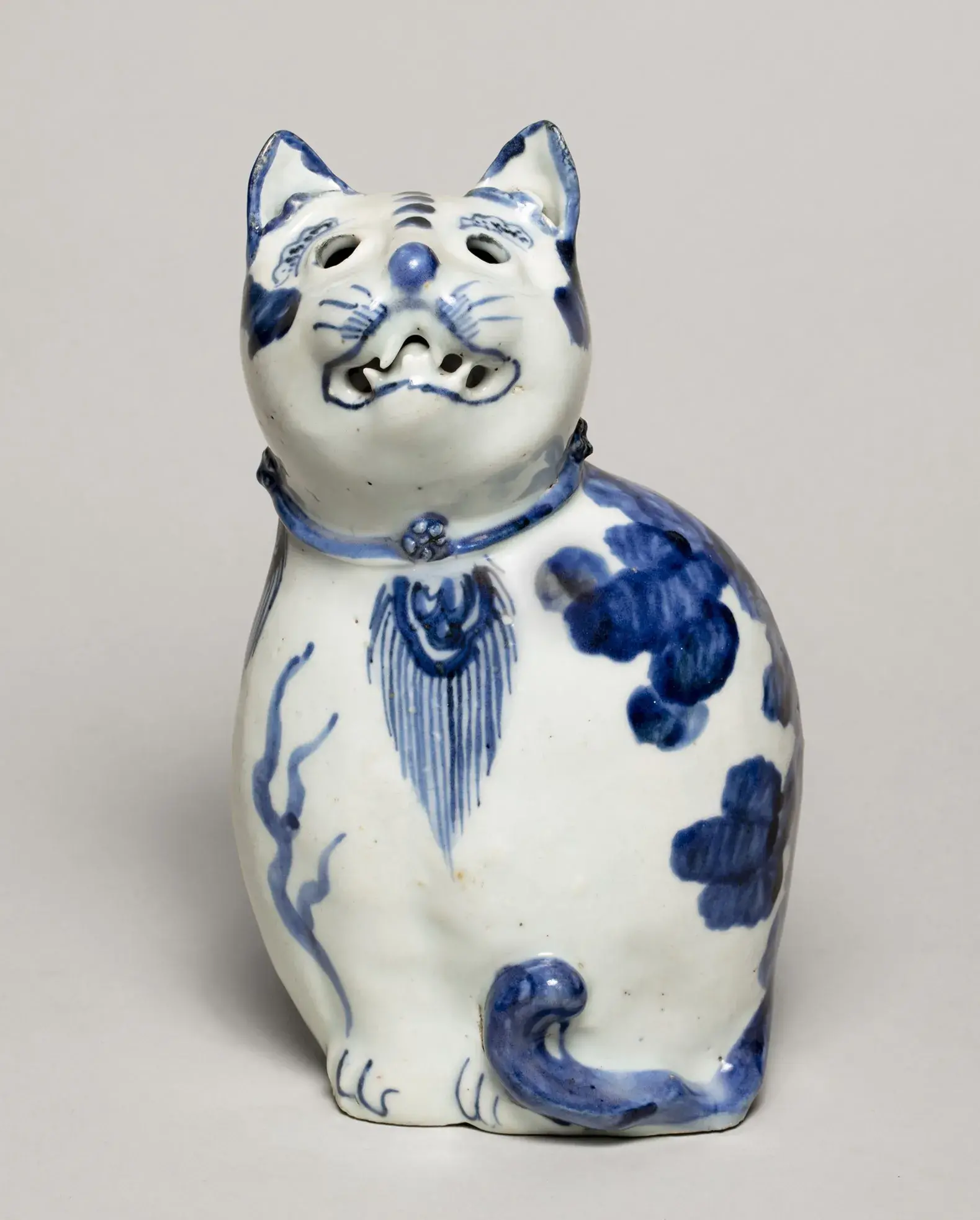
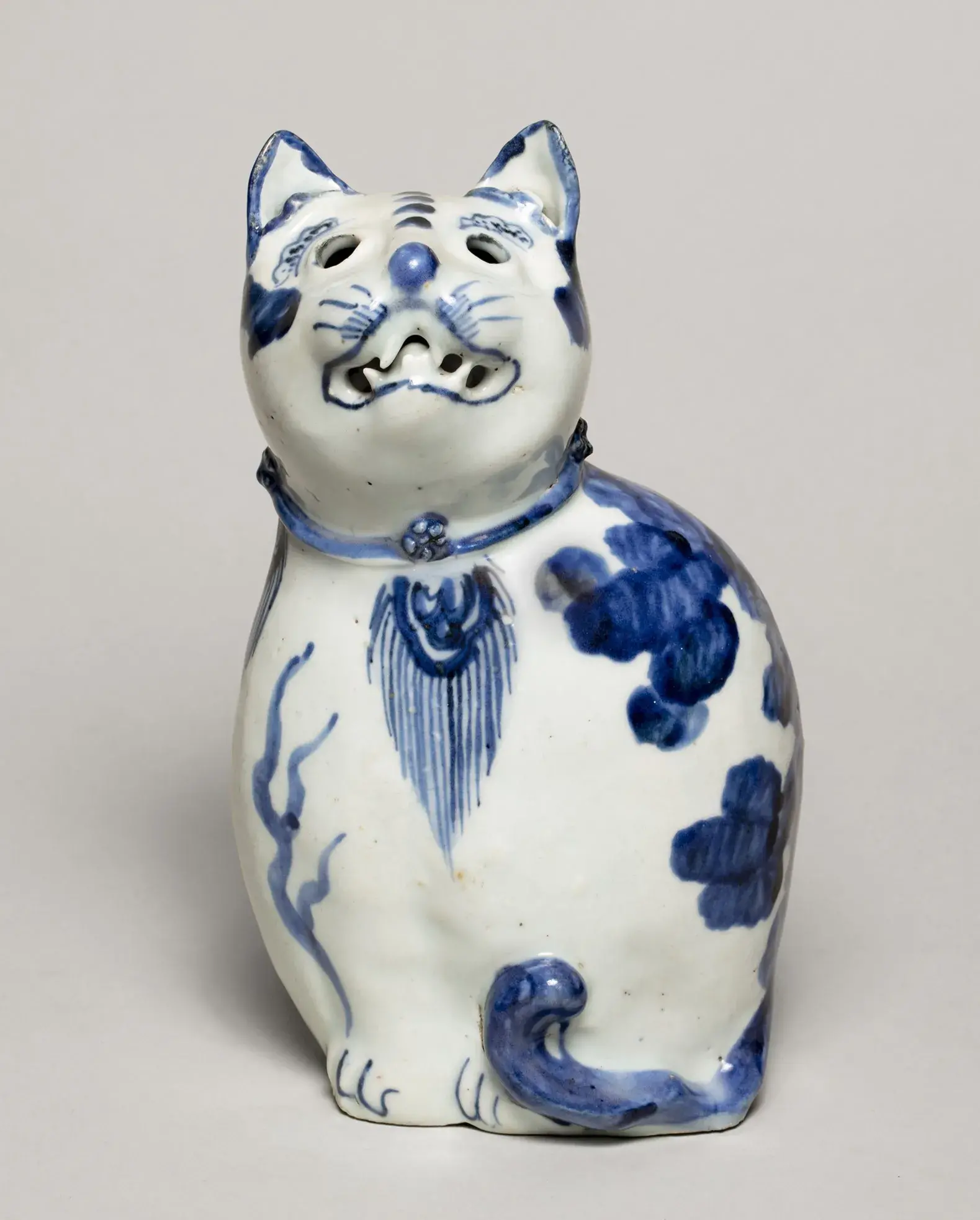
SEATED CAT Wanli period (1573-1620) 8 3/4 inches high Photo credit: David Schlegel
New York: Asia Week New York is delighted to present its Fall webinar: Four Centuries of Blue & White, with the noted decorative arts expert Becky MacGuire author of Four Centuries of Blue & White: The Frelinghuysen Collection of Chinese & Japanese Export Porcelain. Ms. MacGuire will delve into the evolving commercial and cultural exchanges between East and West, with a particular focus on the collection’s rare, unusual and little-studied material. Lark Mason will moderate the discussion which will be held on Wednesday, September 11 at 5:00 p.m. EST. To register for the webinar, click: https://us06web.zoom.us/webinar/register/WN_xYZrTBmBSvu8anXgd-p3jQ
The extraordinary Frelinghuysen collection, assembled carefully over 50 years, features an exceptionally wide array of Asian blue and white export porcelain—that most ubiquitous and influential of all ceramics. Ranging from rarities made at the height of the Ming dynasty, when Europeans first sailed to Asia, to commissions executed for the Thai royal court in the last decades of the Qing dynasty, the collection goes beyond iconic export classics to include pieces made for markets from Japan to the Islamic world. An intriguing counterpoint is provided by a full complement of Japanese export.
About the Panelists:
Becky MacGuire was the longtime senior specialist in Chinese export art at Christie’s and director of the firm’s New York Exceptional Sale. After graduating from the University of California at Berkeley with honors in art history, Ms. MacGuire completed the program of the Study Centre for the Fine and Decorative Arts at the Victoria and Albert Museum. A frequent lecturer, she was an original appraiser on “The Antiques Roadshow” and a founding partner of The Chinese Porcelain Company. Ms. MacGuire is the author of Four Centuries of Blue & White: The Frelinghuysen Collection of Chinese & Japanese Export Porcelain, published by Paul Holberton Books (October 2023).
Lark Mason, founder and CEO of iGavel Auctions, is renowned for his regular appearances on “The Antiques Roadshow” and his expertise in Chinese art. He established Lark Mason Associates, an auction house with locations in New Braunfels, Texas, and New York City, specializing in Asian, ethnographic, and ancient works of art. The firm has a strong track record of record-breaking sales, including the highest price achieved for any work of art in an online sale, a painting that sold for nearly $4.2 million in May 2014. Mason’s career includes serving as a General Appraiser from 1979 to 1985, and as a Senior Vice President and specialist in Chinese art at Sotheby’s from 1985 to 2003, where he also directed online auctions for Sothebys.com from 2000 to 2003. Additionally, he was a consulting curator at the Trammell and Margaret Crow Collection of Asian Art in Dallas from 2003 to 2009. A generalist in American and European works of art and paintings, Mason is also a leading expert in Chinese art, advising numerous private collectors and institutions. He is a member of the Asia Week New York Planning Committee.
About Asia Week New York
The collaboration of top-tier international Asian art galleries, the major auction houses-Bonhams, Christie’s, Doyle, Freedman’s|Hindman, Heritage Auctions, iGavel, and Sotheby’s–and numerous museums and Asian cultural institutions, Asia Week New York is a week-long celebration filled with simultaneous gallery open houses, Asian art auctions as well as numerous museum exhibitions, lectures, and special events. Participants from the United States and countries abroad unveil an extraordinary selection of museum-quality treasures from China, India, the Himalayas, Southeast Asia, Tibet, Nepal, Japan, and Korea.
Asia Week New York Association, Inc. is a 501(c)(6) non-profit trade membership organization registered with the state of New York. For more information visit www.AsiaWeekNewYork.com @asiaweekny #asiaweekny
About Songtsam, Presenting Sponsor
Songtsam (“Paradise”) is an award-winning luxury collection of sixteen hotels, resorts, and tours located in Tibet and Yunnan Provinces, China. Founded in 2000 by Mr. Baima Duoji, a former Tibetan documentary filmmaker, Songtsam is the only collection of luxury Tibetan-style retreats within the wellness space focusing on the concept of Tibetan meditation by combining physical and spiritual healing together. The unique and sustainable properties offer guests authenticity, within the context of refined design, modern amenities, and unobtrusive service in places of untouched natural beauty and cultural interest. One of the Songtsam Properties is a Virtuoso Preferred Partner and four of the Songtsam Properties are Serandipians Hotel Partners. Songstam welcomes all travelers including families with children, travelers with disabilities and is LGBTQ+ friendly. For information, visit: www.songtsam.com/en
Schuco Felix the Cat perfume had the scent of success, selling for nine times its high estimate at $4,674; while a French Hispano-Suiza 900 seaplane dominated the aviation group at $9,225
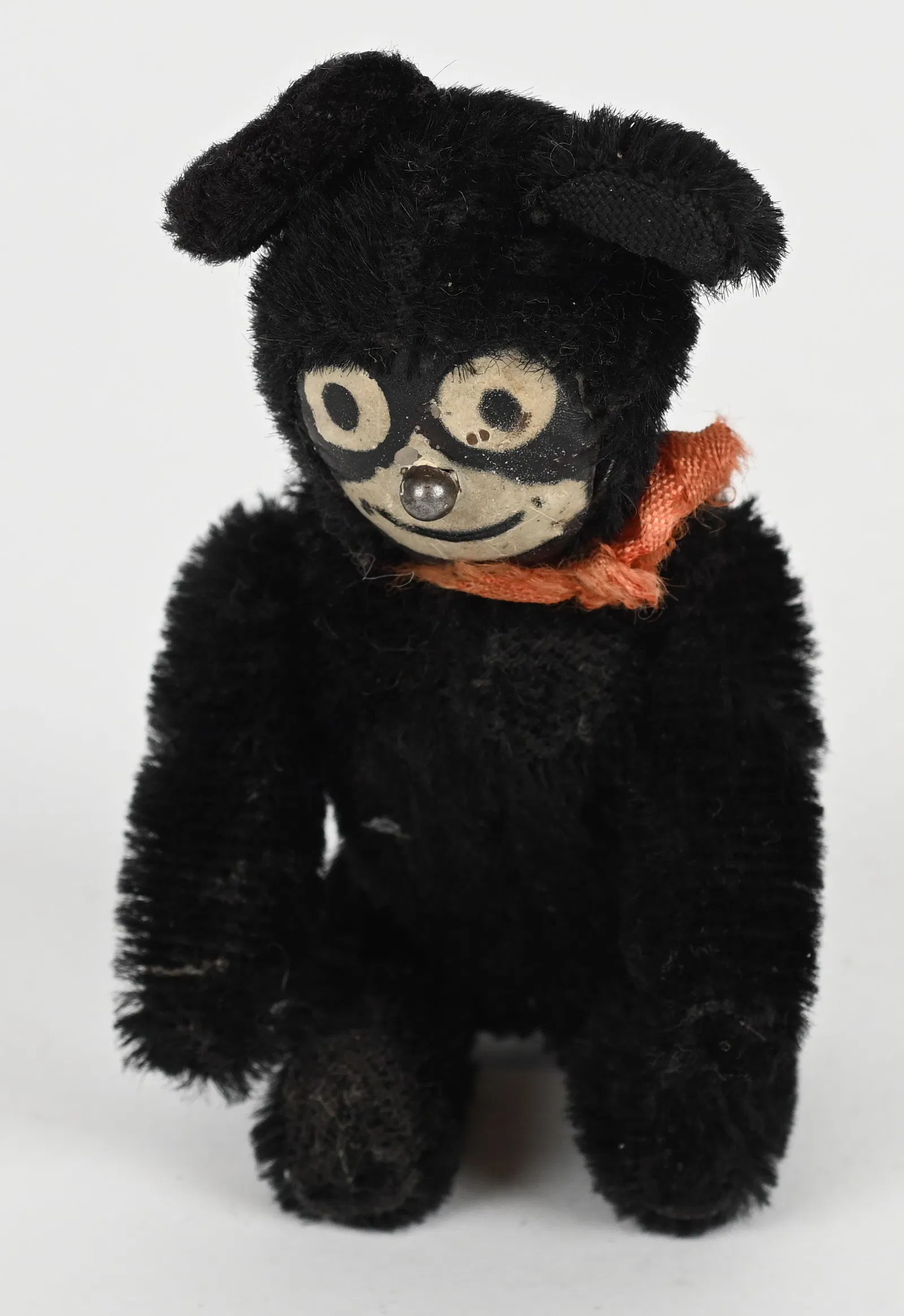
Schuco Felix the Cat perfume, 5in tall, all original and in excellent condition. Provenance: Wint Johnson collection. Sold for $4,674 against an estimate of $300-$500
WILLOUGHBY, Ohio – A phenomenal legacy collection of German Schuco toys and fine pre-WWII airplanes joined forces to conquer the top 10 at Milestone’s August 24 Premier Toy Auction. While most of the Schucos are now en route to successful bidders across the pond in Germany, France and other Continental destinations, the majority of the airplanes – mostly of European manufacture – will remain on US soil. All of the toys entered in the 639-lot auction came from the estate collection of Minnesotan and lifelong toy enthusiast Winton “Wint” Johnson (1937-2022).
According to Milestone Auctions’ co-owner Miles King, online participants kept their bidding cards close to their vests. “They must have all had the same strategy in mind, because they seemed to appear all at once to view the catalog and leave bids in the hour before the sale began,” he said. “We knew that probably every major Schuco collector would be interested in Wint’s collection – there was just no way they were going to miss the opportunity – but we had no idea how strong the interest would be in his vintage airplanes, which were in beautiful condition.”
Nearly 300 lots of Schucos were offered at the live gallery sale, each an outstanding original example. Johnson was known to buy regularly at shows, auctions, online and through a global network of like-minded toy aficionados. He would upgrade whenever possible and sell his duplicates, but he never parted with anything from his core collection, which contained only the rarest and best Schuco toys and prototypes.
The top seller amongst the Schucos was a 5-inch-tall Felix the Cat perfume in excellent, all-original condition with a “ball-bearing” nose, red kerchief and nicely-painted facial features. Against an estimate of $300-$500, it sold for a remarkable $4,674. Other novelties included three Schuco figural compacts: a scarce Cavalier King Charles Spaniel, $1,023; a patterned humpback tortoise, $1,023; and a French bulldog, $906. All were in original condition, retained their mirrors, and had been individually estimated at $300-$500.
Collectors are always on the lookout for early Schuco tin windup vehicles with drivers. Examples of two of the best were featured in Milestone’s sale. The first, known simply as Race Car with Driver, paired a lithographed tin racer with a helmeted and goggled driver dressed in a jaunty felt jacket and scarf. Estimated at $1,500-$2,500, it crossed the finish line at $3,936. Following closely behind was a Schuco mohair and felt monkey driving a tin car. This coveted antique, estimated at $1,000-$1,500, rolled to a stop at $3,813.
The array of Schucos also included approximately two dozen “Yes No” toys, so named because of a design feature that allows the figure’s head to move up and down or side to side, indicating “yes” or “no.” Leading the menagerie of colorful Yes No animals was a 12-inch-long parrot in all-original condition with the colors of its plush mohair “feathers” still vibrant and fresh-looking. Against an estimate of $400-$600, the jungle avian was airborne all the way to $2,952.
A rare opportunity presented itself in the form of a 10½-inch pierrot-style clown from Schuco’s 1914 Automato series. In outstanding all-original condition, with a working windup mechanism, the appealing entertainer in a pointed hat and ruff-collared jacket was bid well beyond the high estimate to capture $2,583.
Huddled on the auction runway, Wint Johnson’s rare pre-war airplanes – mostly of German and French origin – were cleared for takeoff one by one, and take off they did! “We know now that Wint had great foresight in the aviation toys he acquired,” Miles King said. “By profession, he was a mechanical engineer. His knowledge of mechanical systems no doubt fueled his interest in airplanes whose design must have seemed avant-garde at the time of their release.”
Leading the category was an impressive 19-inch French tin-windup Hispano-Suiza “900” seaplane finished in red, yellow and French blue with lithographed window panes. An all-original example, it sold for $9,225 against an estimate of $400-$600. Another high flier was a scarce, all-original 17½-inch Fleischmann tin windup pontoon seaplane, which landed at $7,072 against an estimate of $2,000-$3,000.
An all-original Gunthermann 20-inch lithographed tin windup “1212” airplane with a set of added float pontoons presented handsomely with a color palette of cream with red and black. It rose to $2,952 against an estimate of $600-$800.
Japanese planes found favor, as well. A very unusual tin bi-wing friction seaplane with a 16-inch wingspan exhibited the distinctive green and red shades typical of Japanese toys of the 1930s. it was smooth sailing for this beauty, which commanded a selling price of $4,674 against an estimate of $300-$500. Another Japanese rarity, a 13-inch tin windup Zero seaplane in all-original condition was accompanied by a photocopy of the toy’s original Japanese-language box art. It was bid to $3,698, more than seven times the high estimate.
The late Wint Johnson grew up on lakes and collected many types of antiques related to boating. His nautical-toy collection included not only tin windup and battery-operated outboard, racing and speed boats, but also dozens of manufactured toy replicas of outboard motors, many with their original pictorial boxes. At auction, the latter specialty was led by a great-looking vintage store display made by K&O Models Inc., with five attached battery-operated miniature outboard motors. The display’s selection included representations of Mercury 8, Gale 35, Buccaneer, Mercury, and Green Outboard motors. Entered with an estimate of $2,000-$3,000, it hit its top speed at $5,760.
To discuss consigning a collection or single item to a future Milestone toy auction, please call Miles King at 440-527-8060 or email [email protected]. All enquiries are kept strictly confidential and there is never an obligation to consign. Online: www.milestoneauctions.com
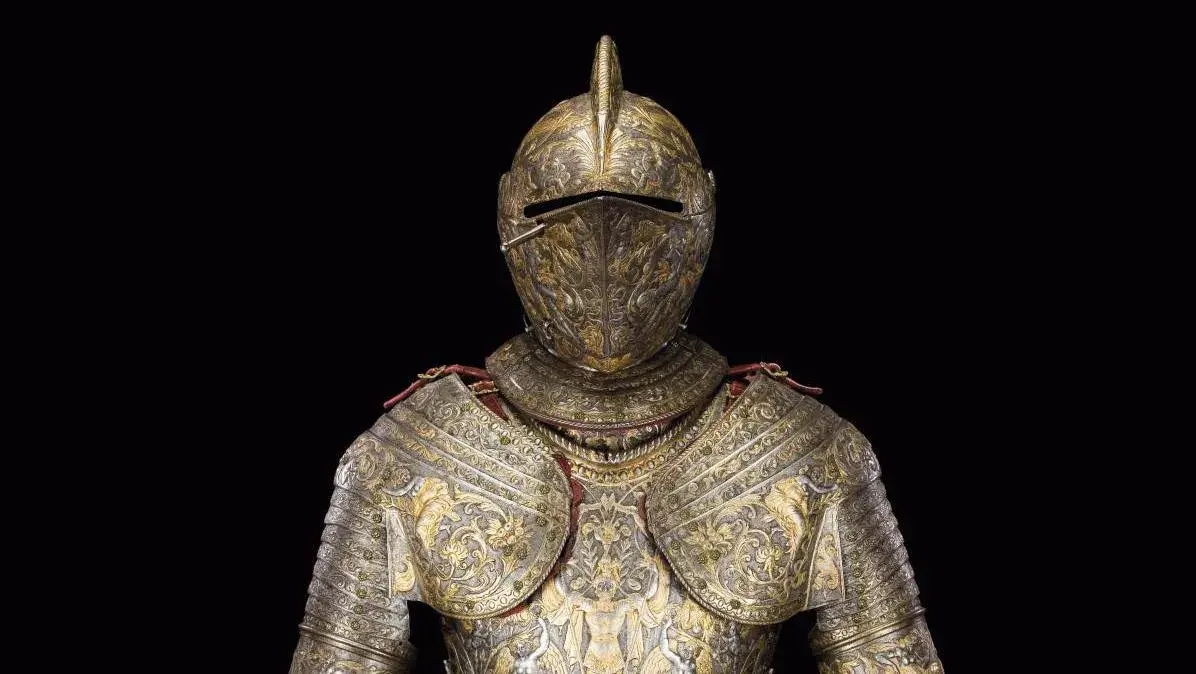
During the Renaissance, ceremonial armor in the second half of the 16th century was often compared to a richly worked garment, when in fact it was more akin to jewelry. And in more ways than one: the same role denoting status of the wearer, the same iconographic imagery, the same craftsmen…
À Mars et à la Victoire” armor, France, 1565-1570. French-built, it is covered with repoussé, chased and gilded decoration on an amatized ground, with Mars in armor surrounded by two Victories on the breastplate. Paris – Musée de l’Armée, Dist. GrandPalaisRmn / Tony Querrec
Is armor a piece of jewelry? On the surface, the answer is no. One, associated with fear and blood, belongs to the art of war, while the other, decorative, evokes love and the art of seduction. And yet, Olivier Renaudeau, cultural heritage curator at the Musée de l’Armée (Paris), establishes a veritable link: “During the Renaissance, around 1530, the Milanese invented a new type of armor, in a Mannerist style, which achieved unprecedented levels of extravagance and splendor. A lesser-known Bellifontaine School (Fontainebleau School) emerged, under the impetus of French King François I. During this period, armor can indeed be considered as a masculine jewel covering the whole body, even that of the horse”. Both express the art of showmanship: the steel carapace of armor, at this point reserved for only for jousting and official ceremonies, breaks with the smooth, shiny appearance polished ‘à blanc’ (white armor, a full-body steel plate without a surcoat) to prevent blows from landing. Breastplate (plastron), backplate (dossière), fauld (braconnière), couter (cubitières), etc. are adorned with engraved and gilded motifs deployed in elaborate compositions echoing the extremely ornate and lavish, colorful and exuberant jewelry of the period.
King Louis XIII’s armor, France, c. 1620-1630. Veritable bulletproof lace (musket). Louis XIII was the last French king to wear full armor on the battlefield. Paris – Musée de l’Armée, Dist. GrandPalaisRmn/Jean-Yves and Nicolas Dubois
A Mirror for Princes
Julie Rohou, heritage curator at the Musée National de la Renaissance, Château d’Écouen, agrees: “Armor addresses exactly the same issues as jewelry. It’s a way of ostentatiously displaying the magnificence and power, the wealth and nobility that patrons prided themselves on”. It reflects their rank. In the extreme density of the motifs, everything has a meaning, everything is a symbol. In both cases, initials, emblems and regalia are present. On rings and pendants, the shapes are formed using enamel highlights and gemstone arrangements, while on the full armor (le harnois) of the future Henri II, the “HC” refers to his marriage with Catherine de Médicis, and the interlaced crescents to the Valois lineage. It’s all there, even the sand, black and silver colors. On the ‘Armor with Lions’, probably intended for François I, the enormous collar carved directly into the metal – the medallion depicts the Archangel striking down the Devil cowering at his feet – refers to his membership of the Order of Saint-Michel. We also find, on armor and jewelry, the desire to show honors won through maps of cities, military trophies, reproductions of helmets and spears, and battle scenes.
Lion armor, Italy, circa 1540-1545. Attributed to Negroli, it may have been made for François I. The chased collar of the Order of Saint-Michel around the collar allows us to attribute it with certainty to a French prince. Paris – Musée de l’Armée, Dist. GrandPalaisRmn/Pascal Segrette
A Common Iconographic Repertoire
The armor of princes and kings, whether François I, Henri II, Charles IX or Louis XIII, drew on the same sources of inspiration as the jewelry, and drew from the same iconographic repertoire. The common references, coming from Italy, are imbued with the unusual and the marvelous, typical of the Mannerist style of the 16th century. Steel armor and gold mounts from the second half of the 16th century share the same infatuation with complex motifs, garlands of leaves and flowers, foliage and interlacing patterns. References to classical antiquity can be found not only in the cameos and intaglios (stones engraved in relief and intaglio) adorning the ring mountings, but also in the various elements of the armor: profiles of women reminiscent of Simonetta Vespucci, real animals or animals from fantastic tales whose virtues the princes wanted to appropriate, such as the chimera, the lion’s head, but also the snarling dragon on the crest of a burgonet (bourguignotte) or clutching an emerald in its claws. Neptune is sometimes depicted on a pendant, straddling a sea monster formed by a baroque pearl, and sometimes on a fault and a backplate. In both disciplines, decorators are not afraid of a certain eclecticism: Christian motifs featuring saints, personal references, etc. are juxtaposed with these elements from classical antiquity.
Dauphin’s armor, Milan, circa 1540. Designed for the future Henri II, it is decorated with rich arabesques damascened with silver scrolls on a blackened ground, thus restoring the personal sand and silver colors of the future sovereign. Paris – Musée de l’Armée, Dist. GrandPalaisRmn/Émilie Cambier
The Same Artisans
Both jewelry and full armor are the result of a collective effort, involving no less than a dozen trades. Armorers collaborate with artists who propose ornamentation models and inspirational elements that can also be adapted into jewelry. In France, none of the artisans signed their work, which makes attributions particularly difficult to establish; in the absence of documentation, they are based mainly on deduction and hypothesis. We know that Étienne Delaune, the most popular of all decorative artists, and the one who contributed most to the spread of Bellifontan Mannerism, provided designs for both disciplines. Delaune grotesque panels and figures of Mars and Minerva can be found on both metal armor and the Darnley pendant commissioned in 1571 by Lady Margaret Douglas to commemorate her husband, who died in battle. Less well-known but equally important are Baptiste Pellerin, Jean Cousin le Père and Pierre Woeiriot, creator of a collection of jewelry designs published in “Livre d’anneaux d’orfevrerie” (1561).
Morion of Charles IX, France, 1555-1560. A ceremonial work in repoussé iron, gold-plated, enameled and upholstered in silk embroidered with gold thread, by the silversmith Pierre Reddon. GrandPalaisRmn (Musée du Louvre) / Stéphane Maréchalle
Identical Trades and Techniques
It was then the turn of goldsmiths, with their unparalleled virtuosity and sense of detail, to transcribe these gold and silver designs onto steel. The armor, a specialist in iron, was unable to work these soft metals. Armorers, also known as armor embellishers, use the same techniques as those used to make jewelry: chasing, damascene (inlaying of gold or silver fillets), niello (inlaying of black enamel fillets), polychrome enamels and so on. One of the finest examples, the perfect synthesis, is the set formed by the shield and morion of Charles IX, preserved in the Musée du Louvre. The morion (a helmet with a high crest) is an armor and jewelry hybrid. It combines an incredible number of techniques: the metal is gold-plated, repoussé, blackened, burnished or blued, then damascened, gold- or silver-plated. It even looks like a row of cameos or intaglios, which the 16th century was so fond of. It’s also adorned with touches of translucent and opaque enamels, green, red, blue and white. “The armor display in museums have generally been sanded, cleaned and stripped. But they were originally polychrome”, recalls Olivier Renaudeau. Almost five centuries later, it’s miraculous to be able to admire such a powerful yet fragile object… This is not the case with this set, but armor were also adorned with precious stones.“In the margins of the inventory of French Crown jewels, a note specifies the loss of a ruby during a joust,” explains Julie Rohou. “The more beautiful you think you are, the better you fight”, said General du Barail (1820-1902). But extraordinary as it may be, ceremonial armor, stripped of its defensive function, could not withstand the test of firearms; in its end phase, it gradually left the battlefield for the museum.
The Musée de l’Armée in Paris today boasts one of the world’s largest and finest collections.
The dispersal of a Paris antique dealer’s collection continues in September with four thematic sales focusing on 19th and 20th-century prints and photographs, drawings, and modern and contemporary art. The latest installment features a poetic painting by Alberto Savinio, Giorgio de Chirico’s brother.
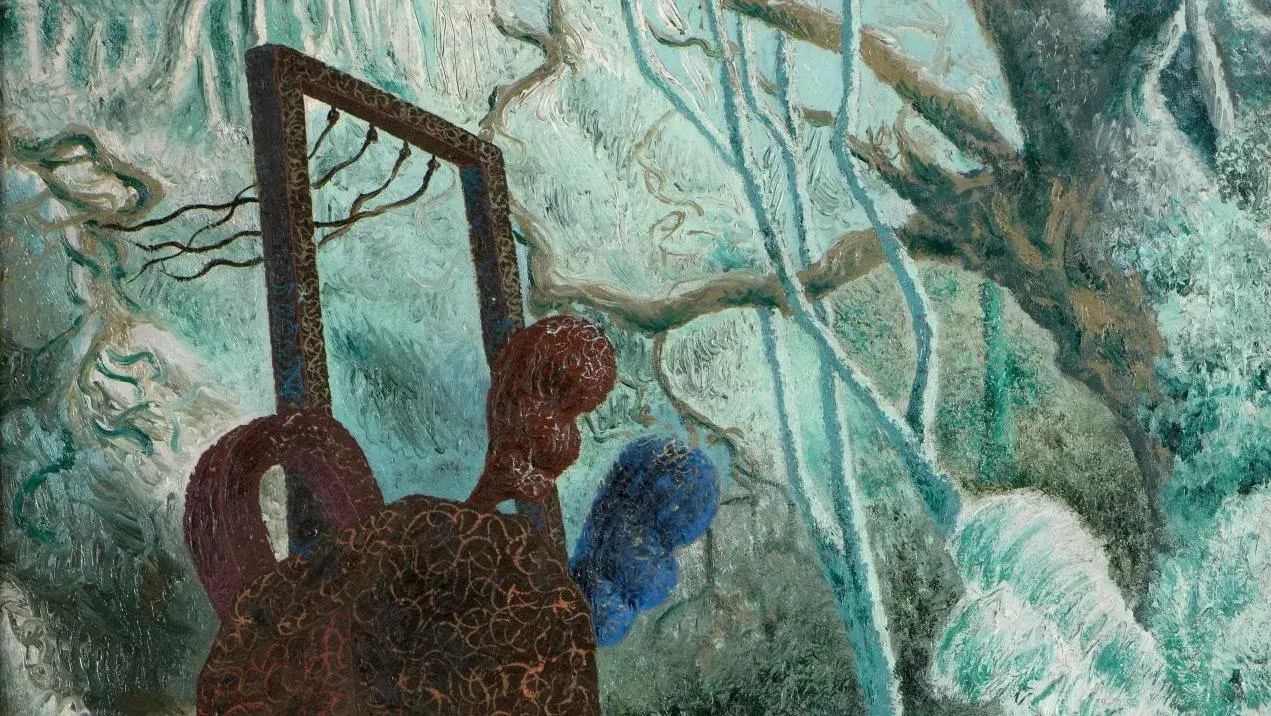
Alberto Savinio (1891-1952), Machine pour féconder les arbres (Machine for Fertilizing Trees), 1929, signed and dated oil on canvas, 81 x 65 cm/ 31.88 x 25.59 in. Estimate: €150,000/200,000
Readers of La Gazette may recall the successful beginning of this dispersal in May, when Jean-Léon Gérôme’s Shipwreck fetched €546,000. Focusing on 19th and 20th-century paintings and drawings, the highly discreet art lover added Alberto Savinio to his collection. The particularly enigmatic Machine pour féconder les arbres (Machine for Fertilizing Trees) sprang from the artist’s imagination in 1929. Influenced by Greece, home of mythology, where he was born and lived until his late teens, the Italian painter also drew upon Etruscan, Egyptian, Hebraic, Roman and Nordic sources to create his whimsical world. In Anthologie de l’humour noir (Anthology of Black Humor), André Breton, the father of Surrealism, wrote: “The whole, as-yet-unformed modern myth rests at its origins on two bodies of work that are almost indistinguishable in spirit, by Alberto Savinio and his brother, Giorgio de Chirico.” The Galerie Bernheim Jeune in Paris hosted Savinio’s first show two years before he painted this work with a metaphysical bent, as the artist himself put it. It was in the Jeanne Castel Collection before being acquired by the owner parting with it today.
Featured: Midcentury Modern and traditional furniture, art glass, ceramics, fine jewelry and silver from estates and residences throughout the Mid-Atlantic region
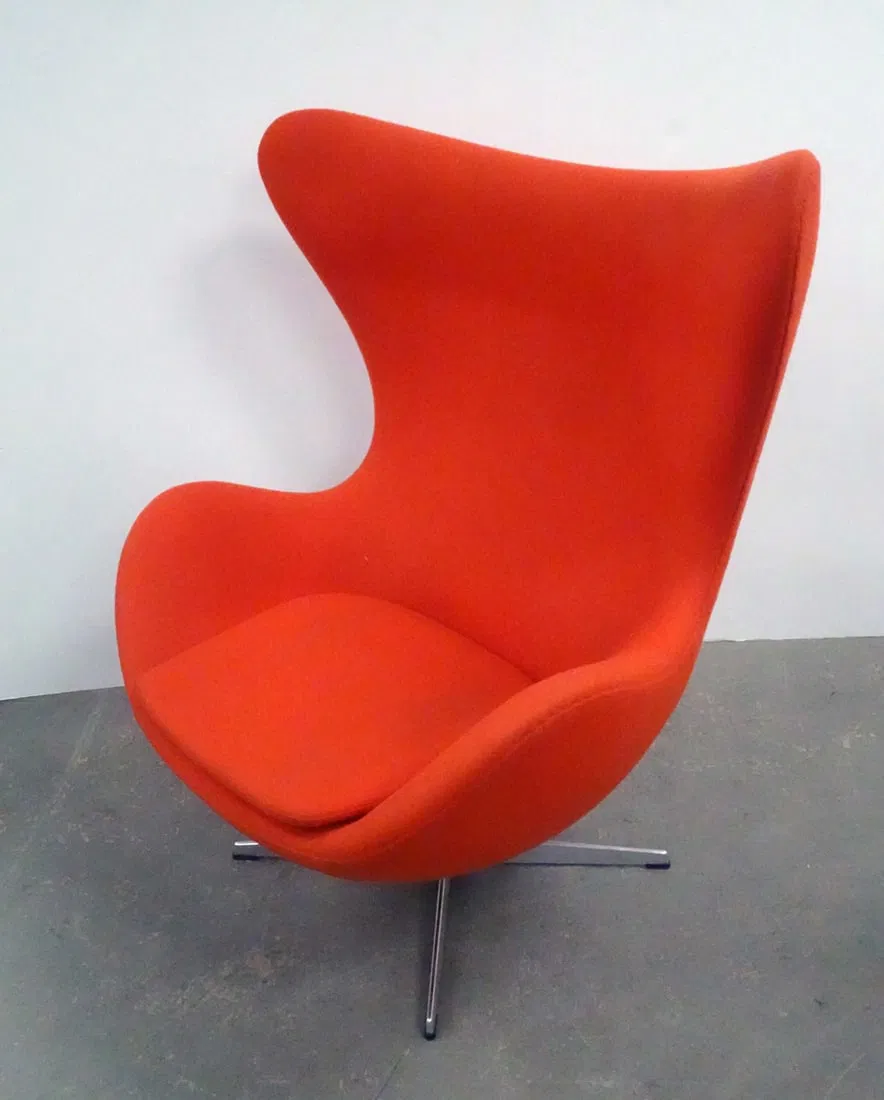
One of an identical pair of labeled Arne Jacobsen for Fritz Hansen Inc Egg Chairs, which will be sold individually and consecutively as Lots 229 and 230, each with an estimate of $1,500-$2,500
SOUTHAMPTON, Pa. – Stephenson’s Auctioneers, the Philadelphia region’s premier source for estate-fresh antiques and art since 1962, will conduct a September 6 Decorative Arts Auction of 318 select lots ranging from stylish Danish Modern furniture to high-quality diamond jewelry and American silver flatware. All forms of bidding will be available, including in person at the gallery, by phone, absentee, or live via the Internet through LiveAuctioneers.
Stephenson’s has a loyal following that has grown exponentially over the past six decades, due in large part to the company’s reputation for hosting sales that are wonderfully unpredictable. “While certain standard categories are seen in all of our auctions – paintings, decorative art, furniture and fine jewelry – every one of our sales is a treasure hunt,” said company owner Cindy Stephenson. “When we’re invited to visit a residence or appraise estate goods, we never know what we will find. For example, in the September 6th auction, there’s a mini selection of music-related items – a Steinway mahogany piano, a novelty radio shaped like a giant Champion spark plug, and an AMI Cadette jukebox whose Space Age design is straight out of an episode of ‘The Jetsons.’”
Now considered a classic design category, Midcentury furnishings are a staple at Stephenson’s sales and often come direct from the original owners’ residences where they’ve remained since the 1960s. On September 6, two prized Arne Jacobsen for Fritz Hansen Inc Egg Chairs – each with tomato-red upholstery, an aluminum swivel base, and lever-activated tilt function – will be sold individually and consecutively as Lots 229 and 230. Based on Jacobsen’s first Egg Chairs, which he created in 1958 for the Hotel Radisson SAS in Copenhagen, the auction examples are 2016 productions that retain their Fritz Hansen labels. Each is offered with an estimate of $1,500-$2,500. The furniture selection also includes: leather sofas, a Thayer Coggin / Milo Baughman chest of drawers and dresser/shelf unit; Komfort of Denmark lounge chairs, George Nelson for Herman Miller side tables, a Douglass Crowell-designed sectional sofa, Italia Erasmo ottomans, and various pieces by Henredon, Lane, Kittinger, Jonathan Rosen Designs, and more.
Artworks entered in the sale cross a broad spectrum of styles, from 19th-century Continental school landscape and genre paintings to tribal and Western art, religious icons, marine art and several drawings from the estate of noted magazine illustrator Davis Meltzer (Pennsylvania, 1930-2017). An accomplished oil-on-board portrait of a female nude by John French Sloan (N.H., N.M. and N.Y., 1871-1951) measures 9¼in x 7¼ (sight); 13½ in x 11½in (framed) and is artist-signed. Sloan was one of the founding members of the Ashcan school of American art and a member of the group known as “The Eight,” which also included Maurice Prendergast, Ernest Lawson and Arthur B Davies. The Sloan painting to be auctioned by Stephenson’s is estimated at $500-$700.
The curated trove of fine jewelry includes many coveted designer pieces and is led by a gorgeous Hammerman Bros 18K gold, platinum, diamond and ruby bird brooch. Its motif features 28 well-matched round diamonds set in platinum with an approximate total weight of 1.40 carats; and 38 round-cut rubies, 53mm x 40mm, with a weight of 15.3g. The brooch is stamped “DES (DESIGNED) IN FRANCE” and “18K HB Plat.” Its estimate is set at $2,500-$4,000.
Designed by Romain de Tirtoff, better known as “Erte” (Russian/French, 1892-1990), a “Tempest” 14K gold, sterling silver and diamond Art Deco cuff bracelet weighs approximately 68.6g. On its interior, it is marked “CFA Sterling 14K” along with the limited-edition numbers “138/600.” Estimate: $2,000-$2,500
An antique platinum diamond engagement ring is a study in impeccable, tasteful design with its 6.5mm European-cut center diamond and two baguette accent diamonds, each 3.0 x 1.5mm; and 1.0-1.7mm single-cut round accent diamonds. The ring is stamped “10%IRRIDPLAT” and weighs approximately .30cttw with an approximate VS/JKL 1.00ct center diamond. Estimate: $2,000-$2,500
Serpents have inspired jewelry designs since ancient Egyptian times, and their popularity continues to influence artisans to this very day. One of the auction’s highlights is a 14K white gold hinged snake-form cuff bracelet with blue sapphires, white diamonds and red-stone eyes. It is possible that the piece was designed by Effy. Marked “14K” and “585,” it weighs 31.6g and is estimated at $1,200-$1,600.
Two significant late-18th to mid-19th Chinese textiles from the Qing Dynasty era are entered in the sale. The first, a black silk embroidery panel with embroidered images of rabbits and a flowering tree branch, measures 50 by 23½ inches and is estimated at $600-$1,000. The second is a two-tone silk embroidery panel with an image of the immortal God of Longevity Shoulao holding a staff with a deer at his side and two bats flying overhead. It is a vertical piece measuring 69 by 36 inches and is estimated at $400-$700.
An exquisite objet de vertu that is not likely to be overlooked is a Continental 935-silver cigarette case with a Classical Ferdinand Von Reznicek-style enameled scene on the obverse depicting a nude male and female couple. An early 20th-century production, it has a gold-wash interior and is signed “935” on the inner panel. Its weight is 4.54ozt. Bidding is expected to reach the $400-$600 range.
Stephenson’s Friday, Sept. 6, 2024 Late Summer Decorative Arts Auction will be held live at the company’s Southampton (suburban Philadelphia), Pennsylvania gallery, with phone, absentee and Internet live bidding available through LiveAuctioneers. Start time: 2pm ET. All goods may be inspected either by appointment or on auction day, Friday, Sept. 6, from 12 noon until the auction commences at 2pm. Stephenson’s is located at 1005 Industrial Blvd., Southampton, PA 18966. For additional information on any item in the sale or to reserve a phone line for bidding, call Cindy Stephenson at 215-322-6182 or e-mail [email protected]. Visit Stephenson’s online at www.stephensonsauction.com.
Featured: Coins & artifacts from collection of metal detectorist Gordon Bailey; monumental stone head of pharaoh, Roman eagle & Serapis bronze finial, ‘Kelton’ Gandharan head of a Bodhisattva
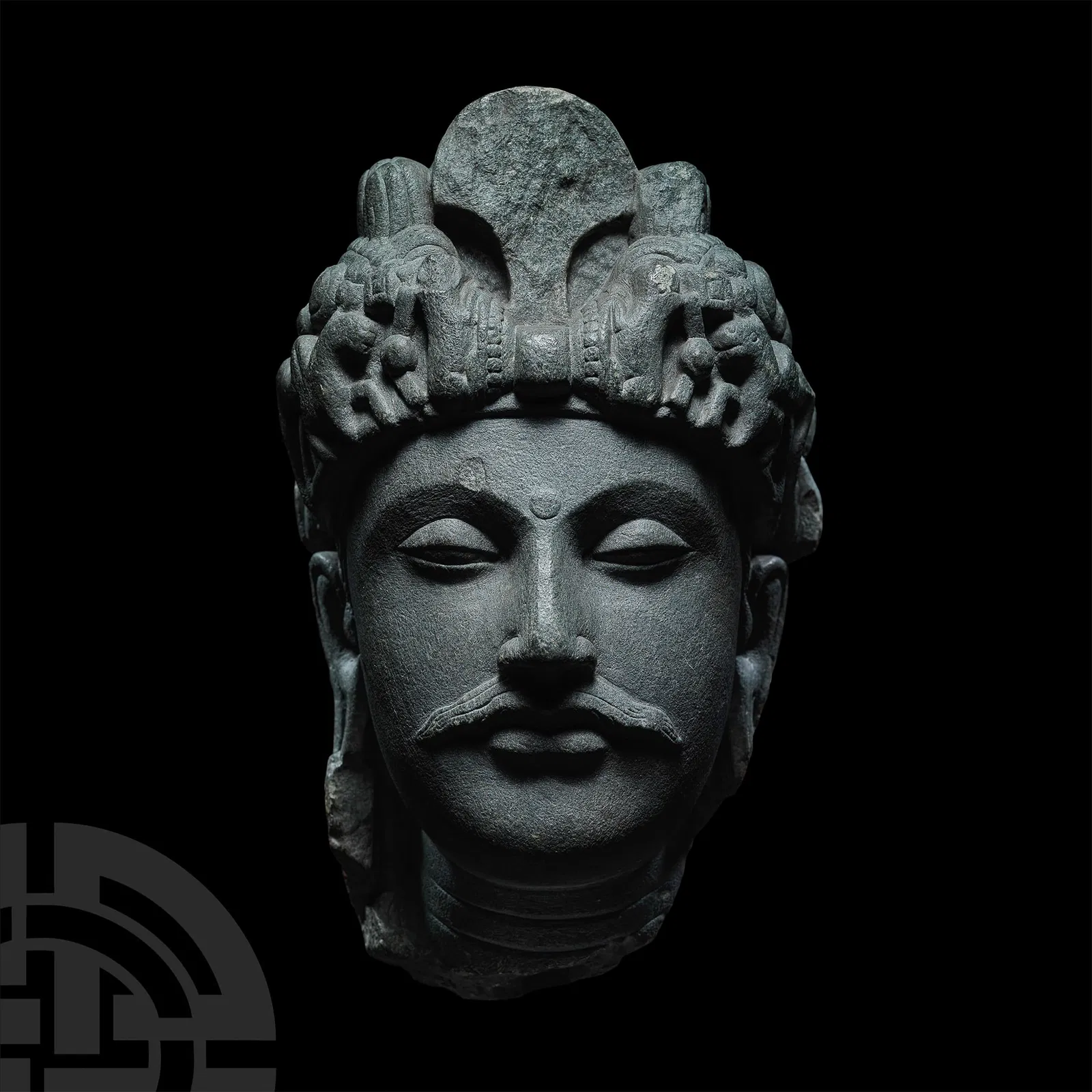
The Kelton’ Gandharan half-round schist head of a Bodhisattva (probably Maitreya), 3rd-6th century AD, exquisitely carved and detailed with arched brow, aquiline nose, neat moustache and full lips; the eyes heavily lidded. Urna to forehead. Curling locks gathered into ushnisha with brow band below. For similar, see Jongeward’s 2018 reference ‘Buddhist Art of Gandhara: In the Ashmolean Museum.’ Exhibited at Frieze Masters, London, 2023. Weight: 14.3kg. Height: 34cm (13 3/8in) on custom stand. From private collection of Richard Kelton (1929-2019), California, USA; acquired 1982, thence by descent; with Abell Auctions, Los Angeles, September 2022; to the present owner. Estimate: £15,000-£20,000 ($19,785-$26,380)
HARWICH, U.K. – With a history dating back to a legendary gem and fossil dealership founded in 1858, TimeLine Auctions continues a long and illustrious tradition as the world’s foremost auctioneers of ancient art and antiquities. Their September 3-8 auction – one of their largest sales ever – includes an expertly curated array of rare and historically important objects. Each piece is notable for its quality and distinguished provenance. The fully-curated selection will be available to bidders worldwide through several bidding methods, including live at the gallery, by phone, absentee, or live online. In addition to the generously illustrated online catalog, videos of many auction lots may be viewed on TimeLine Auctions’ website.
Throughout this sale, there is a strong emphasis on the appreciation of each society’s contributions to material culture as a whole. The impressive range of antiquities serves as a showcase for premier Egyptian, Greek, and Roman works, including pottery, marbles, bronzes and jewelry; as well as art and relics from Byzantine, Western Asiatic, Viking and other civilizations.
The mysteries of Ancient Egypt are embodied in an over-life-size Egyptian stone head of a pharaoh from the Ptolemaic Period, 332-30 BC. Likely from a monumental sphinx, the subject wears a royal nemes striped headdress with a prominent headband and the remains of a rearing uraeus (serpent) on the brow. The pharaoh has a somber expression and large, prominently-outlined, almond-shape eyes. The distinctive features are reminiscent of a granite sphinx head discovered at the Egyptian Delta site of Canopus, now housed in the Graeco-Roman Museum in Alexandria. The trail of ownership can be traced back to 1975 and a German private collection; with subsequent European ownership and family descent. Weighing a hefty 45.15kg (99lbs, 9oz) and presented on a custom display stand, it will convey with an academic report by Egyptologist Paul Whelan. Estimate: £40,000-£60,000 ($52,695-$79,040)
From ancient Rome, a bronze staff finial dating from the 2nd century AD is close to 12 inches in height and depicts a spread-winged eagle standing on an orb beneath a spectacular bust of the bearded god Serapis, his head surmounted by a corn modius. It was probably used atop a processional scepter or standard during the reign of Hadrian and is similar to examples in the collections of the Virginia Museum of Fine Arts and the St Louis Art Museum. Previously, it was held in a private collection in Germany in the 1980s and was last offered at auction by Christie’s New York in June 2012. It is entered in TimeLine’s sale with a £50,000-£70,000 ($65,935-$92,310) estimate.
Another sensational Roman survivor is the finely-carved Roman marble head of a young satyr dating to the late 1st to early 2nd century AD. With tousled curly hair and expressive features, including a mischievous smile with the tip of his tongue protruding to the right, it appears to have been derived from Hellenistic prototypes. It can be compared to the so-called “Young Centaur” signed by Aristeas and Papias, which was found at Tivoli in Hadrian’s Villa and now resides in the Capitoline Museum collection in Rome. TimeLine’s catalog provides an extensive list of book references and museum comparison examples. The line of provenance includes Christoph Bernoulli (1897-1981, Basel), who possibly acquired it from Münzen und Medaillen AG, Basel; thence by descent. Accompanied by an academic report by Dr Raffaele D’Amato, its auction estimate is £40,000-£60,000 ($52,695-$79,040).
A larger-than-life-size Roman bronze sandaled foot from the 2nd-3rd century AD is modeled in the round and was originally part of a monumental statue. It can be compared to similar examples seen in several reference books, including Bonfante’s The World of Roman Costume. It also calls to mind a statue at The British Museum that came from the Mausoleum at Halicarnassus, and another, at the Cleveland Museum of Art, which is a possible portrayal of Emperor Marcus Aurelius in the guise of a simple itinerant philosopher. The ultimate conversation piece, the auction entry is poised to make tracks in the £30,000-£40,000 ($39,570-$52,695) estimate range.
A majestic South Asian artwork, “The Kelton” Gandharan head of a Bodhisattva is so named because it was owned for 37 years by California-based collector Richard Kelton (1929-2019). Three years after Mr Kelton’s passing, it was acquired by its next owner at Abell Auctions in Los Angeles. It subsequently passed by descent to its present owner. The half-round schist head depicting a Bodhisattva, probably Maitreya, dates to the 3rd-6th century AD. It is exquisitely carved and detailed with an arched brow, aquiline nose, neat moustache and full lips. Its eyes are heavily lidded, an urna is present on the forehead, and the subject’s curling locks are gathered into ushnisha. Similar works appear in Jongeward’s 2018 reference Buddhist Art of Gandhara: In the Ashmolean Museum. The auction example, which was exhibited at Frieze Masters 2023 in London, comes to auction with a pre-sale estimate of £15,000-£20,000 ($19,785-$26,380).
A special highlight of the six-day auction is an 87-lot offering of rarities from the collection of Britain’s best-known metal detectorist, Gordon Bailey. Born in wartime London, Bailey was dealing coins and antiques as a teenager from the East End’s famous Brick Lane Market and became an early pioneer of the treasure-hunting hobby after buying his first metal detector in 1968. Today, he is familiar to many hobbyists as the author of the Detector Finds series that helped in the identification of many British metal-detecting finds, ranging from medieval pilgrim ampullae and crossbow bolts to crotal bells and seal matrices. In the days before the availability of Internet search engines, these books, with hundreds of detailed illustrations covering all types of finds, were invaluable as reference works.
Gordon Bailey also amassed an enviable collection of coins and artifacts from virtually every period of British history: Bronze Age, Iron Age, Roman, Anglo-Saxon, medieval, Tudor, and later. The auction features a number of pieces illustrated in his books, including both a 13th or 14th-century gold zoomorphic annular brooch set with sapphire cabochons, estimate £1,50-0-£2,000 ($1,980-$2,640); and a large 15th-century gilt bronze merchant’s glove ring with an octagonal plaque bezel having a merchant’s mark and the letters “IH,” estimate £2,000-£3,000 ($2,640-$3,955).
A top prize in the ancient jewelry category is a 1st century AD Roman agate cameo of Augustus, presented in a later mounting. The gold pendant frame is surrounded by emerald, sapphire and ruby cabochons, as well as clusters of pearls. It is marked “750” on verso, along with “B&G” – believed to be an upstate New York jeweler’s stamp – and an indeterminate third mark. With a total weight of 99 grams, it will convey with a scholarly report by Dr Ittai Gradel, who notes that the cameo is “of exquisite technical quality” and “has a close parallel in the Cabinet des Medailles, Paris.” This wonderful piece of jewelry was part of an early 20th-century New York collection, then was with Robert Haber Gallery in New York (1990), and later, became the property of Jean Clostre, Geneva, Switzerland. The auction estimate is £30,000-£40,000 ($39,570-$52,695).
Among the hundreds of rare and outstanding gold and silver coins, a golden choice is a 282-283 AD Carus AV Aureus, laureate, with a draped and cuirassed bust to the right on the obverse. The reverse shows Victory advancing to the right, holding a palm frond over her left shoulder and a wreath in her right hand. “SMA” is shown in the exergue. This well-provenanced coin, which has a weight of 5.02 grams, was previously auctioned at Hess-Divo AG, Auction 334, May 29, 2018; and Nomos AG, Auction 17, Oct. 26, 2028 (dealer’s ticket included with lot). TimeLine’s auction estimate is £20,000-£30,000 ($26,380-$39,579).
The many collectors of ancient pottery worldwide will find much to admire in a circa-520 BC Greek Attic lekythos. Its ovoid body displays a combat scene with three distinctively-garbed and helmeted hoplites with shields and weapons. A similar example may be seen in the collection of The Metropolitan Museum of Art in New York, and in the Corpus Vasorum Antiquorum. The auction vessel was in a private southern Germany collection in the 1960s, and later with Paul-Francis Jacquier, Numismatique Antique, Münzen und Kunst der Antique. It was acquired by the present owner at the latter company’s September 13, 2013 auction and is now offered with a £25,000-£35,000 ($32,955-$46,135) estimate.
In summary, TimeLine Auctions’ Chief Operating Officer Aaron Hammond described the September 3-8 event as “a landmark sale featuring an extraordinary selection of classical ancient art, medieval treasures, and much more. Each item is historically significant and has been expertly catalogued, thoroughly researched, and rigorously vetted by our experienced team of specialists. This auction is one of our largest to date and presents a rare opportunity to acquire remarkable pieces that connect us to the past, broadening our horizons and deepening our understanding of history. Participating in this sale is not just about acquiring art, but also about preserving the rich cultural heritage that shapes our world. We’re sure collectors won’t want to miss this chance to own a piece of history.”
The Sept. 3-8, 2024 auction will be held live at the company’s head office located at The Court House, 363 Main Rd., Harwich, Essex CO12 4DN, UK. All lots featured in TimeLine’s printed catalog will be auctioned during the Sept. 3 opening session. Internet bidders may pre-register online. London previews will be held at the prestigious Institute of Directors, 116 Pall Mall, St James’s, on Aug. 28 from 12 noon-6pm, followed by a Champagne reception from 6-9pm; as well as Aug. 29 from 9am-noon. Auction start time: 7am US Eastern time/12pm (midday) GMT. All remote forms of bidding will be available, including absentee, by phone (please book phone line 48 hours ahead of time) or live via the Internet through TimeLine’s bidding platform or LiveAuctioneers. TimeLine Auctions accepts payments in GBP and ships worldwide. Questions: call +44 7494 866514 or email Aaron Hammond at [email protected]. Website: https://timelineauctions.com.
Wright of Los Angeles, CA, Lambertville, NJ, and Chicago, IL held its 156-lot Murano glass sale on August 15, 2024. This event featured outstanding 19th and 20th-century decorative glass items produced on Murano– the second-largest island in Italy’s Venetian lagoon. Murano glass is recognized for its beauty, quality of manufacturing and design, and a long history that dates back as early as 1291. Here are some stunning highlights from this late summer auction.
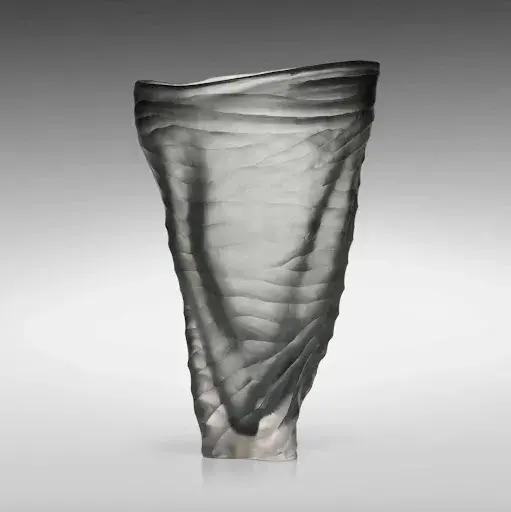
Lot #0240, a vase by Massimo Micheluzzi, was estimated at $1,500 to $2,000 and sold for $41,920. Image courtesy of Wright.
Massimo Micheluzzi Carved Glass Vase
The top lot in this sale was #0240, a carved glass vase by Massimo Micheluzzi. Estimated at USD 1,500 to $2,000, it traded hands at $41,920 during this Murano glass sale. This clear, light gray example measured 37 by 23 by 23 cm and was produced in 2002. The piece resembled a tornado with its color, texture, and presentation. It featured the artist’s etched signature and date of production to its underside.
Massimo Micheluzzi (Italian, 1957 – 2009) was a popular and beloved glass artist and designer. He also was a teacher and instructor, giving classes at the Academy of Fine Arts in Venice. One of his signature styles was to rely not on color but on the glass itself to create textures, movement, and patterns. This blue-ribbon auction highlight is a premier example of this approach. It also appears to be the highest-priced example of the artist’s work ever to sell at public auction.
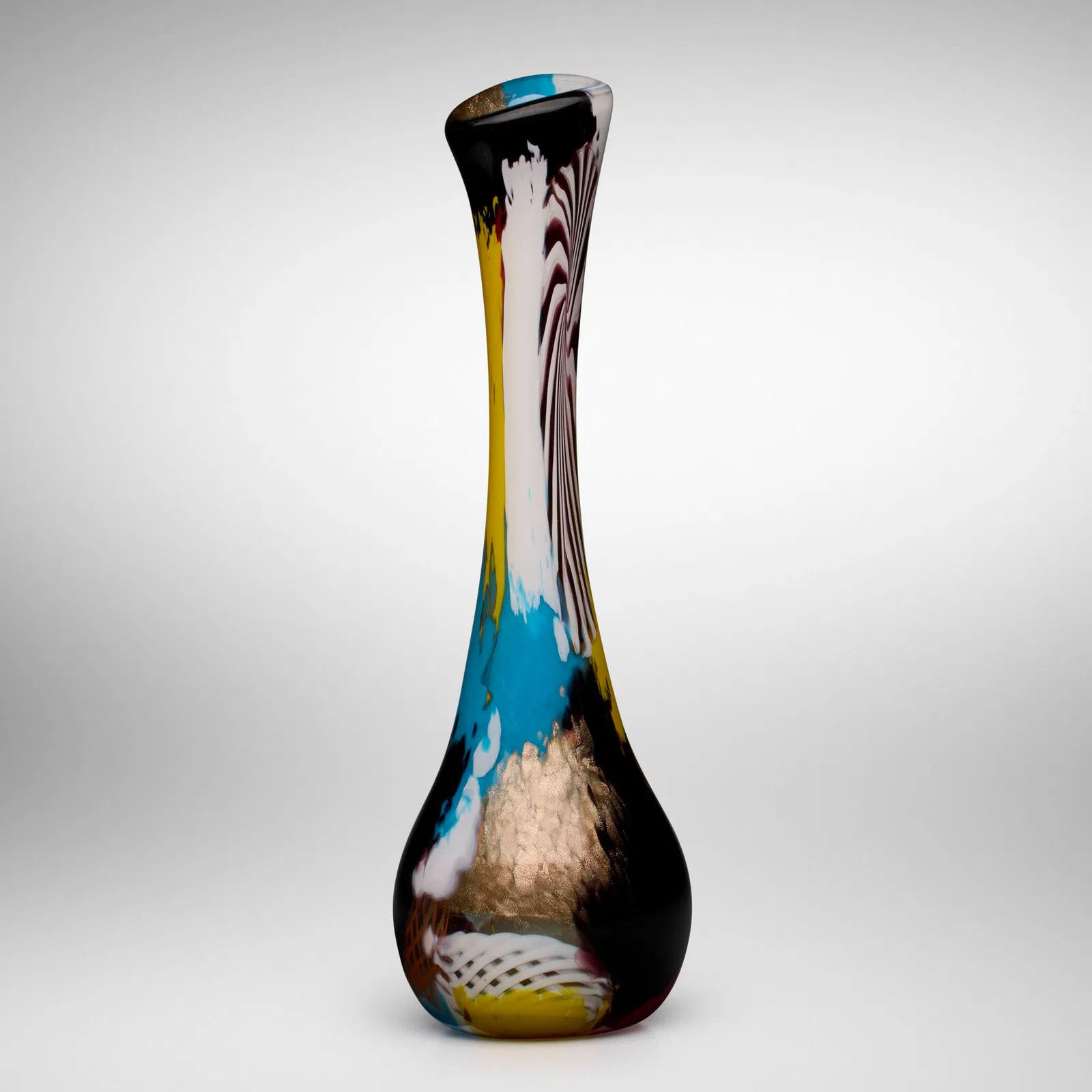
Lot #0184, a vase by Dino Martens, was estimated at $5,000 to $7,000 and sold for $13,100. Image courtesy of Wright.
Dino Martens Oriente Vase
Vases are the perfect form for art glass, and this Murano glass sale offered an impressive selection of these vessels. Lot #0184, an Oriente vase by Dino Martens, was estimated at $5,000 to $7,000 and delivered $13,100. This internally decorated bottle-shaped example was made around 1954. It measured 37 by 11 cm overall and retained its partial paper label on its underside. This clear, yellow, brown, white, and metallic example was featured in Heiremans’ reference book Dino Martens: Muranese Glass Designer.
Dino Martins (Italian, 1894 – 1970) found success both as a glass artist as well as a painter. His works on canvas were shown at the Venice Biennale, an art festival that has been held in Venice continuously since 1895. He was also the artistic director for Vetreria Aureliano Toso– an art glass company that started in 1938– from the early 1940s through the early 1960s. Martins was well known for his technical expertise and ability to render challenging, complicated, and asymmetrical items. In 2021, Bonhams in London sold Martins’ Anfora Ape vase from 1952 for $256,250.
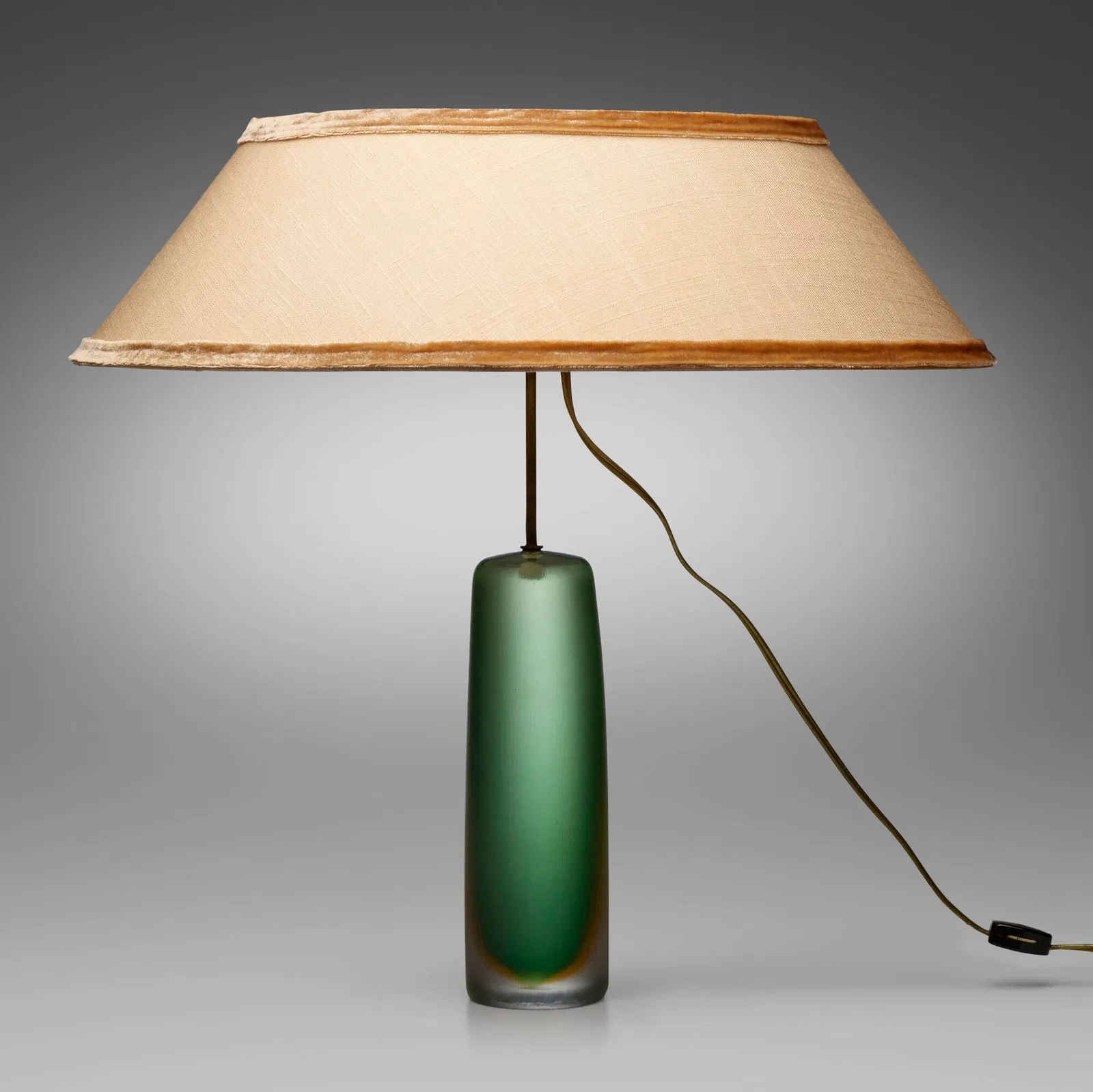
Lot #0128, table lamp by Paolo Venini, was estimated at $3,000 to $5,000 and sold for $8,515. Image courtesy of Wright.
Paolo Venini Table Lamp
Lamps were another important category in this eye-catching Murano glass sale. Lot #0128, Paolo Venini’s Inciso table lamp, was estimated at $3,000 to $5,000 and delivered $8,515. This wheel-carved, midcentury-era fixture measured 50 by 51 cm. Its glass base was primarily green and cylinder-shaped, and its shade was made from textured linen or cloth. This proper topper had a flattened, broad form which perfectly complemented the lamp’s presentation. The base was signed with a circular three-line acid stamp on its underside.
Paolo Venini (Italian, 1895 – 1959) served in World War I and was professionally educated as a lawyer. In 1921, he went into the glass industry with a partner; by 1925 he formed his own firm which would eventually be known as Venini & Co. Venini had a hand in both the business and artistic aspects of his company, including collaborating on some of Venini & Co.’s now signature designs. He sought out partnerships with other top professionals in the fashion, design, and architectural worlds to bring fresh and novel perspectives to his company’s production aesthetic. In 2023, Wright sold Venini’s Dame vase, model 3644 from 1953, for $72,050.
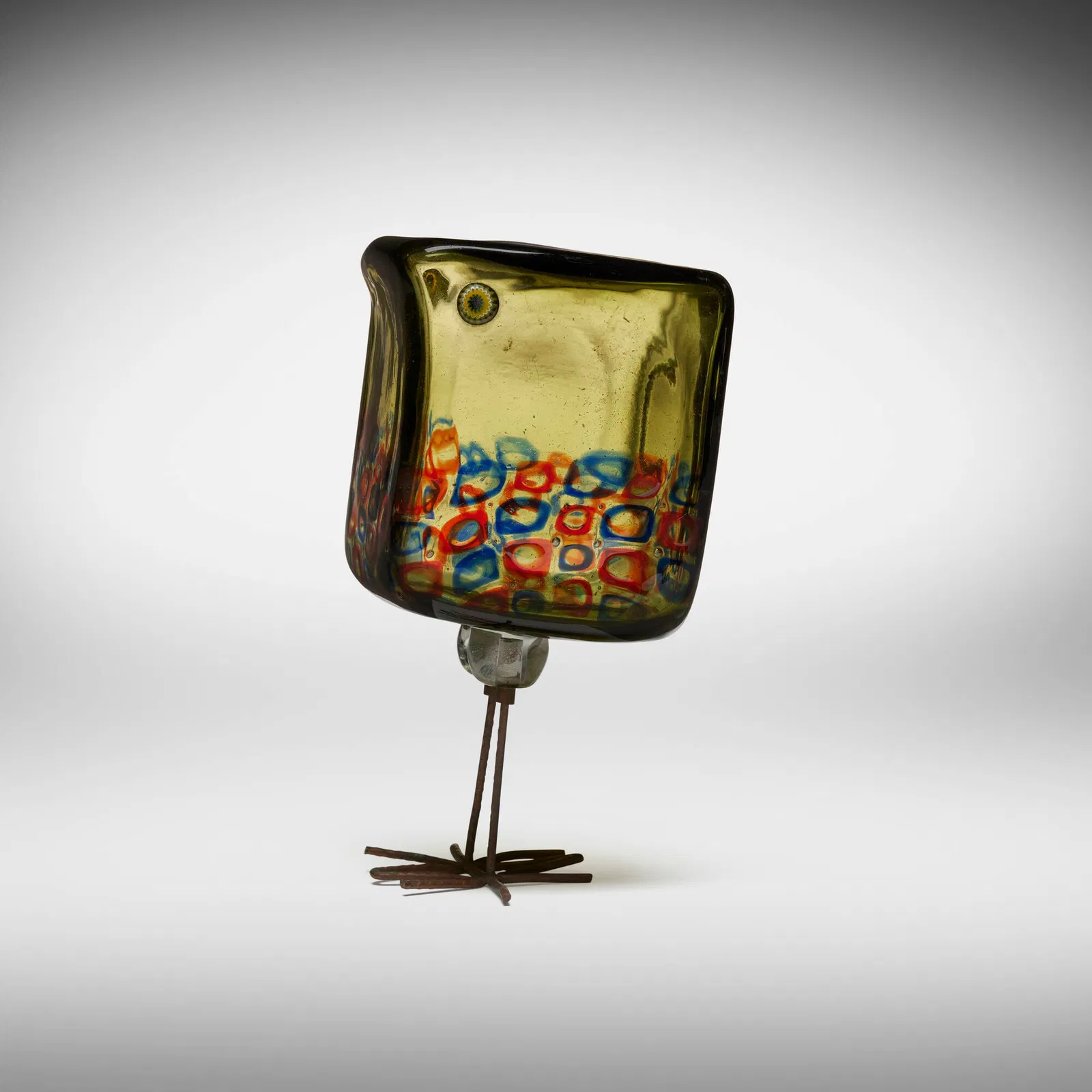
Lot #0200, Alessandro Pianon’s Pulcini, was estimated at $3,000 to $5,000 and sold for $7,860. Image courtesy of Wright.
Alessandro Pianon Sculpture
Figures and other sculptures also caught the eye of enthusiasts in this sale. Lot #0200, Alessandro Pianon’s Pulcini sculpture, was estimated at $3,000 to $5,000 and sold for $7,860. This work, in the form of a playful, top-heavy, standing baby chicken, was produced around 1963. The bird’s square body was decorated internally with blue, red, and orange ovals. He had distinctive glass eyes and metal feet and legs and measured 20 by 10 by 10 cm overall. This particular example was noted in several important reference books, including Heiremans’ 20th Century Murano Glass and Olnick and Spanu’s Glass from the Olnick Spanu Collection.
Artist and architect Alessandro Pianon (Italian, 1931 – 1984) was known in the art world for his blown-glass sculptures, standing birds on metal feet and legs, and lamps. Many, like this example, were decorated on the inside with polychrome murrine highlights.
Pianon joined the glass company Vetreria Vistosi in 1956, where he worked on many creative projects. By 1962, he established his own business to partner with numerous glass factories, designers, and businesses.
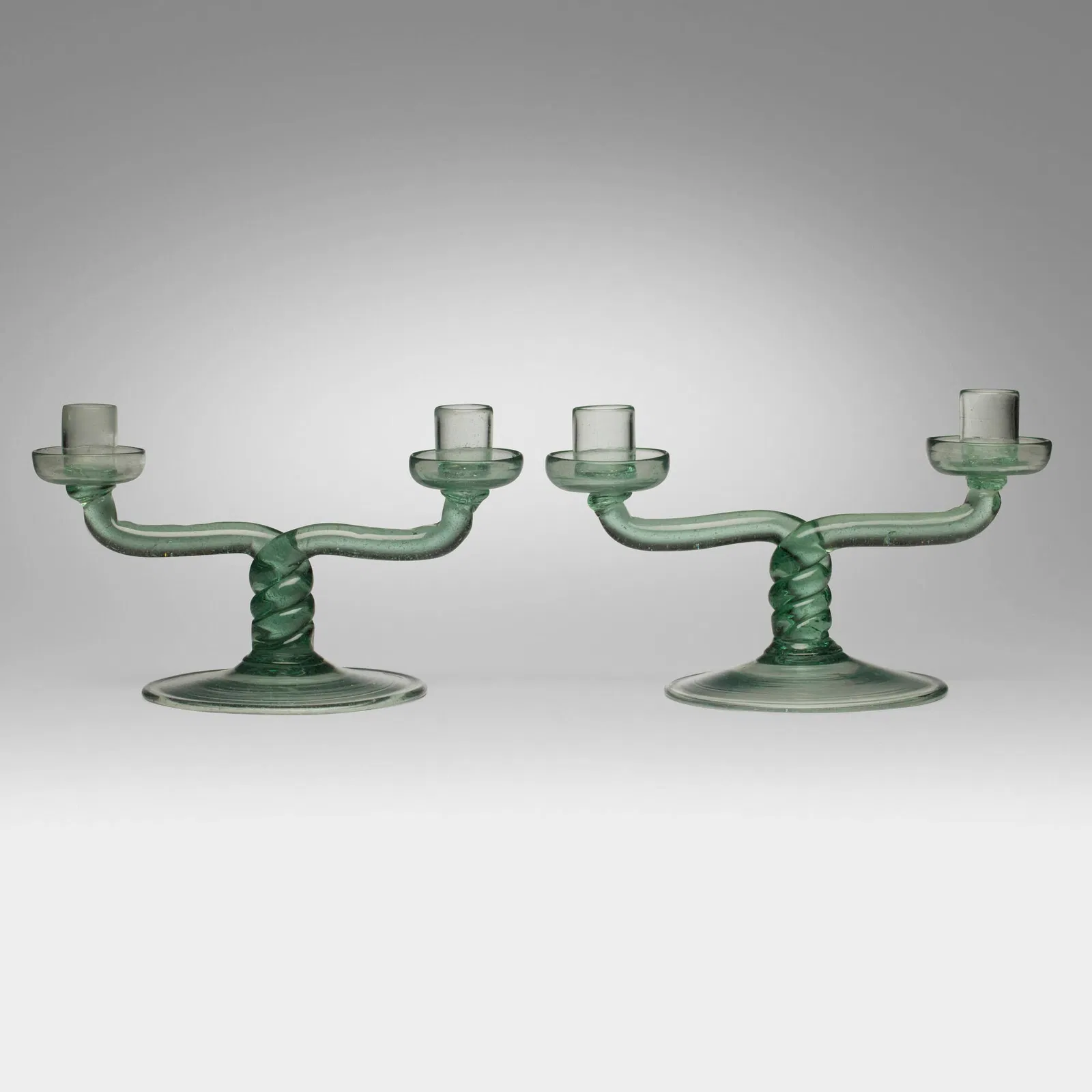
Lot #0159, a pair of Soffiato style candleholders, was estimated at $700 to $900 and sold for $2,358. Image courtesy of Wright.
Green Glass Soffiato Candleholders
Murano glass chargers, pitchers, tableware, and candlesticks brought this important sale full circle. Lot #0159, a pair of light green glass candleholders, was estimated at $700 to $900 and made $2,358. This set was produced around 1930 and was made in the “Soffiato” style. This means that they were made by hand with a blowpipe and feature simple, clean, and basic forms. Both measured 15 by 25 by 14 cm and had provenance to the Dimitri Levas collection. Levas was friends with photographer Robert Mapplethorpe (American, 1946 – 1989) and was responsible for styling many of the artist’s still-life images.
For more information on Wright’s August 15, 2024 Murano Glass sale, visit LiveAuctioneers. Find more auction world news on Auction Daily.
Dane Fine Art’s upcoming Sunshine Sale of Modern & Contemporary Art is a nearly 1,100-lot sale that embraces the breadth of contemporary fine art. The event, scheduled for August 29, 2024, particularly highlights sculpture works by present-day masters such as KAWS, Jeff Koons, and Adam Parker Smith.
Here are some of the top lots that caught our attention at Auction Daily.
KAWS and Hajime Sorayama, No Future Companion. Image courtesy of Dane Fine Art.
KAWS
An artist who bridges the style of fine art with the broad appeal of more commercial endeavors, KAWS (also known as Brian Donnelly) started his career as an animator and graffiti artist. Both mediums inspired his later work. He received an extensive education in fine art and illustration. By the late 1990s, KAWS was creating original characters that referenced and reinterpreted popular culture. Among his most famous characters is Companion, a dark figure that resembles Mickey Mouse with crossed-out eyes and bones protruding from its head. KAWS’ Companion figures are now both museum items and accessible collectibles.
Available with Dane Fine Art this August is KAWS’ No Future Companion, a limited edition figure that is a collaboration with Japanese illustrator Hajime Sorayama (lot #4; estimate: USD 20,000 – $30,000). Sorayama is known for his futuristic depictions of women and androids who are often clad in shimmering metal. This Companion embraces Sorayama’s style with robotic arms and legs, as well as a shiny metallic surface. This piece belongs to an edition of 500 and stands just over 12 inches high.
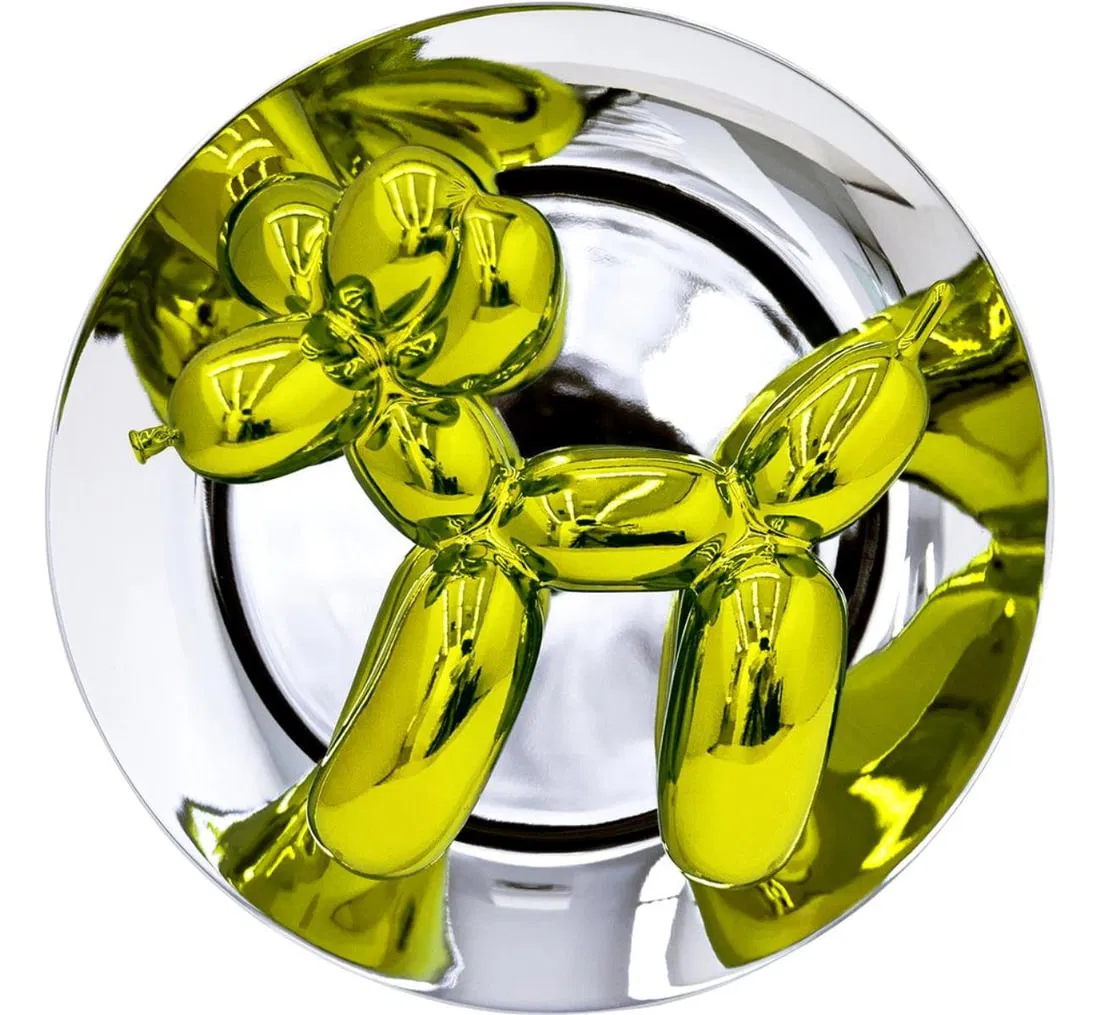
Jeff Koons, Balloon Dog (Yellow). Image courtesy of Dane Fine Art.
Jeff Koons
Another modern master sculptor is Jeff Koons; his work is also well-represented in this sale. Like KAWS, Koons also embraces popular culture in his art and toys with elements of kitsch. He first rose to fame in the 1980s with works intended to shock the art world with their embrace of consumerism and appropriation. Among his most famous projects is a series of sculptures shaped like balloon animals and executed in colored stainless steel. Preserving these ephemeral objects in a permanent, artistic form proved lucrative. Two balloon animal sculptures by Koons separately set records for the most expensive works auctioned by a living artist.
One such Balloon Dog sculpture will be offered with Dane Fine Art this August. Lot #261 is a yellow balloon dog encased in porcelain. Dating from 2015, this piece was published by the Metropolitan Museum of Contemporary Art and is signed to the rear. It has a presale estimate of $19,500 to $27,000.
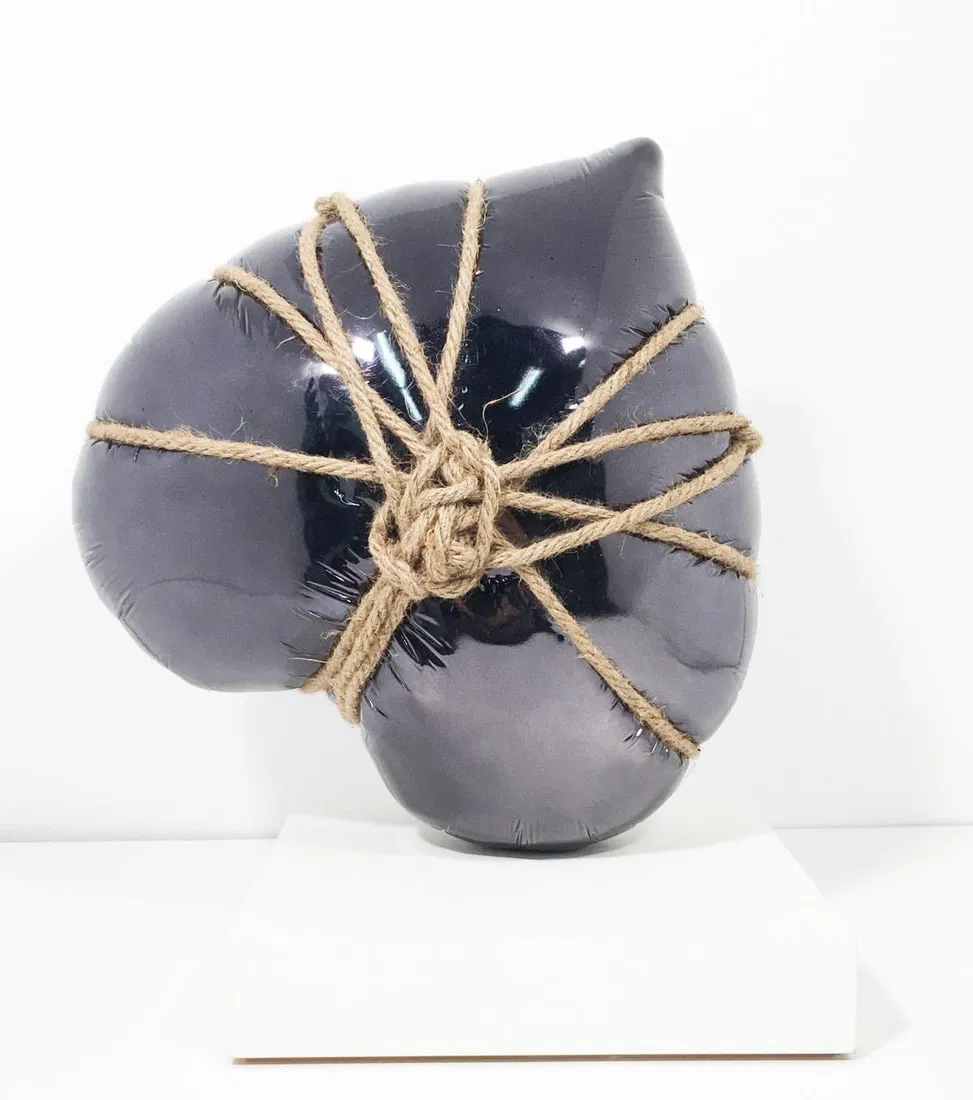
Adam Parker Smith, Shibari Heart (Black). Image courtesy of Dane Fine Art.
Adam Parker Smith
American contemporary artist Adam Parker Smith embraces a certain cheekiness in his works, which often wink at the viewer or contain a joke. Smith tends to embrace unconventional techniques and new ways of looking at the world, from buying ideas from other artists to reimagining classical sculptures as trash-compacted cubes. He prefers to use ordinary found objects instead of more traditional mediums.
This auction will feature Smith’s Shibari Heart (Black), a resin and jute piece that rests on a wood base. This 2019 work resembles an inflated heart balloon tied up with bondage ropes. It comes to auction with an estimate of $10,500 to $14,500.
In addition to these works, the Sunshine Sale of Modern & Contemporary Art highlights prints by Julian Opie and Alex Katz, sketches by Andy Warhol and Keith Haring, and more. Find additional information about each of these works and register to place a bid in the Dane Fine Art sale on Bidsquare. For the latest auction news and a calendar of events, visit Auction Daily.
Schuco– originally named Schreyer & Co. in 1912 by Heinrich Müller in Nuremberg, Germany– is one of the oldest and most recognized European toy manufacturers. The company originally specialized in producing clockwork tin playthings, novelties with moving or functional components, wind-up pets and birds, and miniature replicas of cars and trucks. Today, the firm is owned by the Simba Dickie Group and makes die-cast scale automobiles, planes, boats, and commercial vehicles.
Milestone Auctions of Willoughby, OH is offering its 639-lot Premier Schuco Toy Sale & More on August 24, 2024. This event features a remarkable and complete collection of early to mid-century Schuco items, including samples and rarities. Here are some highlights that caught the eye of the Auction Daily team.
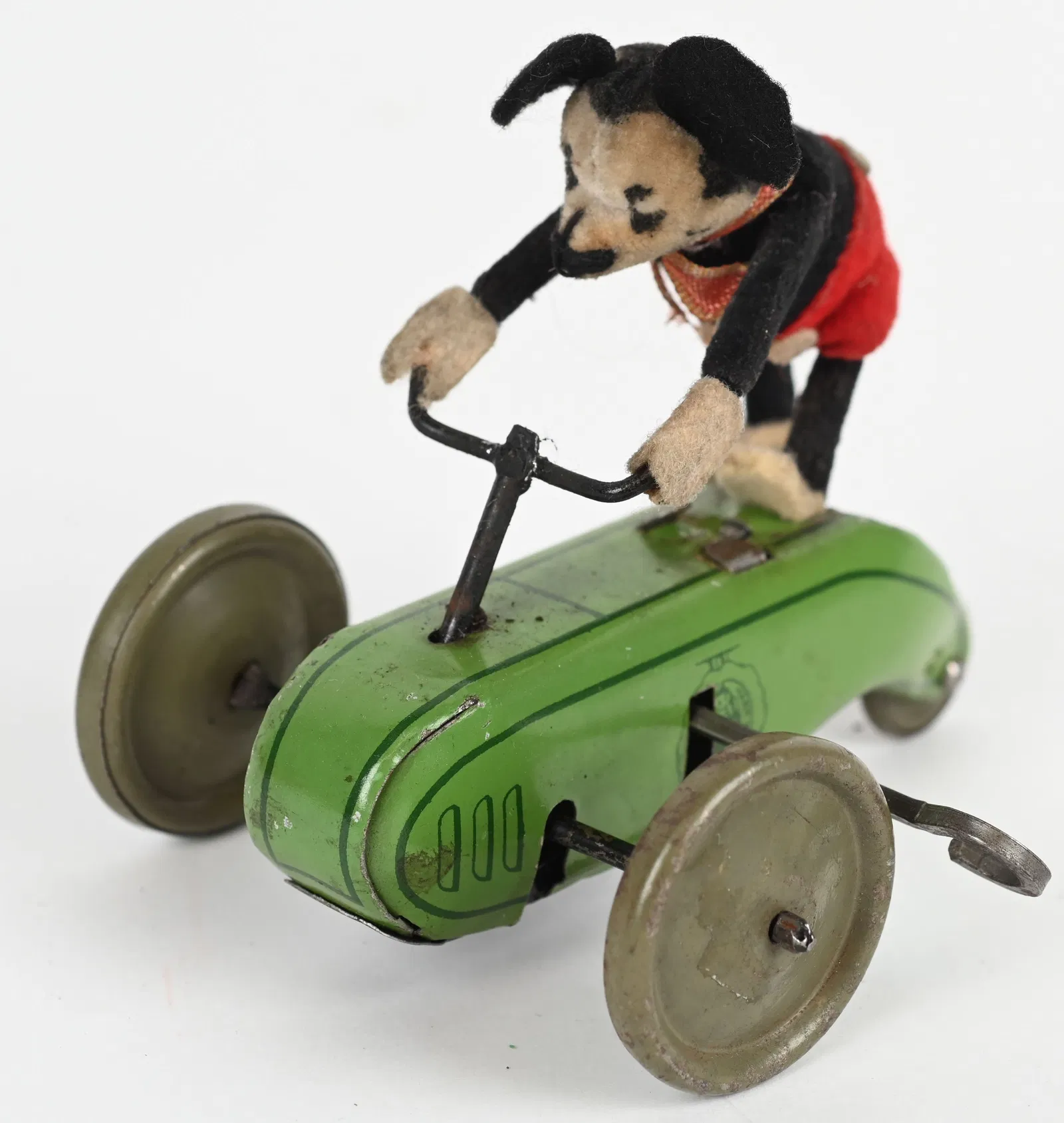
Lot #0266A, a wind-up Mickey Mouse riding on a scooter, is estimated at $2,000 to $3,000. Image courtesy of Milestone Auctions.
Schuco Mickey Mouse Toy
One of the top lots in this Schuco toy sale is #0266A, a wind-up Schuco Mickey Mouse riding a scooter. It is estimated at USD 2,000 to $3,000. This all-original and working clockwork toy consists of a four-inch-tall black and white Mickey Mouse made from velvet and felt riding upon a three-wheeled metal vehicle with a green chassis. Mickey wears red felt shorts decorated with white circles and a red and white bow tie. The tricycle has gray metal wheels, a handlebar, and a wind-up mechanism on its side. This Schuco Mickey Mouse toy is branded with a Schuco mark near the key opening.
Mickey Mouse made his worldwide debut in 1928. Soon after, toy companies around the world began producing items based on this cartoon hero. Steiff, another German toymaker that competed with Schuco for ideas and market share, produced a Mickey Mouse figure from 1931 to 1936 in six sizes ranging from 11 to 48 cm. This Schuco Mickey Mouse vehicle is likely to generate impressive results at auction because it is at the intersection of several important collecting categories. These include Disney, Mickey Mouse, prewar toys, vehicles, and clockwork toys. As such, cross-collectibles often get lots of eyeballs and many bids as they have broad appeal. In 2022, Bertoia Auctions of Vineland, NJ sold a wind-up Schuco Mickey Mouse on a similar three-wheeled vehicle for $18,750.
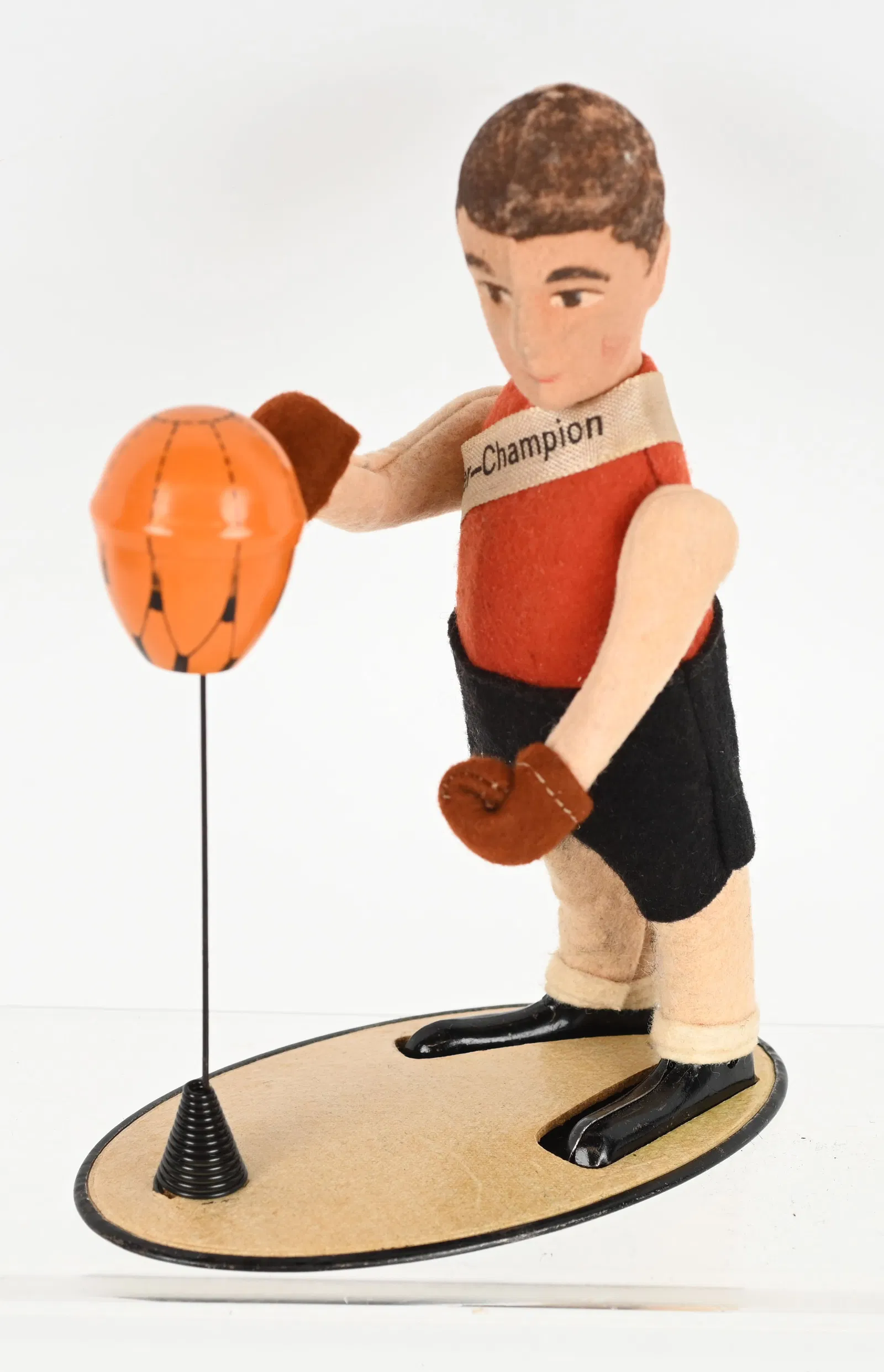
Lot #0193, a rare Boxer Jack with a punching bag, is estimated at $2,000 to $3,000. Image courtesy of Milestone Auctions.
Schuco Boxer Jack Toy
Schuco is well known for its legacy line of clockwork-activated novelties. Lot #0193, a rare Boxer Jack with a punching bag, is estimated at $2,000 to $3,000. This all-original and nearly as-new example is in the form of a six-inch tall arm-jointed felt man in front of an orange and black punching bag on a black metal stand. The man has painted hair and features and wears a red felt shirt, black felt shorts, white felt socks, black metal shoes, and a ribbon sash. The ribbon is marked Germany, imprinted with Boxer Champion and includes the company’s branding. His keyhole for activation is located under one of his arms.
Schuco prewar and mid-century era novelties were usually activated by a flat metal key that resembled a butterfly. These keys were generic in their design and could be used throughout the Schuco line. A key was inserted into the body or most robust part of the toy and gently twisted to activate the item’s movement. In the case of this boxer, the doll’s arms would shuffle back and forth to appear like he was punching the bag. This boxer was also produced with a green felt shirt; in 2024, Antico Mondo Auktionen of Bornheim, Germany sold an almost identical example for $3,476.
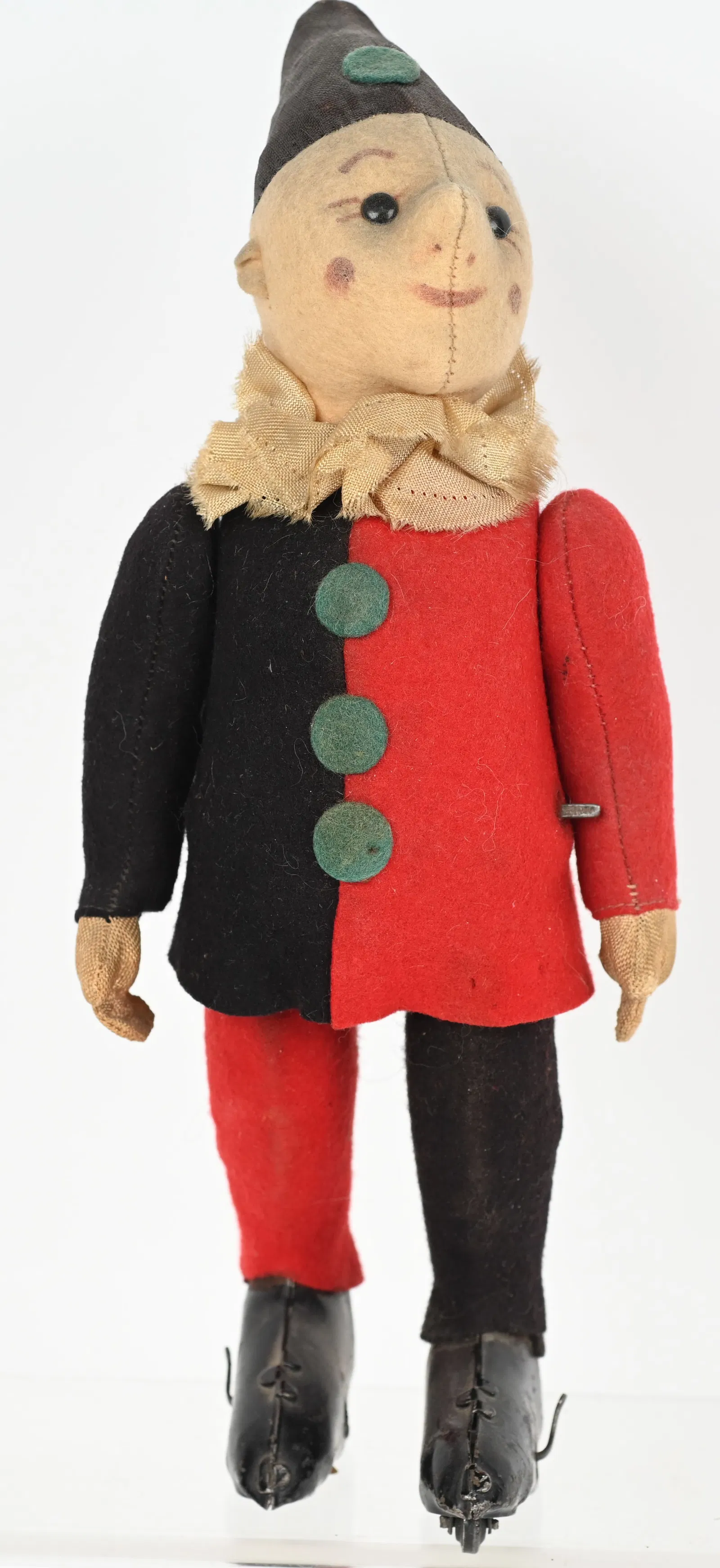
Lot #0222, a jointed clown doll, is estimated at $1,500 to $2,000. Image courtesy of Milestone Auctions.
Schuco Jointed Clown Doll
Like other fine European toymakers in the 19-teens, Schuco also created a line of felt play dolls. It is no surprise that Schuco’s were often differentiated with mechanical features. Lot #0222, a jointed clown doll, is estimated at $1,500 to $2,000. This happy-go-lucky fellow is in working condition and measures 10.5 inches tall. He wears a red and blue harlequin-style suit with green felt dots. His outfit also includes a matching blue felt hat, white bow tie, and shoes with wheels to enable walking. This example was part of a series of Schuco wind-up walking dolls produced around 1914.
Unlike much of Schuco’s production, items on wheeled shoes bridge the company’s pre- and postwar lines. The earliest ones included this clown doll, made as part of the company’s Automato series. Others in this line included a Black American bellhop, a German soldier, a French soldier, and a policeman, among others. When activated, these dolls walked forward or backward; if the lever on their back was flipped, they could turn and stroll left or right. Midcentury and onward, Schuco produced numerous clockwork-activated dolls and animals on roller skates; these included rabbits, bears, monkeys, clowns, and bellhops, among many others. Each of these later models held a stick in one of its hands to help with balance.
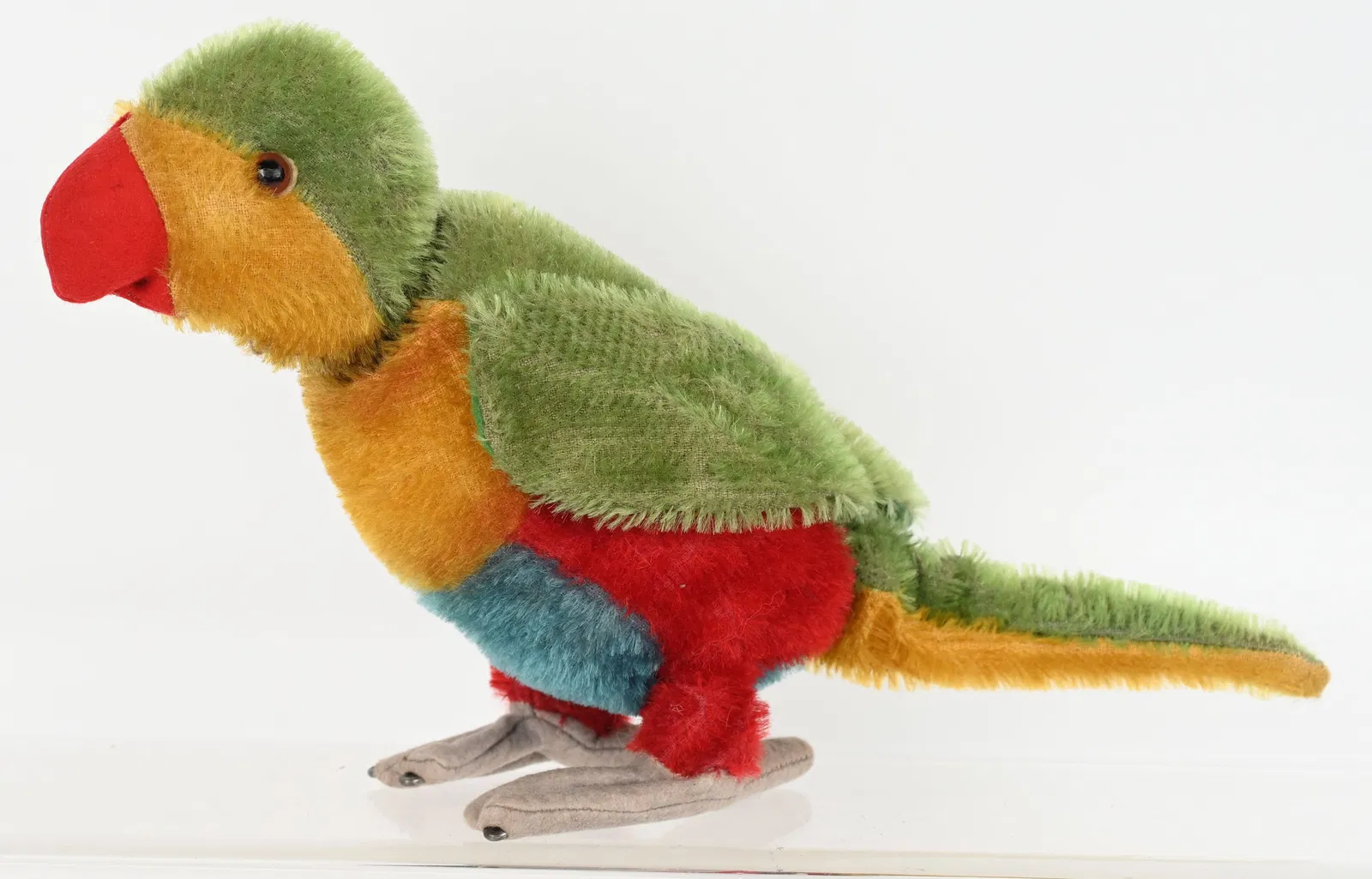
Lot #0113, a standing 12-inch yes-no parrot, is estimated at $400 to $600. Image courtesy of Milestone Auctions.
Schuco Yes-No Parrot Toy
Toys with tail-moves-head features were another signature Schuco line. Lot #0113, a standing 12-inch yes-no parrot, is estimated at $400 to $600. His beak is red felt, his wire-lined feet are gray felt, and his body is short green, gold, red, and blue German mohair. His face comes to life with proportional brown and black glass eyes backed in a circle of white felt. When his long mohair-covered tail moves up, down, right, or left, his head moves in tandem.
Schuco’s yes-no Teddy bears, monkeys, and animals dressed as bellhops in red and black outfits are seen most often today on the secondary market as they were produced in great numbers for many decades. More unusual examples of these mechanical toys– especially those from the 1920s through the early midcentury era– always catch the eye and the pocketbook of collectors worldwide. This parrot, the first on record that we could find to come to public auction since 2005, most likely dates from the 1930s or so, given his vibrant hues, detailing, and materials. Color can be king when it comes to generating strong auction results on yes-no items like this; in 2023, Ladenburger Spielzeugauktion GmbH of Ladenburg, Germany sold a purple/blue 43 cm yes-no Schuco Teddy bear for $3,951.
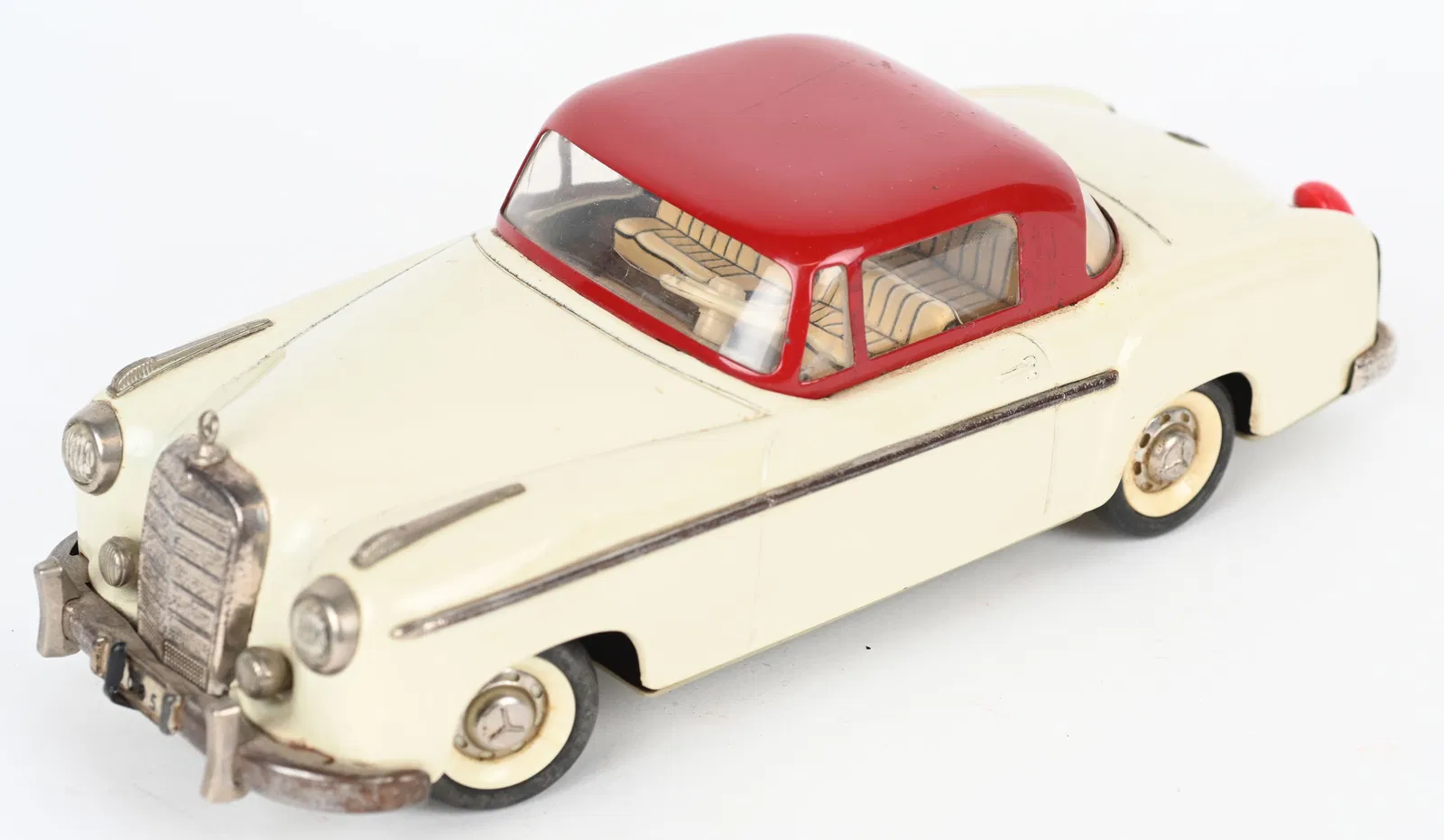
Lot # 0040A, a Schuco Rollfix 1085 Mercedes Coupe, is estimated at $600 to $800. Image courtesy of Milestone Auctions.
Schuco Rollfix 1085 Mercedes Coupe Toy
This Schuco toy sale rounds out with tumblers, vanity items including compacts and perfume vials, miniatures, ephemera, and miniature versions of industrial, racing, and aspirational vehicles. Lot 0040A, a Schuco Rollfix 1085 Mercedes Coupe, is estimated at $600 to $800. This working two-door car has a cream-colored exterior with silver metal trim, grill, bumpers, and headlights. The top is red with a matching dark cream steering wheel and interior. The auto glides upon four whitewall tires and measures about 10 inches long overall.