Guitar Kurt Cobain sensationally smashed at pre-fame gig to express the nihilism of grunge headlines Hake’s Nov. 19-20 pop memorabilia auction

Rock artifact of immeasurable importance was retrieved by local bass player after Jan. 18, 1991 concert and gifted to record shop owner who kept it safe for 33 years despite two break-ins
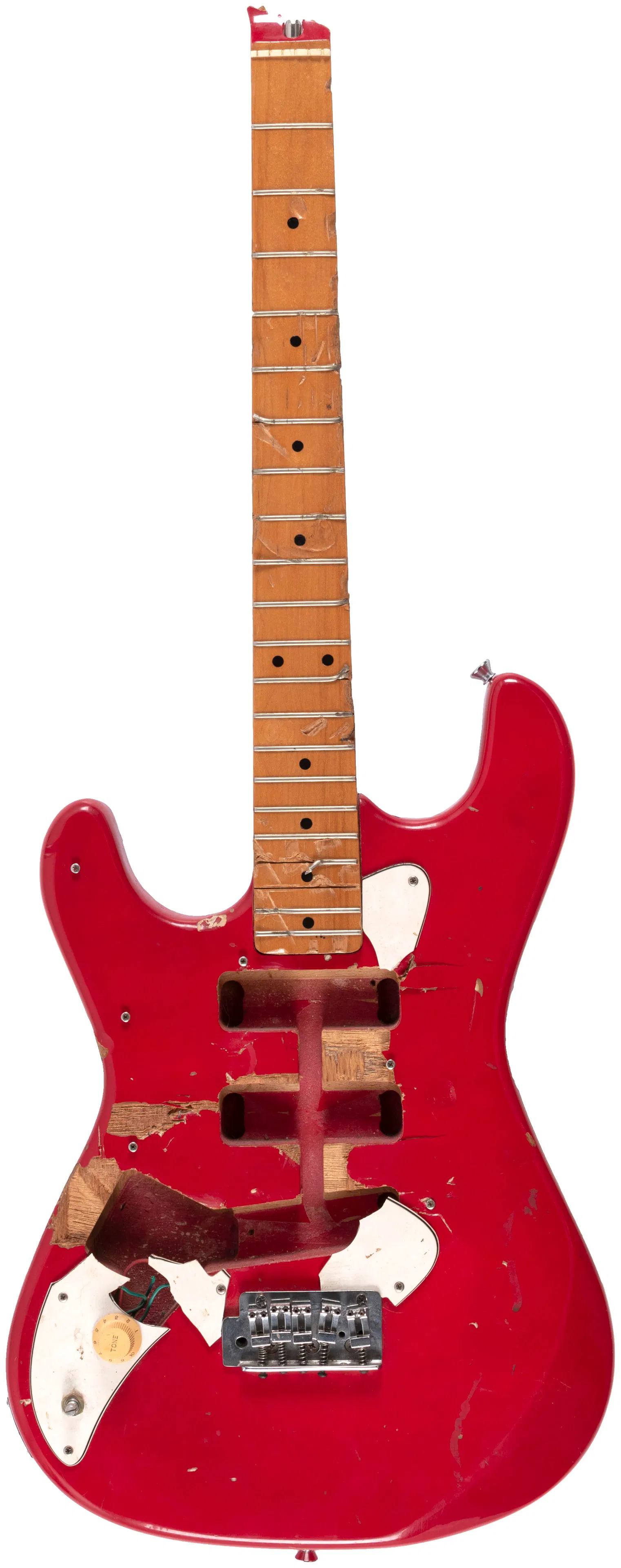
Nirvana Kurt Cobain Stage Used And Smashed Guitar Jan. 18, 1991 Olympia, Wa.

YORK, Pa. – Hake’s will crank up the volume to 11 on November 19-20 as they auction the single most important rock music artifact to pass through their hands in 57 years as pop culture specialists. After not-so-quietly residing in a private collection since 1991, the Japanese-made guitar that a barely-known Kurt Cobain trashed onstage at a small gig in Washington will re-emerge, with a story that deserves its own chapter in the history of grunge.   

It all began on January 18, 1991, in Olympia, Washington, about an hour away from the Pacific Northwest’s music capital, Seattle. On a makeshift stage at The Evergreen State College Library, fewer than 500 local scenesters coughed up $4 each to attend an anti-Gulf War benefit concert headlined by an up-and-coming local band, Nirvana. Few in attendance could have imagined how famous or influential the band would become later that year with the release of their career-changing single Smells Like Teen Spirit, from the LP Nevermind. The band’s set that night in Olympia culminated with Cobain’s violent destruction of a red-and-white Memphis Stratocaster-replica guitar, which was discarded and ultimately recovered by Chris Brady, bassist in the band Pond. Later, Brady gifted the battered instrument to his good friend Janel Jarosz, owner of The Ooze, a Portland, Oregon, record shop. It would go on to serve as the centerpiece of a Nirvana display that won a national MTV-sponsored contest. 

Jarosz, a huge Nirvana fan who also played in a band called Trailer Queen, cherished the guitar and kept it safe, even securing it to her record shop’s ceiling after two break-ins. Now, after 33 years of ownership, she has entrusted Hake’s to auction the historical music treasure. Jarosz discusses its background alongside Brady in an entertaining Hake’s-produced video that is a must-see for grunge fans. The guitar has an open-ended auction estimate, with a required starting bid of $20,000. 

Another tremendous Nirvana memento is the original, one-of-a-kind hand-cut/applied mechanical master art for the poster publicizing the band’s April 17, 1991 concert at the OK Hotel in Seattle. It was on that occasion that Nirvana live-debuted the grunge anthem Smells Like Teen Spirit. The art is signed and inscribed in pencil on verso by the late Seattle artist Mark Bendix with the notation “Original Paste Up Master MB.” Accompanied by a bill of sale dated and signed by both Bendix and the auction consignor – who acquired it directly from the artist – it is expected to make $10,000-$20,000. 

Other grunge-related items include a 1991 Nirvana tour crew shirt (one of fewer than 20 made), Cobain’s high school yearbook, and many signed records. Cobain’s signature appears on both 7-inch and 12-inch singles; as well as on a boxed set also signed by Dave Grohl and Courtney Love. The auction’s impressive selection of concert posters covers many music genres, including grunge, early blues, and psychedelic rock. 

Hake’s will once again head off to a galaxy far, far away with Star Wars rarities to amaze even the most advanced collectors. Topping the list is a Kenner Star Wars (1979) Boba Fett rocket-firing L-slot prototype action figure, 3.75 inches tall, unpainted and encapsulated; and AFA-graded 85 NM+. The 

L-slot rocket-firing mechanism – significant because its spring raised safety concerns that would thwart the proposed production run – is clearly visible from the back of the case. A top prize in the world of Star Wars collectibles, this high-grade prototype comes with a notarized CIB COA and is estimated at $100,000-$200,000.

A Kenner Star Wars: The Empire Strikes Back (1980) Princess Leia Organa prototype action figure/doll dressed in a Bespin Gown is from the unproduced 12-inch series. The figure has a 1978 stock Princess Leia body with a different, hand-painted head and hair hand-rooted in a pattern that is different to that of other 1978 Star Wars dolls. Estoteric and important, this rarely-seen prototype is one of only a handful that were produced. With its CIB LOA, it will open for bidding at $25,000.

The lineup of exotic offerings continues with a Belloq (in ceremonial robe) action figure from The Adventures of Indiana Jones in Raiders of the Lost Ark (1983). The Series 2/9 Back action figure on card is fully authenticated and AFA-graded 50 VG in archival case. Initially, this figure was offered as a boxed mail-order premium, but it was never marketed to the public as part of a traditional distribution. Only a few of these figures are believed to have been packaged on cards, and presumably they were produced prior to the cancellation of Kenner’s toy line for the associated film. One of only four AFA-graded examples of its type, the Belloq figure conveys with a CIB COA. Estimate: $20,000-$35,000

Masters of the Universe fans won’t want to miss out on the opportunity to add a complete 1986 Eternia Series 5 playset to their collections. AFA-graded 70 EX+, the set’s second-release box has a full-color label featuring art by William George. Housed inside are three themed towers, three battery-operated vehicles, a monorail system, and scores of accessories. The box retains its original “Clearance Special” store price sticker indicating a discounted price of $69.90. Estimate: $10,000-$20,000

Turning to the popular category of Hollywood props, a top selection is a screen-used Wasp stunt helmet from Ant-Man and The Wasp. The iconic and readily-identifiable helmet was part of the Wasp suit received in the film sequel by Hope van Dyne (played by Evangeline Lilly), daughter of the first Ant-Man and her mother, the first Wasp. It is an actual stunt prop, as opposed to a piece that might have been used purely for still visuals or closeups. Estimate: $10,000-$20,000

An important Silver Age comic book, The Amazing Spider-Man #1, was issued by Marvel Comics in March 1963 and has been CGC-graded 7.5 VF. The book features first appearances of J. Jonah Jameson and The Chameleon, retells the origin story of Spider-Man, and is notable for being the first Fantastic Four crossover. A classic that combines a Stan Lee story with Jack Kirby and Steve Ditko’s cover art, and interior art by Ditko, this comic is entered with a pre-sale estimate of $35,000-$50,000.

The political section includes one of the most sought-after of all campaign buttons and also introduces the finest political china collection ever assembled. There would be no argument amongst collectors that an extraordinarily rare “Cox Roosevelt Club” Presidential campaign button Hake #1 is comparable to a copy of Action Comics #1 or a Honus Wagner T206 baseball card. Its image depicts 1920 election running mates James M Cox and Franklin Delano Roosevelt, and like all Cox/Roosevelt jugate buttons, it is considered a salesman’s sample. Sized 1 inch in diameter, this button was the crown jewel of the John Gearhart collection and now comes to auction with a $50,000-$75,000 estimate. 

In the opening session of the November 19-20 auction, Hake’s will introduce Part I of a political china grouping that is truly second to none: the private collection of legendary Americana dealer Rex Stark (1947-2023). The rarity, beauty and condition of each piece in this spectacular ceramics trove is something one would expect to see in only the most exceptional museum collection. Just one example is a circa-1841 green-sponged and glazed pearlware handled mug emblazoned “John Tyler” and decorated with the American Seal and polychrome accents. It is an actual book example seen in Anglo American Ceramics, by David and Linda Arman. Near mint and free of restoration, its auction estimate is $2,000-$5,000.

The World Series may be over, but bidders are expected to step up to the plate when a 1917 Collins-McCarthy Candy Co. E135 #82 Shoeless Joe Jackson baseball card crosses the auction block. From a 200-card series, this well-preserved example shows a bright, clean image of Jackson in his Chicago White Sox uniform, complete with shoes. Designated “Authentic-Altered” by PSA due to the slightest margin trim, it is one of only 11 known cards of its type in any condition. Estimate: $10,000-$20,000

Hake’s Nov. 19-20, 2024 online auction is now open for bidding. For a free printed catalog or additional information on any item in the sale, call +1 866-404-9800 (toll-free) or +1 717-434-1600; or email [email protected]. View the fully illustrated catalog online and sign up to bid at https://hakes.com/.

A video of Chris Brady and Janel Jarosz discussing the history and acquisition of the Kurt Cobain guitar can be viewed at https://www.youtube.com/watch?v=kLMn9oDhPbw.
Bertoia’s Nov. 22-23 auction welcomes holiday season with pedigreed antique toys, trains and banks of superlative quality

Featured: Stunning Marklin Oceanliner Amerika, $80K-$120K; newly discovered Ives Cutter Sleigh with rare original figure, $50K-$100; Bill Becker’s Issmayer trains, Ron Sieling’s cast iron toys & trains

The Marklin Oceanliner Amerika

VINELAND, N.J. – No other collector-focused event embraces the arrival of the holiday season with as much spirit as Bertoia’s Annual Fall Auction, which will be held this year on November 22 and 23. Collectors know they can count on the Bertoia family’s final antique toy sale of the year to include rare and exquisite pieces from decades-old collections. 

The auction’s long list of featured collections is crowned by Ron Sieling’s ultra-rare Vindex and other cast-iron automotive toys; Bill Becker’s fine Issmayer trains and stations; cast-iron floor trains from the Rick Ralston and Cantey Johnson collections; and Bob and Dee Vicic’s still banks. Additionally, there are European tin, Lehmann and comic character toys; German boats, delightful penny toys, and the final offering of spelter banks from the Jim & Genia Willett collection. Blue-chip provenance underscores the impressive auction trove, which is backed by a who’s who of past owners that includes Donald Kaufman, Dick Ford, Fred MacAdam, Bill and Lillian Gottschalk; as well as other visionaries who were active during the golden era of toy collecting.  

The Ron Sieling collection reflects 50 years of careful acquisition and is represented in 300-400 lots of cast-iron automotive and tin toys plus another 40 lots of mechanical banks. Especially prized amongst the cast-iron vehicles are Sieling’s half-dozen original Vindex showroom samples with original paper tags, including a Henderson motorcycle with sidecar formerly owned by Dick Ford and Fred MacAdam. It is entered in the sale with an $8,000-$12,000 estimate.  

The factory-samples grouping is one of only two known complete sets of its type. As Sieling noted, “All are full-size toys that a Vindex salesman would have carried in a case. Vindex toys are very rare because the manufacturer was only in business for three years before the Depression put them out of business.” The cherished samples are flanked by dozens of other unplayed-with, mint-condition cast-iron vehicles. 

Horse-drawn cast-iron toys include Pratt & Letchworth and oversize productions, as well as a few classic Hubley brakes (two-, three- and four-seat variations), but setting the pace for the category is a handsome Ives Cutter Sleigh with its extremely rare original factory figure. Until its discovery in a Virginia residence in 2023, only one other Ives Cutter Sleigh with its original figure had ever been documented, and that was the one famously owned by early American toy collector LC “Covert” Hegarty (1902-1968). Sure to deliver excitement to the Saturday session, the 21-inch-long sleigh consigned to Bertioa’s is expected to dash away for $50,000-$100,000.

The selection of cast-iron mechanical banks includes a Darktown Battery, Professor Pug Frog, Dentist, Panorama, and an Atlas bank with paper globe that is one of the nicest ever to reach the marketplace. Nearly all mechanicals entered in the sale are graded Pristine to Near-Mint. And speaking of condition, it would be a challenge to find fault with the Shepard Hardware Jonah and the Whale bank estimated at $10,000-$15,000. Its rich colors and crisp casting truly must be seen to be believed. 

Figural cast-iron doorstop collectors will have their pick of rare and expertly-curated pieces. November highlights include a three-dimensional 12.5-inch Hubley Giraffe, $6,000-$8,000; and an all-original Uncle Sam produced with the words ‘FOR THE OPEN DOOR’ stenciled on its base, a reference to America’s “Open Door” trade policy with China. Estimate; $6,000-$10,000

The Bob and Dee Vicic collection of cast-iron still banks was established in 1969 and grew to include a great variety of forms, e.g., figures, animals and buildings, with the common thread being color and visual appeal. One of their great favorites is an AC Williams’ arch-top auto with passengers that took the couple 20 years to track down. Its auction estimate is $1,000-$1,500. Two Arcade Taxi Cab still banks – one in dark green/black and the other in orange/black – are similarly estimated at $1,000-$1,500. In addition to the Vicics’ many rare and choice banks, the sale includes the final installment of Jim and Genia Willett’s German spelter banks.

The November auction will present the extensive Bill Becker collection of Issmayer trains and train stations. Exhibiting high condition throughout and boasting numerous published examples, the Becker collection easily warrants the description of “world class.” Several of Becker’s trains were photographed for inclusion in highly-regarded British reference books about Issmayer. 

The fall auction will also formally introduce the Lionel train and trolley collection of the late Bradley Kaplan, a well-liked and highly respected member of the Train Collectors Association (TCA) who was known for buying only the very best. One of the fine, early trolleys that took pride of place in Brad’s collection is a boxed Lionel No. 1 with its original “people catcher.” Displaying the sort of primitive charm so appealing to collectors, its sides are marked No. 1 Electric Rapid Transit No. 1. The 9.5-inch trolley in excellent condition could ring the auction bell in the $4,000-$7,000 range. In addition, the category features cast-iron trains from the Rick Ralston and Cantey Johnson collections, including productions by Carpenter, Kenton, Secor and Wilkins. 

Fans of top-shelf German-made Marklin trains are always on the lookout for railroad cars with eye-catching advertising on their sides. In their November auction, Bertoia’s answers the demand with an all-original O gauge car advertising “Schlitz The Beer That Made Milwaukee Famous.” In excellent condition, this colorful piece has a long family provenance and has been consigned by a grandson of its original Midwest USA owner. Estimate: $8,000-$12,000

Pressed steel devotees can look forward to bidding on scarce SturdiToy, Buddy ‘L’ and boxed Smith-Miller vehicles. Two excellent American National Packards – one of them being the incredible ex-Donald Kaufman Fire Chief car, estimate $10,000-$15,000 – round out the category in high style. 

Antique and vintage tin toys of every imaginable type will be offered, including Japanese battery-operated robots and space toys. A boxed Nomura battery-operated Walking Batman with an illuminating face will stride across the auction block in Near-Mint condition. Estimate: $6,000-$10,000 

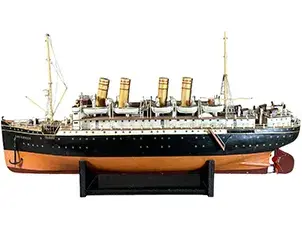
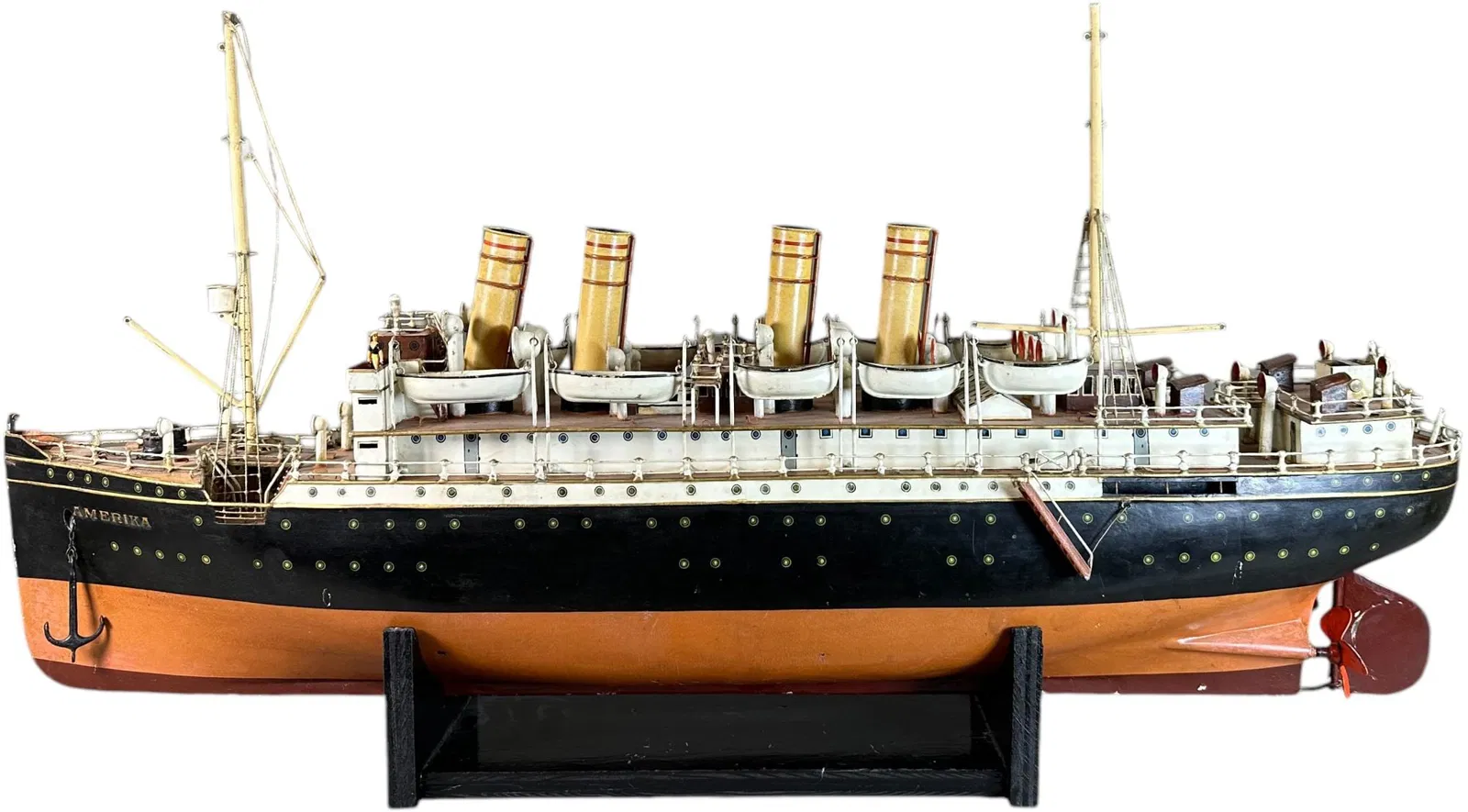
European productions include German-made Lehmanns (Lo-Li, Primus roller skater, etc), automotive toys, windup motorcycles and early German boats. A spectacular early-20th-century Marklin Oceanliner Amerika, a four-funnel, clockwork-powered tin vessel in unimpeachable condition, retains its original lifeboats, masts and upper-deck appointments. A stately 38 inches long, it carries an $80,000-$120,000 estimate. 

Desired by collectors of both German automotive and Christmas antiques, a Tippco lithographed tin windup Santa Claus Driving Auto is in bright, all-original condition and decorated with wonderful graphics of Christmas toys. The 12.5-inch-long convertible in Pristine to Near-Mint condition was formerly in the Curtis and Linda Smith collection. Estimate: $20,000-$40,000

Bertoia’s Friday/Saturday November 22-23 Annual Fall Auction will take place at the company’s spacious gallery located at 2141 DeMarco Drive, Vineland, NJ 08360. Start time: 10 a.m. ET each day. Bid absentee, by phone, or live online through Bertoia Live or LiveAuctioneers. An open preview will be held daily during normal business hours during the week prior to the sale. Preview privately by appointment only. For additional information on any item in the auction, to organize a private preview or to reserve a phone line for bidding, please call +1 856-692-1881 or email [email protected]

Michael Bertoia, welcomes the opportunity to discuss the consignment process with collectors, whether they wish to auction a single piece or entire collection. All enquiries are kept strictly confidential and there is never an obligation to consign. Visit Bertoia’s online at www.bertoiaauctions.com

Extraordinary antique breweriana collection of former Anheuser-Busch exec on tap at Morphy’s, Nov. 13-15

Jim and MaryBeth Fischer collection presents visual history of how 19th/20th-century American breweries promoted their products through exquisite signage designed by fine artists

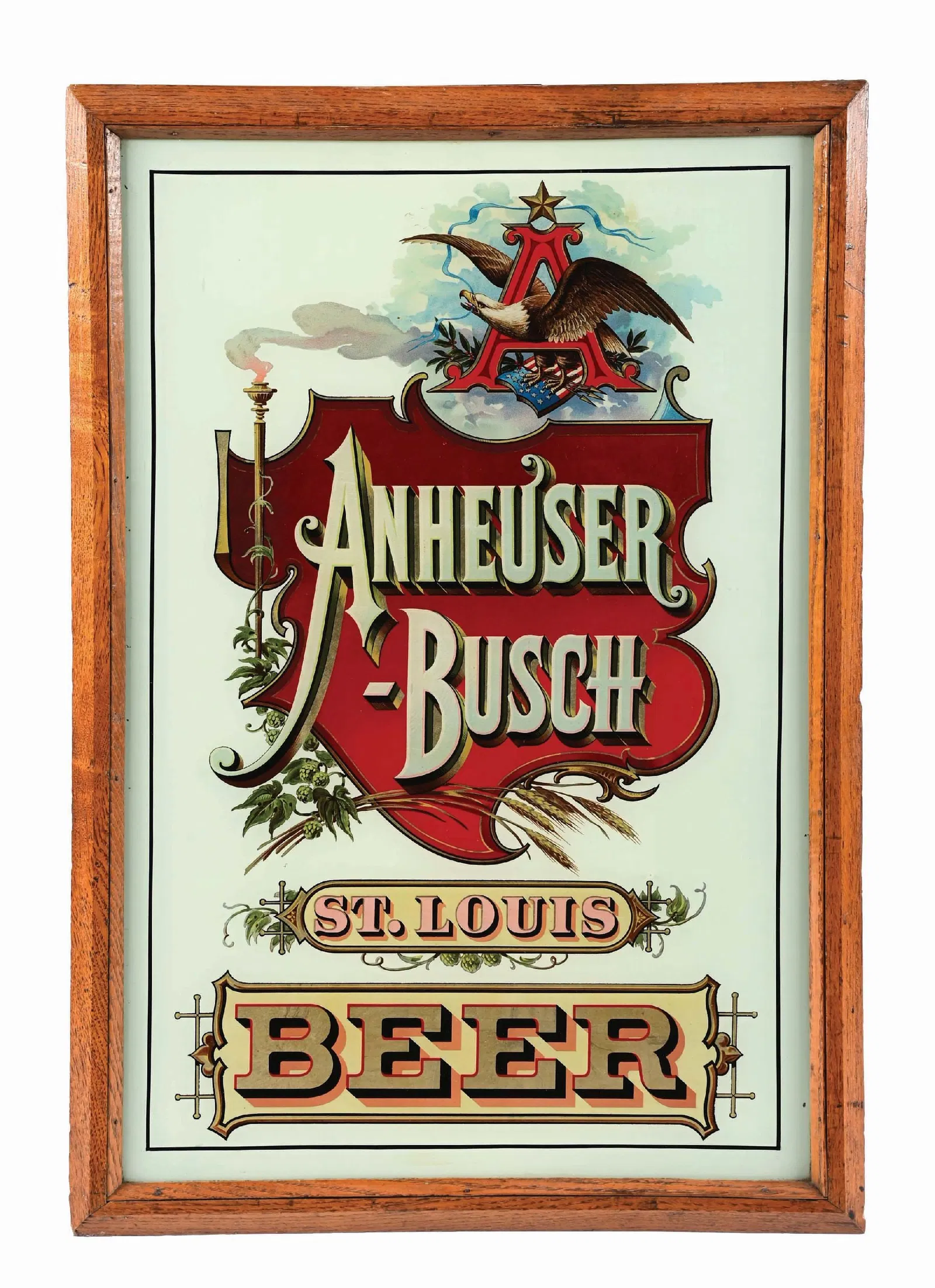
Anheuser-busch Beer Reverse Glass Corner Sign

DENVER, Pa. – Dan Morphy, founder and president of Morphy Auctions, takes pleasure in announcing the November 13-15 auction of one of America’s most exceptional private holdings of antique breweriana: the Jim and MaryBeth Fischer collection. Amassed over 50 years, the couple’s assemblage of rare and unique advertising and merchandising artifacts spans a significant 100-year period that began in the late 1800s, when fine artists and skilled craftsmen combined their talents to create pieces of incomparable and enduring quality.

The 1,416-lot auction is highlighted by many items that are either exquisitely rare or the only known examples of their kind. In addition to breathtaking antique signs of every imaginable variety from obscure, smaller breweries and great legacy brands, the auction lineup casts a wide net across many other types of beer-related collectibles. There are lithographs, chargers, serving trays, calendars, steins, clocks, historical awards and medals; and a fantastic variety of company-branded jewelry and premium items. 

The lifetime hobby that culminated in the Fischers’ awe-inspiring collection of antiques closely parallels Jim’s own career, which included many years in an executive role at the Anheuser-Busch brewing company in St Louis. It was there, Jim said, that his passion for collecting was taken to a whole new level. Later, when he moved on to establish his own software-development firm, there was no question as to how the walls of his corporate offices would be decorated, since the couple’s collection had already grown to the point that it adorned all three floors of their spacious home.

But then the unexpected happened. COVID arrived on U.S. shores. “The pandemic caused the closure of my physical corporate offices and we had to move much of that part of our collection to a commercial storage facility,” Jim said. After that, he and MaryBeth made the decision to send their collection to auction so that, in Jim’s words, “others could enjoy these great items as much as we have.”

Naturally, the collection includes a spectacular array of early Anheuser-Busch signs, led by an extremely rare reverse-on-glass corner sign. Marked on both sides with the patent date “December 13, 1892,” the 17¾- by 25¾-inch sign is in enviable condition, graded an unbelievable 9.0 out of 10. Exceptionally bright and displaying deep, rich colors, it is one of the most highly-prized pieces in the Fischer collection. The pre-sale estimate is $20,000-$40,000.

Another remarkable work of art is the large 3D self-framed plaster sign advertising “Anheuser-Busch Brewing Assn, St. Louis, Mo, USA.” Its fastidiously-detailed relief image depicts St Louis streets with horse-drawn beer delivery wagons and an Anheuser-Busch train. Mounted in its original wood-frame shadowbox, this pre-Prohibition piece dating to circa 1900-1910s is one of few known examples of its type. It measures 56¾ by 43 inches, is graded a condition 8.0, and will be offered with a $15,000-$30,000 estimate.

An important piece of Anheuser-Busch history is captured in a copyright-1879 lithograph promoting “Eberhard Anheuser Co’s St Louis Lager Beer.” Its main image is a profusely illustrated scene of cherubs in a beer garden, with a superimposed cartouche that depicts a large bottle of beer and the company’s bottling plant. The masterful artwork by Moritz Ulffers (German, 1819-1902) incorporates illustrations of the 1876 Philadelphia First Prize Medal and 1878 Paris Grand Gold Medal Brewer’s Award, both won by Anheuser. Sized 41 by 34 inches and in 7.75 condition, this accomplished artwork will cross the auction block with a $12,000-$24,000 estimate.

Just as Coca-Cola found success with its visuals of model Hilda Clark, Anheuser-Busch had a 19th-century brand ambassador known as “The Hostess.” Readily identifiable by her pink dress, The Hostess appeared in numerous advertisements, including a circa-1888 lithograph entered in the auction with a $10,000-$20,000 estimate. The litho is printed on a heavier-weight cardboard and mounted in a well-detailed mahogany and marbled-wood frame with a brass plaque marked The Hostess. Sized 62½ by 28 inches and graded 7.0 out of 10, its estimate is $10,000-$20,000.

The Fischer collection also contains the best of all known examples of a reverse-on-glass “label” sign for American Brewing Co., Saint Louis, that touts “The ABC Bohemian / Brewed from THE CHOICEST BOHEMIAN HOPS.” The colors and detail work on this 34 by 26½-inch sign are beyond compare. Its original oak and gilt frame is marked on verso to indicate that it is “free float mounted” and was “bees wax sealed.” A strong condition 8.75, this prized piece comes to auction with a $15,000-$30,000 estimate.

Issued by P. Schoenhofen Brewing Co., Chicago, a lithographed-cardboard advertising sign depicts a young woman in Tyrolean attire standing atop a mountain and removing a bottle of beer from her shoulder bag. Imprinted with the message FOUND IN HIGH PLACES / EDELWEISS BEER, this attractive, vibrantly-hued pre-Prohibition sign is copyrighted 1904 and graded condition 7.75. Estimate: $8,000-$16,000.

Busch-branded ceramics figure prominently in the collection and are topped by two stunningly beautiful hand-painted and gilded “pokals,” or celebratory vessels. One of them, a double-handled design in red with gilt trim, has main images of the Budweiser goddess with an eagle, and a maiden with an eagle, on Sides A and B, respectively. Hunting dogs and horses are seen in cartouches on its pedestal. A sensational turn-of-the-20th-century production, its condition is 8.5. Auction estimate: $15,000-$30,000.

Other company-branded ceramic rarities include a unique 1888 double-handled 5-gallon picnic jug, condition 9.0; and a possibly unique 1890s arboreal-form umbrella stand, condition 8.0. Both were crafted from brown clay at the St. Louis Sewer Pipe Co., and were personally commissioned by Adolphus Busch. Each carries a pre-sale estimate of $8,000-$16,000.

“The auction of Jim and MaryBeth Fischer’s incredible collection is destined to be one of the most exciting and memorable events in Morphy’s 20-year history,” Dan Morphy said. “Upon first seeing the collection, our team recognized its importance and felt a sense of pride being involved in the process leading to its auction. Every step of the way, they’ve been laser-focused on making sure the collection receives VIP treatment, from the way it’s presented in the hardcover catalog to how it’s displayed at the gallery. It is a literal time capsule documenting one of the most successful and important industries of 19th- and 20th-century America. We’re so grateful to Jim and MaryBeth for allowing us to be a part of their collection’s ongoing journey.” 

Morphy’s November 13-15, 2024 auction of the Jim and MaryBeth Fischer breweriana collection will be held live at Morphy’s gallery, 2000 N. Reading Rd., Denver, PA 17517, starting each day at 9 a.m. Eastern Time. All forms of bidding will be available, including absentee, phone and live via the Internet through Morphy Live. For questions pertaining to any item in the auction, to leave an absentee bid, reserve a phone line, or discuss consigning to a future breweriana auction at Morphy’s, call 877-968-8880 or email [email protected]. Visit Morphy’s online at www.morphyauctions.com.

Button-In-Ear Beauties: Ladenburger Spielzeugauktion’s November 2024 Steiff Archive Auction

Rare Steiff brand button-in-ear Teddy bears, dolls, novelties, and other animals continue to capture the imagination and wallets of collectors worldwide. To strategically reconfigure and consolidate storage space within the company’s physical spaces, the Steiff company of Giengen, Germany has started to deaccession some redundant items from their overflowing archives. The toymaker has partnered with auctioneer Ladenburger Spielzeugauktion of Ladenburg, Germany to rehome these fine archival items over a series of sales events. The first Steiff archive auction, which includes over 500 lots, will be held on November 23, 2024. Here are a few of the extraordinary highlights.

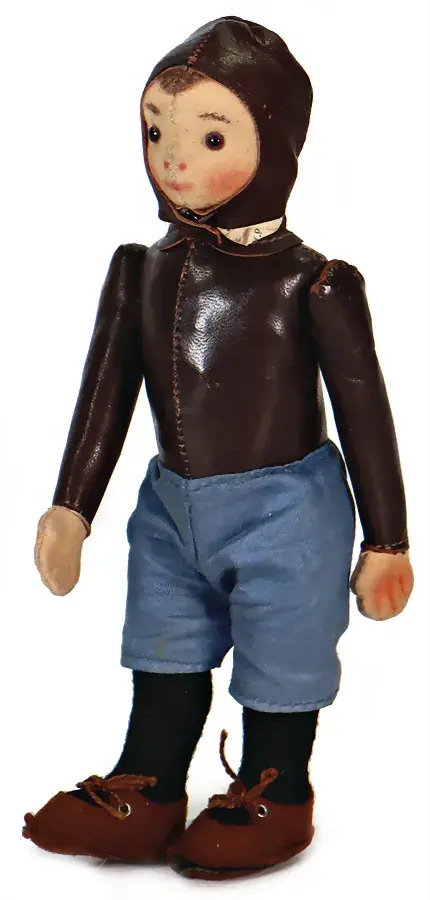
Lot #161, a doll dressed as a pilot or race car driver, has an opening bid of EUR 560. Image courtesy of Ladenburger Spielzeugauktion.
Lot #161, a doll dressed as a pilot or race car driver, has an opening bid of EUR 560. Image courtesy of Ladenburger Spielzeugauktion. 

This sale includes several breathtaking early prewar felt dolls, including several examples that seldom if ever are seen outside of museums or premier collections. Lot #161, a fully-jointed male doll dressed as a pilot or race car driver, has an opening bid of EUR 560. He was made in 1925 and is 20 cm tall. He wears a leather jacket and hat, cotton pants, and felt shoes. His face is detailed with proportional brown and black glass pupil eyes, painted eyes and lips, and a distinctive center seam. He is branded with a Steiff button and a white ear tag. He also has his original round cardboard Steiff archive tag attached to his backside.

This doll is extraordinary for several reasons. His petite size is unusual, with most Steiff dolls of his era measuring at least 28 cm tall. His pattern does appear in the Steiff literature as a pilot for a wooden steering plane, which appeared in the line from 1925 to 1928, and as the driver for a wooden steering car, which appeared in the line from 1925 to 1929. However, in both cases, the vehicle operators are noted at 28 cm tall, and this specific example measures 20 cm tall. He is also dressed in a well-configured leather top which is integral to his body. As far as this author knows, this is the only time Steiff has used leather to create an integral, full garment on a doll from any era.

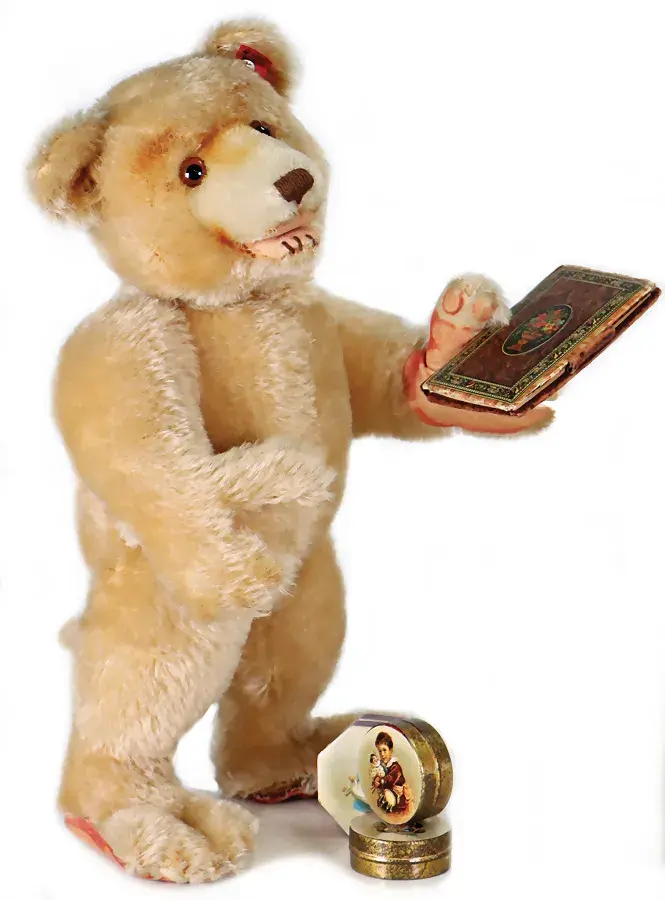
Lot #134, a Snap Dicky bear, has an opening bid of EUR 5,500. Image courtesy of Ladenburger Spielzeugauktion.

Archival quality bears are also a key category in this Steiff archive auction. Lot #134, a Snap Dicky bear, has an opening bid of EUR 5,500. This item was made in 1936 and is only one of five examples extant. Dicky is 31 cm tall and made from golden blonde mohair. His paw pads are made from velvet and are stenciled with fingers and toes. His face is detailed with brown and black glass pupil eyes, an inset muzzle, a brown hand-embroidered nose, and a prominent open mouth. His IDs include his period-appropriate Steiff button, red ear tag, and original archive tag attached to his rear. What makes this bear design so spectacular is his jointing. He is fully jointed, has a tail-moves-head mechanism, and features a series of snap joints in his hands, feet, mouth, and torso that allow him to make and hold various comical positions.

This novelty bear is based on the company’s standard line prewar Dicky bear pattern, which only featured standard five-way jointing. Margarete Steiff’s nephew Hugo Steiff designed this bear at a time when new product development focused on two areas: inexpensive production and very high-end production. Low-end production included items like the company’s woolen pom-pom miniature line. Snap Dicky was part of the very high-end line, intended for consumers who still had significant financial resources at this very challenging socio-political period in history. Snap Dicky never went into full production, probably because his design was very laborious and intensive to produce; mohair and metal elements were rationed for military purposes; and the overall concept did not make sense from a supply and demand perspective.

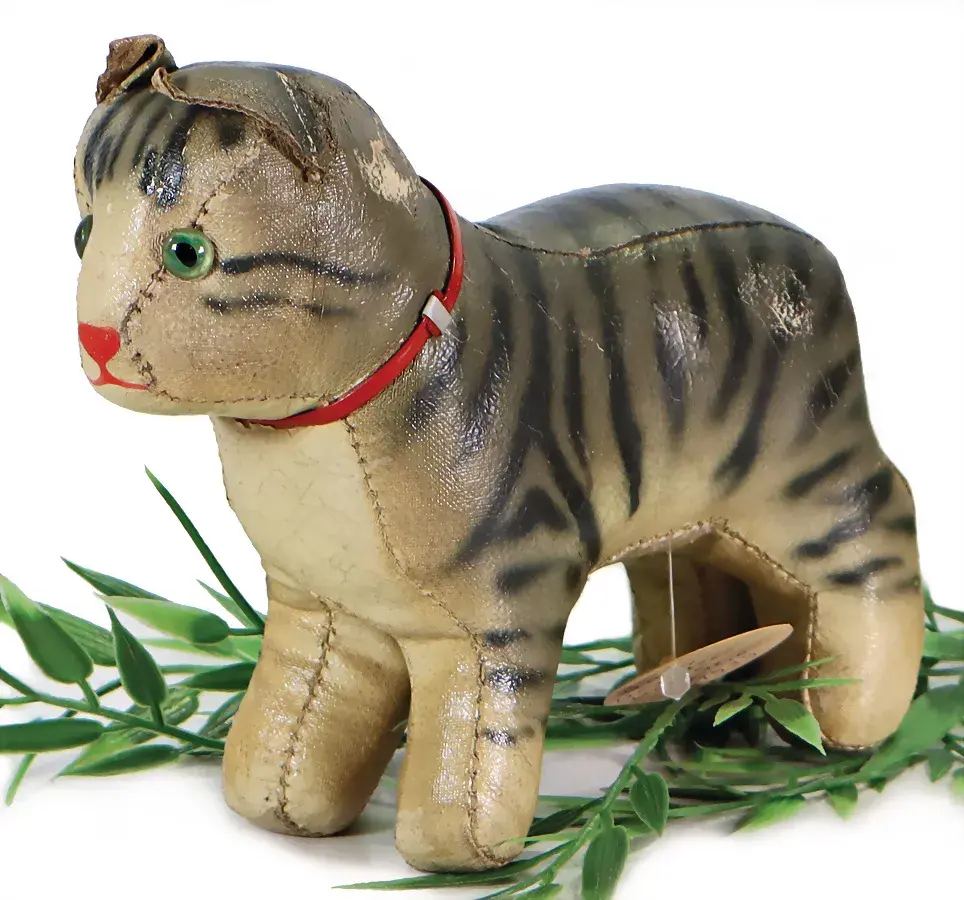
Lot #61, a waterproof cat designed as a bath toy, has an opening bid of EUR 180. Image courtesy of Ladenburger Spielzeugauktion.

Household pets– including cats and dogs– have always been an important part of the Steiff line over the company’s 140+ year history, and this sale offers a full kennel’s worth of rarity temptations. Lot #61, a waterproof cat toy designed as a bath toy, has an opening bid of EUR 180. It is from 1939 and measures 12 cm tall and 15 cm wide. The cat is standing and unjointed and is made out of oilcloth and stuffed with kapok. It is painted with brindle stripes, has green and black glass slit pupil-style eyes, and is decorated with a red collar. This rare hand sample retains its original Steiff archive tag.

This cat novelty appeared in the Steiff catalog from 1939 to 1941 and was produced in 10 and 12 cm. Other bath items produced at the same time include a duck and a Fox Terrier. This bathtime kitty is based on the company’s late 1930s Tabby design. Steiff’s production was grinding to a halt due to wartime shortages and related issues as this novelty debuted. Its concept filled several business purposes. It was made from inexpensive oilcloth, which unlike mohair or felt was available at the time. It was easy to manufacture and required minimal labor or experience to assemble. It was in the form of a cat, so its success was almost guaranteed. It was innovative from the new product introduction perspective, being part of the debut (and perhaps only) series of buoyant, oilcloth bathtime toys for babies.

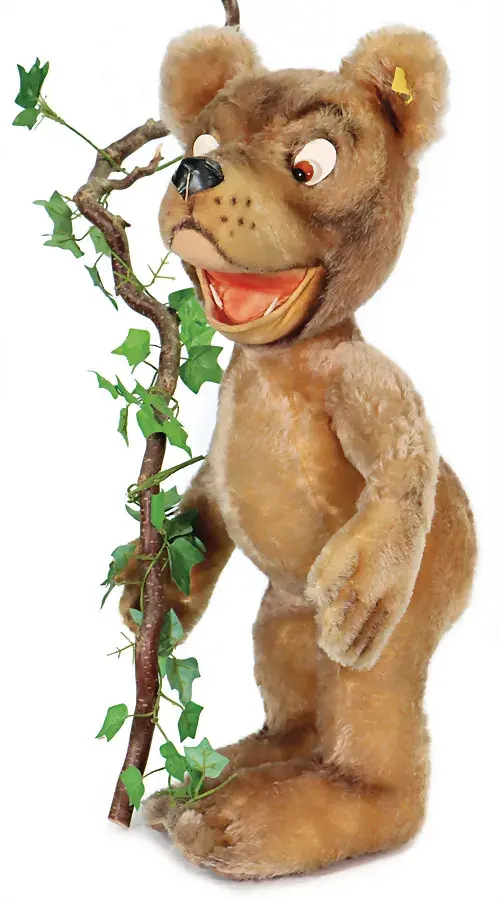
Lot #151, a caricatured bear cub from 1953, has an opening bid of EUR 900. Image courtesy of Ladenburger Spielzeugauktion.

Prototypes that never went into production or were otherwise undocumented in Steiff reference materials are certain to catch the eye and interest of collectors worldwide. Lot #151, an unusual Steiff caricatured bear cub from 1953, has an opening bid of EUR 900. He is standing, 54 cm tall, made from caramel-colored mohair, and has unjointed limbs. His quirky face is detailed with oversized brown and black eyes backed in white fabric, a dimensional black nose, an open mouth, and wooden teeth. His IDs include a raised script-style Steiff button and a yellow ear tag with handwritten digits. Only three of these bears are known to exist.

According to Ladenburger’s experts, this bear is called the “Ford Bear.” It is very possible that he was designed as a “customer special.” These are items that Steiff designed and produced as special orders for companies, organizations, or special events. This otherwise mystery pattern has several features that are similar to other beloved and popular Steiff patterns introduced in the 1950s. They include elaborate eyes dramatically backed in white, as seen on the company’s Bambi fawn (produced from 1951 to 1972 in 14 and 22 cm); white wooden teeth and an open mouth, as seen on Steiff’s Bengal tigers (produced 14, 22, and 43 cm from 1959 to 1961); and a distinctly youthful presentation and toddler-esque proportions, as seen on the company’s sitting Jumbo elephants (produced in 22 and 35 cm from 1952 to 1975).

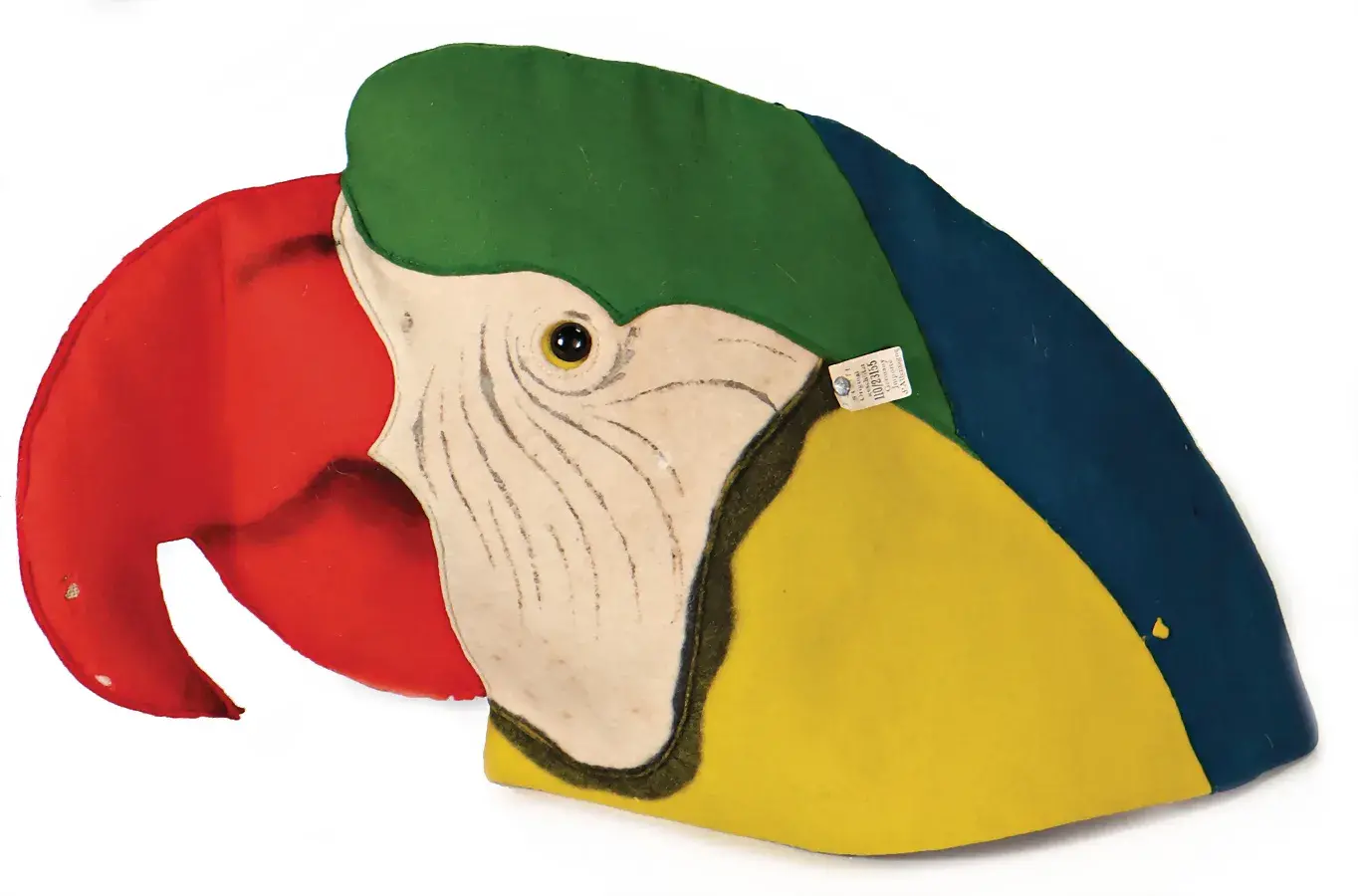
Lot #156, a festive hat in the form of a parrot head, has an opening bid of EUR 180. Image courtesy of Ladenburger Spielzeugauktion.
Lot #156, a festive hat in the form of a parrot head, has an opening bid of EUR 180. Image courtesy of Ladenburger Spielzeugauktion. 

This important sale rounds out with amazing birds, rabbits, farm and wild animals, items on wheels, and other novelties. Lot #156, a festive hat in the form of a parrot head, has an opening bid of EUR 180. This fantastic and rarely-seen accessory was manufactured in 1911 and is made from red, white, blue, yellow, black, and grey felt. It measures 40 cm wide and 23 cm high and is detailed with black shoe button eyes. It retains its button, white tag, and its original Steiff archive tag.

For more information on the November 23, 2024 Steiff Archive Auction by Ladenburger Spielzeugauktion, visit the company’s website.

Browse the latest auction previews and news on Auction Daily

A Painting by Dutch Caravaggist Hendrick Ter Brugghen Makes its Debut at Auction

The recently-discovered work by this Dutch painter forms a magnificent trio with his paintings on the same subject in Berlin and Madrid.

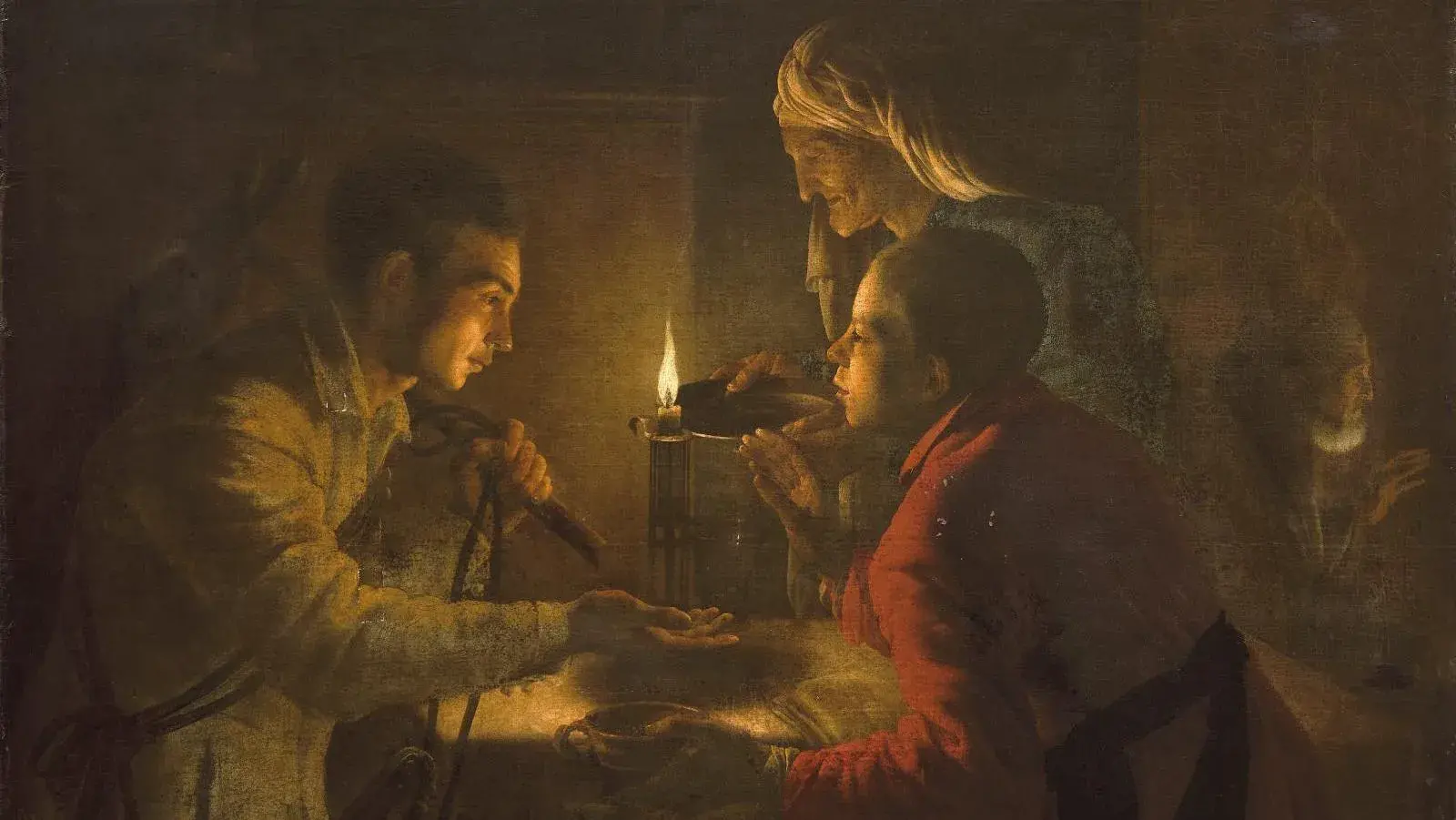
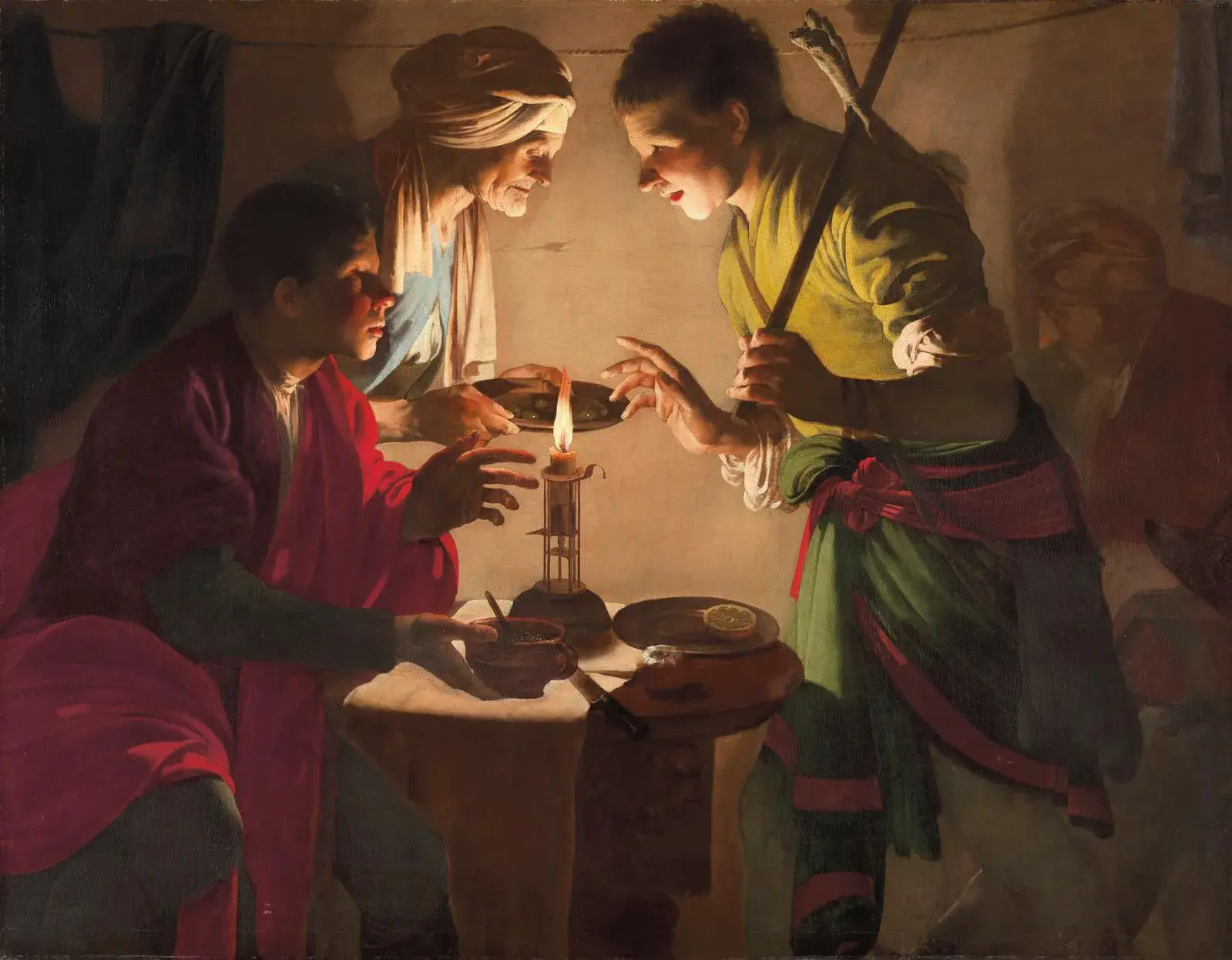
Hendrick Ter Brugghen (1588-1629), Esau Selling His Birthright, canvas, 123 x 162 cm/48.4 x 63.8 in.
Estimate: €200,000/250,000
Hendrick Ter Brugghen (1588-1629), Esau Selling His Birthright, canvas, 123 x 162 cm/48.4 x 63.8 in.
Estimate: €200,000/250,000

Art history is a long series of coincidences. This painting, which came from an English collection, could have already made an appearance twice, and illustrated a host of books on Caravaggio. This is because it was exhibited at Christie’s in London in April 1913 and June 1918, but on both occasions the family, no doubt regretfully, decided not to auction it at a time when little was known about the artist’s corpus. But 106 years on, it’s a different story. Ter Brugghen, whose catalogue raisonné was published by Leonard Slatkes and Wayne Franits in 2007, has now been studied in much more depth, especially since an exhibition held in Modena exactly a year ago showed many of the works under the artist’s name for the first time. This exhibition attracted a great deal of attention not only because of the ideas put forward by the curators, but also because The Mocking of Christ from the Palais des Beaux-arts in Lille, previously listed as a copy and relegated to the reserves, had been restored and was exhibited as an original. A fine gift for French museums, as the Metropolitan Museum in New York recently acquired a spectacular, previously unseen Roman Charity from Carlo Orsi. It was an auspicious time: not only did the painter become better known, but some of his works also resurfaced. So it was almost child’s play for expert René Millet to situate this Esau Selling his Birthright in Ter Brugghen’s artistic career.

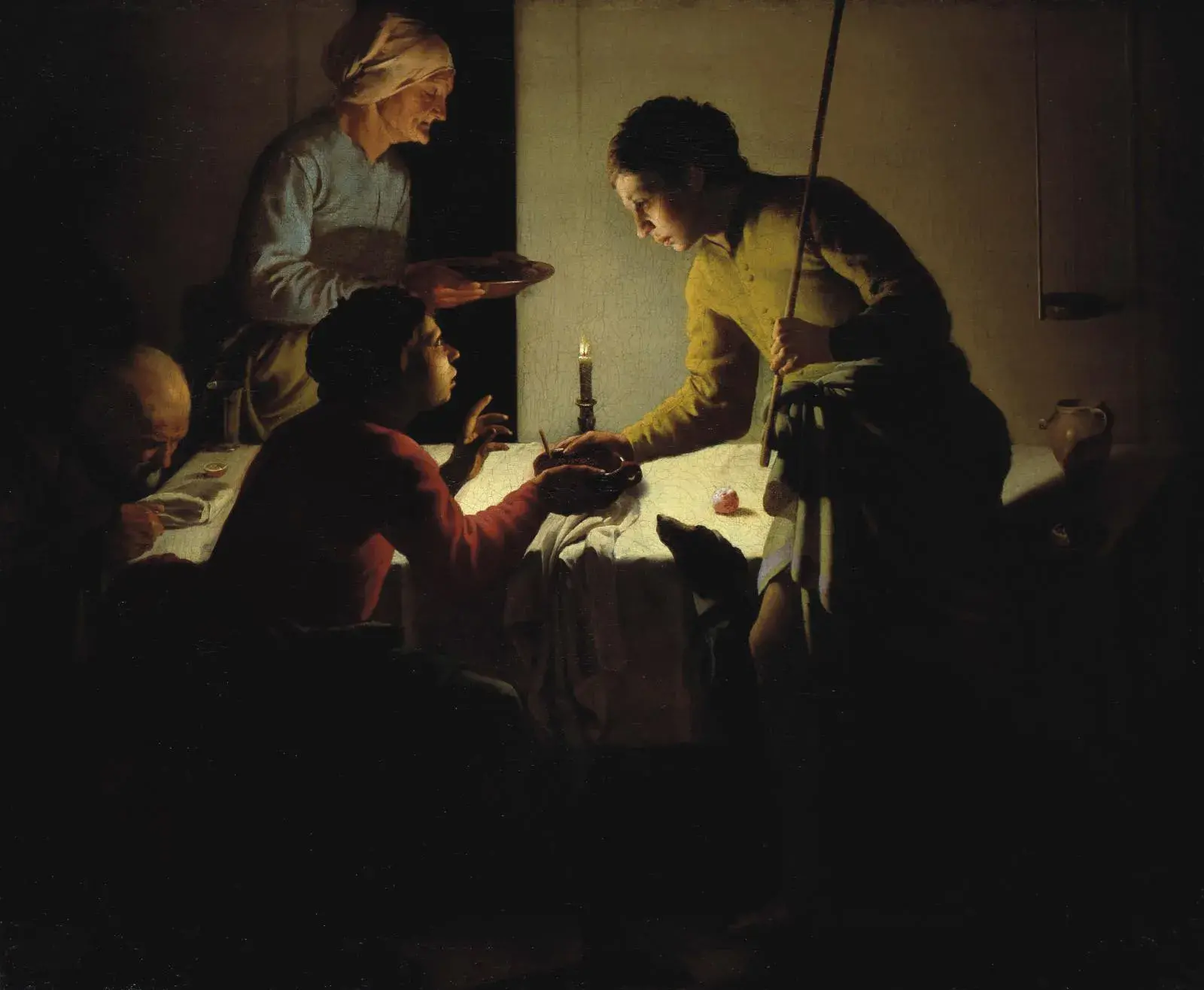
Hendrick Ter BrugghenEsau Selling His Birthright, 1626, oil on canvas, 94.8 x 116.3 cm/37 x 45.7 in, Gemäldegalerie, Berlin.
© Staatliche Museen zu Berlin, Gemäldegalerie/Jörg P. Anders

The painting is the culmination of the artist’s explorations of a theme he treated several times.

The Present and the Absent

The Utrecht Caravaggist School is one of the most spectacular and appealing, illustrating the spread of Caravaggio’s influence across Europe. Arriving in Rome a year after the master had gone into exile, Hendrick Ter Brugghen spent seven years studying Caravaggio’s work and that of his emulators. He returned to his native land in 1615, where, until his early death in 1629, he explored a personal interpretation of Caravaggio’s legacy, whose intonations were enriched from 1624 through the emulation of his Utrecht peers Gerrit Van Honthorst and Dirck Van Baburen, and their own appropriation of the lessons of this master. They had never met him, but they aspired to his genius in every brushstroke. Caravaggism ultimately involved a play on reflections with Caravaggio, but above all between the protagonists of the artists who followed in his footsteps. With Esau Selling his Birthright, those absent take on the same role as those present, and the present mingles with the future…as we’ll see. There are two well-known other versions of the same subject by the artist, now in the Gemäldegalerie and the Thyssen-Bornemisza Collections, which the catalogue raisonné authors date from 1626-1627. A third work should be added, considered by Leonard Slatkes and Wayne E. Franits as a copy, very probably by someone close to Ter Brugghen, of a painting by Bassano, now lost but known from several copies (Greenville, Bob Jones University Museum). For the two Ter Brugghen specialists, “the close relationship between the three Utrecht paintings and the Bassano composition suggests that Ter Brugghen and his anonymous assistant may have taken part in an artistic competition similar to one that took place in Leiden, in the workshop of Rembrandt and Jan Lievens – except that here the Bassano composition served as a starting point.” It is feasible to imagine that the original by the Venetian painter was kept in Ter Brugghen’s home. The story of the rivalry between the twins of Rebecca and Isaac inspired both the Genoese School – for instance, the more famous work by Gioacchino Assereto in Genoa’s Palazzo Bianco – and the Caravaggist School, Matthias Stomer in particular. Not everyone is familiar with the story. In a famine raging at the time, the elder twin, the red-haired Esau, returns home from a hunting trip weak and famished, and his deceitful younger brother Jacob, Rebecca’s favorite, persuades Esau to give up his birthright to him in exchange for a plate of lentils, without telling their father, who loved Esau. Two common expressions reflect the unconscious cultural roots of this episode in the Book of Genesis: “To sell your birthright for a mess of pottage” and “If you go hunting you’ll lose your place” (or, in English, “if you snooze you lose”). The second expression sums up the moral of the story, because later on, the dying Isaac asks Esau to go in search of game to cook the dish he loves one last time, so that Isaac can bless Esau before God. With Rebecca’s help, Jacob takes advantage of his brother’s absence to disguise himself with goat’s hair and deceive their father, who blesses him in Esau’s place.

Hendrick Ter Brugghen, Esau Selling His Birthright, ci. 1627, oil on canvas, 106.7 x 138.8 cm, Museo Thyssen-Bornemisza, Madrid.
© Museo Nacional Thyssen-Bornemisza, Madrid
Hendrick Ter BrugghenEsau Selling His Birthright, ci. 1627, oil on canvas, 106.7 x 138.8 cm, Museo Thyssen-Bornemisza, Madrid.
© Museo Nacional Thyssen-Bornemisza, Madrid

Hendrick Ter Brugghen: from Ambition to Reinvention

The painting unearthed by René Millet, which has a more ambitious format than its companions in Berlin and Madrid, is the culmination of Ter Brugghen’s explorations of the subject, and most certainly dates from 1627, the same year Rubens visited him and was convinced that he was the greatest artist of the Utrecht School. With his brilliant compositional skills, as seen in Saint Sebastian Tended by Irene and her Maid (Oberlin, Allen Memorial Art Museum), in which he reinvented the iconography of the saint, here he paints both episodes in the confrontation between Esau and Jacob. While presenting the scene around the dish of lentils, the work already contains the fateful moment of the bait. Ter Brugghen says it all through the inclination of the faces and hands, and the play on light and ”eloquent color”, to paraphrase the title of Jacqueline Lichtenstein’s famous book. Here, his figures seem to be carved in the round through his treatment of the candlelight. Esau’s robust build, the fatigue weighing him down and his lined forehead contrast with his more youthful and mischievous-looking twin in his scarlet cloak with its sumptuous drapery. Esau echoes the gestures of his father, an old, bent man, intent on the act of blessing. Turning to the left, Rebecca and her beloved son seem to be setting off in a different direction. The mother, even more devious than Jacob, hands an empty plate to her eldest child with lowered eyes. With her imperceptible smile and conniving look, she seems even more at fault than her favorite child, whom she encourages by her closeness and protective presence. She dominates the composition. The heart of the plot staged by Ter Brugghen is perhaps, and in the end above all, an indictment of maternal guilt. The work has yet to reveal all its secrets, or indeed all its qualities, as René Millet has decided to present it “as is”. The windows worked on by restorer Catherine Polnecq hold great promise for its future buyer, who will have every opportunity to restore the painting to its former glory. The blanched layers of varnish and paint on paintings sometimes whet the appetite for discovering the treasures hidden beneath. Esau’s two dogs, with similar coats but of different sizes, are a true mirror of the two brothers, whose presence, somewhat obscure today, will enrich our perception of the subject tomorrow.

Tableaux, mobilier et objet d’art

Thursday 05 December 2024 – 14:30 (CET) – Live

Hôtel des ventes du Marais, 62, rue des Docteurs-Muller – 42000 Saint-Étienne

Ivoire – Hôtel des Ventes du Marais

Info and sales conditions

The band played on as Morphy’s Coin-Op & Antique Advertising Auction reaped a $4.2M payday

Top lots: Hupfeld Phonoliszt-Violina Model ‘A’ music machine, $221,400; Caille Bros. Roulette 5¢ floor-model slot with 7-way roulette wheel payout, $135,300; Mills Deluxe Violano-Virtuoso, $49,200

Hupfeld Phonoliszt-violina Piano-violin Model "A"
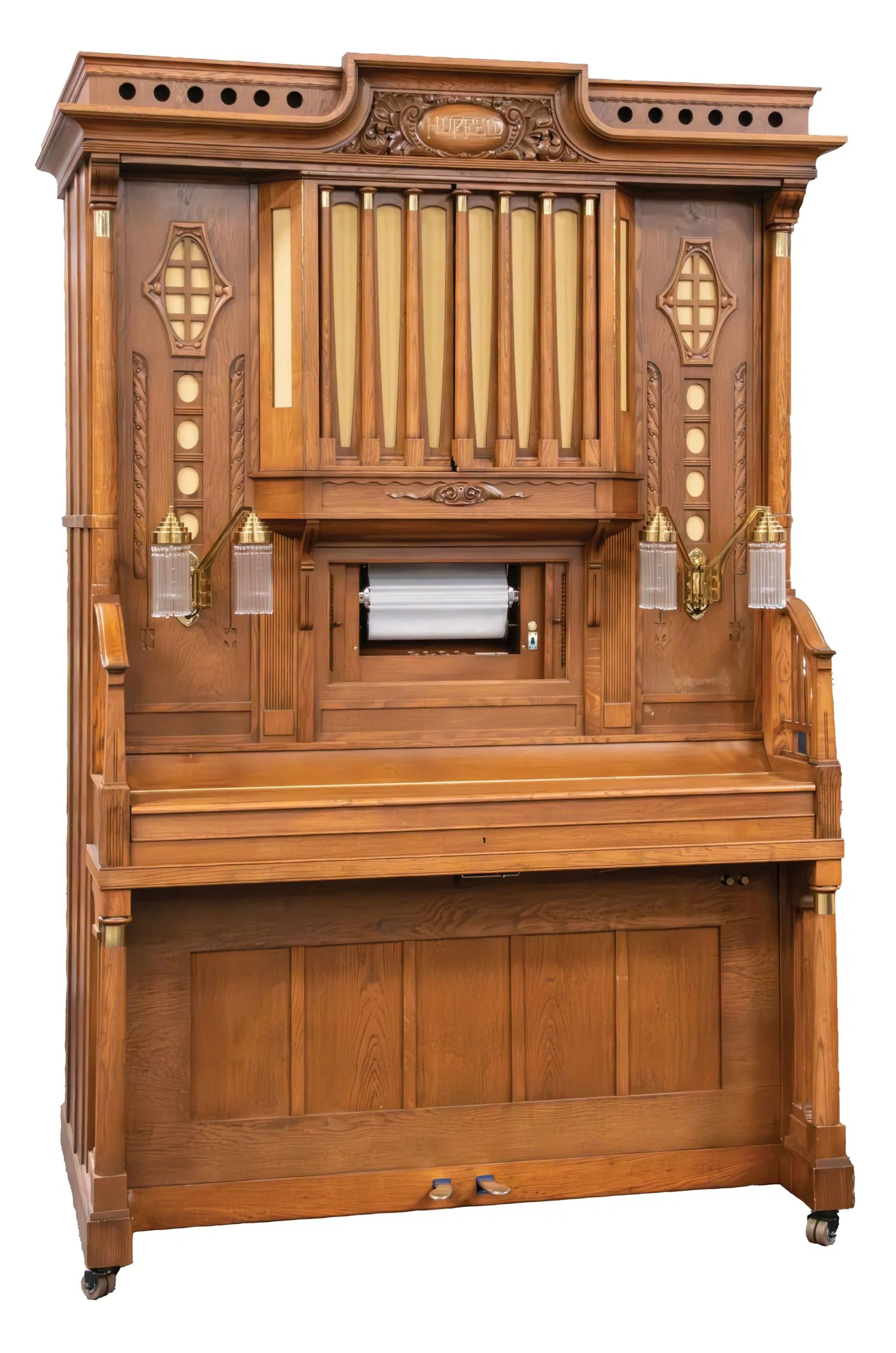
Hupfeld Phonoliszt-violina Piano-violin Model “A”

DENVER, Pa. – Antique European and American music, slot and fortune-telling machines took a well-deserved bow at Morphy’s October 17-19 Coin-Op & Antique Advertising Auction, where 1,913 lots cashed out at a robust $4.2 million. As is always the case at the Pennsylvania company’s popular Coin-Op sales, there were plenty of “sleepers” that quietly simmered below the surface prior to auction day, only to end up eclipsing all expectations once the bidding wars began.

The top-10 list was crowned by a superb example of a circa-1912 Hupfeld Phonoliszt-Violina Model “A,” arguably the most successful automatic violin and piano-playing machine ever made. It is also one of the most spectacularly complicated of all music machines, with mechanisms that reproduce violin expression, bowing, vibrato and staccato, as well as piano expression replicating a very high standard of human touch and sensitivity. Restored in 1986 and again in 2014, it was acquired in 2012 by its present owner from Sanfilippo Place de la Musique in Barrington, Illinois. The business’ owner, Jasper Sanfilippo, obtained the German-made unit in 1983 from a restaurant in France. An undeniable superstar, it sold in the auction’s third session for $221,400. 

Also ready for primetime, a circa-1920 Mills Deluxe Violano-Virtuoso, comprised of two violins that play elegantly and simultaneously, had undergone a scrupulous 36-month restoration. Housed in a Brazilian mahogany cabinet, the sophisticated entertainer achieved a high distinction in its day when the U S Government named it “one of the greatest scientific inventions of the age.” As fine an example as any collector could ever hope to own, it sold within estimate for $49,200. 

An enticing selection of 145 rare slot machines was led by a circa-1904 Caille Bros (Detroit) Roulette 5¢ floor-model slot with a 7-way roulette wheel payout. Resplendent in its rare Honduran mahogany cabinet with ornate copper-flashed and plated iron castings, this desirable machine was fully restored and described by Morphy’s antique coin-op experts as one of the finest examples they had ever seen. Since the 1990s, it had been part of a private collection. On auction day, it changed hands for $135,300.

Another Caille Bros production, a circa-1903 50¢ Centaur upright slot machine had undergone a painstaking restoration, with no small detail overlooked. It had a replacement marquee and back door, and a new wheel had been added, resulting in a stunning example of a hard-to-find slot. It was bid beyond its high estimate to $30,750. 

Half-dollars were also required to operate a rare circa-1939 Watling Machine Co. (Chicago) slot machine. Its beautiful restoration included an artistically-painted front casting and a meticulously-refinished oak cabinet. “The 50¢ model, like this one, is seldom seen in the marketplace because so few were made. Most would have been custom-orders,” explained Morphy Auctions’ founder and president, Dan Morphy. Operating perfectly and with keys included, it landed above estimate at $15,990.

Yet another good-looking slot was an illuminating circa-1935 O.D. Jennings Sun Chief “El Rancho” console unit. With built-in cigarette and drink trays, the $1 gambling machine could accommodate three vices at once. In working order and retaining its keys, it surpassed its high estimate to close at $15,375.

Bidders clearly got a “kick” out of a circa-1891 Roover Bros. “Donkey Wonder” floor-model fortune teller machine. One of only three or four original machines of its type known to exist, the auction example retained its original “lady” donkey fortune teller, who was capable of moving her head from side to side, surveying the audience, then flipping her baton to spin the wheel of fortune. A clockwork machine with an illuminating cabinet section, it finished within estimate at $46,740.

Both gamers and baseball fans competed for a 1937-40 Rockola upright baseball arcade machine replicating the 1937 World Series, its playing field set with nine figural baseball players. For a nickel, the patron could try to drive balls into any of eight “hit” slots or two “foul” slots in each corner. Ready for play, the classic sports-themed machine sold at the midpoint of its estimate range, for $25,830.

Known to collectors as the “Maguire,” a circa-1921 Deluxe Vending Machine Co. (NYC), “Luxo-Model’ gumball vending machine was deemed by Morphy’s specialists to be 100% original, including its copper finish and globe. Fewer than a handful of Maguires are known to exist, and that includes the elusive machine depicted in Bill Enes’ respected reference Silent Salesman Too. The auction example sold near the top of its estimate range, for $14,760.

One of the many antique advertising signs that outperformed was a pre-Prohibition reverse-painted glass sign advertising Yale Brewing Co. (New Haven, Conn.) Lager Beer, with a well-detailed factory scene and beautiful gold-leaf lettering and accents. Retaining its original oak frame with the original manufacturer’s label on verso, it presented in stellar 8.75 condition and attained $11,070, nearly twice the high estimate. Another excellent price was achieved by a circa-1900 single-sided tin sign promoting Columbia Yarns and decorated with the image of a woman in patriotic attire tending her flock of sheep. A strong condition 8.0, it garnered $9,840 against an estimate of $400-$800.

Other highlights from the three-day event included an outstanding original example of an early-20th-century Western Electric stock ticker, Model #2030, which sold for $20,910 against an estimate of $4,000-$8,000; and a large lot of gold nuggets having a total weight of 236 grams. The largest nugget weighed in at 97 grams and was described in the auction catalog as “very pure.” Against an estimate of $14,000-$22,000, it sold for $27,060. 

To discuss consigning to a future Coin-Op & Antique Advertising auction at Morphy’s, please call 877-968-8880 or email [email protected]. All enquiries are kept strictly confidential and there is never an obligation to consign. Visit Morphy’s online at www.morphyauctions.com.

Rosalba Carriera’s Portrait of Louis XV as a Child Joins the Collections at the Château de Versailles

One of the institution’s latest acquisitions is a portrait of the young Louis XV by the ‘Venetian Queen’ of pastels, Rosalba Carriera (1673-1757). This La Gazette exclusive bears witness to an active acquisition policy in the graphic arts.

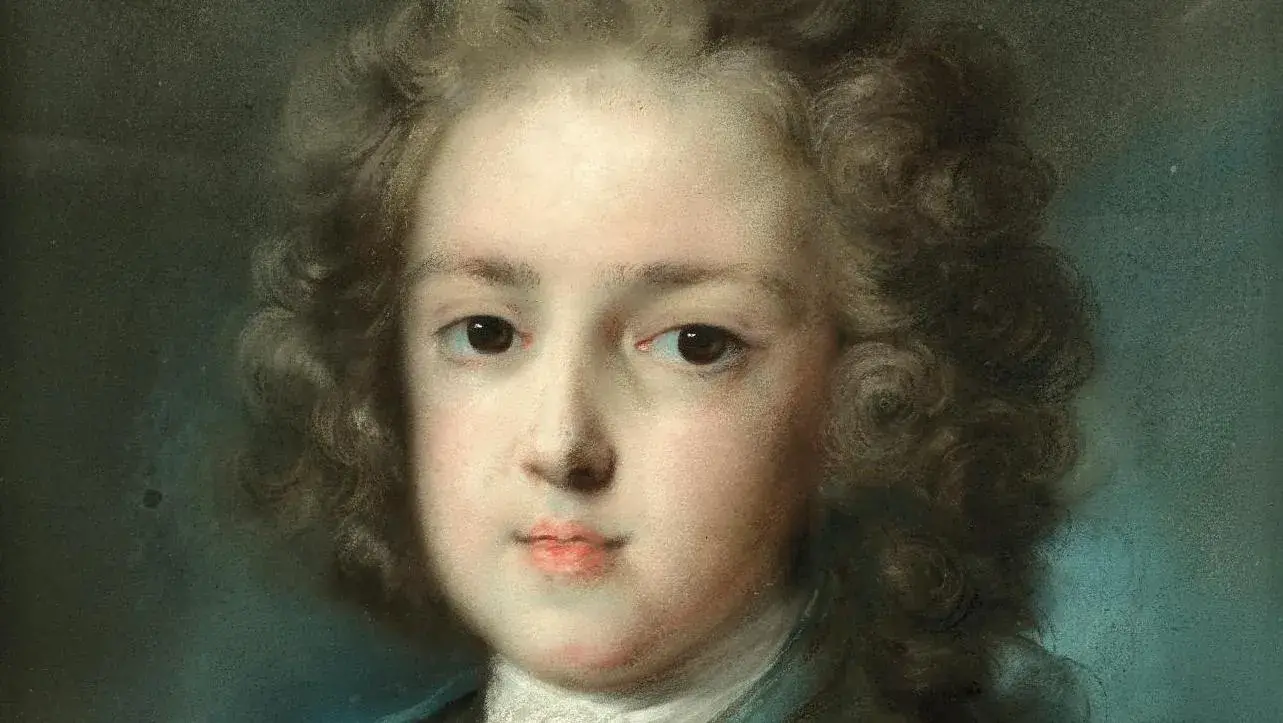
Rosalba Carriera (1675-1757), Portrait de Louis XV enfant (Portrait of Louis XV as a Child), 1720, pastel on paper pasted on linen canvas.
© Château de Versailles / Christophe Fouin
Rosalba Carriera (1675-1757), Portrait de Louis XV enfant (Portrait of Louis XV as a Child), 1720, pastel on paper pasted on linen canvas.
© Château de Versailles / Christophe Fouin

Until a few months ago, visitors to an extraordinary château, owned by a family that did a great deal for Versailles, could admire an impressive pastel by Rosalba Carriera (1673-1757), the “Queen of Venice”. But to preserve France’s châteaux, jewels of the nation’s cultural heritage, it is sometimes necessary to step aside… The transfer of the portrait of the young Louis XV is one such case. Élisabeth Maisonnier, curator in charge of the Graphic Arts Department at the Château de Versailles, is amused by another sideways step: the portrait of the 10-year-old Louis XV, the only King of France to be born and die at Versailles, is not part of the château’s collection! And with good reason: Louis XIV‘s great-grandson, orphaned at the age of two, left Versailles when he became king at the age of five. The Regent chose to raise the young sovereign in Paris, where the virtuoso Antoine Watteau was breaking artistic conventions. Four years later, on September 20, 1719, art lover Pierre Crozat wrote to Rosalba Carriera: “We have here many appreciators who infinitely esteem your talent… An excellent man, M. Watteau, of whom you will no doubt have heard, has the greatest desire to meet you, and to have a small work by your hand, in exchange he would send you one of his, or, if he could not, the equivalent… He is my friend, he lives with me, he begs me to present his most humble respects and desires a favorable response.” In April 1720, the Venetian artist arrived in Paris, where she became the muse of the city. In the diary she kept, whose 1865 editions­—in Italian and French—are still referenced, Rosalba mentions as early as the following June 14: “I began the small portrait of the king”. This was followed by nine portraits of the royal child, in various sizes and media. One of these versions led to Rosalba’s admission to the Académie royale de peinture et de sculpture (French Royal Academy of Painting and Sculpture) on October 26, 1720.

An Exceptional Provenance

In 1865, art historian Alfred Sensier lamented the fact that he knew so little about Rosalba’s artistic production in Paris: “The French Revolution undoubtedly contributed to their dispersal; the property of princes, nobles or émigrés, it was lost in the great shipwreck of eighteenth-century society. Especially regrettable are the portraits of Louis XV as a child; that of the Law, which appears at Versailles only as an unfaithful copy; that of Watteau, and especially those of the two Crozats, the true mécènes (patrons) of that time, whose features are now completely forgotten; that of the interesting Comtesse d’Évreux and the lionesses of the Regency, Mmes d’Alincourt, de Parabère, de Prie, and perhaps that of the Regent.” One hundred and fifty-nine years later, Xavier F. Salomon, the brilliant Chief Curator of the Frick Collection who is working on the artist’s catalog raisonné, makes a slightly more positive assessment. But fewer than five of Rosalba’s Parisian pastels are known to exist: he considers that the “Portrait of Louis XV as a Child” in the Gemäldegalerie Alte Meister in Dresden was executed at a later date. The pastel that made its debut at Versailles, where the king’s features are more youthful, could even be the very first version painted by the artist. Élisabeth Maisonnier points out: “Despite the fact that the posing session was so brief, Rosalba perfectly rendered the velvety, nuanced skin tone, the radiance of the eyes, the movement and lightness of the curls… The underlying drawing is still perceptible in the treatment of the facial contour. A few elements indicate an unfinished version: shorter hair, curls sketched on the shoulders and, in the background, a sober blue suit. The use of a thicker wet paste for the face, followed by the application of a more powdery dry pastel enhanced by a few strokes of color, gives a very painterly finish.” The nugget in question is all the more exceptional in that its provenance has been traced back to the 18th century. The Portrait de Louis XV enfant belonged to one of the king’s closest friends, the Duc Louis-César de La Baume Le Blanc de La Vallière. This grand-nephew of the Duchesse de La Vallière, Grand Falconer of France and close friend of the Marquise de Pompadour, was for some “one of the most corrupt lords of the old court, friend of the late king and devoted to all his mistresses” (Bachaumont), and for others one of the most eminent bibliophiles of his time. The pastel then passed into the collections of the famous amateur Gilbert Paignon-Dijonval. From his grandson, the astonishing Charles-Gilbert, vicomte Morel de Vindé, the pastel then passed into the hands of the latter’s daughter, Claire Morel de Vindé. Claire married the grand-nephew of Abbé Terray, Louis XV’s last Controller General of Finances.

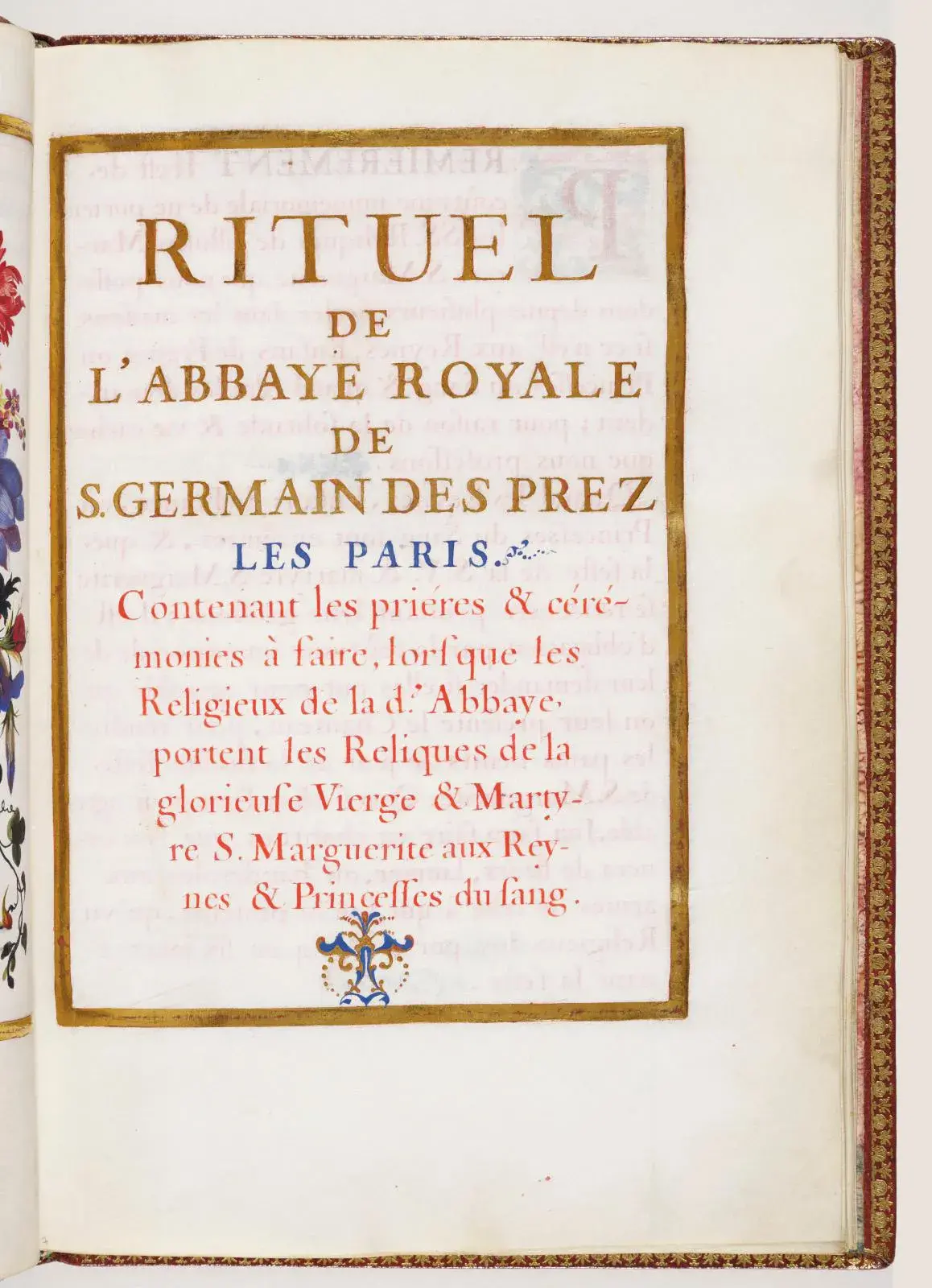
Rituel de l’abbaye royale de S. Germain des Prez les Paris, Contenant les priéres & cérémonies à faire, lorsque les Religieux de la d’Abbaye portent les Reliques de la glorieuse Vierge & Martyre S. Marguerite aux Reynes & Princesses du sang, (The Ritual of the Royal Abbey of S. Germain des Prez in Paris, Containing the prayers & ceremonies to be performed, when the Religious of the Abbey carry the Relics of the Glorious Virgin & Martyr S. Marguerite to the Reynes & Princesses of the Blood. Marguerite to the Queens & Princesses of the Blood), 17th century, illuminated manuscript.
© Château de Versailles

From Simon Vouet to Maria Theresa of Austria

Two years after the major exhibition “Louis XV, passions d’un roi” (Louis XV, Passions of a King), where it was not shown, the entry of the Portrait of Louis XV as a Child into the Versailles collections makes sense. And it was not difficult for Christophe Leribault, the new President of the Château de Versailles, to convince the patron couple Hubert and Mireille Goldschmidt to support this acquisition project: “Their passion for drawing is something they also like to share. They are happy to lend to exhibitions and, with their well-known enthusiasm, have helped countless projects concerning French drawing both in New York and Paris, from the Metropolitan Museum to the Frick Collection, from the Decorative Arts to the Musée d’Orsay, where they supported the recent exhibition “Pastels, de Millet à Redon” [2023, editor’s note]. At Versailles, they took the plunge and, sharing my love at first sight for this pastel by Rosalba Carriera, understood its importance for French cultural heritage.” The acquisition policy pursued by the teams of Laurent Salomé, Director of the Musée National des Châteaux de Versailles et Trianon, is attracting particular attention. Last spring also saw the arrival of Simon Vouet in the Graphic Arts Department. The fantastic pastel depicting the Grande Mademoiselle Enfant, presented by Nicolas Schwed at last year’s Semaine du Dessin (Drawing Week), was purchased in the process. And in keeping with the theme of royal childhood, one of the château’s most spectacular acquisitions is a manuscript given to Maria Theresa of Austria, Rituel de l’abbaye royale de S. Germain des Prez les Paris, Contenant les priéres & cérémonies à faire, lorsque les Religieux de [l’]Abbaye portent les Reliques de la glorieuse Vierge & Martyre S. Marguerite aux Reynes & Princesses du sang. Calligraphied by Nicolas Jarry in the 17th century, this illuminated manuscript details the prayers to Saint Marguerite of Antioch to accompany royal pregnancies. The Abbey of Saint-Germain-des-Prés kept a belt of the saint, which was applied to the queen’s belly shortly before full term, while prayers were recited to encourage childbirth. The manuscript will be one of the centerpieces of the forthcoming exhibition dedicated to the Grand Dauphin.

Worth Knowing
Exhibition: “Le Grand Dauphin (1661-1711)” at the Château de Versailles.
From October 14, 2025 to February 15, 2026
chateauversailles.fr

Lark Mason Associates Achieves Over $900,000 in Asian Art Sales on iGavel Auctions

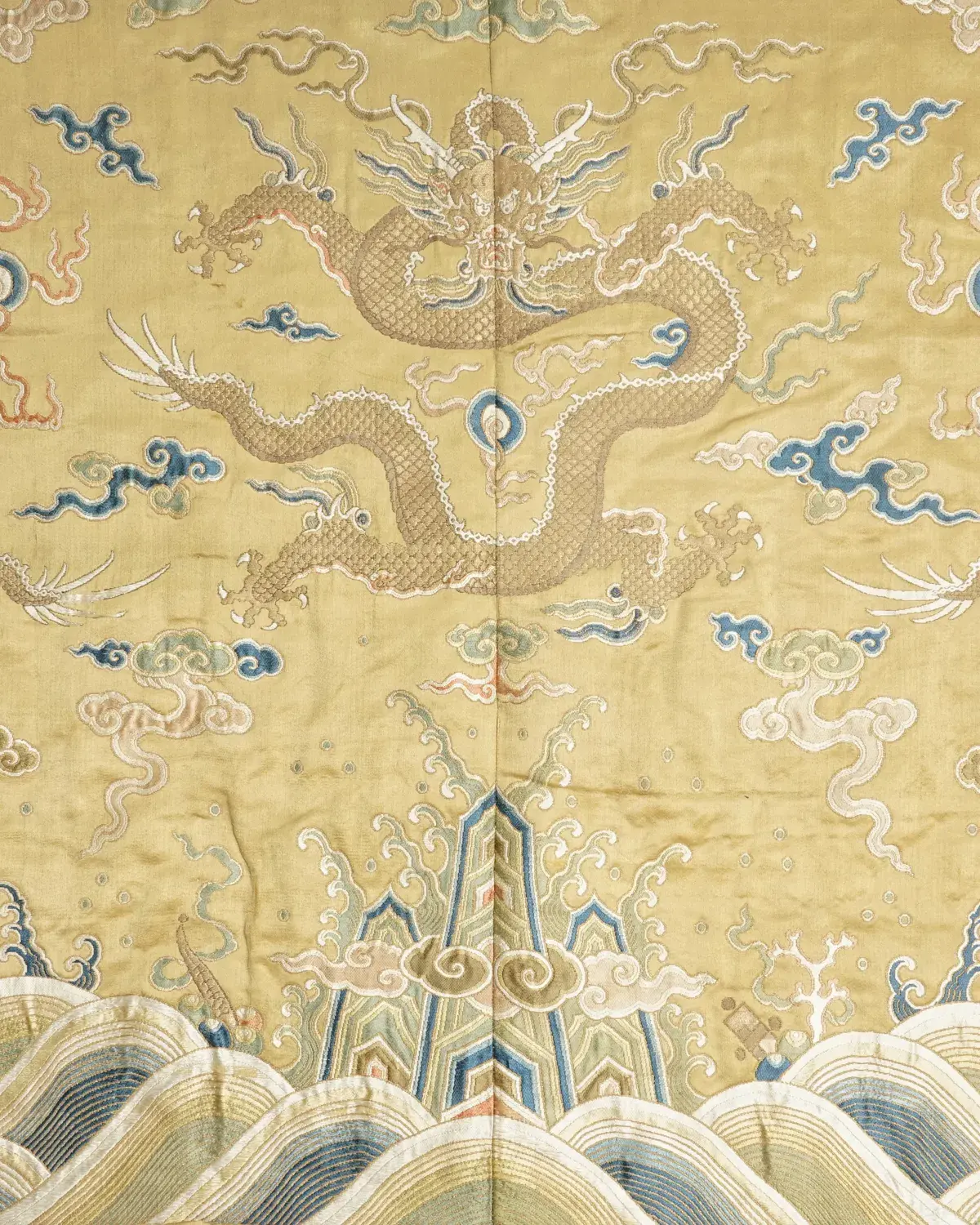
An 18th century Chinese Imperial Yellow Ground Nine Dragon Brocaded Silk Panel, Qing Dynasty fetched  $78,125
An 18th century Chinese Imperial Yellow Ground Nine Dragon Brocaded Silk Panel, Qing Dynasty fetched  $78,125

New Braunfels, TX — Lark Mason Associates successfully concluded a series of four auctions on iGavel Auctions, generating over $900,000 in sales. The auctions, which closed on October 15th, featured over 950 lots of rare Asian art, ranging from Song Dynasty to Republic Period Chinese porcelain bird feeders and water containers, to Chinese porcelain spoons, and important textiles. Collectors from around the world, including many from the People’s Republic of China, competed for the diverse offerings.

“The success of these auctions was largely due to the inclusion of a broad selection of accessible, lower- to middle-market items,” said Lark Mason. “By dividing the lots into smaller, specialized sales, rather than hosting a single large event, we created a more targeted appeal for collectors.”

One of the key features of these auctions was the offering of porcelain spoons, bird feeders, and water containers from the estate of Ida Besse Howes, a renowned conservationist, world traveler, and arts advocate from Round Hill, Texas. “We aimed at a specialized audience, particularly those in China, and our strategy paid off. Had we placed these items in a broader sale without allowing time for word to spread within the specialized collecting community, we might have missed significant interest,” Mason explained.

Competitive bidding led to several lots far exceeding their estimates, with many sales extending into overtime. Notable results include a Qing Dynasty Chinese Imperial Yellow Ground Nine Dragon Brocaded & Kesi Silk Panel, which fetched $78,125; a Chinese Burlwood Covered Album of Letters, Qing Dynasty, and a Rubbing from the Yun Ju Temple, which achieved $52,626.25; and six late 19th-century Chinese Embroidered Framed Silk Panels, which sold for $30,000. A Chinese Gilt Lacquered Bronze Figure of a Bodhisattva hammered at $20,625, while a Chinese Carved Bamboo Figure of a Scholar with a Hardwood Stand brought $13,750.

Other significant lots included an early 20th-century bamboo birdcage, which was snapped up for $7,187.50; a Chinese Cobalt Blue Meiping Vase, which achieved $16,875; four Chinese Porcelain Spoons, including one marked Shende Tang, which sold for $13,125; and six multicolor glazed porcelain tabletop accessories, which brought in $15,000. A Chinese Tea Dust Glazed Vase with a Guangxu Incised mark realized $14,375.

Morphy’s hosted the October Hershey crowd at a lively $2.1M Automobilia & Petroliana Auction

Motivated new bidders battled Morphy regulars for high-end rarities: Husky porcelain service station sign, $59,040; Sinclair ‘Dino’ curb sign, $52,800; Grizzly Gasoline ‘tombstone’ sign, $25,830

Husky Service Porcelain Service Station Shield Sign W/ Husky Dog Graphic.

DENVER, Pa. – Morphy’s October Automobilia & Petroliana Auction has become an annual tradition for motorheads who gather in central Pennsylvania for the Eastern National Fall Meet of the Antique Automobile Club of America. Better known as “Hershey” because of the city where it takes place, the massive car show and flea market attracts thousands of car enthusiasts from around the world. This year many show attendees decided to warm up their buying skills by heading over to Morphy’s October 6 pre-Hershey auction. The colorful gas and oil advertising sale was stocked with 652 lots of wonderful rarities that chalked up nearly $2.1 million. Estimate-defying prices were paid for many of the vintage signs, service station pumps and globes; motor oil cans and other petroleum-related accessories and display items. 

Animal mascots once again proved their popularity as advertising subjects, with several landing in the day’s top 10. Leading the group was the energetic Arctic dog who represents Husky Oil Co., founded in 1938 in Cody, Wyoming. Shown leaping playfully against a rising sun, the brand’s iconic Husky dog dominated an excellent double-sided porcelain sign of shield form and emblazoned with the phrase “Husky Service.” A sizable 42 by 48 inches, it was AGS-certified, with sides graded 89 and 87 respectively. Against an estimate of $20,000-$40,000, it ended its cross-tundra run at $59,040.

Another long-standing mascot is Sinclair’s “Dino” the dinosaur. His well-detailed image, shown in profile with the tagline “Mellowed 100 Million Years,” was the focal point of a circa-1930s double-sided porcelain curb sign advertising Sinclair Pennsylvania Motor Oil. Measuring 24 inches in diameter, the red, white and black circular sign was AGS-certified, with sides graded 90 (front) and 93 (reverse). Exceptionally clean and offered with a $10,000-$20,000 estimate, it left a mighty footprint in claiming runner-up status at $54,120.

Arguably the most formidable animal competitor was the hulking bear mascot for Grizzly Gasoline (Cut Bank, Montana). The formidable beast was depicted standing on two legs, his mouth agape, on a double-sided tombstone-shape tin sign with the message “Perfect Powerful Performance / Watch your Miles.” The tagline “Dubbs Cracked,” referring to the process used by Grizzly to produce its gasoline, also appeared on the colorful 35-inch by 24-inch advert. With both sides graded 7.5, this coveted sign roared past its $6,000-$12,000 estimate to reach $25,830.

Neon lit up the room, with two signs, in particular, commanding special attention. A complete GMC Trucks porcelain neon sign with its original bullnose attachment was composed of two single-sided porcelain signs mounted back-to-back on a metal can. An imposing 82 inches wide by 44 inches high by 14 inches deep, it was graded 80 on its front and 84 on the reverse. It garnered $23,370 against a $6,000-$12,000 estimate. An excellent single-sided porcelain Mobiloil Marine advertising sign with a Pegasus graphic and attractive added neon was mounted to a newly-made metal can. Described in the catalog as having an outstanding presentation overall, it sold for $17,220 against a $4,000-$6,000 estimate.

Other notable advertising included a circa-1930s double-sided porcelain Ford V-8 “GENUINE PARTS” die-cut sign, graded 9.25 on both sides, which sold for $22,140 against a $5,000-$10,000 estimate; and a circa-1950s single-sided tin sign advertising Pennzoil with an appealing image of an adult owl teaching two owlets to “be OIL-WISE.” Exhibiting excellent color and shine, it flew to $11,685 against an estimate of $800-$1,600.

A beautiful selection of 77 gas globes and lenses formed an artful subcategory from which to choose. One of the standouts was a 1950s gas globe lens from Salyer’s Stay-Ready Gasoline, a product of Salyer Refining Co, Oklahoma City. The well-executed graphic depicted a woman flying on a duck’s back, accompanied by the tagline “BALANCED FORMULA.” Graded 93, it outperformed, fetching an above-high-estimate price of $24,600. Also gas-pump-related, a rare Ford Benzol Gasoline porcelain pump-plate sign soared to $14,760 against an estimate of $1,000-$1,500.

More than two dozen vintage petroleum-product cans crossed the auction block. A sought-after entry from the group was a rare circa-1950s Sooner Queen Motor Oils (Salyer Refining Co., Oklahoma City) 1-quart can imprinted with a 35¢ price and displaying the image of a cowgirl beside a campfire. With a clean seam and full contents, the container was AGS-certified and graded 85. It sold above high estimate for $6,150.

Morphy Auctions’ president and principal auctioneer, Dan Morphy, expressed his pleasure over the day’s results. “The sale was very heavily attended, as our October sales usually are, and there was a very positive buzz in the air because everyone was excited about the nearby Hershey show, which opened two days later,” he said. “There were more than 100 unique buyers, including a dozen or so new buyers at higher levels. All in all, it was a very successful sale.”

To discuss consigning to a future Automobilia & Petroliana auction at Morphy’s, call 877-968-8880, email [email protected]. All enquiries are kept strictly confidential and there is never an obligation to consign. Visit Morphy’s online at www.morphyauctions.com.

Historian Michel Pastoureau Presents His New Book on the Color Pink

For nearly 40 years, the medievalist has been tracing the history of colors, from blue to yellow, green and red. After treating bold hues, he is now launching a new cycle focused on intermediate tones, starting with pink.

© Bénédicte Roscot
© Bénédicte Roscot

A half-color, as you call it, pink – already mentioned in your book on red – seems to open up a new cycle in your research. Can you tell us a bit more about this secondary corpus?
My original intention was to limit myself to the six principal colors. The first editorial cycle was such a success that I then decided to tackle the half-colors: pink, and in the future orange, violet, brown and gray. I was afraid that there wouldn’t be as much to say as with the other colors, but I was wrong, as is evident in this book. I won’t go beyond this current series, after which there are only shades and shades of shades, which are difficult to identify and are no longer enough to create an image, which is the very notion of color. I’m pursuing the same approach, proposing history books constructed chronologically, with a balance between the periods, limiting myself to Western Europe. Working on the history of a color involves social history and, as you can’t be an expert in everything, I didn’t want to resort to third- or fourth-hand sources. In any case, a color never comes alone, and it’s not a question of only this color: so this is a monograph in appearance only.
 

The way you tell it, the history of pink seems to be full of gaps. It doesn’t exist scientifically, it hasn’t always had a name and, finally, its perception seems modern. How have you dealt with these difficulties?
For a long time, pink didn’t have a firm name, but that doesn’t mean it didn’t exist. It is referred to in Greek and Latin through shifting terms, and you have to be very attentive when reading to find it. The term roseus, describing bright red, is a false friend, but it is found under a variety of names. Pink is a natural color, and people have always tried to imitate it: many shades of it can be found in Pompeii. The imprecision of the vocabulary is in itself an interesting point worth studying. The scientific theory suggesting that pink is not a color, as was said of black or white, I’ll leave that aside, because social practice says otherwise! Social and cultural history is distinct from the theories of physicists and chemists, and this is indeed the field I situate myself, certainly with greater ease today than 50 years ago.

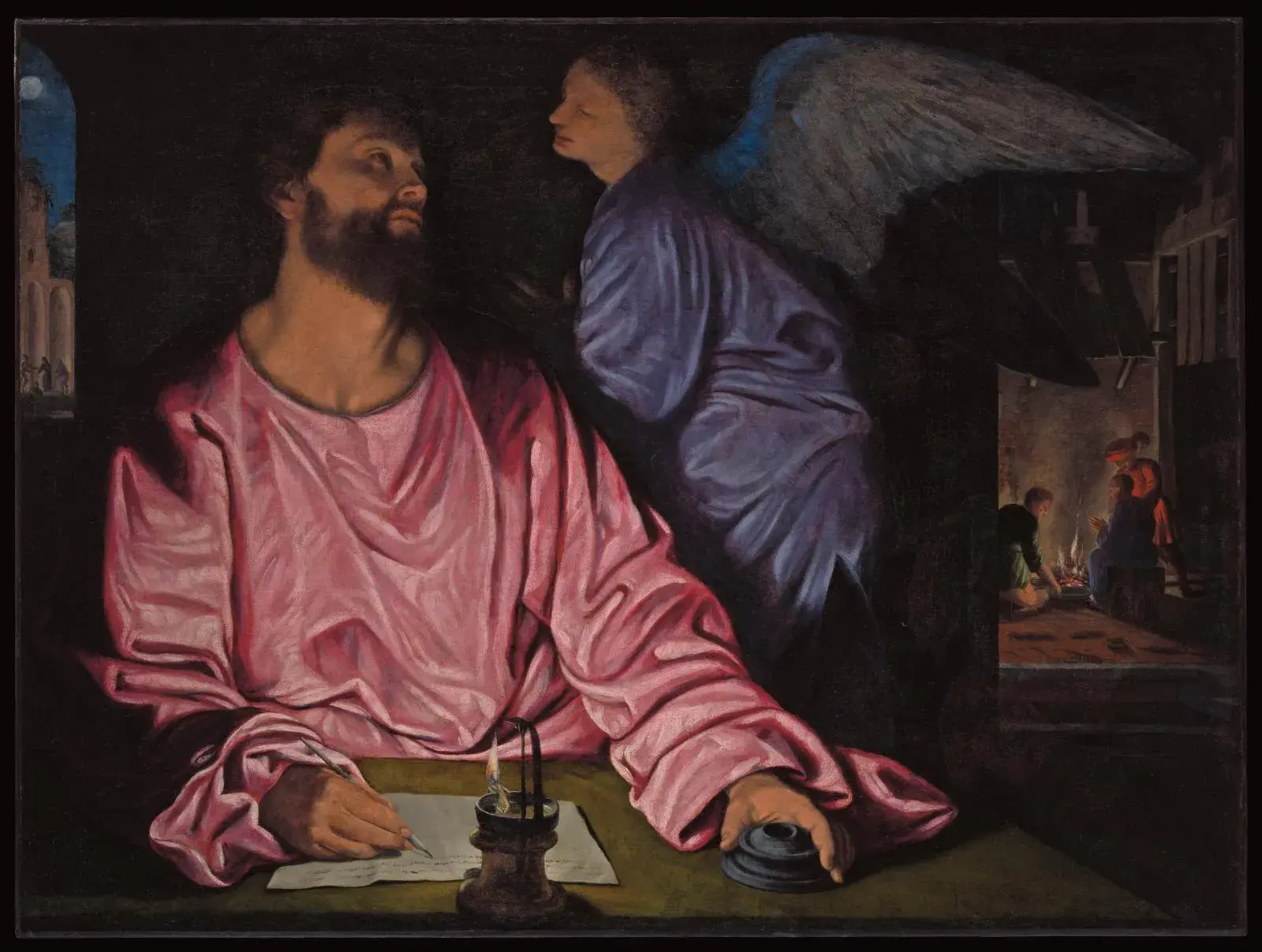
Giovanni Gerolamo Savoldo (1480-1548), Saint Matthew and the Angel, 1534, New York, The Metropolitan Museum of Art.

The history of pink in modern times is better known, or at least better documented. The iconography in your latest work is more diversified: there are reproductions of artworks, objects, fashion photos and so on. What choices did you make?
I don’t offer art history books, but history books. In this respect, the works I decided to reproduce, and which I make a point of commenting on personally, tell us not only about the art of their period, but also about the context in which they were produced and perceived. For the eye, there is indeed a change in the status of the images as we move through the book, but this is due to the very materials with which I work. For the Middle Ages, I focused on miniatures and stained-glass windows: in the end, the best-preserved testimonies of ancient periods, when most of those that have come down to us are badly altered and have lost their colors. But I’m interested in the experience of color in everyday life, and that’s how, as you read on through the book, a bar of soap can rub shoulders with a Picasso. But we mustn’t be fooled on this issue: there is a real difference between the discourse on fashion – what is shown by advertising and images – and real life. You can see it in what goes on in the street: there’s a discrepancy I like to point out. Even if, from that point of view, pink isn’t doing too badly.
 

Isn’t it paradoxical that pink, which, as you say, is one of the least popular colors, should be so present and so much discussed in the public sphere?
Yes and no. All opinion polls since the 1980s have ranked pink as one of people’s least favorite colors, and it’s true that over the years the results have been the same, regardless of gender. The emphasis is always on what’s changing, but as historians, our role is also to highlight what stays the same. Blue crushes all the competition among the most popular colors; pink, on the other hand, is neglected. At the same time, and for this very reason, pink is a color that enables people to stand out, and it is used in marketing to highlight a new product, service and so on. However, I think it’s important to qualify that pink is disliked on its own. When it’s set off by white or pale gray, for example, it’s more appreciated.
 

You point out that pink has been used in different combinations over the centuries. Venetian painters used it with green; La Pompadour with blue. What can we learn from the evolution of these combinations?
It’s true: color schemes are not the same from one period to the next. Pink is staged in its relationships with colors, and different qualities or shades are highlighted in turn, to which we should pay close attention if we are to avoid anachronisms.

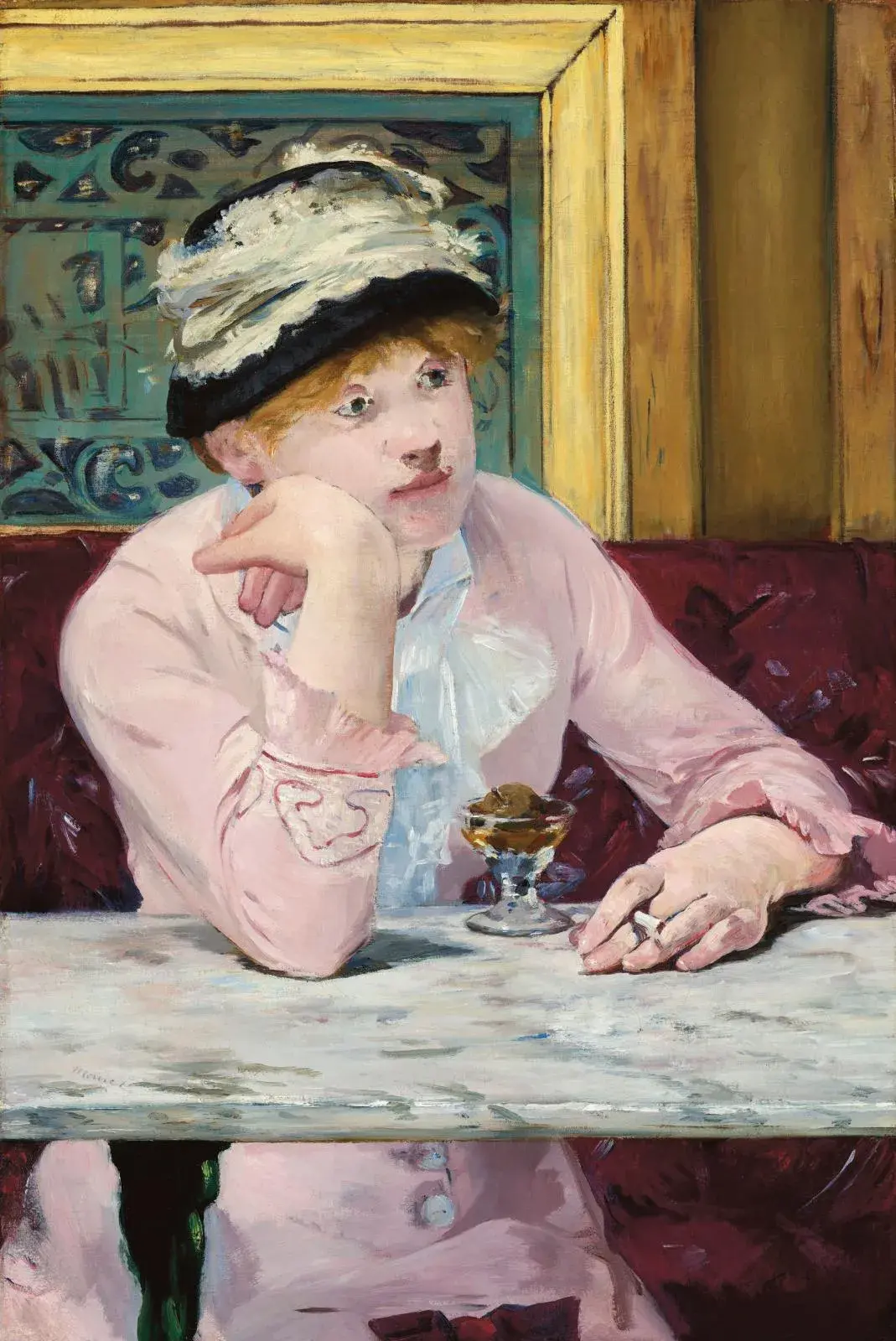
Édouard Manet (1832-1883), La Prune (The Plum), 1877 or 1878, Washington, National Gallery of Art.
© Bridgeman Images
Édouard Manet (1832-1883), La Prune (The Plum), 1877 or 1878, Washington, National Gallery of Art.
© Bridgeman Images

In 2017, with Une couleur ne vient jamais seule (A Color Never Comes Alone), you published your chromatic diary: a more subjective approach to colors. What do you observe about pink in your daily life?
It seems to me that pink is gradually gaining in popularity today. It’s a color that’s better received than it was ten years ago, and it’s moving in a positive direction. I’m talking here about my observations: it’s now more frequent in clothing, not just women’s clothing, and in objects. I don’t know if the success of the Barbie film alone is enough to explain why pink is better liked now, but on the street, where colors in clothing change little over time, it’s noticeable. We’ll have to wait and see what future historians have to say, but I hope they won’t give in to the rather hasty or false ideas that can be formed by leafing through magazines.
 

Your book shows that you care about your readers. What place did you give them when you were writing it?
With this collection, as with the animal collection with which I alternate, I want to produce beautiful books. The publisher plays a role in the images and layout, but I draw on my own research. My writing is based on my university career and my work on vocabulary, clothing and painting. Scientific articles are invisible to the general public, but without all this preliminary work, there would be no books today. The first volumes of this series on color have now been translated into around thirty languages, and while I reread those in languages I know, I also let the books live their own lives. The translation into Japanese was a special moment, with a view of Western culture that found its relevance abroad.

Worth Knowing
Michel Pastoureau, Pink, The History of a Color, Seuil, 192 pages, €39.90.