The latest sale from Robinhood Auctions offers over 1,000 lots of original paintings, prints, multiples, and more. The catalog boasts a robust selection of Pop Art, with examples from Modern masters such as Andy Warhol and Peter Max alongside contemporary reinventions from Patricia Govezensky and Mr. Brainwash.
Here are some of the top Modern and contemporary Pop Art pieces that will be available on November 21, 2024.
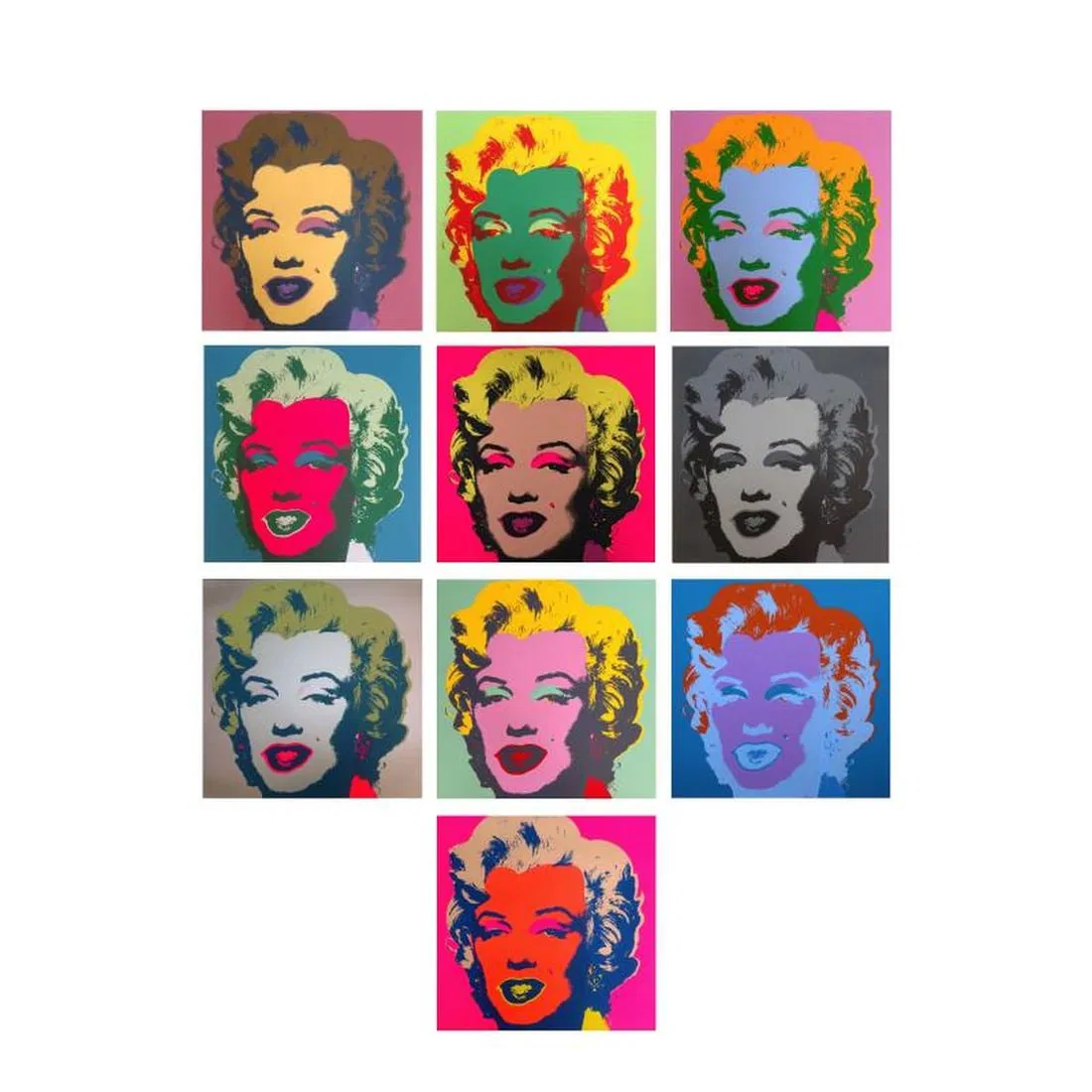
Andy Warhol, Classic Marilyn Portfolio, suite of ten silkscreen prints from Sunday B. Morning. Image courtesy of Robinhood Auctions.
Andy Warhol
Several lots from Pop Art master Andy Warhol will cross the auction block in this sale, including a suite of ten Marilyn Monroe screenprints (lot #787; estimate: USD 6,684 – $8,355). The prints were published by Sunday B. Morning and are accompanied by a certificate of authenticity.
Warhol’s collaboration with Belgian company Sunday B. Morning started pleasantly. In 1970, he sent the anonymous printmakers behind Sunday B. Morning photo negatives and specific printing instructions to mass produce Warhol’s images of Marilyn Monroe, flowers, and Campbell’s Soup cans. Yet the relationship soon soured. Warhol eventually looked down upon the company’s output, viewing it as unironically inauthentic. Sunday B. Morning prints are recognizable for a blue stamp on verso that reads “fill in your own signature,” a cheeky invitation to take ownership of a mass-produced product.
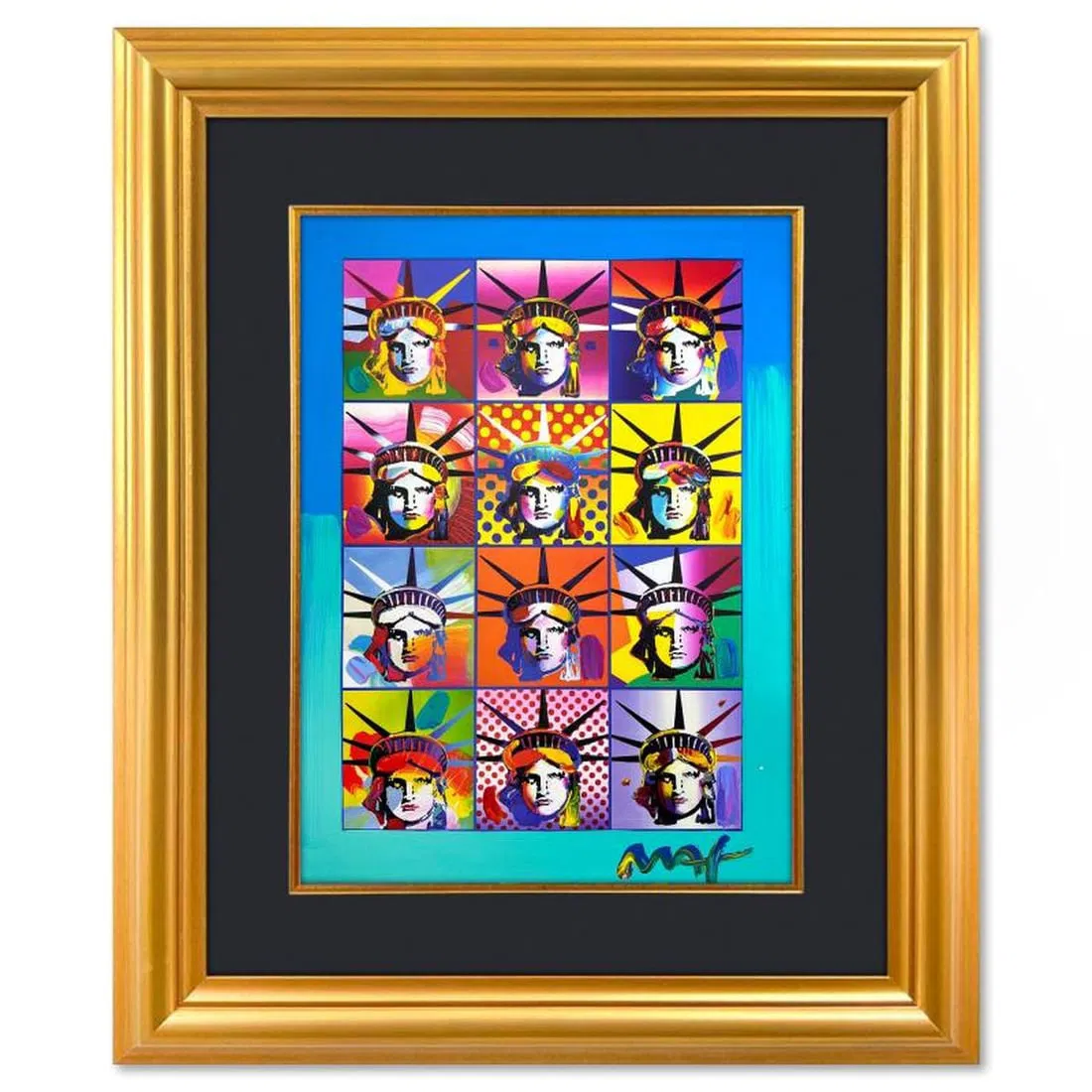
Peter Max, Liberty & Justice, mixed media artwork. Image courtesy of Robinhood Auctions.
Peter Max
Another Pop Art icon with work in the catalog is Peter Max. A German-American painter, Max is known for his colorful paintings that embrace psychedelic images and unrestrained joy. He rose to fame in the late 1950s and early 60s after an early start in graphic design. Max applied the principles of design and marketing to his fine art, especially when he turned to printmaking.
Max’s Liberty & Justice, a mixed media artwork, is one notable item (lot #182; estimate: $6,252 – $7,815). It belongs to a series of patriotic paintings that Max executed in the aftermath of September 11, 2001. The work depicts the Statue of Liberty repeated across 12 boxes. In the background of each is a unique combination of colors and textures.
Patricia Govezensky, Contemporary Love, original painting on cutout steel. Image courtesy of Robinhood Auctions.
Patricia Govezensky
Patricia Govezensky’s Contemporary Love will be available as well (lot #629; estimate: $10,080 – $12,600). The Israeli artist is best known for her colorful depictions of women, often portrayed relaxing in coffee shops. In this work, Govezensky turns her brush to Robert Indiana’s classic Love image, itself an icon of the Pop Art movement. Govezensky’s interpretation mirrors Indiana’s font and arrangement of letters before taking the coloring further. Instead of solid-colored type, she has covered the cutout steel letters with swirling, striped paint. The colors, textures, and movement of the piece lend movement to this classic image.
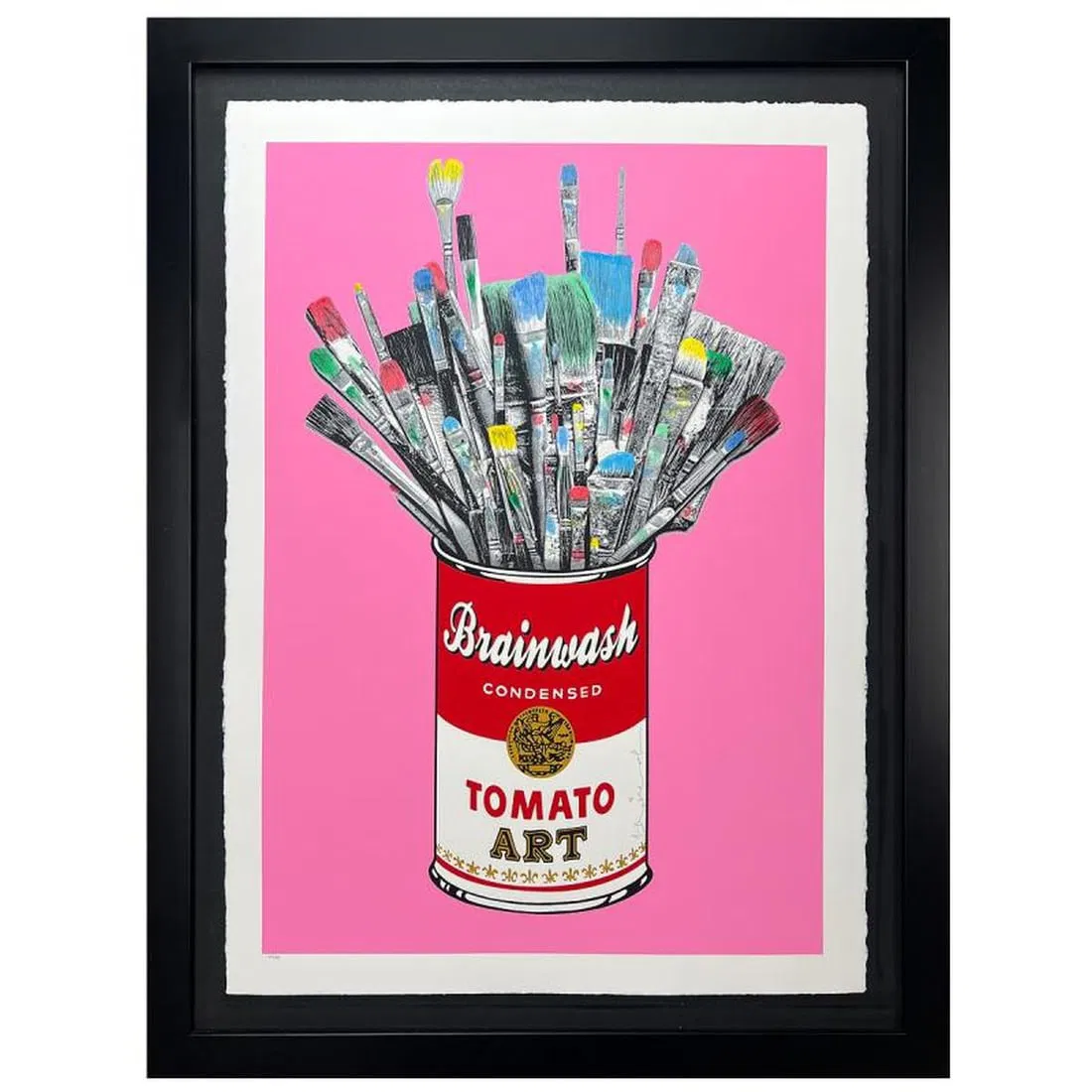
Mr. Brainwash, Tomato Pop (Pink), hand-finished silkscreen. Image courtesy of Robinhood Auctions.
Mr. Brainwash
Another contemporary artist whose work revisits and revises Pop Art is Mr. Brainwash. Thierry Guetta– who is known professionally as Mr. Brainwash– is a Los Angeles-based street artist whose work embraces Pop Art inspirations. He frequently references work by Andy Warhol and others while riffing on the style of contemporaries such as Banksy and Shepard Fairey.
Available from Mr. Brainwash in Robinhood Auctions’ upcoming event is Tomato Pop (Pink), a limited edition hand-finished silkscreen (lot #679; estimate: $4,176 – $5,220). At first glance, this piece bears a striking resemblance to Warhol’s Campbell’s Soup cans. However, closer inspection reveals minor variations. “Brainwash” replaces “Campbell’s” in white cursive letters, while “Art” is substituted for “Soup” at the can’s bottom. Instead of a neatly sealed top, this can bristles with paint-daubed brushes of every shape and size.
Robinhood Auctions’ Contemporary and Classic Masterpieces auction will begin at 1:00 PM EST on November 21, 2024. To find more information about each of these works and to register to bid, visit Bidsquare.
Find more auction previews and news on Auction Daily.
Nov. 6-7 sale highlights: Ty Cobb 1914 Cracker Jack baseball card, $34,440; Rooster sulfide marble, $22,140; Buddy ‘L’ Outdoor Railroad, $13,530; Set of 4 Popeye ‘hoppers,’ $11,685
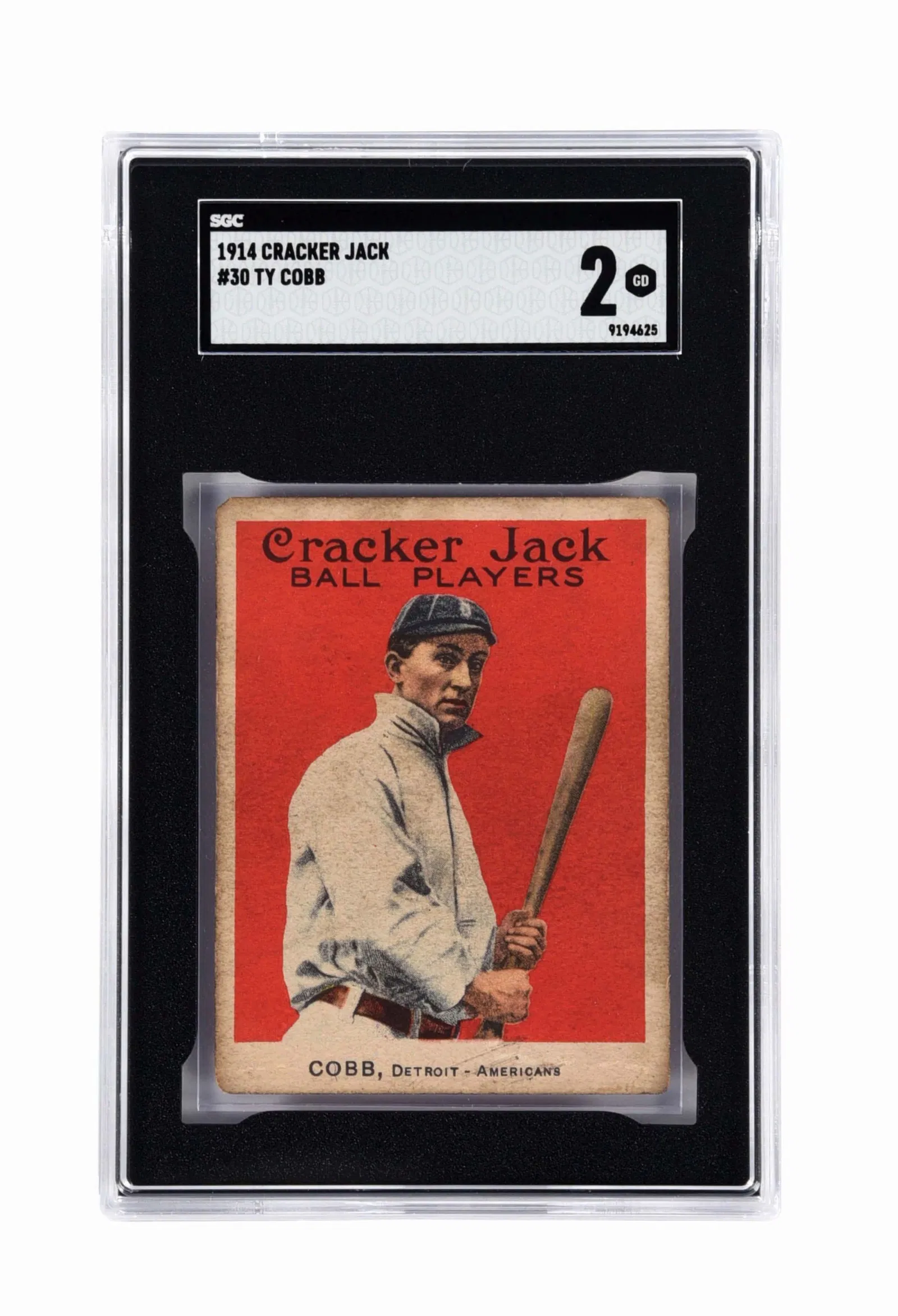
Very Rare No. 30 Ty Cobb 1914 Cracker Jack Baseball Card
DENVER, Pa. – Good things came in small packages at Morphy’s Nov. 6-7 Toys & General Collectibles Auction, which closed the books at more than $1.1 million. The Pennsylvania company’s last major toy auction of the year featured a diverse mix of popular collecting categories within its 1,600+ lots, and when all was said and done, it was an antique baseball card and the smallest of handmade artworks – marbles – that made the biggest impression.
A mesmerizing 2-1/8-inch teal-blue sulfide marble with a nicely-detailed, well-centered rooster had a lot to crow about. It boasted 9.8 condition and earned high praise from Morphy Auctions’ president and longtime marble fancier Dan Morphy, who described it as “one of the best sulfides we have ever seen.” Against an estimate of $8,000-$12,000, it rolled confidently to a winning bid of $22,140. Another diminutive beauty, a painted china marble with pink pinwheels at each end, was adorned with images of a lady holding a rake, a house and trees against a desert scene. The artful 1-15/16-inch orb in 9.7 condition ultimately sold for $7,995.
Another prized item requiring only minimal shelf space was a very rare No. 30 Ty Cobb 1914 Cracker Jack baseball card graded SGC2. Its striking image showed the legendary “Georgia Peach” against a scarlet background, suited up in his Detroit Americans uniform and holding a bat. The card attracted 24 bids before rounding the bases and landing at the top of prices realized for $34,440. A sought-after sports treasure, it far exceeded its $10,000-$20,000 estimate.
Sports cards of a later era also found favor with bidders. A 1962 Topps Baseball 3rd-Series cello pack with a San Francisco Giants team card visible on top was graded PSA 7, Near Mint. It rose to the midpoint of its estimate, settling at $5,658.
From a galaxy far, far away came an unopened 1977 Topps Star Wars Series 1 wax box of Movie Photo Bubble Gum Cards in crisp NM condition. The box was wrapped and certified by BBCE (Baseball Card Exchange, Inc.) and entered in the sale with a $4,000-$8,000 estimate. It ended up selling for a strong $12,300.
Star Wars fans seemed bullish on rarities from the beloved franchise, with 27 bids placed on a 1977 Kenner Star Wars Boba Fett 21 Back action figure. The back of the card retained a large premium-offer sticker advertising a free secret Star Wars: The Empire Strikes Back figure with the purchase of any four Star Wars figures. The toy was bid to $4,920, nearly five times the high estimate.
The auction was anchored by several major collections, including a fantastic array of Popeye toys amassed over 35+ years by retired professor and Popeye reference-book author Mark Kuster. One of the most sought-after lots was a complete circa-1950s set of four Linemar Popeye tin-litho windup “hopper” character toys depicting Popeye, Mean Man, Olive Oyl and Wimpy. Each of the cartoon favorites came with its own original pictorial box. The first complete set of its type to be offered by Morphy Auctions in 20 years of operation, it was “strong to the finich” and sold just below its high estimate for $11,685.
High-quality trains barreled through the saleroom, led by a Buddy ‘L’ pressed-steel Outdoor Railroad engine, tender and cars with three additional straight track sections. This very presentable outfit included an Improved Steam Shovel with original paint and decals. In overall VG+ condition, the railworthy set sold for $13,530 against an estimate of $2,000-$3,500.
A very early 1 Gauge Carlisle & Finch freight train set was pulled by a three-banded engine with original bell and P.R.R. emblazoned on both sides of its cab. The well-detailed locomotive was followed by a matching eight-wheel tender and three eight-wheel freight cars. In VG-Excellent condition, it reached its final destination with a winning bid of $7,380 against an estimate of $2,000-$4,000.
Morphy’s is known for its historically significant sales of mechanical and still bank collections, including the $7.7 million auction of the Steve and Marilyn Steckbeck collection. The October 27, 2007 event featuring 492 lots still holds the world record for highest-grossing one-day sale of a single-owner bank collection. The November 6-7 auction continued the Morphy tradition of always offering rare banks in its toy sales and included a scarce black-coat version of a Shepard Hardware Santa at the Chimney. In all-original, Excellent+ condition, it delivered a pleasing $6,765 selling price against an estimate of $2,000-$4,000.
Another category that has developed organically for Morphy’s is antique occupational shaving mugs. Of the 42 entered in the auction, perhaps the most unusual was a mug bearing a sepia photographic depiction of several men and a dog aboard a craft identified as the Germania. The name F.M. Paloer and the title Captain were applied in gilt, suggesting that the mug possibly belonged to the skipper of the double-decker vessel. Under its base it is stamped Eugene Berninghause / Cincinnati, Ohio. The auction selling price was $3,936 against an estimate of $500-$1,500.
To discuss consigning a collection or individual item to a future Toys & General Collectibles auction at Morphy’s, please call Dan Morphy at 877-968-8880 or email [email protected]. All enquiries are kept strictly confidential and there is never an obligation to consign. Visit Morphy’s online at www.morphyauctions.com.
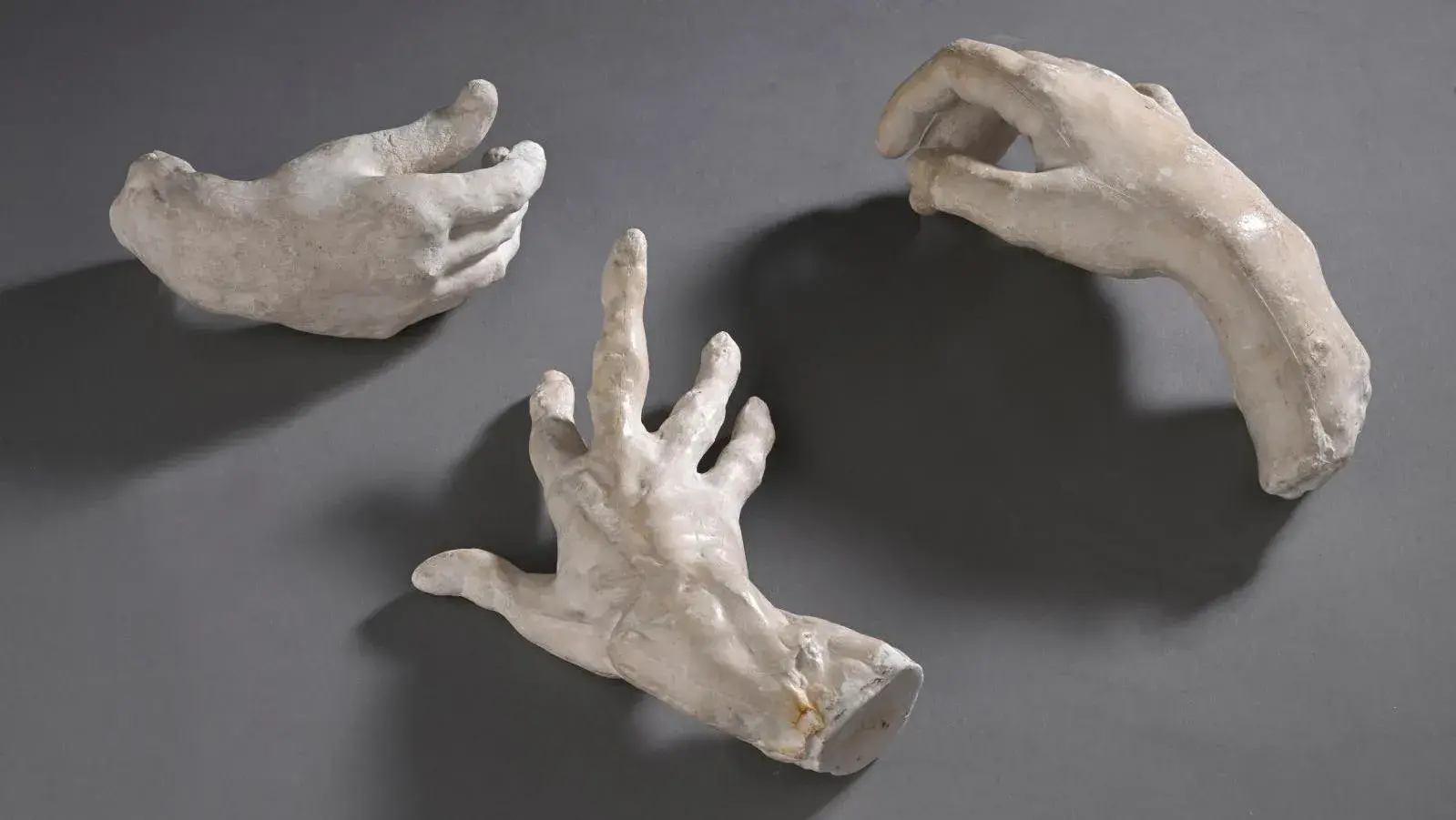
If the hand is Rodin’s preferred motif, three plaster studies tell the story of the admiration and friendship between the sculptor and the painter Eugène Carrière.
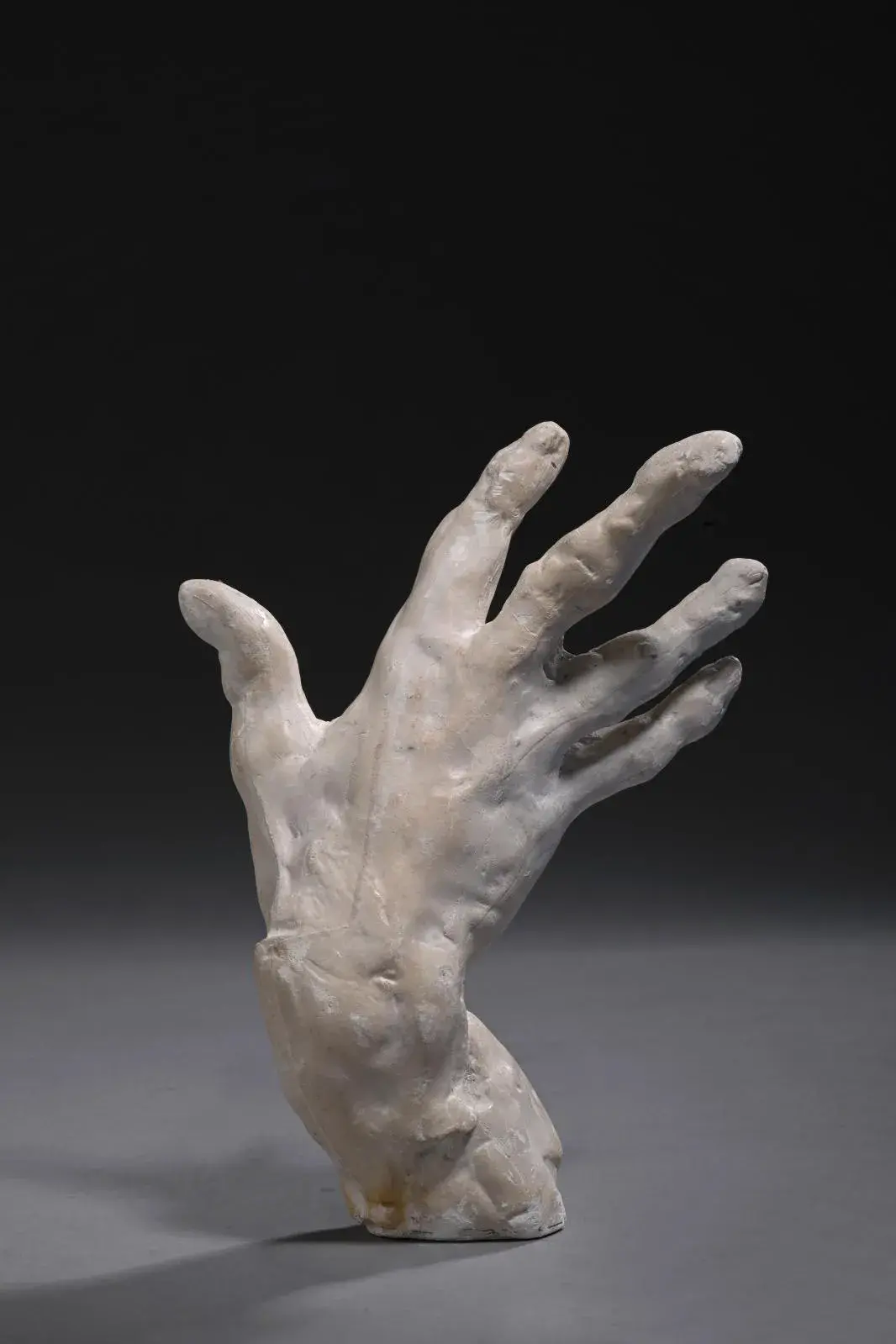
Auguste Rodin (1840-1917), ensemble de trois études de main en plâtre (a group of three studies of hands in plaster, Main droite (Right Hand) n° 3, h. 6, l. 16 cm/h. 2.36, l. 6.2 in, Main droite, majeur levé et poignet cassé (Right Hand, Middle Finger Raised and Wrist Broken), 15 x 10.7 x 5 cm/5.9 x 4.21 x 1.96 in, Main droite féminine, doigts semi-repliés, annuaire levé, FemaleRight Hand, Fingers Semi-Folded, Ring Finger Raised), h. 5.5, l. 11.5 cm/2.16 x 4.52 in, the three signed trois « A. Rodin », presented on a wooden base 5.5 x 50.1 x 28.7 cm/2.16 x 19.72 x 11.29 in. Estimate: €30,000/40,000
When Eugène Carrière died in 1906, Auguste Rodin asked for permission to take impressions of his face and hands. The painter and sculptor had met almost thirty years earlier, in the early 1880s, through art critic Roger Marx. The gesture, to be put in the context of mourning practices at the time, is not exceptional, and other intellectuals and artists are remembered through such casts. But here it reveals the real friendship between the two men. Eugène Carrière took the floor on several occasions to defend or praise Rodin’s work. He took part in his support committee in 1898, in the midst of the controversy surrounding his statue of Balzac, and introduced his 1900 exhibition with these words–“Rodin’s art emerges from the earth and returns to it, similar to the giant blocks that affirm solitudes and in whose heroic growth man has recognized himself”–which set him far above other artists. On several occasions, he portrays himself, and whether at work or posing, the intensity of his gaze shines through, despite the absence of color associated with charcoal or sanguine techniques. Rodin did not reciprocate, but on his death founded the Société des amis d’Eugène Carrière and sketched out a project for a monument to his memory. The two friends exchanged works throughout their lives; the sale of Eugène Carrière’s studio on February 2-3, 1920, included several plaster casts and bronzes by Rodin, while the sculptor had several paintings by Carrière in his museum. The three hand studies in plaster offered for sale (€30,000/40,000), which remained in the painter’s family until 1935 before passing into the Séré de Rivières Collection, all bear Rodin’s signature in an incised line. He was known to offer such gifts to his friends and supporters. The sharp, protruding drips and knife marks are indicative of the mold process, as well as demolding. Rodin frequently used duplication techniques, copying terracotta elements he had modeled himself, and this was an integral part of his working method, on an equal footing with assemblage. There are hundreds of hands in his work, and many more in his museum, if you count the fragments from classical antiquity he collected. Trained at the École Impériale Spéciale de Dessin et de Mathématiques, known as the “Petite École”, the sculptor studied the human body in pieces and by copying often fragmentary antique sculptures, and soon gave as much value to the part as to the whole. The French sculptor even considered the fragment with a modern perspective, no longer as an accidental vestige, but as a deliberate act. Rodin created parts in isolation, building up a repertoire of forms. Using the term abbatis, he models arms, heads, legs, hands and feet of all sizes in clay, which he then casts in plaster. This process, which allows for reuse and greater speed of execution, also offering Rodin great freedom in assembly. For example, in L’Adieu, produced around 1893-1895, he “glued” a sculpture such as the Female Right Hand, similar to the one in this sale, to the head of another, such as the short-haired Camille Claudel.
Rodin’s hands reflect a meticulous observation that borders on the case study.
Surgical Precision
Rodin paid great attention to the extremities, particularly the hands. He told his friend Armand Dayot: “I had to work very hard to achieve maximum truth of expression in the modeling of the hand. The study of the human hand is full of difficulties. Today I find it a most familiar subject, and I enjoy it effortlessly.” In fact, it became an increasingly autonomous part of his work, until, around 1900, it became a veritable obsession. As hand surgeon Raoul Tubiana notes in an article devoted to the artist in Journal of Hand Therapy (1992), Rodin’s hands reflect a meticulous observation that borders on the case study. A closer look at our Female Right Hand, Fingers Semi-Folded, Ring Finger Raised, or our highly expressionistic Right Hand, Middle Finger Raised and Wrist Broken, reveals a real play of combinations. In the first case, there are eight other plaster casts in the Rodin Museum, three of which have no thumbs and are cast separately. In the second, it is similar to the Grande main gauche dite main de pianiste (plaster, Paris, Musée Rodin, inv. S.03186) or the Main gauche (terracotta, Paris, Musée Rodin, inv. S.01355); this system of inversion between left and right can thus be interpreted as a reflection on the notion of reproduction and the creative gesture itself. Associated with God, or with the idea of the sacred through the assemblage La Cathédrale, the hand is for Rodin a separate entity, which needs no attribute to be expressive and to testify to vitality, as his contemporaries well understood. In 1900, commenting on Eugène Druet’s photos, Gustave Kahn wrote in the Symbolist magazine La Plume that Rodin was the sculptor of hands, with all their ambiguities, gentleness and fury. The part embodies the whole. If “the hand reveals the man”, as Hélène Marraud’s book on Rodin’s specific work suggests, above all it reveals the sculptor. The poet Rainer Maria Rilke, in the text dedicated to Rodin, does not fail to underline this: “The artist is the one whose task it is, from many things, to make a single thing and, from the smallest part of a single thing, to make a world. In Rodin’s work, there are hands, small autonomous hands that, without being part of any body, are alive.”
Tableaux, mobilier et objets d’art, verreries, sculptures, bronzes
The dispersal of a group of posthumous bronzes recounts the artist’s quest for movement in a few rare pieces.
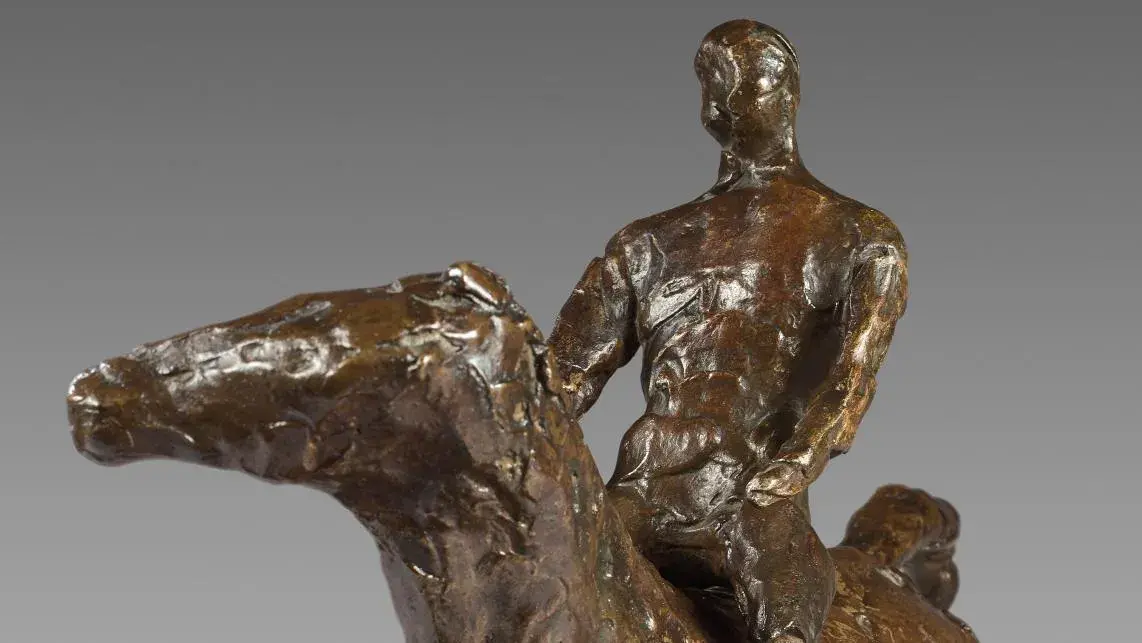
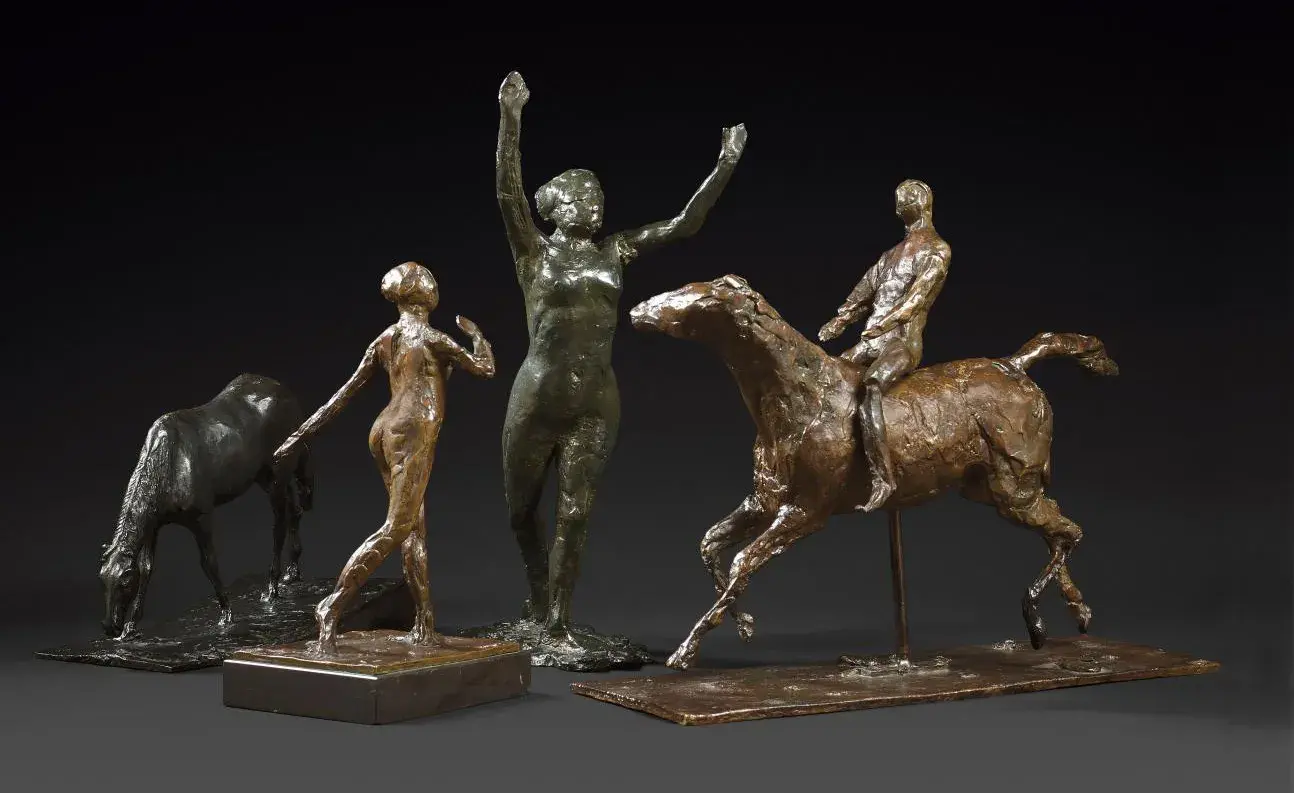
Edgar Degas (1834-1917), Cheval au galop tournant la tête à droite, les pieds ne touchant pas le sol et Jockey monté sur le cheval, 2 proofs patinated bronze, the horse (h. 24.8 cm/9.76 in) signed and numbered, 32/Q, lost wax A.A Hébrard, the jockey (h. 19.5 cm/7.67 in), numbered 36/Q, h. total 36.5 cm/14.37 in. Estimate: €100,000/150,000
Paul Valéry was perhaps the first to see the analogy between Edgar Degas‘s horse and dancer motifs. In his book Degas, danse, dessin, published in 1937, twenty years after the artist’s death, the poet looks back on their friendship, his memories and, above all, is able to take a comprehensive look at his artistic production, much of which was revealed posthumously. At the start of the chapter “Cheval, danse et photo”, Valéry writes: “ It has four hooves. No animal carries the primary ballerina, the star of the ballet company, like a thoroughbred in perfect balance, which the hand of the one who rides the horse seems to be suspended, and which moves forward with a small step in full sunlight.” Degas was interested in horses long before he had access to the backstage of the Paris Opera in 1870. His childhood friend Paul Valpinçon invited Degas with open arms to his family’s property in the Orne region of France, the land of stud farms. He went there regularly and, far from his image as a Parisian painter and worldly artist—which he cultivated—he drew landscapes and horses. He attended the races, observing the horses’ movement—walking, trotting and galloping, without neglecting the impression of speed that could emanate from each movement. Degas is said to have begun sculpting in 1867, after his painting Scène de steeple-chase (Steeple-Chase Scene) received a scathing reception at the Salon the previous year. The testimony of Thiébault-Sisson, who spoke with the artist, is eloquent.
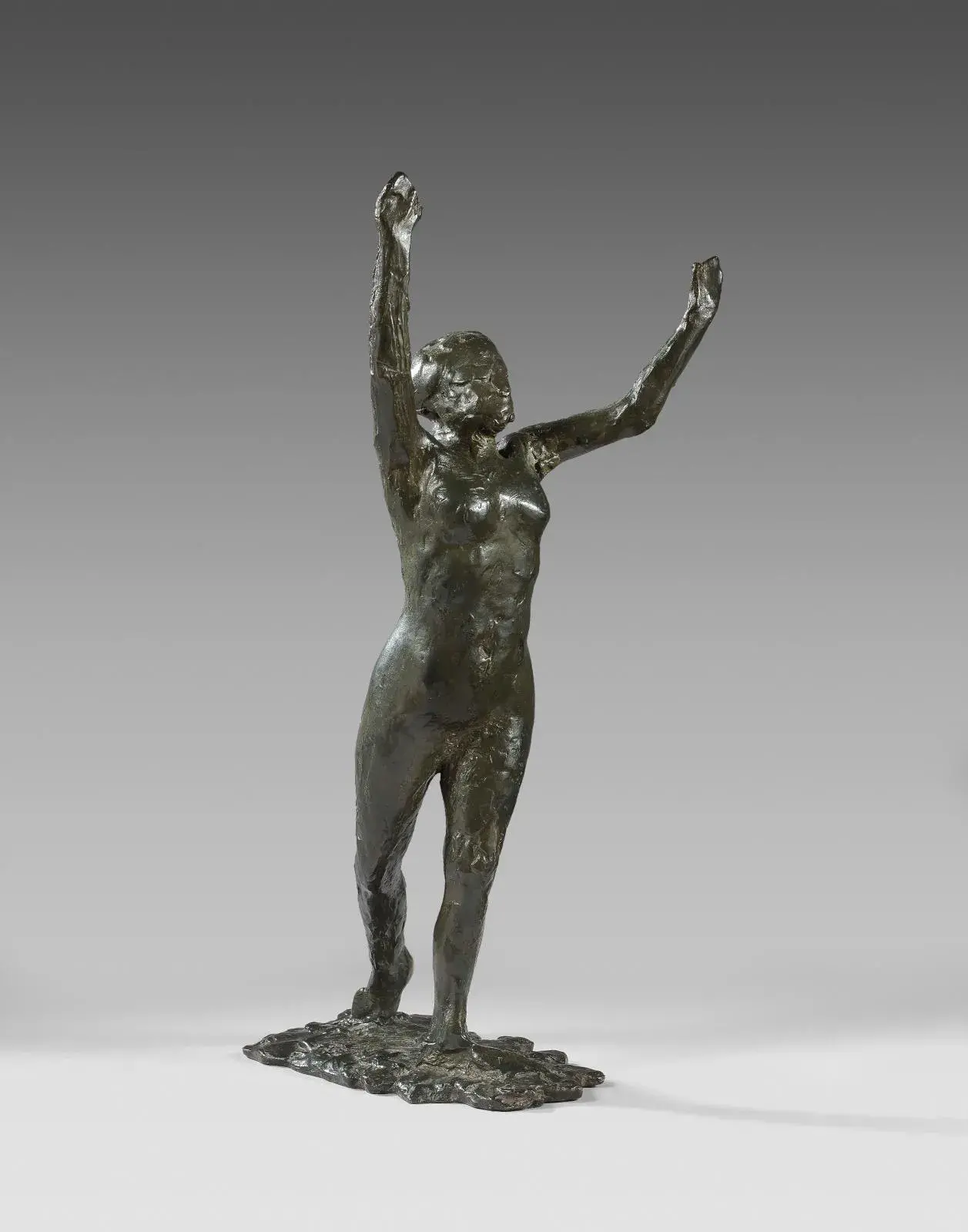
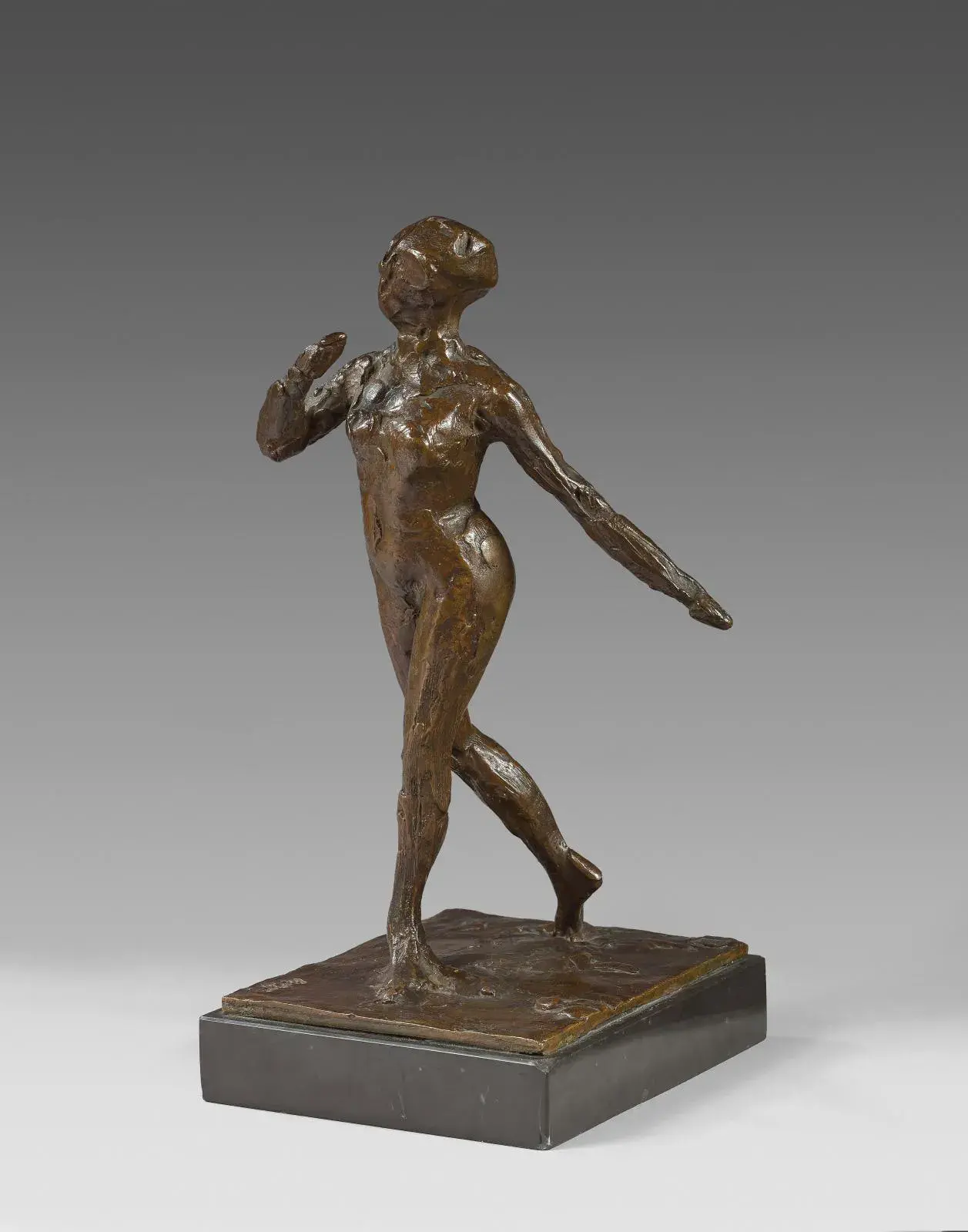
Edgar Degas (1834-1917), Danseuse s’avançant les bras levés, première étude, proof in patinated bronze, signed and numbered,19/G, lost wax A.A. Hébrard, h. 35 cm/13.77 in. Estimate: €50,000/80,000Edgar Degas (1834-1917), Danseuse saluant autrefois appelée Première étude, proof in patinated bronze, signed and numbered 9/K, lost wax A.A. Hébrard, h. 22.5 cm/8.85 in. Estimate: €40,000/60,000
Modeling as Documentation
Piqued by criticism of his ability to draw and represent a horse, Degas sought to understand through modeling what he had not been able to convey through the study of myology and anatomy. Degas rejected the idea of being a sculptor, instead integrating the technique into his painting, in the same way as drawing, from which he then created volume. It’s for my own satisfaction alone that I’ve modeled animals and people in wax, not to take my mind off painting or drawing, but to give my paintings, my drawings, more expression, more ardor and more life,” Degas declared. Considering his models as documentation, using poor materials, mixing tallow with wax, using a little plasticine, he didn’t contemplate the idea of selling them. With age, however, his sculptural practice shifted, and as he lost his eyesight in the 1890s, he devoted all his energies to it, especially as he could no longer draw. On his death, the number of sculptures raised questions for his heirs, his brother René and his sister’s daughter, Jeanne Fèvre. Should these works be destroyed, as the artist once envisaged? Or should they be preserved and their recognition encouraged? Didn’t the sculptor and lifelong friend of Degas, Albert Bartholomé, succeed in convincing him to have plaster casts made for three of his modelages? Hadn’t the man who consolidated La Petite Danseuse de quatorze ans—the only sculpture shown to the public during his lifetime—the day before his exhibition, already changed his opinion of the work? Degas himself had sown the seeds of doubt, through his correspondence with Bartholomé, “his dear friend and perhaps foundryman”. Of the more than 150 wax, terracotta and plaster models scattered around the studio and apartment, some in very poor condition, only 74 have survived, including fifteen depicting horses. Following the inventory, and after much discussion, it was decided to entrust the casting to Adrien Hébrard, under the direction of chief founder Albino Palozzolo. Each of the waxes were made into 22 proofs, of which only 20 were sold (the other two being destined for the founder and the heirs), bearing a letter from A to T. The bronzes schedule to be sold at Drouot on November 22 are derived from castings made between 1921 and 1931 from the original waxes. Listed in the Rewald and Millard catalogs, the latter are surprisingly vague in their dating. For example, the group of Cheval au galop tournant la tête à droite, les pieds ne touchant pas le sol and Jockey monté sur le cheval (Galloping HorseTurning its Head to the Right, with its Hooves not Touching the Ground and Jockey Riding the Horse) (€100,000/150,000) is dated by the former between 1865 and 1881 and by the latter between 1881 and 1890. Degas never dated his wax models, but the two experts rely as much on the comparative analysis of the drawings and paintings as on the artist’s own statements. The artist’s perfectionism led him to constantly rework his figures, even if it meant destroying them each night, as Vollard testifies, astonished when Degas told him he would soon have finished one of his dancers and would be ready to send it to the caster. The definitive nature of bronze, which Degas liked to joke about, frightened him.
Degas’ perfectionism led him to constantly rework his figures, even if it meant destroying them each night.
Degas’ Relationship with Photography
Degas’ sculptures have often been seen as influenced by the chronophotography of Muybridge or Marey, but this could be an a posteriori reconstruction, as Mariel Oberthür reminds us in Edgar Degas en Normandie: le peintre du cheval et des courses. With numerous examples, she shows how Degas began working on horse movement much earlier, by looking at other painters like Meissonier, and above all by experimenting on his own. In fact, while Degas was aware of photographic work on movement in the 1890s, he was also critical of it. The sharpness offered by the camera’s decomposition of movement had a kind of frozen quality. How to capture the sensation of speed? The way Degas included the question of movement in his paintings and sculptures had to do with touch and gesture. For him, three-dimensionality was all about conveying the sensation of life. Modeling, he believes, does not tolerate improvisation and demands more precision than drawing. You can almost feel which muscle is resting and which is active, for example in Cheval à l’abreuvoir (Horse at the Trough) (€60,000/80,000). While it is not lacking life, it is less spectacular than a horse in full race. Degas sensitivity to play of tension when he observed a horse is the same as that which the same treatment he gives to dancers. It’s not necessarily the moment of jumping, but the moment when the animal prepares to jump. It’s not necessarily the performance itself, but the warm-up or the curtain call, as we see with Danseuse saluant autrefois appelée Première étude (Dancer Taking a Bow,formerly called First Study) (€40,000/60,000). The spirit of follow-through should not be overlooked when looking at Degas’ sculptures and, according to Mariel Oberthür, one should not separate walking from trotting or galloping in this marvelous treatise on mechanics. Transposed to the world of dance, this observation is just as accurate. In the 1890s, dance was also broken down by chronophotography, notably in the work La Danse grecque Antique d’après les monuments (Ancient Greek Dance from Monuments and Sculptors ) and sculptors like Camille Claudel took up the theme and made use of these new processes. Degas was in tune with the zeitgeist, but unlike his paintings, in which the dancers are clothed and the tulle gives rise to a striking play of colors, his sculptures are almost all modeled skin-on, naked. The scandal surrounding the exhibition of the fourteen-year-old Petite Danseuse, then wearing a tutu superimposed on the modeled flesh, calls into question the crudeness of the technique and its realism. La Danseuse s’avançant les bras levés, première étude (The Dancer with Arms Raised, First Study) (€50,000/80,000), on the other hand, takes us back to the ritual of the dance spectacle, and depicts a momentum, the very movement that Degas always sought to translate.
Online Auction Features Fine Art, Decorative Arts, Timepieces, Native American, Asian, Militaria, Silver Lots & Much More
Sir John Lavery, R.A., R.S.A., R.H.A. (1856 -1941)
SOUTH SAN FRANCISCO, CA, November 8, 2024 – Turner Auctions + Appraisals is pleased to present the Fine Art & Estate Auction on Saturday, November 30, 2024. Featuring 225 lots, this wide-ranging auction offers a distinctive array of fine art, decorative arts, timepieces, Native American and Asian items, lots of gold and silver, militaria, and much more. Artworks span the 16th-21st centuries in diverse media: oil, acrylics, watercolors, pastels, engravings, serigraphs, lithographs, drawings, mixed media – plus several sculptures. Acclaimed artists include Andy Warhol, Helen Frankenthaler, Ira Yeager, Sir John Lavery, Jean Cocteau, Louis Icart, William Russell Flint, Nathan Oliveira, Gustave Baumann, Francois Burney, and others. From the 16th and 17th centuries are works attributed to Joachim von Sandrart, Augustin Hirschvogel, Guido Reni, Samuel Van Hoogstraaten, and Lorenzo Lotto. There is also a selection of vintage French and American posters related to World War I and World War II.
Timepieces include both men’s watches and clocks. Notable manufacturers of watches are Breguet, Ebel, Baume & Mercier, Bulova, and Gubelin — highlighted by two 18K yellow-gold day-date Rolexes. Among the mantel and table clocks are ones by Jaeger-LeCoultre/Atmos and Tiffany & Co./ Samuel Monti. Lots of precious metals are two Mexican 50 pesos gold pieces; and sterling silver vanity and travel sets, a cigarette case, candlesticks, and spoons.
Edwardian clothing includes bodices and skirts, a corset, coats, and a mourning gown. There are also two contemporary handbags by Prada and Roberta di Camerino. Signed lots are a letter from Diana, Princess of Wales, a Christmas card from Charles Schulz, and a Catherine the Great signature from 1790.
Several nations and cultures are also in the auction. From the U.S. are Native American baskets and/or jars from Papago, Haida, Attu, Washo-Paiute, Pima, Salish, Quinault, Inuit, Navajo, Hopi and Jemez – plus several Blackware dishes, including by San Ildefonso artist Maria Martinez. Asia is represented as well: from Japan are inro and netsuke, a bronze Samurai figure, a man’s silk kimono, and an incense box; from China are a gilt lacquer box, scroll paintings, a landscape drawing, and more; from Thailand is an illuminated manuscript leaf; and a small Asian bronze Buddha.
There is also a wide selection of decorative arts: a 19th-century neoclassical pier mirror, Tiffany pine needle items, a 16th-century map of Russia, several pairs of plaques, Nigerian masks, figurines by Bjorn Wiinblad and Talfourd Toys, a Salviati for Tiffany vase, blown glass whimseys, Victorian Nailsea glass bells, polychrome wood religious figures, santos, and an extensive array of Lalique items. Among several military items are 19th-century engraved plates, several shields, armor, and a sword. Also on offer are an extensive selection of 19th-century English tea caddies.
Turner Auctions + Appraisals begins its online auction on Saturday, November 30, 2024, at 10:30 am PST; sale items are available for preview and bidding now. The online auction will be featured live on multiple platforms: LiveAuctioneers, Invaluable, Bidsquare, and Turner Auctions + Appraisals’ free mobile app, which can be downloaded from the App Store or Google Apps (“Turner Auctions”). All are easily accessed through ‘Upcoming Auctions’ at the company’s website: www.turnerauctionsonline.com/upcoming-auctions.
Here below are some highlights of the upcoming online sale (please see auction information and lot details in the online catalog; note).
Lot 47: Artist: Helen Frankenthaler (1928-2011). Title/Description: “Essence of Mulberry.” Signature: Signed and dated lower right. Date: 1977. Numbered: 22/46. Published by: Tyler Graphics Ltd. Medium: Seven-color woodcut on buff paper. Size: 39 1/2″ x 18 1/2″ (frame 44 3/8″ x 23 1/2″). Condition: Not examined out of frame; please contact office for more information. Provenance: The Merryman Collection, Stanford, California. Estimate $20,000-$40,000. (Photo, top left)
Lot 51: Artist: Andy Warhol (1928-1987). Title/Description: Vote McGovern 84 (Richard Nixon). Signature: Signed in ballpoint and numbered verso. Edition: 2/250. Date: 1972. Medium: Screenprint on paper. Size: 42″ x 42″. Condition: Toning verso. Estimate $20,000-$30,000. (Photo, right)Lot 61: Artist: Francois Brunery (1849-1926). Title/Description: Bishop and Cardinal enjoy a good vintage. Signature: Signed lower right. Date: not given. Medium: Oil on wood panel. Size: 24 1/4″ x 19 1/2″ (frame 30 1/2″ x 26 1/4″). Condition good. Provenance/Gallery Labels: M. Newman, Ltd., Fine Art Dealers, London. And, Burlington Paintings, London. Estimate $8,000-$12,000. (Photo, top right)
Lot 27: Artist: Ira Yeager (1938-2022). Title/Description: White goose in a circle of flowers. Signature: Signed lower right. Medium: Oil and acrylics on canvas. Size:71 1/2in x 71 1/2in. NOTE: Large for shipping. Estimate $8,000-$10,000. (Photo, top left)
Lot 65: Artist: William Russell (Sir William) Flint (1880-1969). Title: The Beach At St. Malo. Size: (Sight) 19 1/4″ x 25 3/4″. Signature: Lower right. Medium/Ground: Watercolor on paper. Estimate $7,000-$9,000. (Photo, middle right)
Miniature Candlesticks. English, Mid-18th Century. Two miniature hallmarked silver candlesticks with a similar scalloped motif, each with the original detachable nozzle. The larger stamped with a dog holding a bird in its mouth on the nozzle and base, and with London maker’s marks. The smaller marked: “M / FM / 1756.” Measuring 5 1/4″ (base 3 1/8″ diam.); and 4 3/4″ tall (base 3 3/8″ diam.). Total weight approx. 318 grams. Condition: overall good; the smaller stick skewed slightly and with old repair at base. Estimate $800-$1,200. (Photo, lower left)
Lot 56: Artist: Attributed to Joachim von Sandrart (Frankfurt am Main, 1606 – Nuremberg, 1688). Title/Description: The Morte di Seneca (The Death of Seneca). Signature: Unsigned. Date: Circa 1635-1640.Medium: Oil on canvas. Size: 34″ x 28 1/2″ (unframed). Condition: re-lined, craquelure; please contact office for more information. NOTE: See images for research provided to the consignor by art historians Maurizio Marini and Didier Bodart. Estimate $3,000-$5,000. (Photo, lower right)
Lot 95: Morel-Ladeuil/Elkington & Co. Pilgrim’s Progress Shield, 1878. Designed by Leonard Morel-Ladeuil (1820-1888), made by Elkington & Co. An electrotype silver- and gold-gilt iron shield, the central relief depicts a scene from John Bunyan’s Pilgrim’s Progress, Christian Battling Apollyon, with two tableaux of heaven above, and two of hell below. The bottom of the center motif is inscribed: “Morel-Ladeuil, inv. fecit 1878” and “Elkington & Co.” To the back, an embossed metal label with Queen Victoria’s device, and “Department of Science & Art, Elkington.” 34 3/4″ x 25 1/2″. Condition: wear and loss to gilt. Note: Elkington & Co. of Birmingham created these electrotype shields as copies, in the manner of the Milton Shield, produced by M. Morel-Ladeuil, which was shown at the Paris Exhibition in 1867. They were intended to be used by artists, artisans, and students as design aids in the government schools of design under the Department of Science & Art. (See “The Milton Shield” at the V & A collections.vam.ac.uk.) Estimate $1,000-$2,000. (Photo, top left)
Lot 9: WWI Liberty Bonds Campaign Poster. Artist: L. A. Shafer (Early 20th Century). Title: “They Kept the Sea Lanes Open, Invest in the Victory Liberty Loan.” Printed for the U.S. Government by the W. F. Powers Co. Litho, NY. Date: 1917-1919. Medium: Color lithograph. Size: 29″ x 39″ (frame 29 1/4″ x 39 1/4″). Condition: Appears very good (not examined out of frame), colors bright. Estimate $300-$500. (Photo, top right)
Lot 98: Tiffany Bronze Pine Needle Desk Set. Early 20th Century. A seven-piece patinated bronze and green slag glass desk set, all items marked Tiffany Studios, New York. Consists of an easel frame, a stamp tray, an inkwell, paperweight, scale, bill file spike, and letter opener. Largest piece 8 1/4″ x 6 3/4″. Condition: the frame with broken/missing glass and missing rims, two glass inserts missing from inkwell (and slight denting to panels, two ball feet missing), one ball foot missing from scale. Estimate $300-$500. (Photo, lower left)
Lot 132: Artist: Bjorn Wiinblad (1918-2006). Title/Description: Woman with Basket on Her Head (No. M25). Signature: initialed/inscribed on base. Date: 1992. Medium: Polychrome glazed ceramic figurine. Size: 8 1/2″ x 4″ x 2 3/4″. Condition good. Estimate $300-$500. (Photo, lower right)
Lot 70: Japanese Inro with Cinnabar Lacquer Netsuke. A Japanese gilt-lacquer four-part inro with carved cinnabar lacquer netsuke. Box 2 1/2″ x 2 1/4″, netsuke 2″ long. Good condition overall, a few tiny chips to gilt. Estimate $300-$500. (Photo, left)
Lot 163: Northwest California Basket Tray. A round basket tray (Hupa, Karok, or Yurok). Approx. 2″ x 10 1/4″. Overall good condition. Estimate $150-$250. (Photo, right)
– PREVIOUS IMAGES –
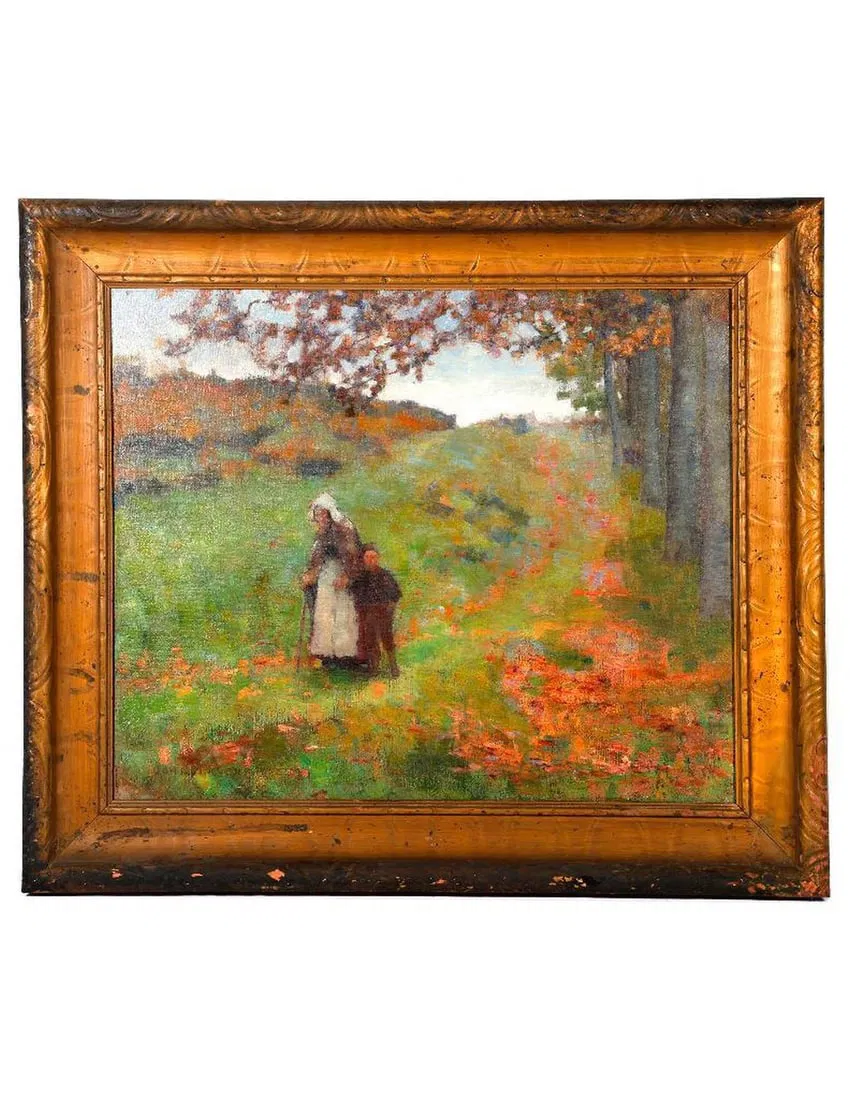
Lot 64: Artist: Sir John Lavery, R.A., R.S.A., R.H.A. (1856-1941). Title: The Fall of the Leaf. Signed: John Lavery and dated 1884 (lower left). Medium: Oil on canvas. Unframed: 48.26cm by 55.88cm (19in. by 22in.). Framed: 59.06cm by 69.22cm (23 1/4in by 27 1/4in). NOTE: Special thanks to Kenneth McConkey, for his contribution of research and insight on this work (see images). McConkey is the author of John Lavery, A Painter and his World (2010), and guest curator of “Lavery, On Location 2023-24,” a major touring exhibition at the national galleries of Ireland and Scotland, and the Ulster Museum, Belfast. Estimate $40,000-$60,000. (Photo, page 1, right)
Lot 214: Diamond Rolex Day-Date 18K Yellow Gold #7610848. Caliber/Movement: 3055.1983. Aftermarket face, bezel and bracelet. Watch was working at the time of inspection. Estimate $5,000-$7,000. (Photo, page 1, left)
###
ABOUT TURNER AUCTIONS + APPRAISALS
Based in South San Francisco, Turner Auctions + Appraisals was founded by Stephen Turner to expand and complement the capabilities of Stephen G. Turner Associates,an auction and appraisal consulting firm founded in 2004.Turner Auctions + Appraisals presents online auctions in diverse categories of personal property (www.turnerauctionsonline.com). Among them are Fine Arts, Decorative Arts, Asian Arts, Toys, Jewelry, Militaria, Ethnic Arts, and others. The company offers a range of auction and appraisal services for buyers, sellers, and collectors. Online auctions are held several times a month. Working with leading live and online auction houses on the West Coast since 1991, Turner is a professional appraiser of personal property and seasoned auctioneer. His areas of expertise include fine art, decorative arts, antiques & residential contents. The company welcomes consignments and appraisals.
For more information about the company, please contact:
Stephen Turner, President, Turner Auctions + Appraisals, 461 Littlefield Avenue, South San Francisco, CA 94080
The English version of the Japan Teddy Bear Association’s 34th Japan Teddy Bear With Friends Convention advertising poster. Image from the Japan Teddy Bear Association.
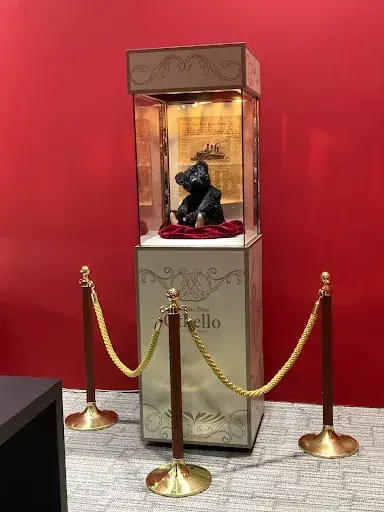
On October 19 and 20, 2024, the Japan Teddy Bear Association held its 34th Japan Teddy Bear With Friends Convention in Tokyo at the Haneda Airport Garden convention center. This annual event is the largest Teddy bear show in Asia. About 5,000 attendees visited the gathering over the two-day-long celebration. The star of the show was Othello, the breathtaking and all-original 1912 Steiff Titanic Mourning Bear that set a new world record for the most expensive antique Steiff bear sold at auction in July 2023. This treasure now calls Japan his home. Other highlights of the event included 200 exhibitors, seminars, and programs given by experts from the international Teddy bear community, a Teddy bear design contest, a Teddy bear-making workshop, raffles and drawings, and a charity auction. Here’s a bit more about this sale, which was managed a little differently than those held across North America and Europe.
The event’s theme of “red and black” was evident when attendees entered the convention space. Image from the author’s collection.
The charity auction was held on an elevated wooden stage that was directly adjacent to the event entranceway. Auction participants stood right below the stage and could view the numbered lots in advance. On the stage were a podium and microphone, and that is where the auctioneers described and sold the lots. The auctioneers were from the Ladenburger Spielzeugauktion auction house of Ladenburg, Germany; this company was also an event sponsor. The auctioneer conducted the bidding primarily in German, with a Japanese translation immediately following each communication from the auctioneer. Another person standing on the stage held up each lot for bidders to see. There were no numbers or paddles; bidders just raised their hands and jumped around a bit to get their bid noticed and registered.
A highlight of the weekend-long Teddy bear celebration was a Steiff auction which generated funds for earthquake relief in Ishikawa Prefecture. Image from the author’s collection.
An auction was held in the afternoon of each day of the event. Thirty lots were auctioned per day, and bidding took about three minutes per lot– a little longer than the US standard of approximately 60 to 100 lots per hour. This extended bid period was the result of multiple language translations, as well as much laughing and fun. The lots on offer included a full range of vintage to newer Steiff, including United States and F.A.O. Schwarz exclusives that were particularly appealing to the Japanese audience. On the first day, the auction generated 1,149,000 yen or $7,478. The second-day proceeds were 831,000 yen or $5,387. Overall, the sale had a 98% sell-through rate and an average price of 33,000 yen or $214.41 per lot. The most expensive lot was a prototype teddy bear donated by the Margarete Steiff GmbH company headquarters.
The star of the show was Othello, a black mohair Steiff Titanic Mourning Bear, who sold for nearly $250,000 in 2023 and holds the world record for the most expensive antique Teddy bear sold at auction. Image from the author’s collection.
Every year, the Japan Teddy Bear Association holds this sort of auction to benefit a Japanese charity. These funds are usually donated to hospitals and other organizations as part of their Teddy Bear Fund. This year, the proceeds went to support victims in Ishikawa Prefecture– a district on the Japanese island of Honshu– which suffered the deadly Noto Peninsula earthquake on January 1. This shaker had a magnitude of 7.6 and generated a tsunami, landslides, and multiple aftershocks. Overall, it resulted in 168,822 structures damaged or destroyed, 426 fatalities, and 1,344 injuries.
There were no buyer’s or seller’s premiums in this sale. Unlike in Europe and America, auction culture is not very popular in Japan and is still a relatively new concept. Nonetheless, many people attended the sale to bid and/or watch the excitement, and there was never a dull– or slow– moment during the auctions.
Featured: Gilded Merovingian (400-600 AD) longsword, Medieval iron helm with eye-slits & breathing holes, Arabian alabaster figure of monk, rich gold Viking pendant, Greek glass, Apulian pottery
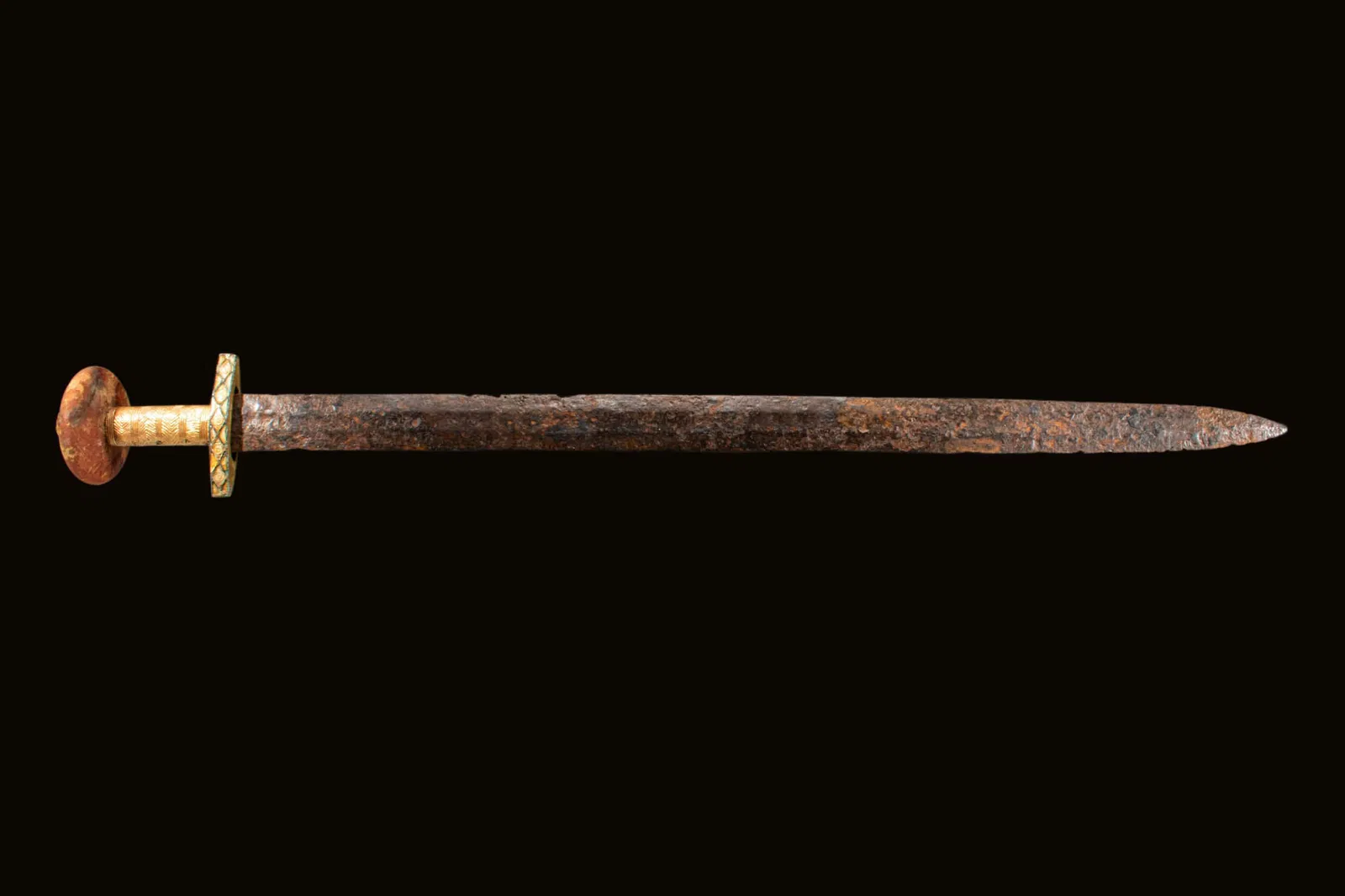
Merovingian Longsword With Gold Handle
LONDON – Hundreds of exciting buying opportunities await collectors of ancient art and cultural relics at Apollo Art Auctions’ November 17 e-sale. The expertly-curated selection includes authentic, well-provenanced artifacts from Classical Europe through Egypt and the Near East, as well as fascinating treasures from India, China and the Islamic world. Apollo makes the auction process pleasurable and easy for international bidders by accepting payments in US dollars, British pounds sterling or euro and handling all packing in-house prior to shipment. Bid securely online through Apollo Live, including via their free app; or through any of three other bidding platforms.
Heavy metal isn’t just a music genre; it’s also one of the most consistently popular categories in Apollo’s sales, year round. Two lots rise to the top of metal offerings in the November event, starting with an elegant edged weapon from the era of the Merovingian Dynasty. The circa 400-600 AD longsword has a double-edged blade with an extremely shallow fuller (groove or slot) and sharp tip. Its bronze crossguard and wood handle are highly decorated with gold leaf, and its large stone pommel is secured by a gold- and glass-adorned end cap. A long trail of provenance indicates it was most recently the property of a European collector, who acquired it on the English art market in 2016; preceded by the collection of T. R., who obtained it in 2000. Prior to that, it was part of the private British collection of Mr. W. L., whose ownership began in 1965. Bidding on this exceptional weapon will open at £12,000 ($15,562).
Dating to circa 1300-1400 AD, a riveted iron great helm was designed with a distinctive barrel-like shape specifically intended to protect a knight’s whole head in combat. Helmets were important elements of medieval knightly armor, and it is known that they often were included on funerary monuments. The compelling visage on the auction example has rectangular slits for vision and rows of holes, called “breaths,” for ventilation. Similar to an example in the collection of The Deutsches Historisches Museum in Berlin, the helm’s line of provenance includes a Central London gallery; a European collector; and the collection of Ing Peter Till, which was formed in 1980s Vienna. Its opening bid is £10,000 ($12,968).
Human figurative art has been dated to as far back as 41,000 years ago and Europe’s cave-dwelling Cro-Magnon artists. Over the millennia, images of people and animals have consistently been associated with every major documented culture. A fascinating South Arabian artwork in the auction is a circa 300 BC to 100 AD alabaster figure of a man – most likely a priest – garbed in a long, tight-fitting tunic. The figure stands on an integral base with two registers, each displaying a line of South Arabic text. An important piece, it is similar to an example that was entered in Sotheby’s December 7, 2021 Ancient Sculpture and Works of Art Auction, Part I. It stands 380mm (15in) high and weighs 5.3kg (11lbs 11oz). Tracing its line of provenance, it came to Apollo Art Auctions from a London collector and, prior to that, was in a private collection in Shrewsbury, England. The figure will convey with a historical report from Alessandro Neri, a respected international cultural heritage expert based in Florence, Italy. The opening bid is £8,000 ($10,375).
Another exceptional figurative artwork is a TL-tested Chinese Tang Dynasty terracotta horse captured in a dramatic pose, stretching its head upward and baring its teeth as though emitting a neigh through curled lips. Molded in a naturalized manner, its body is painted mainly with red pigments, with details such as a mane, tail, saddle cloth and saddle. A Thermo-Luminescence analysis undertaken by Ralf Kotalla precisely dated the sculpture to 619-906 AD. That report will convey to the winning bidder. The feisty equine measures 690mm by 645mm (27.2in by 25.39in) and weighs 12.3kg (27lbs 2oz). Its provenance includes a UK private collection; and acquisition by a former owner in the early 1990s in Hong Kong. Opening bid: £3,000 ($3,891)
Ancient Mediterranean art is led by a circa 100 BC to 100 AD Greek pale yellow cut-glass skyphos with tapering vertical walls and integral ring handles formed between plates. After casting, this handsome, well-balanced vessel was lathe-cut and polished, with a resulting size of 155mm by 85mm (6.1in by 3.35in). Prior to its inclusion in Apollo’s November 17 auction, it was the property of a European collector who acquired it on the European art market pre-2000. Opening bid: £8,000 ($10,375)
A rare circa 350-300 BC Apulian red-figure pottery bell krater measuring 270mm by 320mm (10.6in by 12.6in) is beautifully painted with a different scene on each side. Side A depicts a seated Nike with outstretched wings, holding a large mirror in front of woman wearing a long chiton, while Side B is a possible temple scene depicting two men resting on sticks and wearing long robes. This attractive piece of decorative art measures 270mm by 320mm (10.6in by 12.6in) and weighs 1.8kg (4lbs). Notably, a similar example sold at Christie’s on December 9, 2008. Its provenance includes a private UK collection and prior acquisition on the Dutch art market (Frederik Van Driel, Maastricht 1993). Opening bid: £2,000 ($2,594)
Top jewelry selections include a striking circa 500-800 AD Byzantine solid gold cameo ring whose gold bezel secures a square banded agate cameo with the symbol of the CHI-RO inside a round laurel crown. A similar example can be seen in J. Spier’s 2012 reference Byzantium and the West: Jewelry in the First Millennium, No. 14. Most recently with a London gallery, it was previously acquired on the Monaco art market; and was part of a French collection from the 1970s. Opening bid: £4,000 ($5,187)
With the popularity of Viking jewelry being what it is, strong competition is expected for a gold filigree pendant in the shape of Odin’s head. It is an extremely well-detailed object, with beading employed to form the facial features and hair. A square adorned projection at its top serves as a suspension loop. The pendant’s weight is 10.66g. It became the property of a London ancient art gallery after residing in a private collection that was formed 1965-1975. Bidding will open at £2,000 ($2,594).
Apollo Art Auctions’ Ancient Art & Antiquities e-sale will be held on Sunday, November 17, 2024 starting at 8AM US Eastern Time / 1PM GMT. Preview online at https://apolloauctions.com. Bid live online through Apollo Live, LiveAuctioneers, The Saleroom, or Invaluable. For those on the go, bid through Apollo Art Auctions’ app, which is free to download from the App Store or Google Play. In-person previews are available by appointment only. Gallery address: 63-64 Margaret St., London W1W S8W. For questions regarding any item in the auction or to make an appointment to preview goods, please call or email +44 7424 994167 or email [email protected]. Apollo accepts payments in GBP, USD and EUR. White-glove in-house packing and worldwide shipping. Note: No import charges are assessed on most antiquities sent to the United States.
The Fondation Custodia is exhibiting drawings from Museum Boijmans Van Beuningen: 120 masterpieces in a variety of styles and techniques, showing the medium’s essential role in the creative process from the 15th century onwards.
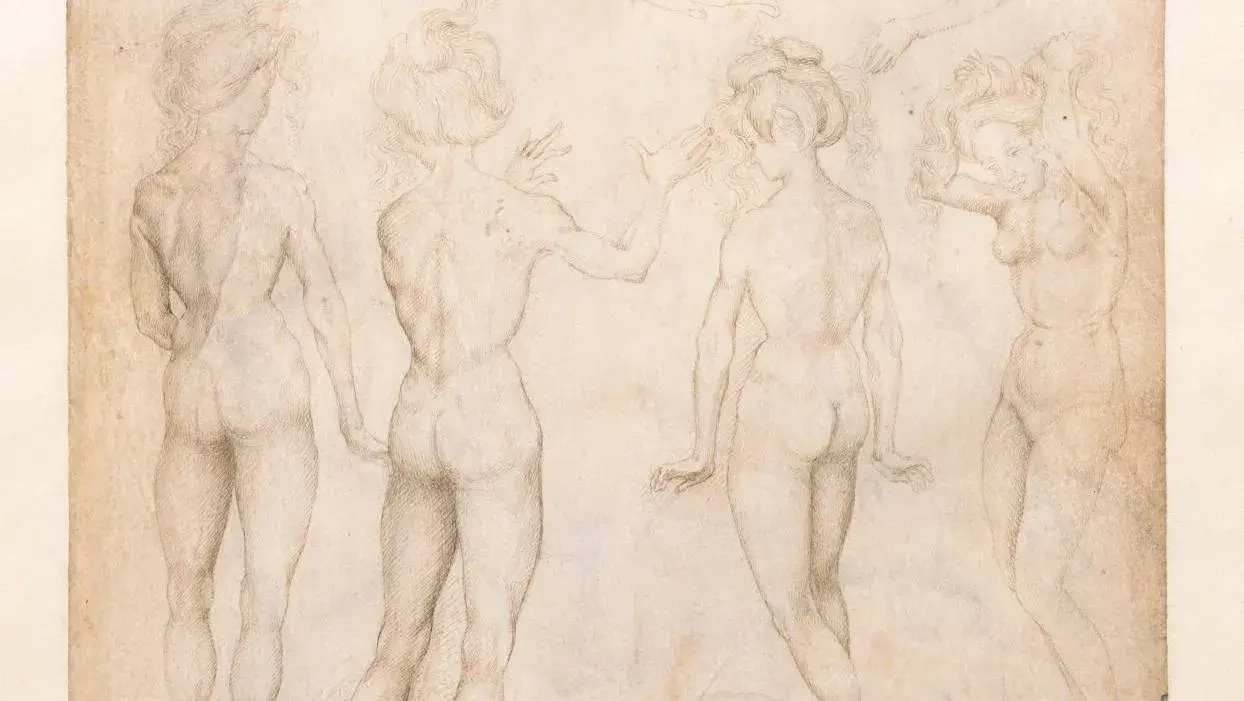
Pisanello (c. 1395-1455), Four studies of a nude woman, an Annunciation and two studies of women swimming, c. 1431-1432, pen and brown ink on parchment, 22.3 x 16.7 cm/8.7 x 6.3 in.
While there are plenty of fine drawings in France’s public collections, there are only a few opportunities to see them, given their fragility: at the Salon du Dessin, in the graphic art departments of various museums and at the Fondation Custodia in Paris. The current exhibition at the latter sheds considerable light on drawing’s fundamental role in the Italian Renaissance, while providing a chance to admire selected works from the outstanding collection of the Museum Boijmans Van Beuningen in Rotterdam. Frits Lugt created the Fondation Custodia in 1947, exactly a century after the lawyer Frans Jacob Otto Boijmans made the initial bequest spawning the museum named after him in Rotterdam. Opened in 1849, in 1935 the museum welcomed the prolific collection of the German-born banker Franz Koenigs. With some 90,000 works, the Rotterdam museum’s graphic art collection is one of the largest in the world, and contains a remarkable group of Italian Renaissance drawings. Between 2018 and 2023, 380 of these Italian works from between 1400 and 1600 were studied and cataloged online as part of “The Paper Project” run by the Getty Foundation. And 120 of them have been selected for the Paris exhibition. According to Maud Guichané, head of collections at the Fondation Bemberg in Toulouse, and a former curator with the Fondation Custodia, these are “the most beautiful, the most remarkable and the most interesting drawings. Some of them recently turned out to be major discoveries, particularly in terms of attribution – to artists including Niccolò di Pietro Gerini, Giovanni Antonio Boltraffio, Jacopo Pontormo, Pellegrino Tibaldi, Federico Zuccari and a few others. We have also ensured that the selection reflects the very nature of the Museum Boijmans collection and its strong points: namely the very early works, especially the drawings by Pisanello and the Gozzoli album, the incredible group of drawings by Fra Bartolomeo, 13 of which are on show, as well as works by other Florentine and Venetian artists, who are well represented in the collection.” She adds: “There are certain similarities between the Italian groups in these two collections, which were produced at the same time: a large majority of the drawings in the Museum Boijmans Van Beuningen come from the collection of Frits Lugt’s contemporary, the German banker Franz Koenigs. The two men knew each other well and even swapped drawings on several occasions!”
Jacopo Pontormo (1494-1557), Study of two boys seated, c. 1525, sanguine, 27.7 x 37.9 cm/10.6 x 14.6 in.
At the Heart of the Creative Process
The exhibition shows how drawing was practised in studios during the Renaissance. Books of motifs, which began to appear in the 14th century, were passed down from master to pupil over the generations. They were drawn in ink or metalpoint, sometimes coloured, and were executed on parchment until the mid-Quattrocento, as paper was very scarce and expensive. The Museum Boijmans has a very few examples, like the five pages from Pisanello’s broken-up travel sketchbook, and a book of models inherited from Gentile da Fabriano, to which he added copies of classical art and motifs drawn from life during his stay in Rome from 1431 to 1432. The drawing with four views of the same naked woman from behind, probably made during a bathing session, features the first profane nude in modern Western art. The meticulously rendered human body, the reference point and measure of all things (echoing the humanist thinking of the time), whether fragmented or in its entirety, was the main subject of Renaissance drawings, as witness the Franz Koenigs collection. Dated c.1450-1460, an album of 20-odd pages (bound in the 18th century using an old book of models from Benozzo Gozzoli’s studio) contains copies of antiquities, frescoes and plaster casts. Copying was an intrinsic part of young artists’ training in the Florentine studios of the Quattrocento. Leonardo da Vinci and Michelangelo were prolific draughtsmen who produced a wealth of works, taking drawing to its apogee at the dawn of the Cinquecento. Drawing then became disegno, i.e. the materialization of thought. For Leonardo, it was a means of exploring and understanding the world; for Michelangelo it was an expression of his inner self. Dated between 1505 and 1506, Leonardo’s study for Leda and the Swan – a work he never actually painted – is one of only two of his drawings now in Holland. The small, helmeted heads penned by Michelangelo in the same years show all the vigour and spontaneity of the artist described by his contemporaries as a “divine draughtsman”. Their followers and pupils, like those of Raphael – represented here by a small study of Saint John the Baptist for the Alba Madonna, painted in Rome in c.1510 – systematised the practice of drawing. Initial ideas were sketched out quickly on paper, then certain elements and the composition would be refined in studies. The whole work, fixed in a model, would finally be scaled up to the size of the final work in a cartoon.
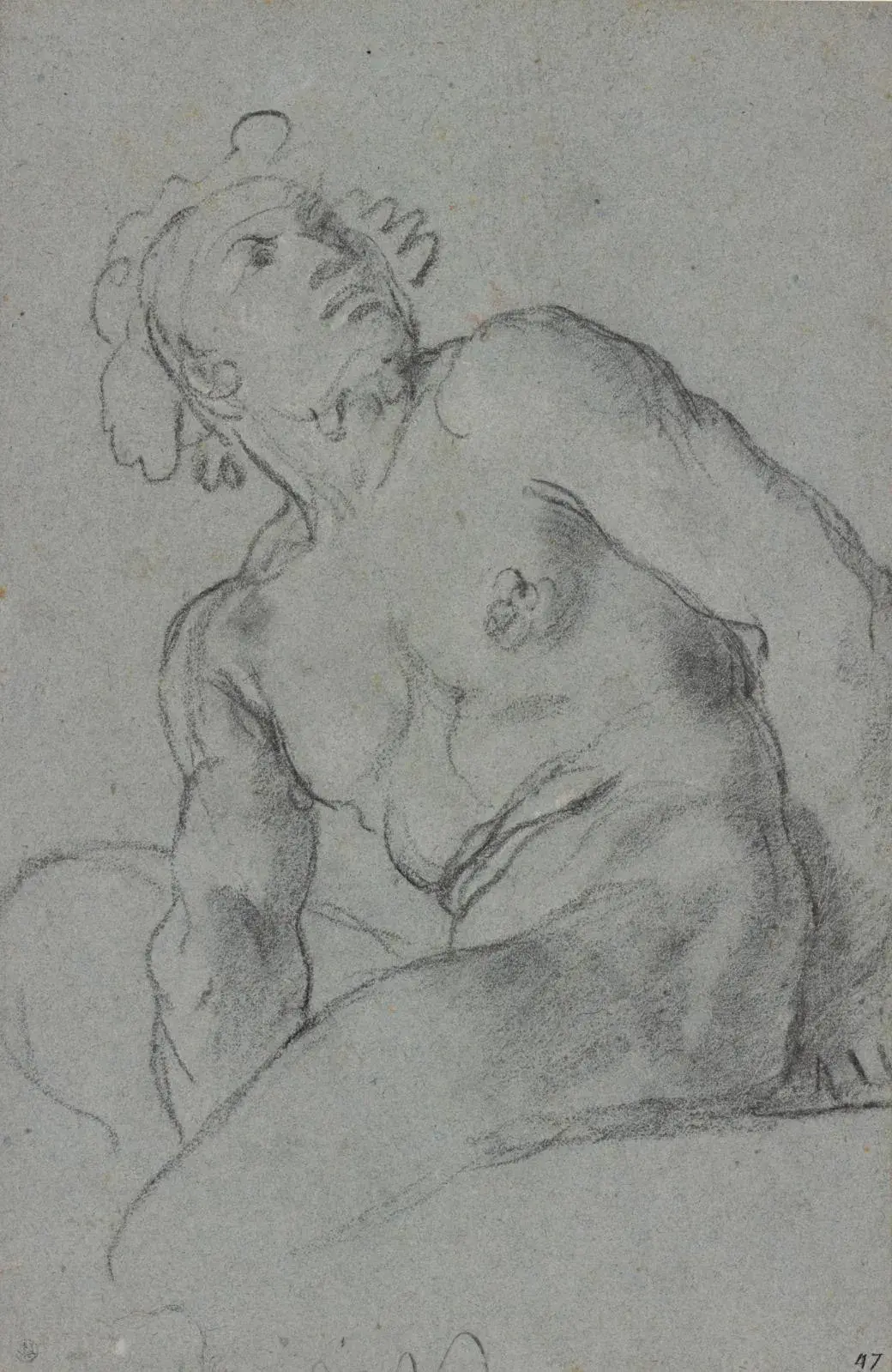
Annibale Carracci (1560-1609), Study of a nude man seated, c. 1595-1600, black chalk with white highlights on blue paper, 33.6 x 22.1 cm/13 x 8.7 in, Museum Boijmans Van Beuningen, Rotterdam. On loan from the Stichting Museum Boijmans Van Beuningen (former Koenigs collection).
From Florence to Venice
Acquired by Franz Koenigs in 1957, Fra Bartolomeo’s two albums, bound in c. 1730, contain some 400 drawings in black chalk and sanguine, the successive stages in the development of his religious compositions. With Jacopo Pontormo, Fra Bartolomeo embodied the Florentine bella maniera. “In his letter on the Paragone to Benedetto Varchi in 1547, Jacopo Pontormo stressed the importance of drawing as the foundation of all the arts,” says Cécile Beuzelin, a lecturer at the University of Montpellier. According to the specialist, the astonishing study of two seated boys, one of whom is picking his nose (c. 1525) bears witness to “Pontormo’s liking for these little scenes in everyday life, making him a precursor of the explorations of Carracci and Caravaggio. This drawing, which seems to have been sketched from life for the sheer pleasure of recording these everyday moments in the studio, is echoed in the small drawing of studio assistants singing, now in the Budapest Museum of Fine Arts.” Particularly well represented in Franz Koenigs’ collection, the style of Cinquecento Venetian drawings arose from a specific practice very different from what was taught in the academies of Florence, Rome and Bologna. This type of drawing was full of colour and sensuality, and was practised in the family studios of the Serenissima: chalk drawings on coloured paper by the Bassanos, spirited studies in black chalk on blue paper by Jacopo Tintoretto and his sons, and ink and wash drawings by Paolo Veronese and members of his close circle. The latest works were produced in Rome, like a preparatory ink study, recently attributed to Federico Zuccari, for a full-length portrait of Polidoro da Caravaggio as the god Mars, which he painted in the Palazzo Zuccari in around 1595. From the outstanding French collections of Pierre Mignard, Pierre Crozat and Pierre-Jean Mariette, the man evoked in a few strokes of black chalk by Annibale Carracci in the same years is a sketch for the famous decoration of the vault of the Sala Grande in the Farnese Palace in Rome. The Renaissance was over; the Baroque and Classicism had now taken the stage.
Worth seeing “Naissance et Renaissance du dessin italien. (The Birth and Renaissance of Italian Drawing.) The collection of the Museum Boijmans Van Beuningen” Fondation Custodia, Paris 75007 Until 12 January 2025 fondationcustodia.fr
Worth reading “Italian Drawings 1400-1600” boijmans.nl “The Paper Project” getty.edu
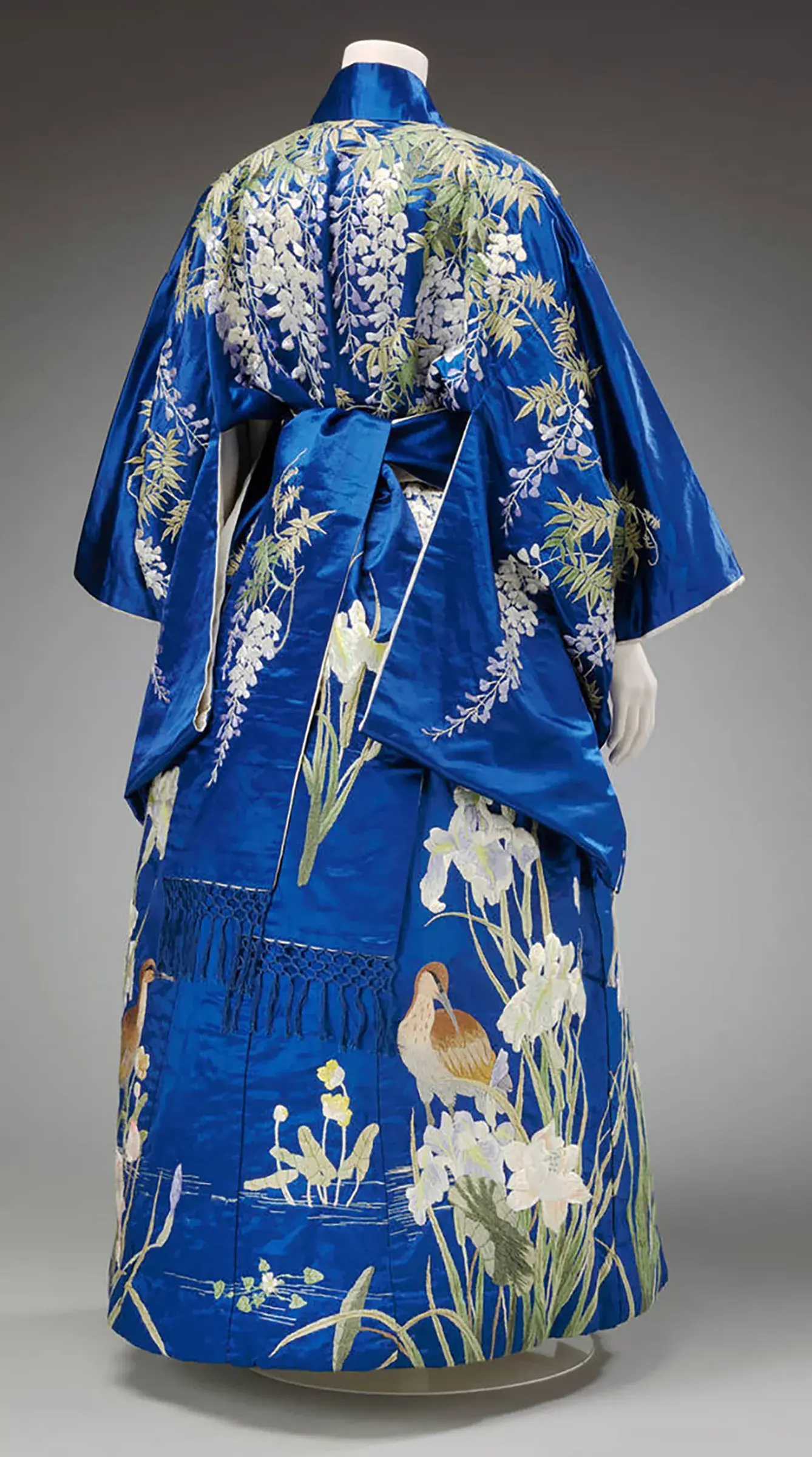
Robe with Sash, 1905 –15, Kyoto, part of the Kimono to Catwalk Exhibition at the Victoria and Albert Museum, August – October 2020
New York: Material Transformation a webinar–co-hosted by
Joan B Mirviss LTD and Asia Week New York– will delve into the vibrant history of Japanese textile art, the evolution of the kimono, the continued use of recycled materials in textile creation, and the ways contemporary makers use traditional aesthetics and techniques innovatively to expand the field of Japanese textile art. To register for the webinar on November 14th at 5:00 p.m. (EST), click: https://us02web.zoom.us/webinar/register/WN_v6vLGomhT6GtfAXcLmnXsg
For over a millennium, Japan has been celebrated for its vibrant and diverse textile industry. From weaving with silk, wool, wood, stainless steel and even silkworm cocoons to numerous styles of fabric dyeing, Japanese artists have continually pushed the boundaries of tradition and technology.
Moderated by Joan Mirviss–whose renowned New York gallery is among the foremost in the field of Japanese of art–the distinguished panelists include:
Steve Beimel, a longtime resident of Japan who produced in-depth cultural tours with a Japanese culture-focused company that he founded in 1992. In 2018, he founded JapanCraft21 (NPO) to save and revitalize Japanese master crafts, support apprenticeships in vulnerable craft genres, and host national contests that give ongoing support to craftspeople.
Monika Bincsik, the Diane and Arthur Abbey Curator for Japanese Decorative Arts at the Metropolitan Museum of Art, specializes in Japanese decorative arts and textiles. She was co-curator of Kimono: A Modern History (2014) and curated Japanese Bamboo Art: The Abbey Collection (2017), and Kyoto: Capital of Artistic Imagination (2019). She has published widely on decorative arts and collecting history.
Anna Jackson is the Keeper of the Asian Department at the Victoria and Albert Museum. A specialist in Japanese textiles and dress, she has written widely on the subject. Most recently she curated the exhibition Kimono: Kyoto to Catwalk and edited the accompanying publication. Jackson was awarded the Foreign Minister`s Commendation in 2020 for the promotion of Japanese culture in the United Kingdom. Reiko Sudō i is the design director for the leading textile design firm Nuno, founded in 1984, and a member of the prestigious Japan Design Committee. Additionally, Sudō is an Emerita Professor at Tokyo Zokei University, an honorary MA graduate from the University for the Creative Arts (UK), and a recipient of the Mainichi Design Award, the ROSCOE Design Prize and the Japan Interior Design Association JID Award.
In its red variety, this stone was long confused with the ruby and embellished many historic jewellery sets. Unjustly forgotten, it is now making a comeback on the jewellery scene.
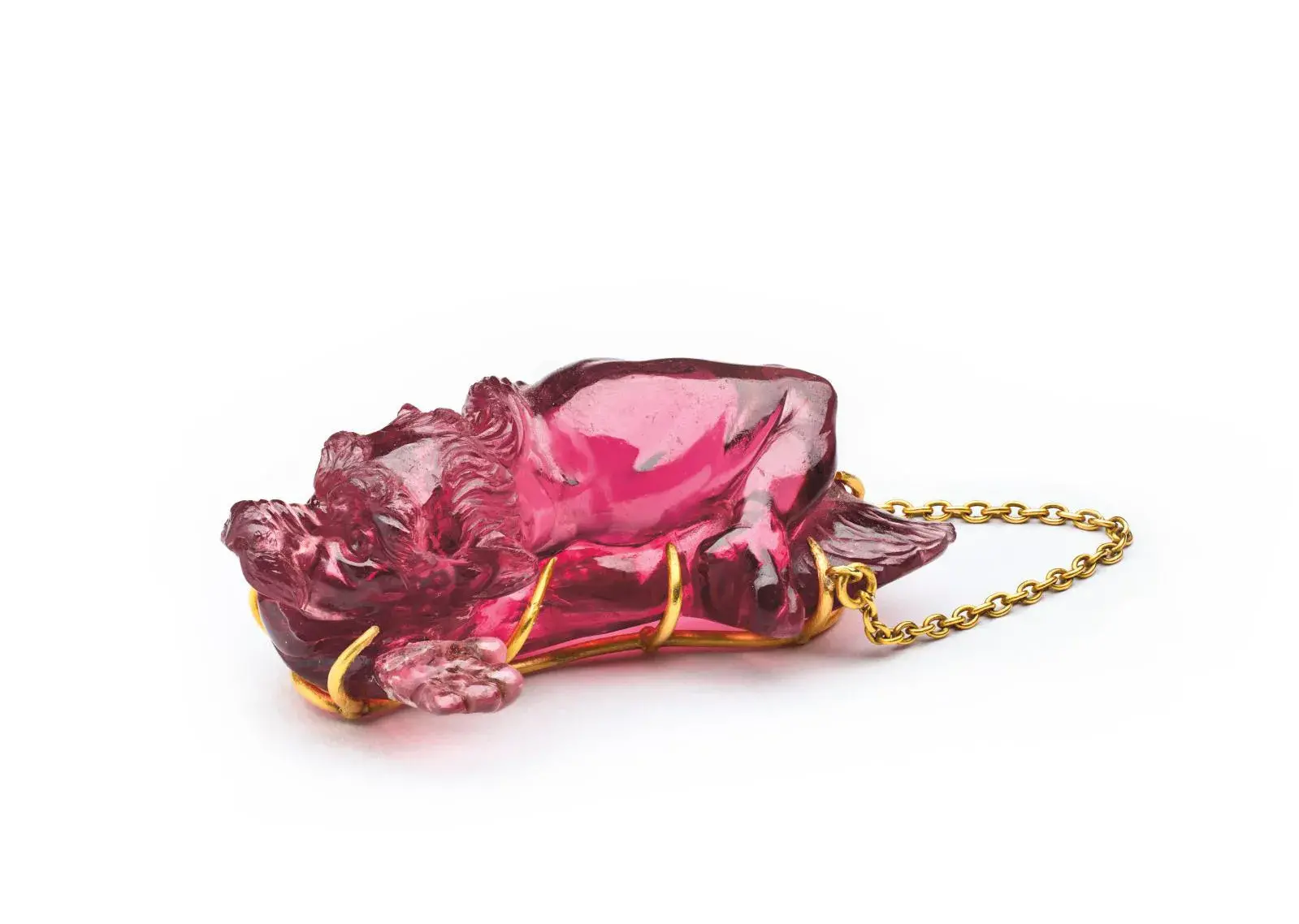
In the world of gems, spinel has been dogged by its reputation as an impostor, particularly when it has a fine red shade, like the ruby. It was found in the great royal courts from Great Britain to Russia under misleading names like the Black Prince’s Ruby, Tamburlaine’s Ruby and Catherine the Great’s Ruby. The first, a 170 ct cabochon named after one of its illustrious owners, Edward of Woodstock (1330-1376), has adorned the heads of several British sovereigns and features in the current imperial crown; the second, an engraved stone weighing over 350 ct, is at the center of a necklace created in 1853 for Queen Victoria; the third, weighing 398 ct, was set in the crown of the Russian empress, Catherine II, in 1762. In France, old inventories also list “three rubies” among the crown jewels, which turned out to be spinels. These were the “A Romain” (over 120 ct), the Œuf de Naples (241 ct) and the famous Côte de Bretagne. Originally belonging to Anne de Bretagne and then to her daughter Claude de France, who passed it on to her husband François I, this gem weighed 206 ct, but was recut in 1750 in the form of a 107 ct dragon to decorate Louis XV’s insignia of the Golden Fleece. It was not realised until the very early 19th century that the world’s largest rubies were actually spinels. Before mineralogy became a science, stones were classified according to their colour. At that time, the reds formed a single large family and were called “carbuncles” (from the Latin carbunculus, meaning a small burning coal).
Balas or “Balais Rubies”
In the Middle Ages, another generic term came into use: “ruby” (from the Latin ruber, meaning red). To describe the shades generally associated with their provenance, dark red stones were called “Bohemian” rubies and light red ones “Balas” or “Balais” rubies. While the former were garnets, the latter were spinels, extracted for the most part from the Kuh-i-Lal mines in the Badakhshan region, formerly known as Balascia and now lying in Northeastern Afghanistan, on the border with Tajikistan. Although the spinel was first described in Europe in 1546 by the scholar Georg Bauer, it was not until 1783 that it was officially distinguished from the ruby. Advances in chemistry and the advent of crystallography under Jean-Baptiste Louis Romé de L’Isle led to the realization that the two stones belonged to different mineral species. Assumed to derive its name from the Latin spina, meaning “thorn” (because of its pointed crystals), spinel now forms a species in its own right, which contains stones in a variety of colours (blue, gray, violet, etc.) depending on the impurities present in its crystalline structure. When colored red by chromium, this aluminium and magnesium oxide has good hardness (8 out of 10 on the Mohs scale) and fine brilliance, and with large carat weights also has the advantage of much clearer transparency than that of its exquisite rival, the ruby. As witness the largest of these specimens, owned by the Crown of Iran and known as the Samarian Spinel, which weighs around 500 ct.
In addition to its rarity in the mineral world, the reason that red was so predominant in this large family of stones was its symbolic power. In the West, red evoked the blood of Christ, as well as fire, ardour and might, and was associated with power. In medieval times, spinels were even the pride of various royal treasuries and featured prominently on the insignia of sovereigns, starting with their crowns. Some of these stones were marked by the peregrinations of world history, the most famous example undoubtedly being the Black Prince’s Ruby. This jewel reached England in the late 14th century, having passed from the Moorish king of Granada’s hands to those of Peter the Cruel of Castile, who gave it to Edward of Woodstock in 1367 as a reward for his military aid. Legend has it that in 1415 it saved the life of Henry V, who wore it during the Battle of Agincourt, when it protected him from a deadly spear. Much prized in the West, red spinel was equally admired in the East and in the Islamic world, where it was identified much earlier, in the 11th century, as different from the ruby by the Persian scholar Al-Beruni. In India, with the Great Mughals, the gem was even classified in the highest category of precious stones, according to a description of their treasure by the historian Abu’l Fazl at the end of the 16th century (see the article by Marie-Laure Cassius-Duranton, Technè review No. 54, 2022). Protective talismans and symbols of imperial power handed down from generation to generation, the finest red spinels were engraved with the names and titles of their illustrious owners, as with the Carew spinel, now in the Victoria & Albert Museum in London. This 133 ct stone is engraved with the names of three great emperors: Jahangir, Shah Jahan (who built the Taj Mahal) and Alamgir (known in the West as Aurangzeb). Similarly, the misleadingly named Tamburlaine Ruby, which probably never belonged to Tamburlaine, is also engraved with the names of five great Mughal rulers. But these rulers also liked to wear these polished stones in the form of large, oblong beads mounted on long necklaces.
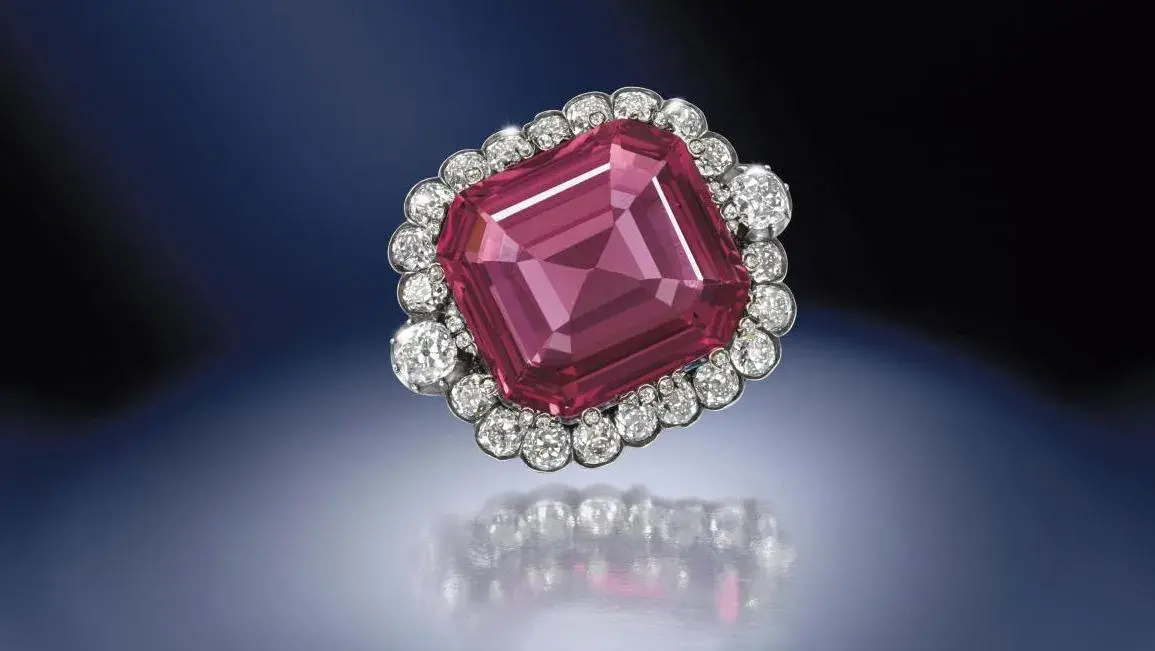
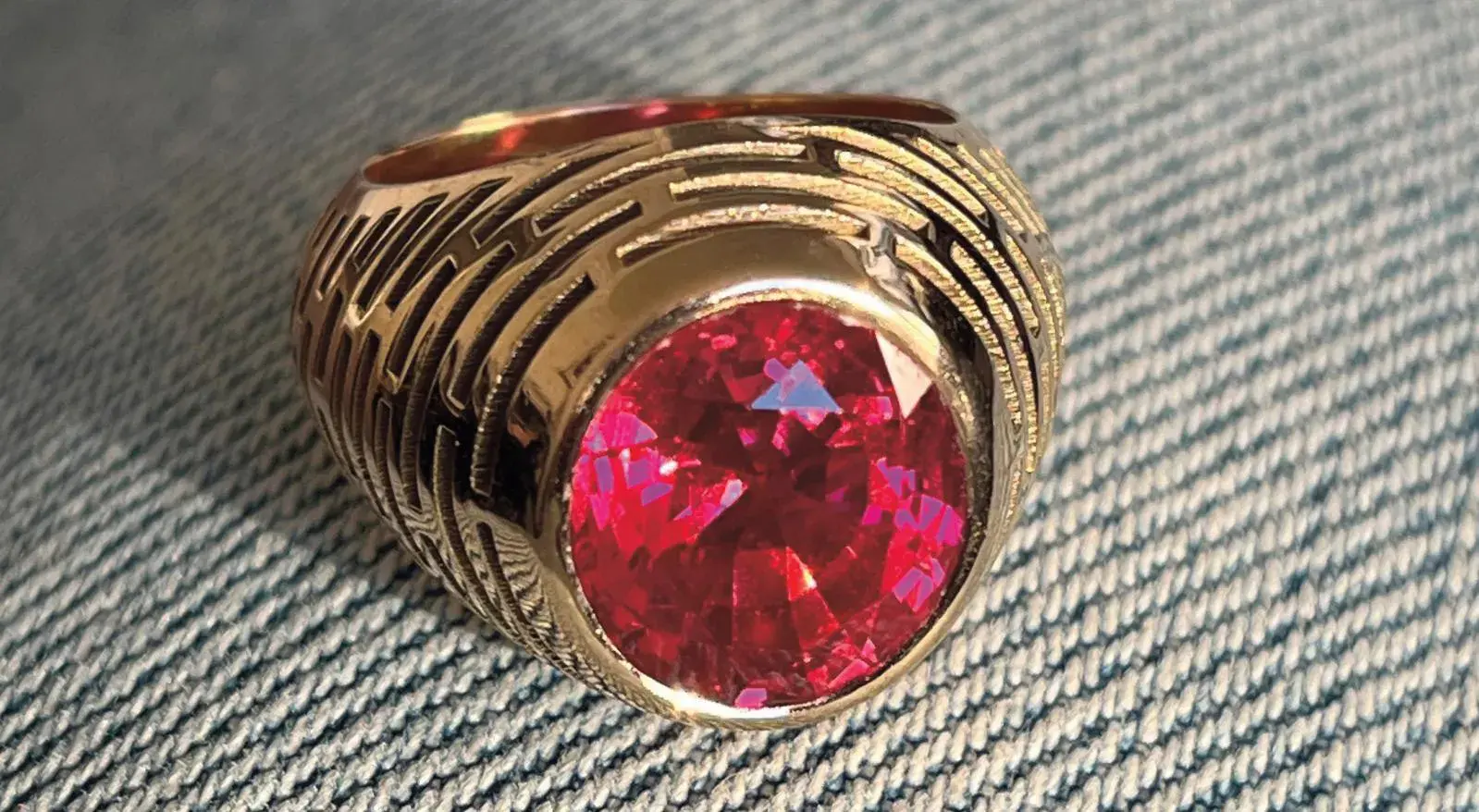
Although the spinel enjoyed a glorious past, it was ousted by the ruby and from the 19th century onwards became a second-rank stone in the West. This trend was undoubtedly reinforced by the rise in popularity of diamonds, which, when cut to a fine shape, finally supplanted red gems as the royal stone. Today, however, after two centuries of disfavour, the spinel seems to be taking its revenge and is emerging as a worthy alternative to the ruby, which has become extremely expensive. Mined in Tajikistan, Myanmar and Sri Lanka, as well as in Vietnam and Tanzania, the spinel is used in refined jewellery creations – in its red version, of course, and sometimes in other shades like cobalt blue, hot pink or grey. Particularly appreciated by professionals, who recognise its gemmological qualities, this stone is also prized because no treatment can alter it, since heating or irradiating it barely touches its appearance. In the auction world, where only red spinels really attract attention, some exceptional pieces have also whetted buyers’ appetites in recent years. In 2011, for instance, Christie’s sold an imperial necklace of the Great Mughals, containing gems totalling 1,131.59 ct, for CHF4.5 M (around €3.6 M at today’s value), after estimates of between CHF1.4 M and CHF 2.4 M. In 2015, a pendant brooch with a 50 ct centre stone that belonged to the famous banker Henry Philip Hope (owner of the blue diamond that bears his name) fetched £962,000 (around €2 M) at Bonhams in London. Almost 100 years earlier, in 1917, this same spinel was sold for £1,060 (the equivalent of £80,000 in 2015, or €107,000). Confirming this return to favour, last year Christie’s sold a ring set with a 20.8 ct Tanzanian stone for CHF882,000 (around €930,000), bringing the price per carat to CHF42,400 (€44,710). While spinel is attracting growing international interest, particularly in the high-end market, in France it is finding it harder to emerge from the ruby’s shadow and is still rare and unobtrusive at auction. A situation that sounds like an appeal to lovers of fine stones.