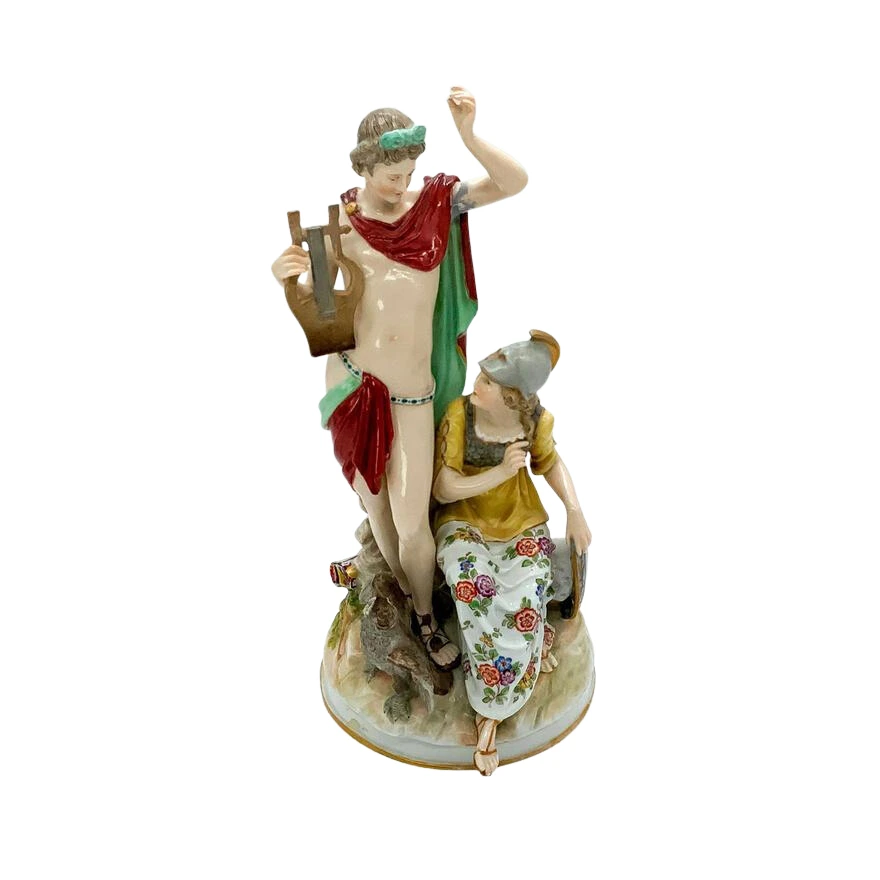
Antique Hochst Porcelain Figural Grouping

Antique Hochst Porcelain Figural Grouping

Antique Hochst Porcelain Figural Grouping:

Hand decorated figure dpicting Apollo holding his lyre, seated Minerva, Cupid and a quiver of arrows, and an owl with outstretched wings. Hochst backstamp on base.

Dimensions: 12″ H
Manufacturer: Hochst
Country of Origin: Germany
Condition
Age related wear. Restored.

Francisco Zuniga (Costa Rican, 1912-1998) Signed Bronze Sculpture

Francisco Zuniga (Costa Rican, 1912-1998) Signed Bronze Sculpture

Francisco Zuniga (Costa Rican, 1912-1998) Signed Bronze Sculpture:

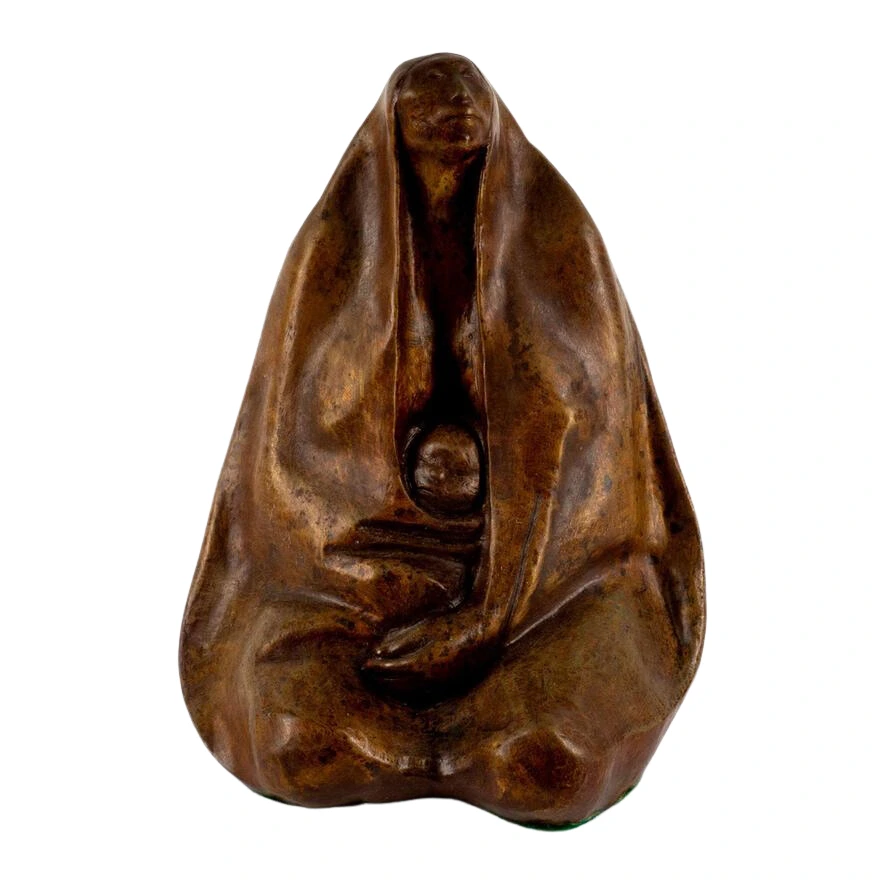
“Maternidad.” Depicts a mother cradling her child in her lap. Artist signed and dated 1974 on right side.

Artist: Francisco Zuniga
Dimensions: 8″ L x 6″ W x 10.5″ H
Country of Origin: Costa Rica
Condition
Age related wear.

Albert Einstein Signed Photograph to Jewish Immigrant

Albert Einstein Signed Photograph to Jewish Immigrant

Albert Einstein Signed Photograph to Jewish Immigrant:

Vintage matte-finish 7 x 9.25 photo of Albert Einstein beside Alice ‘Lili’ von Kahler, taken by Trude Fleischmann, displayed in its original 9.75 x 11.75 mat, signed and inscribed on the mat in fountain pen, “Fur Frau Lili, A. Einstein, (Flattered).” Also signed by the photographer in pencil, “Trude Fleischmann, New York.” Framed to an overall size of 10.75 x 12.75. In fine condition.

The subject and recipient of the photograph, Alice ‘Lili’ Loewy Kahler, was the wife of Erich Kahler, a literary scholar, author, and professor. Like Einstein, Erich Kahler had fled Nazi Germany and emigrated to the United States, where he became Einstein’s colleague as a member of the Institute for Advanced Study. The Kahlers met in Princeton and were friends with Albert Einstein.

The photographer, Trude Fleischmann, had a studio in Vienna before moving to the United States—also under pressure from world affairs—to open a studio in New York City. Her work spanned celebrity portraits and fashion photography (most notably for Vogue), with some of her famous subjects including Albert Einstein, Eleanor Roosevelt, Oskar Kokoschka, and Arturo Toscanini. A highly desirable association piece that reveals an element of Einstein’s playful personality in the flirty “flattered” comment.

Nikola Tesla Typed Letter Signed on Inventions

Nikola Tesla Typed Letter Signed on Inventions

Nikola Tesla Typed Letter Signed on Inventions:

TLS signed “N. Tesla,” one page, 8 x 10, illustrated “Tesla Laboratory” letterhead portraying Wardenclyffe Tower, February 27, 1909. Letter to Anita Drysdale Hawkins (1874-1957), a friend and employee at his Wardenclyffe plant, discussing the departure of a troublesome guest and commenting on his innovative work. In part: “I was very much astonished to learn from your letter just received that the leaving of our friend was attended to with such difficulties. However, if he intended to avoid them he has received just what he deserved and I am glad that he is gone. His stay there has called for considerable sacrifices on my part which I should not have made. Time and time again in my life I have made such mistakes and I always propose myself not to try to help others when in so doing I imperil myself, but it seems I am incorrigible.

I have taken upon myself all of Mr. Warren’s obligations and your brother need not pay any attention to the bills which might be presented to him, and for which he is in no way responsible. You will be glad to know that all of my inventions are turning out to be a splendid success and I am positively expecting not only to resume the work on my plant very shortly, but also to bring it to completion, all from my own resources. You may now expect from me favorable news at any moment.” In fine condition, with a small stain under the signature. Accompanied by the original mailing envelope and an unsigned letter drafted to Tesla on May 1, 1911, most probably by A. D. Hawkins.

Tesla sent this letter from his offices at 165 Broadway in New York City, although typed on Tesla Laboratory letterhead with a fine illustration of the iconic Wardenclyffe Tower at the top. An early experimental wireless transmission station, Tesla designed and built the tower on Long Island in 1901-1902, with famed financier J. P. Morgan as his key backer. From Wardenclyffe, Tesla intended to transmit messages, telephony, facsimile images, and even wireless electrical power across the globe. When Guglielmo Marconi’s wireless telegraphy system advanced beyond Tesla’s, he lost Morgan as an investor and was left to his own devices—hence the pecuniary concern demonstrated in the present letter. By this time in 1909, Tesla had been hounded by creditors for years and had turned to other projects—such as the bladeless turbine—in an effort to fundraise for the Wardenclyffe plant. In spite of these difficulties, Tesla remained energetic and optimistic, enthusiastically proclaiming that he found success with his inventions and that money will soon be a problem of the past.

John Jacob Astor Archive of (14) Letters and Documents

John Jacob Astor Archive of (14) Letters and Documents

John Jacob Astor Archive of (14) Letters and Documents:

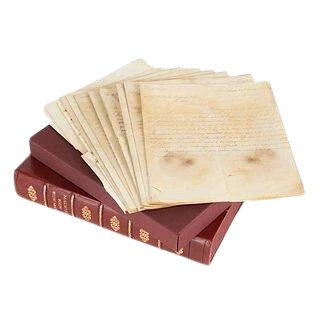
Important collection of 14 letters and documents, 13 of them signed by John Jacob Astor, amounting to 20 pages total, dating from 1802 to 1827. The archive is housed in a handsome custom-made three-quarter morocco case with engraved frontispiece portrait of Astor, featuring his facsimile signature.

John Jacob Astor, founder of the Astor business dynasty, was the first American multimillionaire. In his time he was ‘the richest and most powerful of American businessmen. He came to personify nineteenth-century American business leadership, and he became a favorite subject for both capitalism’s apologists and detractors’ (Haeger).

Astor began trading furs in the 1780s. By 1808, the year of the founding of his American Fur Company, he had become the leading American fur merchant. In the following years Astor made fortunes in the China trade and in New York real estate. He was by far the wealthiest person in American history before the railroad era.

This remarkable collection documents Astor’s wide-ranging contributions to American business and financial history. These letters track the growth of Astor’s enterprises and his vast ambition. In an 1802 letter he asks a merchant in Schenectady for 100 bear skins and names the prices he will pay for various furs. By 1812 Astor is trading gold and paper money with the state bank of New York. Just five years later Astor, having helped to establish the Second Bank of the United States, is shaping its activities to his purposes. Astor also made a fortune in the China trade, a fact reflected in the letter to his longtime partner N. C. Ogden (1776-1823). Ogden handled Astor’s affairs in Canton, the two doing business on a stupendous extent. In a document dated 1823 Astor buys nearly 150,000 muskrat skins! By 1827, when he begins doing business with Poland & Son in London, he is a giant of the fur trade, dictating terms and doing business on a vast scale.

A highlight of the collection is the run of seven Astor letters to London fur merchant Peter R. Poland & Son. The file begins with Astor accepting, on a trial basis, Poland’s offer to act as his agent in London. In the ensuing letters Astor objects to Poland’s fees, addresses market conditions, discusses the difficulties of transatlantic business communications, specifies the animal furs he seeks and the quality he requires, and haggles over terms and prices. Astor’s intimate familiarity with the fur market is on full display in this correspondence.

Ultimately Astor piles on additional orders, doing business on a staggering scale amounting to many hundreds of thousands of furs in the first year alone. The letters to P. R. Poland & Son are marked “duplicate,” yet they bear stamps and seals indicating that they traveled across the Atlantic. It is evident that Astor sent two copies of each letter, using different packet ships, to ensure that his communications reached Poland in a timely manner. In the fur business timing was everything, “it being important to have early information,” as Astor writes.

Another highlight is the outstanding pair of letters written by Astor in 1817 to the head of the Bank of the United States concerning financial matters. In 1815 Astor had joined with several other prominent men, including banker Stephen Girard and Senator John C. Calhoun, to establish the Second Bank of the United States. Anti-Federalist sentiment had killed Alexander Hamilton’s Bank of the United States by 1811. Astor and the other founders saw a national bank as essential for a stable supply of money and credit, economic growth, and westward expansion. William Jones, installed as the first president of the Bank, exacerbated financial tensions with his inept handling of its affairs, driving the country into recession. In these letters to Jones, Astor expresses his frustration with the Bank’s policies and with the money market and attempts to reshape them.

This important collection documents Astor’s unparalleled activities at the dawn of American large-scale capitalism. Complete transcripts of the archive are available online at RRAuction.com. In very good to fine condition, with toning and dampstaining to most of the letters, and occasional tears and fold separations.

Ludwig van Beethoven ALS on & 39 Missa Solemnis & 39

Ludwig van Beethoven ALS on & 39 Missa Solemnis & 39

Ludwig van Beethoven ALS on & 39 Missa Solemnis & 39:

ALS in German, signed “Beethoven,” one page, 9.5 x 8.25, circa September 1823. Letter to Franz Christian Kirchhoffer, concerning the sending of the ‘Missa Solemnis’ to London. He invites him to lunch at his flat on Sunday, with his nephew Karl: the weather appears promising, and his presence would be a great pleasure for both of them. In full (translated): “My dear Kirchhoffer: If it is not possible to send a packet through the English embassy to London, please inquire. I will therefore tomorrow send an answer or if you think it is good for the occasion? On Sunday we will certainly see you, my Karl and I at table, the weather seems to be favorable again and it will be very pleasant for us both to have you here.” In very good condition, with professional repairs and restoration, including full backing.

Kirchhoffer served as cashier at the Hofmann & Goldstein Bank in Vienna. Several times in 1823 he helped Beethoven to send funds as well as music to their mutual friend Ferdinand Ries in London. The shipment of the “packet” in question is the just-completed Missa Solemnis, op. 123, for which Ries is to find a publisher. During Beethoven’s lifetime, the Missa Solemnis was widely considered his masterpiece. It was this work to which he dedicated the most time and intense effort, working on it over the course of four years. In a letter of 1819, Beethoven wrote, ‘The day when a High Mass of mine is performed in honor of the solemnities‰Û_will be the most delightful of my life,’ and in 1822 called the Missa Solemnis his ‘greatest work.’ The piece is even present in the most famous image of Beethoven, an 1820 portrait by Joseph Karl Stieler, which shows the composer holding a pencil above his notebook labeled ‘Missa Solemnis.’ A superb autograph letter by the revered composer.

Johann Sebastian Bach Handwritten Church Cantata Manuscript

Johann Sebastian Bach Handwritten Church Cantata Manuscript

Johann Sebastian Bach Handwritten Church Cantata Manuscript:

Remarkable autograph musical manuscript by Johann Sebastian Bach, one page both sides, 7.75 x 6.25, no date but circa 1728, being a fragment from the church cantata Ich habe meine Zuversicht (BWV 188). This section is the lower half of folio 17 of the original manuscript, comprising bars 59b-66 and 73-76 of the 4th movement, scored for alto with cello and organ obbligato, on four systems of four hand-drawn staves. The present fragment comprises 11½ bars from the conclusion of the movement, including the words “‰Û_Seinen führt, unerforschlich ist die Weise, Wie der Herr die Seinen führt, unerforschlich ist die Weise, Wie‰Û_” The piece has been inlaid in a larger sheet and encapsulated in archival mylar; the lower stave is in very good condition with minor ink acidification, while the upper system is affected by heavy ink corrosion causing a number of cracks and losses, reinforced with early archival film (now toned). Displayed in a handsome custom-made blue morocco portfolio, with only the attractive lower half displayed.

Most likely composed for October 17, 1728 (or possibly November 6, 1729), BMV 188 is a cantata for the 21st Sunday after Trinity and uses text drawn from Picander. Bach wrote the piece in the key of E minor, which he frequently associated with the crucifixion. The ensemble is made up of four voices, two oboes, viola, organo obbligato and basso continuo. In the fourth movement, the dramatic heart of the cantata, the text “Unerforschlich ist die Weise” (“The ways of the Lord are past understanding,” a meditation on the cross and human suffering) is elaborated as a dark, expressive aria for alto voice set against a virtuoso organ obbligato.

Bach’s original manuscript for BMV 188 has suffered more vicissitudes than most, with the first 10 of the 18 leaves being lost at an early date (probably before the 1827 auction of the estate of Wilhelm Friedemann Bach), taking with them the great majority of the first movement. The remaining leaves are now widely scattered, with four leaves being cut up (as here) into two or even three pieces. Although the resulting fragments are now located in ten holdings in eight countries, they are nevertheless sufficiently continuous to enable the 2nd to 5th movements to be reconstituted. The present fragment, which comprises the lower half of fol. 17, is identified in the “Kritischer Bericht” of the Neue Bach-Ausgabe [New Bach Edition] as A14 (“unbekannter Privatbesitz”). The same source notes that the marked ink acidification which has affected the upper half of the present fragment is typical of the dismembered leaves, and is in part a result of the dense compositional script of the composer, in this instance with many tripletised semi-quavers.

Provenance: The autograph score of BWV 188 is thought to have been among a group of manuscripts inherited by Bach’s impecunious eldest son, Wilhelm Friedemann, and sold by him at auction in 1774. Parts of the Wilhelm Friedemann Bach estate were again auctioned in 1827, being acquired by the inventor and collector Carl Philipp Heinrich Pistor (1778-1847). Pistor’s manuscripts were inherited by his son-in-law, Adolf Friedrich Rudorff (1803-73), from whom they passed to the musicologist Friedrich Wilhelm Jähns (1809-88). The present leaf was one of four acquired from Jähns by the Viennese collector Gustav Petter (1828-68), who is thought to have been responsible for their dismemberment. The last owner of the present fragment traced by the “Kritischer Bericht” is Nora Kluge (née von Hase) of Lübeck, wife of the composer and musicologist Manfred Kluge (1928-71), probably inherited from her grandfather, Oskar von Hase (1846-1921), proprietor of the music publishers Breitkopf & Härtel. Sold at auction at Christie’s, 4 November 1981, lot 144, when it passed into the collection of the Canadian chemist and physician Frederick Lewis Maitland Pattison (1923-2010; his bookplate on the portfolio’s inside front cover); sold again at Christie’s, 20 May 2014, lot 15. See: Neue Bach-Ausgabe (1997), Kritischer Bericht, A14.

Volodymyr Zelenskyy Signed Original Painting by Oleg Jones

Volodymyr Zelenskyy Signed Original Painting by Oleg Jones

Volodymyr Zelenskyy Signed Original Painting by Oleg Jones:

Important, one-of-a-kind original painting entitled ‘Zelenskyy,’ created by American artist Oleg Jones in 2022, accomplished in mixed media—mainly acrylic paints in blue and yellow, coated in resin sprinkled with glass ‘diamond dust’—on a 40 x 24 wooden panel, signed at the bottom in blue paint pen by Ukraine’s heroic president, “Zelenskyy, Glory to Ukraine,” and also signed in the lower left corner by the artist. Symbolizing struggle, victory, and love for Ukraine, the piece features the image of President of Ukraine Volodymyr Zelenskyy against the background of the Ukrainian flag. Raised stars in the form of a heart surround the gold trident of Ukraine’s national coat of arms, giving the work an element of three-dimensionality. Portraying the national symbols that evoke the courage and stability of Ukraine, and the unity of its people and president, this work concentrates on the historical memory of heroic achievements and victories in the struggle for freedom on the way to the liberation of Ukraine. The painting is in very fine condition, and is accompanied by four images of Volodymyr Zelenskyy signing it in his office.

This piece is being sold to benefit the Dmytro Kasyanenko International Charitable Foundation via The Power of a Dream Foundation. The funds received by the Dmytro Kasyanenko International Charitable Foundation from the sale of this painting will be used to support Ukraine and the Ukrainian people, to purchase medical equipment, tools and drugs that can save the lives and health of its people and wounded soldiers, as well as to the reconstruction of Ukraine. All auction proceeds will be transferred directly to The Power of A Dream Foundation Inc. which is a Connecticut non-profit with 501(c)(3) status.

Jack Leigh “Good and Evil” Silver Gelatin

Jack Leigh "Good and Evil" Silver Gelatin

Jack Leigh “Good and Evil” Silver Gelatin:

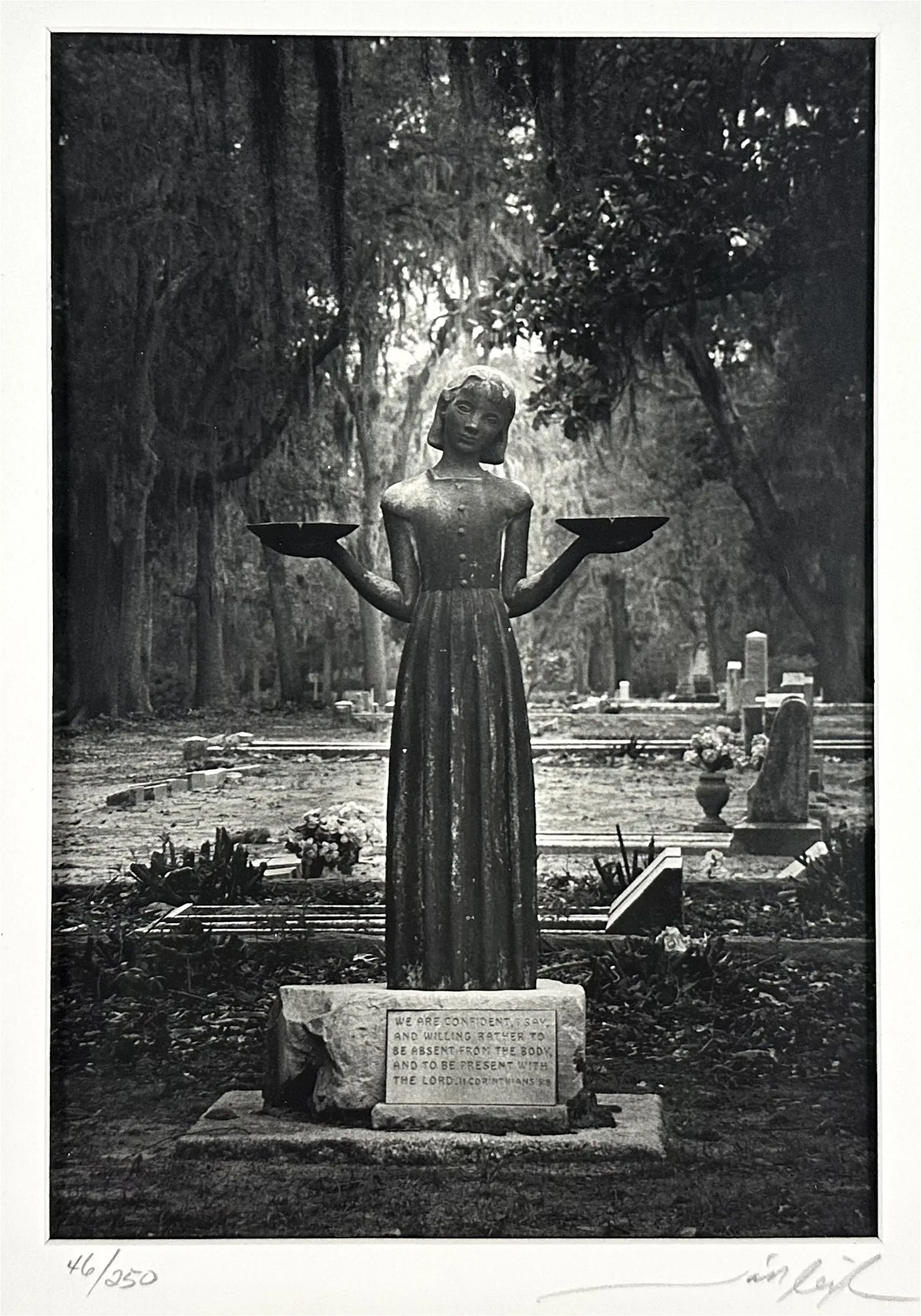
Hand Signed & Numbered on matting # 26/250
Cover for Midnight in the Garden of Good and Evil By John Berendt
Frame: 21″x18″
Image: 8″x6″

Andre Harvey “A Gathering Of Emperors” Bronze

Andre Harvey "A Gathering Of Emperors" Bronze

Andre Harvey “A Gathering Of Emperors” Bronze:

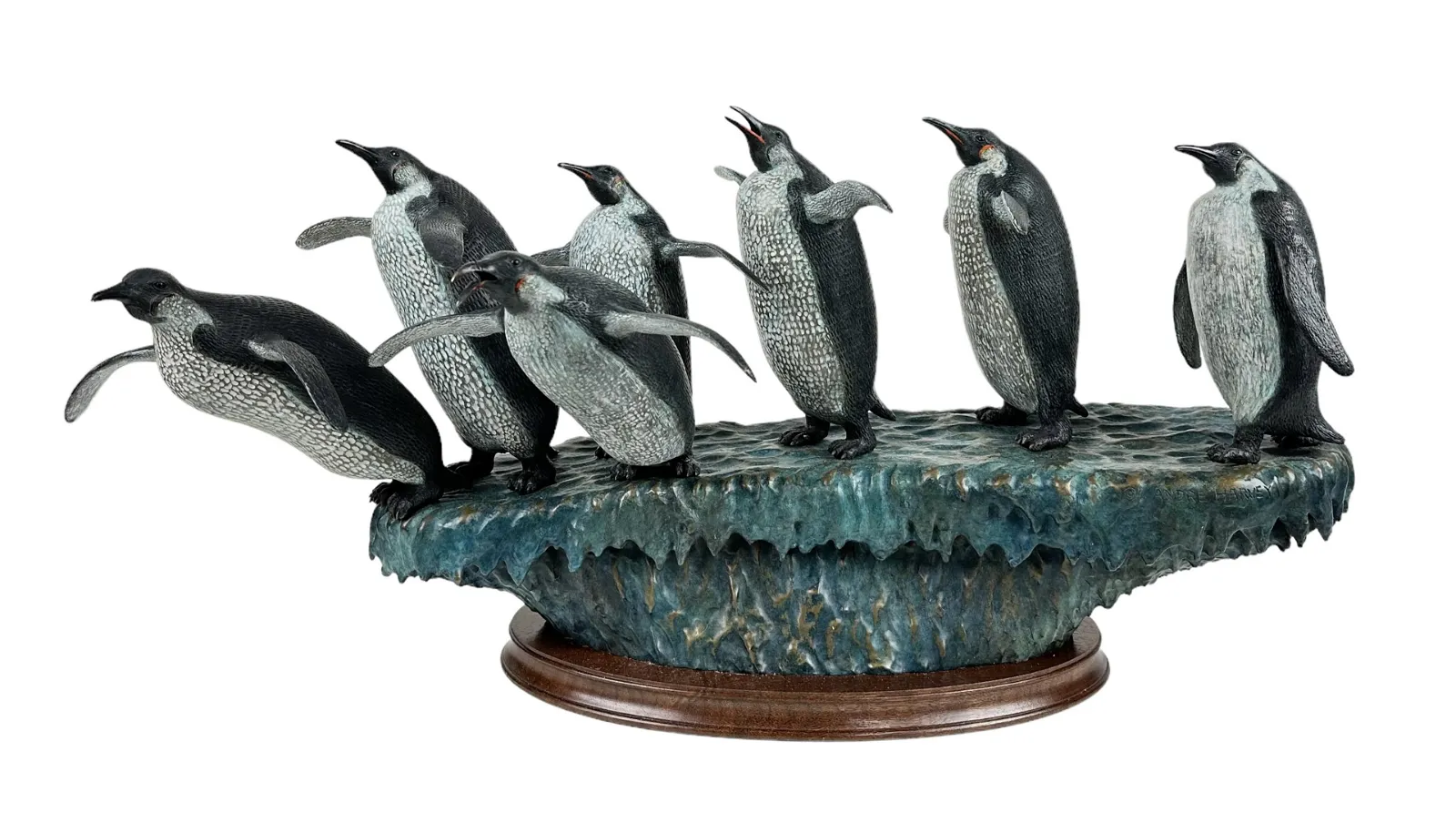
Sculpture On Wood Base (American, 1941-2018)
Hand signed and inscribed on bottom.
Edition 1/60
12.50″ x 27.50″ x 7.50″
Comes with original shipping crate.