Louis-Léopold Boilly

Louis-Léopold Boilly

Louis-Leopold Boilly:

(French, 1761-1845)
Les Joueurs de Dominos (La Partie de dominos au café de la Régence) (B & Z 1040 P) , unsigned, oil on canvas, 6-5/8 x 8-5/8 in.; gilt wood and composition frame, anthemion decoration, 10-3/8 x 12-1/2 in.

Note: Louis-Léopold Boilly was largely self taught, earning great success painting small portraits in the ‘span of two hours,’ as he was said to have once bragged. His career and perhaps life was saved when he was reported for his bawdy content to Robespierre and the revolutionary court. He quickly painted The Triumph of Marat to head off this life threatening accusation. Over his lifetime he painted approximately 5,000 portraits and 500 genre scenes. The scenes often incorporated careful depictions of every individual, a product of his portraiture, as he captured them in social gatherings about Paris. This composition is loosely painted, capturing a crowded popular spot known as the Café de la Régence and a group of men in a rather intense game of dominos. It is one of a series of four works in which the others represent the game of chess, checkers, cards. These scenes were subsequently popularized by being produced as lithographs by the printer, Lemercier, in Paris.The attribution has been confirmed by Étienne Bréton and Pascal Zuber, co-authors of the Louis-Leopold Boilly catalogue raisonnée published in 2019.

Literature: H. Harrisse, L. L. Boilly, peintre, dessinateur et lithographe. Sa vie et son œuvre (1761-1845), Paris, 1898, p. 114, no 348 ; M. Tourneux, Louis-Léopold Boilly, Gazette des beaux-arts, 1er novembre 1898, p. 412 ; P. Marmottan, Le Peintre Louis Boilly (1761-1845), Paris, 1913, p. 191 ;J. S. Hallam, The Genre Works of Louis-Léopold Boilly, Seattle, 1979, p. 138-139, 278, repr. fig. 168, p. 307.E. Bréton, P. Zuber, Louis–Léopold Boilly (1761–1845) : Le Peintre de la société parisienne de Louis XVI à Louis-Philippe, Paris, 2019, p. 757, n°1040 P, reproduit.

Related Works:Lithograph by Lemercier, Le Jeu de dominos, circa 1836, 1st print in black; colored print., H. 16; L. 21 cm.; Reprinted by Meyer in 1845 (see E. Bréton, P. Zuber, op. Cit. Sup. P. 875, n ° 2023 E, reproduced).

References: https://www.nga.gov/collection/artist-info.975.htmlThis lot is accompanied by a photo-certificate issued by Hazlitt, Gooden & Fox, a letter from Dr. Susan L. Siegfried in The Art Institute of Chicago letterhead dated 1986 requesting the work for exhibition, and a copy of the original receipt dated 1980.

Condition
lined with wax and linen, crackle, light retouch upper right; frame with losses to composition

Jeremiah Theus, Important Georgia Portrait

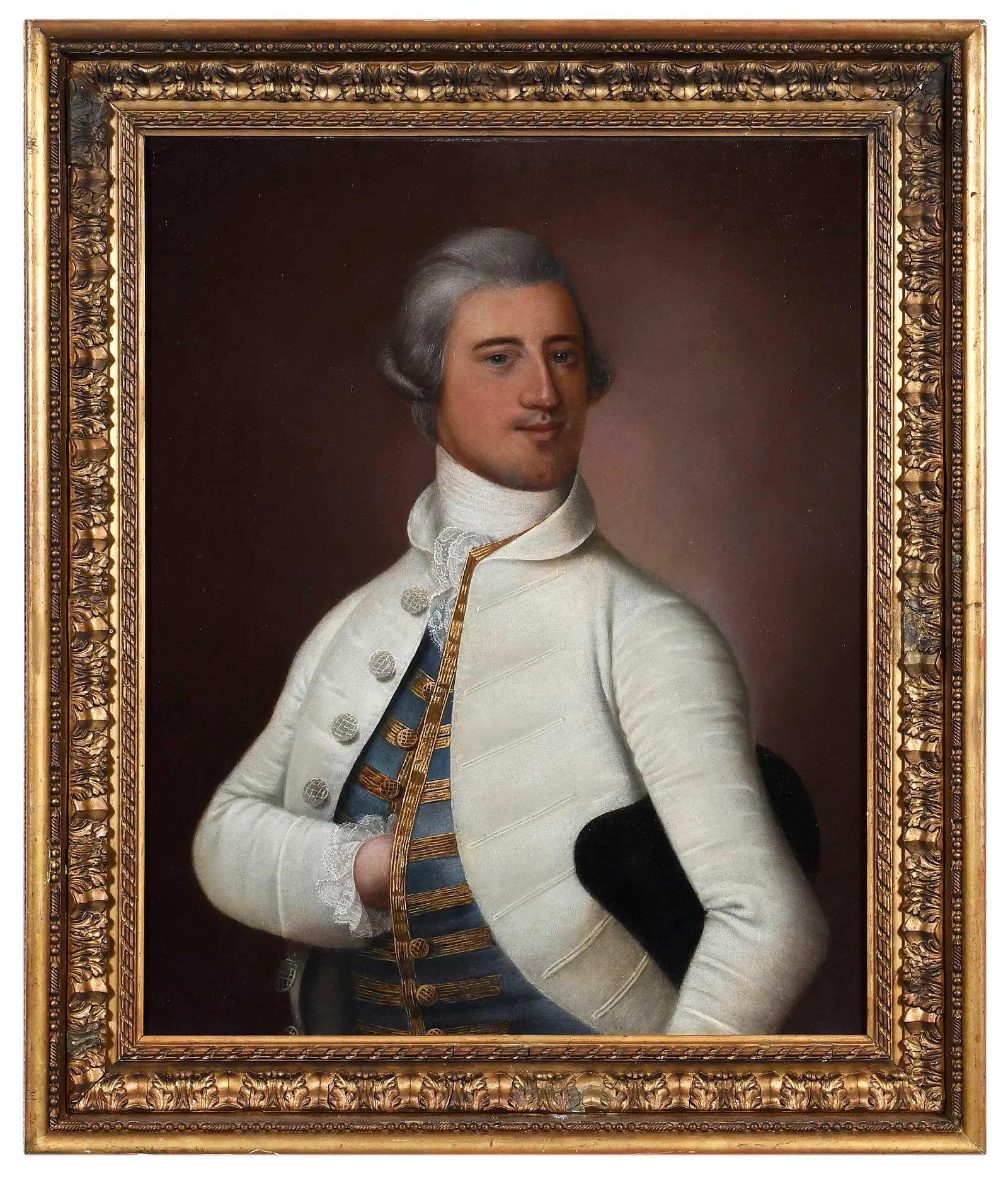
Jeremiah Theus, Important Georgia Portrait

Jeremiah Theus, Important Georgia Portrait:

(Charleston, South Carolina/Swiss, 1719-1774)
Portrait of James Habersham, Jr., unsigned, oil on canvas, 30 x 25 in., good old gilt wood frame with applied decoration, 37-1/2 x 32 in.

Note: James Habersham Jr. (1745-1799) was a planter, merchant, slave trader and politician who was speaker in the Georgia General Assembly. He also served on the board of trustees which established the University of Georgia in 1785.

Literature: Lambert, F. (2012) James Habersham: Loyalty, politics, and commerce in Colonial Georgia. Athens, Georgia: University Of Georgia Press.

Condition
backed and restretched, retouch visible under blacklight (please see photo), several old repairs as well as what appears to be more recent restoration in area of face and hair; frame resurfaced and with some losses

Irving Penn

Irving Penn

Irving Penn:

(American, 1917-2009)
Black and White Vogue Cover, Jean Patchett, New York, 1950, signed, titled, dated, editioned 8/34, and annotated in pencil and stamped print verso, printed in 1974, platinum palladium print,
image: 16 ¼ by 13 ½ in., sheet 22 x 18-1/2 in.; matted 24 x 20 in.

Literature: The Black and White Idea, Vogue, April 1, 1950, cover; Irving Penn, Moments Preserved (New York, 1960), p. 159; Patrick Devlin, Vogue Book of Fashion Photography, Simon and Schuster, New York, 1979, p. 90; John Szarkowski, Irving Penn (New York: The Museum of Modern Art, 1984), pl. 48; Alexander Liberman and Nicholas Callaway, Irving Penn, Passage, a Work Record, Alfred A. Knopf, New York, 1991, p. 100; Colin Westerbeck, ed., Irving Penn: A Career in Photography (The Art Institute of Chicago, 1997), pl. 4; Ned Rifkin, Chorus of Light: Photographs from the Sir Elton John Collection (Atlanta, 2000), p. 65; Sarah Greenough, Irving Penn: Platinum Prints (Washington, D. C.: National Gallery of Art, 2005), p. 11; Norberto Angeletti and Alberto Oliva, In Vogue: The Illustrated History of the World’s Most Famous Fashion Magazine; (New York, 2012), p. 129; cf. Maria Morris Hambourg and Jeff Rosenheim, Irving Penn: Centennial (New York: Metropolitan Museum of Art, 2017), pl. 38.

Condition
print in excellent condition, no visible flaws of any kind, mounted to mat backing with archival corners; mat in good condition

Winfred Rembert

Winfred Rembert

Winfred Rembert:

(American/Georgia, 1945-2021)
The Laughing Barrel, incised lower center “Winfred Rembert”, dye on carved and tooled leather, 32-1/2 x 36 in.; black metal frame, 33-3/4 x 37-1/4 in.

Exhibited: Adelson Galleries, Boston, Massachusetts, n.d., label verso.

Condition
surface is excellent, as made condition; frame with light wear

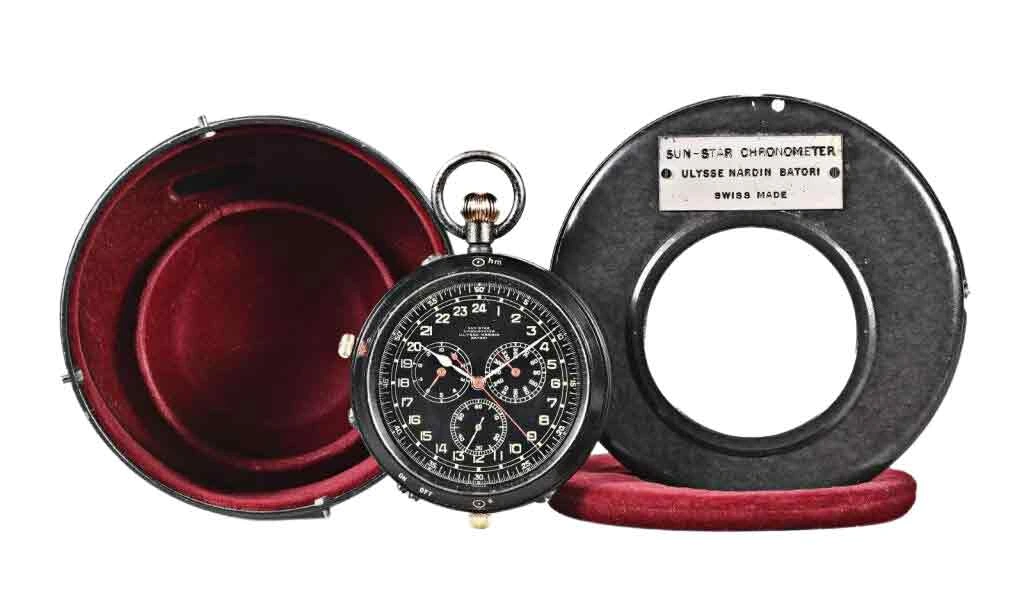
A rare and important Sun-Star Chronometer by Ulysse Nardin for the Batori Computer Co. No. 001

A rare and important Sun-Star Chronometer by Ulysse Nardin for the Batori Computer Co. No. 001

A rare and important Sun-Star Chronometer by Ulysse Nardin for the Batori Computer Co. No. 001:

Ulysse Nardin, LeLocle, for the Batori Computer Co. Inc., New York, a rare and important “Sun – Star Chronometer” aviator’s navigational watch with outer, protective case, 30 jewels, stem wind and pin set, adjusted to five positions, cotes de Geneve decorated, rhodium plated, two train movement with differential, controlled by a single lever escapement with compensating alloy balance and micrometric regulator in a brass, snap back and bezel, open face case with black finish, the bands with crowns and pushers for adjusting the seconds and hour angle displays, black 24 hour dial with spade and poker hands, constant seconds at 6:00, sidereal hour angle arc degrees and minutes displayed at 3:00 and 9:00 respectively, the central red hand indicating arc seconds at the periphery, serial #124505 (movement), #001(Batori Computer Co. number), 70mm, together with it’s original cylindrical, velvet lined protective container with identification plaque, case, dial and movement signed

Condition

CASE: Minor losses to black finish on case band, pendant, and bow; A few spots of corrosion on pendant with corresponding loss of finish; Inside of case back with minor fingerprint staining; Cuvette edge and adjacent surface with localized, minor marks and scratches from case knife. DIAL: Very good. HANDS: Very good. MOVEMENT PLATES: Very good; Appears never to have been disassembled. MOVEMENT FUNCTION: Gummy, dirty; Will run briefly; Needs service. Outer case very good, with minor marks and fine scratches; Top with small gouge above plaque. Developed as a navigational tool for aviators, the Sun-Star chronometer was intended to make navigational computation faster and simpler than the methods using air almanacs or slide rules. Invented by Oscar Batori and Raymond Nardin, the watch contains two separate trains, controlled by a single escapement. A planetary differential allows for the two trains to indicate solar time and sidereal hour angle, the sidereal being represented in arc degrees, minutes and seconds. The chronometer was tested at the Greenwich Observatory and passed tests for accuracy, although it seems not to have caught on among aviators. In vol. 17, No.1 of the Journal of Navigation, Air Marshal Sir Edward Chilton stated that “Current astro techniques using the periscopic sextant require altitude and azimuth to be precomputed in order to set these values initially on the sextant. When the chronometer was used to assist in precomputation, increments of G.H.A. had to be applied to the chronometer reading in order to obtain the G.H.A. of Aries for the time of the astro shot. Used in this way, the chronometer offered little advantage over the air almanac.” A Ministry of Aviation test at Boscombe Down stated that “The chronometer was found useful when sighting celestial bodies on an opportunity basis, when up to 20 seconds of time was saved in obtaining L.H.A.; a process which takes about 30 seconds using the air almanac”. In addition to this relatively lukewarm reception, others were also working on timekeepers that would simultaneously display solar and sidereal time, including a solar – sidereal synchronous motor for driving quartz clocks, developed in the Soviet Union by Smirnov, Stepanov and Tovchigrechko. As a result of these and possibly other factors, the Sun – Star chronometer was not a success, and very few were produced. The highest serial number known to us is 004, sold at Sothebys Geneva, Nov. 12, 2020, lot 616. That example appears to have been altered, the case now gold plated, and with a glazed cuvette. It also lacks the outer case. Provenance: Oscar E. Batori, to his son Louis E. Batori, thence to the consignor, circa 1960, Dimensions: 2.25in x 4.5in x

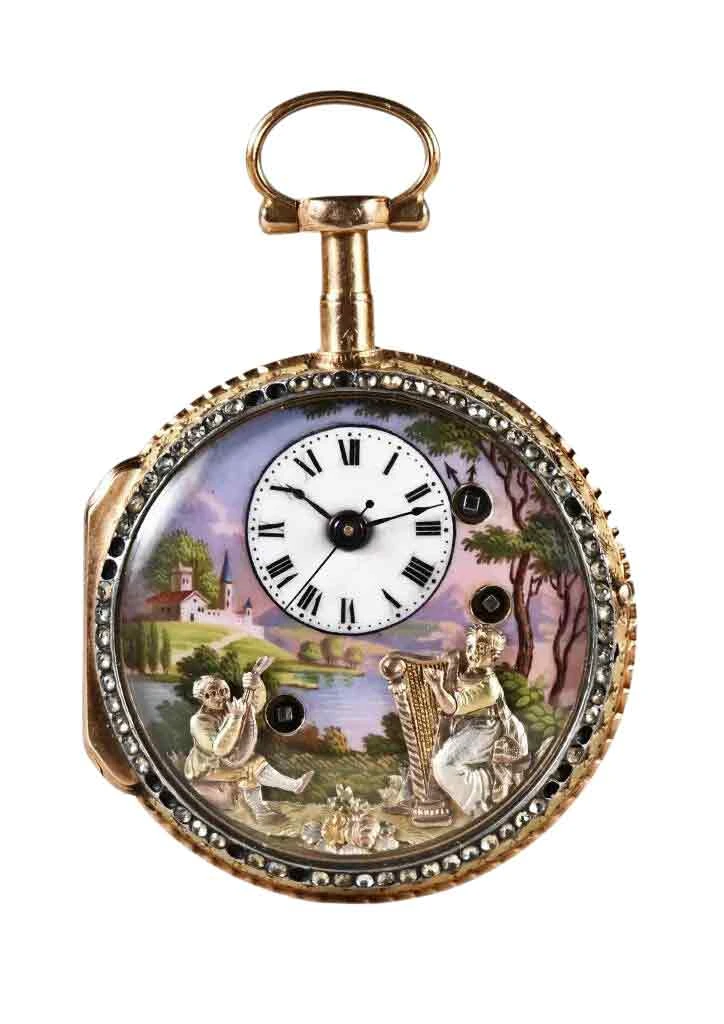
A rare early 19th century Swiss pocket watch with musical automata by Piguet & Meylan

A rare early 19th century Swiss pocket watch with musical automata by Piguet & Meylan

A rare early 19th century Swiss pocket watch with musical automata by Piguet & Meylan:

Piguet & Meylan, Geneva, a rare, early 19th century musical pocket watch with automata, key wind and set gilt movement with cylinder escapement, now in an 18 – 20 karat multicolor gold consular case with paste set bezel, the back featuring an urn on a pedestal, a dog, flying birds and a basket, polychrome enamel dial with roman numeral chapter ring above multicolor gold automata featuring a woman with harp at right and a boy with lute at left, set against a colorful landscape background with buildings and mountains, 41mm, 53.2g TW

Condition

CASE: Case has housed another movement; Small hole in bezel near catch; Interior abraded to clear edge of dial; Pendant with a few shallow file marks; Bezel lacking 13 stones; Bow with minor bend; Precious metal content tested. DIAL: Professional restoration to chapter ring; Base of casting with figures filed to fit case. HANDS: Hour with oxide; Minute and seconds replaced. MOVEMENT PLATES: Fine scratches on plate; Spotting; Some steel components with very shallow pitting. MOVEMENT FUNCTION: Running order (winds, sets and ticks). COMPLICATION: Functions properly. The watch is recently restored, and ready to enjoy, circa 1820, Dimensions:

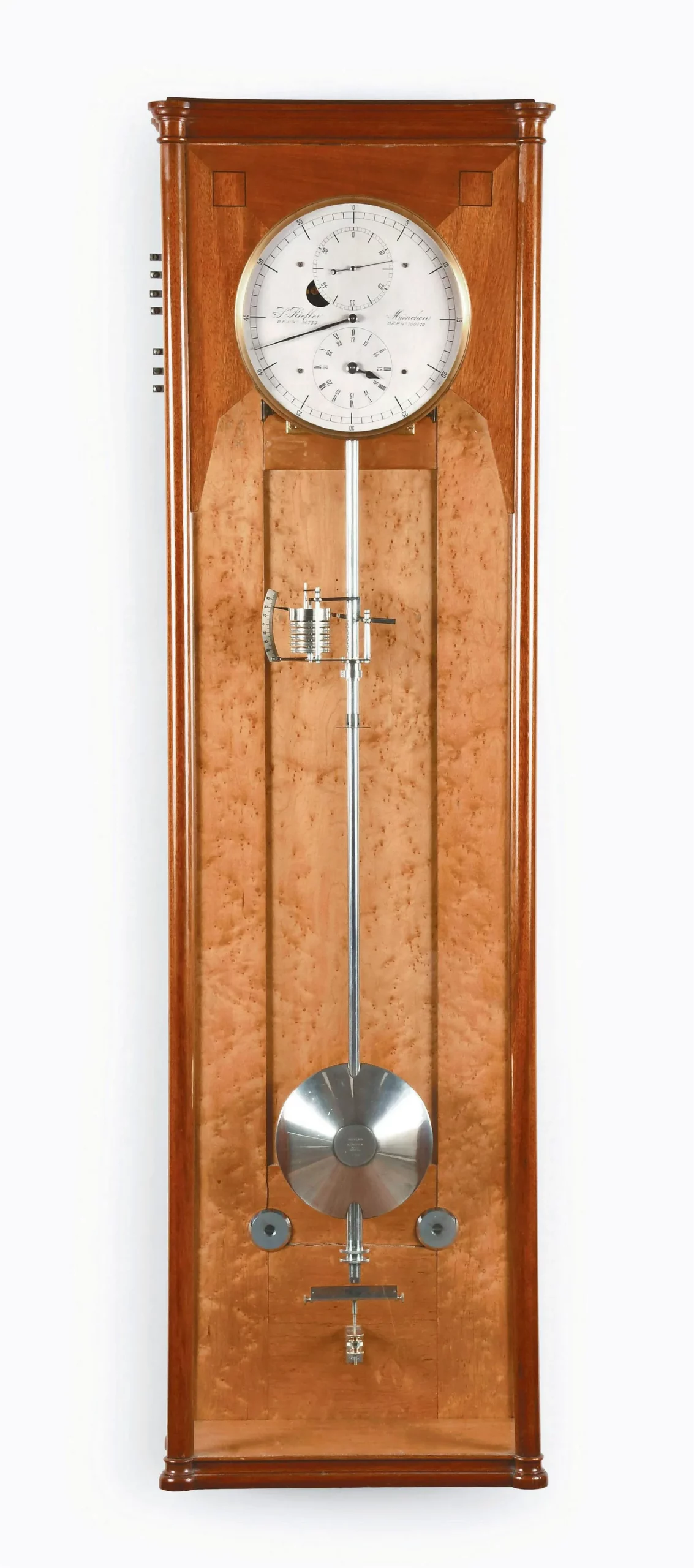
An early 20th century type A1 astronomical regulator by Sigmund Riefler

An early 20th century type A1 astronomical regulator by Sigmund Riefler

An early 20th century type A1 astronomical regulator by Sigmund Riefler:

Sigmund Riefler, Munich, an early 20th century type A1 astronomical regulator, the art deco influenced mahogany case with molded top and bottom, cylindrical corners, and mahogany dial mask with two ebony banded inlaid squares, hinged to a maple frame and panel back board with nickel plated adjustable beat scale and cast iron, rear mounted movement mounting and leveling bracket, silvered roman and arabic numeral astronomical dial with polished steel hands, signed “S. Riefler Munchen”, jeweled type A movement with spring impulse escapement, electric remontoire, and knife edge suspension resting on polished agate pads, type J seconds beating invar pendulum with barometric compensation and tray for fine timing weights, serial #1355, together with it’s boxed control panel with rheostat and relay

Condition

case front sags a bit, some joints with separation, case would benefit from disassembly and regluing, left side glass with crack at top, case back with splits at top and bottom, dial and hands good, movement good, plates darkened, running, electric remontoire not tested, pendulum good. The absence of a serial number and year is a bit of a puzzle. The dial is lined for the engraving of this information, but the work was not done. The serial number on the pendulum would suggest a date between 1910 – 20. The barometric compensation unit is a very good reproduction of the original, made in Germany between 2000 – 2010, circa 1915, ACCESSORIES: Original Coiled Wire & Extra Screws, Control Panel, Pendulum, Beat Scale, Dial & Movement, Dimensions: 59.75in x 17.25in x 8.5in

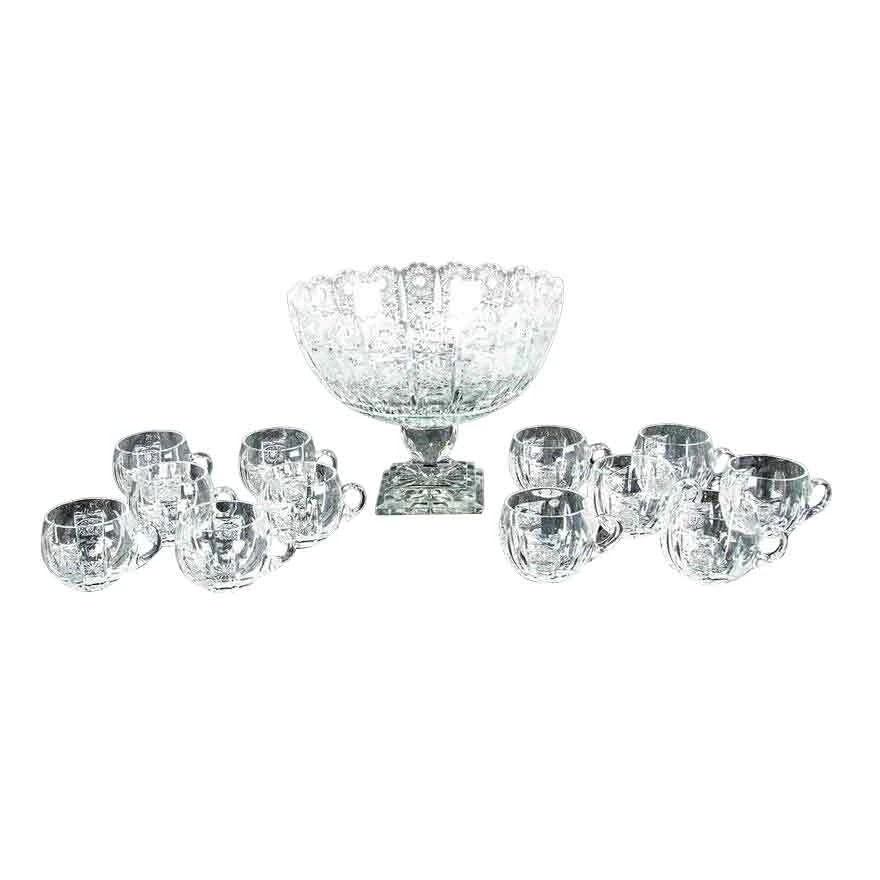
13pc Set American Brilliant Cut Crystal Punch Bowl and Cups by Hawkes

13pc Set American Brilliant Cut Crystal Punch Bowl and Cups by Hawkes

13pc Set American Brilliant Cut Crystal Punch Bowl and Cups by Hawkes:

Square footed pedestal base with tall round bowl and scalloped edge. Gravic Glass Hawkes etched stamp at the bottom of the bowl. Includes 12 cups that measures 4.5 in L x 3.5 in. W x 3 in. H.

Dimensions: 9.5″H x 12″ dia.
Manufacturer: Hawkes Crystal
Country of Origin: USA
Condition
Age related wear. Small chip on cup.

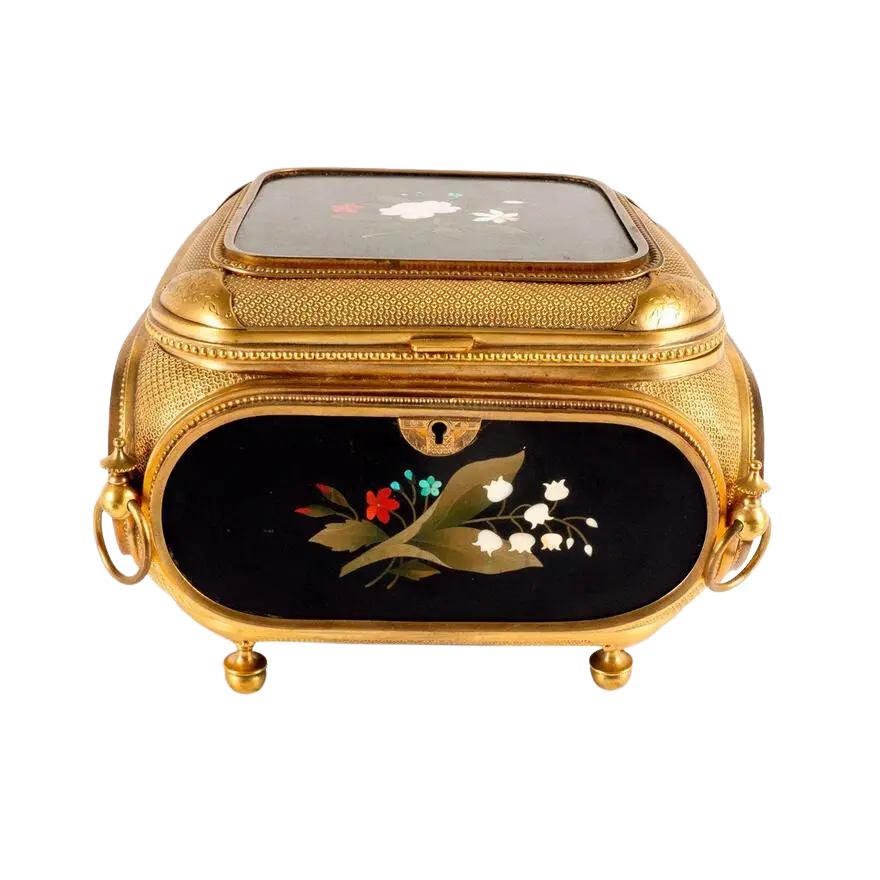
Antique Pietra Dura Floral Stone Inlay Gilded Jewelry Box

Antique Pietra Dura Floral Stone Inlay Gilded Jewelry Box

Antique Pietra Dura Floral Stone Inlay Gilded Jewelry Box:

Fine gilded bronze decorations. Four black panels depicting various colorful flowers.
Decorated with a pearl and a rope on a silk cushion inside. #box #Flower #PietraDura

Dimensions: 7″L x 7″W x 5.5″H
Country of Origin: Italy
Condition
very good, no damages, key is missing

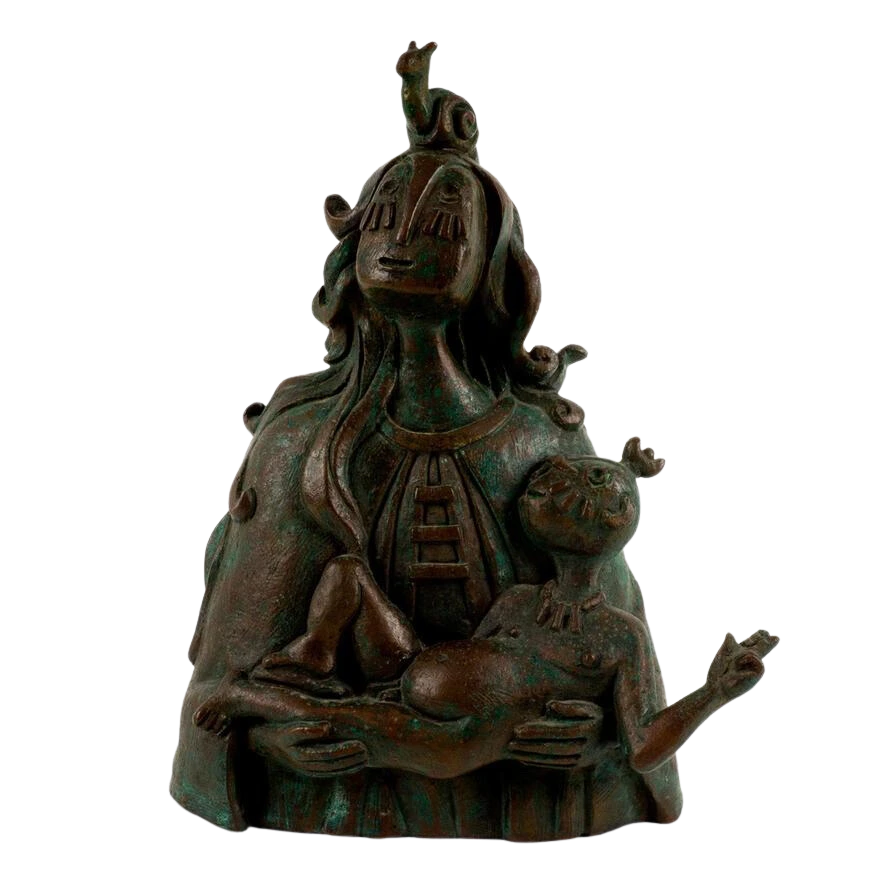
Hector Najera (Mexican/American, b.1931) Bronze Sculpture

Hector Najera (Mexican/American, b.1931) Bronze Sculpture

Hector Najera (Mexican/American, b.1931) Bronze Sculpture:

Modernist figure of a mother with her child and a snake on top of her head. Limited edition number 10 of 55. Dated 1995.
Artist signature, date and edition number on back of piece.

Dimensions: 10.5″ H
Condition
Age related wear.