Hongmiao Shi gets the specialists’ perspectives on a quartet of precious artworks and objects available for immediate purchase
1
Frans Francken II’s colourful fantasy of ‘peace and plenty’Arcadia: A Pastoral Landscape with Shepherds and Shepherdesses Picnicking, 1626-32
Frans Francken II (1581-1642), Arcadia: A Pastoral Landscape with Shepherds and Shepherdesses Picnicking, c. 1626-32. Oil on panel. 28⅝ x 41⅛ in (72.7 x 104 cm). Price on request. Offered for private sale at Christie’s. View Old Masters currently offered for private sale at Christie’s
‘It is impossible not to like this colourful fantasy of carefree shepherds and shepherdesses eating, drinking and dancing in a wooded glade,’ says Paul Raison, Head of Old Masters Private Sales in London, of Arcadia by 17th-century Flemish painter Frans Francken II.
The fantasy of Arcadia, a rural paradise uncorrupted by civilisation, originated from Ancient Greece and enjoyed a resurgence in popularity in the Netherlands in the 17th century. Against a backdrop of decades of war, Dutch artists, poets and playwrights found solace in recreating this ‘lost’ golden age.
‘The yearning for peace and plenty is almost as relevant today as it was then,’ Raison adds. ‘I think this joyous and uplifting scene is perfect for our time.’
2
The proposal ring of choice for Napoleon and John F. KennedyToi et moi diamond ring
Toi et moi diamond ring. 4.20 ct Fancy Vivid Yellow colour VVS2 clarity heart-shaped diamond and 4.01 ct G colour VS2 clarity heart-shaped diamond on a gold band. Price on request. Offered for private sale at Christie’s. View jewellery currently offered for private sale at Christie’s
With two gems set on the same band, the ‘toi et moi’ ring — meaning ‘you and me’ in French — is symbolic of a couple’sunion.‘For the true romantic, these rings capture the essence and spirit of love,’ says Mei Y. Giam, Head of Private Sales in the Jewellery department in London.
Toi et moi rings have played a part in some of history’s most passionate romances —both Napoleon Bonaparte and John F. Kennedy proposed with one.
‘The heart-shaped diamond is one of the most difficult cuts to make,’ Giam explains. ‘Along with sparkle and brilliance, they display a dazzling internal purity that seems to come from the very heart of the diamond. A single true heart is rare. To have its equal — as a pair — is extraordinarily special.’
3
A French cabinet inspired by the Far EastA Louis XIV black and gilt japanned cabinet-on-stand, c. 1680
With its lacquer-style varnish and mother-of-pearl inlays, this precious 17th-century cabinet would have been owned by an educated and wealthy French collector, states Amjad Rauf, a European Furniture specialist in London.
There had been demand in Europe for Oriental-inspired objects since the late 16th century thanks to increased trade between the West and the Far East. European imitations of lacquer, known as ‘japanning’, were developed to meet the demands of a fashion-conscious elite.
This japanned cabinet-on-stand features decorative motifs inspired by the Oriental fable The Prince and the Bird. ‘What makes it even more special is that it’s still in excellent condition,’ adds Rauf.
4
The many faces of Nathaniel Mary QuinnMa, 2016
Nathaniel Mary Quinn (b. 1977), Ma, 2016. Charcoal, gouache, soft pastel, oil pastel and oil paint on Coventry vellum paper. 12 x 12 in (30.5 x 30.5 cm). Price on request. Offered for private sale at Christie’s. View post-war and contemporary artworks currently offered for private sale at Christie’s
Ma exemplifies Nathaniel Mary Quinn’s jagged and discontinuous style of portraiture, combining the faces of family, friends and neighbours with features taken from magazines and online images. Executed in 2016, Ma is one of few fragmented portraits by Quinn to depict a figure with blonde hair.
According to Celine Cunha, a Post-War and Contemporary Art Specialist in New York, the work’s title may reference Quinn’s mother Mary. In a 2014 interview, Quinn said, ‘In some way, I am always painting and drawing my mother, especially being that I lost her when I was 15 years old’. The artist added ‘Mary’ to his name after her death in remembrance.
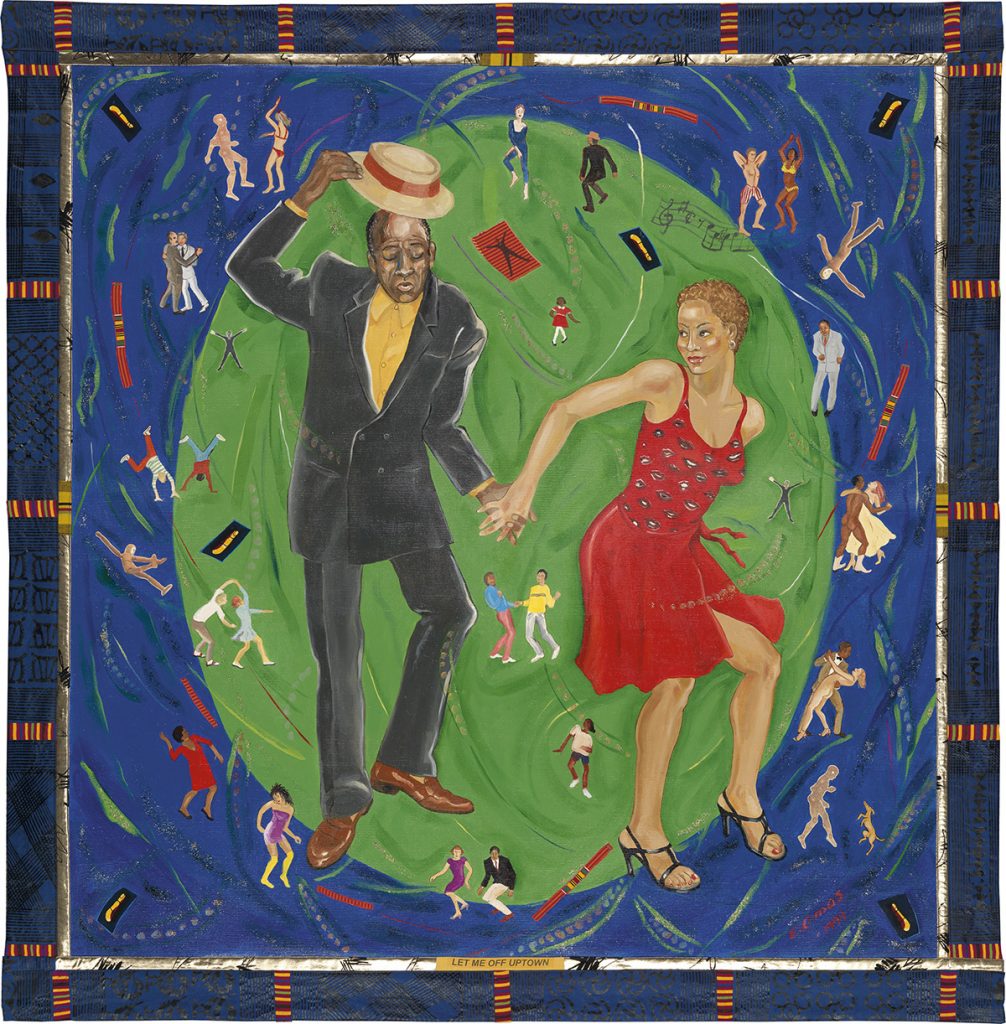
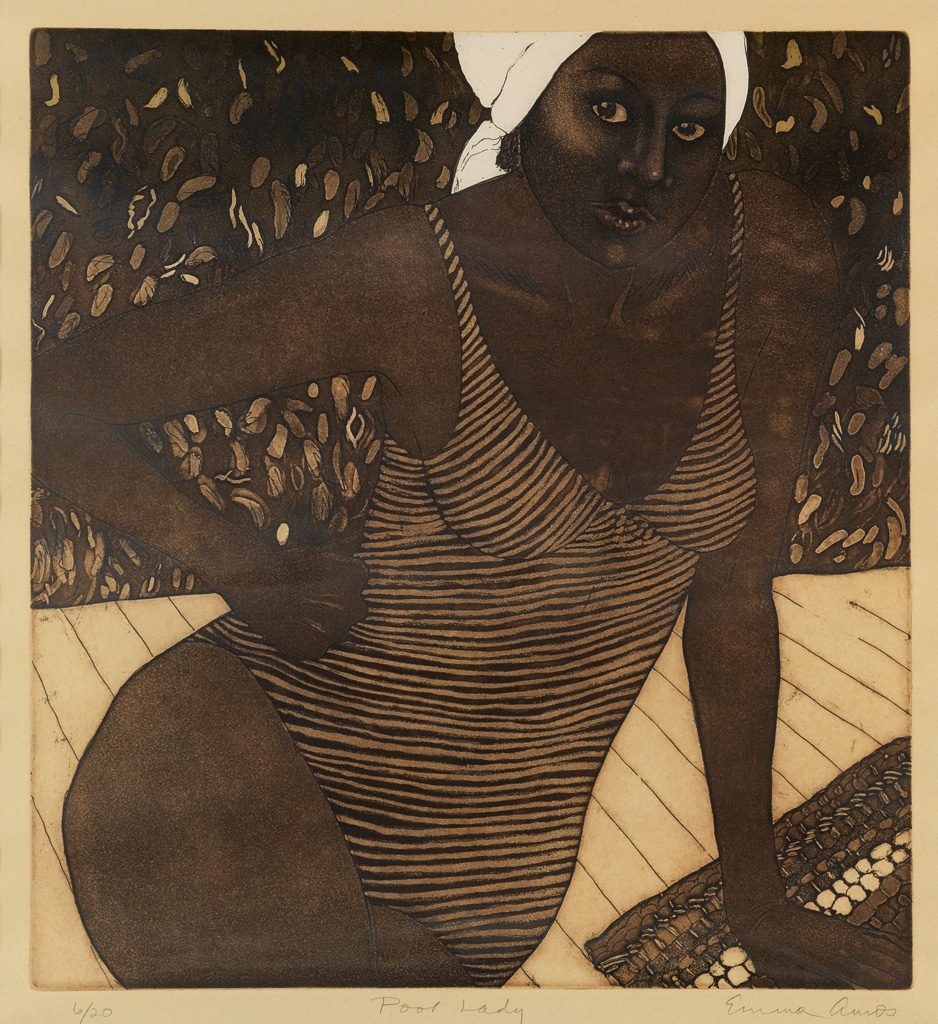
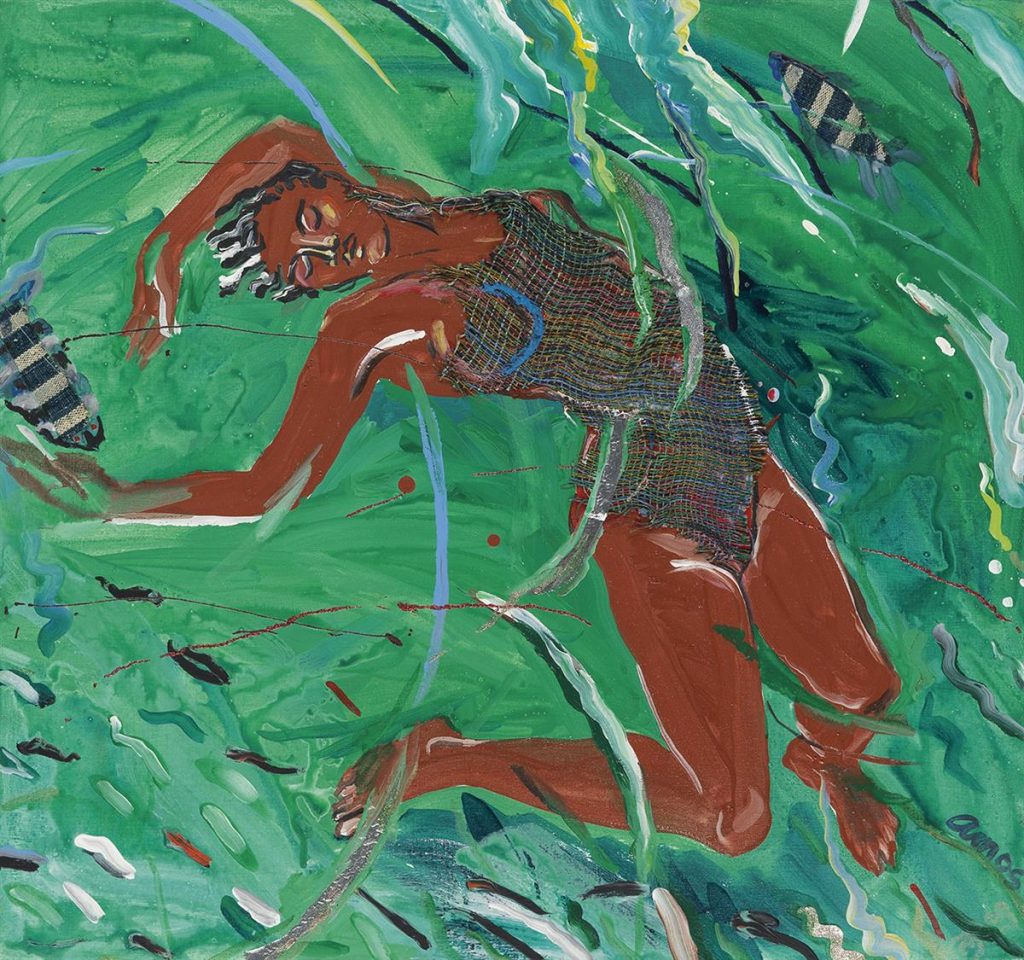
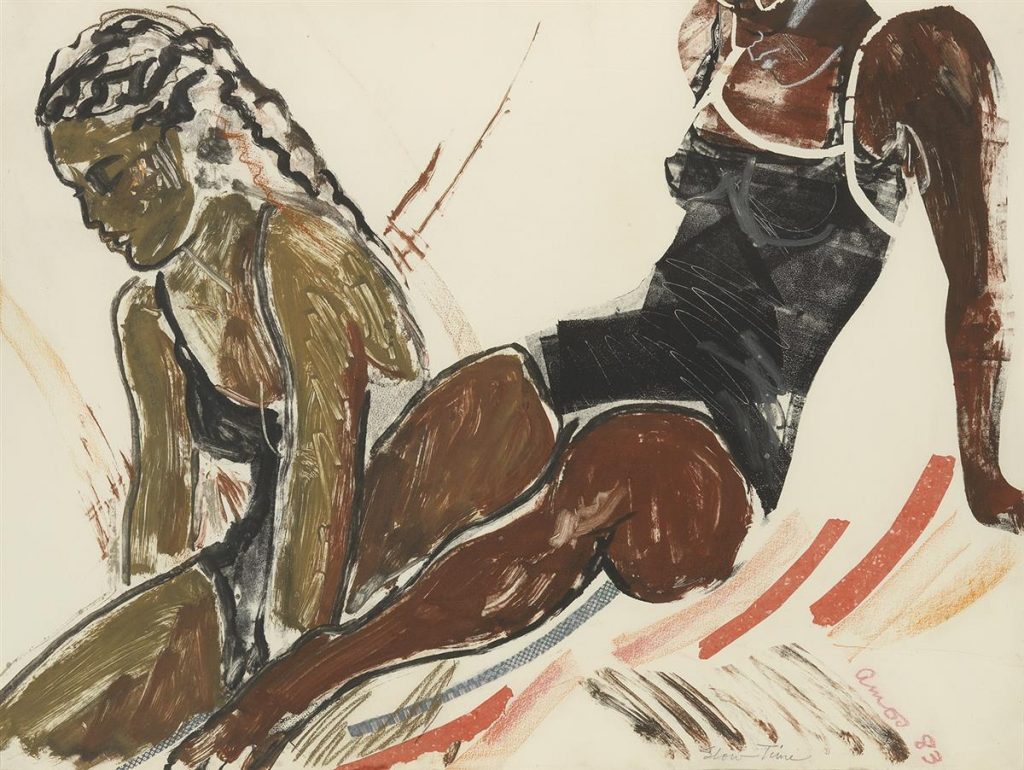
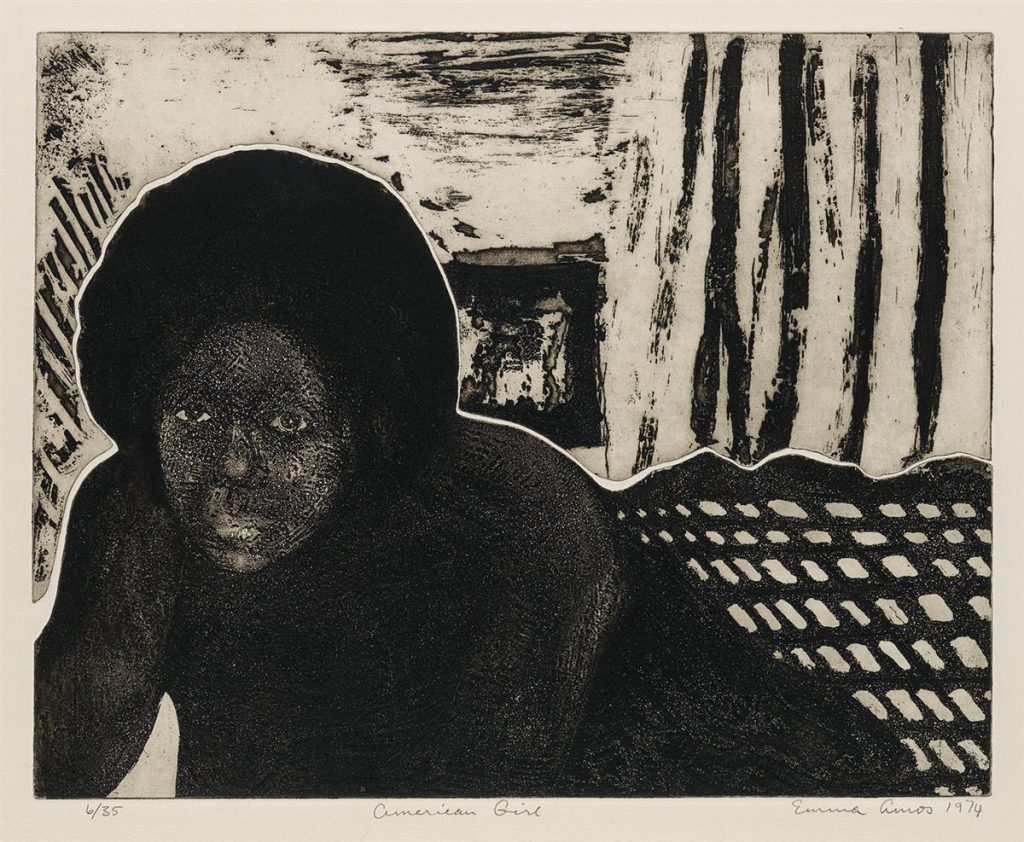
We are sad to hear yesterday’s news of Emma Amos’s passing. Emma Amos was a painter, printmaker, weaver and educator—a great artist and innovator who helped broaden greatly American art in the late twentieth century, challenging inequalities in both art and society with a bold figurative message. I would like to remember her life and work as best we can—through the artworks we have handled here at Swann, as they introduced me to her many facets as an artist.
Amos sought to deconstruct traditional representations of race, gender and beauty, and embraced experimental techniques as a painter and printmaker. Born in 1937 in Atlanta, Georgia, Emma Amos pursued her broad interests in art, studying painting, printmaking and textile design at Antioch College in Ohio. During the fourth year of her five-year program, she made the first of two trips to England to study etching at the London Central School of Art, making abstract images in etching and aquatint. By 1960, she had moved to New York, and began working with textile designer Dorothy Liebes. While studying for her masters in art education at NYU, in 1964 Amos became the first female artist to join Spiral, the collective of African-American artists founded by Charles Alston, Romare Bearden, Norman Lewis, and Hale Woodruff.
By the early 1970s, Amos developed a feminist aesthetic creating modern portraits centered on women as the subject. She continued to make prints in intaglio at Bob Blackburn’s Printmaking Studio in New York. Amos developed a significant body of work into the 1980s depicting African-American women as heroic figures, and everyday women at leisure, in particular swimming including the etchings Sand Tan, 1980, To Sit, 1981, and the painting Arched Swimmer, 1987. Working with master printer Kathy Caraccio, Amos also developed monotypes with similar collage elements and mixed media as found in her paintings on fabric.
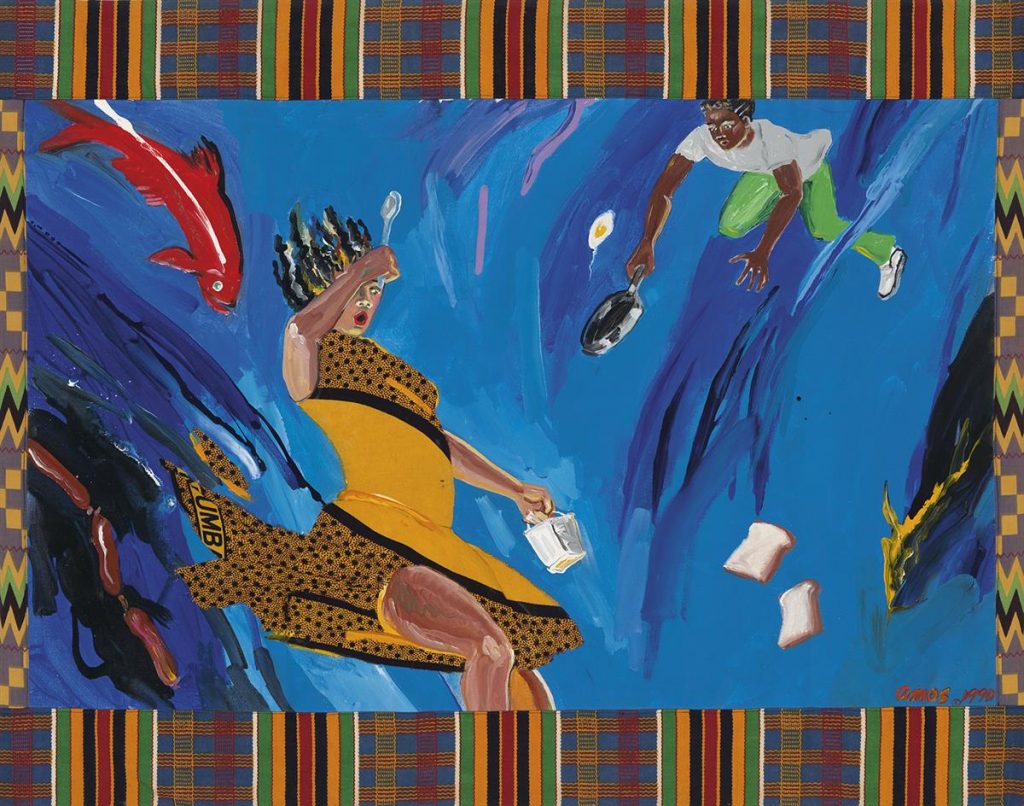
In 1980, when hired as a professor at the Mason Gross School of Art at Rutgers University, Amos developed an important body of fabric paintings. Her combination of non-traditional subjects with non-traditional media helped redefine the representation of African-American women in contemporary art. Emma Amos’ series of paintings on fabric through the late 1990s further celebrated African-American women and culture. With Kente and Adinkra cloth collage, vibrant colors, glitter and gold, her paintings were often joyous celebrations of dance and music, recognizing both the uniqueness and inclusiveness of African-American culture.
In the last five years, Amos had only just begun to receive recognition in institutions and exhibitions, after her decades of accomplishments and contributions. Amos’s paintings have recently been acquired by the Cleveland Museum of Art and Brooklyn Museum, and her artworks were included in the traveling museum exhibitions We Wanted a Revolution: Black Radical Women 1965-1985 and Soul of a Nation: Art in the Age of Black Power. Her first retrospectiveis planned for 2021 at the Georgia Museum of Art.
Offering 450+ Works Assembled Across Decades By the Trailblazing Dealer, Collector, Friend and Champion of Women Artists Together Estimated to Sell for More Than $50 Million 2020 Sales Series to Feature: THE GINNY WILLIAMS COLLECTION EVENING SALE Works by Joan Mitchell, Louise Bourgeois, Lee Krasner, Agnes Martin, Helen Frankenthaler & More Lead a Dedicated Auction This June**PHOTOGRAPHS FROM THE GINNY WILLIAMS COLLECTIONJuly Auction Offering Photographs by Diane Arbus, Dorothea Lange and Tina Modotti, Alongside Iconic Images of the Early-20th Century
JOAN MITCHELL, STRAW, 1976. ESTIMATE $5/7 MILLION
NEW YORK, 22 May 2020 – Sotheby’s is honored to announce that we will offer more than 450 works from the celebrated collection of Ginny Williams across a series of sales throughout 2020, beginning with a dedicated evening auction to be held in New York the week of 29 June.
A pioneering collector and gallerist born in rural Virginia in 1927, Ginny Williams was a larger-than-life personality and dynamic force in the contemporary art and photographs communities in Denver, Colorado, where she lived and worked from the late-1950s onwards, as well as on the East Coast, including her time on the boards of the Solomon R. Guggenheim Museum in New York and the Hirshhorn Museum and Sculpture Garden in Washington, D.C.
As an avid photographer herself, who studied with Austrian-American photojournalist and photographer Ernst Haas, Williams’s collecting journey began with classical figurative photography, which led her to open the Ginny Williams Gallery in Denver in the 1980s. She later developed a passion for collecting Abstract Expressionist and Contemporary art, with a particular focus on the work of pioneering female modernists such as Agnes Martin, Joan Mitchell, Lee Krasner, Alice Neel, and Louise Bourgeois, whose career she impacted as both patron and friend. By the time of her passing in 2019, Williams had assembled the largest collection of works by Bourgeois in private hands, set the auction record for Helen Frankenthaler, and amassed an extensive collection in which the majority of works are by women artists.
LESS KRASNER, RE-ECHO, 1957. ESTIMATE $4/6 MILLION
Williams’s collection of works by trailblazing female modernists will form the centerpiece of The Ginny Williams Collection Evening Sale, which Sotheby’s will hold the week of 29 June in New York – immediately preceding our Contemporary Art Evening Auction. Additional dedicated auctions include Photographs from The Ginny Williams Collection on 14 July, featuring the work of Diane Arbus, Dorothea Lange and Tina Modotti alongside iconic images of the early-20th century by Edward Weston and Herbert Bayer, and The Ginny Williams Collection Online Sale, open for bidding from 9 – 16 July. Property from the Ginny Williams Collection will highlight a number of various-owner auctions throughout the year, most notably a group of 50+ works offered in our Contemporary Art Day Auction in June.
In total, Sotheby’s sales of The Ginny Williams Collection are estimated to achieve in excess of $50 million.
“Ginny Williams was a singular woman and collector. With her fiery red hair, intent gaze and radiant Southern charm, she captivated everyone she met. Decisive and impassioned, Ginny was a collector that stood apart from others – she understood artists, and lived and breathed their work into her collection and her life. She was among the last of a rarefied tribe of old school collectors and dealers, a true artist at heart.”
AMY CAPPELLAZZO, CHAIRMAN OF SOTHEBY’S FINE ART DIVISION
Sotheby’s live evening and day auctions of Contemporary and Impressionist & Modern Art, previously scheduled for May, will be held the week of 29 June, pending the lifting of certain restrictions and confirmation from the relevant authorities that we can proceed. Clients and visitors can expect extra precautions to ensure the safety of our employees and visitors, as well as creative opportunities for those wishing to preview our exhibitions and participate in our auctions – from in-person and virtual appointment viewings to enhanced digital experiences. We will announce a more a detailed schedule in due course, including relevant exhibition plans.
THE GINNY WILLIAMS COLLECTION EVENING SALE
Auction Week of 29 June
Immediately preceding the Contemporary Art Evening Auction
HELEN FRANKENTHALER, ROYAL FIREWORKS, 1975. ESTIMATE $2/3 MILLION
Joan Mitchell’s Straw (estimate $5/7 million) from 1976 is an exceptional embodiment of the paintings that defined the artist’s output in the last decades of her career: larger canvases with expansive gestural brushwork and emboldened color. Towering over nine feet in height, the present work was painted during Mitchell’s time in the provincial French village of Vétheuil. Influenced by the abundant natural beauty of the French countryside, Straw harnesses the sensory imagery of Mitchell’s longtime influencers Claude Monet and Paul Cézanne alongside the abstract idioms of her male contemporaries Jackson Pollock and Willem de Kooning.
A close friend of Louise Bourgeois, Williams collected the artist’s work in depth, amassing more than 40 sculptures and works on paper spanning more than four decades of her career. Sotheby’s will offer works from this extensive collection across a number of sales in 2020, beginning with five pieces that will highlight The Ginny Williams Evening Sale. The group features Observer (estimate $1.5/2 million) from 1947-49, a stela-like bronze sculpture of human scale from the artist’s Personages series. Despite a high degree of abstraction, Observer exhibits unequivocally anthropomorphic characteristics.
A superlative and early example from Lee Krasner’s seminal Earth Green series, Re-Echo (estimate $4/6 million) captures the prophetic brilliance and artistic reawakening that overtook Krasner in the months immediately following the unexpected death of her husband Jackson Pollock in August 1956. Emerging from a moment of extreme crisis and charged with immense psychic exigency, Re-Echo serves as both a testament to and catharsis of the emotional turmoil that fueled her practice at this crucial nexus – Pollock’s death marked a personal tragedy, but also an opportunity for Krasner to regain her own personal and artistic independence. Today, the Earth Green paintings are widely considered to be the most pivotal and significant paintings of the artist’s career.
A luminous and monumental canvas extending nearly 15-feet across, Royal Fireworks (estimate $2/3 million) by Helen Frankenthaler is a masterpiece from her highly acclaimed period of production in the mid-1970s. Recognizing Frankenthaler’s significant and distinct role within the American abstract vernacular, Williams set a new world auction record for the artist when she acquired the painting in 2011. With its expansive, saturated hues, Royal Fireworks from 1975 exemplifies the artist’s mature mastery of color and form in producing complex rhythmic climates on an inspiring scale.
A profoundly peaceful work, Agnes Martin’s Mountain Flowers I (estimate $2/3 million) is a superb example of the artist’s prodigious career. A simple composition with continuous horizontal lines softened by subtle inconsistencies, this 1985 work reflects Martin’s prolonged investigation into the nature of abstraction and the role of the artist, masterfully articulating a balancing act between the understated poetry of delicate mark-making and the muscular prose of modernist geometry.
CONTEMPORARY ART DAY AUCTION
Auction Week of 29 June
Our Day Sale will offer a strong selection 50+ works from the collection, which continue many of the themes from the evening auction. Most especially, the sale features works by women artists working across a number of mediums and techniques – from photographs by Diane Arbus, Louise Lawler and Barbara Kruger, to a group of 13 works on paper and sculpture spanning the career of Louise Bourgeois. Ginny Williams’s interest in Minimalism is represented by works from Donald Judd and John McCracken through to Roni Horn, while Expressionist works by Philip Guston and Franz Kline complete the offering.
PHOTOGRAPHS FROM THE GINNY WILLIAMS COLLECTION
Auction 14 July
Ginny Williams’s collection comprised more than 1,000 photographs by the time of her passing. Sotheby’s will present a curated selection of approximately 100 photographs from the collection in a dedicated auction this July, which demonstrates Williams’s passion for the medium as well as her dedication to the work of female creators.
In addition to photographs by Dorothea Lange, Berenice Abbott, Laura Gilpin, Margaret Bourke-White, Annie Leibovitz, and Ruth Bernhard, whose work Williams exhibited and passionately championed at her first gallery exhibition in Denver, the auction is highlighted by Tina Modotti’s Interior of Church Tower at Tepotzotlán, Mexico (estimate $200/300,000), an exceptional platinum print executed in 1924 during a visit to the Mexican town of Tepotzotlán with Edward Weston, fellow artist and her lover at the time. Modotti was particularly interested in the intersection of architecture and abstraction, and her photographs of the abandoned convent exemplify her explorations of the sculptural qualities of architectural spaces.
Photographs from The Ginny Williams Collection will feature iconic images of the early-20th century, including Edward Weston’s Dunes, Oceano (estimate $120/180,000) from 1936 and Herbert Bayer’s In Search of Times Past, a unique photomontage. Contemporary highlights include Bernd and Hilla Becher’s Fabrikhallen (estimate $80/120,000), a typology of 9 photographs from 1989, Sandy Skoglund’s Radioactive Cats (estimate $15/25,000), and Robert Mapplethorpe’s Lisa Lyon ($30/50,000), a unique large-format print exhibited in the artist’s lifetime retrospective at the Whitney Museum of American Art.
Sotheby’s sales of The Ginny Williams Collection will continue throughout 2020
oil on canvas, 80 1/2 x 78 3/4 in. (204.5 x 200 cm)
Estimate: $9,500,000-12,500,000
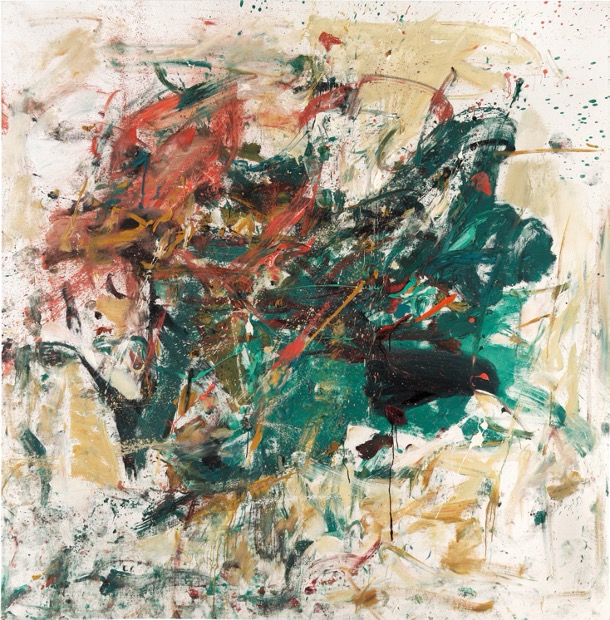
NEW YORK – 22 MAY 2020 – On 2 July, Phillips will offer Joan Mitchell’s Noël in the 20th Century & Contemporary Art Evening Sale in New York. This uplifting work of explosive color, dripping fields of paint and rapid brushstrokes is exemplary of Mitchell’s rich painterly language, and hails from her highly acclaimed body of work from the early 1960s.
Robert Manley, Deputy Chairman and Worldwide Co-Head of 20th Century & Contemporary Art, said, “Joan Mitchell’s large scale paintings from this period are rarely seen on the auction market, and it is an honor to present Noël as a leading highlight of our July Evening Sale. Appreciation of her work has quickened over the last few years, during which we have seen some of her highest prices ever achieved at auction. As the Baltimore Museum of Art and SFMoMA work to co-organize a major survey of her artistic career, this is a moment of collective and worldwide recognition of Mitchell’s legacy as one of the great artists of the 20th century.”
Noël shows the influence of French painters such as Monet and Cezanne, as well as her peers Willem de Kooning, Yves Kline and Jackson Pollock. This master painting is a significant example from the renowned body of work created in her studio on rue Frémicourt between 1960 and 1962. This was a time of great emotional intensity for Mitchell – her mother was diagnosed with cancer in 1960, and her relationship with Jean-Paul Riopelle was volatile. These paintings, some of the most brilliant and expressive of her career, are reflections of both the milieu that surrounded Mitchell in France and the turbulence of her personal life.
Jill Weinberg Adams, who worked with Joan Mitchell at Xavier Fourcade’s gallery when the painting was exhibited has said, “Noël is part of an astonishing cycle of work that was first exhibited at Kornfeld and Klipstein in Bern, Switzerland in 1962. Other than Hawks at 3 O’Clock, bought at the time by Mitchell’s friend Sam Francis, the paintings remained in storage in Switzerland until Fourcade brought them to New York and exhibited a selection of them in 1985, including Grandes Carrières, 1961-1962, Museum of Modern Art, New York, and Cous-cous, 1961-1962, Currier Museum of Art, Manchester, New Hampshire. Noël was in that show and it was a great privilege for me to experience its power at a time when interest in Mitchell’s historical work was beginning the surge that continues unabated today.”
Phillips is a leading global platform for buying and selling 20th and 21st century art and design. With dedicated expertise in the areas of 20th Century and Contemporary Art, Design, Photographs, Editions, Watches, and Jewelry, Phillips offers professional services and advice on all aspects of collecting. Auctions and exhibitions are held at salerooms in New York, London, Geneva, and Hong Kong, while clients are further served through representative offices based throughout Europe, the United States and Asia. Phillips also offers an online auction platform accessible anywhere in the world. In addition to providing selling and buying opportunities through auction, Phillips brokers private sales and offers assistance with appraisals, valuations, and other financial services.
Evaluation Day: Find out the value of your objects from your home!
While we cannot invite you to join us in our Marlborough Galleries on June 2, we are here to help. All of our Skinner specialists from all departments will be on hand from 1:30PM – 4PM to evaluate items via email. Contact us with your auction evaluation requests at [email protected] and we will answer them in as “real time” as we can.
Please submit photos and brief descriptions of your items. Limit of 3 objects per person.
The Whitney Museum of American Art’s exhibition Vida Americana: Mexican Muralists Remake American Art posits Mexico’s valuable artistic legacy. José Clemente Orozo, Diego Rivera and David Alfaro Siqueiros, towering artistic figures, inspired American artists to expose political and social injustices in their art. During this same time photography was also gaining recognition as an authentic art form.
Our June 11, 2020 sale of Fine Photographs features a superb run of photographs by the Mexican photographers Manuel Álvarez Bravo, Graciela Iturbide and Flor Garduño. Here Daile Kaplan, photographs director and Swann vice president, takes us through their histories and what has influenced their photography practices.
Manuel Álvarez Bravo
Images by Manuel Álvarez Bravo, a self-taught photographer, were initially championed by Edward Weston and Tina Modotti, whom he met in Mexico City in the early 1920s. By the following decade, Álvarez Bravo’s distinctive pictures were embraced by the Surrealists and sold by Julien Levy, the renowned Paris and New York gallerist. Álvarez Bravo’s photographs represented a visual reality that captured quotidian scenes of everyday life with an astute awareness of indigenous artistic traditions.
Álvarez Bravo’s contemporaries rendered epic narratives, huge wall murals, in warm earthy tones. His focus, however, was on stories that spontaneously unfolded on city streets and intimate moments rendered in a monochromatic palette of crisp blacks-and-whites. With his poetic proclivities and unique visual content, he created a dynamic iconography that melded pride in Mexico’s cultural heritage with high art aspirations. In Álvarez Bravo’s Retrato de lo Eterno, 1935, he depicts the artist, poet, singer, and songwriter Isabel Villaseñor, who was a remarkable personality and talent in post-revolutionary Mexico. By the 1940s, Álvarez Bravo established a reputation as Mexico’s preeminent photographer, exhibiting internationally in fine art galleries and museums. Subsequently, decades later, he personally influenced a new generation of women photographers, among them Graciela Iturbide and Flor Garduño, both of whom refer to him as a mentor.
Graciela Iturbide, born in 1942, is considered one of Mexico’s leading photographers. Her father was an amateur practitioner who enjoyed shooting images of his 12 children. As a child, she was fascinated by her dad’s pictures, which he secreted away in a dresser. She would repeatedly steal the prints, reveling in images of familiar faces and unfamiliar places and people. From the beginning photography was a means to explore new personal experiences.
Manuel Álvarez Bravo as Iturbide’s Mentor
As an emerging photographer in the 1970s, a tumultuous period in Mexico associated with political unrest, she sought out Álvarez Bravo as her teacher. A revered figure who enjoyed international acclaim as his country’s greatest photographer, Álvarez Bravo’s advice was to remain apolitical and broadly define her vision, noting, “It is good to separate yourself because you can start again, you can discover so many things, archaeology, books, paintings.” Iturbide seized on this wisdom and developed a multi-faceted approach to artistic image-making at the interstices of gender and Latin American studies. A second-wave feminist, Iturbide’s oeuvre visually interprets the Mexican people from her unique woman-identified perch. Indeed a leitmotif of her work counters the in-your-face machismo with multi-layered images depicting the country’s rich pre-historic customs, a time-honored social order that is reinforced by stark colonial (read: Catholic) influences and religious practices, with women occupying center stage.
Photographing the Zapotec People of Juchitan, Oaxaca
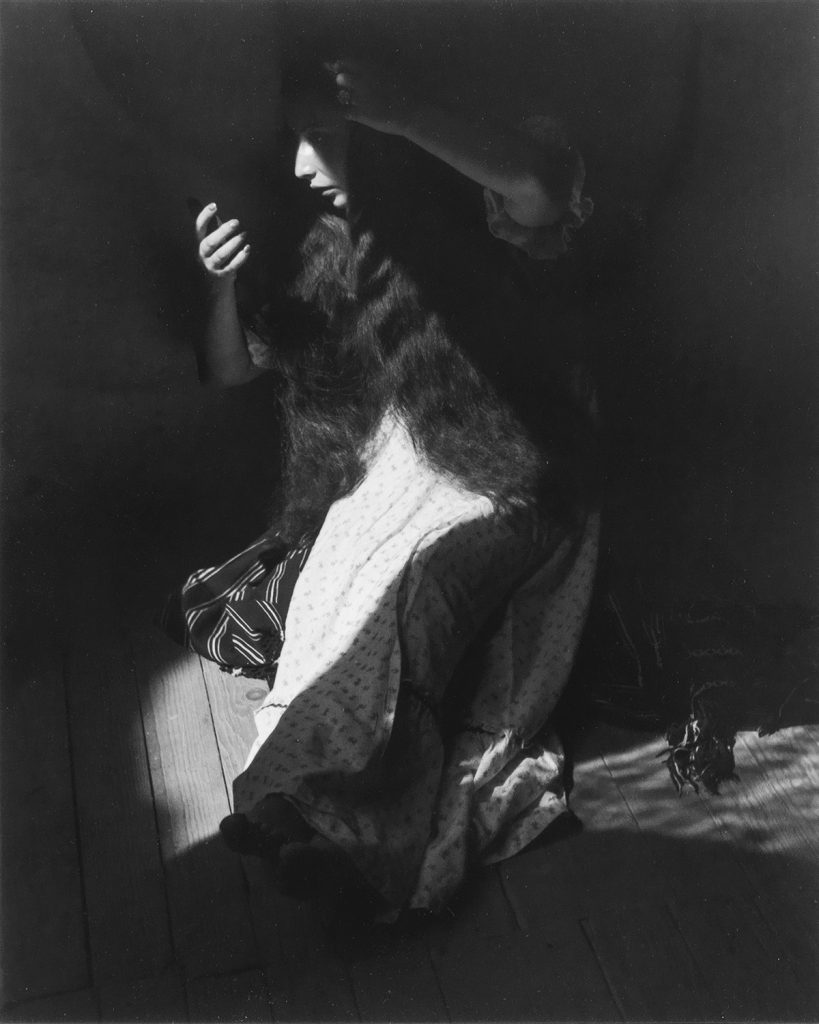
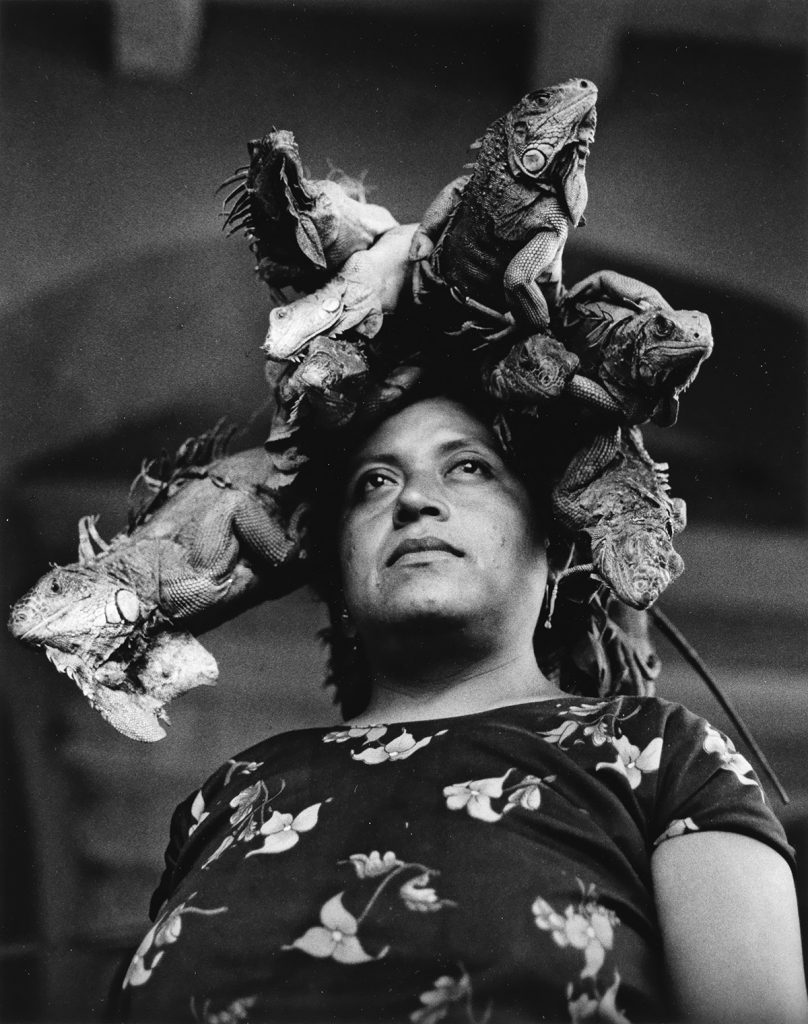
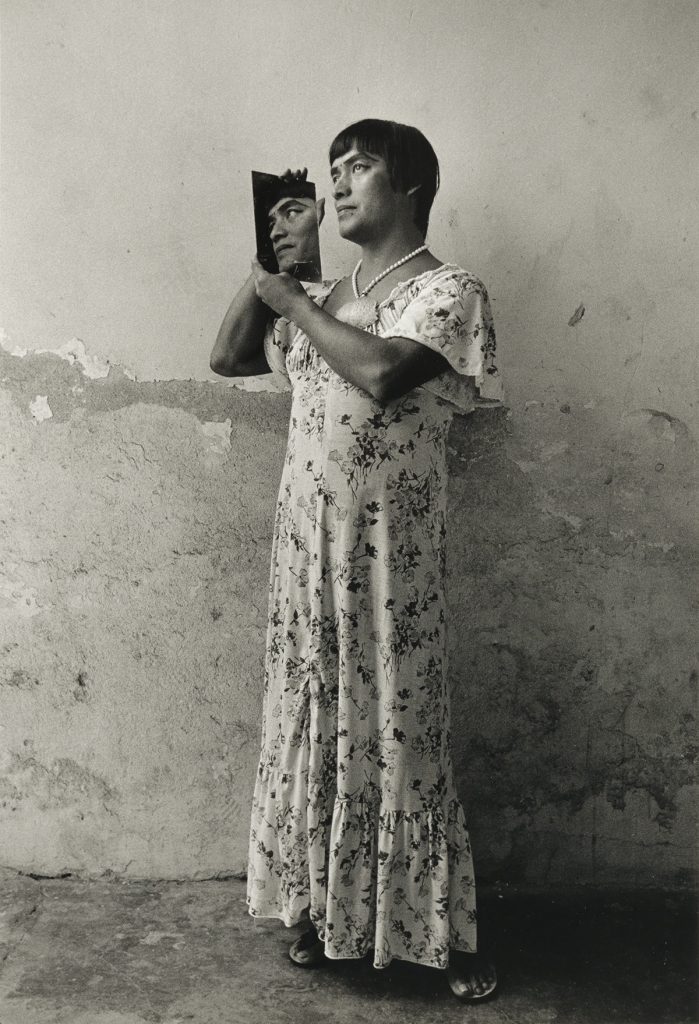
From 1979 to 1986 she photographed the Zapotec people of Juchitán, Oaxaca, a region where matrilineal power has long been asserted and conventional gender roles are openly questioned. Her image, Nuestra Señora de Las Iguanas [Our Lady of the Iguanas, Oaxaca, Mexico], 1979, quickly achieved iconic status. A statue commemorating the figure was commemorated in Juchitan. And her prescient photograph Magnolia, Juchitán, Oaxaca, 1986, a portrait of a Muxe—the Mexican term for those in the Zapotec cultures who are either transgender or nonbinary—wearing a dress and looking at their reflection in a mirror, was also made in the same town.
Iturbide’s Own Legacy & Lexicon
Iturbide, who strongly identifies as a Mexican photographer, condemns Eurocentric terms like magic realism, which she characterized as “completely commodifying, patronizing and paternalistic.” Instead, her pictures embrace a visual lexicon that draws on her own intuition and deliberately avoids formulas or “isms.” Her expressive photographs offer new symbolism and meaning, foregrounding the beauty and power of women, outliers and transgender people to counter conventional perceptions.
Flor Garduño
Flor Garduño’s signature images juxtapose aspects of Mexican and Central American daily life against larger universal themes. Born in 1957 in Mexico City, her family moved to a hacienda in a remote area at the age of five. Her earliest memories were informed by interactions with the natural environment, particularly her childhood attachment to domestic and farm animals.
Kati Horna & Manuel Álvarez Bravo as Garduño’s Mentors
From 1976 to 1978 she pursued an art degree at the Antigua Academia de San Carlos (UNAM) under the tutelage of the Hungarian photographer Kati Horna, who became her earliest influence. Like other photographers forced to flee their European homelands in the 1930s, the powerful emotional undercurrents of Horna’s photographs, which melded elements of surrealism with documentary photography, had a strong impact on Garduño’s emerging aesthetic.
In 1979 she was offered an opportunity to apprentice as Manuel Álvarez Bravo’s assistant. She worked for Álvarez Bravo for several years honing her skills in the darkroom, where she produced both analog silver gelatin and platinum prints. By the mid-1980s, Garduño was hired by the Secretariat of Education for Indigenous Communities, which was directed by the photographer Mariana Yampolsky. Traveling extensively for many years, she was exposed to a range of customs and cultures, visiting remote rural areas in order to find appropriate subjects for reading primers. It was during this period that she developed her own visual style.
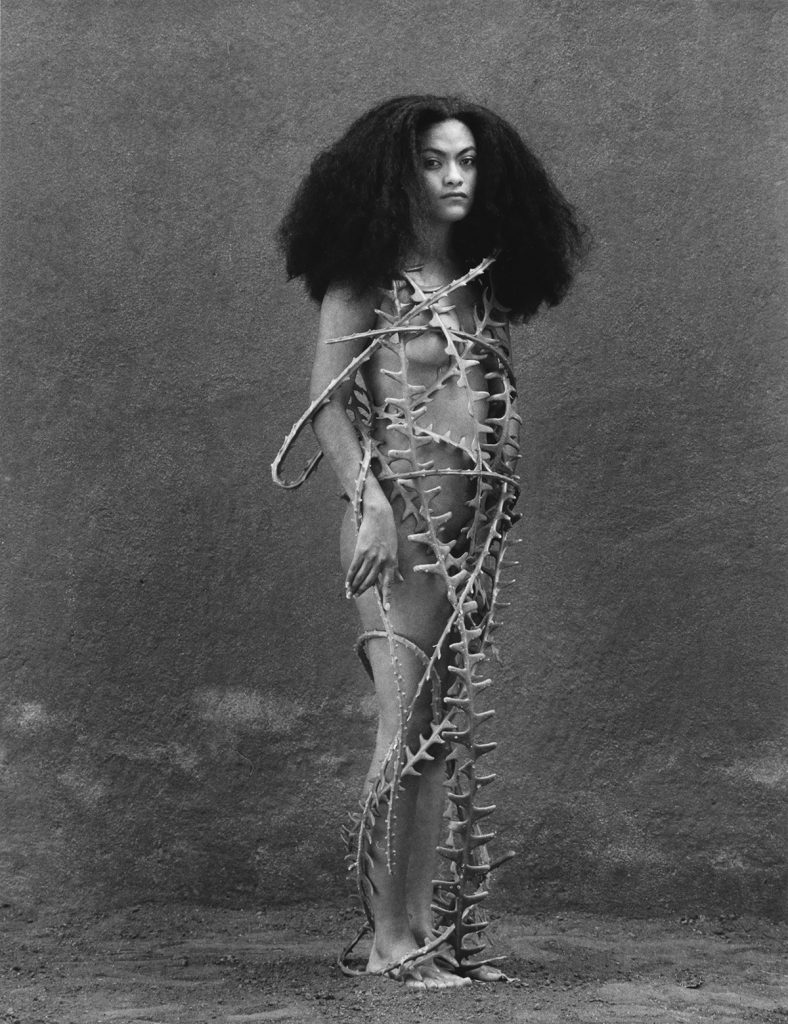
Garduño has photographed in Mexico and Central America and her works reflect a personal visual journey. Her photographs have a dream-like quality that often appears surrealist, resulting in an idiosyncratic personal lexicon that captures the uncanny nature of everyday life while keenly integrating what might be characterized as the elemental feminine. She has also worked in a directorial mode. Her studio portraits, which are explorations of the female form, sometimes include her daughter, Azul, as a model.
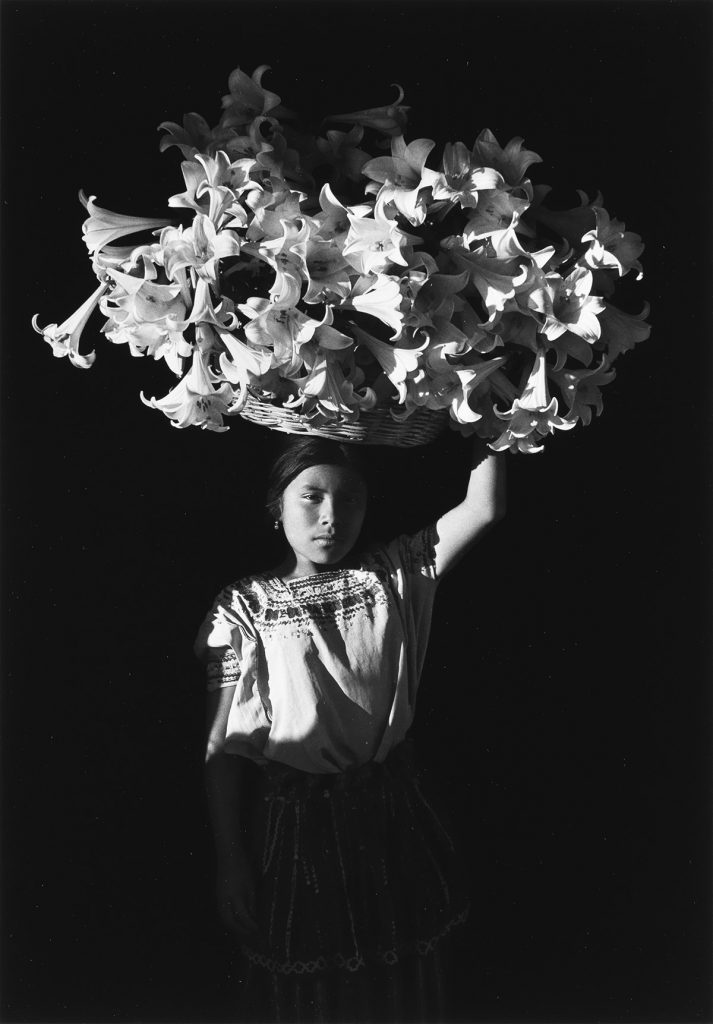
Garduño’s monochromatic prints are stunning objects, exploring the emotional qualities of light and shadow, rendering her subjects in harmonious detail and dimensionality. Her iconic image, Canasta de luz [Basket of Light], 1985, shows an indigenous teenage girl balancing a large basket of lilies on her head. The flowers are radiant and appear to glow from within. Interestingly, the inspiration for the photograph is enriched by pairing it with Alfredo Ramos Martinez’s vividly painted Vendedora de Alcatraces[Calla Lilly Vendor], 1929. While the subject matter is identical (local flower vendors), with each artist choosing to elevate the role of the street vendor, Garduño’s image reflects the particularities of the agency of light, brilliantly capturing its luminescence.
During the past thirty years, though Garduño’s body of work has addressed multiple themes, underpinning her approach is a contemporary appreciation of women’s distinct role and how that lends itself to photographic representation. Her iconic works transcend time, revealing themselves as aspects of our collective unconscious.
• First Auction in Hong Kong Behind-Closed-Doors Live Biddings via Online, Phone and in Written Form • Young Collectors Go From Strength to Strength Nearly Half the Bidders Under 40 Years Old, Winning Top Lots of Sale • Strong Global Participation From 22 Countries Spanning Oceania, Asia, the Middle East, Europe and Americas
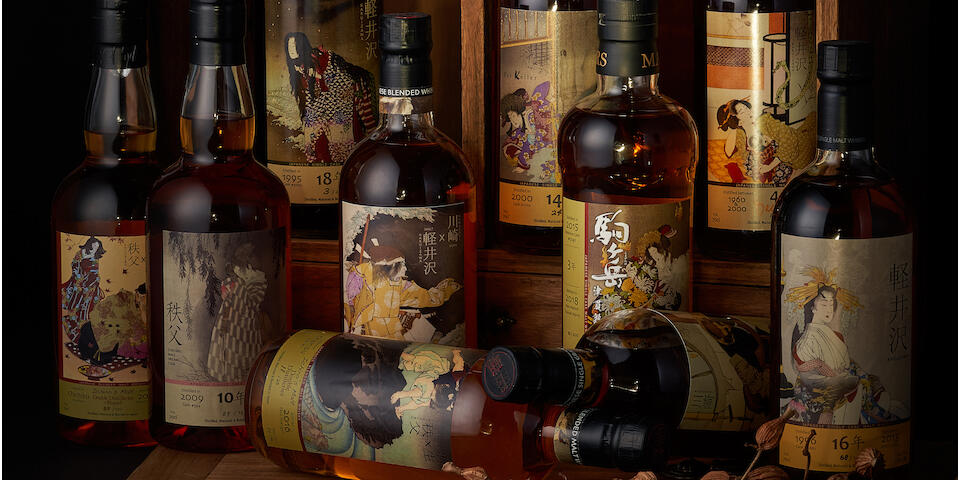
Top Lot: The ‘Ghost Series’ Whisky Collection (11 bottles) Sold for HK$ 967,200 Estimate: HK$ 820,000 – 1,000,000
Commenting on the result, Daniel Lam, Bonhams’ Director of Wine & Spirits, Asia, said: ‘We are pleased to see that the market is active. Japanese whisky, a category already trending over the past few years, shows strong resilience under the current climate, commanding prices in line with high estimates. This solid sale was encouraged by strong, global biddings from 22 countries, especially those from Hong Kong, Taiwan and Mainland China. Meanwhile, young collectors under 40 years old continue to increase, in terms of both numbers (they account for nearly half of the sale’s bidders) and buying power (the top two lots of the sale – both Japanese whisky sets – sold to young collectors).’
Notable highlights: Japanese Whisky • Lot 475 The ‘Ghost Series’ Whisky Collection (11 bottles) Sold for HK$ 967,200 Estimate: HK$ 820,000 – 1,000,000 • Lot 449 Yamazaki & Hakushu Vintage Malt – 1979 – 1994 (16 bottles) Sold for HK$ 682,000 Estimate: HK$ 600,000 – 800,000 • Lot 505 Hanyu Ichiro’s Malt-Joker ‘Monochrome’ and Hanyu Ichiro’s Malt-Joker ‘Colour’ Sold for HK$ 446,400 Estimate: HK$ 350,000 – 450,000 • Lot 439 Hibiki ceramic – 35 year old – Tokuda Yasokichi III Sold for HK$ 347,200 Estimate: HK$ 180,000 – 240,000 • Lot 511 Karuizawa – 1964 – #3603 Sold for HK$ 322,400 Estimate: HK$ 260,000 – 300,000 • Lot 287 Hibiki ceramic-35 year old-Sakaida Kakiemon XIV Sold for HK$ 248,000 Estimate: HK$ 180,000 – 240,000
Other notable highlights: • Lot 239 Armand Rousseau Chambertin Vertical (1998 – 2009) (12 bottles) Sold for HK$ 272,800 Estimate: HK$ 230,000 – 260,000 • Lot 207 Musigny 1994, Domaine Leroy (1) Sold for HK$ 93,000 Estimate: HK$ 60,000 – 80,000 • Lot 222 Château Le Pin 2004, Pomerol (3 Magnum) Sold for HK$ 173,600 Estimate: HK$ 85,000 – 110,000
Including a Previously Unknown Patek Philippe Pocket Watch
Reference 605 HU from 1950 in Pink Gold
And Two Extremely Rare F.P. Journe Models Tourbillon Souverain and Resonance both from his Original “Souscription” Series
Patek Philippe
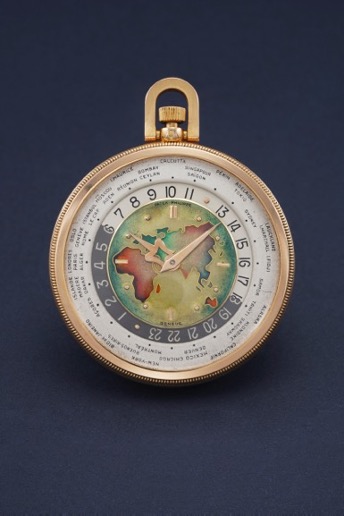
Reference 605 HU from 1950 in pink gold
Estimate: CHF 250,000-500,000
GENEVA – 18 MAY 2020 – Phillips in Association with Bacs & Russo is reveals additional highlights from The Geneva Watch Auction XI, following the earlier announcement of four extraordinary Patek Philippe wristwatches from the private collection of Mr. Jean-Claude Biver to be included in the sale. Taking place at Hôtel La Réserve, Geneva on June 27 and 28, 2020, the double-evening sale will feature over 200 lots including important timepieces that are exceptional in terms of provenance, aesthetics, condition and rarity.
Aurel Bacs, Senior Consultant Bacs &Russo and Alex Ghotbi, Head of Watches, Continental Europe and Middle East, jointly said, “We are delighted with the selection of watches in our Geneva Watch Auction XI, which gathers an unprecedented number of previously unknown, fresh to the market timepieces consigned by their original owners or descendants. The timepieces we are excited to reveal represent some of the greatest creations of the 20th and 21st century. They are watches of the highest quality, rarity, collectability and desirability that offer the type of diversity that adds colour, depth and balance to collecting.”
The Geneva Watch Auction XI marks Phillips’ first live watch auction of 2020 and will be led by an incredible selection of fine collectible timepieces hailing from power houses including Patek Philippe and Rolex, as well as from master independent watchmakers such as F.P. Journe or Kari Voutilainen.
Patek Philippe
The extraordinary selection of Patek Philippe timepieces covers a wide range of complications, styles and periods, with highlights including:
One of Patek Philippe’s signature complications, a pocket watch reference 605 HU from 1950 featuring a cloisonné enamel dial representing Eurasia and Africa. Previously unknown to the collecting community and appearing for the first time publicly, this watch is the only one known in pink gold featuring this type of dial. It is being offered by the family of the original owner.
An incredibly well-preserved reference 1579 chronograph in yellow gold made in 1955 and retailed by famed Swiss retailer Gübelin, it is only the 5th example signed by Gübelin to grace the market.
A reference 1518 in yellow gold from the family of the original owner from 1944, this reference was launched in 1941 and was the world’s first perpetual calendar chronograph made in series.
Continuing with perpetual calendars the sale also offers an ultra-rare white gold reference 3448 from 1970, coming from the family of the original owner. This example is one of only 30 known white gold reference 3448s and the third featuring calendar discs in German.
Rolex
In the field of Rolex wristwatches, the Submariner is a true icon. This season Phillips presents a wide selection of Rolex models, some of which are rarely seen on the market. These include:
A reference 5513 circa 1963 in excellent condition featuring an ultra-rare “Explorer dial” or “3-6-9 dial”. While the majority of Submariners were fitted with regular round hour markers, the present watch bears this extremely rare dial configuration, reminiscent of the dials also found on Rolex’s iconic “Big Crown” reference 6200.
Recently found in an antique shop in Alexandria, a Rolex Submariner “Big Crown” reference 6200 is also offered.
Finally, Phillips is proud to offer what is quite possibly one of the best-preserved examples of Rolex’s ultra-elusive reference 6232 in pink gold, from 1958. It is one of only twelve watches in existence, originally destined for the French market.
Independent Watchmaking
Phillips is renowned for shining a spotlight on Independent Watchmaking and each season a large section of the catalogue is dedicated to these amazing watchmakers, whose unbridled creativity and technical mastery continue to dazzle collectors and enthusiasts around the world. Highlights include:
F.P. Journe’s original Tourbillon Souverain “Souscription”, the watch that enabled the Founder of the firm, Mr. François-Paul Journe, to set up his company, and of which he has made only 20. When Journe decided to launch his second iconic model, the Resonance, he offered the latter to the clients having already bought the tourbillon, here again he used a subscription system. Phillips has the immense pleasure of offering a Resonance “Souscription”, a model rarely seen at auction, and the present example comes in a unique livery specially commissioned by Lorenz Baümer: platinum/pink gold case with white gold dial.
The incredibly talented independent jeweler Bäumer was born in the USA in 1965, and lived abroad from a young age given his father was a German diplomat and his mother was French. He spent much of his childhood globetrotting, which led to his discovery and appreciation of different cultures, which went on to influence his artistic career. After completing engineering studies at the École Centrale de Paris in 1989, Bäumer opened his first salon at 23, rue Royale in Paris to sell costume jewellery. Thereafter he moved to 4, place Vendôme and devoted himself exclusively to jewellery. The creation of the tiara “Ecume de Diamants” for the wedding of HSH Prince Albert of Monaco with Charlène Whittstock in 2010 was a marking moment in his career.
Another exceptional highlight is the Opus 3 made for Harry Winston by Vianney Halter, featuring a unique way of reading time. This example is number one from 25 pieces made in platinum.
Also topping the Independents’ Atelier section is a unique GMT model with power reserve hiding a beautifully engraved and enameled caseback featuring Triton, and a mermaid by Kari Voutilainen.
Some of the finest watches in terms of quality and condition will also be offered, including elegant dress, sports and complicated watches by prestigious collectors’ brands such as Patek Philippe and Rolex, A. Lange & Söhne, Audemars Piguet, Vacheron Constantin, Omega, IWC, Longines and Breitling, to name only a few.
The selection of leading highlights will be available to the public during the pre-sale exhibitions opening in Asia and Europe. Following a preview in Hong Kong from May 20 to 27, highlights will be on display in Geneva from June 24 to 28, 2020.
Patek PhilippeReference 1518 in yellow goldEstimate: CHF200,000-400,000
Patek PhilippeReference 1579 in yellow goldEstimate: CHF60,000-100,000
RolexReference 6232Estimate: CHF200,000-400,000
RolexReference 6200 Big CrownEstimate: CHF250,000-500,000
At Phillips the health and safety of our clients and staff are our highest priority, and we will adapt our preview exhibitions and live auctions to reflect local government guidelines.
Auction
The Geneva Watch Auction XI, Part I: 27 June 2020, 5pm
The Geneva Watch Auction XI, Part II: 28 June 2020, 5pm
Auction Viewing
Asia: 20 – 27 May
Location:14/F St. George’s Building, 2 Ice House Street, Central Hong Kong
ABOUT PHILLIPS IN ASSOCIATION WITH BACS & RUSSO The team of specialists at Phillips Watches is dedicated to an uncompromised approach to quality, transparency, and client service, achieving a sale total of $111 million in 2019 – its third consecutive year as the worldwide market leader in watch auctions.
A selection of our recent record-breaking prices:
1. Paul Newman’s Rolex “Paul Newman” Daytona reference 6239 (CHF 17,709,894 / US$17,752,500) – New York Auction: Winning Icons – 26 October 2017 – Highest result ever achieved for any vintage wristwatch at auction.
2. Patek Philippe reference 1518 in stainless steel (CHF 11,020,000 / US$11,112,020) – Geneva Watch Auction: FOUR – 12 November 2016 – Highest result ever achieved for a Patek Philippe wristwatch at auction.
ABOUT PHILLIPS
Phillips is a leading global platform for buying and selling 20th and 21st century art and design. With dedicated expertise in the areas of 20th Century and Contemporary Art, Design, Photographs, Editions, Watches, and Jewelry, Phillips offers professional services and advice on all aspects of collecting. Auctions and exhibitions are held at salerooms in New York, London, Geneva, and Hong Kong, while clients are further served through representative offices based throughout Europe, the United States and Asia. Phillips also offers an online auction platform accessible anywhere in the world. In addition to providing selling and buying opportunities through auction, Phillips brokers private sales and offers assistance with appraisals, valuations, and other financial services.
As the world celebrates International Museums Day, we talk to four directors across the globe about loans and exhibitions, the future of blockbusters, donations, digital innovations, inclusivity, connectivity and ‘the duty to safeguard great art’
Maria Mok
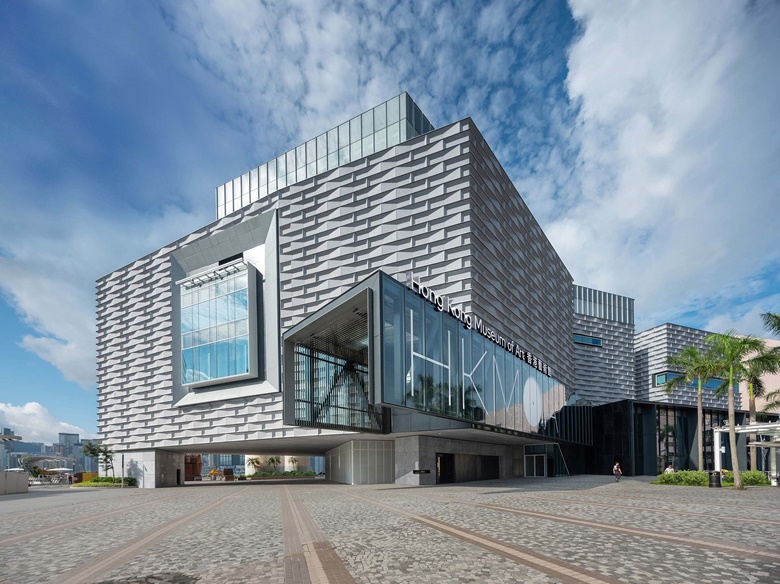
Director of the Hong Kong Museum of Art
‘As I speak, our museum is partially open. We closed in January, opened up for 10 days in March, then closed down again because of the second wave.
‘When we reopened for the second time, on the morning of 6 May, there was a queue outside: everyone seemed happy to have something to do apart from eating. When one man was asked why he had come, he said he wanted to see the largest painting that David Hockney has ever completed, Bigger Trees near Warter.
‘It’s on loan to us from the Tate, part of an exhibition of British landscapes. The show was installed last November and was supposed to be here for three months, but we can’t send it back right now, so it will now run till May. It’s a rare extended opportunity for Hong Kong people to see such works — and that’s a bright side.
Maria Mok, Director of the Hong Kong Museum of Art
‘Many of our visitors have been going online to look at art, of course, but what that gives them is a memory of a two-dimensional image.
‘The challenge for us will be to remind everyone that the true power of art consists in having contact with a space or an object or another human being, that the real experience is different from looking at a picture on Facebook. And that’s because you can immerse yourself in a painting on a wall in a way that is impossible to do with a picture on an iPhone.
‘Since we are among the first to reopen, I am sure that we will be sharing our insights’ — Maria Mok
‘As a museum director, one thing that I will take away from Coronavirus is a renewed sense of solidarity. People are reaching out to each other. In the run up to International Museums Day, I have been having all kinds of meetings with fellow museum directors in Europe and the Middle East and elsewhere.
Hong Kong Museum of Art (HKMoA)
‘Everyone seems eager to chat and exchange ideas. Since we are among the first to reopen I am sure that we will be sharing our insights — and our mistakes. This situation is not a competition, after all; we in the museum world are facing it together.’
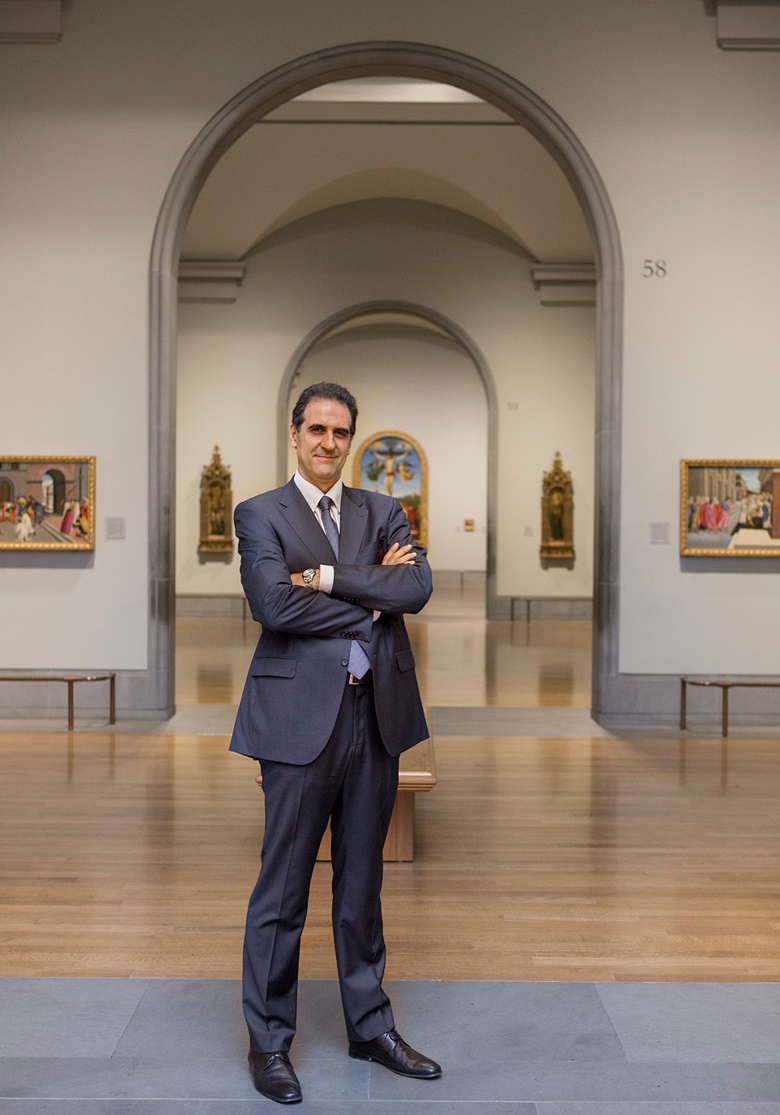
Gabriele Finaldi
Director of the National Gallery, London
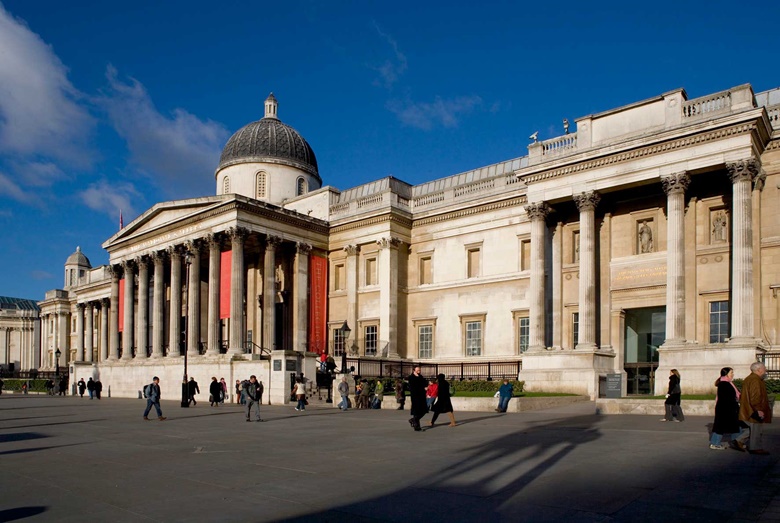
‘This is a curious time for us, because we are so used to having visitors come in every day. But the circumstances are the same for just about every museum in the world. We are an online museum until we can reopen the doors on Trafalgar Square.
‘The only people going into the National Gallery are security and environmental technicians. We are monitoring the paintings remotely, and through twice-weekly visits by our head of conservation.
Gabriele Finaldi, Director of the National Gallery, London
‘We can’t continue to restore pictures for now — you have to be in situ for that — but there is a lot of work that conservators can do without a retouching brush in hand. That includes updating archives, writing reports, preparing articles for publication or lectures. I am very keen that all that activity continues. We chose to keep everyone busy, and not to furlough any staff.
‘The example of the National Gallery during wartime — I am thinking of the Myra Hess [piano] concerts that took place during the Blitz and after — has been an inspiration for us. I have clearly seen the emotional attachment that people, including our own staff, have to the gallery.
‘What will be different? For one thing, fewer institutions will be doing big blockbuster shows’ — Gabriele Finaldi
‘There is a sense of a duty to safeguard great art: whether that art is kept in a slate quarry in North Wales, as during the war years, or in safe-keeping behind our own doors during this Covid-19 pandemic. Art has something to do with who we are as a people, the best of ourselves — and to be reminded of that is very important. Art also has a role in providing solace, in recalling better times and looking forward to a time when this will be over.
The National Gallery, London
‘What will be different then? For one thing, fewer institutions will be doing big blockbuster shows. They are a valuable instrument for drawing new people in, showcasing new research, introducing new areas of art history. But traditionally, it is the local public that focuses on temporary shows, while the tourist audience homes in on the core collection.
‘I would find it a welcome outcome if that were to change — if our local audience in London and the UK came to re-appreciate the collection itself. Because right next to those temporary shows, we have a gallery of masterpieces that amount to a permanent blockbuster.’
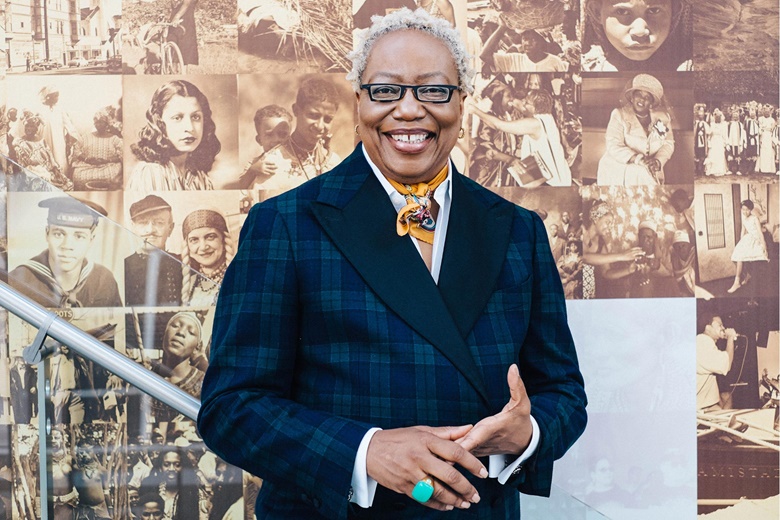
Linda Harrison
Director of the Newark Museum of Art
‘We were just taken aback by the crisis, and in some ways have hardly had a chance to think. We closed on 16 March, hoping that we would reopen in April. That was later revised to 28 May — and now we have decided that we will not be back until the fall.
‘Meanwhile, we have rescheduled this year’s exhibitions for 2021 and even 2022. We had planned a retrospective of Ralph Steadman’s work — this is a political year, after all — but that’s postponed to next spring. We were also putting together an exhibition around Billie Holiday and other jazz greats who came from Newark or played here.
‘That’s moved to the summer of 2022, because we want to combine it with live, open-air music. The museum takes up four and a half acres right in the middle of town. That’s a lot of real estate, and we can’t just be here. We have to be of the community, a part of the city’s ecosystem.
Linda Harrison, Director of the Newark Museum of Art
‘Our museum encompasses a 19th-century home — Ballantine House — and the dimensions of those rooms are distinctly intimate. We are in conversations about how we implement the pretty serious guidelines from the CDC [Centers for Disease Control & Prevention], the local authorities, and the American Association of Museum Directors.
‘Timed viewings, inventive use of digital, tying in our under-leveraged sculpture garden — all those things may play a role. We need to think holistically and test them out. We have the same challenge with our planetarium, which is a theatre in the round. According to the present rules, we’ll have to leave two out of three seats empty.
‘I think we will weather this storm: we know from earlier crises that art somehow endures’ — Linda Harrison
‘One thing I know: the museum that opens in September or October will not be the one that closed in March. We must pivot, adjust to a new reality. If we thrive after this pandemic, it will be because we are relevant to the people we serve. I think we will weather this storm: we know from earlier crises that art somehow endures.
Newark Museum of Art
‘The crisis has been a slap in the face for the art community; it has woken us up to the idea that art cannot be for a small group of people. If there is one word that defines the future, it is “inclusive”. Once you have a home and food, and your family is safe, you look for what make life fulfilling — and art museums provide that. Yes, we can do that.’
Brent Benjamin
Director of the St Louis Art Museum (SLAM)
‘St Louis is beginning to lift the stay-at-home orders, as of Monday 18 May, but the museum is not included in phase one. So we have a major exhibition — on Jean-François Millet and his influence on modern art — hanging in closed galleries right now. It’s a fantastic show with extraordinary loans from all over the world, so that is very frustrating, given all the work and scholarship that went into it.
‘We are working our way through many practical questions — for example, how handlers hang a painting or lift a sculpture while trying to observe the health regime. Gloves and masks are an obvious part of the answer. Our handlers are used to working in gloves, at least. In future we will be planning the movement of large and complex things even more carefully than we do already.
Brent Benjamin, Director of the St Louis Art Museum (SLAM)
‘A few dozen pieces of ours are on loan all over the world right now. Most borrowers have asked us to extend, and we have, of course, said yes in every case — because we want to help our fellow institutions, and also because there’s not much we can do about it. After the pandemic, museums might have to be more fluid and flexible in regard to loans, whether it is lending out or borrowing in.
‘That will drive thinking about programs. We know it will be easier to get something here on a truck from Boston, say, than on a plane from London. And it may be that, in future, projects will run longer than the typical 12 weeks. The pace of exhibitions might become slower, with a greater emphasis on the treasures that are here in the collection.
‘The most wonderful thing has happened: a number of people, when renewing memberships, are adding an additional cheque’ — Brent Benjamin
‘SLAM is funded by property taxes, and that revenue is very stable. In this crisis, that’s a very helpful circumstance, but we will be tightening our belts all the same. And the most wonderful thing has happened: a number of people, when renewing memberships, are adding an additional cheque.
St Louis Art Museum (SLAM)
‘In the first month of closure, we had 85 people who put something extra in the envelope just because they care and want to help. I have to say that is so humbling and heart-warming. Just fantastic.’
When Mitzi Gaynor, in the character of that cockeyed optimist Nellie Forbush, launched into I’m Gonna Wash That Man Right Outa My Hair in the 1958 screen adaptation of Rodgers and Hammerstein’s South Pacific, she won the hearts of cinemagoers the world over, and cemented her reputation as a major international movie star. The much-loved actress, singer and dancer is also celebrated for her many stage shows and the Mitzi… television specials which ran throughout the late 1960s and 1970s. A selection of her memorable and arresting costumes from stage and small screen comes to auction in Bonhams’ Razzle-Dazzle! Costumes and Couture from the Mitzi Gaynor Collection, an online sale that runs from 27 May – 10 June. A portion of the proceeds from the sale will benefit The Actors Fund.
Mitzi Gaynor is available for interviews.
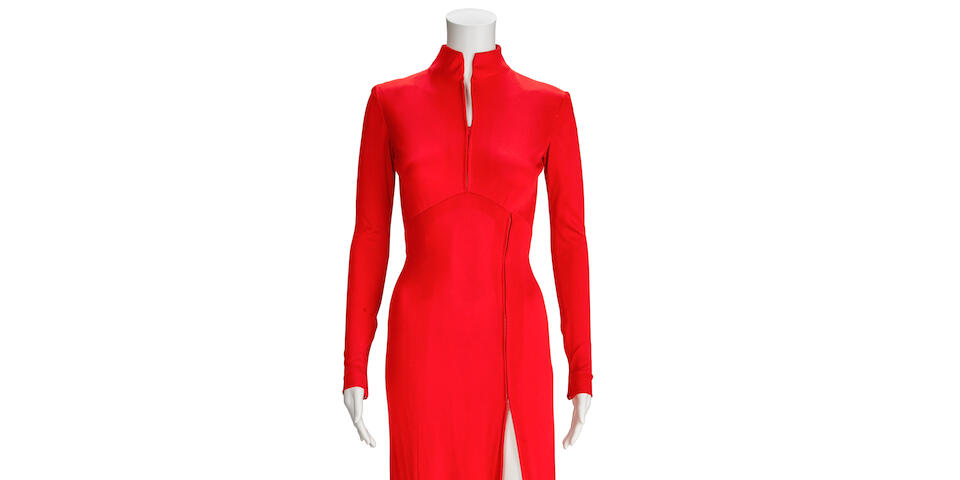
Sale highlights include: • An Emmy award®-winning costume worn by Mitzi Gaynor on Mitzi…Roarin’ in the 20’s. This lively little number, complete with mock purse and jazzy hat, was designed by Bob Mackie and worn by Mitzi in the opening sequence of the 1976 CBS show. Estimate: $600-800. • A Mitzi Gaynor red gown worn on Mitzi… What’s Hot, What’s Not, designed by Bob Mackie. A beautiful but conservative gown becomes instantly sensual in the opening sequence of this variety special in which Mitzi unzips the top zipper, followed by the leg zipper, and exclaims, “That’s hot!” Estimate: $500-700. • A silver metallic gown designed by Robert Carlton and worn by Mitzi in her 1961-62 stage performances. Estimate: $600-800 • A fully beaded stage worn mini-dress designed by Bob Mackie. This sensual costume accentuated those famous Gaynor gams when worn by Mitzi in her 1987-88 stage shows. Estimate $600-800. • A Mitzi Gaynor gown worn on Mitzi…A Tribute to the American Housewife, designed by Bob Mackie. This attractive multi-piece gown was worn by Mitzi in a musical comedy sketch titled based on Stephen Sondheim’s song, “The Little Things You Do Together” (from Company) with guest stars Jerry Orbach, Suzanne Pleshette, Jane Withers, Ted Knight, and Cliff Norton. Estimate: $400-600.
MITZI GAYNOR NOTED: “Thanks to the audiences who’ve brought me so much happiness, I’ve been privileged to do something I truly love for all of my life. These treasures from my archive, and my closet, have been good friends along the way. It makes me very happy to know that they’ll be enjoyed again, and that they’ll also help an organization that’s providing essential support during these challenging times — The Actors Fund.”
Bonhams’ Director of Entertainment Memorabilia, Catherine Williamson, said: “Mitzi Gaynor is a true legend of stage and screen and remains one of America’s most popular performers. Throughout her long and glittering career, she always understood the huge importance of costume to the success of her shows as the wonderful and sometimes astonishing pieces in this sale demonstrates.”