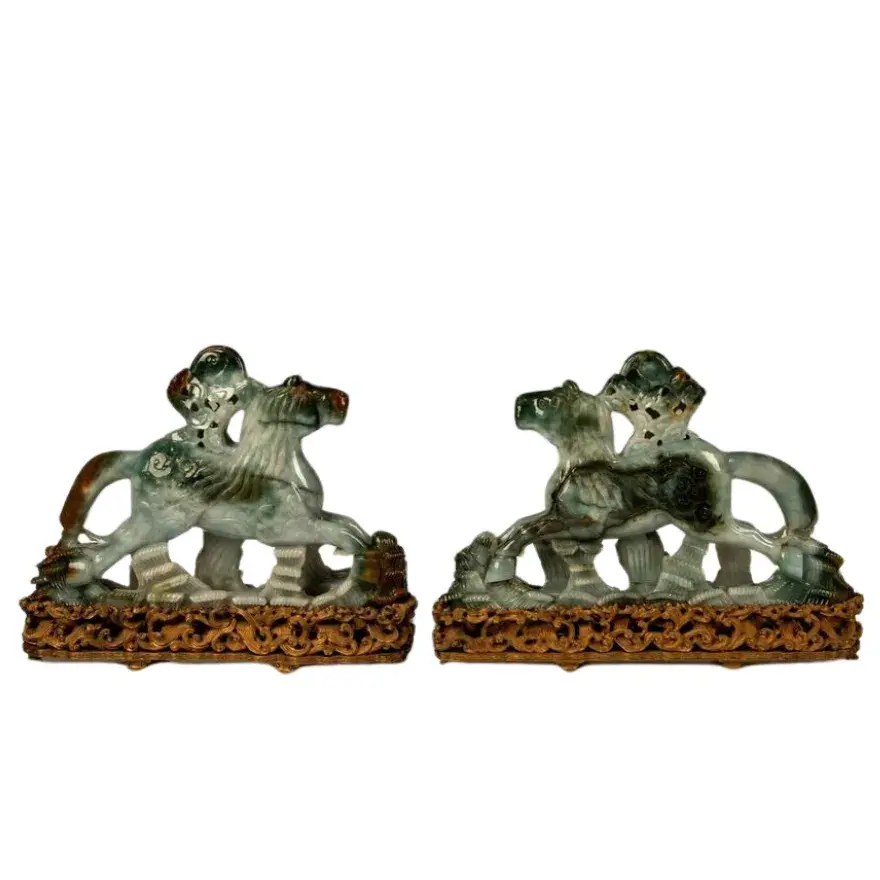
Pair of Antique Chinese Jadeite Horse Sculptures:
2 beautifully green and brown stone horses in fine excellent carved details. A Yin and Yang coin on top of the horses’ backs. Includes two beautiful gilded carved wooden bases. Base: 17.5″L x 3″W x 2.75″H. Sculpture: 16.5″L x 2.75″W x 10″H
Issued: 19th century
Country of Origin: China
Condition
Age related wear. As is.
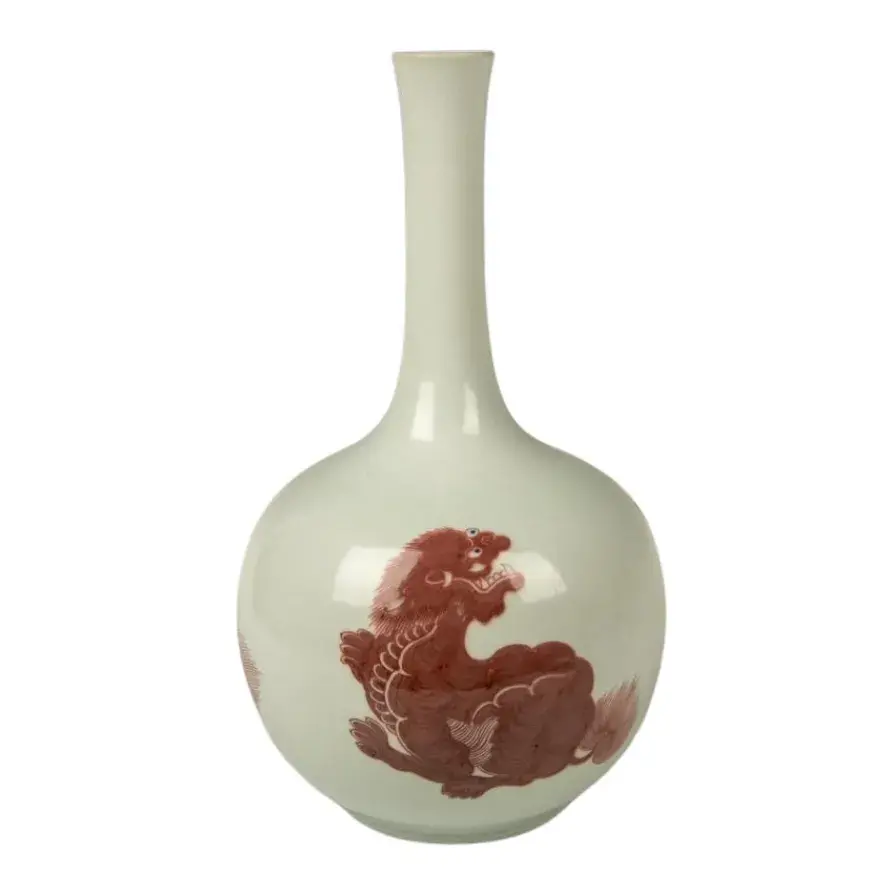
Chinese Kangxi Copper Red Underglaze Buddhist Lions Vase:
A 18th or 19th century white bottle shaped vase stunningly decorated with three lion dogs in copper red glaze and blue eyes.
Issued: 18th century
Dimensions: 9.5″W x 15.75″H
Country of Origin: China
Condition
Age related wear. As is.
Tibetan Gilt Bronze Figure of Avalokiteshvara, Qianlong Period:
18th century, mercury gilt statue. The eleven headed bodhisattva fixed on a lotus base, crowned with heads arranged in five tiers, the top with a small head of Amitabha Buddha, above wrathful head followed by nine heads with serene expression, all above a slender body wearing ornate jewelry and robs with either outstretched hands, the principal hands help in prayer with other hands carrying prayer beads, a kalasha, or in various mudras. Surmounted on lotus base.
Issued: 18th c.
Dimensions: 7.5″L x 5.5″W x 14.5″H
Condition
Age related wear.
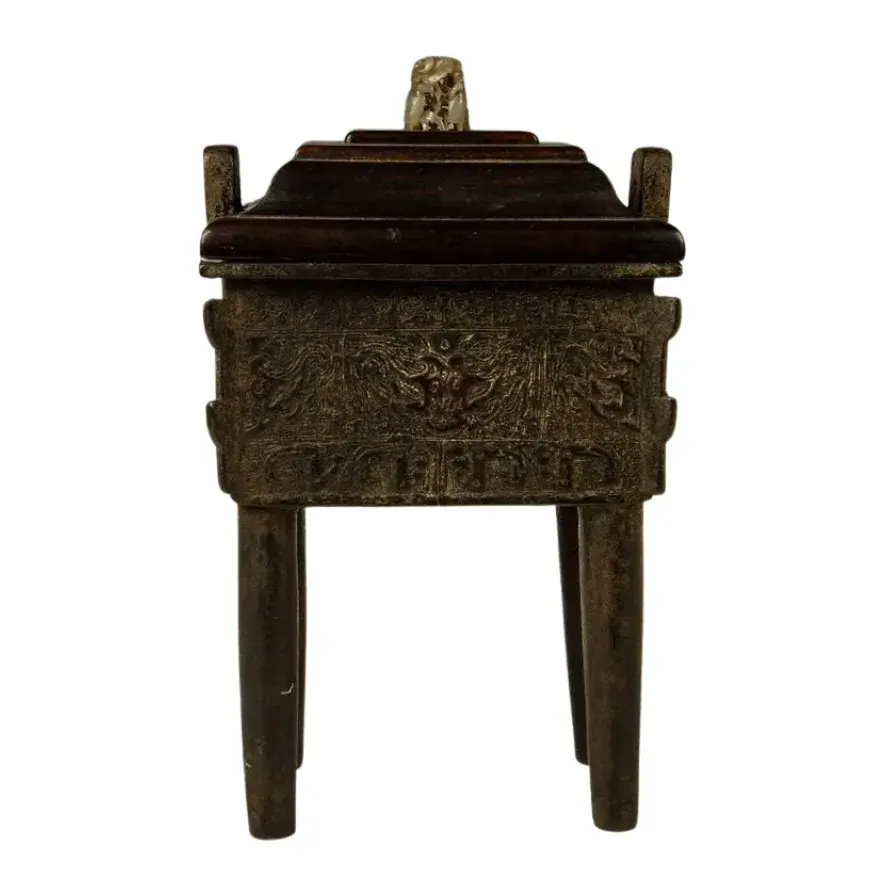
Antique Chinese Ming and Yuan Bronze Censer:
A beautiful four-footed bronze incense burner from the Ming Dynasty, covered with a wood carved lid adorned with a Yuan Dynasty white jade. The jade, stunningly carved to feature four cranes hidden among foliage, was used before as decoration top for a hat.
Issued: Ming dinasty
Dimensions: 7.25″L x 5.25″W x 12″H
Country of Origin: China
Condition
Age related wear. As is.
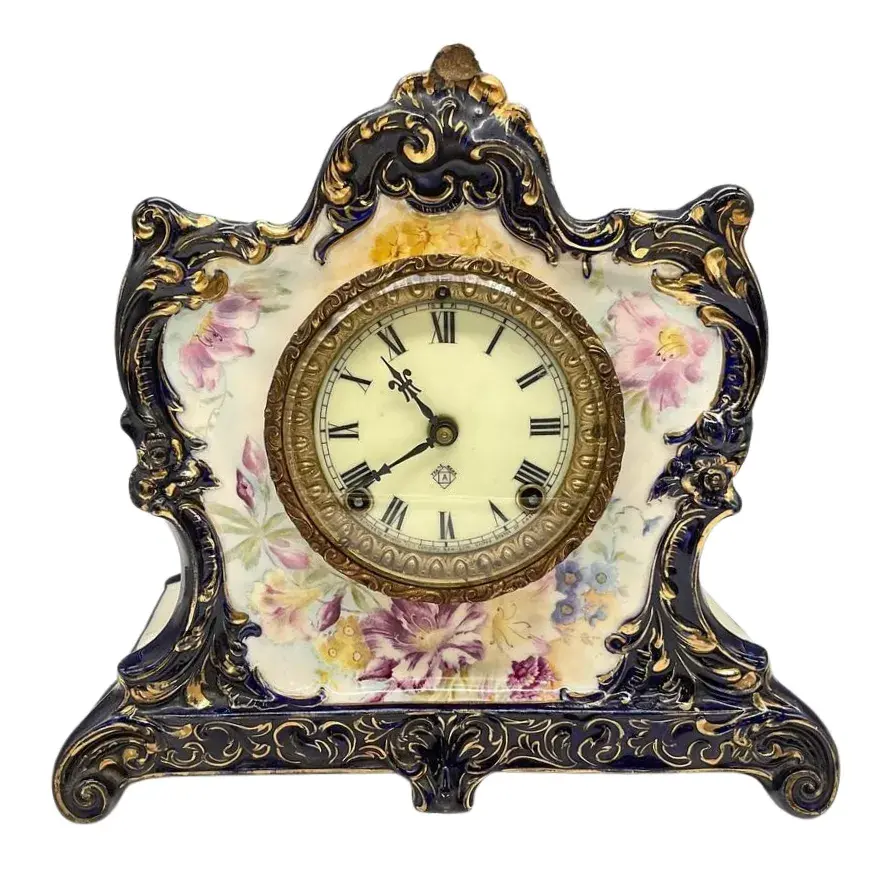
Antique Ansonia Clock Co. and Royal Bonn Porcelain Mantel Clock:
Clock porcelain body colored in royal blue with gilt highlights and floral motif around face of clock. Roman numerals on metal face. Ansonia Clock Co. impressed mark on mechanism, Royal Bonn gilt mark on back.
Dimensions: 12.5″L x 5″W x 11.5″H
Manufacturer: Ansonia Clock Co.
Country of Origin: United States
Condition
Age related wear. As found, crown chip. Not tested, function not guaranteed.
Royal Doulton Prestige Sculpture, Leopard on a Rock HN2638:
Beautiful bone china Doulton Animal Study. Golden brown leopard with dark brown spots on earthenware charcoal rock. Large exhibition piece; exquisitely detailed. Doulton backstamp.
Artist: Charles Noke
Issued: c. 1952-1981
Dimensions: 16.5″L x 8″W x 8.5″H
Manufacturer: Royal Doulton
Country of Origin: England
Condition
Age related wear.
Inlaid Moroccan Folded Game Table with Chess Board Set:
A stunning wooden table adorned in a beautiful marquetry design. The surface rotates to reveal storage, and the top can unfold to be a game table with a green fabric center. Also includes a vintage chess board with 32 bone pieces carved in a Asian motif. Table open: 32″L x 32″W x 30.25″H. Table close: 32″L x 16″W x 32.5″H. Chess board set: 12.25″L x 7″W x 2.5″H.
Issued: 20th century
Condition
Age related wear.

The Lamentation Of Christ, Delacroix c. 1852-63:
Featured in this lot is an Original “The Lamentation Of Christ, A Study In Progress” attributed to Eugène Delacroix, circa 1852-1863; Provenance: Henry Sjaardema collection Big Sky, Montana. Delacroix, considered the greatest painter of the Romantic period, is probably best known for his painting “Liberty Leading the People.” He is far less known and appreciated as an important painter of religious subjects, yet with 120 pictures and over 220 drawings depicting traditional subjects, like The Pietà or Christ on the Cross, initiate the style of modern religious art. Although Delacroix (1798-1863) has been characterized as a radical and an unbeliever who found religion irrational, these pictures challenge claims that Delacroix’s religious subjects were few in number, mere commissions remote from his personal interests. Delacroix’s religious paintings were informed in general terms by the Romantic penchant for introspection that defined the aesthetic experience as a sign of the spiritual. In 1847, 1848, and again in 1857, Delacroix painted variations of The Lamentation. Delacroix’s early work is in marked contrast to his later versions which were created in a variety of media from the 1840s through the 1850s. The later pictures demonstrate a transformation from the solitary, strong, heroic figure to a more austere and vulnerable personality, posed in a stark and haunting vision of suffering as described in the Gospel of Mark. Delacroix continued to paint until the end of his life, but in his last years, perhaps as a result of personal reflection, he increasingly focused on Christian-themed works. This oil painting features the central figures of the Virgin Mary, arms outstretched, standing over the white-robed lifeless body of Christ being borne by three men. Next to Mary is a young boy, three adults are in the forefront right side while one man in the forefront left side is holding a torch in front of what appears to be the entrance to a cave. In the above left background, a cross is visible on a hill, three figures kneeling over a dead body. This painting was made over two strips of horizontal canvas. Appears unsigned but is titled and dated on an accompanying metal plaque. The painting has an ornate gold gilt wood frame. Craquelure observed, scuffing, and spotting observed on the reverse of the canvas. Visible art measures 92″L x 66.5″W with the frame measuring 97.5″L x 72.5″W x 2.5″D.*

Ca. 1890 Ghost Dance Plains Shield:
This is a fantastic, rare and authentic circa 1890’s Plains Indian Ghost Dance Shield from the ex-Forest Fenn collection. The shield is likely attributed to the Sioux or Arapaho and is from the ex-collection of Forest Fenn of Santa Fe, New Mexico, Fenn noted it as Sioux. The shield is comprised of parfleche buffalo hide wetted and stretched over a hoop frame. The piece has a large painted waterbird on the front that has faded over time but still displays beautifully. The shield exhibits six black bear claws attached to the top with old crenshaw twine ties. Under magnification, small brush strokes can be seen in the old painted lines. The original braided hide arm strap is still in tact. This is a beautiful shield that presents wonderfully and is truly a work of Native American art. Provenance: From the ex-Forest Fenn Santa Fe, New Mexico, Fenn sold the shield in the 1980’s to Ted levy in Santa Rosa, California. Well kept, good condition. The shield measures 17 ½ inches in diameter.

19th C. Southern Plains Bow, Arrow & Quiver Set:
The lot features a 19th Century Southern Plains bow, arrow, & quiver set attributed to the Comanche Indians of the Southern Plains in Northern Texas. The set is comprised of Indian brain-tanned buffalo / bison hide smeared with yellow mineral pigment ocher / ochre in typical Southern Plains fashion. There are beautifully beaded sections that extend on both sides and long frilly Indian hide fringes hanging down. The beadwork is done in period correct early glass trade seed beads in a classic Comanche tab design having a light blue background with colors of greasy yellow, cobalt, blue and red. The fringes have a red ocher / ochre mineral pigment coloring. The original wide Indian hide shoulder strap is still intact and has beaded cross motifs. The case shows a bow sheath with arrow quiver attached that shows some minor wear and loss from age and use but overall in very good condition. The set includes two metal tipped arrows with turkey feather fletching as well as an original old bow with the sinew string long gone. The set appears to be well kept with some possible professional preservation work done. Provenance: From a private Cincinnati, Ohio collection of Native American weapons and beadwork. Measures 40 inches long without fringes, quiver by itself is 24 inches long without fringes.