Tapestry Weaving HN3048 – Royal Doulton Figurine

Tapestry Weaving HN3048 - Royal Doulton Figurine

Tapestry Weaving HN3048 – Royal Doulton Figurine:

Limited edition, from the Gentle Arts Series. Features a woman in a pink flowered dress accompanied by a metal tapestry stand. Includes the original box, dimensions: 10.25”L x 10.25”W x 13.25”H. Figurine dimensions: 5.5”L x 6”W x 6.75”H.
Artist: Pauline Parsons
Issued: 20th century
Dimensions: See Description
Edition Number: 394 of 750
Manufacturer: Royal Doulton
Country of Origin: England
Condition
Age related wear.

In The Stocks HN2163 – Royal Doulton Figurine

In The Stocks HN2163 - Royal Doulton Figurine

In The Stocks HN2163 – Royal Doulton Figurine:

Artist: Mary Nicoll
Issued: 1955 – 1959
Dimensions: 5.75″H
Manufacturer: Royal Doulton
Country of Origin: England
Condition
Age related wear

Indian Temple Dancer HN2830 – Royal Doulton Figurine

Indian Temple Dancer HN2830 - Royal Doulton Figurine

Indian Temple Dancer HN2830 – Royal Doulton Figurine:

Artist: Peggy Davies
Issued: 1982
Dimensions: 9.25″H
Edition Number: 616 of 750
Manufacturer: Royal Doulton
Country of Origin: England
Condition
Age related wear

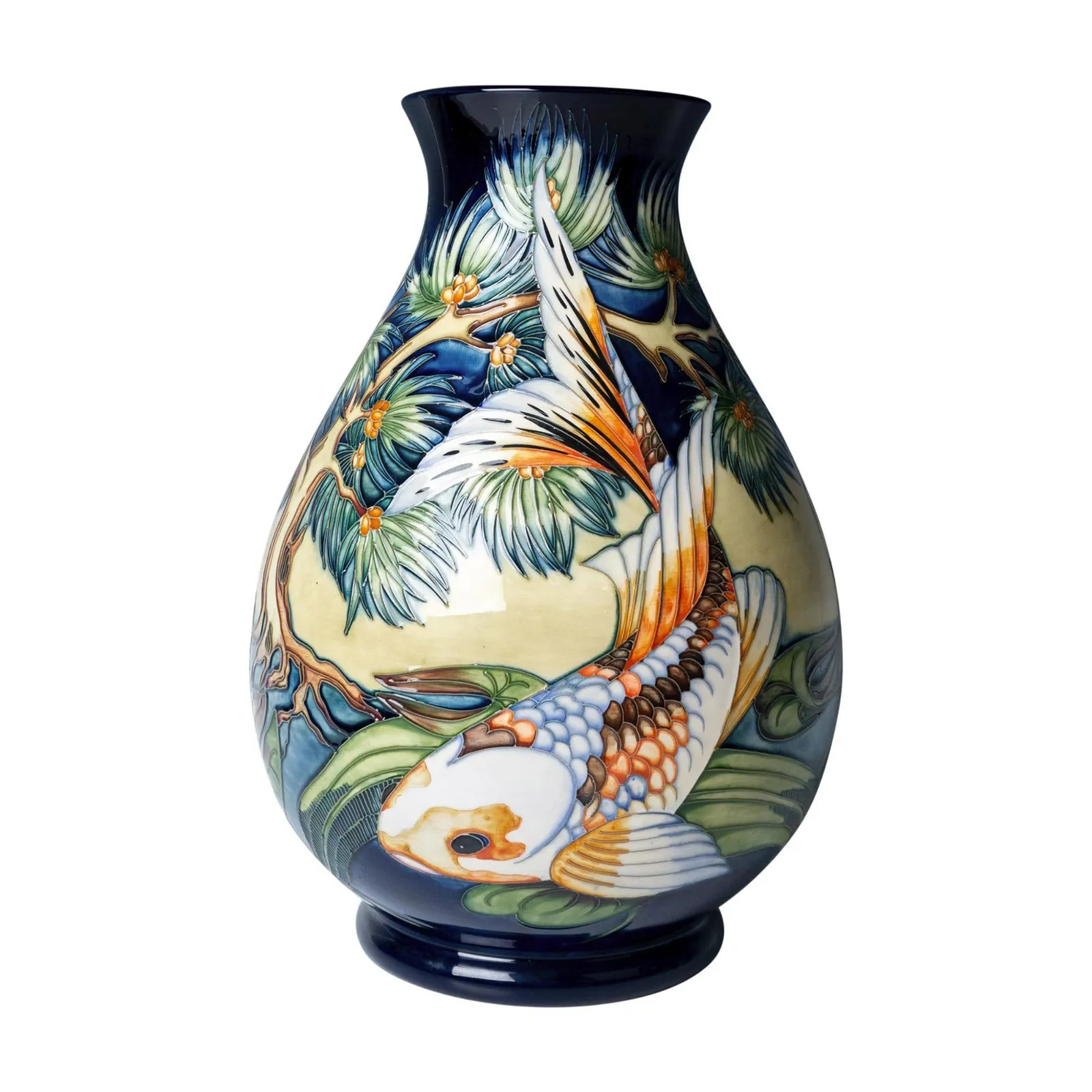
Moorcroft by Philip Gibson Vase, Quiet Waters, Signed

Moorcroft by Philip Gibson Vase, Quiet Waters, Signed

Moorcroft by Philip Gibson Vase, Quiet Waters, Signed:

A large bulbous form adorned with excellent tubeline koi swimming amongst waterlilies. Moorcroft impressed stamp. Signed by artist on the underside.
Artist: Philip Gibson
Issued: 2002
Dimensions: 105″W x 15″H
Manufacturer: Moorcroft
Country of Origin: England
Condition
Age related wear.

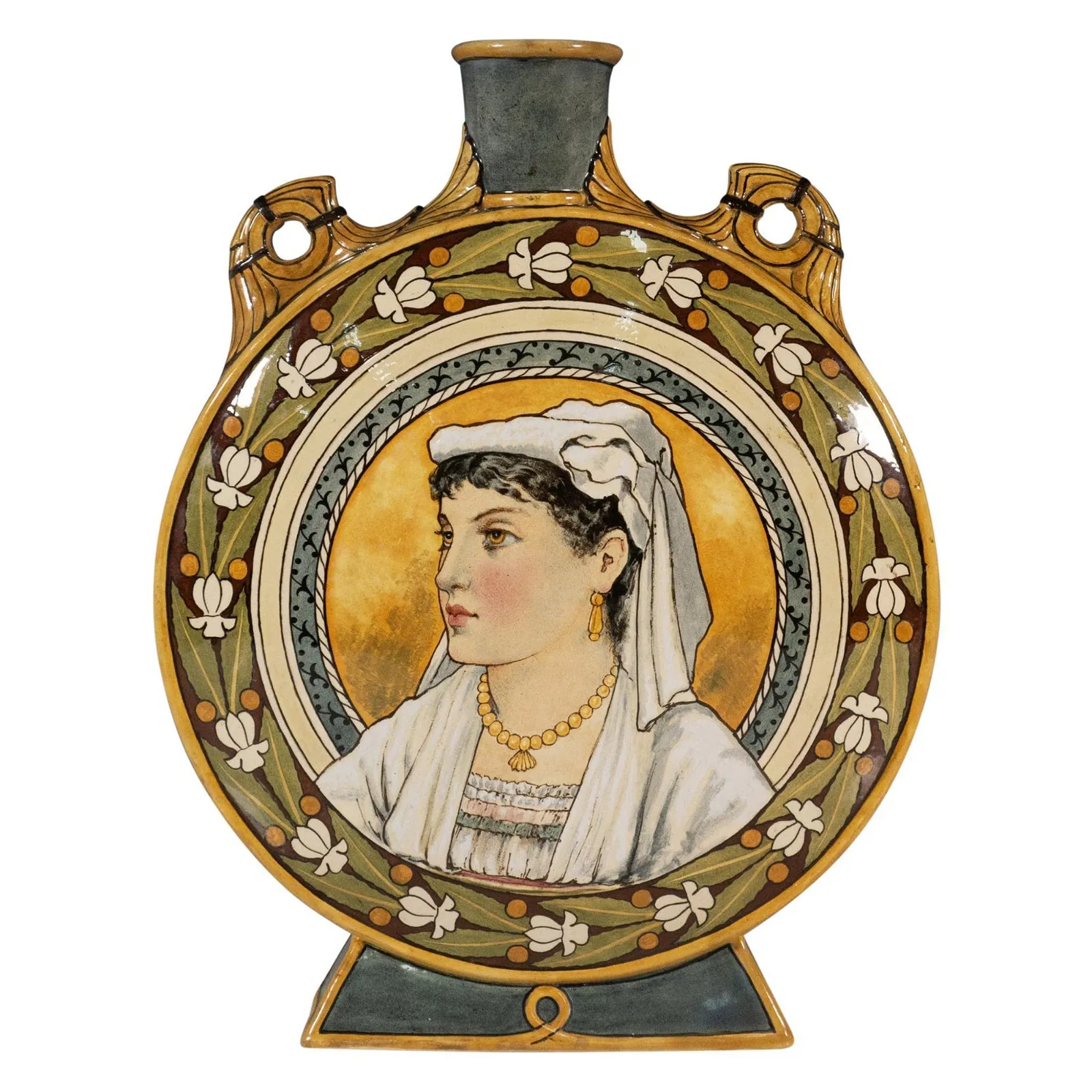
Rare Minton’s Art Pottery Studio Moon Flask Vase

Rare Minton's Art Pottery Studio Moon Flask Vase

Rare Minton’s Art Pottery Studio Moon Flask Vase:

A short double-handled vase featuring a lady’s profile in the center of a laurel boarder. Minton’s Art Pottery Studio Kensington Gore backstamp.
Dimensions: 10.75″L x 3.5″W x 13.5″H
Manufacturer: Minton’s Art Pottery Studio
Country of Origin: England
Condition
Age related wear.

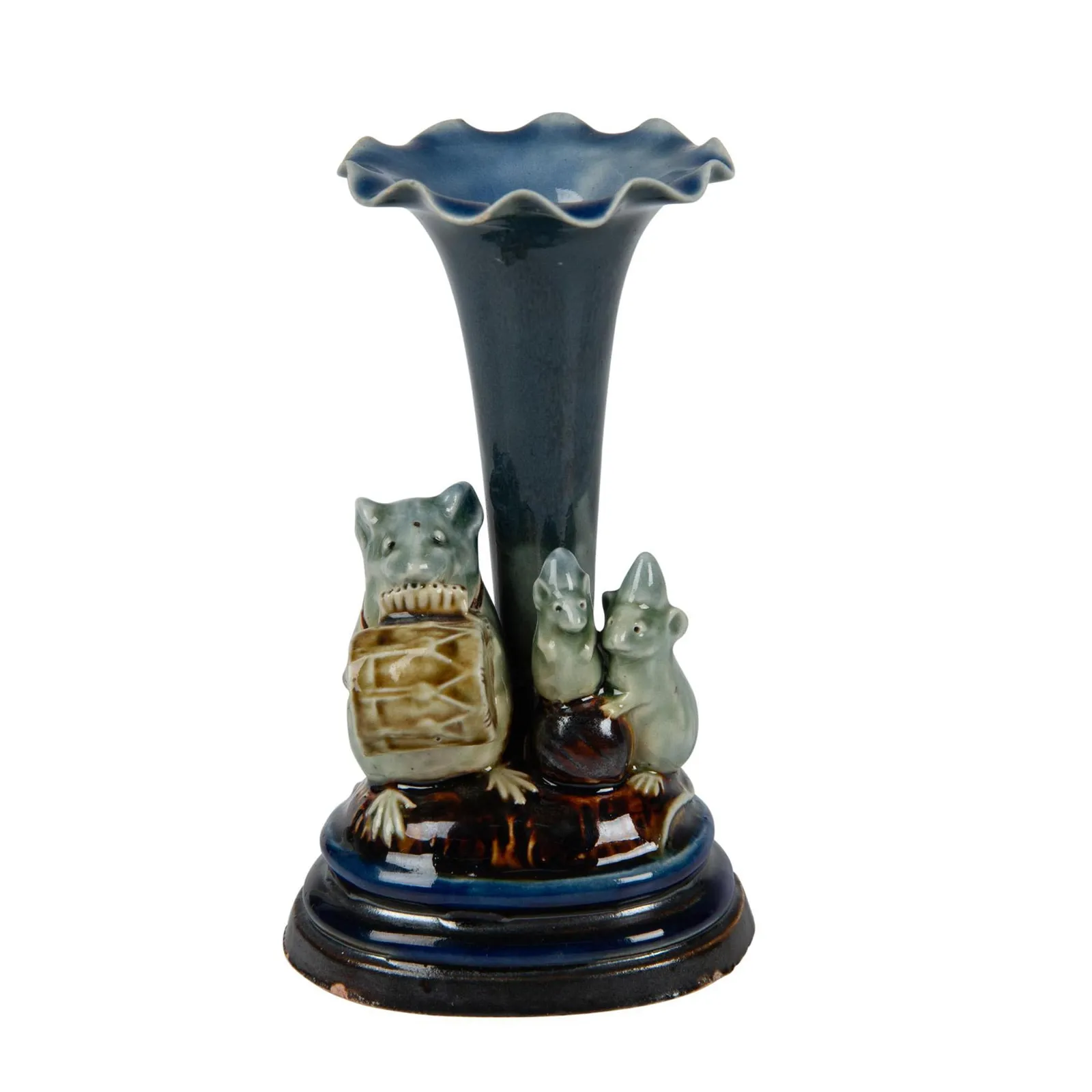
Doulton Lambeth George Tinworth Stoneware Mice Spill Vase

Doulton Lambeth George Tinworth Stoneware Mice Spill Vase

Doulton Lambeth George Tinworth Stoneware Mice Spill Vase:

Attributed to George Tinworth. A small floral form vase adorably decorated with the Conjurors mice figures by George Tinworth. Impressed artists initials. Doulton Lambeth impressed stamped.
Artist: George Tinworth
Issued: Late 19th century
Dimensions: 3.25″L x 3.25″W x 5″H
Manufacturer: Doulton Lambeth
Country of Origin: England
Condition
Age related wear.

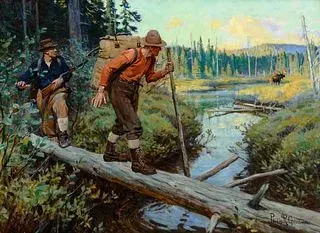
Philip R. Goodwin (1881 – 1935) – An Unexpected Game

Philip R. Goodwin (1881 – 1935) – An Unexpected Game

Philip R. Goodwin (1881 – 1935) – An Unexpected Game:

Philip R. Goodwin (1881 – 1935)
An Unexpected Game
oil on canvas
24 × 33 inches
signed lower right

VERSO
Label, American Illustrators Gallery, New York, New York

According to Goodwin authority Dr. Larry Len Peterson, “Along with Cruisers Making Portage (1910), An Unexpected Game is perhaps Goodwin’s finest painting of timber cruisers in the great out-of-doors. Both present two cruisers on the move and adorned in the same clothing. When a composition worked, Goodwin didn’t hesitate to explore similar ones. A timber cruiser surveyed the land that was available to log and estimated the amount of desirable timber available for the lumber company. Once the land had been cruised, lumber companies made bids to purchase either the land or the rights to cut the timber from it. Strong, courageous, and trustworthy, the timber cruiser appealed to Goodwin much like the cowboy did to Charles M. Russell. It was a subject Goodwin loved and became very familiar with.

“The North American moose (Alces alces) is known as an elk to Europeans. The majestic beast can stand from seven feet tall at the hump of the shoulders and measure eight to nine feet from nose to tail with a weight up to 1,200 pounds. The range of the Rocky Mountain moose has changed little over the centuries, extending from the Rocky Mountains in British Columbia through Idaho, Western Montana, and Wyoming all the way down to Utah and Colorado. They are also found across the forests of North America from Maine to Washington, throughout Canada, and into Alaska. In addition, they live in Europe and Russia. Moose were able to avoid the devastation brought on by the market hunters in the 19th and early 20th century.

“There were many benefits to being a timber cruiser. For instance, besides comrades working together in nature to complete a worthy job, they also didn’t hesitate to jump at the opportunity to bag a big game animal. They carried a rifle not only for protection but also if luck came their way. In this brightly colored, beautifully composed piece, two cruisers spot a trophy moose as they balance themselves on a log that serves as a bridge over a meandering stream. Taking a shot from that position is impossible. Will the bull still be in sight once they traverse the tightrope? Or, will the rifleman step back onto stable ground to take a shot? And if so, will he hit his target in the far distance? Your guess is as good as mine, and there lies the oil’s ultimate appeal.”

PROVENANCE
Cobbs Auctioneers, Peterborough, New Hampshire, 2002
Private collection, Wyoming

LITERATURE
Larry Len Peterson, Philip R. Goodwin: America’s Sporting & Wildlife Artist, Coeur d’Alene Art Auction and Settlers West Galleries, 2001, pp. 275, 280, illustrated
Judy Goffman Cutler and Laurence S. Cutler, Howard Pyle, His Students & the Golden Age of American Illustration, The American Civilization Foundation, 2017, p. 90, illustrated

View More Information

Condition
Surface is in excellent condition. No signs of restoration.

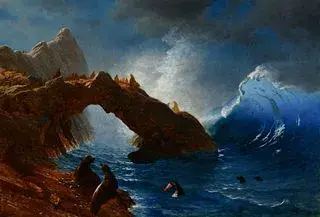
Albert Bierstadt (1830 – 1902) – Seals on the Rocks

Albert Bierstadt (1830 – 1902) – Seals on the Rocks

Albert Bierstadt (1830 – 1902) – Seals on the Rocks:

Albert Bierstadt (1830 – 1902)
Seals on the Rocks
oil on canvas
30 × 44 inches
signed lower left

VERSO
Label, Christie’s, New York, New York
Label, Gerald Peters Gallery, Santa Fe, New Mexico

The artist wrote, “It is like one vast menagerie. Upon the rocks adjacent to the sea, repose in easy indifference, thousands – yes, thousands – of sea lions (one species of the seal,) that weigh from two to five thousand pounds each.… On our left, and but a few yards from shore, is an isle, called Seal Rock, and where the sea lions have possession, and are waving their lubberly bodies to and fro, upon its very summit; and from whence the echoes of their low howling moans are heard across the sea, long after distance has hidden them from our sight.”

PROVENANCE
George Herzog, Cincinnati, Ohio
Mrs. George E. Medley, Owensboro, Kentucky, 1912
Private collection, Springfield, Kentucky, 1938
Hirschl & Adler Galleries, New York, New York
Christie’s, New York, New York, 1994
Peter Simon, Morristown, New Jersey

EXHIBITED
A Collection Once Owned by George Herzog of Cincinnati, The Davies County Distilling Company, Owensboro, Kentucky, 1938
The George E. Medley Collection, The Owensboro Museum of Fine Art, Owensboro, Kentucky, 1978
Lines of Different Character: American Art from 1727 to 1947, Hirschl & Adler Galleries, New York, New York, 1982-83
Bierstadt’s West, Gerald Peters Gallery, New York, New York, 1997

LITERATURE
The George E. Medley Painting Collection, The Owensboro Museum of Fine Art, 1978, p. 6, illustrated
Lines of Different Character: American Art from 1727 to 1947, Hirschl & Adler Galleries, 1982, pp. 48-49, illustrated
M. S. Young, “Other Regionalisms in American Paintings.” Apollo, November 1984, p. 330, illustrated
Gerald L. Carr, Bierstadt’s West, Gerald Peters Gallery, 1997, p. 55, illustrated

View More Information

Condition
Surface is in excellent condition. Canvas is lined. Spot of inpainting in upper-left corner, at edge of frame. Small spots of inpainting in the sky and under the rock arch in the water. Specks of inpainting on the top of wave, on right side.

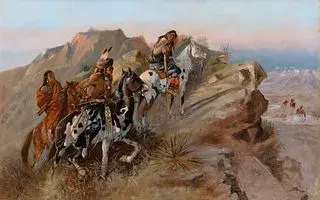
Charles M. Russell (1864 – 1926) – The Ambush

Charles M. Russell (1864 – 1926) – The Ambush

Charles M. Russell (1864 – 1926) – The Ambush:

Charles M. Russell (1864 – 1926)
The Ambush
oil on canvas
18.5 × 29.5 inches
signed lower left

VERSO
Label, J. N. Bartfield Galleries, New York, New York

An original bill of sale from J. N. Bartfield Galleries dated 1992 will accompany the lot.

In 1888, Charles M. Russell made a decision which would have a major effect in his artistic portrayal of Indians. In his book about Russell, Harold McCracken wrote, “He went to live with the Indians – not just as a casual visitor, but to live in their skin lodges as one of them. He rode Monte over the long trail that led north, beyond the Canadian border and into the land of the Bloods, a primitive band of the Blackfeet.” Russell declared, “My Indian study came from observing the Blackfeet in Alberta.”

McCracken stated, “The Bloods accepted Russell into their lodges and he quickly became a brother of the tribe. His worn out cowboy clothing was supplemented with Indian buckskin and he let his hair grow. Hospitality led to real friendship. He enjoyed the privilege of being welcome to sit for long storytelling sessions in the big tepee of Sleeping Thunder, the principal chief of the tribe; and in that of Nat-o-wap-e-sti-pis-e-mach-is, or Medicine Whip, the principal warrior hero of the tribe.” No doubt this relationship led Russell to paint sympathetic portrayals of Indian life such as The Ambush.

According to Russell historian Fred Renner, “Russell often used a classical pyramidal configuration to emphasize the ascension of the Indians to the overlook, to balance the precipitous fall of the canyon and to lead the viewer, wherever he may begin, to the central heights of the picture from which the Indians gaze out.” The Ambush evokes the spirit of the Native American and Russell’s full understanding of his subject is clearly evident.

PROVENANCE
George A. Bates, Cary, Illinois, ca. 1958
Constance MacGregor, by descent, 1984
J. N. Bartfield Galleries, New York, New York, 1992
James R. Jundt, Wayzata, Minnesota
Present owners, by descent

View More Information

Condition
Surface is in good condition. Canvas is lined. Inpainting along top and right side, at edge of frame. Small spot of inpainting in lower-right corner. Spots of inpainting in the sky.

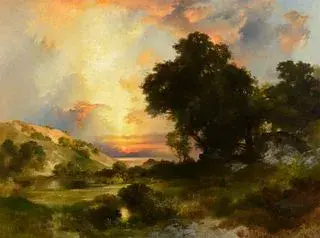
Thomas Moran (1837 – 1926) – Monterey Coast (1920)

Thomas Moran (1837 – 1926) – Monterey Coast (1920)

Thomas Moran (1837 – 1926) – Monterey Coast (1920):

Thomas Moran (1837 – 1926)
Monterey Coast (1920)
oil on canvas
30 × 40 inches
signed and dated lower right

Monterey Coast will be included in Stephen Good and Phyllis Braff’s forthcoming Thomas Moran Catalogue Raisonné.

Moran historian Phyllis Braff writes, “In 1920, as he neared the end of a long career, Thomas Moran was turning enthusiastically towards reinterpreting his favorite themes and applying updated technical skills that derived from new tastes in art. He was now synthesizing and generalizing as he reconsidered scenic concepts such as Monterey Coast, one of the California motifs he regarded as particularly inspirational. Rather than specifically describing landscape details – a goal he believed necessary in his earlier work – he prioritized bringing poetic suggestion to shrubs, trees, rocks and rising land mass areas. Colors are softer and seem filled with their own inner illumination. Shadow hues are especially rich. He believed that a large format, as in Monterey Coast, was best suited to bring the viewer into physical engagement with these inventive, dramatic tonal qualities. Moran’s softening and blending of visual details became so accomplished that some settings could almost be interchangeable in terms of precise locale. Indeed, this painting has also been called Montauk at various times. Generating an emotional response rather than providing descriptive information became primary.

“To further his subjective goals, Moran created a visual and emotional experience by using his delicately modulated color symbolically: suggesting darkness, stormy conditions or danger with deep hues at the right side, and a calm, otherworldly serenity, or redemption with radiant, glowing hues at left. A warm, mystically alluring infinite distance is achieved through the intensity of tonal modulations. These echo in the soft clouds above. The powerful effect is a reminder of Moran’s success at creating distance through pigment modulation – one of the pillars of his reputation.

“While the intention here is to build generalized effects, the mixed shrub and oak vegetation is recognizable as being in character with the studio locale Moran now had in Santa Barbara, following several years working in Pasadena. A fairly set travel pattern defined this era: the artist painted in California through the winter, then visited the Grand Canyon in April, New York City in May, and resided in his East Hampton, Long Island studio during summer and early fall. He seems to have enjoyed his absorption in California topics, placing special focus on the potential resonance he saw in Monterey themes, which he addressed several times over the decade leading up to this powerful 1920 canvas. It serves as a vehicle summarizing his technical achievements and his thoughts about successfully communicating a mood.”

PROVENANCE
Ruth Moran, Santa Barbara, California
Yellowstone Lodge, Yellowstone Park, Wyoming
David Findlay Galleries, New York, New York
Private collection, Oklahoma, 1980
Present owners, by descent

View More Information

Condition
Surface is in excellent condition. Canvas is lined. Small spots of inpainting in trees along right side; in the foreground.