Published 17th C. European Fruitwood Statue of Venus

Published 17th C. European Fruitwood Statue of Venus

Europe, Netherlandish or German, Baroque period, 17th century. Expertly carved from fruitwood, a bozzetto or study for a larger statue of Venus, seated on a rock, half nude – draped to the waist with her upper body revealed, and presented in the candid act of reaching down to dry her foot after a bath. The goddess’ physique is rendered by a sculptor who was clearly well-versed in the study of anatomy and the depiction of the flesh. The statue also conveys a sense of motion that begs the viewer to move around the figure and examine it from every angle, this appreciation for movement and dynamicism quite characteristic of the Baroque period. Such statuettes of idealized bathers were traditionally identified as Aphrodite/Venus, the goddess of love, and this is a wonderful example that follows in the tradition of the bathing Aphrodite/Venus originated in the Classical World with Praxiteles’ statue of Aphrodite ca. 350 BCE as well as Renaissance statues like Giambologna’s “Bathing Venus” (1597). Size: 4.2″ W x 9.375″ H (10.7 cm x 23.8 cm)

A 17th C. Baroque South German fruitwood statue of a draped maiden realized GBP 9,375 (equivalent to about $11,986) at Christie’s London, 26 January 2011, Lot 401.

Published: Art of the Ancient World, Volume iV (1985), no. 387. On loan to Ohio State University, Columbus, Ohio, USA; Picker Art Gallery, Colgate University; Fitchburg Art Museum, 1986 to 2016.

Provenance: ex-E. Gardner Collection, exhibited at Royal Albert Hall, London, 1880; ex-Sotheby’s London, December 1984; E.B. collection, Orion, Michigan, acquired from Royal Athena in February, 1986. Published: Art of the Ancient World, Volume iV (1985), no. 387. On loan to Ohio State University, Columbus, Ohio, USA; Picker Art Gallery, Colgate University; Fitchburg Art Museum, 1986 to 2016.

All items legal to buy/sell under U.S. Statute covering cultural patrimony Code 2600, CHAPTER 14, and are guaranteed to be as described or your money back.

Ancient Greek 18K Gold Earrings w/ Erotes, ex-Christies

Ancient Greek 18K Gold Earrings w/ Erotes, ex-Christies

Ancient Greece, Hellenistic, ca. late 4th to 3rd century BCE. One of the most superb works of luxury art from ancient Greece, a very rare pair of matching 18K gold earrings, each one comprised of a pan-shaped disk that houses an attractive rosette with petals delineated in plain wire, the upturned edges of the disk trimmed with a beaded border. Suspended from this is a solid-cast figure of Eros, the god of love, depicted with an advanced right leg, separately cast wings, and holding a large torch in both hands across his body. Eros is characteristically nude save the billowing mantle (also separately cast) strewn across his chest and down either side of his body. All is suspended from a hooked wire on the verso of the floral disk. A beautiful pair of earrings – luxurious tokens of love during ancient times that still resonate with us – making our hearts sing today! Size: each measures ~ 1.125″ H (2.9 cm); 1.625″ H (4.1 cm) including hooked wires; Total Weight: 4.2 grams

A similar pair of Greek gold earrings presenting Eros below a disk form sold for $25,000 at Christie’s New York (Ancient Jewelry, 9 December 2010, Sale 2375, lot 359) – https://www.christies.com/lotfinder/Lot/a-pair-of-greek-gold-earrings-hellenistic-5385566-details.aspx

See a similar pair of ancient Greek gold earrings with Eros suspended from a disk at the Metropolitan Museum of Art (30.116.1.2) on view in Gallery 158 – https://www.metmuseum.org/art/collection/search/253134

For another related example see no. 1888 in Marshall, Catalogue of the Jewellery, Greek, Etruscan, and Roman, in the Departments of Antiquities, British Museum.

Egyptian Limestone False Door Fragment w/ Inscription

Egyptian Limestone False Door Fragment w/ Inscription

Ancient Egypt, Third Intermediate to Late Dynastic Period, ca. 1070 to 332 BCE. A beautiful fragment of a false door or lintel consisting of a recessed central panel surrounded by two columns and one upper register of inscribed hieroglyphs. The right-most periphery is decorated with a broad, incised sawtooth motif that would have wrapped around the lateral and upper borders of the false door. This fragment was perhaps painted in vibrant colors when adorning the interior of a tomb, though no traces of such coloration remain. The upper register reads, “Revered one,” and the interior column reads, “Revered one, who is in . . .” and signify that this individual was perhaps a priest. The right-most column reads, “The Osiris, Mereri” above an image of the decease facing to the left. Size: 11.2″ W x 17.6″ H (28.4 cm x 44.7 cm); 18.7″ H (47.5 cm) on included custom stand.

Secretary Bookcase From Connecticut

Secretary Bookcase From Connecticut

Connecticut
Cherry and white pine
Circa 1800,.
H 84″, W 36-1/2″, D 18-1/2″.

Everything about this desk and bookcase is unconventional, even by Connecticut standards. In decoration, this desk has few rival for exuberance in carved details. While carved shells and sunbursts are used with abandon in the region, this example boasts 14 sunbursts decorating the numerous drawer fronts and fall front. Chip, punch and incised carving decorates the door frame, the exterior rectangular drawer fronts and pidgeonhole valences. The decorative shaping of the apron and bracket feet is also fanciful and unusual.

The form of the desk and its interior is straightforward, but the upper bookcase section is likely one of a kind. Six square drawers with carved fronts vertically frame each side of the actual bookcase; two horizontal drawers frame the top and bottom.

This desk and bookcase is a catalog of a particular cabinetmaker’s talents abundantly expressed in a practical piece of case furniture. Whether the design was the cabinetmaker’s or the client’s, the result is a whimsical desk in a very desirable and small size for the Americana collector of the unusual.

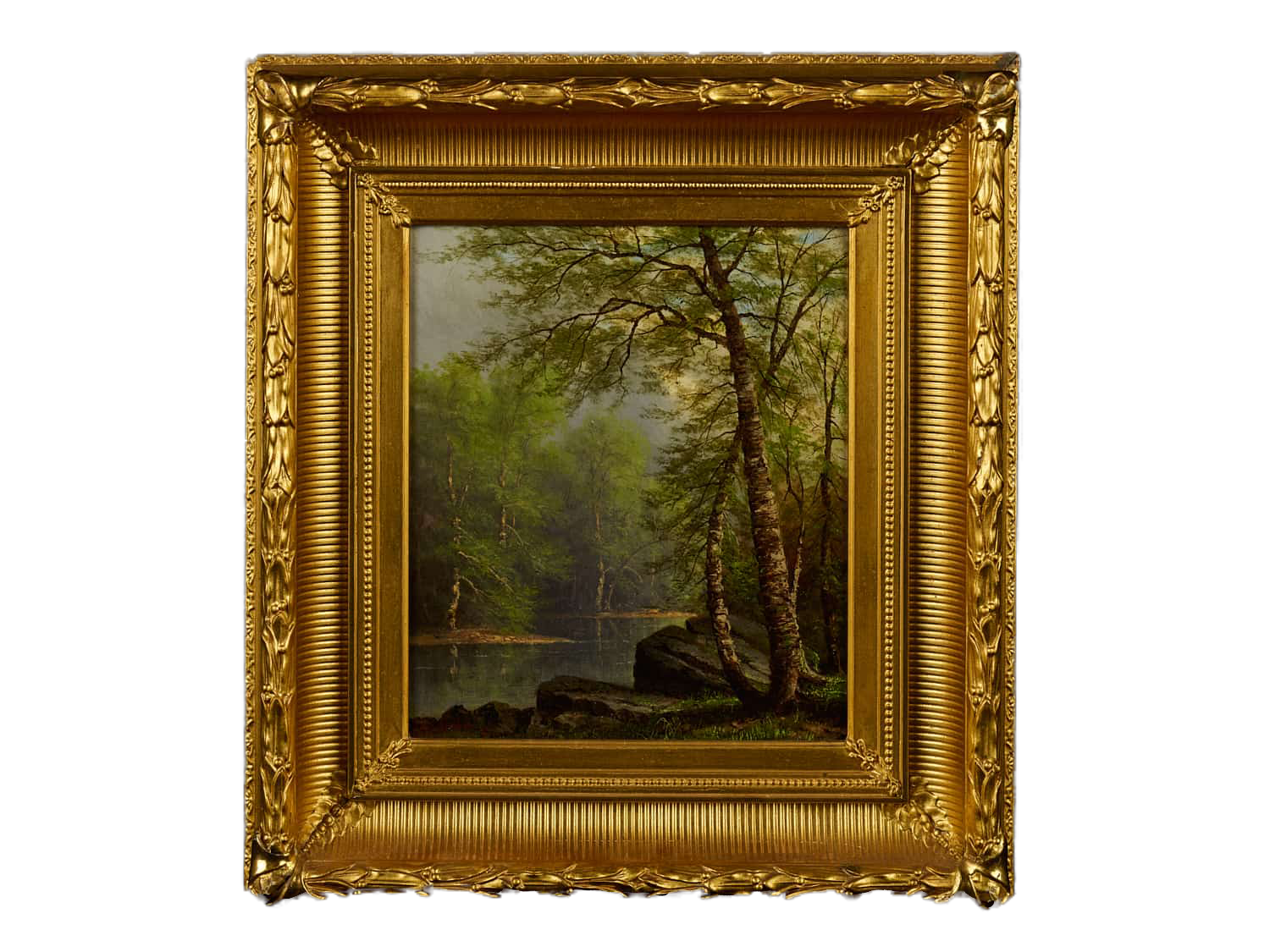
Birch Trees Along the River by Carl Brenner (1838-1888)

Birch Trees Along the River by Carl Brenner (1838-1888)

Signed: Carl Brenner “77 for Carl Christina Brenner (1838-1888)
Dated 1877
Kentucky
Oil on canvas
Original fluted cove frame.

Sight: 12″ x 10″

Overall: 20″ x 18″

Brenner emigrated to the United States in 1853 and lived briefly in New Orleans before moving permanently to Louisville, KY. Well known for his landscapes, he usually included detailed views of the Cumberland Mountains and the rivers, forests, trees and parks around his hometown of Louisville, Kentucky. Painting in the realist style, Brenner’s works also reflect his attention to shadow and mood, clearly evident in this rare, small size example. One of his earliest known works.

Furniture

A graceful Regency amboyna kidney-shaped writing table with pierced ormolu galleries and parcel gilt supports.

Retro citrine and diamond X-form necklace

A Retro gold necklace comprised of large graduated citrines with alternating X-form diamond links, in 14k. Atw. 3.30 ct. round brilliant and single cut diamonds; approx. 276 ct. tw. citrines.