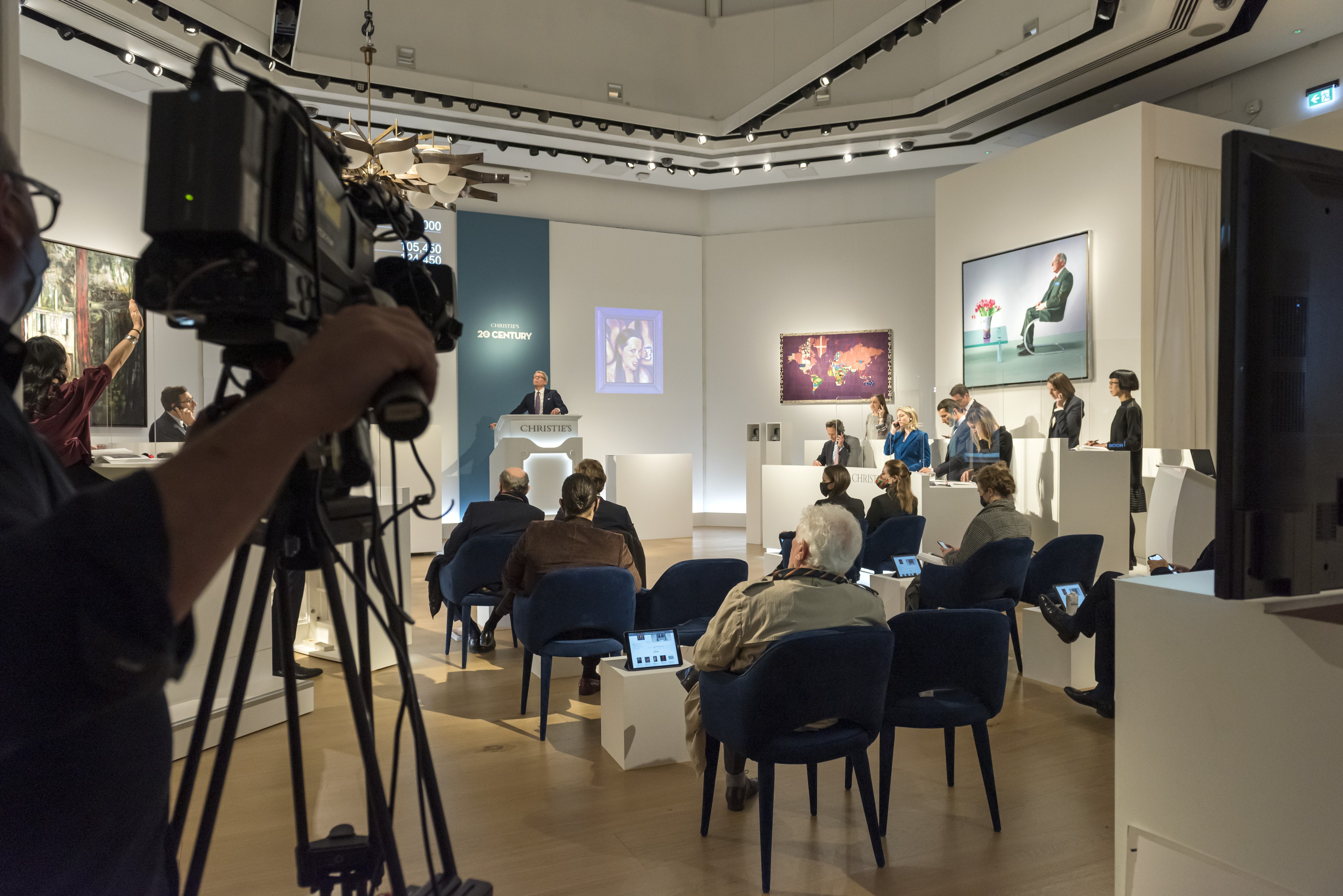
Bonhams is continuing with its full auction schedule around the world, holding sales in accordance with the government guidelines in each region.
In the light of new measures announced by the British government, all UK sales will be either livestreamed from the auction house or entirely online.
Our specialists will be delighted to help with valuations and consignments – or you can go online at sell.bonhams.com. The Customer Service team can answer any queries about registering for an auction or ways to bid, either online, on the telephone or by placing an absentee bid. Alternatively, download the newly updated Bonhams App from the App store. It provides a platform from which to register for forthcoming auctions, follow lots, place bids and to watch the auction live.
We are sorry, but in accordance with UK guidelines, at the moment the salerooms in London will not be open to members of the public for viewing until December 3rd. For enquiries regarding deliveries and collections, please contact the Client Services Team.
BOSTON and MEDFORD/SOMERVILLE, Mass. (Oct. 22, 2020)—The School of the Museum of Fine Arts at Tufts University (SMFA at Tufts) will host its38th annual art sale from November 9 – 23, 2020. The sale is moving online for the first time to keep artists and patrons connected but still safe during the COVID-19 pandemic.
Art lovers worldwide will be able to browse nearly 600 works by more than 300 students, alumni and faculty from across the globe. The curated works available for sale were selected by a jury of esteemed artists, curators and gallerists.
“Cha Cha,” Gonzalo Fuenmayor (Image courtesy of the artist)
Previously, the sale was limited to local members of the SMFA at Tufts community. Now, SMFA artists from across the globe are able to offer their works to art collectors everywhere.
The sale provides crucial visibility to emerging and established artists who may have limited visibility because of the global pandemic closing countless museums and galleries. The annual sale is also SMFA at Tufts’ biggest fundraiser, with the proceeds of each sale supporting the contributing artist and a dedicated scholarship for students from underrepresented groups.”
This year’s sale also prioritizes work from Black, indigenous, LGBTQIA+ and feminist communities, providing artists often overlooked by mainstream contemporary art communities with an opportunity to have their work seen widely.
Among the artists involved in this year’s sale are Marlon Forrestor, Anthony Peyton Young, Helina Metaferia, Jamal Thorne, Cobi Moules, Gonzalo Fuenmayor and Mima McMillan.
Jurors for the SMFA art sale include Akili Tommasino, associate curator of modern and contemporary art at the Museum of Fine Arts, Boston; Nina Johnson, SMFA alumna and director of Nina Johnson Gallery in Miami; and Shinique Smith, SMFA alumna and artist.
Additionally, between six and nine complete pieces from the SMFA at Tufts’ “Exquisite Corpse” project will be available for purchase as part of the sale. A project inspired by the link between the current pandemic and the influenza pandemic in 1918, “Exquisite Corpse” uses a drawing technique developed by the surrealists in which multiple artists co-create art by drawing on a single piece of paper together.
The special project was developed by Jen Mergel, contemporary artist and SMFA at Tufts board member. Mergel saw this exercise as an opportunity to create meaningful connections between creative minds during a time of social distance.
Participating “Exquisite Corpse” artists include SMFA at Tufts faculty members Ethan Murrow, Ria Brodell and David Antonio Cruz, and alumni Sheila Pepe, Jed Caesar and Nicole Cherubini..
The 2020 art sale is sponsored by Judi and Tim Ritchie, Jessie and Sam Rubenstein, Carol and Richard Daynard, Around the Corner Framing, Art New England, Boston Art Review, BostonGuide.com, Cube, Fortress, Stanhope Framers and U.S. Art.
To Be Offered in a Dedicated Single Lot Evening SaleThe Crowning Highlight of Christie’s Season of Masterpieces
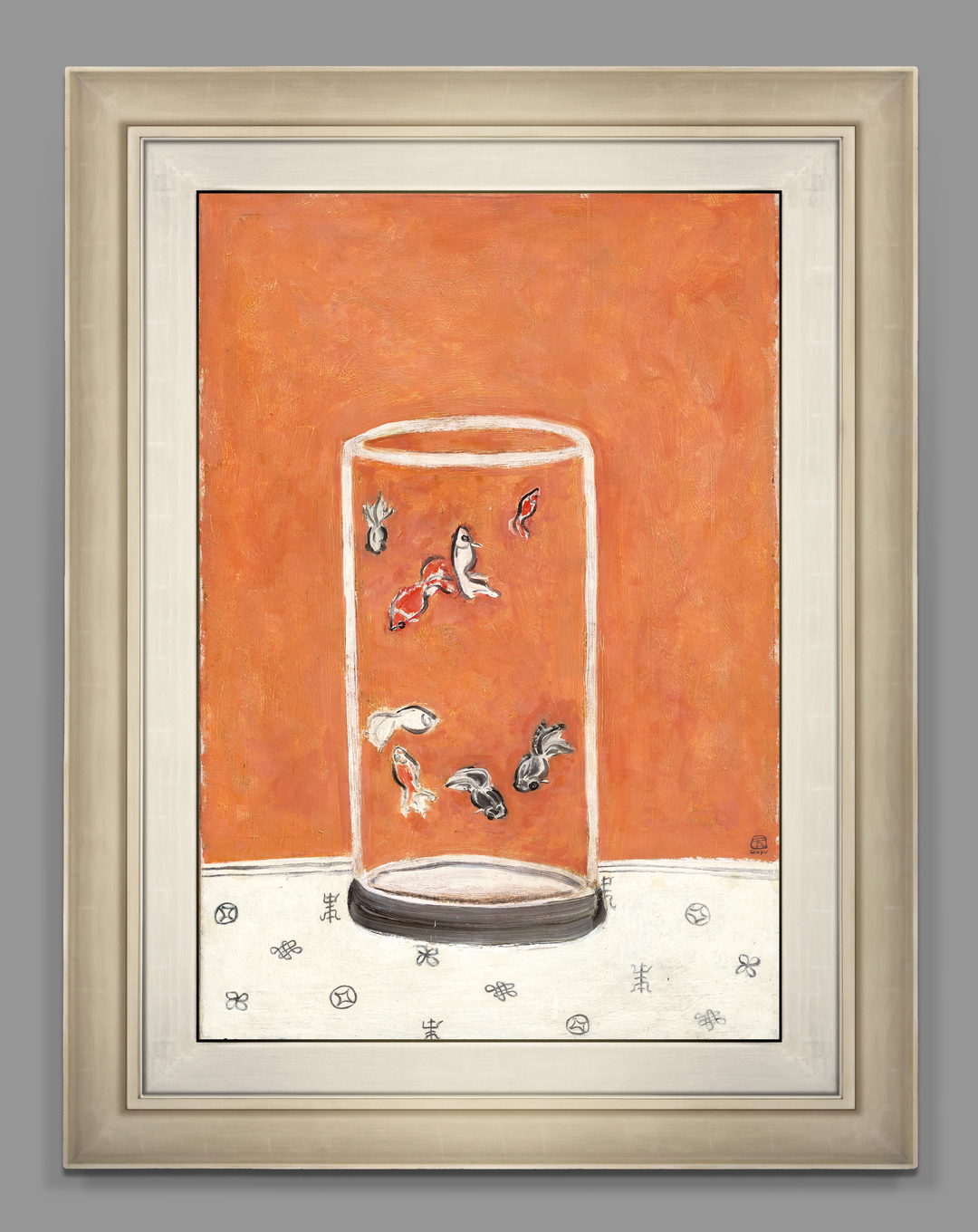
SANYU (CHANG YU, 1895-1966) Goldfish signed in Chinese and signed ‘SANYU’ (lower right) oil on canvas 73.8 x 50.2 cm. (29 x 19 3/4 in.) Painted in 1930s-1940s HK$120,000,000 – 180,000,000 / US$16,000,000 – 23,000,000
Hong Kong – This December, Christie’s is honoured to unveil Sanyu’s Goldfish as a major masterpiece of the autumn season. This painting is the first and only work by Sanyu to depict eight goldfish in such exquisite detail as the central subject of the composition, making the work completely unique and without compare within the context of the artist’s oeuvre. An iconic painting by one of the most important artists of the 20th century, Goldfish will be presented as the focus of a stand-alone, single lot evening auction immediately following the Modern and Contemporary Art Evening Sale on 2 December.
Depicting eight goldfish – a symbol of luck, hope, and prosperity – Goldfish is entirely unique in the context of Sanyu’s oeuvre. According to the first and second volumes of the artist’s catalogue raisonné, Sanyu only created 11 oil paintings in his lifetime that include the subject of fish, four of which currently reside in the permanent collection of the National Museum of History in Taipei. Among them, Goldfish is the only work that presents the fish in a still-life format, with the cylindrical fish bowl resting upon a tabletop decorated with auspicious symbols, a setting more commonly seen in Sanyu’s paintings of flowers and indoor scenes.
Painted during the 1930s–1940s, Goldfish is a spectacular example of Sanyu’s avant-garde artistic vision, demonstrating how he blended, deconstructed, and combined disparate artistic styles and aesthetics in his work. His application of ink-and-brush style lines, the simple but refined use of colour, and tactical spatial handling reflect his understanding and exploration of modern Western art, while simultaneously expressing the poetic aesthetic elements of the East.
The painting is endowed with a truly illustrious provenance, having been exhibited across the globe and included in numerous publications about Sanyu. Goldfish formerly resided in the Robert Frank Collection, collected by one of the most influential photographers of the 20th century who was also an intimate friend of Sanyu’s.
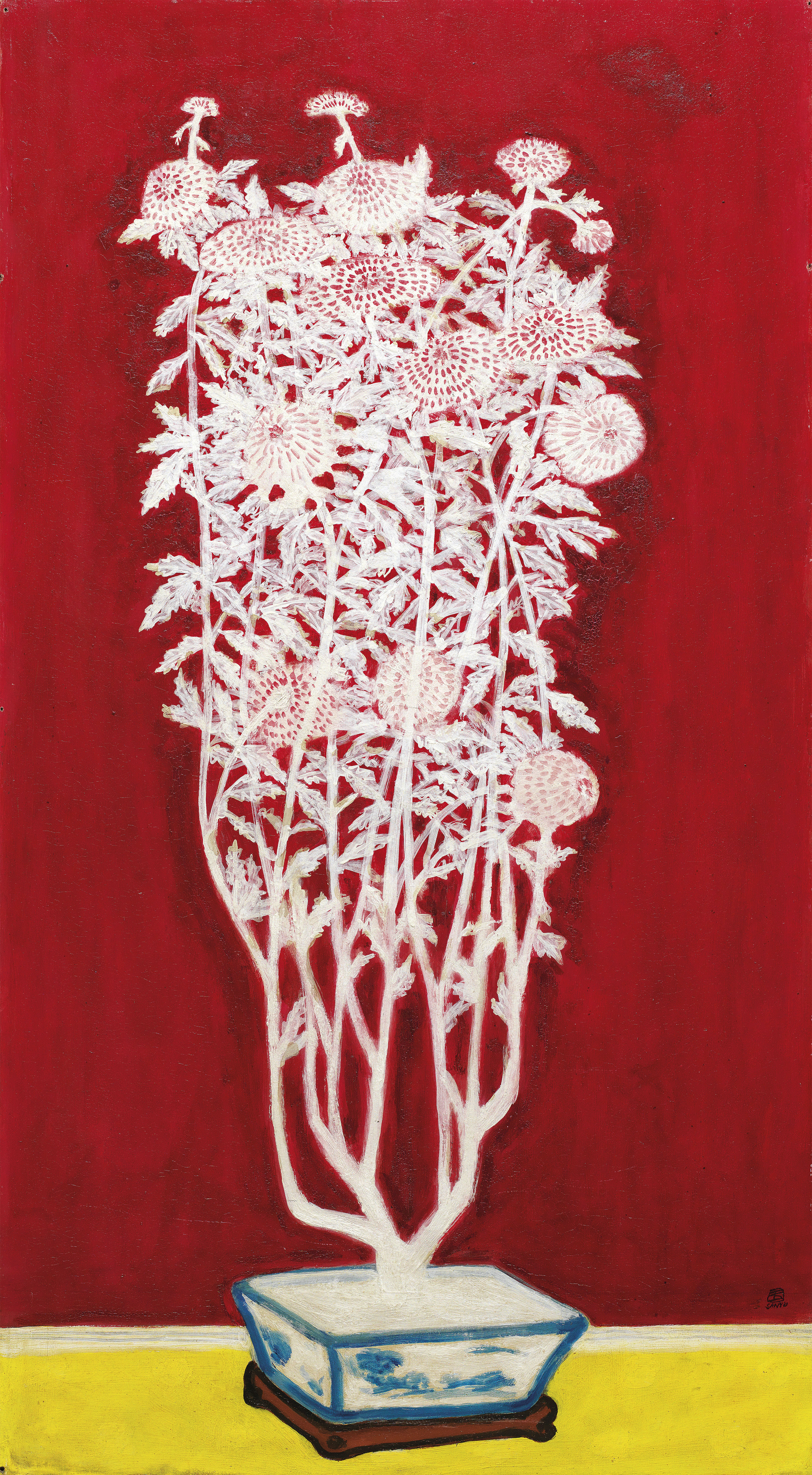
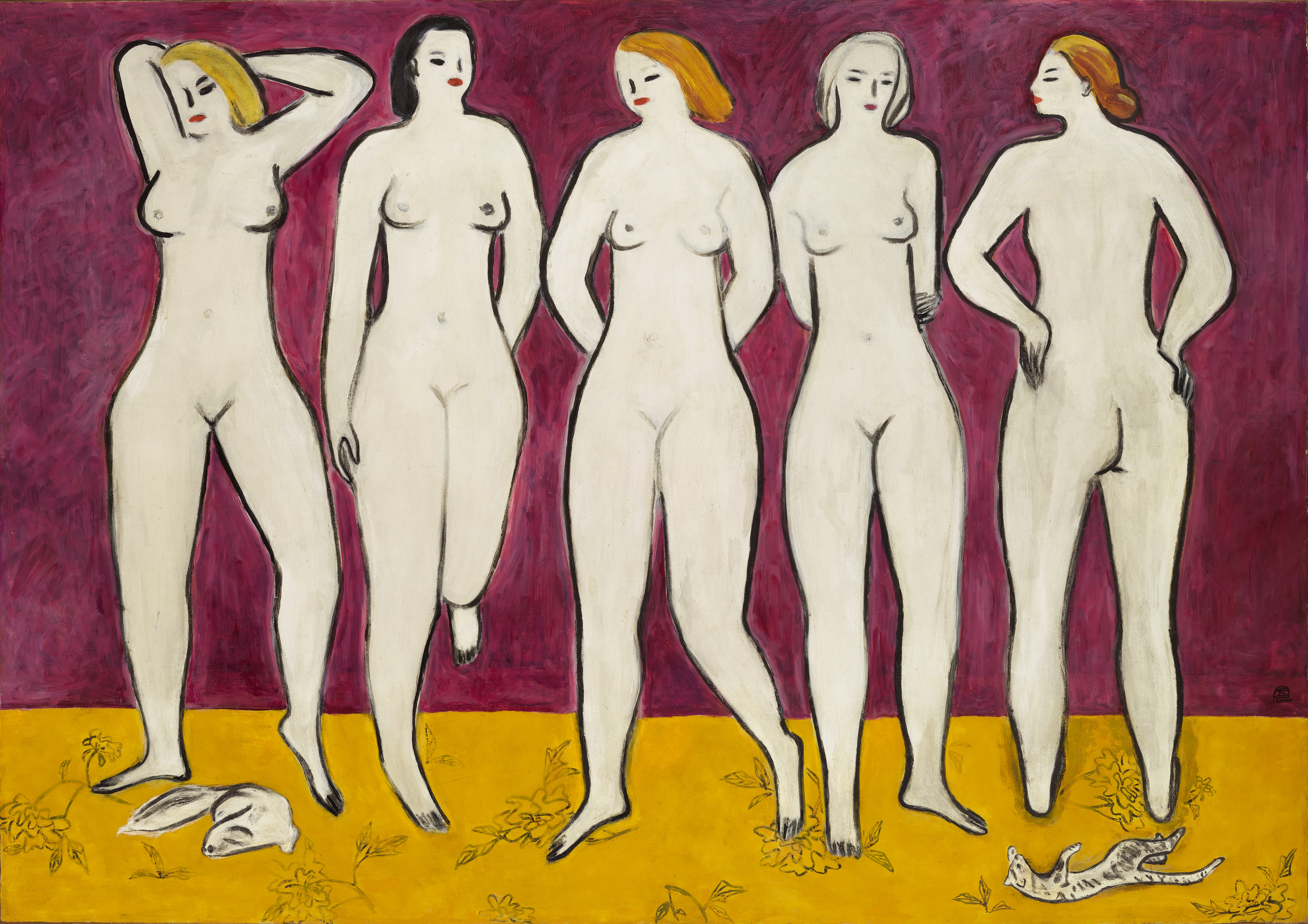
This July, Christie’s offered White Chrysanthemum in a Blue and White Jardiniere at auction, which set a new record for any still-life painting by Sanyu. In 2019, Sanyu’s Five Nudes was sold at Christie’s for HK$303,984,992, which remains the current world record for the artist. This season, as the market-leader with the greatest expertise in works by Sanyu, Christie’s is delighted to offer a masterpiece featuring an animal subject, one of the most magnificent paintings ever created by the artist.
Notes To Editors
Sanyu Auction Records Set By Christie’s
World Auction Record For a Still Life by Sanyu White Chrysanthemum in a Blue and White Jardiniere July 2020 Sold for HK$191,620,000 / US$24,844,389
World Auction Record for Sanyu Five Nudes November 2019 Sold for HK$303,984,992 / US$39,045,331
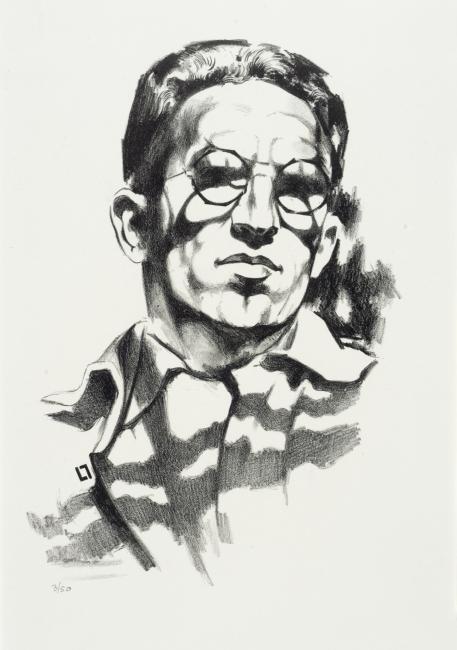
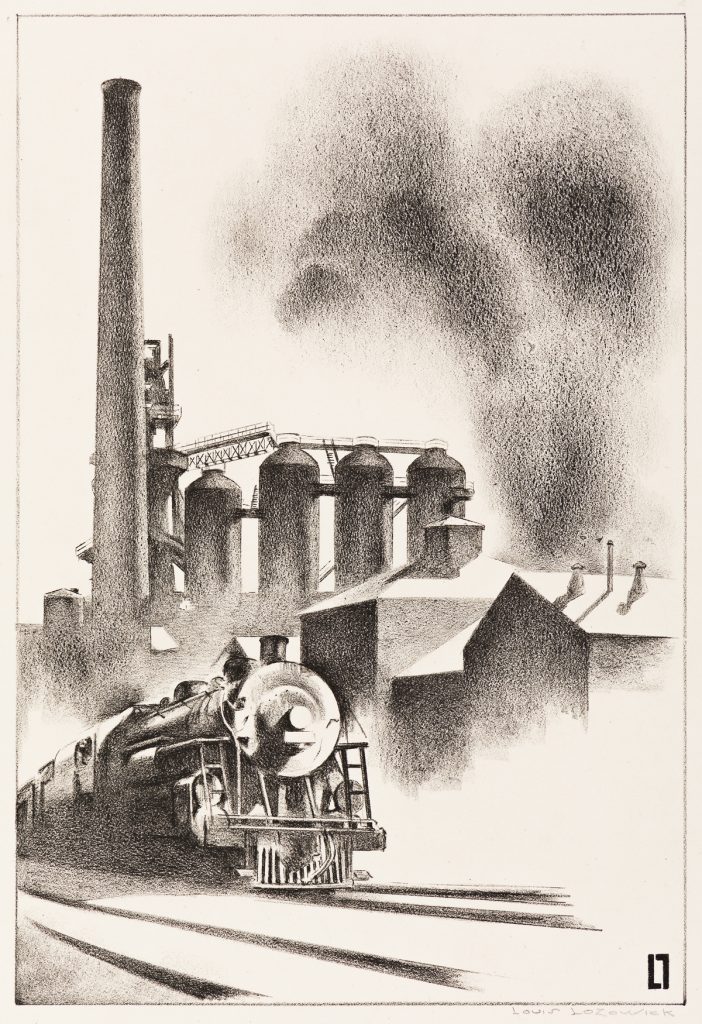
Louis Lozowick is known for his geometric and abstracted lithographs of New York City, although his work also included social themes. Often compared to Charles Sheeler and the Precisionists, his stylistic influences changed over the years, but his emphasis stayed the same: the celebration of the power of men and machines. Here Sarah McMillan, a cataloguer for our prints and drawings department, gives an overview of the artist’s career and style.
Early Life
Lozowick was born in Ludvinovka, a small village near Kiev in 1892. One of six children, he moved from his village to the larger city of Kiev as a child with his older brother. In 1903, he enrolled in the Kiev Art School where he learned the traditional tenets of drawing and studied with traditional realist Russian artists, like Ilya Repin. A curious student, he went beyond his curriculum to study artists who were pushing the boundaries of artistic expression, such as Aubrey Beardsley and Edward Burne-Jones.
His life changed, however, when his brother was arrested shortly before the Revolution of 1905. Once out of prison, Lozowick’s brother forged papers to move to New York and then sent for his younger brother, who, at fourteen, undertook an illegal border crossing, ultimately arriving at Ellis Island in 1906.
New York was an overwhelming vision for a teenager arriving from Eastern Europe. He settled in New Jersey, got a job at a factory, and learned English. He continued his studies, at the National Academy of Design, taking courses with Emil Carlsen and Leon Kroll. They pushed Lozowick to seek a personal viewpoint in his artwork beyond the traditional training. He took a break from making art while he was a student at Ohio State University and joined the army during World War I.
Travels & Embracing Lithography
Between 1920 and 1924 Lozowick traveled throughout Europe. Having seen many of the European Modernists at the 1913 Armory show, he spent his time in Europe meeting Modern artists and enmeshing himself into artistic and cultural communities. Traveling to major art capitals such as Paris and Berlin, he admired the work of Juan Gris and Fernand Léger. He was drawn to the Russian Constructivists and met El Lissitsky and others, exhibiting with them in 1922 in Düsseldorf. In 1923, Lozowick was introduced to lithography.
When he returned to New York, he experimented further with the medium. At the time, lithography was still an underrated technique amongst printmakers.Its popularity at the time languished due to the scant professional lithography workshops in the United States. Etching was the preferred process, and the subject matter tended towards genre or landscape views. Lozowick was among a small group of artists, including Jan Matulka and Howard Cook, who depicted the industrial city. His early works show the influence of the Modernist movements he had observed and experienced in Europe. He was particularly drawn to Cubist and Futurist styles. Embracing these European movements while choosing specifically American subject matter was typical of Precisionism, and while artists like Sheeler and Ralston Crawford never organized, they shared the approach of paring down their compositions to the simplest of forms.
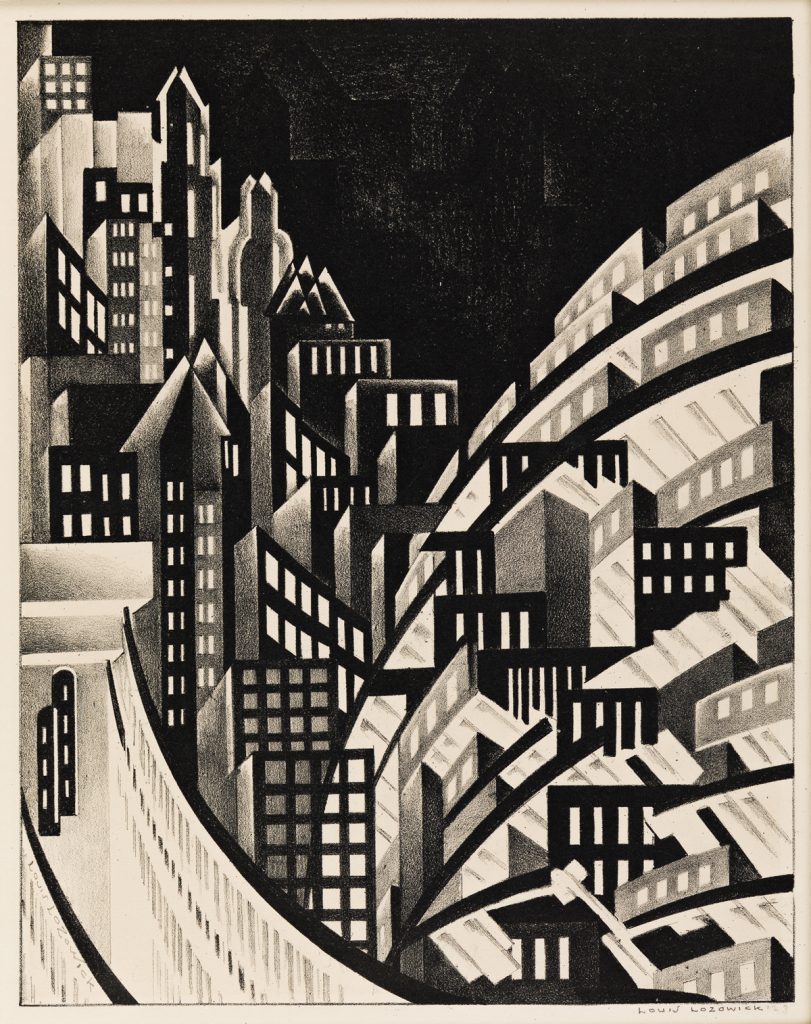
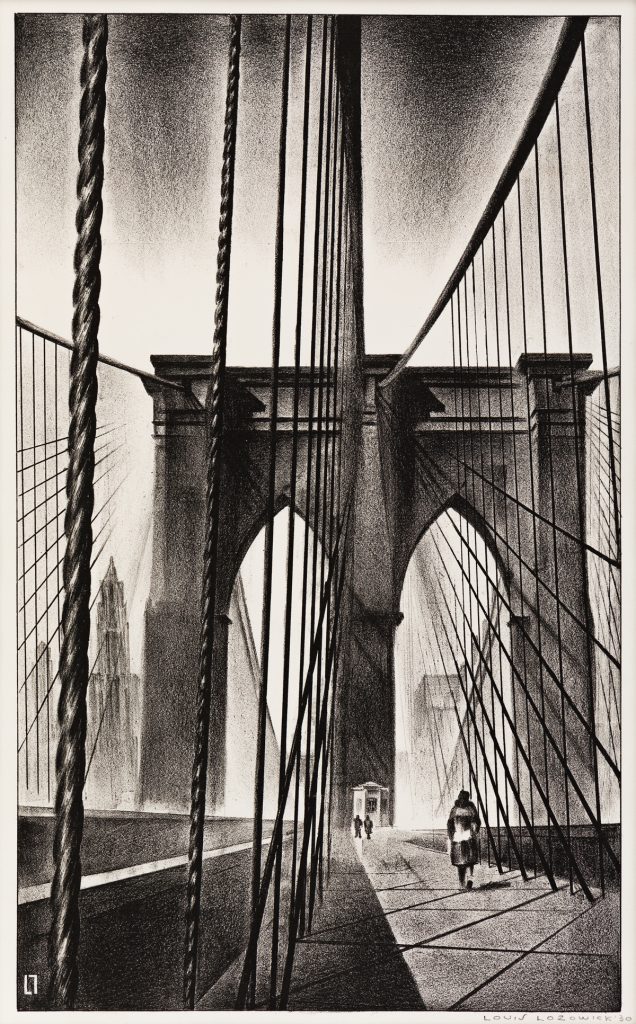
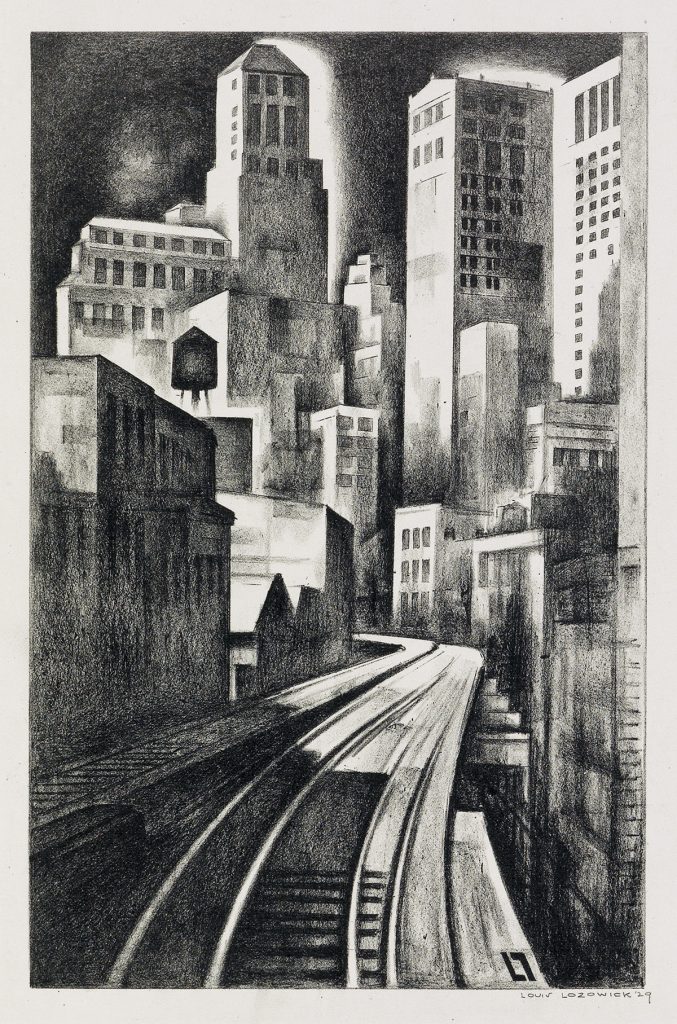
New York, considered one of Lozowick’s early masterpieces, shows Futurist influence. He created this composition from memory, recalling an elevated line that made a sharp turn along West 109th street that the artist observed when he was a student at the National Academy. Replacing the line of the train with the Brooklyn Bridge and curving skyscrapers, Lozowick captured the dynamism of the city.
The late 1920s were a very productive time in his career as a printmaker. From 1928 to 1930 he created more than 70 lithographs. He also became acquainted with the Weyhe Gallery in New York, who encouraged Lozowick to continue working in lithography and gave him his first lithograph-only exhibition in 1929.
The Later Years
After the fall of the stock market and as the country turned towards despair in the 1930s, Lozowick adapted his concept of the city. It was not longer the aspirational place of opportunity. Along with many artists, he turned toward depicting the social reality of its residents who were affected by the Depression. Figures within his works were no longer passive objects—they took precedence over the urban environment. During this time he also worked for public programs that supported artists, such as the New York Graphic Arts Division of the W.P.A. and the Treasury Relief Art Project.
After he married and welcomed a son in 1943, his work often reflected the domestic joy in his life. However, the city remained his primary subject matter, and he reflected in 1943, “From the innumerable choices which our complex and tradition-laden civilization presents to the artist, I have chosen one which seems to suit my training and temperament. I might characterize it this: ‘Industry harnessed by Man for the Benefit of Mankind.’”
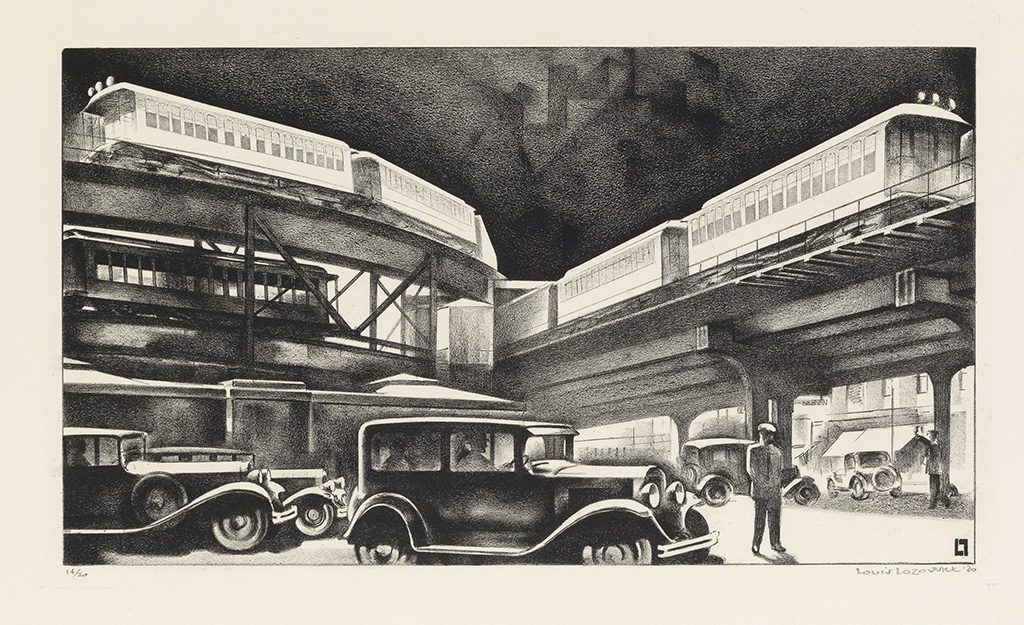
Collectors of American art continue to value Lozowick’s artwork today. The lithographs from his prolific period in 1920s are the most desirable on the market for their visually striking and simple yet bold forms that illustrate the power and hope of industry and the city. The record for one of his prints is Traffic, which sold at Swann, September 23, 2014 for $42,500, and illustrates a busy cross section of elevated trains, cars and pedestrians. His drawings and paintings come to the auction market with less frequency than his prints, but his more coveted original works echo the popularity of his prints and show the Cubist and Futurist influences from early in his career.
Featuring The Macallan 78 Years Old, the Oldest Aged Whisky Ever to be Sold at Auction**Proceeds to be Donated to Food Charity, City Harvest London* The Second Part of the Ultimate Whisky Collection Realises £1,057,364 / $1,366,431 Bringing the Combined Total of Parts I and II to £8.7 Million / $11.2 Million *The Most Valuable Whisky Collection Ever to be Sold at Auction*
AT SOTHEBY’S LONDON HALLOWEEN SALE OF “SPIRITS”
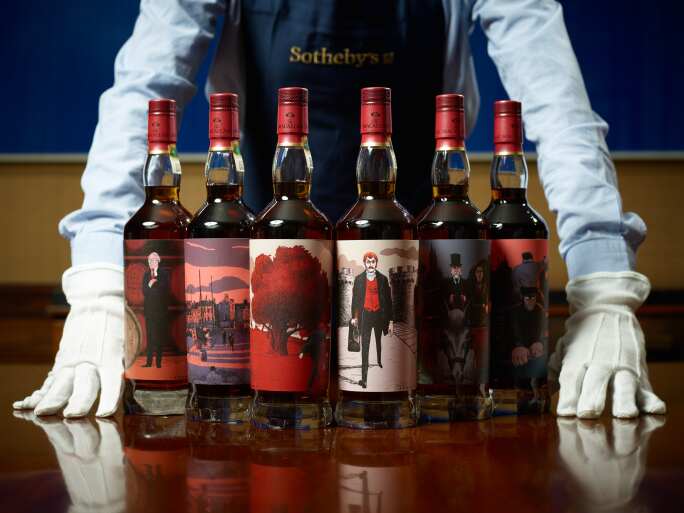
This morning in London, a complete set of The Red Collection, a new classic aged collection of single malt from The Macallan, achieved £756,400 / $975,756 in Sotheby’s first annual sale of Spirits to fall on the day that Halloween is celebrated around the world, The Ultimate Whisky Collection Part II + More. Against a low estimate of £200,000, the hammer came down as determined collectors online and in the room competed to own the only set of its kind to be made available for sale. Acquired by an Asian private collector, the set was gifted by The Macallan to City Harvest London to raise funds for the food charity which redistributes surplus from the food industry to vulnerable people across the capital. Proceeds from the sale will provide almost two and a half million meals for those in need.
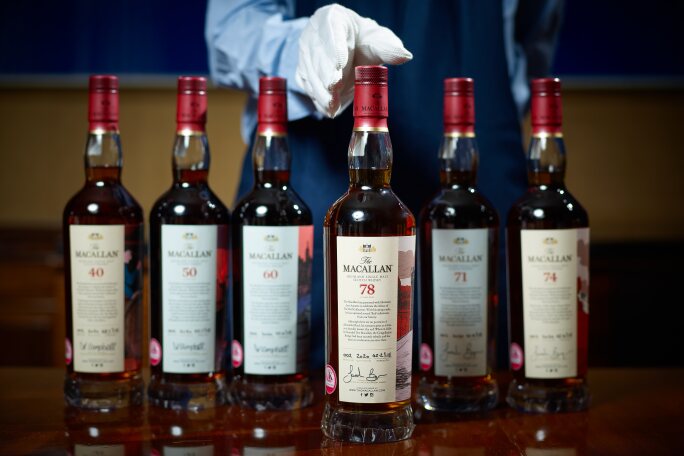
The complete set of six whiskies in The Red Collection is anchored by The Macallan 40 Years Old, The Macallan 50 Years Old and The Macallan 60 Years Old, which are joined by two further highly aged bottles at 71 Years Old and 74 Years Old. The sixth and final bottle in this collection has been matured for 78 Years, making it not only the oldest bottle released from The Macallan Distillery, but the oldest age statement whisky ever offered at auction. The extremely rare set offered today differs from the standard release and is distinguished by its exclusive labels, which are illustrated and signed by Spanish artist Javi Aznarez. Only two sets feature these labels: Set #1 will remain in The Macallan’s archives and Set #2 was presented in the Sotheby’s auction.
The auction continued with the second part of the Ultimate Whisky Collection which realised £1,057,364 / $1,366,431, bringing the combined total for parts I and II to £8.7 million / $11.2 million. Sotheby’s sale of Part I in October 2019 set the record for the most valuable whisky collection ever sold at auction at £7.6 million / $10 million, an auction record any bottle of wine or spirit with The Macallan Fine & Rare 60-Year-Old 1926, sold for £1.5 million / $1.9 million, and distillery records for Bowmore, Brora and Glenfiddich and Springbank. The second part of this superlative collection included whiskies aged in excess of 50 years from The Macallan, Bowmore, Glenfiddich and The Dalmore, and exquisite independent bottles from Silvano Samaroli.
“This exceptional result for The Red Collection is testament not only to the strength of the whisky market but also to the esteem with which The Macallan is held. Equally, the result of The Ultimate Whisky Collection Part II cements its position as the most valuable whisky collection ever sold at auction. The overall total for The Ultimate Whisky Collection speaks volumes of the diversity in today’s premium whisky market and the importance of provenance to collectors. A fantastic result for Sotheby’s inaugural Halloween spirits sale and City Harvest London.”
JONNY FOWLE, SOTHEBY’S SPIRITS SPECIALIST
“Global communities are key to The Macallan and as part of our commitment to giving back, we are pleased to have collaborated with Sotheby’s to auction this extremely rare, complete set of The Red Collection, which features our oldest ongoing aged expressions and a selection of high aged guest releases, including the oldest bottlings our brand has ever released. This bespoke auction lot has raised an incredible amount of funds for food charity, City Harvest London, with a final sale price of £756,400, which crucially equates to almost 2.5m meals delivered to people in need. This will allow the charity to continue to make a real difference to people’s lives, and we are very supportive of their sustainable vision and efforts to support those most in need.”
IGOR BOYADJIAN, MANAGING DIRECTOR, THE MACALLAN
“We are overwhelmed with the incredible support The Macallan has given us, and the fantastic figure reached. Huge congratulations to everyone who has been involved, what terrific news! The proceeds from this auction will be critical in nourishing and improving the lives of tens of thousands of people in the very challenging months ahead, as we are able to expand our operations to include more charities and groups feeding people in London. We are so appreciative of the continued support of The Macallan, their interest in our mission, and commitment to people and the planet.”
LAURA WINNINGHAM, CEO, CITY HARVEST LONDON
ABOUT THE RED COLLECTION
Inspired by the significance of the colour red throughout the history of the brand, The Red Collection captures The Macallan’s deep respect for tradition and craftsmanship. Distilled decades ago, in The Macallan’s signature copper stills, each expression in the collection has been matured in the distillery’s oak casks under the watchful eye of several generations of whisky makers. Over time, they developed into extraordinarily elegant aged whiskies.
The colour red has deep and long-standing significance for The Macallan, beginning with Alexander Reid, the farmer and teacher who founded The Macallan in 1824, whose surname means ‘the red one’ in Scots and was originally associated with red hair. In 1903, owner Roderick Kemp launched The Macallan Choice Old range, which was reportedly shipped in cases labelled with distinctive red print to distinguish it from The Macallan’s existing whiskies, which featured black labelling. Almost eight decades later, in 1980, red was to feature strongly in the release of The Macallan’s then oldest vintages, dated 1938, 1940 and 1950. Allan Shiach, chairman of The Macallan at that time, tied a red ribbon around the sought-after bottlings to denote their age and value.
These three characters are featured in an animated film created to introduce The Red Collection in collaboration with Javi Aznarez, acclaimed for his striking graphic art which has featured in several films, including director Wes Anderson’s forthcoming feature, The French Dispatch. The animation is set to music recorded by Scottish violinist Nicola Benedetti, one of the most sought-after classical musicians of her generation.
Each bottle in The Red Collection is encased in a hand-crafted oak presentation box created from the same sustainable European oak used to craft The Macallan’s oak casks. These boxes are beautifully upholstered with sustainably sourced soft red leather from Scottish supplier Bridge of Weir Leather, which creates upholstery for leading luxury car brands across the globe. The Sotheby’s set uniquely included two exclusive display cases and two bespoke tables.
Three of the bottles in the collection are also hand-signed by Kirsteen Campbell, who was appointed Master Whisky Maker at The Macallan in 2019 – the first woman to occupy the role in the history of the brand. The remaining three bottles – The Macallan 71 Years Old, The Macallan 74 Years Old and The Macallan 78 Years Old – are hand-signed by Sarah Burgess, Lead Whisky Maker for The Macallan.
About The Macallan Founded in 1824, The Macallan is renowned worldwide for its extraordinary single malt whiskies. Their outstanding quality and distinctive character reveal the uncompromised excellence pursued by The Macallan since it was established by Alexander Reid, on a plateau above the River Spey in north-east Scotland.
In 2018, The Macallan opened a new chapter in its history with the launch of its award-winning Speyside distillery. Designed by internationally acclaimed architects to promote sustainability, the building takes inspiration from the surrounding ancient Scottish hills. It stands nearby Easter Elchies House, the Highland Manor built in 1700 which is The Macallan’s spiritual home and remains the heartbeat of The Macallan’s beautiful 485-acre Estate.
About City Harvest City Harvest is part of London’s support network, enabling quality surplus food to be redistributed for free to those unable to access food. A sustainable vision for London feeding Londoners, underpinned by the belief that everyone has the absolute right to food. Working with manufacturers, farms, retailers, studios, and markets, City Harvest vans collect healthy surplus food and deliver to over 300 charities and organisations that feed those facing food poverty.
Based in Acton and New Spitalfields Market City Harvest vans deliver to hostels, shelters, children & family centres, women’s refuges, food banks, faith groups, mental health homes, community, and youth centres across greater London.
About Sotheby’s Wine Sotheby’s Wine’s annual worldwide sales in 2019 significantly exceeded $100 million for the second consecutive year, led by a 20% increase in auction sales to a total of $118 million – the highest-ever annual total in Sotheby’s history.
Sotheby’s Wine, with a store located within the auction house’s worldwide headquarters on New York’s Upper East Side, offers a carefully curated selection of wines from the world’s most prestigious producers and important regions. Expertly assembled by Sotheby’s’ experienced specialists, the ever-evolving selection is built upon lasting relationships with winemakers from across the globe, with prices beginning at just $13.95. With bottles that are ready for immediate consumption, in addition to investment-worthy wines from highly sought-after vintages, each wine is chosen for its expression of its region and value for money. Each bottle selected by Sotheby’s specialist team must pass the brand’s signature “three-glass” tasting guideline, meaning that the tasters must like it enough to want to drink three glasses, or the standard amount enjoyed when sharing a bottle.
The Sotheby’s Wine Store in New York City is located at 1334 York Avenue, and is open Monday through Friday from 10AM to 7PM and Saturday from 10AM to 6PM. Along with a retail location in Hong Kong Sotheby’s Wine also offers all bottles online, 24 hours, at www.sothebyswine.com.
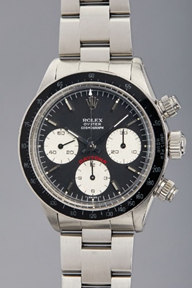
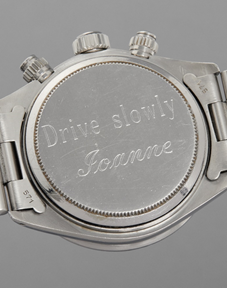
NEW YORK – 29 OCTOBER 2020 – On Saturday, 12 December, Phillips in Association with Bacs & Russo, will offer one of the world’s most important Rolex watches – Paul Newman’s “Big Red” Rolex Cosmograph Daytona – in RACING PULSE, the Flagship New York watch auction. Estimated in excess of $1 million, it is the wristwatch Paul Newman was most often photographed wearing for over two decades until he gifted it to his daughter, Clea Newman Soderlund, in 2008. Treasured by Clea for a dozen years, it remains remarkably well-preserved, with its engraved caseback displaying the incredible and loving inscription, “Drive slowly Joanne.” Bearing all the features of one of the most sought-after wristwatches of the present era, it is being offered with its original dial with its bold black dial with white sub-dials, featuring the distinctive “Big Red” Daytona logo at 6 o’clock.
Paul Boutros, Phillips’ Head of Watches, Americas, said, “While many know Joanne Woodward and Paul Newman as actors and philanthropists, their names signal something more to watch collectors – an extraordinary impact on the field of watch collecting. Throughout his lifetime, Paul Newman was photographed wearing a small handful of Rolex Cosmograph Daytona watches. Without any doubt, it is this association with Paul Newman that has led to the Rolex Daytona being universally regarded as possibly the world’s most sought after wristwatch. Of these, the watch he owned and wore the longest is the present “Big Red” Daytona Ref. 6263. It is amongst the most exclusive handful of watches with impeccable Newman-family provenance. We are truly humbled that the Newman family once again turned to Phillips for this incredibly important consignment, and we sincerely thank them for their trust. With the support of Clea’s sisters and with a portion of proceeds benefiting charitable organizations founded by Paul Newman, we are thrilled and honored to offer what is one of the most storied vintage Rolex watches of our era.”
Clea Newman Soderlund wearing
Paul Newman’s Rolex “Big Red” Daytona
According to Clea, Newman’s “Big Red” Daytona was presented to him by his wife Joanne Woodward in 1983 for their 25th wedding anniversary. Nearly two decades earlier, in 1965, Newman was injured in a serious motorcycle accident. A few years later, during filming of the 1969 film, Winning, his passion for car racing would form. With those unpleasant memories ever fresh in her mind, Joanne felt great discomfort every time he went onto the racetrack for a drive. Always concerned for the safety of her husband whenever he left to pursue his passion on the track, she wanted to make sure that he continued to remember to take care of himself, choosing the loving message for this caseback.
Clea Newman Soderlund explains, in her signed letter accompanying the watch:
“He wore the watch nearly every day until he gave it to me. He was photographed wearing it on numerous occasions as was I. It has been a treasure of mine for almost thirteen years. To me, this watch shows my mother’s tolerance of his continued passion for racing and reflects the enduring love between them which remained for another 25 years until his passing.”
Photo credit:
Geoffrey Hewitt Photograph Collection
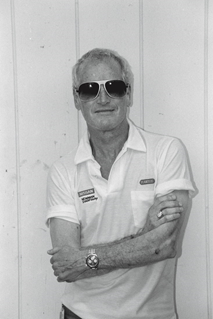
Throughout his lifetime, Mr. Newman was seen wearing several generations of Daytona models. He not only made the model famous, but also, without any doubt, helped fuel the growth and popularity of wristwatch collecting beginning in the 1980s. The present Rolex was not the first Paul Newman was famous for wearing. A woman of exceptional taste, Joanne Woodward gifted him his first Rolex Daytona in 1968, a reference 6239, which was engraved “Drive Carefully Me.” The watch that first sparked the famous association between Newman and Rolex, in approximately 1984, it seemingly disappeared once he received a new watch – the one being sold this December. The story of Paul Newman’s Ref. 6239 is well-known now: Newman gifted it to his daughter Nell’s boyfriend at the time, James Cox, who owned it for over thirty years until he consigned it to Phillips. It made history in the Winning Icons New York auction of October 2017, achieving a world record price of $17.8 million. It was after Newman received the “Big Red” Ref. 6263 from his wife, the watch being sold in December, that he made the decision to gift the ref. 6239.
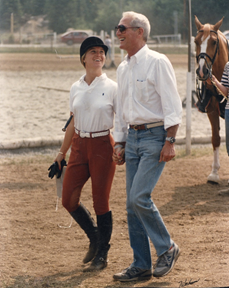
Newman was often photographed wearing the “Big Red” with its chronograph pushers unscrewed, so that he would have easy access to begin timing events – whether during a race or simply in his day-to-day activities, including timing his daughter Clea’s horseback riding at their home in Westport, Connecticut. So proud and confident he was of the accuracy of his Daytonas, he would place bets with friends that his watch was more accurate than theirs. After calling Central Time, a phone service providing exact time, Newman would collect his winnings. A true enthusiast, he wore this very watch on a bund strap similar to his Ref. 6239 with exotic dial, on a President bracelet, Jubilee bracelet, and the presently fitted Oyster bracelet. The effortlessness and unpretentiousness of his personal style and aura carried over in his approach to watches. Rolex’s Cosmograph Daytona was meant to be a utilitarian timekeeper, to provide timing information legibly and accurately – suiting Paul Newman’s lifestyle and sensibilities perfectly.
Introduced in 1969, the Daytona reference 6263 housed Rolex’s caliber 727 and featured screw down pushers to prevent their actuation underwater. Along with the Ref. 6265, the stainless steel bezel version of the watch, the two references sit proudly in the pantheon of Rolex chronograph history, and were offered with either a silvered dial or black dial, similar to the present watch. It is sized at a generous 37mm diameter without the pushers, with the gently curved lugs providing comfort for any sized wrist.
Photo courtesy of SeriousFun Children’s Network
The Daytona is a model that will forever be associated with Paul Newman, treasured by watch collectors simply because Newman embodied an unstudied, unassuming coolness while wearing his Daytona that is not so easily captured. The popularity of the model among collectors in the twenty-first century has only increased – no doubt in part due its enduring association with Paul Newman. Phillips is thrilled and honored to offer this incredible “two-owner” timepiece, direct from Paul Newman’s daughter Clea, with a portion of the proceeds going to charitable causes that were important to Paul Newman and Joanne Woodward, including SeriousFun Children’s Network and Safe Water Network, charities founded by Paul Newman himself.
On December 6, Freeman’s will have the privilege to present, for the first time at auction, Wake up, America!, an important socio-political canvas executed by Rockwell Kent at the onset of WWII in 1941. Conceived as a rallying cry to urge the United States to partake in the global conflict, the painting stands out as one of the artist’s boldest images—a visual plea against government’s neutrality, which still resonates, even today, within the agitated socio-political climate. We would like to thank leading expert Scott Ferris, who kindly agreed to retrace the painting’s important genesis and history in the essay down below.
Rockwell Kent (1882-1971) Wake Up, America!, 1941, oil on burlap. 34 x 44 in., $200,000-300,000
Rockwell Kent involved himself in politics early on in life, joining the Socialist Party of America in 1904, and casting his vote for the perennial presidential candidate, Eugene V. Debs the same year. The roots of the artist’s democratic-socialist expression initially surfaced on the front pages of The New York Evening Call, where his drawings portrayed the challenges and espoused the rights of the laborer (1909); his images for The Patriots Progress or The Long Road (1917) exposed his anti-war heart; and his paintings and wood engraving of the severed heads of Nicola Sacco and Bartolomeo Vanzetti (1927) brought to light what many believed were the injustices within the American judicial system. From the 1930s on, Kent’s commentary on these issues took center stage (some would say) over his accomplishment as a “fine-artist” and writer.
Rockwell Kent, August XXIII, MCMXXVII, Wood engraving, 4.9 x 3.1 in.
Rockwell Kent, Celebrate Arkansas Centennial-End Peonage, 1936. Printed reproduction of stamp for the Workers’ Defense League, 1 15/16 x 1 15/16 in. From Rockwell Kent, Later Bookplates and Marks, Pynson Printers: New York, 1937, p. 75.
The Spirit of War
Rockwell Kent, Bomb’s Away, 1942, oil on canvas, 34 x 44 in, Columbus Museum of Art
Wake Up! —also known as Wake Up, America!— belongs to a series of drawings, paintings, prints and posters that provide useful commentary on Kent’s contemporary topicality. It is one of a handful of large, well-executed, socio-political canvases that includes Heavy, Heavy Hangs Over Thy Head (Baltimore Museum of Art) and Bombs Away (Columbus Museum of Art); and a statement on the artist’s return to the fight against fascism, after the world failed to address its rising viperous head during the Spanish Civil War (a position that required the artist to temporarily relinquish his anti-war stance in an effort to defeat the evils of fascism).
James Montgomery, Wake up America! Civilization Calls Every Man, Woman and Child!, 1917, Courtesy of Library of Congress, Flagg.
The title was not new to American war propaganda art. One example is James Montgomery Flagg’s 1917 poster, Wake Up, America!: Civilization Calls Every Man Woman and Child!, which, compositionally, is significantly tamer when compared to Kent’s canvas as Flagg depicts America as a beautiful, reclined woman.
Kent’s vision can be described as more radical.
In a ravaged landscape surrounded by flames stands an Amazon-like figure, which represents the Spirit of War. Armed with a rifle, she is the center of the composition. She is shown ready for battle, and encourages a lethargic citizen, America itself, to join her on the battlefield. In a 1994 letter to a one time owner of the painting, Kent’s widow, Sally Kent Gorton, summarized the composition best when she wrote:
That the recumbent male is indifferent to what is going on in the world, specifically the ever growing menace of Hitlerism: the bombing of London; the invasion of Czechoslovakia; etc. etc. etc. Norway. The USSR. To these invasions the armed female is responding with the cry: WAKE UP AMERICA! And, as you know, the United States entered the war in 1941. Roosevelt having finally capitulated on his determination that we should not participate.
The artist’s development of this painting was complex. It emerged from numerous pencil sketches (some in the Rare Book and Manuscript Library at Columbia University), and a small gouache and transparent watercolor study that finalized the layout of the composition.
Life, Liberty, and the Pursuit of Happiness, 1938, pencil on paper, final cartoon for a bronze medal. Courtesy Rockwell Kent Papers, Archives of American Art, Smithsonian Institution.
The upper torso of the Spirit of War appears to have its formalist origins in the Kent designed Hugo Lafayette Black medallion, “Life, Liberty and the Pursuit of Happiness” (1938).
Rockwell Kent, Know and Defend America. Printed cover for the eponymous exhibition catalogu at the Wildenstein Galleries, New York City, 1942-43. Stanley Collection, Porland, Maine. Photograph Courtesy Scott Ferris.
Rockwell Kent, Eternal Vigilance is the Price of Liberty, Lithograph, 10 ¼ x 13 15/16 in. Stanley Collection, Portland, Maine. From Rockwell Kent 1882-1971, a memorial portfolio by the National Council of American-Soviet Friendship
In content and in some respects form, this figure closely relates to Kent’s “Winged Victory” and “Our Seamen, Give ‘Em A Hand” poster studies, as well as his “Forest Fires Aid the Enemy: Volunteer to Fight Them” and “Eternal Vigilance is the Price of Liberty” poster and lithograph, respectively.
Posterity
The painting first appeared in the exhibition, “Know and Defend America”. In the catalogue that accompanied the exhibition Kent wrote: “This was painted six months ago. We’ve waked up now. We’ll stay awake; not only to complete the job that has been forced upon us, but to take up with renewed energy the cultivation of our own garden for the realization, at long last, of the Life, Liberty and Happiness for everyone that can give meaning to our faith in democracy.”
Both Royal Cortissoz, the noted art critic, and John O’Connor, Jr., assistant director of the Carnegie Institute, at the time, singled out the painting when they commented on the exhibition. In Cortissoz’s critique he remarked: “… Landscapes predominate upon this occasion, but several figure pieces are on the walls. One of the best of the latter is the ‘Wake Up’… in which the spirit of war, gun in hand, admonishes a lethargic citizen”; whereas O’Connor noted that “the latest painting in the exhibition is ‘Wake Up’ which… serve[s] as the theme of the show.”
The endless fecundity — and beauty — of the natural world is a constant theme in antique rugs, and that is especially true of the selection for our Fall 2020 Sale. The importance of the idea of “the Garden” is an often-noted feature of Islamic Art in general, and Persian Art in particular. A garden, of course, has echoes of the original Paradise, Eden, as well as the Paradise to come. But beyond all notions of the life-to-come, a garden, no matter how small, represents respite and shelter in a region where much of the landscape is arid and unforgiving.
Lot 1048: Serapi Carpet, northwestern Iran, c. 1890
Serapi Carpet, northwestern Iran, c. 1890. Lot 1048, Estimate: $8,000-10,000
Here in this lovely Serapi carpet, for example, we have a provincial weaver’s version of a classic walled garden: a central pool of water, surrounded by various stylized renderings of plants and (quite unusually, and wonderfully) large heraldic birds.
Despite the fact that the design vocabulary in this carpet, as with most Persian rugs, is floral in origin, there is nothing flowery going on here. Or curvy, for that matter. Instead, in classic Northwest Persian fashion, the branches, leaves, and blossoms are rendered with a highly stylized angularity that is both childlike and controlled. Another appealing aspect of this lovely carpet is the weaver’s use of space. A musician friend tells me that when he’s playing at his best, it’s like there’s an envelope of silence around every note. Similarly, in this carpet, there’s an envelope of space around every element, so we can really see, and feel, what’s going on in the garden at our feet.
Lot 1140: Marasali Rug, Caucasus, dated 1852 (1269)
Marasali Rug, Caucasus, dated 1852 (1269). Lot 1140, Estimate: $3,000-3,500
This relatively early Marasali Prayer rug is exemplary: a dark blue field with staggered rows of boteh-shaped flowers surrounded by an ivory grape-vine border. And clearly made for a special client — a local potentate, perhaps — suggested by a fine weave and the numerous silk highlights. But beyond those things that make it a splendid example of type, however, there’s that “something” that raises certain rugs to the level of real art. That “something”, obviously, is difficult to define, but we know it when we see it: the range of colors, the harmonious wedding of technical finesse with playfulness, the way the interiors of the botehs are wonderfully varied, both elegant and psychedelic.
Lot 1103: Ningxia Runner, western China, 18th century
Ningxia Runner, western China, 18th century. Lot 1103, Estimate: $1,000-1,200
One of the wonders that early rugs from Western China sometimes achieve, as in this sweet little Ningxia, is a seamless mix of austerity and whimsy. We see a darkened sky, maybe a half-hour after sunset, with cloud-bands and bats. But these bats are not the stiff, stylized doodles of auspicious presence that we’re used to seeing in Chinese rugs. These bats are real creatures, on the hunt, swooping in and out of the roiling clouds.
Lot 1101: Victorian Chair Upholstered with Ningxia Mats, western China, c. 1890
Victorian Chair Upholstered with Ningxia Mats, western China, c. 1890. Lot 1101, Estimate: $800-1,000
To the late Victorian sensibility, any rug — no matter what significance it may have held in the culture that made it — was fair game as a furnishing object. Every textile was potential upholstery. And when you had covered your floors and your stairs and your table-tops and your walls with rugs, you could chop them up and cover an armchair with them. As we have here, where pieces from a number of Ningxia mats and rugs have been artfully arranged for seating. Plus, it’s comfortable — just the place to curl up with a snifter of brandy & a book of Tang Dynasty poetry.
Lot 1119: Ukrainian Carpet, c. 1800
Ukrainian Carpet, c. 1800. Lot 1119, Estimate: $6,000-8,000
The first thing that strikes one about this beautiful carpet is its quality, the fine weave and delicate drawing, the soft sumptuous wool, the generous use of space. The ivory field, with its wreaths of acanthus leaves surrounding floral bouquets, is pure “Age of Reason”. The expansive terracotta border, on the other hand, with its huge, blobby flowerheads, represents barely contained wildness. Made almost certainly for the Francophile Russian market, one can imagine this rug on the floor of Count Rostov’s house in St. Petersburg, 10 years before Napoleon — that upstart — decided to invade.
PETER DOIG’S, BOILER HOUSE, LEADS THE EVENING SALE SERIES £13,895,500 / €15,368,423 / $18,230,896
DAVID HOCKNEY’S PORTRAIT OF SIR DAVID WEBSTER SELLS FOR £12,865,000 / €14,228,690 / $16,878,880 SOLD TO RAISE VITAL FUNDS FOR LONDON’S ROYAL OPERA HOUSE
PAUL HAIM COLLECTION LAUNCHES SERIES SELLING 100% BY LOT
PARIS AVANT-GARDE LED BY PIERRE SOULAGES
PARIS/LONDON – On 22 October, Christie’s opened its 20th Century London to Paris auction series with a total of £90,279,883 / €99,849,551 across four hybrid-style live auctions, with an average sell through rate of 84% by lot.
Over 190,000 viewers tuned into the sales through Facebook, You Tube, Christies.com and Christie’s Live.
The top lot of the evening was Peter Doig’s Boiler House,1993, which achieved £13,895,500 in the London Post-War and Contemporary Art Sale.
Leading the Paris Avant-garde sale was Pierre Soulages’ Peinture 162 x 130 cm, 9 juillet 1961, which realised €5,392,500, followed by Zao Wou-Ki’s 310768, which saw significant competition and ultimately sold for €2,060,000.
Among the top lots of the evening was David Hockney’s Portrait Of Sir David Webster sold to raise vital funds for London’s Royal Opera House, which achieved £12,865,000.
In another highpoint of the evening, Marina Abramović’s The Life was acquired by the Faurschou Foundation, an art institution headquartered in Copenhagen with permanent exhibition spaces in Beijing and New York, for £287,500, setting a new world auction record for the artist.
Day sales in Paris and London will continue tomorrow, 23 October, and online-only sales will continue into next week. In the meantime, please find results for tonight’s sale attached.
For further details and insights into the Evening Sale, please view tonight’s wrap report or watch a recording of the post-sale press conference.
Records achieved by: Marina Abramović, Juan Bordes, Agustín Cárdenas, Riccardo Dalisi, Eugène Dodeigne, Jacques H. Gainsbury, Françoise Lacampagne, Markus Lűpertz, Matta, Jorge Oteiza, Antoine Poncet, Daniel Richter, Jean-Michel Sanejouand, Steven Shearer, Zigor
SALE BREAKDOWN
Le jardin secret de Paul Haim | View ResultsSale Total: €20,589,375 / £18,616,071 / $24,424,286The highly successful sale of Le jardin secret de Paul Haim saw global interest from collectors from 23 countries, including a significant number of new clients who represented 22% of sale registrants. Strong international bidding resulted in 78% of lots selling above high estimate. The top lot of the sale was Joan Miró’s La Caresse d’un oiseau, which realised €4,700,000. Paris Avant-garde | View Results
Sale Total: €18,937,000 / £17,122,061 / $22,464,145The Avant Garde auction saw Strong results for French artists such as Robert Delaunay and Pierre Soulages, whose Peinture 162 x 130 cm, 9 juillet 1961 became the top lot of the sale when it achieved €5,392,500. Coming from a French Collection, Zao Wou-Ki’s 31.07.68 achieved a strong price of €2,060,000 further confirming the strength of the market for the artist in France. Deutsche Bank entrusted Christie’s with three lots, which totaled €1.8 million. Post-War and Contemporary Art Evening Sale | View ResultsSale Total: £49,220,500 / €54,437,873 / $64,577,296 This sale reconfirmed the strength for British artists, and not only Peter Doig and David Hockney who lead the sale, but also for Francis Bacon and Lucien Freud who also saw strong prices. Christie’s was very proud to have placed Marina Abrmovic’s The Life, with the Faurschou Foundation for the world auction setting price of £287,500. Thinking Italian | View ResultsSale Total: £5,321,250 / €5,885,303 / $6,981,480The Italian sale brought together a selection of art and design on the occasion of the 20th anniversary of sales in London dedicated to Italian creativity in the 20th century. The sale was led by Alghiero Boetti’s Mappa which sold for £1,702,500.
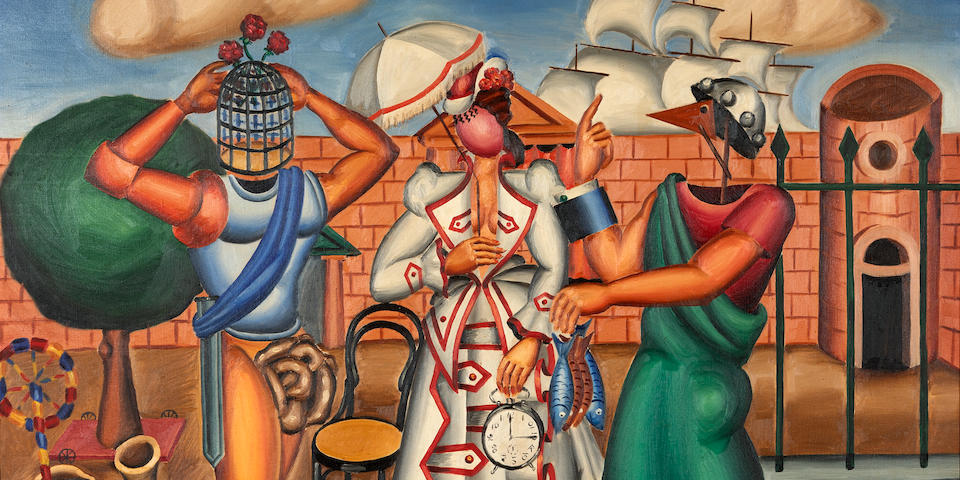
Scène homérique avec le héros, a masterpiece by the leading Greek painter Nikos Engonopoulos (1907-1985) is among the major works in Bonhams Greek Art sale in London on Wednesday 18 November. It is estimated at £150,000-200,000.
The painting dates from Engonopoulos’s much sought after pre-war period – it was executed in 1938 – and offers a dazzling and joyfully colourful array of styles and references. The figures are posed as if on a stage set, echoing the artist’s belief that “under the stage lights, with the most harmonious moves, in a coordinated whole, amidst colours and music, every human dream comes alive.” This highly important work was exhibited at the career-defining 1954 Venice Biennale when Engonopoulos became the first Greek artist to represent his country in a solo show. It is the most well documented and exhibited artwork of his entire oeuvre.
In addition, the sale features four important works by Constantinos Parthenis (1878-1967); Prosperity (£80,000-120,000), Angel /Discipline (£70,000-100,000, Harmony (£60,000 -80,000), and Double Axes (£30,000-40,000). In 1940, Parthenis, regarded as one of the greatest living Greek painters, was commissioned to provide 12 paintings to decorate a room on the first floor of Athens’ City Hall. He was to be paid the vast – at the time – fee of 800,000 drachmas. The painter produced the canvases, but because of the outbreak of war and the German occupation of Greece, the Municipality was unable to pay. In the early 1950s, the Mayor of Athens proposed to revive the commission on the original terms. By then, however, the drachma had lost much of its pre-war value. Parthenis saw the offer as an insult and the paintings remained in his studio until his death in 1967.
Post-war and contemporary Greek international artists are also well represented in the sale and include:
Delphic Sun-Box #2, 1968 by Theodoros Stamos (1922-1997). Estimate: £25,000-35,000.
Penderie/ Coats by Pavlos (1930-2019). A construction with poster paper and hangers on board in plexiglass, c. 1968. Estimate: £20,000-30,000.
Untitled from 1996 by Apostolos Georgiou (born 1952). Estimate: £12,000-18,000.
Heads Mix Table 32 by Lucas Samaras (born 1936). Executed in 2003, this work is number 2 from an edition of 5. Another work from the same edition is in the collection of the Museum of Modern Art in New York. Estimate: £4,000-6,000.
Bonhams Greek Art specialist Anastasia Orfanidou said: “This strong sale truly represents the full sweep of 19th and 20th century Greek Art, from paintings by Volonakis and Jacobides, to photographic works (Polaroid and Photofiction series) by Lucas Samaras. Three works, however, stand out for me; Scène sale homérique avec le héros by Encononpoulos and the two works by Parthenis – Prosperity and Angel/Disciple – which were originally destined for Athens City Hall. All three paintings are of superb quality, the equal of works by these artists displayed in national and international galleries. I expect there to be a great deal of interest.”