Featuring Gifts from her Father, Louis Mountbatten
And Historic Pieces from the Jewellery Box of Queen Victoria
To Be Offered at Sotheby’s London on 24 March
Featuring Gifts from her Father, Louis Mountbatten
And Historic Pieces from the Jewellery Box of Queen Victoria
To Be Offered at Sotheby’s London on 24 March

AUCTION EVALUATION DAY | TUESDAY, MARCH 2
See what hidden treasures our experts may be able to reveal
We invite you to join us online for our Virtual First Tuesday on March 2. Submit your items anytime before the 2nd and Skinner specialists from all departments will be on hand on Tuesday to evaluate items and respond by email.
Let’s get started:
Step 1: Gather information and images for up to three items of fine & decorative arts, furniture, jewelry, silver, watches, coins and much more.
Step 2: Send us an email with the information and images at [email protected] or at the button below.
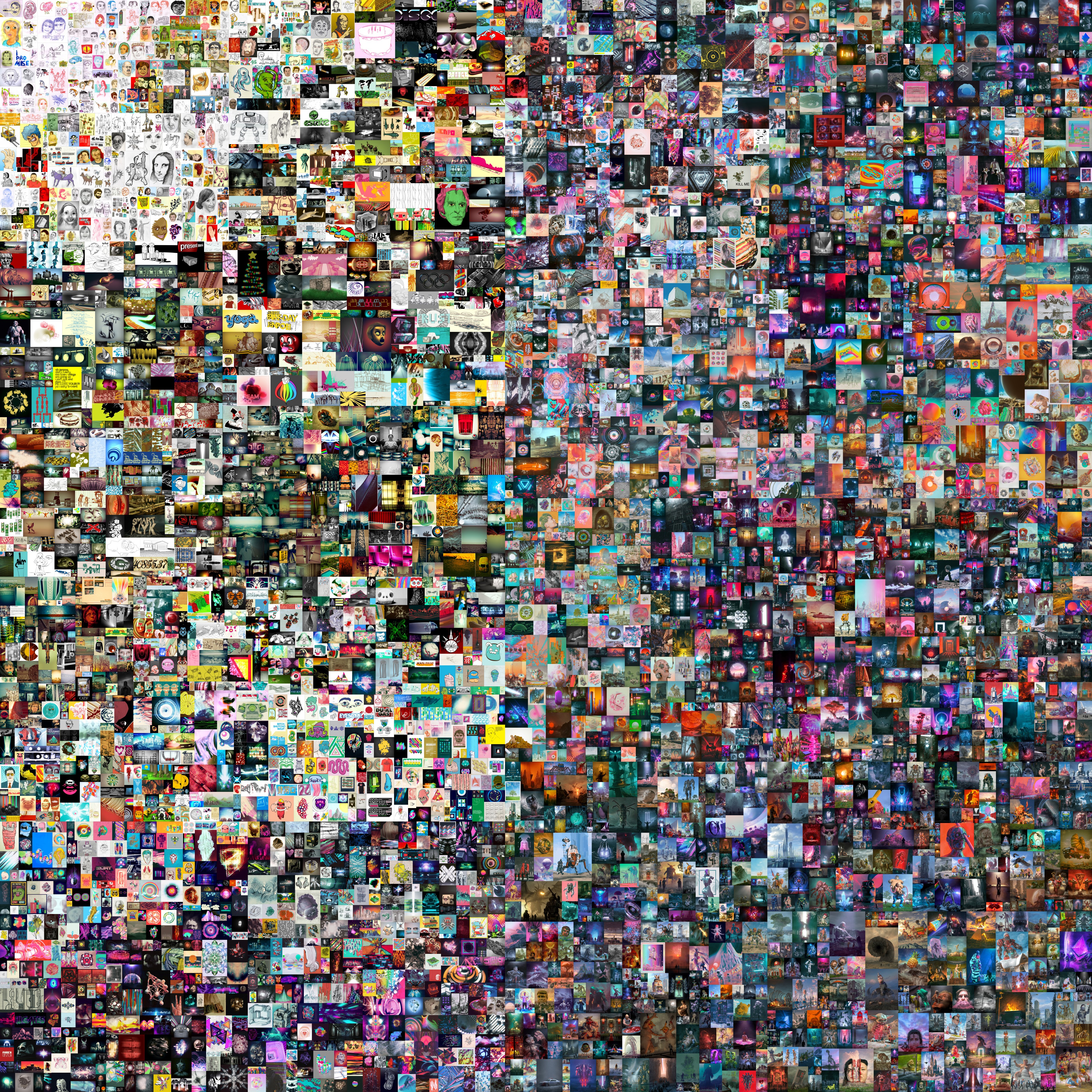
NEW YORK – Christie’s is honored to present Everydays – The First 5000 Days by leading digital artist, Beeple, in a stand alone online-only sale open for bidding from February 25 – March 11, coinciding with First Open | Online. This sale marks the first time that a purely digital NFT (Non-Fungible Token) based work of art has ever been offered by a major auction house, signifying an important milestone in the development of the market for digital art. Given that this is a new medium for Christie’s, the estimate for The First 5000 Days will be listed as “unknown.” Bidding will open at $100. Visit www.christies.com/beeple for additional information.
Noah Davis, Specialist, Post-War and Contemporary Art, remarked: “Christie’s is thrilled to have the opportunity to work with Beeple, a brash pioneer among digital artists, to present the first purely digital NFT-based work of art ever offered by a major auction house. We see this as a pivotal moment for the future of New Media and even the practice of collecting itself. Everydays – The First 5000 Days is a monumental work comprised of 5,000 individual images created over the course of as many days, giving viewers the opportunity to zoom in and witness Beeple’s often irreverent but always engaging, evolution as an artist pixel by pixel. The capacity to represent 13 years of an artist’s career in a single work perfectly illustrates the limitless nature of this medium. Not unlike the advent of Street Art as a blue chip collecting category, NFT-based art is on the threshold of becoming the next ingeniously disruptive force in the art market. Christie’s is proud to be in the vanguard of this exhilarating movement.”
Beeple, digital artist, remarked: “I am beyond excited to have the first 100% digital artwork auctioned at Christie’s. I think this is a truly historic moment not just for digital art, but for the entire fine art world. The technology is now at a place with the blockchain to be able to prove ownership and have true scarcity with digital artwork so I think we are going to see an explosion of not only new artwork, but also new collectors and I am very honored to be a part of this movement.”
Everydays – The First 5000 Days is a tour-de-force by Mike Winkelmann, a leading digital artist best known as Beeple. On May 1, 2007, the artist set out to create and post a new work of art every day indefinitely, and has not missed a single day in 13 years. These works, which are now known as Everydays, form one of the most celebrated bodies of work in the history of digital art. The First 5000 Days comprises every single individual image from Beeple’s first 5,000 Everydays compiled into a single composition. Together, this work presents an extensive glimpse into Beeple’s artistic journey from his early days of anonymity to the digital art star that he is today – its unfaltering continuity creating a poignant timeline charting the progression of United States history in real time.
Beeple’s artwork is rich with brazen symbolism in his examination of social contradictions and absurdities. Utilizing his signature grotesque, hypnotizing digital style, the artist tackles themes such as society’s simultaneous obsession with and fear of technology, desire and resentment towards wealth, and of course, the political turbulence of recent years.
The First 5000 Days is a purely digital work of art, which is a Non-Fungible Token. An NFT is a unique digital token encrypted with the artist’s signature, which is individually identified on the blockchain, effectively verifying the rightful owner and authenticity of an original digital creation. The NFT for this work has been generated by MakersPlace, a premier marketplace for digital creators.
Digital Art has a long established history as an artistic medium, but until the recent introduction of NFTs and blockchain technology, it was impossible to assign value to digital works of art given the ease of duplication. However, when an NFT-based digital creation is acquired today, the buyer receives the artwork file containing a digital signature from the artist and all vital details including time of creation, edition size and a record of any prior sales. These details are permanently attached to the artwork, providing an enduring guarantee of value. This development has effectively ushered in a new era for digital artists, and Christie’s is honored to be on the forefront of this long awaited breakthrough.
The market for digital art is expanding rapidly, with major acquisitions taking place on specialized platforms such as MakersPlace. Beeple is one of the most sought after digital artists within this market, having recently sold a collection of 20 works at auction for $3.5 million on another blockchain-based platform.
Outside the realm of the digital art market, Beeple has made a major name for himself in the creative world, collaborating with global brands including Apple, Space X, Nike, and Samsung and creating concert visuals for artists such as Ariana Grande, Justin Bieber, Childish Gambino, Nicki Minaj, Skrillex and deadmau5 among others. In 2019, Beeple’s artwork was featured on Louis Vuitton’s Women’s Spring 2019 ready to wear collection, as well as in window displays of the brand’s global flagships.
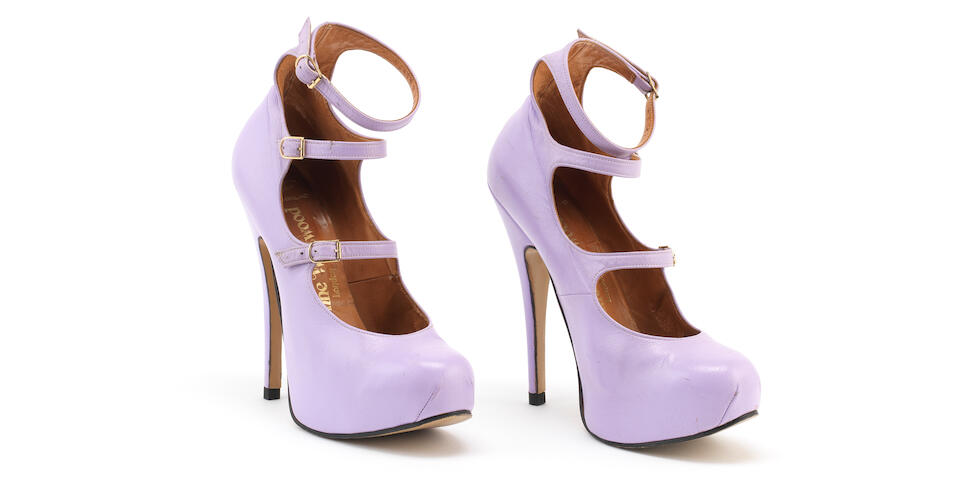
British. Cool.25 Feb 2021London, New Bond StreetVivienne Westwood‘Prostitute’ Shoes, Café Society Collection, Spring/Summer 1994
The world of art and fashion come together at Bonhams British. Cool. sale on 25 February in New Bond Street, London, with designer pieces by Vivienne Westwood, Alexander McQueen, Ossie Clark, and Zandra Rhodes to be offered alongside artworks, photographs, and entertainment memorabilia, all presenting the best of British. One of the star lots of the sale will be a unique photographic artwork of the world-famous supermodel Kate Moss by the artist Chris Levine – jointly donated by both Levine and Moss to raise funds for Oxfam GB. The work has an estimate of £20,000 – 30,000. The sale also has prints by Banksy, works by Yinka Ilori, and Tim Noble and Sue Webster, amongst others.
Head of Bonhams’ Designer Handbags & Fashion Department, Meg Randell, commented: “British fashion is known for being bold and experimental and from Ossie Clark and Zandra Rhodes, to Vivienne Westwood and Alexander McQueen, British. Cool. will showcase some of the biggest and best names in British fashion from the last 50 years. Many of them played a significant role in elevating fashion into an artform, and it is only apt that these exquisite pieces are being offered alongside a host of wonderful works of art from across different visual mediums.”
Vivienne Westwood
The sale will feature a number of pieces from the Queen of provocative punk fashion, Vivienne Westwood. Items range from designs dating from her early days with Malcolm McLaren, up to a Union Jack sequinned gown produced for the 2012 diamond jubilee – which has an estimate of £1,200 -1,800. Other highlights include a Putti Mackintosh featuring the memorable cupid print from 1992 (estimate: £2,000-3,000); a ‘Harris Tweed’ Crown, Autumn/Winter 1987-88, which is one of the most collectable Westwood items (estimate: £2,500-3,500); and a pair of ‘Prostitute’ Shoes, Café Society Collection, Spring/Summer 1994, worn by Yasmin Le Bon on the runway in 1994, with ‘Yasmin’ handwritten in the sole (estimate: £1,200 – 1,800).
Alexander McQueen
A tortured genius and enfant terrible of British fashion, Alexander McQueen, knew how to cause a stir with his dark and expressive designs, as well as his shocking and inspired catwalk shows. The sale will offer a number of signature McQueen creations, including a Life in Pain, Mesh Top, Autumn/Winter 1996, which has an estimate of £600 – 800, and Birds of Paradise Gown, circa Spring/Summer 2008, which has an estimate of £1,500 – 2,000. The latter design was part of one of McQueen’s final collections, before his suicide in 2010. Another example of the gown was worn by FKA Twigs in 2015, when she performed at the launch of the landmark exhibition Alexander McQueen: Savage Beauty at the V&A.
Zandra Rhodes
Zandra Rhodes was part of the new wave of British designers who put London at the forefront of the international fashion scene in the 1970s. During her long and esteemed career, Rhodes designed garments for Diana Princess of Wales as well as many other celebrities. In 2003 Rhodes founded the Fashion and Textile Museum in London, and she has won numerous awards recognizing contribution within the fashion industry. The sale will include a number of Rhodes dresses from her early collections, including a Blue Chiffon Butterfly Dress, circa 1969, which has an estimate of £850 – 1,000. This dress was photographed by David Bailey in 1969 for a Vogue fashion shoot with model Natalie Wood.
Ossie Clark
The sale will also feature a large selection of Ossie Clark designs, including a number of pieces featuring the fabrics of Celia Birtwell. A major figure in the Swinging Sixties scene in London, Raymond “Ossie” Clark is held in the same esteem as that of 1960s fashion great Biba, and influenced many major designers, including Yves Saint Laurent, Anna Sui and Tom Ford. Manolo Blahnik has even said of Clark’s work: “He created an incredible magic with the body and achieved what fashion should do – produce desire”. Clark’s designs, and especially those created with his wife Celia Birtwell, are highly sort after, and have been seen on the likes of supermodels Kate Moss and Naomi Campbell. The sale will include Ossie Clark and Celia Birtwell’s Tulip Dress, circa 1971, which has an estimate of £1,200 – 1,800, and a Cream Moss Crepe Maxi Dress by Ossie Clark and Celia Birtwell for Radley, circa 1971, which has an estimate: £600 – 800.
Damien Hirst X Manolo Blahnik
A highlight of the fashion section of the sale will be two pairs of Damien Hirst designed Manolo Blahnik boots – one pair featuring Hirst’s instantly recognisable spot designs, and another inspired by his signature spin paintings. They have an estimate of £2000- 3000 each.
In 2002 seven artists were partnered with seven top shoe designers to each produce 20 pairs of original limited-edition shoes. Damien Hirst and Manolo Blahnik were partnered, producing ten pairs of “spot boots” and ten pairs of “spin boots”. The shoes were sold at Bergdorf Goodman and a proportion of the proceeds went to The New Museum of Contemporary Art.
The current owner received both pairs as a gift from Hirst. They commented: “I worked as the liaison between Damien and Manolo and organised collection of the leather from Manolo Blahnik, which Damien put on the spin machine & spun with household gloss. The spot boots were spots printed onto canvas, which Manolo Blahnik then made into the boots. Damien gave each of us in the office a pair of boots – I also had to send a pair to Liz Hurley & Victoria Beckham! Damien insisted I wore the spin boots to the opening on his exhibition at the new Saatchi Gallery in September 2003 – so they have been worn once! The spot boots have never been worn.”
Other highlights of the sale include:
• As part of the sale, Bonhams will also be partnering with British-Nigerian multidisciplinary artist Yinka Ilori, who will be curating a selection of his favourite works from the sale. Bonhams will also offer three unique works by the artist; United We Stand United We Fall, 2020, (Estimate: £3,000-5,000), Sometimes The Grass Is Greener On The Other Side, 2020, (Estimate: £3,000-5,000), and Ayomide, 2020 (Estimate: £3,000-5,000).
• A large number of prints by Banksy, including Girl with Balloon, 2004. Estimate: £100,000-150,000.
• Tim Noble and Sue Webster, Lucky, 1999 (2018 upgraded version). Estimate: £40,000-60,000.
• Lillian Bassman, Jean Shrimpton. Estimate: £8,000 – 12,000.
• Art Kane, The Who With Flag, 1968, printed later. Estimate: £10,000 – 12,000.
• Gerald Laing, B.B., from ‘Baby Baby Wild Things’, 1968. Estimate: £6,000-8,000.
• Bob and Roberta Smith R.A., Art Does Real And Permanent Good, 2020. Estimate: £4,000 – 6,000.
• Damien Hirst for Manolo Blahnik Spot Boots, circa 2002 (includes original box). Estimate: £2,000 – 3,000.
• Property from The Iain MacMillan Archive, including; The Beatles, ‘Abbey Road’, 1969, Estimate: £4,000-6,000.
• Alexander McQueen Birds of Paradise Gown, circa Spring/Summer 2008. Estimate: £1,500-2,000.
Missing our Poster Auction Exhibitions? An easy way to see the posters Swann has to offer, right from your couch.
Jennifer De Candia, our vintage poster department administrator, takes us on an “As Seen on TV” tour of posters we have offered through the years.
Like many people who have found themselves quarantining and snowed-in this winter, I have passed much of my time watching reruns on television. And as administrator for the Vintage Poster Department, I have noticed a trend in many of the most popular American sitcoms that rerun throughout the day—they love using posters in their set design.
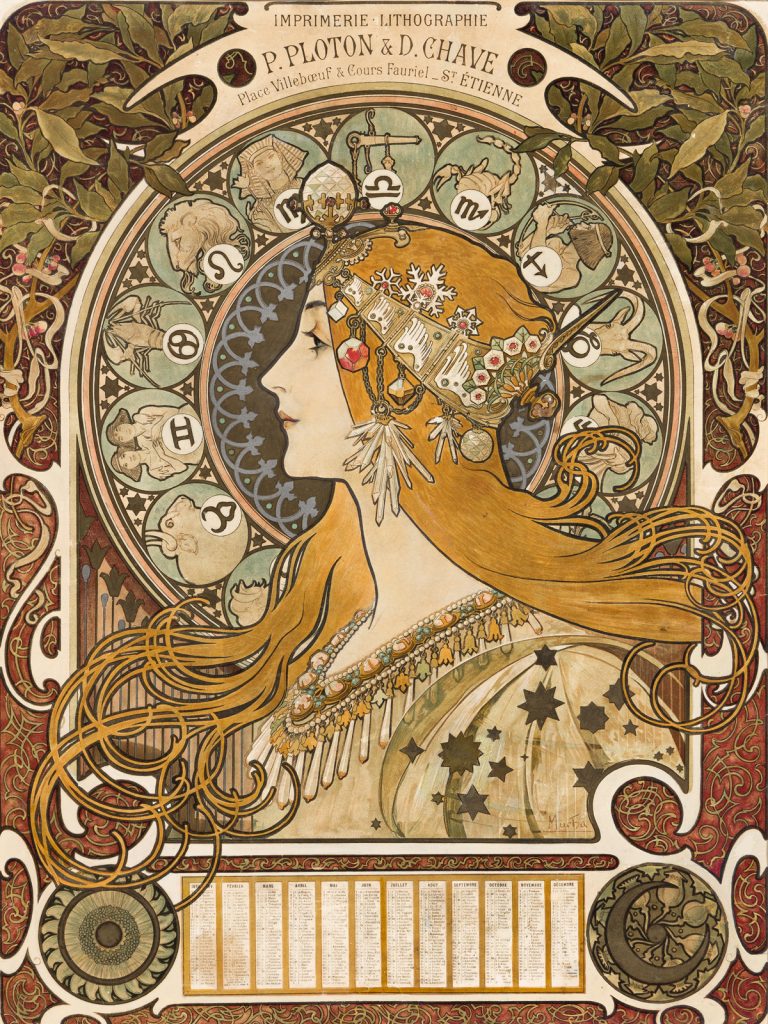
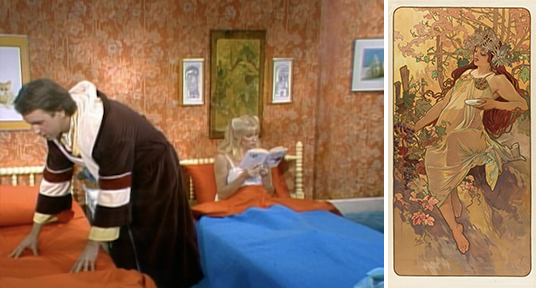
One of the most frequent displays of art nouveau posters can be seen in the sitcom Three’s Company. The apartment that Jack, Chrissy, and Janet share features numerous works by Alphonse Mucha throughout its 8 seasons, two of which are being offered in the February 18, 2021 sale.
From the first episodes of the show, much of Mucha’s work adorns the wall of the main set, such as this Zodiac image. Although the image is the same as the one being offered in our sale (Lot 60), for the printer and lithographer P. Ploton & D. Chave, the camera does not show any of the text at the top of the poster. As Mucha’s image was used in at least ten different advertisements, this makes it difficult to determine which exact version of this advertisement this poster represents.
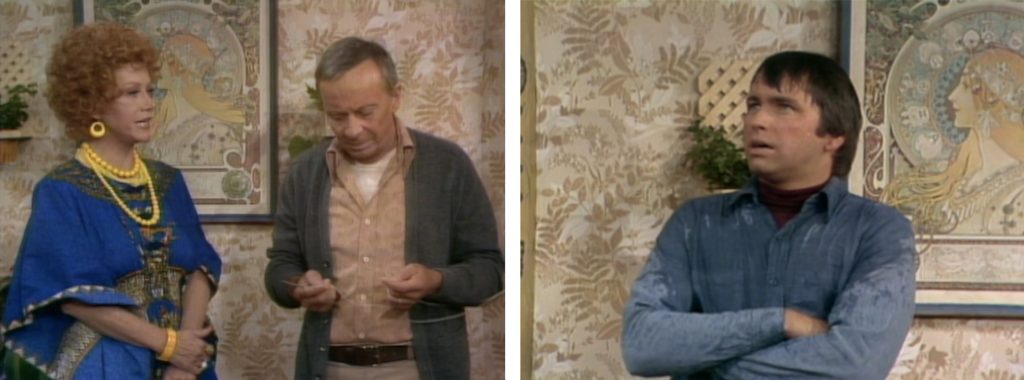
Additionally, individual panels from Mucha’s 1896 series of The Seasons appear on the show. In this episode, it shows the “Autumn” panel (Lot 62 in our upcoming sale).
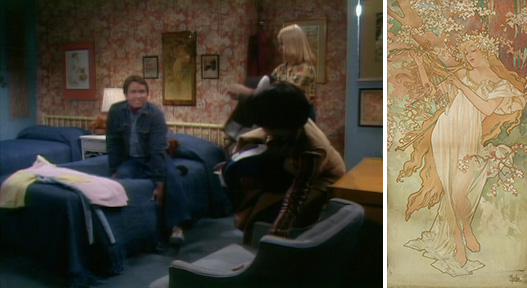
However, in the image below, it has been switched to the Spring image from that same series (last offered at Swann in 2016).
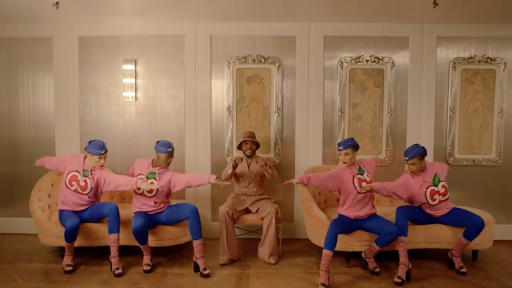
Sitcoms are not the only way to see Mucha’s work on TV. If you tune in to MTV, you might catch the music video for the latest single from the Black Eyed Peas, MAMACITA, showcasing the Carnation, Iris, and Rose panels of Mucha’s 1898 four-panel Flowers series.
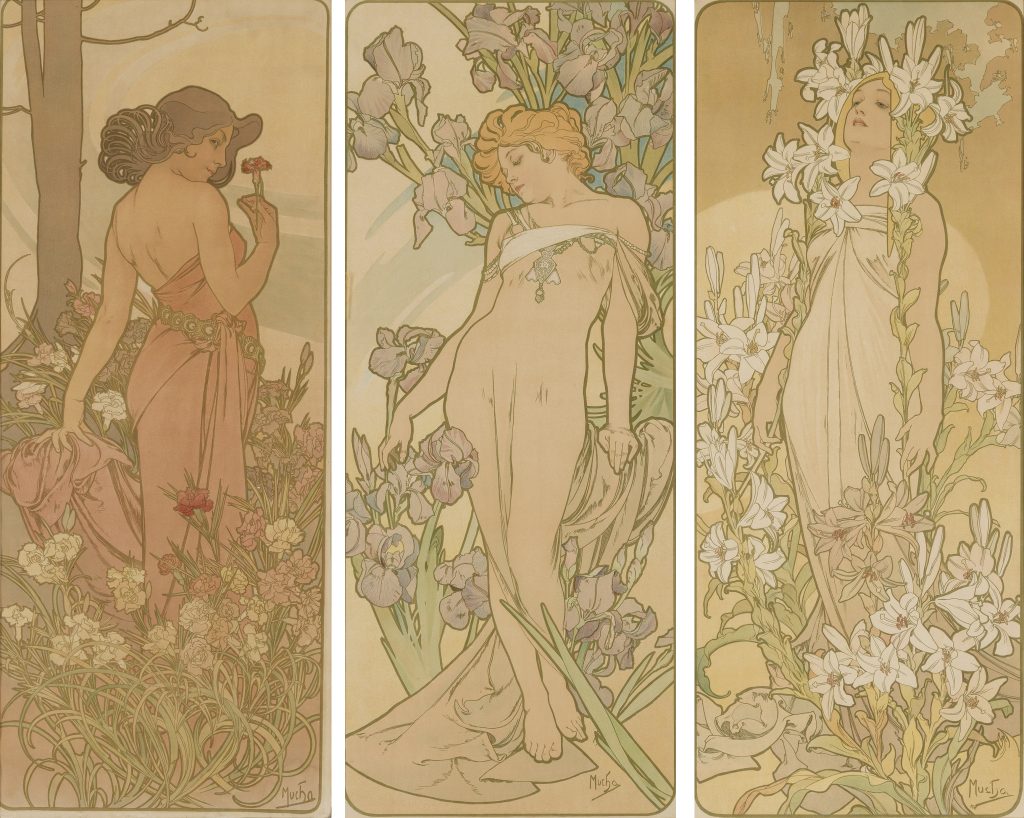
Other sitcoms have been spotted featuring posters Swann has sold in the past.
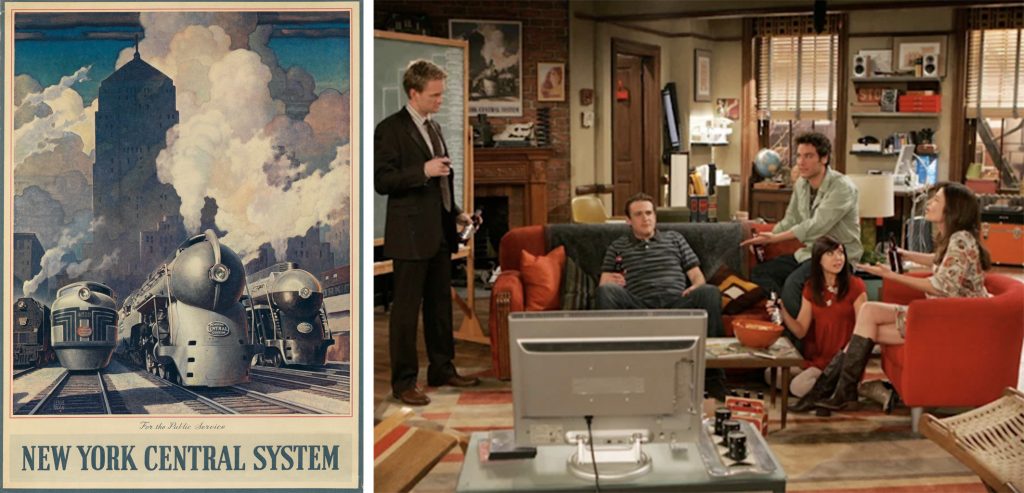
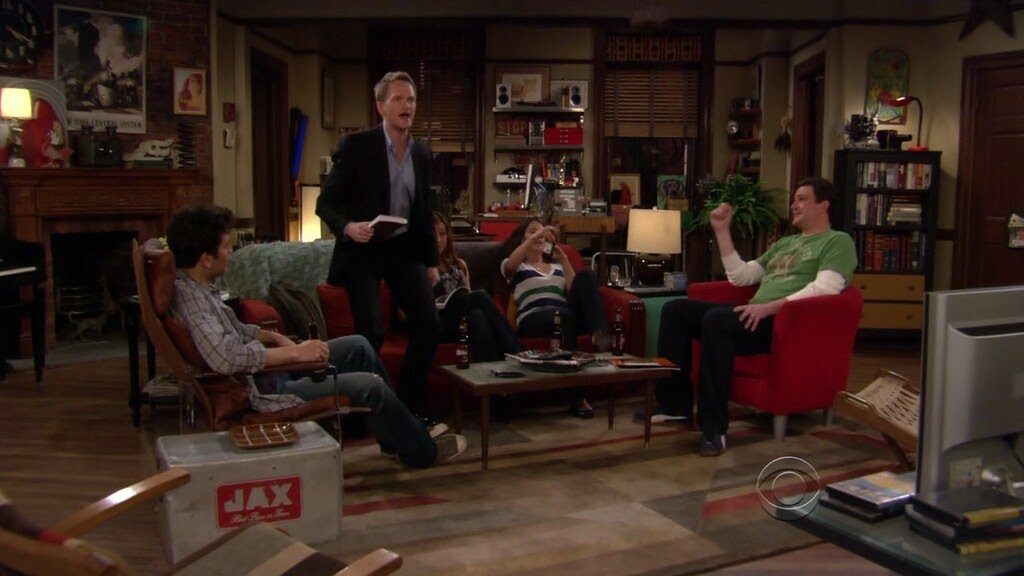
In Ted Mosby’s apartment in How I Met Your Mother, a Leslie Ragan image for the New York Central System can be seen above the mantle in the upper left corner. As an architect living in New York City, it makes sense that the character would display a poster with a strong focus on art deco design. (Though it’s hard to know the reason this poster was chosen by the production and set designers, it is worth noting that although the image is for a 1945 New York Central Line calendar, the station depicted is LaSalle Street Station in Chicago- the building shown amongst the smoke is the Chicago Board of Trade Building)
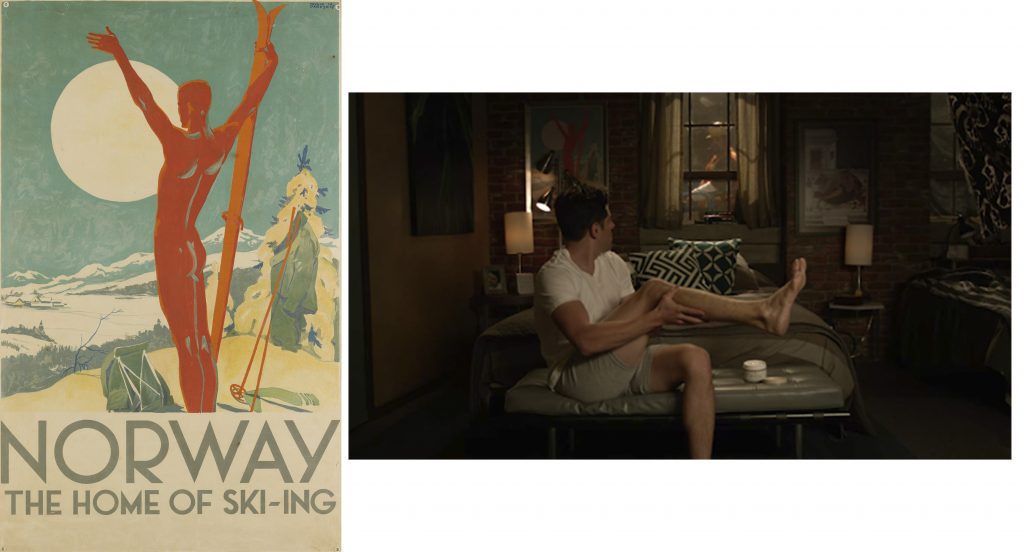
Seen here in the bedroom of Schmidt, one of the roommates in the show New Girl, is the English version of Trygve M. Davidsen’s travel poster touting Norway as an ideal skiing destination.
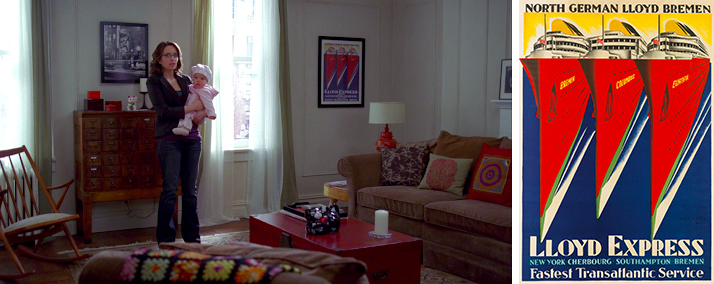
And Liz Lemon, the lead character of 30 Rock, has decorated her spacious New York apartment with Lois Gaigg’s competition-winning poster for the North German LLoyd shipping company (with slightly different bottom text). Like the architectural influences in Ted Mosby’s decorations, this poster could be a subtle reference to the character’s love of Germany, where she studied abroad for a year in college.
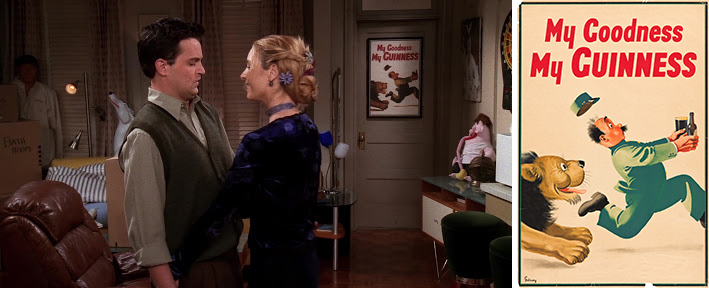
Lastly, one of the most recognizable posters in our upcoming auction is featured in a show well-known for its posters, Friends. Of the many posters John Gilroy created for Guinness, the one I personally know best is the My Goodness My Guinness poster, featuring a lion chasing a zookeeper. This poster can be seen on the bathroom door in Joey and Chandler’s apartment.
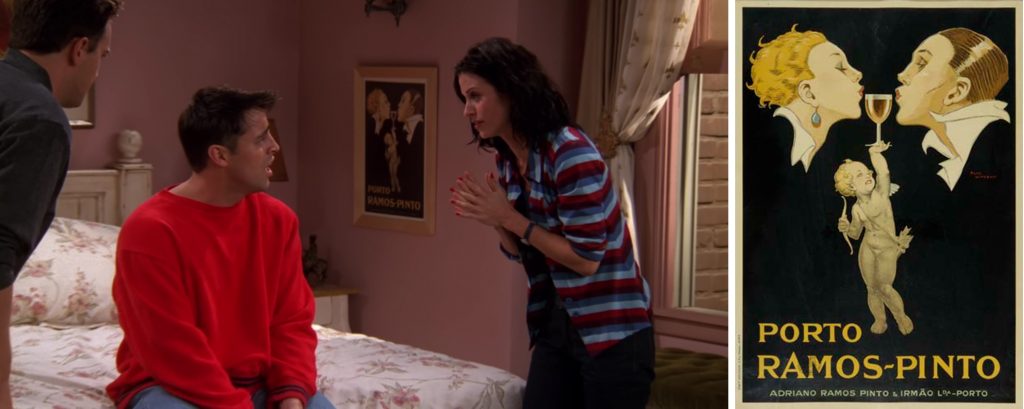
Like Three’s Company before them, Friends showcased an array of posters in its many apartment sets. Monica’s bedroom displays René Vincent’s art deco poster for Porto Ramos-Pinto.
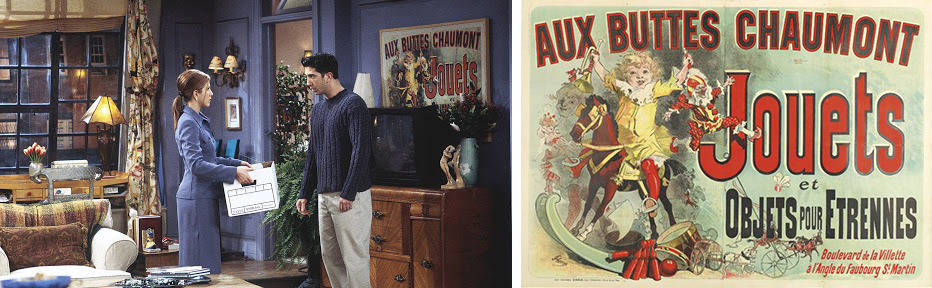
And most famously, the Jules Chéret poster Aux Buttes Chaumont / Jouets Et Objets Pour Étrennes that hangs behind the television in Monica and Rachel’s apartment. Both functional for filming (this poster was originally hung in that location to cover a hole the camera could film through) and indicative of Monica’s eclectic decorating taste, this Chéret poster became one of the most famous set pieces of the long-running show.
These posters not only colorfully decorate the living spaces of well-known characters, but can also tell us more about the lifestyles and tastes of the characters themselves- much like the posters that decorate our own homes.
“Spot-the-poster” with sitcom reruns is a game that’s hard to stop playing once you start. But if you ever miss flipping through our catalogue, I recommend flipping through the channels- you might end up seeing our posters.
A previously unrecorded work by French Impressionist Master, Pierre-Auguste Renoir, will make its debut at auction as one of the many highlights of Freeman’s February 23 sale of European Art & Old Masters.

In 1907, Renoir purchased the estate of Les Collettes in Cagnes on the French Riviera, where he permanently moved in the fall of 1908. It is there, amidst the picturesque olive groves and in the bright light of the Mediterranean, that he painted a series of still life with roses in the later years of his career. Such is the case of Roses, which the artist executed in 1917, just two years before his death.
According to a letter by Jean Renoir dated March 26, 1917 (which will accompany the painting, alongside six other letters), Roses was offered directly from Renoir to family friend Captain William Boissel and his wife, Élise. It was delivered by the artist’s son, filmmaker Jean Renoir who, at the time, served as a WWI war pilot under Captain Boissel’s orders in the French Air Force. The painting then passed into the possession of Mrs. Boissel’s niece, Mrs. Louis Cauvin, née Anne-Henriette-Alice Dorsner (of Bayonne, France) who in turn bequeathed it to her daughter, Nelly C. (Nono) Stone, wife of John E. Stone (of Alexandria, VA), who gifted it to the Virginia Museum of Fine Arts in Richmond, Virginia in 1988 after his wife’s death.

The painting, Jean wrote to Captain Boissel, was a mere token of friendship: “several flowers scattered on a canvas” having “no value” and “of little importance.” Rather than belittling his father’s work, Jean was more likely referring to his poor health, namely his crippling arthritis, which only allowed him to paint with a paintbrush strapped between his fingers, and “condemned him to produce nothing but such hasty sketches.” In his letter, Jean Renoir also echoes his father’s general attitude towards his late works, many of which were still lifes, which he considered as visual “notes.”
Still life painting was an important subject in the oeuvre of Renoir, who first started to paint flowers on porcelain as an apprentice for the Manufacture de Sèvres. In his later paintings, flowers remained a current motif: if not used as the main subject of the composition, they could be spotted as hat decorations, brooches, hidden in a garden, or even used as a backdrop.
To Renoir, and to many other artists of the time, still life painting represented financial security since it was deeply appreciated, and sought-after, by his clientèle, especially abroad. It also enabled Renoir to paint more freely, and experiment with endless technical and colorful combinations, as he confessed to his friend and student Albert André, “I just let my brain rest when I paint flowers (…) When I am painting flowers, I establish the tones, I study the values carefully (…) The experience I gain in these works, I eventually apply to my (figure) pictures.”

Renoir’s still lifes are often characterized by a rich texture, a warm palette and overall informal composition. With the thick, loose brushstrokes used to render the fully bloomed roses, and the thinly painted background revealing the texture of the canvas, Roses shares the overall qualities of improvisation and intuitiveness often associated with watercolor painting. The deep tones, mostly oscillating between reds and browns, give the work a sense of sensuality, often associated with the flower. It also links Renoir’s painting to the Old Masters he studied and revered, namely Peter Paul Rubens and François Boucher. In fact, Roses channels many aspects of 18th century French painting especially through its feathery, energetic brushwork – a pochade as stated by Jean Renoir in his letter, meaning a quick sketch which instantly captures the colors and the atmosphere of a scene. Through his lush, creamy touch, Renoir essentially dissolves the contours of the composition into one jubilant, abstract playground, thus giving the impression that the painting is being completed before our own eyes. The result is a wonderful example of spontaneity and color play – a bold, sensual take on still life painting.
Apart from sharing Colombia as a native country, Maluma and Federico Uribe have core beliefs in common and a profound love and respect for nature. Over the course of the past year, Maluma and Uribe have developed a relationship, and they have discussed their travels and personal experiences of seeing man-made trash spread through our beautiful planet. Both artists grew up in mountainous towns in the Zona Cafetera – a region of Colombia known for its lush, fertile farmland, where animals and people rely on each other, and there is a profound respect for the ecosystem. Uribe and Maluma continue to find solace when visiting their native land, and they have developed an urgent desire to protect it.
Uribe has made a name for himself over the past 20 years as a master of utilizing objects, often
recycled materials, to create life-like sculptures. When Maluma saw these works for the first time, he instantly connected with them, and knew that Uribe’s message aligned with his principles. They have a shared desire to bring awareness to the discarded plastic and artificial materials scattered throughout the world’s landscapes and oceans and want to work together to contribute towards the solution.
Recently, during Maluma’s trip to Jamaica to create his sixth album, it became more obvious to Maluma that garbage and litter everywhere is a global threat and destroys our plants, animals, and the communities that raise and represent different cultures. For the release of Maluma’s sixth studio album, “#7DJ” (Siete Dias en Jamaica – Seven Days in Jamaica), he felt it would be a perfect opportunity to collaborate with Uribe to bring his vision of infusing music and art with Uribe’s mastered artistry of utilizing recycled materials to create life-like sculptures and art pieces. With the concept of executing a sustainable art exhibition in Miami for the release of his surprise album to his fans (on his birthday – January 28th), Uribe immediately began working on a portrait of Maluma. As with most of his work, Uribe became obsessed with its creation – working tirelessly day and night for months. The result is a masterpiece of Maluma’s image, one of Uribe’s finest portraits to date. The incredibly accurate representation of Maluma’s face looks like a photograph from a distance, but up close, one can see the portrait is created from plastic pieces. The portrait will serve as the album cover for “#7DJ”, and the art piece will be auctioned off with 100% of the proceeds going to environmental non-profits presented by Maluma’s foundation El Arte De Los Suenos.
In addition, Maluma has chosen seven other artworks made of recycled materials by Uribe for each individual song featured on the album. Descriptions of these works and their respective songs presented by Maluma can be listened to on your phone via QR codes in the exhibition. The show will be open to the public for a month and streamed virtually for everyone around-the- world, with a portion of the proceeds from any sale benefitting non-profits based in Colombia, including Fundacion Amigos del Mar, Jardín Botánico de Cartagena and Stand Up Providencia.
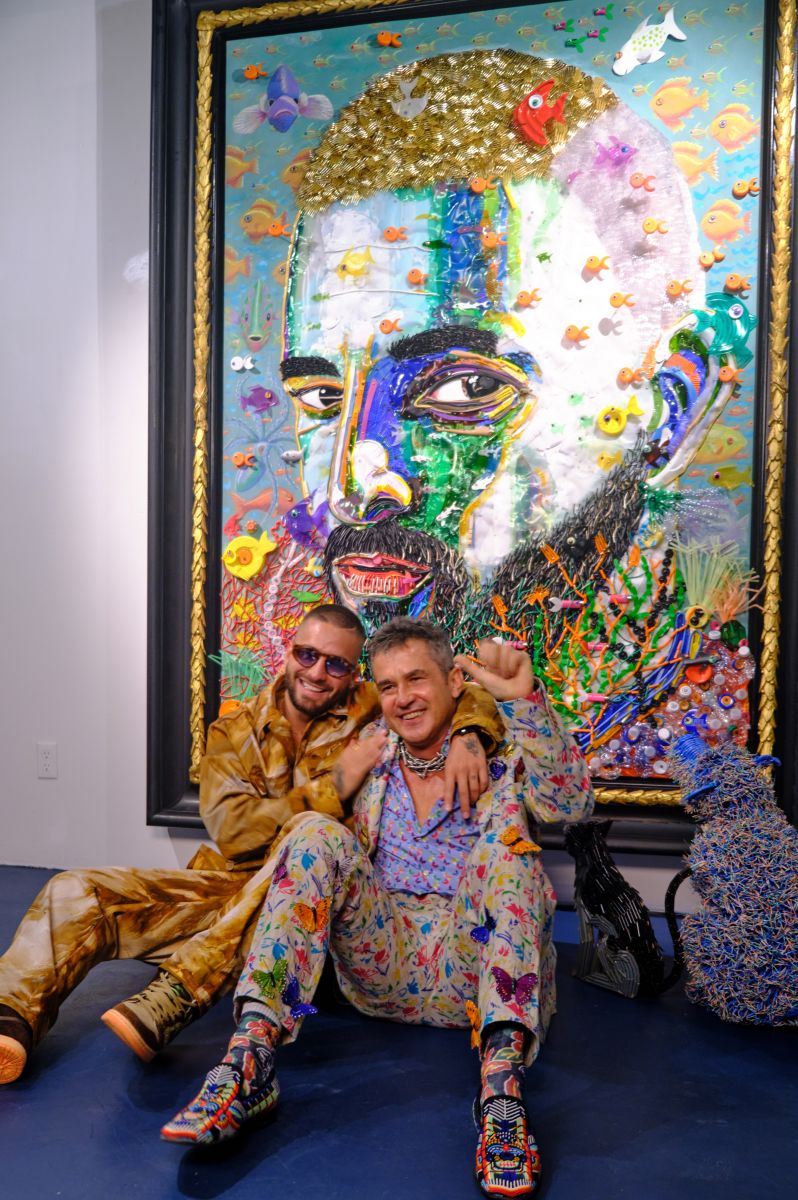
Both artists believe that intention and goodwill are contagious, and everything we put out into the world has an effect. The money that they raise will be instrumental in reviving bionetworks, but the work will not end with the exhibition or promotion of the album. The intention of these artists is to contribute to the movement of environmental reconstruction by refocusing the attention towards loving the world rather than fighting against it. As a byproduct, they hope to replace the fear generated by COVID-19 with the hope of solving larger environmental issues.
View Exhibition and auction online available on Bidsquare.
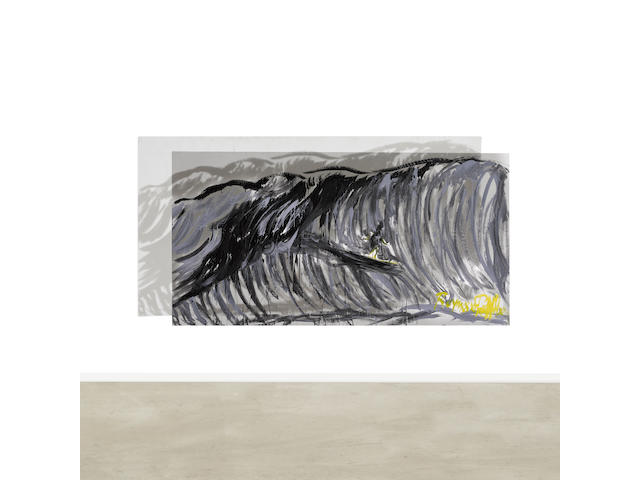
A double-sided acrylic painting on Plexiglas by Raymond Pettibon (b. 1957) will be offered in Bonhams Post-War and Contemporary Sale taking place February 19, 2021 in Los Angeles. Among the most highly sought-after artists of today, Pettibon initially came into the art world through music, creating cover art for his brother’s rock band Black Flag in the 1970s and later iconic groups Sonic Youth and the Foo Fighters. He has since become a highly coveted name in the world of visual art and leading figure in contemporary culture. Currently living and working in New York City, Pettibon produces thoughtful and engaging artwork imbued with layers of wit, humor, and sociopolitical commentary; he has been collected by leading institutions globally, including the Museum of Modern Art in New York and Centre Georges Pompidou in Paris. The lot on offer, No Title (Surfer in the Great Wave), 1993 (Estimate: $500,000 – $800,000), is rare for the artist, both in medium and execution. Absolutely unique in Pettibon’s oeuvre, this painting on Plexiglas encompasses the excitement and drama of Pettibon’s iconic surf imagery with the energy, expression, and passion of an artist at the height of his powers.
Laura Bjorstad, Head of Sale, said:
“Bonhams consistently seeks to offer not just the finest names in contemporary art, but also uniquely special objects. Coming to auction for the first time, this incredibly important painting has not been exhibited publicly since its creation. Not only is it historically significant to the artist’s overall body of work, but viewed from any angle, it is absolutely breathtaking. We’re thrilled to have this visual treasure leading our upcoming sale.”
Additional highlights include:
OLGA DE AMARAL (B. 1932), Alquimia XXVIII, 1985, Estimate: $70,000 – 100,000
Alquimia XXVIII is constructed of shimmering gold leaf tiles and layers of deep blue and red thread, that imbue the work with a living quality drawn from the natural world. The artist’s sculptural weavings are deeply personal, evoking the landscape and history of her native Colombia. Still practicing at age 89, Amaral’s first major museum retrospective in the United States will be held at the Museum of Fine Arts, Houston in 2021 and travel to Michigan’s Cranbrook Art Museum in 2022.
RUTH ASAWA (1926-2013), Untitled (S.788, Hanging Sphere), circa 1960-1969, Estimate: $35,000 – 55,000
In Asawa’s signature wire medium, this delicate sculpture breaks spatial boundaries through redefining perceived constructs of dimensionality by interweaving a single unbroken line. Her work is represented is permanent collections of revered institutions including the Solomon R. Guggenheim Museum and the Whitney Museum of American Art. Over the course of the last several years, Asawa has established a name for herself as an art market superstar, with sale prices of her work on meteoric rise.
The Whitney Museum of American Art’s recent exhibition, Vida Americana: Mexican Muralists Remake American Art, 1925-1945, was a comprehensive evaluation of post-revolution art in Mexico and the powerful influence it had on artists of America. The exhibition was curated by Barbara Haskell, and assistant curator, Marcela Guerrero, and ran from February 17, 2020, to January 31, 2021.
With our February 4, 2021, sale featuring works from The Artists of the WPA, Harold Porcher, our director of Modern and Post-war art, takes a moment to reflect on the Mexican muralists who influenced the artists involved in the Works Progress Administration programs, as well as many additional Modern artists that followed after them.
In 1920, after a decade of revolution and unstable factions seizing control of the Mexican government, Álvero Obregón was elected president. Under Obregón’s leadership, and with the aid of José Vasconcelos, his Minister of education, they launched a program to build schools and employed artists to decorate the walls with murals in order to tell the history of the Mexican peoples in imagery.
From this program, three leading talents emerged, often referred to as Los Tres Grandes: Diego Rivera, José Clemente Orozco and David Alfaro Siqueiros. Their murals—and most paintings, film, and photography of their contemporaries—celebrated the indigenous peoples of Mexico and promoted Socialist government beliefs shared by many artists active in Mexico at that time. These artists’ influence on American art was profound, as can be seen in works by over forty Americans included in the exhibition, and many of these Americans who drew inspiration from the Mexican Muralists would end up contributing to the WPA’s artist programs.
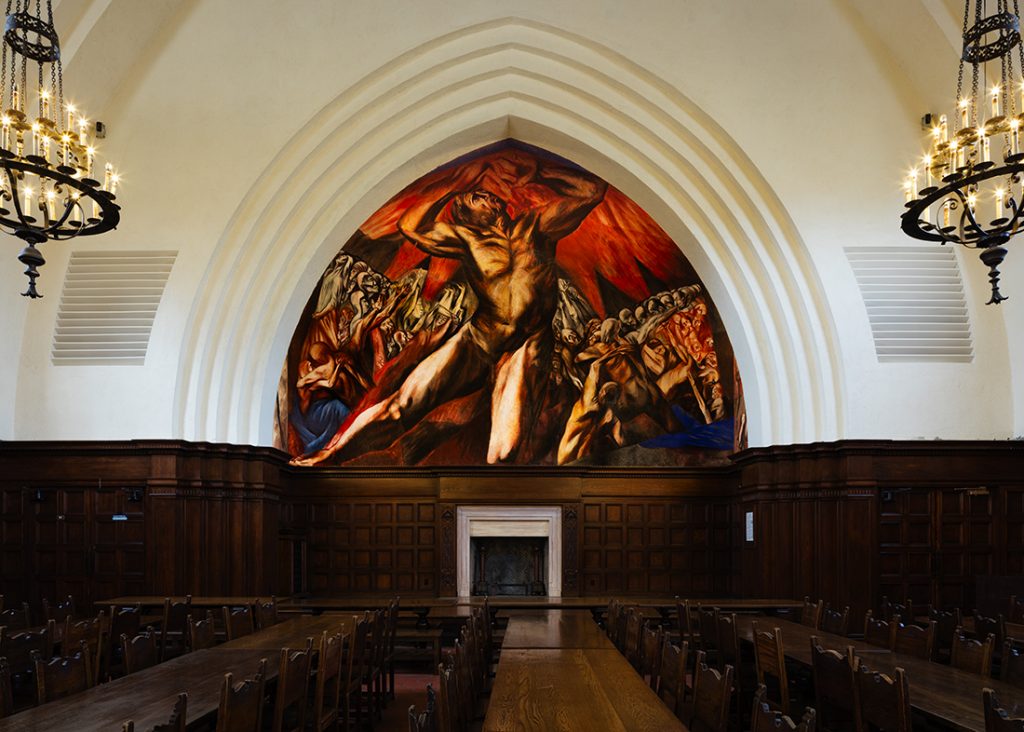
At the end of Obregón’s four-year term as president, the funding for mural projects declined, with most awards going to Diego Rivera. Los Tres Grandes sought mural projects in the United States, beginning with Orozco, who completed the first modern mural in America, Prometheus, at Pomona College, Claremont, CA in 1930. Jackson Pollock traveled to California to see the mural and was so inspired he kept an image of Prometheus in his studio. Mitchell Siporin and Edward Millman studied the murals of Orozco before starting their frescos for the St. Louis Post Office, the largest mural project of the WPA.
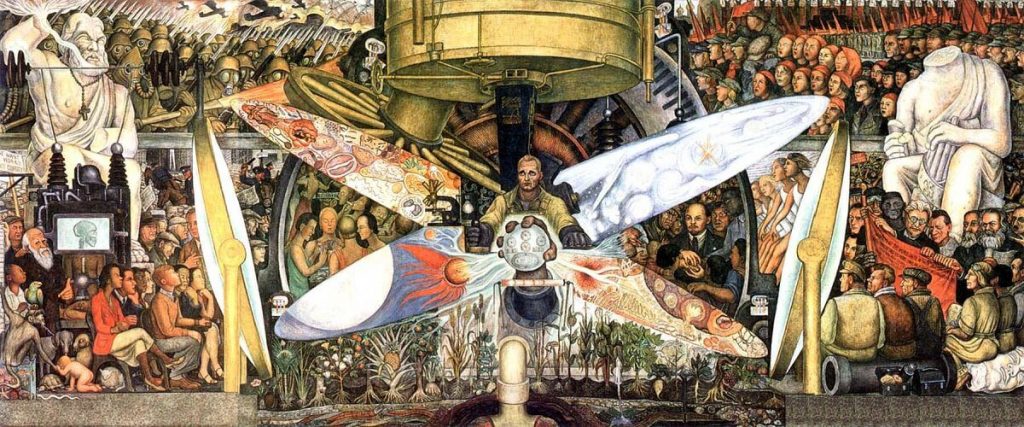
Diego Rivera created murals in San Francisco, Detroit, and New York City. His Man at the Crossroads, a fresco commissioned by the Rockefeller family for Rockefeller Center, was destroyed after Rivera refused to modify the mural by removing the image of Vladimir Lenin from the composition. Rivera would later recreate the mural in Mexico City. Not only did he influence American artists indirectly through his artwork and activism, but he also taught several artists that would go on to use their learned fresco craft under the employ of the WPA.
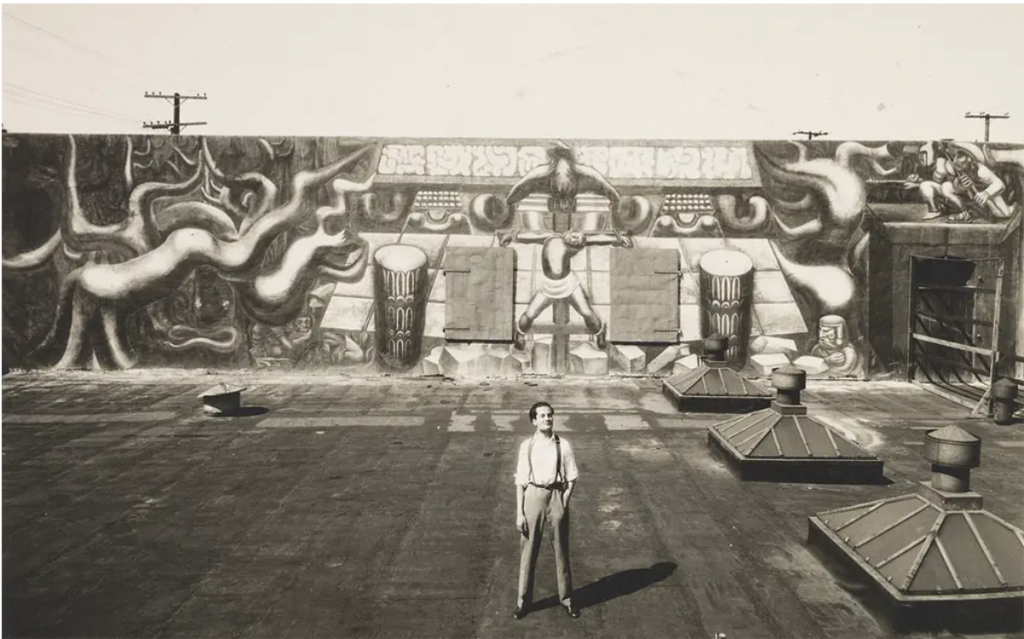
David Alfaro Siqueiros, the most progressive of the three, would only complete one mural in America. América Tropical: Oprimida y Destrozada por los Imperialismos was completed in Los Angeles in 1932. The imagery, with a bound and murdered indigenous person at its center, proved too much for American audiences and was soon painted over. In 2012 the work was presented to the public after an extensive restoration and renovation funded by the Getty Foundation. Siqueiros’ use of industrial-grade paints and materials influenced Jackson Pollock who studied under Siqueiros in his Experimental Workshop, which he opened in New York City in 1936.
The parallels of the art created in Mexico under the Obregon presidency and that of artists working in Franklin D. Roosevelt’s New Deal, WPA programs is extraordinary. Expressing hope through the imagery of hardship—is an American tradition in our art, theater, and our music.
Available Through Phillips Perpetual’s Online Store
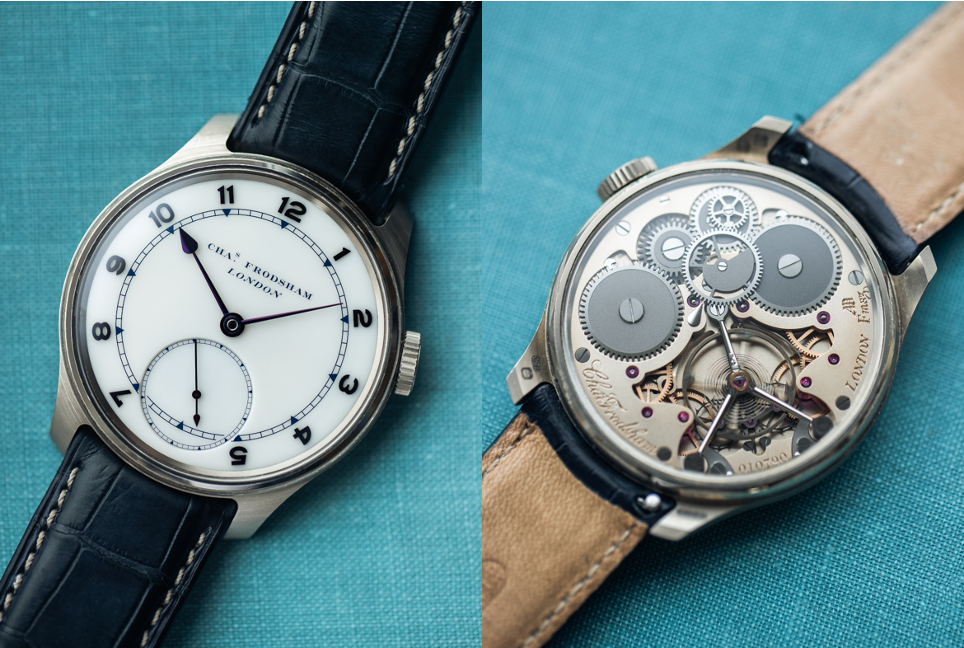
LONDON – 01 FEBRUARY 2021 – Phillips Perpetual is delighted to announce the consignment of the only publicly offered Charles Frodsham Double Impulse Chronometer wristwatch. The first watch ever produced in 18kt White Gold and delivered in 2018 to an English connoisseur and collector, it features an elegant Arabic dial. This unique opportunity comes after a record-breaking year for Phillips Perpetual in 2020, with over £5 million in private transactions and the sale of a number of notable, fine and rare Independents including a Philippe Dufour Simplicity, F.P. Journe Brass movement Resonance and Coffret set Tourbillion. This current example is available through the Phillips Perpetual website and App.
James Marks, International Specialist and Director, Watches, noted, “We are incredibly honoured to bring to market for the first time a unique piece of British watchmaking that brings together so many artisan British watchmakers of incredible vision and skill. Suggested to Charles Frodsham by Derek Pratt, the Double Impulse Chronometer escapement was invented by George Daniels, who was inspired by Abraham-Louis Breguet’s “natural escapement”. The movement perfected by the watchmakers of Charles Frodsham took some 16 years of research and development, before being unveiled to universal acclaim in 2018.
Featuring a charming 18kt White Gold case with eye catching London Hallmarks, a linear brushed finish and a dial produced from Ceramic with blue steeled hands of identical length which served as the inspiration for a one-off clock made for Queen Elizabeth on the occasion of her Diamond Jubilee, this is without doubt a trophy watch for any collector of both British and contemporary Independent Watchmaking.”